Catalogue > List by artist
Browse the entire list of Rencontre Internationales artists since 2004. Use the alphabetical filter to refine your search. update in progress
Mit Borrás
Catalogue : 2023Hanaba | Experimental fiction | 4k | color | 10:0 | Spain | 2022
Mit BorrÁs
Hanaba
Experimental fiction | 4k | color | 10:0 | Spain | 2022
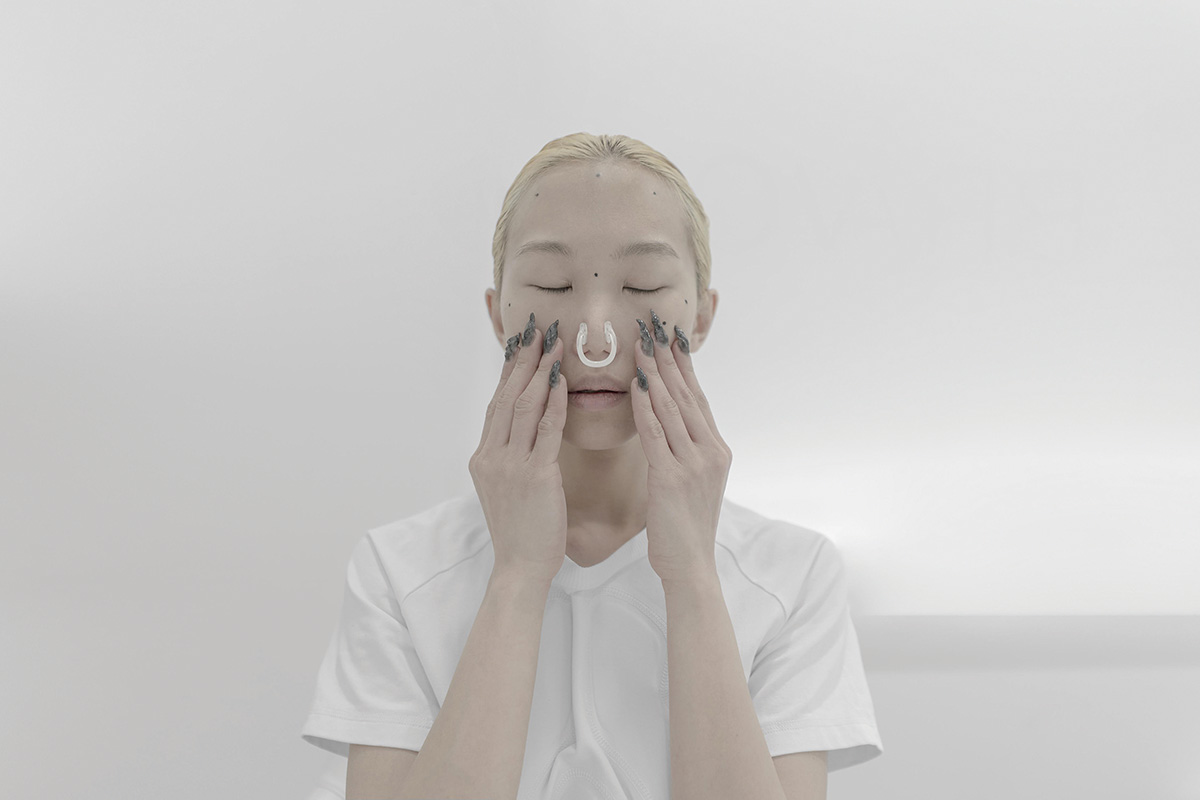
Hanaba belongs to a speculative future and lives isolated in a new cave with a heavenly aspect, an aseptic laboratory surrounded on the outside by an uninhabited natural environment where time seems to stand still. The protagonist of Hanaba, a term whose meaning comes from the scientific concept of "new mutant flower whose DNA has been isolated", transits between their human nature and their dream of transcending and merging with nature through technology. This idea takes shape during Hanaba's meditations where their recurrently dream of being a drone that crosses a forest like a ghost. We can see how Hanaba develope scientific studies devoted to biotechnology, geology and the meaning of conservation of human body. Progress becomes a new cult, mediated by nature through the ceremonial use of flowers, chants and the ingestion of psychoactive plants as a way to travel to a transhumanist transcendence and total adaptation to nature. A film created by Mit Borrás, with the art direction of Rachel Lamot, with script by Mit Borrás and Rachel Lamot, music by Daniel Vacas Peralta the fashion designs of Kim Rosario and Path by Janine Grosche, the special participation of Weixin Quek Chong as Hanaba and the production team.
Mit Borrás is a visual artist based in Madrid and Berlin. His work examines the relationship between human, nature and technology, their purpose of evolution and the idea of death and eternal life with a transhumanist perspective. He has developed a work complex that encompasses visions of a post-human state of consciousness. Its center of focus is based on the interconnectivity between biodiversity and technological progress. His work has been exhibited at Pompidou, Paris (2022), Art Dubai, UAE (2022), Hara Museum, Tokyo (2010), Exgirlfriend Gallery, Berlin (2016-21), Tick Tack Gallery, Antwerp (2021), The Wrong Bienale, Paris (2021), Harddiskmuseum, Paris (2020), Arebyte Gallery, London (2019), Dimora Artica, Milan (2018), Frontviews, Vienna (2019) Berlin (2018), Aleph Projects, Tel Aviv (2017), Biennial of Media Arts of Chile, (2017), Palacio Fernandini, Lima (2016), Museo de Bellas Artes de Chile (2017), Loop Barcelona (2010,15-19) and Transmediale, Berlin (2011) among others. He has directed the production of digital art festivals as independent curator, co-directed Fünf Galerie in Berlin (2010-14) and worked as coordinator of cultural projects at Instituto Cervantes in Berlin (2014). His work is represented in by House of Chappaz gallery and is member of the art collective Frontviews in Berlin.
Mark Boswell
Catalogue : 2008The St. Petersburg Paradox | Experimental video | dv | color | 8:22 | USA | 2006
Mark Boswell
The St. Petersburg Paradox
Experimental video | dv | color | 8:22 | USA | 2006
?The St. Petersburg Paradox was invented by the Swiss Mathematician Nicolas Bernoulli in 1713. The SPP describes a particular casino game (in a hypothetical St. Petersburg, Russia casino) that features a random variable with an infinite expected value. The game involves the flipping of a coin of which two things can happen: a) the coin lands on heads and the game is over rewarding the player with a small sum of money; or b) the coin lands on tails and the sum is doubled while the game continues until the coin lands on heads. However , to enter this game a player must pay the Casino an unreasonably large amount of money to start. The SPP is a classical situation where a gambler makes a naive decision theory (which takes only the expected value of winning into account) - a gamble that no rational person would make. SPP-the film-utilizes footage from Night of the Living Dead, Godard?s One Plus One, & Casino by M. Scorsese and through a hallucinatory re-montage draws a grim portrait of a Texas Wastrel?s interpretation of l?Etranger with a gut punch Dadaistic finale.? Dr. Benway
Mark Boswell studied art history, cinema theory, and film/video production at the American Center of Paris, France from 1986-1989 and Phillips College of Melbourne, Florida from 1990-92. He has presented experimental film works internationally in over 25 countries in museums, biennials, and film festivals, including The Transmediale Berlin (?03, 04, 07,) The 10th Biennial of The Moving Image, Geneva, Switzerland, The Avanto Media Arts Festival of Helsinki, Finland (03? 04? 06), The National Center of Contemporary Art, St. Petersburg, Russia, The Los Angeles Freewaves Video Biennial (Hammer Museum), Los Angeles, California, and the New York Video Festival at The Lincoln Center, New York, New York. In 2004, He was awarded the ?International Media Art Award? from the ZKM Museum of Karlsruhe, Germany.
Louise Botkay
Catalogue : 2016Estou aqui | Experimental film | super8 | color | 7:0 | Brazil, Haiti | 2015
Louise Botkay
Estou aqui
Experimental film | super8 | color | 7:0 | Brazil, Haiti | 2015
I`ve spent my childhood in Cap-Haitien, a city at the north of a half island of the Caribbean called Haiti. My life will always be inhabited by the memory and experience of this mysterious and warm(ardent???) place. I`m under the impression that everything i am comes from this light, this wind, this land, this growing up creole. "I`m here" is an ode to childhood time that accompagnies us forever
Louise Botkay is a photographer and film maker, utilizing super 8,16 and 35mm film, video, cell phone that are developed artisanally by the artist herself. She worked in several countries like Haiti, Congo, Niger, Chad, Holland, France and Brazil. Her films were selected and recipients of awards in Movie Festivals (Oberhausen, Fid de Marseille, Vidéobraisl, São Paulo Movie Festival, Brive Festival, Anger 1er Plan Festival, Fespaço, Recife International Window Movie festival, among others). Her film “Mammah” was exhibited in the Christopher Grimes Gallery (Santa Monica, Ca.), at theYerba Buena Center for the Arts (San Francisco, Ca.), Centre George Pompidou (Paris, France) and MAM – Museum of Modern Art (Rio de Janeiro, Brazil). She received the prize scholarship “Villa Hors les Murs” from the Institut Français, to develop her more recent work, at Acre with the nation Hunikui. She lives today in Rio de Janeiro and works between Brazil and France.
Catalogue : 2015Vertières I,II,III | Experimental film | super8 | color | 9:36 | Brazil, Haiti | 2014
Louise Botkay
Vertières I,II,III
Experimental film | super8 | color | 9:36 | Brazil, Haiti | 2014
Vertières est le nom d'un quartier de la ville du Cap-Haïtien où, en 1803, a eu lieu la grande bataille qui a fini par expulser l'armée de Napoléon de l`île, Haïti à ce moment devient le premier pays au monde a conquérir son indépendance face aux puissances colonialistes.
Formation: La FEMIS, école nationale du cinéma-France, (diplômée juin 2006) Faculté de Design à Rio (diplômée en 2000) Bourse Aprofundamento-Parque Lage RJ (2014) Louise Botkay réalise des films utilisant autant le télephonne portable, que la vidéo, les pellicules super-8, 16 et 35 millimètres qui souvent sont développées "artisanalement". Travail nomade,elle réalise des films en Haïti, au Congo, Niger, Tchad, Hollande, Françe et Brésil.. Ses films on été sélectionnés et primés en festivals comme le Festival 1er Plan d`Anger, le festival de Brive, le festival Janela international de Recife, le festival de curtas de São Paulo, entre autres. Son film "Mammah" a été exhibé à la Galerie Christopher Grimes (Santa Monica), au Yerba Buena Center for the Arts (São Francisco) et au MAM-Rio de Janeiro en 2013, dans l'expo collective SP8. Elle a reçu la bourse "Villa Hors les murs", de l'Institut Français, pour produire son plus récent travail réalisé en Acre, Amazonie Brésilienne avec le peuple Hunikui. Elle vit à Rio de Janeiro et travaille entre le Brésil et la France.
Eliane Esther Bots
Catalogue : 2023In Flow of Words | Documentary | dcp | color | 22:15 | Netherlands | 2021
Eliane Esther Bots
In Flow of Words
Documentary | dcp | color | 22:15 | Netherlands | 2021
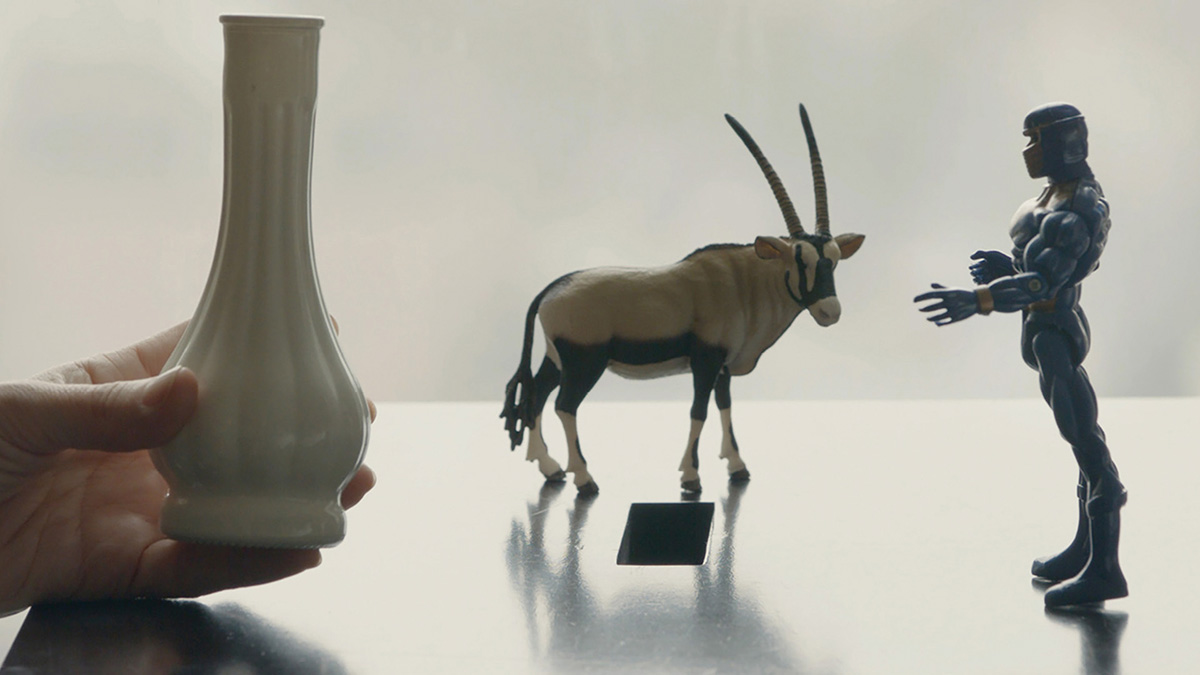
In Flow of Words follows the narratives of three interpreters of the International Criminal Tribunal for the former Yugoslavia. They interpreted shocking testimonies from witnesses, victims and perpetrators, without ever allowing their own emotions, feelings and personal histories to be present. Contrary to their position at the tribunal, this film places their voices and experiences center stage.
Eliane Esther Bots (1986, The Netherlands) graduated cum laude from the Master of Film at the Netherlands Film Academy in Amsterdam. Her films have been screened at ‘IDFA’ (NL) ‘Berlinale’, Berlin (DE), ‘Cinema du Reel’, Paris (FR), ‘New York Film Festival’ (USA), ‘International short film festival Oberhausen’ (DE), ‘Go Short’, Nijmegen (NL), Kassel Dokfest (DE). She works as a lecturer ‘Moving image’ at the University of the Arts in Utrecht (NL).
Bottomley Bottomley, Johnny Hourigan
Catalogue : 2016Everybody Says It's All In Your Head | Experimental film | hdv | color | 18:4 | United Kingdom | 2015
Bottomley Bottomley, Johnny Hourigan
Everybody Says It's All In Your Head
Experimental film | hdv | color | 18:4 | United Kingdom | 2015
Everybody says is all in your head is a collaboration between Clare Bottomley and Johnny Hourrigan unfolding as a video diary over one year. Encouraged by Clare to make a portrayal of himself, Johnny gets familiarised into the process of filmmaking and participate fully in all the aspects that define such a production from the choice of the camera to the practice of editing. While he acquires the technical knowledge, Johnny gets full agency in testing and controlling the medium of representation. With a camera that mediates his contact with the outside world, Johnny immerses himself into a journey of self-discovery gaining the confidence to address the unaddressed his condition of mild-autism and the challenges he faces. Through a non-hierarchical and non-didactic approach, Clare Bottomley reveals the potential of learning to create an authentic space of participation and empowerment for subjects whose voices have been marginalised.
Clare Bottomley lives and works in London. With a practice that incorporates video and photography, her work investigates self-portrait and performance of the self. She studied for an MA in Photography at the Royal College of Art, London, 2011-2013 and has been working as an art educator for six years. Johnny Hourigan is now a young man studying Media Production at college in south London and developing his independent projects. Johnny sees process of creating the personal view point for the film as ‘...with all the memories remained in the camera, what the camera does not capture are memories in ourselves.’
Gaelle Boucand
Catalogue : 2021Voin | Documentary | mov | | 30:0 | France, Bulgaria | 0
Gaelle Boucand
Voin
Documentary | mov | | 30:0 | France, Bulgaria | 0
Voin a grandi dans la Bulgarie communiste. Après vingt ans passés en Europe de l’Ouest, il retourne à Sofia sur les lieux de son enfance et de son adolescence. Son portrait se compose de lieu en lieu, de souvenir en anecdote. Du cou coupé du coq qui voulait l’énucléer aux rites d’initiation sexuelle dans la maison interdite, Voin campe les saynètes d’un roman d’apprentissage bataillien, cru et souverain. En racontant ses travestissements, il revendique aussi l’exercice d’une liberté, d’une agilité à se mouvoir dans le cours de l’Histoire. Voin l’imite, en hérite, et c’est l’Histoire qui transparaît dans une tonalité rafraîchie, une vitalité excentrique et mineure, loin des lieux communs du récit majoritaire. Et quand, penché sur le vide au 19e étage de la tour Tolstoï, le trentenaire contemple les barres d’immeubles du quartier Espoir de son enfance, son vertige est contagieux, et la sensation (dé)grisante. (Cyril Neyrat)
Gaelle Boucand est artiste et cinéaste. Sa pratique se concentre depuis dix ans sur la réalisation de documentaires au sein desquels les questions du portrait et du dispositif filmique tiennent une place centrale. En 2010, son premier film, "Partis pour Croatan", sur une communauté de raveur, est exposé, notamment au Musée d'Art Moderne de la ville de Paris (France). Son deuxième film, "JJA" — premier volet d'une trilogie — dresse le portrait d'un exilé fiscal en Suisse. Il reçoit la mention du Grand Prix de la compétition française au FIDMarseille (France) en 2012, ainsi que le Grand Prix expérimental au festival Coté Court de Pantin (France), et est également diffusé au sein de multiples institutions artistiques internationales (Kunsthalle Mannheim (Allemagne); MAST – Manifattura di Arti, Sperimentazione e Tecnologia Bologna, Bologne (Italie); Kunstwerk Carlshütte, Büdelsdorf (Allemagne). Depuis 2014, elle enseigne régulièrement à l'isdaT – Institut supérieur des arts de Toulouse (France) et réalise des films avec différentes écoles. En 2015, elle termine "Changement de décor", deuxième volet de la trilogie initiée avec "JJA", présenté notamment aux États généraux du film documentaire de Lussas (France), et cofonde la société Elinka Films. En 2020, "J.A" — qui vient clore la trilogie — est en compétition à Cinéma du Réel, Paris (France), et son dernier film, "Voin", portrait d'un homme à travers son retour en Bulgarie, reçoit le prix Alice Guy au FIDMarseille (France).
Gaëlle Boucand
Catalogue : 2008Berliner Bildstörung / Zoologischer Garten | Experimental video | dv | color | 3:12 | France, Germany | 2006
Gaëlle Boucand
Berliner Bildstörung / Zoologischer Garten
Experimental video | dv | color | 3:12 | France, Germany | 2006
Berliner Bildstörung / Zoologischer Garten est une vidéo construite à partir d`images d`un zoo déserté par ses animaux. Ces images mettent en avant les paysages artificiels du zoo et ses décors spécifiques. Elles surgissent du noir telles des interférences scandées par des réminiscences de sons d`animaux.
Gaëlle Boucand est née en 1980 à Paris. Elle bénéficie actuellement d`un atelier-résidence du BBK à Berlin et participe également au Pavillon, laboratoire de création du Palais de Tokyo à Paris. Son travail a récemment été exposé entre autres au Palais de Tokyo, au Luggage Store de San Francisco, ainsi qu`à Berlin (Air Garten, Kolonie Wedding), à Genève (Attitudes), à Montreuil (Les Instants Chavirés) et à Paris (Kadist Art Foundation, Bétonsalon, La Générale, Première vue, Jeune création). Plusieurs de ses films ont également été programmés dans le cadre de festivals vidéos tels que Les rencontres Internationales Paris-Berlin-Madrid (cinéma l`Entrepôt, Paris), Signes de nuit (cinéma le Balzac, Paris), Bandits-mages (Bourges) et le Kasseler Dokumentarfilm und Videofest (Kassel).
Catalogue : 2006Arles | Experimental video | dv | color | 1:28 | France | 2004

Gaëlle Boucand
Arles
Experimental video | dv | color | 1:28 | France | 2004
A serie of four portarits of young boys is shot on close frame. The camera, floating, passes from one visage to another visage, stirring up thusly, from one to another, a feeling of proximity, almost a shared intimacy. Then, the frame goes wider to a general and final iview. The group appears wholly, sitting on the steps in front of a church. The image forms nothing else than a common portrait.
Gaëlle Boucand is born in 1980 in Paris where she works and lives currently. She graduated from the Ecole Nationale des Beaux Arts of Paris in 2005. The same year, she takes part in group exhibition notably, "Attentifs Ensemble", organised by Christian Bernard at the contemporary art space Attitudes, in Geneva, Switzerland, at the "Premiere vue", on Michel Nuridsany's invitation at the Paysage Retz in Paris, also at "Nomad's land" at the Poudrière in Bayonne. In 2004, she receives the Collin-Lefranc scholarship for a six-month residency at the Cooper Union School in New York (USA). She takes part in the exhibition "Tracks" at the Hewitt Gallery. In 2003, she collaborates to the exhibition "Stade de France" currated by Jen-Marc Bustamande at the Italian-Swedish Foundation of Venice (Italia), in mirror with the Biennale. Many of her films have also been programmed for some video festivals such as "Signes de Nuit", at the Le Balzac cinema in Paris, "Bandit-mages" in Bourges and "Kasseler" documentary film and video festival in Kassel (Germany).
Emma Boudon
Catalogue : 2023RAGE THEY DESERVE | Experimental video | 4k | color | 6:6 | France | 2022
Emma Boudon
RAGE THEY DESERVE
Experimental video | 4k | color | 6:6 | France | 2022
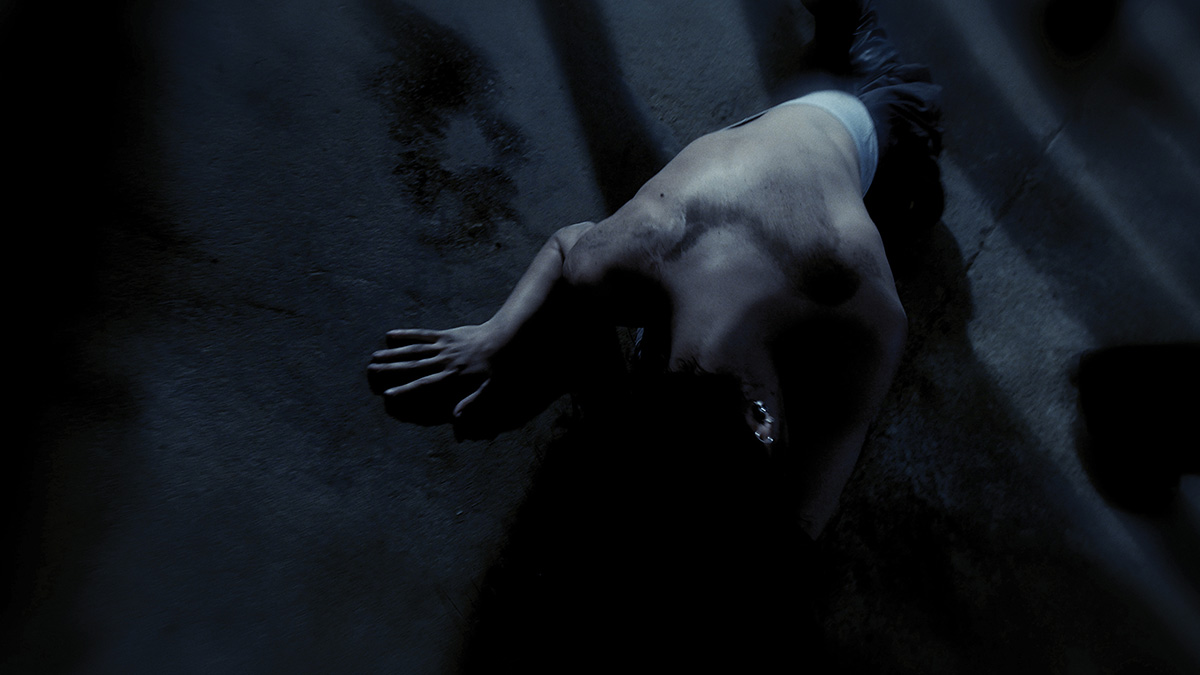
This film is halfway between a contemporary dance piece and an experimental film. In this second collaboration with the dancer Hava Hudry, I wanted to explore the place of the female body in public space, and in this particular case the night-time and clubbing scene, which can be a highly ambivalent place (both a brave space and a dangerous one, particularly for women or people perceived as women). The dancer's relationship with the floor is essential; she shocks, straightens, arches her back, breaks her movements and crawls. It is both a liberating trance and a primal expression of internalised violence that eventually explodes. Hava's performance takes the viewer back to the relationship they have with their own body, and to the judgements they have made about the bodies of others, particularly those of sexed people (women or people perceived as women). The projection is accompanied by a perfume whose saline and metallic notes are reminiscent of body odours that are as attractive as they are repulsive. This multi-sensory mix occupies the entire space and invites the spectator to join in the party.
Emma Boudon studied at the École des Beaux-Arts in Paris, where her artistic practice combines video, installations and photography. She graduated from the Paris-Sorbonne with a degree in literature and went on to complete a Bachelor's degree in Photography and Video at the Ecole des Gobelins. Her work focuses on the presence of women, or women perceived as women, in the public space. In her latest film/installation, RAGE THEY DESERVE, she bears witness to the violence that manifests itself in various collective spaces, particularly the world of nightlife. She describes it as a transgressive 'brave space' where violence and freedom collide. This ambiguity is reflected both in the choreography, which combines liberating trance and explosive anger, and in the environment itself, a space for letting off steam, which can quickly shift from joy to insecurity, from light to darkness. This obsession with partying has led him to make a film about the Seoul underground scene.
Halida Boughriet
Catalogue : 2016Des intégrations | Video | hdv | color and b&w | 16:7 | France | 2015
Halida Boughriet
Des intégrations
Video | hdv | color and b&w | 16:7 | France | 2015
Dans le film « Des intégrations» , La mémoire collective officielle et la mémoire politique se figent, à la limite de l’amnésie voire de la négation. C’est par le biais d’un univers poétique mais désenchanté que le film se propose de soulever des enjeux touchant à la jeunesse contemporaine. Les personnages jouent sur une série de correspondances qui érigent le film au rang de transfert visuel.
Artiste française et Algérienne . Anciennement diplômée de L’Ecole Nationale Supérieure des Beaux Arts de Paris et du programme d’échange de la SVA section cinéma à New York jusqu’en 2005. Halida Boughriet explore un large éventail de médias à travers ses oeuvres . Elle accorde une place centrale à la performance, dont les structures de son langage artistique lui donne une variété de formes. Au carrefour d’une préoccupation esthétique, sociale et politique, ses pièces s’efforcent de saisir les tensions dans les relations humaines mis en évidence par la société . Le corps est omniprésent , comme un instrument de geste poétique.
Catalogue : 2015pandore | Video | hdv | color | 8:44 | France | 2014
Halida Boughriet
pandore
Video | hdv | color | 8:44 | France | 2014
La vidéo Pandore se concentre sur un groupe social, enfants en marge du reste de la société française. Portant un regard sombre et inquiétant sur la réalité des rapports humains et aussi du système médiatique à la violence qui en découle. Les protagonistes sont invités à se dévoiler, témoignant de leurs histoires qui renvoient à l’image d’un passé et d’un présent "Mythe ou Réalité". Ils se mettent en scène dans des positions et postures artificielles, filmées par des séquences au ralenti extrêmement fluides. Enfin, La lumière travaille à inviter le spectateur à une curieuse contemplation dans l’intimité d’un espace clos et artificiel, dégageant une atmosphère irréelle et anormale.
Halida Boughriet est une artiste française d’origine algérienne. Anciennement diplômée de l’École nationale supérieure des beaux-arts de Paris et du programme d’échange de la SVA section cinéma à New York jusqu’en 2005. Halida Boughriet explore un large éventail de média à travers ses œuvres. Elle accorde une place centrale à la performance, dont les structures de son langage artistique lui donne une variété de formes. Au carrefour d’une préoccupation esthétique, sociale et politique, ses pièces s’efforcent de saisir les tensions dans les relations humaines mises en évidence par la société. Le corps est omniprésent, comme un instrument de geste poétique expérimental. Ses œuvres font partie de la collection «Nouveaux Médias» du Centre Pompidou (Paris) et du musée MAC / VAL (Vitry -sur-Seine). Ses travaux ont été présentés dans de nombreuses expositions dont Elles@centrepompidou (2011, Paris), y compris au FIAC d’Alger (2011, Algérie), à l’Institut du Monde Arabe, (2012, Paris) pour l’exposition «Le corps découvert». En 2013, au Musée d’Art et d’Histoire de Saint-Denis (Seine-Saint-Denis) pour «Chapelle vidéo # 4». Plus récemment, elle participe à «Vidéo et après» au Centre Pompidou et à la Biennale internationale de Dak’Art 2014 (Dakar, Sénégal).
Ghyzlène Boukaila
Catalogue : 2022#31# (Unknown call) | Experimental fiction | hdv | color | 16:16 | Algeria, France | 2021
Ghyzlène Boukaila
#31# (Unknown call)
Experimental fiction | hdv | color | 16:16 | Algeria, France | 2021
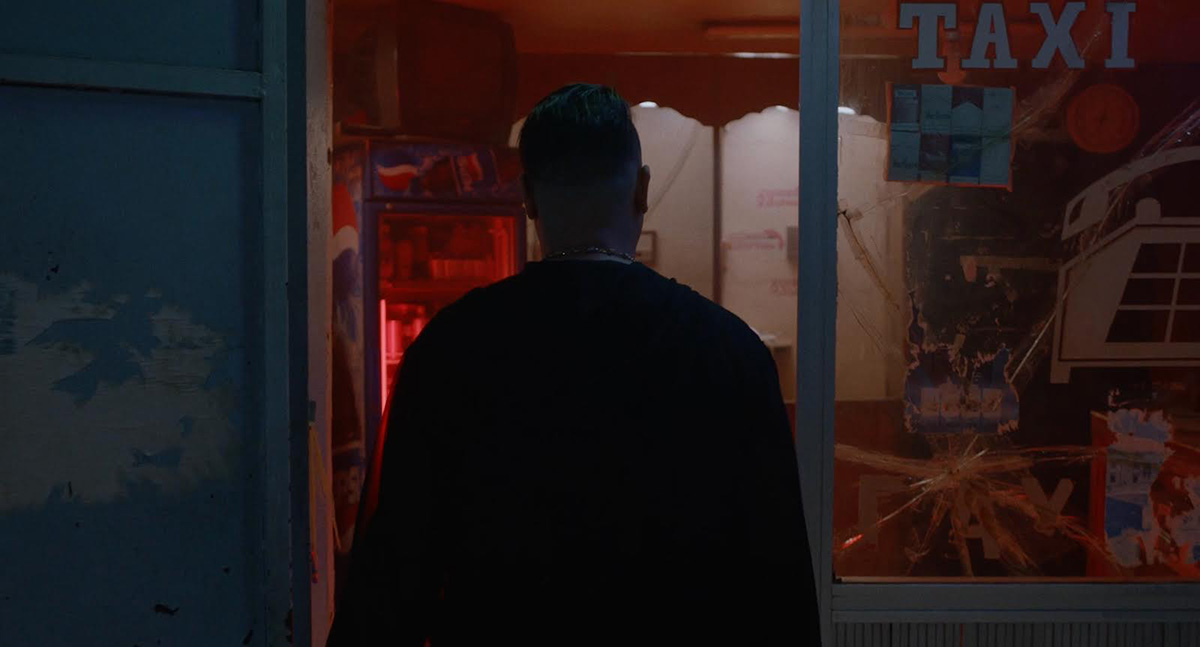
Off the coast of a world in reconstruction, a voice whose source is unknown overhangs the city and sounds like an injunction. In resistance to this authoritarian diction, a new voice emerges. Cheikh Morad Djadja makes his way through this universe, he must go to the Taxiphone and leave his own encrypted message. "Appel masqué" is a song composed by Cheb Abdou in 1993, during the period of the black decade in Algeria. Like many of his songs, Cheb Abdou wrote and performed them under constant threat. Through his music, he opened a field of identity expression and gender affirmation, the etymology of the word Raï takes all its meaning. By returning to the traces of the birth of raï, Oran, I met Cheikh Morad Djadja a personality of this environment and successor of Cheb Abdou, it was a real immersion in the community of singers and musicians raï.The film was built around the taxi-phone representing this non-place of anonymous telecommunication and the impossibility of maintaining a message, an opinion within a contemporary society. Echoing the lyrics of the song ''Appel masqué'' by Cheb Abdou, "#31# (Unknown call)" is an approach somewhere between documentary, fiction and performance, where Cheikh Morad Djadja leads us on an existential quest, in a world in perpetual reconstruction, where this non-place allows him to leave a masked vocal message about his trans-identity.
Ghyzlène Boukaïla is a multimedia artist and director born in 1993 in Algiers. She lives and works between Algiers and Lille. Her artistic approach and sensitivity crystallizes in the breasts of a family of Algerian revolutionaries. Exploring certain issues related to post-colonialism, her approach explores new narratives related to socio-political and digital (re)evolutions by situating her practice at the interface of documentary/performance and post-human digital narratives.
Angus Boulton, Boulton
Catalogue : 2009'08/26' | Documentary | dv | color | 31:0 | United Kingdom, Germany | 2007

Angus Boulton, Boulton
'08/26'
Documentary | dv | color | 31:0 | United Kingdom, Germany | 2007
The central subject of ?08/26? is the frequently unseen yet all pervading Cold War air conflict, one easily imagined, endlessly rehearsed for and occasionally played out in the skies over Europe. Taking a fixed, frequently low viewpoint, the inherent visual aesthetics of military airbases provide an ambiguous backdrop to the unfolding chronology. Initially the film surveys many of the recognisable structures standing idle amidst the overgrown topography that remains at one Soviet location, infused with the ambient sounds and memories of an earlier time. Meditative sequences of redundancy at Wittstock, north of Berlin, are juxtaposed with scenes of activity from two operational NATO airbases in East Anglia. In contrast, here we witness military personnel engaged in routine exercises representing the present, now training against a less identifiable enemy. Separated by almost two decades, the practice and procedures are similar, the Cold War era aircraft and routine manoeuvres much the same. Sequences overlap portraying different times and locations, exploring the similarities and differences between occupation and emptiness, scenes that in their entirety create a complex visual and aural impression. Essentially, the piece resembles a slow exercise in objective observation, a film researching time and space, the present, the recent past and our uncertain future.
Born York, England, 1964.
Mohamed Bourouissa
Catalogue : 2013J.M Mondésir | Experimental doc. | hdv | color | 24:0 | France | 2012
Alice Colomer-kang
J.M Mondésir
Experimental doc. | hdv | color | 24:0 | France | 2012
A housing project that seems more like an amphitheater, bears witness to a sacrifice. In 2002, Georges Mondesir dies after an encounter with the police. He`s crazy, or just simple-minded. When face to face with the police, Mondesir is the Other. It?s the underlying ancestral struggle between this duo that interests Alice Colomer. It never becomes a documentary about death. It?s a ballet from which only the camera is free to escape. Slow motion defies realism, several perspectives intertwine ? these bring about the impression that something had happened.
Alice Colomer-Kang born in 1985 in Paris, she lives and works in Paris. She graduated from ?Ecole Nationale supérieure des Beaux Arts de Paris? in November 2011, and studied at the Central Academy of Fine Arts in Beijing (China). 2012 Group exhibition at la Saline Royale d?Arc-et-Senans, Tranches de carré sur Tranches de cerles (ENSBA-ENS), with Lekh Lekha installation. 2011 Paris screening of One World One Dream One People, in the Festival « les nuits photographiques ».. 2007 Group exhibition at CNAM of Paris les visites dessinées.
Catalogue : 2010Temps mort | Experimental fiction | dv | color | 18:0 | France | 2009
Mohamed Bourouissa
Temps mort
Experimental fiction | dv | color | 18:0 | France | 2009
It is about a correspondence between two individuals, one who is locked up and the other who is in prison. All film constructs on this exchange of text (sms), pictures and words. The film begins with the installation of film process (in some way, the beginning film tells The film begins with the installation of film process) to become little by little a film which questions the notions of freedom and imprisonment.
Mohamed Bourouissa was born in Blida in Algeria. He lives and works in Paris. He is currently student of Studio National des Arts ? Le Fresnoy. He graduated at the Ecole Nationale Superieure des Arts Decoratifs de Paris in photography and has been studying visual arts at La Sorbonne Paris 1 (MA). Some solo shows were set up in the Centre culturel de Correios, in Rio de Janeiro in Brésil, at the Galerie des filles du Calvaire, at Breda Photo 2008, Pays-Bas, at the Site Gallery, Sheffield in England, at the Pauza Galerie, in Cracovie in Pologne. His work has been part of number of exhibitions in the world, including the Biennale Photographie et Architecture in La Cambre, Bruxelles, Belgique, at the contemporary art biennale of Alger, Algeria, at the New Museum of contemporary art, New York, and at the Deutsches Historisches Museum, Berlin, Germany. His work has been part of several public collections: the Cité nationale de l?Histoire de l?immigration, Paris, the Fonds national d?art contemporain, France, the Galerie du Château d?Eau, Toulouse, France, the Finnish Museum of Photography, Helsinki, Finlande.
Mohamed Bourouissa
Catalogue : 2026Généalogie de la violence | Fiction | dcp | color | 15:15 | France | 2024
Mohamed Bourouissa
Généalogie de la violence
Fiction | dcp | color | 15:15 | France | 2024
Imagine a film about police brutality, with no brutality. A film where nothing happens, yet you’re left baffled. Invisible violence, disguised under lawful humiliation. Domination wrapped in polite protocols. I started talking about making this short film back in 2018, but the idea of it was haunting me probably since the late 90s, when I started being constantly stopped by the police for “random identity checks”. I felt a certain urgency to tell this very personal story. With the series of sculptures in cast aluminium that can be read as an esquisse to Généalogie de la Violence wider project, Mohamed Bourouissa aims to convey the intimate sensations that a formal procedure can induce, the traces that a systematic judicial practice can leave, both on and in the body. These sculptures represent moments of palpation during body searches. They evoke a tension between body parts and the hands that palpate it and reveal a point of contact between social bodies and a state body. The artist reveals an intimate experience of what the notion of control imposes in terms of bodily dispossession. The interiority of this experience is reflected by the void in the works. Through them, Mohamed Bourouissa represents an emotional dynamic that involves the enactment of two male bodies, highlighting the power dynamics and domination by one body over another.
Mohamed Bourouissa was born in 1978 in Blida (Algeria), and lives and works in Gennevilliers. He is represented by the Mennour, Paris and Blum Los Angeles galleries. Exhibited in 2010 by the Palais de Tokyo and the Musée d’Art Moderne on the occasion of Dynasty, an original association between the art center and the Musée de la Ville de Paris to highlight a new generation of French artists, Mohamed Bourouissa has since exhibited in numerous museums and international biennials (Rencontres internationales de la photographie d’Arles ; Musée d’Art Moderne de la Ville de Paris; Centre Pompidou, Paris; New Museum, New York; Barnes Foundation, Philadelphia; Stedelijk Museum, Amsterdam; Frankfurt am Main; Bal, Paris; Haus der Kunst, Munich; Biennales de Sydney, Sharjah, Havana, Lyon, Venice, Algiers, Liverpool, Berlin; Milan Triennale… ). Mohamed Bourouissa’s work is included in numerous public and private collections (Centre Pompidou, Paris; SF Moma, San Francisco; LACMA, Los Angeles; Pinault Collection; Fondation Louis Vuitton, Paris; The Israel Museum, Israel…).
Louise Bourque
Catalogue : 2023Bye Bye Now | Experimental film | 16mm | color | 8:27 | Canada | 2022
Louise Bourque
Bye Bye Now
Experimental film | 16mm | color | 8:27 | Canada | 2022
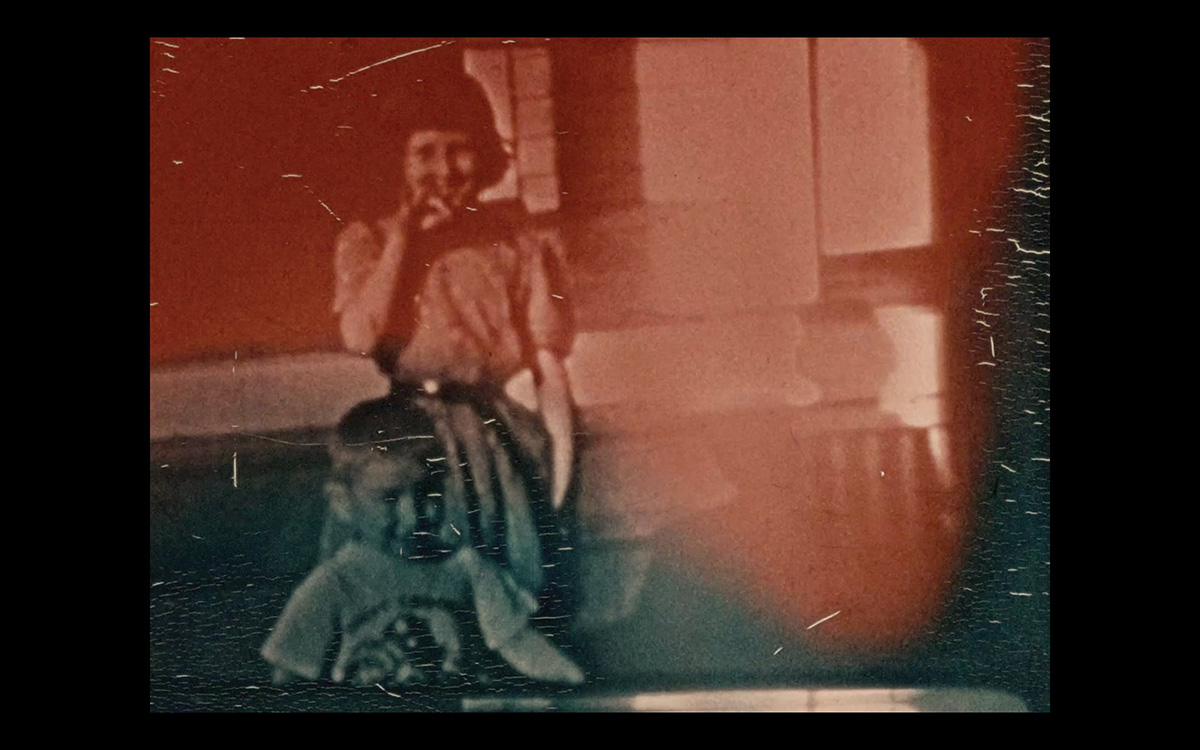
Waving hello to the filming cameraperson, the subjects through this very gesture, are also providing a future viewer with the acknowledgment of a constant good-bye to a fleeting moment. Yet when the film is projected and the captured gesture is seen, it’s as if the subjects are saying hello again from the past. This film is an homage to the artist’s father, the man behind the camera in these personal family archives.
The filmmaker Louise Bourque recently moved back to Montréal after spending 30 years in the United States and elsewhere. Her films have been screened in more than forty-five countries and broadcast on PBS and the Sundance Channel in the US as well as on Télé-Québec in Canada and SBS in Australia. Her work has been presented by major galleries and museums worldwide, including the Musée de la Civilisation and the Musée national des beaux-arts du Québec in Québec city, the National Gallery of Art in Washington, D.C., the Museum of Modern Art and the Whitney Museum of American Art in NYC.
Louise Bourque
Catalogue : 2006L?éclat du mal | Experimental film | 16mm | color | 8:0 | Canada | 2005
Louise Bourque
L?éclat du mal
Experimental film | 16mm | color | 8:0 | Canada | 2005
Nelson Bourrec Carter
Catalogue : 2023It's Coming from Inside the House | Experimental fiction | mp4 | color | 10:45 | France | 2022
Nelson Bourrec Carter
It's Coming from Inside the House
Experimental fiction | mp4 | color | 10:45 | France | 2022
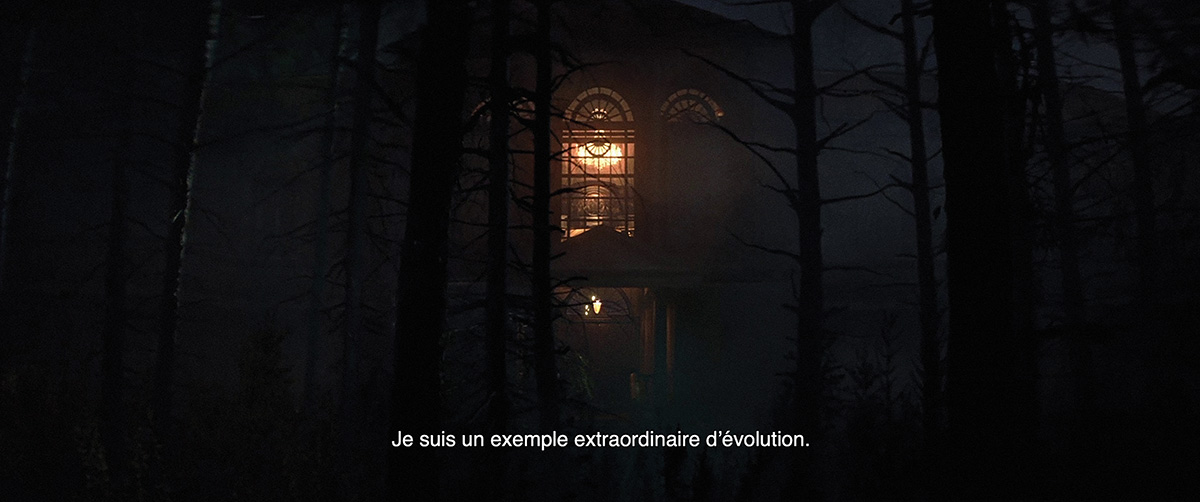
A seemingly disembodied voice reflects on what it takes to survive, in a world modeled after a perception of reality far from what the one it experiences on a daily basis.
Nelson Bourrec Carter is a French-American filmmaker and visual artist. His practice combines photography, film, installation and performance while his research revolve around the links woven between real territories and fantasized landscapes, whether they be urban, peri-urban, or rural, influenced by the weight of popular imagery. His work focuses mainly on the influence of American iconography on identity construction and racial awareness, and operates from places whose hybridity, history or architecture lend themselves to a new interpretation. He demonstrates that these visual tropes are more interconnected than they appear and that they articulate questions of gender, race, and class, while raising the issue of which bodies - whether they are embodied or inscribed in a ghostlike manner within the architecture - occupy the spaces of representation in the American cultural economy. Nelson’s films have been shown in festivals such as New Directors/New Films, Entrevues Belfort, Vila do Conde or within institutions like the Cinémathèque Française or the Jeu de Paume.
Gast Bouschet, Nadine HILBERT. Collaboration: Stephen O'MALLEY
Catalogue : 2015Tempestarii | Video | hdv | black and white | 38:25 | Luxembourg | 2013
Gast Bouschet, Nadine HILBERT. Collaboration: Stephen O'MALLEY
Tempestarii
Video | hdv | black and white | 38:25 | Luxembourg | 2013
Dawn spreads its luminous rays across the coast of Iceland, revealing a sorcerer standing between wine-dark sea and mountainous black rock. It is Tempestarii, a figure of medieval lore, undertaking a primitive rite manifested to conjure a storm. The tides of the deep ocean breathe heavily, rising and falling across the cinema screen with amplifying power as the weather-maker beats a mysterious sack against the monolithic cliffs with powerful repetition. As a magical tool, this sack contains forceful winds pulled from each corner of world. As an analogy, it is aligned with the revolutionary transformations of nature by water, air, solar radiation, and geological shifts and filled with the vast potential of man’s will in alliance with Nature. As an omen, the tempestarii signals profound change in both physical and metaphysical realms. (Amelia Ishmael)
Gast Bouschet & Nadine Hilbert were both born in Luxembourg and are currently based in Brussels, Belgium. They have worked together since 1990s, using a combination of photography, video, and sound to create potent social, political, and institutional critiques which they have exhibited at major international venues including The Wall Taipei, Taiwan; Cube Space Taipei, Taiwan; Philharmonie, Luxembourg; Muzeum Sztuki Lodz, Poland; Casino Forum d`Art Contemporain, Luxembourg; Trienal de Luanda, Angola; Busan Biennale of Contemporary Art, South-Korea; Camouflage Johannesburg, South Africa; MUHKA Antwerp Belgium, CCA Glasgow, Scotland among others. Gast Bouschet & Nadine Hilbert represented Luxembourg at the Venice Biennale in 2009.
Antoine Boutet
Catalogue : 2007Zone of Initial Dilution | Experimental doc. | dv | color | 30:0 | France, China | 2006
Antoine Boutet
Zone of Initial Dilution
Experimental doc. | dv | color | 30:0 | France, China | 2006
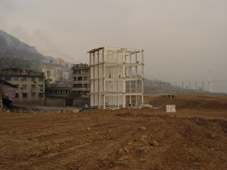
"Zone of Initial Dilution" interests itself in the urban transformation of the Three Ravines region, China, disrupted by the implementation of the world`s largest hydraulic dam. This initial zone of dilution - term borrowed from engineers to define the perimeter of a body of water polluted by waste which will progressively dilute into the general current - illustrates the generalised situation in the region, with the gradual erasure of lifestyles and local practices. Before the end of construction, foreseen in 2008, the video lays out the state of the spaces, cities and banks of the Yangtze River, of those in ruin or those which have disappeared. The video also attempts to define the consequences on the landscape and the affected populations, within a planned perspective of the ultimate rising of the waters
Antoine Boutet
Catalogue : 2026ICI BRAZZA, chronique d’un terrain vague | Documentary | 4k | color | 86:0 | France | 2023
Antoine Boutet
ICI BRAZZA, chronique d’un terrain vague
Documentary | 4k | color | 86:0 | France | 2023
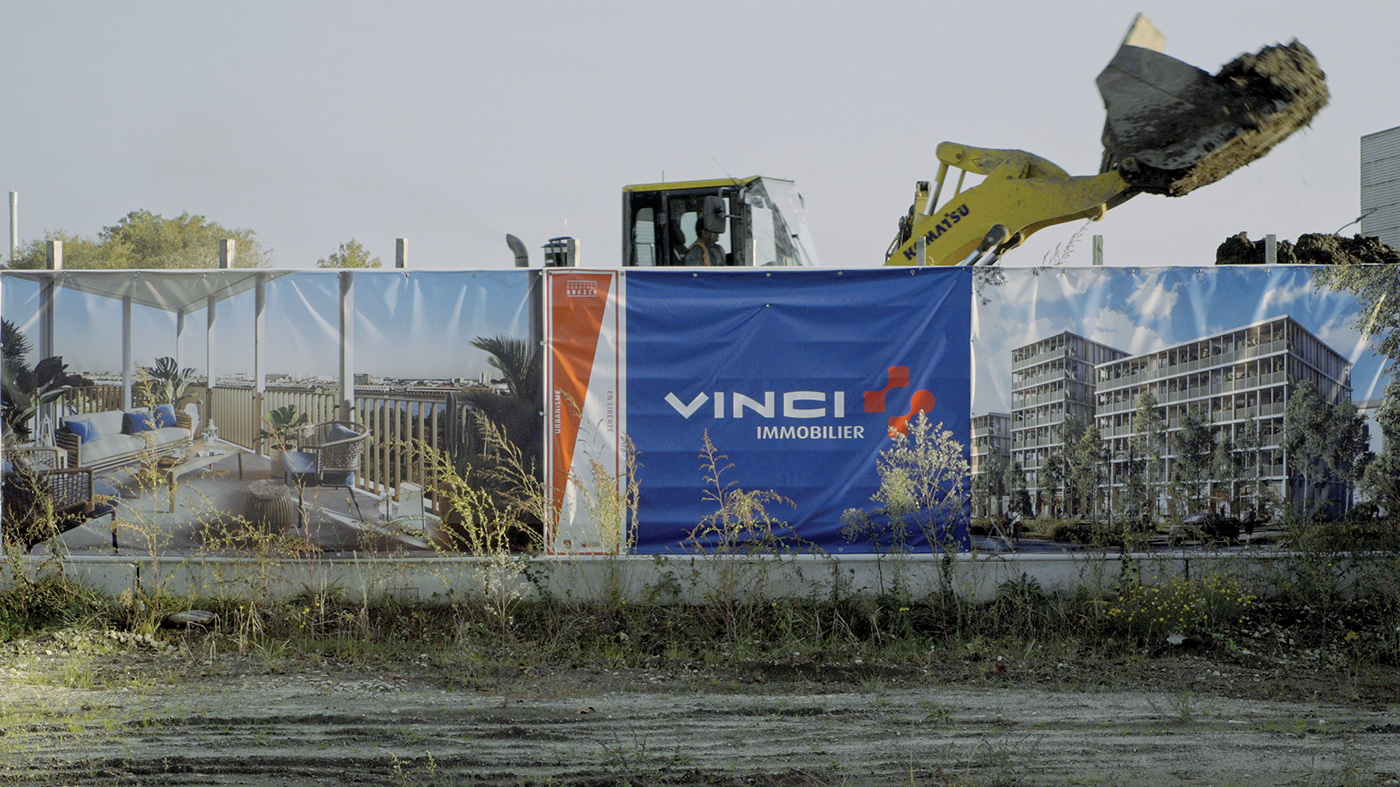
Ici Brazza, tout un programme : une zone en friche vit ses dernières heures. 53 hectares à bâtir pour un vaste projet immobilier dans l’air du temps. Chronique d’un terrain vague en transformation, le film scrute l’annonce d’un « nouvel art de vivre » dans la réalité brute du terrain. Suscitant désir et appréhension, les états successifs du paysage dessinent au fil des ans l’image de la ville de demain.
Antoine Boutet est un réalisateur français. Depuis 15 ans, ses films documentaires prolongent son travail de plasticien sur la transformation du paysage : le long- métrage Sud Eau Nord Déplacer suit pendant quatre ans le plus grand projet de détournement d’eau au monde ; Zone of initial dilution montre un territoire bouleversé par la construction du barrage des Trois-Gorges en Chine ; Le plein pays révèle l’existence d’un ermite au fond d’une forêt française... tous primés dans de nombreux festivals en France et à l’étranger. Son dernier long-métrage Ici Brazza fait la chronique d’un terrain vague confronté à la naissance d’un quartier et d’un « nouvel art de vivre ».
Tim Bowditch
Catalogue : 2012Firedive | Experimental doc. | hdv | color | 13:9 | United Kingdom | 2010
Tim Bowditch
Firedive
Experimental doc. | hdv | color | 13:9 | United Kingdom | 2010
Firedive is a short documentary about La Vallette Bathing Pools on the east coast of the Island of Guernsey. The film describes the Island`s collective memory of the tidal pools, focusing on the floodlit swimming galas and `firedives` that once made the pools a central part of the local community. Bowditch?s mother relayed the almost mythical personal tales of her childhood, which inspired the film. Contributors include locals who all have their own complimentary and contrasting tales adding to the visual portrait presented of the pools. The narrators talk about the decline in usage of the pools before going on to describe the ritualistic ceremony of the torch light processions and ?firedives? that once took place. The film is not a recreation of events but rather documents Bowditch?s own experience and involvement in adding to the collective memory of the location. By staging a floodlit torchlight procession based on the tales and accounts of the inhabitants he adds to the islands history and represents it for a new generation. Production dialogue, filming equipment and crew are therefore included in the edit, showing it was an exploration based on intertwined memories rather than a factual straight re-enactment.
Tim Bowditch (b.1986 Guernsey, Channel Islands) graduated from the University of Portsmouth in 2008 with a BA Hons Degree is Photography. Bowditch moved from his childhood home of Guernsey to begin a career as a photographer in London in the Autmn of 2008. He has kept his ties with Guernsey by annually applying and receiving funding to make new work incorporating the Island in someway. The last two years have been spent working on a project entitled Firedive (submitted as a multimedia piece). Firedive saw Bowditch follow the current trend of the digital SLR film makers to shoot a short documentary about the about La Vallette Bathing Pools on the east coast of the Island. The film describes the Island`s collective memory of the pools, focusing on the floodlit swimming galas and `firedives` that once made the pools a central part of the local community. This year the film was premiered at a special open air screening at the pools accompanied by a swimming gala and torch light procession. Three Artists were invited to the Island to make work in response to the screening and gala. The third phase of the project is a proposed exhibition at the greenhouse gallery in Guernsey next Spring. I will curate an exhibition from the work made at the screening.
Ric Bower, Supercharger-blown collective
Catalogue : 2023Easy Asylum Booth 'Bundu Edition' | Multimedia installation | 4k | | 0:0 | United Kingdom | 2023
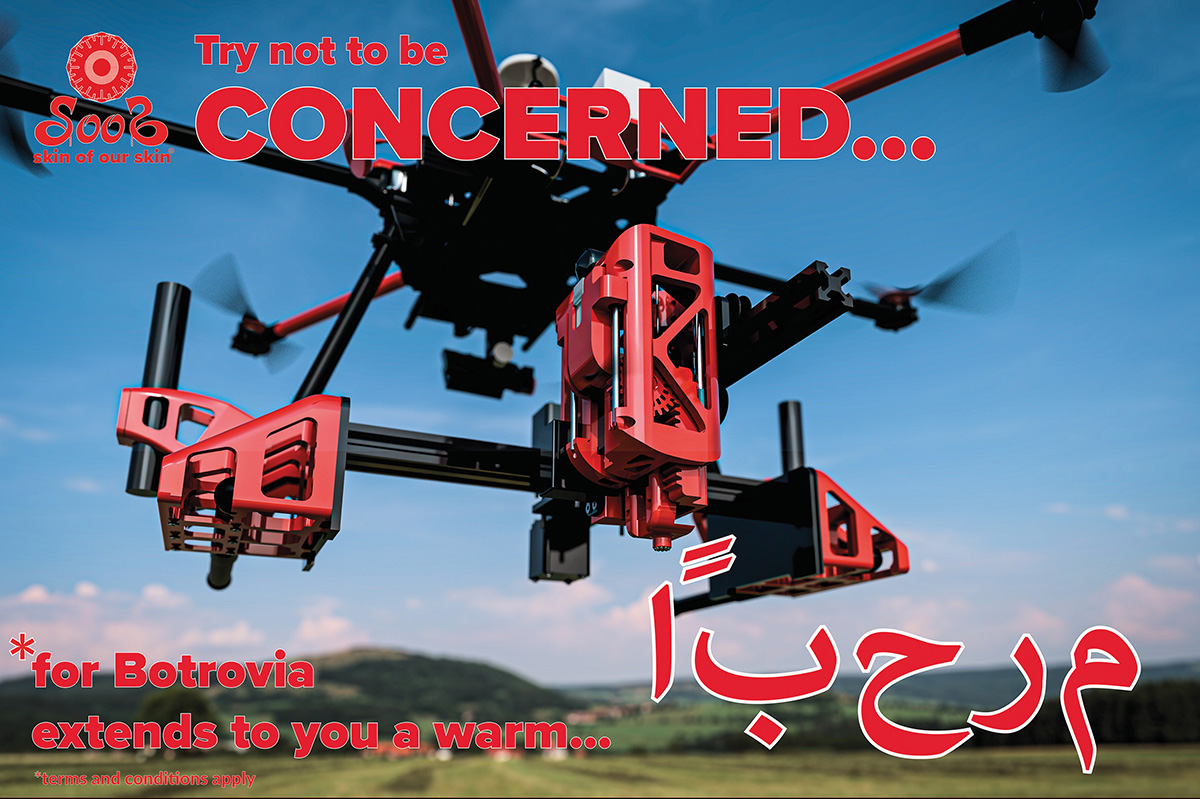
Ric Bower, Supercharger-blown collective
Easy Asylum Booth 'Bundu Edition'
Multimedia installation | 4k | | 0:0 | United Kingdom | 2023
Supercharger-blown collective offers ‘Easy Asylum Booth ‘Bundu Edition’’, a satirical and situation specific, modular presentation which interrogates European asylum policies, (and attitudes to immigration as a whole) by inverting hegemonic narratives. The collective uses provocative spectacle as a vehicle to facilitate social engagement, partying, shisha smoking, music and political dialogue. Easy Asylum Booth ‘Bundu Edition’ is another chapter in the shifting, magical-real vision derived from the fictitious nation of Botrovia. The booth is a ‘pop up embassy’ offering instant refugee status to anyone seeking asylum in Botrovia. Applicants just need to demonstrate their loyalty by offering 7 x 7cm of their skin for a tattoo specially chosen for them by Skin of our Skin (SooS®), the Botrovian Ministry of Immigration and executed by a flying robotic tattoo gun. Benefits to refugee status include a direct telephone connection with the Botrovian Leader (‘Our Leader is Available’); Training in ‘DASHT (Drone Asylum Seeker Herding Techniques)’ with a fully featured computer game; a lifetime subscription to ‘Botrovian Seeker (Your Guide to Asylum Success)’ plus access to numerous helpful and supportive infographics, interviews and seminars. The project and multicultural collective are formally partnered with Oasis Cardiff, an asylum seeker and refugee charity.
Supercharger-blown collective is a group of artists, scientists and thinkers from a range of cultural backgrounds. Formed and led by the artist Ric Bower their knowingly complex, multi-disciplinary practice often assumes the appearance of an elaborate practical joke and usually explores issues relating to European asylum policy through magical-real narratives. Supercharger-blown collective’s influences include the magical-realism of Murakami and Bulgakov: the satirical illustrator Heath Robinson and the 19th century history painter Thomas Cole. Bower says of Supercharger-blown collective’s approach: ‘...we do not want to make work that sits quietly, meekly waiting to be observed. We mean to make madness that follows you out of the gallery space, slithers into the back seat behind you and shanks you as you drive home.’