Catalogue > List by artist
Browse the entire list of Rencontre Internationales artists since 2004. Use the alphabetical filter to refine your search. update in progress
Francois Fleury
Catalogue : 2020Waimaha | Experimental doc. | hdv | color | 42:30 | France | 2018
Francois Fleury
Waimaha
Experimental doc. | hdv | color | 42:30 | France | 2018
Both an ethnographical study and an artistic meditation, this film presents the life and rituals of the Waimaha people through their myths. Shot in the Columbian Vaupès, a region which has attracted anthropologists since the 1970s, the film relates three ancestral Amazonian legends told by shamans. It foregrounds the spoken word of learned men and women who keep their culture alive and adapt it to the 21st century. The musicality of their language and their non-linear narration of this culture's thought meld with contemplative tableaux, rendering a double and renewed reality for the spectator
François Fleury, born in 1977, is a photographer & artist based in Paris. Graduated with the unanimous congratulations of the jury of the Ecole des Beaux-Arts in Paris in 2003, he settles for a year in Afghanistan. His photographic project "The Blast" ("Afghanistan") obtains the 2004 Young Hope Award Nicolas Feuillate, awarded by Kamel Mennour. The following year, sponsored by Christian Caujolle, he was shortlisted at the World Press Photo Joop Swart Masterclass for two consecutive years. He then initiated the "Bureau Iso" a photographic workshop on the corporate culture within "the Caisse des Dépôts et Consignations" which led to an exhibition during the "Nuit Blanche 2007" in Paris and a book edited by the "Caisse des Dépôts". He worked as an artist and curator in the collective "La Générale" and exhibited at the "Casa Asia" in Madrid and Barcelona in 2010 and 2011 a collection of portraits of Afghan studios and "The Blast". In 2012, he moved to Uganda to carry out projects in eastern Congo DRC presented in the exhibition "De bile et de lumière" (of bile & light) in 2013. The following year he moved to Fordlândia in Brazil, a city built by Henri Ford in the 1920s whose methods in the heart of the Amazon jungle ended in failure. He then went up the rivers of the Amazon in search of communities cut off from the western world. This experience gave birth to the film "Waimaha" and to the series of photographs "A river's tale" and "Negative forest".
Arthur Fléchard
Catalogue : 2023The Yellow Question | Experimental fiction | mp4 | color | 10:22 | France | 2020
Arthur FlÉchard
The Yellow Question
Experimental fiction | mp4 | color | 10:22 | France | 2020
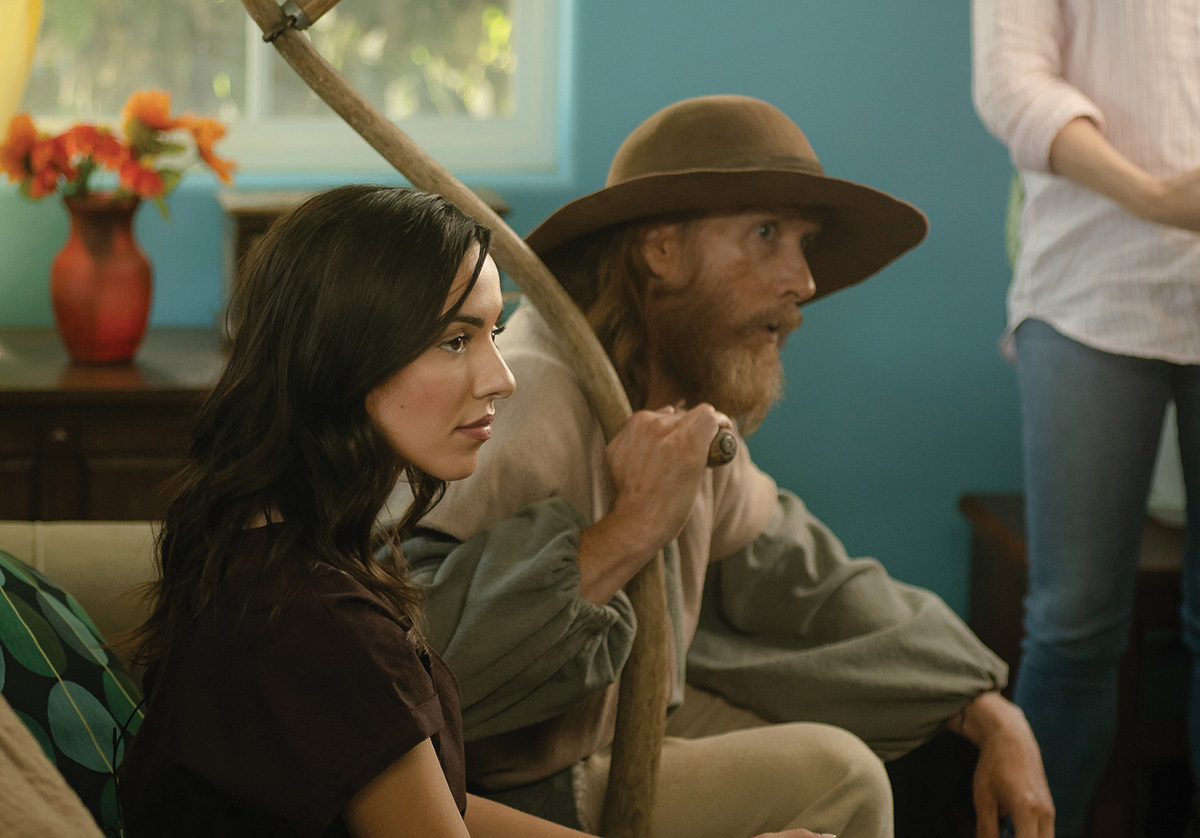
Fiction expérimentale, « The Yellow Question » met en jeu les conflits et contradictions qui se cristallisent en Californie autour d'un sujet à première vue anodin : le gazon. En 2017, Arthur Flechard accompagne à Los Angeles Marine Pesquet, étudiante en anthropologie à l’EHESS, dont la recherche porte sur les relations entretenues par les résidents suburbains avec leur gazon. Depuis 2012, la Californie est touchée par une sécheresse sans précédent. La culture des gazons est remise en question par les politiques locales, bousculant une tradition paysagère aux connotations fortement identitaires. « The Yellow Question » est la reconstitution fictionnelle d’une réunion d’association de propriétaires en proie à des restrictions d’eau. Arthur Flechard y apporte un imaginaire spéculatif, étirant jusqu'à l'absurde cette petite histoire au sein de la grande histoire du gazon, le nœud gordien qu’est la culture du gazon en Californie aujourd'hui. La réalisation du film (décor, tournage, montage…) a été déléguée a? un prestataire, basé en Californie, de la plateforme en ligne Fiverr. En se remettant aux notions de « compétences » mises en avant par Fiverr, et en se limitant à un script et des indications, Arthur Flechard questionne le rôle de l'artiste au sein du processus créatif.
Né en 1990 à la Ferté-Macé, Arthur Fléchard vit et travaille à Paris. Il est diplômé d’un baccalauréat STAV (science technique de l’agronomie et du vivant) ; du CEB (certificat d’étude Biblique) à l’université catholique de l’ouest (2011) ; du DNAP avec félicitations du jury à l’école des Beaux-arts d’Angers (2012) ; et du DNSEP à l’école nationale des Beaux-arts de Paris (atelier Tania Bruguera) (2014).Il est lauréat en 2016 du prix Leipzig lors de la 66e édition de l’exposition «Jeune Création». Il réalise en 2023 une résidence à la Villa Belleville, à Paris. Il a notamment participé aux expositions « Museum of Arte Util » au Van Abbemuseum à Eindhoven, sur l’invitation de Tania Bruguera (2013) ; « DrawingRoom 015 », commissariat Judicaël Lavrador à La Panacée - Centre de Culture Contemporaine, Montpelier (2015) ; « Nouveau Monde Industriel » commissariat Nicolas Bourriaud (2016), ou encore « Reims scène d’Europe », commissariat C-E-A, FRAC Champagne-Ardenne (2019).
Catalogue : 2016La Sémantique du mouvement | Experimental fiction | hdv | color | 2:35 | France | 2014
Arthur FlÉchard
La Sémantique du mouvement
Experimental fiction | hdv | color | 2:35 | France | 2014
An art critic portrays, using a voice-over narration, the practice of a robotized mower. Video archives illustrate his words. "Automower 320" emancipated from its predefined task , addressing cutting the lawn on its own aesthetic concerns . In a geometric hysteria , it uses lines, planes and curves , in order to raise the sensitivity in a mechanical organization.
Nicolas Floc'h
Catalogue : 2007End | Fiction | 16mm | color | 22:31 | France | 2006
Nicolas Floc'h
End
Fiction | 16mm | color | 22:31 | France | 2006
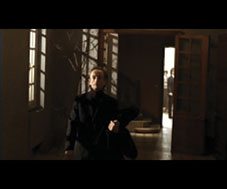
A man in his fifties nearly knocks down a young imprudent girl on a country road at night. She is young. He makes her get in the car to drive her to the hospital. She categorically refuses; she has to be at a very important meeting a few kilometres from where they are. The man offers to take her to her meeting place.
Nicolas Floc'h is a plastics artist and has a MA from the Glasgow School of Art. He exhibits his work regularly in art centres and museums in France and abroad. He works with dancers in laboratory frameworks, such as Edelweiss, Hourvari, Kyoto Creators Meeting, etc. Nicolas Floc'h produces his projects in collaboration with choreographers like Alain Michard, Emmanuelle Huynh, Rachid Ouramdane, and the lighting technician Caty Olive. He also develops projects starting from a forum, 'Structure multifonctions', in which he invites diverse artists to intervene. He has produced several videos, including "Anna's Life and Market" which has previously been presented at the Paris/Berlin festival. "End" is his first short fiction film. The Nicolas Floc'h catalogue "In Other Words" was published by "Roma" in June 2005. He currently has a personal exhibition at MAC/VAL in Vitry-sur-seine. The "Structures odysséennes" was published by MAC/VAL for the occasion of this exhibition.
Elise Florenty, Marcel Türkowski
Catalogue : 2017Shadow-Machine | Video | hdv | color | 14:20 | France | 2016
Elise Florenty, Marcel Türkowski
Shadow-Machine
Video | hdv | color | 14:20 | France | 2016
One indigo summer night, in a rather tropical suburban Japan, several isolated people find themselves caught in a game of shadows and lights more or less threatening. Operators dressed in black seem to manipulate them as they abandon themselves to the idea of being puppets. Yet here no ventriloquism, at most a few tears, or a laughter hidden behind a scream, are tearing the silence of the night apart. Featuring Junko Hiroshige (member of Hijokaidan)
Elise Florenty & Marcel Türkowsky are a franco-german artist/filmmaker duo working together since 2009. Combining the fields of cinema, installation, publication and curation, they have been exploring the multiplicity of the self through a spiral of metamorphoses that interrogate our power relation - always shifting - to the Other („the enemy, the plant, the animal, the spirit, the dead“).
Elise Florenty, Marcel Türkowsky
Catalogue : 2018Saboten to no Kaiwa (Conversation avec un cactus) | Experimental doc. | hdv | color | 45:0 | France | 2017
Elise Florenty, Marcel Türkowsky
Saboten to no Kaiwa (Conversation avec un cactus)
Experimental doc. | hdv | color | 45:0 | France | 2017
A young woman relates the dream she had right after the suspicious death of a journalist known for working on the Fukushima disaster. As she pauses, an oneiric journey unfolds that interweaves her animate surroundings with fragmented facts and rumors about the legendary Hashimoto Experiment from the 70s in which a scientist and his wife tried to teach the Japanese alphabet to a cactus. To manifest the consciousness of plants, they used a lie detector translating their electric output into sound, thus giving them a voice. While the ultimate goal was to make the cactus become a potential witness in the investigation of future crimes, the dream turns into a collective inquiry evolving through a spiral of threatening metamorphoses and mutations. Addressing the fractured nature of cinematic language, Elise Florenty & Marcel Türkowsky`s film is a psychic trance looking for new ways of communication.
Elise Florenty & Marcel Türkowsky are a franco-german artist/filmmaker duo working together since 2009. Combining the fields of cinema, installation, publication and curation, they have been exploring the multiplicity of the self through a spiral of metamorphoses that interrogate our power relation - always shifting - to the Other (« the enemy, the plant, the animal, the spirit, the dead »). Interweaving their respective knowledge in Theory of Cinema/Visual Arts (Nouvelle Sorbonne, Cergy-Paris Art School) and Ethnomusicology/Philosophy/Sound Studies (Humboldt University, UDK - Berlin University of the Arts), they have developed their multifaceted practice between diverse geographies (Europe, Brazil, Japan...) focusing on the (post) human condition in relation to transforming geopolitical landscapes ; natural, built and virtual environments and their multiple inhabitants and hi/stories. Their investigations mainly draw attention to the manifestations of the irrational, the survivals of the fabulesque and the mechanisms of resistance seen through a cosmology of signs and narratives activated by human and non-human protagonists and perspectives to rise alternative ways of reading the present and speculative futures.
Catalogue : 2010Gennariello due volte | Experimental doc. | dv | color | 36:30 | France | 2009
Elise Florenty
Gennariello due volte
Experimental doc. | dv | color | 36:30 | France | 2009
Qu?est devenu l?adolescent napolitain «Gennariello» inventé par Pasolini en 1975 dans son petit traité pédagogique Lettres luthériennes? Gennariello aurait aujourd?hui 50 ans c?est à dire le même âge que Pasolini quand il a écrit ce texte, c?est à dire qu?il aurait le même écart générationnel avec des jeunes de 15 ans d?aujourd?hui. Tout en se remémorant en napolitain ce que lui avait dit Pasolini 35 ans plus tôt (l?adresse est donc inversée : Tu est Pasolini, Je est Gennariello) le «fantôme» de Gennariello regarde les jeunes napolitains d?aujourd?hui, en train de jouer, rire et... occuper leurs lycées. Ils pratiquent à des degrés divers l?autogestion, analysant la dictature berlusconienne à la lumière de Fahrenheit 451 ou transformant le lycée en grande discothèque tout en essayant d?échapper à la Mafia. Deux séquences font allusion à Accatone et Oedipe roi (elles encadrent le film comme une parenthèse) alors que deux autres sont tournées sur des lieux où Pasolini a filmé à Naples (Decameron, Comizi d?amore). Le film commence de façon assez documentaire et devient de plus en plus poétique et lyrique.
Catalogue : 2010Iʼll Live (work song) | Experimental doc. | dv | black and white | 6:35 | France | 2008
Elise Florenty
Iʼll Live (work song)
Experimental doc. | dv | black and white | 6:35 | France | 2008
«Iʼll live» (work song) is inspired by a poem of the american and modernist architect Frank Llord Wright written in 1896. The main idea was to combine architecture and language. At the beginning the poem is written by blocks of letters which represent abstract elements (T for thought, A for Action, W for Work, L for Life, D for Death). Some characters manipulate the letters and construct the poem stanza after stanza, as stone after stone. The elements are stacked up in a vertical, linear and logical way. Together they seem to build a vertical and rational tower for the community. But a man arrives to de-construct this vertical tower-poem in order to make one more playfull and close to the organic human beings. Then, the exploded elements start to make loose associations. As if they were not able to «illustrate» the poem any more and start to act and combine their own way.The Man (the artist, the architect) fight with the abstract elements Work - Thought - Action. He tries to find a way between fantasia and rationalism. To keep his freedom in his art he has to refuse some temptations : Favour (symbolized by the Mask) Fortune (symbolized by the Jade) Fame (symbolized by the Sheath of the blade). This video was made during a workshop in a art school in france. I choose to keep all the moment during which the students were thinking and hesitating in their gesture. This moments «in progress» sometimes say more about the poem than the choreographic development that we were searching for.
Born in December 78 in Pessac (33). After studying theory and history of Cinema, Elise Florenty gratuated from National Superior Fine Art School of Cergy-Paris, then from the master course of National Superior Fine Art School of Lyon with Jean-Pierre Rehm et Marie-José Burki and at last from the animation master course of National Superior Decorative Art School of Paris. She did Art residencies in Seoul, in Buenos Aires, in Moly Sabata (under the Artistic Direction of Marie de Brugerolle), in Naples and kuenstlerhaeuser Worpswede (as guest). Since 2005, she is doing sound and music collaboration with Marcel Türkowsky, musician and sound artist. Since 2002, she has regulary been exhibiting her work : Centre National de la Photographie, Espace Paul Ricard, Galerie In Situ, Jeu de Paume, Béton-Salon, La Générale, L?Antenne, La Ferme du Buisson, Centre d?art de Chelles Les Églises, Maison d?Art Bernard Anthonioz, Centre d?art Synagogue de Delme, MAC de Lyon, Centre d?art Passerelle à Brest, Carré d?art à Nîmes, Printemps de Septembre à Toulouse, Festival Photographique de Lectoure, Parc Saint Léger de Pougues-les-Eaux, Musée des histoires de Saint-Brieuc, NBK - Berlin, Temporäre Kunsthalle Berlin, Kunst Verein de Göttingen, Kunstraum de Munich, Kolonie Wedding et Uqbar à Berlin, Galerie Pierogi à Leipzig, Galerie Etc. - Prague, Correo Central and Centre Culturel La Recoleta de Buenos AIres, Musée d?Art Contemporain - Rijeka, Fieldgate Gallery ? Londres, Kimusa ? Séoul.
Catalogue : 2009Arriba! Desde Abajo | Experimental doc. | dv | black and white | 10:45 | France | 2008
Elise Florenty
Arriba! Desde Abajo
Experimental doc. | dv | black and white | 10:45 | France | 2008
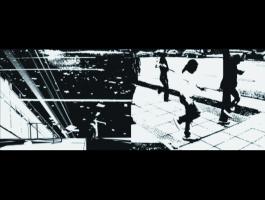
New split screen showing videos Autop and El Juego del No. Both movies sometimes play together and sometimes separately, one against the other, causing a confrontation but often the two characters points of view. On the one hand the students, the other the street dancers. From Argentine history and it recent past, these two videos show moments of the breaking up (perforated posters, scattered leaflets, and torn books) and the collapsing of the system(demolition, ruins, and other lost "buildings") while questioning the "resistance" of a pencil in hand - for the students, support for the land ? by the street dancers. Oblivious of the promise flouted "Never again" finds strength in these lines in the tense and contradictory movements of UP "Arriba" the dancers and DOWN "Abajo" students. Between jubilation and condemnation. They take on the form of demand or claims property rights in the 70s,this form of expression still valid in today?s Argentine making one doubt as to the origin the pictures (the end of the 70´s or Thirty years later) the codification of past in present is far more solid now than during the used during the dictatorship as threats of extermination once again for those who look for justice and speak out when democracy is absent.
Elise Florenty was born in 1978 in Bordeaux. After studying theory and film history at the Sorbonne Nouvelle Paris 3, and the ENSBA of Cergy, she participated in post-graduate ENSBA at Lyon with Jean-Pierre Rehm and Marie-Jose Burki, then got an ENSAD animation degree. Since then, she has lived in Seul, Buenos Aires and recently at Moly Sabata, in the Isere. With her work, Elise Florenty explores the physical deployment of language, the opening signs of her work wish to create a modest monument to a period reminding us how no matter ?when? it?s never the moment to speak up.
Catalogue : 2007Ring-a-ring-a-roses | Animation | dv | black and white | 3:16 | France | 2005
Elise Florenty
Ring-a-ring-a-roses
Animation | dv | black and white | 3:16 | France | 2005
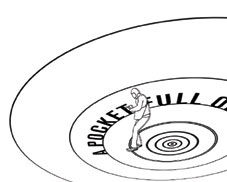
The video is a new interpretation of an old song and dance about the plague called "ring-a-ring-a-roses". Reactivating the hidden and forgotten meaning of the different images that the poem evokes, it questions how the game can win over power, sickness, and death. A somewhat autistic looking man is turning in circles. His loneliness is filled with children playing around him, mimicking various figures with humour: the leader, the executor, the victim, etc.: one shouts a slogan, the other screams into a speaking pipe which seems to be a telescope, another moves as a dove, the last ones all finally decide to fall down at the same time as if they were death stricken. The children have fun with the historical figures whereas the adult remains locked up in a mysterious and obsessive circularity. The soundtrack consists of two call signals: a church bell merging with a police siren. These two sounds take turns, embodying different bodies of power. They are like calls to order, being diffused by waves, and cutting off the people from the emitting center up to the periphery. They continue to emit their control even as they are fading. The sadly ironic figures of the children decline into the possible figures of resistance inside a system of multiple powers. "Ring-a-Ring-a Roses" is a fine example of an apparently vacuous and harmless rhyme, sung by happy school kids perhaps ignorant of the song?s central macabre topic - namely, the Bubonic Plague. The Bubonic Plague is more commonly known as 'The Black Death'; the horrific disease swept throughout Europe in the 14th Century, spreading from China, killing 25 million people in just under five years, between 1347 and 1352. Thereafter, the plague was epidemic throughout Europe. The rhyme details the effects of the plague on the sufferer. 'Ring-a-Ring-of-Roses' refers to the first sign of the onset of the disease. Before lesions would develop on the skin of those affected, small rings of red bruise-like marks would appear. ?A pocket full of posies? indirectly points to the fact that people didn't know that it is germs that cause disease, and not smells. It was a commonly-held belief that bad smells - so often associated with the open sewers of London's Thames area - were actually carrying the disease. As a caution therefore, doctors used to carry with them a pouch of sweet smelling flowers, thinking it would ward off the infection. 'A pocket full of posies' would also go some way to mask the stench of rotting corpses. The third line, 'Achoo!, Achoo!' is particularly chilling in that the act of sneezing was final physical proof that you had indeed succumbed to the Plague. Sneezing was an audible harbinger of the worst news - that the disease was contracted and that much worse was to come. And of course, 'We all fall down' refers to that great inevitability; the end of life itself.
Elise Florenty studied at the Ecole Nationale Supérieure of Arts of Cergy-Paris and at the Université Paris 3 Nouvelle Sorbonne in the department of History and Theory of cinema. She completed two Masters Degrees: Post-diplôme Art in Lyon and Post-diplôme AII at the Ecole Nationale of Decoratif Arts of Paris. In her videos, documents and images from reality are mixed with fictitious images. The overlapping of these two systems of representation that are mental projections and reality, disable spectators in determining which one is controlling the other. Collages operate incessantly, meaning shifts and visual or semantic analogies that open several directions of reading. Elise Florenty establishes a constant parallel between working on an image on screen and developing a thought. The language and the signs about dreams, urban representations, media, and experience, are part of the thinking process enhanced in her work. A selection of her exhibitions includes: Atelier of National Center of Photography of Paris (2002), Espace Paul Ricard (2002), Mac of Lyon (2002) Gallery: In Situ in Paris (2003), and in the exhibition entitled «Public Relation» (2004).
Catalogue : 2006Kino krov | Animation | dv | black and white | 5:45 | France | 2005
Elise Florenty
Kino krov
Animation | dv | black and white | 5:45 | France | 2005
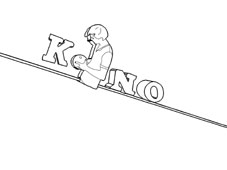
Cluttered by enormous letters, a man tries hard to write the world KINO. Thus other words recur in his mind. Alternating between an autistic attitude and a monologue full of maniac-obsessional gestures, this man talks about different kind of morbid hallucinations he has in relation towards language, space and daily objects. Confronting the trauma of his own history, he tries to resist it by connecting things which seem to have lost any links.
Elise Florenty, born in december 1978, in bordeaux. Lives and works between Paris and Berlin. After a double major in the Superior National School of Arts of Cergy-Paris and at the University Paris 3 Nouvelle Sorbonne in History and Theory of cinema, i did two post graduate work : post-diploma in Arts in Beaux-Arts School of Lyon and post-diploma in AII in the Superior National School of Decorative Arts in Paris.
Elise Florenty, Marcel Türkowsky
Catalogue : 2023Zapotitland | Experimental doc. | 0 | color | 47:0 | France, Mexico | 2023
Elise Florenty, Marcel Türkowsky
Zapotitland
Experimental doc. | 0 | color | 47:0 | France, Mexico | 2023
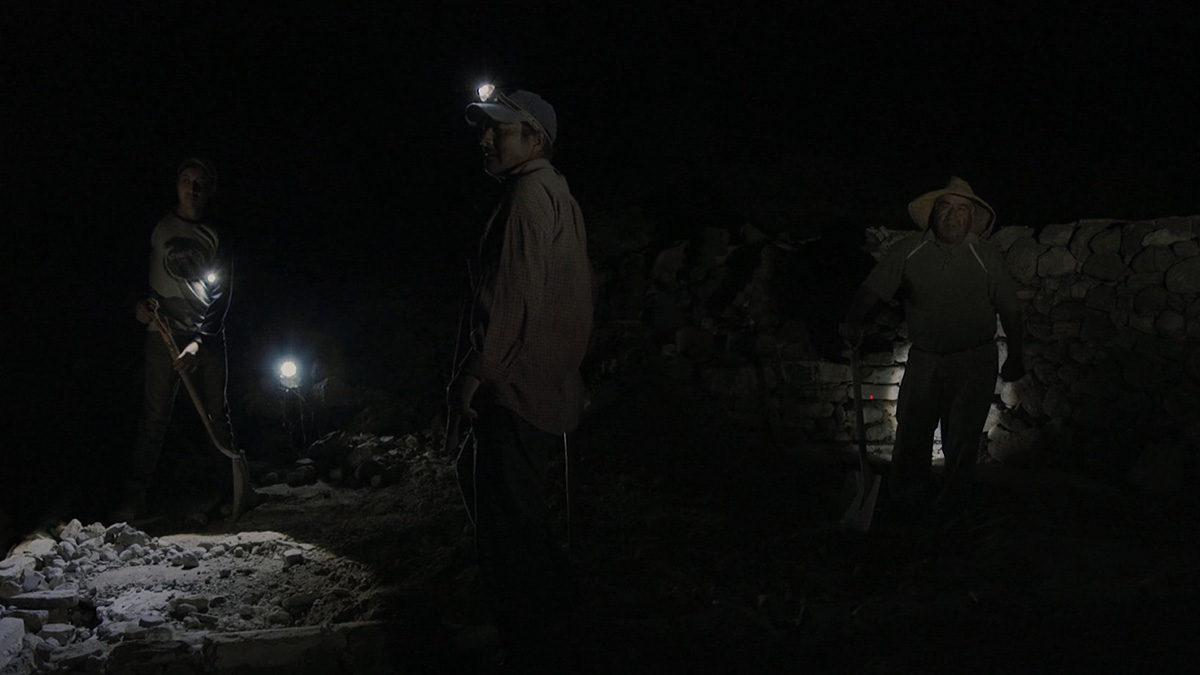
Between phantasmagorical fiction and historical investigation, the film unveils how a daytime reverie of a young Mexican from the city turns into a nocturnal venture inside the world’s biggest cactus forest. It is here, through his imaginary disguise as a German “cactus hunter”, that one gets to know the many stories of desire, greed and death that haunt this extraordinary and strange "vegetal eldorado".
Elise Florenty
Catalogue : 2018Saboten to no Kaiwa (Conversation avec un cactus) | Experimental doc. | hdv | color | 45:0 | France | 2017
Elise Florenty, Marcel Türkowsky
Saboten to no Kaiwa (Conversation avec un cactus)
Experimental doc. | hdv | color | 45:0 | France | 2017
A young woman relates the dream she had right after the suspicious death of a journalist known for working on the Fukushima disaster. As she pauses, an oneiric journey unfolds that interweaves her animate surroundings with fragmented facts and rumors about the legendary Hashimoto Experiment from the 70s in which a scientist and his wife tried to teach the Japanese alphabet to a cactus. To manifest the consciousness of plants, they used a lie detector translating their electric output into sound, thus giving them a voice. While the ultimate goal was to make the cactus become a potential witness in the investigation of future crimes, the dream turns into a collective inquiry evolving through a spiral of threatening metamorphoses and mutations. Addressing the fractured nature of cinematic language, Elise Florenty & Marcel Türkowsky`s film is a psychic trance looking for new ways of communication.
Elise Florenty & Marcel Türkowsky are a franco-german artist/filmmaker duo working together since 2009. Combining the fields of cinema, installation, publication and curation, they have been exploring the multiplicity of the self through a spiral of metamorphoses that interrogate our power relation - always shifting - to the Other (« the enemy, the plant, the animal, the spirit, the dead »). Interweaving their respective knowledge in Theory of Cinema/Visual Arts (Nouvelle Sorbonne, Cergy-Paris Art School) and Ethnomusicology/Philosophy/Sound Studies (Humboldt University, UDK - Berlin University of the Arts), they have developed their multifaceted practice between diverse geographies (Europe, Brazil, Japan...) focusing on the (post) human condition in relation to transforming geopolitical landscapes ; natural, built and virtual environments and their multiple inhabitants and hi/stories. Their investigations mainly draw attention to the manifestations of the irrational, the survivals of the fabulesque and the mechanisms of resistance seen through a cosmology of signs and narratives activated by human and non-human protagonists and perspectives to rise alternative ways of reading the present and speculative futures.
Catalogue : 2010Gennariello due volte | Experimental doc. | dv | color | 36:30 | France | 2009
Elise Florenty
Gennariello due volte
Experimental doc. | dv | color | 36:30 | France | 2009
Qu?est devenu l?adolescent napolitain «Gennariello» inventé par Pasolini en 1975 dans son petit traité pédagogique Lettres luthériennes? Gennariello aurait aujourd?hui 50 ans c?est à dire le même âge que Pasolini quand il a écrit ce texte, c?est à dire qu?il aurait le même écart générationnel avec des jeunes de 15 ans d?aujourd?hui. Tout en se remémorant en napolitain ce que lui avait dit Pasolini 35 ans plus tôt (l?adresse est donc inversée : Tu est Pasolini, Je est Gennariello) le «fantôme» de Gennariello regarde les jeunes napolitains d?aujourd?hui, en train de jouer, rire et... occuper leurs lycées. Ils pratiquent à des degrés divers l?autogestion, analysant la dictature berlusconienne à la lumière de Fahrenheit 451 ou transformant le lycée en grande discothèque tout en essayant d?échapper à la Mafia. Deux séquences font allusion à Accatone et Oedipe roi (elles encadrent le film comme une parenthèse) alors que deux autres sont tournées sur des lieux où Pasolini a filmé à Naples (Decameron, Comizi d?amore). Le film commence de façon assez documentaire et devient de plus en plus poétique et lyrique.
Catalogue : 2010Iʼll Live (work song) | Experimental doc. | dv | black and white | 6:35 | France | 2008
Elise Florenty
Iʼll Live (work song)
Experimental doc. | dv | black and white | 6:35 | France | 2008
«Iʼll live» (work song) is inspired by a poem of the american and modernist architect Frank Llord Wright written in 1896. The main idea was to combine architecture and language. At the beginning the poem is written by blocks of letters which represent abstract elements (T for thought, A for Action, W for Work, L for Life, D for Death). Some characters manipulate the letters and construct the poem stanza after stanza, as stone after stone. The elements are stacked up in a vertical, linear and logical way. Together they seem to build a vertical and rational tower for the community. But a man arrives to de-construct this vertical tower-poem in order to make one more playfull and close to the organic human beings. Then, the exploded elements start to make loose associations. As if they were not able to «illustrate» the poem any more and start to act and combine their own way.The Man (the artist, the architect) fight with the abstract elements Work - Thought - Action. He tries to find a way between fantasia and rationalism. To keep his freedom in his art he has to refuse some temptations : Favour (symbolized by the Mask) Fortune (symbolized by the Jade) Fame (symbolized by the Sheath of the blade). This video was made during a workshop in a art school in france. I choose to keep all the moment during which the students were thinking and hesitating in their gesture. This moments «in progress» sometimes say more about the poem than the choreographic development that we were searching for.
Born in December 78 in Pessac (33). After studying theory and history of Cinema, Elise Florenty gratuated from National Superior Fine Art School of Cergy-Paris, then from the master course of National Superior Fine Art School of Lyon with Jean-Pierre Rehm et Marie-José Burki and at last from the animation master course of National Superior Decorative Art School of Paris. She did Art residencies in Seoul, in Buenos Aires, in Moly Sabata (under the Artistic Direction of Marie de Brugerolle), in Naples and kuenstlerhaeuser Worpswede (as guest). Since 2005, she is doing sound and music collaboration with Marcel Türkowsky, musician and sound artist. Since 2002, she has regulary been exhibiting her work : Centre National de la Photographie, Espace Paul Ricard, Galerie In Situ, Jeu de Paume, Béton-Salon, La Générale, L?Antenne, La Ferme du Buisson, Centre d?art de Chelles Les Églises, Maison d?Art Bernard Anthonioz, Centre d?art Synagogue de Delme, MAC de Lyon, Centre d?art Passerelle à Brest, Carré d?art à Nîmes, Printemps de Septembre à Toulouse, Festival Photographique de Lectoure, Parc Saint Léger de Pougues-les-Eaux, Musée des histoires de Saint-Brieuc, NBK - Berlin, Temporäre Kunsthalle Berlin, Kunst Verein de Göttingen, Kunstraum de Munich, Kolonie Wedding et Uqbar à Berlin, Galerie Pierogi à Leipzig, Galerie Etc. - Prague, Correo Central and Centre Culturel La Recoleta de Buenos AIres, Musée d?Art Contemporain - Rijeka, Fieldgate Gallery ? Londres, Kimusa ? Séoul.
Catalogue : 2009Arriba! Desde Abajo | Experimental doc. | dv | black and white | 10:45 | France | 2008
Elise Florenty
Arriba! Desde Abajo
Experimental doc. | dv | black and white | 10:45 | France | 2008
New split screen showing videos Autop and El Juego del No. Both movies sometimes play together and sometimes separately, one against the other, causing a confrontation but often the two characters points of view. On the one hand the students, the other the street dancers. From Argentine history and it recent past, these two videos show moments of the breaking up (perforated posters, scattered leaflets, and torn books) and the collapsing of the system(demolition, ruins, and other lost "buildings") while questioning the "resistance" of a pencil in hand - for the students, support for the land ? by the street dancers. Oblivious of the promise flouted "Never again" finds strength in these lines in the tense and contradictory movements of UP "Arriba" the dancers and DOWN "Abajo" students. Between jubilation and condemnation. They take on the form of demand or claims property rights in the 70s,this form of expression still valid in today?s Argentine making one doubt as to the origin the pictures (the end of the 70´s or Thirty years later) the codification of past in present is far more solid now than during the used during the dictatorship as threats of extermination once again for those who look for justice and speak out when democracy is absent.
Elise Florenty was born in 1978 in Bordeaux. After studying theory and film history at the Sorbonne Nouvelle Paris 3, and the ENSBA of Cergy, she participated in post-graduate ENSBA at Lyon with Jean-Pierre Rehm and Marie-Jose Burki, then got an ENSAD animation degree. Since then, she has lived in Seul, Buenos Aires and recently at Moly Sabata, in the Isere. With her work, Elise Florenty explores the physical deployment of language, the opening signs of her work wish to create a modest monument to a period reminding us how no matter ?when? it?s never the moment to speak up.
Catalogue : 2007Ring-a-ring-a-roses | Animation | dv | black and white | 3:16 | France | 2005
Elise Florenty
Ring-a-ring-a-roses
Animation | dv | black and white | 3:16 | France | 2005
The video is a new interpretation of an old song and dance about the plague called "ring-a-ring-a-roses". Reactivating the hidden and forgotten meaning of the different images that the poem evokes, it questions how the game can win over power, sickness, and death. A somewhat autistic looking man is turning in circles. His loneliness is filled with children playing around him, mimicking various figures with humour: the leader, the executor, the victim, etc.: one shouts a slogan, the other screams into a speaking pipe which seems to be a telescope, another moves as a dove, the last ones all finally decide to fall down at the same time as if they were death stricken. The children have fun with the historical figures whereas the adult remains locked up in a mysterious and obsessive circularity. The soundtrack consists of two call signals: a church bell merging with a police siren. These two sounds take turns, embodying different bodies of power. They are like calls to order, being diffused by waves, and cutting off the people from the emitting center up to the periphery. They continue to emit their control even as they are fading. The sadly ironic figures of the children decline into the possible figures of resistance inside a system of multiple powers. "Ring-a-Ring-a Roses" is a fine example of an apparently vacuous and harmless rhyme, sung by happy school kids perhaps ignorant of the song?s central macabre topic - namely, the Bubonic Plague. The Bubonic Plague is more commonly known as 'The Black Death'; the horrific disease swept throughout Europe in the 14th Century, spreading from China, killing 25 million people in just under five years, between 1347 and 1352. Thereafter, the plague was epidemic throughout Europe. The rhyme details the effects of the plague on the sufferer. 'Ring-a-Ring-of-Roses' refers to the first sign of the onset of the disease. Before lesions would develop on the skin of those affected, small rings of red bruise-like marks would appear. ?A pocket full of posies? indirectly points to the fact that people didn't know that it is germs that cause disease, and not smells. It was a commonly-held belief that bad smells - so often associated with the open sewers of London's Thames area - were actually carrying the disease. As a caution therefore, doctors used to carry with them a pouch of sweet smelling flowers, thinking it would ward off the infection. 'A pocket full of posies' would also go some way to mask the stench of rotting corpses. The third line, 'Achoo!, Achoo!' is particularly chilling in that the act of sneezing was final physical proof that you had indeed succumbed to the Plague. Sneezing was an audible harbinger of the worst news - that the disease was contracted and that much worse was to come. And of course, 'We all fall down' refers to that great inevitability; the end of life itself.
Elise Florenty studied at the Ecole Nationale Supérieure of Arts of Cergy-Paris and at the Université Paris 3 Nouvelle Sorbonne in the department of History and Theory of cinema. She completed two Masters Degrees: Post-diplôme Art in Lyon and Post-diplôme AII at the Ecole Nationale of Decoratif Arts of Paris. In her videos, documents and images from reality are mixed with fictitious images. The overlapping of these two systems of representation that are mental projections and reality, disable spectators in determining which one is controlling the other. Collages operate incessantly, meaning shifts and visual or semantic analogies that open several directions of reading. Elise Florenty establishes a constant parallel between working on an image on screen and developing a thought. The language and the signs about dreams, urban representations, media, and experience, are part of the thinking process enhanced in her work. A selection of her exhibitions includes: Atelier of National Center of Photography of Paris (2002), Espace Paul Ricard (2002), Mac of Lyon (2002) Gallery: In Situ in Paris (2003), and in the exhibition entitled «Public Relation» (2004).
Catalogue : 2006Kino krov | Animation | dv | black and white | 5:45 | France | 2005
Elise Florenty
Kino krov
Animation | dv | black and white | 5:45 | France | 2005
Cluttered by enormous letters, a man tries hard to write the world KINO. Thus other words recur in his mind. Alternating between an autistic attitude and a monologue full of maniac-obsessional gestures, this man talks about different kind of morbid hallucinations he has in relation towards language, space and daily objects. Confronting the trauma of his own history, he tries to resist it by connecting things which seem to have lost any links.
Elise Florenty, born in december 1978, in bordeaux. Lives and works between Paris and Berlin. After a double major in the Superior National School of Arts of Cergy-Paris and at the University Paris 3 Nouvelle Sorbonne in History and Theory of cinema, i did two post graduate work : post-diploma in Arts in Beaux-Arts School of Lyon and post-diploma in AII in the Superior National School of Decorative Arts in Paris.
Marianne Flotron
Catalogue : 2013Work | Video | hdv | color | 53:21 | Switzerland, Netherlands | 2011
Marianne Flotron
Work
Video | hdv | color | 53:21 | Switzerland, Netherlands | 2011
WORK is based on the idea of bringing the Theatre of Oppressed to the employees of a multinational insurance company based in the Netherlands. The Theatre of Oppressed is originally invented in Brazil to unmask totalitarian political strategies and to develop ways of resistance. It functions as a democratizing tool using the means of participatory theatre. Through different techniques participants start to detect and understand strategies of oppression and learn through acting the first steps of resistance or change. The Columbian Theater of Oppressed director Hector Aristizabal was invited by Marianne Flotron to work for one week in the insurance company in the Netherlands. He set up a forum theater play (a form of the Theatre of Oppressed) at the company?s premises helped by several actors and employees of the company. In the contemporary labor society where most of the subjects identify themselves over work, the project tried to bring up the idea of a possible democratization of work. WORK is emphasizing the way the capitalistic economy is forming behavior and influencing mentality by employing knowledge of social science.
Marianne Flotron (born in Meiringen, Switzerland,1970) currently lives and works in Amsterdam, The Netherlands. After two years of studies in history in Zurich, she continued courses at the School of Fine Arts of Geneva (Switzerland), where she earned her degree in 2001. From 2007 till 2008 she was in residence at the Rijksakademie voor Beeldende Kunsten in Amsterdam. She won the Swiss Art Awards in 2003, 2007 and 2009. In 2008, she received the Aeschlimann Corti award from the canton of Berne. In her work she is mainly interested in the interrelationship between political and economical systems and human behavior. How the subject creates the society and how, in return, the society is creating its subjects, forms a basis for her work. She had her first institutional solo exhibition at the Kunsthalle Bern in 2011. Other recent exhibitions include Monumentalisme, Stedelijk Museum Amsterdam (2010), ?Motores utopicos, sensores reais? Galeria Quarta Parede, Sao Paulo (2011), Schon wieder und noch mal, Kunstverein Medienturm, Graz (2011). Her work got support from the Kunsthalle Bern, the Rijksakademie voor Beldende Kunsten, the Fonds voor Beeldende Kunsten, Vormgeving en Bouwkunst and the Mondrian Foundation.
Catalogue : 2009Fired | Video | dv | color | 7:51 | Switzerland, Netherlands | 2007
Marianne Flotron
Fired
Video | dv | color | 7:51 | Switzerland, Netherlands | 2007
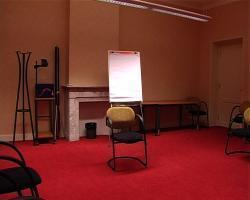
Das Video Fired besteht aus einer Trainingssituation in der Manager lernen wie Angestellte zu entlassen. Der erste Teil des Videos zeigt ein Rollenspiel eines auszubildenen Managers und einer Schauspielerin. Im zweiten Teil des Videos erklaert eine Psychologin was sich bei Angestellten in dieser Situation abspielen kann. In der Rollenspiel Situation verwendet der Manager den Begriff ?Bewegen- -Mobility- anstelle ?Entlassen-. Die Angestellte konfrontiert den Manager im Laufe des Gespraechs mit diesem Ausdruck und verlangt von ihm die Sache beim Namen zu nennen. Waehrend des Rollenspiels besteht der Eindruck, dass es sich um eine inszenierte Situation handelt. Erst gegen das Ende des Videos wird klar, dass es sich um eine reale Situation handelt, oder genauer um eine ?reelle gestellte Situation? im Rahmen eines ?Verhaltenstrainings? was die Absurditaet der Situation weitertreibt.
Née en Suisse en 1970, Marianna Flotron vit et travaille actuellement à Amsterdam (Pays-Bas). Après deux années d'études d'histoire à Zurich, elle a suivi les cours de l?Ecole des Beaux-Arts de Genève (Suisse) où elle a obtenu son diplôme en 2001. Actuellement, Marianna Flotron est en résidence artistique à la Rijksacademie voor Beeldende Kunsten d?Amsterdam. Elle a remporté le Swiss Art Awards en 2003 et en 2007. En 2008, elle a reçu la bourse Aeschlimann Corti du canton de Berne. Son ?uvre est actuellement modelée plutôt par la déconstruction d?un objet ou d?une situation donnée que par l?adition de couches successives. De par son intérêt pour l?interrelation entre les systèmes (politiques ou économiques) et le comportement humain, elle essaie de retrouver la trace des manipulations qui peuvent potentiellement influencer le comportement humain (et vice-versa). Son point de départ est souvent une forme de comportement qui, hors contexte, a tendance à devenir abstrait ou absurde.
Adrian Flury
Catalogue : 2016A place I`ve never been | Experimental film | 4k | color | 4:40 | Switzerland | 2014
Adrian Flury
A place I`ve never been
Experimental film | 4k | color | 4:40 | Switzerland | 2014
By sourcing multiple digital images of the same place from different archives this experiment in film makes use of frame by frame montage to discover hidden forms, patterns and references thereby giving new meaning to the prevailing redundancy of these pictures.
Adrian Flury was born in 1978 in Zug, Switzerland. He started out in an apprenticeship as an electrician, after which he studied animation at the Lucerne University of Arts. He has been working in the field of moving images since 2005.
Anna Fo
Catalogue : 2021Sealed Faithful Halls | Experimental video | hdcam | color | 3:0 | Cyprus | 2020
Anna Fo
Sealed Faithful Halls
Experimental video | hdcam | color | 3:0 | Cyprus | 2020
“Sealed Faithful Halls” —a poem turned to an experimental film— refers to a series of videos that have been recorded in different locations, through a period of years, either as part of art projects (but were never used) or as a record of situations, feelings and moments in time, in order to be used for future art projects. This archival material, became the motivation of a video art piece, made during the pandemic of 2020, when movement was restricted and confinement was imposed; therefore no video was able to be recorded. Drawing inspiration from the rectangular forms of expressionist painter Mark Rothko, a juxtaposition of moving images and sounds was created, an illusion of situations, where real spaces are transformed into imaginary ones. Sealed Faithful Halls becomes a record of thoughts, feelings and ways in which an artist 'sees' everything that passes in front of her and the cause for the allegorical relationship of form-space, reality-illusion, language-text.
Anna Fo (Fotiadou) is a Cypriot multidisciplinary artist and educator with specialisation in video art and direction. She holds a Bachelor degree in Graphic Design and Fine Arts and a Master degree in Performance Design and Practice. Anna is a freelance graphic designer and awarded illustrator and has been working as a video artist, art director and director for various theatre plays, performances and dance shows, in Cyprus and in Europe. She is the co-writer of the awarded film “Pause” (Cyprus, Greece, 2017). Anna directed her first short film entitled “Drained” (Cyprus, USA, 2020) which will be released in 2021 and explores issues of femininity, abandonment and revenge through a contemporary re-tell of the myth of Clytemnestra. Anna has presented her artwork —both in solo and group exhibitions— in galleries, venues, festivals and biennials in Cyprus, Greece, Italy, Spain, Germany, France, UK, Netherlands, Austria and Mexico. She works in collective art projects and collaborates with artists of different practices and disciplines. Her artistic research focuses on the subject matter of reality and illusion by exploring conceptual frameworks of the duality juxtaposition between text and image, within an examination of performance, digital media and art placement in space.
Christian Fogarolli
Catalogue : 2026Esprits Rebelles | Video | mp4 | black and white | 5:2 | Italy, Belgium | 2025

Christian Fogarolli
Esprits Rebelles
Video | mp4 | black and white | 5:2 | Italy, Belgium | 2025
Through an evocative sequence of archival photographs from the Royal Museum for Central Africa in Tervuren, Belgium, the video work Esprits Rebelles explores the ritual and therapeutic universe in traditional practices in the Congo during the period of the second phase of Belgian colonization from about 1908 to 1960. Medicinal plants, healers, sorcerers, spells, ritual objects and organic remains emerge as visual evidence of a deep knowledge, rooted in the earth and bodies, designed to deal with psychic illnesses, adverse events and invisible imbalances. The images, originally documented in a colonial context, now reveal the silent but powerful resilience of an animist and spiritual healing system that has survived the imposition of monotheistic religions, the colonizing work of disruption, and globalized modernity. These rituals and beliefs, far from being folkloric remnants, persist and transform, crossing social classes, creeping even into the contemporary elite. The video editing conveys the fragmentary and opaque nature of these practices, many of which remain elusive, ambiguous, and esoteric to this day. The gaze becomes inquisitive: who is observing, and what remains concealed? In this short circuit between documentation and vision, a critical space emerges, one that interrogates the history of representation, the violence of the colonial gaze, and the indecipherable vitality of what continues to resist Western codification. The plants shown in these sequences are used by Congolese populations to treat psychological problems and mental disorders, and were identified by the author following encyclopedic and archival research. Esprits Rebelles seeks to offer a respectful reflection on the power of ancestral knowledge, while providing a critical perspective on the lasting consequences of colonialism. It promotes an inclusive reading that affirms the dignity and cultural richness of traditional African practices.
Born in Italy in 1983, Christian Fogarolli obtained a degree in archeology in 2007 to then pursuing his historical-artistic studies with a master’s degree in 2011 at the University of Trento, alongside a master’s degree in diagnostics and restoration of works of art at the University of Verona. Since 2011, he has been dedicated to studies and research of artistic, philosophical, and historical practices. His theoretical and field research unfolds in archival and museum contexts, from which he draws inspiration with the aim of enhancing little-known heritages. His practice develops at the intersection of visual art and scientific disciplines, investigating how the latter have used the artistic medium to progress. Through historical and archival research, he attempts to deconstruct the binary condition that separates deviance and normality, reflecting on the normative attributions of disease, marginalization and categorization in contemporary society. He works through different forms of expression, from installation to photography, from sculpture to video. Fogarolli’s works stimulate critical thinking on the relationship between the mind and the brain, reflecting on how the functional processes of the latter interact with the subjective ones of the mind, and investigating how these acts of thought develop into behaviors considered lawful or prohibited.
Catalogue : 2017Lost Identities | Video | hdv | color | 1:49 | Italy | 2012
Christian Fogarolli
Lost Identities
Video | hdv | color | 1:49 | Italy | 2012
The project Lost identities was born in early 2011 in the spaces of the psychiatric institutions in Italy. This research takes over from criminal photography of early Twentieth century and it is deeply characterized by archival and photographic research connected with the identity dimension The study of those documents and photographic plates showed features and aesthetic values closer to art than the psychiatric science. Artworks have been realized considering and respecting the original archival bonds, trying to investigate some of the mechanisms that have influenced the physical appearance/identity of the subjects studied. The study of documents such as folders and clinical diaries, personal letters, notes and diagnosis has been the main instrument for the realization of the works. The way patients were treated in the mental institutes has distorted, in many cases permanently, the human, both psychological and physical, identity. People considered "crazy", which actually were in many cases simply suffering of physical deformities or diseases have been transformed into something else. Common paralysis of the face becomes suddenly "imbecility", the anthropometric analysis derived from "Lombroso" has lead to diagnose infectious melancholy, amorality, delirium, paranoia. A metamorphosis which reflects who really the beasts are. These faces and bodies contain a heavy contrast to what life is supposed to be, the patients? identities were stolen, distorted, warped and corroded, and lost. But still it is possible to see in their expressions the wish of an affirmation of life, of struggle and of that tough identity that challenged the eye of the camera. Photographs and video images that suddenly become instruments that instead of stealing can paradoxically give an identity long denied. The photographs of idiots, insane, freaks, maniacs, fools and madmen are not distant and unreal images, but actually only the mirror of ourselves.
Christian Fogarolli is an Italian artist born in 1983. He obtained in 2010 the Master Inside the image: study, diagnosis and restoration of antique, modern and contemporary paintings at the University of Verona and graduated the following year in Management and Conservation of Cultural Heritage at the University of Trento. The research of Christian Fogarolli is characterized by a strong interest in the nature of identity, particularly investigated through different perspectives, such as the archival research. He works with different media, such as environmental installations, photography, sculpture, video. The work shows connections with theories and scientific disciplines, that often and unconsciously, have used art to progress and become science. The artworks can be contextualized within a study on image and object perception in relation to subjectivity, probing ties with the abnormality and deviance. They pose questions about the abundance of heritage that we have and the use we offer them.
Luciana Foglio, Luján Montes
Catalogue : 2020El ruido son las casas | Experimental doc. | 4k | color | 63:0 | Argentina | 2018
Luciana Foglio, Luján Montes
El ruido son las casas
Experimental doc. | 4k | color | 63:0 | Argentina | 2018
Home and music, walls and rhythms, rooms and chants, ecos and facades. In the deeps of the city, different artists transform urban noise in expressive landscapes. The film proposes the discovery of multiple forms of sound creation in a nocturnal and unsettling Buenos Aires.
Luciana Foglio (1987) and Luján Montes (1980) are filmmakers, born in Buenos Aires, Argentina. They studied Filmmaking, photography and sound. They are particularly interested in making films that mix documentary and experimental elements. They usually work in Super 8 and other formats. Their short films have taken part in many national and international festivals and exhibitions. In 2011 they directed, among other filmmakers, the experimental film “Teoría de Cuerdas” which had its world premiere at 13º BAFICI. In 2018, their film “El ruido son las casas” had its world premiere at 20º BAFICI, in the Avant-Garde and Genre International Competition. In the same year, the film had its international premiere at 29º FID MARSEILLE where it got a special mention in the First Film International Competition. Currently, they are shooting the feature film “Music Much Movement”. These works were supported by the Argentinean Cinema Institute (INCAA).
Andreas Maria Fohr
Catalogue : 20081.Orakel (Orakel von Prohlis) | Documentary | dv | color | 47:30 | Germany | 2007
Andreas Maria Fohr
1.Orakel (Orakel von Prohlis)
Documentary | dv | color | 47:30 | Germany | 2007
To wipe out its debts, the city of Dresden sold all of its social housing to an American financial investment company. In Prohlis, a suburb mostly composed of this type of housing, an enigmatic investigator who is silent but armed with a recording instrument, walks around and records sounds. It seems, according to the images, that he is trying to decode the words of an oracle. Nothing is spared from this auscultation, from courtyard rumours to the sound of pipes or the corridors of the buildings themselves. Several threads simultaneously come together, providing as much a reflection about sound, polyphony and listening as about contemporary social policy and its (our) future
Sirah Foighel Brutmann, Eitan Efrat
Catalogue : 2017Orientation | Experimental doc. | hdv | color | 12:40 | Denmark, Belgium | 2015
Sirah Foighel Brutmann, Eitan Efrat
Orientation
Experimental doc. | hdv | color | 12:40 | Denmark, Belgium | 2015
Looking at two locations— the public sculpture White Square commemorating the founders of Tel Aviv, and the shrine of Palestinian village Salame in today’s Israeli Kafar Shalem—Orientation focuses on the ability of architectural material, and of sound and image, to register collective experience of forgetfulness. In 1989, the Israeli sculptor Dani Karavan, completed his sculpture White Square. The work was commissioned by the Municipality of Tel Aviv, and by the end of the building process Karavan decided to dedicate the sculpture to the founders of Tel Aviv—among whom his father Abraham Karavan, who was the city’s landscape architect for four decades from 1930’s onwards. The sculpture is composed of simple geometrical shapes and is made of white concrete, influenced by the International Style of early architecture in Tel Aviv. White Square—situated on the highest point in the area located in the eastern outskirts of Tel Aviv—overlooks through the skyscrapers all the way to the Mediterranean Sea in the west. The commonly used name of the hill on which White Square is exalted is pronounced in Arabic: “Giv’at Batih” (Watermelon Hill). The remains of the shrine of Salame, in today’s Tel Avivian neighbourhood Kfar Shalem is located a few hundred meters south of this hill. The abandoned dome-structure was once at the centre of the ancient Palestinian village Salame. The village, dating back to the 16th century up until 1948, was located on the highway from Jaffa Port to the mainland. During the ‘Nakba’ of 1948 it was occupied and depopulated by the Israeli Army and the new Zionist state. Weeks after expelling the Palestinian villagers from their land, the Israeli authorities—managing waves of Jewish immigration—re-inhabited the village with Yemenite Jews. Those, were settled in the original Palestinian stone houses. Today, decades later, the ownership of the land is still in dispute, and the Jewish-Israeli residents of Kfar Shalem are threatened with evacuation due to a construction-corporations’ plan to destroy the stone houses and to build a new profitable neighbourhood. Orientation is the second chapter in a series of works titled Gathering Series.
Sirah Foighel Brutmann and Eitan Efrat (both b.1983 in Tel Aviv) have been working in collaboration for several years and are creating works in the Audiovisual field. Living and working in Brussels. Their works have been shown in filmfestivals as IDFA and Rotterdam Film Festival (NL); Courtisane (BE); New Horizons (PL); on ARTE/WDR; exhibited in solo exhibitions at Kunsthalle Basel (CH) and Argos (BE), and group exhibitions in STUK (BE); EMAF (DE) and The Petah-Tikva Museum for Contemporary Arts (IL). Their works have been produced by Auguste Orts and Argos (BE) and distributed by EYE institute (NL), they have won prizes in IMAGES (CA) and Oberhausen Film Festival (DE). Sirah and Eitan have presented their work as featured artists at the 59th Flaherty Film Seminar (US), and have participated in artists talks and presentations in institutions such as FLACC, Genk, LUCA BFA class, Brussels, L’erg BFA class, Brussels, DocNomads 2014, and Bezalel MFA class, Tel Aviv. Sirah and Eitan’s practice focuses on the performative aspects of the moving image. In their work they aim to mark the spatial and durational potentialities of reading of images ? moving or still; the relations between spectatorship and history; and the temporality of narratives and memory. Sirah and Eitan are members of the artists-run collective Messidor
Catalogue : 2016Nude Descending a Staircase | Video | hdv | color | 18:30 | Denmark, Belgium | 2015
Sirah Foighel Brutmann, Eitan Efrat
Nude Descending a Staircase
Video | hdv | color | 18:30 | Denmark, Belgium | 2015
The first part of Nude Descending a Staircase is a composition of clips found online that were made by visitors—pilgrims—to the remote memorial site of Walter Benjamin in Portbou, Spain. Each of these individual registrations is anchored in the specificity of the location. They start with the arrival to Portbou, go through the small town up to the cemetery, and end in a dramatic descent down Dani Karavan’s iconic staircase, which was created as an homage to Walter Benjamin. The assembly this audiovisual material transforms the autonomous experiences into one collective trajectory, and entangles collective memory, experience and the production of images. The second part reveals another staircase, abandoned and barricaded, on a small stage-like platform, outside the former Espai Memorial Walter Benjamin. The second staircase modestly suggests an alternative mode of framing memory. The title, borrowed from Marcel Duchamp’s 1912 painting, proposes to dialogue Walter Benjamin’s writing on history and reproduction with Duchamp’s attempt—in relation to the developments in photography—to capture movement autonomous from a body. Nude Descending a Staircase is the first chapter in a series of works titled Gathering Series.
Sirah Foighel Brutmann and Eitan Efrat (both °1983 in Tel Aviv) have been working in collaboration for several years and are creating works in the Audiovisual field. Living and working in Brussels. Their works have been shown in film festivals as IDFA and Rotterdam Film Festival (NL); Courtisane (BE); New Horizons (PL); on ARTE/WDR; exhibited in solo exhibitions at Kunsthalle Basel (CH) and Argos (BE), and group exhibitions in STUK (BE); EMAF (DE) and The Petah-Tikva Museum for Contemporary Arts (IL). Their works have been produced by Auguste Orts and Argos (BE) and distributed by EYE institute (NL), they have won prizes in IMAGES (CA) and Oberhausen Film Festival (DE). Sirah and Eitan have presented their work as featured artists at the 59th Flaherty Film Seminar (US), and have participated in artists talks and presentations in institutions such as FLACC, Genk, LUCA BFA class, Brussels, L`erg BFA class, Brussels, DocNomads 2014, and Bezalel MFA class, Tel Aviv. Sirah and Eitan`s practice focuses on the performative aspects of the moving image. In their work they aim to mark the spatial and durational potentialities of reading of images – moving or still; the relations between spectatorship and history; and the temporality of narratives and memory. Sirah and Eitan are members of the artists-run collective Messidor
Mauro Folci
Catalogue : 2011noia | Art vidéo | dv | color | 3:33 | Italy | 2009
Mauro Folci
noia
Art vidéo | dv | color | 3:33 | Italy | 2009
A man is sitting at a desk opposite a lion, whose paws rest on the desk, an implicit, strictly formal cross-reference to a painting by Antonio Colantonio, Saint Hyeronimus in his study (1455) in which the saint extracts a thorn from a lion`s paw. The imagine focuses on the two figures and on the strange interaction between the animal`s paw and the man`s hands. As a result of the bare surroundings, both the interplay between the hands and the paws and the man`s closeness to the enormous beast sitting solemnly opposite his minute body stand out. The hands and the paws rest on the table at a proximity emphasized by the black background.
Mauro Folci Lives beetween Rome and Milan. Visual artist and Performative Art professor at Brera Art Accademy Milan.
Miguel Fonseca
Catalogue : 2011I KNOW YOU CAN YOU HEAR ME | Experimental fiction | | color | 4:8 | Portugal | 2010
Miguel Fonseca
I KNOW YOU CAN YOU HEAR ME
Experimental fiction | | color | 4:8 | Portugal | 2010
A film about love inside a film about war. Every shot of the work belongs to the film ?First Blood?, directed by Ted Kotcheff in 1982. (The first Rambo film). I use only those shots without anyone, only empty shots. And I use every one of them.
Miguel Fonseca was born in Lisbon in 1973. He studied philosophy and in 2008 he directed ALPHA, his first film. He?s currently preparing his next short film ?The Waves?. He works as a director, as a writer and as a continuity supervisor.
Miguel Fonseca
Catalogue : 2009ALPHA | Fiction | 35mm | color | 27:0 | Portugal | 2008
Miguel Fonseca
ALPHA
Fiction | 35mm | color | 27:0 | Portugal | 2008
What starts as an animal lab experiment leads, in the future, to the development of artificial beings capable of carrying out the most varied and complex of tasks. These totally human-looking beings are intelligent and versatile ? they?re capable of doing simple things like watering plants, laying the table, doing the laundry or feeding a pet. But that?s not all. These beings are almost autonomous and can even talk or interact with us. They have been designed to be more than a perfect appliance; they can cater to what the customer wants them to be ? they can be mere home helpers or a children?s toy but they can also be sophisticated lovers or the perfect companion for lonesome people. Before being delivered to their customers, the manufacturer develops a kind of final quality control test, supervised by a technician, where certain skills (like learning the customer?s language) are improved. This part of the process invariably occurs in a closed environment, usually a house with key characteristics of the customers home. Alpha is one of such artificial beings. He and Beta are a couple only a few weeks away from being shipped to their future owners in Japan.
Miguel Fonseca was born in Lisbon in 1973. He studied at the Universidade Clássica de Lisboa where he got his degree in Philosophy. Since 2001 he works at the production company O Som e a Fúria. ALPHA is his first film.
Marco Fontichiari
Catalogue : 2019Primal | Experimental video | hdv | color | 7:50 | Italy | 2017
Marco Fontichiari
Primal
Experimental video | hdv | color | 7:50 | Italy | 2017
“Primal” is a video that documents the layers of individual memories and how events take place from a subjective point of view. The stories originate from encounters that the videomaker had during his 4293 KM walk across the USA.
Marco B. Fontichiari was born in 1992, he is currently working and living in Bologna, Italy. In 2018 he graduated in Film Studies from the Academy of Fine Arts of Bologna. His works are mainly video and performance pieces that question the relationship between human limits and absolute concepts. Marco has presented his work in several galleries and festivals among which, P420, 2016, Ibrida Festival, 2017, METACINEMA, 2017-2018, FILE Festival 2018.
Zachary Formwalt
Catalogue : 2012Through a Fine Screen | Video | | color | 20:30 | USA, Netherlands | 2010
Zachary Formwalt
Through a Fine Screen
Video | | color | 20:30 | USA, Netherlands | 2010
Beginning with an image considered by many to be the first photograph printed mechanically in a newspaper, `Through a Fine Screen` questions the relationship of this image to the history of New York?s Central Park. Did photography enter the mass media as a way to remember or forget?
Zachary Formwalt is an american artist born in 1979 in Albany, Georgia (US), living and working in Amsterdam where he has a residence at the Rijksakademie since 2008. He graduated from the School of the Art Institute of Chicago and the Northwestern University in Evanston, Illinois, and attended the Critical Postgraduate Program at the Malmö Art Academy in 2004 and 2005. His works were shown in solo exhibitions at the Elder Gallery in Lincoln in 2006, at the Rooseum Center for contemporary Art in Malmö in 2005 and at the Kunsthalle of Basel in 2009.
André Fortino
Catalogue : 2012866 FEROCE | Video | hdv | color | 9:6 | France | 2011
André Fortino, Thomas Jeames
866 FEROCE
Video | hdv | color | 9:6 | France | 2011
A traffic circle, some tap dancing, the Calanques, a refrigerator, a scooter, the matador of cock...
Catalogue : 2011Hôtel Dieu | Art vidéo | dv | color | 45:0 | France | 2009
André Fortino
Hôtel Dieu
Art vidéo | dv | color | 45:0 | France | 2009
Vidéo réalisée à l?Hôtel-Dieu de Marseille. Un individu masqué déambule dans un hôpital désaffecté et interagit avec l?espace et les objets qu?il rencontre.
Né le 30 Avril 1977 à Marseille
André Fortino, Thomas Jeames
Catalogue : 2012866 FEROCE | Video | hdv | color | 9:6 | France | 2011
André Fortino, Thomas Jeames
866 FEROCE
Video | hdv | color | 9:6 | France | 2011
A traffic circle, some tap dancing, the Calanques, a refrigerator, a scooter, the matador of cock...
Catalogue : 2011Hôtel Dieu | Art vidéo | dv | color | 45:0 | France | 2009
André Fortino
Hôtel Dieu
Art vidéo | dv | color | 45:0 | France | 2009
Vidéo réalisée à l?Hôtel-Dieu de Marseille. Un individu masqué déambule dans un hôpital désaffecté et interagit avec l?espace et les objets qu?il rencontre.
Né le 30 Avril 1977 à Marseille