Catalogue > List by artist
Browse the entire list of Rencontre Internationales artists since 2004. Use the alphabetical filter to refine your search. update in progress
Nikos Veliotis
Catalogue : 2006ObJet | Art vidéo | dv | color | 11:28 | Greece | 2004
Nikos Veliotis
ObJet
Art vidéo | dv | color | 11:28 | Greece | 2004
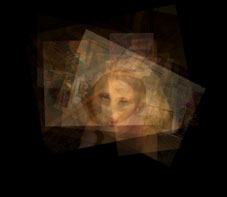
obJet?s material consists entirely of low-resolution free porn pictures. This porn ?objet trouve? was downloaded via the Internet by following dozens of spam emails that offered free pictures. Shortly after the collection of the material the account was terminated since due to the large amount of spam it was no longer manageable! The video proceeds formally by dramatically slowing down the frenetic rhythm of on screen intercourse encountered in porn movies through the use of a simple kind of animation: multiple layers of still images in soft pendulum motion. The animation generates a perpetual emergence of dislocated body parts and figures which surface in the midst of a binding, ondulating confusion only to be swallowed by the next wave of images. The superposition of images conceals as much as it reveals. Only the emerging slices of faces and bodies suggest a, multilayered reality invisible to the naked eye.
Video artist trapped inside the body of a musician. Working on static overlays of digital trash and other digital found material (through internet or broadcasts) combined with live sound or silence. Also active in the experimental music field as a cellist and video artist.
Javiera Veliz, -
Catalogue : 2020Vivir allì no es el infierno, es el fuego del desierto. La plenitud de la vida que quedó ahí como un árbol | Documentary | hdv | color | 58:34 | Chile | 2018
Javiera Veliz, -
Vivir allì no es el infierno, es el fuego del desierto. La plenitud de la vida que quedó ahí como un árbol
Documentary | hdv | color | 58:34 | Chile | 2018
Le vent, les oiseaux, la sueur, les mains, un chariot, la sécheresse et le sable. Sera t-il possible de disparaître dans le désert? Totoral est un village qui disparaît dans ses propres collines. Un lieu enraciné à la terre, à ses animaux et à la survie. Le désert change en permanence. Les arbres sèchent et les hommes, en compagnie de ses animaux, effacent leur traces ainsi que le passage du temps.
Javiera was born in 1986 in Copiapo, Chile, Where she stu- died visual arts and cinema. In 2009 she founded Pocilga Productions with Bárbara Pestan. In 2013 she studied in EICTV, Cuba. In 2015 she studied a Master’s in Direction of Photography at Escac, Spain. She`d realized several works as producer and DOP. “Living there...” her`s first film as director has it ?s interna- tional premiere in Cinema du réel where she won Tenk`s Prize. Actually she`s producing “To see is an act“ and realizing her second film “Marine water”.
Vangjush Vellahu
Catalogue : 2023Land X | Experimental video | 4k | color | 23:41 | Albania, Somalia | 2022
Vangjush Vellahu
Land X
Experimental video | 4k | color | 23:41 | Albania, Somalia | 2022
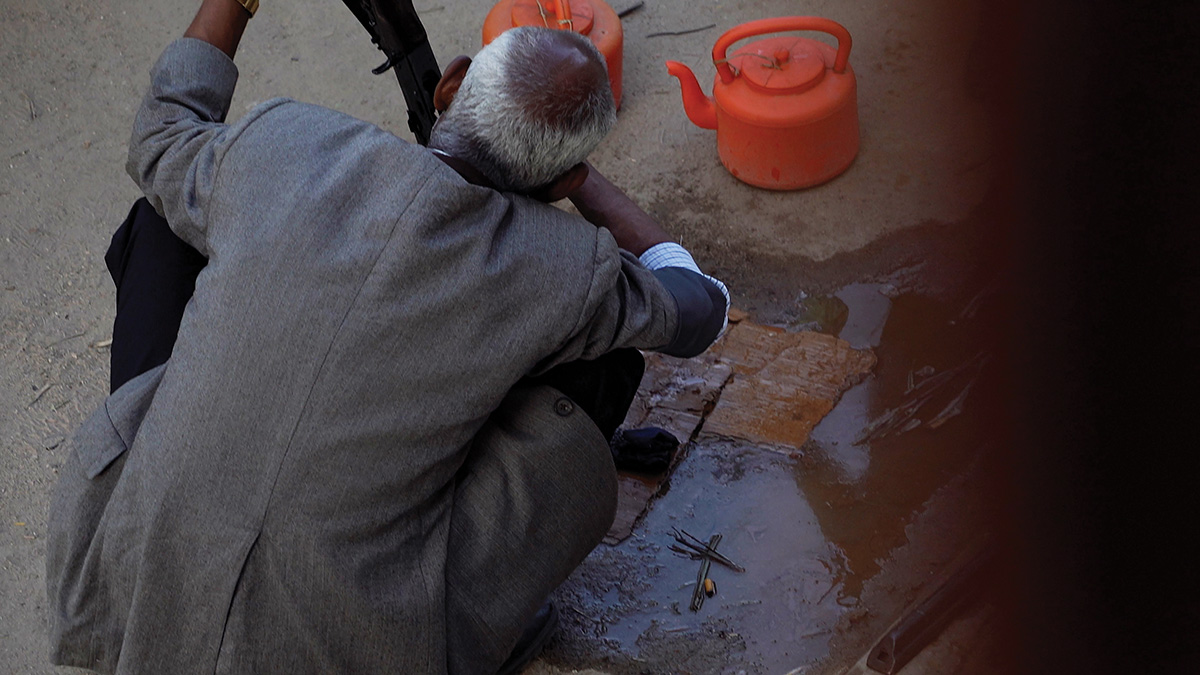
This video was filmed in February 2022 from one of the rooms at Oriental Hotel in the city center of Hargeisa, interfering in a way in between the two opposing positions to a place that it is being referred to as fictional and real at the same time. -Position One: I was never here and therefore I never filmed this video, these images don't exist because this place doesn't, the hotel, the buildings around, the people and that military entity. The filming took place entirely somewhere else. -Position Two: I certainly was here and therefore I certainly filmed this video, these images do exist because this place does, the hotel, the buildings around, the people and that military entity. The filming took place entirely in Somaliland. Both of this positions emphasize two points of political actions, one being exterior and the other interior.
Vangjush Vellahu born in 1987 in Pogradec, Albania, lives and works between Berlin and Tirana.
Catalogue : 2021A Tool of Resistance | Video | hdv | color | 29:55 | Albania, Germany | 2020
Vangjush Vellahu
A Tool of Resistance
Video | hdv | color | 29:55 | Albania, Germany | 2020
This two channel video installation is an introduction to what is happening in the West Bank, between Palestinians and the Israeli army. This video installation is designed to narrate the everyday reality of the Palestinians at large through the micro example of the city of Hebron and its resistance to the Israeli army. In order to be able to develop this narrative, the artist traveled to the region, where he came into contact with Human Rights Defenders, a local group who makes use of the camera and video footage as a tool of peaceful resistance. This video installation contains mostly footage filmed by the artist but includes also other archival materials, allowing this way an insight into the Palestinian history and reality. The work explores the role and nature of the camera and video especially in situations of conflicts and oppressions. This work is part of the ongoing series called "Fragments" that he has made, since 2015, in different territories affected by long years of frozen conflicts.
Vangjush Vellahu was born in 1987 in Pogradec, Albania and currently lives and works between Tirana and Berlin. In his work he is interested in travel as a medium to collect and tell stories. His works intertwine urban histories of entities that from an ideological and political stand point remain on the margins of recognition. In 2018 he published his first travelogue “Fragments I - Where stories cut across the land” that came along with his video solo show with the same title. His works have been exhibited, among others at: Times Art Center, Berlin, DE; Museu d´Història de Catalunya, Barcelona, ES; Museum of Modern and Contemporary Art, Rijeka, HR; Škuc Gallery, Ljubljana, SI; Hamburger Bahnhof, Berlin, DE; State Museum of Contemporary Art, Thessaloniki, GR; Museum of Contemporary Art, Acri, IT; National Gallery of Arts, Tirana, AL; National Historical Museum, Tirana, AL; National Gallery, Prague, CZ; etc.
Dimitri Venkov
Catalogue : 2017Krisis | Experimental doc. | 4k | color | 32:26 | Russia | 2016
Dimitri Venkov
Krisis
Experimental doc. | 4k | color | 32:26 | Russia | 2016
The video Krisis is a reenactment of a facebook discussion among Russian and Ukrainian artists, which took place in December 2013 upon the tear-down of the statue of Lenin in Kiev during the early stages of the Maidan protests. The discussion unfolds at a pivoting point in modern history. In fact, it occurs at the very moment when History bursts into the scene as a force surpassing individual actors and dragging them into its course in an indefinite capacity somewhere between that of a witness and participant. Krisis should also be understood here as trial or judgment, where twelve jurors debate the meaning of the historical event but fail to pass a verdict. Just as with Pilate’s judgment of Jesus, the decision is not reached and the trial takes on “a continuous and implacable course, an incessant passing and progress through time.” The historical crisis is bound to last like trauma in psychoanalysis: separated from its original context, it reappears in pathological forms in every sphere and at every moment. Structurally and thematically it is a remake of the Sidney Lumet film “Twelve Angry Men.” This classic is an idealized image of the American democracy based on inclusiveness. In the film Krisis the situation is reversed: although the characters belong to the same circle or community, their positions are irreconcilable and mutually exclusive thus making a compromise impossible. There is no way out of this argument but to split apart. The film Krisis plays out a metaphor of a society divided by history, politics, and aesthetics. New challenges further polarize it and augment its internal contradictions revealing a crisis as a state of imminent threat that the society presents for itself.
Dimitri Venkov (born 1980) is a video artist and filmmaker working across art, film, and academic institutional contexts. His works have been presented at Vth Moscow Biennale, First Bergen Assembly, Hayward Gallery, Kino der Kunst, Documenta 14,Oberhausen and Moscow Film Festivals, and others. In 2012 he received the Young Artist Kandinsky Prize for his film Mad Mimes. He was nominated for the Moscow Innovation Prize and St. Petersburg Kuryokhin Prize. Dimitri is a professor of videoart at Moscow Rodchenko School of Photography and Multimedia and has lectured at Yale University, Moscow State University, Moscow Art and Multimedia Museum.
Devis Venturelli
Catalogue : 2019Unframed | Video | hdv | color | 4:22 | Italy | 2018
Devis Venturelli
Unframed
Video | hdv | color | 4:22 | Italy | 2018
In "Unframed", the city is object of observation from inside a nebula black, floating, cavernous, mysterious. As in the depths of a primordial cave, the urban overview is fragmented in a collage-city in form of video. The drone unveils the Milan urban fabric with its patterns, grains and densities: from historical city emerges a new contemporary skyline. "Unframed" investigates the possibility to create images with mobile and fluid outline, an aerial view, sinuous and oscillating, in an incessant fluctuation. "Unframed" documents the odeporic approach of the contemporary culture in which the perception is an idiomatic overview.
Born 1974 in Faenza, Italy. He lives and works in Milan, Italy. Multi-disciplinary artist and architect, in his practice he uses the languages of video, performance, sculpture and installation to document ephemeral architectures and temporary utopias. He has taken part in solo and group shows in institutions such as Lincoln Center for the Performing Arts, New York; Antology Film Archive, New York; PAC, Milan; Medialab-Prado, Madrid; Museo de Arte, Lima; Xinjiang Biennale; MACRO, Rome; Kulturhuset Museum, Stockholm; MMOMA - Moscow Museum of Modern Art, Moscow; Ace Gallery, Los Angeles; Angel Orensanz Foundation, New York; Istituto Italiano di Cultura, Amsterdam; Spazio Oberdan, Milan; Fondazione Sandretto Re Rebaudengo, Turin; Kunsthalle, Wien; Stadtgalerie, Kiel; Centre d'Art Santa Monica, Barcelona; Fondazione Merz, Turin; Kunstverein, Augsburg; National Museum, Wroclaw; Mart - Galleria Civica, Trento; Galleria Nazionale d'Arte Moderna, Rome. In 2013 he presented the film project Luciano Berio/Devis Venturelli/Tempo Reale. In My End is My Music produced by Fondazione Romaeuropa. His videos and experimental films have been screened in International Film Festivals including Dance on Camera Festival, Videoformes, 25FPS Experimental Film Festival, FIVA - Festival Internacional de Video Arte, Romaeuropa Festival, Tehran International Short Film Festival, Regensburg International Short Film Week, New Filmakers NY.
Borjana Ventzislavova
Catalogue : 2022Gesellschaftsspiele | Video | hdv | color | 15:55 | Austria | 2021
Borjana Ventzislavova
Gesellschaftsspiele
Video | hdv | color | 15:55 | Austria | 2021
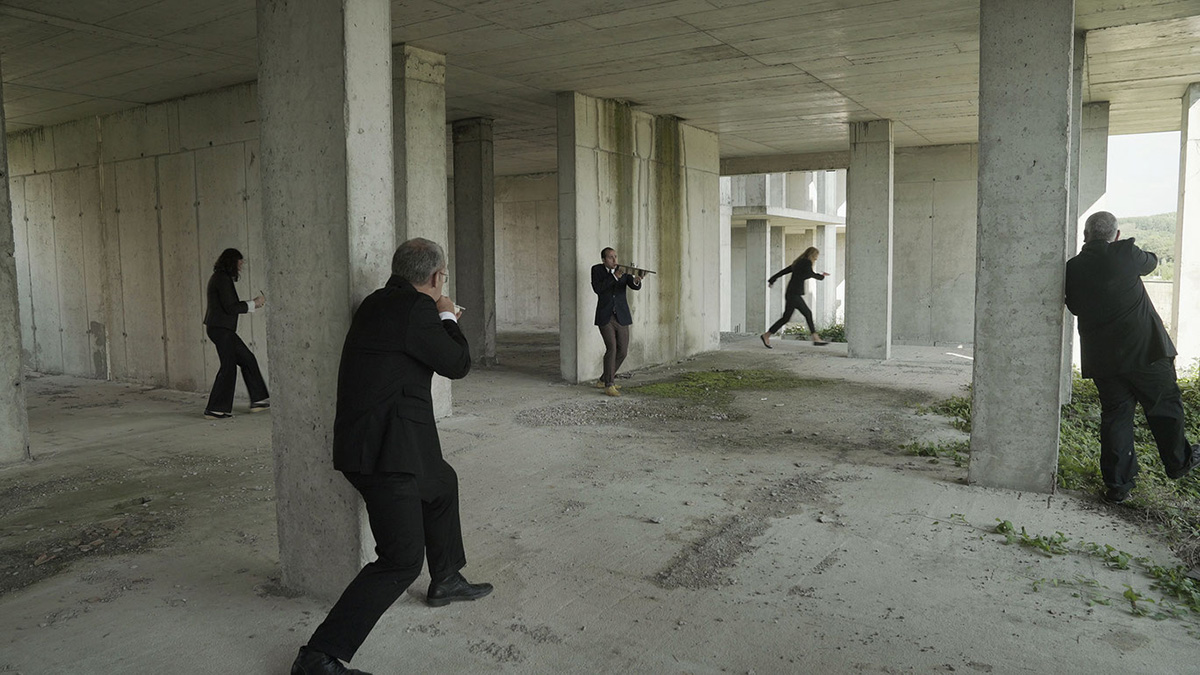
Games are generally defined through agreements—rules, within the framework of which, a certain degree of freedom reigns, but also compelling constraints. Many of these conventions are not explicitly identified as such, for example, how earnest one should be, or how much inner distance to keep. And a game does not at all define the more precise (individual, social, etc.) characteristics that participants should display in order to be among the players. For that reason, it is incredibly perplexing to see the adults in Borjana Ventzislavova’s Gesellschaftsspiele / Real Games in relations of play that we generally dismiss as puerile. In clever montages with players who appear deliberately misplaced or “miscast,” the film expands five of these contexts; or rather, interlocks them in such a way that we are rendered witnesses to an uncanny alienation. The nursery rhymes recited with a wink of the eye at the start are merely gentle harbingers of the dead serious shooting game with blowpipe arrows played by a group of sophisticated ladies and gentlemen in the concrete column foundation of a massive building shell. No less ambiguous is the cops and robber game that adult, suit-wearing players engage in around a monumental memorial in Sofia. And another game that’s not so bad is the acrobatic Chinese jump rope enjoyed by three smartly dressed women in a closed school yard. Entirely enigmatic, on the contrary, is a group wearing only underwear who pursue an odd ritual around a quartz lamp sculpture in the film’s sole interior space—until it turns out that what they’re doing is nothing other (or perhaps entirely different) than a simple Ring-Around-The-Rosey. The film’s transfiguration and simultaneous unmasking, has a double effect: on the one hand, as recognition that even the most casual activities are controlled by some type of role playing; and on the other—which is perhaps even more sobering—that their symbolic contexts withstand even the cleverest infiltrations. Whereby freedom and compulsion can even boil down to one and the same thing at times. And that is, no least, what the “real” aims at; uncatchable, as it were, these revealing and at the same time enigmatic games. (Christian Höller)
Born 1976, Sofia, BG, currently based in Vienna and Sofia; graduated visual media art / digital art at the University for applied arts Vienna. She works in the fields of film/ video, photography, installation and new media. Her works have been exhibited internationally in solo and group shows as well at film and media art festivals.
Mario Verandi
Catalogue : 2007Klang-Film | Experimental doc. | dv | black and white | 12:12 | Argentina, Germany | 2005
Mario Verandi
Klang-Film
Experimental doc. | dv | black and white | 12:12 | Argentina, Germany | 2005
"La Sortie des Usines Lumière à Lyon" (1895), was the title of the first cinema film ever shown in public. For 45 seconds, this film depicts workers leaving a photographic factory owned by the brothers Lumière in Lyon. In his film "Arbeiter verlassen die Fabrik", Harun Farocki explores this scene right through the history of film. For the creation of "Klang-Film", Farocki's film was re-edited into a shorter version. Most of the spoken texts were edited out, so that only a few were left. Therefore the film essentially became a silent movie. This allowed the incorporation of music as a new and influential shaping element which opens up a new dimension for the perception of the images. "Klang-Film" explores the sensory counterpoint of sounds and images and their interaction, ambiguity, and friction. How does certain music shape the perception of images? How do images shape the perception of certain music? In his book "Audio-Vision: Sound on Screen", Michel Chion suggests that sound and image are always independent, it is simply our conditioning and use of conventions of synchronization that make us believe that they are not. The French filmmaker Robert Bresson provides us with an illuminating metaphor: "Images and sounds, like strangers who make acquaintance on a journey and afterwards cannot separate".
Mario Verandi was born in Buenos Aires in 1960. He studied music in Argentina, Barcelona, and at the University of Birmingham, England. Verandi's works include electro-acoustic music and audiovisual pieces as well as sound installations and radiophonic works. He was composer-in-residence at La Muse en Circuit (Paris), the Césaré Studio (Reims), TU-studios Berlin, ZKM (Karlsruhe) and a guest of the 2000 Berlin artists-in-residence program. Verandi's awards include the Bourges Electroacoustic Music Competition (France), Musica Nova Competition (Prague), CIEJ Electronic Music Awards (Barcelona), Prix Ars Electronica (Linz), Stockholm Electronic Art Awards (Sweden), and ZKM European Bell Days Commission Prize (Germany). His works have been performed and broadcast worldwide. Harun Farocki was born in 1944 in in Nová Jicin (Neutitschein), in German-annexed Czechoslovakia. He attended the Deutsche Film- und Fernsehakademie Berlin (DFFB) from 1966-68. After having held teaching posts in Berlin, Düsseldorf, Hamburg, Manila, Munich, and Stuttgart, Farocki took up a visiting professorship at the University of California, Berkeley, from 1993-1999. Farocki has made close to 90 films, including three feature films, essay films and documentaries.
Bas Verbruggen
Catalogue : 2021Environs | Experimental film | 4k | color | 17:45 | Belgium | 2020
Bas Verbruggen
Environs
Experimental film | 4k | color | 17:45 | Belgium | 2020
In a deserted landscape where animals are affected by a distant rumble, a character emerges. Sinking deeper into the auditive world, sounds start to vibrate, time slowly loses its function and a storm rises. The character listens carefully as a dark tower seems to absorb his sonorous memories.
Bas Verbruggen (1997, Antwerp) started studying film at the KASK school of arts in Ghent, where he completed his master's degree in september 2020 with the film Environs. He is fascinated by absurd shapes in the everyday (Belgian) landscape, focuses on the experience of sound in cinema and usually makes his films individually and always from an audiovisual investigative point of view.
Matthieu Verdeil, Dominique POUPARDIN, Jérémie VAN QUYNH
Catalogue : 2021Dans l’armure d’Abraham | Experimental film | mov | color | 60:0 | France | 2020
Matthieu Verdeil, Dominique POUPARDIN, Jérémie VAN QUYNH
Dans l’armure d’Abraham
Experimental film | mov | color | 60:0 | France | 2020
Dressed in heavy medieval armour, Abraham crosses Brittany on foot, like a 21st century Don Quixote. Travelling through fields and forests, towns and villages, this anachronistic and wacky knight is astonishing to those who cross his path. He is accompanied on his journey by the director, his Sancho Panza, in front and behind the camera. Together, they wander around, accepting the food and lodging offered to them, or bivouacking under the stars. Little by little, Abraham loses his footing. His armour becomes his Dulcinea. Absorbed by his work, the artist finally disappears behind the character he has created. Only a knight errant on a foolish quest remains.
Since 1997, Matthieu Verdeil has been working with numerous production companies for television, communication, institutions and the web. Mainly as a cinematographer, but also in directing and editing. His experience is very varied with all types of services, from very big live events to the report alone in unknown lands, through TV magazines, documentaries... He has made commissioned films for the MuCEM, the Friche Belle de Mai, the National Center for Plastic Arts, KLAP-maison pour la danse, the Palais de Tokyo, the CIRVA international research center on glass and plastic arts...
Matthew Verdon
Catalogue : 2018Hyperthermia | Video | hdv | color | 11:39 | Australia, United Kingdom | 2016
Matthew Verdon
Hyperthermia
Video | hdv | color | 11:39 | Australia, United Kingdom | 2016
Thermoregulation is the maintenance of a particular temperature regardless of changes in the surrounding environment. This is a dynamic process responding to both external and internal stimuli. Hyperthermia is the reaction to an increased temperature where the human body produces more heat than it dissipates. The physiological effects of such a breakdown in temperature regulation can lead to the malfunctioning of other systems. Museum collections are maintained at particular environmental conditions to prolong the life of the objects they contain. Computer server farms or data centres are run at optimal temperatures to increase the efficiency of the servers that store vast quantities of information. The work highlights the role climate and temperature play in the preservation of knowledge and the maintenance of operational efficiency. Whilst each system has their ideal temperatures in terms of function and lifespan, we live in a world of climate change where thermoregulation and physiological adaptation are increasingly at stake.
Matthew Verdon was born in Brisbane, Australia, and currently lives/works in London. After completing studies in agricultural science and art, he has exhibited widely both throughout the United Kingdom and internationally.
Catalogue : 2015Water finds its own level | Video | hdv | color | 10:17 | Australia | 2013
Matthew Verdon
Water finds its own level
Video | hdv | color | 10:17 | Australia | 2013
The work questions the conflation of abstractions such as economic growth and finance with organic natural processes. We hear of flows of capital and liquid assets, but can such dematerialised entities be equated with the movement of water that inherently acts under the influence of natural laws and gravity? Here nature is utilised in an attempt to give monetary concepts and mechanisms a form of naturalised comprehensibility, but perhaps both operate in fundamentally differing ways. This is highlighted in the work through featuring varying uses of running water in relation to accumulation and change over time. Ranging from a biomorphic corporate bank building surrounded by traditional water gardens, to cotton irrigation and fluctuating commodity prices, to a subversion of a Richard Serra’s 1968 film “Hand catching lead”, natural, historical and cultural references are appropriated in order to create a narrative that examines an equation that seems somewhat ubiquitous today.
2013 Les Rencontres Internationales, Haus der Kulturen der Welt, Berlin, Germany Ghost Town, Saison Video, Lille, France 2012 Les Rencontres Internationales, Palais de Tokyo, Paris, France PVM-2130, Furnished Space, London, UK Oriel Davies Open, Oriel Davies Gallery, Newtown, Powys, UK The Lewton Bus: Coming Soon & Conditions, Shortwave Cinema & Vitrine Gallery, London, UK 2011 Open, New Gallery, London, UK Video Guerrilha, Sao Paolo, Brazil Hors Pistes, Pompidou Center, Paris, France 2010 All that glitters is NOT institution, Whitechapel Gallery, London, UK Pop-up Show, The Old Police Station, London, UK Art / Value / Currency Part 2, Eastern District, Brooklyn, New York, USA Images Contre Nature, Theatre des Chartreux, Marseille, France agency, The Agency Gallery, London, UK Saison Video, Espace Croise, Lille, France The Pursuit of Happiness, Arsenal Gallery, Poznan, Poland 2009 Art / Value / Currency, The Pigeon Wing, London, UK The Pursuit of Happiness, This Is Not A Gateway Festival, Kobi Nazrul Centre, London, UK 2007 Visual Deflections, The Roxy Screen, London, UK Punk, Ada Street Gallery, London, UK & Rote Flora / Galerie Lecocon, Hamburg, Germany
Catalogue : 2014Hugelkultur | Video | hdv | color and b&w | 9:30 | Australia, United Kingdom | 2013
Matthew Verdon
Hugelkultur
Video | hdv | color and b&w | 9:30 | Australia, United Kingdom | 2013
In 1963 a spiral staircase was built in Salvador, Brazil, by the architect Lina Bo Bardi as part of the transformation of an old mill into a museum of modern art. The design of this staircase was based on a vernacular technique for making ox cart wheels. The agricultural practice of hugelkultur involves burying large pieces of old wood that rot over time and subsequently become rich fertiliser, providing enhanced growing conditions for the roots of new plantings. A spoken narrative describes the proposed renovation of an old room in need of repair into a new room of unspecified end uses. Such varying but related notions of material transformation and adaptive re-use are featured in the present work as ways of thinking about how the ?new? is produced and the relationship of such production to the already existent. Featuring filmed, found and hand drawn footage, the video is based upon the idea of a spiral staircase, this being utilised for not only its content but also its form through the structural use of evolving repetitions and loops. The work draws on plant science, architecture and speculation to arrive at a questioning of function, progress and growth.
Born: Brisbane, Australia Lives & Works: London, United Kingdom
Catalogue : 2013One thing after another | Video | dv | color | 8:34 | Australia, United Kingdom | 2012
Matthew Verdon
One thing after another
Video | dv | color | 8:34 | Australia, United Kingdom | 2012
The work juxtaposes close up images of an ageing Donald Judd sculpture with a dialogue about biological adaptation, function and vestigial structures. The film appropriates the Judd piece that is said to exist in a place somewhere between art and architecture, but a full view is never shown, just upward looking shots of details and the effects of time and nature upon it that increase in frequency as the film progresses. The treatment of the Judd sculpture transforms it from a formal to a representational structure, becoming a questioning not just of the original, but also of function, the inherent qualities of physical and historical structures and permanence or resistance to change. The editing of the film also gradually develops along with the narrative, thus embodying structural adaptation whilst discussing it. The viewer is then left with questions of temporality and change, be it artistic, social, biological, historical or structural, of what something was, what it is now and what it might become.
Matthew Verdon?s practice deals with man made structures and constructs, challenging and questioning them as an attempt to understand social systems and processes that are in constant flux. Change is an unavoidable part of life, the question is how do we deal with it. Utilising past and vernacular structures, Verdon transforms them with notions of the present to speculate, experiment and adapt in order to think about the nature of things and objects in the world, how we shape them and how they shape us. The outcomes of his practice usually take the form of video, collage and small to medium scale objects. Verdon was born in Brisbane, Australia, and presently lives and works in London. He has studied at Chelsea College of Art, London and Goldsmiths College, London. He has exhibited widely both throughout the United Kingdom and internationally, with recent exhibitions including The Object as Image at Kunsthalle Exnergasse, Vienna (2012), An Exchange with Sol Lewitt, MASS MOCA, Massachusetts, USA (2011), Hors Pistes, Pompidou Centre, Paris (2011), All that glitters is not institution, Whitechapel Gallery, London (2010), and Madrid Abierto, La Casa Encendida & Spanish National Radio, Madrid (2010).
Snear Vered
Catalogue : 2018Crack the Window | Video | hdv | color | 17:40 | USA | 2016
Snear Vered
Crack the Window
Video | hdv | color | 17:40 | USA | 2016
In this work, I appropriate user tutorials as a genre in order to investigate the relationship between technology and culture. The work presents a teenage vlogger instructing how to use a fictive app.With media increasingly becoming more life-like and life increasingly adapting the logic of media, sleek interfaces of operating systems, internet browsers, and websites makes it difficult to stop, identify, and think critically about how these things actually structure and monopolize our experience, despite the misleading empowerment of “ user-generated content ” or “ customizable ” options. I am interested in interrupting this seemingly closer getting circuit and seeking not only to deconstruct the formal and instrumental aspects of Internet browsing, but also the identities that are constructed with and within it.
Vered Snear (b. Israel 1982) is an artist based in Toronto and Tel Aviv. Recent group exhibitions include: Superpositions, 21st Biennale of Sydney (in collaboration with Brook Andrew), Museum of Contemporary Art, Sydney (2018); Bronx Calling: The Fourth AIM Biennial, The Bronx Museum of the Arts, New York (2017); I can because you do, Participant Inc, New York (2016); Universum, The International Photography Festival, Jaffa, Israel (2016). Snear was a NYC Art + Law Fellow (2016) and part of the AIM Program, Bronx Museum (2017). She has undertaken residencies at Banff Centre, Canada (2016), MASS MoCA (2018), Vermont Studio Center (2018), and UNSW Art + Design, Australia (2018). Research-based artist Vered Snear investigates the role of visual and textual language to explore intricate relationships between media and ideology. Through her practice, she aims to challenge dominant narratives and representation as a tool that articulates subjectivities, affects, and desires. Working predominantly in video, installation, photography, and sculpture, Snear uses a combination of text and imagery from archives, television, video-sharing and social media that she reworks into fictional scenarios. These fictions hold the potential to create a space of re-imagination and agency.
Pablo Vergara Escalona
Katja Verheul
Catalogue : 2026Red Dust | Experimental doc. | dcp | color | 17:9 | Netherlands, France | 2024
Katja Verheul
Red Dust
Experimental doc. | dcp | color | 17:9 | Netherlands, France | 2024
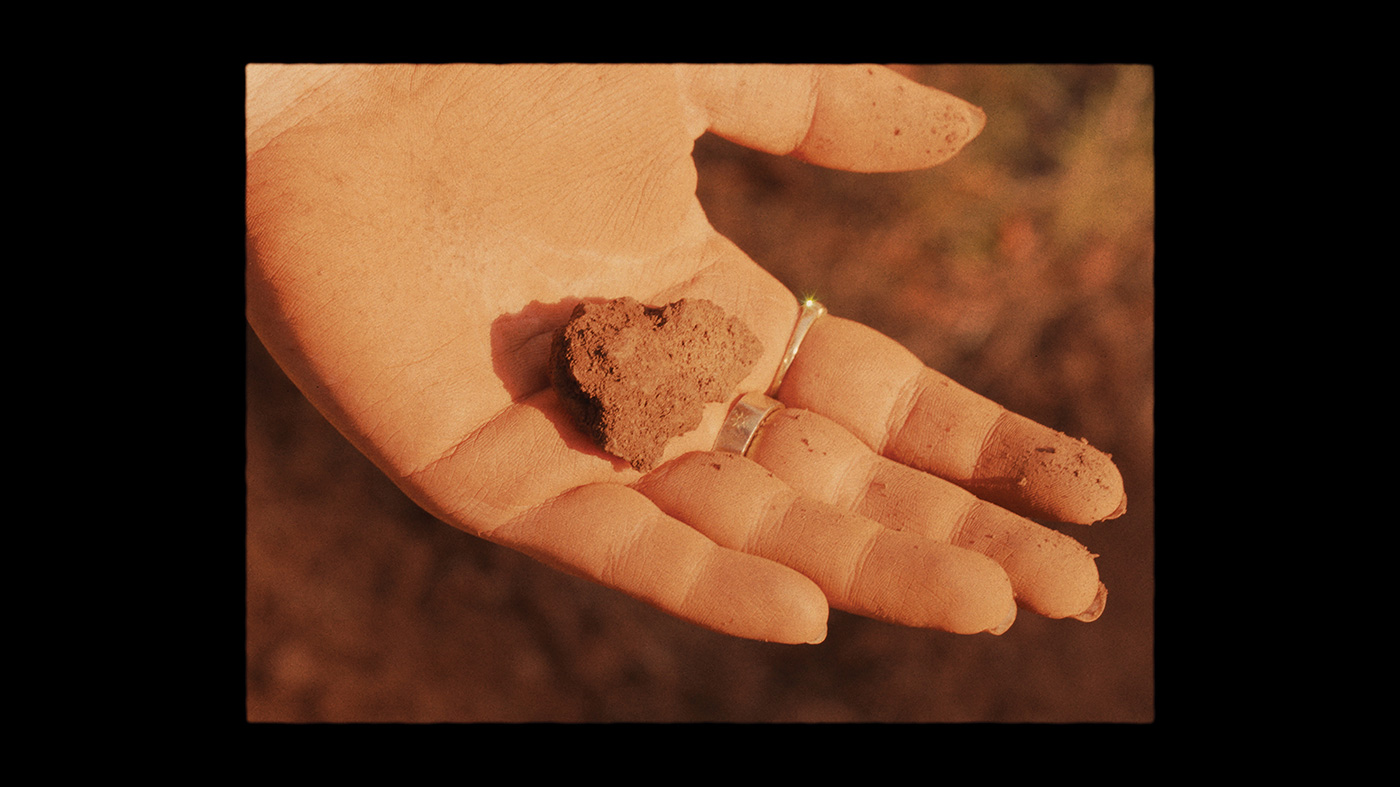
A couple of times a year, the sky turns red in France. Sand dust from the Sahara is passed through a difference in air pressure from North Africa to Southern Europe. This dust, a time capsule containing cesium-137 from the French nuclear tests in Algeria, covers everything. The film exposes the impact of a war that was never fought. A French veteran and an archeology student share and speculate on what will be remembered and what will be hidden under the sand forever.
I am a filmmaker and artistic archeologist based in Rotterdam (NL). I graduated with a BFA in Audio-Visual Arts from Gerrit Rietveld Academie (NL) in 2012 and a MFA in Fine Arts from Goldsmiths University (UK) in 2016. I believe in the revealing value of long-term research. The deep dive into complex matter is an important part of my work process. With my films I want to make complex (invisible) social, political and economical issues visible. My work often arises from the question; what remains after a war and what is the impact of these remains on people and nature? I am working as an artistic archeologist digging through our most recent history. Before it is nostalgic, before it is a story that lies generations before us. Not only to demystify, but to make the mediated and almost historicized and perhaps forgotten reality personal again. I was a resident at the Jan van Eyck Academie (2018-2019), Visio - European Program on Artists Moving Images (2018), Film Forward (2020-2021) and Rotterdam Writers' Rooms (2024). I have shown my films at IFFR, Visions du Réel, Eye Filmmuseum, Kasseler Dokfest, Dokufest, Ji.hlava IDFF, LeGuessWho?, Sharjah Art Foundation, Nederlands Film Festival, Art Rotterdam, MAXXI Museum and on Dutch television, among others.
Iris Verhoeyen
Catalogue : 2006deux hectares | Documentary | dv | color | 14:0 | Belgium | 2004
Iris Verhoeyen
deux hectares
Documentary | dv | color | 14:0 | Belgium | 2004
A deux pas de la gare du Nord de Bruxelles se trouve le quartier Gaucheret. `Deux hectares` presente les problemes auxquels ce quartier et ses habitants sont confrontés depuis quarante ans et qui se posent une nouvelle fois à eux aujourd`hui. Comment survivre dans l`ombre de la plus grosse erreur d`urbanisme jamais vue a Bruxelles: le quartier Manhattan ?
Resem Verkron, Marc Serena
Catalogue : 2026AS AVENTURAS DO ANGOSAT | Fiction | mov | color | 35:0 | Angola | 2025
Resem Verkron, Marc Serena
AS AVENTURAS DO ANGOSAT
Fiction | mov | color | 35:0 | Angola | 2025
In 2017 Angola launched its first satellite into space… and it was shortly declared lost. As Aventuras do Angosat is thed dream born from that frustrated endeavour, in the form of a musical film written and performed by Isis Hembe, one of the leading names in Angolan urban music, here transformed into Man Ré. Filmed in a single take in the Cazenga district of Luanda with new emerging talents.
Resem Verkron (1999) is part of two leading prominent cultural movements in Luanda: the urban art collective Verkron Collective and Geração 80. His debut short, Lola & Mami (2021), explored toxic masculinity. Marc Serena (1983) codirected the award-winning documentary Tchindas (2015), broadcast on PBS in the United States. His feature El escritor de un país sin librerías premiered at l’Alternativa and won a DIG Award for outstanding European investigative journalism.
Katleen Vermeir, Ronny HEIREMANS
Catalogue : 2011The Good Life | 0 | dv | color | 16:0 | Belgium | 2009
Katleen Vermeir, Ronny HEIREMANS
The Good Life
0 | dv | color | 16:0 | Belgium | 2009
In the background technicians are installing a prestigious exhibition,whilst a smartly dressed lady is guiding a group of people around a series of pristine white spaces, some of them filled with crates and wrapped-up paintings. Along the way she not only comments on the art but also reveals the building to her audience from a unique perspective. Describing interiors, great views and the city?s vibrant opportunities, the lady turns out to be an estate agent who is selling an up-market architectural proposal and a lifestyle that grafts the ?value? of art with its institutions. Moving through the labyrinthine building, she finds herself lost in narrow corridors and staircases. Meanwhile the future development projects itself into the group?s collective imagination, fed by the visionary architectural model on display. ?The Good Life (a guided tour)? redefines our perception of the art institution and raises our awareness of its part in the ?creative city?, a scenario that is being played out in metropoles around the globe. The apparently ?neutral? frame of the gallery space which envelopes the spiritual and cultural heritage of our society, recedes in favour of that of a real estate opportunity. The estate agent is the embodiment of the denial of any possible negative impact that the creative race between cities in a neo-liberal context might generate. Through a generic language that excludes any notion of ?gentrification?, her hyperbolic tour creates an exclusive identity. The film?s elaborate treatment of sound ? as well as the absence of it ? disrupts the untenable perfection of the architecture, and its mediated forms, making the emptiness of the building sensible, which actually is what the estate agent is selling: a lifestyle fantasy projected on an empty shell. ?The Good Life (a guided tour)? is an autonomous single screen video piece that can be presented either in an exhibition or screening context. In its first presentation the video functioned as a ?marketing tool? for a fictional real estate development ?The Good Life?, which was the title of the Vermeir/Heiremans solo exhibition at Arnolfini, Bristol (UK) in Spring 2009. The show was curated by Nav Haq.
Katleen Vermeir (Bornem 1973) works and lives in Brussels (BE) Education/international studio programs 1992-1996 Hogeschool voor Wetenschap en Kunst (painting), St.-Lukas, Ghent (BE) // 1996-1999 HISK, Antwerp (BE) // 1997 Germinations, Miscolc (HU) // 1997-1998 Academy for Fine Arts, Tianjin (CN) // 1999-2001 Ateliers 63, Amsterdam (NL) // 2001-2002 P.S.1, International Studio Program, New York (US) // 2004 Research & residency with Ronny Heiremans, New Mexico (US) // 2006 Platform Garanti, Istanbul (TR) // 2009-2010 CEAC, Xiamen (CN) // 2010 Theater In Motion (T.I.M.), Beijing (CN) Solo & duo shows 2010 LOOP (in collaboration with Ronny Heiremans), The Good Life (a guided tour) at LOOP Video Art Fair with Koraalberg Gallery, Barcelona (SP) // 2009 VIDEO LOUNGE (in collaboration with Ronny Heiremans), CEAC, Xiamen (CN) also featuring a commissioned screening program compiled by Vincent Meessen & Nav Haq // A.I.R extension #15 THE GOOD LIFE (in collaboration with Ronny Heiremans), Arnolfini Center of Contemporary Art, Bristol (UK) // THE PASSING OF A PERFECT DAY (REVISITED), Insert Katleen Vermeir, MuHKA, Antwerp (BE) // 2007 CONJONCTIONS (in collaboration with Ronny Heiremans), Piano Nobile, Geneva (CH) (also presenting Anouk De Clerck) // 2006 THE IDEAL CITY (CONSTRUCTION MODELS) Therese Dion Gallery, Montreal (CA) // A.I.R extension #01 (in collaboration with Ronny Heiremans) One-man show Art Brussels, Koraalberg Gallery, Brussels (BE) // 2005 THE PASSING OF A PERFECT DAY (for GM-C) Koraalberg Gallery, Antwerp (BE) // 2004 CADAVRE EXQUIS, (in collaboration with Ronny Heiremans) STUK, leuven (BE) // 2003 BIGG, (in collaboration with Francis Denys) UTIL, Brussels (BE) // 2002 PARAMOUNT BASICS (EXTENTED) (in collaboration with Ronny Heiremans), hosted by Richard Venlet and Netwerk at MuHKA, Antwerp (BE) // 2001 HORTUS CONCLUSUS, De Ateliers, Amsterdam (NL) // WHEN DID YOU LAST MOVE YOUR FURNITURE AROUND? (in collaboration with Ronny Heiremans), private apartment, Brussels (BE) // 2000 CIRCUITS, De Vierkante Zaal, Sint-Niklaas (BE) (also presenting Eva-Maria Bogaert) // CIAP hosted by Netwerk, Hasselt (BE) (also presenting Karel Breugelmans) // 1999 AMBULANTE ARCHITECTUUR, Netwerk, Aalst (BE)
Vermeir & Heiremans
Catalogue : 2019A Modest Proposal (in a Black Box) | Video | hdv | color | 28:7 | Belgium, United Kingdom | 2018
Vermeir & Heiremans
A Modest Proposal (in a Black Box)
Video | hdv | color | 28:7 | Belgium, United Kingdom | 2018
In A Modest Proposal, Vermeir & Heiremans are discussing a new financial model with a lawyer. They question if financialisation can be re-purposed towards generating a more equitable arts ecology. Considering the financialisation of public art collections and museum buildings, the financial model should benefit not only investors, but also its stakeholders, the creators of the art`s value, the art workers. The artists propose to financialise Pump House Gallery in Battersea Park as their case-study. It is located close to Battersea Power Station, a former coal-fired power station that will soon house Apple's London headquarters and luxury apartments. The artists propose to "pump" up the gallery`s value, and generate a return for the wider art community. The conversation between artists and lawyer takes place in Vermeir & Heiremans` house, which they define as an art work. Meanwhile the absent-minded lawyer`s assistant often slips away from the discussions. She appears to be able to materialise and dematerialise at will the lofty space by caressing the walls, playing with a scale model of the house or using the latter as a framing device, manipulating the window views. When the artists and the lawyer go on to celebrate the proposal on the loft's rooftop garden she takes control…
The videos and installations of the artist duo Vermeir & Heiremans investigate the complex relationship between economy, spatiality, and social reality in today's highly globalized world. The artists define their own house as an art work, which they use as a framing device to focus on the growing financialisation of the arts, real estate and daily life in general. The duo raises questions about the role the arts play within the ever-growing entanglement between urban development, financialisation and governing. The artists employ financial tools, historical references, technology, and cinematic language to reflect on social codes as well as on the production of value in today's artistic and non-artistic realms. Vermeir & Heiremans have presented their work at 10th Istanbul Biennial (2007), Arnolfini, Bristol (2009), Nam June Paik Art Center, Yongin (2010), Viennale, Vienna (2011), 7th Shenzhen Sculpture Biennial (2012), Manifesta 9, Limburg (2012), Argos, Brussels (2012), Extra City, Antwerp (2012), 13th Istanbul Biennale (2013), Rotwand Gallery, Zurich (2014), Triennale Brugge (2015), Dojima River Biennale, Osaka (2015), Curated by_Vienna at Georg Kargl Gallery (2015), Transmediale, Berlin (2016), Bucharest Biennale 7 (2016), Rencontres Internationales Paris/Berlin (2010, 2012, 2017), Glassyard Gallery, Budapest (2018), Art Brussels (2018), The Atlantic Project, Plymouth (2018), Pump House Gallery, London (2018)
Catalogue : 2017Masquerade | Experimental doc. | hdv | color | 51:1 | Belgium | 2015
Vermeir & Heiremans, Ronny Heiremans
Masquerade
Experimental doc. | hdv | color | 51:1 | Belgium | 2015
Katleen Vermeir and Ronny Heiremans observe human relations, which have become pure transactions, in an ironic critic of the cultural and investment funds sectors. Art, like finance, is a belief system. The Maison Des Artistes, defined like a work of art, becomes a financial instrument.
Since 2006 Ronny Heiremans and Katleen Vermeir have engaged in a long-term collaborative practice A.I.R (short for 'artist in residence'). A.I.R examines the dynamic relation between art, architecture and economy. Click here to continue to the A.I.R website: www.in-residence.be
Vermeir & Heiremans, Ronny Heiremans
Catalogue : 2019A Modest Proposal (in a Black Box) | Video | hdv | color | 28:7 | Belgium, United Kingdom | 2018
Vermeir & Heiremans
A Modest Proposal (in a Black Box)
Video | hdv | color | 28:7 | Belgium, United Kingdom | 2018
In A Modest Proposal, Vermeir & Heiremans are discussing a new financial model with a lawyer. They question if financialisation can be re-purposed towards generating a more equitable arts ecology. Considering the financialisation of public art collections and museum buildings, the financial model should benefit not only investors, but also its stakeholders, the creators of the art`s value, the art workers. The artists propose to financialise Pump House Gallery in Battersea Park as their case-study. It is located close to Battersea Power Station, a former coal-fired power station that will soon house Apple's London headquarters and luxury apartments. The artists propose to "pump" up the gallery`s value, and generate a return for the wider art community. The conversation between artists and lawyer takes place in Vermeir & Heiremans` house, which they define as an art work. Meanwhile the absent-minded lawyer`s assistant often slips away from the discussions. She appears to be able to materialise and dematerialise at will the lofty space by caressing the walls, playing with a scale model of the house or using the latter as a framing device, manipulating the window views. When the artists and the lawyer go on to celebrate the proposal on the loft's rooftop garden she takes control…
The videos and installations of the artist duo Vermeir & Heiremans investigate the complex relationship between economy, spatiality, and social reality in today's highly globalized world. The artists define their own house as an art work, which they use as a framing device to focus on the growing financialisation of the arts, real estate and daily life in general. The duo raises questions about the role the arts play within the ever-growing entanglement between urban development, financialisation and governing. The artists employ financial tools, historical references, technology, and cinematic language to reflect on social codes as well as on the production of value in today's artistic and non-artistic realms. Vermeir & Heiremans have presented their work at 10th Istanbul Biennial (2007), Arnolfini, Bristol (2009), Nam June Paik Art Center, Yongin (2010), Viennale, Vienna (2011), 7th Shenzhen Sculpture Biennial (2012), Manifesta 9, Limburg (2012), Argos, Brussels (2012), Extra City, Antwerp (2012), 13th Istanbul Biennale (2013), Rotwand Gallery, Zurich (2014), Triennale Brugge (2015), Dojima River Biennale, Osaka (2015), Curated by_Vienna at Georg Kargl Gallery (2015), Transmediale, Berlin (2016), Bucharest Biennale 7 (2016), Rencontres Internationales Paris/Berlin (2010, 2012, 2017), Glassyard Gallery, Budapest (2018), Art Brussels (2018), The Atlantic Project, Plymouth (2018), Pump House Gallery, London (2018)
Catalogue : 2017Masquerade | Experimental doc. | hdv | color | 51:1 | Belgium | 2015
Vermeir & Heiremans, Ronny Heiremans
Masquerade
Experimental doc. | hdv | color | 51:1 | Belgium | 2015
Katleen Vermeir and Ronny Heiremans observe human relations, which have become pure transactions, in an ironic critic of the cultural and investment funds sectors. Art, like finance, is a belief system. The Maison Des Artistes, defined like a work of art, becomes a financial instrument.
Since 2006 Ronny Heiremans and Katleen Vermeir have engaged in a long-term collaborative practice A.I.R (short for 'artist in residence'). A.I.R examines the dynamic relation between art, architecture and economy. Click here to continue to the A.I.R website: www.in-residence.be
Philip Vermeulen
Catalogue : 2026Chasing The Dot | Multimedia installation | 0 | color | 18:35 | Netherlands | 0
Philip Vermeulen
Chasing The Dot
Multimedia installation | 0 | color | 18:35 | Netherlands | 0
Chasing The Dot (2021-ongoing) is an immersive rollercoaster of light and colour, a sensorial plunge into the limits of perception. Within a vast, horizonless Ganzfeld space, the audience floats through storm-like fields of colour, blazing with indirect light, 1 million lumen waves carrying vivid after-images. At the centre of their gaze, a single floating point, he foveal dot, flares to life and remains fixed, no matter where the eye turns. Premiered at Rijksmuseum Twenthe, this installation explores stroboscopic thresholds and synaesthesia. Inspired by Brion Gysin’s cut-up technique, the meticulously crafted light score fragments and reassembles vision, prompting open-eye hallucinations. Viewers experience a sensory fusion, seeing with their ears and listening with their eyes. Every modulation of hue, frequency, and decay reveals the hidden architecture of consciousness, exposing its hinges and seams. The audio emerges directly from the humming, pulsing, and crackling of the powerful lights, intertwining seamlessly with the visual hallucinations. It sounds like a rhythmic, electric storm rich, textured, and hypnotically synchronized with waves of colour. Here, light becomes tangible matter. Perception transforms into choreographed dance, casting each viewer as co-author. The artwork completes itself when spectators close their eyes, creating private cinemas behind their eyelids. Chasing The Dot demonstrates how flexible our perception of reality truly is, highlighting how astonishingly fine tuned our brains are in creating consciousness.
Philip Vermeulen is a Dutch artist who explores the fundamentals of human perception. His installations are to be experienced with the whole body, while challenging the physicality of light and sound, movement and vibrations. Vermeulen experiments with a variety of elements including motion, light, sound compositions, physics, nature, and digital technology, creating hypersculptures that appeal to and trick the senses of the spectator. These kinetic works act as a catalyst, dissolving the boundaries between mind and material, creating new realms of imagination and challenging perspectives. His installations have been exhibited in museums such as Stedelijk Museum Amsterdam (NL), Stedelijk Museum Schiedam (NL), Rijksmuseum Twenthe (NL), Museum Voorlinden (Wassenaar, NL), Museum for International Light Art (Unna, DE), iMAL (Brussels, BE), Light Art Museum (Budapest, HU), Industrial Art Biennial (Labin, HR) and ART Rotterdam (NL). Works have also been featured at media festivals, including Sonic Acts (Amsterdam, NL), Ars Electronica (Linz, AT), Festival Interstice (Caen, FR), Mapping Festival (Geneva, CH), Novas Freque?ncias (Rio de Janeiro, BR) and CTM at Halle am Berghain (Berlin, DE). In 2024, Vermeulen will present his first large-scale solo exhibition Chasing The Dot at the Rijksmuseum Twenthe.
Catherine Vertige, Kosten KOPER
Catalogue : 2009sad in country, part 1 and 2 | Documentary | dv | color and b&w | 52:0 | Belgium | 2007
Catherine Vertige, Kosten KOPER
sad in country, part 1 and 2
Documentary | dv | color and b&w | 52:0 | Belgium | 2007
Belgium is a country noted for its `vagueness` and taking this into account, this pair of Belgian films delve into the world of `quasi` cultural forms. One of the vaguest notions in the cultural lexicon is that of the `collective` and these films explore collective art actions in Belgium and their intersection with dominant and subcultural political and cultural ideologies that brushed against them. A collaboration between Brussels based art historian Catherine Vertige & artist Kosten Koper, these films are neither an obituary for cultural idealism nor a bittersweet tale of lost Utopia but a series of encounters raising questions about the collective archetypes which emerged during research and shooting : ranging from the micro-institution to the orgy. ?Is it alive, or is it dead?? is what Resnais stated was the only question worth asking in art and this film uses its medium as a tool of research to consider the worth and the worthlessness of history. The collectives covered are : Agency (Brussels, 1992-), Building Underwood (Brussels / Caudiès, 1999-2001), VAGA, A379089 (Antwerp, 1968/69), Rona Family (Brussels, 1976), Club Moral (Antwerp, 1981-2005), Ruptz (Namur, 1975-1977), Soldes, Fin de Séries (Brussels, 1978-1982) and the collective work of Jacques Charlier (Leige, 1964-1980).
Catherine Vertige (b.1971) is an art historian and founding member of Brussels based contemporary art curatorial collective Komplot. Kosten Koper (b. 1970) is a fine artist, filmmaker, musician, electronic music publisher, curator and events organiser. He was a member of the group Diskono, which created situations and environments for the creative perception of music.
Iana & Joao Viana