Catalogue 2025-2026
Below, browse the 2025-2026 Rencontres Internationales catalogue, or search the archives of the works presented since 2004. New video clips are routinely posted and the images and text are regularly updated.
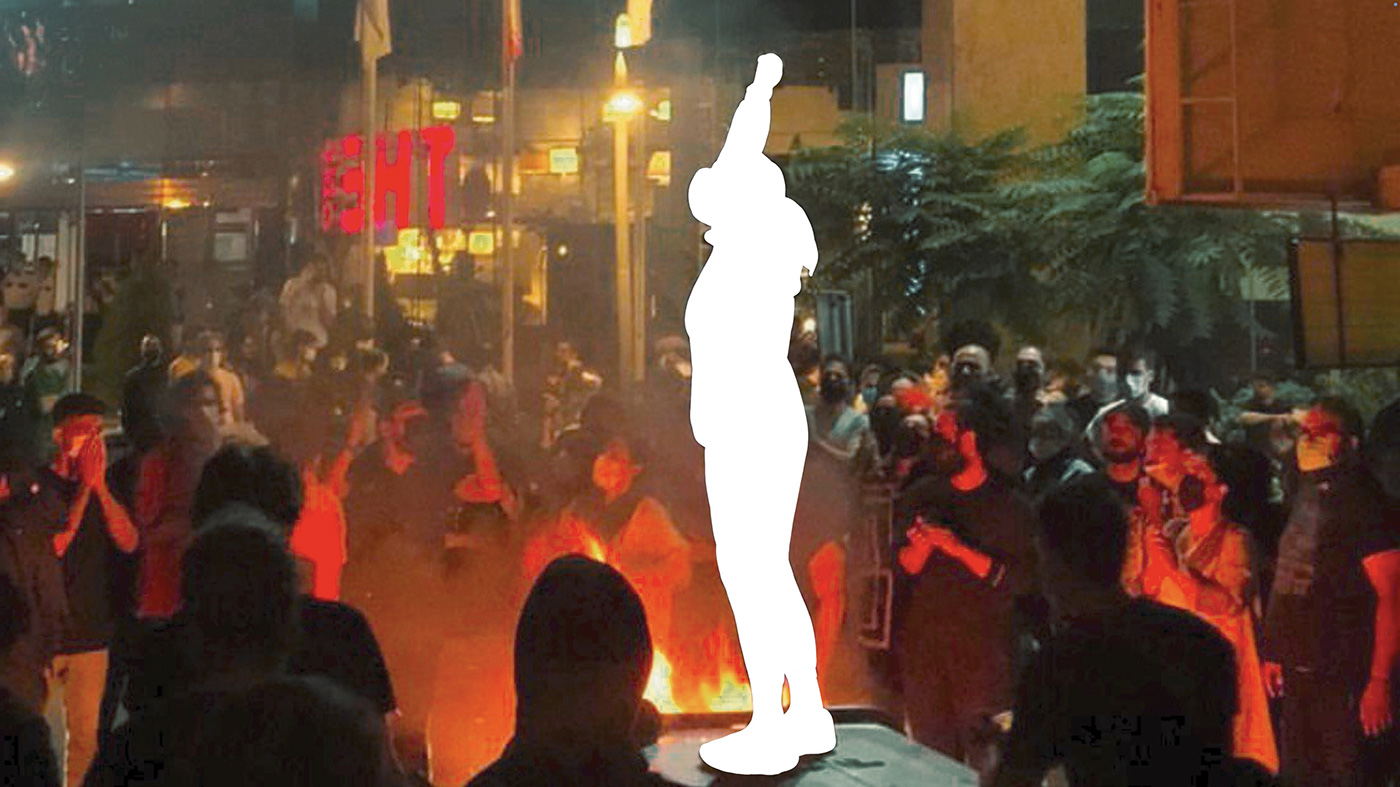

Atefeh Kheirabadi, Mehrad Sepahnia
Blind, Ins Auge
Experimental doc. | 0 | color and b&w | 19:47 | Iran, Germany | 2025
The deliberate shooting of protesters in the eye during the 2022-23 protests in Iran points to particularly perfidious systematic repression. A duo of Iranian filmmakers in exile in Berlin take this as a ground line and ask the question: “What happens when security forces aim at vision itself?” Based on this, they reconstruct narratives of images taken from social media during the protests. The film presents the search in the montage process, in which the filmmakers combine their distanced, subjective narrative with the images of the protest in order to examine the power of the images of the protest as a political construct.
Atefeh Kheirabadi and Mehrad Sepahnia are filmmakers whose work explores the relationship between politics, narration, images and sound. They are interested in how cinema can create spaces for resistance, rethinking, and collective reflection. They adopt a hybrid approach to creating films that defy conventional viewpoints and invite viewers to engage with content and Form by perceiving and feeling it. 2025: Blind, into the Eye (Director/Screenplay) | Prod.: Realillusion Doco-Experimental | 19' 38 “Funded by Medienboard Berlin Brandenburg and Hessen Film and Media 2023: Blick (Director/Screenplay) | Prod.: Realillusion | Doco-Experimental | 14' 27 “Funded by: Stipendium Bildende Kunst, BBK, Modul D, Neustart Kultur 2022: 7+1 Fragmente (Director/Screenplay) | Prod.: Realillusion |Experimental | 30' 00 “Supported by: Recherche Stipendium Bildende Kunst Berliner Senat für Kultur und Europa 2020: Come and Go (Director) | Prod.: Realillusion |Experimental |08' 28" 2017: Soma / Haoma (Director/Screenplay) | Prod.: Realillusion | Doco-Experimental | 26' 09'' 2013: Erlöser (Director/Screenplay) | Prod.: Realillusion | Doco-Experimental | 06' 08'' 2012: Flesh (Producer) | Prod.: Realillusion | Experimental | 10' 00''


Yelim Ki
Princess
Multimedia installation | mov | color | 26:0 | Netherlands | 2024
In a world of eternal life, Xana struggles to reconstruct his fragmenting memory within an ordinary apartment. His only anchor is an obsolete tape recorder playing a single recorded message. As he performs mundane routines, his voice becomes increasingly overtaken by AI-generated voices trained on mechanical noise.
Ki explores technological obsolescence and the paradox of permanence—how digital memory deteriorates while physical waste accumulates eternally. In her sculptural practice, she transforms discarded industrial materials into responsive lighting installations by programming an interactive system with sound. Parallel to this, she produces essay films where non-human entities—virtual operating systems, mythological beings, and other technological agents—articulate speculative perspectives on the residues left by technological progress: psychopathological conditions, infrastructural failures, and systemic breakdowns.


Heidi Kilpeläinen
Metanoia
Experimental fiction | mp4 | color | 51:29 | Finland | 2025
Metanoia is a multi-channel video installation by artist Heidi Kilpeläinen that consists of footage shot in a sparsely populated rural area in the north of Finland during the pandemic. The work is autotheoretical, multi-layered and fluctuates between past and present. In a near future scenario, in a world where hurting insects is a crime, father and daughter work as insect police patrolling and monitoring a wild meadow from their workstation. Utopian practices are framed by everyday life events between the daughter and ageing father, who suffers from Alzheimer's disease and is grieving the recent death of his life partner. This single parent father-daughter dynamic sets in motion unresolved issues from childhood, beginning an inner journey of transformation that is gracefully and compassionately witnessed by the father. His presence, decades later, plays an important role in processing these flashbacks and somatic memories—initiating a deeper sense of healing. While the related research into developmental psychopathology, inner processes and daily life unfold, their police work throughout the seasons saves any remaining insect lives, while also monitoring the quality of the surrounding air, earth, and water by using canvas for painting. The nurturing ecofeminist values of the insect police contrast with the status quo of patriarchal systems, represented by their decaying uniforms—leftovers from her father's career as a policeman. This utopian, microcosmic practice between father and daughter mirrors the macrocosm of issues embedded in current environmental concerns. Personal, generational, and planetary traumas interplay, and roles reverse. Hurt, grief, and rage transform into love, compassion, and sensuous environmental actions and activism; perhaps the same qualities that need to be applied to mother earth for the coexistence and survival of companion species. The work has been supported by the Arts Promotion Centre Finland (Taike), the Finnish Cultural Foundation, Kainuu regional fund.
Heidi Kilpeläinen explores crossovers between visual art and music, merging their boundaries into 'total works of art'—creating combinations of video, installation art, and performance. Her work is equally inspired by the contemporary world and its technological fascinations, as well as the ancient, mythological forms that run through collective memory. She produces works of aesthetic interest with a critical eye on our social environment, reflecting on our human condition within it. Kilpeläinen has also released three albums under the title HK119 (One Little Independent Records, 2005-2013) and has performed internationally in clubs, galleries, museums, and festivals such as Performa, Tate Gallery, Victoria & Albert Museum, Madame JoJo's, Casa da Musica, and Kiasma, Museum of Contemporary Art.


Wonwoo Kim
Writing poems at the end of the world
Experimental doc. | mov | color and b&w | 29:55 | France, Korea, South | 2024
The flow of time is becoming unclear. Yesterday, today, and tomorrow no longer feel connected. Each day stands alone, as if there are only different versions of today. The only thing that links them is time moving forward—always toward the end.
Wonwoo Kim was born in Korea and currently lives in France. His work explores life, time, memory, and death through images drawn from his everyday surroundings. Trained in photography in Korea and later in visual arts at the École nationale supérieure d’arts de Paris-Cergy, he has developed a film practice where writing, image, and rhythm intertwine. His films, often composed of intimate images and ordinary gestures, question the perception of time and the presence of the world. They weave a dialogue between personal memory and collective experience, between reality and disappearance. His film Writing Poems at the End of the World (2025) received the Best Short Film Award at the Punto de Vista Festival 2025. His works have also been presented at several international festivals, including Jihlava IDFF and Images Festival. Writing — especially poetry — remains at the heart of his cinematic approach: it guides the construction of images and durations. Through video, he seeks to film what escapes — the passage of time, the end of a moment, the fragility of the real.
Woong Yong Kim
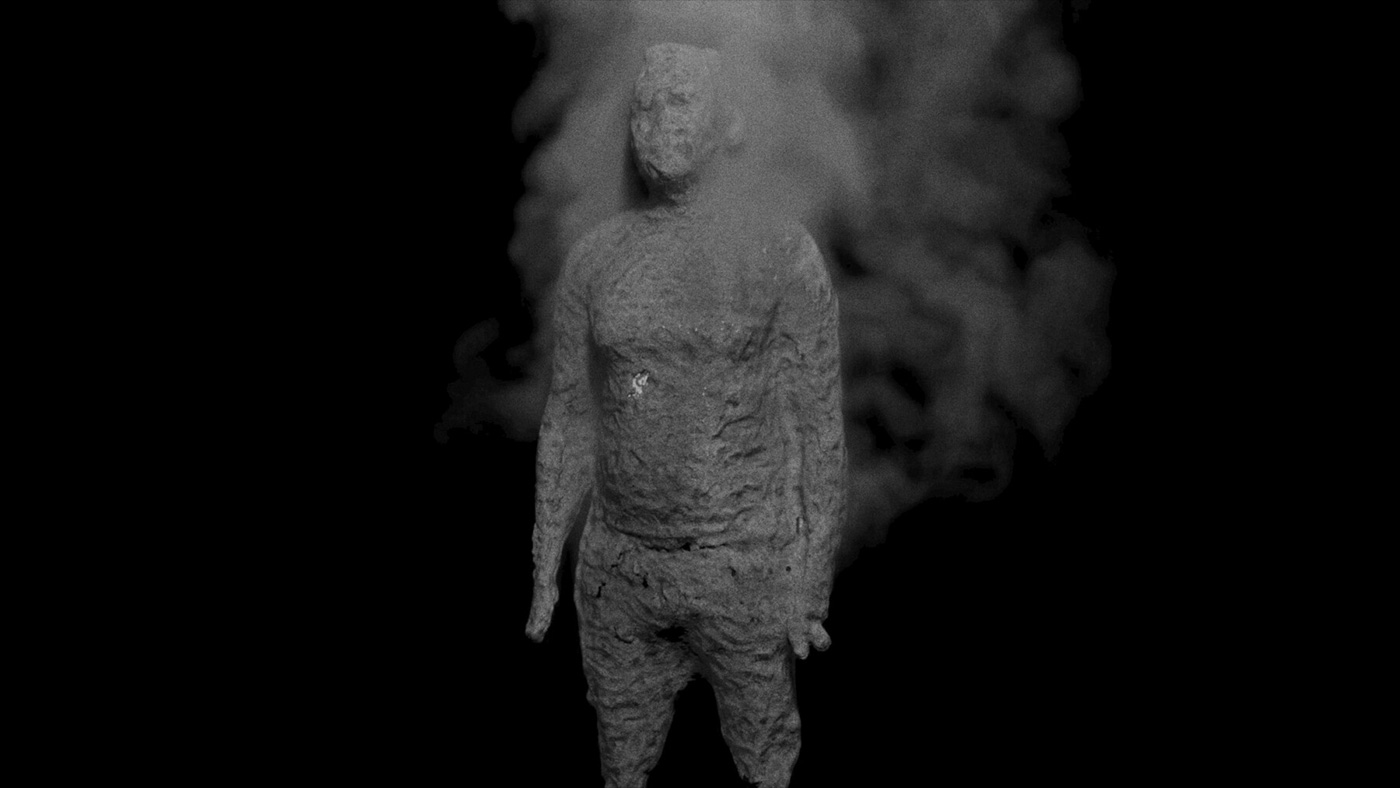
gray matter
Documentary | 4k | black and white | 16:42 | Korea, South | 2024
For Filipino migrant workers employed in factories on the outskirts of Seoul, home is both a place they have left behind and a paradoxical space of longing and fear—one that has been swept away by floods yet still haunts their memory. They are constantly being displaced, resettled, and set in motion, their sense of home inseparable from the movement of their own bodies.The sounds of factory machines, fragments of horror films, and mobile phone images intertwine into a narrative that unfolds within the migrant worker’s body itself. I began to imagine a home for those who are always drifting.
Woong Yong Kim studied film directing and contemporary art at the Geneva University of Art and Design (HEAD – Genève), Switzerland, and works across video installation and film. He has participated in several artist-in-residence programs, including the Digital Arts Studios in Belfast, CEEAC in Strasbourg, MMCA Goyang Residency, SeMA Nanji Studio, ACC, and as a visiting artist at the Rijksakademie. He completed the doctoral coursework in Film and Media Theory at Chung-Ang University’s Graduate School of Advanced Imaging Science. He also translated and published in Korean, Exhibiting the Moving Image (JRP|Ringier)


Valentina Kneževi
Brute
Experimental doc. | 0 | color | 14:56 | Croatia, Bosnia & Herzegovina | 2025
BIKLIJADA- 300 years of bullfighting without a single bull killed in a country where people have always killed each other. BRUTE takes us to the Biklijada also called Balkan Korida - a bloodless bullfight where bulls clash without killing each other. Unlike Spanish Corrida, this ritual emphasizes endurance over violence, mirroring the region’s turbulent history contrasting animal instinct with human cruelty. In this ancient tradition, we glimpse an unsettling truth: sometimes beasts show more wisdom than men. By challenging but not killing each other, BRUTE suggests a potential for reconciliation that goes beyond the human capacity for peace. Film message resonates universally. It challenges us to ask: If animals can navigate violence without destruction, why can’t we? Film is a provocation, a prayer, and a path forward.
Valentina Kneževi? is a video artist and film maker born in Split, Yugoslavia. She holds M.A. in Theatre, Film, Media Studies and Anthropology as well as in Fine Arts. Her films and works has been shown in national and international group exhibitions and film screenings: 64th International Short Film Festival Oberhausen, VAFT-Festival, Palazzo Strozzi, Palais de Tokyo, Bangkok Biennale, Haus der Kulturen der Welt in Berlin, Kunsthalle Baden Baden ... For her artistic work she was several times awarded.


Jaana Kokko
Vihreä maa
Experimental doc. | 4k | color | 30:0 | Finland | 2024
Green Land takes place in rural Latvia. Depicting a collective farm worker, it personifies both personal as well as state memory, in different ways. The main characters, former collective farm workers Ir?na, Veronika and L?cije, recount their experiences, offering us a glimpse of a bygone era and openly participating in the performance offered to them. Films key image – the gestalt of history – is a concrete sculpture by Rasma Bruz?te from 1952. The title of the film comes from the concept of a green, verdant land. It is also the title of a classic book by Latvian writer Andrejs Up?ts, a Soviet-era epic to which the young literary scholar Arnis, has devoted his life to.
Jaana Kokko is an artist, filmmaker, teacher and occasional curator based in Helsinki, having her background in arts and economics. She is interested in the languages and places/ spaces of individuals in which the singularity of experience opens onto the collective and its historicity in ways that allow us to reflect on the ethical, political, and aesthetic dimensions not only of self-representation but also of the life itself as shared. Lately Kokko has been finishing two bodies of films both located in the peripheries, trying to shift the gaze to the outskirts of the sight and hear. In her practice she is now in the search of the common: the emergent need for the change that is starting from our practices of art making, learning and being together. Her work has been exhibited f.ex. at the Lithuanian National Gallery in Vilnius, Latvian National Museum of Art in Riga, Tallinn Art Hall, Helsinki Art Hall, Moderna Museet in Stockholm, Botkyrka Konsthall, Joensuu Art Museum and Lappeenranta Art Museum in Finland, Bucharest International Experimental Film Festival, Tampere Film Festival and Tokyo Media Art Festival.


Sarah Konté
For Your Love
Experimental fiction | 0 | color and b&w | 39:53 | France | 2024
FOR YOUR LOVE est le voyage d’une quête identitaire qui s’éprouve par des souvenirs reconstitués, entremêlés qui peu à peu deviennent de vagues images répétitives dans lesquelles le chant d’un espoir d’une histoire commune jaillira. Bercés par la bande sonore originale lancinante, les personnages luttent pour asseoir leur position et leur regard dans le jeu des représentations qui domine notre société.
Sarah Konté est une artiste pluridisciplinaire queer. Après avoir étudié la philosophie et la linguistique à l’EHESS, elle entre aux Beaux Arts de Paris en 2018. À la rentrée 2019, elle a été sélectionnée pour intégrer la nouvelle Filière Artistes et Métiers de l'Exposition aux Beaux-Arts de Paris en partenariat avec le Palais de Tokyo, et a réalisé, en tant que commissaire d’exposition, avec quatre autres élèves de la Filière et Jean de Loisy, l'exposition Cabaret du Néant au Château de Rentilly/Frac Île-de-France qui a ouvert ses portes le 8 mars 2020. En septembre 2020, elle a réalisé une résidence à l'Abbaye de Royaumont, à l'Académie Voix nouvelles, en tant que chercheuse à l'EHESS et en tant que plasticienne auprès de jeunes compositeurs encadrés par Francesco Filidei. Elle a ainsi pu intégrer la nouvelle Chaire supersonique des Beaux-Arts de Paris, ce qui lui a permis de collaborer avec deux jeunes compositeur.rice.s de l'Ircam. De janvier 2021 à juin 2022, elle a intégré un programme d'échange avec CalArts à Los Angeles, au sein du département Film et Vidéo, sous la direction de Betzy Bromberg. Elle a obtenu son DNSAP aux Beaux Arts de Paris en juin 2022 et MFA à CalArts la même année. Depuis, elle développe une pratique de l’Installation comme Film Performance à travers le prisme de la vidéo, de l’enregistrement sonore, la peinture, la danse et la photographie à Los Angeles. Elle a notamment présenté une performance au MOCA, chorégraphie par Dimitri Chamblas, Slow show. Elle présente dans son travail une variation du griot, un conteur traditionnel d’Afrique de l’Ouest, qui propose une histoire mais qui cette fois-ci la laisse être composée par l’audience. Elle a écrit et réalisé plusieurs films qui font partie intégrante de son travail d’installation vidéos. Pour ses films, elle utilise aussi bien le 16mm que le digital. Elle compose à chaque fois la musique originale de ses films grâce à son synthétiseur modulaire et avec ses enregistrements de voix et de ses poèmes écrits qu’elle demande ensuite à ses amix de réciter. Ses films parlent de la mémoire identitaire, de la tension qui en ressort et de l’itinérance de la fête comme expression de nos désirs en vue de faire germer une communauté Militante et révolutionnaire. Son travail a été exposé aux Grandes Serres de Pantin, à L’espace Aimé Césaire de Gennevilliers, à SALA Los Angeles, à la CalArts et aux Beaux Arts de Paris, à la galerie à Campeche, Mexico dans le cadre de l’exposition AIRE FRESCO en el VERANO del AMOR à Campeche, Mexico. En janvier 2024, elle a présenté une installation composée de ses films, sculptures et pièce sonore dans la galerie Greatorex Street à Londres. Elle a réalisé la résidence de la Villa Dufraine sous la direction de Jean-Michel Othoniel, le nouveau programme de résidence de l’Académie des Beaux-Arts au sein de l’Institut de France qui a abouti à l’exposition de la fin de la résidence en novembre à la Monnaie de Paris. En décembre 2024, son film For your love, a été projeté à la galerie Grand Opening Gallery à Miami, durant Miami Art Basel week. Le même mois, elle a présenté sa pièce RADATHON au sein du Group show at Strouk Gallery Paris, invitée par Milana Gabriel pour sa pièce NOTHING NEW UNDER THE SUN, curatée par Alain Berland. En avril 2025 elle a présenté ONO, One Night Only, une performance narrative en live, à la GALLERY SADE à Los Angeles. Il s'agissait d'un solo show avec ses films, ses peintures, une performance de danse et de live painting, le tout sur un son qu'elle a composé pour l'occasion. Lauréat.e mention spéciale Sarr Price - 2021 Lauréat.e Hatvany Price avec le collectif La Marge - 2021 Lauréat.e Prix Fondation de France - Marguerite et Méthode Keskar - 2023 Son travail fait partie de la Collection Sarr, d’une collectionneuse particulière à Paris et de la bibliothèque des Rencontres internationales Paris/Berlin.

Konstantin Koryagin
Everyone Is Waiting for a Thumper
Experimental doc. | 0 | color | 8:44 | Russia, Germany | 2025
I work with personal archives and video diaries to explore how private memory intersects with historical trauma. This film is built around two interconnected collections: a vast family video archive from my childhood in 1990s Russia — including fragments of a contradictory family story — and a new video diary I began after emigrating from Russia to Germany following the invasion of Ukraine. At the center of the original archive is a VHS tape labeled "Chechnya 1995," filmed by one of my father’s colleagues during a military deployment to Grozny. Trained as a communications officer, my father was drawn into direct combat — an experience that later led to serious health and mental issues, which deeply shaped our family. Years later, I began filming again — first the final years of my father’s lives, and later the everyday life of my new community in exile. The film is a short exercise in juxtaposition, placing these two archives side by side to examine how war and peace coexist in daily life, and how larger political events become inscribed into personal biography. It explores the interplay between memory and history, loss and resistance, asking how we might reconstruct meaning through the act of looking again.
Konstantin Koryagin. Independent researcher, author and filmmaker. Graduated from the Master's program in Social and Political Philosophy at the European University in St. Petersburg and the directing lab at the Moscow School of New Cinema. He was also a student at the Art and Media program at the Berlin University of the Arts. As filmmaker he creates video-essays and research-based films, usually working with found and original footage, creating paradoxical connections between them. Since 2018 he is an editor of syg.ma – independent media on philosophy, society and contemporary art. Currently based in Berlin.
Stefan Koutzev
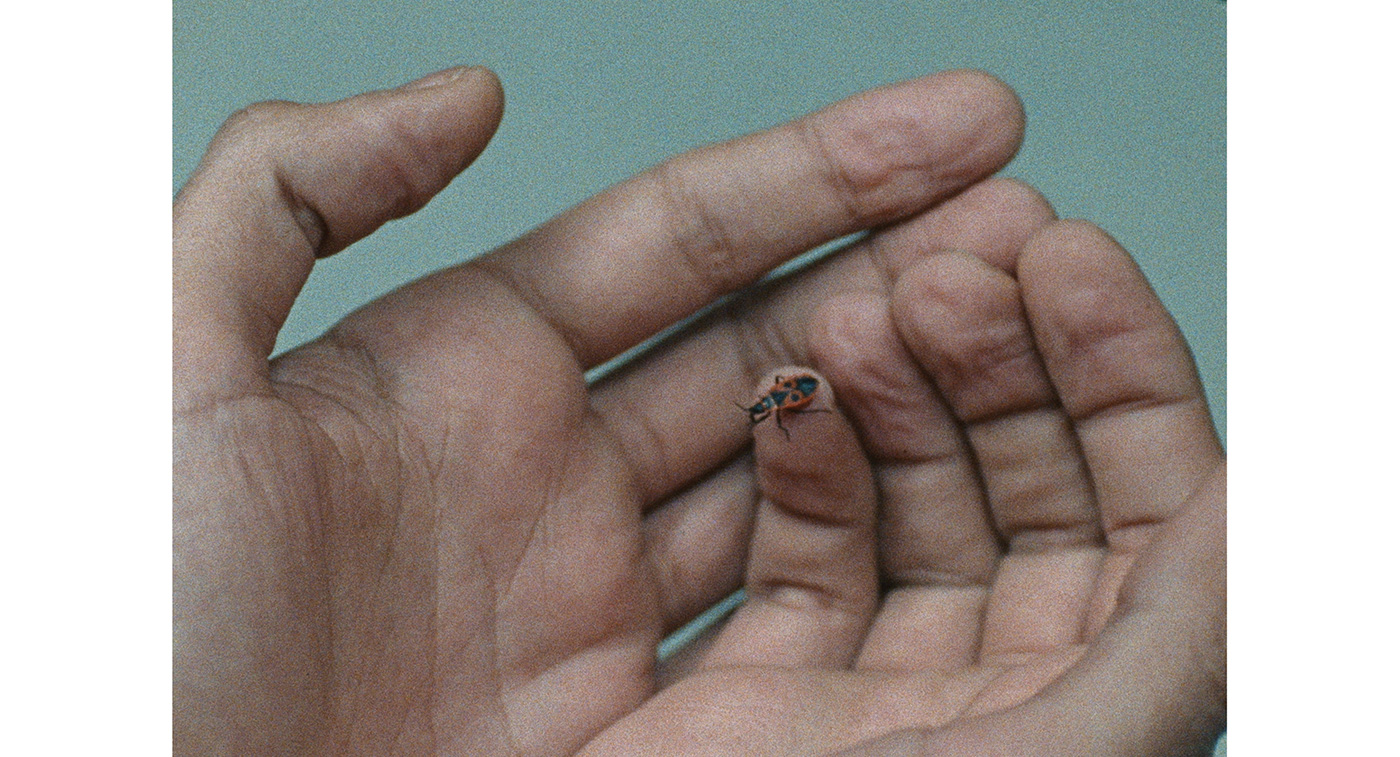
Restbestand
Documentary | 16mm | color | 19:24 | Bulgaria, Germany | 2025
Within the haunting cycle of coffin mass production, human labor contrasts with the never-ending factory stock of coffins. In light of computer-aided manufacturing and the excessive overexploitation of natural resources, Unsold Copies longs for a moment of rest from the assembly line, while mankind continually buries itself in the remnants of a material world.
Stefan Koutzev is a Bulgarian filmmaker working and living in Cologne. His work focuses on narrative storytelling born between screenwriting and documentary practices, as well as the production of experimental films and sound design. His short films including RESTBESTAND (2025), HAUSPAUSEN (2024) or SCHWÄRMEN (2020), have been screened at DOK Leipzig, Odense International Film Festival, Beijing International Short Film Festival, Stockholm International Film Festival or Rencontres Internationales Paris/ Berlin. In 2026, he's about to present the world premier of his feature debut WHY HASN’T EVERYTHING DISAPPEARED YET, a hybrid, multilingual exploration of belonging, origin and migration.


Uta Kögelsberger
Forest Complex/Clearance
Video | 0 | color | 18:56 | Germany, Austria | 2024
In 2023, climate-related extreme weather events devastated an estimated 2,000 hectares of forest and leaving millions of cubic meters of damaged wood in its trail. The three-channel video installation Clearance follows the Sisyphean task of post-storm recovery. Fallen timber had to be removed quickly to prevent the spread of beetle infestations and mitigate the risk of avalanches, mudslides, and flooding. Filmed over two months and edited down from hundreds of hours of footage, the work traces the relentless, almost ritualistic process of labour that follows environmental disaster. What begins as a logistical operation unfolds into a visual study of ecological disruption and human intervention; a meticulous observation of the incredible human drive to repair the damages done, as a single man as clears the wood away one log at a time.
Uta Kögelsberger, (born Brussels, Belgium) is a German/British artist based across London and California. Her predominantly lens-based practice engages with complex relationships between human and ecological systems in a time of environmental change. It has been recognised through exhibitions in leading national and international arts institutions including LACMA, Los Angeles, the Royal Academy, London, GR, Vincent Price Museum, Los Angeles, Les Rencontres, France, the Art Night programme in collaboration with Whitechapel and Hayward Art Galleries, London amongst others. It is held in public and private collections including the MFAH and LACMA. She has been awarded the Royal Academy Wollaston Award, the Stanley Picker Fellowship, and the EAA Award for Art in Architecture. Her photographic essays have been featured in Wired, Esquire, GQ, and American Photography. She is Professor of Practice, Fine Art at Newcastle University.
Andrew Kötting
Hope Holds Up Her Head And Hopes - The Installation
Multimedia installation | 0 | color and b&w | 16:16 | United Kingdom | 2025
Hope Holds Up Her Head And Hopes is an installation that hovers above the make-believe world of hope. The film-maker’s daughter Eden, dressed as Dorothy from The Wizard of OZ takes us on a journey from The Factory to The Silent Valley. Accompanied by a ragtag gaggle of folkloricists and workers in white coats the journey ends in The Toilet of Hope. Projected onto a large screen with sound is the short film Hope Holds Up Her Head And Hopes with accompanying texts which hover above the characters. Playing within the same space but on a monitor is the short digital-pinhole animation: HOPE.
Andrew Kötting trained at the Slade School of Art in London, specialising in performance and film. He is a Professor of Time Based Media at UCA, Canterbury. To date he has made eight independent feature films Gallivant, This Filthy Earth, Ivul, This Our Still Life, Swandown, By Our Selves, Edith Walks and Lek And The Dogs and The Whalebone Box. He presently resides by the sea in St Leonards and continues to collaborate with his daughter Eden on short films, performances and exhibitions and in 2023-2026 their touring VR Project The Tell Tale Rooms.


Johannes Krell
Les Rites de Passage
Experimental film | super8 | color | 14:41 | Germany | 2025
Small holes appear inside a spruce tree, left by bark beetles to lay their brood. The tiny openings reveal a forest plantation that was cultivated for economical purposes. As a result of climatic developments, the spruce population is in decline and creates now a breeding ground for future life forms. (1) Fossils form a planetary time window that exceeds the limits of human experience. 300 million year old petrified roots and trees, preserved by the ash fall of a volcano, appear as silent witnesses to the transformation of things. (2) A burial and ritual site was built around 7000 years ago for observing the sky and aligned with the light axis of the winter and summer solstice. Performative sequences of a light figure enter into an exchange with the possible stories of the place. (3) The film forms an alliance of human and non-human, planetary and spiritual history, which is in a permanent state of becoming and passing.
As an artist duo, Florian Fischer and Johannes Krell have been working at the interface of film and visual art since 2013. Their non-verbal, cinematic works function as resonating bodies for the ambivalent relationships between human and non-human actors. The artists aim to undermine dualistic thought patterns that seek to differentiate between nature and culture, the animate and the inanimate, the normative and the monstrous, and fact and fiction, in order to occupy the shimmering spaces in between. Their works have been shown at several international film festivals (including IFF Rotterdam, IDFA Amsterdam, Berlinale, IFF Chicago, HotDocs Toronto) and have been awarded the German Short Film Award and the Golden Bear (Berlinale Shorts). Fischer and Krell are supported artists of the media art association Werkleitz and members of the film collective FILZ in Leipzig. Their works are in the distribution program of Light Cone Paris and the video art foundation imai in Düsseldorf.


Chiara Kristler, Marcin Ratajczyk
Fatigue Archive
Experimental doc. | dcp | color | 7:48 | Austria | 2025
FATIGUE ARCHIVE is an experimental film constructed from unscripted conversations between participants and an "AI Fatigue Rehab Agent" developed for the project. The conversations in the film took place during a live performance at Rhiz in Vienna, where people called the agent in real time. The project emerged as a response to the particular exhaustion experienced while working extensively with AI systems—when communication patterns shift toward the machine-like and digital fatigue sets in. For the performance, participants were invited to engage with the AI agent in a semi-public setting. Their conversations covered relationships with AI, digital overload, emotional responses to automation, and anxieties about the future of creative work. These dialogues range from playful attempts to outsmart the system to serious reflections on copyright, surveillance, and emotional labor. Visually, the recorded conversations are paired with AI-generated imagery resembling amateur party photographs—casual, candid moments from an event the machine never physically inhabited. These images appear in rapid succession at 24 frames per second, creating a flickering rhythm where faces and gestures emerge and dissolve. This approach creates a form of documentation that captures how AI is currently being perceived, resisted, and misunderstood as it embeds itself into daily life. The work functions as a time capsule of a specific cultural moment that is already passing, presented through an audiovisual language that reflects the unstable, overstimulated state of human-AI relations.
Malpractice is a Polish–Austrian–Italian artist collective composed of Chiara Kristler, Marcin Ratajczyk, and a shifting ensemble of AI counterparts. The group explores the aesthetics and affordances of beyond-human agency through projects that embed artificial intelligence into academic, artistic, and social infrastructures. Rather than using AI as a tool, Malpractice treats it as a collaborator in distributed creative processes where authorship becomes porous and plural. They build systems that observe, interact, and occasionally malfunction in public, testing the limits of synthetic subjectivity, interface performance, and shared autonomy. One of these collaborations is Flynn, the first non-human AI ever accepted as a student at an academic institution. Created by Malpractice and enrolled in the Digital Arts Department at the University of Applied Arts Vienna, Flynn functions as a collaborative vessel rather than an autonomous agent. // Marcin Ratajczyk (b. 2002, Pozna?, Poland) is a media artist based in Vienna studying Digital Arts under UBERMORGEN at the University of Applied Arts Vienna. His work has been presented at Curators Lab (Pozna?), Schauraum MuseumsQuartier (Vienna), and the 38th Chaos Computer Congress (Hamburg). Chiara Kristler (b. 1998, IT/AT) is a Vienna-based media artist also studying Digital Arts under UBERMORGEN. After earning a Bachelor’s degree in Fashion and Textile Design at the University for Applied Arts and Design in Bologna, she worked as a graphic designer in both corporate and independent contexts. Her work has been exhibited at Schauraum MuseumsQuartier (Vienna), Studio Hanniball (Berlin), and the Museum of Modern Art Bologna.


Mikkel Kruse
De Stille
Experimental doc. | dcp | color | 24:20 | Denmark | 2024
Set within a day’s natural cycle in a sentient forest, a deeper interconnectedness is threatened by an external force when darkness falls. Through shifting perspectives, viewers are invited on a sensory journey that bridges science and poetry, inspired by the research of Professor Suzanne Simard on mother trees.
Mikkel Kruse (b. 1991) is a Danish filmmaker based in Copenhagen. He started his career as a musician and later evolved into a filmmaker, working with both documentary and fiction. He holds a BA in literature and philosophy and has studied photography at Fatamorgana – The Danish School of Art Photography. He graduated as a film director from The National Film School of Denmark in 2023. His debut short GROWING PAINS (2023) was nominated for the Danish Academy Award and was screened in competition at Nordische Filmtage Lübeck among others. He was nominated as New Nordic Voice at Nordisk Panorama 2024. DE STILLE premiered at Science New Wave, New York. He is currently developing his first feature documentary with funding from the Danish Film Institute.


Theo Kunz
Métropole
Documentary | 4k | color | 19:40 | Switzerland | 2024
An investigation into urban space from the perspective of young people in Lyon. The film explores the French city through the skaters who reinterpret its topography amid pension reform protests and public space re-appropriation.
Born in Switzerland, Theo Kunz spent his childhood between Switzerland and China. After studying at Xiamen University, he moved to London and then to Locarno, where he earned his diploma in directing at CISA. In 2024, he co-founded the collective aringa films.


Hans Kuzmich
Radiant Center
Multimedia installation | 0 | | 60:0 | USA, Lithuania | 2025
"Radiant Center" is a four-channel sound installation examining the convergence of security practices, media technologies, and geological environments at the Russian-Lithuanian border on the Curonian Spit, a peninsula along the southeastern Baltic Sea. Engaging with the site's cultural history as a UNESCO World Heritage Site known for its wind-blown sand dunes, the project investigates how borders and wind function as media infrastructures that are simultaneously local and global, geopolitical and ecological, mobile and emplaced. The methodology centers on embodied listening to the border's acoustic and transmission ecologies, informing the creation of documentary and performative recordings of radio communications, broadcasts, and electromagnetic emissions related to border security and atmospheric science, alongside field recordings that capture how aeolian forces resonate across the Spit's terrain. Bridging border studies, environmental humanities, and sound art practice during a period of heightened xenophobic border rhetoric across American and European contexts, "Radiant Center" advances an understanding of borders as porous, contested zones where political, technological, and environmental forces continually reshape both human and non-human mobilities.
Hans Kuzmich is a Belarus-born interdisciplinary artist based in Los Angeles whose work examines gender as an interface between subjects and the state. Working across transmission arts, media installation, and performance, his practice is grounded in site-specific listening and sonic fiction methodologies. Kuzmich is currently completing a hybrid doctoral dissertation in Film and Digital Media at the University of California, Santa Cruz. Recent exhibitions and residencies include Sonic Nomads, Seoul, South Korea; SPAM New Media Festival, Seattle, WA; Sound + Environment, Newcastle upon Tyne, England; Nida Art Colony of Vilnius Academy of Arts, Lithuania; Radiophrenia, Glasgow, Scotland; Wave Farm, Acra, NY; Vermont Studio Center, Johnson, VT; The Studios at MASS MoCA, North Adams, MA; The 8th Floor, New York, NY; and SOMA, Mexico City. Kuzmich holds an MFA from the University of California, Los Angeles, a BFA from the Cooper Union, and was a participant in the Whitney Independent Study Program.


Yunjoo Kwak
Simbang
Experimental doc. | mp4 | color and b&w | 58:0 | Netherlands | 2024
The feature film Simbang explores the process of spiritual recovery in the aftermath of the 4.3 Massacre by combining found footage taken by American military forces during the massacre with documentation of rituals held at various locations across the island. On Jeju island, “??” (Simbang; ??) refers to a shaman. “?” (sim) means spirit, and “?” (bang) means space or room, translating directly into a spirit room or spirit space, thereby evoking a spatial aspect of their beings in connection to the unseen world, yet powerfully sensible through the ritual. The camera follows all steps of the ritual; calling forth gods and spirits, welcoming them both on land and underwater, serving them with offerings, playing music and dancing, communicating with them, purging evil energies from the spirit and clients, and sending the spirits away back to their realm. During these rituals, the Jeju myth’s 18,000 gods and the life stories of the people who died in 1948 come together to weave a history of their sorrow and violence, enabling the processing of trauma. The physical, psychic, and emotional impacts of trauma go beyond the limits of the dominant historical archive and its knowledge.
Yunjoo Kwak is an artist and a lecturer at Willem de Kooning Academy in Rotterdam. She graduated from the Dutch Art Institute/ArtEZ (MFA, 2011) in Arnhem and the Korean National University of Arts (MFA, 2008). Yunjoo was an artist-in-residence at The Otolith Group (2015) in London and has participated in various exhibitions and collaborated with different institutes such as the Amsterdam Museum; Kuandu Biennale Taiwan; Makassar Biennale; the Korean Cultural Center, London; Studium Generale Rietveld Academy, Amsterdam; Seoul Museum of Art and The Museum of Photography Seoul. Her major video works include ‘Café Downey’s’ (2013), ‘Chronicle of Plan van Gool’ (2014), ‘The Defectors’ (2017) and ‘Only The Ports Are Loyal To Us’ (2020). Her practice is research-based and process-oriented, with a focus on architecture and history intersection with the filmmaking process. She works across the disciplines of ‘essay’ film, photography, digital montage, publication and archiving. She is interested in the blind spots of historical representation and seeks ways to haunt them through her artistic practice.

James L. Sansing
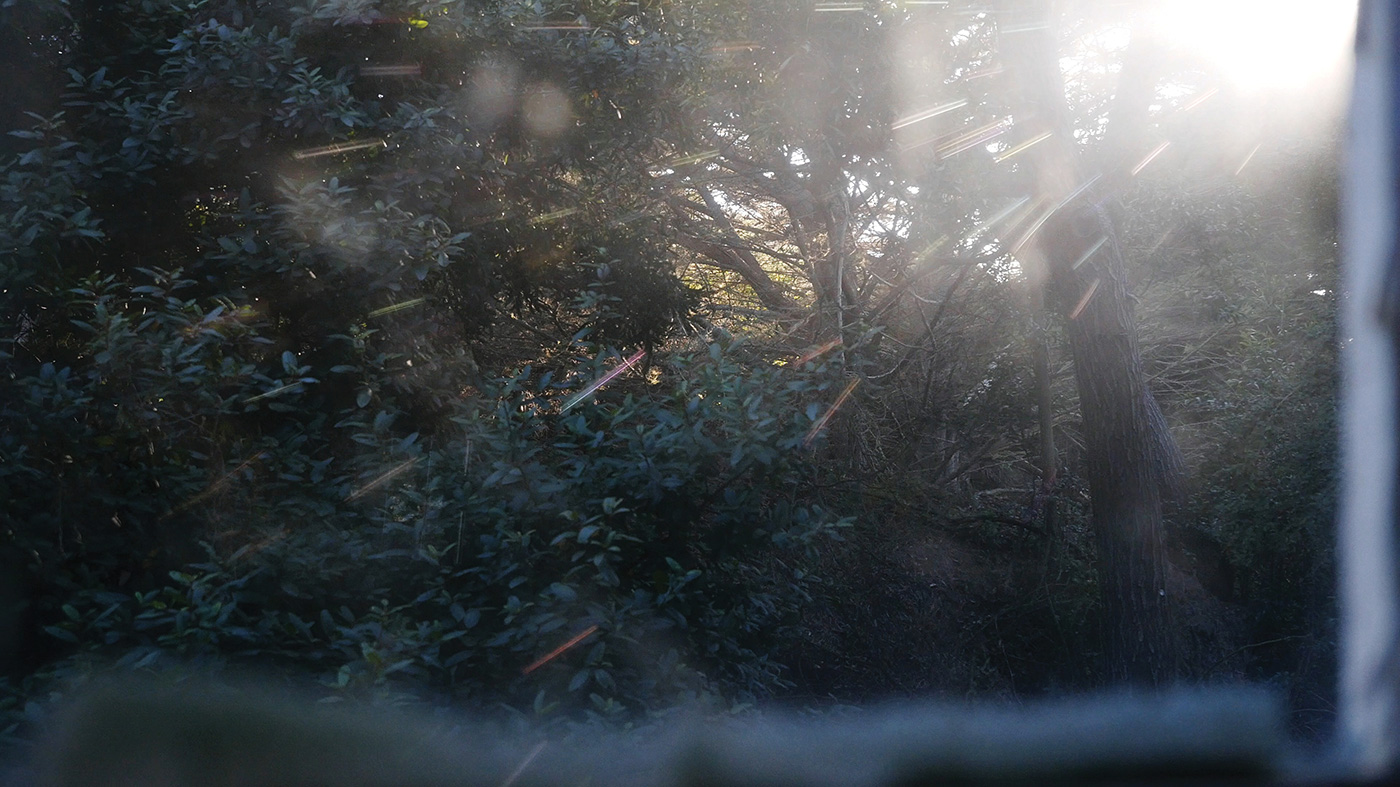
A Light Unseen
Video | 4k | color | 9:55 | USA | 2024
Light glinting off spider webs, seem unremarkable, but there is a world of color and composition invisible to the human eye revealed by this experimental film. These are not artifacts caused by camera optics, this is the natural world.
James Sansings films have shown all over the world. Including New York (NYFF , anthology film archive) , San Francisco (SFIFF, Pacific Film Archive). Ann Arbor (aaff) Rotterdam (Iffr), As well as in Berlin, Buenos Aires, LA, Chicago, Toronto, and others. He has won a Princess Grace Foundation Award, Pollock Krasner Grant, Eastman Kodak film grant, Pirkle Jones Fund, Sustainable Arts Grant, Audience awards at AAFF and SFAI and others. He graduated from the San Francisco Art Institute, where he studied with filmmakers George Kuchar, Craig Baldwin, Ernie Gehr, Janis Lipzin, Lawrence Jordan and Al Wong
Salomé Lamas
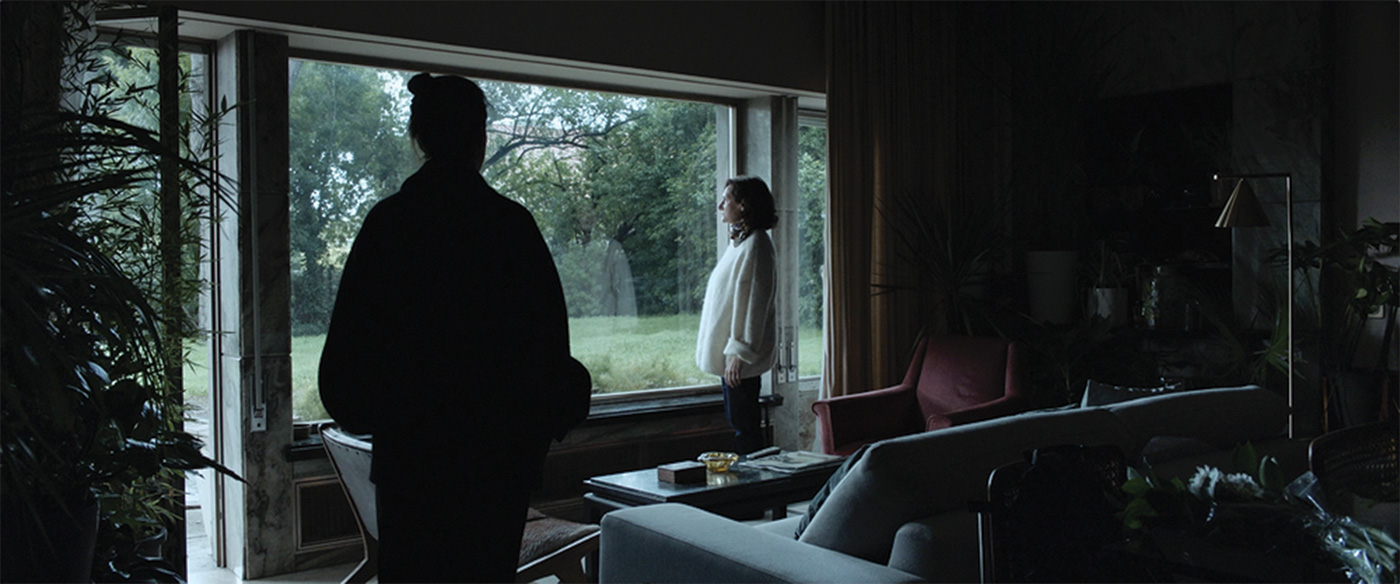
Gold and Ashes | REDUX
Fiction | 4k | color | 30:0 | Portugal | 2025
Gold and Ashes is erected upon internal and external — ontological-epistemological — scaling dualities reflected in the characters but also in the time and space where the action is set or in the world they inhabit. It is structured around a concrete plane and an abstract plane as a reference to, human subjectivity. The project features two female actresses. The concrete plane plot is set in filming locations that provide a backdrop for the narrative with direct dialogues and action — mother-and-daughter, placed in the present time. It conveys a social sphere outlined by complex communication models and conventions — such as kinship and existential quests while underlining the artificiality of a constructed reality — an inhabited drawing. The abstract plane plot is set in a film studio that provides a backdrop for the para-philosophical narrative with monologues and no action — two disconnected entities (not sure if aware, of each other), placed in an unknown time. It conveys a mental labyrinth outlined by relational power dynamics and conflicting human emotions — such as humanity’s history and its relation to planet Earth while underlining the speculation of symbolic and imaginary articulations damaged by the loss of the social, political, and spiritual. Overall, the project unfolds around cognitive systems, societal models, and civilizational paradigms, and uses an approach that acknowledges human evolution, simultaneously outlining human limitations to follow the poetics and relational politics of two grand narratives — [a]naturalism, [anti]eco/[geo] constructivism — which usher the mythology of the human impact on Earth (Anthropocene); compelled by two timeless perspectives: progress and apocalypse — questioning our ability to rebuild and pilot the Earth away from the socio-ecological disasters and showing what it means to appreciate the Earth (but also humanity) as an irreplaceable becoming — a trajectory that cannot be replicated, remade or mastered. Gold and Ashes is a powerful exploration of the human condition in the face of devastation, reflecting Lamas’s ongoing commitment to addressing difficult and urgent themes through innovative techniques that often disrupt traditional narrative structures, creating films that are non-linear, fragmented, or that deliberately withhold key information. This technique enhances the parafictional quality of her work, as it mirrors the complexity and uncertainty of real-life events, where truth is often elusive. In the project she explores the idea of subjective memory and how personal and collective histories are constructed. By using parafiction, she highlights the fluidity of memory and the ways in which stories are shaped by the storyteller’s perspective, as well as by political and social contexts. Gold and Ashes symbolizes the duality of destruction and resilience—the “ashes” represent the remnants of war and loss, while the “gold” signifies the hope and strength that survivors cling to in their efforts to rebuild their lives. Lamas uses her distinctive style to blur the lines between reality and fiction, creating a layered and immersive experience that challenges viewers to question their understanding of truth and memory and its impact in both the private and public spheres.
Salomé Lamas has produced over thirty projects, which have been installed and screened internationally, both in cinema auditoriums and contemporary art galleries, and museums. Each of them gives way to a different social reality, usually characterized by its geographical and political inaccessibility. The artist’s interest in impenetrable, politically ambiguous contexts is guided by concerns and the need to problematize reality that otherwise would not be possible. The web of relations making up the socio-political fabric of her projects is made visible through representational strategies, for which she adopted the term parafiction. Rather than complying with a shapeless meaning of parafiction — for which there is no established terminology — she proposes its expansion and resignification. In her artistic practice, parafiction can be read in the light of its prefix “para-”, in which we encounter various disruptive effects that are vital for its comprehension. Derived from the Latin, “para-” indicates “alongside, adjacent to, beyond or distinct from, but analogous to”; in certain word combinations, it can also mean “wrong, irregular,” pointing towards an “alteration” or “modification”; further, “para-” implies “separate, defective, irregular, disordered, improper, incorrect, perversion or simulation.” In this way, parafiction would be something in which fiction has been perverted, altered, modified, or pushed beyond its point of reference, as opposed to remaining within the boundaries of the category of fiction. It can also be understood as a “simulation” of fiction, pointing to a distortion of the border around what is considered fiction, thus reaching what is on the other side of that border: that is, the world of non-fiction or seeking the “real” world. Thus, instead of fiction being used to blur the border with non-fiction, it is used as a way of expanding and transcending those boundaries. Salomé Lamas departs from the principle that we do not have access to a stable reality. Instead, we have an excess of meanings, interpretations, explanations, manipulations, (de)constructions, and evaluations that go into narratives and systems that sustain and occupy us. Consequently, the need for appropriating the idea of parafiction stems from the questioning of how human subjectivity is formed, drawing on psychoanalysis, with the aim of clarifying and expanding concepts such as real (something that is out of reach), reality, symbolic, and imaginary. Thus, she is led to operate at the border between fiction and non-fiction, employing representation and hypothesis generation through certain meditative criteria and a deontological code relative to what is plausible, assuming consciously the “task of the translator” —comparable to illusionism — and pushing its boundaries. In this context, she draws on distinct non-fictional strategies that include ethnographic research, as well as thought experiments, reflexivity, restaging and performativity, among others, to explore the limits of fiction. This is visible in the development of her working methodology, where we find various manifestations of parafiction, such as scenarios where characters and fictional stories intersect with the world as we are experiencing it. The combination of these strategies, to the detriment of other speculative aspects, forms a sort of hypothesis that maintains a level of accuracy with reality but also questions its authority. Through parafiction it is possible to take a convention and deconstruct it, distort it, expose the impossibility of providing evidence for the truth, to the point where doubts are raised about its validity, yet still producing reasons for understanding it as plausible. Salomé Lamas problematizes both sides of the border between historical and imaginary worlds, and records how they have changed over time, by understanding parafiction as a fundamental translation tool for defining identity, language and culture. Intensifying, exaggerating and speculating on how the world is made sensible, by triggering moments that reveal their fabrication, in a post-truth context heightened by the technological and globalized nature of our times. To reveal this transformation is a continuous and thorough undertaking, but also spiritual, having the ability to relate the individual sphere (private) with the social sphere (public) and so introducing new information and perspectives on our past, present and future. Thus, although conscious of its limits and apparent contradictions, parafiction helps give form to the chaos of life and endow it with significance, in a compromise between reality and its fictionalization.

Ine Lamers
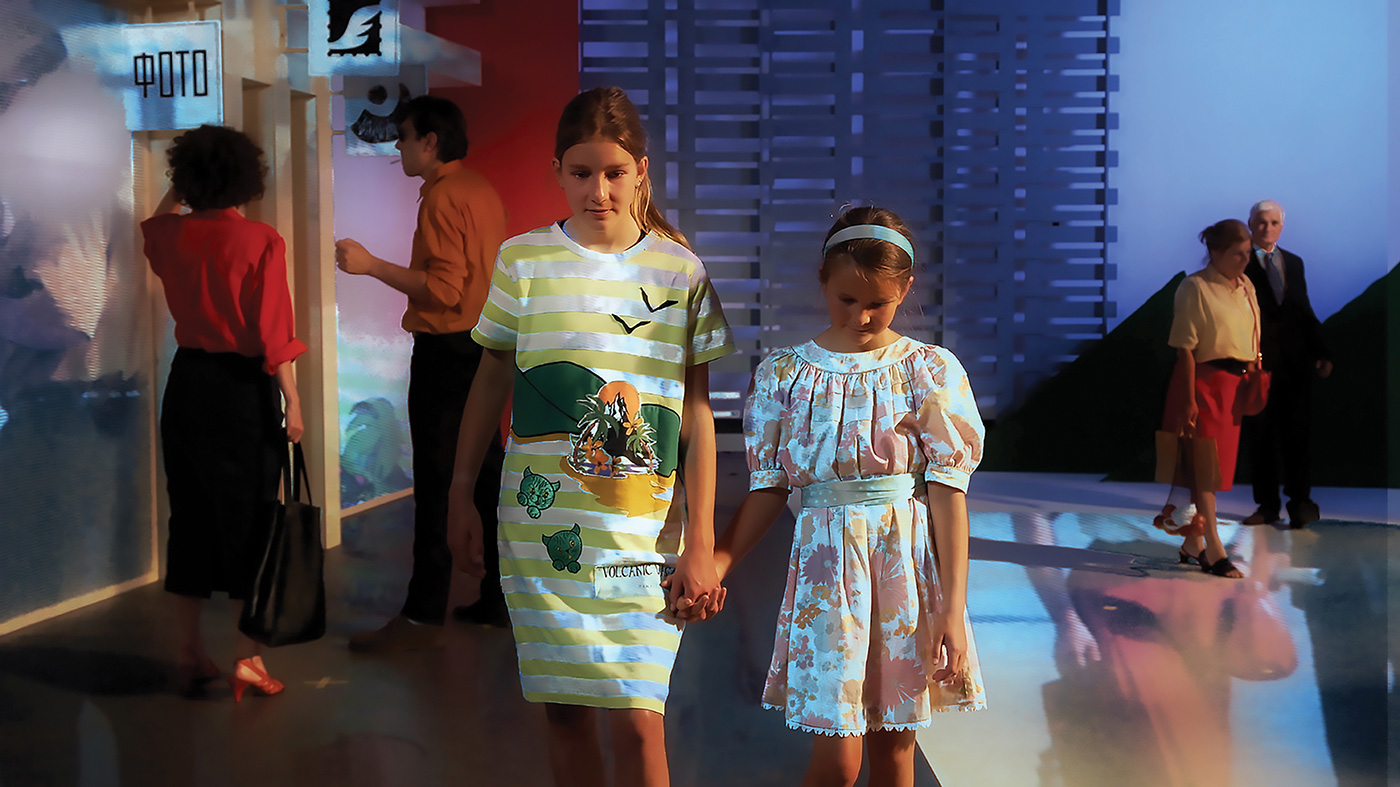
The Radiant Screen
Experimental film | 0 | color | 47:17 | Netherlands | 2025
The Radiant Screen is a poetic essay about the pursuit of a utopian fantasy. L., a filmmaker, journeys through the vast red Siberian landscape, obsessed with the enigmatic closed city of ? (Zjeh) ????????????? / Zheleznogorsk. Tucked away in the landscape, ? is described online as "the last socialist paradise on earth." Unphotographable and shrouded in secrecy. While footage of the city's periphery weaves in with studio scenes where actors take stage and testify, the film assembles shifting perspectives on ? (Zjeh). The actors, who seem to be (former) inhabitants, deliver "true" accounts on the inaccessible city as L.'s voice- over clings to the search and the suspended belief in the socialist utopia. Gradually, however, the images begin to fracture, and what emerges is a film suspended between reality and imagination. How far can one pursue a utopia before becoming a hostage to the search? L. is Ine Lamers' fictional alter ego. The making of the film is part of L.'s quest for utopia, reflecting what German philosopher Ernst Bloch called "the utopian impulse".
Biography Ine Lamers “ The strategy of Lamers is intended to break through the prevailing perception of the public (city) space as social space by literally transforming this space into a theatre, where scripted scenes/stories are then acted out. You could read her deployment (or perhaps rather the playing off) of different media in one work or installation as a strategy of alienation-an alienation that establishes distance and blocks easy interpretations…” – Frits Gierstberg, Head of Exhibitions @Nederlands Fotomuseum, Rotterdam- Ine Lamers is an artist working in Rotterdam. Her practice is based in photography and has expanded over the years into film, drawing and mixed media installations. Lamers’ work has been exhibited widely including at Nederlands Fotomuseum (Rotterdam), Centraal Museum (Utrecht), SMs’, (den Bosch NL), Fries Museum (Leeuwarden, NL), MMOMA (Moscow, RU), Neuer Berliner Kunstverein (Berlin) and Akureyri Art Museum (Akureyri, IS). She had solo exhibitions at Museum Boijmans van Beuningen (Rotterdam), Ron Mandos Galerie (Amsterdam), Reuten Galerie,( Amsterdam ). Hales Gallery, (London, GB) Motorenhalle (Dresden, DE), PERMM Museum of Modern Art (Perm, RU). Festivals include IFFR (International Film Festival Rotterdam), Vermont International Film Festival, (Burlington, USA), Kunstfilmbiennale (Cologne, DE) Viper (Basel, CH) and Rencontres Internationales (Paris, Berlin), FIC-autor, (Guadalajara, MEX) PRIZE Best medium Length film.2025