Catalogue > List by artist
Browse the entire list of Rencontre Internationales artists since 2004. Use the alphabetical filter to refine your search. update in progress
Christophe Herreros
Catalogue : 2013Orange Pattern | Video | hdv | color | 6:21 | France | 2011
Christophe Herreros
Orange Pattern
Video | hdv | color | 6:21 | France | 2011
Dans la trilogie Orange Pattern, la caméra explore l?espace, comme elle parcourrait la scène d?un crime. Latéralement, verticalement, profondément, elle se meut dans trois décors successifs et finit par s?immobiliser sur un détail, digne descendant du MacGuffin hitchcockien. Clément Dirié
Christophe Herreros est né le 11 Mai 1981 à Carcassonne, Diplômé de l`Ecole Nationale Supèrieure des Beaux-arts de Paris avec les félicitations du Jury à l`unanimité en 2009 après un passage au California Institute of the Arts. Il l`expose l`année d`après à la galerie Air de Paris dans l`exposition DREAMLANDZ avec Carsten Holler et Bruno Serralongue. Puis, dans l`exposition Yet to be Title avec Neil Beloufa et Jonathan Binet à la Galerie Gaudel de Stampa. On retrouve également son travail dans différents salons dont le Salon de Montrouge et Jeune Création à l`espace 104 à Paris dont il est le lauréat 2010. En 2012, il propose une installation à la galerie de multiples à Paris "Five Red Herrings" dans laquelle il propose un interprétation spatiale de sa vidéo polar "Orange Pattern". La même année il a présenté au Fresnoy Studio National des Arts Contemporains dont il sort diplômé avec les félicitations du jury à l`unanimité une installation vidéo "Le Dragon d`Or" dans laquelle un film en image de synthèse 3D réalisé en 24h à Taiwan par NMA fait face à un diamant en pierre de taille et un mobilier en chêne.
Henri Herré
Catalogue : 2015NOUVELLES HISTOIRES DE FANTOMES - GENESE | Documentaire exp. | hdv | Couleur | 45:0 | France | 2013
Henri HerrÉ
NOUVELLES HISTOIRES DE FANTOMES - GENESE
Documentaire exp. | hdv | Couleur | 45:0 | France | 2013
NOUVELLES HISTOIRES DE FANTOMES est le 7ème chapitre de LA TABLE DES MATIERES, un projet cinématographique d’Henri Herré avec Georges Didi-Huberman commencé en 2013. La table des matières, c’est le bureau de Georges Didi-Huberman où il étale tous ses documents, photos, fiches, livres et images pour en faire ses montages. Deux fois par ans, il propose à Henri Herré de venir avec sa caméra pour voir où il en est de son travail. En ce début de 2014, Georges Didi-Huberman venait de finir l’élaboration de son exposition au Palais de Tokyo « Nouvelles histoires de fantômes », il en décrit pas à pas la conception.
Catalogue : 2014sortir par les yeux | Experimental doc. | hdv | color | 15:0 | France | 2013
Henri HerrÉ
sortir par les yeux
Experimental doc. | hdv | color | 15:0 | France | 2013
Sortir par les yeux » 15mn, extrait du 1er tournage d?avril 2013, est l?étape liminaire d?une documentation sur comment, où, avec quelle méthode, dans quelles conditions travaille Georges Didi-Huberman. Pour élaborer ses productions, il s?assied à la table de couturière qui lui sert de bureau. Il y étale ses éléments écrits et iconographiques : « je les tourne, je les retourne, je les reproduis, les annote, les classe, les cadre et les décadre, les monte et les démonte, façon de les « secouer ». Avec les gestes de l?artisan qu?il revendique être, son travail intellectuel se déroule concrètement sur cette table. D?où le titre LA TABLE DES MATIERES, projet qui se poursuivra sur plusieurs années. En 2013 il propose 7 heures de films de 15mn à 2h 45mn.
Georges Didi-Huberman est anthropologue des images. Il étudie l?effet que produisent les images sur l?homme (en tant qu?individu plongé dans sa culture). Si vous vous intéressez à l?histoire de l?art et à la philosophie, vous avez probablement rencontré Georges Didi-Huberman via ses quarante livres traduits en une dizaine de langues, ses expositions dans de grands musées européens, ou ses conférences à travers le monde. Il a renouvelé sa discipline en profondeur, avec le don particulier de parler aux artistes et aux penseurs par cette production protéiforme. Henri Herré est auteur et réalisateur de fictions et de documentaires.
Rudolf Herz
Catalogue : 2020Szeemann and Lenin Crossing the Alps | Documentary | hdv | color | 18:46 | Germany | 2019
Rudolf Herz
Szeemann and Lenin Crossing the Alps
Documentary | hdv | color | 18:46 | Germany | 2019
An unusual cooperative project between curator and artist was set in motion by Harald Szeemann and Rudolf Herz in the summer of 2003. Their ultimate goal was to produce a film. Now – more than ten years after Szeemann's death – the film is ready to be shown. Harald Szeemann had invited Rudolf Herz to present the project “Prologo sul Lago Maggiore” at the exhibition “G 2003. Mostra internazionale d'Arte all'aperto” in Ascona, Switzerland: a mobile monument consisting of granite busts from the dismantled Lenin monument in Dresden (in former East Germany), which is tied down on a semitrailer. It was a preliminary project for the “Lenin on Tour,” a Europe-wide monument touring event Herz staged the following year under the motto “I show Lenin to my contemporaries. And the 21st century to Lenin. Who will explain it to him?” In turn, Rudolf Herz suggested to present a performance together: He invited Harald Szeemann to join him in the driver's cabin on the long “Prologo” trip and express his thoughts on Lenin. Both Szeemann's discourse on the topic and the journey across the Alps were filmed. The videotapes were long lost and only recently rediscovered. The concept of the film is an interweaving of the surreal and yet very real slow-moving Alpine crossing of the huge vagabonding monument and Szeemann's contemplations on whether or not Lenin had ever been on Monte Verità, the mythenshrouded hill, the center for society's dropouts, back-to-nature lifestyle reformers and Anarchists at the Lago Maggiore around 1900. Szeemann, whose grandfather had been Lenin’s barber in Bern, talks about today at the beginning of the new millennium: about art and politics, about the world situation after the Fall of the Berlin Wall and about the September 11 attacks on the World Trade Center. This was one of the last lengthy talks Szeemann delivered that was recorded before his death in February 2005. Harald Szeemann (1933–2005) was a Swiss curator, artist, and art historian. Having curated more than 200 exhibitions many of which have been characterized as groundbreaking, such as Live In Your Head: When Attitudes Become Form (1969), Happening and Fluxus (1970), Documenta 5 (1972). Szeemann is said to have helped redefine the role of an art curator.
Rudolf Herz (born 1954) is a German sculptor and media artist living in Munich. He was awarded several art prices and grants including the renowned Villa Massimo scholarship in Rome in 1995. Herz’ artistic interest focuses on highly sensitve historical topics and their relation to the present time. In 1997 he was a laureate in the competition for the "Memorial to the Murdered Jews of Europe" (1997). Herz is most renowned for his installation “Zugzwang” which was internationally exhibited, including at The Jewish Museum, New York in 2002. One of his most recent works is a radio play (“Desperados or Hitler goes tot he movies“) about a lost anti-revolutionary film from 1919 which Herz could produce with the national broadcaster Bayerischer Rundfunk.
Dirk Herzog
Catalogue : 2006Pelmeni or Bliny | Experimental doc. | dv | color | 22:0 | Germany, Russia | 2005
Dirk Herzog
Pelmeni or Bliny
Experimental doc. | dv | color | 22:0 | Germany, Russia | 2005
The first biennial for contemporary art is taking place in Venice in 1895. Over the past decade there has been a proper boom of such intercontinental art events on a global scale. Havana, Sao Paulo, Johannesburg, Dakar, Istanbul, Gwanju, Yokohama or Seoul, nowadays biennials are to be found worldwide. It seems to be good form to put local contexts in the service of a globalized modernity. Some people describe biennials as stimulants for neoliberal economies, as the globalization of globalization. Others try to look at them as competitive artistic events, just like the olympic games, and mourn about the loss of artistic subtlety. But all participants seem to profit. The gain of image is enormous, for the organizers as well as for the participants. On January the 28th 2005, Moscow claims one of the sought after places on the map of the International Art Inc. and opens its first biennial of contemporary art. Pelmeni or Bliny is documenting this event, asks for the ingredients of such a spectacle and examines the scale of decisions in such a win-win situation.
Dirk Herzog, born 1971 in Bad Bergzabern in Bad Berzabern, lives and works in Berlin.
Alex Hetherington
Catalogue : 2026The Disco, a portrait of Simon Eilbeck | Experimental doc. | 16mm | color and b&w | 46:1 | United Kingdom | 2025

Alex Hetherington
The Disco, a portrait of Simon Eilbeck
Experimental doc. | 16mm | color and b&w | 46:1 | United Kingdom | 2025
The Disco is a nonfiction experimental portrait of Queer Deaf DJ Simon Eilbeck formed from a collection of 16mm film and location sound recordings encountering members of the queer, trans, alternative and non-binary communities who gather at his monthly disco Hot Mess at The Poetry Club, in Glasgow, Scotland. Encounters include artist and academic Conal McStravick, who responds to the film’s footage alongside their ongoing research on the filmmaker and AIDS activist Stuart Marshall, Trans femme artist Nat Walpole in her studio and interview with Leyre Mann Vadillo, who has attended the disco since its inception. The Disco considers the contingencies, intimacies and tensions of encounter, between filmmaker and subject, recorded at a time of precarity, austerity and crisis but contain illuminations on radical forms of assembly, queer dreaming, hapticality, on hospitality, care and consent. The film makes reference to Hours for Jerome by Nathaniel Dorsky, Wittgenstein by Derek Jarman and the biography and works of Belgian experimental composer Henri Pousseur. It is his first work for cinema.
Alex Hetherington is a visual artist who works with 16mm film. Recent films include The Disco (2025), which opened the Glasgow Short Film Festival, 2025 and has screened at Queer North Film Festival, Elevation Film and MIX NYC Queer Experimental Film Festival; An Actress Prepares (2025) with artist William Joys based on historic 16mm documentation of Joys' live performances, with screenings including the ICA, London; Hybrids, a film for television (2023), Sister Films (2023) commissioned by CCA Annex, accompanied by an essay by Jessica Higgins published by MAP magazine and Ilam Actual (version) (2023) with Luke Fowler commissioned by Arts&Heritage. During summer 2022 he presented SEEN AND NOT SEEN, an installation of new 16mms at the CCA, Glasgow alongside recent works by Berlin-based artist Scott Caruth. His recent cinematography credits include film work for Hannan Jones at The Common Guild, Glasgow and Collective Gallery, Edinburgh and on her short film Dear F… (2022), Alia Syed’s exhibition at CCA, Glasgow in 2025, and Conor Baird at Glasgow Project Room in 2024. He recently presented a 16mm camera workshop Taking Time/A cinema of small gestures with LUX Scotland, July 2025. His writing on film includes commissions on works by Rosalind Nashashibi, Margaret Salmon, Karen Cunningham, Savinder Bual, Helen McCrorie and Laida Lertxundi.
Manon Heugel
Catalogue : 2026TYPÖ | Experimental fiction | 4k | color | 20:13 | France | 2025

Manon Heugel
TYPÖ
Experimental fiction | 4k | color | 20:13 | France | 2025
Tiphaine, 30, moves to Berlin to be an artist, but soon discovers that she landed in the city of failure and that she doesn't even seem to be writing her own fate. Who is the mysterious man who seems to be narrating her life?
Manon Heugel was born in Paris in 1981 and started working as an actor before completing her film education at the Femis (Paris) with a screenwriting Master's degree in 2013. She lives between Paris, France and Berlin, Germany. Her first short, The Prison Guard's Daughter, produced by Lumina Films, was selected in fifteen international festivals in 2015. In 2019, her video art installation EROS, a collaboration with contemporary dance choreographer Meritxell Checa, presented at the Palais de la Découverte (Paris), addressed gender and race issues in sexuality. Manon also wrote NO FUTURE! The Punk Years and Positively Living (about AIDS survivors) two documentary features for ARTE, the French-German European TV network. She uses many media to work on storytelling, often mixing fiction with documentary and video art. Her graphic novel, Forté, was published in 2019 by Dargaud. She wrote and directed many narrative and creative podcasts for Louie Media.
Elias Heuninck
Catalogue : 2018Lightkeeping | Experimental doc. | 4k | black and white | 11:11 | Belgium | 2015
Elias Heuninck
Lightkeeping
Experimental doc. | 4k | black and white | 11:11 | Belgium | 2015
Curious about creating a new image quality, Elias Heuninck made a digital camera. A very simple one. Instead of using a complex sensor to capture the whole image in a fraction of a second, it builds up the image pixel by pixel by making one simple measurement at a time. The camera starts at the top left corner and works its way to the bottom right one, just as you are reading this text. To get the information for each position, the camera shoots a short pulse of laser light towards its subject and waits for the light-echo to return. It is then able to find the distance between itself and the object that reflected the light. The collected measurements do not show anything recognisable yet. The data has to be translated first in order to be visible as a greyscale image. With an exposure time of four days (and up to four weeks), it is not the most practical camera around, but it allows Elias to work directly with the building blocks of the picture itself. The resulting images are digital by nature, yet the visual resemblance with prints from the early days of photography is striking. Whereas the conventional camera is a darkroom that captures light, this camera is more like a lighthouse. Since every point in the image is a distance measurement, the image becomes a map. The video is a slideshow of scenes and letters. The letters are selected from an archive of the correspondence of William Henry Fox Talbot, a pioneer in negative-positive photography.
Elias Heuninck (1986) studied media art at the School of Arts in Ghent. He got interested in the use of a contemporary form of the landscape-image for various experiments. His works do sometimes involve different media, but they always touch on the material of film and the notion of cinema. He gently disorients the audience by changing the perspective in space, on paper, or in a digital data file.
Nicole Hewitt
Catalogue : 2022Žene minorne spekulacije | Experimental doc. | 4k | color and b&w | 59:0 | Croatia | 2021
Nicole Hewitt
Žene minorne spekulacije
Experimental doc. | 4k | color and b&w | 59:0 | Croatia | 2021
Taking as its starting point the Neolithic figurines found throughout the Danube region from Croatia to the Black Sea through Serbia, Romania, North Macedonia,Bulgaria and Greece Women Minor Speculations is part road trip, part time travel and part speculative fiction using fragments of time, archaeological fragments, sound fragments and imaginary audio files trying to weave a potential whole from many distinct parts. During a period of four years I collected materials in film, images, sounds, and text dealing with remains as evidential material, with landscapes as witnesses, with interwoven biographies of archaeologists, their objects and subjects of research (the figurines, the constellations, cement, gossip and songs) in an exploration of how real and unreal objects of material culture produce gendered interpretations, collisions and hallucinations of public accounts, using technologies of memory, data storage devices to fracture the official historical narrative through minor histories, minor narratives and minor speculations. Shot over a fiveyear period on 35mm, 16mm, digital Bolex, Digital 8, mobile phones and still cameras the film involves a tentative encounter of two female explorers in south eastern Europe meeting through materials and separated by 6000 years.
Nicole Hewitt is a visual artist working in film, video, installation, performance, spoken word and text. Her work has recently been shown at The Museum of Contemporary Art Zagreb, Pogon Centre for Independent Culture, Zagreb; Sonic Acts Academy, Amsterdam, The Museum of Modern and Contemporary Art Rijeka; Invisible Savicenta – Savicenta; international festivals such as Days of Croatian Film, Hiroshima International Festival of Animation, International Documentary Film Festival Amsterdam, Festival of New Film Split, Rencontres Internationales Paris/Berlin/Madrid, International Film Festival Rotterdam, EMAF, New Media Festival Seoul, Mumbai International Film Festival, Montreal International Festival of New Cinema and New Media, etc. Retrospectives of her film, video and animation work were parts of Holland International Animation Film Festival Utrecht (2007) and ANIMATEKA (2006), Nicole Hewitt, Museums Quartier Vienna, 2004; Nicole Hewitt, Galerija Nova, Zagreb, 2004; UrbanFestival, Zagreb, 2011; Spaport Biennial 2009/2010, Banja Luka; Women With Vision, Walker Art Centre, Minneapolis, 2008, Insert, Retrospective of Croatian Video Art, MSU, Zagreb, 2006; Here Tomorrow, MSU Zagreb, 2002., etc.). Hewitt is cofounder of the artist run collective Studio Pangolin , is part of the sound collective Soundspiels and teaches at The Academy of Fine Arts, Zagreb. Hewitt lives and works in Zagreb and London.
Nicole Hewitt
Catalogue : 2007In time - Episode 1 | Experimental doc. | dv | color | 10:0 | Croatia | 2006
Nicole Hewitt
In time - Episode 1
Experimental doc. | dv | color | 10:0 | Croatia | 2006
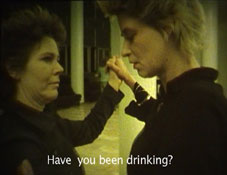
"In Time - Episode 1" is the first of a series of Episodes based around the ballroom dancing schools and clubs of Croatia, Bosnia, etc. For a period of a year or more, the artist and the crew attend ballroom dancing lessons with the intention of making a film. The relationship between the artist, the crew, and the club is one which changes constantly as their roles and positions within this triad switch from being filmmakers, to beginners of dance. They archive everything on video, to use their own memories and the video archive as a memory aid in order to choose moments that occurred in reality and transform them into cinematic events. This offer is open to everyone in and around the club. Here, a participant of a ballroom dancing class is accused of drinking. This event forms the basis for a visual exploration of the possibilities offered in fiction, documentary and drama.
Born in London in 1965, Nicole Hewitt attended primary school in Zagreb, Croatia. She graduated from the Brighton Polytechnic Art College and specialized in model animation at the Jiri Trnka studio of animated films in Prague. She has a MA in Fine Art Media from the Slade School of Fine Art (2002). She is currently a research student at the Slade attached to the Anthropology department of UCL. She has made numerous short, animated, and experimental films since 1986, and has been screened and awarded at numerous international festivals and exhibitions. She participates in various multimedia performances and collaborative projects, and teaches experimental film and animation at the Zagreb Academy of Fine Art.
Catalogue : 2006The Waltz. a Mock Ball | Experimental film | 16mm | color | 10:0 | Croatia | 2004
Nicole Hewitt
The Waltz. a Mock Ball
Experimental film | 16mm | color | 10:0 | Croatia | 2004
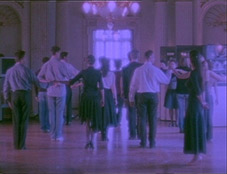
The sound track consists of documentary audio from the preparations for the Vienese Opera Ball in Vienna, the images are reconstructions with Croatian actors and students of the events I filmed while attending the reharsals, auditions and preparations for the Ball. Croatia hopes to emulate the Vienese Opera Ball in February 2005.
Born in London in 1965. Attended primary school in Zagreb, Croatia, graduated from Brighton Polytechnic Art College, specialised in model animation at the Jiri Trnka studio of animated films in Prague. MA in Fine Art Media at the Slade School of Fine Art, 2002.Is currently a research student at the Slade attached to the Anthropology department of UCL. Has made numerous short, animated and experimental films since 1986, screened and awarded at numerous international festivals and exhibitions. Participates in various multimedia performances and collaborative projects. Teaches experimental film and animation at the Zagreb Academy of Fine Art. (selected films: IN/DIVIDU; IN BETWEEN; PIGS, ETC; GLORIA; BRIDGE;WALTZ)
Patrick Hébrard
Catalogue : 2006Tornade vidéo | Art vidéo | dv | color | 4:0 | France | 2004
Patrick HÉbrard
Tornade vidéo
Art vidéo | dv | color | 4:0 | France | 2004
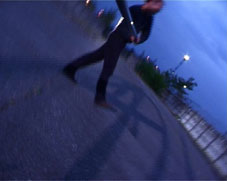
"Tornade Vidéo" Video 4 min. 2004 This film is part of an installation and was orignally intended to be projected onto a large, outstretched spiral in the exhibition space. We see a man walking and running through different landscapes, day and night, as if he was looking to escape imminent disaster, which is none other than the whirling that takes him away, just like a tornado.
I wanted to use the video to put forward the data that brings out the sculpture field and even more our relationship to space. These filmed experimentations are a way to realize the forces, pressure, movements, and speeds that act upon a body. The specific devices used for the video shoot (or for their installation in the form of video sculptures) allow the emergence of these forces' and movements' power, of which, for the most part, we are unconscious.
Daphné Hérétakis
Catalogue : 2013ici rien | Documentary | 16mm | color | 30:0 | Greece, France | 2011
Daphné HÉrÉtakis
ici rien
Documentary | 16mm | color | 30:0 | Greece, France | 2011
The film begun in september 2008, in Exarhia, a major centre of social protest in the heart of Athens. As the months passed and the political situation of Greece evolved, the film became the canvas on which fragments of stories finally laid, composing the tattered landscape of a country in crisis.
Born in 1987 in Paris, Daphné Hérétakis studied documentary filmmaking at the University Paris 8. She currently lives in Paris and Athens. She has directed experimental documentary short films since 2008.
Lily Hibberd, HIBBERD, Lily and TAYLOR, Curtis
Catalogue : 2014The Phone Booth Project | Experimental doc. | hdv | | 14:7 | Australia | 2012
Lily Hibberd, HIBBERD, Lily and TAYLOR, Curtis
The Phone Booth Project
Experimental doc. | hdv | | 14:7 | Australia | 2012
The Phone Booth Project A collaboration between Lily Hibberd and Curtis Taylor The Phone Booth Project presents the special and quotidian role of phone booths in remote Western Desert communities from the perspective of the Martu people living there. Realised as a theatrical installation, three video screens create an immersion into physical sensation and happenings around the booths. Working collaboratively with Martu communities we have made a video installation that explores the use of phone booths in these remote desert regions. A rare insight into the independence and adaptation of modern telecommunications by Martu people across the vast Western Desert of aboriginal Australia.
understanding significant Australian historical events and sites. Her reflexive and collaborative, projects investigate collective, historical, philosophical and psychological aspects of memory and time. Since 2011, she has been commissioned ten community art projects. Lily has an established international career, exhibiting frequently in solo and curated exhibitions, most recently presenting the Ice Pendulum at the Paris Nuit Blanche. She is currently working with the Musée des arts et Métiers on a solo project for their 2015 exhibition on Measures of Time. She is represented by Galerie de Roussan, Paris. Curtis TAYLOR is an actor, emerging film writer/director and a young Martu leader. He is currently undertaking a Bachelor of Culture, Communications and Media at Murdoch University. Curtis has worked as Community Coordinator and Youth Development Officer at Martu Media (a division of Kanyirninpa Jukurrpa), where he spent 18 months working on `Yiwarra Kuju: The Canning Stock Route` as a filmmaker and youth ambassador. Curtis was the recipient of 2011 Western Australian Youth Art Award and Wesfarmers Youth Scholarship.
Danièle Hibon
Catalogue : 2007Musée national du Jeu de Paume | 0 | 0 | | 0:0 | France | 2007

Danièle Hibon
Musée national du Jeu de Paume
0 | 0 | | 0:0 | France | 2007
In 1991 the Jeu de Paume National Gallery became a place of exhibition, a place of contemporary art, and a place of photography. It was not until 2004 that the Gallery fused with both the National Centre of Photography and the Photographic Patrimony, residing at the Sully Hotel in the Marais. Since then, the Gallery sites are exclusively dedicated to contemporary photography, as well as to video and cinema. It welcomes artists from all over the world, thus privileging a synchronic approach of historic moments of art's journey, notably, of photography and and its emotions since its creation up to its contemporary transformations. Image as an artistic expression is touched and revealed in the diversity of its modes of appearance. Anxious to attract its public, the Jeu de Paume National Gallery configures its exhibitions as sources of knowledge, and organizes educational projections, conferences, and symposiums. From the exhibition "Support/Surface" working with the functional across the folded canvases and paintings of Louis Cane, or the knotted ends of twine of André Valensi, to the Arman exhibition, pieces of daily newspapers melted into plexiglass, to the photography art of Joël Meyerowitz, images are discovered at the Gallery in all of their singularity. It gives something to think about.
Danièle Hibon is the head of cinema programming at the Jeu de Paume National Gallery in Paris. She studied classic art and philosophy, and specialized in art history. She has been the head of the 'bureau d'accompagnement de l'avance sur recettes' at the National Centre of Cinematography. Since 1995 she has co-organized a cycle of cine-conferences with Henri Foucault of l'Ensad and Jean-Claude Biette of l'Ensba destined for students at these two art schools. This unique initiative is animated by the constant anxiety to make known the figures of contemporary art and little known filmmakers, and to create events where, in their presence, a genuine dialogue about the questions and problems of art and cinema can be held. In 1995, during a retrospective at the Gallery, Danièle Hibon firmly pushed for the permission to make two filmmakers, Yervant Gianikian and Angela Ricci Lucchi, known to the French public.
Roderick Hietbrink
Catalogue : 2012The Living Room | Video installation | hdcam | color | 8:6 | Netherlands | 2011
Roderick Hietbrink
The Living Room
Video installation | hdcam | color | 8:6 | Netherlands | 2011
The private atmosphere of a Dutch living room is breached by the disturbing presence of a large oak tree that slowly enters the room. Close-ups of different kinds of furniture, potted plants, souvenirs and other personal belongings are carefully depicted. No longer protected from the outside by the thin sheets of glass, the vacuum is cancelled when the large oak tree enters the room, confronting the viewer with the impact this has to both tree and home. Being both realistic and absurd, the confrontation between the tree and the home raises questions about the meaning and symbolism of the tree and the private domain, and its representational aspects towards the outside world.
Roderick Hietbrink (b. 1975, the Netherlands) is a visual artist. He received his BA in Fine Art from the Art Academy St. Joost in Breda in 1999 and his MA in Fine Art from the Piet Zwart Institute in Rotterdam in 2002. He is a current resident at the Rijksakademie van beeldende kunsten in Amsterdam. His work is shown internationally in solo and group exhibitions at Museum Boijmans van Beuningen Rotterdam, Künstlerhaus Bethanien Berlin, Artspace Visual Arts Centre in Sydney, SMART Project Space Amsterdam and Where Where Exhibition Space in Beijing. Roderick Hietbrink lives and works in Amsterdam and Rotterdam, the Netherlands.
Miguel Hilari
Catalogue : 2023Cerro Saturno | Experimental doc. | hdcam | black and white | 13:19 | Bolivia | 2022

Miguel Hilari
Cerro Saturno
Experimental doc. | hdcam | black and white | 13:19 | Bolivia | 2022
A mountain range in fog and snow. Human absence, ancient sacred places. Traces appear: Dirt roads, antennas, transmission lines. Human faces, behind windows and rain. A city.
Miguel Hilari (1985. Aymara/German) is a documentary filmmaker. His work centers around migration, urbanization and history. It has played and was awarded at various international festivals. He lives and works in La Paz.
Claudia Hill, Stephane Leonard
Catalogue : 2018Kon'voi' | Experimental video | 4k | color | 9:23 | Germany | 2017
Claudia Hill, Stephane Leonard
Kon'voi'
Experimental video | 4k | color | 9:23 | Germany | 2017
A group of travellers of unknown origin arrive out of nowhere into an open landscape. Over the course of a day, they explore and scan the environment with their unique handmade triangular antennae. Through their sensual decoding of information and hypnotic choreography of sign language, a necessity of care for this strange and beautiful planet emerges.
Claudia Hill is a Berlin-based cross-disciplinary artist who makes objects that create possibilities for personal encounters and community. Hill’s work developed from a career in fashion presenting her collections between New York and Japan. As her designs expanded beyond the boundaries of the industry, she made costumes for choreographer William Forsythe, The Wooster Group, and became a frequent collaborator with choreographer Meg Stuart. Her interventions range from performative designs to constructing large scale, textile based sculptures, and conceiving participatory actions for art centers such as Centre Pompidou Paris, and ZKM Center for Art and Media, Karlsruhe. Hill’s own artist film Kon’voi’ has been presented in several international film festivals. She is currently developing new work for Supernova, an artist group formed around Damaged Goods´ Sketches/Notebook (extended version) for the HAU Berlin 2018 season.
Pat Hillaire, Rolf Meesters
Catalogue : 2006Dansent le désert | Art vidéo | s-vhs | color | 2:50 | France, Spain | 2004
Pat Hillaire, Rolf Meesters
Dansent le désert
Art vidéo | s-vhs | color | 2:50 | France, Spain | 2004
?Dansent le désert? Some landscapes of body are overlapping in images. Such dances are possible in such an environment. This is the challenge that take the dancers. Created by Pat Hillaire. Dansed by Rolf Meesters and Pat Hillaire. Length: 2 minutes and 50 sec.
1998 initiated a work in video performance in presence of the dancer Claudia Flammin then of Rof Meesters with who I started in 2000 experimental dance. The last performance is in October 2005 Da LI LI DA DA. Falls Festival of Barcelona, 6 performers are gathering to experiment a performance where the important will be that each position on the stage has the same intensity that another. Dance, poetry, video, japans flute are melting. In 2005, this is especially street performances: bar opening exhibitions, Bcn street festival, Museo Mares? 2003 in Berlin: KNOWHERE, 10 street performances, 3 performers, dances Rolf Meesters, Pat Hillaire, musician without instrument Joahnnes Gergmark. He challenged to perform with no object or instruments.
Jürgen Hille
Catalogue : 2023AP 28-2 | Experimental video | mp4 | black and white | 2:28 | Germany | 0
Jürgen Hille
AP 28-2
Experimental video | mp4 | black and white | 2:28 | Germany | 0
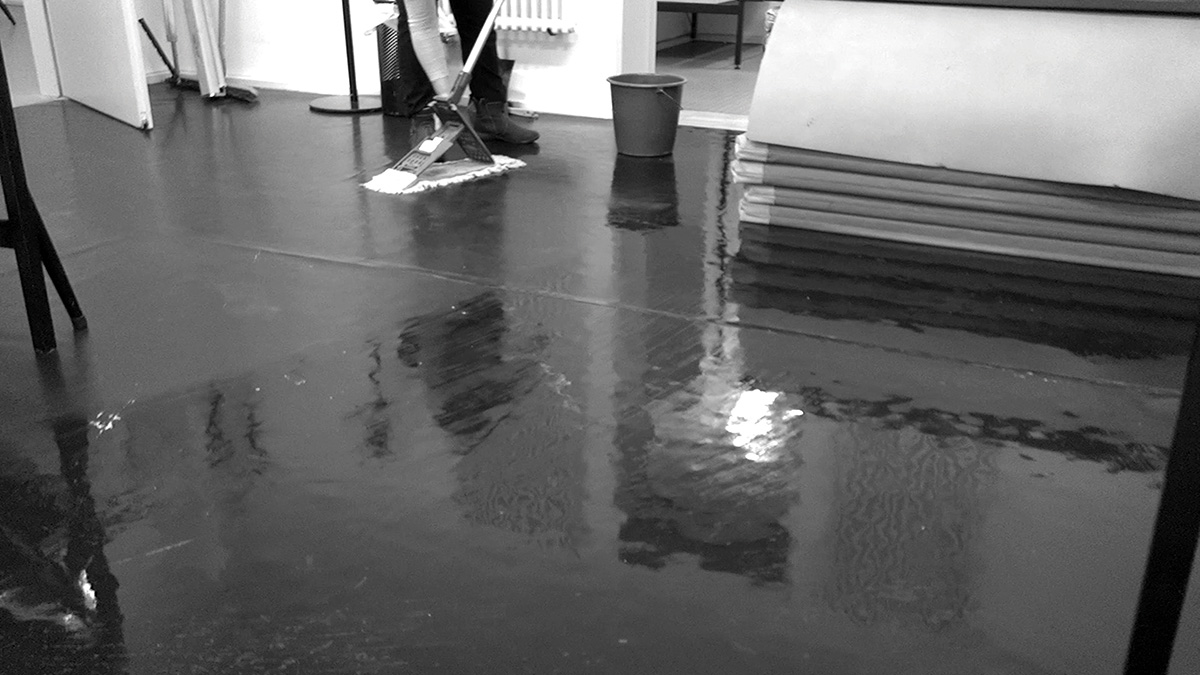
Meine Videoarbeit "AP 28-2" zeigt den Ort und die Institution "Alte Post" in Neuss. Das Gebäude wurde 1877 gebaut und diente bis ca. 1987 als städtisches Postgebäude. Ab 1989 ist darin das Kulturforum Alte Post mit einer kleinen Bühne untergebracht. Der Serviceraum hat sich zu einem kreativen Ort gewandelt. Ich zeige den "Tanz-Probe-Raum" im Obergeschoss mit einer Putzfrau in Aktion. Fotos aus dem Stadtarchiv Neuss. Ein bewegter kleiner Stein belebt die Szene akustisch.
1961 geboren in Düsseldorf 1980-86 Studium Freie Kunst, Kunstakademie Düsseldorf seit 1993 dokumentarische und experimentelle Videoarbeiten
Catalogue : 2021space capsule III | Experimental video | mp4 | black and white | 1:26 | Germany | 2020
Jürgen Hille
space capsule III
Experimental video | mp4 | black and white | 1:26 | Germany | 2020
Cette vidéo est une réaction artistique à la pandémie de Covid qui s’est déroulée au cours de la dernière année. Une bouée, dispositif passif et fixe de signalisation, que je remplis d’images souvenir et d’impulsions de mouvement. Un drone monte et descend. Je montre les êtres humains en tant que foule dans un stade de football et en petit groupe de vacanciers sous un parasol sur une plage déserte.
1961: naissance à Düsseldorf, en Allemagne. 1980-86: études de beaux-arts, Kunstakademie Düsseldorf (Allemagne). Depuis 1993, travaux libres de vidéo documentaire et expérimentale
Catalogue : 2019koi beam boats retina | Experimental video | mov | | 2:48 | Germany | 0
Jürgen Hille
koi beam boats retina
Experimental video | mov | | 2:48 | Germany | 0
1961 in Düsseldorf geboren 1980-86 Studium Freie Kunst, Kunstakademie Düsseldorf 1983 Reisestipendium der Kunstakademie, Italien 1987 Arbeitsstipendium NRW, Schloss Ringenberg 1994 Arbeitsstipendium Schlesw.-Holstein, Künstlerhaus Selk 1995 Künstleraustausch Düsseldorf-Ein Hod, Israel 1999 Projektstipendium Kunstfonds e.V., Bonn (für Videoprojekt “HALDE”) 2018 Cites internationale des arts Paris (Gastatelier) Mitglied im Deutschen Künstlerbund
Baba Hillman
Catalogue : 2023Mary Bauermeister: Light and Stone | Experimental film | super8 | color | 3:45 | Canada, France | 2022
Baba Hillman
Mary Bauermeister: Light and Stone
Experimental film | super8 | color | 3:45 | Canada, France | 2022
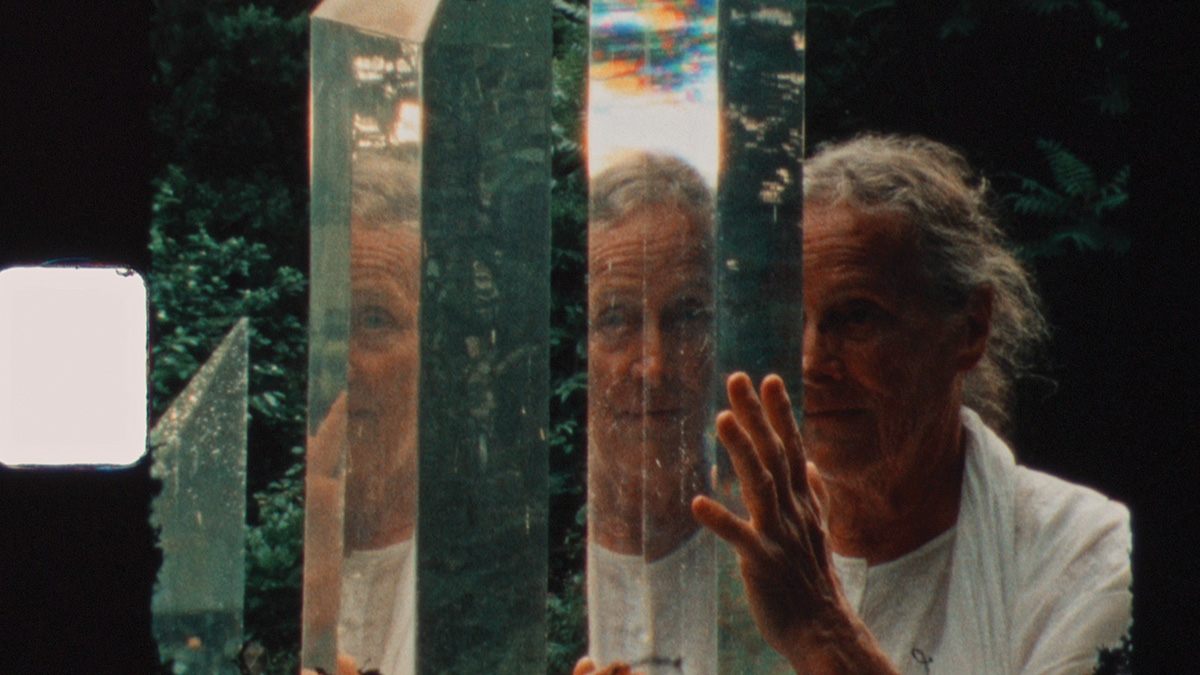
Remembering my last visit with Mary in her garden of light, trees, glass and stone.
Baba Hillman grew up in Japan, Venezuela and Panama and works between France and the U.S.. She received a B.A. in French Literature from Duke University and an M.F.A. in Film and Performance from the University of California, San Diego. Her films and performance works explore memory, history, perception and the poetics and politics of place, language, and the body. She was co-director of Teatro Movimento in Florence, studied with Etienne Decroux and Jean-Pierre Gorin, and is Professor Emerita of Film at Hampshire College in Amherst, Massachusetts. Her films have screened widely at festivals and museums including the Museum of Contemporary Art, Los Angeles, FIDMarseille, Edinburgh Film Festival, Rencontres Internationales Paris/Berlin, Ann Arbor Film Festival, National Gallery of Art, Washington D.C., Anthology Film Archives, ICAIC Havana, Africa World Documentary Festival, Yaounde, MIX Brazil, and European Media Art Festival, Osnabruck, among others. She has received awards and grants from the French Ministry of Culture, the Whiting Foundation, the California Arts Council, and the Italian city governments of Florence, Lecce and Certaldo. In 2020, Hillman’s film Kitâb al-Isfâr: Book of the Journey, a feature-length film about near-death and mystical experiences in Andalucia, premiered at the FIDMarseille film festival and was selected for the Athens Avant Garde Film Festival. Earlier films by Hillman include Decroux’s Garden, and 5 Cité de la Roquette, part of a series of films connected to return, place and disappearance.
Catalogue : 2021Kitâb al-isfâr: Book of the Journey | Experimental doc. | 16mm | color and b&w | 58:0 | Canada, Spain | 2020
Baba Hillman
Kitâb al-isfâr: Book of the Journey
Experimental doc. | 16mm | color and b&w | 58:0 | Canada, Spain | 2020
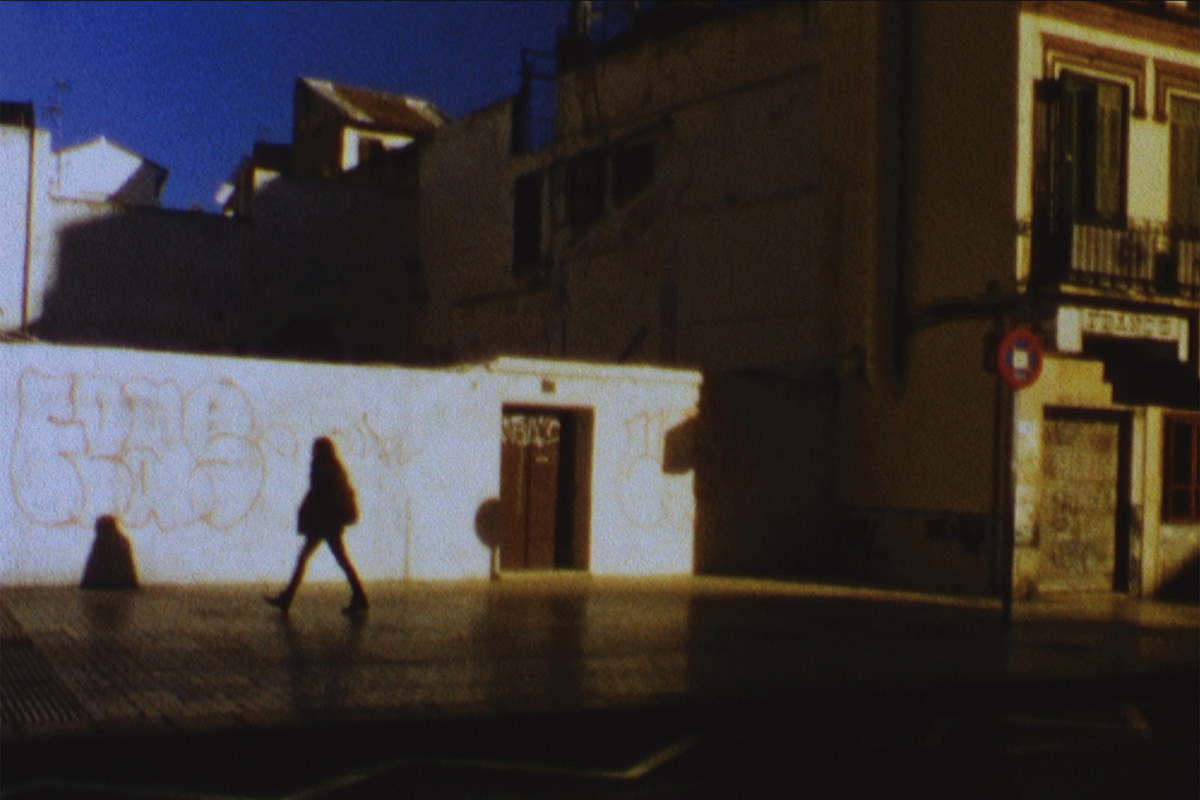
An immersive cinematic poem of a seven year journey of return, "Kitâb al-Isfâr: Book of the Journey," weaves together stories of near-death and mystical experience in Andalucia. When I was 19 I set out, hoping I could learn the meaning of life by "experiencing everything." I bought a car for 20 marks in a cafe in Ulm. I spray painted it yellow and green and drove it from Holland to Romania to Spain, sleeping in the back seat in a red blanket. Driving down to Malaga, at the crest of the mountains, the brakes went out. As the car sped down the mountain then crashed, I lost consciousness, followed by three days and nights of visions. What did I see, what did I understand? The Shaykh al-Akbar, sufi mystic and philosopher Ibn 'Arabi, writes that the journey only has true meaning if it brings a new beginning. In traveling, the heart becomes the goal of the journey.
Baba Hillman is an artist and filmmaker who grew up in Japan, Venezuela and Panama and works between France and the U.S.. Her films and performance works explore memory, history, perception and the poetics and politics of place, language, and the body. Her films have screened at festivals and museums including the Museum of Contemporary Art, Los Angeles, FIDMarseille, Edinburgh Film Festival, Anthology Film Archives, Ann Arbor Film Festival, National Gallery of Art, Washington D.C., Athens Avant Garde Film Festival, ICAIC Havana, Africa World Documentary Festival, Yaounde, MIX Brazil and European Media Art Festival, Osnabruck, among others.
Julien Hilmoine
Catalogue : 2006A chaque instant mourir | Fiction | 16mm | black and white | 20:20 | France | 2005
Julien Hilmoine
A chaque instant mourir
Fiction | 16mm | black and white | 20:20 | France | 2005
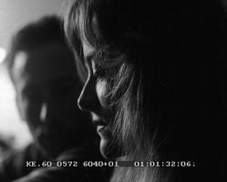
Agnès: a very sensitive young woman. Her best friend: Camille. The latter?s companion: Marianne. The latter?s sister: Astrid. They were to meet again, the four of them, for the first time in a long time. But, Marianne does not show up. Agnès drifts away with her sentiments. For one day and two nights, old stories buried away and new desires will re-emerge, and they will all completely question their relationships with one another.
Julien Hilmoine was born in Fécamp in 1979. Having spent his childhood and teen-age years in Rouen in an upper-middle class, non-religious, and republican family, Hilmoine persued his studies in Litterature, Audio-Visual (Assiciate's Degree with emphasis in Image), and at the Fémis [Ecole Nationale Supérieure des Métiers de l?Image et du Son] in the department of Directing. He lived a typical French youth: love stories, friendships, passions, break-ups, and deaths. He became a Parisian by force of circumstances and tried directing films. He loves actors with a passion. He is always looking for new images, faces, and voices.
Steve Hines
Catalogue : 2007Anyone | Experimental video | dv | color | 2:11 | United Kingdom | 2006
Steve Hines
Anyone
Experimental video | dv | color | 2:11 | United Kingdom | 2006
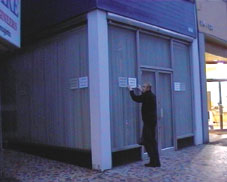
This short video film criticizes, parodies, but also reinforces a Public Warning. Someone has taken the law into their own hands and promised a prosecution. The artist, who could be anyone, is seen challenging and breaking 'the law' while also re-enforcing it. Careful planning and attention is used to prepare for the action by replicating the warning, while stealth and humour is engaged for presentation and execution.
Steve Hines has been exhibiting on a regular basis for ten years now. He has shown his work nationally and internationally, having participated in several international art festivals. With a background in Photography, Steve Hines' practice is now firmly rooted within a conceptual framework and as such he works in various mediums. This provides a great deal of liberty and constantly brings forth new challenges. Steve Hines is interested in making minimal conceptual work that is often combined with the opposing, yet complimentary, nature of extremes. Personal experiences and the everyday provide inspiration and material for his creation of work that combines narratives and elements that can affect us all.
Catalogue : 2006Speakers | Art vidéo | dv | color | 4:16 | United Kingdom | 2005
Steve Hines
Speakers
Art vidéo | dv | color | 4:16 | United Kingdom | 2005
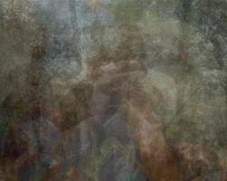
"speakers" represents the notion of a confused, competitive world where the numerous factions, groups, religions, and cultures are all trying to communicate and persuade the rest of the world that their way or belief is superior. The film is a colourful kaleidoscopic, impressionistic image with a matching chaotic audio message. "speakers" is a short digital video film composed from footage shot at Speakers Corner, Hyde Park, London. The finished work represents the notion of a confused world where there are numerous factions, groups, religions, and cultures, of which many are minorities, who are all trying to communicate and persuade the rest of the world that their way or belief is superior. The Speakers are: a black male Muslim, three different white male speakers talking about the ideals of Socialism, a black male Christian; one female and five separate white male Christians, two black males talking about their personal experiences, and an American preacher. All are individuals expressing their ideas, hopes, fears, and concerns about issues affecting us all. The footage of all the "participants" is layered directly on top of each other and what results is a montage and a confused chaos of moving images and words. This effect and action mirrors issues around the world and draws comparisons with arguments and disagreements about borders, territories, religions, governments, and regimes, etc. Presented in its finished state, "speakers" inverts the original audience/speaker role in a particular way. Initially it was the speakers who were struggling, shouting, and vying to get their message across to a varied audience consisting of doubting, interested, or even mocking individuals. Now, in a gallery space, it is the audience who stand there intrigued by what is before them and who then begin to listen more carefully, trying to catch or hear a legible word here or there, or to try and visualise an individual face in the crowd. The image brings to mind a kind of moving, impressionist painting of kaleidoscopic nature whilst the sound reminds one of a civilised world in confusion, rather like that of The Stock Exchange in full flow for example. © steve hines 2005
steve hines has been exhibiting on a regular basis for almost ten years now. He has shown his work nationally and more recently internationally, having participated in several international art festivals. With a background in photography, steve hines` practice is now firmly rooted within a conceptual framework, and as such he works in various mediums. He is interested in making minimal, conceptual work that is often combined with the opposing yet complimentary nature of extremes. Personal experiences and the everyday provide inspiration and material for the creation of work that combines narratives and elements that can affect us all.