Catalogue > List by artist
Browse the entire list of Rencontre Internationales artists since 2004. Use the alphabetical filter to refine your search. update in progress
Marta Hryniuk, Nick Thomas
Catalogue : 2025Centre for Creativity | Experimental doc. | 16mm | color and b&w | 22:30 | Poland, Netherlands | 2024
Marta Hryniuk, Nick Thomas
Centre for Creativity
Experimental doc. | 16mm | color and b&w | 22:30 | Poland, Netherlands | 2024
Two parallel stories in post-full scale invasion Ukraine. Oksana is a psychologist and dance teacher at the Centre for Creativity, a community space in Kosiv, west Ukraine, now repurposed as a hub for volunteers to make soup, salo and camouflage nets for the front lines. Margarita is an artist and volunteer medic, working to evacuate wounded soldiers, civilians and animals, while still maintaining her practice as a painter. A meditation on resistance, the role of art in extreme times, and the ways in which people relate to or make sense of the war.
The collaborative practice of Marta Hryniuk and Nick Thomas is devoted to the radical potential of film and video, paying close attention to themes of collectivity, a subjective relation to history, and possibilities for resistance. They seek out places and subjects which offer insights into ways of living ‘otherwise’, opening up questions around freedom, agency and solidarity. They are interested in the utopian social projects of the twentieth century and their legacies, feminist and migration histories, and the ways in which individuals embody and respond to historical forces. Their work often takes the form of portraiture; collaborating with individuals and small groups allows the artists to think about broader themes while embracing subjectivity, tactility and embodied knowledge.
Chia-wei Hsu
Catalogue : 2012The Story of Hoping Island | Video installation | hdv | color | 12:40 | Taiwan | 2008
Chia-wei Hsu
The Story of Hoping Island
Video installation | hdv | color | 12:40 | Taiwan | 2008
?The Story of Hoping Island? was shot in a shipyard on Hoping Island in Keelung, which has 88 years of history. During the Japanese occupation of Taiwan, it was the Japanese government?s southernmost shipyard, and as such, it supported Imperial Japanese, southward expansion. After the retrocession of Taiwan, the shipyard played a key role in Taiwan?s economic takeoff. This shipyard represents a highly compressed, symbolic timeframe, from WWII to now. The shipyard reflects how the locals identify themselves based on their specific, local histories, and at the same time, how the national government encodes and directs history. To support this history, complicated traditions and myths are continually developed and developing. So Hsu, Chia-Wei shot this shipyard, a real space, and responded to the shipyard?s other historical side: the legend. The whole scene of ?The Story of Hoping Island? was shot in the shipyard in Hoping Island. Artist invited his grandmother to describe the situation in Japanese (She had received Japanese education). Through the process of narratives, this place seems remote and deserted caused of no people appeared in the video. (Actually, there are usually numerous of workers) In this work, artist regarded this shipyard as a memory crystal to develop the narratives. Through the complexity of place and memory, this place becomes an effective instrument to reproduce memory. In this video, an artist-created creature?Ni-Ku is the only element to connect to the narrative. It has weightless science-fictional characteristic: both the military detector and the luminary. Artist also put electronic music with shattered rhythms in the background. Through this tiny creature, this work responds to the grand era and so do the fictional narratives respond to the politics statement. It also permeates through history, memory and dream. Or we could say that history itself seems like memory and dream to some extent. There is many usage of ?light? in this work, including the luminous Ni-Ku in the narratives, sparkling gem-like light in the shipyard, the lighting in the end of the video, and also the physics light from projector in the space. In the illusory dimension, with its light-like non-material characteristic, this work transits the immense and heavy history to a legend. ?The Story of Hoping Island? lies in constantly-overlapped process of history and dream, image space and physical space, reality and fiction. While national governments continuously constructed its own identification, this work becomes a weightless, fictional space, and provides a breathing break.
My method is a specific kind of ?Narrative? -- a way of documenting that interferes with the reality of the text, by focusing on a site?s specific and peculiar characteristics, such as memory, imagination, or identification. With these characteristics in mind, I develop a narrative, and between the reality of the text and the fictional narrative, I construct a myth or a legend. I am also one of the members from Open-Contemporary Art Center in Taipei, Taiwan. This art space consists of numerous young artist and runs over 11 years. Through practicing organizing exhibitions and writing, I try to expand art influences to the society.
Catalogue : 2011Huatung Village | Art vidéo | dv | color | 7:45 | Taiwan | 2010
Chia-wei Hsu
Huatung Village
Art vidéo | dv | color | 7:45 | Taiwan | 2010
Huatung Village was located in Sijhih City in Taiwan and populated by the Amis people. In 1985, there were three Amis families farming vegetables by the Dakeng River Bridge along Provincial Highway No. 5. The next year, about ten Amis families built cabins and stayed there. That is how Huatung Village started. By 1996, it became a village of 215 families. It was a huge block of illegal buildings. The villagers used abandoned iron sheets and wood to build their houses. They also used those materials to build the traditional tribal lookouts, community meeting rooms, and churches. In 1997, the government evicted the whole village and moved them to subsidized government housing. Now, the site is covered by grass, and one can only find a few ruins left behind. My work was videotaping the actual site. Juxtaposing separate audio and video tracks, the chieftain?s voiceover talks about the village?s history, while the video track shows what the village looks like nowadays. Gradually, as day turns into night, the video?s structure changes from documentation to another approach: I wanted to constantly blend the layers between the location (documentation) and the scene (narrative).
1983 Born in Taichung, Taiwan, live and work in Taipei, Taiwan. 2005 graduated from Department of Fine Arts, National Taiwan University of Arts 2010 graduated from Graduate School of Plastic Art, National Taiwan University of Arts My method is a specific kind of ?Narrative? -- a way of documenting that interferes with the reality of the text, by focusing on a site?s specific and peculiar characteristics, such as memory, imagination, or identification. With these characteristics in mind, I develop a narrative, and between the reality of the text and the fictional narrative, I construct a myth or a legend. I am also one of the members from Open-Contemporary Art Center in Taipei, Taiwan. This art space consists of numerous young artist and runs over 9 years. Through practicing organizing exhibitions and writing, I try to expand art influences to the society.
Catalogue : 2010March 14, 2009, Hong Kong Coliseum | Experimental video | dv | color | 7:43 | Taiwan | 2009
Chia-wei Hsu
March 14, 2009, Hong Kong Coliseum
Experimental video | dv | color | 7:43 | Taiwan | 2009
Narrated by Chinese Malaysian singer Fish Leong, the project ?March 14, Hong Kong Coliseum? follows her tour through different cities in Asia, including Shanghai, Hong Kong, Taipei, Singapore, Malaysia, Beijing, Guangzhou, Kunming, and Chengdu. In Chinese world, almost everyone knows Fish Leong and her voice. Here was a huge entertainment industry with a pan-Asian approach. The tour moved from city to city, and wherever it went, the stage, lighting, and songs at each event were similar, and each concert scene was also a confrontation between globalization and local cultures. In this exhibition, I present a single-channel version and make two images juxtaposed. The video shows an empty concert scene with neither the singer nor audiences. The real event becomes an enormous and fictional scene. Here, the concerts represent globalization, but the video work makes this connection drift apart.
I live and work in Taipei, Taiwan. I am now a full-time artist. My method is a specific kind of ?Narrative? -- a way of documenting that interferes with the reality of the text, by focusing on a site?s specific and peculiar characteristics, such as memory, imagination, or identification. With these characteristics in mind, I develop a narrative, and between the reality of the text and the fictional narrative, I construct a myth or a legend. I am also one of the members from Open-Contemporary Art Center in Taipei, Taiwan. This art space consists of numerous young artist and runs over 8 years. Through practicing organizing exhibitions and writing, I try to expand art influences to the society.
Che-yu Hsu
Catalogue : 2023The Making of Crime Scenes | Experimental doc. | 0 | color | 21:56 | Taiwan, France | 2022
Che-yu Hsu
The Making of Crime Scenes
Experimental doc. | 0 | color | 21:56 | Taiwan, France | 2022
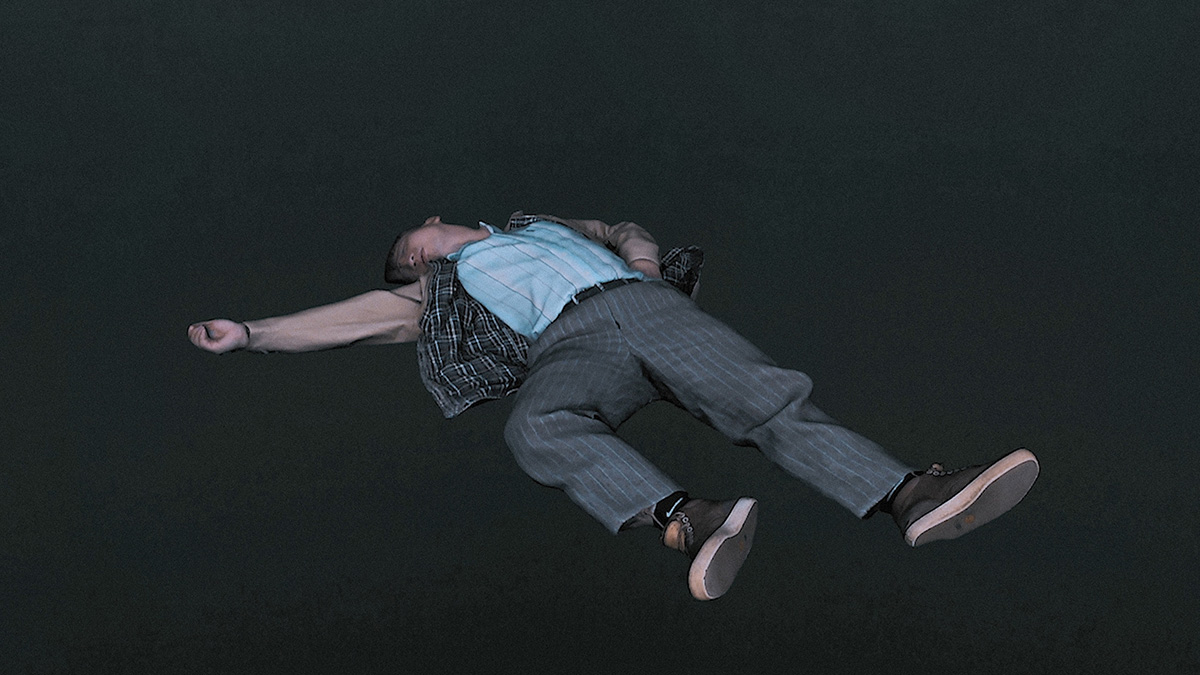
Starting from a gunman involved in a murder case, I seek to reflect the collective unconscious within society and politics through the gunman's multiple peculiar roles—a filmmaker, a killer, a gangster, and a patriot. In 1984, when Taiwan was still under Martial Law, a Taiwanese American writer Henry Liu was shot to death in his own house in the US by a Taiwanese assassin. Afterward, due to the intervention and investigation of the US government authorities, this case was eventually confirmed to be a political murder jointly committed by the Military Intelligence Bureau and the biggest mafia United Bamboo Gang in Taiwan, as the government paid the mafia to kill Henry Liu. The protagonist of this work, Wu Dun, is the assassin who fired the shot at the time. After the case was exposed, the Taiwanese authorities were pressured by the US, and Wu Dun was thus sentenced to life imprisonment. However, he was given amnesty and discharged from prison after six years. After he got out of prison, Wu Dun remained an important member of the United Bamboo Gang, and he established a film company as a producer with the support of his mafia influence, making several “wuxia films” – refers to specific traditional Chinese swordplay films. In this work, I revisited the film studio that was once used by Wu Dun and is now deserted to recompose the fragments of the political assassination and the scenes of wuxia films, and I cooperated with a 3D scanning team—their job is to provide forensic scanning service at crime scenes—to make a digital double of Wu Dun.
Hsu Che-Yu (b. 1985) is an artist based in Taipei and Amsterdam. Previously, Hsu obtained a master’s degree from the Graduate Institute of Plastic Arts, Tainan National University of the Arts (Taiwan). Since 2019, he had participated in the residency program in HISK (Ghent, 2019–2020) and Le Fresnoy – Studio national des arts contemporains (Tourcoing, 2020–2022). In 2022, he begins his two-year art residency in Rijksakademie in Amsterdam. Hsu has solo exhibitions at Liang Gallery (Taipei, 2022), Vanguard Gallery (Shanghai, 2020), Taipei Fine Arts Museum (2015), Kuandu Museum of Fine Arts (Taipei, 2012), SAT Society for Arts and Technology (Montreal, 2012). He has participated in the Theater der Welt (Frankfurt, 2023), Bienal de São Paulo (2021), Seoul Mediacity Biennale (2021), Sonsbeek20?24 Quadrennial public program (2021), Techniques of Becoming (Württembergischer Kunstverein, Stuttgart, 2021), VIDEONALE.18 (2021), Shanghai Biennale (2018), London Design Biennale (2018), Asian Art Biennial (Taichung, 2017), and film festivals IFFR International Film Festival Rotterdam (2023, 2022, 2020, 2018), NYFF New York Film Festival (2020)and Rencontres Internationales Paris/Berlin (2020, 2019, 2018). He was awarded the Videonale Award of the Fluentum Collection (Kunstmuseum Bonn, 2021), the Loop Barcelona Video Art Production Award (Han Nefkens Foundation, 2020), the Taishin Annual Grand Prize (Taishin Bank Foundation for Arts and Culture, 2016), and was a finalist for HUGO BOSS ASIA ART (2019).
Che-yu Hsu
Catalogue : 2020Single Copy | Video | hdv | color | 21:17 | Taiwan | 2019
Che-yu Hsu
Single Copy
Video | hdv | color | 21:17 | Taiwan | 2019
I deploy the technique of 3D scanning on the body of the first conjoined twins in Taiwan and use it as materials to reenact their memory from the youth. In this work, I explore the layer of biopolitics and the demonstration of one’s memory. The first conjoined twins underwent the separation surgery in 1979 and the whole surgeon process was broadcast on TV. In that period, Taiwan was under martial law. Therefore, this surgery was often interpreted as a metaphor for the relationship between Taiwan and China. Forty years later, I revisit the iconic figures and reconstruct the narration of their memory within personal and public experiences. Back in 1979, in order to rehearse for the separation surgery, the hospital invited an artist to make a cast of the conjoined twins. However, because it was difficult to control the babies during the molding process, the attempt to make a cast was unsuccessful. In this project Single Copy, I have re-casted the body of the now 43-year old Chang Chung-I, and also use 3D scanning technology to archive his body. The data from the archive are then used as sources for capturing memories from Chang’s earlier life.
Hsu Che-Yu was born in Taipei in 1985. Earning his master’s degree from the Graduate Institute of Plastic Arts, Tainan National University of the Arts. From 2019 to 2020, he began to join the post-academic research programme HISK (Higher Insititute for Fine Art). Hsu Che-Yu works as an artist who primarily creates animations, videos and installations that feature the relations between media and memories. What matters to the artist is not simply the history of events traceable through media, but also the construction and visualization of memories, be they private or collective. The exhibitions he once participated include: 2020“International Film Festival Rotterdam”(Rotterdam), 2019 “HUGO BOSS ASIA ART” (Rockbund Art Museum, Shanghai), “Pre-biennale screening program- Seoul Mediacity Biennale 2020” (Seoul Cinema, Seoul), 2018 “Shanghai Biennale: Proregress” (Power Station of Art, Shanghai), “London Design Biennale: Emotional States” (Somerset House, London), “Osmosis Audiovisual Media festival” (CCI Fabrika, Moscow), 2017 “Asian Art Biennial: Negotiating the Future”(National Taiwan Museum, Taiwan), “EXiS, Experimental Film And Video Festiva” (Sonje Art Center , Seoul), “ifva Festival” (Hong Kong Arts Centre, Hong Kong), 2016“Public Spirits” (Center for Contempoary Art Ujazdowski Castle, Warsaw), “Time Test: International Video Art Research Exhibition” (CAFA Art Museum, Beijing)
Catalogue : 2019Lacuna | Video | mov | color and b&w | 40:45 | Taiwan | 2018
Che-yu Hsu
Lacuna
Video | mov | color and b&w | 40:45 | Taiwan | 2018
This video is about my brother’s family memories in the form of animation, and extend from these memories to two criminal cases that took place in the surrounding area: one teenager was murdered, which happened at an Internet café where my brother often used to go to in his adolescent years, and this event was made into an illustration on the news. Another event also happened in my hometown; someone witnessed a dog wandering on the street, with a female’s head too rotten to be identified in its mouth. Police imagined and portrayed the female’s face before her death according to the shape of the skull. - The two events were separately made into portraitures on public media:a manga illustration made with 3D software by news media, and the portrait of the victim drawn with pencil by the police. I visited the police who produced the head profile of the female, as well as the storyboard director who made the news animation. By exploring their graphic techniques, I attempt to construct the images of my brother’s memories in my work.
Hsu Che-Yu was born in Taipei in 1985.Earning his master’s degree from the Graduate Institute of Plastic Arts, Tainan National University of the Arts. Now participate in post-academic research programme HISK (Higher Insititute for Fine Art) 2019-2020. Hsu Che-Yu works as an artist who primarily creates animations, videos and installations that feature the relations between media and memories. What matters to the artist is not simply the history of events traceable through media, but also the construction and visualization of memories, be they private or collective.
Catalogue : 2018Re-rupture | Video | hdv | color | 15:19 | Taiwan | 2017
Che-yu Hsu
Re-rupture
Video | hdv | color | 15:19 | Taiwan | 2017
In 1995, there was a human-shape balloon on the top of Chongxing Bridge in Taipei, and there was also the attempt of suspending all kinds of items in the air, such as washing machine, boiling hot pot, the statue of Chiang Kai-shek, and sex doll, trying to crash them to the ground. But the plan failed eventually; nothing was destroyed. Before everything started, it ended because of the self-explosion of the human-shape balloon. The same year under Chongxing Bridge, there was also a large scale fight. The people present there that day slashing each other with iron rod or sashimi knife. When we found the people invovled, however, they told us it was actually a fight between political factions. Re-rupture assembles two seemingly unrelated historical fragments: "People`s Taxi riot" and "Taipei Breaking Sky." I invited five drivers who participated in the fight at the time to return to the event site, while hanging a guitarist Li Na-shao on the top of Chongxing Bridge to play music.
Hsu Che-Yu was born in Taipei in 1985.Earning his master’s degree from the Graduate Institute of Plastic Arts, Tainan National University of the Arts. Hsu Che-Yu works as an artist who primarily creates animations, videos and installations that feature the relations between media and memories. What matters to the artist is not simply the history of events traceable through media, but also the construction and visualization of memories, be they private or collective.
Chia-wei Hsu
Catalogue : 2010March 14, 2009, Hong Kong Coliseum | Video installation | dv | color | 7:43 | Taiwan | 2009

Chia-wei Hsu
March 14, 2009, Hong Kong Coliseum
Video installation | dv | color | 7:43 | Taiwan | 2009
Lin Htet Aung
Catalogue : 2025Eclipse | Video | digital | color | 35:0 | Myanmar | 2023
Lin Htet Aung
Eclipse
Video | digital | color | 35:0 | Myanmar | 2023
The soldier's mind was a turbulent sea of anxiety and resolve as he arrived at the abandoned battle camp, where the hasty departure of others left him grappling with solitude and the weight of his duty.
Lin Htet Aung (1998, Myanmar) is a self-taught filmmaker based in Myanmar. In his earlier days, he wrote avant-garde poems and published underground poetry books. In 2020, his experimental short film Estate won the Silver Screen Award for Best Director at the Southeast Asian Short Film Competition at the 31st Singapore International Film Festival (SGIFF). In 2023, his short film Once Upon A Time There Was A Mom won the Silver Screen Award for Best Screenplay at the 34th SGIFF. His same short film won the Principi Award at Lago Film Fest and the Jury Prize at Bangkok ASEAN Film Festival (BAFF). His short films have been selected at International Film Festival Rotterdam, Internationale Kurzfilmtage Oberhausen, Rencontres Internationales Paris/Berlin, LINOLEUM Contemporary Animation and Media Art Festival, Kurzfilm Festival Hamburg, among others. In 2024, he received a Script Development Fund for his debut feature project, Making A Sea, which won the Fellowship Prize at the Southeast Asian Film Lab at the Singapore International Film Festival 2023. He is one of the directing fellows for the CHANEL X BIFF Asian Film Academy 2023. He has also been nominated twice for SEA AiR Studio Residencies Cycle 1 and Cycle 2. He is also one of the Prince Claus Seed Awardees 2023 and a Locarno Filmmakers Academy 2024 participant.
Lin Htet Aung
Catalogue : 2026A Metamorphosis | Experimental fiction | 0 | color | 16:36 | Myanmar | 2024
Lin Htet Aung
A Metamorphosis
Experimental fiction | 0 | color | 16:36 | Myanmar | 2024
In the houses, after parting, Mothers were made up of tears. Sons were transformed into empty glass cups. And the lullabies became a curse. The film examines the suffering and resilience of the Burmese people by using the distinct political elements that have floated for several years on the ocean of political opera under repetitive military dictatorships in Myanmar. The visual composition draws on the colors of Myanmar’s national flag, adopted in 2010 during the country’s so-called transition period. This flag, rooted in the 2008 Constitution forced upon the country by a former military dictator, contrasts sharply with the earlier 1974 State Flag Law, as it includes a formal definition of the flag. The film deconstructs and questions the existing definition of the flag by playing with the colors, objects, and sequences, by using a form of Government Propaganda Television Footage showing different generations under repetitive military dictatorships, by mixing the chilling voice of the current dictator, Min Aung Hlaing, narrating haunting lullabies through AI technology. The film also revisits the song which was sung from the last footage of actual footage of a birthday party celebration for Myanmar’s former dictator, General Ne Win, held at Sedona Hotel in Yangon on March 21, 2001, one year before his death.
Lin Htet Aung (b. 1998) is a filmmaker from Myanmar. He began with avant-garde poetry before transitioning to filmmaking in 2017. His short films have been selected at several international film festivals, including New York Film Festival, Vancouver, Tirana, Karlovy Vary International Film Festival, International Film Festival Rotterdam and won several awards, including the TIGER SHORT AWARD at International Film Festival Rotterdam IFFR. An alumnus of TIFF Directors’ Lab, Berlinale Talents, Locarno Filmmakers Academy, Asian Film Academy, and a Prince Claus Seed Awardee 2023, he is now developing his debut feature, Making A Sea, which received the Asian Cinema Fund and Red Sea Award at Asian Project Market (APM). After the coup in 2021, he joined the CDM (Civil Disobedience Movement) for his Engineering study in Myanmar, and currently studying at Städelschule art School, Germany.
Wei Hu
Catalogue : 2014la lampe au beurre de yak | Fiction | hdv | color | 15:0 | China, Tibet | 2013
Wei Hu
la lampe au beurre de yak
Fiction | hdv | color | 15:0 | China, Tibet | 2013
A young itinerant photographer and his assistant offer to photograph some Tibetan nomads in front of various backgrounds.
HU Wei, born in Beijing (China) in 1983 and currently live and work between Paris and Beijing.Diploma of the Ecole Nationale Superieure des Beaux-Arts de Paris in 2011 and Fresnoy, National Studio of Contemporary Arts in 2013. works through the cinema, installation, sculpture and drawing.
Di Hu
Catalogue : 2018Ecstasy | Video | mov | color and b&w | 12:42 | China | 2015
Di Hu
Ecstasy
Video | mov | color and b&w | 12:42 | China | 2015
This video is an analytical montage of shots extracted from more than 60 films from the Chinese Cultural Revolution period. It exclusively studies the moments of the interpellation of the Ideology (Louis Althusser) which are represented physically by music, words, gazes, gestures and situations found in these films. Strictly speaking, Ecstasy does not lend itself to a specific synopsis, but this does not mean that there is nothing to look at in it. The multiple symbols and meanings extracted from a wide range of shots make up the narratives found in this video: The resemblance of the music in different films, the dramatic gazes with catchlights (like they are absorbed by an overwhelming feeling of great excitement, where the title Ecstasy comes from), the repetition of the words (like “ Mao Zhuxi ”, Chairman Mao), the robotic gestures (raising one’s head, turning around), the faces with tears, the symbolic objects which reincarnate the transmission of ecstasy (like needle, spanner and apple) and the exaggerated film techniques (close-up, zoom in). This video is one of a series of videos and they are not only reexaminations of the cinema of that period but also reflections of history as told through cinema.
Di HU Born in Zhejiang, China. He studied Chinese Literature at Zhejiang University before going on to study cinema at several universities in Paris (Paris 1, Paris 7 and Paris 3). He became a film critic and scholar afterwards and started making video works in 2014. Since then, his works have been screened and exhibited in Stuttgarter Filmwinter, Cairo Video Festival, Dallas Medianale, Athens Digital Arts Festival, Images Contre Nature, Magmart International Videoart Festival, EXiS, Channels Festival, Korean Film Archive and the Australian Center for the Moving Images and Cinémathèque de Toulouse, among others. www.hudi-art.com
Zhenqian Huang
Catalogue : 2013Stand along zone | Experimental doc. | dv | color | 8:5 | China | 2012
Zhenqian Huang
Stand along zone
Experimental doc. | dv | color | 8:5 | China | 2012
Suite à la démolition du quartier Yanji, situé au centre-ville de Canton (Chine) qui devient une zone de chantier entre construction et destruction. Une seule maison reste aujourd`hui visible dans cette vaste zone désaffectée. Celle-ci est désormais source de nombreux récits, merveilleuse, elle détiendrait le secret du monde. Un jeune homme jette des pierres face à cette étendue et tente, de déclencher une vibration du monde, jusqu`à l`épuisement, et une femme observe le lointain avec des jumelles. Un geste ancré dans un rapport de lutte intime, incarné entre le corps et l`architecture, la modernité et la ruine, un geste pour réactiver un lien sensible avec ce qu`il reste du réel.
Photographe et vidéaste indépendant, né en 1980 à Canton (Chine). Zhenqian Huang vit depuis 2004 en France. Après un diplôme à l`Ecole Supérieure d`Art Lorraine d`Epinal et de Metz en 2011, Ensuite, il est passé au post-diplôme à l`Ecole Supérieure des Beaux-Arts de Lyon. Son projet art vidéo " Village in the city " (2010) a obtenu le premier prix vidéo Grand Est et vidéo "Déshabitation`` (2011) pour le prix mention spéciale du jury au Festival d`Art Vidéo D`Konschtkëscht au Luxembourg. Il a exposé son travail au plusieurs pays, notamment au Centre Pompidou de Metz et Européen média art festival en Allemagne. Il est actuellement en promotion au Fresnoy, Studio national des arts contemporains.
Xueyi Huang
Catalogue : 2025No.27 Tong Poo Road | Experimental film | digital | color | 5:0 | China | 2023

Xueyi Huang
No.27 Tong Poo Road
Experimental film | digital | color | 5:0 | China | 2023
Born in an old house in Xiachun, Zhuhai, Guangdong, it holds collective memories for my family and me. Twenty years ago, urban development led to its demolition, making way for new residential areas. Afterward, we spent 16 years in various rental houses, only returning to our original neighborhood in 2016. My recollections of the old house are vague, as I was only three years old, but each family member holds distinct memories and stories of it. It was where my parents spent their careers and my older sister her childhood and youth. This work is an AI-generated image project. Utilizing deep learning, text-to-image, and image-to-image models, it attempts to reconstruct the memories of our old house as preserved in my family's minds. This project is not just about the application of technology; it delves into the role of AI in documenting and enhancing family history, especially for families with rich cultural backgrounds. This method serves as a way to record and preserve diverse experiences, facilitating cultural exchange and understanding. Through AI, I deeply explore our family history, understanding the significance of the old house and its role in shaping our collective memory.
Xueyi Huang, an artist known as Snow, is a digital media artist from Zhuhai, China. She holds a Bachelor's degree in Digital Performance Design from the China Academy of Art and a Master’s degree in Computational Arts from Goldsmiths, University of London. Her career spans across visual effects, game engines, and digital interaction. Snow’s creations are deeply influenced by her educational and life experiences in both China and the UK. Utilizing technologies such as generative art, machine learning, augmented reality, and motion capture, Snow is dedicated to producing narrative works that weave together personal and cultural memories, presenting emotionally resonant computational art.
Po-chih Huang
Catalogue : 2023Heaven on Fourth | Video installation | 4k | color | 30:42 | Taiwan, USA | 2019
Po-chih Huang
Heaven on Fourth
Video installation | 4k | color | 30:42 | Taiwan, USA | 2019
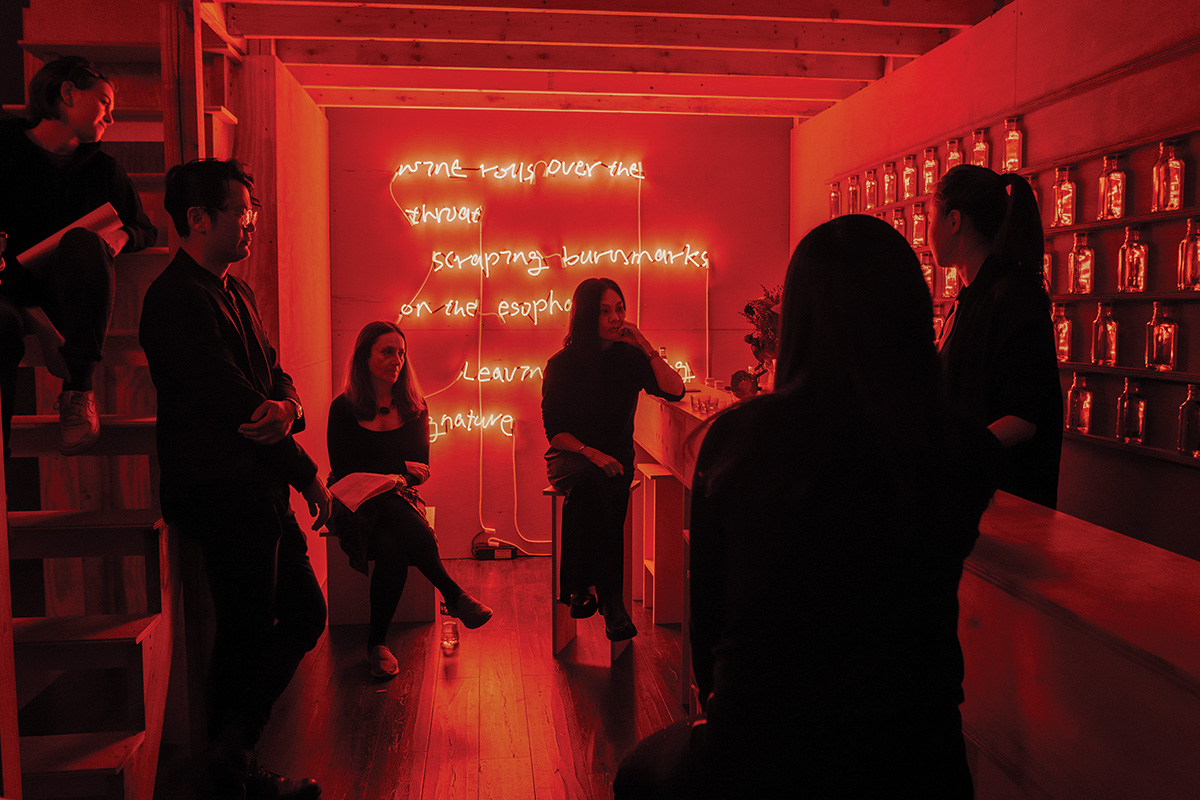
This is the video version of Heaven on Fourth. At “Performa 19” Huang Po-Chih used a non-realistic method to interpret an incident that occurred in the Chinese community of Flushing, New York. Heaven on Fourth took place in six performances, three performances per week. The work was expressed through a variety of forms, including installation, text and live performance. He hired actors, writers, bartenders and a masseuse to reconstruct the incident. The entire performance was based on the story of the Chinese woman Song Yang, an undocumented immigrant who engaged in erotic massage: To avoid being arrested by the police for prostitution again, she leapt from her rented fourth-floor apartment and landed heavily on a street lined with restaurants and erotic massage parlors in Flushing, New York. The title of the work (Heaven on Fourth) alludes to this incident, as well as the name of a massage parlor that was later established in the same apartment. Through this title, he directly explored the many contradictions in society today. Heaven on Fourth was not a typical performance. It defied specific categorization, because it had no script, only five texts. Within this structure, Huang Po-Chih and the four writers used words to open up an ambiguous space that accommodated any plot, any imagining or information, enabling an open-ended examination and review of the life of an inconspicuous character, and telling a story of “human fate at its lowest state.” During the process of performance, the actors read the text in a calm and gentle tone, and at each pause in the recitation, the bartender at the bar invited the audience to taste the cocktails. A massage bed was set up above the bar, and an actor randomly asked audience members if they would like to go upstairs for a massage. In this private mezzanine space, the hired masseuse massaged participants silently, while an actor recited the text softly in their ear. For Huang Po-Chih, the purpose of re-editing the incident with texts rather than a script was to provoke a direct reaction from spectators. However, such a manipulation had the potential to alter the real world. The artist did this deliberately in order to create a socially conscious “artwork.” However, works of art differ from acts of social activism, with their appeal to ideas and attitudes of skepticism. The use of an artistic vocabulary makes it easier for the audience to become engaged with a certain scenario.
Huang Po-Chih (1980 born in Taoyuan, lives and works in Taipei, Taiwan) completed his studies at the Taipei National University of the Arts in Taiwan in 2011. His diverse artistic practice revolves around the circumstances and history of his family which enable him to involve in issues like agriculture, manufacturing, production, consumption, etc. Since 2013, exhibitions of his continuous art project "Five Hundred Lemon Trees" have been transformed into a crowd-funding platform allowing the appropriation of artistic resources for developing an agricultural brand, activating fallow farmland, and growing lemon trees for lemon liquor. On the other hand, the project has connected his family members, local farmers, and consumers to make a new social relationship possible. In the same year, he published his first collection of essays "Blue Skin: My Mother’s Story", the story about his mother. In a way, such a brief account of personal history can somehow reflect Taiwan's agricultural economic reform and social change over the past fifty years, which is essentially, a micro-level of observing his own family history and society as a whole in Taiwan. Huang Po-Chin received the grand prize of the Taipei Arts Award in 2013, was nominated HUGO BOSS Asia arts Award in 2015, and received Prudential Eye Awards in 2016. Huang participated in Taipei Biennale in 2014 and 2016 and has been exhibited internationally including the 8th Shenzhen Sculpture Biennale in China in 2014, Performa 19 in New York in 2019, Busan Biennale in Korea in 2020, also many group exhibitions in museums, e.g., the National Museum of Modern and Contemporary Art (MMCA) in Seoul, the Rockbund Art Museum in Shanghai, CHAT in Hong Kong, the Museum moderner Kunst Stiftung Ludwig Wie (mumok) in Vienna.
Shuli Huang
Catalogue : 2025Goodbye First Love | Fiction | hdv | color | 12:53 | China, USA | 2024

Shuli Huang
Goodbye First Love
Fiction | hdv | color | 12:53 | China, USA | 2024
He pays him a visit in Frankfurt during his work trip in Europe. The last time he saw him was in Beijing, back in 2015, and this could be the last time he sees him.
Shuli Huang is a writer-director and cinematographer born in Wenzhou, China. His second short film, Will You Look At Me, premiered at the 61st Semaine de la Critique where it was awarded Queer Palm of Festival de Cannes 2022, and went on to win Short Film Jury Award at Sundance Film Festival 2023. Goodbye First Love, his latest short film will premiere in competition at Berlinale shorts 2024. As a cinematographer, Shuli lensed several Chinese independent feature films including Farewell, My Hometown, which received the New Currents Award at Busan International Film Festival 2021, and Borrowed Time, selected for International Film Festival Rotterdam 2024. Shuli studied film production and cinematography at Beijing Film Academy. In 2019, he moved to New York City, pursuing an MFA in film directing at New York University’s Graduate Film program.
Séverine Hubard
Catalogue : 2008Un jour, | Experimental film | dv | color | 6:0 | France | 2007
Séverine Hubard
Un jour,
Experimental film | dv | color | 6:0 | France | 2007
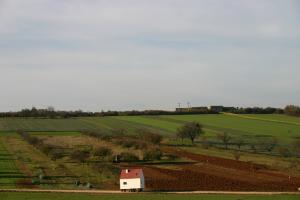
A house takes flight and strolls off on foot into the landscape Description > A house/set is installed in a housing estate at Fontaine-les-Dijon on the northern edge between town and countryside. All of a sudden, this house/set is raised up. Carried aloft by a dozen porters, whose legs we can see beneath, the house makes off in a straight line, crosses the housing estate, and ends up in the country, finally vanishing over the skyline.
Séverine Hubard (born 1977) studied Fine Arts at the Ecole des Beaux Arts in Dunkerque and Nantes in France. She already held scholarships in Aomori Art Center in Japan, Saint-Jean-Port-Joli, Québec / Canada, FRAC du grand EST, Dijon / France and AFAA programme, Montréal / Cananda.Her works were shown in solo shows in Canada, France, Germany and The Netherlands and in group shows like at the Izmir Biennial, FRAC Nord Pas-de-Calais, Lille / France, Kunst Ambassade, Rotterdam / The Netherlands, Aomori Art Center / Japan and Sirus Art Center, Cobh co Cork / Ireland.
Véronique Hubert
Catalogue : 2025Tentatives #2 (NOUTRES suites, le leporello) | Experimental video | hdv | color | 10:2 | France | 2024
Véronique Hubert
Tentatives #2 (NOUTRES suites, le leporello)
Experimental video | hdv | color | 10:2 | France | 2024
Video graphic poem. Adaptation of drawings on Leporello paper of 20 pages. Since HUMAN CHAOS (NOUTRES/Little girls must be warned) 2020, I transpose the drawings into video poems. This is another way of reading this story of the movements of the fairy Utopia in the process of graphic writing. This is episode 2 of his escape. Utopia has secretly left its place of life. Wandering, thoughts and daydreaming is going towards “you”
Visual artist, vj-dj, teacher, organizer of artistic events and collectives, (B&b unlimited, the core, the Inapproprié.e.s, Femn'Furious) In the Jerk Off Festival team since 2019. Mixed race and feminisms are gradually materialize through his choices of various mixed techniques: audio-visual, performances, live mixing, graphic writing and in their incessant connections. The sources can be iconic or literary, sociological or poetic, past or current, historical or banally believed. It has featured fictional characters since 1996, such as the fairy UTOPIA who is found in performances, burlesque situations, in drawings, photographs, editions, installations or videos. The main role of his approach remains the absurdity of our self-centered and anthropocentric human comedy.
Veronique Hubert
Catalogue : 20064 positions (de la fée) | Experimental video | dv | color | 8:15 | France | 2005
Veronique Hubert
4 positions (de la fée)
Experimental video | dv | color | 8:15 | France | 2005
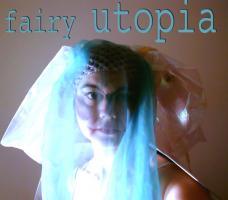
The Utopia Fairy in four parts: her sung angers, her spontaneities and magic somersaults accompanied by social fairness and mysterious music. The story´s background: "We are complex and we are deceived by what we see/What do you know of me when looking at me? I could be a terrorist, a nurse, an astronaut? I smile at you but you disgust me. The anger of being small and full of hopes in front of mediocre fatality. Even blue fairies making bubbles can be wasted, but tomorrow i'll feel better...
v.hubert, was born in 1970. She lives and works in Alfortville/Paris and is represented by the Galerie Quang, Paris. "For a decade, Véronique Hubert has been elaborating a complex work which can not be confined to the agitated humor that we can find in it. Working with numerous skills, her eclecticism contrasts with the seriousness of her themes. Her works takes form with the superposition of her means of expression: video, flyers, drawings, photographies and writings (since 1995). A strong knowledge of art history, cinema, the medical field, electronic music as well as an endless curiosity give to the artist a very rich structure that she shows in her fictional constructions, short stories or sketches interpreted by characters who are falsely childish "pretexts", and displaying paranoiac drifts."Extract from "La bonne position", France, Valliccioni 2004.
Jean-charles Hue
Catalogue : 2011La BM du Seigneur | Fiction | dv | color | 1:24 | France | 2010
Jean-charles Hue
La BM du Seigneur
Fiction | dv | color | 1:24 | France | 2010
Chez les Yéniches, communauté de gens du voyage, le respect des aînés et la ferveur religieuse côtoient indifféremment le vandalisme. Fred Dorkel est l'un d'entre eux : craint et estimé par les siens, il vit du vol de voitures. Une nuit, sa vie bascule : un ange lui apparait. Pour Fred, c'est le signe d'une seconde chance qu'il doit saisir. Il décide de se ranger, mais ce choix va l'opposer à sa famille...
Jean-Charles Hue (né en France en 1968) vit et travaille à Paris. Après des etudes à l'École Nationale d'Arts de Cergy-Pontoise, l'artiste est sélectionné pour la résidence "Villa Medicis Hors-les-murs" à Monterrey au Mexique, où il tourne plusieurs films, dont Carnaval Pitbull qui reçoit le premier prix au festival Loop Barcelona en 2006. En 2009, il retourne au Mexique pour tourner une serie de films. Il a été récompensé par le "Golden award" du festival de film Impakt à Utrecht, le prix Mulhouse 002, et nominé pour le prix Gilles Dusein. Ses films sont souvent projetés dans des programmations et festivals du monde entier (Festival Hors pistes - Centre Pompidou-Paris, Rencontres Internationales Paris/Berlin/Madrid, Art Forum - Berlin, festival Courtisane - Gent, Impakt Film Festival - Utrecht...). Jean-Charles Hue a déjà réalisé huit expositions personnelles en France, en Hollande et au Mexique (Ricard Foundation, Galerie Michel Rein, Alliance Française in Mexico, Villa Steinbach of Mulhouse...) et ses travaux ont étés présentés dans de nombreuses expositions collectives.
Jean-charles Hue
Catalogue : 2007Un Ange (sans st) | Experimental doc. | dv | color | 40:0 | France | 2006
Jean-charles Hue
Un Ange (sans st)
Experimental doc. | dv | color | 40:0 | France | 2006
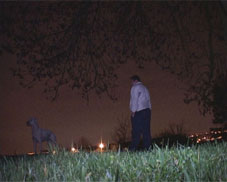
On the Dorkel's grounds (a family of gypsy travellers) time goes by as always between thieving and poaching. Nothing would have changed for the eldest called Fred, if he hadn't met an angel, his angel.
Born June 22 1968 in Eaubonne, he lives and works in Paris. He has a degree from the Cergy-Pontoise Art School. It is through diverse mediums; objects, writings, and films, that he tries to create a life journey. Principally it is the one of the gypsy (traveller) world that has held his interest for more than ten years. But it is also the attempt to construct a memory that like a kaleidoscope would reflect a multitude of lived or desired images. On the good days the images achieve a certain enchantment that betrays well a naive desire to see the piece of meat that we are fly away elsewhere. In this, the artist's gypsy cousin Fred gave him one of the most beautiful occasions of his life to re-transcribe in a film ("Un Ange") the quasi-desperate attempt of the flight.
Laura Huertas Millan
Catalogue : 2013Aequador | Fiction | 0 | color | 19:47 | Colombia, France | 2012
Laura Huertas Millan
Aequador
Fiction | 0 | color | 19:47 | Colombia, France | 2012
Aequador is an alternate history built as a travel account without words: an equatorial dystopia evoking the excesses of a progressist and modernist dream in Latin America during the twentieth century. We imagined a bygone era where an extremist ideology would tried to conquer the Amazon territory. The film describes in a composite and voluntarily fragmented way this parallel present, where fake ruins and relics of utopian architecture in 3D coexists with vernacular constructions and daily lifes of human beings.
Catalogue : 2012Voyage En La Terre Autrement Dite | Doc. exp�rimental | | color | 23:0 | Colombia, France | 2011
Laura Huertas Millan
Voyage En La Terre Autrement Dite
Doc. exp�rimental | | color | 23:0 | Colombia, France | 2011
A journey to a Land Otherwise Known is inspired from the first accounts of the natural and ethnographic explorations in America by Conquistadors, missionaries and scientists. The film is entirely shot in the Tropical Greenhouse of Lille, a building constructed in 1970 by Jean-Pierre Secq, a sort of reinforced concrete botanical Crystal Palace. The architecture and the plants of this closed place are used as narrative supports for an initiatory journey, presenting the speech of an "explorer" and his visions. The film evoques the origin of the « New World » and the images that it engendered.
Laura Huertas Millan was born in Bogota in 1983. In 2001 she's the laureate of the "Excellence" scolarship of the "A.E.F.E" and in 2003 of the "Major" scolarship for university studies in France. Before joining "Le Fresnoy" in 2010 she gets a diploma from the Beaux-Arts of Paris with distinction. Her videos have been shown in various festivals and exhibitions in France (FID 2010, Biennale Mulhouse 010, Traverse Vidéo 2010, Saison Vidéo 2011) and in Latin America (Museum of Contemporary Art of Chili, University of la Plata in Argentine, Museum of Modern Art of Bogota, Colombie...). Since 2009, she directs a series of monotapes focusing on the concept of exoticism, including "Sin Dejar Huella" (2009), "Orénoque" (scolarship of "Aide à la Création" of the city of Paris, 2010) and "Voyage En La Terre Autrement Dite" (Le Fresnoy production, 2011). She's preparing the last instalment of this series, "Los Elegidos", which will be filmed in columbian Amazon in 2012.
Laura Huertas Millán
Catalogue : 2021Jíibie | Documentary | dcp | color | 24:45 | France, Colombia | 2019
Laura Huertas MillÁn
Jíibie
Documentary | dcp | color | 24:45 | France, Colombia | 2019
The fabrication ritual of the green coca powder (called mambe or "Jiíbie") unveils an ancestral myth of kinship. In the Muiná-Muruí community, the coca plant is not a product, but a sacred interlocutor, the beating heart of a collective body.
Laura Huertas Millan is a French-Colombian filmmaker and visual artist, whose practise stands at the intersection between cinema, contemporary art and research. Selected in cinema festivals such as the Berlinale, Toronto International Film Festival (TIFF), Rotterdam International Film Festival, New York Film Festival and Cinéma du Réel, her films have earn prizes at the Locarno Film Festival, FIDMarseille, Doclisboa and Videobrasil, among others. More than twenty retrospectives and focus of her work have been organised around the globe, in cinematheques such as Toronto ?s TIFF Lightbox, Harvard ?s Film Archive or Bogota ?s cinematheque, and leading film festivals as Mar del Plata and Rencontres du Documentaire de Montreal. In the art field, her latest solo exhibitions were held at the MASP Sao Paulo, Maison des Arts de Malakoff and Medellin ?s Modern Art Museum. Her films have also been exhibited and screened in art institutions (Centre Pompidou Paris, Jeu de Paume, Guggenheim Museum NY, Times Art Berlin) and biennials (Liverpool, FRONT Triennial, Videobrasil, Videonnale). They are part of private and public collections (Kadist, CNAP, Banco de la República de Colombia, CIFO, FRAC Lorraine, and others). Huertas Millan holds a practise-based PhD on “Ethnographic Fictions” developed between PSL University (SACRe program) and the Sensory Ethnography Lab (Harvard University). She works as an educator in academic and alternative spaces. Since 2019, Huertas Millan is part of a research-based duo with curator and writer Rachael Rakes on critical anthropology and the aesthetics and politics of the encounter.
Allan Hughes
Catalogue : 2013Enemy Blue | Video | dv | color | 22:23 | Ireland, United Kingdom | 2012
Allan Hughes
Enemy Blue
Video | dv | color | 22:23 | Ireland, United Kingdom | 2012
Enemy Blue explores the precarious nature of the video through a narrative on propaganda and ?friendly fire?. The work conflates material from a number of sources, namely, a Committee report made to the United States House of representatives by Edward Hunter, a U.S. governmental investigation ?Misleading Information from the Battlefield: the Tillman and Lynch episodes? and Gerhard Richter?s published notes on political ideology. The work is an attempt to explore the failure of video to articulate politicized historical narratives. Despite the proliferation of digital high definition technologies our access and experience to the wider world is largely mediated through ?poor? images. Hand held camera-phones, telecined archive material, surveillance footage and low-res streams proliferate the political landscape. In an aesthetic anomaly our relationship to these images define a kind of authenticity or participation in the construction of political realities; that despite their lack of information or detail they become imbued with a semblance of truth. In turn the work identifies the use and control of such ?poor? forms as an aspect of political propaganda. While each dialogue offers it?s position in contrast or opposition to a polarized political position, by implication of its subject, it?s meaning is by turns, entirely reversible.
Allan Hughes is an artist from Belfast based in Newcastle Upon Tyne. His video installation work explores the production of remediated histories through the deconstruction of post-production processes. Hughes? works usually proceeds from research into the sites, documents and apparatus of recorded and remediated histories His works examine the precarious position of subjectivity within the constructed narratives of history and the processes of their representation and reception. Hughes unpacks the processes of remediation and establishes a place that privileges listening and the rediscovery of subjective and heterogeneous positions within these narratives. The last year has seen exhibitions of his work at the Belltable Art Centre, Limerick, where he had a solo exhibition and as a part of Temple Bar Gallery?s ?Lights, Camera, Action!?. His work was included in the 2011 Tulca Arts Festival and Rencontres Internationales. In 2010 he was awarded the ACNI Major artist award and in 2009 he was the recipient of a six-month Artist?s Residency Programme at the Irish Museum of Modern Art in Dublin. He has exhibited both nationally and internationally with work shown in the Mediations Biennale in Poznan Poland, UNOACTU in Dresden, the Ormeau Baths Gallery Belfast and the Beursschouwburg in Brussels amongst others.
Catalogue : 2011Point of Audition | Experimental doc. | 0 | color | 13:42 | Ireland, United Kingdom | 2009
Allan Hughes
Point of Audition
Experimental doc. | 0 | color | 13:42 | Ireland, United Kingdom | 2009