Catalogue > List by artist
Browse the entire list of Rencontre Internationales artists since 2004. Use the alphabetical filter to refine your search. update in progress
Anocha Suwichakornpong
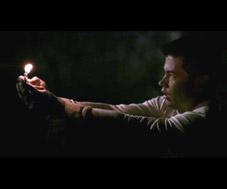
Catalogue : 2008Graceland | Fiction | 35mm | color | 17:0 | Thailand | 2006
Anocha Suwichakornpong
Graceland
Fiction | 35mm | color | 17:0 | Thailand | 2006
One night in Bangkok, Jon meets a mysterious woman. Together, they embark on a journey to a foreign land - the human heart.
Born in Thailand in 1976, Anocha Suwichakornpong, also known as 'Mai', spent the nineties living in England where she received her BA and MA. In February 2006, she graduated from a MFA film program at Columbia University, New York. In that same month, Anocha attended the Berlinale Talent Campus. Her feature-length script, "The White Room", was among the fifteen scripts chosen to participate in their Script Clinic program. In May 2006, Anocha's thesis, "Graceland" became the first Thai short film to be included in the Official Selection at Cannes Film Festival (Cinéfondation). She is soon to begin pre-production on a series of short films, titled "Like. Real. Love." Currently, Anocha is developing another feature-length script entitled "Jao Nok Krajok" (The Sparrow), which has received the Hubert Bals Fund from the Rotterdam International Film Festival and is one of twenty-five projects selected for HAF ? Hong Kong Film Financing Forum 2007. A former art and cultural studies student, Anocha's interest in film extends beyond the visual aspects of the medium. She views film as a language, with its own codes and representation. However, she fervently believes that great cinema can transcend the language barrier, in all senses of the term. Film can only be meaningful if it contains truth ? and not just cinematic truth. In other words, it must speak about human condition.
Ondrej Svadlena
Catalogue : 2008SANITKASAN | Animation | betaSP | color | 7:34 | Czech Republic | 2007

Ondrej Svadlena
SANITKASAN
Animation | betaSP | color | 7:34 | Czech Republic | 2007
Sanitkasan is a short film/audiovisual work about strange beings in interrelated worlds, trying to escape the inevitable. It explores in metaphorical ways a loop of events where various entities are trapped in their ever-repeating actions and questions the degree of freedom in the freedom of choice. It?s a sweet-sour jelly. The 3d pieces directly result from a long-term preoccupation with the means of drawing, by which I first build the different parts, worlds, subjects, creatures. I work with visions as serial images and moods often accompanied by accoustic backgrounds, developing for each piece a special metaphorical audio-visual language. These visions evolve in my mind - just like dreams, or daydreams. I then transpose those by audiovisual means.
nouvelle bio: Ondrej Svadlena was born in Czechoslovakia on April 6th 1978. In 1984 he escaped on foot across the jugoslavian-austrian border with his mother and step-father. After waiting for 6 months in Austria they were granted political asylum in Canada. Ondrej had a peaceful childhood in Hull, Aylmer and Montreal in the province of Quebec until 1991 when he moved to Munich, Germany with his family. After his Bac in 1996, he moved to Bruxelles to study illustration and comics. In 1997 he moved to the Czech Republic to study film and television graphics at the Academy of Art Architecture and Design in Prague where he completed his studies with a Master of Art in 2003. As a fresh graduate he moved back to Montreal, and after a month of unsuccessful jobseeking, he ended up working as a construction/renovation worker. Since 2005, Ondrej Svadlena is back in Prague where he is employed as a 3D animator, and works on his personal projects in his spare time (often in the small village of Palcano in Italy). ***** Born 06.04.1978 in Benesov, Czechoslovakia 1984 Escape to Austria 1985 - 1991 Living in the province of Quebec, Canada 1991 - 1996 Living in Munich, Germany 1996 - 1997 Academie Royale des Beaux-Arts, Bruxelles, Belgium Department of Illustration and Comics 1997 - 2003 Academy of Art, Design and Architecture, Prague, Czech Republic Department of Film and Television Graphics. Professor: Jiri Barta 2003 Master of Arts 2003 - 2004 Construction and renovation work, Montreal, Canada from 2005 living and working in Prague Artist/3D animator/Director, Avion Postproduction, Prague, Czech Republic
Katherine Sweetman
Catalogue : 2008Swimming with Rosemary | Documentary | dv | color | 41:33 | USA | 0

Katherine Sweetman
Swimming with Rosemary
Documentary | dv | color | 41:33 | USA | 0
Swimming with Rosemary (2007): Rosemary and her boyfriend lived in New Orleans during the devastation of Hurricane Katrina. They chose to remain in New Orleans through the storm and its aftermath. After a five-day, paranoid, militant, stakeout of their home, they decided to leave. The power was out; there were shootings and explosions in their neighborhood. They believed that the military was bombing the Superdome to stop the looters. Conspiracy theories and rumors escalated in their neighborhood, and there was no communication from the outside world to stop the rumors. They believed that their lives were in danger, so they packed-up some belongings, water, and their dogs, and they tried to evacuate. They found a truck and drove through the waterlogged streets of New Orleans. They had to fend off mobs of ?zombies? trying to attack them and steal the truck. The truck finally broke down on an overpass just outside of the city. They sat there for a day and a night trying to get a ride. When a ride finally came, it took them to a ranch on the outskirts of Houston, Texas. The ranch was owned by a Church Pastor, and he convinced them that if they were going to sleep in the same bed, they should go ahead and get married. This could be a beautifully romantic story except for the fact that this man, her boyfriend (and now her husband), is an extremely abusive alcoholic with very violent tendencies. The two were married in this evacuee camp / ?Christian Revival Ranch? by the Pastor about a week and a half after the hurricane destroyed their home, their city, and Rosemary?s life. Six months after Hurricane Katrina leveled areas of New Orleans, I flew Rosemary and myself back to the city to re-trace her evacuation route, visit her former home, and make a documentary about her escape. At least this is what I told her that the documentary was about. My true intention was to convince her to leave her abusive husband. I had heard too many horrible stories, and I needed to see her. I needed to convince her that she was capable of leaving him and that leaving him was the only thing to do. Our journey begins in the airport in New Orleans (January 2006). We go to Bourbon Street and fall into the same roles that we had when we were best friends back in our late high school/early college years. We take the Greyline Bus Katrina ?Damage Tour?, go to her former home, drive up the overpass, and talk. But for some reason, it became increasingly difficult to discuss her relationship with this man on camera and off, and I found myself avoiding the subject and feeling uneasy about the whole idea. I took her to Houston, and we visited the Pastor and his family. We saw the church where they had been married and the stage where they stood and gave their wedding vows. The last day of our journey I took her to a counselor-- in some last, vain attempt at an intervention.
My background centers on film studies, video, and experimental communications projects. As a result, my first year and a half of work at the Visual Arts Facility, UCSD, has produced three, very personal documentary films concerning my family, close friends, and myself. The issue then quickly became, why do I want to expose these very personal issues to the public? What is the human drive to do that type of act? My work has since become an investigation of that question. Beyond myself, why do others expose themselves to the public and what are the means through which we all do this?
Corin Sworn, Tony Romano
Catalogue : 2017The Coat | Experimental fiction | 4k | color | 57:58 | United Kingdom | 2016
Corin Sworn, Tony Romano
The Coat
Experimental fiction | 4k | color | 57:58 | United Kingdom | 2016
The Coat loosely adapts Aristophanes’ The Birds from the Athens of 414 BC to contemporary Calabria. Here the two people who leave their home looking for a better life are a young man and his daughter arriving from Albania in search of a swimming coach who fled the collapse of Communism in the 1990s. They search for the coach among Italy’s Arboresh community, descendants of an earlier Albanian exodus of the 1450s. Along the way the pair intercept two actors touring the rural south in an attempt to resuscitate the long dead street hero Punchinella. Here histories are invoked only to be folded in on themselves and diffused back through the Calabrian landscape. The characters, naive to the terrain that surrounds them rely predominantly on cartographies of their own desire while the birds fly overhead taunting their imprudence. Co written with, and employing professional and amateur actors, The Coat’s itinerant figures don’t so much drive narrative as walk it slowly along.
CORIN SWORN was born in London, England, and raised in Toronto. She studied psychology and integrated media before earning her master’s at the Glasgow School of Art. Sworn has exhibited internationally, including at the Whitechapel Gallery, Tate Britain, the National Gallery of Canada, and the 2013 Venice and Sydney Biennials. Her film work has appeared at Rotterdam Film Festival and the Centre Pompidou. TONY ROMANO was born in Toronto and earned his B.F.A. from the Emily Carr Institute of Art and Design. His film installations have been exhibited internationally, with solo and group shows at MoMA, Night Gallery in Los Angeles, Articule in Montreal, Kulturhuset in Stockholm, and MOCCA and The Power Plant in Toronto.
Telco Systems, Longina
Catalogue : 2006Oidar | Experimental video | dv | black and white | 2:0 | Netherlands | 2005

Telco Systems, Longina
Oidar
Experimental video | dv | black and white | 2:0 | Netherlands | 2005
Oidar (2`, 2004) Digital film, specially made for the Cronica 021-2005 DVD: "Can I have 2 minutes of your time?". All Images by Telcosystems Audio by Longina
Telcosystems Lucas van der Velden and Gideon Kiers are the founding members of Telcosystems. Lucas van der Velden (1976, Eindhoven) lives and works in Rotterdam. Gideon Kiers (1975, Amsterdam) lives and works in Rotterdam and Reykjavik. Both studied at the Interfaculty Image and Sound, a department at the Royal Conservatory and the Royal Academy in The Hague. They started the Telcosystems in 2001 to explore new modes of audiovisual expression. They are also initiators of 0010, minuszero, D:U:M:B and DLF and members of the curatorial team for the Sonic Acts festival in Amsterdam.
Illya Szilak, Tsiboulski
Catalogue : 2025Queerskins: Fly Angel Soul | Experimental film | mp4 | color and b&w | 21:2 | USA | 2024
Illya Szilak, Tsiboulski
Queerskins: Fly Angel Soul
Experimental film | mp4 | color and b&w | 21:2 | USA | 2024
FLY ANGEL SOUL recounts the story of Sebastian, a young gay physician estranged from his Missouri Catholic family who dies of AIDS in Mali, having lived a peripatetic life searching for acceptance and a place to call home. Drawing on our experience as interactive VR storytellers (Queerskins: A Love Story, Queerskins: ARK, QuillsFest VR world), we created a bold cinematic language made possible only through virtual production. This language forefronts gestural camerawork, multiple perspectives, and elements of dance film, theater, and video games. Using Unity game engine and Cinemachine tools and the directors’ descriptions, lead engineer Elliott Mitchell created three types of “embodied” virtual cameras: a fly, an angel, and a human/soul, each of which sees and moves through the responsive virtual mis-en-scene differently. Although our film privileges the human space-time perspective, it allows the audience to experience alternative, computer-mediated ways of perceiving the same story. All three cameras function as the “players,” both in the video game and theatrical sense. The cameras’ real-time “performance” is documented as footage edited to create the final film. Both the fly and the angel cams are purely virtual. The “soul” cam path, however, was based on the real-time experience of creative technologist, dancer, and artist Clemence Debaig who was asked to move through the virtual set with the mindset of certain characters e.g. Sebastian’s estranged but loving mother, his cold and distant father, and as herself, a “neutral” observer. Debaig's decisions regarding how she moved through the environments and interacted with the virtual sets determined what was captured in real-time as 2D film footage by the “soul cam” programmed to follow her path and speed. In agreement with Vivian Sobchack’s description of the film camera as perceiving “subject,” we propose that our soul cam acts like a virtual cinematic avatar, allowing viewers to actively participate in the narrative as it navigates the responsive mis-en-scene. mbracing the visual language of spatial computing and video game, the film is constructed as a journey. There is little plot. In place of action, Sebastian’s acceptance of himself as a gay man and a Christian evolves. To allow Sebastian's interior state to manifest outwardly in a way that could be “lived" by film viewers, the story is revealed and experienced by movement through dream-like architecture and landscapes created in collaboration with fine artist Paolo Barlascini.
llya Szilak is an independent scholar, writer and new media artist. In her art practice, she uses open source media and collaborations forged via the Internet to create multimedia narrative installations online. Shaped by her experience as a physician, her artistic practice explores mortality, embodiment, identity, and belief in a media inundated by an increasingly virtual world. Cyril Tsiboulski is her interactive designer/ collaborator. Her first work Reconstructing Mayakovsky was included in the second Electronic Literature Collection and has been taught both as an example of innovative narrative game and literature at the university level. Her second work Queerskins was included in the third Electronic Literature Collection. She is currently working on Atomic Vacation, a post-apocalyptic narrative journey through virtual landscapes. She writes frequently in the popular press on new media art and electronic literature. Please join her September 10th from 1-6 PM at The Kitchen in NYC for the event she is curating: Electronic Literature: We Have Always Been Digital. This afternoon of interactive presentations showcases a range of dynamic forms from bots and games to interactive online works, and offers audience members the chance to engage with works and authors after the performances.