Catalogue > Search
Results for : Tout le catalogue
Aslan Gaisumov
Volga
Video | 4k | color | 4:11 | Russia | 2015
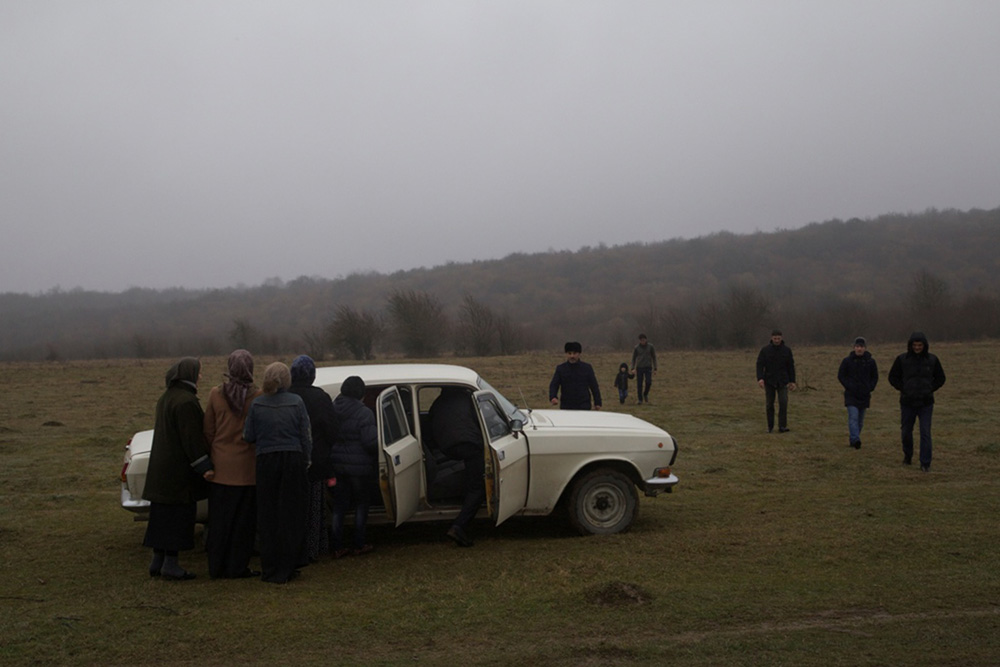
Dans cette vidéo faisant preuve d’une simplicité des plus efficaces, l’artiste de 24 ans Aslan Gaisumov nous plonge dans le conflit tragique auquel est confrontée sa Tchétchénie natale. Ce document, en partie autobiographique, montre comment les familles tentent de fuir le pays en s’entassant par douzaines dans de minuscules voitures. Le langage intuitif et poétique de Gaisumov vise à signifier les conséquences de la guerre, associées à la perte des traditions et des repères d’identité. Lorsque la survie devient une nécessité, les constructions fragiles comme le langage, les contes de fée et les symboles disparaissent. La mémoire et les histoires familiales se font rares et sont la plupart du temps perdues à jamais. Mais ceux qui parviennent à fuir, tel Gaisumov, représentent une nouvelle génération. On observe alors un nouveau leitmotiv, où le passé et le présent s’entremêlent pour créer de nouveaux symboles et métaphores perpétuant la continuité d’un peuple.
Aslan Gaisumov son parcours relève presque du miracle : aujourd`hui âgé de 25 ans, l`artiste a grandi dans le nord du Caucase tchétchène, région marquée par la guerre civile et le terrorisme, et vécu sept ans dans un camp de réfugiés avec sa famille. A travers ses oeuvres marquantes, Aslan Gaisumov trouve le moyen de traiter son traumatisme et d`attirer l`attention sur la situation en Tchétchénie.
Rafael Gallar
Infinitos monos
Experimental video | dv | color | 6:0 | Spain | 2006
"Infinitos monos" is a plastic interpretation of the Theorem of infinites monkeys, which states that a monkey touching keys at random on a keyboard will be able to, in all safety, finally write any book that is situated in the national library of France. The film demonstrates that it is extremely improbable that this could happen, but even this way it would be more improbable than the laws of the statistics that were violated.
Rafael Gallar was born in Alicante in 1969. He began as a industrial photographer in Alicante, a career that he developed for four years. In 1998, Rafael moved to Madrid to work as assistant of several photographers. Three years later he started collaborating as a freelance photographer with several magazines and realizing advertising campaigns. He exhibited photography in Photoespaña-02, and in the festival BAC-03, in the CCCB. Gallar's work with video began in 2004, exposing two pieces in the same year in the FEM-04. He exhibited "Infinities Monkeys" in FEM-05, and "I'd prefer to borrow someone else's interpretation" in FEM-06.

Inti Gallardo
Mnemoc(y)ne
Experimental VR | super8 | color | 0:0 | Argentina, Chile | 2019
In a black cubic space of virtual reality based on panels of ATLAS MENOSYNE created by Aby Warburg, the user will be able to activate different fragments of a personal memory filmed in Super8mm, generating his own montage and relations between the sequences that are projected in the space. The exterior limit of the physical space is defined by the same films exposed in their original materiality. The project pretends to expand with time, adding images to an atlas in motion, that reports Nomadic life of the fragmented time-space and the no existence of digital borders. Programer: Lucian A. Meister. Sound design: Sonoscopia.
Inti Gallardo has a degree in Cinema (University of Córdoba), and a Master in Media Art (University of Chile / Polytechnic University of Valencia). It is part of the ANCORA AV work cooperative and the CEIS8 group (Experimentation in analog film formats). Her work is linked to the use of materialities, archives, memory and the crossing between analog and digital media in different aesthetic and political configurations.

Christophe Gallois
L'écoute vagabonde
Documentary | 4k | color | 23:18 | France | 2024
Le monde de Dominique Petitgand est celui de l’écoute. Depuis trois décennies, l’artiste crée des pièces sonores qu’il diffuse à travers des disques, à la radio, lors de séances d’écoute se déroulant dans l’obscurité, selon le principe d’un « cinéma pour l’oreille », ou encore sous la forme d’installations déployées dans l’espace, dans des lieux d’exposition. Dans son travail de montage, des fragments de voix sont découpés, isolés, détachés de leur contexte, et associés à d’autres éléments vocaux, sonores ou musicaux. Ses œuvres portent attention au potentiel narratif que recèlent ces fragments de réel autant qu’aux « liens invisibles » qui les relient entre eux. Comment prolonger, à l’écran, l’expérience de ses œuvres ? Comment filmer l’écoute ? C’est à partir de ces interrogations que sont restitués trois moments de création et de diffusion : une séance d’écoute présentée au Musée des Beaux-Arts de Nancy ; un temps de travail autour de la table de montage, dans l’atelier de l’artiste ; une installation sonore, Les heures creuses, créée pour les espaces du T2G – Théâtre de Gennevilliers.
Christophe Gallois est, depuis 2007, curateur au Mudam Luxembourg. Il a été le commissaire de plusieurs expositions collectives d’envergure, parmi lesquelles « The Space of Words » (2009) et « L’Image papillon » (2013), et d’expositions personnelles d’artistes tels que Guillaume Leblon (2009), John Stezaker (2011), Sanja Ivekovic (2012), Fiona Tan (2016), Su-Mei Tse (2017), Jeff Wall (2018), Katinka Bock (2018), David Wojnarowicz (2019), LaToya Ruby Frazier (2019), Zoe Leonard (2022), Tacita Dean (2022) et Dayanita Singh (2023). Un nombre important de ces projets ont été développés en collaboration avec des institutions telles que le Taipei Fine Arts Museum, le Aargauer Kunsthaus, la Whitechapel Gallery à Londres, le Musée d’Art Moderne de Paris, le MCA Australia à Sydney, la Kunsthalle Mannheim ou encore le Whitney Museum of American Art à New York. Consacré au travail de Dominique Petitgand, « L’écoute vagabonde » est son premier court-métrage documentaire. Pensé comme un prolongement de sa pratique curatoriale, celui-ci poursuit un dialogue entamé avec l’artiste au milieu des années 2000 dans le cadre de plusieurs expositions de groupe et d’une exposition personnelle, ainsi que de la rédaction de textes et des entretiens.
Mindaugas Gapsevicius
Bookshelf
Multimedia installation | 0 | color | 99:99 | Lithuania | 2006
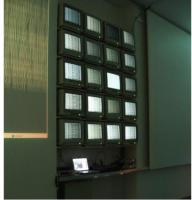
Rapid flow of letters and numbers on the monitors has nothing to do with chaos theory which can cause big disruptions in our world. It has also nothing to do with hacker?s world as one would like to say. Monitors placed on a wall shelf become a contemporary bookshelf containing in itself endless digitized textual and visual material. The Bookshelf represents a network traffic translated into descriptive form, so the unseen side of "networking" would be understandable or at least readable. In technical terms the flow of letters and numbers on the monitors would sound like `tcpdump`, a common computer network debugging tool. The Bookshelf was exhibited in various shapes and contexts. A Memex Wall installation, conceptualized in cooperation with superfactory.biz, was shown within a context of a "memory extender" game, the term of which was used to call a proto hypertext computer system influencing the development of subsequential hypertext and intellectual augmenting computer systems.
Mindaugas Gapsevicius aka mi_ga was born in 1974 in Lithuania, he lives and works in Berlin and Vilnius, Lithuania. Having studied visual arts in Academy of Arts in Vilnius, Lithuania and in Muthesius-Hochschule in Kiel, Germany, he obtained an MA degree in painting and painting restoration in Vilnius. Following that, he participated in a number of exhibitions and conferences concerning arts and digital culture, Re-Approaching new Media (RAM) workshops in Tallinn and Vilnius, Interfiction conference in Kassel. Gapsevicius exhibited his work in contemporary art galleries, among them in Vilnius Contemporary Art Center in 2002, Moscow National Center for Contemporary Arts in 2004, Kunstraum Kreuzberg/Bethanien, in Berlin, in 2006. He is one of the initiators of o-o institutio media which was established in 1998 (www.o-o.lt) and a co-author of net.art projects asco-o (www.asco-o.com) and carpet art (www.triple-double-u.com)
Nicolás Garcés
Réplicas
Experimental fiction | hdv | color | 13:49 | Colombia | 2024
In a land of musical rivers and omens coming from the heart of the jungle, a young man overhears a bird's song as a message of his fate. A dream-like contemplation of a man dissolving into a large common body.
Nicolás Garcés was born in Pasto, Colombia, and holds a degree in Filmmaking from the Universidad Nacional de Colombia. His work focuses on ethnographic explorations and experimental practices in audiovisual media, and has been screened in festivals such as MIDBO, Festival du Nouveau Cinéma de Montreal, FICCI, among others.

Marcos Garcia
MediaLab Madrid
0 | 0 | | 0:0 | Spain | 2007
Medialab was founded in 2002 by the Conde Duque Cultural Centre and the Arts Council of the city of Madrid. It is a structure conceived as an exhibition space and an open laboratory in which research regarding information and communication technologies related to arts and sciences takes form. Thanks to the organization of seminars and festivals, numerous creators and researchers of various disciplines come together. It is a place that wishes to favour the sharing and exchange of ideas and opinions regarding emerging artistic forms.
Marco Garcia is a media artist working at the heart of the Medialab space in the departments of documentation and educational programming.
Dora Garcia
Film (Hôtel Wolfers)
Video | betaSP | color | 11:31 | Spain | 2009
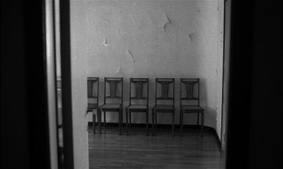
The camera?s eye tours through an abandoned house. Accurately it scans the walls, the window panes in their metal grooves and the light rooms. Its gaze slides over flaking paint. The outspoken architecture of this distinguished building ( Hôtel Wolfers in Brussels) is designed by Henry van de Velde. The soundless recordings, made in black and white on 35 mm film, the historical location and the chosen technique underline the story that is narrated by the voice-over. This story, a film script, dates back to 1965 but refers to 1929, the same era from which the building stems. There is no relation between the recordings of the space and the narration, although both sometimes seem to coincide. The house is a neutral space that is filled with the story written in 1965 by Samuel Beckett and bears the same mane as Dora Garcia?s work: ?Film?. Beckett was one of the first who emphasized the voyeuristic gaze of the viewer in cinema. He introduced the viewer into the story by letting him/her take the place of the camera. In the original version of ?Film?, Buster Keaton is the protagonist O. O is trying his best to remain unseen; his face is constantly turned away. People who do look into the camera and who are seen by it, shrivel with fear. After O has entered a house, he liberates each room from any gaze. Windows and mirrors are covered and portraits are taken from the walls. One gaze is overlooked: E?s ? the eye of the camera. In the confrontation, O and E appear to be the same person, symbolizing the viewer who is being confronted with his/her own gaze. In Dora Garcia?s piece it works in the same manner: the viewer?s position is investigated again through the camera, which accurately scans the space, looking for a clue or a story. The outward views are protected, nothing can be seen out of the windows. The wandering viewer eventually only meets himself.

Inés García
LIFT
Video | hdv | color | 1:13 | Spain | 2012
Transit time where the inside and outside, the above and below are merged into one unit.
Bachelor of Fine Arts from the University of Barcelona, she won a scholarship to study for a year in Bali, on her return she decided to bet for the local context of Barcelona and Bilbao. She has participated in several exhibitions in Barcelona, in Bilbao (BilbaoArte, Espacio Abisal and Rekalde?s Art Space) in Madrid in Space Trapezio and Matadero through Curator?s Network, or Berlin in exhibitions such as The Secret Cabinet or Sans Soleil. Her videos have been shown at the Contemporary Art Center of La Conservera in Murcia, LOOP and SCREEN Festival in Barcelona. Last year she has participated in the Latino Video Art Festival of New York, or at the International Video art festival ( FIVA) in Buenos Aires among others.

Dora García
(Revolución, cumple tu promesa) Amor Rojo
Experimental doc. | 4k | color | 95:0 | Spain, Belgium | 2024
Turn your love into a weapon. This film reads Soviet revolutionary and sexual activist Alexandra Kollontai’s writings on female sexuality and emancipation, on the abolition of the family and the need to “change hearts and minds”. This reading traces a complex web of connections between 20th century European Marxist feminism and 21st century Latin American transfeminisms, between personal and collective mourning, between a myriad of ways of understanding the feminine, and between the melancholic gaze of disenchantment and the furious, tender, and imperious demand that the Revolution, finally, fulfil its promise. (Revolution, fulfil your promise) Red Love (2024) is the sister film to Red Love (2023). The sounds and images from the original footage of Red Love have been completely re-edited, and a wealth of new archive material has been added, which is clearly inscribed with the urgency of militancy while tracing careful historical genealogies. This film is the result of 8 years of research going from Moscow Engels-Marx-Lenin archives to multiple personal, familiar, historical and activist archives in Mexico and Latin America. It is a collective work made by a team of researchers and artists of different nationalities. It wants to inscribe itself in the urgency of the tradition of militant film while at the same time tracing careful historical genealogies and projecting into the future.
Dora García lives and works in Oslo. She currently teaches at Oslo National Academy of the Arts, Norway. She has represented Spain at the Venice Biennale in 2011 and was present again in the Venice Biennale 2013. She took part in the 56th Venice International Art Exhibition, dOCUMENTA(13) and other international events such as Münster Sculpture Projects in 2007, Sydney Biennale 2008 and Sao Paulo Biennale 2010. Her work is largely performative and deals with issues related to community and individuality in contemporary society, exploring the political potential of marginal positions, paying homage to eccentric characters and antiheroes. These eccentric characters have often been the center of her film projects, such as The Deviant Majority (2010), The Joycean Society (2013) and Segunda Vez (2018).

Dora García
Segunda Vez
Experimental doc. | hdv | color | 94:0 | Spain, Belgium | 2018
SYNOPSIS - Short (107 words) Dora García intertwines politics, psychoanalysis and performance into Segunda Vez (Second Time Around). This staged documentary orbits the figure of Oscar Masotta, a pivotal theorist in the Argentinian avant-garde from the 1950s to the 1970s, whilst not being a biopic about him. Masotta`s ideas on Lacanian psychoanalysis, politics and art (happenings and dematerialized art) changed the artistic landscape of that 1960s Buenos Aires preceding the dictatorship and with it the end of the avant-garde. The title, Segunda Vez, originates from a homonymous story written by a contemporary of Masotta`s, Julio Cortázar, which recounts the climate of psychosis and uncertainty caused by the trauma of disappearances in Argentina. SYNOPSIS - Long (260 words) Dora García intertwines politics, psychoanalysis and performance into Segunda Vez (Second Time Around). This staged documentary orbits the figure of Oscar Masotta, a pivotal theorist in the Argentinian avant-garde from the 1950s to the 1970s, whilst not being a biopic about him. Masotta`s ideas on Lacanian psychoanalysis, politics and art (happenings and dematerialized art) changed the artistic landscape of that 1960s Buenos Aires preceding the dictatorship and with it the end of the avant-garde. The title, Segunda Vez, originates from a homonymous story written by a contemporary of Masotta`s, Julio Cortázar, which recounts the climate of psychosis and uncertainty caused by the trauma of disappearances in Argentina. In Segunda Vez, García weaves together a sequence of seemingly disparate scenes that are bound by the act of repetition and observation: posters plastered along a wall advertise their own transmission, a phantom message in a bustling city; two audiences converge on a cliff top, divided in their knowledge of the scenario in which they are participating; a person, tied up in white cloth and ropes, is carried and left in a forest; the brief appearance of a helicopter causes some excitement and consternation; a group of poor and aging people is assembled on a podium, paid to endure violent light and sound for an hour, while an audience observes them; a library brings reading groups together who are aware they’re being watched; after a mysterious official summons, strangers chat in a waiting room anticipating what may happen, one young man among them has been called to return for a second time around.
Dora GarcÃa lives and works in Barcelona and Oslo. She teaches currently at Oslo National Academy of the Arts, Norway and HEAD Genève, Switzerland; and she is co-director of Les Laboratoires d`Aubervilliers, Paris. She has represented Spain at the Venice Biennale in 2011 and was present again in the Venice Biennale 2013 (collateral events). She took part in the 56th Venice International Art Exhibition, dOCUMENTA(13) and other international events such as Münster Sculpture Projects in 2007, Sydney Biennale 2008 and Sao Paulo Biennale 2010. Her work is largely performative and deals with issues related to community and individuality in contemporary society, exploring the political potential of marginal positions, paying homage to eccentric characters and antiheroes. These eccentric characters have often been the center of her film projects, such as The Deviant Majority (2010) and The Joycean Society (2013).
Dora García
Si Pudiera Desear Algo
Experimental doc. | hdv | color | 68:0 | Spain, Belgium | 2021
If I could wish for something takes its title from a Friedrich Holländer's Weimar song. The lyrics of ‘Wenn ich mir was wünschen dürfte’ are sung from the perspective of a woman who seeks to be happy, but not too happy, because sadness has become a refuge for her. This feeling is typical of the fraught ‘love story’ between feminism and socialism, between love and revolution. ‘The woman question’ has been tiptoed around by every revolutionary movement since the nineteenth century. These decades of disillusionment are part and parcel of feminist history.
Dora García lives and works in Oslo. She currently teaches at Oslo National Academy of the Arts, Norway. She has represented Spain at the Venice Biennale in 2011 and was present again in the Venice Biennale 2013. She took part in the 56th Venice International Art Exhibition, dOCUMENTA(13) and other international events such as Münster Sculpture Projects in 2007, Sydney Biennale 2008 and Sao Paulo Biennale 2010. Her work is largely performative and deals with issues related to community and individuality in contemporary society, exploring the political potential of marginal positions, paying homage to eccentric characters and antiheroes. These eccentric characters have often been the center of her film projects, such as The Deviant Majority (2010), The Joycean Society (2013) and Segunda Vez (2018).
Virginia García Del Pino
Mi hermana y yo
Experimental doc. | dv | color | 10:0 | Spain | 2009
Por primera vez Virginia García del Pino bucea en la experiencia familiar para volver, desde una posición mucho más personal e íntima, sobre algunas de las cuerdas dramáticas que ya había pulsado en su obra anterior. En esta ocasión se trata de trazar en la pantalla sentimientos y estados de ánimo sin excusa narrativa. Relaciones descarnadas en un doble sentido: por que surgen sin argumento aparente que las organice y por que formalmente rompe cualquier tipo de continuidad entre la banda de sonido y la imagen que pueda servir de asidero para el espectador. Pieza oscura, como sus planos finales, que nos devuelve al siempre complejo y muchas veces tormentoso universo familiar, en un viaje interno que cada espectador debe realizar con sus propios fantasmas. Esos con los que es imposible pactar una tregua duradera.
Virginia García del Pino estudió Bellas Artes y cine en Barcelona, su ciudad natal. Sus creaciones como video-artista la acercan al género documental. Sus vídeos surgen de una tentativa de comprender el mundo desde una óptica menos dolorosa y es en ese intento de comprensión donde se despoja de todo artificio y opta por una contundente sencillez. Sus trabajos son muchas veces una manera de poner atención a las cosas que ya conoce hasta que le parecen del todo desconocidas. Es precisamente de esta mirada a lo conocido (lo cercano) como si no lo conociera, de donde parece emerger la profunda humanidad de sus vídeos y la dignidad de sus retratados: ya sean sirvientas en México (Hágase su voluntad, 2004) o trabajadores españoles cuyas profesiones están socialmente desprestigiadas (Lo que tú dices que soy, 2007). Ese mismo empeño por conocer se percibe también en su último trabajo, Mi hermana y yo (2009), en el que no trata de comunicar ideas, sino de plasmar sentimientos, de ahí que la pieza, se mantenga en un territorio difuso entre la experiencia intransferible y la capacidad de identificación. Y es este movimiento hacia el otro, este reconocimiento de y en las emociones ajenas, lo que aquí se pone en imágenes y en sonidos.

Albert García-alzórriz
EYES / EYES / EYES / EYES
Experimental doc. | 4k | color and b&w | 37:7 | Spain | 2020
An archive holds fragments of toppled statues. In a corner, a fan stirs the atmosphere. The air caresses the archivists’ measured movements. The hum of the motor and the drawn-out wait induce sleep: In a dream, soldiers and civilians smile, motionless. (Faraway shots, bullets whistling and explosions). In another dream, there are just stones, indifference and oblivion. (None of the above is real or true).
Albert García-Alzórriz (Barcelona, 1992). Master’s and bachelor’s graduate in Architecture from the Polytechnic University of Catalonia and bachelor’s graduate in Fine Arts from the University of Barcelona. He is currently undertaking the Master’s course in Contemporary Film and Audiovisual Studies at Pompeu Fabra University in Barcelona. His work as an artist and filmmaker has recently been exhibited at international events and festivals, including the 58th Biennale Arte in Venice, the 7th Taiwan International Video Art Exhibition in Taipei, the 31st FID Marseille, the 8th FID Buenos Aires and the 17th Documenta Madrid, as well as at public institutions such as the IVAM (Valencia) and the ECCO (Cádiz).
Peter Garfield
Deep Space 1
Experimental video | dv | color | 17:0 | USA | 2007
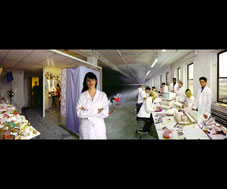
Three films play simultaneously, offering three perspectives of one story. Snow falls lightly on a garbage dump in near darkness. The headlights of a fuel truck rake across our view, animating the scene. A helicopter lifts off, into the flare of a floodlight and over a hangar, its blinking light receding and disappearing into a screen of pixels. The music swells as an awe-inspiring, snow-covered mountain range emerges in the moonlight. Or perhaps it is a miniature set made of paper maché and plaster. We are lulled into the beauty of this majestic landscape before being cast abruptly into a busy environment of people in lab coats at work on the sets for the film, or people resting between takes, or others applying makeup to an actor in preparation for the next action. The camera continues, flying over the trash and leftovers of a fast food lunch and then rises to take in the view of a vast warehouse space where workers concentrate on tasks along an almost endless work table. It soon becomes apparent, however, that this deep space is only half real, that the table ends in a wall on which is pictured the continuation of the table, the entire space and the workers. Inexplicably, one of the actors wields a power saw and cuts through this barrier, enters into the wall, staying briefly to complete some meaningless task, before being directed to continue through and into the nocturnal snowy landscape beyond. The camera studiously observes this actor's task and then follows as she disappears through the wall and into the wintry night. But we soon find that this wintry landscape is yet another façade as the walls begin to fall away before the camera, one after another like dominos, creating a scene of destruction that leads yet further into the distance. And finally, but inconclusively, one is high among mountain peaks again, but this time barely maintaining equilibrium as the camera movements become more jarring and anxious, until the three images begin to fade and blink out into blackness. And then we begin all over again in the lightly falling snow.
Peter Garfield is an interdisciplinary artist who works primarily in photography, sculpture, video, and painting. A graduate of Dartmouth College and the Ecole Nationale Supérieure des Beaux-Arts, Paris, he is now based in Brooklyn, NY. In 1993 Garfield was awarded a National Endowment for the Arts Fellowship grant for his work as a painter and in 1999 was awarded a fellowship grant by the New York Foundation for the Arts for his artist book "Harsh Reality". He has also been awarded a number of fellowships from The Edward F. Albee Foundation, Blue Mountain Center, MacDowell Colony, Millay Colony for the Arts and Yaddo. Garfield has had solo exhibitions in New York at Feigen Contemporary, Pierogi 2000, and the Queens Museum of Art; in Berlin, Germany at the Kapinos Galerie; and in Geneva, Switzerland at Art & Public. His work has been included in group shows throughout Europe and the United States and is in the collections at the Los Angeles County Museum of Art, San Francisco Museum of Modern Art, the M.I.T. List Visual Arts Center, and the F.R.A.C. Bourgogne in Dijon, France. Most recently Garfield was featured in a two-person show at MassMoCA in North Adams, Massachussets, and his video "Deep Space 1" was nominated for a Tiger Award in Short Film at the Rotterdam Fim Festival.
Peter Garfield
Fall
Art vidéo | dv | color | 1:9 | USA | 2008
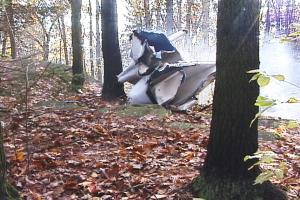
On an autumn morning in a northern forest, the peace is disturbed by an unlikely event.This is not your typical autumn day. "Fall" is a brief, "close encounter of the third kind."
Peter Garfield is an interdisciplinary artist working primarily in photography, sculpture, video and painting. A graduate of Dartmouth College and the Ecole Nationale Supérieure des Beaux-Arts, Paris, he is now based in Brooklyn, NY. In 1993 Garfield was awarded a National Endowment for the Arts Fellowship grant for his work as a painter and in 1999 was awarded a fellowship grant by the New York Foundation for the Arts for his artist book Harsh Realty. He has also been awarded a number of fellowships from The Edward F. Albee Foundation, Blue Mountain Center, MacDowell Colony, Millay Colony for the Arts and Yaddo. Garfield has had solo exhibitions in New York at Feigen Contemporary, Pierogi 2000, and the Queens Museum of Art; in Berlin, Germany at the Kapinos Galerie; and in Geneva, Switzerland at Art & Public. His work has been included in group shows throughout Europe and the United States and is in the collections of the Los Angeles County Museum of Art, San Francisco Museum of Modern Art, the M.I.T. List Visual Arts Center, and the F.R.A.C. Bourgogne. Most recently Garfield was featured in a two-person show at MassMoCA in North Adams, Massachussets and his video "Deep Space 1" was nominated for a Tiger Award in Short Film at the Rotterdam Film Festival.
Tessa Garland
Zombie
Experimental video | dv | color | 3:5 | United Kingdom | 2006
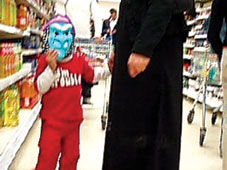
"Zombie" is a short film based upon George Romero?s 1960?s cult film "Night of the Living Dead". It is set in the multi-national supermarket Tesco?s. In it, this giant supermarket becomes a backdrop and a film set to a constructed scene that unfolds upon everyday and unsuspecting shoppers in a short and climatic horror sequence. The soundtrack was mixed by Garland and carefully composed from a number of classic horror films to create a generic sound that the viewer immediately identifies with this genre. The film was shot on a mobile phone camera. These low grade resolution images gives "Zombie" its distinctive flickering picture quality and that sense of real-time authenticity. It is because of the barely visible nature of this camera that the film is able to create both a sense of being caught on CCTV cameras and an atmosphere of surveillance. This work explores the idea that our daily experiences are structured through genre and repetition. In the edit the collected film clips have been rhythmically timed to the music. Together the sound and imagery both construct and create a real and imagined situation. Throughout the film this everyday situation unfolds into a space of suspense and foreboding in a consumer and material world. The environment is both comic and disturbing. Garland?s approach to film making examines narrative spaces. In this film the viewer is displaced by the disruption of their placement and perception of the real or unreal, staged or un-staged. It seeks a freedom of construction, a site for play, and an area of experimentation.
Tessa Garland is a practicing visual artist based in London. She has exhibited extensively, in solo and group exhibitions, in the UK and Internationally since 1990. For many years she has been developing and producing installation work that encompasses the moving image. In 2002 she received an Arts Council England major award to develop her work further; it resulted in her producing several interactive digital film installations which were included in well-profiled national exhibitions. Over the past year she has produced a series of short artist films which have been well received, most recently at the Whitechapel Art Gallery in London.
Mariah Garnett
Full Burn
Experimental doc. | hdv | color | 20:0 | USA | 2015
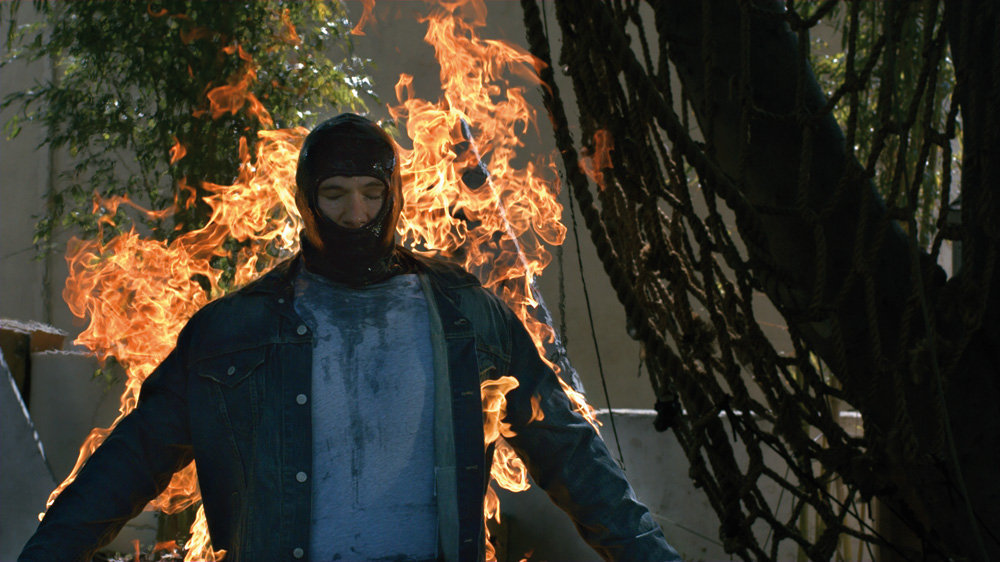
Full Burn (20min, 2014), features U.S. war veterans who have all continued to test the limits of their physical abilities as civilians. Theses veterans, working as Hollywood stunt men, and one as massage therapist, describe relationships to the body, and how their experiences as soldiers have been carried back into their lives now. Named for the stunt restaged in the opening scene of this film, Full Burn pictures an ex-special ops marine set on fire in extreme slow motion, transforming the stunt into a ritualized reenactment of trauma. Full burn serves as a meditation on masculine duty and the emotional stakes of transcending fear. In 2014 it was exhibited as part of the Hammer Muesum`s Los Angeles Biennial, Made in LA, curated by Connie Butler and Michael Ned Holte. It was funded in part by The Hammer Museum and an FCA Emergency Grant.
Mariah Garnett mixes documentary, narrative and experimental filmmaking practices to make work that accesses existing people and communities beyond her immediate experience. Using source material that ranges from found text to iconic gay porn stars, Garnett often inserts herself into the films, creating cinematic allegories that codify and locate identity. Garnett holds an MFA from Calarts in Film/Video and a BA from Brown University in American Civilization. Her work has been screened internationally including: REDCAT (LA), White Columns (NY), SF MoMA (SF), Venice Bienniale (Swiss Off-site Pavillion), Rencontres Internationales (Paris, Madrid, Berlin, Beirut), Midway Contemporary Art (Minneapolis), Ann Arbor Film Festival (Ann Arbor), Kerstin Engholm Galerie (Vienna). In 2016 she has her first institutional solo show at the MAC in Belfast, Northern Ireland and her first solo show at a commercial art gallery in Los Angeles at ltd los angeles. In 2014, she was in residence at The Headlands Center for the Arts in Marin, and featured in Made in LA, the Hammer Museum`s biennial exhibition. The LA Times called her piece "Best in Show." She was awarded the Rema Hort Mann and CCF Emerging artist fellowships in 2014 and 2015.
Mariah Garnett
Garbage, The City, And Death
Experimental video | dv | color | 7:31 | USA | 2010
Garbage, The City, And Death is an eight-minute, single-channel video. It consists of three scenes from a Fassbinder play of the same title, which was banned from the stage in Germany in 1985. My adaptation consists of the scenes between Roma, the prostitute and Franz, her boyfriend/pimp. I play Franz and my half-sister, Joanna Coleman, plays Roma. The couple bickers over money problems, her undying love for him, and his general disgust with her (produced by his latent homosexuality). The film moves from the city, where they are living in their car, to the Salton Sea, to a hot tub in the night. This project was born out of a month-long visit between long-lost sisters who did not grow up together. I use Fassbinder?s text as a means of exploring concepts relating to sibling-hood that do not exist in my actual relationship with my sister. Sibling rivalry is warped here into a lovers? quarrel. As Franz and Roma?s relationship deteriorates, their surroundings become progressively more intangible. They end in a vaccum, engulfed by the blackness of night, as they are drawn hopelessly closer together despite Franz? clear disdain for her and desire to get away from her.
Mariah Garnett, 30, lives and works in Los Angeles and is pursuing her MFA at Calarts in Film/Video. Often using markers from a multitude of genres, Garnett`s work addresses gender and performativity and blurs lines between "fiction" and "reality". She has worked with A.L. Steiner, Zackary Drucker, Peter Berlin, Wu Ingrid Tsang, Stanya Kahn, and Cheryl Dunye. Her work has shown internationally in festivals and galleries (Outfest, Los Angeles Film Festival, Rencontres Internacionales). She graduated with a BA in American Civilization from Brown University in 2003.
Mariah Garnett
Signal
Experimental film | 16mm | color | 7:0 | USA | 2012
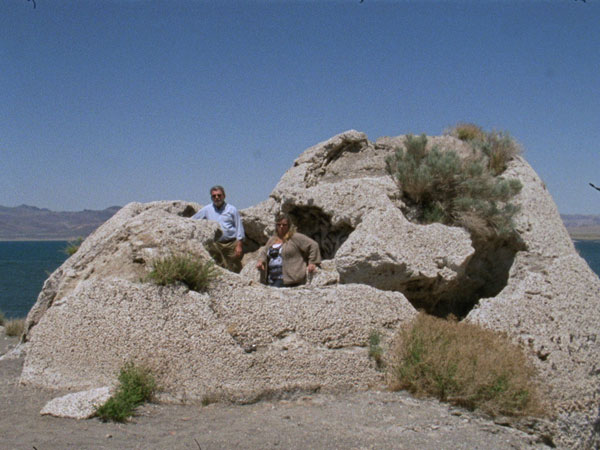
The script for Signal, a 7-minute, 16mm film, attempts to narrativize a collection of spam emails gathered over a 3-year period, and is staged in or near ?sacred spaces?. The landscape of Pyramid Lake, on the Paiute Indian reservation is populated by 10,000-year-old rock formations, many of which are off limits to the public. They loom in the background as characters banter in the sometimes awkward, sometimes solicitous, sometimes nonsensical dialog of spam. The Black Rock Desert Playa, while vacant most of the year, is home to close to 60,000 people annually during Burning Man. These locations were chosen because they act as both mirror and foil for the internet - at once wastelands and gathering sites for millions of people, while maintaining an ancient physicality that transcends any inhabiting group.
Mariah Garnett is an experimental filmmaker and artist living and working in Los Angeles. Her work seeks to occupy a space between convention and experimentation - or, rather, to experiment with convention. The boundaries of adaptation, documentary and fiction are continually being drawn and re-drawn in her work. A big part of her practice involves finding people or thing out in the world to inhabit for a spell. For the most part, these figures are significant, though many times unknown, players in queer history. These twisted homages go so far as to ingest and regurgitate identities to the point where the maker?s motivation is called into question. Garnett holds an MFA from Calarts in Film/Video and a BA from Brown University in American Civilization. Her work has been screened internationally including the following venues: Venice Biennial (Swiss Offsite Pavillion), Rencontres Internationales (Paris, Madrid, Berlin, Beiruit), Outfest (Los Angeles), Midway Contemporary Art (Minneapolis), Mix NYC, Girl Monster (Hamburg). In 2012 she took part in a 2 person show Common Era at ltd los angeles. In 2011 she had a solo show at Human Resources Gallery in Los Angeles titled Encounters I May or May Not Have Had With Peter Berlin and has had work in group shows at Acuna Hansen Gallery (Los Angeles), Montehermoso Cultural Center (Vittoria, Spain) and Workspace Gallery (Los Angeles). She has collaborated with artists Guillermo Gomez-Pena, Zackary Drucker, A.L. Steiner and Chiara Giovando. She is represented by ltd los angeles.
Mariah Garnett, Van BARNES, Zackary DRUCKER, A.L. STEINER
You Will Never, Ever Be A Woman...
Experimental fiction | dv | color | 8:45 | USA | 2008
"You Will Never, Ever Be A Woman...," a video performance, features a conversation between two trans-identified people, Zackary Drucker and Van Barnes. Utilizing a coded language of bitchiness, resistance, and understanding, the syncopated language is as assaultive as it is poetic. Including vernacular "reads," candid dialogue, and improvised conversation, the piece addresses the characters? inter-personal relationship, and their cultural and political positions as ?women.? While performative, the 8 minute video presents an authentic arc of feelings experienced in a romantic relationship; the characters vacillate between love, affection, desire, identification, protectiveness, defensiveness, disdain, contempt, and finally, understanding. Punctuated with hostile antagonism, the piece utilizes a communication technique called ?reading;? a back-and-forth series of insults hurled from one queen to another. When a queen ?reads? a bitch she is demonstrating her wit, her ability to think quickly, and ultimately, her power. Often misperceived by an illegible audience as a genuine attack, ?reading? is a playful sub-cultural exercise of resistance. It is the ability to say and hear the most painful things a person could say, to prepare one for a larger, more dangerous, culture of intolerance. The title of the piece is articulated in the form of a mantra repeated between the characters: ?You will never be a woman. You must live the rest of your days entirely as a man and will only grow more masculine with every passing year. There is no way out.? The phrase acts as both an embrace and a condemnation, an abject acknowledgement of the characters? greatest fear and their potential reality. They are preparing on all fronts. As the characters occupy multiple roles (predators, chasers, exhibitionists, studied academics, nasty sluts looking for equitable romance), they ultimately propose ?kyky love? (trans-on-trans romance) as an alternative to fetishistic objectification. The view is an altogether novel exploration of trans-identity that attempts to subvert traditional documentary and often-exploitative methods of representation. The narrative is about ways of seeing, identity construction, and cultural celebration.
Zackary Drucker is a 25 year-old Los Angeles-based artist. Originally from upstate New York, Drucker holds a MFA from the California Institute of the Arts, and a BFA from the School of Visual Arts. Infusing elements of installation, performance, photography, and video, Drucker?s work has been included in the recent group exhibitions Artstar at Deitch Projects, in New York, Brave New World at Lizabeth Oliveria Gallery, 25 Bold Moves at the House of Campari, Powder Room at Track 16, Summer Guests at Acuna-Hansen Gallery, and has performed at the UCLA Hammer Museum, WILDNESS, and Bitches Rule, all in Los Angeles. Mariah Garnett, 28, is a Los Angeles based filmmaker. Her work often employs the absurd or the grotesque substituting genre-play for gender-play. Ranging from music videos to experimental films, her works have been screened at the Fruit Farm Film Festival (Portland, OR), SiteLA (Los Angeles, CA) Coney Island Film Festival (NYC), MVPA Directors Cuts (Los Angeles, CA) and Movies with Live Soundtracks (Providence, RI). A.L. Steiner uses constructions of photography, video, installation, collaboration, performance and curatorial work as seductive tropes channeled through the sensibility of a cynical queer eco-feminist androgyne. Her work has been featured at Taxter & Spegemann (USA), Centro Cultural Montehermoso (SPN), Tel Aviv Museum of Art (ISR), John Connelly Presents (USA), Contemporary Museum/Baltimore (USA), Nicole Klagsbrun Gallery (USA), The Kitchen (USA), Museo Nacional Centro de Arte Reina Sofía (SP), White Columns (USA), Exit Art (USA), Centre Pompidou (FR), Yvon Lambert/Paris (FR), Derek Eller Gallery (USA), Los Angeles Contemporary Exhibitions (USA), Performance Space 122 (USA), Aspen Museum of Art (USA), Kyoto Museum of Contemporary Art (JPN), Art Cologne (GER) and P.S.1 Contemporary Art Center (USA), among others. Steiner is a collective member of Chicks on Speed, the co-editor/curator of Ridykeulous and collaborates with numerous visual and performing artists. She is an instructor at the School of Visual Arts in New York City and is represented by Taxter & Spengemann, NYC. Van Barnes is an unstoppable tour-de-force, career-woman, model/muse, inspiration source, and flawless beauty. Her life approach seamlessly integrates art and performance into every aspect of daily practice, and her fierce white-girl realness has been documented by Steven Ashmore, Zackary Drucker, Eve Fowler, Adolfo Gallela, Greer Lankton, Gilles Larrain, Thairin Smothers, and John Wellington.