Catalogue > Faire une recherche
Résultats pour : Tout le catalogue

Thomas Bertay, Pacôme THIELLEMENT
Le Manège cosmique du dieu-peur
Fiction expérimentale | dv | couleur et n&b | 71:0 | France | 2011
Un Semblant de Monde est un sous-programme inédit d?une durée de 1 heure et 11 minutes, regroupant 4 épisodes parmi les derniers réalisés à ce jour de la série Le Dispositif. Le Dispositif est un programme vidéo d?orientation, d?explicitation et de conditionnement qui sera composé d?un corpus de 52 films à son achèvement en 2012 formant une totalité d?une durée de plus 8 heures (50 épisodes sont réalisés à ce jour). Le projet d?un « homme reconstitué » a maintes fois été évoqué dans l?Histoire : il serait le fait de la voix divine bicamérale ? représentée tour à tour par le visage du Renard, du Papillon et de l?Hippocampe ? et celle-ci s?épiphaniserait sous la forme des Hommes-Oiseaux, lointains représentants d?une humanité de souche aux origines mal établies (Fravartis mazdéens, Anges, Petite Reines?). Tout récemment, les concepteurs des Villes Nouvelles, ignorant la Connaissance, confondirent le monde en suspend des Hommes-Oiseaux avec leur réalité d?ici-bas et en expérimentèrent les sinistres conséquences. Dans le monde contemporain, un homme n?apparaît jamais que par morceaux. Le Dispositif produit un courant électrique et une fréquence vibratoire qui se propose de réagencer la multitude éparpillée de morceaux d?hommes pour faire jaillir en vous, La Seconde Mémoire.
Thomas Bertay fonde, anime et dirige la maison de production Sycomore films depuis sa création en 1999. À la fois auteur, réalisateur et artiste vidéo, il se spécialise en post-production et travail sur de nombreux projets depuis lors (fictions, documentaires, art vidéo). Il co-produit et signe le montage du dernier film de Nico Papatakis, Gloria Mundi qui sort en salles en 2005. Il collabore avec les réalisateurs et artistes Jean-Jacques Beineix, Mickael Raeburn, François Lunel, Manuel Pradal, Valérie Pavia, ZEVS, Philippe Meste, Anne Jaffrenou, Marie Cuisset, Aude Py, Nicolas Nakamoto, Frédéric Nicolas? Il est le co-auteur avec Pacôme Thiellement de la collection Le Dispositif, une série de vidéos expérimentales ayant fait l?objet de nombreuses monstrations (Centre Pompidou, Espace Ricard, Le Denfert-Rochereau, Beaux-Arts de Toulouse, La Gaîté Lyrique?) et de deux rétrospectives, l?une au Palais de Tokyo en hiver 2009, et l?autre, au PCF dans le cadre du festival Politiques 0 en octobre 2010. Parallèlement à ces activités, il est en charge de la rubrique Médias dans la revue Musica Falsa dirigée par Bastien Gallet entre 1998 et 2002, et auteur de plusieurs courts essais dans la revue d?Art et Littérature Spectre entre 1999 et 2002. --------------------------- Pacôme Thiellement s?est d?abord illustré dans le milieu de la bande dessinée, en dirigeant, de 1987 à 1991, le fanzine Réciproquement, Alph?art Fanzine à Angoulême en 1990. Il fonde et dirige la revue littéraire Spectre de 1998 à 2003. Trois films ont été co-réalisé avec Thomas Bertay dans le cadre de cette revue expérimentale (DVD édité chez Sycomore films J?apporte la Guerre en 2005). Il est l?auteur de sept livres d?inspiration exégétique, herméneutique, théophanique et burlesque : Poppermost ? Considérations sur la mort de Paul McCartney (MF, 2002), Economie Eskimo ? Le Rêve de Zappa (MF, 2005), Mattt Konture (L?Associaton, 2006), L?Homme électrique ? Nerval et la vie (MF, 2008), Cabala ? Led Zeppelin occulte (Hoëbeke, 2009), La Main gauche de David Lynch (P.U.F., 2010) et Les Mêmes yeux que Lost (Léo Scheer, 2011). Il a publié des textes dans de nombreuses revues (R de Réel, Vertige, L?Eprouvette, Le Tigre), magazines (Rock & Folk, Chronic?art, Standard, Les Cahiers du Cinéma), ouvrages collectifs (Fresh Théorie, Ecrivains en série, Le Ciel vu de la Terre), donné des conférences ou participé à des débats au Palais de Tokyo, au Centre Pompidou, au Grand Palais, aux Beaux Arts de Lyon, à l?Espace Ricard? Ses livres ont été salué par la critique (Fluctuat.net, Les Inrockuptibles, Les Cahiers du Cinéma, Positif, France Culture, France Inter, France 3, Le Magazine des Livres, Artpress?). Chronic?art lui a consacré la couverture d?un de leurs numéros et son avant-dernier essai, La Main gauche de David Lynch a été considéré par le magazine Technikart comme le meilleur livre non-romanesque publié en 2010. Il est le co-auteur avec Thomas Bertay de la collection Le Dispositif, une cinquantaine de vidéos expérimentales ayant fait l?objet de nombreuses projections (Centre Pompidou, Espace Ricard, Le Denfert-Rochereau, Beaux-Arts de Toulouse, La Gaîté Lyrique?) et de deux rétrospectives, l?une au Palais de Tokyo en hiver 2009, et l?autre, au PCF dans le cadre du festival Politiques 0 en octobre 2010.
Markus Bertuch, bertuch
Walperloh
Installation vidéo | dv | couleur | 7:30 | Allemagne | 2006
?Walperloh? shows three young men situated in Estern Germany amongst a pre-fabricated housing development. The historical inscriptions of the landscape connect with the characters.The situation and the relationship between the men refer to a semantic field that refuses concrete attributions. Quiet, sparce takes creat personal closeness without any real determination: a non-space full of undefined melancholy and tenderness. The density of the description creates an open space of association that doesn?t terminate into narration and allows for distance despite ist closeness.
Markus Bertuch, born 1974 in Arnstadt, lives and works in Berlin; 1999 ? 2001 studied design at Werkakademie Kassel, studied Fine Arts and Visual Communications at School of Art Kassel. Since 2003 several participations in international exhibitions and festivals (selection): Kunstfilmbiennale - Köln 2007, Lucas-Cranach-Preis für Video Kunst - Kunstverein Kronach 2007, 60° Festival del film Locarna - Locarna 2007, ?To be continued - Was macht Video Anders?? Galerie Anita Beckers - Frankfurt/Main 2007

Sebastian Betancur Montoya, Abi Green
Fata Morgana
Vidéo | hdv | couleur | 12:18 | Colombie, Royaume-Uni | 2021
Us, humans, the one species present in every latitude of the earth have never really settled, from hunters and gatherers to refugees and expats. Throughout human history reasons for exploration vary; trade, fear, ambition, or curiosity. Still nomads, our quest to chart every reachable corner has been fundamental to the dissemination of symbolic structures growing from wealth and power into different forms around the globe. Fata Morgana balances between that primal urge to explore the unknown and the instinctive need to make a home and belong... Pulling or being pulled? Coming, going or returning? The physicality of struggle, disappearance and emergence within this piece becomes a metaphor reflecting on Poetics and Politics, Geography and Geometry, Dreams and Death, as well as memories of Future and Past. With the uncertainty and hope of new beginnings across the ocean, the transient figures glimmer and nearly blend into their surroundings, flirting with symbolisms of ritual: the platonic geometry, immersion/ascension, and their perpetual journey. These travellers move oblivious of any limits but their own, challenging the very notion of borders; which are, anyway, invisible and futile drawings of power onto an ever-shifting landscape defiant of any divisions. Inspired by the artists own attempts of somehow always carrying home with them, the piece is a video loop meditating on the emotional ebb and flow of the many departures and the inevitability of a return. A return home, that whether it be a place, memory, feeling, or a word it is always a reflection of oneself.
SEBASTIAN BETANCUR MONTOYA: A common conceptual thread legible in his artwork is the constant preoccupation for the body[ies] and its relation with[in] the surrounding space and its limits/conditions; the themes of home, language, migration, belonging and uprooting have become unavoidable for someone as him, who has lived on the move, away from his birth place half of his life. Sebastián´s work has been part of exhibitions, publications, art residencies, and art fairs in Colombia, The Bahamas, Qatar, Russia, and Germany and participated in other events such as The 2015 Oslo Architecture Triennial, the 2015 Kuwait pavilion for the Venice Biennale, NYT art for tomorrow 2016, and the 2018 Istanbul design Biennial. ABI GREEN: Born and raised in London, she was educated at Fine Arts College, Chelsea College of Arts and went on to graduate with a BA (Hons) in Photography from Middlesex University London. Abi’s work has been featured on Vogue and Vogue Italia online, Le Book and It’s Nice That. Nominated to exhibit at the D&AD, New Blood Awards, London, in 2009 and Mother London’s, Open Book in 2015, she has also been published both in the UK and the Middle East, including magazines such as Notion, Crack, Elle and Twenty-six. Driven by interests in colour, light art, and sculptural objects, she is often influenced by surrealism, modern and industrial design, which enhances her contemporary visual style. Her projects carefully balance a minimalist approach with a graphic, colourful aesthetic resulting in a distinctive eye-popping quality. A key part of her image-making is the humorous twist that underpins her creative concepts, with this unique approach she hopes to leave her audience with a taste of her playful nature.
Vicky Betsou
field
Art vidéo | dv | couleur | 3:45 | Grèce | 2009
A man spreads lime on a field in August, to prepare the earth for the autumn sowing. His action recorded and extracted from the surroundings and realistic conditions, becomes a ritual of a human caressing the land at dusk, reminding us of our relation and dependence to earth. The image obscured and slowed down confronts the viewer with an enigmatic time fragment of a ritual dance.
Vicky Betsou is a visual artist, working mainly with video installations. She lives and works in Athens. She studied Biology at Athens University, painting at Athens School of Fine Arts (ASFA) and completed her MA in Digital Arts at ASFA (2000). She has been a teaching assistant in Multimedia and Video-art courses at ASFA since 2001 and in 2006 she was elected a Lecturer and is teaching Video Art in the graduate and postgraduate program at the same Institute. She has participated in research programs concerning Art and new Media and collaborated in E-Learning projects on Art education. Her work mainly addresses the complicated notion of time and memory, blurring the boundaries between objective and subjective time, emphasizing on the construction of temporal structures or the composition of time loops, engaged in the construction of multiple, multilevel narrations. Her work has been presented in solo and group exhibitions and festivals in Greece and abroad.

David Bex
Inspecteur Rredick
Fiction expérimentale | dv | couleur | 30:22 | France | 2005
Une nouvelle enquête de l?inspecteur Rredick. Rien n?est dit, mais tout se sait. Alors il n?y a plus qu?à se regarder, s?écouter en silence et attendre, la vie allant. Quand les paroles ont disparu, on lit sur les visages. Des hommes vivent ensemble côte à côte et c?est tout. Ils rêvent parfois. Un homme meurt, le premier mot est dit. La langue des morts est née.
Né le 13 août 1972 dans le Lot. Après des études universitaires de cinéma, il intègre l?école nationale supérieurs Louis Lumière. Son travail de fin d?étude achevé en 2003 : « Temps atomique » fut projeté lors de la dernière édition du festival Paris Berlin. Il travaille depuis essentiellement sur la manipulation des images extraites de séries télévisées dont « Inspecteur Rredick » est le premier opus.
Luis Bezeta
Morma Jeane es Marilyn
Vidéo | hdv | couleur | 2:45 | Espagne | 2011

Palash Bhattacharjee
A Bridge and Beyond the Bridge
Vidéo expérimentale | hdv | couleur | 3:8 | Bangladesh | 2024
Built during British colonial rule in 1930, the Kalurghat Bridge serves as a vital connection between the north and south of the greater Chittagong district of Bangladesh, bisected by the Karnaphuli River. Historically, this bridge facilitated communication between regions in south Chittagong, bridging the gap from British India. From the circle of my family ancestors, many left the southern part of Chittagong from the British period, particularly the partition period, to the Pakistan period and settled in different parts of this subcontinent. Then, during the liberation war of Bangladesh in 1971, some people in Bangladesh-India border areas took shelter for some time and worked in various ways for the freedom of the country. From the post-independence period to the present, many people from this southern region migrated to other countries outside the subcontinent for different purposes and reasons, including re-settlement in Chittagong City and Dhaka. These familial and local stories are not linear. Through different layered images on the bridge, the video features a female narrator, embodying the collective familial past. The narrative within the video is a fictionalised merge drawn from different stories and correspondences, further exploring familial history and connection.
Palash Bhattachajee has undergone a shift in his artistic journey, transitioning from academically focused printmaking toward multi-media, experimental art-practice via a close encounter with performance art activism. He takes critical interest in closely reading filmic genres and their performative idioms. The photo/videographic style and the eclectic selection of objects in his works are influenced by the cerebral matrix of contrapuntal, non-narrative aspect of deconstructed storytelling adopted from global cinema. Based and born in Chittagong, Bangladesh, he received his Master’s and Bachelor's degrees from the Department of Fine Arts, Chittagong University. He was awarded the Asia Pacific Fellowship Residency from MMCA Residency Goyang in 2011 and received a grant from Seoksu Art Project of Stone & Water, South Korea, in 2010. His works have been widely exhibited in Bangladesh, including at Chobi Mela 2021, Dhaka Art Summit 2012-2020, Asian Art Biennale 2012-2022, Dhaka, and internationally, including ‘Legacies of Crossings’, Shahnaz Gallery, London, UK 2024; NOmade Biennial, Art Center Gallery Elblag, Poland, 2023; Warehouse421, Abu Dhabi, UAE, 2022; Colomboscope, Colombo, Sri Lanka, 2022; ‘The Oceans and the Interpreters’ and ‘The Deep City’, Hong-Gah Museum, Taiwan, 2020; ‘Seven Exhibitions’ at Exhibit 320, New Delhi, India, 2018; and many more.
Fatima Bianchi
Tyndall
Doc. expérimental | hdv | couleur | 29:27 | France, Italie | 2014
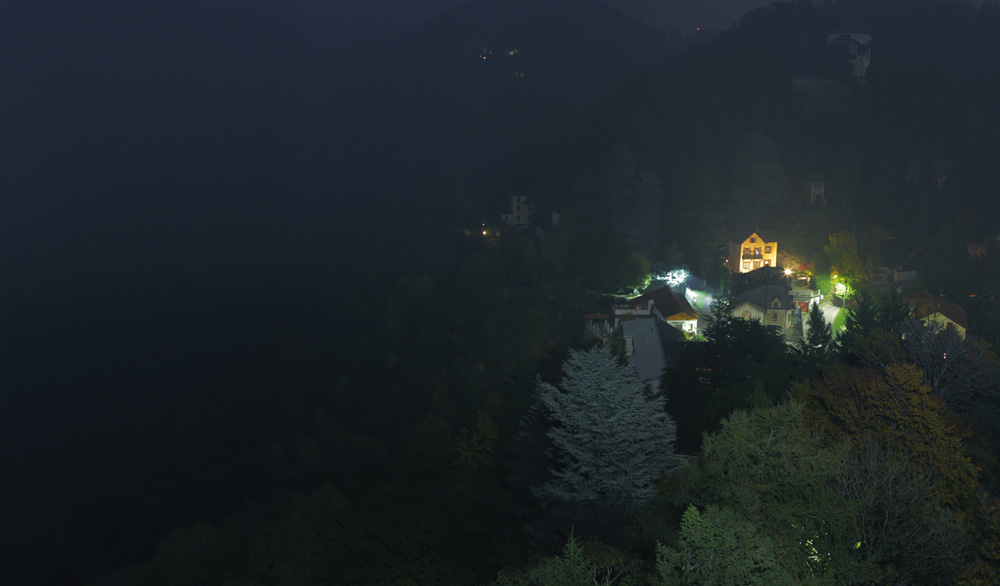
A lighthouse on the mountains over Brunate, a beam of light incessantly rotating in the dark, shedding light over something which has remained in the shadows. It illuminates one house. The house contains members of one family, portrayed in they daily life. The story revolves around a specific moment in time, when Francesco, the eldest son, spends one year in jail. Around that time each one of the relatives exchanges letters with him. The Tyndall effect is a phenomenon of diffusion of light due to the presence of some particles in the air. It manifests itself, for example, when the car lights are turned on in a foggy day. The same effect is visible from the tower of the lighthouse looking towards the home of the Bianchi’s family.
Fatima Bianchi was born in Milano in 1981, she lives between Milano and Marseille. Her research focuses on the understanding of the individual, on his historical memory, his cultural and natural contest. Her artistic production is expressed through the medium of the video, the documentary and the site installation.

Matthew Biederman
A Quickie in the Bouncy House
Vidéo expérimentale | hdv | couleur | 4:26 | USA, Canada | 2023
The video is an AI assisted meditation on self-help through extreme sonic manipulation, in a semi-erotic plastic dreamscape of watered down and for profit thanatotherapy, where new age imagery devolves into Cronenberg-esque mutations, in complete contrast with the chaotic and unpredictable sonic experiments which may or may not be useful in your personal quest to embetter your True Self™. The music is highly processed, with just a few audible artifacts left of the original code, drum kit and modular based sources, creating sounds that hopefully escape attempts at AI classification.
Matthew Biederman, b. 1972, Chicago Heights, IL, USA. Matthew Biederman works across media and milieus, architectures and systems, communities and continents since 1990. He creates works where light, space and sound reflect on the intricacies of perception. Since 2008 he is a co-founder of Arctic Perspective Initiative, with Marko Peljhan working throughout the circumpolar region. He has served as artist-in-residence at a variety of institutions and institutes, including the Center for Experimental Television on numerous occasions, CMU’s CREATE lab, the Wave Farm, th Finnish Bioarts Society and many more. His work has been featured at: Lyon Bienniale, Istanbul Design Bienniale, The Tokyo Museum of Photography, ELEKTRA, MUTEK, Ars Electronica, Bienniale of Digital Art (CA), Artissima (IT), SCAPE Bienniale (NZ) and the Moscow Biennale (RU), among others. Pierce Warnecke is a multidisciplinary digital artist. His work, on the border between experimental music, digital arts and video art, is influenced by the observation of the effects of time on matter: modification, deterioration and disappearance. He frequently collaborates with prominent figures such as Frank Bretschneider, Matthew Biederman, Yair Elazar Glotman and Keith Fullerton Whitman among others. He has presented his work in the form of performances, concerts and installations at MUTEK, ZKM, CTM, Elektra, KW Institut, La Biennale NEMO, Sonic Acts, Martin Gropius Bau, MAC Montreal, Scopitone, LEV Festival, SXSW, FILE, etc. Between 2017 and 2019 he composed several audiovisual pieces for the Institute for Sound and Music’s Hexadome project in Berlin, San Francisco, Montreal and more. His music has been published on raster-media (DE) and Room40 (AU), and he is represented by DISK Agency in Berlin.

Gregg Biermann
Cropduster Octet
Film expérimental | hdv | couleur | 5:32 | USA | 2011
One of the most iconic sequences in the history of Hollywood cinema (from Hitchcock?s North by Northwest) is deconstructed and reassembled to illuminate the patterns, rhythms and choreography of the original so as to break through and make for an eight banded kinetic tour de force. As the piece progresses the temporal displacement of each band gets closer and closer until they all unite into a remarkable grand finale. --John Columbus, Black Maria Film and Video Festival
Gregg Biermann is a video and multimedia artist whose work comes out of the avant-garde filmmaking tradition. His work takes advantage of digital technologies to advance rigorous compositional strategies.

Gregg Biermann
Labyrinthine
Vidéo expérimentale | dv | | 14:40 | USA | 2010
This is a recent piece in my series of computational transformations of iconic scenes taken from classic Hollywood films. Forty-one separate shots that have been appropriated and excised from the Hitchcock classic Vertigo are repeated and re-sequenced into a composite sequence of concentric rectangles. Each rectangle appears over the last and grows larger over time. The narrative of the original is all but lost and in its place is a hypnotic and meditative display of forms and sounds.
Gregg Biermann?s work is in the collection of FRAC Limousin has been exhibited internationally at Nam Jun Paik Art Center, Seoul, Korea; Museum of Modern and Contemporary Art Strasbourg; Festival Images Contre Nature, Marseille; Film Festival of Experimental and Different Cinemas of Paris; Rencontres Internationales, Paris; Electrochoc Festival, Rhones-Alpes; Centre Images, Vendôme, France; Osterreiches Filmmuseum, Vienna, Austria; European Media Art Festival, Osnabruek, Hamburg Film Festival, Germany; The Caracas Contemporary Art Museum; The National Cinematheque, Venezuela; Media Art Friesland, IMPAKT Panorama, Noordelijk Film Festival, The Netherlands; Optica International Festival of Video Art, Gijon, Spain;VIDEOEX, Zurich, Switzerland and INVIDEO, Milan, and Abstracta, Rome, Italy. His work has also been exhibited in the USA at the Yerba Buena Center for the Arts/San Francisco Cinematheque; Baltimore Museum of Art; Corcoran Gallery; Hunter Museum of American Art; National Gallery of Art; Cleveland Institute of Art; Anthology Film Archives; U.C. Berkeley Art Museum/Pacific Film Archive; Centraltrak Gallery, Univ. of Texas at Dallas; Weisman Art Museum, Univ, of Minnesota; California Institute of the Arts; Los Angeles Filmforum/Echo Park Film Center; ArtPace San Antonio; Hallwalls Contemporary Art Center; Visual Arts Center of New Jersey and the Jersey City Museum.
Gregg Biermann
The hills are alive
Vidéo expérimentale | dv | couleur | 7:18 | USA | 2005
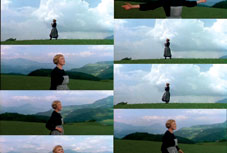
Dans "The Hills Are Alive" (Les collines sont vivantes), une scène iconique tirée de la comédie musicale Hollywoodienne à succès "The Sound of Music" subit une transformation par des effets d´écran fractionnés progressant en contrepoint. La mosaïque qui en résulte révèle des mélodies inoubliables et des dissonances retentissantes.
Gregg Biermann was born in 1969 in Brooklyn, New York. He graduated with Honours in Cinema from Binghamton University in 1991, and subsequently received an M.F.A. from the San Francisco Art Institute. He has been making films, videos, and multi-media pieces since 1988. These works have been exhibited internationally including exhibitions at Anthology Film Archives, Millennium, the San Francisco Cinémathèque, the Pacific Film Archive, the Documentary Film Society at the University of Chicago, Chicago Filmmakers, the Massachusetts College of Art Film Society, the Ontario Cinémathèque, and the Deutsches Filmmuseum. His works and activities have received critical attention in the San Francisco Bay Guardian, The Chicago Reader, and The Chicago Sun-Times. He has been collaborating with electronic music composer/performer Ron Mazurek for the past several years on a series of real-time music/video performances. He was a member of the Chicago x-film group, which mounted many programs of avant-garde films in and out of Chicago. More recently, he has done programming for the Robert Beck Memorial Cinema in New York. He has also written an avant-garde film including an article for the Millennium Film Journal on Nathaniel Dorsky's films, which was co-authored with his wife, Sarah Markgraf. Mr. Biermann has taught at Barat College, Horizons: the New England Craft Program, and is currently a Professor of Art at Bergen Community College.
Marine Bikard
Coulisses
Animation | mp4 | couleur | 4:9 | France | 2020
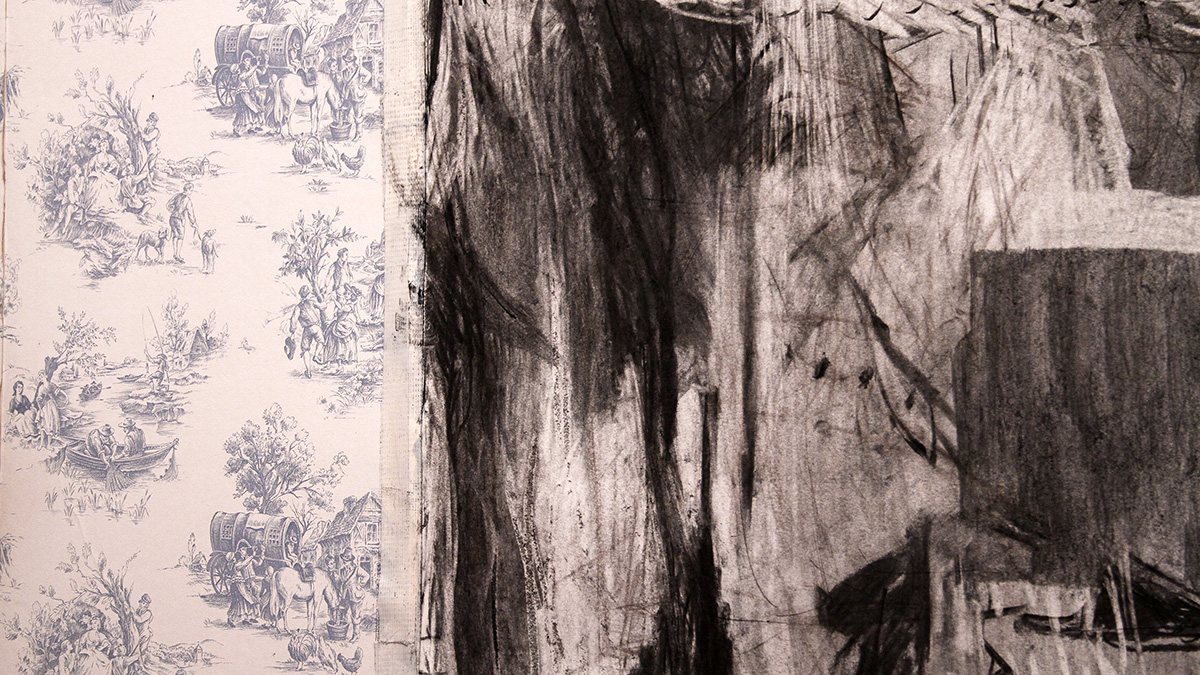
Un mouvement de caméra comme un balancement de tête, de gauche à droite. Si bien qu’il y a toujours ce qui sort et ce qui entre dans le champ. Dans ce trajet, l’œil caméra croise un papier, du papier peint, et plus loin encore, un miroir dans lequel se reflètent papier-peint et papier.
Marine Bikard est née en 1988 et diplômée de l’ENSBA - École nationale supérieure des beaux-arts de Paris (France) en juillet 2020. Avant et en parallèle de ce cursus artistique, elle a travaillé comme sociologue et poursuit la réalisation d’enquêtes de terrain. Pendant ces cinq années passées à l’ENSBA de Paris, elle a travaillé dans les ateliers de Pascale Martine Tayou, Emmanuelle Huynh, Aurélie Pagès et Jean-Michel Alberola, et a régulièrement participé à des workshops de danse qui ont marqué son parcours, notamment sa rencontre avec la chorégraphe américaine Lisa Nelson. Depuis 2019, elle imagine des rencontres collectives pour explorer par le dessin différentes manières d’être avec ce qui nous entoure. En 2021, elle a été artiste en résidence à l’Embac – École municipale des beaux-arts de Châteauroux (France).

Manuel Billi
Battre, enlever
Vidéo | hdv | couleur | 11:0 | Italie | 2014
« Maintenant, je suis partout » « Maintenant, je te suis partout ». Des paupières qui s’ouvrent et se ferment en battant le rythme d’une rencontre amoureuse. Des captations de téléphone portable qui enlèvent au réel le sentiment du vécu. "Battre, enlever" est un compte-rendu vraisemblable de faits qui n’ont pas eu lieu ou qui ont eu lieu autrement, le récit d’un amour qui bride et élève à la fois.
Manuel Billi est écrivain, scénariste et producteur. Co-fondateur du collectif d'artistes Le Gauche, il a réalisé plusieurs courts-métrages à partir de captations de téléphone portable. Depuis 2013, il travaille avec Christian Merlhiot sur le scénario d'un long-métrage de fiction.
Manuel Billi
Guardarla negli occhi (La Regarder dans les yeux)
Doc. expérimental | hdv | couleur | 15:0 | Italie, France | 2020
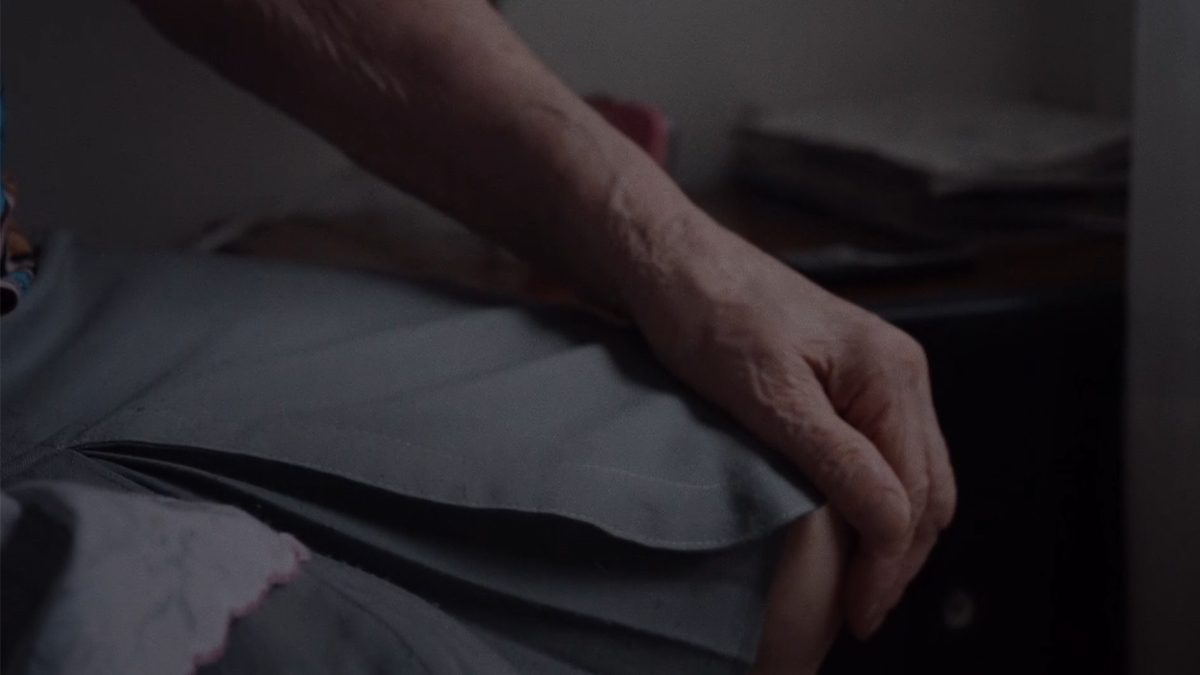
Une journée dans la vie d'une famille. Une histoire de mains: des mains qui agissent, des mains qui assistent, des mains qui dansent jusqu'à la fin de la journée.
Manuel Billi vit et travaille à Paris. Critique cinéma et réalisateur, il est l'auteur de plusieurs essais sur le cinéma contemporain. Depuis 2000, il collabore avec différents magazines de cinéma italiens et français. En 2014, il réalise son premier film court expérimental, "Battre, enlever". Son premier film court de fiction, "Ghosts of Yesterday" (2017) a été présenté en avant-première à la Mostra de Venise (Italie). Par la suite, il a alterné entre fiction ("Enter", 2018, sélectionné dans plus de vingt festivals internationaux ; "Ten Times Love", 2020) et documentaire ("Guardarla negli occhi - La Regarder dans les yeux", sélection officielle 2020 à la Mostra Internazionale del Nuovo Cinema di Pesaro, Italie).
Richard Billingham
Sweep
Installation vidéo | dv | couleur | 14:10 | Royaume-Uni | 2004
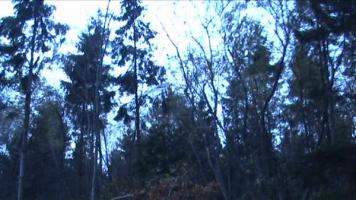
Un panorama extrêmement lent sur des arbres sombres, contre un ciel au crépuscule. Tourné avec deux images par seconde, les mouvements des arbres semblent davantage être une photographie animée. Dans un silence complet, les arbres sont secoués par un vent fort, qui remue les couches et les textures de la forêt alors que, presque imperceptiblement, la caméra fait un panoramique de droite à gauche. C?est seulement lorsque la forêt s?éloigne que l?on prend conscience du mouvement de l?image, à la fois lentement et soudainement, juste comme la nuit qui prend la relève du jour et le calme qui succède à l?agitation. SWEEP possède certaines des qualités spatiales et temporelles habituellement associées à la peinture de paysage, de Ruysdael, Claude ou Poussin, Turner ou Constable, et manifeste du sentiment intense de l?environnement et de la nature de Richard Billigham. Il effectue une réappropriation contemporaine du paysage, dans ce mouvement de forêt lors d?une tempête. SWEEP a été projeté au festival de Locarno, et présenté au New Forest Pavilion à la biennale de Venise cette année
Richard Billingham est né en 1970. Il grandit dans une zone industrielle de Birmingham, alors très touchée par la crise économique. Il suit des cours à la fondation d?art de la ville et à l?université de Sunderland. Il prend des photographies de sa famille, et de son environnement immédiat. Ce travail photographique, intitulé « Who`s looking at the family », a été présenté à la Barbican Gallery, et dans de nombreuses expositions consacrées à l?art anglais. Billingham réalise aussi des vidéos, la plus connue est FISHTANK, qui reprend les mêmes éléments tirés de son environnement immédiat, et présente sa famille. FISHTANK est de type documentaire, mais avec des spécificités propres à un travail de plasticien, notamment l?utilisation que Billigham fait des très gros plans pour étudier le mouvement. Présenté en 1997 à la Anthony Reynolds Gallery, à Londres, il gagne en 1997 le prix de la Citybank, et est présent à Londres, Berlin, New York dans l?exposition de la collection Saatchi consacrée aux jeunes artistes britanniques. Il est nominé en 2001 pour le Turner Prize, avec sa vidéo RAY IN BED. Richard Billingham réalise actuellement des photographies de paysages non habités : terrains semi ruraux en déréliction, à l?arrière de murs de briques rouges, aire de jeux désertées dans les banlieues entre des blocs d?habitats sociaux, mais aussi des paysages infinis en pleine campagne, aux ciels orageux.

Juliette Bineau
Jour de chasse
| | | 10:19 | France | 0
Steeve, Le chasseur marche dans la neige. Il s`est levé très tôt ce sont les premiers neiges. Il tue le temps, puis tue la bête. Qui as dit : "Un roi sans divertissement est une homme plein de misères "?
Juliette Bineau est Francaise, elle est né en 74. Elle a été comédienne avant de réaliser des films. Elle a réalisée Gertrud un remake du film éponyme de C th Dreyer et La Tête, d`après Sam Peckinpah. En 2013 elle est Lauréate de la résidence Hors les Murs , elle travaille sur un projet autour de Robocop, memory of Detroit. (projet en cours)
Juliette Bineau
LA TÊTE
Fiction expérimentale | | couleur | 44:54 | France, Argentine | 2010
Road-trip, Argentine 2009. Un remake de « Apportez-moi le tête d?Alfredo Garcia » de Sam Peckinpah. Alfredo Garcia, l? homme que l?on recherche, est mort. Sa tête est mise à prix. Bennie convaint Elita de le conduire à sa tombe pour decapiter la tête du cadavre. Le couple roule au travers des montagnes arides du nord de l?Argentine, tels des Yankees traversant un purgatoire indien ....
Juliette Bineau Est né en 1974. Elle fait les beaux Arts de Rennes et suit l?enseignement de théâtre de l?auteur scène Didier George Gabily, ce qui la mène à être un temps comédienne et metteur en scène. Elle est aujourd`hui musicienne (batteuse du groupe de free noise psychédélique Minitel)vidéaste et performeuse. Depuis quelques années elle s?intéresse particulièrement au remake comme moyen de revisiter et de s?approprier de grandes formes cinématographiques, de remettre en jeu dans ses films des questions de théâtre (la répétition, l?interprétation d?une ?uvre). Elle réalise « Gertrud » d?après le « Gertrud » de Carl Th. Dreyer. Ce projet a été soutenu par la DRAC Île-de-France (Bourse individuelle à la création 2008) et est montré à la Fémis par le collectif Point Ligne Plan, au centre Culturel de la Récolta de Buenos Aires, au Film Festival de Rotterdam, à la Cinémathèque Française, au Palais de Tokyo? En 2009, elle réalise « La Tête « d?après Apportez-moi la tête de SamPeckinpah : Un road movie argentin, dans le cadre d?une résidence de Cultures-France, avec le concours de l?allocation Image mouvement.

Juliette Bineau
Pleura
0 | 0 | couleur | 0:0 | France, Brésil | 2011
"Dieu? prit un de ses "pleura" (côte ou côté), l`édifia pour en faire une femme et l`amena à Adam?" Utopie androgyne et cannibale, Pleura décline en l`union et la séparation des amants. Diptyque : 1. Dans l`ascenseur de verre, nulle part au milieu du dehors, s`élévant au dessus d`un jardin inaccessible, un homme et une femme sont tues de pensées inavouables. 3. Ils s`enfoncent dans une forêt suintante, c`est après la chute, ils sont couverts de boue ou peints pour un rituel cannibale. Défloraison androgyne, ils dansent entre les branches, rognent un phallus reptilien...
Juliette Bineau est né en 1974. Elle étudie aux Beaux?Arts de Rennes puis auprès de l`auteur metteur en scène Didier George Gabily. Elle est comédienne, performeuse dans des groupes de noise music, cinéaste (Gertrud 2009, La Tête 2010, Robocop memory Room 2011). Elle rencontre la danseuse Cécilia Bengoléa en 2005, lors de la création de la pièce du duo Chaignaud-Bengoléa Pâquerette qu`elle accompagne à la batterie (tribale) dans son groupe Minitel.
Juliette Bineau
Pleura (Part. 1)
Vidéo | hdv | couleur | 3:49 | France, Brésil | 2011
"Dieu? prit un de ses "pleura" (côte ou côté), l`édifia pour en faire une femme et l`amena à Adam?". Utopie androgyne et cannibale, Pleura décline en l`union et la séparation des amants. Dans l`ascenseur de verre, nulle part au milieu du dehors, s`élevant au dessus d`un jardin inaccessible, un homme et une femme sont tues de pensées inavouables.
Juliette Bineau Est né en 1974. Elle fait les beaux Arts de Rennes et suit l?enseignement de théâtre de l?auteur scène Didier George Gabily, ce qui la mène à être un temps comédienne et metteur en scène. Elle est aujourd`hui musicienne (batteuse du groupe de free noise psychédélique Minitel)vidéaste et performeuse. Depuis quelques années elle s?intéresse particulièrement au remake comme moyen de revisiter et de s?approprier de grandes formes cinématographiques, de remettre en jeu dans ses films des questions de théâtre (la répétition, l?interprétation d?une ?uvre). Elle réalise « Gertrud » d?après le « Gertrud » de Carl Th. Dreyer. Ce projet a été soutenu par la DRAC Île-de-France (Bourse individuelle à la création 2008) et est montré à la Fémis par le collectif Point Ligne Plan, au centre Culturel de la Récolta de Buenos Aires, au Film Festival de Rotterdam, à la Cinémathèque Française, au Palais de Tokyo? En 2009, elle réalise « La Tête « d?après Apportez-moi la tête de SamPeckinpah : Un road movie argentin, dans le cadre d?une résidence de Cultures-France, avec le concours de l?allocation Image mouvement
Dara Birnbaum
Canon: Taking to the Streets (Part One: Princeton University – Take Back the Night)
Documentaire | 0 | couleur | 10:0 | USA | 1990
In Canon: Taking to the Streets, Birnbaum breaks with traditional documentary format. Using tools from the low-end and high-end of technology, she episodically views recent events of student activism in the United States. This is a study of the 1987 Take Back the Night march on the Princeton University campus. Birnbaum's treatment of the original student-recorded VHS footage reveals this march as having the potential to develop political awareness through personalized experience. The students attempt to "put across a historical message" that was started in San Francisco in 1978: the protest of any form of violence against women. Take Back the Night now represents men and women, in solidarity with one another, marching against sexual violence of any kind. Here the activity remains specific to violence as perpetrated against persons in the Princeton community.
For four decades, Dara Birnbaum's pioneering works in video, media and installation have questioned the ideological and aesthetic character of mass media imagery, and are considered fundamental to our understanding of the history of media practices and contemporary art. Dara Birnbaum was born in New York City in 1946 where she continues to live and work. Dara Birnbaum received a B.A. in architecture from Carnegie Mellon University in Pittsburgh, a B.F.A. in painting from the San Francisco Art Institute, and a certificate in video and electronic editing from the Video Study Center at the New School for Social Research in New York. Dara Birnbaum was one of the first artists to develop complex and innovative installations that juxtapose images from multiple sources while incorporating three-dimensional elements - large-scale photographs, sculptural or architectural elements - into the work. She is known for her innovative strategies and use of manipulated television footage. Birnbaum's work has been exhibited widely at MoMA PS1, New York (2019); National Portrait Gallery, London (2018); Cleveland Museum of Art, Ohio (2018); South London Gallery, UK (2011); major retrospectives at Serralves Foundation, Porto, Portugal (2010) and S. M.A.K. Stedelijk Museum voor Actuele Kunst, Ghent, Belgium (2009); Center for Contemporary Art, CCA Kitakyushu (2009); Museum of Modern Art, New York (2008); Kunsthalle Wien, Vienna, Austria (2006); and The Jewish Museum, New York (2003). His work has been exhibited at Documenta 7, 8 and 9. Birnbaum has won several prestigious awards including: John Simon Guggenheim Memorial Foundation Fellowship (2021); The Rockefeller Foundation Bellagio Center Arts Residency (2011); the Pollock-Krasner Foundation Grant (2011); and the prestigious United States Artists Fellowship (2010). In 2016, she was recognized and honored for her work by The Kitchen, New York, at their annual gala. She was the first woman in video to receive the prestigious Maya Deren Award from the American Film Institute in 1987. In February 2017, Carnegie Mellon University's School of Art established the Birnbaum Award in her honour.