Catalogue > Faire une recherche
Résultats pour : Tout le catalogue
Tobias Daemgen
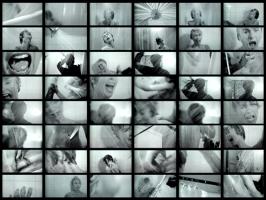
Duschszenarium
Vidéo expérimentale | dv | couleur | 1:44 | Allemagne | 2007
In der Videoarbeit "Duschszenarium" wird die lineare, filmische Abfolge der Einstellungen der Duschszene aus dem Film "Psycho" von Alfred Hitchcok durch das Element der Gleichzeitigkeit erweitert. Die ursprüngliche Struktur der aufeinanderfolgenden Schnitte wird aufgebrochen und ein Blick in die Mechanik der Szene wird geöffnet. Jede der Einstellungen behält ihre zeitliche Position innerhalb des Erzählstrangs aber bleibt nach ihrem Einsatz für die restliche Dauer des Clips als Loop erhalten. Durch die serielle, gleichzeitige Anordnung der Einstellungen bleibt es sowohl möglich dem Verlauf der Szene zu folgen als auch etwas über das Verhältnis und die Zeitlichkeit der Schnitte und Einstellungen zueinander im direkten Vergleich zu erfahren.
Tobias Daemgen, geboren 12.07.1980 in Braunschweig, 2001 bis 2008 Studium an der Fachhochschule Düsseldorf. Lebt und arbeitet in Düsseldorf.

Emanuele Dainotti
Prossimo
Vidéo expérimentale | mp4 | noir et blanc | 4:20 | Italie, Belgique | 2020
Mai 2020, Limbourg (Belgique). Une famille de paysans vaccine ses animaux.
Emanuele Dainotti est né en 1987 à Milan (Italie). Il vit et travaille à Anvers (Belgique). Il artiste et réalisateur. Ses expositions récentes incluent: le Museum of the Moving Image, New York (USA); le Musée du Louvre, Paris (France); le Reykjavík International Film Festival (Islande); les Rencontres Internationales Paris/Berlin (France/Allemagne); le Museu de Arte Moderna do Rio de Janeiro (Brésil); le CGAI – Centro Galego de Artes da Imaxe, La Corogne (Espagne); le Hudson Valley MOCA, Peekskill (USA); le Museu Nacional de Arte Contemporânea, Lisbonne (Portugal); le Festival Miden, Kalamata (Grèce); et le FIVAC – Festival Internacional de Videoarte de Camagüey (Cuba). En 2018, il a remporté la International Competition for the Intermedia Artwork, organisée par l'Académie des beaux-arts de Cracovie (Pologne), la Faculty of Intermedia, Cracovie (Pologne), et la Foundation for Development of Intermedia Artwork. En 2019, un jury présidé par Anish Kapoor et Anda Rottenberg lui a décerné le Now You See Me Award, au Musée du Louvre, Paris (France). En 2020, il a fait partie des artistes de Loops Expanded, un réseau international consacré à l'exposition et à la recherche sur le concept et la forme "en boucle".

Catherine Dalfin
L'âge du Bronze
Doc. expérimental | dv | couleur | 6:20 | France | 2009
Sur une petite île au large de la Baltique, une idylle douce-amère entre l?homme qui tente de se faire une place et la nature qui n`en a cure.
"Dans le désordre, Catherine Dalfin a fait des études de lettres et d'histoire de l'art, s'est glissée à la radio pendant un certain temps, a croisé la route d'un collectif d'artistes, a été critique d'art pensant que ça valait la peine, a cru pouvoir participer à la création d'une revue et a finalement persévéré dans la vie après avoir touché une caméra." (Catherine Dalfin, juin 2009).
Charlotte Dalia
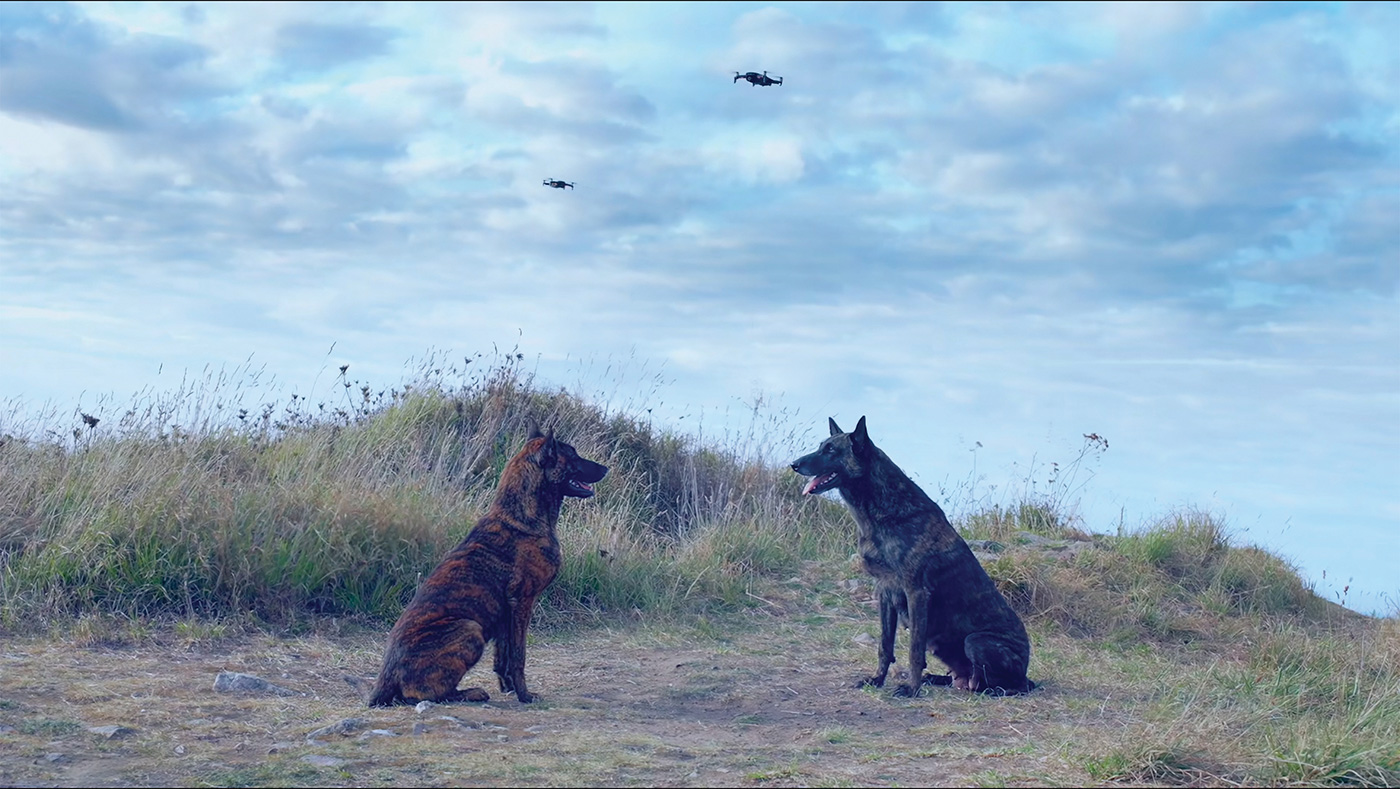
Speechloss
Film expérimental | 4K | couleur | 15:0 | France | 2023
SPEECHLOSS est un film traversé par des personnages solitaires, des figures en décalage et en quête de sens. Dans une ambiance maritime et étrange, on croise une joggeuse, un bodybuilder, des chiens et un étrange organe géant. Speechloss est une succession de quatre tableaux dans lesquels souffle le vent et un puissant désir de se dire vivant. Car chacun.e incarne un.e IA abandonnée, en attente d’activation.
Charlotte Dalia est née en 1993. Elle est diplômée de l’Institut Supérieur des Arts de Toulouse. Artiste plasticienne, vidéaste et réalisatrice, ses recherches portent sur les effets tant plastiques que narratifs du cinéma. Impégnée du principe de «cinémonde» théorisé par Jean-Luc Nancy, elle utilise le cinéma en tant que répertoire de signes «ouvrant le dedans sur lui-même». Elle a participé à de nombreuses expositions collectives et a été invitée à construire deux expositions personnelles. Poursuivant ses recherches sur les écritures de la réalité à travers les formes de la fiction, elle se forme à l’écriture documentaire auprès de Ty Films et Films en Bretagne. Elle travaille actuellement au développement d’ALMERICA, un projet mêlant crise climatique et décors de cinéma, et à l’écriture d’ un moyen métrage faisant suite à SPEECHLOSS, pour en poursuivre l'univers.
Walwin Dan
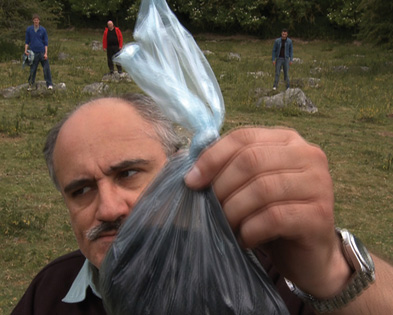
Second Unit
Vidéo expérimentale | hdcam | couleur | 9:0 | Pays-Bas, Royaume-Uni | 2010
The title refers both to a fictional unit of soldiers and their role in detaining the men standing on the stones in the field, and also to the role of a team in commercial film production to the role of shooting material without the requirement of the main cast and crew. The presence of the camera in observing events, and the characters awareness of it, in front of and behind the camera, lends the video a functional aesthetic that suggests it is made for tactical or intelligence purposes, but is made complicated by the soundtrack, where all the extraneous sounds of the surroundings are audible apart from the dialogue, which further obscures its reading.
Dan Walwin studied Fine Art at Goldsmiths College, London, and begins a residency at the Rijksakademie van Beeldende Kunsten, Amsterdam in 2012. Recent presentations include European Media Art Festival, Osnabruck in 2011, Rencontres Internationales in 2010/11 and Festarte Video Art Festival (Museum of Contemporary Art, Rome) in 2010. A solo exhibition of his, tele-, begins in November 2011 at ZAAL5, Filmhuis Den Haag, Netherlands. More information can be found at www.danwalwin.co.uk
Walwin Dan
Water is a burned body
Vidéo | dv | couleur | 11:45 | Pays-Bas, Royaume-Uni | 2009
Water is a burned body is an attempt to evoke a dystopia by economic means. A couple wake to find a boat colliding with wall of the flooded house they are in. The man goes to investigate, only to find the body of a woman, which he discards into the water. They set off in the boat into the open water, coming across an obstruction that puts an end to their attempts.
Dan Walwin is an artist working primarily in video, having studied Fine Art at Goldsmiths College, London, graduating in 2007. Recent shows include For the sake of the image at Jerwood Space, London, 2010, Verena Klary, Iwan van`t Spijker, Dan Walwin at Walden Affairs, The Hague, 2009, and Nature Untouched at Tou Vindu, Stavanger, 2007.

Levy Dana
Eden Without Eve
Documentaire | hdv | couleur | 5:2 | Israel, USA | 2014
A short documentary about life in the Everglades National Park’s with it’s few residents. Living in the midst of a national park, they learn to exist with the the wild. As a woman filmmaker I observe these men almost like an anthropologist, observing how they interact with their surroundings. The only women that appear in the film are as still images in Lucky`s photographs, . He believes that women like having themselves put in a romantic, exotic, dangerous setting to be photographed.
Dana Levy was born in Tel Aviv and Lives and works in New York. She completed her Post graduate in Electronic Imaging at the Duncan of Jordanston College of Art Dundee University, Scotland, and holds a BA from Camberwell Art College London Awards include 2013 Beatrice Kolliner Young Artist Award from the Israel Museum, 2010 Dumbo Arts Festival best studio award, 2008 Young Israeli Artist Award, 2006 Hamburg Short Film festival jury award. Solo shows include at The Israel Museum, CCA Tel Aviv, Nicelle Beauchene Gallery New York . Her work has been screened at Tate London, Tribeca Film Festival,Oberhausen Film Festival and more. group shows include at the Biennial of Contemporary Art of Cartagena 2013, Bass Museum, Miami, Florida, Invisible Exports Gallery NYC , MOCA Cleveland, EVA International Bienniel , Israel Museum Jerusalem, Harn Museum of Art ,OK Contemporary Art, Linz Au and more Artist Residencies include AIRIE Everglades National Park, Wave Hill Workspace residency New, LMCC Workspace NYC, Le Havre/ New York. Regards croisés Art Omi NY, I-park, Connecticut, Triangle Arts Association NY and more

Daniel & Clara
Notes from a Journey
Fiction expérimentale | hdv | couleur | 72:30 | Royaume-Uni | 2019
"Notes From A Journey" uses images and sound captured whilst on a journey through the British landscape as the material for an exploration of the acts of looking/seeing listening/hearing. More than simply mapping a journey across the country, this film presents a map of the filmmakers' engagement with the images of the landscape. By reducing them to impressions, fragments, fictions and forms, the recorded images/sounds are transformed into “artefacts” which, when presented in the sequence of a film, activate narratives, ideas and sensations in the viewer. Central to the film are scenes shot at the Neolithic mound and stone circle of Avebury, motifs that speak of the long and complex relationship humans have to their environment and how through art and ritual we seek to understand our place in relation to it. Ultimately this film is a journey in itself – a first person encounter with the limits of perception, it exists in a place where both the recording device and the human senses are tested.
Daniel & Clara, two humans one artist on a journey of exploration of dimensions real and imagined, the results of which consist of moving image, photography and performance. In their current work they have been exploring the British landscape as a site for encounters with the mysterious, the eerie, the otherworldly and the unknown. As they say, “we seek to see with one eye open and one eye closed, sight turned simultaneously out towards the world and inward to the depths of the human experience.” In their work, images and sounds of the landscape become activators of narratives where past, present and the imagination intermingle. Their work has been exhibited and screened internationally at galleries and film festivals including Whitechapel Gallery, Kettle’s Yard, Fabrica Gallery, Close-up Cinema, BFI, Alchemy Film & Moving Image Festival, Doclisboa, Microcinema Artist Moving Image, Museu de Arte Moderna Rio de Janeiro, Black Box Farnham, Film Mutations Zagreb. In 2019 they launched Moving Image Artists (MIA), an organisation dedicated to supporting and cultivating contemporary moving image art and experimental film. This includes an online magazine, screenings and the Moving Image Salon, a monthly gathering for artists to meet, share and discuss their work. The Moving Image Salon takes place at Film and Video Umbrella, London. Several of their films are distributed online by Tao Films and Kinoscope. Films by Daniel & Clara are also included in the BFI National Archive.

Jérémie Danon
Plein Air
Doc. expérimental | hdv | couleur | 26:30 | France | 2020
Au milieu d'espaces extraits de jeux vidéo, des personnes en réinsertion témoignent. Face caméra, ils évoquent leurs espoirs, leurs doutes et leurs difficultés depuis leur sortie du milieu carcéral.
Jérémie Danon vit et travaille à Paris. Il est étudiant à l'école des beaux-arts de Paris. Son travail a été présenté dans le cadre d'expositions collective et de festivals, notamment au BBB Centre d’art contemporain, Toulouse (France); à la Galerie Bridaine, Paris (France); au Centquatre, Paris (France); à la Fondation Ricard, Paris (France); au FIPADOC – Festival international de programmes audiovisuels documentaires, Biarritz (France), et à la Galerie Jeune Création à Romainville (France).
Ariani Darmawan
A City of Desire
Fiction | dv | couleur | 4:0 | Indonésie | 2006
An interpretation of Italo Calvino's Zobeide: a tale of a city where the inhabitants constantly build their places upon their dreams... which never come true. Calvino names it 'an ugly city', we call it 'a reality'.
Ariani Darmawan is a video artist/filmmaker who lives and works in Bandung, Indonesia. She studied Fine Arts at the School of the Art Institute of Chicago after finishing her bachelor degree in Architecture at the Parahyangan Catholic University in her hometown. Most of her works comment on power/identity and language along with its construction of meanings, where she constantly erases and re-draws the lines of actuality. Ariani has participated in numerous film festivals and art exhibitions in North America, Europe, Australia, and Asia. She recently finished her short film called "The Anniversaries" after receiving a special mention at the Jakarta International Film Festival Script Competition.
Kenan Darwich
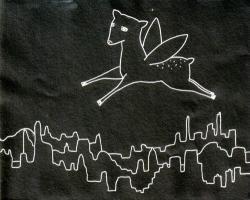
Do the Bambi
Animation | dv | couleur | 2:15 | Syrie, Allemagne | 2005
"Do the Bambi" est une vidéo musicale expérimentale sur la chanson du groupe Stereo Total. Le film se compose de 2000 images individuelles, dessinées à la main, et relie ainsi des ambiances au visuel poétisé en se basant sur une ancienne technique de dessin animé et en utilisant les nouveaux médias.
Kenan Darwich est né en 1982 à Damas, Syrie. Il vit depuis 2001 à Hambourg. En 2003 il commence ses études à la Kunsthochschule de Kiel, section design de la communication.

Adheep Das
Half-Portrait of Dadu
Film expérimental | hdv | couleur | 5:15 | Inde | 2023
Like many people in their later years, my grandfather had a set of oft-repeated stories. Towards the last few months of his life, a brand new person,'Chetan' started populating his life. This poem-film is an attempt to understand the feeling.
Adheep Das likes mixing various mediums and finding out what comes of them. Fascinated by science and arts alike, his interests take him to places that merge the two. As part of a 3 person collective, he got the ThinkArts Grant for Children in 2022. 'Moonless', a film he directed and animated, has competed at DokLeipzig and Dharamshala Intl. Film Festival, amongst others. His documentary 'Khaalti Kaay Varti Kaay' competed at IDSSFK, Kerala. Some of his work has also been exhibited as part of the Kochi-Muziris Students' Biennale and the Wrong Biennale. He has worked on a live shadow puppetry production called ‘Zig Zags to Earth’, and has performed at venues such as Max Muller Bhawan, Delhi, and Kiran Nadar Museum of Arts, Delhi. He has also been part of the Serendipity Arts Foundation Residency 2024.

Bhaskar Jyoti Das, Waribam Dorendra
I Don't Want to Be Born Again for Poem
Doc. expérimental | hdv | couleur | 22:0 | Inde | 2019
During 1970’s and 80’s there were many revolutionary uprising happening, near and far, all around the world. In this period, amidst this protest and revolutionary uprising, a poet symbolically expresses his feelings to capture the complexity of human existence. Constant financial pressure in his family life is also evident in his words. At one point, words become distorted and absurd. One evening, the poet, Abani Chakravarty disappears and left many confusions.
we are two Directors 1. Bhaskar Jyoti Das, I am currently based in Assam. I’m an independent film maker and Screenplay writer. Recently two of my scripted feature films got Best film award, one, in Los Angeles Indian Film Festivals 2017, “SONAR BORON PAKHI”, another in MAMI 2016, india,”HANDUK” and National Film Award 2016. Last 10 yrs I worked for 3 UCLA projects under a professor from University of California, LA, USA. 2. Waribam Dorendra, studied basic film making in his native state of Assam in India. He explored film making process for some years with a mini DV camera. He has edited few short and long, video and documentaries of his fellow native filmmakers. He has worked with a new media group called Desire Machine Collective from 2007 till 2010 on a project called "periferry" in Guwahati city. He has made many short and long videos and documentaries since the year 2007. He finds cinema as a tool to reflect upon life as well as playful desire.

Silvia Das Fadas
A casa, a verdadeira e a seguinte, ainda está por fazer
Doc. expérimental | 16mm | couleur | 35:52 | Portugal | 2018
Un récit de voyage vers des lieux créés sous une impulsion utopique et qui défient la surface du monde. Par ordre d'apparition: un palais idéal construit par un facteur après chacune de ses rondes quotidiennes; une maison rouge conçue par un agitateur socialiste; une tour pacifiste érigée contre les mouvements de l'Histoire; un jardin exubérant engendré au féminin; et un joyeux cimetière qui évoque une communauté d'égaux dans la périphérie de l'Europe. Pour nous assurer que nous risquons notre joie pour ceux qui agissent en leur temps.
Sílvia das Fadas est cinéaste, chercheuse, enseignante. Elle s’intéresse aux politiques intrinsèques aux pratiques cinématographiques et au cinéma en tant que moyen d’être ensemble dans une expérience capable d’instaurer une communauté nomade et intranquille.
Jaime Davidovich
Reality Properties : Fake estates
Doc. expérimental | 16mm | noir et blanc | 7:0 | USA | 1975
Dans ce projet, Fake Estates, élaboré dans les années 1973-1974, Gordon Matta-Clark aborde les questions de la propriété, des biens immobiliers, et des espaces urbains. Matta-Clark achète alors quinze parcelles de terrain mises aux enchères par la ville de New-York. Elles sont petites, discontinues, et de taille inutilisable, du type de celles qui sont appelées les ?espaces caniveau?. Matta-Clark a réuni un grand nombre de matériaux d?archive liés à ces propriétés, mais il n?a jamais pu réaliser l?ensemble de son projet artistique, et à sa mort, les lots sont revenus à la ville. Les séquences de cette vidéo ont récemment été redécouvertes. Tournées par Jaime Davidovich, pionnier de l?art vidéo et des débuts de la télévision, elles montrent Matta-Clark dans le quartier des Queens, alors qu?il documente et visite ses parcelles.
Jaime Davidovich est un artiste conceptuel d?origine espagnole. Il vit et travaille à New York. . Auteur de vidéos et d?installations, il a également été un activiste pour la programmation de télévisions locales câblées, gérées par des artistes. Davidovich a été un membre fondateur de Cable SoHo, en 1976, et président du Artists' Television Network en 1978. Il tenait sa propre émission sur le câble, un programme de variété hebdomadaire intitulé The Live! Show, diffusé par la télévision câblée de Manhattan de 1979 à 1984. En prenant l?apparence de son alter ego, le docteur Videovich, Davidovich menait le show, qui présentait des performances d?artistes, des interviews avec des personnalités du monde de l?art, des émissions où les téléspectateurs pouvaient intervenir en direct par téléphone, et même des séquences de télé-achat, lors lesquelles il mettait en vente sa collection d?objets kitsch liés à la télévision.
Katie Davies
The Separate System
Doc. expérimental | hdv | couleur | 23:9 | Royaume-Uni | 2017
At the end of 2014 the Ministry of Justice released an announcement stating that from January 2015, “ every prisoner coming into custody will be asked if they have been a member of the armed forces ” and that “ prisons will be given new guidance about helping them during their sentence”. The announcement followed wide debate over the percentage of veterans in prison. Behind these policy contexts there also sits a wider public perception of the identity of the “ veteran ” which exists in tension with the notion of the “ offender ”. The Separate System was collaboratively produced by veterans through workshops at two local prisons with artist Katie Davies. The piece investigates the spaces of the military, custody and “ civilian ” life through the notion of work, an everyday activity that unites these worlds and is familiar to us all. The film communicates what we, as a civilian audience, perhaps do not understand about the unique set of relations, actions and responsibilities held by the people within these spaces. Created through FACT`s Adults Learning Programme, our work within the criminal justice system aims to approach the context of the prison system from a critically engaged position.
Katie Davies is a video artist exploring the construction of identities, their reflections and manipulations. Nationalism, violence and democracy form a central critique for her videos and installations, often focusing upon individuals and communities whose identities are dictated by the state; their agency to self-identify snared between political agendas and Sovereign violence. Katie is a Royal West of England Academician and was nominated for the 2016 Paul Hamlyn Award. She is a Jury member for the International competition, Short Film Festival Oberhausen, 2018 and has exhibited nationally and internationally including FACT Liverpool 2018, Kassel Dokfest, Bratislava International Film Festival and Oberhausen International Film Festival 2017 & 2015, Sarajevo Film Festival 2015, Border Visions, Connecticut, USA 2012 and The Istanbul Biennial 2009. She has contributed to several publications and her writing on practice-led research has been included in US and British publications. Katie is Senior Lecturer in Media & Cultural Production at The University of The West of England.

Andrés Davila
Sour Lake
Doc. expérimental | hdv | couleur | 14:40 | Colombie | 2019
Inspiré du nom donné par la Texaco à un petit village d’Amazonie, Sour Lake explore les confluences, rencontres et déplacements géographiques, sociaux et imaginaires qui se sont noués depuis le XVIe siècle entre la forêt équatorienne et les Andes colombiennes.
Andrés Dávila est un réalisateur colombien. Il a obtenu en 2013 un master en cinéma et études audiovisuelles à l’Université Sorbonne Nouvelle. Il vit actuellement en Equateur.
Jonathas De Andrade
Olho da Rua
Film expérimental | 4k | couleur | 25:13 | Brésil | 2022
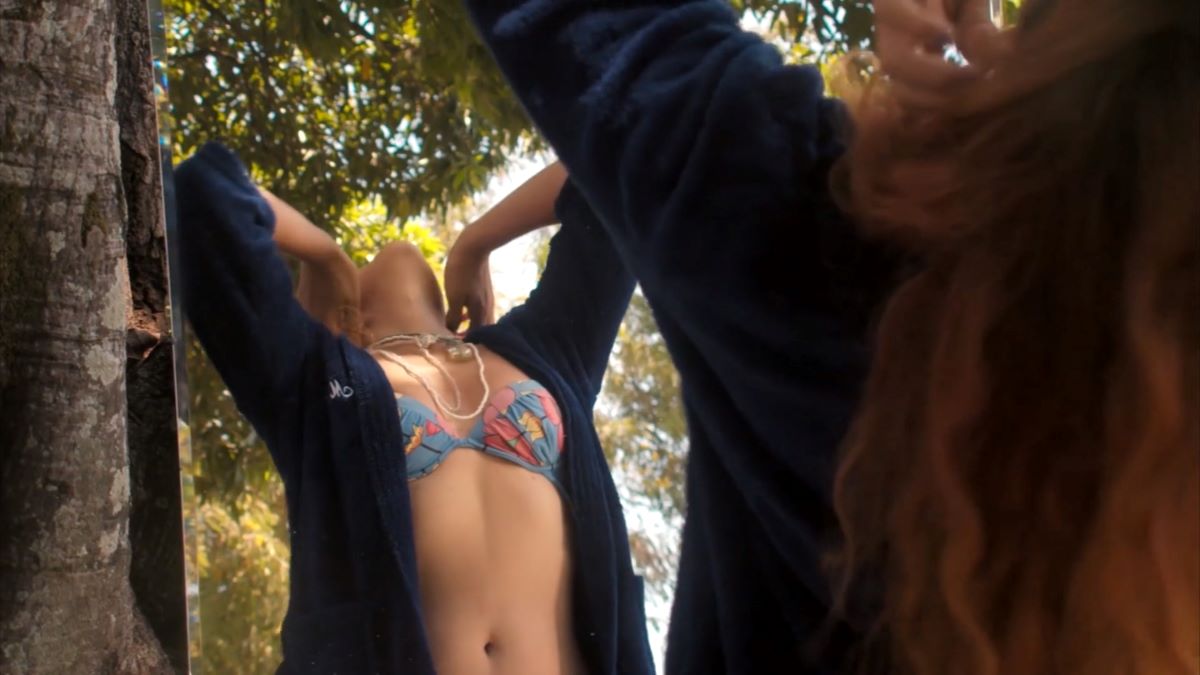
Starring a cast of 100 people, Olho da Rua (Out Loud) is divided into eight acts and presents performance propositions in front of the camera as exercises of the gaze. Simple actions are presented, such as looking and admiring oneself in front of a mirror, improvising an assembly and saying messages to the camera, representing a collective party making the public square a great stage, or facing the camera lens that it's the eye of the beholder, whether on the streets or on the movie screen when it's ready. Made in two days at Praça do Hipódromo, in Recife, the film is made up of a cast of homeless people, linked to public shelters and non-governmental initiatives to support the vulnerable population.
Jonathas de Andrade was born in Maceió, Brazil, in 1982, and studied communications at the Universidade Federal de Pernambuco, Recife. He works with installation, photography, and video to explore constructs of love and the process of urbanization, with particular emphasis on Brazil’s vibrant but often ignored northeast region. De Andrade’s series Love and Happiness in Marriage (Amor e Felicidade no Casamento, 2007) juxtaposes photographic portraits of a young couple with pages from a 1960s psychiatric textbook on love and marriage. What appear to be vintage shots are actually new images of contemporary actors, their treatment and combination framing the popular ideals of romance and family as bourgeois fictions. In 2 in 1 (2 em 1, 2010), diagrams and photographs of carpenters illustrate the process of converting two single beds into a double and also seem to offer functional instruction on how to “make” a couple. Tropical Hangover (Ressaca Tropical, 2009) also employs found material, in this case a salvaged diary that forms the basis for an installation in which a book’s pages are illustrated with original, vintage, and found photographs, offering a reflection on memory, modernity, and urban space. Since 2007, many of de Andrade’s ideas have been developed in collaboration with A Casa como Convém (The House as It Should Be), an artists’ collective that he founded with Cristiano Lenhardt and others in Recife. The group, which focuses on issues around tropical modern architecture, offers a valuable counterpoint to the dominant cultural axis of São Paulo and Rio de Janeiro. One example of the influence of collectivity and local community on de Andrade’s work is The Uprising (O Levante, 2012), for which the artist organized a horse-drawn cart race in the center of Recife. Also inspired by the town is De Andrade’s mural Nostalgia, a Class Sentiment (Nostalgia, Sentimiento de Classe, 2012). This work, constructed from 340 primary-colored geometric fiberglass tiles displayed in a segmented composition, reproduces a tiled panel in a Recife tropical modern house, and is shown opposite a vinyl text that quotes manifestos about modern life composed by two Brazilian architects of the 1960s and ’70s. Some of the tiles interrupt these texts, the suggestion of loss offering pointed comment on the failure of Brazil’s modernist project. De Andrade has had solo exhibitions at Instituto Cultural Itaú, São Paulo (2008); Instituto Cultural Banco Real, Recife (2009); Centro Cultural São Paulo (2010); Kunsthalle Lissabon, Lisbon (2013); and Musée d’art Contemporain de Montréal (2013). He participated in the group exhibitions When Attitudes Became Form Become Attitudes, CCA Wattis Institute for Contemporary Art, San Francisco; and Salvajes: Digesting Europe Piece by Piece, Traneudstillingen Exhibition Space, Copenhagen (both 2012); and EXPO 1: Rio, Museu de Arte Moderna de Rio de Janeiro; Love and Hate to Lygia Clark, Zach?ta National Gallery, Warsaw; HIWAR, Conversations in Amman, Darat al Funun, Amman, Jordan; My Third Land, Frankendael Foundation, Amsterdam; Imagine Brazil, Astrup Fearnley Museet, Oslo; La Bienal 2013: Here is where we jump, El Museo del Barrio, New York; and Moving: Norman Foster on Art, Carré d’Art, Musée d’Art Contemporain, Nîmes (all 2013). He participated in the Mercosul Biennial, Porto Alegre, Brazil (2009); São Paulo Biennial (2010); Sharjah Biennial, United Arab Emirates (2011); Istanbul Biennial (2011); New Museum Triennial: The Ungovernables, New York (2012); and Lyon Biennial (2013). De Andrade lives and works in Recife.
Yentl De Baets
Burning Clouds
Fiction expérimentale | 0 | couleur | 17:24 | Belgique | 2021
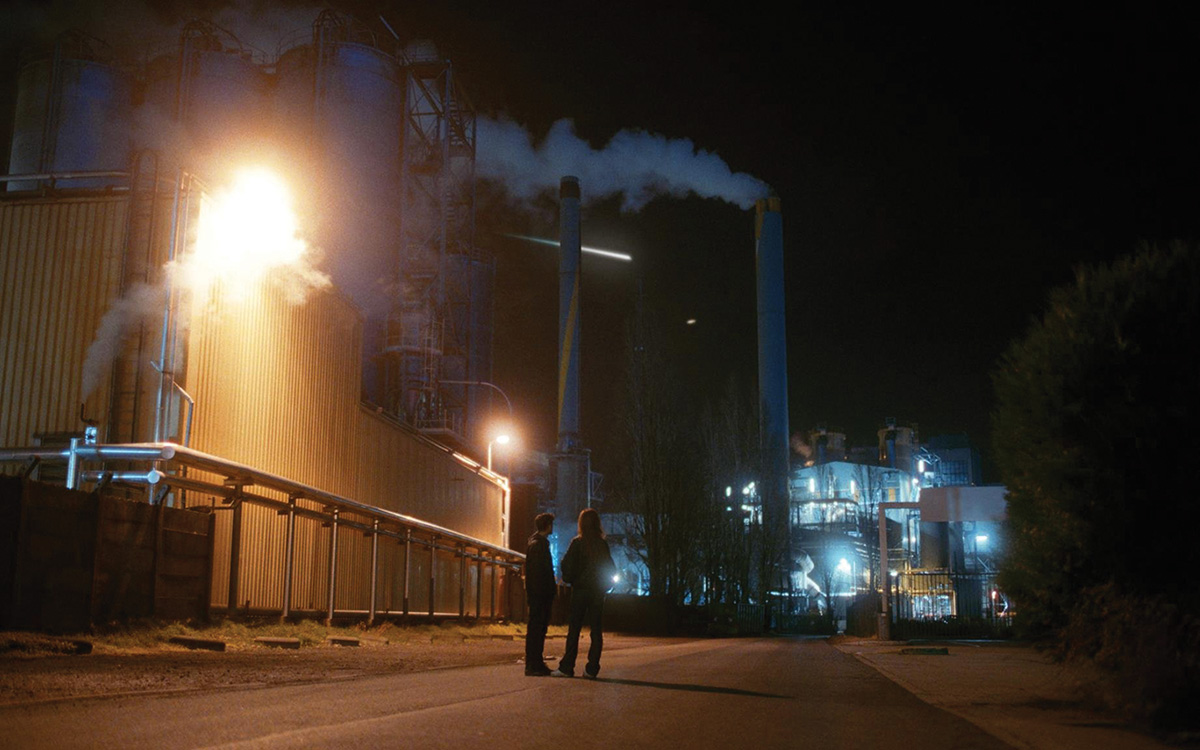
A passing meteorite connects a roaming young woman, a burned-out factory worker and an unemployed young man during a long winter night. A portrait of the night and the people in it.
Yentl De Baets is a Ghent based director and cinematographer. He graduated at the film department of the KASK School of Arts in 2021 with his short experimental fiction film 'Burning Clouds'.
Antonin De Bemels
Au quart de tour
Vidéo expérimentale | dv | couleur | 8:0 | Belgique | 2005
Un homme avance, accompagné d?un rythme incessant et fascinant, on le voit de profile sur un fond noir. Ses jambes et ses bras ne sont pas dans le champ, comme si la caméra parvenait aussi à pénétrer ses motivations intérieures, chaque mouvement est fragmenté, répété et multiplié. Chaque pensée, chaque souvenir, chaque hésitation qu?il a à propos du fait qu?il soit en train de marcher et chaque impulsion qu?il a envers le fait qu?il soit en train de marcher est intégré à sa foulée. Cela devrait le rendre fou mais il semble être inconscient de toute cette excitation. Lorsque la caméra zoom lentement sur son visage, on peut voir ses lèvres bouger mais les mots s?évaporent et ne laissent plus que des moitiés de syllabes qui ne veulent plus rien dire une fois répétées et multipliées. La marche continue ainsi que les tapotements et les tic tac de la bande son, et presque imperceptiblement on se rend compte qu?il n?a en fait effectué qu?un quart de tour.
Antonin de Bemels est né en 1975 à Bruxelles et a étudié dans la section Communication Visuelle et Narration de la ERG (Ecole de Recherche Graphique). Son travail a été exposé dans le monde entier et a reçu différents prix. Il collabore fréquemment avec des musiciens et beaucoup de ses travaux peuvent être classé dans une catégorie qu?il appelle ?clip musicaux non commerciaux?. Du point de vue de la forme, le travail de de Bemels repose énormément sur différentes techniques de montage qui vont de la manipulation directe de film super 8 au ?scrubbing?, une technique numérique qui peut être décrite comme l?équivalent vidéo du scratch. De Bemels effectue le montage d?images de corps ou de parties du corps, d?objets trouvés et de différents décors naturels ou architecturaux et la façon dont ils sont éclairés fait souvent penser à des tableaux de Caravage. Les images sont montées selon des schémas rythmiques et accélérés dont la vitesse est synchronisée avec la bande son. Cette technique aliène les objets et les actions du quotidien en les entravant et en les rendant abstraits, ce qui met en lumières le processus de la perception sensorielle à travers laquelle le sujet incarné découvre le monde matériel.
Antonin De Bemels
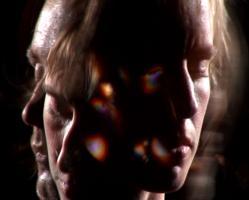
Light body corpuscles
Vidéo expérimentale | dv | couleur | 5:24 | Belgique | 2005
D`un essaim de points lumineux agités de mouvements apparemment désordonnés apparaît la silhouette imprécise d`un corps humain. On ne voit que la tête, les bras, le torse, et les traits du visage ne semblent jamais devoir se fixer. Ce corps partiel effectue une séquence de gestes simples répétés en boucle. Progressivement, le visage prend de plus en plus de place dans l`image, jusqu`à l`envahir complètement. Là, les traits se désorganisent encore plus, des ombres se creusent dans les replis de la peau, les détails s`isolent les uns les autres pour ne plus ressembler qu`à des taches de lumière instables, corpuscules corporels désincarnés?
Né en 1975 à Bruxelles. Diplômé de l?ERG (Ecole de Recherche Graphique) en 1997. Son travail vidéographique est principalement axé sur la représentation du corps en mouvement et sur la relation dynamique entre images et sons. Il a réalisé à ce jour une douzaine de courts-métrages expérimentaux, montrés dans de nombreux festivals internationaux, principalement en Europe mais aussi aux Etats-Unis, au Canada, en Amérique du Sud (Pérou, Uruguay, Brésil), en Asie (Taiwan, Chine, Corée du Sud) et en Australie. Parallèlement à son travail de création personnel, il collabore régulièrement à des spectacles de danse contemporaine en tant que vidéaste mais aussi comme créateur sonore. Il prépare actuellement un court-métrage de fiction qui devrait voir le jour fin 2005.