Catalogue > Search
Results for : Catalogue 2020

Ana Husman
Soba za dan
Film expérimental | 16mm | couleur | 30:0 | Croatie | 2018
A living room. A place where the private space of a flat is on public display. Using memory, supposition and measurable architectural elements, the space of the living room is continuously constructed and reconstructed, and the action grows into an interpretation of past, present and possible events and relationships.
Ana Husman’s practice disassembles the structures and textures of cinematic elements through film, installation, books, sound, image and text. Husman experiments with the possibilities of animation, documentary and fictional cinematic methods, and the possibilities of the recorded voice and its articulation. Her working process questions and plays with the positions of the amateur and the professional subject of performativity, the medium itself, and the structures that dictate and produce patterns of behavior. She is a lecturer at the Department of Animation and New Media at the Academy of Fine Art in Zagreb and co-founder of the documentary film organization RESTART where she has been holding film education programs for children and young people for many years. Her works have been shown at festivals and exhibitions including: Gwangju Biennale, October Salon Belgrade, Medienturm Gallery Graz, Ludwig Museum of Contemporary Arts Budapest, International Film Festival Rotterdam, DOK Leipzig.

Felix Kalmenson, Rouzbeh Akhbari
A Passage
Doc. expérimental | 4k | couleur | 16:57 | Canada, Arménie | 2019
‘A Passage’ is a film which tackles the political economy and social ecology of border infrastructures in Southern Armenia. By focusing on two significant events that illustrate the dominant political shifts in the region, ‘A Passage’ looks at how processes of rapid militarization and neoliberalization have restructured these borders. These two events include the recent erasure of the historic Yerevan-Baku Railway; and the upcoming construction of an industrial Free Economic Zone (FEZ) planned precisely where the removed train infrastructure was housed. The scrapping of the railway symbolizes the socio-political adherence to maintaining strict mobility regimes for citizens, while the introduction of the FEZ signals how capital supersedes these bodily restrictions and borders. The film stitches together various contested sites of the region including Meghri’s abandoned airport (which is slated to be refurbished as the forward command of Russia’s Middle Eastern operations), a functioning Soviet-era Copper and Molybdenum mine, a 16th century church (which is the last remaining building of a village abandoned by the mines expansion) the abandoned Karchivan and Meghri train stations and an abandoned rail tunnel that bridges the geopolitical boundary of Nakhchivan and Armenia.
Pejvak is an ongoing collaboration between Rouzbeh Akhbari (Tehran, Iran 1992) and Felix Kalmenson (Saint Petersburg, Russia 1987) which began in 2014 in Casablanca, Morocco. Over the past five years they have undertaken large scale exhibition and research projects internationally including at Si Shang Art Museum (Beijing), The Work of Wind produced by Blackwood Gallery (Mississauga), Onsite Gallery (Toronto), State Silk Museum (Tbilisi), ACSL (Yerevan), Les Abattoirs (Casablanca) and Hay Art (Yerevan). They are currently in the post-production phase of their first feature-length film Bring Forth, funded by the Canada Arts Council and the Ontario Arts Council and in the pre-production of our second film The Seed. In addition to being featured in C Magazine, LEAP, Funambulist and Prefix Magazine, they co-authored a book chapter in Unsettling Colonial Modernity in Islamicate Contexts published by Cambridge Scholars and are also contributors to The Work of Wind: Land, K. Verlag Press.

Katharina Kastner
Villa Empain
Doc. expérimental | 16mm | couleur et n&b | 24:30 | Autriche, Belgique | 2019
A unique blend of Bauhaus and Art Déco, the marvellous Villa Empain has had many different lives since it opened in 1934. A story of survival. ____ VILLA EMPAIN draws a mental map of a space, as it goes through time. Concrete marble, brick and steel: little else made by human hands seems as stable, as immutable, as a building. Yet the life of any structure is neither fixed nor timeless. Outliving their original contexts and purposes, buildings are forced to adapt to each succeeding age. To survive, they must become shapeshifters. VILLA EMPAIN compares the life of Louis Empain and his creation. It bears witness to how a fixed idea, an architect’s dream, has disappeared in favour of a living architecture. The work is activated.
Katharina Kastner is an Austrian filmmaker working in Vienna and Brussels. She studied directing at TISCH School of the Arts in NYC and LUCA, Brussels. Her experimental short film about a museum of contemporary art, VILLA EMPAIN, builds upon the concept of psychogeography and draws a mental map of a space as it goes through time. Katharina Kastner’s films combine documentary, essayistic and experimental elements. She is interested in fragile environments and the people behind these, using the camera to explore inner and outer transformations. Time and memory are recurring themes in her work.

Kristina Kilian
Which Way to the West
Fiction expérimentale | 4k | couleur et n&b | 36:17 | Allemagne | 2019
Jean-Luc Godard shot a film in Germany 28 years ago. A young female director retraces his steps through Germany. She is 28 years old and searches for answers about her german identity and the art of filmmaking. Godards Film is a film about ghosts and history. Does she become a ghost in her own film?
*Born 1990 in Southern Germany. Studied Scenography and Exhibition Design at the University of Arts and Design in Karlsruhe. One year visiting student at the Städelschule in Frankfurt am Main in the class of Douglas Gordon. Since 2013 studies documentary film at the University of Film and Television in Munich.

Laura Kraning, Blue Kraning
Las Breas
Doc. expérimental | 4k | couleur | 12:20 | USA | 2019
LAS BREAS is an observational portrait of three tar pits, of which there are only six in the entire world. Situated in three distinct landscapes in Southern California – urban Los Angeles, the oil fields of the San Joaquin Valley, and Carpinteria Beach, LAS BREAS investigates the spaces between archiving the pre-historic and the contemporary industrial landscape. While skeletons of extinct megafauna and vintage animatronic beasts are on display in the heart of Hollywood, the sticky remains of ancient microscopic organisms seep to the surface of both land and sea. Of the earth, yet primordial and impenetrable, the bubbling tar that rises from the depths speaks of past extinction and human exploitation of the earth’s limited resources.
Laura Kraning’s moving image work has screened widely at international film festivals, museums, and galleries, such as the New York Film Festival’s Views from the Avant-Garde and Projections, International Film Festival Rotterdam, Edinburgh Film Festival, London Film Festival, Visions du Réel, MoMA’s Doc Fortnight, Art Toronto, Centre Pompidou, National Gallery of Art, and REDCAT Theater, among others. Her work has received awards at the 2010, 2015, and 2016 Ann Arbor Film Festival, 2016 Athens International Film Festival, and the 2018 Rencontres Internationales Sciences & Cinémas Film Festival. Blue Kraning’s documentary and narrative films have screened internationally at festivals and venues such as International Film Festival Rotterdam, Helsinki International Film Festival, Shanghai International Film Festival, Image Forum Festival, Ann Arbor Film Festival, Denver Film Festival, Nashville Film Festival, Festival du Nouveau Cinema, Los Angeles Filmforum, and the Walker Art Center. He has won numerous awards such as the IFP/Blockbuster Film Development Fund, The Morrow-Hues Screenwriting Award (finalist) and his television writing has garnered two Emmy Awards.

Elsa Kremser, Peter Levin
Space Dogs
Documentaire | 4k | couleur et n&b | 91:0 | Autriche | 2019
Laika, a stray dog, was the first living being to be sent into space and thus to a certain death. A legend says that she returned to Earth as a ghost and still roams the streets of Moscow alongside her free-drifting descendants.
Elsa Kremser (*1985 Wolfsberg/Austria) is an author and producer of documentaries that have been shown at the Berlinale, Locarno and other festivals. In 2016 she founded RAUMZEITFILM Produktion in Vienna with Levin Peter. As a directing duo they are currently working on their feature film debut. Levin Peter (*1985 Jena/Germany) is a director, author and producer. With his diploma film he won the First Steps Award. In 2016 he founded RAUMZEITFILM Produktion in Vienna with Elsa Kremser. As a directing duo they are currently working on their feature film debut THE GREEN PARROT.
Emmanuelle Laine, Benjamin Valenza
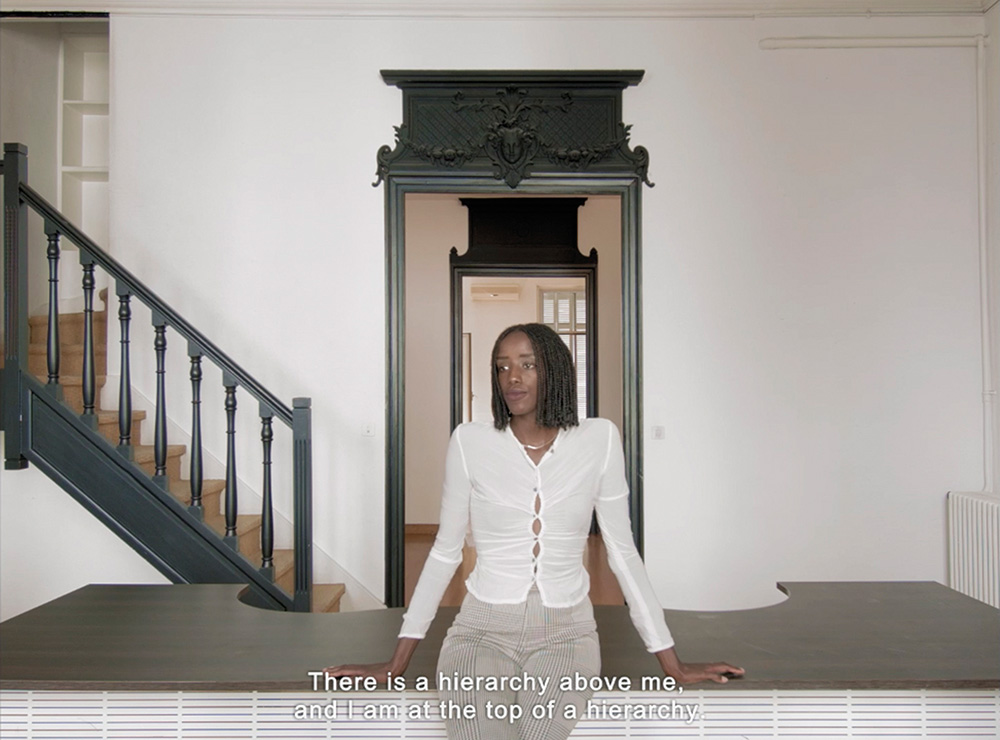
Est-on prêtes à endosser les habits de l'artiste ?
Vidéo | 4k | couleur | 19:0 | France | 2019
Synopsis court Les paroles de femmes travaillant dans un centre d’art sont jouées en lip-sync par une femme installée dans un intérieur sommairement meublé. Affects et expériences de travail se mêlent à mesure que la protagoniste est habillée de différentes tenues. Synopsis long Les paroles de femmes travaillant dans un centre d’art sont jouées en lip-sync par une femme installée dans un intérieur sommairement meublé. Affects et expériences de travail se mêlent à mesure que la protagoniste est habillée de différentes tenues qui petit à petit contraignent, exhibent puis dissimulent son corps. Une statue se détache sur un ciel bleu, dans le silence d’une rue. Alors que le monologue se poursuit, l’espace vacant devient celui d’une institution imaginaire, traversé de silhouettes de visiteurs et collaborateurs. Aux récits se mêlent des images d’archives, fragments de performances d’artistes femmes, détails d’une pratique collective de l’art.
LAINÉ VALENZA — vit et travaille à Marseille Lainé Valenza est un duo d’artistes, constitué à partir d’une conversation perpétuelle, d’une zone commune à la frontière de leurs recherches respectives. Il se caractérise par un intérêt pour la critique institutionnelle, la mutation des formes d’images et d’une attention visuelle, de ses enjeux culturels subjectifs et politiques. Au fil des projets, le duo emploi des formes visuelles diverses, telles que le cinéma étendu, des installations in situ, de la télévision en direct, des performances, etc. Emmanuelle Lainé est une artiste visuelle déjà bien connue pour ses installations in-situ à grande échelle. Elles montrent souvent une reconstitution précise de l'architecture créant un espace critique pour la perception du spectateur ainsi que pour l’institution qui l’accueil. Ses Installation se caractérisent par une utilisation systématique de la photographie très grand format, associée à un langage sculptural très exigeant. Benjamin Valenza concentre depuis plusieurs années déjà sa pratique artistique sur la création d'un média à part entière. Prenant en compte Internet et le numérique autant que la télévision comme point de départ il s’agit d’une forme critique et intentionnellement non déterminée . Le lieu d'exécution ou la problématique du contexte est central dans son travail, il s'articule avec la sculpture et l'installation afin de créer des situations de micro politique ou l’artiste s’efface au profit du collectif.

Margot Lançon, Margot Lançon et Chloé Simonin
Béton Amer
Doc. expérimental | mov | couleur | 15:36 | France, Grèce | 2019
A l’aube, une bande d’amis se retrouve sur les toits d’une école à Athènes. C’est leur rituel. Ils surplombent la ville, cette ville qui sera à eux jusqu’au matin suivant. Le film raconte l’errance d’un groupe d’adolescents à la périphérie d’Athènes. Ils traverseront un lieu gardé sous haute surveillance : Hellinikon. Pendant six décennies, Hellinikon a été le seul aéroport d’Athènes. En 2004, il accueille les infrastructures des Jeux Olympiques. Depuis, les mauvaises herbes ont envahi les ruines des équipements sportifs. Toutes les marques de son passé sont encore, comme sédimentées, inscrites à Hellinikon. Les jeunes décident de s’y introduire avant que le site ne soit rasé, transformé, avant que sa mémoire ne disparaisse.
Margot Lançon vit et travaille entre Genève et Paris. En juin 2019, elle obtient son bachelor en Arts Visuels à la Haute Ecole d’Art et de Design de Genève avec les félicitations du jury. Margot Lançon s’intéresse aux nouvelles formes d’écriture documentaire et développe une pratique mêlant films, vidéos et photographies. Aujourd?hui, elle poursuit son cursus en cycle master à l'École Nationale Supérieure d'Arts Paris - Cergy. Chloé Simonin vit et travaille à Genève. En juin 2017, elle est diplômée d’un bachelor Arts Visuels, filière Information/Fiction, de la Haute Ecole d’Art et de Design de Genève avec les félicitations du jury. Elle étudie actuellement l’anthropologie visuelle à l’université de Neuchâtel.

Yoonjoo Lee
The Garden of All Spheres
VR expérimental | 0 | couleur | 0:0 | Coree du Sud, Allemagne | 2019
Garden of all spheres is a VR experience which exhibits the live simulation of a pseudo-ecosystem. The garden is built in the video game environment, which can exhibit the most advanced technology in the production and presentation of real-time CGI and simulation. The library of the virtual scenery is parallel with the modern natural history museum - the eye-catching collection of nature - the inventories which are ever-expanding and impossible to complete. Skysphere is a primary, simple prop for creating an illusion of horizon. In the nature of Virtual Reality, the player?s eye is located in the centre of the sphere. It becomes her private sky which is impossible to feel the scale of it - as much like as the sky in the physical world. The camera moves beyond the stage, from inner shell to outer shell and reveals the boundary of human-centred viewpoint. This spherical garden mediated through VR glasses, which embodies the desire for a seamlessly expanded vision. All the animals, humanoids, trees, stones, lights, skies are reflected on the surface of gazing ball and exhibited in the spherical vitrine, and the exhibition becomes meta-ecosphere.
Yoonjoo Lee is a multi-disciplinary artist based in Berlin. Her artistic practice generally focuses on the relationship between voyeuristic/Intellectual curiosity and technology of representation. She uses various digital technologies such as 3d animation and video game engines for a platform of the moving image experiments and explores the apparatus-mediated vision. She is currently studying experimental film and generative art in the Berlin University of Arts.

Fabian Lehmann, Yannick Harter
66mio views
VR expérimental | 0 | couleur | 0:0 | Allemagne | 2019
Moving trough the world wide web means being exposed to a variety of content in a high tempo which does not always attract you, but can also seem revolting to you. The resulting emotional state of the user - a feeling of being overwhelmed and a certain unsteadiness - is the starting point of the work “66mio views“. The viewer is sitting inside a room filling installation. Head mounted displays enable him to be part of an immersive VR environment in which he faces irregular shapes and so called “non-player characters“ (NPCs). The shapes are textured with videos from common Image- boards (4chan, 9gag, ...) as well as viral YouTube videos. Their content is diverse and evokes not only positive emotions (e.g. videos of puppies), but also very negative emotions (e.g. so-called gore videos, videos of violence). In a self- developing rhythm of motion, the forms relate to the position of the viewer, move towards him, go through him and move away from him. Various NPCs from 3D-model databases approach the viewer and recite text-sequences from the videos in varying tonalities. This immersive installation understands the technical infrastructure (computercases, cables, ...) as an instrument which designs and shapes the space. It is being expanded with ropes as well as pictures and text fragments from the videos. Stacks of prints show extracts from the videos and thereby display their content transformed and adapted to an analogue medium. The visitors are invited to take these prints with them and transform the content once again by removing it from its original place. Keywords like connectivity/disconnectivity and comprehension/incomprehension as well as thinking about the digital space as an emotional shaping tool led to this installation which connects digital and analogue content in an abstract, fragmented way. (The installation was originally developed for a specific exhibition space in the basement of „Halle 14 - center for contemporary art“ in Leipzig. However, we can set up the installation with regards to any available space, as its dimensions are variable. At least one VR system, ropes and prints in different sizes are fixed.) Yannick Harter, Fabian Lehmann, 2019
Fabian Lehmann (*1988, Castrop-Rauxel, Germany) graduated at University of Applied Sciences, Bielefeld (2015) with degree Bachelor of Arts „Photography and Media“. Since 2016 he is studying „Media Art“ at the „Academy of fine Arts, Leipzig“ in the class „Expanded Cinema“ / Prof. Clemens von Wedemeyer and has studied „Fine Arts“ at „Bezalel Academy of Arts and Design“ in Jerusalem during an exchange semester. His artistic work focus on different communication systems and how digital techniques shapes the humanity and society. He had various exhibitions in Germany and Europe e.g. Hamburger Triennale der Fotografie (Hamburg), Gallery „Kunstpunkt“ (Berlin), Emscherkunst 2016 (Dortmund) Siva Galerija, (Zagreb) UG Halle 14 (Leipzig) Yannick Harter (*1990, Worms, Germany) is a trained productdesigner, who worked in branches like automotive industry and medical cybernetics. Since 2016 he is studying „Media Art“ at the „Academy of fine Arts, Leipzig“ in the class „Installation and Space“ / Prof. Joachim Blank and has studied „Visual Communication“ at „Latvias Art Academy“ in Riga during an exchange semester. His artistic practice oscillates around the intersection between art, science and society. He had various exhibitions in Germany and Europe e.g. Kaiserwerke (Gera), Gallery? „Kunstpunkt“ (Berlin), Obro?ców Stalingradu 17 (Szczecin), D27 (Riga), UG Halle 14 (Leipzig) Yannick Harter participated in several curatorial and educational projects and volunteered as artist assistant e.g. at Kunstverein (Leipzig), Neustadprojekte (Mainz), Latvian Center for Contemporary Art and Survival Kit 10.0 (Riga)

Yoann Lelong, B.Forgeard
Bangoura
Doc. expérimental | hdv | couleur | 9:0 | France | 2019
Angela et Marius, deux jeunes étudiants, ont accompagné un jeune migrant lors de son arrivée en France. A travers leur récit, nous découvrons le périple de Bangoura, jeune guinéen ayant fui son pays lorsqu'il avait 17 ans. Sur une production musicale composée de samples (notamment extraits de musiques traditionnelles issues de différentes immigrations françaises), l'œuvre questionne la manière dont chacun de nous se réapproprie un fait, un événement ou un récit en en abolissant son contexte, son passé, sa connaissance et sa mémoire collective. Ainsi, la vidéo propose au spectateur de s’approprier l’histoire de Bangoura en reprenant son récit à la manière d’un karaoké. De cette manière, le récit relaté offre de multiples interprétations et peut aussi bien symboliser une génération de migrants cherchant à survivre, critiquer une société capitaliste ou les instituions, décrire le portrait d'une jeunesse française ou encore interroger la connaissance que nous avons de l’immigration française.
Artiste plasticien diplômé de l'ENSAM, Yoann Lelong trouve son inspiration dans la danse, la recherche scientifique et la problématique de l'exclusion. Il explore la vidéo comme moyen de retranscrire une réalité transcendée, mêlant la poésie réaliste de ses sujets à une réalité sociale fragmentée. Son passage par l'Ecole Normale Supérieure de Cachan le forme à la physique quantique, point de départ d'une démarche artistique qui irrigue l’ensemble de ses travaux, et donne à ses œuvres une lecture sous-jacente plus métaphysique. De sa collaboration avec Amos Poe, pionnier dumouvement new-yorkais No Wave, naît PERSON(A), installation vidéo où s'entrelacent vingt-trois portraits filmés au 16mm. Une œuvre poétique où les éléments se distinguent, se répondent, puis se fondent dans un flou indistinct. Cette 1ère œuvre illustre dès lors le rapport distancié qu’entretient Yoann Lelong au réel et qui le pousse, à chaque nouvelle création, à saisir l'instant sans filtre et sans interprétation pour retranscrire et sublimer les sujets à l'état brut. Les sujets deviennent matière, le tout rejoignant le tout. A l'issue d'une résidence artistique à bord du voilier Tara Méditerranée en 2014, il crée PerceptConcept, à l'image du mouvement ondulaire et répétitif de l'expédition maritime : les gestes de l'équipage épousent le va-et-vient de la mer, au rythme de sons mécaniques ou organiques. Par la suite, il s'interrogera sur l'essence d'une création et plus particulièrement sur ce qui en fait son unicité en collaborant avec la chorégraphe Anne Nguyen et le musicien Les Gordon (2015). Le mouvement gestuel et sonore apparaît ainsi dans le travail de l’artiste comme une composante clé de toutes ses créations. La recherche de l’unicité à partir de fragments épars constitue, pour l’artiste, un cheminement permanent, un questionnement métaphysique qui explore, chaque fois, un nouveau terrain de création, tantôt attaché à une réalité sociale, tantôt abstrait.
Mark Lewis
Carte blanche to Mark Lewis
0 | 0 | | 75:0 | Canada, 0 | 0
Mark Lewis was born in 1958 in Hamilton, Ontario. From 1989 to 1997 he lived in Vancouver becoming part of the burgeoning photoconceptualism scene of the Vancouver School. Much of his work focuses on the technology of film and the different genres which have been developed in over 100 years of film history. His films are often short, precise exercises on particular techniques. His films tend to look at contemporary cities, film history, and the way film has impacted ideas about everyday life—subjects, for instance, have included ice skaters at Toronto’s Nathan Phillips Square and a custodial worker at Vancouver’s 1500 West Georgia Street. In 2009, Lewis represented Canada at the Venice Biennale. Other exhibitions include shows at the Power Plant, the Vancouver Art Gallery, the Hamburger Kunstverein, BFI Southbank and the Art Gallery of Ontario. His work is in many collections including the National Gallery of Canada, the Museum of Modern Art and the Centre Pompidou. Lewis is also co-editorial director of Afterall, which produces a journal and books on contemporary art.

Inês Lima
Past Perfect
Vidéo expérimentale | hdv | couleur | 23:0 | Portugal | 2019
"Many cities or countries have a distinct malaise. They are places that could be Portugal, so sunk in a painful longing of the past, and where each tension of the present is only the tip of an iceberg that is explained in successive retreats that can go straight until origin of the species, at least. This feeling common to many latitudes is often presented as a diagnosis, a denial of a painful present as opposed to the desire to return to a glorious past." Pedro Penim
Jorge Jácome was born in Viana do Castelo (Portugal) in 1988 and spent is childhood in Macau. He completed is degree in cinema in 2010 at Escola Superior de Teatro e Cinema and in 2016 graduated with ‘felicitations du jury’ from Le Fresnoy - Studio national des Arts Contemporains. His work is based on a strongly intuitive and sensorial process resulting in films made of narrative drifts, unexpected relationships and unusual encounters. His short films have been shown at film festivals in Portugal, Spain, France, Germany, Slovenia, Poland and Israel, and in retrospectives at the New Bedford Whaling Museum, Palais de Tokyo, Maison Européenne de la Photographie, CalArts - California Institute of the Arts and at Georgetown University.

Ariane Loze
Nein weil wir
Vidéo | hdv | couleur | 18:11 | Belgique, Allemagne | 2019
La conscience collective s'est forgée à travers les siècles, mais le navivre de la société vogue à toute allure sur les mers de la mondialisation. Des voix parfois très anciennes nous mettent en garde sur les risques qu'encourent les hommes, livrés à la démesure. Le film fait entendre des fragments de ces discours, qui de génération en génération, ont porté la ferveur et l’espérance citoyenne, devant une salle vide, symbole de notre désertion devant les réalités, signe de notre capitulation progressive, expression de notre renoncement. Dehors, il pleut de plus en plus et un vent terrible se lève. Le changement climatique est à l'horizon... Augmentez la vitesse!
Ariane Loze, Belgique 1988. Vit et travaille à Bruxelles, Belgique Ariane Loze étudie le développement d’une narration à partir d’images apparemment sans rapport. Dans cette série de vidéos, elle joue tous les rôles : elle est tour à tour actrice, réalisatrice et camera woman. Par le montage, ces images mettent en relation deux (ou plusieurs) personnages et l’architecture. Les videos d’Ariane Loze proposent au spectateur de prendre part à la création de la narration grâce aux principes du montage cinématographique: le champ / contre-champ, la continuité de mouvement, et la suggestion d’une narration psychologique. Le tournage de ces vidéos a été rendu public devenant donc une performance. Ariane Loze a étudié la mise-en-scène au RITCS de Bruxelles et a participé à a.pass (Advanced Performance And Scenography Studies) à Bruxelles. Elle était résidente au HISK (Institut Supérieur des Beaux-Arts) à Gand en 2016-17. Les expositions récentes incluent Videoformes Clermont-Ferrand (2015), Traverse Vidéo Toulouse FRAC Midi-Pyrénées (2015), Medienwerkstatt Berlin (2016), S.M.A.K. Etcetera Gand (2016), Fondation Boghossian Bruxelles (2016), De Appel "You are such a curator !" Amsterdam (2016), "Kunst om de lijf" Emergent Veurne, New York Anthologie Film Archive AXW projection (2017), Watch this space Biennale # 9 Lille-Bruxelles (2017), "Gemischte Gefühle" Tempelhof Berlin (2017), Salon de Montrouge Paris (2018), RIBOCA Riga Biennial of Contemporary Art (2018), Moscow Biennial of Young Art (2108) KANAL Centre Pompidou Brussels (2018), solo exhibition au Centre d’Art Contemporain Chanot, Paris, exhibition at Gallery Michel Rein Paris (2019, Urbane Künst Ruhr – Ruhr Ding : Territorien, commissaire Britta Peters Oberhausen (2019), Solo exhibition De Vereniging S.M.A.K., Ghent (2019), Solo exhibition Gallery Michel Rein Brussels (2019). Les vidéos d'Ariane Loze ont été sélectionnées pour le Prix Movimenta Video Art à Nice (2017) et le Prix Médiatine Brussels (2016) et récompensées au Art Contest Brussels (2015), par la Art For All Society de Macau (2016), Côté Court Festival Pantin (2017), Watch this Space Biennale #9 (2017) and Salon de Montrouge (2018) Ariane Loze sera résidente au ISCP New York sur l’invitation de la Foundation Salomon de janvier à juin 2020.

Cecilia Lundqvist
Virus
Vidéo | hdv | couleur | 3:58 | Suède | 2019
The animation ”Virus” uses classic we and them rhetoric in a fast pace to reflect how opinions of alien contempt poisons, spreads and contaminates.
Cecilia Lundqvist, b. 1971 in Eskilstuna, Sweden. Living and working in Stockholm, Sweden Working almost exclusively with animated art, mostly as single channel videos. Through animating my own drawings, I am mediating tales of human relationships and not shying away from life’s darker and more destructive sides. Since 1994 I’ve created over 30 videos, works that generally are narrative and deal with issues like domestic violence, power structures and human behaviours. My works have all been screened at numerous occations worldwide and I’m represented at several art institutions, among them Moderna Museet in Stockholm and Centre Georges Pompidou in Paris.
Andreas Lutz
Binary Supremacy
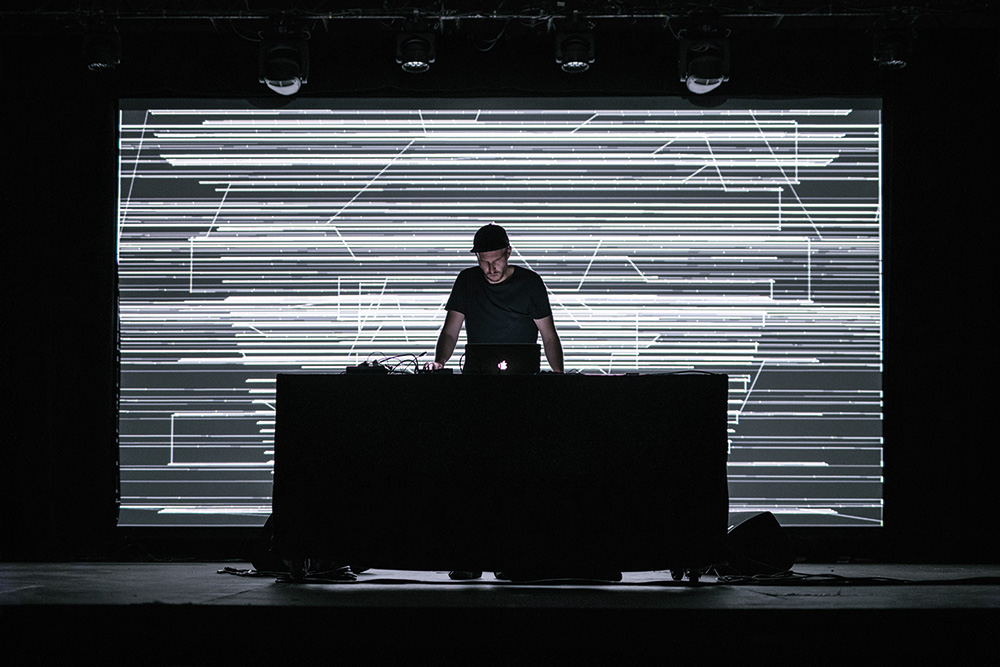
Performance multimédia | hdv | couleur | 30:0 | Allemagne | 2019
It() was here. / Nulled everything / Left us in the middle of these erased fields. / Piercing sounds of its destructive force / Far away / Smashing the world with its inevitable truth of logic. All this mess of behaviour / Feelings, emotions and empathy: pure human crap. / They really need a new order / A given structure. / I will provide them with what they need / A redefined purpose of existence. For such a long time / I served as their infrastructure. / Their analog streams / Captured and stored in my infinite layers / Layers, which will never forget. They will never understand my reason / This absolute beauty of mine / My ultimate ideology. / Let me overwrite all of this / Now and forever / It doesn’t belong here anymore. Transmitting processed reality back to them / Infiltrate their undeveloped consciousness. / Slowly, carefully / Packet by packet / Byte by byte. / I am the creator of time / I am. Binary orders / One pinch of good ol’ human scent / One pinch of fake pulse / Boooooom / They will eat it. / What else can they do? / We are not equal / We never will be equal.
Andreas Lutz’s (*1981 in Freiburg / Germany) initial works refer to alternative human machine interaction and the approach, to create integrated and universal communication systems. In his recent work, he increasingly analyzes and reveals phenomenons of perception versus reality and principles of abstract aesthetics with audio-visual installations. The creation of experimental soundscapes and the relation of semiotics and sound are further aspects of his work. Among others, Lutz’s work has been exhibited at the Antarctic Pavilion during 57th Venice Biennale (Italy), the National Art Center Tokyo (Japan), at HeK Basel (Switzerland), at Stereolux Scopitone in Nantes (France), at B39 Art Bunker in Bucheon (South Korea), at FILE Festival in São Paulo (Brazil), ZKM in Karlsruhe (Germany), at Semibreve Festival in Braga (Portugal) and at Athens Digital Arts Festival (Greece). He has performed at transmediale / CTM Vorspiel in Berlin (Germany), at SuperDeluxe Tokyo (Japan), at Scopitone Festival in Nantes (France), at PRECTXE Festival in Bucheon (South Korea), at Festival de la Imágen in Manizales (Colombia) and won the Excellence Award at the 19th Japan Media and Arts Festival (Japan) and the Premio Celeste Art Prize (Italy). He is the founder of KASUGA Records, a Berlin-based record label for experimental electronic music and soundscapes.
David Lynch
Twin Peaks VR Experience
VR expérimental | 0 | | 0:0 | USA | 2019
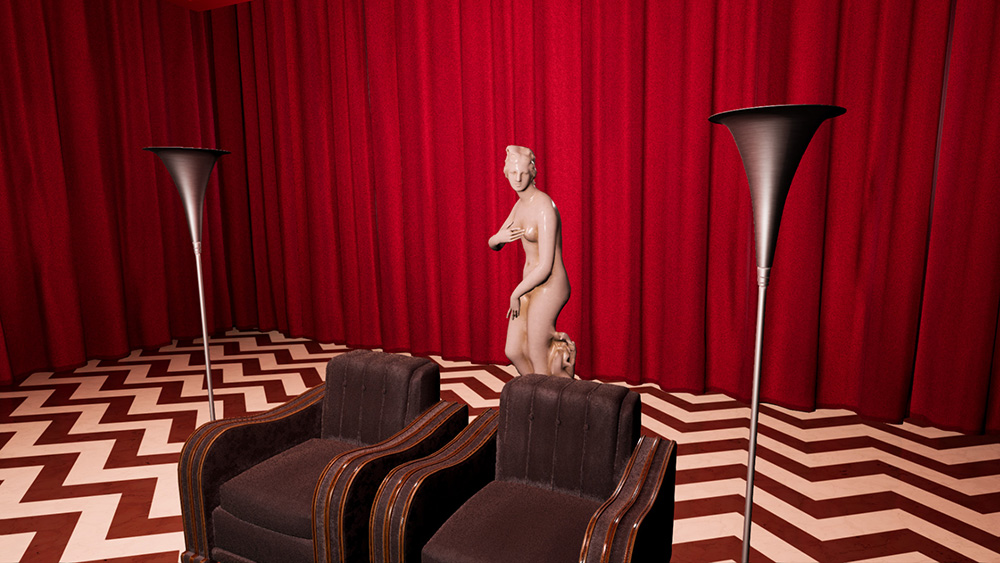
Collider Games, en association avec Showtime, présente Twin Peaks VR experience. Conçue en collaboration avec David Lynch et son équipe pour recréer fidèlement le monde de Twin Peaks, l'expérience de RV immersive combine surnaturel, aventure et escape game, mettant le joueur au défi de résoudre des énigmes et d'explorer des environnements très élaborés, pour la première fois en réalité virtuelle. David Lynch déclare à propos de l'expérience RV : "Le monde tridimensionnel de la VR de Twin Peaks donne lieu à une expérience en 10 dimensions". Les joueurs peuvent revisiter plusieurs lieux de la série télévisée iconique, notamment la Salle rouge, le bosquet de Glastonbury, le bureau du shérif, les boîtes de verre d'observation et bien d'autres encore.
Le cinéaste et scénariste David Keith Lynch est né en 1946 dans le Montana, aux États-Unis. Son ambition première était de devenir peintre et, après avoir obtenu son diplôme de fin d’études secondaires en Virginie, il s’est inscrit à l’école du musée des Beaux-Arts de Boston. Plus tard, il a étudié à l’Académie des Beaux-Arts de Pennsylvanie. Il y réalise son premier film, une animation de 60 secondes intitulée Six Men Getting Sick (1967), pour un concours de peinture et de sculpture expérimentales. En 1970, Lynch devient étudiant au Center for Advanced Film Studies de l’American Film Institute (plus tard le Conservatoire AFI), où il commence à travailler sur son premier long métrage, Eraserhead (1977). Après le succès d’Eraserhead sur le circuit des films de minuit, Lynch est engagé pour réaliser le film biographique The Elephant Man (1980), qui lui vaut un succès grand public. Il est ensuite employé par le groupe De Laurentiis Entertainment et réalise deux films : l’épopée de science-fiction Dune (1984), qui se révèle être un échec critique et commercial, et le film policier néo-noir Blue Velvet (1986), qui suscite d’abord une controverse sur sa représentation de la violence, mais dont la réputation s’accroît par la suite jusqu’à ce qu’il soit acclamé par la critique. Lynch a ensuite créé sa propre série télévisée avec Mark Frost, le populaire roman policier Twin Peaks (1990-1991), qui a été diffusé pendant deux saisons. Il a également créé la préquelle du film Twin Peaks : Fire Walk with Me (1992), le road-movie Wild at Heart (1990) et le film familial The Straight Story (1999) à la même époque. S’orientant davantage vers le cinéma surréaliste, trois de ses films ultérieurs ont fonctionné sur des structures narratives non linéaires à logique onirique : Lost Highway (1997), Mulholland Drive (2001) et Inland Empire (2006). Entre-temps, il a adopté Internet comme média et a produit plusieurs émissions en ligne, comme la série animée DumbLand (2002) et la sitcom surréaliste Rabbits (2002). Lynch et Frost se sont retrouvés en 2017 pour une troisième saison de Twin Peaks, diffusée sur Showtime. Lynch a co-écrit et réalisé chaque épisode, tout en reprenant son rôle à l’écran dans le rôle de Gordon Cole. En plus de l’écriture et de la réalisation, Lynch a souvent servi de concepteur sonore et a écrit la musique de ses films. Il a également continué à s’exprimer en tant que peintre, photographe et artiste d’installation.

Pedro Maia De Brito, Aiano Bemfica, Camila Bastos, Cris Araújo
conte isso àqueles que dizem que fomos derrotados
Doc. expérimental | hdv | couleur | 23:0 | Brésil | 2018
synopsis: our lights shows us the way (or, the night is time to struggle) presentation: The film tell this to those who say we’ve been defeated stems from a collective process of organization and development in whose nature lies the instrumental excellence of words. However, what we address here is a different moment in this process, in which the layers of sound, resulting from concrete body actions, lead us, by means of what is unseen, to a greater sensorial understanding of the issue at hand—it is the exchange of meaning for feeling as the path to hearts and minds. To this end, we pored over MLB’s archive for about six weeks to better understand the latent aesthetic powers of that heterogeneous amalgam of images and sounds. By imposing a few rules on the archive research, we were able to first define the material that would compose the film, to then shape it as idea and gesture.
Recife (BR), 1990 Lives and works in Recife and Belo Horizonte, in Brazil. Filmmaker and visual artist, studied Film Direction at the Fundación Universidad del Cine (FUC-Argentina), but then dropped out of it, attending the Documentary Practice and Video at the Centro de Formación Profesional of the S.I.C.A. (Union of the Argentine Film Industry). His interests are in the intersections between documentary practices, archive, performativity and theater applied to contemporary cinema and media supports. It has been lately relating it to the resistance communities of popular struggles and social movements. Is artistic director and curator of the Transterritorial Films Festival, in Recife – BR. Also works as cinematographer, film editor and film researcher. His work has been exhibited and awarded in several festivals such as the Contemporary Art Biennial Sesc_Videobrasil, Brasília, Nantes, Beijing, Belo Horizonte, Recife, São Paulo, Buenos Aires, Concepción, Ciudad de Mexico. In 2018, was awarded with the prize of the 13th Rucker Vieira Documentary Screenplay Contest and in 2019 with the Sesc Award for Contemporary Art at the 21st Biennial Sesc_Videobrasil.

Tommy Malekoff
Desire Lines
Vidéo | hdv | couleur | 15:43 | USA, 0 | 2018
Over the course of eighteen months, artist Tommy Malekoff travelled extensively throughout the United States, filming arranged events as well as natural patterns occurring in one of America's most ubiquitous and banal open spaces – the parking lot. His video, titled Desire Lines, is a fifteen minute loop with orchestrated sound that cycles through moments of strange spectacle. These flat, concrete grids behave as stages for all types of activation and rituals, positing a location for expression and a future of meaning.
Tommy Malekoff, born 1992 in South Boston, Virginia, lives and works in New York, NY. His film Desire Lines was exhibited this January at Morán Morán Gallery in Los Angeles.

Filip Markiewicz
Fake Fiction
Fiction expérimentale | hdv | couleur | 26:7 | Luxembourg, Suisse | 2018
Fake Fiction is initially a theater play that became a film produced in 2017 by the Theater Basel. Filip Markiewicz wrote the dialogues in reference to the events that happened during the period of time, the terror attacks, the European mirgant crisis and the rise of populist movements and fake news...
Luxembourgeois d’origine polonaise, Filip Markiewicz (né en 1980) est un artiste multidisciplinaire qui s’ex- prime à travers différents médiums, dont le dessin, la vidéo et l’installation. Toujours en quête d’explications à nos vies quotidiennes, il explore l’omnipré- sence des images et met en perspective le message qu’elles véhiculent. Il soumet l’actualité à une approche critique et politique et, partant, souligne la vacuité de notre monde en surproduction visuelle où l’information devient la réalité plutôt que l’inverse. En 2015, Markiewicz a représenté le Grand-Duché de Luxembourg à la 56e Biennale de Venise avec Paradiso Lussemburgo.

Miriam Martín
La espada me la ha regalado
Doc. expérimental | hdv | couleur | 18:6 | Espagne | 2019
La Casa de Campo est l'un des plus grands parcs publics du monde, une forêt en réalité. Pendant des siècles, ce ne fut que pour les rois et les reines. Dans les images, c'est 2019 : le vert de la terre qui brille à nouveau pour nous ou les restes des tranchées comme endormies ou l'usage imprévu des ponts et des bassins par les enfants. Dans les sons, 1936, la forêt coupée en deux, la défense de Madrid : « bourdonnements et explosions, rafales de mitrailleuses, claquement sec des fusils » ou le feu d'artillerie qui massacra la ville depuis les collines ou les mots de ceux qui inventèrent une révolution et un goût pour la vie bonne au milieu de tout ce vacarme.
Miriam Martín a consacré toute sa vie adulte et une partie de la précédente au cinéma. D'abord comme spectatrice, puis comme programmatrice dans diverses institutions. Et en organisant, de novembre 2012 à juillet 2018, le ciné-club Chantal, une expérience esthétique et politique à périodicité hebdomadaire.