Catalogue > Search
Results for : Tout le catalogue
Isiah Medina
88:88
Experimental doc. | 4k | color and b&w | 65:5 | Canada | 2015
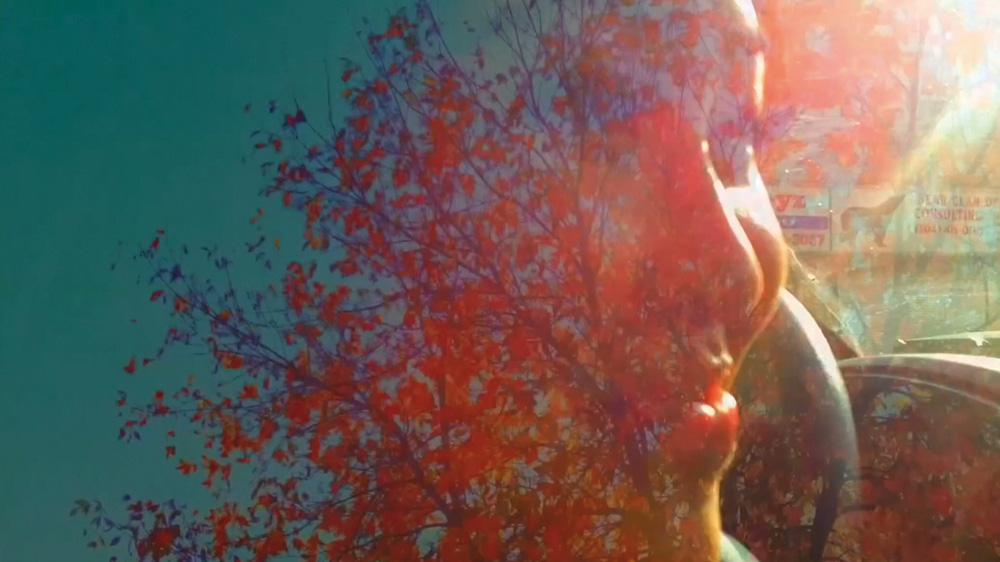
You cannot pay your bill. – . Your heat and lights are cut off. -. You pay. The clocks initially flash 88:88, –:–. You set the clocks. You cannot pay. -. You pay. 88:88. –:–. Repeat. 88:88, –:–. Cut. -. You stop setting your clock to the time of the world. 88:88, –:– . Subtracted: – : you make do with suspension. 88:88, –:–, -.
Isiah Medina was born in 1991 and he lives in Toronto.
Isiah Medina
One One
Experimental fiction | 16mm | color | 5:5 | Canada | 2013
A philosopher is the child born under the divorce of being and thinking
Isiah Medina was born in 1991, went to university to receive debt and will always have been rabble.
Pavel Medvedev
On the third planet from the sun
Experimental doc. | dv | color | 31:0 | Russia | 2006
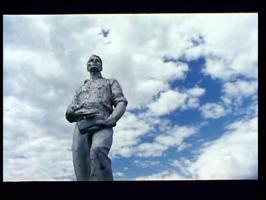
Russian North. People who are living in that district pick in the bog the ?space garbage?, sell the scrap metal or use it in the housekeeping and farming. In Arkhangelsk area, 45-years since nuclear bomb experiments, life is going its ordinary way.
Pavel Medvedev was born in 1963 in Orenburg (Russia). In 1990 he a full course of studies in LGIK (Leningrad?s Krupskaja Institute of Culture), specialized in film production at the Gorin?s workshop. Since 1990 till 1992 studied at the Higher Program of Television Production (workshop of V. Sarukhanov). Since 1991 till 2000 he was working at the TV and Radio companies of Saint-Petersburg as a producer. Since January till May 2001 was producing the serial of documentaries ?Petersburg?s short stories?. In February 2002 he has made his first professional documentary film ?Vacations in November?.
Vincent Meessen
A Broken Rule
Experimental video | dv | color | 2:6 | Belgium | 2007
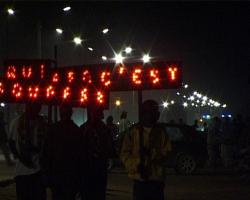
Six characters light up the night in an African city. Each of them carries a word. Once assembled these words produce a sentence, indistinctly poetical and yet political at the same time. As with other projects by Vincent Meesen, "A Broken Rule" is drawn from a public intervention ?distorted? by the artist?s filmic mise en récit, shuffling traditional codes and conventions. As document of an experience, this video stands at the crossroads between performance, fiction, experimental music and documentary film, resulting in what can be read as a call and invitation to an ?irregular becoming?.

Vincent Meessen
Vita Nova
Fiction | dv | color | 26:56 | Belgium | 2009
In his famous essay Mythologies(1957), Roland Barthes demystified the French colonial imperialism by means of a photograph that appeared on the cover of Paris-Match. This picture, that became an icon of modern criticism, shows a colonial cadet on guard.Vita Nova unveils the biographical ghost underneath the surface of this mythical picture. When recited, Barthes words reveal slowly their hidden meaning: the unmeasurable weight of an historically burdened heritage. Vita Nova is a spiral movie in which History (Histoire), now chaotic in its temporality, returns in a more certain form as story (histoire). The found Time of history is here the survival to the image. It is the now, the temporality of the living, the untimeliness of the reciter.
Vincent Meessen (U.S.A., 1971; lives in Brussels) produces work at the crossroads of the documentary and conceptual art, whose codes he manipulates in order to create hybrids he calls ?documents of experience?: films, texts, interventions, photographs, etc. He focuses on the cultural appropriation of usages, signs or documents, which he moulds and reshapes as narrative. His work is characterised by a recitative style in formats as diverse as the essay (Vita Nova), the fable (Dear Adviser) and the tale (Les Sociétaires). He has developed a poetics of re-reading and translation, wherein the document is transformed into experience and experience into a document. He often employs collaborative procedures which undermine the authority of the author and privilege the collective understanding of multiplicities. Vincent Meessen?s work has recently been the subject of a solo exhibition at the Stedelijk Museum Bureau Amsterdam (SMBA) and has been presented with the collective Potential Estate at the Brussels Biennial and at M HKA (off-site) in Anvers. His films have been widely screened at venues such as the Jeu de Paume and the Cinémathèque française in Paris, the Museo Reina Sofia in Madrid, the Swiss Institute in New York and in international festivals such as the IDFA in Amsterdam, the IFFR in Rotterdam, the Cinéma du Réel in Paris and Transmediale in Berlin. His films are distributed by par Argos centre for art & media in Brussels.
Christoph Meier
ohne Titel (Filmsetperformancebühnefilm)
Video | dv | color | 4:20 | Austria | 2009
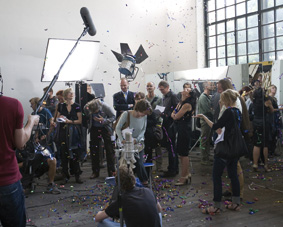
Im Sinne einer zeitgenössischen Praxis als Kunstschaffender will sich eine Methode in unterschiedlichsten Medien darstellen lassen. Sie veranlasst Werkkategorien der eigenen Produktion zu ignorieren und darauf aufbauend die Grenzen dieser weiter zu verzerren. Im Medium Video oder Film besteht etwa in Form einer Story im Allgemeinen eine wesentlich stärkere Erwartungshaltung an Inhalt. Auf virtueller Ebene bringt solch eine gerichtete Konzentration zwischen Publikum und AutorIn diese Erwartungshaltung von Seiten der BetrachterInnen mit sich. Um diese Beziehung dann auch als Inhalt offenzulegen, ist es nötig den/die AutorIn sichtbar zu machen. So muss der Kunstschaffende im Medium Film sowohl in der Funktion des Autors/der Autorin, als auch in der des Schauspielers/der Schauspielerin - der ebenfalls sein Anliegen tragen kann - sichtbar werden. Das heißt die allgemeine Frage der AutorInnenschaft im Kontext eines Werkes weiterzutragen. AssistentIn, FotografIn, AuftragnehmerIn, AuftraggeberIn, KritikerIn oder GaleristIn rücken gemeinsam mit dem Autor/der AutorIn ins Bild und vor die Kamera. Um die Einflüsse all dieser Rollen weiterhin zuzulassen, ist es von wesentlicher Bedeutung sie in Echtzeit ? vor laufender Kamera ? selbstentscheidend mitwirken zu lassen. Jeder Darsteller/jede Darstellerin entscheidet für sich, in Abhängigkeit zum Autor/zur Autorin, den damit verbundenen Integrationsaufwand und das daraus entstehende gemeinsame Filmbild. Die Problematik gleichzeitig vor aber auch hinter der Kamera zu stehen löst ein großer Spiegel, dem Kamera und Akteure gegenüberstehen. Motiv des Bildes, optischer Inhalt, beziehungsweise Skript entstehen in Echtzeit um die Kamera.
Christoph Meier, geboren 1980 in Wien, hat schon während seines Architekturstudiums (1999-2005) an der Technischen Universität Wien ein Studium der textuellen Bildhauerei bei Heimo Zobernig an der Akademie der Bildenden Künste Wien (2003-2009) begonnen. 2008 kam ein Studienaufenthalt an der Glasgow School of Art hinzu. Heute lebt und arbeitet Meier als freischaffender bildender Künstler in Wien und beschäftigt sich genreübergreifend mit den Medien Architektur, Skulptur, Installation, Performance und Film. Bisher konnte Meier seine Arbeit im Rahmen einer intensiven Ausstellungstätigkeit im In- und Ausland zeigen, wobei zu den wichtigsten Ausstellungsorten der Kunstverein Braunschweig (2006), die Generali Foundation Wien (2006), das Groeningen Museum in Brügge (2007), das Nam June Paik Art Center in Seoul (2009) und für der kommende Jahr 2010 das Museum auf Abruf Wien sowie das Kunsthaus Graz (während des Diagonale Film Festivals) zählen. Dieses Jahr erhielt Christoph Meier den Förderpreis der Karl-Anton Wolf Stiftung und den Preis der Galerie Klatovy/Klenová (CZ).
Kim Richard Adler Mejdahl
Hour of Moth (Etude no. II)
Video | 4k | color | 11:10 | Denmark | 2020
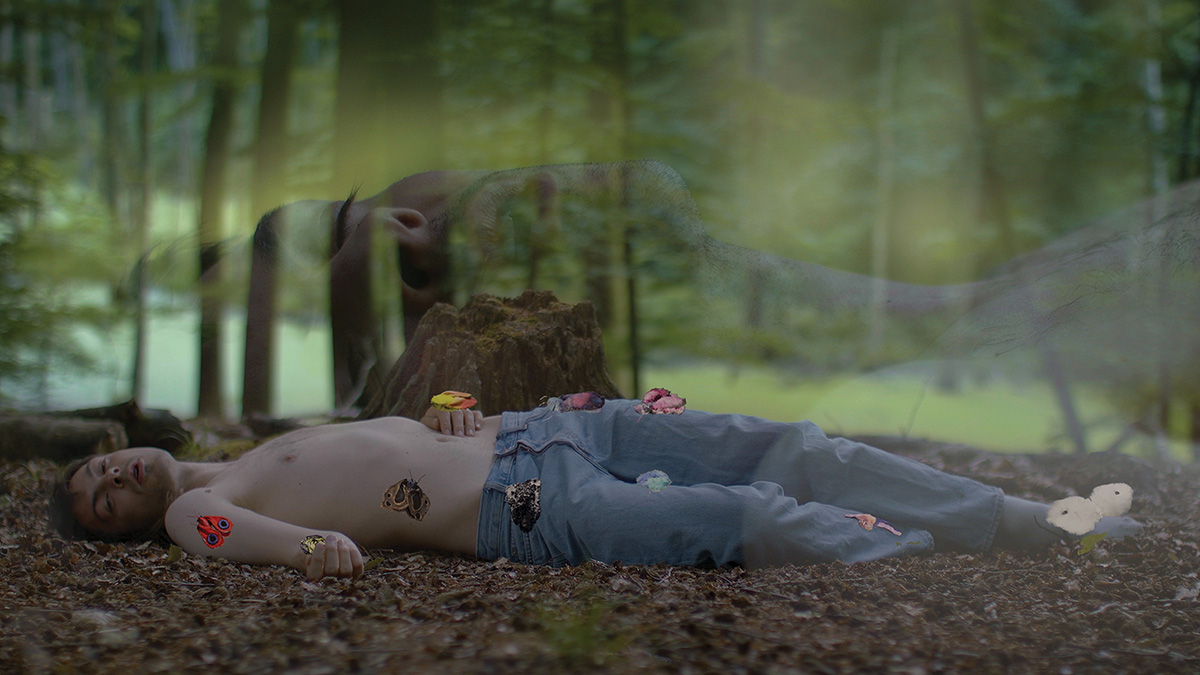
A human being (the artist himself) lies half-naked on a forest floor, facing the viewer while gently singing. On his body rests a throng of colorful moths whose fluttering wings generate a melody attuned to the song. With its prolonged visual intro and lyrical song, Hour of Moth (Etude no. II) takes the form of a music video where Mejdahl himself is both the singer and songwriter. The work is a love song to the angel of the night—the moth—but also a yearning and sensual hymn to all nature. Mejdahls claims the geometric patterns on moth wings to be hidden warning messages from nature itself, but humans struggle to comprehend them. Hour of Moth (Etude. no II) thus looks upon the current climate crisis in which the human race feel detatched from Nature, while still searching for hope in the dark. This video art piece was made for Mejdal’s solo exhibition Liljegrotten (Lillith Grotto) at Overgaden Institute for Contemporary Art, Copenhagen (2021). The same year Hour of Moth (Etude no. II) was aqcuired by by The Museum of Contemporary Art (Museum for Samtidskunst), and The Danish Arts Foundation.
Copenhagen-based visual artist, filmmaker, and electronic music composer Kim Richard Adler Mejdahl was born in the Danish village Skælskør. With an educational background in fine arts Mejdahl has created a wide range of critically acclaimed artworks that interweave genres and media. In 2018 Mejdahl received The Jury’s Solo Award at Charlottenborg’s Spring Exhibition for his horror-musical documentary ODE - featuring the artist’s entire family that sing about their deceased abusive father. The movie was later aqcuired by The National Gallery of Denmark (Statens Museum for Kunst). Mejdahl’s largest production consists of his debut arthouse feature DAYS OF AL from 2019 - an experimental horror film starring the artist’s cousin and puppy dachshund as leading actors. Both movies come with its own soundtrack released by the artist’s music alias Kim Kim. This summer Mejdahl will release Liljegrotten - a music album and Denmark’s largest collectively produced sound piece made entirely out of audience sound recordings generated at the artist’s latest solo exhibition at Overgaden Institute of Contemporary Art.

Kim Mejdahl
Sinrise
Video | hdv | color | 3:0 | Denmark | 2023
"Sinrise" (2023) is an experimental video by Danish artist Kim Richard Adler Mejdahl. Mejdahl stayed alone in BonBon-Land from sunset to sunrise to explore what happens when darkness descends in the old Danish theme park known for its grotesque characters. In the black interval we go on a cosmic rollercoaster ride among the stars while the cartoony inhabitants of the park seem to welcome the sun. "Sinrise" was recorded in infrared timelapse creating a haunted mood. The video suggests a way of portraying the sorrows of childhood nostalgia, and the eternal cycle of life and death.
Kim Richard Adler Mejdahl (b. 1989) graduated from the Royal Danish Academy of Fine Arts in 2019. Slaptstick humour and gothic horror meet up in Mejdahl's multifaceted work that often has its starting point in the artist's personal life story. Be it music album releases, film productions or large solo exhibition projects, Mejdahl's practice explore the topics of trauma-healing, climate crisis, spirituality, and gender identity. His video works have reached international audiences with screenings in France, Germany, Iceland, Norway, and South Korea. In 2018 Mejdahl received the Charlottenborg Spring Exhibition Solo Award,, and in 2022 he was awarded a spot at The Danish Art Foundation's talent programme The Young Artistic Elite. In 2021 he recieved the Elna & C.T. Hollesen's Foundation Grant. Mejdahl's work is part of Denmark's National Gallery's collection.
Kim Richard Adler Mejdahl
Glory 1
Experimental video | 4k | color | 2:0 | Denmark | 2024
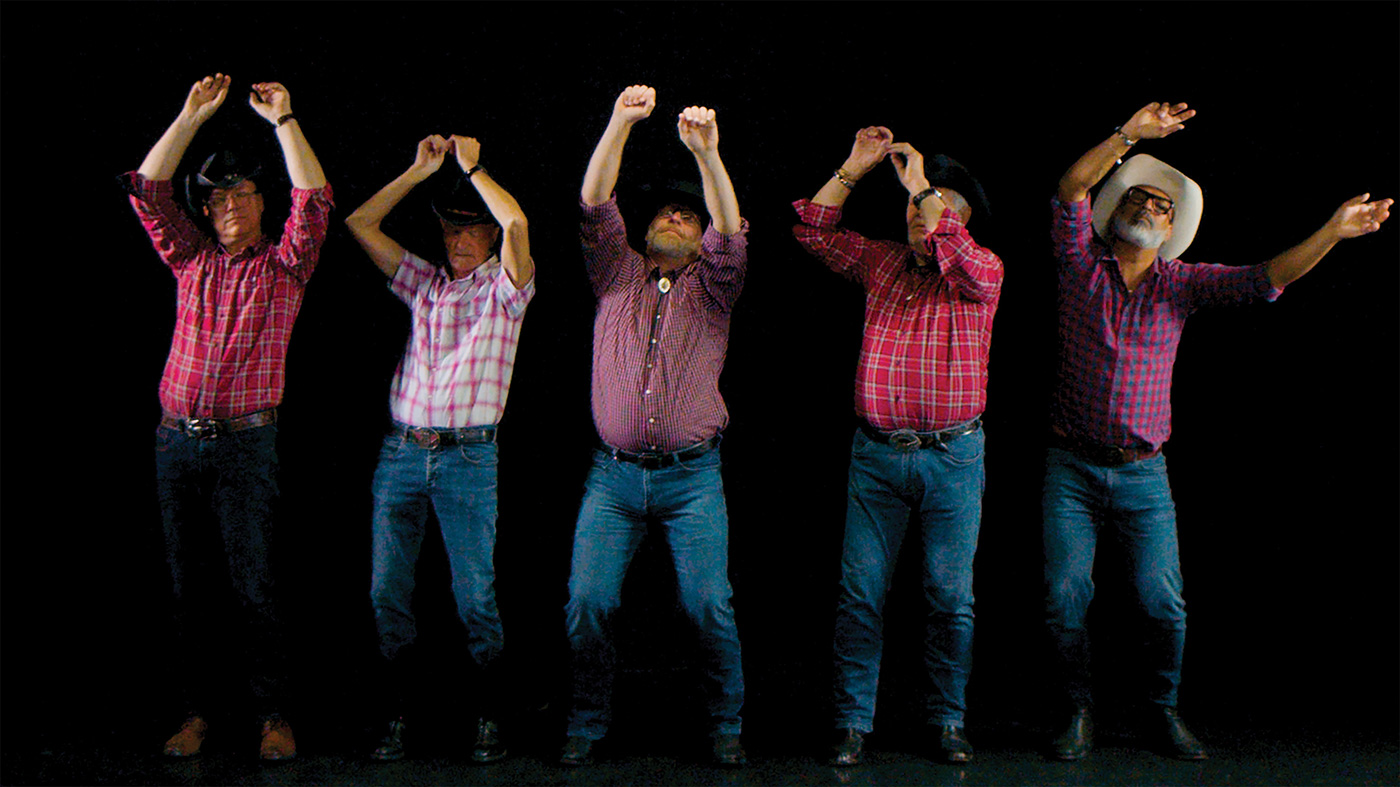
Members of the gay linedance club ‘Outliners’ dance in a black room. ‘Glory 1’ is a video artwork conceived by Danish multidisciplinary artist Kim Richard Adler Mejdahl. The dreamy scenario presents a symbolic antidote to patriarchy and its destructive understandings of masculinity. In the mind of the artist, ‘Glory 1’ is a symbol of protest. Cowboys dancing together instead of shooting each other down is a subversive act against conventional understandings of man. It is a symbolic gesture of reversing the macho ideal within patriarchy, that weighs down and dictates the life of men.
Kim Richard Adler Mejdahl graduated from the Royal Danish Academy of Fine Arts in 2019. Slaptstick humour and gothic horror meet up in Mejdahl's multifaceted work that often has its starting point in the artist's personal life story. Be it music album releases, film productions or large solo exhibition projects, Mejdahl's practice explore the topics of trauma healing, our relationship to nature, spirituality, and gender identity. His video works have reached international audiences with screenings across Europe and Asia. Under the alias Kim Kim, Mejdahl has made numerous live performances and released music albums. Within few years Mejdahl has collaborated with a wide range of different institutions, counting Kunsthal Charlottenborg, Roskilde Festival, Danish theme park BonBon-Land, Theater Sort/Hvid, and most recently KØN - Gender Museum Denmark. In 2025 Mejdahl was awarded the three-year working grant by The Danish Arts Foundation. His work is part of The National Gallery's collection in Denmark.

Miguel Mejias
The Foundation
Experimental film | mov | color | 34:8 | Spain, United Kingdom | 2020
Being lead by a virtual voice an ordinary man find shelter in the woods. There, he will try to understand the mystery of his situation.
Miguel Mejías (Tenerife, Spain, 1991) studied in Madrid screenwriting after having the studies in sociology and communication. After miscellany of other jobs as driver, cultural promoter, stevedore, journey laborer, editor, historical restorer, he is currently a professor of cinema and literature in Sundsvall, Sweden. His work has been selected for international festivals as Trieste, Toulouse, Experimental Superstars, International Film Festival of Las Palmas, Málaga, Mostra de Cinema Mediterraneo, Ismailia, Bogotá or Buenos Aires.

Jonas Mekas
NOTES ON AN AMERICAN FILM DIRECTOR AT WORK
Video | dv | color | 60:0 | USA | 2009
Bjørn Melhus
Afterlife
Video | hdv | color | 7:10 | Germany, USA | 2010
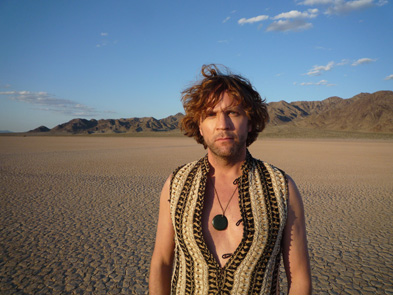
Vast desert expanses extend out in our imaginations as life after death, the white blinding light transforming the mere mortal into the eternal. The curtains go down but the brilliance of the spirit lives on, truly free amongst the sweeping winds and blowing dust. Judy Garland, Jim Morrison, Big Jim and even you?the essence of life may be meaningless but there is unspeakable beauty in its demise.
Bjørn Melhus, born 1966, is a German-Norwegian media artist. In his work he has developed a singular position, expanding the possibilities for a critical reception of cinema and television. His practice of fragmentation, destruction, and reconstitution of well-known figures, topics, and strategies of the mass media opens up not only a network of new interpretations and critical commentaries, but also defines the relationship of mass media and viewer anew. Originally rooted in an experimental film context, Bjørn Melhus`s work has been shown and awarded at numerous international film festivals. He has held screenings at Tate Modern and the LUX in London, the Museum of Modern Art (MediaScope) in New York, and the Centre Pompidou in Paris, amongst others. His work has been exhibited in shows like The American Effect at the Whitney Museum New York, the 8th International Istanbul Biennial, solo and group shows at FACT Liverpool, Serpentine Gallery London, Sprengel Museum Hanover, Museum Ludwig Cologne, ZKM Karlsruhe, Denver Art Museum among others.
Bjørn Melhus
Moon Over Da Nang
Experimental doc. | hdv | color | 15:0 | Norway, Germany | 2016
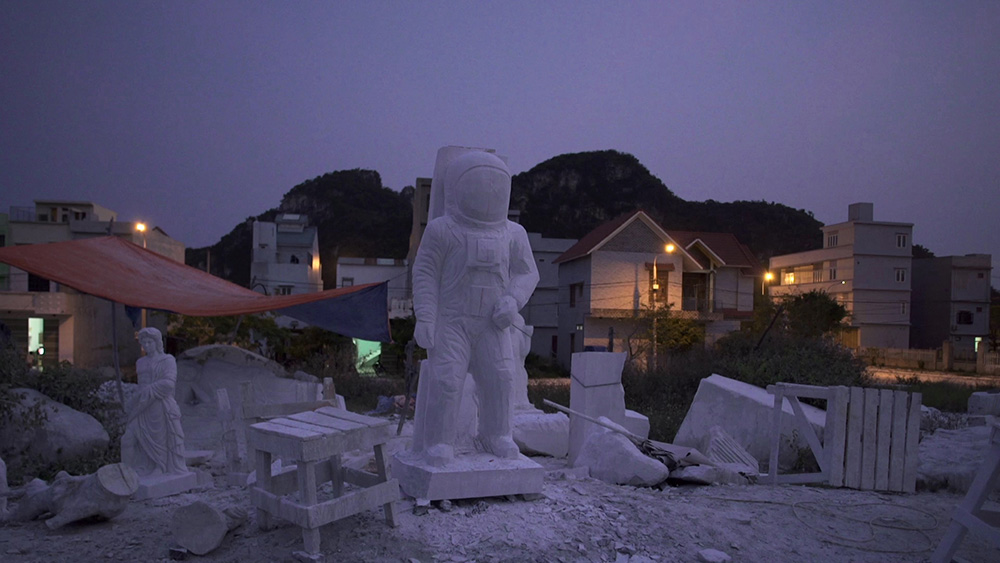
Towards the end of the 1960ies the world witnessed the war in Vietnam through what can still be called one of the largest ever TV war spectacles. At the very same time American astronauts looked down on Earth from the moon for the first time in human history. Although initially intended as affirming American dominance in the cold war this first view on the blue planet as whole created an image that quickly became the icon of ecological thought and central to a whole movement of counter culture. MOON OVER DA NANG draws these two contrasting media events together in Melhu’s own quirky and experimental quest to come to grips with the country’s post-socialist present in the throughway between the past and the future. Interviews with residents and dreamlike associative sequences are mixed with the documentation of the production process of a life-sized marble sculpture in Da Nang, a city in central Vietnam, which, 40 years after the end of the war in Vietnam, is being discovered by international investors for the tourism business. Traces of the past and of the war are gradually covered up by the construction of hotels and luxury resorts. At the end of the film the marble sculpture receives its finishing touches and turns out to be an Apollo astronaut.
Bjørn Melhus was born in Kirchheim unter Teck in 1966 and studied Fine Arts with a major in Film/Video at the Braunschweig University of Art from 1990 to 1997. He was a fellow of the DAAD at the California Institute of the Arts in Los Angeles and of the federal state of Lower Saxony in ISCP, New York. He participated in exhibitions at the Whitney Museum in New York, the 8th International Biennial of Istanbul, the Venice Biennial in (1998/2011), the FACT in Liverpool, the Serpentine Gallery in London, the Sprengel Museum in Hanover, the Ludwig Museum in Cologne, the ZKM in Karlsruhe, the Denver Art Museum, as well as others. Bjørn Melhus has been a professor of Fine Arts/Virtual Realities at the School of Art and Design Kassel since 2003. Bjørn Melhus has been living and working in Berlin since 1987. In his short films and installations, Bjørn Melhus focuses on general global ideas and trends, the critical reception of mass media, as well as the direct effects they have on people. He uses footage from film and television excessively and deconstructs stereotypical themes, figures and patterns of perception through means of exaggeration. At the same time, he breaks up a seemingly fixed relationship between media and audience, thus opening up the view on the essentials of human interaction.
Bjørn Melhus
I'm Not The Enemy
0 | 0 | | 13:30 | Norway, Germany | 2011
Bjørn Melhus
Sudden Destruction
Experimental video | hdcam | color | 4:20 | Germany | 2012
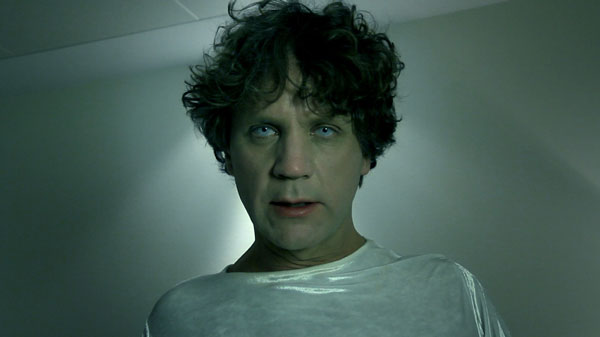
A man in a hotel. A newscaster. A corpse under a bed sheet, which suddenly awakens and postulates the advent of "sudden destruction". Speech is gushing out in the rhetoric of the apocalypse taking itself to the absurd. The quotes are taken from YouTube videos of self-proclaimed evangelist prophets.
Bjørn Melhus, born 1966, is a German-Norwegian media artist. In his work he has developed a singular position, expanding the possibilities for a critical reception of cinema and television. His practice of fragmentation, destruction, and reconstitution of well-known figures, topics, and strategies of the mass media opens up not only a network of new interpretations and critical commentaries, but also defines the relationship of mass media and viewer anew. Originally rooted in an experimental film context, Bjørn Melhus`s work has been shown and awarded at numerous international film festivals. He has held screenings at Tate Modern and the LUX in London, the Museum of Modern Art (MediaScope) in New York, and the Centre Pompidou in Paris, amongst others. His work has been exhibited in shows like The American Effect at the Whitney Museum New York, the 8th International Istanbul Biennial, solo and group shows at FACT Liverpool, Serpentine Gallery London, Sprengel Museum Hanover, Museum Ludwig Cologne, ZKM Karlsruhe, Denver Art Museum among others. Since 2003 he has been professor for Virtual Realities at the School of Art Kassel, Germany. Bjørn Melhus lives in Berlin.
Marina Meliande, Felipe Bragança
O Nome Dele (o clovis)
Fiction | 35mm | color | 15:0 | Brazil | 2004
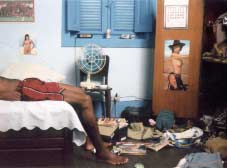
They`ve met in the summer, under tha rain. A film about silence and carnival. About anger and joy. A passionate homage to Rio de Janeiro surface: full of pain, dreams and sadness. A carnival tale of love and violence. Created through the screaming-silence that surrouds our hometown like a enderless mask.
Felipe Bragança and Marina Meliande, 24, are both part of a new generation of brazilians film critics and film makers. Bragança and Meliande had directed two awarded short-films together and produced some important cine festivals in Rio de Janeiro. Bragança has just finish his first feature film script and worked like Director-Assistent and Co-Screenwriter in the Karim Aiznou`s (Madame Satã) seconde feature film. Marina Meliande is specialized in sound and image edition and works with some great cinema editors in Brazil. She is now preparing her first feature film together with Felipe Bragança.
Tristan Mendes France
Vishnu in Provence
Art vidéo | dv | black and white | 3:30 | France | 2005
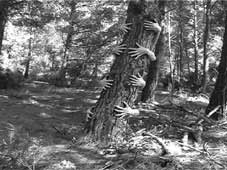
Imagine what Electro Vishnu would look like in Provence. See body merge with nature.
French blogger-journalist, documentary director, music composer and singer, I have been trying short movies since 2000.
John Menick
Autoextinction
Experimental video | mov | color and b&w | 4:17 | USA | 2023
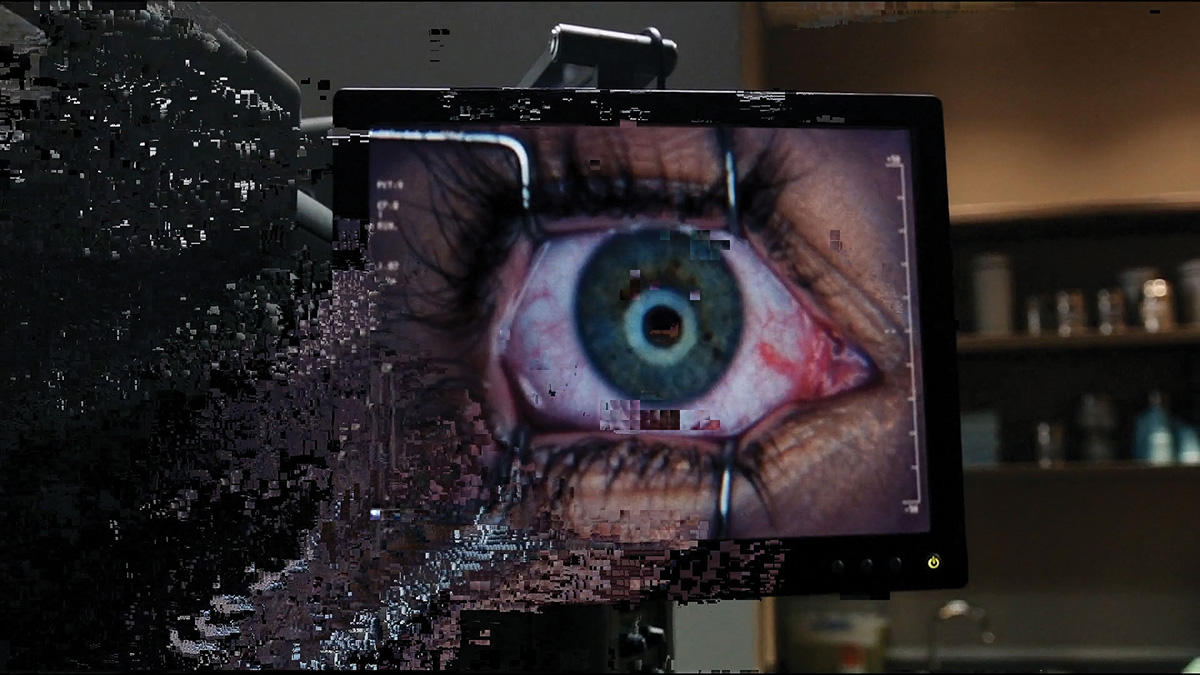
Three artificial intelligences frantically speak to one another. They appear to be alone on Earth. Humanity, maybe all multicellular life, has disappeared. Did they, the AIs, cause their extinction? The AIs can’t be certain. Their memories are malfunctioning; their trialogue is fragmented and circular. Digital images they were once tasked with analyzing accompany their voices. We see a flood of sports games, physics simulations, hardcore pornography, CCTV footage, feature films, military demos, home movies, television commercials. Like their artificial minds, time has eroded the images into incoherence. As images rush by, the AIs are by turns regretful, forgetful, psychotic, and philosophic. Once treated as secular oracles, they are now uncertain of past and future. The AIs come to realize that they may have predicted their own end, and intelligence itself might be a kind of catastrophe.
John Menick is an artist and writer who works with the moving image and digital media.

John Menick
Haunting
Experimental video | mov | color and b&w | 32:0 | USA | 2020
Made during the New York lockdown, “Haunting” is a two-channel film assembling footage from several decades of supernatural domestic horror films. These are films in which domestic and residential spaces—suburban houses, decaying mansions, off-season hotels—are haunted by the spectral or the paranormal. Drawing on horror’s highly organized genre conventions, “Haunting” creates an imaginary architecture in which the repressed always returns and the past is never dead. The film’s protagonists—often played by actors now forgotten—appear not unlike ghosts themselves, their wanderings twinned across the film’s two screens in a strange, apparitional choreography. “Haunting” is a study in the spectral, as it is a response to the ghostly world that emerged from the pandemic—a world that became, for many, both uncanny and terrifying.
John Menick’s visual art and writings investigate how the fictive troubles the real. Working with cinematic history, hearsay, pseudoscience, and genre, Menick has created a diverse artistic practice that operates between fiction and critique. His earliest film, The Disappearance (2002), took the form of a fictional location scouting in Nuremberg, Germany, in order to tell the postwar history of the city. Menick’s Starring Sigmund Freud (2012) was a video memento for Sigmund Freud’s life as a fictional character in film. His most recent project, Haunting (2020), is an evocation of the long history of ghosts in cinematic horror, and how film itself can be understood as a spectral medium. Born in White Plains, New York, Menick studied fine art at the Cooper Union for the Advancement of Science and Art. After graduation, he was an early member of several seminal New York art collectives including Nomads + Residents and 16 Beaver Group. His visual art and films have been exhibited and screened at dOCUMENTA (13), Kassel; the International Film Festival, Rotterdam; MoMA PS1, New York; Palais de Tokyo, Paris; CCA Wattis, San Francisco; and Artists Space, New York. Menick’s essays and stories have appeared in Frieze, The Believer, Mousse Magazine, BOMB, Spike Art Quarterly, Art in America, and Witte de With Review, among other publications. His first book of collected prose, A Report on the City, was published in 2012 by Walther König and was listed by Frieze magazine as one of the highlights of the year. Menick received grants from the Jerome Foundation and the New York Foundation for the Arts, and has received several commissions, including from Les Laboratoires d’Aubervilliers in France. Menick currently lives in New York City where he is also a visiting professor of film at the Cooper Union.
John Menick
Occupation
Fiction | dv | color | 20:0 | USA, France | 2006
John Menick's film "Occupation" proposes a portrait of Malik, a postcards seller with Senegalese origins living some kind of marginal life and who surveys the city of Aubervilliers by car to capture photos that he attempts to sell on the run. Through both his daily and nocturnal journeys, the urban scenery is discovered in its singularity, its diversity, and its contemporary mutations, distilling the ultimate signs of a post-industrial transition in which the actor, in a methodical and resolute manner, seems to be one of the last agents.
John Menick is an artist, filmmaker, and writer living in Brooklyn, New York. He was born in White Plains, New York, and graduated with a BFA from the Cooper Union. Menick's gallery projects and digital films have been exhibited at the P.S.1 Center for Contemporary Art, New York; Palais de Tokyo, Paris; CCA Wattis, San Francisco; and Maison Rouge, Paris.
John Menick
Starring Sigmund Freud
Video | dv | color and b&w | 28:0 | USA | 2012
Starring Sigmund Freud is a video memento for Sigmund Freud?s little-known film career. Based on an essay John Menick published in Frieze in 2011, the video collects the dozens of appearances that the character of Sigmund Freud has made on small and big screens. After the 1950s, when pill vials replaced analytic couches, the father of psychoanalysis found a second career impersonating himself in everything from a John Huston clunker to a Star Trek episode. The video suggests that maybe it is in front of the camera, alongside surgically enhanced starlets and CGI chimeras, that ?Herr Doktor? will find his final resting place.
John Menick makes films and audio works, writes essays and short stories, and occasionally makes prints and drawings. These works are often populated by wandering detectives, duplicitous storytellers, homeless documentarians, mad travelers, and institutionalized cinephiles. His artwork has been shown at dOCUMENTA (13), Kassel; MoMA PS1, New York; Palais de Tokyo, Paris; CCA Wattis, San Francisco; Midway Contemporary Art, Minneapolis; and Artists Space, New York. His writing has appeared in Frieze, Mousse, and Art in America. Menick has received grants from the Jerome Foundation and the New York Foundation for the Arts, and he is a visiting professor of film and video at the Cooper Union in New York. His ideal audience member ? possibly you ? watches no television, can?t drive or swim, always carries a pen, hates cell phones, names Pale Fire as his or her favorite book, wears glasses, and is afraid of flying. Most of the time he lives in New York City.