Catalogue > Faire une recherche
Résultats pour : Tout le catalogue
Edgar Pera
Impending Doom
Film expérimental | super8 | couleur | 7:30 | Portugal | 2006
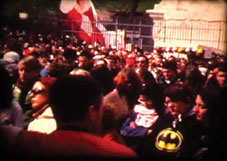
Impending Room a été tourné au format super 8. C'est un témoignage visuel et une interprétation sonique de deux cérémonies de communion qui ont eu lieu à Rome et à Lisbonne en l'an 2005 après J.C.. Malgré des croyances et des idéologies différentes, les deux communautés ont partagé la douleur, la peine et un sentiment de paix dans un monde en guerre.
Edgar Pêra est né à Lisbonne au Portugal en 1960.

Vladimir Perales
La Fiambrera Obrera
0 | 0 | | 0:0 | Espagne | 2007
Fiambrera est un groupe ouvert qui a travaillé et qui est intervenu dans des régions où les conflits politiques sont fréquents, comme par exemple les frontières entre pays riches et pays pauvres, ou dans des endroits (pas si) différents comme le centre de Madrid, de Barcelone ou de Séville. Leurs méthodes consistent à intervenir et à organiser des actions directes avec d?autres moyens sociaux et politiques plus conventionnels, fournissant des graphiques, des outils de communication et des outils et des équipements d?action directe. Ils ont été invités en tant qu?artistes résidents par des institutions telles que le MIT, Calarts, l?université de Yale, NYU, etc. et plus récemment à Transmediale et Ars Electronica. Il y a quelques années, ils ont organisé ?The Agencies?, travaillant de Barcelone avec l?aide du Contemporary Art Museum de Barcelone (MACBA) et essayant de proposer des mouvements sociaux et des resources pour créer des campagnes, des lieux d'information alternatifs, des actions et des interventions. Au fil des ans ils ont collaboré avec d?autres groupes tels que The Yes Men, Rtmark, et ?Kein Mensch ist Illegal?. Ils ont participé à l?édition de deux livres à propos des pratiques artistiques publiques et politiques : "Manual de la Guerilla de la Communicación" (Editorial Virus, Barcelone, 2000), et Modos de hacer : Arte Politico, esfera pública y acción directa (Ediciones Universidad de Salamanca, Salamanca, 2001). La recherche d?autonomie étant un de leurs principaux principes, ils ont organisé récemment une série d?événements et ont produit un certain nombre de vidéos sous l?identité ?PornoLab? dans lesquelles leur énergie converge vers l?exploration de l?intimité et du désir sexuel en tant qu?outils d?analyse politique et d?action.
Vladimir Perales vit et travaille à Madrid.
Galería Perdida
The blind don't see black, they see nothing
Film expérimental | 16mm | noir et blanc | 5:41 | Mexique, USA | 2015
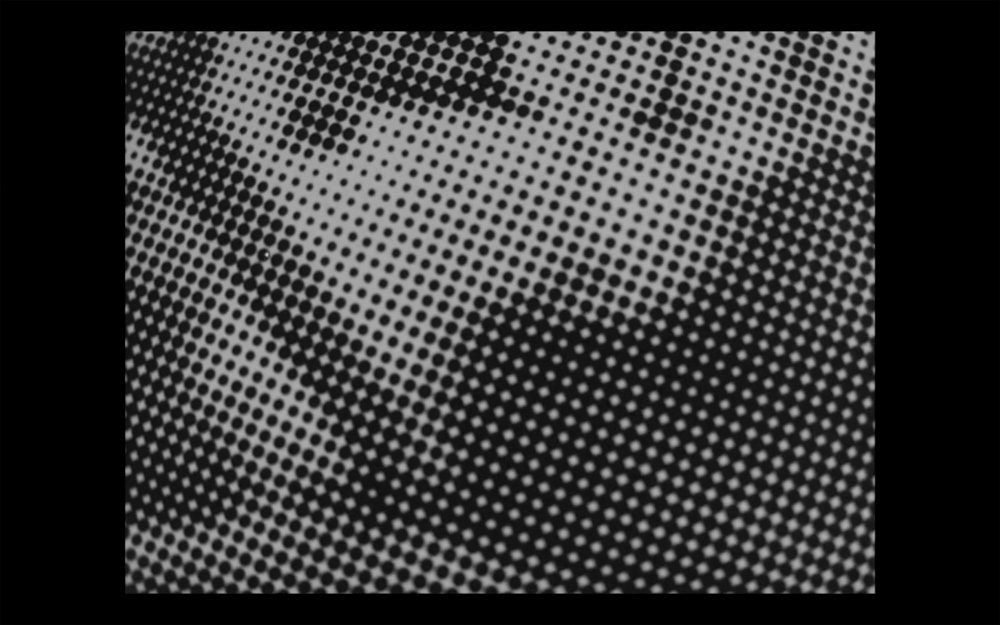
This film marks an investigation into the halftone print. Specifically, the spherical and diamond pattern that makes up an image found commonly in offset printing. These tessellations form a corollary to the structure of language where each "dot" is akin to a phoneme. In linguistics, the collated phonemes make up a morpheme—what we can call a meaningful word. The dot in the halftone print functions much the same way. With these dots, the reach of an image is made possible, exploded and distributed for the masses. Its legibility is a consumable currency by being illustrative for accompanying texts. When enlarged, the text loosens its hinges on the atomized image. The dots establish a dominant vocabulary contingent only on one another. For The Blind Don`t see Black, They See Nothing, the poetics lie within the parts of a whole, hidden amidst a constituted body.
The artist collective Galería Perdida are known for their multidisciplinary practice that brings together an inquiry of traditional crafts and the absurd, typographical design with semantic operatives. Fundamental to their research are encounters with idiosyncratic found texts and humor, design principles and the moving image; these irrational sources form the basis of a sculptural vocabulary. The use of humor is just one of many interests that Galería Perdida pursue in their body of work. Textiles, dead languages, redundancy, negation, display and the gallery, glyphs, organic matter, and graphic design are among the multiple reference points. Their constellation of objects and situations formulate a place for these subjects to collide, interact, and push against one another while defining the decree that the production of an object is not a singular but collective act.

Carlos Pereira
Unruhe
Film expérimental | 16mm | couleur | 11:50 | Portugal, Allemagne | 2024
« Une étrange épidémie s'est récemment propagée Parmi la population, Si bien que beaucoup, dans leur folie, Se sont mis à danser. Ils ont continué jour et nuit, Sans interruption, Jusqu'à perdre connaissance. Beaucoup en sont morts. »
Carlos Pereira, né à Lisbonne, étudie la réalisation cinématographique à la Deutsche Film- und Fernsehakademie Berlin (DFFB). Ses films ont été projetés dans des festivals tels que Locarno, San Sebastián et Rencontres Internationales Paris/Berlin. Son film Slimane (2023) a remporté le Prix de la critique cinématographique allemande du meilleur court métrage. Son premier long métrage, Remote Islands, écrit lors d'une résidence à la Fondation Bergman sur l'île de Fårö, est actuellement en préproduction.
Carlos Pereira
Histórias de Fantasmas (Ghost Stories)
Doc. expérimental | hdv | couleur | 13:32 | Portugal, Allemagne | 2017
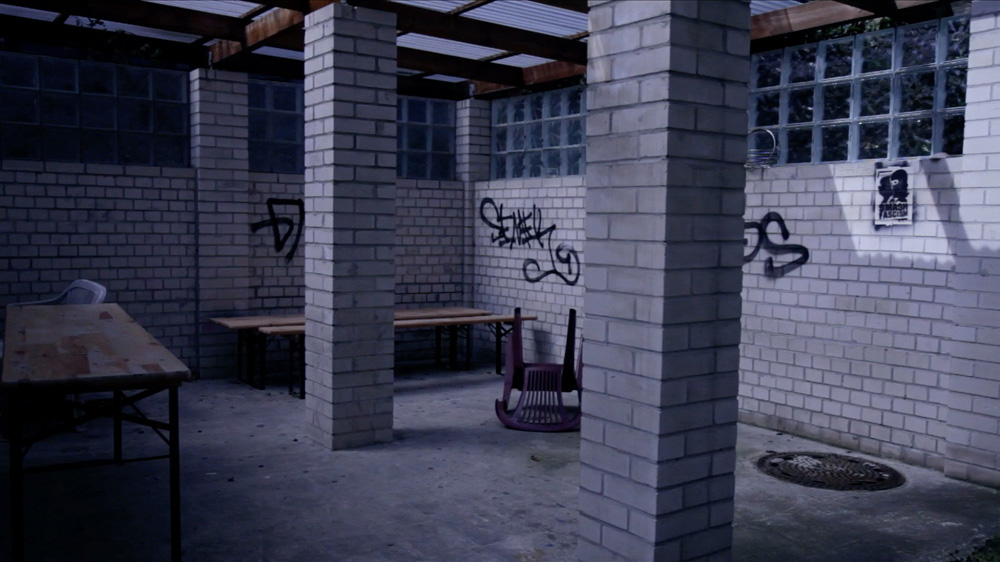
I. A storm in Berlin. Lightnings. The sound of thunders. II. Searching for a face in the dark. III. Inside an old Stasi building, a painter of ruins talks about being human.
Carlos Pereira (Lisbon, 1989) studied film directing in Lisbon (Escola Superior de Teatro e Cinema) and Barcelona (Escuela de Cine Bande à Part) and film studies in Stockholm (Stockholms Universitet). His films have been screened in festivals such as IndieLisboa, DocLisboa, Vila do Conde and Córtex and venues such as The Portuguese Cinematheque. Lives and works in Berlin, where he is as a member of the selection committee for Generation (Berlinale).
Carlos Pereira
Vulkan
Fiction expérimentale | mov | couleur | 6:2 | Portugal, Allemagne | 2021
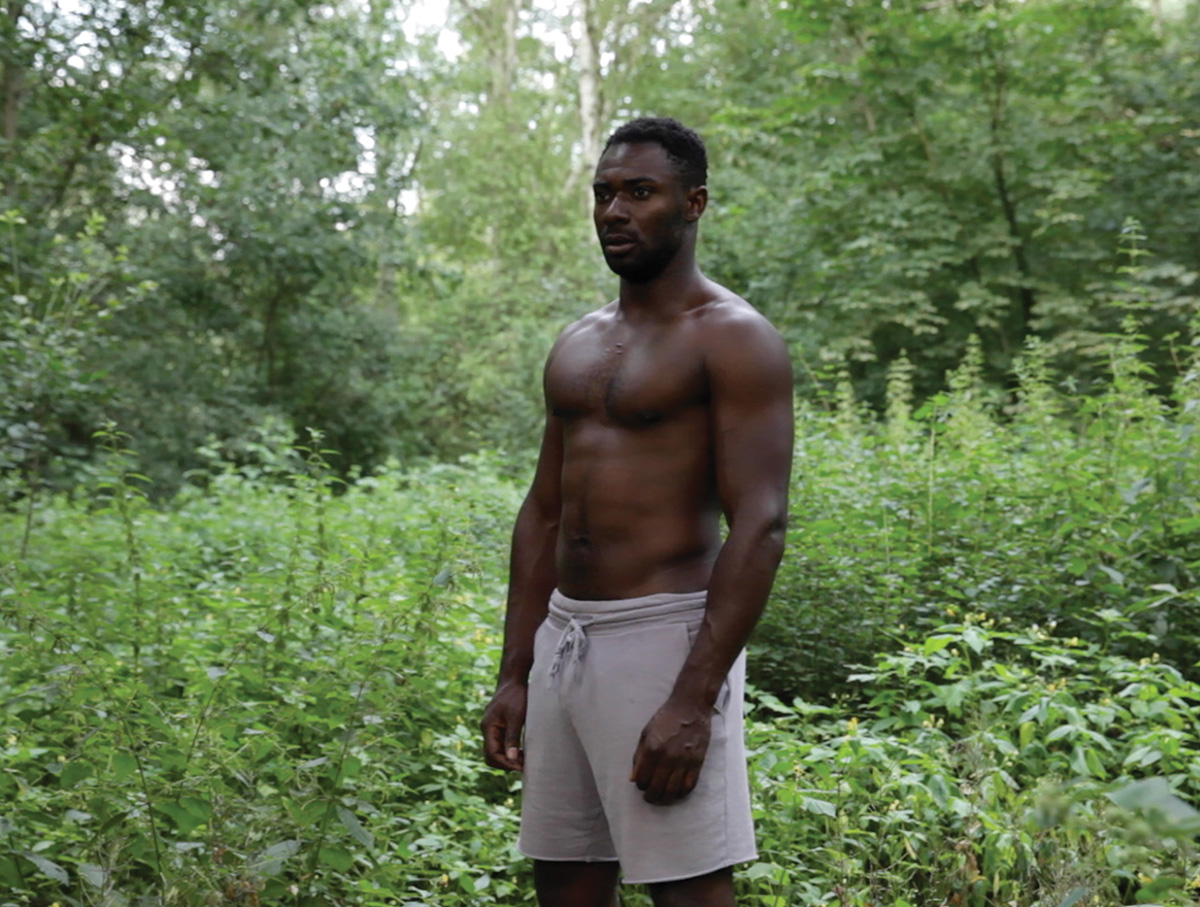
Berlin, 2020. On that cloudy summer day by the lake, while observing something terrible, their bodies blocked with fear.
Carlos Pereira (1989, Lisbon) is a filmmaker and programmer. He is currently studying Film Directing at the Deutsche Film- und Fernsehakademie Berlin (dffb), having previously studied film in Lisbon, Barcelona and Stockholm. His films have been shown at festivals such as Rencontres Internationales Paris/Berlin, IndieLisboa, Doclisboa and Vila do Conde, and screened at venues such as Cité Internationale des Arts, Haus der Kulturen der Welt and Museum of Modern Art of Rio de Janeiro. He worked as a member of the selection committee for Sheffield DocFest and is a member of the advisory selection committee for Berlinale Generation.
Jonathan Perel
LAS AGUAS DEL OLVIDO
Doc. expérimental | hdcam | couleur | 9:0 | Argentine | 2013
The poems to death are a deception. Death is death. The river was filled. Ghostly extensions. A grave in the air was dug, in the course of the wide river, where there is no stricture. All sank into the deepest shadows. A river as grave. What is the color of this water? How to swim or sail in the darkness of our history? Hairs are still crossing the waters, remain under a poisonous sky. The skin, river sand. In a glass are collected every day, bodies. We drink water of forgetfulness. There is fog.
Born in 1976, lives and works in Buenos Aires. In 2013 he premieres Tabula Rasa, his third feature film at BAFICI 15° Panorama Selection, and his last short documentary Oblivion Waters at the Official Competition of FIDBA. In 2012 he premieres his second documentary feature 17 monuments at BAFICI?s Official Selection. In 2011 he premieres his documentary short Los Murales at BAFICI 13°. In 2010 he premiered El Predio, his first feature film, at the Cinema of the Future Competition of BAFICI 12°. He also directed the short documentaries 5 (five) (2008, Official Competition BAFICI 10°) and The Murals (2011, BAFICI 13°). Two times awarded with the Metropolitan Fund for the Arts in Buenos Aires. His films have been screened in numerous international film festivals, such as: FIDMarseille (France); Rencontres Internationales Paris/Madrid/Berlin at Palais de Tokio & at Haus der Kulturen der Welt; Festival Internacional del Nuevo Cine Lationamericano, La Havana (Cuba); Semana de Cine Experimental de Madrid (Spain); Cine//B (Chile); Festival Cinematográfico Internacional del Uruguay; Óptica, Gijón Festival Internacional de Video Arte (Spain); FIACID Festival Iberoamericano de Cine Digital (Perú); La Sudestada, Quinzaine de culture et Cinéma Argentin à Paris (France).
Jonathan Perel
5-T-2 Ushuaia
Doc. expérimental | 4k | couleur | 4:0 | Argentine | 2016
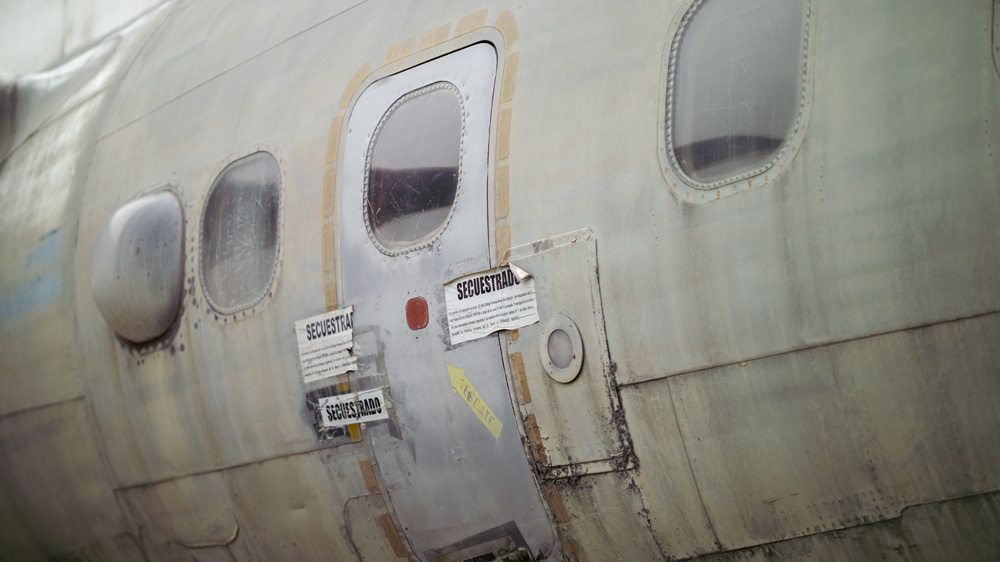
Adolfo Scilingo was the only military officer to confess the dictatorship crimes. Among the details he gave of the way the genocide worked, throwing prisoners from planes into the water to their death, Scilingo specifies the model that was used in the flights he participated in: an Electra. Of the eight Electras that belonged to the Argentine Navy, five of them were bought in 1982. Only the three bought in 1973 could have been used in the flight that Scilingo describes. Those three Electras are at present in Argentina. This film of Jonathan Perel searches cartographically the traces of those planes.
Jonathan Perel, born in 1976, lives and works in Buenos Aires. He attended a degree in Arts at the Faculty of Philosophy and Letters (University of Buenos Aires). He directed the feature films Toponimia (2015), Tabula Rasa (2013), 17 Monumentos (2012) and El Predio (2010), and the short films Las Aguas del Olvido (2013), Los Murales (2011) and 5 (cinco) (2008). Two times awarded with the Metropolitan Fund for the Arts, his films have been screened and awarded in numerous international film festivals, such as: Viennale, IFFR Rotterdam, FIDMarseille (Prix Camira), BAFICI, YIDFF Yamagata, Rencontres Internationales Paris/Madrid/Berlin (Palais de Tokio & Haus der Kulturen der Welt), First Look (Museum of the Moving Image), Porto/Post/Doc, Underdox, La Havana.
Miguel Peres Dos Santos
Voices
Film expérimental | hdv | couleur et n&b | 18:48 | Portugal, Pays-Bas | 2015
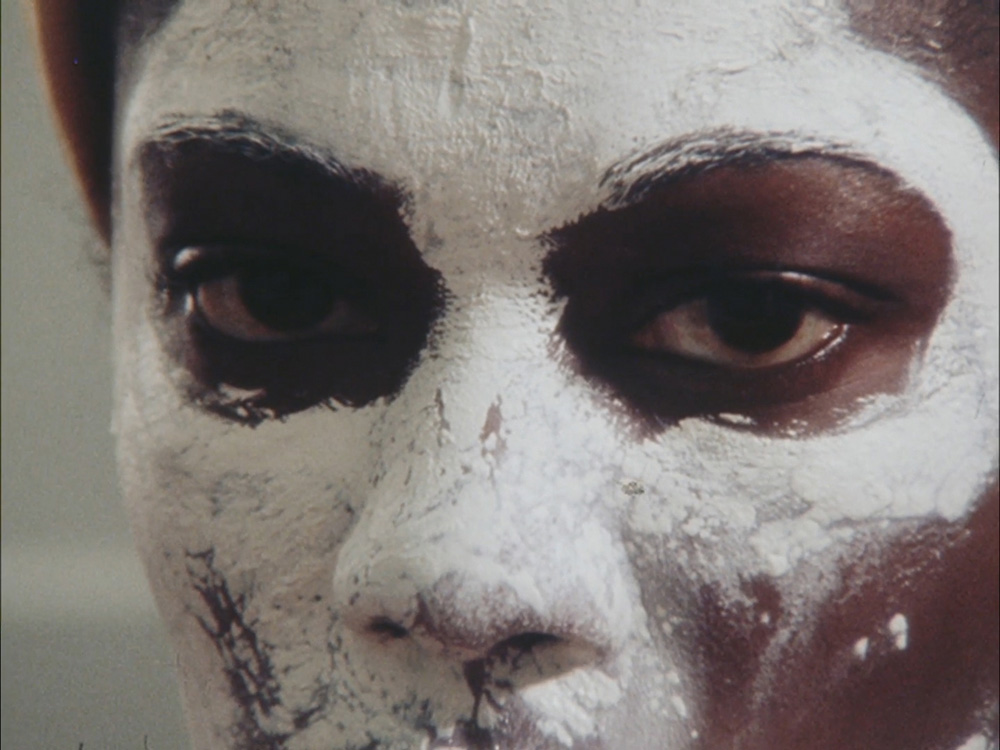
That one is able to speak does not mean that one has a voice. In Voices, Miguel Peres do Santos constructs a comparison between the collective consciousness and a censored archive. Just like in our own lives, we “choose” to keep what we do not want to remember as far from our consciousness as we unconsciously can; the same method we apply on public archival material that we would rather not be confronted with as a societal whole. At the television archive of Beeld and Geluid, Miguel Peres dos Santos and Sharelly Emanuelson found a significant amount of footage relating to migration from the public television memory of the Netherlands. In it, the essence of the Dutch relation to the alleged “other” can be viewed. In Voices Peres dos Santos uses this material to try to find out if the perceived voiceless were really silent, and if those who do not have a voice today are only mute to the ones who refuse to listen.
Miguel Peres dos Santos (Lisboa, 1976) is an independent artistic researcher graduated in his MA in 2012 from the Royal University of the Arts in The Hague, The Netherlands. His work is frequently screened in The Netherlands, but also in Belgium, France, Denmark, Norway, Portugal and the U.S. He lectured in 2012 for the University College Leiden, and is a policy advisor for Foundation Focus. He currently lives and works in The Hague.
Dan Perez, Benjamin Klintoe
Cantine
Fiction expérimentale | hdv | couleur | 32:16 | France | 2013
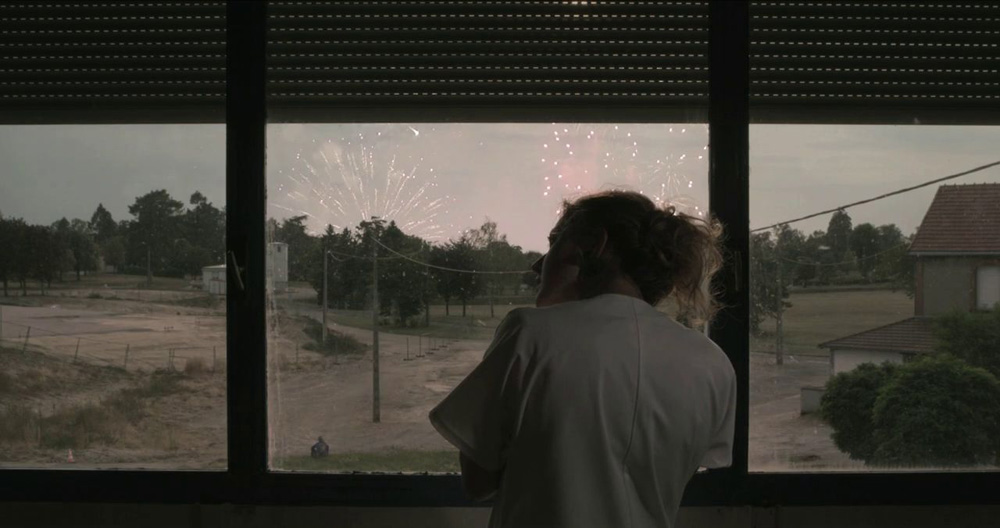
Ismaël est venu en France dans l'espoir de trouver le pardon. Ex-prisonnier, il a quitté les Etats-Unis pour Paris, où il pense trouver calme et paix. Il atterrit finalement dans une zone sinistrée de la banlieue parisienne. Il déambule à la bordure du périphérique et, parfois, il tente d’oublier ses démons dans un sommeil trouble et agité. Des souvenirs de son enfance viennent le hanter alors que la vie en France semble être de plus en plus difficile, entre contrition et abandon.
Dan Perez et Benjamin Klintoe sortent tout juste de la prestigieuse Ecole Nationale Supérieure des Arts Décoratifs de Paris. Ils pratiquent la vidéo ou la photographie dans une pratique régulière et personnelle.
Jenny Perlin
Possible Models
Animation | 16mm | | 10:45 | USA | 2004
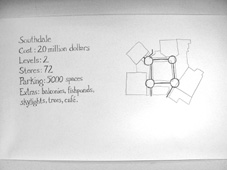
Le film en 16mm fait à partir d'images fixes animées regarde la tentation du capitalisme d?acheter le paradis par trois "études de cas": les Mall of America qui échoua à vivre à la hauteur de son potentiel comme complexe utopique ; le Mall of Dubaï en tant que nouveau super galerie marchande ; et le ??freedom ship??, flottant en autarcie, une commune/communauté basée sur une galerie marchande qui fait des cercles autour des continents. Jeffrey Uslip, The Project, New York, July, 2004
Les films, vidéos et dessinées 16mm de Jenny Perlin travaillent pour et contre la tradition du documentaire, incorporant des techniques stylistiques pour mettre l?accent sur des questions de vérités, d?incompréhensions et d?histoires personnelles. Les films de Perlin ainsi que ses vidéos ont gagné de nombreux prix dans beaucoup de festivals, ont été exposés dans des galeries et musées aussi bien aux USA qu?ailleurs. Perlin est actuellement présentée à la Annet Gelink Gallery à Amsterdam, aux Pays-Bas. Un livre de l?artiste sera publié en 2006 par D.Marzonan à Berlin, mais elle a aussi d?autres publications dans de nombreux catalogues d?expositions récentes.
Jean-baptiste Perret
Le quotidien
Vidéo | hdv | couleur | 5:11 | France | 2025
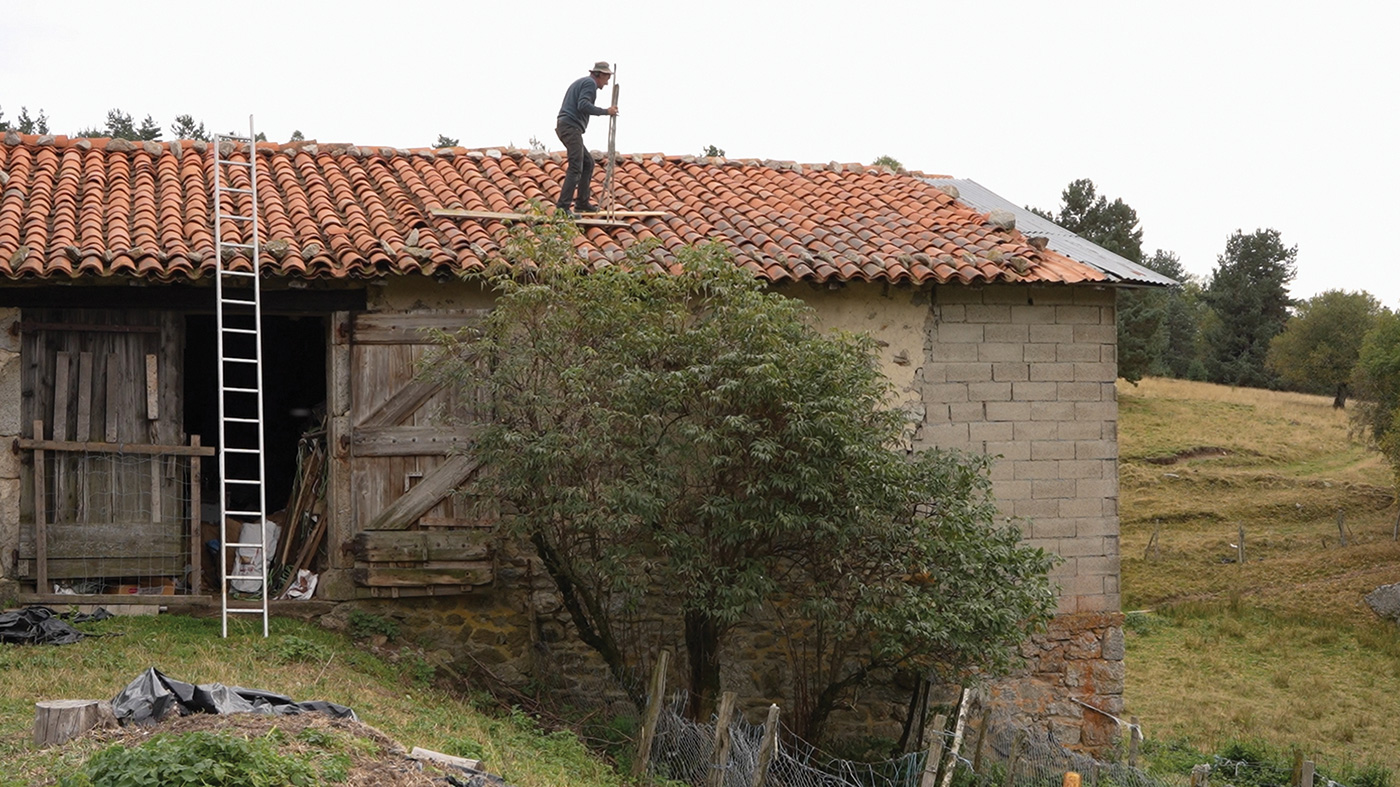
Tourné dans les gorges du Haut-Allier, Le quotidien est le portrait d’un homme qui a fait le choix de vivre seul et à l’écart, dans une cabane à l’orée d’une forêt. Les images sont la capture de ses gestes quotidiens, liés aux besoins essentiels de l’être humain : boire, manger, se laver, réparer, recommencer. "A la manière d’un cinéaste anthropologue, Jean-Baptiste Perret choisit un terrain, souvent rural, et s’y immerge pour de longues périodes. Il noue des relations avec les personnes qu’il y rencontre, filme leur habitat et leurs savoir-faire. Tourné dans les gorges du Haut-Allier, Le quotidien est le portrait d’un homme qui a fait le choix de vivre seul et à l’écart de la société humaine, dans une cabane à l’orée d’une forêt. Le vidéaste capture ses gestes quotidiens, liés aux besoins essentiels de l’être humain : boire, manger, se laver, réparer, recommencer. Le film s’inscrit dans une recherche plus globale sur les parcours de vie marginaux dans des contexte ruraux, qui inventent un autre lien au vivant, au territoire et à l’écologie." (Work Method, Guillaume Désanges et Coline Davenne)
Après des études scientifiques en écologie, Jean-Baptiste Perret a travaillé pendant plusieurs années à la protection de l’environnement au sein de collectivités territoriales. Diplômé en 2018 des Beaux-arts de Lyon, il poursuit son intérêt pour le milieu rural à travers une pratique cinématographique qui prend la forme de films et d’installations vidéo. Sa production est traversée par la question du soin qu’il envisage comme une attention à la vulnérabilité, inséparable de la puissance régénératrice des individus. Sa démarche s’appuie sur des enquêtes documentaires et utilise des méthodes issues de l’anthropologie qui interrogent les critères d’objectivité, plaçant ainsi l’affect au centre même du travail de recherche. Il s’inspire également du courant de la microhistoire qui cherche à se détacher des récits officiels des masses pour se concentrer sur les individus et leur propre vision du monde. Jean-Baptiste Perret filme des personnes qu’il rencontre dans des situations quotidiennes ; il s’intéresse à leur parcours de vie, leur environnement et leurs savoir-faire. À travers divers degrés de mise en scène qui laissent volontiers la place à l’improvisation, récits subjectifs et procédés fictionnels s’entremêlent. Son travail a notamment été présenté à l’Institut d’art contemporain (IAC) de Villeurbanne dans le cadre de la 15ème biennale de Lyon, au Musée d’art contemporain de Lyon, à la fondation d’entreprise Ricard (Paris), au musée de la Chasse et de la Nature (Paris), à la Chapelle Saint-Jacques (St Gaudens), à l’Institut national d’histoire de l’art (Paris), au FID Marseille, au Festival Hors-Pistes Centre Pompidou, aux États généraux du documentaire de Lussas, et plus récemment au 66ème Salon de Montrouge. Jean-Baptiste Perret est représenté par la galerie Salle Principale à Paris.
Naïmé Perrette
Forebear Forward
Vidéo | hdv | couleur | 1:8 | France, Pays-Bas | 2014
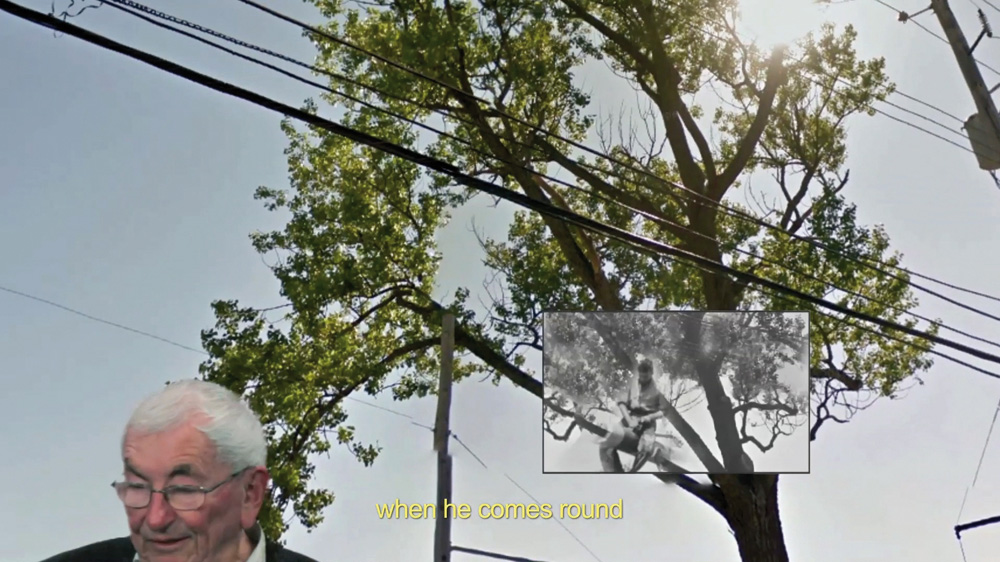
En mêlant mémoires familiales et images collectées sur internet, Forebear Forward et Work Hard Play Hard jouent sur le décalage entre des événements et leurs récits. Au premier plan, un grand-père relate des faits vécus par ses aïeux, accompagné par les commentaires de sa femme en hors-champs. Leurs échanges et l`arrière plan d`images d`archives ou de Google Street View se superposent aux histoires, accordant ainsi plus d`importance au contextes de narrations qu`à leurs sujets. Ces réappropriations de récits commentent avec humour le décalage générationnel, l`appartenance sociale, et le passage du drame à l`anecdote. Dans Forebear Forward,le grand-père se concentre sur une anecdote individuelle cocasse ayant eu lieu lors d`une dramatique explosion, tandis que sa femme désire surtout connaître le bilan des morts et rentrer chez elle. De son côté, la vidéaste invoque google pour inscrire cette histoire dans ses outils quotidiens de compréhension. Pour commenter le décalage social entre des matelots embarqués contre leur gré et le ton bourgeois et relativiste de ceux qui livrent ce récit, Work Hard Play Hard utilise des images de culturistes observés par le public comme s`ils étaient étrangers à leur propre espèce.
Using a range of time-based media including animation, video and installation, Naïmé Perrette in interested in layering narratives and subjectivities. In her documentary based works, she investigate the role of labour in the construction of young adults` identities. She follows individuals whose lives are shaped by physically or emotionally demanding activities to understand how they arrive to their own sense of empowerment. She conducts immersive research, interacting with isolated groups that are distant from her own experience but with whom she shares a larger cultural framework. Through this contrast she investigates systems of value and gender identity, in order to capture the multiple expressions of social relations and their borders. Graduated from the Ecole Nationale Supérieure des Arts Décoratifs of Paris in Cinema Animation in 2012, she was resident at the Rijksakademie van beeldende kunsten in Amsterdam in 2014-2015.

Cesar Pesquera
Círculo Uno
Fiction expérimentale | | couleur | 20:30 | Espagne | 2010
René lives a dull, uneventful life in a subterranean and futuristic world. He is about to be promoted and transferred from Circle One to Circle Six, when a series of mysterious mounds start to appear systematically in his apartment. Circle one`s starting point is Dante?s Divine Comedy combining the notion of Michael Haneke?s thriller with Andrei Tarkovski?s intimacy, albeit clearly influenced by pioneering movie directors like Stanley Kubrick or George Lucas.
César Pesquera is a director, graphic designer and audiovisual artist. He has directed and designed innovative moving image work across a broad spectrum of both commercial and non-commercial strands of the visual arts. His work is a reflection on the grammar of cinema and the relation between visual art and the cinematic experience. His films are screened worldwide on both visual art platforms and film festivals.
Cesar Pesquera Muro
Passer/8
Doc. expérimental | dv | couleur | 15:0 | Espagne | 2006
Passer/8 est un projet expérimental de deux personnes réelles, une fille qui travaille dans une cabine de péage et un gars propriétaire d'un manège. Le projet traite de problèmes comme le mouvement constant et l'immobilité, étant les activités mentionnées plus haut , des méthaphores de tels concepts, tellement liées à la vie ou tout autre phénomène en procédure- qu'il soit vital ou créatif.
César Pesquera a exposé son travail dans différents festivals et évènements internationaux tels que: A/V Festival 2006 (Sunderland, Grande Bretagne), Resfest Spain (Art Futura 2005, Barcelone, Espagne), Optronica 2005 (Londres Grande Bretagne), Dotmov 2004 (Sapporo, Japon), La 8éme Rencontres internationales Paris/Berlin 2004, VIPER 2002 International Festival for Film Video and New Media (Basel, Suisse), Observatori 2002 and 2003. 3rd International Festival of Artistic Research of Valencia, Art Futura 2001. Art and New Technologies Festival (Barcelone, Espagne), Transmissions Festival 004 (Chicago, USA), and SONAR 2001, 2004 and 2005 (Barcelone, Espagne) Il a aussi montré son oeuvre durant des expositions comme Digital Showcase #31. AMOADA, the Austin Museum of Digital Art au Texas (USA). Projectionsareal. ZKM, Zentrum für Kunst und Medientechnologie Karlsruhe (Allemagne). This Is Not My Computer. DA2 Museum Of Contemporary Art (Salamanque, Espagne), ZooRoom. A Room with a view. Resistor Galery (Toronto, Canada) Cesar Pesquera travaille actuellement comme rélisateur de publicités et de vidéo clips. Il est aussi co-producteur de Actop, un studio opérant comme structure ouverte et travaille sur une grande gamme de médias: Typographie, Animation, Mouvement Graphique, Visuel Live et de nouvelles approches de l'Image en mouvement. Il a récemment fini son premier court-métrage Passer/8 et il collabore actuellement avec la british collective D-Fuse sur différents projets. Il est aussi le Directeur Associé de Rojo®Magazine et Directeur Artistique de Ruga®Magazine, un magazine DVD distribué internationalement visant à montrer des oeuvres audiovisuelles, d'artsites du monde entier, non- distribuées. En tant que Shudo, Cesar Pesquera a distribué deux albums pour le prestigieux label Belge Sub Rosa/ Quatermass. Il travaille maintenant sur un nouveau projet sous le nom de Portabot.
Axel Petersén
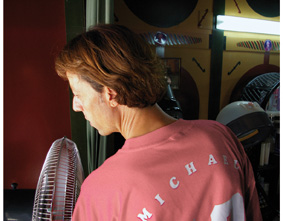
close to god / far from home
Documentaire | dv | couleur | 11:7 | Suède, Palestine | 2009
Close to God / Far from Home (Somewhere in between pop and classical) is a portrait of a place and a state, stuck in between and surrounded by barriers. Close to God / Far from Home is High Class Salon and it?s owner; Palestine`s loneliest lover Tony, hair-dresser and choir-boy. Mr Tony is a proud decendant of Italian 13th century cruisaders and a natural born Germanophile. Mr Tony is also the sexiest man in Bethlehem, forever faithful to Jesus Christ, Richard Clayderman and Kaiser Franz Joseph to whom he built a temple, an altar, a home.
Axel Petersén is a visual artist born in Sweden 1979. He was educated in film at FAMU, Academy of Performing Arts i Prauge and in fine arts at the Royal Academy of Fine Arts in Stockholm. Axel Petersén makes videos, video-installations, still and moving image portraits and block buster movies for the cinema. Axel Petersén works with both ?fiction? and ?documentary?, usually merging the two in to a form were he can take on an active part, and by doing so, being able to push the scenes in the right, or the wrong direction. Right now he?s working on a feature length fiction film; After Eigh, a thrillerish manifestation to the grown-ups that never grew up.

Axel Petersén
Like Father, Like Son, Like Michael Douglas
Vidéo | hdv | couleur | 11:30 | Suède | 2012
In Paul Verhoevens erotic thriller Basic Instinct from1992, Michael Douglas character is put to the test. Is he still living up to the image of his own sexuality? Is he still the sex symbol Michael Douglas, son to the former sex symbol Kirk Douglas? In Like Father, Like Son, Like Michael Douglas Axel Petersén is staging a sexual generation shift. Through a number of scenes he instructs his father, Etienne Petersén to play the main male character while he himself portrays the female counterparts - a father and a son together watching and acting Basic Instinct.
Axel Petersén, born in Stockholm 1979, is a visual artist and filmmaker. He has made feature film (1), short films and video installations that have been shown widely in art and film contexts. He has a MFA from The Royal Institute of Art, Stockholm; he also studied film at FAMU, Academy of Performing Arts in Prague and most recently attended the Mountain School of Arts in Los Angeles.
Axel Petersén
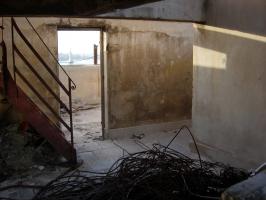
Slumber past Zenith
Fiction | | | 17:5 | Suède, Egypte | 2007
À l?Hôtel Alexandria, à Alexandrie, l?Europe meurt lentement ; George a un Alzheimer, Sami s?occupe en organisant sa soirée d?adieu, et le fossoyeur Salah aide Madame avec les préparatifs de son dernier voyage.
Axel Petersén est né en 1979. Il a étudié l?histoire de l?art à la Lund University de Stockholm (Suède), puis à la FAMU de l?Académie Tchèque des Arts Musicaux de Prague (République tchèque) ainsi qu?au KKH, l?Université Royale des Beaux-Arts de Stockholm.
Axel Petersén, in co-operation with Arild Andersson
The Tracks of my Tears
Art vidéo | 0 | couleur | 10:0 | Suède, Iraq | 2010
Saddam Hussein?s palace is looted in Baghdad 2003. A red Ferrari Testarossa disappears from his garage. Years pass by and cars from the same garage are found around the world; some crashed, some in mint condition. The Testarossa is still out there, ghostriding through the neverending desert.
Axel Petersén, born in Stockholm 1979, is a story teller and a visual artist. Educated at FAMU, Academy of Performing Arts in Prague and took his MFA at KKH, the Royal Institute of Art in Stockholm.
Dirk Peuker, Bettina NÜRNBERG
Die Amerikanischen Häuser
Doc. expérimental | 16mm | couleur | 20:0 | Allemagne | 2010
The film ?The American Houses? examines the buildings of the nearly forgotten german architect, Thilo Schoder. Schoder, who had studied under Henry van de Velde in Weimar, was classified as an architect of ?The New Objectivity? movement of the 1920s. Schoder built only a few houses in the 8 years period, from 1923 to 1931, in small villages from eastern Germany to the Czech Republic. When the Nazis took power Schoder, accused of being a socialist, was refused any further building contracts, forcing him to emigrate to Norway. In ?The American Houses? the condition of the buildings filmed range from highly renovated to abandoned and dilapidated. The surviving examples are not portrayed as technical depictions, but as subjective sensation.
Dirk Peuker born in 1970 2000-2005 University of Arts Berlin, Master of Fine Arts, Experimental Film and Media Department Mentor: Hartmut Bitomsky, Heinz Emigholz, Thomas Arslan 2006 Artist Grant from the Nordmedia Film Foundation and the Hannover Region Cultural Foundation 2007 DAAD Artist Grant 2008 Postgraduate Artist Grant Free State of Thuringia 2009 NaFÖG Grant from Berliner Senat since 2009 assistant professor for film and video Weißensee/School of Art Berlin Bettina Nürnberg born in 1976 2002-2007 University of Fine Arts Hamburg, Master of Fine Arts, Film Department Mentor: Wim Wenders, Gerd Roscher 2007 Künstlerinnenförderung ?artist film fond from Berliner Senat 2008 Production grant from Thuringia Region Cultural Film Foundation 2009 Stiftung Kunstfond, Artist Grand Germany
Dirk Peuker, BETTINA NÜRNBERG
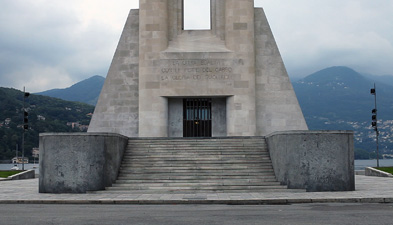
Flat Roofs for Mussolini
Doc. expérimental | 16mm | couleur | 20:0 | Allemagne, Italie | 2012
The experimental film work ?Flat Roofs for Mussolini? talks about the Italien Rationalism and Fascist architecture at Lake Como and the buildings by Guiseppe Terragni, who was an important pioneer of this style and tried to persuade the fascist regime to adopt his architecture as an official style. During a creative period lasting only 13 years, Terragni produced a body of work unique in terms of consistency and density. His buildings conform to the modern and are characterised by a reduction to elementary geometrical basic forms. While his buildings now serve as an important reference for architects such as Peter Eisenmann, they are also glorified and their political dimension is downplayed. (Text by Magdalena Magiera)
Dirk Peuker born 1970 in Friedrichroda, Germany, lives and works in Berlin. He studied Experimental Film at the university of the Arts Berlin since 2009 he teaches Film & Video at the Berlin Weißensee academy of art. 2006 Residency grant at the Villa Minimo, Hannover 2007 DAAD travel grant 2008 postgraduate grant of the Free State of Thuringia, 2009 NaFöG grant by the Berlin City Council Bettina Nürnberg born 1976 in Mannheim, Germany, lives and works in Berlin. She studied Film at the University of Fine Arts Hamburg 2006-07 Funding for woman artists 2008 Film Culture Fund of the Free State of Thuringia 2009 Stiftung Kunstfonds, artist fund