Catalogue > Faire une recherche
Résultats pour : Tout le catalogue

Kevin Jerome Everson
Tygers
Film expérimental | 16mm | noir et blanc | 2:0 | USA | 2014
Tygers (2014) is a glance at the fancy moves by the Mansfield Senior High football team in Mansfield, Ohio, the alma mater of the filmmaker.
Kevin Jerome Everson: Filmmaker Biography Kevin Jerome Everson (b.1965) was born and raised in Mansfield, Ohio. He has a MFA from Ohio University and a BFA from the University of Akron. He is currently a Professor of Art at the University of Virginia, Charlottesville. Everson was awarded the prestigious 2012 Alpert Award for Film/Video and was the subject in spring 2012 of a mid-career retrospective at Visions du Reel, Nyon Switzerland, a solo exhibition at the Whitney Museum of American Art in 2011 and a retrospective at Centre Pompidou in 2009. He is slated for a solo exhibition at the Cleveland’s MoCA in late 2014. His films have screened at 10 consecutive IFFR editions, since 2005. His artwork--paintings, sculptures, and photographs--and films, including six features (Spicebush, 2005; Cinnamon, 2006; The Golden Age of Fish, 2008; Erie, 2010; Quality Control, 2011; The Island of St. Matthews, 2013) and over 100 short form works, have been exhibited internationally. From April-September 2011, a solo exhibition of 17 short form works, More Than That: Films of Kevin Jerome Everson, was featured at the Whitney Museum of American Art. A 3 DVD Boxed Set, Broad Daylight and Other Times, was released by Video Data Bank (U.S.) in 2011. The feature film Quality Control (2011) was included in the 2012 Whitney Biennial and the short Emergency Needs (2007) in the 2008 Whitney Biennial. Everson has received numerous fellowships and academic awards including the Guggenheim, NEA, American Academy Rome Prize, and grants and residences from Creative Capital, Hallwalls Contemporary Arts Center, Yaddo and MacDowell Colony.

Kevin Jerome Everson
Workers Leaving the Job Site
Film expérimental | 16mm | couleur | 6:50 | USA | 2013
Workers Leaving the Job Site is another take on the Lumiere Brothers classic 1895 film. Shot in Columbus, Mississippi, the hometown of the filmmaker's parents.
Kevin Jerome Everson (b.1965) was born and raised in Mansfield, Ohio. He has a MFA from Ohio University and a BFA from the University of Akron. He is currently a Professor of Art at the University of Virginia, Charlottesville. Everson was awarded the prestigious 2012 Alpert Award for Film/Video and was the subject in spring 2012 of a mid-career retrospective at Visions du Reel, Nyon Switzerland, a solo exhibition at the Whitney Museum of American Art in 2011 and a retrospective at Centre Pompidou in 2009. He is slated for a solo exhibition at the Cleveland’s MoCA in late 2014. His films have screened at 10 consecutive IFFR editions, since 2005. His artwork--paintings, sculptures, and photographs--and films, including six features (Spicebush, 2005; Cinnamon, 2006; The Golden Age of Fish, 2008; Erie, 2010; Quality Control, 2011; The Island of St. Matthews, 2013) and over 100 short form works, have been exhibited internationally. From April-September 2011, a solo exhibition of 17 short form works, More Than That: Films of Kevin Jerome Everson, was featured at the Whitney Museum of American Art. A 3 DVD Boxed Set, Broad Daylight and Other Times, was released by Video Data Bank (U.S.) in 2011. The feature film Quality Control (2011) was included in the 2012 Whitney Biennial and the short Emergency Needs (2007) in the 2008 Whitney Biennial. Everson has received numerous fellowships and academic awards including the Guggenheim, NEA, American Academy Rome Prize, and grants and residences from Creative Capital, Hallwalls Contemporary Arts Center, Yaddo and MacDowell Colony.

Nir Evron
A Free Moment
Film expérimental | 35mm | noir et blanc | 4:0 | Israel | 2011
" A Free Moment was made in Tell el-Full in Jerusalem. The site, which before 1967 was in Jordan, had been chosen as the location for King Hussein?s summer palace. The framework of the palace was constructed before the occupation of East Jerusalem after the Six Day War and it remains a kind of ruin to this day. Evron gained access to the site and eventually determined to make a film within the building with a camera which would simultaneously perform three operations: it would pan in a 360 degree circle; it would tilt in another 360 degree circle, and it would undertake these two motions while traveling along a dolly track on a north-south axis. In other words, the camera would exhaust the repertoire of its mechanical motions and ?see? everything possible around it. The film also would last four minutes, being the length of one 400 foot film cartridge. In order to make this work, Evron worked with technical advisors to construct a track within the shell of the abandoned 1967 palace, and to programme the motions of the camera. The resulting film begins simply enough, with a view over Jerusalem. It is a view from a summit, and one we associate with notions of control and ownership ? the kind of view that we could well expect a king to enjoy from a palace. We would not be surprised if this view were accompanied or followed by a panoramic movement, so that the landscape all around was surveyed, but as Evron?s camera begins its journey, a completely unfamiliar motion begins since the camera starts looking up and around while moving backwards. Soon enough it points towards the rough concrete blocks of the floor above it, which, because of the way they are filmed, seem to lose their material identity. It seems as if we are looking down at a strange landscape, rather than upwards at rough breezeblocks. A few seconds later, the initial viewpoint out to the city reappears, but this time it is inverted. As the camera continues its backwards journey, it begins to record the track on which it is moving and the floor beneath the track, another rough surface that appears like a desert or lunar surface. Eventually the motion stops with a return to the orientation with which the film opens. Evron?s film relates to the late 1960s in more ways than the date of the palace: this was the moment of structuralist film, when artists such as Michael Snow, Anthony McCall, Paul Sharits and others began to interrogate the apparatus of cinema, looking at the nature of a zoom or panning movement, the conical shape of a projected film, and the material properties of celluloid. A Free Moment is deeply indebted to this legacy and throughout the film, however unworldly the motion of the camera, Evron emphasizes the construction that has to be in place for this motion to occur: the camera necessarily records the track along which it moves, and even the mechanism between it and the track. But what is much more interesting than its structuralist credentials is the way Evron deploys these formal ideas in order to re-imagine the site in which he works. Through its elaborate structures, the film produces another way of seeing and thinking about the space in which it is set. We are not invited to ?see? Jerusalem as the Jordanian king once hoped to see it, nor as many Israelis now hope to see it, panning around a ?united Jerusalem?, all of which is hoped will remain under Israeli control. Instead, we are invited to loosen our ways of looking at architecture and landscape, to turn our way of looking on its head. The invitation and utopianism of this work is the idea that this way of looking might mean thinking about the city and its future in completely new ways. " excerpt from a text by Mark Godfrey
Nir Evron, born 1974 is a video artist and film maker. He graduated from the Bezelel Academy of Art and Design in Jerusalem in 2001 and completed a MFA degree at The Slade School of Art in London in 2005. Since then he exhibited extensively in Europe and Israel. He participated in the 2010 Berlin Biennale, The Jerusalem Film Festival (2011) where he won The Ostrovsky Family Fund Award for his piece `A Free Moment`. His solo Show `Here-Afrer` at the Tel Aviv Center for Contemporary Art was received with critical acclaim. His video works and film were purchased by museums and private collections, among them The Israel Museum, Jerusalem, The Tel Aviv Museum and The Zabludovicz Collection, London. He teaches video art at the Bezalel Academy and Hamidrasha College.

Simo Ezoubeiri
Ladder
Fiction | hdv | couleur | 7:26 | Maroc | 2015
After living together for more than thirty year, a woman decided to leave her husband suddenly. The man sits in grieve contemplating what’s next as he looks back.
After his fellowship at the prestigious LaRochelle Film Festival in 2002, Simo Ezoubeiri directed two short films ( Terrace & Under the table) that both became an international artistic hits, being widely screened in Santa Monica Art Center in Barcelona, LaSala Una in Roma and chosen as the best film of the month by videoart.net editor in New York. In 2007, Simo moved to live and work in Chicago and directed a short thriller “Popcorn” that received The Second Best award by Chicago Filmmakers. Between 2009 and 2014, Simo received wide acclaim for his film trilogy (The Daily Show, Inner Marrakech and A Day in Life). These projects were a representation of artistic themes on experimental films particularly his portrayals of the Marrakech he knows and loves. In June 2015, He wrote, edited and directed his first narrative film “Ladder”. The film has already received accolades in accomplished film festivals such as les Inattendus Film Festival in Lyon, Wiper Film festival in New York and Goldensun festival in Malta.
Bojan Fajfric
Greetings from Kosovo 1989
Doc. expérimental | mov | couleur | 13:39 | Slovénie, Pays-Bas | 2025
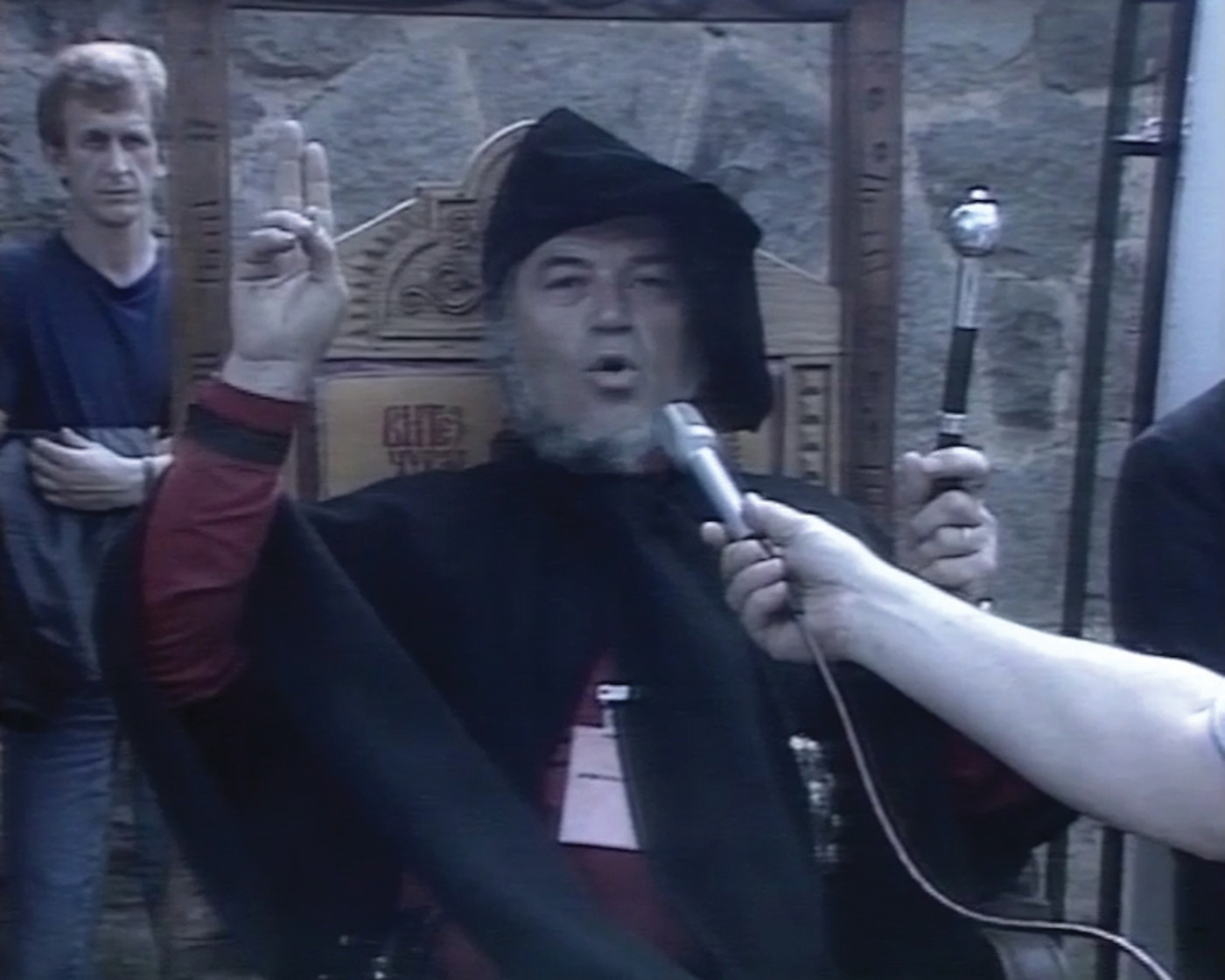
Greetings from Kosovo 1989 (2025) Single-channel video, (DV Pal 4:3), 13:39 min. Greetings from Kosovo 1989 s’appuie sur des images d’archives du rassemblement de 1989 au Kosovo, rendu célèbre par le discours de Slobodan Miloševi?. S’adressant à une foule de plus d’un million de personnes, il prit la parole dans un contexte de tensions ethniques croissantes au Kosovo et d’agitation politique en Yougoslavie. Sa mention de « combats armés » dans l’avenir de la Serbie a fait de ce discours un moment tristement célèbre, souvent considéré comme annonciateur des guerres yougoslaves. Reformulant et subvertissant le format du reportage télévisé, l’œuvre met en évidence l’hystérie de masse, la folie et la banalité de l’iconographie nationaliste et religieuse. À la lumière des événements récents, revisiter cet épisode — une composante indissociable d’une histoire qui a profondément marqué la fin du XXème siècle — constitue un geste crucial, tant cette histoire demeure intensément vivante.
Bojan Fajfri? (Belgrade, ex-Yougoslavie) est un artiste et cinéaste basé aux Pays-Bas depuis 1995. Diplômé de la Royal Academy of Fine Arts de La Haye et ancien résident de la Rijksakademie à Amsterdam. Travaillant principalement avec les images en mouvement et la photographie, il crée des récits stratifiés qui interrogent l’impact de l’histoire sur les trajectoires individuelles. Son intérêt se porte sur la relation poreuse entre la mémoire et l’image en mouvement. Son travail a été présenté dans des institutions telles que le Palais de Tokyo (Paris), le Baltic Centre for Contemporary Art (Gateshead), le San Telmo Museum (Saint-Sébatien), De Appel (Amsterdam), le Belgrade October Salon, la NGBK (Berlin) et le Center for Cultural Decontamination (Belgrade). Ses films ont été largement diffusés dans des festivals internationaux, parmi lesquels le International Film Festival Rotterdam, le International Short Film Festival Oberhausen, le Vienna International Film Festival, DOK Leipzig, le Sharjah International Film Festival, le Tempo Documentary Festival (Stockholm), les Rencontres Internationales Paris/Berlin/Madrid, et le Impakt Festival (Utrecht).

Bojan Fajfric
Theta Rhythm
Fiction expérimentale | hdcam | couleur | 17:0 | Slovénie, Pays-Bas | 2010
On September 24th 1987, the Serbian League of Communists in the former Yugoslavia held its 8th Session. The 8th Session was a meeting in which Slobodan Milosević won a significant vote over his main political rivals on his rise to power. The whole event was broadcast live on Yugoslav television. The 8th Session was an historical turning point, starting an era of ethnic conflict which ultimately lead to the break-up of Yugoslavia . Theta Rhythm is a meticulous reconstruction of that day, from the perspective of one of the administrators of the 8th Session, Mirko Fajfrić. Mirko is interpreted by his son Bojan Fajfrić, the director of this film.
Bojan Fajfrić was born in 1976, in Belgrade, Yugoslavia. His professional development has not been linked to Yugoslavia, which he left in 1995, when he went to study visual arts in the Netherlands. He graduated from the Royal Academy in The Hague and was the resident of the Rijks Academy in Amsterdam. However, in his works he has always referred to the country he grew up in, its political inheritance, as well as other social circumstances. His work presents a certain way of looking at history, one which stands at the intersection of personal memories, collective historical consciousness and the inevitable course of events. He uses mostly video installations as a form of expression. His works have been exhibited in many art galleries/spaces and museums: the Salon of the Museum of Contemporary Art, Belgrade; the Tirana Contemporary Art Biennial; De Appel, Amsterdam; MUHKA, Antwerp; Tim Van Laere Gallery, Antwerp; ARCUS, Japan; Spaport, Banja Luka, October Salon, Belgrade. Film Theta Rhythm was shown at the International Film Festival Rotterdam, International Short Film Festival Oberhausen, Seoul international NewMedia Festival, Viennale-International Film Festival Vienna, Human Rights Film Festival PRAVO LJUDSKI Sarajevo, Noordelijk Film Festival Leeuwarden, Impakt Festival Utrecht and Film Institute Netherlands.
Ivan Faktor
DAS LIED IST AUS
Doc. expérimental | dv | couleur | 18:0 | Croatie | 2008
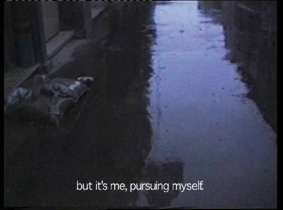
``He has no coherent idea of himself, but all that he remembers is somehow connected to the city, although he has never lived, nor was born in the city, nor did he die in the city, or anybody else, as far as he knows. `` (Georgio Manganelli) Documentary scenes of wartime Osijek and a sound recording of Fritz Lang`s M create a macabre portrait of the city devastated by irrational forces and an invisible killer.
Born in Crnac (Croatia) in 1953. He is working on experimental film, photography, video, and video-installations. From 1975 to 1977 he was the editor of The Film-lovers panel in Osijek, than went on to direct film program of the Students` Centre (1981-1988), and since 1992 he has been the editor of the film program of Osijek Cinema. He has been shooting films and video works since 1975. Since 1979, he has regularly participated in conceptualist activities and exhibitions, held video and film performances, built installations and made multimedia presentations. In 1995, he participated at the Venice Biennale (A Case/At Home2), and in 2002, he represented Croatia at the 25th biennale in Sao Paolo. He won numerous awards, including the Grand Prix at 11th Days of Croatian film, the 2002 "Vladimir Nazor" award, and the Grand Prix of the 39th Zagreb salon in 2005. He was the founder and manager of the "Kazamat" gallery in Osijek (2001-2004) and organizer of the Performans art festival since 2001. Lives and works in Osijek.
Ivan Faktor
Kangaroo court
Vidéo | dv | couleur et n&b | 7:40 | Croatie | 2007
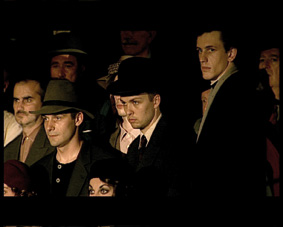
Kangaroo Court is the second part of the multimedia reconstruction of the sequence from Fritz Lang`s famous movie M (1931), which began with the photographic replica of the scene of the illegal trial of the psychopathic murder in Berlin underground. In the first phase, the Berlin half world was revived by two hundred costumed actors, rounded up in a devastated former Zagreb factory. Two film cameramen kept a look out on the process of their costumed retro-initiation to Lang`s universe, which was in the film ?reconstruction of reconstruction? additionally underlined by the counter-point of documentary material and fragments from the sound track with dialogues from M.
Born in Crnac (Croatia) in 1953. He is working on experimental film, photography, video, and video-installations. From 1975 to 1977 he was the editor of The Film-lovers panel in Osijek, than went on to direct film program of the Students` Centre (1981-1988), and since 1992 he has been the editor of the film program of Osijek Cinema. He has been shooting films and video works since 1975. Since 1979, he has regularly participated in conceptualist activities and exhibitions, held video and film performances, built installations and made multimedia presentations. In 1995, he participated at the Venice Biennale (A Casa/At Home2), and in 2002, he represented Croatia at the 25th biennale in Sao Paolo. He won numerous awards, including the Grand Prix at 11th Days of Croatian film, the 2002 "Vladimir Nazor" award, and the Grand Prix of the 39th Zagreb salon in 2005. He was the founder and manager of the "Kazamat" gallery in Osijek (2001-2004) and organizer of the Performans art festival since 2001. He lives and works in Osijek.

Ivan Faktor
PUSTARA
Film expérimental | betaSP | couleur | 26:0 | Croatie | 2010
?Pusta? or wasteland (aftre the Hungarian word ?puszta?), designates a spacious, level steppe in Hungary; it is a spacious, lever terrain which is not worked, but used for raising livestock, horses and pigs in the open. The puszta is a form of organised, planned, collective habitation, specific to Hungary, Slavonia and Baranja, constructed in 18th and 19th centuries on the nedless Slavonian plains owned by well-to-do aristocratic families. The wasteland was always inhabited by those who had no land, settlers, rstless spirits, wanderers unable to stay in one place, but there were those who stayed in the wasteland for generations. The film was shot by hand-held camera, and is all in subjective takes. The main ?character? in the film is light. Light reveals characters and objects, without care for the composition of the shot ou using artificial lighting. Simultaneously with the shooting of the refraction of light, the spreading ? ringing of sound is recorded. And the most important ? silence, because in the wasteland, on that ?island? with no visiable boundary between the sky and the eart, in that prison with no fences, silence is louder than the noise of any city.
Faktor was born in Crnac, Slavonia, in 1953. He deals with experimental film, photography, video and video installations. He has shot films and subsequenly videos ever since 1975. Since 1979 he has taken part in conceptualist actions and exhibitions, film and video performances, mounted installations and done multimedia shows. In 1995 he took part at the 46th Venice Biennale (A Casa/At Home 2) and in 2002 was representative of Croatia at the 25th Biennial in Sao Paolo. He has won numerous prizes and awards, including the Grand Prix at the 11th Croatian Film Days, 2002, the annual Vladimir Nazor Prize for film, 2002, and the Grand Prix of the 39th Zagreb Salon, 2005. From 1975 to 1977 he was the editor of the panel of the Film Lovers Club in Osijek; from 1981 he ran the film programme at the Student Centre, and from 1992 to 2006 was the editor of the film programme of Osijek Cinematography. He is the founder of the Kazamat Gallery in Osijek and managed it from 2001 to 2004, and has run the Performance Art Festival since 2001. Since 2001 he has been the director of Osijek?s City Galleries. He lives and works in Osijek.

Fantastic Little Splash Group, Oleksandr Hants and Lera Malchenko (Fantastic Little Splash Group)
See also: a set of compressed images and feelings
Installation multimédia | mp4 | couleur | 0:0 | Ukraine | 2023

Mahmoud Farag
04-02-2011
Vidéo expérimentale | hdcam | couleur | 5:0 | Egypte | 2011
Synopsis: Les coups sur la porte ne révélaient pas ce qui se cachait derrière... J`aurais souhaité être mort, mourir entre leurs mains, avant que la peur ait raison de moi.
My name is Mahmud Farag, I am 28 years old, from Alexadria, Egypt. In 2005 I graduated from the faculty of Education in Arabic Language and Education at Al-Azhar University in Cairo. My interest in cinema started when I was a teenager but as a student in Al Azhar school I was not allowed to study cinema. So, in these years I cultivated my passion for cinema by reading and watching movies, and attending workshops (Script writing workshop at French Cultural Centre in Alexandria, 2004). In 2005 I made my first digital video experiment, which is film Fabrica, based on the debut poetry collection Bel-Amsy Faqadtu Zirran (Yesterday I Lost A Button) written by the Alexandrian poet Tamer Fathy (Sharqyat, Cairo, 2005) In 2006 I wrote and directed the film Kurras Kharayt (Blank Note), which tells about the inner thoughts of an intellectual, his relation with girl-friend and his friends, and his inner conflict with himself and the society.Both the films are mini-dv, their duration is 15 minutes and have been shown in Cairo and Alexandria in the Cinema Cultural centre, Syndicate of Journalists and at the Indipendent Film Cairo Festival. In 2006 I enrolled the High Cinema Institute and I obtained my second degree in Scriptwriting and Cinema Studies in 2010. During this four year study period I wrote and directed some documentaries (Nubat Sahyan (Sudden wake) and Al-dar darak (The center is yours). I also wrote scripts for the graduation movies of some students from the direction department in the academy. My last scriptwriting work is "Pale Red", which has been awarded with many prizes inside and outside Egypt ( Best short film prize for in Alexandria International Film Festival (2010) - Best short film prize in Carthage Film Festival, Tunis (2010) - Best short film prize in Kazan International Film Festival, Russia (2010)- Best film in the Independent film festival at the French Cultural Centre in Cairo, 2011). In the last year I also worked as Assistant Script-writer of Dr. Rafiq El-Sabban for the next-coming film As-Samt (The silence) and for the next-coming series Akhir Ayyam Ghrnata (The last days of Granada). This year, I also had a very interesting experience from my work as assistant with two photographers. The first one wanted to meet the new generation of the revolution, the youth of the new Cairo. My second work was about the families of the martyrs of the revolutio. Beside my interest in cinema, I also have a passion for visual arts. Painting, to me, is the unloading extra energy process, and the teacher of patience. Later I started making pieces of arts from old garments and unused plastic pieces. In May 2010, I was awarded the best painting prize in the ?Funny Nature? artistic competition organized by the association L?Arbre des égrégores, Paris, France.
Antonello Faretta
Just say no to family values
Vidéo expérimentale | dv | couleur | 4:37 | Italie | 2006
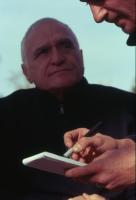
John Giorno (né en 1936), poète de la beat generation, récite passionément son poème «Just say no to family values» (1995). Il essaye avec une grande détermination de persuader son auditeur de profiter de la vie au maximum de son potentiel, et de ne pas se satisfaire avec moins. Dans les mots de Giorno, cela donne : « Le tabac est une substance sacrée pour certains, donc même si vous avez arrêté, faites preuve d?un peu de respect. L?alcool est complètement génial, célébrons les glorieuses vertus de la pinaille, et j?ai passé un bon moment avec toi. » Cependant, ses mots sont perdus pour la frêle petite femme qui regarde distraitement ce poète gesticulant, cet étranger. Elle est assise en face de son habitat décrépi, le rideau voguant de temps à autre au gré du vent. Dans ses vêtements dernier cri, Giorno est comme un cheveu dans la soupe au milieu de ce décor simple. La femme et le petit hameau de Tursi représentent précisément tous ces standards et valeurs qui devraient être, pour Giorno, évacués avec l?eau du bain. La région de Basilicata, où se situe Tursi, est sa terre d?origine: ce poète italo-américain qui a fait partie de la scène underground des années 60, jouait le premier rôle dans Sleep, d?Andy Warhol (1963), et fréquentait des personnes comme William S. Burroughs. John Giorno se donna pour mission d?amener la poésie parmi les gens dans l?esprit de la production de masse. Les images lucides d?Antonello Faretta nous montrent sans équivoque que la passion de Giorno pour la poésie est toujours bien vivante.
Antonello Faretta est né en 1973 à Potenza. Il est photographe, réalisateur et producteur. Il a collaboré avec des réalisateurs comme Abbas Kiarostami, Marco Bellochio, Saverio Costanzo, Giacomo Campiotti, Peter del Monte, Babak Payami. Il travaille également pour la Rai, Sat Arte et T9. Il réalise de nombreux films, parmi lesquels Lei lo Sa, Da Dove Vengono le Storie, Il vento, la Terra, Il Grasso sulle mani, 20Venti, Silenced Thoughts, et Just Say No to family values. Ses oeuvres ont été montrées dans de nombreux festivals, chaînes de télévision, galeries et musées de part le monde, et ont reçu de prestigieus prix. En 2002, Antonello Faretta fonde une production indépendante, Noeltan Film, qui produit ses propres oeuvres comme celles de jeunes artistes internationaux : presque 40 films ont été ainsi produits jusqu?à ce jour. En 2004, il fonde l?Atelier del Cinema di Potenza et le festival international du film de Poteza dont il est le directeur, et pour lequel il a reçu en 2006 le prestigieux Targa per Meriti Culturali du Président italien Giorgio Napolitano.
Nooshin Farhid
Conic study 2
Art vidéo | dv | noir et blanc | 2:30 | Royaume-Uni | 2010
Conic Trilogy Study 2 explores the idea of machinery through its rhythmical and continuous production processes, the early association with a human being is quickly supplanted by the power and energy of the heavy machine. Filmed in black and white there is a poetic quality to the images which is added to and emphasized through the early slowing down of the movement. The viewer is lured into this sense of the ?romance? of the machine and its potential for endless production and the efficiency to manage that production without human interference. However the outcome of this reliance on the mechanical is answered in the latter part of the film. This is a powerfully metaphorical work that relates to contemporary political systems and movements.
Nooshin Farhid was born in Tehran, Iran and lives in London. She has been involved in a number of exhibitions, screenings and festivals both nationally and internationally. Nooshin Farhid?s video works whilst employing different subjects and scenarios have a connecting thread, a commonality, namely there is a certain kind of agitation, a restlessness, a sense of things not being right. This agitation and an unwillingness to settle for what is ?on offer? ( this is the way things are ), reflects upon the current state of things socially, politically and ideologically. Though not overtly political, for such a strategy inevitably enables privileged authority to manipulate the artist into the cul de sac of irrelevance, this work continually picks away at those familiar stabilising forces we encounter on a daily basis both within the social space of the everyday but also within the domain of contemporary art itself. Farhid?s work is eclectic and conceptually nomadic, she uses the camera as a visual notebook collecting fragments of encounters, events, chance meetings that collectively question the incessant drive towards normality and conformity through the pressure of state surveillance.

Nooshin Farhid
CRISS CROSS
Vidéo | dv | couleur | 7:30 | Royaume-Uni | 2009
Criss Cross opens with a single image of a parked car lit only by a street light, although this ?minimal? scene is countered by the imposition of redness, infa red or night vision. This opening image in many ways sets the agenda for what is to follow, the colour red coupled with the overpowering element of water, a double saturation both literally and metaphorically. Criss Cross appropriates images from particular areas of media representation, the video takes genres that would appear to come from areas that might be generally referred to as ?low life? or an underworld of sexual exploitation and criminality. What follows from the opening sequence is a series of image clips, fragments, as if wrenched from more prolonged narrative sources, these visual fragmented elements have in common the night, what goes on in the night, what goes on in the ?after dark?. There is an almost subterranean quality to the series of rolling images, cars being broken into, sex chat line conversations, clandestine meetings in dark streets, empty car parks as sites of secret exchange and the imposing sounds and images of law enforcement, however the latter seem only on the periphery of this darkness.
Nooshin Farhid was born in Tehran, Iran and lives in London, she has been involved in a number of exhibitions, screenings and festivals internationally. She also co curated a number of exhibitions including ?Use this kind of Sky? which manifests as gallery show, video installation, radio broadcast, film/video screening and publication (www.nooshinfarhid.com). Nooshin Farhid?s video works whilst employing different subjects and scenarios have a connecting thread, a commonality, namely there is a certain kind of agitation, a restlessness, a sense of things not being right. This agitation and an unwillingness to settle for what is ?on offer? ( this is the way things are ), reflects upon the current state of things socially, politically and ideologically. This work continually picks away at those familiar stabilising forces we encounter on a daily basis both within the social space of the everyday but also within the domain of contemporary art itself. Farhid?s work is eclectic and conceptually nomadic, she uses the camera as a visual notebook collecting fragments of encounters, events, chance meetings that collectively question the incessant drive towards normality and conformity through the pressure of state surveillance. At the same time she appropriates that other form of ?making dumb? the popular media ? soaps, reality TV, Bollywood, MTV. This raw material is savagely and uncompromisingly edited and undergoes a form of post production, collaged fragments are welded together, each one activating and qualifying its predecessor. This process produces a contemporary surreal space that re-presents the familiar into that which is astonishing and invites the viewer to reconsider.
Nooshin Farhid
Sleepwalker
Art vidéo | dv | couleur | 6:0 | Royaume-Uni | 2008
« Sleepwalker » se concentre sur un unique personnage, un jeune homme que l?on voit errer dans des espaces urbains banals, apparemment à la dérive, sans aucun but et seul. Toutefois, cette errance fait rapidement place à la prise de conscience qu?il existe un courant sous-jacent d?une autre sorte d?espace psychologique. Le jeune homme commence à étudier son environnement, en touchant les choses, en testant leurs surfaces comme s?il n?était plus certain de leur stabilité matérielle, comme si elles contenaient quelque de chose de menaçant à son égard. Ce faisant, il déclenche un autre type de réalité qui peut être vue comme un flash-back, comme le souvenir d?expériences antérieures ou comme une certaine forme de névrose. Ces images menaçantes, filmées à travers un filtre bleu, proposent un espace liminal de paranoïa, d'anxiété, ou peut-être de fantasmes ; s?instaure alors, de façon progressive mais insistante, une fracturation et un flou entre la notion de réalité et l?espace de la psychose, comme si les règles du jeu qui déterminent notre compréhension du fonctionnement des choses étaient en train d?être brisées.
Les vidéos de Nooshin Farhid s?approprient différentes situations narratives et genres cinématographiques, en les re-présentant dans des scénarios nouveaux et dérangeants. Son point de départ est souvent l'ordinaire, le banal ou le culturellement familier. Elle observe attentivement ces événements banals, en les isolant et en les montant de telle façon qu'il existe une interaction entre la lucidité et la raison, l'obsession et la folie. Structurellement, ces vidéos apparaissent souvent fragmentées et incohérentes. La reconnaissance d?un genre cinématographique est perturbée, de manière à éviter continuellement la sécurité d?un territoire narratif familier, ce qui ne permet donc pas au spectateur de contrôler pleinement ce qu?il est en train d?éprouver. Mais, tout au long de ce voyage « schizophrène », une certaine logique du sens trace son chemin à travers la complexité de l??uvre.
Harun Farocki
Counter Music
Doc. expérimental | dv | couleur et n&b | 25:0 | Allemagne, France | 2004
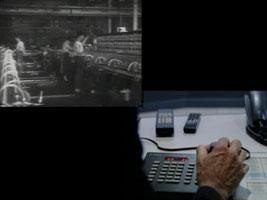
"Aux ouvriers d?une société industrielle se substituent les technocrates issus de l?ère informatique. La vision de la gestion des moyens de transport est saisissante : les employés des années vingt s?occupant de la surveillance des transports ferroviaires sont remplacés par des caméras vidéos reliées à des centres où un personnel surveille les écrans et analyse la multitude d?images reçues. Prenant la suite de L?homme à la caméra, les images sans cameraman de Farocki témoignent d?un regard critique sur notre société, où le développement des moyens de communication génère des outils de surveillance toujours plus puissants et conduit à la négation de l?individu."
Harun Farocki est né en 1944 à Neutitschein en Tchécoslovaquie alors indexée par l`Allemagne. De 1966 à 1968, il étudie à la Deutsche Film and Fernsehakademie de Berlin et est depuis cette date réalisateur freelance, de 1993 à 1999, il est lecteur à l?Université de Californie à Berkeley, depuis 2000 il enseigne à la Hochschule der Künste de Berlin au sein du dépatement Média. Ces films abordent les notions de politique et de mass média à partir d?un travail d?archives, de recherches et de réflexions théoriques sur la société contemporaine. Harun Farocki vit et travaille à Berlin.
Harun Farocki
Respite
Documentaire | dv | noir et blanc | 40:0 | Allemagne | 2007
"Respite" se déroule à Westerbork, un camp de transit des déportés vers Bergen-Belsen et Auschwitz. À la demande de l?officier SS Gemmeker, le Juif Allemand Breslauer a filmé avec une caméra 16mm un convoi en partance pour les camps de la mort, ainsi que des scènes de travail et de loisir.
Harun Farocki est né en 1944 à Neutitschein en Tchécoslovaquie alors annexée par l`Allemagne. De 1966 à 1968, il étudie à la Deutsche Film and Fernsehakademie de Berlin et est depuis cette date réalisateur freelance, de 1993 à 1999, il est lecteur à l'Université de Californie à Berkeley, depuis 2000 il enseigne à la Hochschule der Künste de Berlin au sein du département Média. Ses films abordent les notions de politique et de mass média à partir d'un travail d'archives, de recherches et de réflexions théoriques sur la société contemporaine. Harun Farocki vit et travaille à Berlin.
Harun Farocki
Zum Vergleich
Documentaire | 16mm | couleur | 61:0 | Allemagne | 2009
Anthony Faroux
Bab El Ramaal
Vidéo | dv | couleur | 4:37 | France, Royaume-Uni | 2010
Whistling can be heard, there is a natural reverb, the sounds ascend up and it comes from outside the frame, from the streets. People on roofs keep looking down and up; some don?t seem to care drinking coffee and talking, a man stands up and start shaking a stick as he looks up, one shacks a big green and yellow umbrella. Bab el Ramaal is located north of the city of Tripoli in Lebanon.
Anthony Faroux b in Aix en Provence, is an artist based in London. He received an MA from the Royal Academy Schools in 2007.He completed his undergraduate education at the School of FIne Arts, Marseilles. He is currently Artist in residence at the Durham Cathedral and was awarded a residency at the British School in Rome in 2007/08. His work shown widely in London and internationally, including a Hex Project space commission in London this year. His work was screened at the Goethe Institute in Cairo, Egypt. Faroux presented a solo Exhibition at Five Years, London in 2010.

Anthony Faroux
Down, up and so forth
Vidéo | hdv | couleur | 9:0 | France, Royaume-Uni | 2011
The film shows a preoccupation with movement and stillness. It mimics the act of ?scouting?. By ascending the mountain to its foggy summit, it suggests a motion, seeking areas in which to pause and explore stillness; a journey through a series of derelict places that are rich with suggestion and significance. We are led to an elevated place; however, one where clarity is fading.
Anthony Faroux was born in Aix en Provence in 1971. He went to school in Lebanon and Morocco. He studied art in France and UK. His practice is video, film and painting. He has been in residence at the British School of Rome in 2007 and just returned from a year living and working at the Durham Cathedral artist residence. His work has been shown across Europe for the last five years. He is currently working in London.

Syd Farrington
Descent
Film expérimental | 16mm | couleur | 6:0 | Royaume-Uni | 2023
Newly built high-rise buildings in multiple areas of accelerated regeneration across London are abstracted in a series of free-falling motions. Through this abstraction comes an attempted reclamation of London’s skyline.
Syd Farrington is an artist and filmmaker living and working in London. His work has been shown internationally at International Film Festival Rotterdam, London Short Film Festival and Kasseler Dokfest, among others. Working with film, his work explores the physical effect of contemporary capitalism on the changing landscape of London. Often using place and landscape as a starting point, He navigates the interrelation of personal and shared experience, drawing from the vast history of cinema and modes of structural filmmaking.