Catalogue > Search
Results for : Tout le catalogue
Abu Ali & Retroyou
The Babylon Archieves
Experimental doc. | dv | color and b&w | 65:0 | Spain | 2003
"The Babylon Archives: The Dark Side of the Empire" is a video compilation by Abu Ali & retroyou produced by the OVNI Archives. 1999-2003. Forgotten encounters in the past, the first words after the event. The oil celebration and the unknown footage. When entertainment becomes training. The thin invisible limits of the future game, the final victory.
Saed Abu Hmud
Tashweesh
Experimental doc. | dv | color | 4:0 | Palestine | 2007
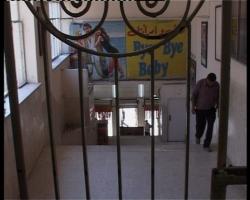
Cinema Zahran in the center of Amman is screening porno films since 37 years, the director goes to see a porno movie but he discovers the underworld sexual for Arab men. Inside this cinema we can see and hear more than a porno movie.
Saed Abu Hmud Was born in 1976 in Bethlehem Palestine, He studied TV directing and audiovisual productions at the Palestine technical colleges. After graduation in 1999 he worked as a cameraman and producer with many broadcasters and production companies. He participated in many filmmaking and script writing workshops and training courses arranged by the Euromed Audiovisual Project 2, the Sundance film Institute and the Script factory. His first documentary film "Nativity Church" 28min was produced in 1999. In 2005 he directed "Second Halftime" 21min; premiered in Visions du reel international film festival (Nyon) and officially selected for many other major film festivals worldwide. In 2006 He joined the BBC television center in London for 3 months fellowship as a cameraman and producer in the program News night. He directed two short documentaries in Jordan in cooperation with the Palestinian audiovisual project and the Jordanian Royal film commission (Distortion 4min, Offside 13min).

Narges Abyar
Yek rooz pas az dahomin rooz)
Documentary | dv | color | 24:30 | Iran | 2008
Brief story:ý This realistic fiction is about an old man when he was alone. He fills his solitary life with a ýcamel, but camel to fall a victim to religious customs.ý ý ý Summary A camel once mauled Uncle Reza`s head and now he lives alone with his few possessions and visits from a little girl. He takes care of ýanother camel whose neck is branded with delicate sacred tattoos. Loneliness and solitude echo around him like the bell he carries to ýhis charge each morning, the story builds complex layers around this simple man as a religious festival is staged with the camel at its ýcentre. On the 10th Day of Muharram, Uncle Reza tries to reassure the camel as it is dressed in ceremonial trappings, and walks it into ýa gathering with music, historical reenactments and pilgrims. One Day After the 10th Day you may realize how much you care for this ýman and his camel.ý
Narges Abyar was born in Tehran. she studied in Persian Literature and received her B.A. in this field. So far she has devoted most of ýher time to writing, which had led to the publication of ten story and fiction books for children, young adults and also the adults. She ýhas made several short and one documentary
Dan Acostioaei, Florin Bobu, Cristina David, Livia Pancu
Si eu sunt tractorist
Video | hdv | color | 7:45 | Romania | 2015
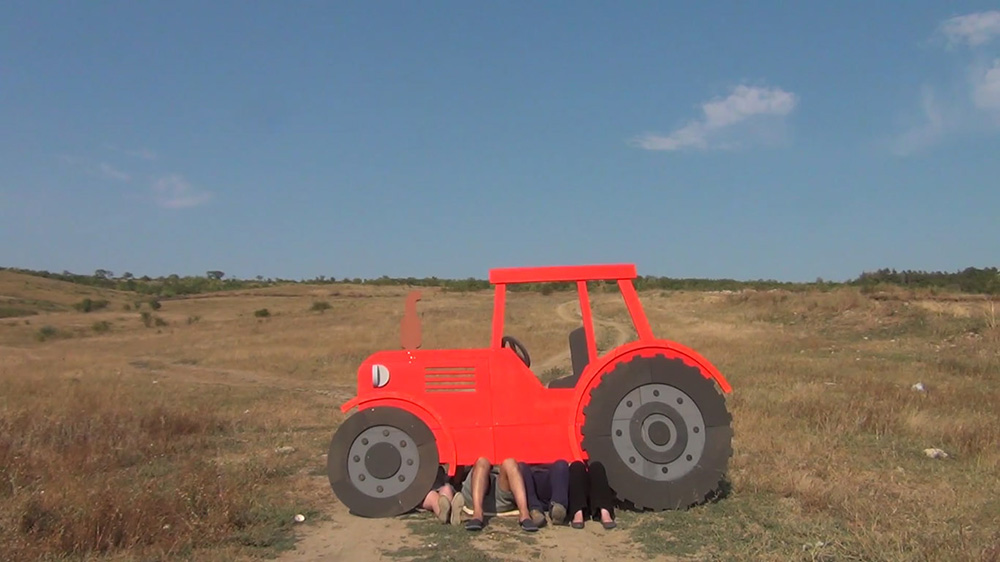
The main character of the story is a red two dimensional model of a tractor that during all the duration of the film is travelled by the artists into a relocated landscape and than into the city of Iasi, Romania. At unforeseen moments in time, the tractor is witnessing a lunch with the artists or it has a couple encounters, more or less violent, with two monuments in the city: The Independece Statue and the Monuments for the victims of the Communism. On the sound track one can listen obsessive excerpts of the Romanian Television in 1989 live broadcasted and than taped by an anonymous. The tape was found 25 years later on the flea market and it`s sound is overlapped with sounds generated by an analogue low-fi synthesizer.
Dan Acostioaei (born 1974) lives and works in Iaşi, Romania. He is a visual artist and he holds a teaching position at University of Arts ”George Enescu” in Iaşi. Alongside a group of artists and philosophers from Iasi and felow visual artist Matei Bejenaru, Acostioaei is a founding member of Vector Association. Since 2001 this artist run institution promoted and supported the local emerging contemporary art scene and organised the Periferic Biennial in Iasi, Romania. Acostioaei`s works focus on the identity models of the Romanian society in transition and on the ideological boundaries between the economic sphere and the conditions of artistic production within former Eastern Bloc. His projects were exhibited în One Sixth of the Earth - Ecologies of Image, MUSAC, Leon, Spain (2012), Transitland: videoart in Central and Eastern Europe 1989-2009, Museo Nacional Centro de Arte Reina Sofia, Madrid, Spain (2010), Illuminations, Level 2 Gallery, Tate Modern, London, U.K. (2007). The visual artist and independent curator, Florin Bobu was born in 1978 in Tecuci (Romania) and lives in Lasi (Romania). He has a degree from the Academy of Visual Art and Design (The Netherlands) and has been involved in several contemporary art events in Rotterdam, Munster and Antwerp. Cristina David (born 1979) started her artistic training at the Art Academy in Bucharest and completed her MDA at the Art Academy in Bergen. Video art is her prime choice of artistic medium. Cristina also works with photography and installations. Her often humorous texts and images are related. The stories come from day-to-day life. In her texts, she blends her personal experiences and thoughts. Cristina David has said that her stories often emerge from her impatience at the slow motion of daily life. LIVIA PANCU (born in 1980) is a curator based in Iași, România. Since 2005 she has been a member of Vector Association, and, from 2011 to 2012, its director. She is currently one of the Co-directors of tranzit.ro, part of the international network tranzit.org. She graduated the Curating Contemporary Art department of the Royal College of Art in 2009. In April 2012, Vertical Site (with Florin Bobu and George Doros), an ongoing project based on her PhD research (The Socialist Decorations and the Process of Thermic Rehabilitation of the Housing Blocks Facades build between 1950 and 1990 in Romania), was launched and curated by the 1+1 association. Most recently she has written for the Self-Organised Subjects anthology, Open Editions, Stine Hebert & Anne Szefer Karlsen (Eds.): The Almost Institution (2013). Her research is based on understanding the different internal mechanics of contemporary art organizations located in cities that are not governmental or financial capitals. Currently she is preoccupied on how to inherit or dissolve institutional heritage.
Anna Adahl
Porous Bodies (Draft Cut)
Experimental film | 4k | color | 19:23 | Sweden | 2025
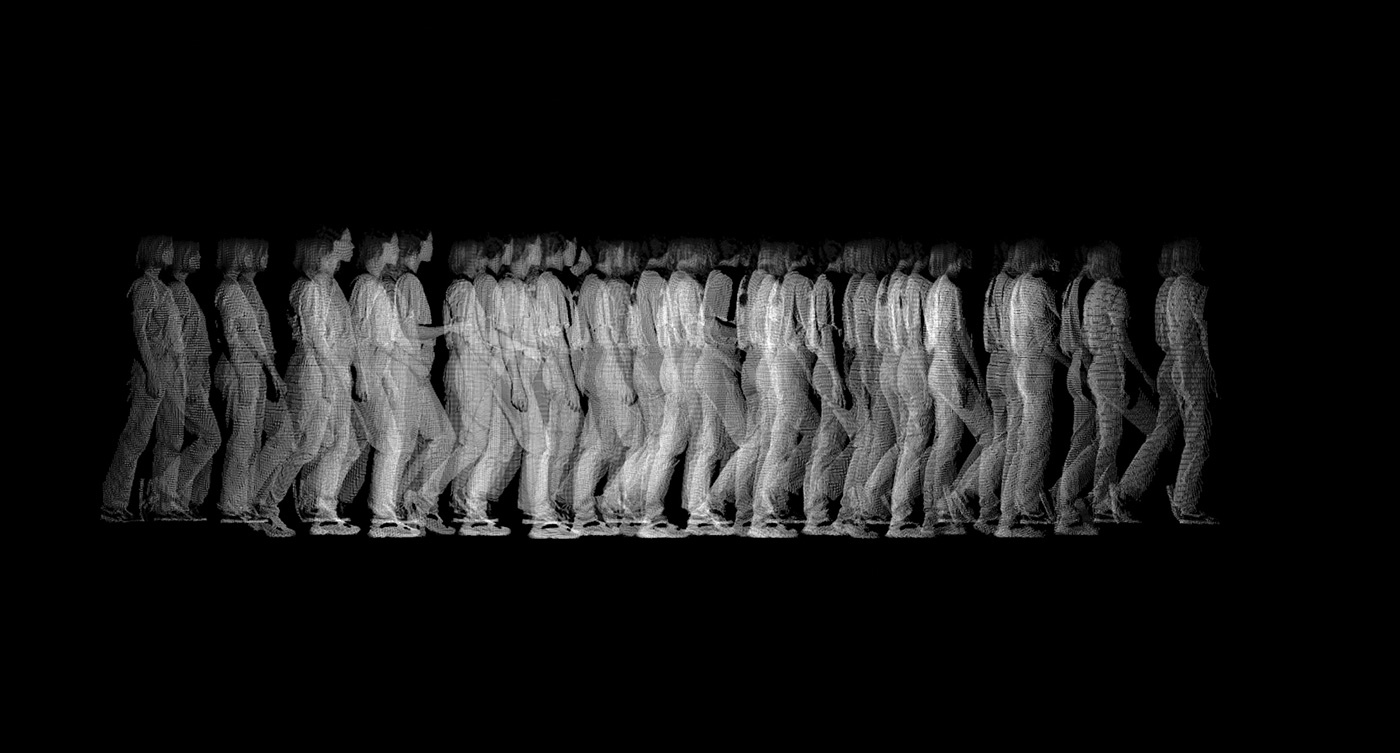
Porous Bodies is an essay film in diptych format where found footage meets newly shot images in assemblage editing. The film explores how our bodies are becoming data and unfolds the concept of porous bodies. Optical and infrared scanning systems penetrate beyond the skin, measuring the materiality and patterns of our iris or palm veins, while other tools capture our identities from afar, without consent, by analysing videos of our physical and choreographic uniqueness. These scanning techniques oscillate between micro and macro images of our bodies, used for the control of people, protesting crowds, security systems, crypto-based economies, digital IDs, and refugee camps. Vulnerable populations often become testing grounds for such technologies. Iris scans read the materiality of the eye through infrared light—a confrontation between two lenses, one organic and one technological. Authority and agency reside in the latter; the eye becomes mere material, algorithmically turned into code. Similarly, palm vein scanning reduces the hand—once a symbol of political emancipation—to a biometric signature. Through gait recognition, we are identified by the way we walk, our choreographic uniqueness rendered into data. Facial recognition becomes obsolete; no one in a crowd is anonymous. It is the body as a whole that is now scanned and quantified. A walking body, optically and mathematically analysed without consent—a representation of agency yet transformed into a porous, fragile, and permeable entity. Scanned from the inside out, it becomes a cloud of harvestable data. Emerging technologies penetrate our bodies, while self-tracking devices extend the intrusion. We are porous—open to these systems, sometimes unknowingly, sometimes willingly. Still, the body remains a representation of agency: the walking body, the body in the street, the political body that assembles with others. Datafied clouds in motion, grasping for agency in an increasingly authoritarian landscape.
Anna Ådahl is a Swedish artist and researcher working in various mediums such as film, installations and performance. She uses the editing tools of assemblage and montage where found footage meets newly produced images. Her installations use artworks in various mediums as props in spatial narratives where the body is used as reference and an investigative tool. Over more than a decade the notion and politics of crowds has been central in her artistic practice. Her fine art practice-based research, Inside the Postdigital Crowds, (2022), at the Royal College of Art in London addressed the aesthetics and politics of the digital conditions in which contemporary crowds are represented and governed. She is currently pursuing a post doctorate and is running a funded (Swedish Research Council) practice-led fine art research project in collaboration with Stefan Jonsson at REMESO (Institute for Research on Migration, Ethnicity and Society) at LiU and affiliated with the Royal Institute of Art, titled Collective Agency in an Era of Authoritarian Automation. Her work has been shown at Pylon Lab, Dresden; Impakt, Utrecht; Marabouparken, Sundbyberg; Whitechapel Gallery, London; Moderna Muséet (part of the collection), Stockholm; LIAF, Norway; CCA Derry, UK; Bonniers Konsthall, amongst others.

Ozan Adam
Little Birdie
Animation | dv | color | 1:6 | Turkey | 2010
The animation is about the transformation of lines into shapes and objects then to figures and finally into a flight through space.
Ozan Adam was born in 1976 in Ankara, Turkey. He studied art and cinema in New York, worked in film production, advertising, commercials, media, stage construction and design industries. His body of diverse artwork, which consists of text, design, illustration, painting, sculpture, animation, film, video and installation, has been exhibited in solo and collective exhibitions around the world. He has taught film, video production and experimental cinema courses at İstanbul Bilgi University and supervised workshops at Bilkent University, Middle Eastern Technical University, Netherlands Institute for Higher Education and Boğaziçi University. He is currently working at Bahcesehir University teaching production, documentary and video art courses. His film ?Zymotic-Amaurosis? was awarded with the Special Jury Award in the 14th International Ankara Film Festival and another film of his titled ?The Two Names of A Testimony About The Execution of A Happening and A Suitcase Full of Broken Records? was awarded as the Best Experimental Film in the 17th International Ankara Film Festival. Many of his films have been selected and screened by international festivals, galleries and museums.
Ozan Adam
Zymotic amaurosis
Animation | dv | color | 0:54 | Turkey | 2007
Zymotic-Amaurosis: Contagious Arbitrary Blindness is a disease caused by a virus, which can capture and store visual information and memories. The film is about a fantastic journey through the book that tells the fragmented story of the remembrances, visions and dreams of a blind man who is subjected to experiments to reveal the visual data that was recorded by the micro-cameras, which were installed in the eyes of an astronaut for a secret mission. After transplanting the eyes of the astronaut to the blind man, they expect to retrieve the recordings through the dreams of the blind man but they get lost in the surreal absurdity of a complex subconscious.
Ozan Adam was born in 1976 in Ankara, Turkey. He studied art and cinema in New York, worked in film production, advertising, commercials, media, stage construction and design industries. His body of diverse artwork, which consists of text, design, illustration, painting, sculpture, animation, film, video and installation, has been exhibited in solo and collective exhibitions around the world. He has been teaching film, video production and experimental cinema courses at İstanbul Bilgi University and Bahcesehir University, supervised workshops at Bilkent University, Middle Eastern Technical University, Netherlands Institute for Higher Education and Boğaziçi University. Many of his films have been selected and screened by international festivals, galleries and museums.
Stefan Adamski
RE:
Experimental film | hdv | color | 3:19 | Poland | 2011
RE: is an ironic piece based on my correspondence with popular international directors and filmmakers. It is a frustrating, perverse and unsuccessful search for ideas connected with an inscrutable film project and classic Hollywood scenes - a piece about artist`s condition and acting desires with intentionally unprofessionally made scenes.
I studied History of Art in Krakow and Acting in London. I participated in various theater/performance worksessions (i.a. with Robert Wilson, Eugenio Barba, Franko B and Ron Athey) and exhibitions in Germany, Greece, Unites States, Mexico, Austria and Russia. Since 2009 I run a private contemporary art space `Florianska22` in Krakow.
Milo Addica
Wirtshaus Zur Pfaueninsel
Fiction | 35mm | color | 9:19 | USA, Germany | 2025
A young boy adventures through a forest outside of Berlin Germany in search of a rare bird and has a stark encounter with a man who offers him a harsh dose of life.
MILO ADDICA BIOGRAPHY Director / writer / producer Milo Addica was nominated for an Academy Award, WGA Award, and an Independent Spirit Award for Monster’s Ball, starring Halle Berry, Billy Bob Thornton, and Heath Ledger. Some of Addica’s writing credits include Jonathan Glazer’s Birth, co-written with Jean-Claude Carrier, starring Nicole Kidman and Danny Huston, and Lauren Bacall (the film was selected for competition at the Venice Film Festival) as well as James Marsh’s The King, starring Gael Garcia Bernal, William Hurt, and Paul Dano, (the film was selected for Un Certain Regard at Cannes.) Addica has written for numerous directors including: Andrew Dominik, Joel Schumacher, John Hillcoat, David Mackenzie, as well as actors including Russell Crowe, Julia Roberts, Sandra Bullock, Nicole Kidman, Danny Huston, Paul Dano, Gael Garcia-Bernal, William Hurt, and Lauren Bacall. Addica is currently shooting a documentary about his father artist Kent Floeter who was in a 1960s/70s tight knit group including Chuck Close, Brice Marden, and Richard Serra as well as being in pre production on his next feature to direct, Motorcycle Ranger, starring Edgar Ramirez. Addica has directed two short films, Ms. Longlegs and Wirtshaus zur Pfaueninsel. Addica grew up in New York City in the late 1970s/80s where he attended public school before enrolling at the University of Massachusetts at Amherst. He later attended the Neighborhood Playhouse and Hunter College. Milo Addica won a Satellite Award and a Final Draft Award for Monster’s Ball.
Soufiane Adel
La lumière tombe
Experimental fiction | 4k | color | 9:23 | Algeria, France | 2018
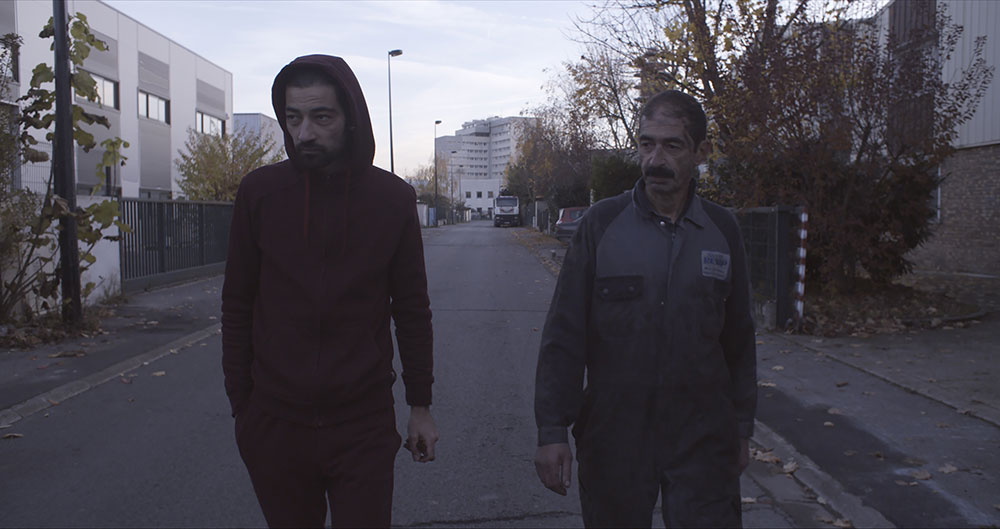
Quelque part en Banlieue, dans un futur proche. La classe ouvrière n'existe plus. Vénus se rapproche de la terre. Un homme et son fils refont le monde.
Soufiane Adel est né en 1981 en Algérie et arrive en France à 8 ans. C`est en faisant une école de design, l'ENSCI - Les Ateliers, qu'il découvre le cinéma. En 2004, il décide de filmer son père : ce sera son premier court métrage, "Nuits closes", qui débutera au festival de Clermont-Ferrand. En 2007, il réalise "Kamel s`est suicidé six fois, son père est mort" qui a été sélectionné à la Quinzaine des Réalisateurs et à l'ACID à Cannes en 2008, ainsi que dans de nombreux festivals de par le monde. En 2009, il coréalise avec Angela Terrail, "Sur la tête de Bertha Boxcar", prix du jury au festival Silhouette (montré également à Clermont, Pantin, Ciné-banlieue, Indielisboa ...) et diffusé sur Arte. En 2013, il réalise son second documentaire "Go Forth" qui aborde l`histoire de sa grand-mère algérienne, projetés dans des dizaines de festivals internationaux (Cinéma du réel, Rencontres Internationales Paris-Berlin, Lussas, Montréal...). Son exploration de formes fictionnelles d`auto-filmage se poursuit avec "Vincent V" et "Les bonnes". En 2017, il met de nouveau en scène son père dans une fiction, "La Faim", puis dans l'essai "La lumière tombe", en 2018.
Soufiane Adel
Kamel s'est suicidé six fois, son père est mort
Fiction | | color | 9:0 | Algeria, France | 2007
One evening, my grandfather Tahar died in palliative care. Zouina, her stepdaughter is there. Aziz, his son is there. Fayçal is there. I am there. God is not there ? Kamel arrives too late.
Soufiane Adel, graduate of the École Nationale Supérieure of industrial Creation of Paris, carries out scenographies for various cultural events (the Meetings of the Photography of Arles, the arts centre Telemar in Rio de Janeiro). At the same time he realizes short films and fiction which are shown at many festivals. In 2007, he was chief operator for an Angela Terrail documentary.
Soufiane Adel
Kung Fu
Experimental film | hdcam | color | 14:35 | Algeria, France | 2021
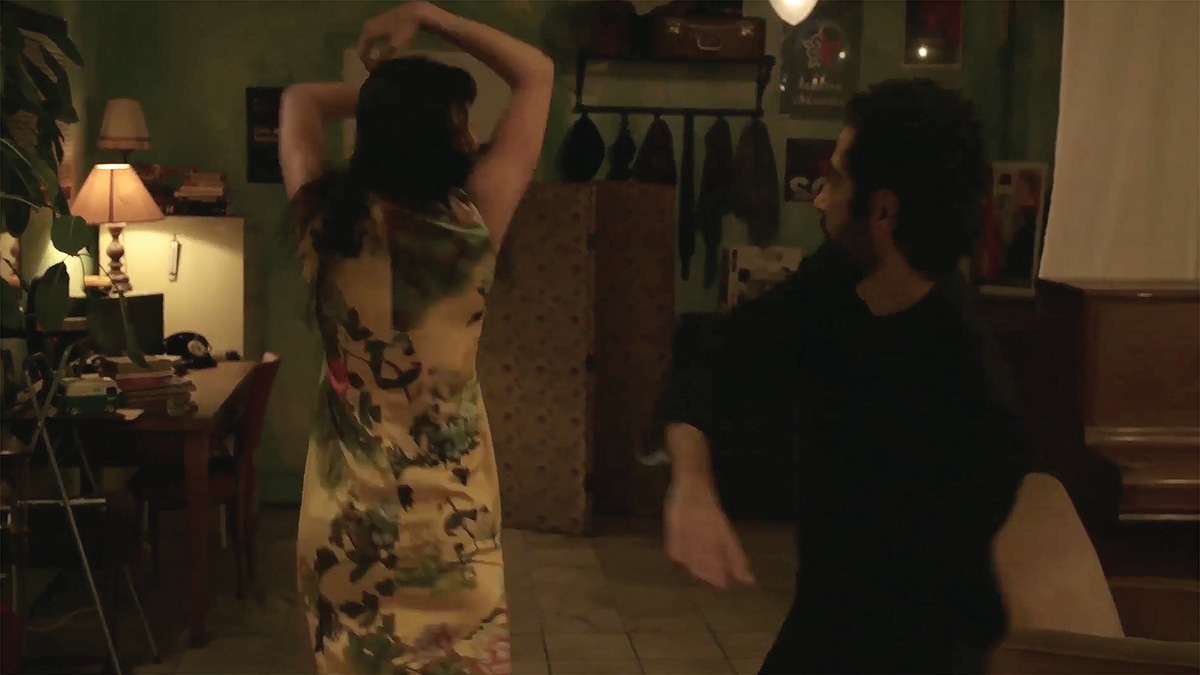
Un homme d’origine prolétaire, revient chez ses parents et son frère après une rupture amoureuse avec une femme d’un rang social plus élevé que le sien.
Soufiane Adel est né en 1981 en Algérie et arrive en France à 8 ans. C'est en faisant une école de design, l'ENSCI - Les Ateliers, qu'il découvre le cinéma. En 2004, il décide de filmer son père : ce sera son premier court métrage, "Nuits closes", qui débutera au festival de Clermont-Ferrand. En 2007, il réalise "Kamel s'est suicidé six fois, son père est mort" qui a été sélectionné à la Quinzaine des Réalisateurs et à l'ACID à Cannes en 2008, ainsi que dans de nombreux festivals de par le monde. En 2009, il coréalise avec Angela Terrail, « Sur la tête de Bertha Boxcar », prix du jury au festival Silhouette (montré également à Clermont, Pantin, Ciné-banlieue, Indielisboa ...) et diffusé sur Arte. En 2013, il réalise son second documentaire "Go Forth" qui aborde l'histoire de sa grand-mère algérienne, projetés dans des dizaines de festivals internationaux (Cinéma du réel, Rencontres Paris-Berlin, Lussas, Montréal...). Son exploration de formes fictionnelles d'auto-filmage se poursuit avec « Vincent V » et « Les bonnes ». En 2017, il met de nouveau en scène son père dans une fiction, "La Faim", puis dans l’essai "La lumière tombe".
Soufiane Adel
Nuits Closes
Fiction | dv | color | 12:0 | Algeria, France | 2004
11pm. Soufiane, Fayçal and Zouina, their mother, wander from one bar to another ... They are looking for someone in the streets of Champigny.
Soufiane Adel was born September 22, 1981, in Algeria. In 1990, at age 8, she arrived in France. In 2001 she received her high school diploma in Applied Arts from Vitry-sur-Seine. The following year she entered the National Superior School of Industrial Creation (ENSCI, Les Ateliers), Paris, for 5 years of study.
Soufiane Adel
Le jour où j étais perdu
Experimental fiction | 8k, 6k, 4k | color | 29:0 | France | 2022
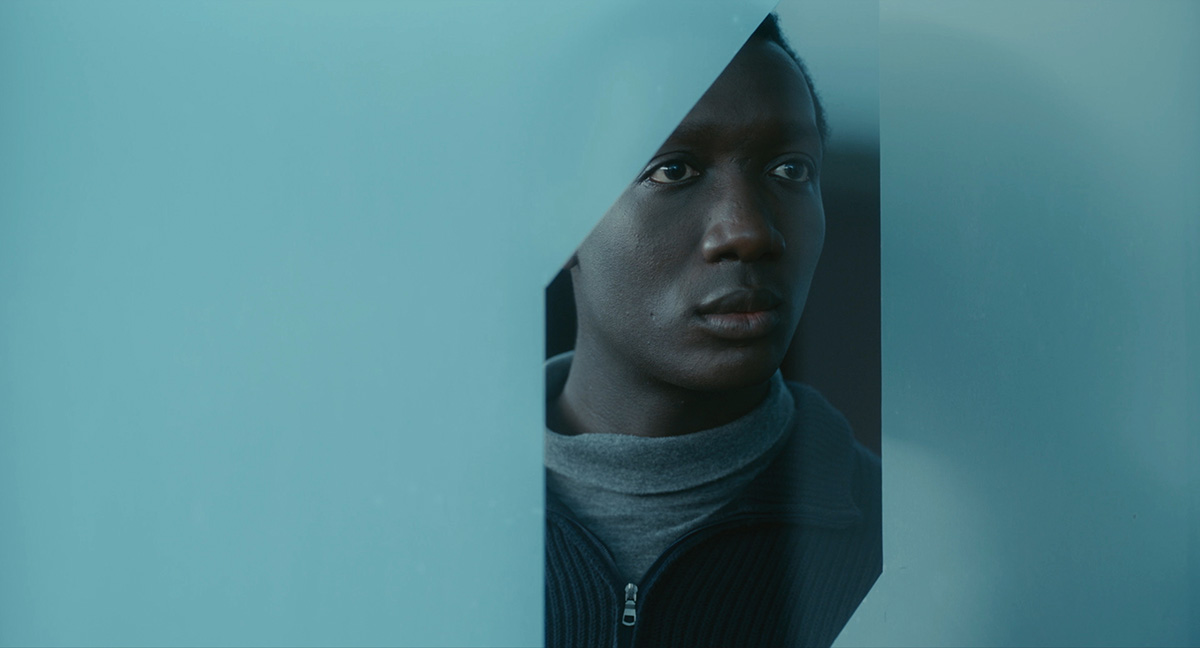
Synopsis : La sonde Voyager s’apprête à quitter notre système solaire. Au même moment, sur Terre, Alain Diaw commence son premier jour de travail dans une grande entreprise automobile. Il revient de loin, et vise lui aussi l’inconnu.
Soufiane Adel est né en 1981 en Algérie et arrive en France à 8 ans. C'est en faisant une école de design, l'ENSCI - Les Ateliers, qu'il découvre le cinéma. En 2004, il décide de filmer son père : ce sera son premier court métrage, NUITS CLOSES, qui débutera au festival de Clermont-Ferrand. En 2007, il réalise KAMEL S’EST SUICIDÉ SIX FOIS, SON PÈRE EST MORT, sélectionné à la Quinzaine des Réalisateurs et à l'ACID à Cannes en 2008. En 2009, il coréalise avec Angela Terrail, SUR LA TÊTE DE BERTHA BOXCAR, prix du jury au festival Silhouette, montré mondialement et diffusé sur Arte. En 2013, il réalise son second documentaire GO FORTH, qui aborde l'histoire de sa grand-mère algérienne, projetés dans des dizaines de festivals internationaux. Son exploration de formes fictionnelles d'auto-filmage se poursuit avec VINCENT V » et LES BONNES. En 2017, il met de nouveau en scène son père dans une fiction, LA FAIM, puis dans l’essai LA LUMIÈRE TOMBE. Son dernier court-métrage LE JOUR OÙ J’ÉTAIS PERDU, interprété par Souleymane Sylla et Damien Bonnard, débute en compétition au IFFR Rotterdam et au Festival international du court-métrage de Clermont-Ferrand.
Samantha Adler De Oliveira
Palace, 2013
Experimental film | hdv | color | 10:50 | Israel | 2013
The Palace was once a grandiose hotel built by the Mufti of Jerusalem in 1929. Long abandoned, the building has recently been bought by Waldorf Astoria and entirely gutted so as to preserve only its historical façade. "Palace, 2013" is a collaboration with the workers on the construction site of Waldorf Astoria Jerusalem and presents a series of three atmospheric tableaux inspired by the formal qualities of the site and its history. By means of simple props and actions, the order of the site and its daily labour routine are temporarily disrupted, allowing for a multiplicity of resonances to occur. Adler de Oliveira thus acts as an observer of the broad range of possibilities embedded within the site: its current reality as a dismantled building on the one hand; and its latent future on the other. The hotel in its present form - a site in the making - presents an anomalous reality, since it functions as a temporary home for its construction workers. The site imbues the power relationships characteristic of Israeli society, contrasted against its designed purpose: to offer its visitors an escape from local reality; a total disconnection from time and place.
Samantha Adler de Oliveira was born in Paris in 1985 and grew up in Brussels. In 2003 she completed a BA in European Studies at King`s College London. She then went on to earn a Fine Art degree from the Bezalel Academy of Arts and Design, Jerusalem, during which time she spent a semester at the School of Visual Arts in New York. In 2011 she participated in the European Exchange Academy and is a recent graduate of the Skowhegan School of Painting and Sculpture, Maine. She received a special mention at the Mediatine Award for emerging artists in Belgium (2011) and the Aileen Cooper Prize for outstanding graduate show (2012). Her work has been shown in Israel, Belgium, Germany and New York. She had her first one-person exhibition in 2013 at the Architect House in Tel-Aviv Yaffo.
Kim Richard Adler Mejdahl
Kom Så Molly
Experimental film | digital | color | 21:0 | Denmark | 2022
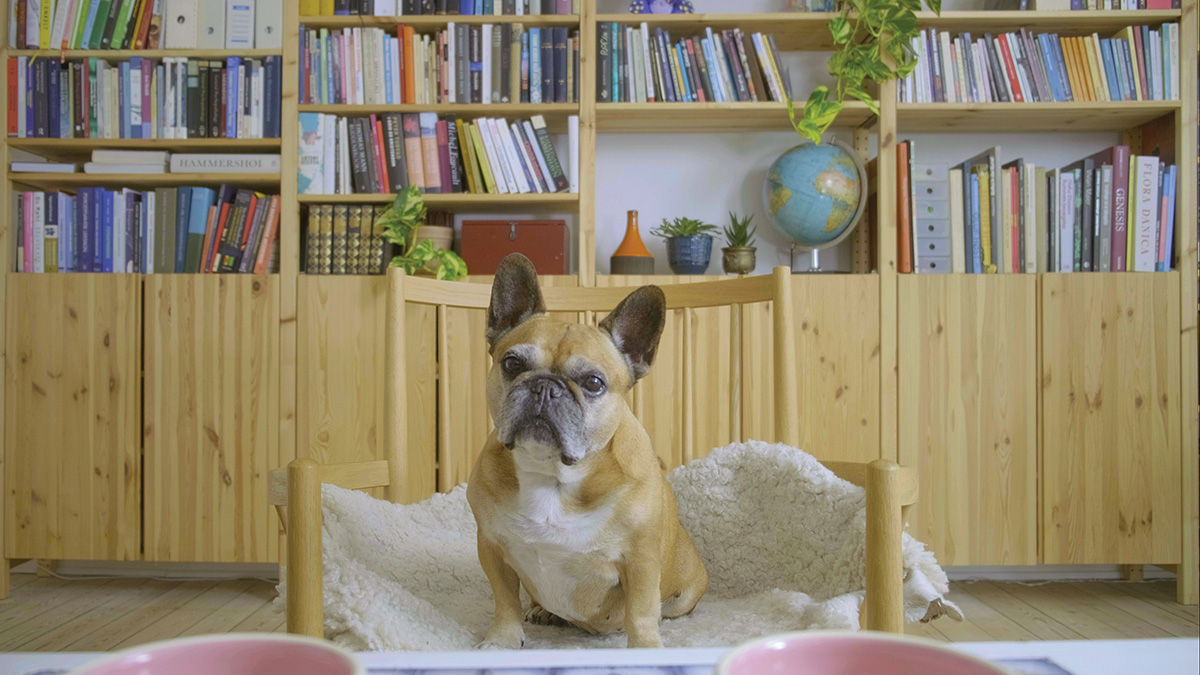
Rokko and Bobbi visits world-famous psychoanalyst Molly for the first time. The dog couple reveal problems with PTSD and childhood trauma, manifested as symptomatic carpet wetting and an amputated sex life. But through the teachings of Goethe’s color theory, Molly brings the couple on a hypnotic, and transformative love journey.
Copenhagen-based visual artist, experimental filmmaker, and electronic music composer Kim Richard Adler Mejdahl was born in the Danish village Skælskør. He has created a wide range of critically acclaimed artworks that blends genres and media in order to create intricate, bizarre, and sometimes humourous works which resolve around dissolving memory, trauma, and eco-gothic fantasies. Mejdahl holds a master’s degree from The Royal Danish Academy of Fine Arts. Within few years, Mejdahl has created a wide range of exhibitions at art institutions, and his film works have reached international audiences with screenings in Europe and Asia. Working cross-disciplinary, Mejdahls project often combine different fields of art. His recent solo exhibition 'One! More! Time!" at Kunsthal Rønnebæksholm in Denmark centered around a surprising collaboration with the Danish amusement park BonBon-Land. In 2018, Mejdahl received the Charlottenborg Spring Exhibition’s Solo Award for his film 'Ode' — an experimental documentary dealing with the killing of the artist’s abusive father. The film was later acquired by The National Gallery of Denmark.
Danielle Adobi Dean
Hemel
Experimental doc. | 16mm | color and b&w | 29:44 | USA | 2025
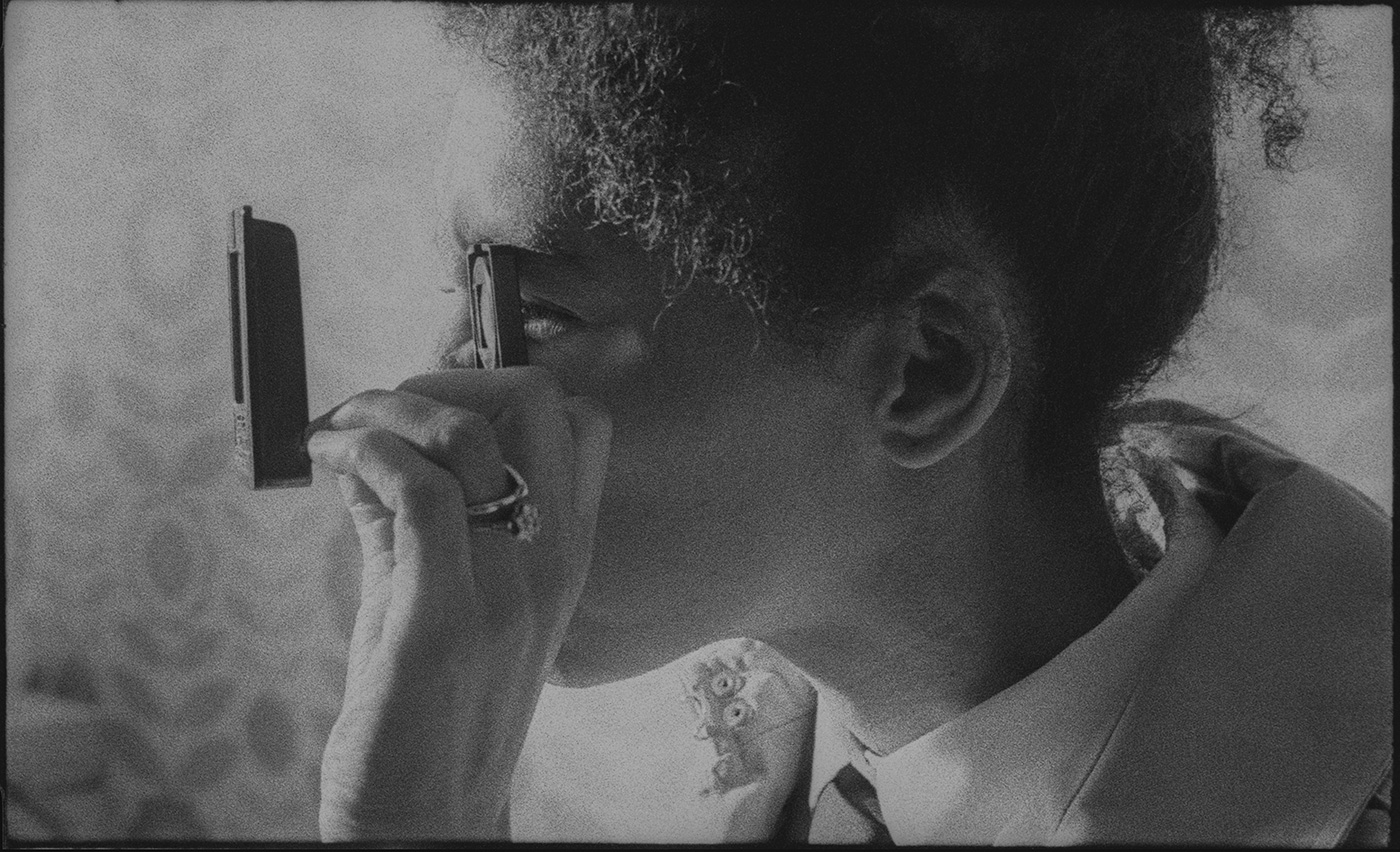
Danielle Dean’s new film is a portrait of Hemel Hempstead, where she was raised and unfolds as a personal essay on the town’s history as a planned community under the New Towns Act of 1946. Titled Hemel, the work’s central reference is a 1957 sci-fi horror B-movie shot in town about the arrival of a non-human entity that infiltrates the minds of residents and endangers life with a toxic black slime. Playing a composite character based on herself and the movie’s detective protagonist, Dean’s extraordinary vantage brings together real and imagined worlds, both past and present.
Working with archives, video, performance, social practice, sculpture, and drawing, Danielle A. Dean investigates the recursive loops between the circulation of ideas and the material reproduction of global capitalism. Operating across media and with a variety of collaborators and participants, her work examines the fault lines within this seemingly closed circuit. Dean received an MFA from California Institute of the Arts and is an alumna of the Whitney Independent Study Program. Recently completed projects include new commissions for Mercer Union, Toronto (2024), a solo show at Tate Britain, London (2022), and Performa, New York (2021). Other recent solo shows include: Long Low Line, Times Square Arts, NY (2023); Bazar, ICA San Diego (2023); and True Red Ruin, Museum of Contemporary Art Detroit (2018). She participated in the Whitney Biennial in New York (2022). Group exhibitions include: This Land, at The Contemporary Austin (2023); Freedom of Movement, at the Stedelijk Museum in Amsterdam, Netherlands (2019); The Centre Cannot Hold, Lafayette Anticipation, Paris (2018); and Made in LA, at The Hammer Museum, Los Angeles (2014).
Akosua Adoma Owusu
King of Sanwi
Video | 0 | color | 7:18 | USA, Ghana | 2020
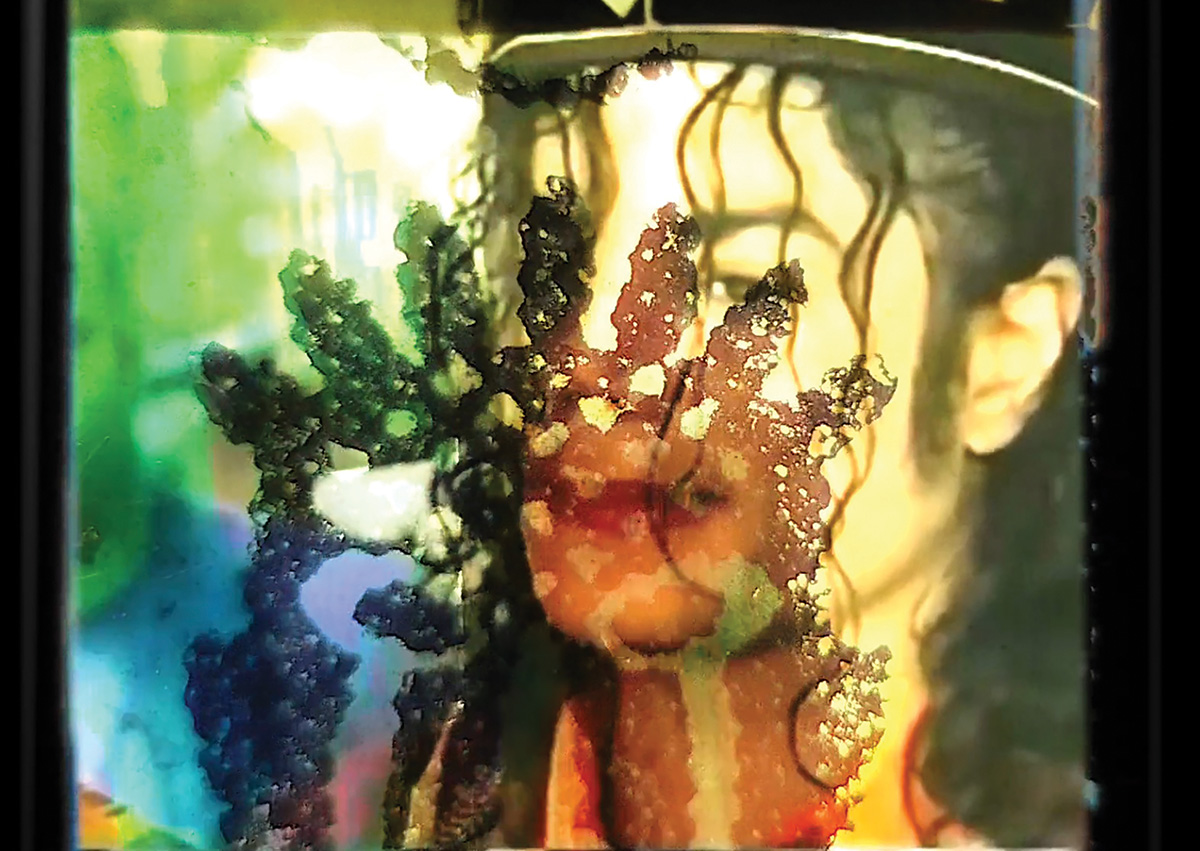
Re-worked footage from an unfinished film by Senegalese director Mamadou Johnny Sekka forms a re-examination of The Jackson 5’s 1974 trip to Dakar.
Akosua Adoma Owusu is a Ghanaian-American filmmaker, producer, and educator. Aiming to create a third cinematic space or consciousness, Owusu’s work explores the colliding identities of black immigrants in America through multiple forms, ranging from cinematic essays to experimental narratives to reconstructed Black popular media. In her works, feminism, queerness, and African identities interact in African, white American, and black American cultural spaces. Named by IndieWire as one of six preeminent “avant-garde female filmmakers who redefined cinema,”, her work has been screened extensively at festivals and museums nationally and internationally and are available on streaming platforms including PBS, The Criterion Channel and MUBI. In 2013 her short film KWAKU ANANSE was well-received at the Berlinale Shorts and won the 2013 Africa Movie Academy Award. Her short film RELUCTANTLY QUEER was nominated for the Golden Bear and Teddy Award at the 2016 Berlinale Shorts. Owusu has received numerous fellowships and grants including the Lincoln Center Award for Emerging Artists (2020). She has been invited to the 59th International Art Exhibition of La Biennale di Venezia curated by Cecilia Alemani. She currently lectures at Harvard University.

Jan Adriaans
The Large Blue
Video installation | 4K | color | 15:0 | Netherlands | 2024
A two-screen video based on the book Undercover: ‘The True Story of Britain's Secret Police’ and witness statements from victims. The narrative revolves around the audition of a cop becoming an undercover agent and incorporating a new identity. He is trained to lie and act as a sympathetic and trustworthy person. The video is set in Melbourne and therefore only speculative, based on rumors. It is edited as a shattered timeline, with parallel realities. Starting as a small group in the 1960s, a time of violent student riots, the British undercover police unit steadily grew in the decades that followed. Its main task being to infiltrate activist circles. Romantic relationships were seen as necessary and condoned by these men’s superiors. The video draws a parallel to parasitic mimicry, such as the caterpillar of The Large Blue butterfly, that, to get enough food, mimics the pheromones of ants. Once taken into the nest it can eat all the larvae undisturbed, slowly but surely depleting the colony of its future.
Jan Adriaans works in video, sound, performance and installation. He finished his Master at the Dutch Art Institute and is currently finishing a course: Posthumanism, alien bodies, cyborgs and Artificial Intelligence in American Literature, at the University in Leiden. He showed his work at Rencontres Internationales Paris/Berlin / BB15 space for contemporary art, Linz (solo) / Now and After ecology without borders, The National Darwin Museum Moscow / Visions Programme 1, The Nunnery London / There’s absolutely No cause for alarm, TAAK Amsterdam, curated by Katia Krupennikova / After Year Zero, Museum of Yugoslav History, Belgrade curated by Doreen Mende (Dutch Art Institute) / Prometheanism 2.0, Showroom Arnhem, symposium curated by Bassam El Baroni / Videonale 12, Kunstmuseum, Bonn, and was in the following artist-in-residences: SeMA NANJI Residency, Seoul Museum of Art, Seoul, Projectstudio, Künstlerhaus Bethaniën Berlin, Townhouse, Cairo.
Jan Adriaans
Stay
Video | hdv | color | 6:24 | Netherlands | 2016
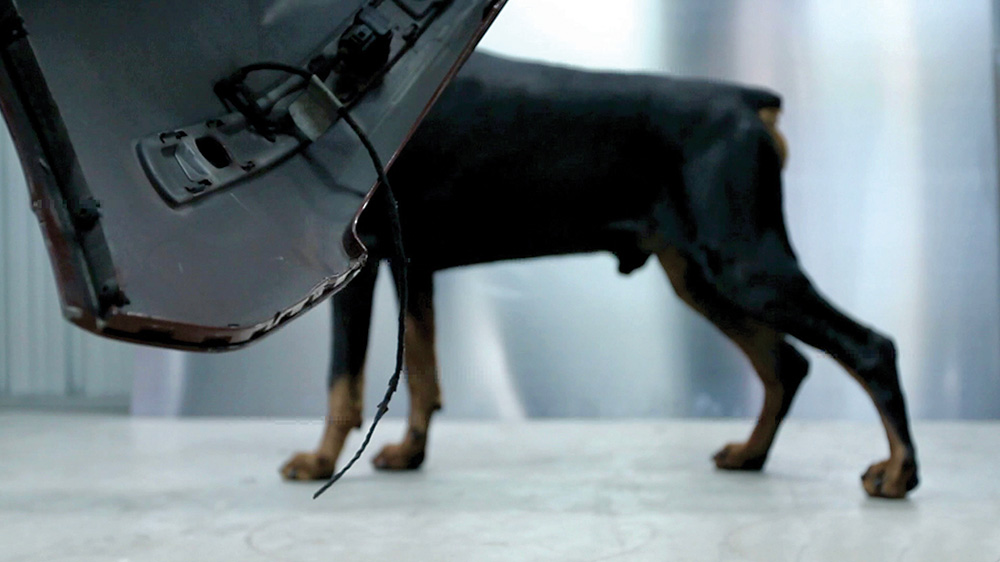
In a car workshop type space, between the pristine surfaces of car parts, archetypes of mass production, a construction of power is unfolding between a Dobermann Pinscher and its owner. A Dobermann is a special breed, it’s gracious, loyal, and potentially aggressive to strangers. It needs severe training. Both the owner’s and the dog’s consciousness are formed within this relationship. By the obedient appearance of the dog, it seems to concede to the rules it’s been given. But by knowing the rules it starts to gain power itself. The impression the video gives moves between floating through an abattoir where fresh slaughtered livestock is vertically stored and moved around in this almost perfectly hidden horror of death, and a peek into a shop window, where commodities are on display, waiting for a buyer in their best possible appearance. Starting from Wilfrid Sellars theory on the self: If the abattoir represents our scientific self; our matter, our genetic material, our flesh and bones without moral or ethics. In the image of the shop window our manifest self is reflected, a self constructed in a social context, a world of abstractions, of language and reasoning.
Jan Adriaans graduated from the Dutch Art Institute in 2015. His video-works explore human selfhood in its evolutionary context. By drawing a parallel with the animal, the set of constraints we are subjected to become more apparent. If we take these constraints into account, how can we redefine human agency, will, and control? “Selfhood is tyrannical precisely insofar as it is merely a congerie of drives. The act supplants the tyranny of the impulsive self with the rule of the subject. But it is the act itself that is subject. It is no-one’s.” Ray Brassier
Newton Aduaka
The Map Makers
Video | hdv | color and b&w | 16:56 | Nigeria | 2020
As the leader makes a speech, the skies rain...
With his feature film Ezra, Newton I Aduaka won the Etalon d’or de Yennenga at the 20th edition of FESPACO. Premiering in competition at the Sundance film festival, it was nominated for the Humanitas Prize, screened at the Critics’ Week in Cannes and was awarded the United Nation’s prize for Peace and Tolerance, the FIPRESI award and various other awards, including 6 grand jury prizes. Prior to that his multi-award winning indie film debut feature, Rage, was released nation-wide in the UK to critical acclaim and was a recipient of the Carlton television multicultural award, FESPACO’s Oumorou Ganda award, PAFF best first feature award and the OCIC prize. A Ford Foundation grantee, Newton was Filmmaker in Residence at the Cannes Film Festival’s Cinéfondation’s La Résidence du Festival and writer in residence at The Moulin d’Ande. Commissioned by the Society of French Directors (SRF) and Cannes’ Quinzaine des Réalisateurs he made a short film on the theme, “Cinema and Globalization”. The result was Funeral. His short films, have screened, in various official competitions and won awards at numerous film festivals such as the Mostra de Venise, Oberhausen film festival, Claremont Ferrand Intl. film festival, Uppsala Intl. short film festival Edinburgh International Film Festival... The NGO, Global Dialogue, commissioned Aduaka to direct four short films on AIDS awareness. These films have been translated into numerous African and European languages and are effectively used as educational tools across the world. Aduaka was a member of the London based Activist film collective Migrant Media. Aduaka was invited to speak at TED, “Africa: The Next Chapter”, held in Arusha, Tanzania. His speech is available online at www.ted.com. He was invited by the Berlin film festival as an expert, to speak on drama and aesthetics of Cinema at the Berlinale Talent Campus. At the 60th edition of the Cannes Film Festival, Aduaka was invited to hold a Master class. One Man’s Show, his third feature premiered at Fespaco, winning the Critics’ Prize. The film had its US premier at the Mill Valley Film Festival. In the past few years Aduaka has made forays into experimental cinema and visual art installation pieces, a return to his days as a member of the radical avant-garde cinema in the early 90s at the London Film-Coop. Aduaka studied Film at the London Film School. He is a published short story writer. The British newspaper, The Independent, named Aduaka as one of the 50 greatest cultural figures shaping the African continent. Aduaka lives in Paris.