Catalogue > Search
Results for : Tout le catalogue
Bouchra Khalili
Straight Stories - Part 1
Doc. exp�rimental | dv | color | 10:6 | Morocco | 2006
First part of a video triptych about wanderings in frontier zones, where physical and imaginary geographies become indistinguishable.
Bouchra Khalili is a French-Moroccan artist born in 1975 in Casablanca. Her videos explore the Mediterranean area which she believes to be a territory dedicated to nomadic and labyrinthine wandering. In her videos she explores the relations, plastic or conceptual, maintained by physical, imaginary or mental geographies. Focused on the theme of shift, she tries to disturb the boundaries between cinema and art, fiction and documentary and essay and experimentation. Her work has been shown at numerous international exhibitions, biennials, and festivals. Khalili studied cinema at the Sorbonne Nouvelle and Fine Arts at the Ecole Nationale Supérieure d`Arts de Paris-Cergy.
Bouchra Khalili
Vue aérienne
Experimental video | dv | color | 10:0 | Morocco, France | 2006
An aerial journey over an unspecified major western city. We see a large television screen that projects advertising images within a public space, a heavily urbanized architecture, and an inhabited coastline. At the same time, voices escaped from a film, call out meetings to take or to miss, speak of cinema as utopia, and discuss the "world as will and depiction."
Bouchra Khalili is a French-Moroccan video artist, born in 1975 in Casablanca and raised in Paris where she also lives and works. She is the co-programmer of the Cinémathèque de Tanger. Her videos has been shown at numerous international festivals, exhibitions and biennales, including the New York Video Festival (Lincoln Center); New Arab Video (Caixa Forum of Art, Barcelona); The Film-Laboratorio (Museum of Contemporary Art of Rome and Villa Médicis), The Biennale of The Moving Image (Genève, Switzerland), VideoBrasil (Sao Paulo, Brazil), Cinéma d`Avant-Garde (La Cinémathèque Française, Paris). In 2005, she was awarded the Louis Lumière - Villa Médicis Hors les Murs Prize. In 2006, several programmes focused on her work were curated, including: Instituto Itau Cultural (Belo Horizonte, Brazil), and Palacio das Artes (Belem, Brazil). Khalili studied Cinema at the Sorbonne Nouvelle, and Fine Arts at the Ecole Nationale Supérieure d`Arts de Paris-Cergy.
Sina Khani
Watch With the Weary Ones
Experimental doc. | 4k | color | 7:29 | Iran | 2025
Watch with the Weary Ones is a short documentary that looks at the American urban landscape while the filmmaker quietly drifts back to memories of Iran. It places the surfaces of U.S. cities next to the feelings of someone living far from home, caught between two places. The film reflects on the sorrow carried by those who left Iran searching for another life, and those who stayed and continue to fight for theirs. It’s about holding two worlds at once, the one in front of you and the one that never leaves you, and trying to make sense of that weight
Sina Khani (aka Sina Ahmadkhani) is a Tehran-born, Los Angeles–based filmmaker, writer, and editor. His feature debut won Best International Experimental Feature at the Portoviejo Film Festival and earned awards, nominations, and selections at Regina IFF, Toronto International Nollywood FF, New York City Indie FF, and many other international festivals. He recently completed his MFA at Virginia Commonwealth University and continues to create bold, character-driven stories.

Jean-pierre Khazem, Misi PARK
Dayfly
Experimental fiction | betaSP | color | 11:11 | France, Japan | 2007
In a modern city, a boy is locked up in his room for some time. He insulates himself more and more in his universe ? even speaks with him, hears voices. He creates his own imaginary world. He defies the imperceptible.
Day Fly is based on the hikikomori phenomenon What is Hikikomori ? Hikikomori, which literally means "pulling away, being confined" (i.e., "acute social withdrawal") is a Japanese term to refer to the phenomenon of reclusive adolescents and young adults who have chosen to withdraw from social life, often seeking extreme degrees of isolation and confinement due to various personal and social factors in their lives. The term "hikikomori" refers to both the sociological phenomenon in general and to individuals belonging to this societal group. In the film, the main actor wears a mask, which becomes a character in itself as he moves and plays with different perception. The mask is the means for a transference to occur between model and watcher. The speechless face, staring without emotion, becomes the face of a dweller of another world being watched in our own. such an eerie juxtaposition draws viewers in close to Khazem`s and Park `s silent innocents.
Mony Khoury, Lois Winkler
Mutilation
Experimental film | dv | color | 2:0 | Syria, Austria | 2004
Berlin/Chalottenburg On Thursday March 20th, I was sitting in front of the TV screen, zapping through the channels in order to watch the beginning of the war on Iraq instead of having my first cup of coffee in the morning. I felt bewildered, powerless, and tense at the same time. The following weeks I found myself sitting in front of the TV screen every day, scraping my feet raw on each other until they were mutilated. Like a chained woman who cannot come to terms with the situation and is incapable of changing it. On a permanent quest for answers, I switched to and forth between news in German, English, French, and Arabic; and I went through online papers. I wanted to understand and felt a profound longing and craving for news, live ? broadcasts, confronting discussions. Everything was simply delivered right into the living room. Being an Arabic woman in Europe, I was often asked about the situation in the Middle East, especially at the beginning of the war. The question was part of the greeting at every phone call. I could sense caution or sympathy. Some consoled me with the hope that it would be over soon. I could very well understand their behavior, yet I felt tortured because people were constantly talking about nothing else. The never-ending discussions about the causes and effects of every new event and the feeling that I even have to justify myself, wore me down. And I asked myself how much longer this kind of occupation is going to last ? or rather when the awakening will take place. Everybody asked how I felt. ?Like that!? I responded.
1965 born in Damascus, Syria. Study at the University of Damascus and at the university for applied art in vienna. Painting, grafik, video performance, photography.
Sonia Khurana
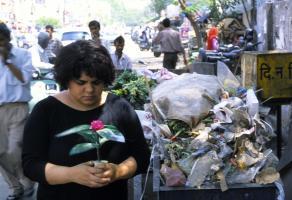
Flower carrier
Experimental video | dv | color | 5:30 | India | 2007
The flower carrier Version I 2000 to 2006 © 2006 performance video. Flower carrier is a performed sequence over a period of six years of the myself walking with a plastic flower through various streets in various cities. Each location is revealed both visually as well as acoustically, through the cacophony of road noises as the flower carrier moves fluidly between the streets of the small town of Modinagar, through the heavy-traffic streets of Delhi., through the hilly village of Rajpur, through the busy undergrounds of London and through the Badarur border, that neighbours Delhi, forever caught in messy states of [under] development. The simple act of a walk in the streets, while tenaciously looking at the tip of a flower [ : recycled plastic ] soon becomes a somewhat personalised ritual; a study of self in city very quickly transforms into an insurrection of turbulent city... There is no grand narrative. The narrative here is pursued in and through the act of making, almost as a form of psycho-visual enquiry.
S o n i a K h u r a n a abridged bio: Sonia Khurana?s studies in art include an M.A. in 1999 at the Royal College of Art, London, earllier art education in Delhi, a short course at the Film and Television institute in Pune, and in 2002, a 2-year Research residency at the Rijksakademie in Amsterdam. All of the above was pursued through sholarships and Awards, including the coveted INLAKS Award, in 1997. She now lives and works in New Delhi. « My art practice embraces areas in-between video, photography, elements of performance, text, drawing and installation. In my work I often makes psycho-sexual enquiries into two main areas of experience: interiority, or embodied experience, and the dynamics of identity. Recent body of work focuses on the poetics of inner experience mostly through performance-based videos that are often visually simple and understated Through deleberately poetic intimations, I strive to explore and re-define the space of the political. » During and beyond November 2007, Sonia?s works are currently showing at : ?Public places Private Spaces? - Newark Museum, ? Horn Please? - Kunstmuseum Bern, ? Tiger by the tail ? - Rose Museum, Boston, ?India-Art Now? Spazio Oberdan, Milan, Film Festival Roma, Rome, ?Performa 2007? ? Gallery Elga Wimmer, New York and ?Global Feminisms? - Davis Museum, Wellselly.
Sung Hwan Kim
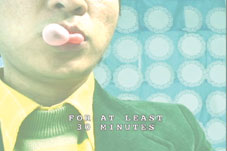
Greenlotte
Experimental video | dv | color | 4:0 | Korea, South, USA | 2005
A curator, "Amalia Pica" writes an SMS to "I", asking to make a short video out of the gum stuck on the pavement in Amsterdam. "I" wander off to think about how "I" was educated to chew gum, brush teeth, and wear clothes. Then "I" make comparisons to a girlfriend who wears clothes differently, chews gum differently, and would have made this video differently.
Born in 1975 in Seoul, Korea, the artist Sung Hwan Kim holds a Master of Science in Visual Studies from M.I.T, and was a resident artist at the Rijksakademie van Beeldende Kunsten. He has shown his works at such venues as the Gwangju Biennial, the Busan Biennial, the Portland Institute of Contemporary Art, the Asia Society, D.U.M.B.O Art Center, Pacific Film Archive, Le Plateau (Paris), The Living Art Museum (Reykyavik), Mediamatic (Amsterdam), SMART Project Space, (Amsterdam), Objective-Exhibitions (Antwerp), and Leeum Samsung Museum of Art (Seoul) among others, as well as at various international film festivals. As a performer, he participated in Joan Jonas' "Lines in the Sand" at Documenta 11, Kassel; Tate Modern, London; and The Kitchen, NYC.
Woong Yong Kim
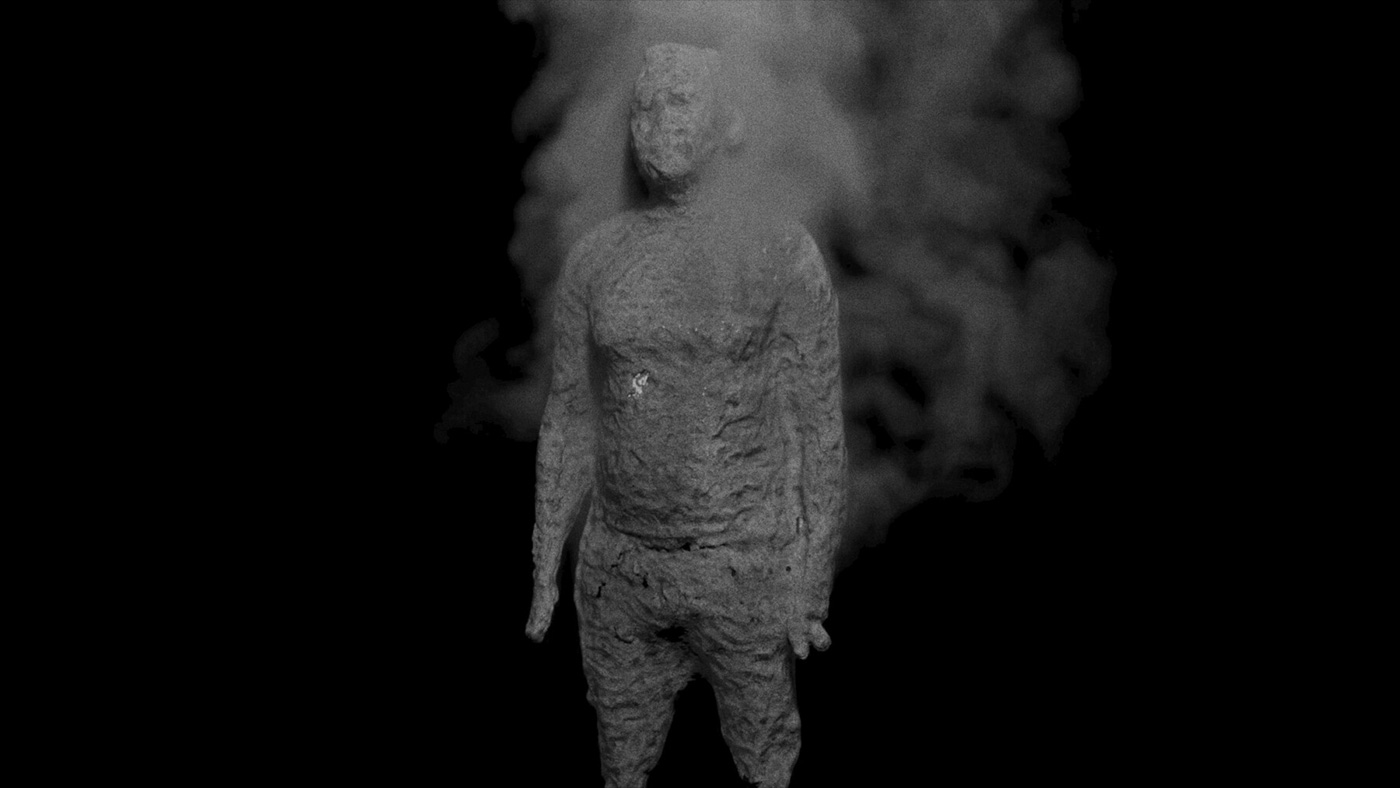
gray matter
Documentary | 4k | black and white | 16:42 | Korea, South | 2024
For Filipino migrant workers employed in factories on the outskirts of Seoul, home is both a place they have left behind and a paradoxical space of longing and fear—one that has been swept away by floods yet still haunts their memory. They are constantly being displaced, resettled, and set in motion, their sense of home inseparable from the movement of their own bodies.The sounds of factory machines, fragments of horror films, and mobile phone images intertwine into a narrative that unfolds within the migrant worker’s body itself. I began to imagine a home for those who are always drifting.
Woong Yong Kim studied film directing and contemporary art at the Geneva University of Art and Design (HEAD – Genève), Switzerland, and works across video installation and film. He has participated in several artist-in-residence programs, including the Digital Arts Studios in Belfast, CEEAC in Strasbourg, MMCA Goyang Residency, SeMA Nanji Studio, ACC, and as a visiting artist at the Rijksakademie. He completed the doctoral coursework in Film and Media Theory at Chung-Ang University’s Graduate School of Advanced Imaging Science. He also translated and published in Korean, Exhibiting the Moving Image (JRP|Ringier)
Chansoo Kim
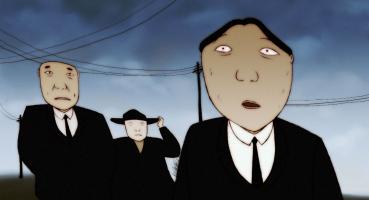
Vaudeville
Animation | betaSP | color | 5:10 | Korea, South, USA | 2005
Loosely based on Korea in the 30?s, Vaudeville is a visual poem about despair, wandering and the loss of cultural identity.
Chansoo Kim studied animation in the Division of Animation and Digital Arts at the University of Southern California, and produced short animated films using various techniques, ranging from hand-drawn to stop-motion and CGI. His films, Woman in the Attic and Floating gained critical attention through the festival circuit. His new film, Vaudeville is currently touring the festivals since the spring of 2005. Chansoo recently finished the Animation Apprentice Program at Rhythm and Hues and is now working in CG animation.

Jonna Kina
After Life followed by Red Impasto Jar
Experimental film | 16mm | color | 9:0 | Finland | 2021
The work is composed of two separate films followed by each other. Both films explore transcendental issues through archaeological and illegal excavations of tombs. "After Life" consists of a sequence of meditative short scenes picturing the ruins of a small Faliscan necropolis Cavone di Monte Li Santi in Italy and its surrounding natural elements. The rock-cut chamber tombs of the necropolis had been illegally excavated before they were archaeologically discovered in 2015 – a phenomenon still faced by many rural archaeological sites. At the center of "Red Impasto Jar" is a looted archaeological tomb object. In antiquity, the funeral was a significant ceremony where entombing of the body was just one component in the complex sequence of events. This ancient Faliscan tomb item dating back to the 6th century BCE was passed on to the archaeological museum (Mazzano Romano, Italy). The jar is radically altered and damaged by being cemented into the structures of a house as a decorative element. The film portrays the state of the pottery focusing on the detailed choreography and documentation of the object with a slow 360º rotation on a robust industrial motor against a monochromatic background.
Sound, perception and imagination are essential ingredients in the research and practice of Jonna Kina (b. 1984). Her work reveals the value of fictional viewpoints in non-fictional investigations. Kina’s works have been shown in the Tokyo Photographic Art Museum; Fondazione Pastificio Cerere, Rome; Dunkers Kulturhus, Helsingborg; Musée de l’Elysée, Lausanne; International Film Festival Rotterdam; Hasselblad Foundation, Gothenburg; Espoo Modern Art Museum EMMA; Kumu Art Museum, Tallinn and in Sara Hildén Art Museum, Tampere, among others. Kina has recently been awarded the Finnish Art Prize “Below Zero” (2018) and her film Arr. for a Scene was awarded as the “Best Nordic Short Film” at Nordisk Panorama Film Festival in Malmö (2017). She was also shortlisted for the VISIO Young Talent Acquisition Prize in Florence (2017).
Joe King, Rosie PEDLOW
Sea Change
Experimental film | 35mm | color | 5:28 | United Kingdom | 2005
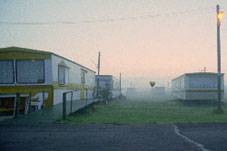
Filmed on a caravan park at the end of the season, this film reveals a landscape dramatically transformed by light and time, and resonating with the transience of human presence.
Rainer Kirberg
Überfahrt
Experimental doc. | dv | color | 14:0 | Germany | 2006
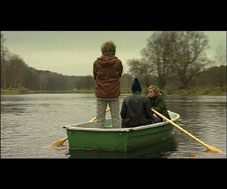
Brandenburg/GDR, 1979. In the custody of the East German Staatssicherheit, three battle-weary terrorists of the West German Red Army Faction design fictitious biographies in order to survive undercover in the socialist part of Germany. The conversation among the three about their false identities shifts to a requital of their own political past and an admission of moral defeat.
Author, stage manager, artist, Rainer Kirberg studied painting, cinema, art history, and philosophy at the Kunstakademie and at the University of Düsseldorf. Since the end of his scholarly period, in 1969, he has been making experimental short films, independent music clips (some bought by the 'Cinemathèque Française'), and is also the author and director of three feature-length films. It was in 1979 that he really started working in the artistic domain through cinema, scenic installation, and performance. In addition to his own projects, for which he has been in charge of production, scenery, architecture, filming, and editing, Rainer Kirberg works as an author for the German television and film industry. His prizes and achievements include the Prix du scénario de Rhénanie-Westphalie in 1991, and a nomination for Le prix du scénario allemand in 1996. Among the numerous artists that have collaborated on his work are: the star of French cinema, Tcheky Caryo ("Nikita"); renowned German actors Erwin Leder ("Das Boot"), Christopher Eichhorn ("Zuberberg" : "Montagne magique"), and Peter Lohmeyer; as well as such international personalities as Amanda Lear, a muse of Dali, and Kenneth Anger, a legend of underground film.
Freja Sofie Kirk
Killing Kidding Colliding
Experimental video | mov | color | 7:6 | Denmark | 2022
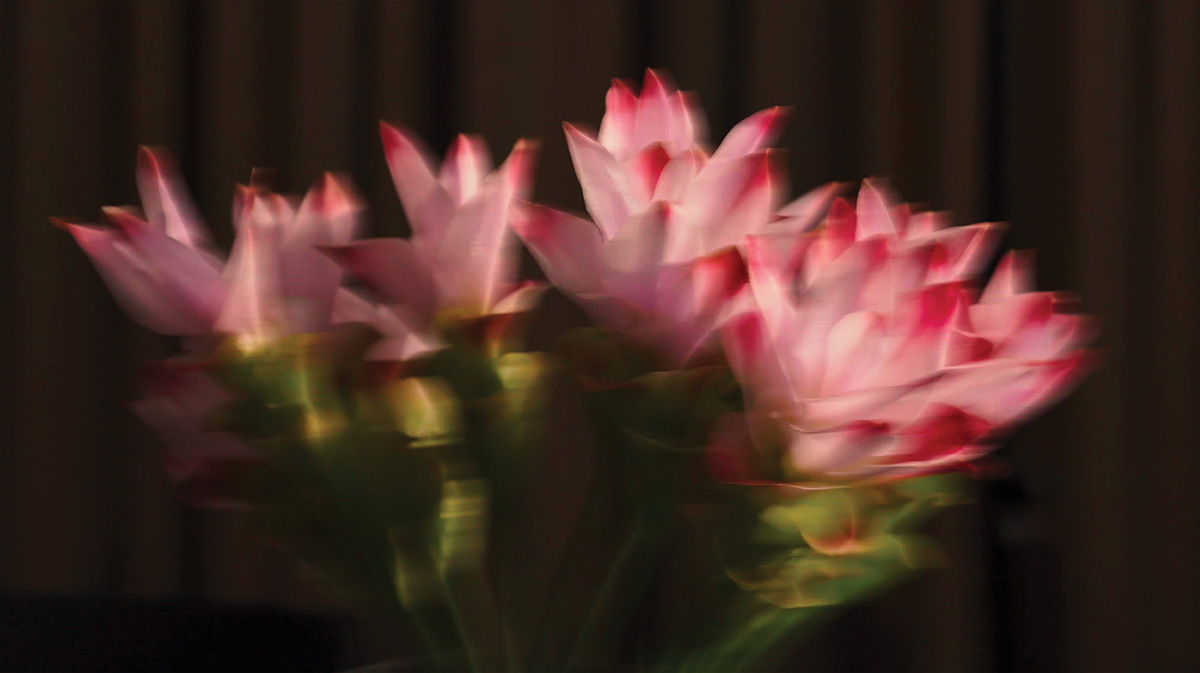
A bird carries us swiftly through empty lobbies and offices of a bank in Frankfurt, until it collides with a glass façade and falls to the floor. In this way, ‘Killing Kidding Colliding’ shows glass as both a material and an ideological symbol, moving between transparency and reflection, making things visible but impossible to touch. Moving mechanically between the different spaces of the bank, it draws attention to its own technique, while looking at the power and ideology of modern architecture, and how its immediate openness, transparency and smoothness also contain an underlying and invisible volatility.
Freja Sofie Kirk is a visual artist based in Copenhagen. Working across video, photography and installation, and often in connection with each other, she looks at the inner mechanisms and contradictions of images. Her work takes the form of a continuous study of spatial and medial constructions, the violence they perform and the architecture they manifest. By utilizing the camera, Freja Sofie Kirk attempts to renegotiate the power relations inherent in both archi- tecture and image production.

Freja Sofie Kirk, Kjær Esben Weile
Industries of Freedom
Experimental doc. | mov | color | 13:36 | Denmark | 2020
Industries of Freedom portrays a group of dancers who work at the biggest EDM night club in the world - Privilege. The dancers are being lifted up in cranes, carried over a beach in the mouth of an inflatable shark, or are hovering under the ceiling in the club. We experience how their bodies transform into scenographic objects, that merge with the rest of the stage construction. In Industries of Freedom, the night club is presented both as a workplace with strictly defined roles and as a space wherein one can live out notions of freedom and ecstasy, which is nonetheless strictly choreographed by the commercial logics of the entertainment industry.
Esben Weile Kjær and Freja Sofie Kirk both work in visual arts with various medias including film, photography, sculpture and performance. For the past five years, they have collaborated on several film projects, exploring identity, pop culture and image production. Their work have been represented in The National Gallery of Denmark, ARoS Museum of Modern Art, Kunsthal Aarhus, Den Frie Centre of Contemporary Art, The Factory for Art and Design and featured on platforms such as i-D, Tissue Magazine, Indechs and Out Magazine. Freja Sofie Kirk (born 1990) is an artist based in Copenhagen. Working with video, photography and sculpture, and often in combination with each other, her work explores narratives, popular culture and how images generate meaning in contemporary society. Freja Sofie Kirk has a background in film and photography and through the work with two-dimensional representations of the world, she has attained a sincere interest in the meaning of images and also an urge to dissolve or transform them into material qualities. Her works contain a constant interplay, between materiality and the mechanic, the sensuous and its absence, reality and the unreal. They are simultaneously both visually seductive and disturbing, but none the less, are they an image of the symptoms that our present reality leaves us with. Esben Weile Kjær (born 1992) is an artist based in Copenhagen. Spanning sculpture, video and performance, his work draws on the history of pop culture and pop music to investigate themes of nostalgia, authenticity, and generational anxiety. In an attentive though reckless visual language, he investigates today’s event economy, often focusing on marketing tactics and the aesthetics of the entertainment industry. Mainly to consider art’s relationship to its surrounding culture industries. As such, his work attempts to not only mimic other cultural modes of performance (such as those found in raves, protests, press conferences, and ballets), but become performative pop culture in its own right—often through interventions in public and commercial space, using props such as podiums, confetti canons, fences, and party lasers.

Freja Sofie Kirk
The End
Video | digital | color | 8:56 | Denmark | 2024
‘The End’ introduces Todd, an actor who has specialized in playing ill and dying patients in the context of medical practice situations for 30 years. Through documenting the scenography of a simulated hospital, a heart surgery on a plastic torso and Todd in an hotel room repeatedly falling to the floor - playing dead - ‘The End’ reflects on the way we use narratives to navigate reality. Layers of Todd’s voice and fragments from his scripts contribute to the blurring of lines between the fictitious and the actual, while elements of repetition in both speech and image remold ideas of linearity. In this way, ‘The End’ investigates the images, rituals and words associated with the certainty of death. It asks what space and shape it is granted — in the daily as well as on the screen - and how our emotional lives are continually shaped by the images we consume, leading us to turn to the language of fiction in the moments of our lives when we cannot find the words ourselves.
Freja Sofie Kirk (b. 1990) is a visual artist based in Copenhagen. Recent exhibitions includes Simian (DK), Kunsthal Charlottenborg (DK), Inter.pblc (DK), 5533 (TR), Copenhagen Contemporary (DK), Bianca D’Alessandro (DK), Kunstforeningen Gl. Strand (DK), Kunstverein Wiesen (DE). Her films have been screened at CPH:DOX, Rencontres Internationales Paris/Berlin, Oberhausen International Short Film Festival, Uppsala International Short Film Festival among others.
Lisa Klapstock
Ambiguous Landscape : Helsinki
Experimental doc. | dv | color | 99:99 | Canada, Finland | 2007
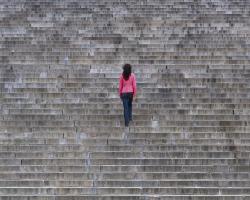
Ambiguous Landscapes (2003-2005) comprises large-scale ?dislocated? photo diptychs and a wall-mount ed 5-screen video work. The subject matter of natural and man-made landscapes includes a granite stair, a grass field, a paved dyke, a scrubby hillside, and a snowy slope, all rendered unfamiliar and spatially ambiguous with the cam era. These landscapes, made abstract by the analogue camera, are brought back into the realm of the real through temporal mechanisms involving the presence of a figure in the work. The figure registers and describes space and time, altering our perception of the depicted landscape, transforming it from a flat image into a three-dimensional space. In the videos, the movement of the figure traversing an otherwise empty and still landscape, reveals the shape of the depicted topography, as well as its expanse, and in the process registers both time and space. These moving images are endlessly repeating, looped with a built-in randomness that produces moments when the same landscape appears, at different points in time, across multiple screens. The videos are nevertheless largely still, setting up a situation of waiting and expectation. www.lisaklapstock.com
Lens-based artist Lisa Klapstock lives and works in Toronto and holds a Communication degree from Simon Fraser University, Vancouver. With a focus on everyday places and their human occupation, Klapstock?s practice investigates the relationship between photographic depiction and visual perception. Since the late 90?s, Klapstock has participated in numerous solo and group exhibitions in Canada, and in Europe where she has also participated in residencies: Stichting Duende Aktiviteiten, Rotterdam (2002); the Helsinki International Artist-in-Residence Programme, Cable Factory (2004); and the Danish International Visual Art Exchange Program, Copenhagan (2007). Klapstock?s work is in corporate and public collections including the Musée de la Photographie, Belgium; the Museet for Fotokunst, Denmark; the National Portrait of Canada, the Winnipeg Art Gallery (CA); the Kamloops Art Gallery (CA), and the Art Gallery of Hamilton (CA). Between 2004 and 2006, Klapstock?s work toured Canada in a solo exhibition, Liminal, organized by the Southern Alberta Art Gallery and accompanied by a monograph. She is represented in Canada by Jessica Bradley Art + Projects, Toronto and Diane Farris Gallery, Vancouver.
Karl Kliem, Christine FOWLER
2 minutes
Experimental video | dv | black and white | 2:0 | Germany | 2005
Karl Klien, 34 ans, est un membre fondateur du laboratoire MESO base à Frankfurt. Il développe des systèmes audio et vidéos en temps réel. Il réalise aussi de divers travaux dans les champs du multimédia, du design Internet et télévisé, de la production sonore et musicale pour les films et les installations interactives. Il est aussi membre de Involving Systems et le fondateur d?un label, Dienstselle. Il est en 1969 né à Frankfurt sur le Main. En 1990, il entre à HFG OF et en sort diplômé en 98. Il créé en 95 Involving system pour faire des installations vidéos et audio interractives. En 97, il est membre fondateur de MESO pour le design des systèmes média numérique et finalement fonde son propre label, Dienstselle en 2002.

Valentinas Klimasauskas
Vilnius Contemporary Art Center
0 | 0 | | 0:0 | Lithuania | 2007
Inaugurated in 1968 in Vilnius, Lithuania, the Contemporary Art Centre (CAC) depended on the original Lithuanian Museum of Art. It was not until 1992 that the CAC, mainly funded by the Ministry of Lithuanian Culture, became independent. Today, with 2400 square metre surface dedicated to exhibitions, the CAC is the biggest institution dedicated to contemporary arts in the Baltic States. Proud of this space, the CAC asserts itself as an major player on the northern European Baltic scene. Every year the CAC organizes five to six major exhibitions as well as fifteen or more modest ones. It is also sheltering the Baltic Triennial of International Art, a contemporary art festival, and, every two years the CAC reviews the evolutions of Lithuanian art. Like all art centres, the CAC organizes conferences, screenings, and concerts. It also maintains a library, a media library where the public can come and consult specialized books and magazines as well as videos, CDs, DVDs, and the Internet. And since 2004 the CAC has greatly diversified its activities. Since 2004, it has produced its own series for Lithuanian television; a very experimental show where a group of social misfits and pariahs take control of a televised program. Inexperienced in television, they decide to reinvent the medium. In 2005 and in parallel to its activity of publishing catalogues and books, the CAC also began to publish "CAC Interview". A quarterly bilingual magazine (English/Lithuanian), "CAC Interview" takes interests in regional events that have an international impact and dimension. This year, the CAC is uniting with the Vilnius Art Academy and five other European institutions to propose a Master in Curatorial Studies program. And for the second time in its history, the CAC will be in charge of the Lithuanian Pavilion during the 52nd Venice Biennial.
Valentinas Klimasauskas is the curator of the Vilnius Contemporary Art Centre in Lithuania, and has taken part in the CACTV project, a television series produced by the CAC.
Vera Klute
Hair in my soup
Animation | dv | color | 2:32 | Germany, Ireland | 2009
The 2-channel video ?Hair in my soup? uses pencil drawing, photo-collage and video footage to create a multi-disciplinary animation. Over two and a half minutes the video moves through a variety of domestic scenes and settings, connected only through fragments of storylines. The imagery is immediately recognizable yet strange and mysterious, ranging from bicycle wheels that are wearing shoes and pill-popping magpies to grinding teeth and ants in the shower. The two screens go back and forth between displaying separate clips and then merging again into one continuous canvas. The two channels might shift, leave a gap or even show opposite view points of the same scene, relying on the viewer chose their own perspective. By juxtaposing the fantastic elements on both screens, associations and suggestions are created rather than a traditional narrative. The video is looking at life as a subjective experience where imagination and reality become undistinguishable. The ordinary becomes absurd in this rearrangement of everyday occurrences.
Now based in Dublin, German born Klute is currently an artist in residence at Fire Station artist?s studios. After graduating from an Honours BA in Fine Art at IADT in 2006 she has been exhibiting consistently in Ireland and abroad. Previous solo exhibitions were held at Wexford Arts Centre (2009) and The LAB, Dublin (2006). Her work has also been featured in numerous group shows including `How Do You Know?` at Blankspace Gallery in Oakland, `Housewarming` at RUA RED in Tallaght , `Dare to live without limits` at the Sub-Urban Video Lounge in Rotterdam, `Phoenix Park` at the Kerlin Gallery in Dublin, `The Video Project` at the Pawnshop Gallery in Los Angeles. She recently received the Wexford Emerging Visual Artist Award (2008) and the Arts Council Bursary Award (2008 & 2009).
Kari Og Odveig Klyve-gulbrandsen Og Klyve
Between
| | color | 5:51 | Norway | 2012
Miska Michael Knapek
kiasma cafe north
Animation | | color | 3:5 | Denmark, Finland | 2008
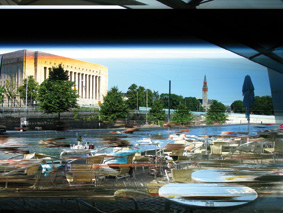
Through a spatiotemporal representation twenty-two hours of a central Helsinki cafe`s life, asking to our permanence and soul of being. How are we, beyond the instants? Every animation frame holds twenty-two hours dispersed through its surface, linearly as if the motif`s time was scanned horizontally. Every subsequent animation frame moves the time`s position across the motif, revealing each bit at a slightly later time. Tracing the life in a watering hole of society, a cafe, the work juxtaposes the static built environment and the fluidity of being. The cafe-goers stay long enough for them to be visually caught, depicted, the essence of their being, almost as if it were their souls, are like colours spilled running in the rain. A blur in motion. Cyclically appearing and disappearing daily.
Miska Knapek is an artist designer, with a past in Graphic Information Design (BA) and graduate studies in artistic interaction design, currently based at Media Lab Helsinki. He explores chaotic patterns and challenging fundamental perceptions of society, optics, time, and space. Applying information visualisation techniques, to photographic/sensory/datamined material, Knapek?s work traces the hidden lives of nature, society and people?s immediate personal surrounds. His work has been exhibited internationally, including at Ars Electronica and Transmediale.