Catalogue > Search
Results for : Tout le catalogue
Miska Michael Knapek
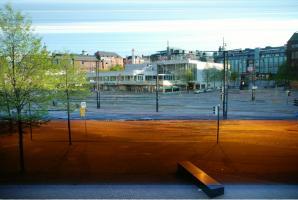
longlapses: mannerheimintie south
Animation | | color | 3:58 | Denmark, Finland | 2007
The 14:00 - 04:00 period of a busy Helsinki street, May. The ?Longlapses? projects peers at human perception and memory?s short attention spans and long forgettings. Miska Knapek?s ?Longlapses? seeks to open eyes and minds to life in longer attention spans, to trace the hidden chaotic being of society and nature. In compressed time and traces, nature?s movement is caught in changing light and shadow, but so too is society?s ?being?, tracing its life visually. As if a physical object, society?s sleeping, waking, leaving, working, travelling, returning, and sleeping, imprints itself visually.
Miska Knapek (`75) is an artist designer, with a past in Graphic Information Design (BA) and graduate studies in artistic interaction design, currently based at Media Lab Helsinki. He explores chaotic patterns and challenging fundamental perceptions of society, optics, time, and space. Applying information visualisation techniques, to photographic/sensory/datamined material, Knapek`s work traces the hidden lives of nature, society and people`s immediate personal surrounds. His work has been exhibited internationally, including Ars Electronica and Transmediale.
John Kneller
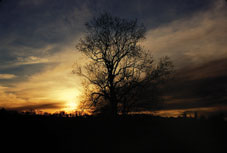
This film has no commercial value
Experimental film | 16mm | color | 23:30 | Canada | 2006
"This Film Has No Commercial Value" was traditionally made on film using a process based production method. It is an individual effort by one film artist and one sound artist. It focuses on the natural and man-made environment captured with the camera and a specialized apparatus, revealing a phenomenon that is unseeable with the naked eye. This compression of elapsed time is augmented by custom automated pan, tilt and zoom mechanics built by the filmmaker. The resultant imagery is a hyper-reality of landscapes and cityscapes, as captured and transformed through a means of mechanical mediation. The sound design is culled almost entirely from naturally recorded sound and musical performances in different environments; the romantic strains of the music harken back to the lyrical depictions of nature and environment. The deliberate mediation of the apparatus of sound and image suggests that our relationship to the environment can never again be viewed outside of the realm of the political. The music serves as a lament for the plundering of the earth by Man. The images of phenomena such as the Aurora Borealis are subjected to a lengthy filmmaking process that transforms them, eventually leading to phenomena that is created solely by the film process itself, particularly by the means of an optical printer and the crafting of travelling mattes on film and then performing repeated operations of combining and recombining with mattes to the point of complete image abstraction. The film is a culprit in which it wishes to expose the trouble with the post modernist tendency towards spectacle. It plunders nature and environment presenting them not as they are but with human intervention and manipulation.
John Kneller graduated from the University of Toronto, Cinema Studies programme in 1988 and has been making unusual films ever since. His stock in trade is the creative and time-intensive process of optical printing and time lapse manipulation. He currently teaches film at Sheridan College and is pursuing a MFA in Film at York University in Toronto. Recent and ongoing optical printing work has been done for Canadian experimental filmmakers Steve Sanguedolce, Phil Hoffman and Sol Nagler. He attended WNDX Winnipeg Experimental and Underground Film Festival, presenting an optical printing master class, and also presented new work in progress, "Homecoming Montreal 1950", a film that takes Kodachrome original and optically makes 3 colour separations, red, green, and blue, and then reconstitutes the colour on the printer at first faithfully but with increased experiments and interventions later on. It is a shorter 6 minute companion piece to the longer film from the same year. "This Film has No Commercial Value" (23 mins, 2006) is a mediated view of the harsh but beautiful Canadian Landscape.
Thomas Kneubühler
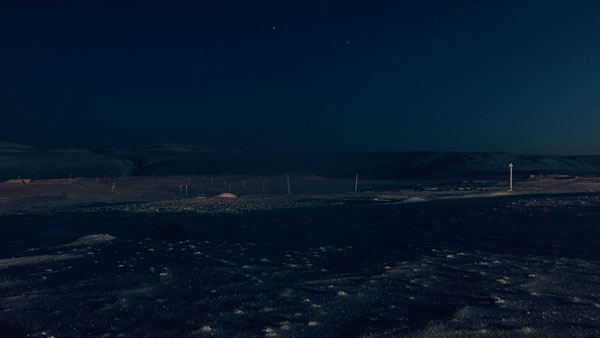
Days in Nights
Experimental doc. | | color | 3:45 | Canada | 2013
It is hard to navigate in the dark, especially in an unknown territory. Over time, the eyes adjust to the darkness, and the new environment starts to emerge. This video was made during an artist residency at CFS Alert, a military and research station in the high Arctic. CFS Alert is the northernmost settlement in the world, 800 km from the North Pole. From October to early March there is polar night, with no direct sunlight. Most people at the station are there for limited time, on average 3 to 6 months.
Born in Solothurn, Switzerland, Thomas Kneubühler has been living in Canada since 2000. In 2003, he completed a Master?s degree in Studio Arts at Concordia University, Montreal. His work often deals with social issues and how technology is affecting people?s lives. His work has been presented in many exhibitions in both Europe and North America, most recently at the Québec Triennial at the Musée d?art contemporain de Montréal (2011), at the Centre culturel canadien, Paris (2012) and at the Ausstellungsraum Klingental, Basel (2013). In 2011 he was awarded the Pratt & Whitney Canada Prize of the Conseil des arts de Montréal. «Whether it is the ambiguous boundaries of public and private space, the all-pervasive spectre of security surveillance or even the radiant, if dehumanizing, beauty of cityscapes, Kneubühler`s practice tellingly identifies the co-existing insecurities, uncertainties and subtle pleasures embedded in the structures of modern life.» (Bryne McLaughlin, Canadian Art) www.thomaskneubuhler.com
Thomas Kneubühler
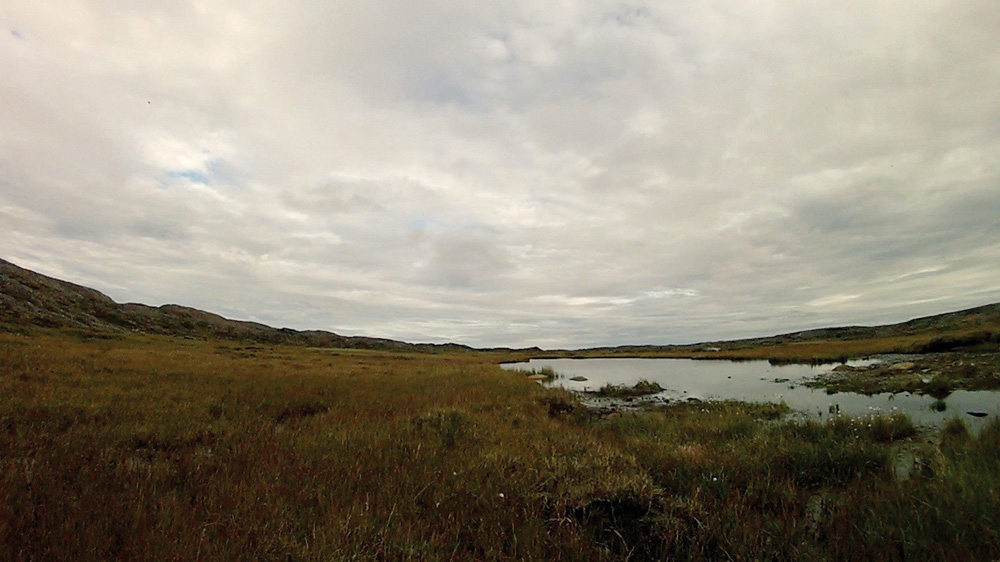
Forward Looking Statements
Experimental doc. | hdv | color | 3:47 | Canada | 2014
A conference call by investors of a planned iron mine provides the soundtrack for a ride over the land which the company wants to exploit. The land in question is a traditional hunting ground for the Inuit community of Aupaluk, located in Canada's far North. The village has already been relocated in the 1980 and is now again under threat. The term "forward looking statements" is used in the world of investors to describe future events which are subject to certain risks and uncertainties.
Born in Solothurn, Switzerland, Thomas Kneubühler has been living in Canada since 2000. In 2003, he completed a Master’s degree in Studio Arts at Concordia University, Montreal. His work often deals with social issues and how technology is affecting people’s lives. His work has been presented in many exhibitions in both Europe and North America, most recently at the Québec Triennial at the Musée d’art contemporain de Montréal (2011), at the Centre culturel canadien, Paris (2012) and at the Centre Pasquart, Bienne (2014). In 2011 he was awarded the Pratt & Whitney Canada Prize of the Conseil des arts de Montréal, and in 2012 the Swiss Art Award by the Ministry of Culture Switzerland. «Whether it is the ambiguous boundaries of public and private space, the all-pervasive spectre of security surveillance or even the radiant, if dehumanizing, beauty of cityscapes, Kneubühler’s practice tellingly identifies the co-existing insecurities, uncertainties and subtle pleasures embedded in the structures of modern life.» (Bryne McLaughlin, Canadian Art)
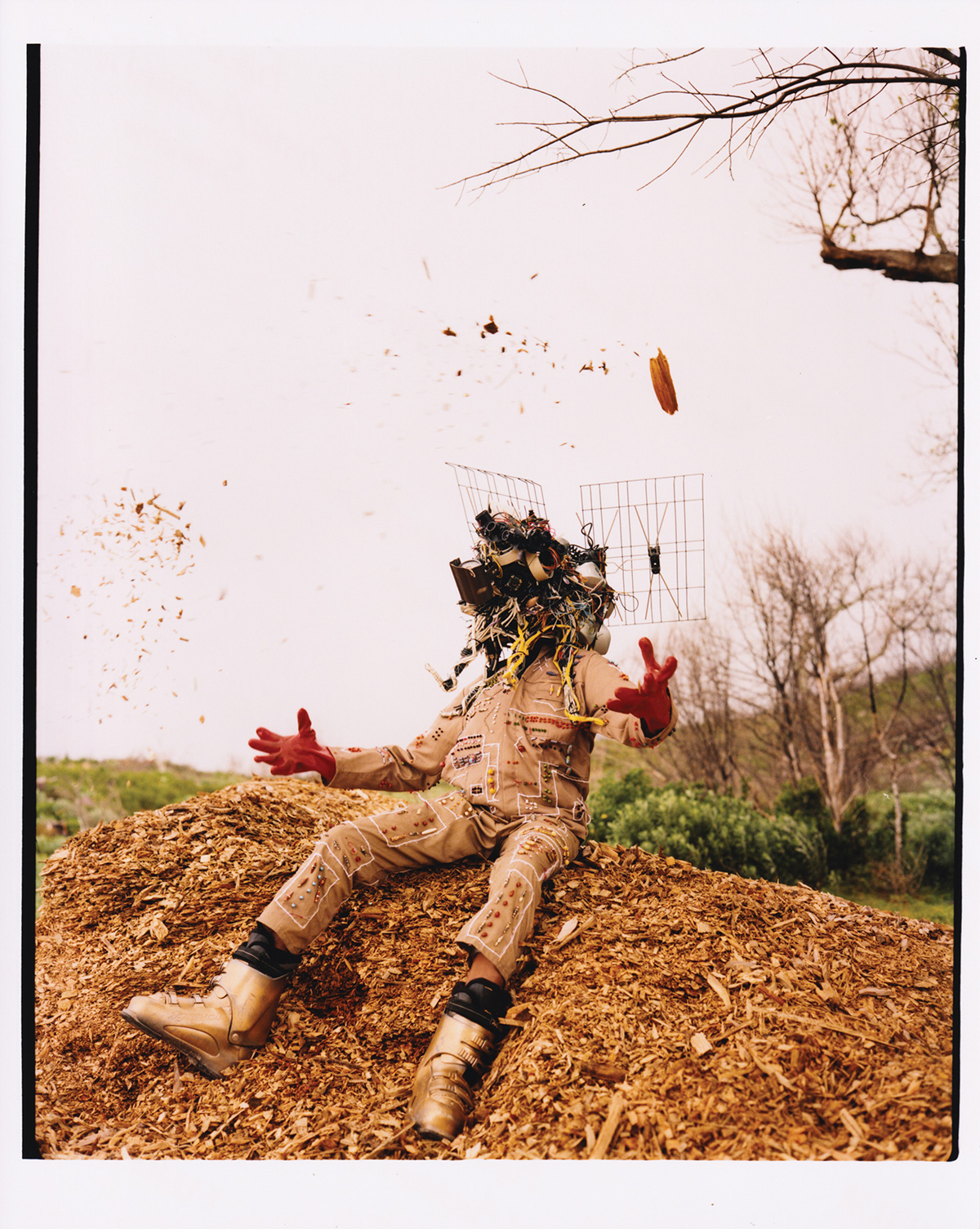
Francois Knoetze, Russel Hlongwane, Amy Louise Wilson
Dzata: The Institute of Technological Consciousness
Experimental video | mp4 | color | 8:23 | South Africa | 2023
Dzata: The Institute of Technological Consciousness is a creative research project by South African artists Russel Hlongwane, Francois Knoetze and Amy Louise Wilson. In fabricating a fictional institute and its archive, the artists explore and imagine vernacular technological practices operating across the African continent. An intertextual conversation between the documentary and the poetic, the video operates as an in-house media assemblage created for the preservation of the institute’s activities and ideas. The project aims to foreground indigenous technological knowledge and to explore how science, technology and innovation are part of a long interlinked process of accumulative knowledge production which extends long into the past. The work builds on the field of technopolitical research to formulate a multi-scalar history and future of technological creativity. Positioning the triumphs and failures of the everyday in the future-oriented technoscientific, the work unfolds the idea of development as a historical process Africans shaped.
Russel Hlongwane works in the production and assembly of culture. His area of interest is in heritage, tradition and modernity in South Africa. He moves between art-making (installation and film) and curating. His performance work operates as a bridge to transmit his academic interest to a broader audience, while his writing practice moves between academia, policy and art journals. His most recent peer reviewed paper is titled ‘Transcendental Technologies, Mother Tongues and Space (2022). He works intentionally with language (isiZulu) as a way to mobilise ideas contained in supressed histories. His work, Ifu Elimnyama (The Dark Cloud) has featured in six exhibitions and won the Sharjah Film Platform Jury Award. He curated the Bristol based Cntrl Shift Network festival that featured filmic works from the global south confronting the relationship between technology and the continent. Lo-Def Film Factory (Francois Knoetze & Amy Louise Wilson) is a DIY art duo who work across archival research, dramaturgy and visual strategies with video art, collage, sculptural installation and virtual reality. The duo aims to create a space for storytelling through the democratization of filmmaking via video by and for underrepresented communities across Southern Africa. They run workshops and work with various communities, placing value on the transmission ideas and lived experience over high production values. Their VR experience and research project The Subterranean Imprint Archive explores the legacy of technologies used in the extraction of mineral resources in Central and Southern Africa. It has been shown at the International Film Festival Rotterdam, University of African Futures (France), MUTEK Montreal and the Geneva International Film Festival. Amy and Francois have exhibited at the ZKM Center for Art and Media, The Centre Pompidou, The Dakar Biennale and the Akademie Der Kunste, Berlin.
Knut Asdam Special
| | | 90:0 | Norway | 0
.
.
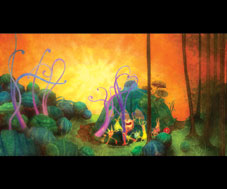
Jan Koester
Our Man In Nirvana
Animation | 35mm | color | 10:27 | Germany | 2005
John, a famous rock star, accidentally dies during a live gig with his band and awakes in nirvana. There he has to face his wishes and actions.
Jan Koester was born 1978 in Berlin. After going to school in Freiburg and Wilhelmshaven he returned to Berlin to study animation at the HFF "Konrad Wolf". After 3 years of working on it, he finished his diploma film "Our Man In Nirvana" in November 2005. He is currently working on a new short film.
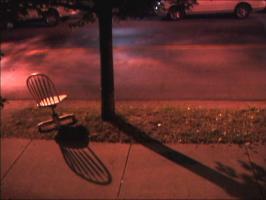
Siew-wai Kok
In Solitude, A Camera-eye
Experimental video | dv | color | 4:25 | Malaysia | 2006
The video took place in two locations: Buffalo, New York (USA) and Kuala Lumpur, Malaysia. Holding the camera, it serves as an extension of the artist?s eyes. A windy night, before the rain, a camera-eye. It has captured yearnings, solitude and time.
Born and raised in Kuala Lumpur, Malaysia, Siew-wai Kok is a video artist, also working with sound and performance. Her work explores intimate subjects in everyday life such as emotion, solitude and spiritual yearnings. Siew-wai received her Bachelor of Arts in Media Study at University at Buffalo, and her Master of Fine Art in Electronic Integrated Arts at Alfred University. She has participated in international festivals such as the 25hrs International Videoart Show 2003 (Spain), Signal & Noise 2006 (Canada), the International Film Festival Rotterdam 2007 (The Netherlands). Siew-wai is currently teaching at the Multimedia University (MMU), Malaysia.
Kai Foong Kok
Life is Elsewhere
Experimental film | dv | color and b&w | 7:14 | Malaysia | 2004
Do you sometimes feel like you`re being watched? Who is watching whom? Whose life are we living right now? Looking at the mirror, who do you see?
KOK Kai Foong studied Computer Science at Tamkang University (Taiwan) and became a film critic in 1996. Since 2002 he has made several shorts, next to his work as a freelance software engineer.
Selene Kolman, Stef KOLMAN
Tokyo Driver Caress
Experimental fiction | dv | color | 11:32 | Netherlands | 2004
Taisuke drives through futuristic Tokyo nights. Luminous express ways reflect vastness and infinitude with networks connecting humans, vehicles and visions. Caress ... a hypnotic visual of today?s ubiquitous journeys.
BIOGRAPHY SELENE KOLMAN OCCUPATION 2002 ? teaching at University of Utrecht (New Media and Digital Culture) EDUCATION 1994 - M.A. Philosophy, University of Amsterdam 1993 - B.A. Art Academy Minerva, Groningen 1990 -Propaedeutics Art History, University Groningen BIOGRAPHY STEF KOLMAN OCCUPATION 2003 ? creative director MediaCatalyst, Amsterdam EDUCATION 1993 - M.A. History&Theory Architectural Association, London 1992 - B.A. The Design Academy, Eindhoven BIOGRAPHY STIJN VAN SANTEN Stijn van Santen was born in 1965 in Amsterdam. After completing his studies at the Sint Joost Academy of Art in Breda in 1992, he was cameraman (16mm) for Miss Blanche and Leklicht by Mark de Cloe, Some Like It Hot and Can?t U Hear me Singing by Walter Stokman, De Tijdreiziger by Dick Tuinder and Jannes de Film by Rein Hazewinkel. In 1993 he received the Grolsch Prize for new talent during the Dutch Film Festival in 1993. He directed Igitur, Act of Presence and Goud, for which he won the Golden Flame. In 1995, he directed Downstairs, that was nominated for a Golden Calf. His recent films are Ichiko, Laatste woorden (documentary) and Talmen for which he won the Golden Calf and most recent Profs (Kort! 2004).

Sara Kolster, Pawel GRABOWSKI
Experimental video | dv | color | 2:0 | Netherlands | 2005
By using my camera as a searchlight, silently tracing textures, narrative space is revealed. The captured images and sounds will recall places within our own memory. Each fixed moment is like a capsule of time, a reminder of a future forgotten in the past.
Kolster [NL 1978] is a visual artist with a background in design. Recently, the focus of her work shifted more towards video and film; capturing details from urban locations, visualizing fragments of stories of these environments. She uses different strategies, from time-based media (video, film, photography) to appropriated research methods belonging to different observational disciplines (journalism, documentary & archeology).
Kong-chang Kong
Name of Wu Mei
Experimental video | dv | color | 16:0 | Hongkong | 2005
The story of this video comes from a short novel, ?The Name of Wu-mei,? written by Siu-cheong Yuen. Yuen used an extraordinary narrative direction to present the story. He pushed the audience to question our own sense during the reading. The story is about the narrator, Nin Kuen, telling us the process of completing the novel ?The Name of Wu-mei.? During the narration, we find out the hint we get may be about other lies.
In 2000 and 2005, Kongkee received a BA in Fine Arts from the Chinese University and a MFA from the School of Creative Media, City University of Hong Kong. Then, he started his comic and video work, such as the on-line comic: Rice-Gas. In 2003, his comic series Imperfect Shoes were published. His recent video works with the writing of novelist Siu-cheong Yuen: "Name of Wu Mei," which was just selected by the Hong Kong Art Biennial 2005 at the Hong Kong Art Museum.
Aglaia Konrad
Concrete & Samples I Wotruba Wien
Experimental doc. | 16mm | color | 16:30 | Belgium | 2009
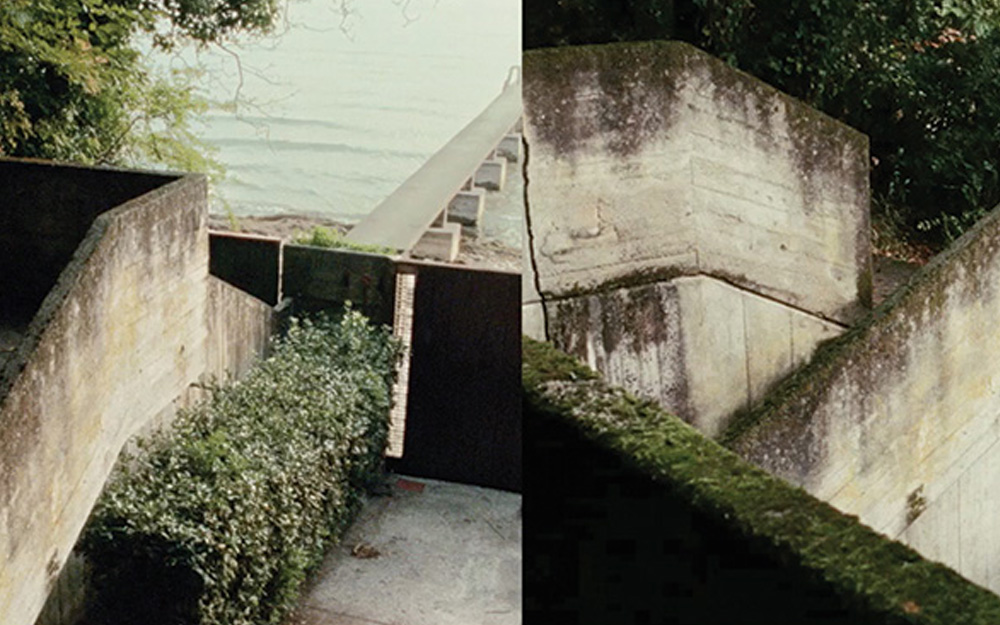
Concrete & Samples I, II, III is a series of 16mm films on sculptural architecture. What the buildings and site in all films have in common is the idea of ?architecture as sculpture? and a very distinct use of concrete that seem to depart from the free form of the whole in a sculptural manner. In the absence of a traditional narrative, it is the space itself, that takes the role of the protagonist, while the camera proposes a narration through its travel and observation. The church of Fritz Wotruba, in Vienna looks like an enlarged piece of abstract sculpture, a kind of three-dimensional synthetic cubist arrangement of 152 concrete blocks arranged vertically and horizontally, but asymmetrically, in which the narrow spaces produced in-between are made use of as windows and doors.
Aglaia Konrad is a photography based artist living in Brussels whose work has focused mainly on metropolitan urban space. She has been advising researcher at the Jan Van Eyck Academy in Maastricht and is currently teaching at the Hogeschool Sint-Lukas in Brussels. She had presented her work in solo exhibitions in Siegen, Antwerp, Geneva, Graz, Cologne and New York, among other cities, as well as in international group shows such as Documenta X (1997), Cities on the Move (1998-1999) and Talking Cities (2006). Her work has been documented in several exhibitions catalogues and monographic publications such as `Elasticity` (2002) and `Iconocity` (2005). For her latest book `Desert Cities` (2008) she received the Infinity award for the best photo book 2009 of the International Center for Photography, New York.
Aglaia Konrad
Das Haus
Experimental film | 16mm | color | 21:40 | Austria | 2014
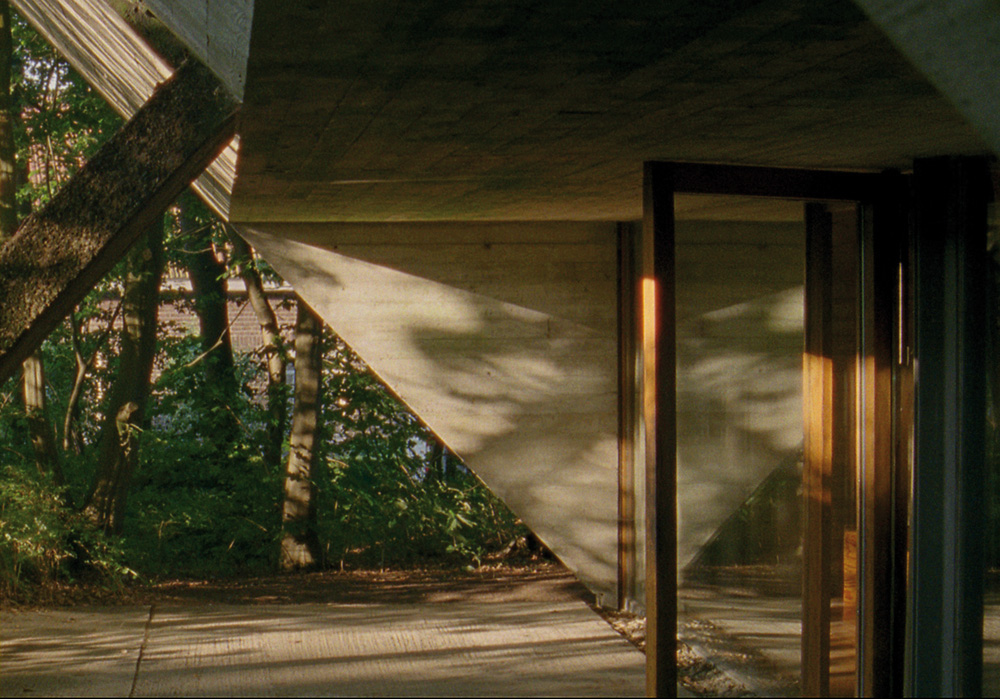
Das Haus deepens the exploration of sculptural architecture that Aglaia Konrad conducted with the series of 16mm films Concrete and Samples. Shot in a house designed by architect Juliaan Lampens in Sint-Martens-Latem (Belgium), the film resumes the artist’s interest on the possibilities of the cinematic medium to generate –rather than capture - an architectural experience. An experience which, in this film, surpasses the visual to mobilize bodily perception and even desire. Konrad’s editing carefully measures the doses of perceptual information it provides to our orientation drive in a process that departs from an initial willingness to orient oneself towards the pleasure of surrendering to disorientation and fragmentation. A disorientation that could be called “perverse” in the sense that Freud bestowed to the word –perverse pleasures are those which linger in the detour; in the resistance to result in a productive goal– insofar as the film replaces the production of a representation of space in favour of perceptive defamiliarization and tactile pleasure. Architecture and film are constantly looking at each other in a piece in which "angle", "transition", "cut", "sequence", "frame", " joint", " fold " and "rhythm" are notions that are spread from one discipline to the other as if the camera and editing would be reading the space as a composition score. There are two architectural comparisons that are often applied to filmmaking: the idea of cinema as a "window" and as “mirror". Das Haus, entangles and complicates those comparisons by treating windows as interfaces that blur the inside and outside and whose transparency acquires materiality, and by using mirrors as devices that disrupt form pushing it to a state of potentiality. In Das Haus the screen is no longer a window but rather a skin: for it is a body interface, a tactile surface and a membrane that is neither safe nor transparent because it reveals its inner cinematic compositional strategies.
Aglaia Konrad is a photography based artist living in Brussels whose work has focused mainly on metropolitan urban space. She has been advising researcher at the Jan Van Eyck Academy in Maastricht and is currently teaching at the Hogeschool Sint-Lukas in Brussels. She had presented her work in solo exhibitions in Siegen, Antwerp, Geneva, Graz, Cologne and New York, among other cities, as well as in international group shows such as Documenta X (1997), Cities on the Move (1998-1999) and Talking Cities (2006). Her work has been documented in several exhibitions catalogues and monographic publications such as 'Elasticity' (2002) and 'Iconocity' (2005). For her book 'Desert Cities' (2008) she received the Infinity award for the best photo book 2009 of the International Center for Photography, New York. The book 'Carrara' (2011) won the Fernand Baudin Prize 2011. Before the trilogy Concrete & Samples (2009-2010) she made the film Sculpture House (2008, 12'05") based on a house built in 1968 around Liège (BE) by Jacques Gillet, Felix Roulin and René Greisch.
Aglaia Konrad
La Scala
Experimental film | 16mm | color | 12:24 | Austria, Belgium | 2016
The subject of Aglaia Konrad’s 16mm films is modernist architecture but rather than a form of architecture on film, or film on architecture, her films investigate the potential for film to embody the experience of architecture as sculpture. The protagonist here is ‘La Scala’, a villa on Lake Garda, designed by Vittoriano Vigano for André Bloc in 1958. The ‘multiple projection’ (split-screen) of La Scala proposes a multiplicity of perspectives and, more significantly, a succession of combined images.
Aglaia Konrad (1960, Salzburg) criss-crosses urban spaces. Her photographs, films and installations zoom in on exceptional buildings and the transformation of cities. She focuses on the way architecture is visualised and exhibited. Aglaia Konrad lives in Brussels and teaches at LUCA School of Arts. She had presented her work in solo exhibitions in Siegen, Antwerp, Geneva, Graz, Cologne and New York, among other cities, as well as in international group shows such as Documenta X (1997), Cities on the Move (1998-1999) and Talking Cities (2006). Her work has been documented in several exhibitions catalogues and monographic publications such as ‘Elasticity’ (2002) and ‘Iconocity’ (2005). For her book ‘Desert Cities’ (2008) she received the Infinity award for the best photo book 2009 of the International Center for Photography, New York. The book ‘Carrara’ (2011) won the Fernand Baudin Prize 2011. In 2016 she published ‘From A to K’ (Buchhandlung Walther Konig).
Aglaia Konrad, George van Dam
sequenza
Experimental film | 16mm | color | 14:0 | Belgium | 2014
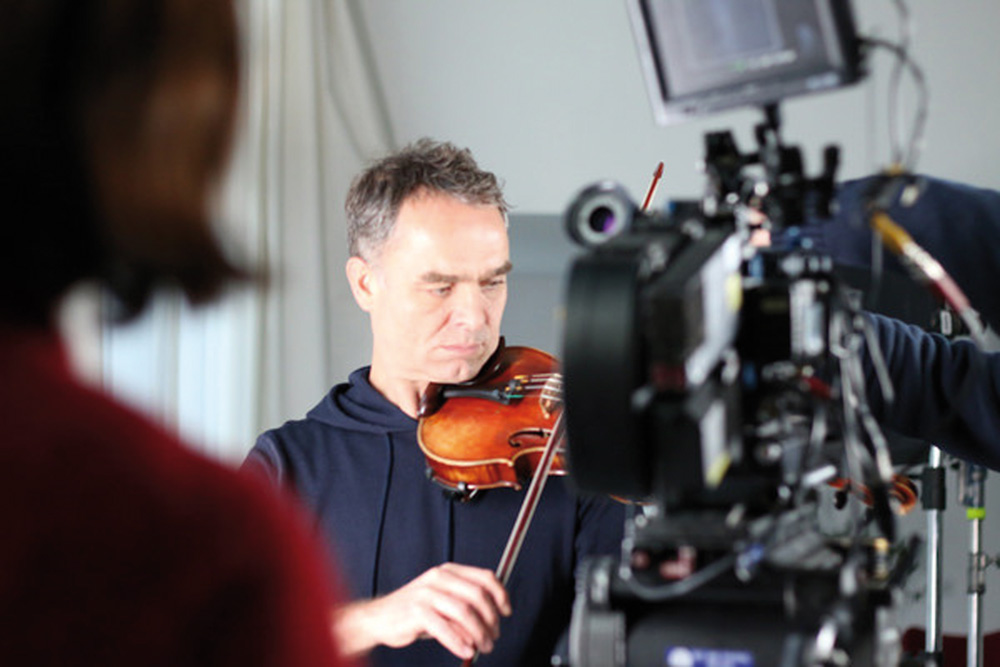
Sequenza is an experimental film project by Manon de Boer and George van Dam based on the composition Sequenza VIII for solo violin by Luciano Berio . From a long history of cooperation - to include the soundtrack of Manon de Boer's film trilogy Sylvia Kristel - Paris (2003), Resonating Surfaces (2005) and Think about Wood, Think about Metal (2011) and her portrait of George van Dam in Presto, Perfect Sound (2006) - came the desire to work together to make a movie based on Sequenza VIII . This piece is for its crystalline structure one of the most beloved compositions by George van Dam . Together with Manon de Boer, he wants to explore how rhythm and structure of this composition can be articulated in conjunction with moving images to penetrate. So even deeper into the composition Manon de Boer is fascinated by the image of the intimate contact of the chin, the ears, the face of the violinist with the violin, which extends in the movement of his arms and hands to the body and space, the instrument - body of the violin as a material, physical transition between two abstract elusive poles : that of the mental construction of the composition and experience of its sounds in space. Van Dam and de Boer have developed the following idea from these different interests. In several recordings of Dam filmed (and sound is recorded) when he performs Sequenza VIII . Emphasizing first half total, the body and the intimacy with the instrument. Then abstract details filmed, like his hands, his ear, details of the violin, strings and the like. In the editing is from the portrait / body of the violinist a more fragmented, abstract image created a physical, gives spatial experience in the tension between the music and the image rhythm. If the body and the violin in abstract details and solve dancing away in the (sound) space.
Manon de Boer (°1966 in Kodaicanal, India) completed her artistic education at the Akademie Van Beeldende Kunsten, Rotterdam, and at the Rijksakademie van Beeldende Kunsten in Amsterdam. Using personal narration and musical interpretation as both method and subject, de Boer explores the relationship between language, time, and truth claims to produce a series of portrait films in which the film medium itself is continuously interrogated. Her work has been exhibited internationally, at the Venice Biennial (2007), Berlin Biennial (2008), Sao Paolo Biennial (2010), Documenta (2012) and has also been included in numerous film festivals in Hong Kong, Marseille, Rotterdam and Vienna. Her work has been the subject of monographic exhibitions at Witte de With in Rotterdam (2008), Frankfurter Kunstverein (2008), London South Gallery (2010), Index in Stockholm (2011), Contemporary Art Museum of St Louis (2011) and Museum of Art Philadelphia (2012), among others. De Boer currently teaches at the School of Arts in Ghent and ERG in Brussels. She lives and works in Brussels.
Aglaia Konrad
Two Times 4'33
Experimental doc. | 35mm | color | 11:0 | Belgium | 2008
De Boer invited the Brussels-based pianist Jean-Luc Fafchamps to play John Cage?s eponymous composition 4?33? twice in front of a live audience in a studio space of the P.A.R.T.S. (The Performing Arts Research and Training Studios) in Brussels. Once, with one single still take, the camera films his execution of the ?silent? musical composition, complete with the three punctuations indicated on Cage?s simple line score at 1?40?, 2?23? and 30?, which the otherwise still and absorbed Fafchamps interprets by striking a timer. Filmed on 35 mm film, which ensures palpable visual detail, this first part is married to its synchronously recorded ambient sound, which is played in Dolby surround when the work is projected. For the second performance, and the second part of her film, De Boer cut all sound, interjecting only with the timer?s click at 1?40? and 2?23? and 30? into the 4?33? filmed performance. The camera travels in a long pan that begins where the first section does, at Fafchamps, but then moves in a steadily along every member of his audience and finally travels outside the studio door to show a parochial landscape at the edge of the city centre cut through by telephone wires and animated by wind-blown bushes. None of this is heard. Viewed in a cinema setting, the second performance, and the second part of the projected film relies on the ambient silence of the live audience. (Monika Szewczyk)
Manon de Boer (°India) lives and works in Brussels, Belgium. She makes films, videos, installations, publications and she teaches at KASK. She`s part of the production-distribution platform named Auguste Orts. Using personal narration as a method, Manon de Boer explores the relationship, between language, time and claims to truth. She also explores the perception of time through a conscious use of film as an artistic mediator and in analysis of its effect on the viewer. The way she divests image, sound and music in her compositions, subtly alters the classic pattern of perception of film.

Sara Kontar
3350 KM
Experimental doc. | hdv | color | 13:0 | Syria, France | 2023
In exile, 7 years away from my father and my homeland, I record our phone conversations. He tells me about the country, his loneliness. My screen unites and separates us, my only window. My memories fade, my life severed, my country inaccessible.
Sara Kontar is a Syrian artist, photographer, and filmmaker who has been based in France since 2016. She holds a Master's degree in animation cinema from L’École Nationale Supérieure des Arts Décoratifs de Paris (ENSAD). Her work spans documentary and artistic photography, with international exhibitions and recognition, including the Inge Morath Award. "3350 KM" is her first experimental documentary, following earlier experimental video works showcased at venues like Centre Pompidou and Palais de Tokyo. Kontar's work explores her roots and the experience of exile, expressing human emotions from a personal and intimate perspective. She is also the founder of "Al-Ayoun," a space for visual storytellers in Syria and the diaspora.
Frank Koolen, Kasper Jacobs
Play Curacao
Experimental doc. | hdv | color | 29:28 | Netherlands, Curaçao Islands | 2015
In the experimental documentary Play Curacao (2015) contemporary games, social rituals and leisure typical for the Caribbean island of Curacao are thoroughly investigated through a mix of observations, discussions and performative acts. During a four month residency at the Instituto Buena Bista artists/filmmakers Kasper Jacobs and Frank Koolen followed a wide variety of sub-cultures and singletons in their free-time routines resulting in a personal taxonomy of the Caribbean ‘Homo Ludens’. Play Curacao offers a dynamic, absurd and playful insight in the versatile everyday society and culture of Curacao.
Kasper Jacobs and Frank koolen, both visual artists working in the field of film and photography, met in 2007 and since then have been assisting each other frequently in a range of individual projects. Through these collaborations they created a mutual frame of preference and understanding. Their shared interest in subcultures and the structures they create to frame their own reality form the fundament of `Play Curacao` and future projects. Kasper Jacobs (1981, Bergen, NL) studied at the Gerrit Rietveld Academie in Amsterdam. Frank Koolen (1978, Maastricht, NL) studied at the HKU in Utrecht, De Ateliers and the Rijksakademie van Beeldende Kunsten in Amsterdam.
Jan Kopp
Les balançoires
Animation | hdv | black and white | 4:15 | Germany, France | 2011
.
Born 1970 in Frankfurt/Main, lives in Paris and Berlin 1992-1994 : studies philosophy at Paris IV, la Sorbonne. 1996 : graduates from Ecole Nat. Sup. des Beaux Arts, Paris.
Efthimis Kosemund Sanidis
Astrometal
Fiction | 4k | color | 15:55 | Greece | 2017
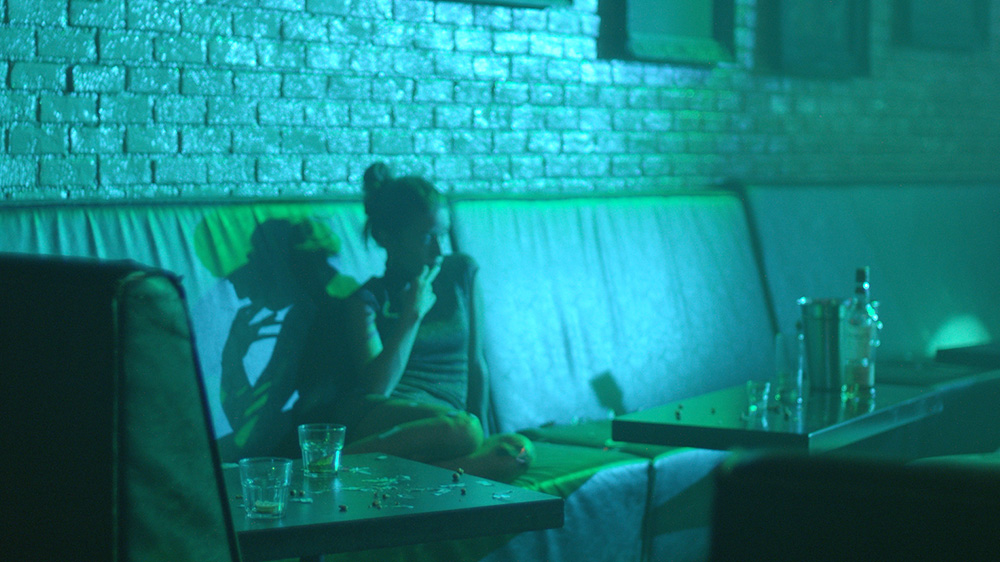
Two boys and a girl prepare for nightclubbing in the heart of Athens. Arriving, they face a deserted club, where music plays blaring but there is no one to listen. There, one by one falls asleep as they surrender themselves in a collective dream.
Born with dual Greek/German nationality, Efthimis Kosemund Sanidis studied Informatics Engineering, and then Contemporary Arts at Le Fresnoy - Studio National in France. His films have won acclaim at festivals around the world. His debut short film, “ II ” (2014, 16’), won the Pack & Pitch award at Sarajevo while in development, followed by a world premiere in the Pardi di Domani section of the Locarno Film Festival. He shot his next two films, “ Odette ” (2015, 16’) and “ Unbuilt Light ” (2017, 29’), while in residency at Le Fresnoy, with the latter opening in competition in Sarajevo. “ Astrometal ” (2017, 15’) was nominated for a Golden Lion in the Orizzonti section of the 74th Venice International Film Festival.