Catalogue > Search
Results for : Tout le catalogue
Joan Leandre
In the Name of Kernel! Song of the Iron Bird
Experimental video | 0 | color | 0:0 | Spain | 2007
"The Dr Strangelove of computing, Leandre loves the bomb and knows its mechanisms well enough to transform them instantly into the workings of a multi-layered ambiguous narrative, esoteric and seductive at the same time. This is what we can see in his latest project, In the Name of Kernel (2006 - ongoing). The kernel, the heart of every operating system, becomes the myth around which coagulates a symbolic event combining travel literature, the alchemy tradition and science fiction, terrorism and conspiracy theories, programming and mountaineering, 3D modelling and satellite mapping, hallucinations and revelations. A high definition metaphor for those who love the clear air of the high peaks." - Domenico Quaranta
Joan Leandre (b. 1968, lives and works in Barcelona, Spain) Media interpreter, member of the OVNI Archives since 1994. From 1994-1996 I worked on the series of media interruptions MAP (Mega Assemble Project), Fundación Zero and Serial Monuments, in 1995-1997 the Oigo Rom project, later in 1998 in Brooklyn I was involved with the President Archives. In 1999 I worked again with mass entertainment software and started the projects retroyou (RC) and retroyou (nostalG) and the long series still in process, retroyou nostalg2 and the Black Boot Project. Other colective projects I`ve been involved with these years are Velvet Strike (http://www.opensorcery.net/velvet-strike/) and the Archivos Babilonia (http://desorg.org/babylon_25-01-2005.php). I`m currently in that floating point of several considerations which bring the name of the iron bird scream in its flight through the automatic dusk, ...In the Name of Kernel!.

Joan Leandre
OVNI
0 | 0 | | 0:0 | Spain | 2007
The OVNI (Observatoire de la vidéo non identifiée) was founded in 1993 by the artists Joan Leandre, Toni Serra and Rosa Llop in Barcelona. OVNI's archives have an international and thematic character, facilitating a criticism of the contemporary culture using various strategies such as video art, independent documentary, and the archaeology of mass media. The archives gather a constellation of disparate works of which the common denominator is self-expression and thought about fears and the place of individual in collectives, building, and conjugating a multiple view. A thousand little works go into detail and explore our world or announce other possibilities. A discourse of which major values are heterogeneity, plurality, and contradiction, and in which subjectivity accomplishes itself. In this discourse, subjectivity is the only tool of repulsion against cloning and corporate mass media's repetition. During the various editions, the thematic character of this convocation changes through selections of works into a reading, a particular register of our time's dreams and nightmares. Thus, one could verify how the concerns' spectre has been gradually concentrated, taking part in a very developed range at the beginning of OVNI in 1993-1999 (to develop and explore video language's boundaries, recovering its first formal freedom and theme), until that it concentrates itself more and more on specific themes : Identity against Media (1997-98), Community (2000), Globalization (2002), September 11th's Consequences (2003), Resistances (2005), and the Colonial Dream Independent Zones (2006).
The Catalan artist Joan Leandre has been a member of OVNI (Observatoire de la vidéo non identifiée) since 1993. From 1994 to 1996, he worked on the series MAP (Mega Assemble Project), Foundation Zero and Serial Monuments. In 1996 he instigated the project Oigo Romo, financially supported by the Audiovisual University Institute (Instituto Universitario del Audiovisual) which provided a place for the Mega Assembly Project MSN ? Adult Playground 1.0. In 1998, he participated in President Archives in New York. In 1999, he began the project retroyou.org made for the break series of software retroyou RC, retroyou nostal(G), retroyou nostalg2, and the mailing list autoreplicant http://ddtpv-txmx7-bbgj9-wgy8k-b9ghm.org. During the last few years, he has made projects in collaboration with Archivos Babilonia and Velvet Strike.
Joan Leandre
In the Name of the Kernel Series - Magic Line
Animation | hdv | color | 22:25 | Spain | 2010
An exhibition of HD video, digital print and text by Barcelona based artist Joan Leandre. As the second Gallery exhibition in the artist?s extensive history, In the Name of Kernel ! The Magic Line is the third installment of the In the Name of Kernel series, introducing Leandre?s critical practice of media interpretation and reverse engineering to a new audience. The first two films of the series toured internationally to venues such as Sonar Festival, Barcelona 2008, 3rd Moscow Biennial, Moscow, 2009, and Centre George Pompidou, Paris 2009.
"Media interpreter and member of the OVNI Archives since 1994. From 1994 to 1996 I worked on a series of media interruptions called MAP (Mega Assemble Project), Fundación Zero and Serial Monuments. From 1995-1997 I was involved in the Oigo Rom project, and later in 1998 in Brooklyn I was involved with the President Archives. In 1999, I began working again with mass entertainment software and started the projects retroyou (RC) and retroyou (nostalG), and continue to work on the series retroyou nostalg2 and the Black Boot Project. Other collective projects include Velvet Strike and the Archivos Babilonia.? J.Leandre

Joan Leandre
In the Name of Kernel Series - Lonely Record Sessi
Video | dv | color | 20:0 | Spain | 2009
?In the Name of Kernel ! The Magic Line? is the third installation of the ?In the Name of Kernel series?, introducing Leandre?s critical practice of media interpretation and reversing engineering to a new audience. ?In the Name of Kernel ! ? gathers his last videos in an open cycle. They offer to the viewer a complex narration in which he can decode the mechanisms of the fascination for technology to which we are usually subjected, such mechanisms, that will then condition our perception of the world. In that sense, the work of Joan Leandre is quite subversive. In this installation, the kernel, which is at the heart of most computer systems, becomes the myth around which a symbolic event coagulates. It combines travel literature, the alchemy tradition, science fiction, terrorism and conspiracy theories, computer programming, mountain climbing, 3-D modeling, satellite mapping, hallucinations and revelations. Joan Leandre explores the troubled imagination of a fundamental principle of computer science, without regard for its potential uses, be they military or dreamlike. The image itself, which is created by manipulating computers, changes its status. Along with the images, the blind power of the Kernel appears, the kernel in whose name all technological usages become possible.
Joan Leandre lives and works in Barcelona. He is media interpreter and member of the OVNI Archives (Observatoire de Vidéos Non Identifiées). since 1994. From 1994 to 1996 he worked on a series of media interruptions called ?MAP? (Mega Assemble Project), ?Fundación Zero? and ?Serial Monuments?. From 1995-1997 he was involved in the Oigo Rom project, and later in 1998 in Brooklyn he was involved with the President Archives. In 1999, he began working again with mass entertainment software and started the projects ?Retroyou (RC) and retroyou (nostalG)?, and continues to work on the series ?Retroyou nostalg2? and the ?Black Boot Project?. Other collective projects include Velvet Strike and the Archivos Babilonia. Since the begining of the 90ies, Joan Leandre is a media interpreter, an Internet archeologist. He make permanent excavations and collects data. He archives numerous datas that have been ?forgotten?, on a corporate site for example, or, contrariwise, data that have very short apparition before becoming confidential or outdated in terms of technologies. Going further than the apparent usability of such or such interface, he tries to create a state of consciousness concerning what the machines are able to make us do because of our ignorance and the power of the ideological conditioning on our understanding of the real today due to the new images. Since 2006, the work of Joan Leandre lies essentially on the analysis and the deconstruction of games, simulation or military training softwares. His work has been shown at the Sonar festival, Barcelona, at Transmediale, Berlin ; at the Whitney Biennial in the Whitney Museum of American Art, New York, at the Laboral Centro de Arte Contemporaneo, Gijon, at the Moscow Biennale, at the ZKM, Karlsruhe.
Joan Leandre
Magic Line
Video | dv | color | 20:0 | Spain | 2010
Joan Leandre
Retroyou_nostal(g)
Multimedia installation | 0 | | 0:0 | Spain | 2007
?Retroyou_nostal(g)? is a software research project whose aim is to transform the original programs into self-running simulation environments. The conditions in four flight simulator programs are modulated in such a way that they can hardly be operated by human pilots any more. Prix Ars Electronica 2006, Honorary Mention Interactive Art
The Catalan artist Joan Leandre has been a member of OVNI (Observatoire de la vidéo non identifiée) since 1993. From 1994 to 1996, he worked on the series MAP (Mega Assemble Project), Foundation Zero and Serial Monuments. In 1996 he instigated the project Oigo Romo, financially supported by the Audiovisual University Institute (Instituto Universitario del Audiovisual) which provided a place for the Mega Assembly Project MSN ? Adult Playground 1.0. In 1998, he participated in President Archives in New York. In 1999, he began the project retroyou.org made for the break series of software retroyou RC, retroyou nostal(G), retroyou nostalg2, and the mailing list autoreplicant http://ddtpv-txmx7-bbgj9-wgy8k-b9ghm.org. During the last few years, he has made projects in collaboration with Archivos Babilonia and Velvet Strike.
Sonia Leber, David Chesworth
Earthwork
Video | hdv | color | 5:0 | Australia | 2016
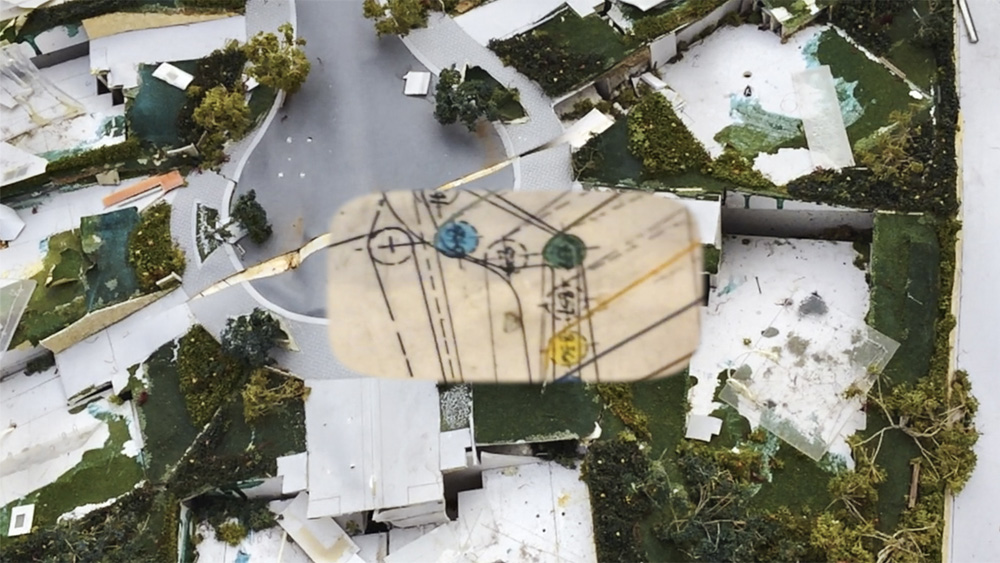
Earthwork’s screen is positioned flat on the floor, facing upwards. The visitor, looking down, gets a bird’s-eye view of a suburban landscape in which there are destroyed buildings, damaged roads, fences, and gardens. The image suggests a world that has undergone massive disruption. It is unclear whether accident, entropic forces, or warfare has caused this result. Superimposed upon Earthwork’s devastated landscape is another smaller image that presents the viewer with an alternative framing the site. We see diagrams: symbols of what might be location coordinates, suggesting an ongoing search for boundaries, and an intention. The two images appear to be attempting to “ line-up ”, but this is never achieved. The title, Earthwork, references the American Land Art movement of the 1960s; Leber and Chesworth’s videowork further explores Robert Smithson’s concept of the “ non-site ”. A non-site is an artwork situated in a gallery that metaphorically represents a remote actual site. As Smithson suggests “ the site is evading you all the while its directing you to it ”.
Sonia Leber and David Chesworth are known for their distinctive installation artworks, using video, sound, architecture, and public participation. Developed through expansive research in places undergoing social change, Leber and Chesworth’s works are speculative and archaeological, responding to architectural, social, and technological settings.
Sonia Leber, David Chesworth
Where Lakes Once Had Water
Video | 4k | color | 28:14 | Australia | 2020
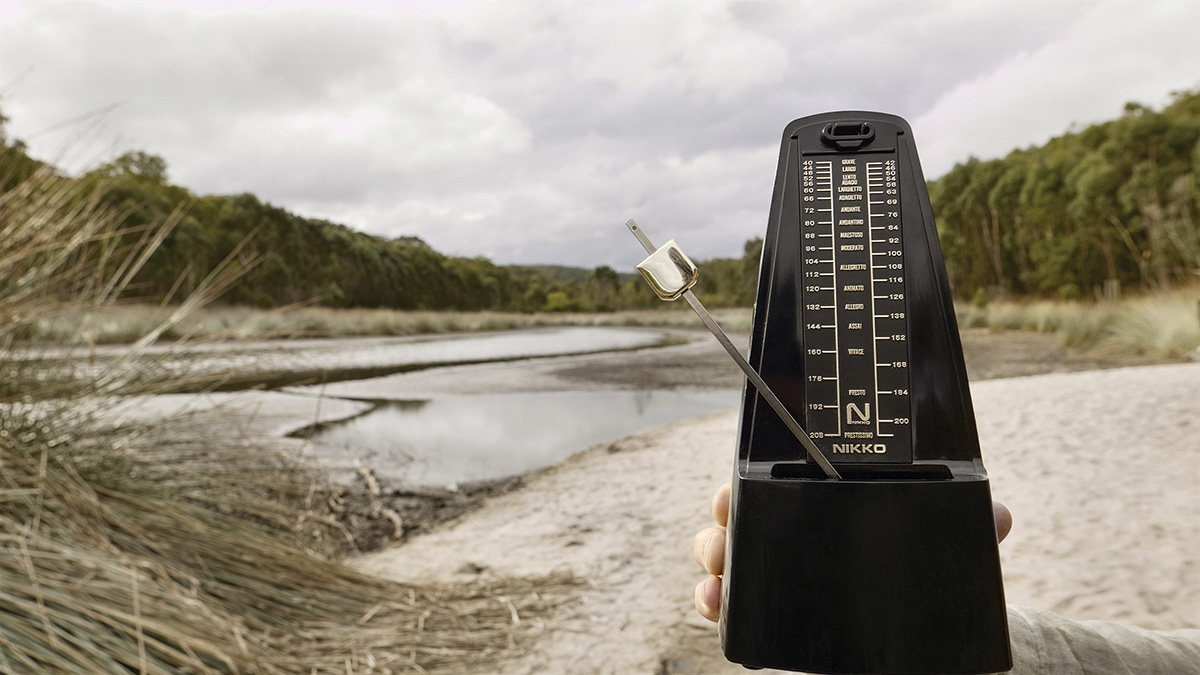
‘Where Lakes Once Had Water contemplates how the Earth is experienced and understood through different ontologies – ways of being, seeing, sensing, listening and thinking – that reverberate across art, Indigenous thought, science, ancient and modern cultures, and the non-human.’ Sonia Leber and David Chesworth travelled with a team of Earth and environmental scientists who are investigating changes in the climate, landscape and ecology over 130,000 years. Their journey took them to Australia’s Northern Territory, to spectacular yet challenging environments, from locations of long-term aridity to lush, green waterways. Where Lakes Once Had Water channels the experience, where Indigenous rangers, Elders and community members collaborate with scientists. Working across the ancient shorelines, everyone is receptive to the signs, signals and rhythms of the land. Meanwhile, non-human cohabitants continue their struggles for survival. Leber and Chesworth deploy video as a tool, scanning tree lines, erosions, termite mounds, and the effects of water, sun and fire. Their disquieting sound design encompasses natural and human-made sounds, and the hidden signals and energies that exist beyond human hearing. The project is a journey across audio-visual realms, scientific endeavour and Indigenous knowledge – a coalescence of efforts to understand the ancient land. "Where Lakes Once Had Water" was commissioned by the Australian Research Council Centre of Excellence for Australian Biodiversity and Heritage (CABAH) in association with Bundanon. It was filmed on the lands and waters of the Mudburra, Marlinja, Jingili, Elliot, Jawoyn and Larrakia communities in Northern Territory, with additional filming and editing on Barkandji, Dharawal, Djabugay, Yidinji and Wurundjeri Country. University of Wollongong Art Collection, Australia.
Australian artists Sonia Leber and David Chesworth are known for their distinctive video, sound and architecture-based installations that are audible as much as visible. Leber and Chesworth’s works are speculative and archaeological, often involving communities and elaborated from research in places undergoing social, technological or local geological transformation. Their works emerge from the real but exist significantly in the realm of the imaginary, hinting at unseen forces and non-human perspectives. Leber and Chesworth’s artworks have been shown in the central exhibitions of the 56th Venice Biennale: All The World’s Futures (2015) and the 19th Biennale of Sydney: You Imagine What You Desire (2014). Solo exhibitions include What Listening Knows, Messums Wiltshire, UK (2021) and the survey exhibition Architecture Makes Us: Cinematic Visions of Sonia Leber & David Chesworth, Centre for Contemporary Photography, Melbourne, Australia (2018) touring to Griffith University Art Museum, Brisbane (2019) and UNSW Galleries, Sydney (2019).
Ange Leccia
Nuit bleue
Experimental fiction | | color | 86:0 | France | 2010
"Celui qui n`accepte pas de se laisser égarer n`empruntera jamais que des chemins déjà tracés: il risquera de manquer celui qui le concernerait en propre. A moins qu`il ne sabote tous les chemins, les coupe et les embrouille." L?égarement de mes personnages dans « Nuit Bleue » s?imprègne de la pensée du philosophe Jean Toussaint Desanti ; mes émotions visuelles tentent de l?illustrer. A. LECCIA
Ange Leccia est né le 19 avril 1952 à Minerviù en Corse. Artiste plasticien, il a été pensionnaire de la villa Médicis à Rome en 1981-1983, puis résident à la villa Kujoyama à Kyoto en 1992-1993. Professeur à l?École Régionale des Beaux-Arts de Grenoble de 1985 à 1997, puis à l`l?École nationale supérieure des Beaux-Arts de Cergy de 1997 à 2000, il est actuellement directeur du Pavillon, le laboratoire de création du Palais de Tokyo. Ses oeuvres ont été exposés dans de nombreux musées (Guggenheim, Centre Georges Pompidou) et manifestations (Kassel, Sydney) en France et à l`étranger et il a réalisé de nombreux films dont Ile de Beauté (1996) et Gold (2000) avec Dominique Gonzales-Foerster, ainsi que Azé (2004) ou encore La déraison du Louvre (2005).
Johanna Lecklin
Paljon on iloakin
Experimental video | dv | color | 10:0 | Finland | 2005
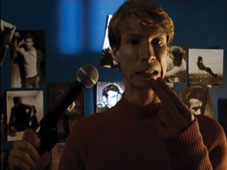
The script in "There is a Lot of Joy, too" is based on discussions with a young boy who has Asperger's syndrome. The script became a fictive dialogue between a boy and his mother. They never meet on the screen, but are shown in their own rooms next to each other. The boy talks about his dreams and the mother recounts how it is to live with a child who is different.
Johanna Lecklin is currently completing a PhD at the Academy of Fine Arts in Helsinki, Finland. Her subject is Narrativity, Documentary, and Performativity in Video Art; it is closely related to her own artistic practices. Her background includes an Erasmus exchange at Slade School of Fine Art, UCL in London 1998-99 and a MA degree from the Academy of Fine Arts in Helsinki in 2003. She has taken part in film and video festivals such as Raindance Film Festival in London, UK in 2006; "bzzz" - Pépinières européennes pour jeunes artistes - 18th Festival International des Programmes Audiovisuels Biarritz in France 2005; and in Kasseler Dokumentarfilm - & Videofest Festival, in Kassel, Germany, 2004. She has had several solo shows in Finland and taken part in group shows in many Finnish museums and abroad. In 2001 she won First Prize of the Artists' Association of Finland.
Jean François Lecourt, Thomas Auriol
Tir dans le miroir
Performance | hdv | color | 0:0 | France | 2010
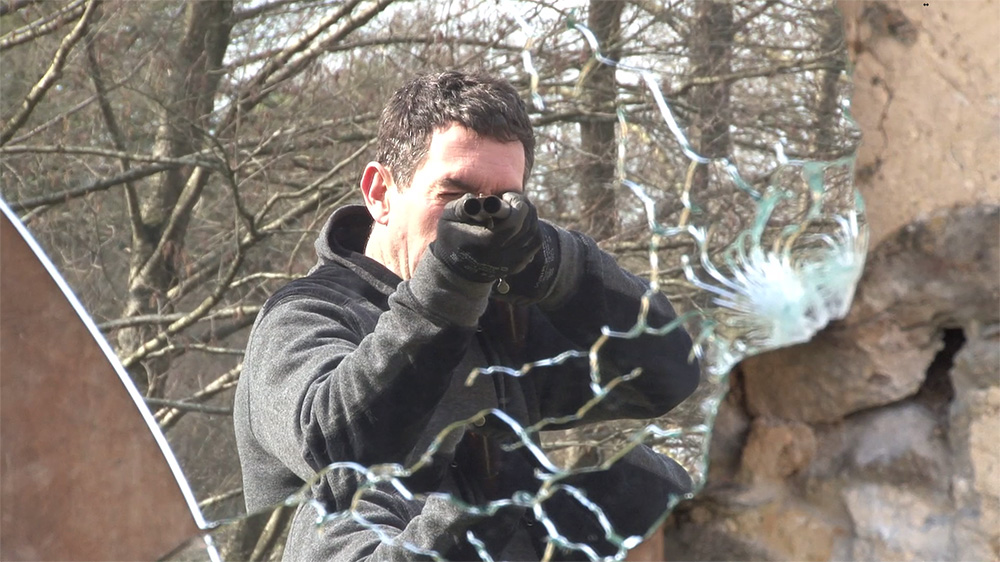
Jean-François Lecourt est né dans le Perche le 3 Novembre 1958, au sein d’une famille d’agriculteurs. Il entre à 17 ans à l’école des Beaux-Arts du Mans où enseigne Gina Pane, une des artistes fondatrices du mouvement de l’art corporel. Parallèlement, il suit l’éducation d’un Maître d’Arts Martiaux en Karaté Do (la voie des mains nues) de l’école Shotokan, et s’adonne assidûment aux pratiques du Tir à l’arme à feu et du Tir à l’arc. Sa démarche est basée sur l’analogie et l’identification. Une méthode qui le conduit à la découverte de l’aspect cyclique et symétrique des processus de tir et de photographie ; d’où le concept majeur de son œuvre : Le Tir dans l’appareil photographique.Cet acte artistique est un cérémonial immuable qu’il pratique depuis 1977. Il ne s’agit pas pour lui d’illustrer une névrose autodestructrice mais de tenter, en un retour immédiat, d’abolir l’arrêt fatal du cliché. La photographie est donc ici un Art martial. Comme dans le Kuy-Do, la cible à atteindre est soi-même, le but étant la réalisation au présent de celui qui pratique. Une nouvelle création vidéo de 2010 implique une série de films qui mettent en jeu l’autoportrait, la détonation, effondrement et la renaissance du paysage, ce travail s’intitule « Les tirs dans le miroir ».
Alejandro Lecuna
718 Nebel und Rauch
Art vidéo | dv | | 7:18 | Venezuela, Germany | 2005
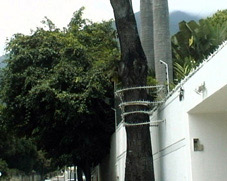
The polarized political situation of Venezuela is presented as an asymmetric documentary that shows the private and the public space in the capital Caracas. The constant fear induced by political in-stability and the incapability of the government in public safety has given raise in the last few years to a prosperous industry of home-security that has re-shaped the public and private space. Bob-wire and electric fences are the new decoration fashion that every house must have in order to be saved from the ?other?. Caracas is a place where nature, humans and panic seem to be able to co-exist in a tense harmony.
Alejandro Lecuna started his career in the arts has aprenticeship of the Venezuelan Op artist Carlos Cruz-Diez. Studied Graphic Design in the Instituto de Diseño de Caracas and in the School of Visual arts of New York with Prof. Milton Glazer, Prof. Tony Palladino and Prof. Ed Benguiat. Recently finished his studies in Visuelle Kommunikation and Video art- at the University of the Arts of Berlin with the German video-artis Prof. Maria Vedder and Prof. Holger Matthies (UdK). Currently studies his Maisterschüler (member of a master class) also with Prof. Vedder. In the commercial world his experience lies in the area of corporate design for print & digital. He has worked for various firms including SME branding and FDTdesign in NY and frogdesign in Germany. Among his clients and projects are Coca-Cola, DaimlerChrysler, Smart, Consors, NHL, NFL, NBA and David Byrne`s music label Luaka Bop. In the art world his video works has found space in the Berlin night scene. His most recent shows include the "Dis-appearances" show in 2004 in the Opel Haus in Berlin Friedrichstrasse (catalog) and the 48 Stünden Neu-Koln Kunst un Kultur Festival. He has concentrated his art in using the public space as the object and objective of his work. He is a regular lecturer in the design and art schools in Venezuela.
Samuel Kiehoon Lee
5 x 90: the wake
Experimental video | dv | color | 10:45 | Canada | 2005
Five different stories comprise a single ninety second vignette; each tale illuminating an element of the deceased's life during his wake. A meditation on the Buddhist notion of reincarnation, "5x90: the wake" is a sly and clever look at an interracial family coping with a death in the family.
Samuel Kiehoon Lee's award-winning pieces include the short documentary "How to make Kimchi according to my Kun-Umma"; the experimental narrative "5 x 90: the wake"; and "Hannah".
Eelyn Lee
An Ealing Trilogy
Video installation | hdv | color | 7:46 | United Kingdom | 2014
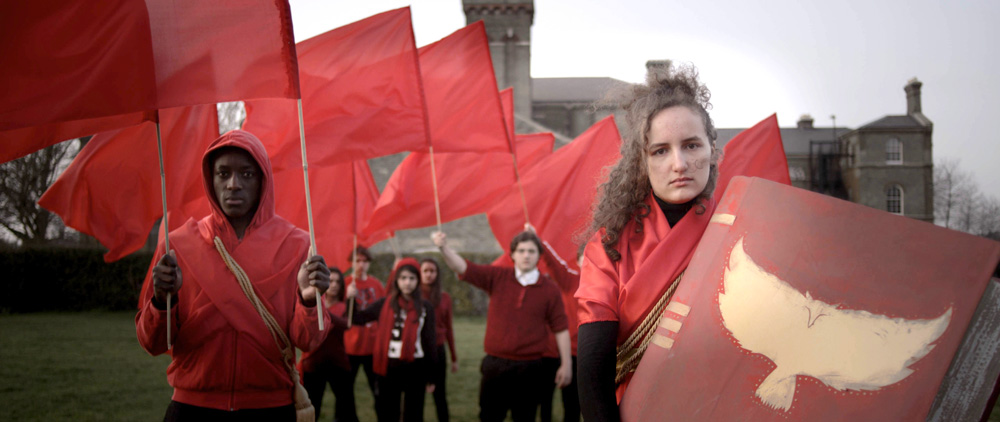
An Ealing Trilogy is a response to selected portraits from the collection of the National Portrait Gallery, London. Commissioned by the gallery, the film re-invents the lives of inspirational people who have links to Ealing, West London including Dusty Springfield, Charlie Chaplin and Freddie Mercury. Tableaux imagery is combined with an abstract soundscape to create a captivating slow motion film portrait of people and places from a west London borough.
Eelyn Lee is an award-winning artist-filmmaker who had works screened across London including Tate Modern and Whitechapel Gallery as well as internationally in Paris, Berlin and Toronto. Using processes of devising and collaboration her films use rich imagery and soundscapes to tell multi-layered stories about people and place. She is interested in groups of people, both in the making of the work and the subject of the work itself. The vision, energy and experience she brings to the creative process builds an environment conducive to making bold and original work. www.eelynlee.com
Marc Lee, Marc Lee
Oamos
Net art | | | 0:0 | Switzerland | 2008
An instrument of Meta-Inspiration. With Oamos, Marc Lee had only one goal: to make the spectator discover with the contents those things likely to please and inspire him. What is Oamos? According to topics launched by the public, Oamos requests machines to investigate, using current events, images, synonyms, music, arguments, noises, blogs and videos. The data are prepared audio-visually and are presented by choice in a pragmatic or entertaining way, with or without sound, with or without interconnecting with the others sites.
Marc Lee was born in 1969 in Switzerland. He created interactive projects oriented towards the network since 1999 in a production directed towards the artistic field. He experiments with information and communication technologies which contain cultural, creative or economic and political aspects. He recently took part an important art media exhibition, such as the ZKM of Karlsruhe, New Museum of New York, the Biennial one of art media of Seoul, Transmediale 02 and 04 of Berlin, Viper 01, 03, 04 and 05 from Basel, Ars Electronica, CeC de Dehli, Read_Me Festival of Moscow and the ICC of Tokyo.

Heewon Lee
phone tapping
Experimental video | betaSP | color | 9:30 | Korea, South | 2009
The film is built up from that single, imperceptible instant that signals the shift from day to night, a fleeting moment in which what was, is no more, where things might acquire fresh significance. A voiceover guides us through the city, while the camera seems to be searching for a specific plot of land, for the coincidence between narrative and image. The topography of the site continues to advance, while in parallel there emerges a second topography ? mental this time, ? until, perhaps, they meet, somewhere here, in a new psychical space. Using the city of Seoul, it is a personal story that is being told. Our role is to follow it and select a locus of interpretation: truth, (urban) folktale ?
HeeWon Navi LEE Born in December 1978, at Kyeung Ki - Do, South Korea. She worked as a stylist in Seoul, and since 2002 it is installed in France. After studying visual communication at the Ecole Nationale Superieure d?Art de Nancy, Won Hee LEE Navi integrates the Fresnoy - Studio National des Arts Contemporain. His research and practice various artistic blend clothing influences ranging from cinema to graphics, sound installation. His works are moving and using more and more new media across a digital world in works such as;
Meesoo Lee
Spaceship 2000
Experimental video | dv | color | 3:0 | Canada | 2004
Meesoo Lee a commencé à faire de la vidéo en utilisant un caméscope et deux magnétoscopes. Inspiré par les DIY ethos of Zines, la musique « lo-fi » et le cinéma d?avant-garde, il réalise des vidéos originales inspirées de la méthode du « vidéo-clip ». Il prétend que ce médium peu coûteux ouvre la voie à un monde infini de créativité et permet l?apprentissage autodidacte sous forme «d?essai-erreur». Meesoo Lee a réalisé des dizaines de courts métrages qui ont été présentés dans divers festivals ainsi qu?au Festival du Front Occidental et au Festival des Images à Toronto

Eelyn Lee
Truce Triptych
Video | hdv | color | 3:52 | United Kingdom | 2012
Inspired by Old Master paintings, three slow-moving tableaux images appear depicting scenes of conflict and resolution on the streets, at home and in the workplace. Shot on locations in East London the images feature young people playing various roles including a young pregnant mum representing Justice and a smart young man battling with a politician at the doors of a local Job Centre. These evocative and multi-layered images employ both photographic and filmmaking techniques, challenging the audience to see different things in them on each viewing. Under the direction of Eelyn Lee, young filmmakers and photographers from A New Direction?s Headstart worked alongside filmmakers at Eelyn Lee Productions and photographers Tim & Barry to create this compelling piece of moving image work. Commissioned by A New Direction
Eelyn Lee is a filmmaker and managing director of Eelyn Lee Productions. After studying fine art she founded the performance group Sacred Cow, producing site-responsive visual theatre in the North of England during the 1990?s. Following a Post-Graduate in sculpture, her work became more installation based, which in turn triggered a career in filmmaking. Her visual art and performance background continues to inform her narrative-led filmmaking, a career in which now spans 15 years. Eelyn has written, produced and directed documentaries, short films and animations. She has a strong reputation for making high quality films about young people that are often devised through participatory processes. Her films have been broadcast on TV and online, shown in festivals and distributed on DVD. In 2012 she received the ?RITTER SPORT Film Prize? for Life and Deaf, a short film selected for the competition programme of the 6th ZEBRA Poetry Film Festival in Berlin. Eelyn lives and works in London and Sheffield and is currently developing ideas for narrative feature films.

Yoonjoo Lee
The Garden of All Spheres
Experimental VR | 0 | color | 0:0 | Korea, South, Germany | 2019
Garden of all spheres is a VR experience which exhibits the live simulation of a pseudo-ecosystem. The garden is built in the video game environment, which can exhibit the most advanced technology in the production and presentation of real-time CGI and simulation. The library of the virtual scenery is parallel with the modern natural history museum - the eye-catching collection of nature - the inventories which are ever-expanding and impossible to complete. Skysphere is a primary, simple prop for creating an illusion of horizon. In the nature of Virtual Reality, the player?s eye is located in the centre of the sphere. It becomes her private sky which is impossible to feel the scale of it - as much like as the sky in the physical world. The camera moves beyond the stage, from inner shell to outer shell and reveals the boundary of human-centred viewpoint. This spherical garden mediated through VR glasses, which embodies the desire for a seamlessly expanded vision. All the animals, humanoids, trees, stones, lights, skies are reflected on the surface of gazing ball and exhibited in the spherical vitrine, and the exhibition becomes meta-ecosphere.
Yoonjoo Lee is a multi-disciplinary artist based in Berlin. Her artistic practice generally focuses on the relationship between voyeuristic/Intellectual curiosity and technology of representation. She uses various digital technologies such as 3d animation and video game engines for a platform of the moving image experiments and explores the apparatus-mediated vision. She is currently studying experimental film and generative art in the Berlin University of Arts.
Cathy Lee Crane, John Di Stefano
Tra
Video | hdv | color | 5:35 | USA, Canada | 2024
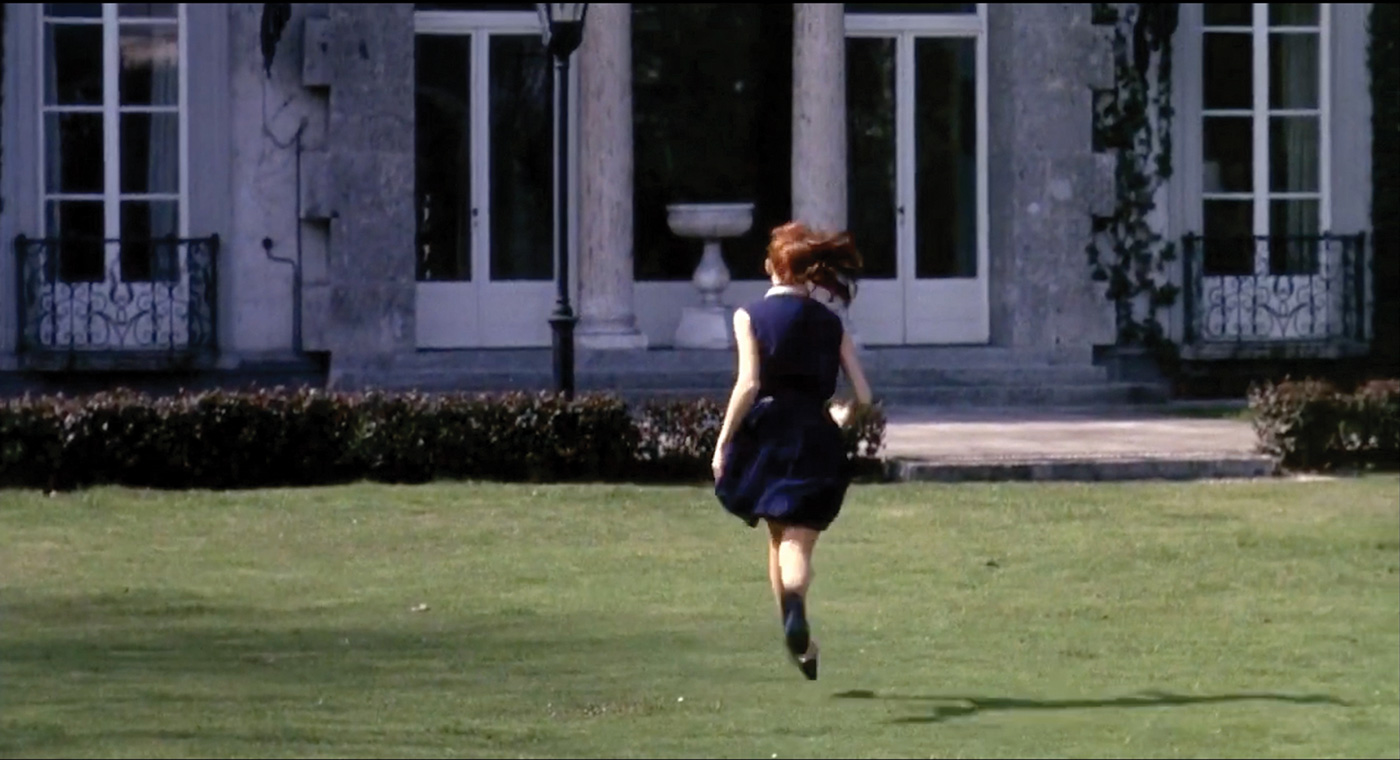
‘Tra' is an ode to Italian filmmaker Pier Paolo Pasolini. ‘Tra' synthesizes the narrative of his film ‘Teorema' (1968) by highlighting its interstitial moments. The act of running that appears throughout the film is isolated and deployed to expose the film’s subtextual currents.
John Di Stefano is an artist/filmmaker, writer, and curator whose work reconciles the personal with the social, the everyday with history through hybrid forms of documentary practices and the essayistic form. His work often deals with his immigrant past seen through a queer lens, including the feature-length 'You Are Here' (2009) which premiered at the Festival International du Documentaire (Marseille). His award-winning work has also been featured at the Videonale (Bonn), Whitechapel Gallery, Tensta Konsthall, Barcelona Museum of Modern Art, Para/Site (Hong Kong), and Anthology Film Archives. His critical writings appear in various international publications. He teaches at Concordia University (Montreal). Cathy Lee Crane is an experimental filmmaker whose work mines the historical archive to produce lyrical films of speculative history. She was a Guggenheim Fellow, and in 2015 her work enjoyed its first survey at the National Gallery of Art (Washington DC). Crane’s award-winning films –including 'Pasolini’s Last Words' (2012)– have screened at Viennale, Cinematheque Francais, BFI, and Arsenal/Berlin. Her interest in borders saw the release of 'Crossing Columbus' (2020) about the border town of Columbus, New Mexico which was supported by the Rockefeller Foundation and the Harun Farocki Institut in Berlin. She teaches at Ithaca College (New York).
Jan Robert Leegte, Raton BOCA
Along the line
Experimental video | dv | black and white | 2:0 | Netherlands | 2005
Jan Robert Leegte a étudié à l'académie des arts de Rotterdam, après trois ans d'études d' architecture à l'université de Delft. PArallèlement à ses performances et installations, il a commencé à travailler pour internet en 1997. http://rhizome.org/thread.rhiz?thread=20448&page=1#39300