Catalogue > Liste par artiste
Parcourez la liste complète des artistes présentés dans le cadre des Rencontres Internationales depuis 2004. Utilisez le filtre alphabétique pour affiner vos recherches.
Teresa Maria Diaz Nerio
Catalogue : 2008Hommage à Sara Bartman | Vidéo expérimentale | dv | couleur | 5:0 | Dominicaine (Rép.), Pays-Bas | 2007
Teresa Maria Diaz Nerio
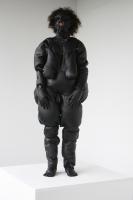
Hommage à Sara Bartman
Vidéo expérimentale | dv | couleur | 5:0 | Dominicaine (Rép.), Pays-Bas | 2007
Sara Bartman, plus connue sous le nom de Venus Hottentot, était une femme sud-africaine Khoisan qui fut ramenée en Angleterre pour être exhibé en 1810. Ses génitales et son derrière étaient bien au delà de la compréhension que les européens avaient d'un corps humain à cette époque, compréhension basée seulement sur leurs corps. Elle fut considérée comme un animal et exposée comme un objet. Après sa mort, ses génitales et son cerveau, tout comme un model de cire de son corps et son squelette furent exposés dans un musée Parisien. Cette performance est le résultat d'une investigation sur les corps de noirs dans le spectacle et comment le fait d'être noir était un acte en soi. Le fait de porter son corps comme une peau était une manière de me déguiser mais aussi de devenir moi à travers l'autre. La raison pour laquelle Sara Bartman est devenu cette icône pour le peuple africain en Afrique et dans la diaspora mais aussi pour le peuple européen, est une réaction contre le viol scientifique et voyeuriste mais aussi légitime et documenté de son corps. La verticalité des sculptures et monuments qui glorifient les actes héroïque de l'homme n?est maintenant que le simple corps d'une femme africaine, silencieuse, droit, éveillé.
Née à Santo Domingo, République Dominicaine, le 9 Avril 1982, vivant à Amsterdam et faisant un Master en Fine Arts à la Dutch Art Institute à Enschede, Hollande. Je finis mes études de la Gerrit Rietveld Academie, Amsterdam oû je fit mes derniers travaux, tous des performances, Hommage à Sara Bartman 2007, Throne of Gold 2007, Trujillo's Island 2007, Trujillo, 2006.
Michael Dietrich
Catalogue : 2026zone of silence (scream machine) | Film expérimental | hdv | couleur | 9:30 | Autriche | 2025
Michael Dietrich
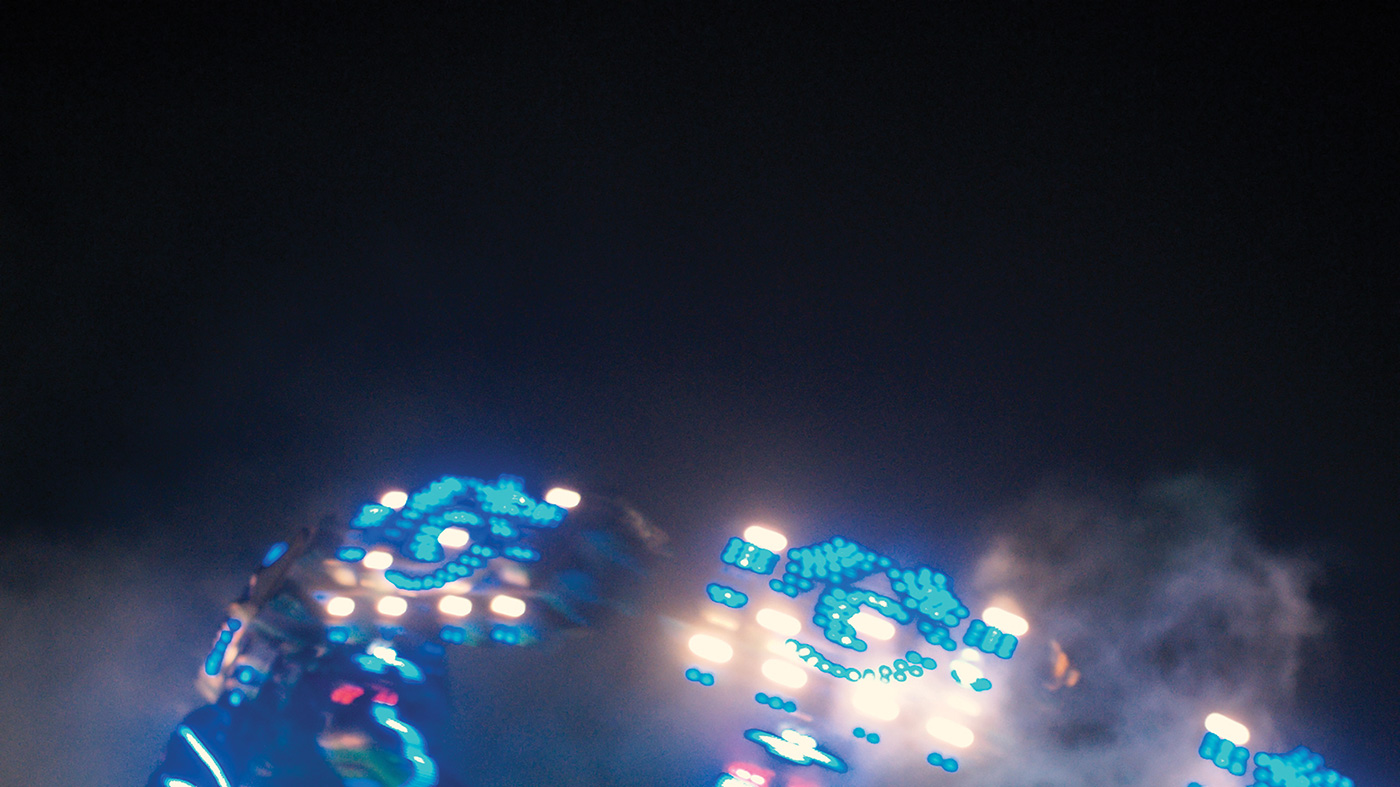
zone of silence (scream machine)
Film expérimental | hdv | couleur | 9:30 | Autriche | 2025
Le film expérimental Zone of Silence (Scream Machine) explore l’interaction entre lumière, brouillard et résonance pour évoquer l’isolement intérieur et la désorientation psychique. La ville est enveloppée d’une atmosphère dense ; reflets lumineux et sons étouffés composent une « zone de silence » où l’orientation comme la communication commencent à se dissoudre. Inspiré des problèmes historiques de navigation maritime — lorsque les signaux de brume devenaient inaudibles dans certaines conditions météorologiques — le film transpose ce phénomène dans le domaine de l’inconscient humain. Le concept psychanalytique de « zone de silence » formulé par Theodor Reik devient un motif central, désignant les émotions refoulées et la difficulté à les traverser. La séquence finale montre l’inscription « EUROPA » s’effaçant peu à peu, sombre reflet du futur politique du continent. Par son atmosphère saturée, sa composition mêlant enregistrements de terrain et sons synthétisés, et son usage de métaphores visuelles, le film propose une exploration profonde du vide intérieur et de la quête d’orientation.
Michael Dietrich (*1985, Vienne, Autriche) a étudié le social design à la HfbK de Hambourg ainsi que la photographie à l’Académie des beaux-arts de Vienne. Son travail explore l’impact des interventions humaines sur la nature, déployant souvent, à travers la vidéo et l’acousmatique, des scénarios troublants.
Igor Dimitri
Catalogue : 2022Salsa | Fiction expérimentale | 16mm | couleur | 13:0 | Portugal | 2020
Igor Dimitri
Salsa
Fiction expérimentale | 16mm | couleur | 13:0 | Portugal | 2020
One Buenos Aires afternoon in the dominican hairdresser saloon, in which characters from different origins reunite around the musical feeling of the place. From dancers to performers and actors, clients and reggaeton singers.
MA in Documentary Cinema and Profesor Assistant at Universidad del Cine, Buenos Aires. PhD Candidate at University NOVA, Lisboa. Currently working on my first feature film. I'm interested in the notions of displacement, ritual and longing. In color, rhythm, body and mixing genres in a surrealist way.
Dj Nasri
Catalogue : 2015Popopop | Performance | | | 120:0 | Liban | 2015

Dj Nasri
Popopop
Performance | | | 120:0 | Liban | 2015
When Oum Kalthoum meets Serge Gainsbourg meets Billie Holliday meets Aisha Al Marta meets Sabah meets Taxi Girl meets Esther Phillips meets Yasmine Hamdan meets Souad Abdallah meets Jeanne Moreau meets Dina Washington meets PJ Harvey meets Marylin Monroe meets Astrud Gilberto meets Sara Vaughan meets Catherine Deneuve meets Mohamad Mounir meets Madonna meets Delphine Seyrig meets Soapkills meets Ahmad Adawiya meets Eartha Kitt meets Mirwais meets Bandali Family meets Feyrouz meets Asmahan meets Cheikh Imam meets Marguerite Duras meets Nina Simone meets Cole Porter meets Omar Zeini meets Fleetwood Mac meets Tarab meets Kitsch meets Choubi meets you.
Acteur de cinéma (dirigé notamment par Christian Merlhiot, Jocelyne Saab, Georges Hachem, Roy Samaha, Omar Fakhoury, Jad Youssef…) et journaliste, Nasri officie en tant que DJ depuis plus de 8 ans à Beyrouth et à Berlin où il est actuellement basé. Une pop sans frontière de genre, sans frontière de goûts - bons ou mauvais. Une pop décomplexée qui fait se côtoyer les grands noms du répertoire classique arabe et ceux de la pop américaine, émiratie, égyptienne, libanaise et bien au - delà à ceux aussi des grands noms du cinéma et de la littérature française. Amoureux fou des grandes dames du Jazz, Nasri fait par ailleurs se rencontrer Asmahan et Delphine Seyrig, Grace Jones et Jeanne Moreau et le plus kitsch des sons arabes aux dialogues acérés d’une Bettes Davis entre autres grandes du cinéma mondial.
Daniel Nicolae Djamo
Catalogue : 2015Pasari | Vidéo | hdv | couleur | 7:32 | Roumanie | 2014
Daniel Nicolae Djamo
Pasari
Vidéo | hdv | couleur | 7:32 | Roumanie | 2014
The work is based on fragments from interviews taken from Romanian immigrants living in Paris in 2011, 2013 and 2014. Shot in Nogent sur Vernisson. Loiret, on December 28th, 2013. 2013 had a warm autumn and an even warmer winter debut. "I think that this is one of the reasons why the birds that live along the Loire chose to rest longer. Some rested even until late December. I filmed this material when they started preparing to fly away. ”Birds” presents 7 minutes of French sunset, on continuous shooting, with the migratory birds preparing to leave. It presents the sunset of the West, with governments taking measures belonging to the right. I chose to draw a paralel between this story and statements that I had previously recorded in Paris, belonging to Romanian immigrants."
Daniel Djamo (b.1987, lives and works in Bucharest) is a young Romanian artist and film director, being interested in personal and group histories. He combines film with video art and installation with photography in order to evoke the past and to underline “the now.” Winner of the ESSL award, Henkel Art.Award. Young artist prize CEE, Startpoint Prize Romania and the Grand Prize of the National University of Fine Arts from Bucharest. Daniel benefited from residencies in Paris, Kassel, Chemnitz, Bruxelles, Vienna and Liege. He exhibited at the Museum of Moscow, Kunsthaus Dresden, Moscow Museum of Modern Art (MMOMA) and the ESSL museum from Vienna, while also presenting his works in Germany, Italy, Canada, Netherlands, USA, Russia, Portugal, Czech Republic, Estonia etc. His video artworks have been screened in numerous video art and film festivals. He is a PhD candidate at the National University of Fine Arts from Bucharest.
Shwan Dler Qaradaki
Catalogue : 2021The Golden Wish | Vidéo | mov | couleur | 5:29 | Norvège, Iraq | 2019
Shwan Dler Qaradaki
The Golden Wish
Vidéo | mov | couleur | 5:29 | Norvège, Iraq | 2019
L'histoire de "The Golden Wish" est liée à la proposition du gouvernement de gauche danois d’autoriser la police à saisir les bijoux et les objets de valeur des demandeurs d'asile à leur arrivée dans le pays. Ces bijoux et objets de valeur serviraient à financer le logement et la nourriture des nouveaux arrivants. Dans le cadre de ce projet, je me suis rendu en Irak, et ai visité deux grands camps de réfugiés à l'extérieur de Sulaymaniya. Ces camps s'appellent Arbar et Barika, et sont situés à 29 km au sud-est de la ville de Sulaymaniya. Ils comptent 32 000 réfugiés au total. J'ai exploré leurs marchés locaux, et j'ai contacté des bijoutiers et particuliers dans la région. J'ai ensuite acheté leurs bijoux en or, les ai fondus et moulés pour en faire une installation textuelle, sous la forme de la phrase: "Everything will be ok" ("Tout ira bien").
Je suis artiste et travaille dans les domaines du dessin, de la peinture, de l'installation, de la vidéo, et du film. Dans plusieurs de mes œuvres, j'ai travaillé sur mes propres expériences en tant que réfugié kurde, ces expériences pouvant fournir des connaissances à propos de questions universelles liées à la situation d'un être humain en fuite. Originaire du Kurdistan irakien, j'ai suivi une formation artistique de cinq ans avant de fuir à cause des persécutions en 1997. Après une fuite difficile à travers 11 pays, je suis arrivé en Norvège en décembre 1999, et j'y ai terminé mes études d'art.
Alexei Dmitriev
Catalogue : 2008Dubus | Vidéo expérimentale | dv | noir et blanc | 4:9 | Russie | 2005
Alexei Dmitriev
Dubus
Vidéo expérimentale | dv | noir et blanc | 4:9 | Russie | 2005
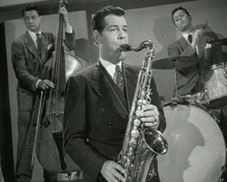
Un "slow" du cinéma classique sur la musique de Zelany Rashoho.
AV = deux artistes vidéastes de Saint-Petersbourg, en Russie. "Dubus" est un début.
Patrick Doan
Catalogue : 2006Density 1 | Vidéo expérimentale | dv | couleur | 4:7 | Canada | 2005
Patrick Doan
Density 1
Vidéo expérimentale | dv | couleur | 4:7 | Canada | 2005
"DENSITY 1" est une vidéo sensorielle sur le déplacement, le temps et l'espace. Elle tente de saisir l'essence des espaces temporels que l'on chasse si souvent avec insouciance. La relation entre audio et vidéo est intensifiée par sa transmission flatteuse et subconsciente des ses caractéristiques fondamentales. Dans l'ensemble, cette ?uvre pose une réflexion sur la nature éphémère de la mémoire à long terme, et sur la manière dont ses représentations sont déformées à travers l'environnement, l'expérience et le tempérament d'un individu.
Patrick Doan réside actuellement à Montréal, Canada, et étudie le design à l'Université de Concordia. Se spécialisant dans l'animation numérique, son travail se caractérise par une étude de la relation existant dans l'information numérique, l'espace et le paysage urbain. Ayant beaucoup travaillé dans le graphisme, son travail cumule compositions cinématographiques et traitement typographique. Depuis 2001, il réalise des ?uvres chez DEFASTEN, un débouché créatif et une réserve d'?uvres de clients.
Christo Doherty, Aryan Kaganof
Catalogue : 2017Lamentation/Klaaglied | Doc. expérimental | hdv | couleur | 18:0 | Afrique du sud | 2015
Christo Doherty, Aryan Kaganof
Lamentation/Klaaglied
Doc. expérimental | hdv | couleur | 18:0 | Afrique du sud | 2015
Blackface in a film about a secret war Experimental SA documentary challenges hidden memories of a faraway and forgotten fight Blackface and South Africa’s secret border war are exposed and explored in a poignant and troubling new film by Christo Doherty and Aryan Kaganof, which was shown in Cape Town and Joburg (South Africa) for the first time in June 2016. For 23 years from 1967 to 1989, young white men were conscripted to kill and die for apartheid during a long deadly war on the border of Namibia and Angola. In 2011, Doherty presented his ground-breaking BOS exhibition of constructed miniature models and blackfaced conscript portraits based on the rare photographs leaked from the conflict zone, often at great risk to the photographers at the time. Described by its directors as an ‘experimental psychic documentary’, Lamentation is a filmic response to Doherty`s BOS exhibition of physical suffering,traumatic memory and the border war. Doherty and Kaganof’s 18-minute film is a formal meditation on the traumatic memory of an illegal war in which tens of thousands of young white South African men were forced to participate and uncounted numbers of black Namibians were killed or injured. It is a contemporary attempt to explore one of the unexamined aspects of apartheid’s military misadventures, a conflict which killed and injured unknown numbers of civilians and well as soldiers and left a generation of men and women traumatised on both sides of the conflict. The film makers are not afraid to challenge and to shock. And they stress that the film is about memories and understanding for all participants and victims of the border war, not only SA soldiers. Lamentation’s delicate musical score, by leading South African composer Michael Blake, accompanies the camera’s slow movement up the uniformed chest of a solemn white model with painted black face, cutting to scan a miniature scene showing the mutilated corpse of a black Namibian civilian alongside an armoured SA military vehicle. Throughout the film, the disconcerting and shocking imagery is presented through an insistently choreographed interplay of cinematography and sound design. “We know this is difficult material, but interpreted and constructed images in art are an important way to reflect on a war which we don’t think South Africa has fully dealt with,” Doherty says. “Many white men, including myself, firmly shut the door on their army days, yet the SADF was a dark formative experience which we need to expose and understand.” White soldiers: black faces The filmmakers’ portrayal of white men in brown army uniform with black faces sparked controversy in South Africa, but the use of this make-up was a survival mechanism in the war. The blackface device in the film and in BOS is based on the combat body paint used as camouflage in the Angolan bush by apartheid’s soldiers, ironically known to the white troops as ‘black is beautiful’. “White faces painted black are currently taboo, but were very much part of a conscripted white soldier’s experience during South Africa’s war in Namibia and Angola,” Doherty says. The photographs in BOS, and now Lamentation, use re-enacted representations of this wartime practice, together with miniature reconstructions of scenes of battle and violence, to probe the psychological and ethical transformation of young men who joined in an involuntary battle against a hidden enemy. Beautiful music: origins of a difficult film The film emerged through Doherty and film-maker Aryan Kaganof`s mutual involvement with the hauntingly beautiful music by South African composer Michael Blake, Tombeau de Mosoeu Moerane(2011) for soprano birbyne and 5-track (or 2-track) tape. Written in homage to the little-known South African black composer Mosoeu Moerane, the film score features Lithuanian clarinet virtuoso Darius Klysis playing the birbyne, a simple keyless wooden wind instrument. The conclusion to the film is underscored by an extract from another composition by Michael Blake, his String Quartet No 1, performed by The Fitzwilliam String Quartet. Cinematographer Eran Tahor’s beautifully choreographed and achingly-slow camera movements match the cadences of Blake`s music and provide a powerful visual sense of the isolated and estranging experience of South Africa’s war on a distant and dangerous border. The editing and sound design by Aryan Kaganof bring together the music and the cinematography with strands of found audio, including a voice softly singing fragments of "Die Stem van Suid Afrika", the old National Anthem.
Christo Doherty Christo is Associate Professor of Digital Arts in the Wits School of Arts at Wits University. He is a photographer and artist with a keen interest in the visual representation of conflict and trauma. He was conscripted into the apartheid army at the age of 17. Aryan Kaganof Aryan Kaganof is a South African film maker, novelist, poet and fine artist. His extensive filmography includes Threnody for the Victims of Marikana, Decolonising Wits, Western 4.33, and Nicola’s First Orgasm. Aryan left SA aged 19 to avoid conscription into the apartheid army.
Júlio Dolbeth, Steinbrüchel
Catalogue : 2006AM/FM | Vidéo expérimentale | dv | noir et blanc | 2:0 | Portugal | 2005

Júlio Dolbeth, Steinbrüchel
AM/FM
Vidéo expérimentale | dv | noir et blanc | 2:0 | Portugal | 2005
AM-Fm, 2 fréquences de communication, 2 personnages se dissolvant l'un dans l'autre. Je ressentis le son comme un arbre grandissant.
Julio Dolbeth, vit et travaille à Porto, Portugal. Il enseigne le Communication Design à la Faculté des Beaux-Arts, à l'Université de Porto. Il est diplômé en graphisme. Maîtrise d'Art Multimedia - intitulée ?Artificial Skin?. Il travaille comme graphiste, illustrateur et artiste vidéo. Collaborateur régulier de DifMagazine (Portugal).
Yana Dombrowsky-m’baye
Catalogue : 2026saint louis saint louis | Film expérimental | mp4 | couleur | 26:45 | Nouvelle-Zélande, France | 2024
Yana Dombrowsky-m’baye
saint louis saint louis
Film expérimental | mp4 | couleur | 26:45 | Nouvelle-Zélande, France | 2024
Au XXI? siècle, vous êtes retournée dans les archipels de Saint-Louis du Sénégal et de Saint-Louis de Paris pour exhumer les vestiges des signares — ces femmes autrefois au cœur du commerce et de la société de l’Afrique occidentale française. À travers la nuit, à travers les murmures de vos tantes et de vos nièces, à travers les institutions qui abritent aujourd’hui le “patrimoine” français, vous êtes tombée dans une spirale entre des présents coloniaux et le passé.
Yana Nafysa Dombrowsky-M’Baye est une chercheuse et enseignante pluridisciplinaire originaire de T?maki Makaurau, Aotearoa. Sa lignée matrilinéaire remonte au Sénégal et à la France, tandis que sa lignée patrilinéaire est d’ascendance polonaise et tchèque. À travers des processus itératifs et rituels, la pratique de Yana constitue une enquête poétique sur les conditions matérielles et immatérielles de l’appartenance, abordant la pratique artistique comme un geste archéologique, mettant au jour la présence spectrale, souvent effacée, des identités interculturelles enfouies dans des lieux marqués à la fois par l’histoire coloniale et par son propre
Pablo Dominguez
Johanna Domke
Catalogue : 2010Søen i spejlet | Fiction expérimentale | 16mm | noir et blanc | 20:22 | Allemagne, Danemark | 2009
Johanna Domke
Søen i spejlet
Fiction expérimentale | 16mm | noir et blanc | 20:22 | Allemagne, Danemark | 2009
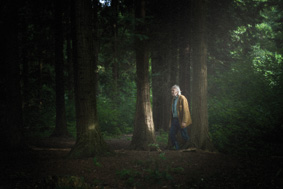
?Søen i spejlet? is the re-enactment of a former boarding school tradition in Denmark. Once a year the students of Sorø Academy held a ritual out in the woods, burning effigies of their teachers on a bonfire. The narrative of the film evolves around the character of a former student that revisits the place of his school days meeting with a group of young students. What first seems to be the fictionalization of the former student´s memory, becomes more and more the documentation of the staging of the ritual ? the alumni himself being the director. But as soon as the ritual sets off, all turns to a different state of realness, as the anger and emotion of the young students boil up to an uncanny level of authenticity.
After studying Fine Art at the Muthesius Academy for Art and Design in Kiel, Johanna Domke went on to graduate studies at the Royal Art Academy in Copenhagen and the Malmö Art Academy, Sweden, where she got her MA in 2004. She received the ZKM International Media Art Award, Audience Prize, for her single-channel piece ?Let the wind blow? and the Brockmann Prize from the Stadtgalerie Kiel. 2004 she got the Edstranska Grant for Graduating Students. Since then Domke has broadly exhibited her work in renowned art institutions, such as Casino Luxembourg, KIASMA Museum of Contemporary Art, Helsinki, Berlinische Galerie and international film festivals such as Film Festival Oberhausen, Locarno Film Festival, Videonale at the Bonner Kunstmuseum and the Kunstfilmbiennale.
Catalogue : 2010Stultifera Garden | Fiction expérimentale | | couleur | 12:5 | Allemagne | 2008
Johanna Domke
Stultifera Garden
Fiction expérimentale | | couleur | 12:5 | Allemagne | 2008
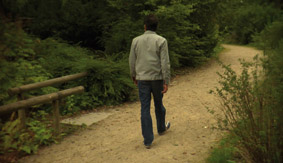
Stultifera Garden deals with an overlapping structure of the public and the private. The film is set in a park ? a place were city dwellers recover from busy urban life. At the same time it is a place implementing the ?elsewhere? - an un-ruled territory for individuals who are in conflict with society or the human milieu in which they live. It is also a place for individuals whose behaviour is deviant with the respect to the mean or the required norm. As in earlier works, Domke uses a travelling camera to approach the parks diverse character, emphasizing polarities as observing and being watched, high and low culture, control and non-control. The incessant pan evolves from a classic park scenario towards a dystopic, mazy structure of trails. The camera experiences different milieus of the park not directly examining them but portraying them with an inexplicit openness. She accesses milieus that formed architectonical structures in the shrubs, such as cruising areas and drug trafficking points. She discovers places that became functionalised entities - for teens as a get-away, for elderly as a meeting point - each and everyone with their own character and history. Without stating explicit action or narrative Stultifera Garden is more interested to explain that a park is a place for the other, where all these milieus and facets function along side. Intruding as an omniscient eye, Domke is constructing the real to establish the fictitious.
After studying art at the Muthesius Academy for Art and Design in Kiel, Johanna Domke went on to graduate studies at the Royal Art Academy in Copenhagen and the Malmö Art Academy, Sweden, where she got her MA in 2004. In 2003 she received the ZKM International Media Art Award, Audience Prize, for her single-channel piece ?Let the wind blow? and the Brockmann Prize from the Stadtgalerie Kiel. 2004 she got the Edstranska Grant for Graduating Students. Since then Domke has broadly exhibited her work in renowned art institutions, such as Casino Luxembourg, Berlinische Galerie, KIASMA Museum of Contemporary Art, Helsinki and international film festivals such as Film festival Oberhausen, Locarno Film Festival, Videonale at the Bonner Kunstmuseum and Kunstfilmbiennale, Köln.
Catalogue : 2009Cuers | Art vidéo | | couleur | 18:5 | Allemagne | 2008
Johanna Domke
Cuers
Art vidéo | | couleur | 18:5 | Allemagne | 2008
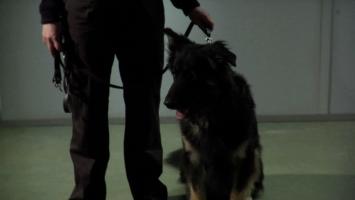
Johanna Domke?s film Cuers is inspired by Franz Kafka?s The Trial and the filmic universe of Orson Welles. The audience is taken on a fleeting and meandering journey through different sites in public space, where people are exposed to long waiting. The individual is presented as a singular being, confronting structures of public space. The particular situations are represented in an inspirational manner shifting in and out of each other. Time and space is dissolved in kaleidoscopic pictures, which emphasizes how we physically as well as mentally have trouble adjusting to our anonymous environment. ? Cuers? seeks to create a mental space through abstraction and subversion of the familiar.
After studying art at the Muthesius Academy for Art and Design in Kiel, Johanna Domke went on to graduate studies at the Royal Art Academy in Copenhagen and the Malmö Art Academy, Sweden, where she got her MA in 2004. In 2003 she received the ZKM International Media Art Award, Audience Prize, for her single-channel piece ?Let the wind blow? and the Brockmann Prize from the Stadtgalerie Kiel. 2004 she got the Edstranska Grant for Graduating Students. Since then Domke has broadly exhibited her work in renowned art institutions, such as Casino Luxembourg, Göteborg Konstmuseum, KIASMA Museum of Contemporary Art, Helsinki and international film festivals such as Film festival Oberhausen, Locarno Film Festival, Videonale at the Bonner Kunstmuseum and VIPER, Basel.
Catalogue : 2008Crossing Fields | Art vidéo | | couleur | 12:14 | Allemagne, Chine | 2007
Johanna Domke
Crossing Fields
Art vidéo | | couleur | 12:14 | Allemagne, Chine | 2007
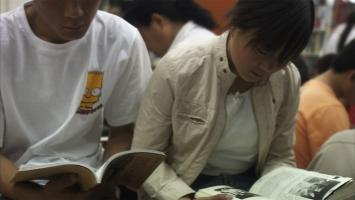
"Crossing Fields" est un document sur l'usage privé de l'espace commercial et les personnnes qui lisent dans les magasins. La vidéo a été tournée dans une librairie de Beijing, ce phénomène étant largement répandu dans les villes chinoises. A cause du caractère obsolète des bibliothèques, les librairies fonctionnent comme sources libres de connaissance: les gens viennent en foule passer leut temps libre dans les gigantesques complexes commerciaux. Mais au lieu d'acheter les livres, ils passent des journées entières, assis dans les magasins, à lire. Comme la direction approuve ce phénomène, l'usage privé de l'espace est devenu une activité généralement admise dans les commerces. Johanna Domke se penche sur cet usage plus ou moins anarchique de l'espace et le caractère de stagnation qu'implique la situation. Se faufilant entre les lecteurs immobiles comme des statues, la caméra capte dans un mouvement de proximité et d'intimité l'ambiguïté de leur présence. Ils sont physiquement présents et en même temps, ils investissent la sphère fictive de leur lecture. L'apparence immobile des lecteurs donne l'impression que la caméra se déplace dans un espace où le temps s'est arrêté.
Après avoir étudié l'art à la Muthesius Academy of Art and Design de Kiel, Johanna Domke a obtenu ses diplômes à la Royal Art Academy de Copenhague et à la Malmö Art Academy, en Suède. En 2003, elle a reçu le ZKM International Media Art Award pour "Let the Wind Blow" et le Brockmann Prize de la Stadtgalerie, Kiel. En 2004, elle a reçu la bourse d'étude Edstranska. Domke a montré son oeuvre dans de nombreuses institutions d'art prestigieuses, comme Casino Luxembourg, Göteborg Konstmuseum, KIASMA Museum of Contemporary Art, Helsinki et des festivals de film internationaux comme Film festival Oberhausen, Locarno Film Festival, Videonale au Bonner Kunstmuseum et VIPER, Basel.
Catalogue : 2008Sleepers | Art vidéo | dv | couleur | 13:40 | Allemagne, Royaume-Uni | 2006
Johanna Domke
Sleepers
Art vidéo | dv | couleur | 13:40 | Allemagne, Royaume-Uni | 2006
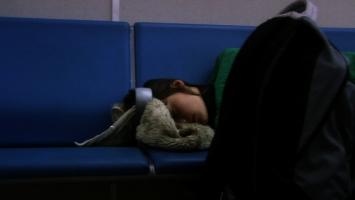
?Sleepers? takes place at Stansted Airport in London in the very late night and portrays sleeping people with slowly panning camera moves. The slow takes emphasise with the passenger?s tiresome waiting for an early morning flight. Within this physical location Domke grips a real, temporal situation that shows the airport as a form of standstill. The video follows a sequence of sleeping people in a transit situation. But even if they are in transit they undergo a present standstill that deludes oneself into a void, where one is not quite sure how the situation will progress. With the interest of this kind of void Johanna Domke evolves her artistic praxis within the time-based media of film and the photographic still image, which on a conceptual level can be seen as a distortion of time and movement. A hybridisation, that opens up for other relations and references.
Johanna Domke was born in 1978 in Kiel. After studying Fine Arts at the Muthesius Academy for Art and Design in Kiel, Domke went on to study at Malmö Art Academy, Sweden and the Royal Danish Art Academy in Copenhagen, where she received her MA in 2006. In 2003 Domke received the Audience Prize at the ZKM International Media Art Award for her work Let the wind blow, as well as the Brookmann Prize from Stadtgalerie Kiel. In 2004 Johanna Domke was awarded the Edstranska Stiftelsen?s Grant for Students in Sweden. Since then, her work has been shown in major institutions in Europe and elsewhere, including the Hasselblad Center, Gothenburg; Göteborg Konstmuseum, Gothenburg; KIASMA Museum of Contemporary Art, Helsinki; Casino Luxembourg, Luxembourg and Bonner Kunstmuseum, Bonn. Furthermore, her works have been screened at film festivals such as European Media Art Festival 2003/2008 Osnabrück; Locarno Film festival 2006, Locarno; Oberhausen Film Festival 2007, Oberhausen and Rencontres Internationales 2005/2007, Berlin and Paris. Domke lives and works in Copenhagen and Berlin.
Catalogue : 2006Let the wind blow | Art vidéo | 0 | couleur | 3:19 | Allemagne, Costa Rica | 2003
Johanna Domke
Let the wind blow
Art vidéo | 0 | couleur | 3:19 | Allemagne, Costa Rica | 2003
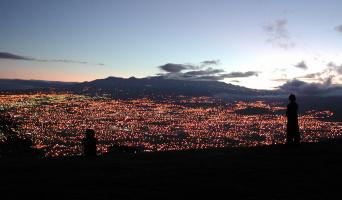
En haut d'une colline balayée par le vent, deux silhouettes immobiles surplombent la vallée abritant une grande ville fourmillante. L'une des deux se tient debout, l'autre est assise sur le sol. La distance les séparant est trop grande pour évoquer tout sentiment d'intimité. Les nuages défilent dans le ciel, la nuit tombe comme une brique et des centaines de lumières brillent dans la vallée, avant que le jour ne se lève. Le soleil apparaît et un nouveau jour commence. Pendant tout ce temps, les deux silhouettes demeurent complètement immobiles devant ce paysage qui se dévoile. Il n'y a que le vent qui souffle dans leurs vêtements et leurs cheveux.
Johanna Domke, née en 1978 à Kiel, Allemagne. Elle est une artiste allemande vivant à Copenhague et à Berlin. Après avoir étudié les Beaux-Arts à l'Académie Muthesius des Arts et Design à Kiel, Johanna Domke poursuit ses études universitaires à la Royal Art Academy de Copenhague et à la Malmö Art Academy, en Suisse, où elle obtient sa maîtrise en 2004. En 2003, elle reçoit le Prix ZKM International Media Art, Prix du public, pour son ?uvre "Let the wind blow", et le Prix Brockmann de la Stadtgalerie Kiel. En 2004, elle reçoit la Bourse Edstranska pour les étudiants diplômés et la Bourse Assistent du Conseil des Arts Suédois. Les ?uvres de Johanna Domke ont été présentées lors d'expositions, de festivals vidéo et de salons de l'art, en Europe et aux Etats-Unis. Elle est représentée par Gallery Art Agents à Hambourg.
Arnaud Dommerc
Catalogue : 2011le cochon | | | couleur | 55:0 | France | 2010
Arnaud Dommerc
le cochon
| | couleur | 55:0 | France | 2010
Durant trois jours, dans la montagne corse, des Hommes tuent et charcutent le cochon.
Arnaud Dommerc est né en 1971. Il enseigne le cinéma à l?Université Saint Denis - Paris 8 depuis 2001. Il travaille notamment comme assistant avec Jean-Marie Straub (Le genou d?Artémide, Itinéraire de Jean Bricard, Le Streghe, O Somma Luce, Joachim Gatti, L?Inconsolable, L?Héritier). Son précédent film "Nous n?irons pas à Buti" a été sélectionné en compétition au FID 2008 ainsi qu?aux Rencontres Paris / Berlin / Madrid 2009. Il prépare actuellement une installation vidéo sur Gênes et la méditerranée pour l`Université de Lille 3, "L`innocence radicale des fleurs".
Tommaso Donati
Catalogue : 2022L'epoca geniale | Doc. expérimental | hdcam | couleur | 45:0 | Suisse | 2021
Tommaso Donati
L'epoca geniale
Doc. expérimental | hdcam | couleur | 45:0 | Suisse | 2021
L'epoca geniale (L'époque de génie) est un film qui entre dans un lieu où la forme se mêle au lyrisme et à la magie des mouvements du corps et des regards. Les yeux s'émerveillent et se révèlent être la métaphore d'une société dans laquelle les gens souhaitent redevenir enfants. Les exercices des protagonistes n'ont rien de réaliste, mais tendent vers la théâtralité et l'imagination. Les murs de cet espace universel deviennent ainsi les témoins silencieux de ces gestes compliqués, de ces tentatives répétées à l'infini pour atteindre enfin une maturité.
Tommaso Donati (Lugano, 1988). Son travail combine une approche narrative avec le cinéma documentaire et s'articule autour du thème de la marginalité. Ses films ont été présentés dans plusieurs festivals nationaux et internationaux. Il vit et travaille actuellement à Lugano.
Catalogue : 2021Cligne-musette | Doc. expérimental | hdcam | couleur | 21:30 | Suisse | 2020
Tommaso Donati
Cligne-musette
Doc. expérimental | hdcam | couleur | 21:30 | Suisse | 2020
Jusqu'au début du XXe siècle en France, le jeu de cache-cache était appelé cligne-musette. Dans un paysage hivernal, le film suit cinq enfants et un jeune homme qui errent seuls entre les bâtiments du quartier populaire de Valibout, situé dans la ville de province de Plaisir. Leurs chemins ne se croiseront pas, mais semblent destinés à connaître le même sort, celui d'être abandonnés à eux-mêmes, de se cacher et de ne pas être retrouvés.
Tommaso Donati est né en 1988. Il vit et travaille à Lugano, en Suisse. Son travail combine une approche narrative avec le cinéma documentaire et s'articule autour du thème de la marginalité.
Catalogue : 2020Je parle à mes démons | Doc. expérimental | hdv | couleur | 22:30 | Suisse | 2019
Tommaso Donati
Je parle à mes démons
Doc. expérimental | hdv | couleur | 22:30 | Suisse | 2019
Patrice est reclus dans la prison de Bois-d’Arcy. Comme autant un acteur et spectateur silencieux, il cache son drame à travers une routine faite des gestes quotidiens et des posture ambigues.
Tommaso Donati (1988, Suisse) vit et travaille à Lugano. Son travail explore le point de rencontre du documentaire, de la fiction expérimentale et de la photographie en racontant des histoires de marginalisation et de relations entre les gens et l'espace-nature dans lequel ils vivent.
Catalogue : 2019Monte Amiata | Fiction expérimentale | hdv | couleur | 22:29 | Suisse | 2018
Tommaso Donati
Monte Amiata
Fiction expérimentale | hdv | couleur | 22:29 | Suisse | 2018
Le Monte Amiata est un complexe résidentiel dans le quartier Gallaratese de Milan, conçu par les architectes Carlo Aymonino et Aldo Rossi à la fin des années 1960. Leur intention était de créer un microcosme paralléle, une sorte de ville alternative du futur. Ses habitants, en référence à sa couleur et à sa forme insolite, le surnomment le dinosaure rouge.
Né en 1988, son travail se partage entre le documentaire, le cinéma expérimental et la photographie où il explore les relations entre l’homme et le milieu naturel dans lequel ils vivent.
Catalogue : 2018A Song from the Future | Doc. expérimental | hdv | couleur | 17:29 | Suisse | 2017
Tommaso Donati
A Song from the Future
Doc. expérimental | hdv | couleur | 17:29 | Suisse | 2017
Un migrant somalien cherche abri dans les souterrains d`un immeuble près de la douane Suisse italien. Une chanson populaire de son pays réveille en lui l`envie de partir.
Né en 1988, Tommaso Donati est diplômé de l’école internationale de création audiovisuelle et de réalisation (EICAR) à Paris. Son travail se partage entre le documentaire, le cinéma expérimental et la photographie où il explore les relations entre l’homme, l’animal et le milieu naturel dans lequel ils vivent.
Catalogue : 2017Dormiente | Fiction | hdv | couleur | 18:15 | Suisse | 2016
Tommaso Donati
Dormiente
Fiction | hdv | couleur | 18:15 | Suisse | 2016
Un homme et une femme, qui vivent en marge de la société, se déplacent et se croisent entre espaces urbains et espaces naturels, à la recherche d’une liberté oubliée, en essayant péniblement de rester éveillés.
Tommaso Donati (Lugano, 1988 ) est un réalisateur et photographe. En 2013 il obtient un diplôme en cinema à l’ EICAR – The International Film School of Paris. Ces films et son œuvre photographique se concentrent sur la nature, le cycle de la vie et la relation entre homme et animal. Il partecipe à plusieurs festival comme le Festival du Film de Locarno, Torino Film Festival, Les Rencontres Internationales Paris/Berlin, FimmakerFest...
Catalogue : 2016Faim | Fiction expérimentale | hdv | couleur | 16:4 | Suisse, France | 2015
Tommaso Donati
Faim
Fiction expérimentale | hdv | couleur | 16:4 | Suisse, France | 2015
Une femme sdf partage sa vie avec son chien. Après sa fuite, elle s`égare sur les traces de l`animal, ;au même temps les gestes d`un gardien du musée de préhistoire se succèdent comme chaque jour. Unis par le même besoin primaire la femme, l`homme et l`animal se croisent et se déplacent à la recherche de quelque chose de plus élevé.
Tommaso Donati (Lugano, 1988 ) est un réalisateur et photographe. En 2013 il obtient un diplôme en cinema à l’ EICAR – The International Film School of Paris. Ces films et son œuvre photographique se concentrent sur la nature, le cycle de la vie et la relation entre homme et animal.
Wojtek Doroszuk
Catalogue : 2016Prince | Doc. expérimental | hdv | couleur | 18:50 | Pologne, Congo (Brazzaville) | 2014
Wojtek Doroszuk
Prince
Doc. expérimental | hdv | couleur | 18:50 | Pologne, Congo (Brazzaville) | 2014
A man performs the same ritual every day: he cleans his shoes, dresses up in his shiny blue suit, wears his white gloves and grey hat, and spends his time walking around Brazzaville. His presence generates an absurd apparition in the urban chaos of the city, which reflects the imaginary produced by one of the up-most icons of pop culture.
Wojtek Doroszuk (b. 1980 in Poland) is a video artist based in Krakow, Poland and Rouen, France. He graduated from the Academy of Fine Arts in Kraków, Poland, Faculty of Painting, in 2006. His works have been shown in numerous solo and group shows in, among others, Centre for Contemporary Art Ujazdowski Castle (Warsaw), Zachęta National Gallery of Art (Warsaw), Museum of Modern Art (Warsaw), Location One (New York), Marina Abramovic Institute (San Francisco), The Stenersen Museum (Oslo), Joseph Tang Gallery (Paris) etc.
Barbara Doser
Catalogue : 2006Even odd even | Art vidéo | dv | noir et blanc | 7:30 | Autriche | 2004
Barbara Doser
Even odd even
Art vidéo | dv | noir et blanc | 7:30 | Autriche | 2004
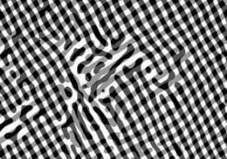
"even odd even" est une interprétation artistique du temps et de l'espace d'une vidéo qui délivre une vue intérieure d'un monde fascinant de complexité spaciale et d'un comportement dynamique. "La vision est dessinée de manière hautement suggestive par des motifs de lignes en noir et blanc. Par le mouvement rhytmiques de ces codes barre, pénétré par un épais tapis de son, la vision se transforme en même temps d'une pièce de puzzle à une dimension spatiale...". (Gunnar Landsgesell) Cela concerne le centre d'une vidéo dont les images défilent très vite. Pour être capable non seulement d'expérimenter les informations mais aussi le contenu et les liens, la vidéo est décomposée en ses parties essentielles- l'alternance de scènes faisant chacune 1/50second. Chacune séparée les unes des autres, différentes séquences sont créées pour faire un lien avec la vidéo d'origine. L'apparence cachée devient visible dans un processus d'expérience esthétique.
Né à Innsbruck, Autriche. Vit et travaille à Vienne. A étudié à l'Université d'Innsbruck, doctorat en 1989. Depuis 1994, artiste free lance. Domaine artistique: vidéo, vidéo expérimentale, intallations vidéo/média, gravure et peinture. A exposé en Autriche et ailleurs, vidéos présentées dans plus de 30 pays, à des festivals internationaux de film. Collaboration à des projets d'art média internationaux.
Kamil Dossar
Catalogue : 2023Insert Song | Film expérimental | mp4 | couleur | 11:9 | Danemark | 2022
Kamil Dossar
Insert Song
Film expérimental | mp4 | couleur | 11:9 | Danemark | 2022
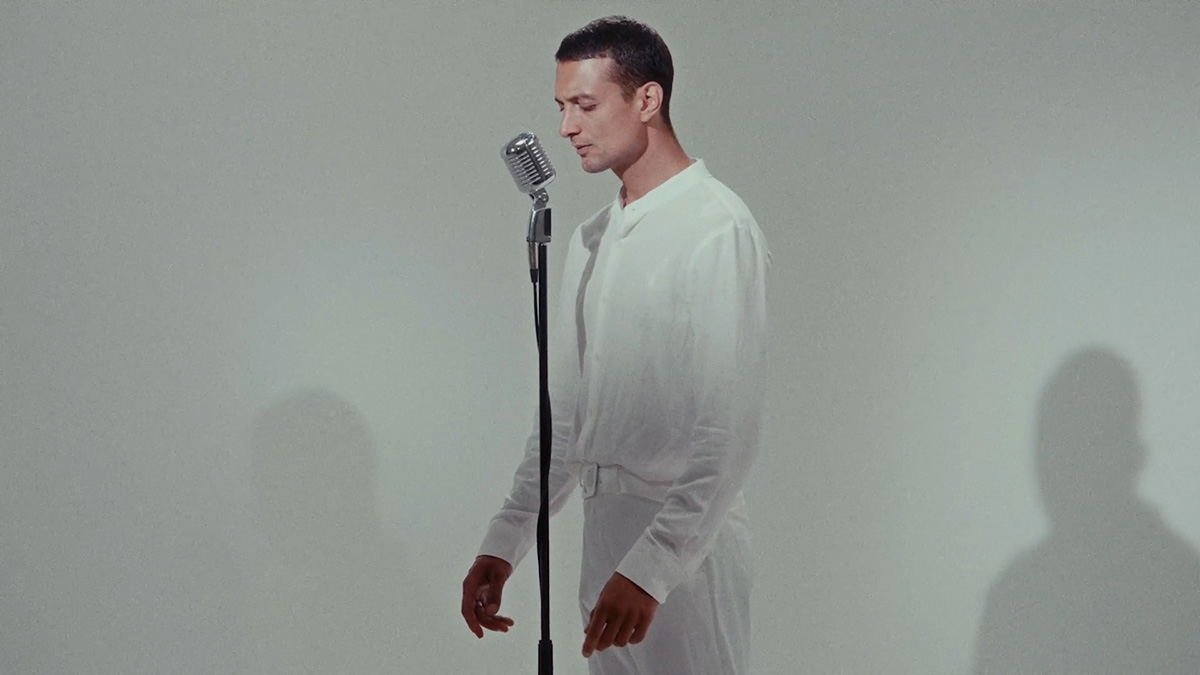
A stage unfolds and a love song is sung displaced from it’s owner. INSERT SONG is video-essay meditating on music and semiotics in relation to love, and how love declarations are falling victim to the image.
Kamil Dossar (b. 1988) is a Danish artist currently based in Copenhagen. Dossar’s practice is rooted in an interest in themes concerning identity and how we relate to images in contemporary society. Central to his work is the relationship between identity and the loss of it, and exploring the image in relation to the imageless, as a son to political refugees. By investigating visual identity and semiotics he renegotiates the status of the image by rearranging it into new modes of associations.
Marco Douma, Roel Meelkop
Catalogue : 2025The Clearing | Vidéo expérimentale | 4k | noir et blanc | 8:49 | Pays-Bas | 2024
Marco Douma, Roel Meelkop
The Clearing
Vidéo expérimentale | 4k | noir et blanc | 8:49 | Pays-Bas | 2024
The video work The Clearing reveals a fascination for exploring the indescribable and the ambiguous, a space in which certainty falls away and one can experience moments of thoughtlessness, perhaps even timelessness. This concept of an indefinable space is a recurring theme in Marco Douma and Roel Meelkop's audiovisual works.
Since the 1990s, both makers have been active in art in their own fields. Roel Meelkop developed from visual art to sound artist and Marco Douma developed from painting to multimedia artist. They made the acquired expertises their own and are in that sense self-taught in their current fields. At the same time, their visual academic background still plays a major role in the creation process. Perhaps this common denominator, which they recognise in each other's work, makes their collaboration so natural and complete. The collaboration began in 2011 and since then they have created video installations, performances and video works.
Peter Downsbrough
Catalogue : 2017THE [ AS | Vidéo | hdv | noir et blanc | 10:12 | USA, Belgique | 2016
Peter Downsbrough
THE [ AS
Vidéo | hdv | noir et blanc | 10:12 | USA, Belgique | 2016
Peter Downsbrough (1940, New Brunswick, N.J.) fait des études d’achitecture et d’art. Au milieu des années 1960, après quelques années de travail et d’exploration de divers matériaux, notamment le carton, le bois, l’acier, le plomb et les tubes de néon, sa pratique a évolué et trouve une forme différente, en 1970, dans les oeuvres "Two Pipes" (outside), "Two Dowels" (inside) et "Two Lines" (on paper).A la même époque, il commence à prendre des photographies de ses pièces. En prenant en photo sous différents angles et avec différentes distances, il commence graduellement à se concentrer sur les "coupes" existantes du paysage urbain. Certaines de ses photographies ont été publiées dans des livres, d’autres apparaissent dans des magazines, mais elles n’ont pas été exposées avant 1980. A partir de 1977, Downsbrough réalise plusieurs vidéos et des cassettes audio. Il a fait un disque en 1978 qui est sorti en 1982. Cherchant à étendre son vocabulaire pictural, il développe une série d’oeuvres avec des dés. En 1980, sur le Spectacolor Board de Time Square à New York, il réalise une pièce, un spot de 30 secondes s’allumant une fois l’heure pendant quatre jours, une performance qu’il documente dans un court-métrage « 7 come 11 ». Autour de 1980, il commence également à utiliser des cartes postales, en y dessinant deux lignes, suivi ensuite par l’utilisation de mots. Le travail avec des maquettes comme un moyen d’explorer l’espace et la structure commence vers 1983. Downsbrough a réalisé sa première commande publique à Rennes (France) en 1983 pour un espace mural. Le film "Occupied" a été produit en 2000, dis ans après qu’il a été conçu. Depuis, plusieurs films, tournés avec une caméra numérique, ont été édités en DVD. Aujourd’hui toutes ces disciplines font partie de son champ d’activité. L’intérêt de Downsbrough pour l’architecture industrielle prend beaucoup de forme. Plus souvent, la "préservation" signifie la survie formelle d’un film ou d’une série photo. Ses films et ses photos capturent toujours une réalité industrielle ou (sub)urbaine qui disparaîtra un jour où l’autre ou sera sujet à des réaménagements ‘ comme c’est le cas dans le Manhattan de la fin des années 1970 ou dans les zones industrielles de Kent, en Angleterre.
Peter Downsbrough
Catalogue : 2019AND TO | Vidéo | hdv | noir et blanc | 3:1 | USA, Belgique | 2018
Peter Downsbrough
AND TO
Vidéo | hdv | noir et blanc | 3:1 | USA, Belgique | 2018
We don`t know where we are. We`re in a car, looking at other cars, roads, structures, tunnels – wasteland. Position? The Global Positioning System informs us, with its horde of satellites, orbiting Earth. Guiding us with its synthesised voice, transporting us, `translating` us. Telling us what to do. `After 250 meters, keep to the right on the Brudermühlstraße, then keep to the left.` (And so on, and so forth.)
Brussels-based Peter Downsbrough (born New Jersey, USA, 1940) has developed a highly distinctive, strongly cohesive body of work that includes sculpture, drawings, photographs, films, videos, books, wall pieces and room pieces, architectural maquettes, and sculptural interventions in public space. Frequently heightening his famously sparse visual vocabulary with an equally sparse linguistic component—often just a single word—Downsbrough calls attention to a vast landscape of structures both physical and social, cultural and political—that shape modern life.
Catalogue : 2014AS ... | | hdv | noir et blanc | 1:46 | USA, Belgique | 2013
Peter Downsbrough
AS ...
| hdv | noir et blanc | 1:46 | USA, Belgique | 2013
Catalogue : 2013IN [ TO | Vidéo | hdv | noir et blanc | 2:47 | USA, Belgique | 2012
Peter Downsbrough
IN [ TO
Vidéo | hdv | noir et blanc | 2:47 | USA, Belgique | 2012
The silent, ultra-short black-and-white video IN [ TO is shorter than a video clip: it clocks in at 2 minutes, 47 seconds. It was made with material shot exclusively for the film, plus footage filmed `on the occasion`, while Downsbrough was working on other projects. One sees images from (South) Chicago, Brussels and Kent respectively, but since everything is filmed at night, only viewers who are familiar with the location will easily identify the spots. Here, the purpose is not to be specific about a site, to identify a place, or to document a certain location. Rather, Downsbrough gives an overall feeling of some quasi-archetypical `city at night`. The city is shot both as cityscape, from a distance, e.g. from outside the window of a Brussels apartment private building, or from nearer-by: a zoom-in from inside of the same building. IN [ TO contains many elements that define former Downsbrough films, both content-wise ? urbanism, cars, freeways and ring roads ? and formally: clean, `structural` framing, abstraction, the use of graphically inserted words. Here, as before, a phrase or a word game, almost hidden, can be discerned ? it might or might not be a key to the film. First, there?s the title of course, IN [ TO. Only at the very end, when the image is fading, the word TIME lights up, shortly. It seems like an indication of what time does: fading out light. Into time, the light fades out. A stream of cars passes by, only their head lights are visible. Everything else is dark, except for the horizon, with the outlines of distant buildings and hundreds of lights flickering: lit windows, neon publicity, street lights. At the film`s very end, a point of view shot from inside a car shows a road at night: Kent ? but it might be any city, or in between cities. To the left, trees; to the right, light posts; in front, the beam of the headlights, some other cars` rear lights. Then the image fades. TIME. The image`s gone. IN ] TO, with reversed bracket. Credits. - Steven Tallon -
Peter Downsbrough (1940, New Brunswick, N.J.; lives in Brussels) initially studied architecture but decided early on to work as a sculptor. Taking photographs of his trademark Two Pipes lead to taking photographs of ?cuts? that already existed in the urban landscape. Initially used in his books, they were shown in exhibitions from 1980 on. After having realized a few videos around 1978, Downsbrough took up filming again when he got a digital camera in 2002. In 1980, on the Spectacolor Board on Times Square, New York, he realized a 30-second spot shown once every hour for four days, and documented it in a short film, ?7 come 11.? His ongoing research of time, space and structure is further articulated through lines and letters in maquettes, wall and room pieces, and public commissions. Exhibitions include POSITION, 2003, curated by M.-T. Champesme, Palais des Beaux-Arts, Brussels (B), Espace de l?Art Concret, Mouans-Sartoux (F) and Muzeum Sztuki, Lodz (PL); Mamco, Genève (CH); FRAC Bourgogne, Dijon (F); SMAK, Ghent (B) and PETER DOWNSBROUGH: THE BOOK(S), curated by M. Küng, deSingel, Antwerp (B) which will have a second venue at Fabra i Coats, Barcelona (E) in the beginning of 2013.
Catalogue : 2012ET- [ | | hdv | couleur et n&b | 9:11 | USA, Belgique | 2009
Peter Downsbrough
ET- [
| hdv | couleur et n&b | 9:11 | USA, Belgique | 2009
ET[- opens with a silent black-and-white close-up of a vertical rod shuttling back and forth across a mechanical loom. The short sequence could be mistaken for footage from an early 20th-century propaganda film. Cut sharply to the next scene, also in black and white and taken from a fixed position but unmistakably contemporary. Reflected in a polished, slightly distorting surface, cars are seen entering a gated parking lot. That image is overlaid on the lower left by the film's title, printed in black, and is accompanied by a burst of ambient sound: the dull rumble of traffic. Cut abruptly to a silent close-up in color -- a kind of industrial interior still-life-- then cut again to black and white: a steel door opens vertically onto a cavernous corridor where mini-forklifts scurry about. The rest of the film, which zig-zags between exterior and interior views, is in black and white. Two more jarring spurts of ambient sound are heard and a second word, LA, appears, in white and preceded by a closed bracket, just before the final fade-out and credits. The reflected scene over which ]LA is superimposed is much like the one seen in the film's title image. ET[- has all the characteristics of a signature piece by Peter Downsbrough. The mostly silent, almost entirely black-and-white film is a visual exploration of constructed form, in this case, a modern factory building, a sprawling reflective box situated next to a busy road in a semi-rural setting. The blind facade of pleated, polished stainless-steel mirrors the constant flux of its surroundings and seems to dissolve into them. Inside is a different story: a universe of crisp, hard-edged geometries, gleaming surfaces and clinical precision. Giant spools, looms and bolts of material are stacked, aligned and otherwise arranged in perfect order. Fully automated machines revolve, throb, swivel and tick, each in its own rhythm and speed in the film's eerie silence. Eerie too is the absence of humans. Except for the two forklift operators, whose tiny vehicles occasionally career by like wind-up toys in a madcap adventure, there isn't a soul in sight. The camera surveys the factory's outside features and inner workings with slow pans, and it fixes on details with a steady gaze, shifting its focus constantly from interior to exterior, and its pacing from smooth, stately pans to rapidly cut fixed shots -- a visual interweaving that mimics the manufacturing processes taking place in the factory itself. If the final product is shown wrapped up and ready to go, we don't necessarily recognize it as such. However, we do witness its departure in trailer trucks as they pull out from the factory's loading docks, bound for the highway. That part of the drama, too, is seen reflected in the building's skin. - Sarah McFadden -
Catalogue : 2011I, Y, AND | | dv | couleur et n&b | 6:30 | USA, Espagne | 2010
Peter Downsbrough
I, Y, AND
| dv | couleur et n&b | 6:30 | USA, Espagne | 2010
Peter Downsbrough (1940, New Brunswick, N.J.) studied architecture and art. Around the mid-1960?s, after several years of work and exploring materials, including cardboard, wood, steel, lead, neon tubing, an evolution took place which resulted, in 1970, in the work with the Two Pipes (outside), Two Dowels (inside) and Two Lines (on paper). At the same time, he also started taking photographs to document these pieces. By taking photographs from different angles and distances, he gradually started taking photographs of ?cuts? that already existed in the urban landscape. Some of these photographs were used in books, some appeared in magazines, but it wasn?t until 1980 that they showed up in exhibitions. From 1977 on, Downsbrough realized several videos as well as audiotapes. A record was made in 1978 and released in 1982. Looking to expand the vocabulary, he developed a series of works using dice. In 1980, on the Spectacolor Board on Times Square, New York, he realized a piece, a 30 second spot shown once every hour for four days, and documented it in a short film, ?7 come 11?. Around 1980, he also started using regular postcards, initially by applying two lines, later to be followed by the use of words. The work with maquettes as a means of exploring space and structure started around 1983. The first commissioned public work was a wall piece realized in Rennes, France, 1990. The film ?Occupied? was produced in 2000, ten years after it was conceived. Since then, several films, shot with a digital camera, have been published as dvd?s. Today, all these disciplines occupy the field of his activities. An overview exhibition, curated by Marie-Thérèse Champesme, opened on June 24, 2003, at the Paleis van Schone Kunsten, Brussels. It was accompanied by an extensive catalogue and traveled to two other venues.
Catalogue : 2010A]PART | Vidéo | dv | noir et blanc | 11:50 | USA, Belgique | 2009
Peter Downsbrough
A]PART
Vidéo | dv | noir et blanc | 11:50 | USA, Belgique | 2009
A]PART is the first publication in the brand new CKA _ EDITIONS series, run by Christian Kieckens. It constitutes the third collaboration between Brussels-based American artist Peter Downsbrough and Brussels architect Christian Kieckens. Sharing the same sensibilty for both industrial architectural heritage and public space in general, former joint-ventures involved the industrial `Amylum` site in the centre of Aalst (culminating in the 1996 exhibition and photo/text publication Densities) and Brussels? city centre, where Kieckens took on the technical and logistical side of the public commissioned work AND /MAAR, OP AND /POUR, ET (2000-03). Downsbrough?s passion for industrial architecture takes many forms. More often than not, ?preservation? means survival in the form of a film or photo series. His films and photos always capture an industrial or (sub)urban reality that will sooner or later vanish or be subject to redevelopment ? be it late Seventies Manhattan or the industrial zones around Kent, UK. For now, and for the foreseeable future, this seems not to be the fate of Citroën`s impressive, prototypical modernist interbellum garage at Place d?Yser in Brussels ? the subject of Downsbrough`s latest film. The building, once threatened with demolition, will hopefully be there for some time to come, and Downsbrough pays homage to the building and its architects, Belgians Alexis Dumont and Marcel Van Goethem, who cooperated with French architect Maurice Ravazé. By publishing this work, architect Kieckens pays tribute to them as well. The black-and-white film underscores the building`s basic logic and rhythm. The garage consists of two parts, garage and showroom, and Peter Downsbrough films both in a playful yet formally precise way. This includes trade-mark Downsbrough idiosyncrasies, like suddenly letting in short diegetic environmental sounds, or superimposing words, e.g. IN TIME, at the beginning of the film. Typical `car movements` are alternated with proper cinematic movements like pannings; sometimes, an image freezes, and film becomes film still, photo. Shot from the passenger seat of a car driving down the distended corkscrew ramp, the film shows the garage?s interior and views through its windows onto the urban setting below. Downsbrough In a way, the building is filmically taken apart by Downsbrough: from top to bottom (including close-ups of the stained garage floor) it is visually analysed and scrutinised. Yet the physicality of the building also imposes its framing rules on the film; `rules` the artist evidently plays with ? as before. Towards the end of the film, we witness a gay, somewhat absurd dance of cars at the roundabout in front of the building, a picture reminiscent of the famous last scene of Jacques Tati`s fillm Trafic. Still, A]PART ? elegant, heedful and spare ? has a darker side too: it is both ode and elegy. A part. In time. Apart in time. In paying attention to all the minute details of the space and its immediate surroundings, the work symbolically preserves the Citroën building-as-film. However, it also shows how space itself (every space, not just a filmed one) is formed as well by an `attention`. Created by circumstances of history, society and perception, it will in the end always be subjected to the workings of time. (Steven Tallon)
Peter Downsbrough (1940, New Brunswick, N.J.) studied architecture and art. Around the mid-1960?s, after several years of work and exploring materials, including cardboard, wood, steel, lead, neon tubing, an evolution took place which resulted, in 1970, in the work with the Two Pipes (outside), Two Dowels (inside) and Two Lines (on paper). At the same time, he also started taking photographs to document these pieces. By taking photographs from different angles and distances, he gradually started taking photographs of ?cuts? that already existed in the urban landscape. Some of these photographs were used in books, some appeared in magazines, but it wasn?t until 1980 that they showed up in exhibitions. From 1977 on, Downsbrough realized several videos as well as audiotapes. A record was made in 1978 and released in 1982. Looking to expand the vocabulary, he developed a series of works using dice. In 1980, on the Spectacolor Board on Times Square, New York, he realized a piece, a 30 second spot shown once every hour for four days, and documented it in a short film, ?7 come 11?. Around 1980, he also started using regular postcards, initially by applying two lines, later to be followed by the use of words. The work with maquettes as a means of exploring space and structure started around 1983. The first commissioned public work was a wall piece realized in Rennes, France, 1990. The film ?Occupied? was produced in 2000, ten years after it was conceived. Since then, several films, shot with a digital camera, have been published as dvd?s. Today, all these disciplines occupy the field of his activities. An overview exhibition, curated by Marie-Thérèse Champesme, opened on June 24, 2003, at the Paleis van Schone Kunsten, Brussels. It was accompanied by an extensive catalogue and traveled to two other venues.
Catalogue : 2009And [ Back | Vidéo | dv | noir et blanc | 4:37 | USA, Belgique | 2006
Peter Downsbrough
And [ Back
Vidéo | dv | noir et blanc | 4:37 | USA, Belgique | 2006
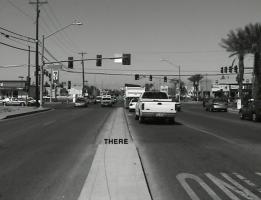
« And Back » « joue » un « jeu » complexe avec les mots « and » (« et ») et « back » (« arrière »), dans lequel le mot « back » fonctionne parfois comme indicateur, parfois comme déclencheur, parfois comme commentaire sur ce qui se passe à l'écran. Il s?agit en particulier de mouvements gauche/droite et droite/gauche (« back » signifie également « à reculons » ) de choses représentées ? en majorité des véhicules ? mais ceux des interventions cinématographiques ont aussi leur importance. Ce mouvement de « back » est parfois répété dans la typographie ; enfin, il pénètre et, en un sens, organise le film dans son intégralité : comme une « histoire » qui se déroule, comme une « structure » avec ses symétries et ses qualités morphologiques.
eter Downsbrough est né en 1940 aux Etats-Unis. Son oeuvre - sculpure, graphisme, photographie, vidéo, film, livre - est née d'un intérêt pour l'architecture et explore la relation complexe entre architecture, langage et typographie pour ne garder que l'essentiel. La forme est réduite à des lignes, les couleurs sont presque inexistantes. Dans ses vidéos, le mouvement et le langage sont envisagés dans leur rapport au temps et à l'espace : tous deux représentent et déconstruisent l'architecture moderne urbaine et industrielle. Il se produit en parallèle un détournement linguistique : en insérant et en interposant des blocs de mots comme AND, AS ou IN, Downsbrough fait de sa vidéo une sorte de "phrase" qui fonctionne également comme un "lieu" pouvant accueillir le spectateur. Les oeuvres de Peter Downsbrough ont notamment été présentées au Reina Sofia (Madrid), au SMAK (Ghent), au Paleis voor Schone Kunsten/Palais des Beaux-Arts (Bruxelles) et au Musée Sztuki (Lodz).
Catalogue : 2008AS] IN | Art vidéo | dv | couleur | 3:35 | USA, Belgique | 2007
Peter Downsbrough
AS] IN
Art vidéo | dv | couleur | 3:35 | USA, Belgique | 2007
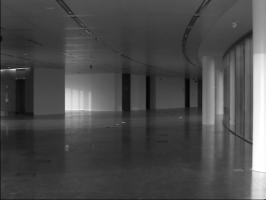
Des bureaux vides dans la zone de Zaventem, près de l'aéroport de Bruxelles. Aucune présence humaine, excepté les voitures passent ou les bureaux voisins que l'on aperçoit par la fenêtre. Avec de fluides mouvements de caméra, des travellings et des panoramiques, Downsbrough scrute l'environnement et explore les relations potentielles qui peuvent en émerger : intérieur et extérieur, vide et inhabité, horizontal et vertical, surfaces sombres et surfaces claires. La géométrie de l'espace, renforcée par le recours à des images en noir et blanc, détermine également celle de l'écran. Dans l'?uvre de Downsbrough, la façon de considérer l'espace, de même que l'espace, est profondément politique. Ses vidéos mettent l'accent sur les limites, l'ordre et les règles que le système social nous impose et s'intéressent à nos modes d'appropriation de l'espace, nous rappelant que tout "placement" est en même temps une "mise en ordre".
Peter Downsbrough est né en 1940 aux Etats-Unis. Son oeuvre - sculpure, graphisme, photographie, vidéo, film, livre - est née d'un intérêt pour l'architecture et explore la relation complexe entre architecture, langage et typographie pour ne garder que l'essentiel. La forme est réduite à des lignes, les couleurs sont presque inexistantes. Dans ses vidéos, le mouvement et le langage sont envisagés dans leur rapport au temps et à l'espace : tous deux représentent et déconstruisent l'architecture moderne urbaine et industrielle. Il se produit en parallèle un détournement linguistique : en insérant et en interposant des blocs de mots comme AND, AS ou IN, Downsbrough fait de sa vidéo une sorte de "phrase" qui fonctionne également comme un "lieu" pouvant accueillir le spectateur. Les oeuvres de Peter Downsbrough ont notamment été présentées au Reina Sofia (Madrid), au SMAK (Ghent), au Paleis voor Schone Kunsten/Palais des Beaux-Arts (Bruxelles) et au Musée Sztuki (Lodz).
Catalogue : 2008And Here | Vidéo expérimentale | dv | couleur | 24:0 | USA, Belgique | 2007
Peter Downsbrough
And Here
Vidéo expérimentale | dv | couleur | 24:0 | USA, Belgique | 2007
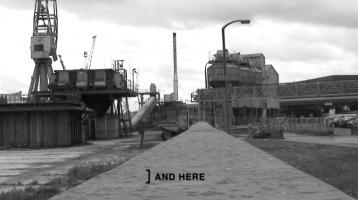
"] AND HERE" est un projet vidéo filmé dans l'environnement urbain et industriel du North Kent. Il se compose d'images de centres villes, de la plate forme de transport de containers de l'île de Grain, des caravanes de l'île de Sheppey, etc. Ce projet est une commande de la Faversham Society en réponse aux changements rapides entraînés par le Thames Gateway North Kent Development, un programme de rénovation s'étendant Dartford à Teynham dans le Sud de la région. Contrairement aux précédents films de Downsbrough, l'espace est ici clairement identifié : les endroits visités par l'artiste peuvent théoriquement être reportés sur une carte. Cette oeuvre souligne avant tout un aspect du travail de Downsbrough (que l'on retrouve également dans d'autres films) qui consiste à offrir un témoignage matériel de l'histoire et de lieux qui sont en train de disparaître. Une autre différence vient du fait que ce film est en noir et blanc et en couleur : les spectateurs concentrés pourront à certains moments distinguer deux secondes en couleur ! Il s'agit de son plus long film (24 min.) depuis "The Other Side" en 1979. Dans les oeuvres de Downsbrough, le spectateur est en général confronté à un même type de "mondes". Comme auparavant, ce film est fait d'espace ? un espace représenté concrètement et mentalement ? de typographie et de blocs de mots : le titre "]AND HERE" ou des mots comme AS, qui découlent des précédents films de Downsbrough. Le film alterne plans fixes, travelling et images tournées depuis l'intérieur d'une voiture, auxquelles on peut facilement rattacher des scènes de "AND[BACK " tournées depuis une voiture et inversement. Ici, Downsbrough ne filme pas que des sites industriels mais aussi des villes et des villages du Kent. Avec leurs bâtiments en briques typiques et leurs pubs, ces lieux et ces habitations ? contrairement à la force de déplacement formellement et géo-économiquement uniformisante de l'espace industriel ? sont identifiables comme appartenant au Sud-Est de l'Angleterre et, plus particulièrement, au Kent. Mais la principale différence par rapport à ses précédents projets, qui pourrait être annonciatrice d'une nouvelle tendance chez Downsbrough, réside non pas dans l'utilisation de texte et d'images (ou d'images textuelles) mais dans celle du son. Pour "] AND HERE", Downsbrough utilise une musique spécialement commandée pour l'occasion et jouée par Xavier Garcia Bardon et Benjamin Franklin, deux membres du groupe bruxellois Buffle. Downsbrough avait déjà utilisé la musique dans ses premières vidéos avec des groupes comme The Spinners ou Talking Heads mais ici, outre le fait de créer un certain atmosphère, la musique joue le rôle d'un élément structurel et structurant. Tout comme les images, la musique est souvent interrompue soudainement ? le morceau le plus long ne dure qu'une minute. Comme dans la plupart des cinémas narratifs, il y là aussi une confrontation et un dialogue entre le son/la musique et l'image/la typographie. La musique, similaire aux images structuralistes du cinéma de Downsbrough, se situe entre shoegaze, post-rock et improvisation et insiste fortement sur la texture, notamment à travers des effets obtenus avec la pédale de la guitare et l'utilisation du traitement numérique. On note également un côté industriel dans cette musique qui reflète et renforce les paysages industriels filmés par Downsbrough.
Peter Downsbrough est né en 1940 aux Etats-Unis. Son oeuvre - sculpures, graphismes, photographies, vidéos, films, livres - est née d'un intérêt pour l'architecture et explore la relation complexe entre architecture, langage et typographie pour ne garder que l'essentiel. La forme est réduite à des lignes, les couleurs sont presque inexistantes. Dans ses vidéos, le mouvement et le langage sont envisagées dans leur rapport au temps et à l'espace : tous deux représentent et déconstruisent l'architecture moderne urbaine et industrielle. Il se produit en parallèle un détournement linguistique : in insérant et en interposant des blocs de mots comme AND, AS ou IN, Downsbrough fait de sa vidéo une sorte de "phrase" qui fonctionne également comme un "lieu" pouvant accueillir le spectateur. Les oeuvres de Peter Downsbrough ont notamment été présentées au Reina Sofia (Madrid), au SMAK (Ghent), au Paleis voor Schone Kunsten/Palais des Beaux-Arts (Bruxelles) et au Musée Sztuki (Lodz).