Catalogue > Search
Results for : Catalogue 2021

Mélissa Epaminondi, Esteban Ulrich
Deconstructing Niemeyer
Doc. expérimental | mp4 | couleur | 1:9 | France | 2020
Sur une succession d'images documentant le chantier de remise en état de la coupole du siège du Parti Communiste Français, la voix de l'architecte brésilien Oscar Niemeyer traverse le temps pour nous dévoiler le cœur de son œuvre et de sa pensée.
Mélissa Epaminondi est née en 1977. Elle vit et travaille entre Paris (France) et Oletta (Corse, France). Elle est DPLG diplômée de l’École d’Architecture de Luminy Marseille (France). Architecte et artiste, son travail reflète une vision sensible en même temps qu’une réflexion étayée sur les questions environnementales. Elle poursuit sa pratique initiale et réalise des films, vidéos et installations. Esteban Ulrich est né à Buenos Aires, Argentine, en 1975 il étudie dans des écoles françaises avant de commencer sa carrière professionnelle chez Los Inrockuptibles, la version argentine du magazine français. Depuis, il se partage entre le journalisme, le cinéma, la photographie et l'expérimentation avec les nouvelles technologies appliquées à l'art et aux médias. Il vit à Paris (France) depuis 2015.

Zachary Epcar
The Canyon
Fiction expérimentale | 16mm | couleur | 15:43 | USA | 2020
Un portrait d’un complexe résidentiel urbain qui tombe dans l'oubli. Plus de beaux bébés, plus de chaises en rotin emballées à la main.
Zachary Epcar est né à San Francisco (USA). Il est réalisateur, et ses œuvres ont notamment été présentées au New York Film Festival (USA); au Toronto International Film Festival (Canada); au Festival international du film de Rotterdam (Pays-Bas); au Museum of Contemporary Art Chicago (USA); et à la Pacific Film Archive, Berkeley (USA).

Deniz Eroglu
Blut und Boden
Film expérimental | 4k | couleur | 10:3 | Danemark, Allemagne | 2019
Le titre de "Blut und Boden" fait référence au slogan nationaliste "sang et sol", un idéal raciste d'une identité nationale qui entretiendrait une relation mythique avec une zone de peuplement. Ce terme a ensuite été adopté par les nazis pour propager le faux idéal du fermier aryen et de son droit divin au Lebensraum. Dans cette œuvre, le slogan prend un nouveau sens, faisant plutôt référence à l'histoire du passage à l'âge adulte d'un migrant de deuxième génération en Allemagne. Au début, les paysages contemporains qui accompagnent la narration sont reconnaissables en tant que tels: des voitures traversant un pont, deux hommes promenant un berger allemand. À mesure que le narrateur raconte son histoire et les difficultés qu'il a rencontrées, les paysages deviennent de plus en plus vides et dépourvus de traces humaines, rappelant l'Allemagne rurale, plus calme, des siècles passés. Au fur et à mesure que l'histoire progresse vers un dénouement, les paysages crépusculaires se mettent à dégager un caractère inquiétant et menaçant, en plus de la violence sur le point d'éclater. Les images ont été enregistrées dans la région où ces événements ont eu lieu. Ces dernières années, cette région a connu une forte augmentation du soutien à l’AFD, un parti politique d'extrême droite, et a été le théâtre de grandes manifestations néonazies.
Deniz Eroglu est né en 1981. Il est artiste. D’origine danoise et turque, il habite actuellement aux Pays-Bas. Il a reçu son diplôme de la Hochschule für Bildende Künste – Städelschule, Francfort-sur-le-Main (Allemagne) en 2014. Il été artiste en résidence à la Rijksakademie van Beeldende Kunsten à Amsterdam (Pays-Bas) de 2016 à 2017. Il travaille de nombreux médias et genres - film, vidéo, sculpture, performance et œuvres textuelles. Sur le plan thématique, son travail s'articule autour de l'identité culturelle, des relations humaines, de l'immigration, des utopies, des personnes "éclairées", de la solitude, de la puissance et de l'impuissance, de l'individu et du groupe, et, ces dernières années, de l'examen des institutions sociétales.

Tirtza Even, Nadav Assor
Chronicle of a Fall
Doc. expérimental | mov | couleur | 60:0 | USA | 2020
"Chronicle of a Fall" est un documentaire expérimental sous la forme d’une installation multicanale immersive. Le projet dépeint l'expérience Fragmentée de six migrants aux États-Unis, en utilisant des caméras corporelles et une capture volumétrique.
Tirtza Even est documentariste et vidéaste depuis plus de vingt ans, et a produit des vidéos linéaires et interactives, représentant les aspects les moins évidents de dynamiques sociales et politiques complexes et parfois extrêmes dans des lieux spécifiques (par exemple en Palestine, en Turquie, en Espagne, aux États-Unis et en Allemagne, entre autres). Son travail a été présenté notamment au MoMa - Museum of Modern Art, New York (USA); à la Whitney Biennale, New York (USA), et à la Biennale de Johannesburg (Afrique du Sud). Il a également été présenté dans de nombreuses autres galeries, musées et festivals aux États-Unis, en Israël et en Europe, notamment au Festival du film de Rotterdam (Pays-Bas); au San Francisco International Film Festival (USA); et au New York Video Festival, Lincoln Center, New-York (USA). Elle a obtenu de nombreuses bourses et récompenses, notamment le Fledgling Distribution Fund; le Artadia Awards, Chicago (USA) [premier prix]; le Golden Gate Awards Certificate of Merit, San Francisco International Film Festival (USA); le Best Experimental Film au Syracuse Film Festival (USA); le Media Arts Award de The Jerome Foundation, New York (USA); le premier prix de L'immagine Leggera Festival, Palerme (Italie); et un Individual Artists Program Award du NYSCA – New York State Council on the Arts (USA). Ses œuvres ont notamment été acquises par la collection permanente du Museum of Modern Art, New York (USA); du Jewish Museum, New York (USA), et du Israel Museum, Jérusalem (Israël). Elle a été invitée à participer à plusieurs conférences et programmes universitaires, dont la Whitney Museum Seminar Series, New York (USA); le Digital Flaherty Seminar, New York (USA); la SXSW Interactive Conference, Austin (USA); le panel annuel Art Pace, San Antonio (USA); ACM Multimedia, San Francisco (USA); la conférence PSI - Performance Studies International, Providence (USA); la conférence SLSA - Society for Literature, Science, and the Arts, Chicago (USA) et plusieurs autres. Son travail est distribué par Heure Exquise, (France); VDB - Video Data Bank (USA), et GIV - Groupe Intervention Video (Canada). Elle est Maître de conférence au département Film, Vidéo, Nouveaux Médias et Animation de la School of the Art Institute of Chicago (USA). Nadav Assor (né en 1979, États-Unis / Israël) vit et travaille à Providence (USA). Dans son travail, il s'intéresse aux systèmes de médiation technologique, souvent d'origine militaro-industrielle: des caméras de suivi oculaire aux drones, en passant par les dispositifs de téléprésence et les environnements de réalité mixte. Dans son travail, il réutilise de manière critique des versions low-fi de ces systèmes, afin de créer des communautés, des relations, des dialogues humains et intimes, ainsi que des expériences audio-visuelles-tactiles profondes. Ses vidéos, installations et performances ont été présentées dans des festivals de cinéma, des musées, des galeries et des salles de spectacle en Amérique du Nord, en Europe et en Asie. Parmi les lieux récents, citons entre autres Arsenal Berlin (Allemagne); le Oberhausen International Short Film Festival (Allemagnue; "Video Vortex XI" à la biennale Kochi-Muziris, Kochi (Inde); le Hong-Gah Museum Taipei (Taïwan); La Casa Encendida, Madrid (Espagne); la Edith-Russ Haus, Oldenburg (Allemagne); la Transmediale, Berlin (Allemagne); la Soundwave Biennial, San Francisco (USA); Residency Unlimited, New York (USA); la Julie M Gallery, Toronto (Canada) et Tel Aviv (Israël); et la Fridman Gallery, New York (USA). Son travail a fait l'objet de critiques dans des publications telles que Artforum, Vice Motherboard, Art Monthly UK et Haaretz, et a récemment été présenté dans "Rêvolution Digitale", une collection à propos de l'art numérique international coproduite par la chaîne Museum TV de CANAL. Ses œuvres vidéo à canal unique sont distribuées par Video Data Bank, Chicago (USA). Il est Maître de conférence en expanded media au département Studio Art du Connecticut College, New London (USA), et directeur du Ammerman Center for Arts and Technology, New London (USA). Il est actuellement membre de l'Open Documentary Lab du MIT – Massachusetts Institute of Technology, Cambridge (USA).

Charles Fairbanks, Kak, Saúl
( ( ( ( ( /*\ ) ) ) ) )
Doc. expérimental | dcp | couleur | 18:15 | USA, Mexique | 2019
"En 1982, l’éruption du volcan Chichonal a forcé la communauté zoque à émigrer. Filmé pendant six ans, (((((/*\))))) capte l’atmosphère unique de leur village du Chiapas. Cette promenade ethnographique ravit le regard, nous entraînant dans un voyage sonore rythmé par les musiques et les annonces commerciales pittoresques qui émanent des magasins ou des camionnettes ambulantes. Peu à peu, d’autres discours plus politiques font surface. À travers le portrait de ce micromonde, Charles Fairbanks et Saul Kak (artiste et activiste zoque) abordent aussi bien la richesse culturelle des communautés minoritaires que la pression néolibérale exercée sur les Autochtones et leurs terres, tout en se faisant l’écho de la situation douloureuse des réfugiés à travers le monde." (RIDM). Cette excursion ethnographique est un régal pour les yeux, rythmé par le refrain des sons quotidiens d'un village chiapanèque. Petit à petit, des thèmes politiques font surface. En racontant l'héritage des ancêtres réfugiés du coréalisateur Saúl Kak, (((((/*\))))) (ou "echos of the volcano") donne une voix à la lutte du peuple Zoque pour la souveraineté autochtone, contre un État néolibéral.
Saúl Kak est peintre et jouit d’une renommée internationale. D’origine Zoque, il parle cette langue depuis sa naissance. Sa pratique artistique est dédiée à la "cosmovisión" (la vision du monde) et aux droits de son peuple. Fils de campesinos, des paysans, qui ont fui l'éruption du volcan Chichonal en 1982, Saúl dirige le programme de résidence artistique de la Galería MUY, un centre d'art contemporain pour l'art et les artistes autochtones. Charles Fairbanks est réalisateur, écrivain et boursier Guggenheim. Ses films ont été diffusés sur POV et à l’Anthology Film Archives, New-York (USA); au CPH:DOX, Copenhague (Danemark); à Visions du Réel, Nyon (Suisse) et dans plus de 100 autres festivals sur six continents. Ensemble, Fairbanks et Kak aspirent à documenter les défis contemporains du peuple Zoque et sa vision unique du monde: la cosmovision. Leur précédent film "The Modern Jungle" a été nommé l'un des meilleurs films latino-américains de 2016 par de nombreux critiques. Il a reçu le prix du meilleur documentaire au Festival international Présence Autochtone, à Montréal (Canada), et les prix du jury à Slamdance, Park City (USA), et au Athens International Film and Video Festival, Athènes (Grèce).

Mounir Fatmi
The Human Factor
Vidéo expérimentale | mov | couleur | 15:57 | Maroc, France | 2018
« The Human Factor » est une video expérimentale qui traite de l’art décoratif et de l’exotisme. Sur fond d’exposition coloniale internationale de 1931 à Paris qui s’est déroulé pen-dant l’entre deux guerres, certaines oeuvres indigènes des colonies côtoyaient celles des principales puissances coloniales de l’époque au sein de pavillons rappelant l’architecture de l’Afrique noir, de l’Afrique du nord, ou de l’Indochine. La vidéo « The Human Factor » décompose le film « L’inhumaine » de Marcel L’Hérbier (1923). Ce film est considéré encore aujourd’hui comme le manifeste de l’art dé-coratif. Ce chef d’œuvre du cinéma muet, tourné dans des décors modernes et spec-taculaires pour l’époque, retrace l’esprit du temps et les influences des artistes euro-péens par les créations venant des Art lointains. « L’inhumaine » regroupe de ma-nière inédite des artistes, décorateurs, costumiers et architectes, comme Robert Mallet-Stevens, Fernand Leger, Alberto Cavalcanti, Claude Autant-Lara, Pierre Chareau, Michel Dufet, Joseph Csaky et Paul Poiret. « The Human Factor » tente de montrer un autre aspect de l’Art décoratif, sous la puissance de l’idéologie coloniale et son ambition universelle. Il faut dire que l’influence de l’art colonial n’est pas nouvelle en cette période de l’entre deux guerres. Elle existait depuis 1907 sous le nom de « la société coloniale des artistes français », et dont le but était l’expansion coloniale par l’art, au profit de la France. Des prix et des bourses de voyages ont été attribué pour aider des artistes comme Van Dongen, Matisse ou Paul Klee à séjourner en Afrique du Nord. En 1919 la revue « Les Arts à Paris » parle déjà de l’art « nègre » comme d’ « Une esthétique nouvelle » qui risque d’influencer complètement l’art européen. Ainsi les masques et les sculptures africaines sont devenue de vrais objets de curiosité et d’inspirations pour des artistes comme Picasso, ou Fernand Léger qui a conçu tous les costumes et les décors du Ballet Suédois « La création du Monde » en s’inspirant de « l’Art indigène et africain ». Une autre exposition a été organisée en 1930 par Tristan Tzara, Pierre Loeb et Charles Ratton sous le titre « L’Exposition d’art africain et océanien ». Celle-ci constitue une étape primordiale dans l’histoire de l’appréhen-sion des arts premiers en occident. Le public parisien a pu voir alors des sculptures primitives exposées avec des œuvres de Pablo Picasso, André Derain, Georges Braque, Joan Miró, Paul Guillaume et Félix Fénéon. Puis vient finalement l’exposition coloniale de 1931 qui a affiché d’une manière claire l’idéologie coloniale n’évoquant les caractères originels des colonisés qu’à la condi-tion d’évoquer les bienfaits de la métropole et de ne montrer de la colonisation que les aspects positifs. A l’exception de quelques masques, statuettes et pièces archéologiques, les œuvres indigènes sont rares. On leur préfère en générale les spectacles de danses et de folklore, de ce fait dans le domaine artistique c’est le point de vue français et occidental qui fut privilégié. Il faut savoir aussi que cette vision n’a pas été partagée par l’ensemble des artistes français, puisque le groupe des surréalistes avec l’aide de Louis Aragon, Georges Sadoul et André Breton entre autres, a monté « L’Anti-exposition coloniale » sous l’égide du Part communiste français en diffusant un mot d’ordre sur le tract- « Ne visitez pas L’Exposition coloniale ». Ainsi la video « The Human Factor » aborde l’exposition coloniale qui a officialisé en quelque sorte le lien entre le primitivisme de l’avant garde et l’exotisme de l’art déco d’inspiration coloniale. Studio Fatmi, Septembre 2018.
mounir fatmi est né à Tanger au Maroc, en 1970. À l’âge de quatre ans, sa famille déménage à Casablanca. A dix-sept ans il part à Rome où il s’inscrit à l’école libre de nu et de gravure à l’académie des beaux-arts, puis à l’école des beaux arts de Casablanca et finalement à la Rijksakademie à Amsterdam. Il passe son enfance dans le marché aux puces du quartier Casabarata, un des quartiers le plus pauvres de la ville de Tanger où sa mère vendait des vêtements pour enfants. Un environnement qui multiplie jusqu’à l’excès les déchets et les objets de consommation en fin de vie. L’artiste voit par la suite cette enfance comme sa première éducation artistique et compare ce marché aux puces à un musée en ruine. Cette vision a également valeur de métaphore et exprime les aspects essentiels de son travail. Influencé par l’idée de médias morts et l’effondrement de la civilisation industrielle et consumériste, il développe une réflexion sur le statut de l’oeuvre d’art entre Archive et Archéologie. Il utilise des matériaux obsolètes tels que les câbles d’antenne, les anciennes machines à écrire, ou les cassettes VHS, et travaille sur la notion d’une archéologie expérimentale en examinant le rôle de l’artiste au sein d’une société en crise. Il joue des codes et préceptes de cette dernière sous le prisme de la trinité Langage, Architecture et Machine. Il interroge ainsi les limites de la mémoire, du langage et de la communication, tout en réfléchissant sur les matériaux en cours d’obsolescence et à leurs avenirs incertains. La recherche artistique de mounir fatmi, constitue une pensée sur l’histoire des technologies et leurs influences dans la culture populaire. BIOGRAPHIE Il faut voir ainsi dans ses oeuvres, de futures archives de médias en construction. Bien qu’ils marquent des moments clés de notre histoire contemporaine, ces matériaux techniques remettent également en question le transfert de connaissances, le pouvoir suggestif des images et critiquent les mécanismes illusoires qui nous lient à la technologie et aux idéologies. Depuis 2000, les installations de mounir fatmi ont été sélectionnées dans plusieurs biennales, la 52e et la 57e Biennale de Venise, la 8e Biennale de Sharjah, la 5e et la 7e biennale de Dakar, la 2e Biennale de Séville, la 5e Biennale de Gwangju, la 10e Biennale de Lyon, la 5e triennale d’Auckland, la 10e et 11e biennale de Bamako, la 7e Biennale d’architecture, Shenzhen, à la triennale de Setouchi et la triennale Echigo –Tsumari, au Japon. Son travail a été présenté au sein de nombreuses expositions personnelles, au Migros Museum fu?r Gegenwarskunst, Zu?rich. Mamco, Genève. Musée Picasso, la guerre et la paix, Vallauris. Fondation AK Bank, d’Istanbul. Museum Kunst Palast, Du?sseldorf et au Goteborg Konsthall. Il a participé à plusieurs expositions collectives au Centre Georges Pompidou, Paris. Brooklyn Museum, New York. Palais de Tokyo, Paris. MAXXI, Rome. Mori Art Museum, Tokyo. MMOMA, Moscou. Mathaf, Doha. Hayward Gallery et Victoria & Albert Museum, Londres. Van Abbemuseum, Eindhoven, au Nasher Museum of Art, Durham et au Louvre Abu Dhabi. Il a reçu plusieurs prix dont le Uriöt prize, Amsterdam, le Grand Prix Léopold Sédar Senghor de la 7e Biennale de Dakar en 2006, le prix de la Biennale du Caire, en 2010, ainsi que le Silver Plane Prize de la Biennale de l'Altai, Moscou en 2020.

Javier Fernández Vázquez
Anunciaron tormenta
Doc. expérimental | mov | couleur | 87:50 | Espagne | 2020
En 1904, Ësáasi Eweera, le dernier chef autochtone bubi, qui s'opposait à la domination espagnole sur l'actuelle île de Bioko (Guinée équatoriale), a été arrêté par des gardes coloniaux et emmené de force à Santa Isabel, capitale de la colonie. Emprisonné et mortellement blessé, Ësáasi Eweera est mort trois jours plus tard. Son village natal a été incendié et la plupart des habitants ont disparu. Un compte rendu incomplet de ces événements se trouve dans les Archives générales de l'administration espagnole. Dossier par dossier, lettres et rapports manuscrits présentent plusieurs récits des évènements présumés, et exposent les opérations progressives de dissimulation menées par les institutions coloniales. Parallèlement, certains récits oraux autochtones ont survécu et se sont opposés à la version officielle espagnole, faisant face au risque permanent d'oubli et tentant de contribuer à une sorte de mémoire collective émancipée. En rejouant des textes écrits, par le biais de voix off, en enregistrant et en étudiant les récits oraux des Bubis et en identifiant des lieux chargés d'histoire, "Anunciaron tormenta" tente de réfléchir aux lacunes, aux silences, aux contradictions et aux mensonges sur lesquels l'histoire coloniale est généralement construite.
Javier Fernández Vázquez est cinéaste, anthropologue et chercheur en culture visuelle. En 2007, il a réalisé son premier film court, "Señales de Indiferencia / Marks of Indifference", qui a reçu le prix du meilleur court métrage international au Festival Internacional de Cine de Valdivia (Chili). En 2008, il a fondé le collectif de cinéma expérimental et documentaire Los Hijos en collaboration avec Luis López Carrasco et Natalia Marín Sancho. En 2010, Leur premier long métrage, "Los materiales / The Materials", a remporté le prix Jean Vigo de la meilleure réalisation au Punto de Vista Pamplona International Film Festival, Pampelune (Espagne), ainsi qu’une mention spéciale au FID Marseille (France). Leurs longs métrages suivants ainsi que plusieurs films courts et installations vidéo ont été sélectionnés par des festivals internationaux et exposés dans des centres d'art contemporain. Des rétrospectives de leur travail ont également été présentées dans des sections spéciales du Mar del Plata International Film Festival, Mar del Plata (Argentine) ou encore du Distrital, Mexico (Mexique). En 2015, Javier Fernández Vázquez a entamé une carrière universitaire en études cinématographiques et culture visuelle, qui l'a conduit à mener des recherches sur des questions liées à l'histoire, la mémoire, le colonialisme, la culture visuelle et la théorie de l'objet. "Anunciaron tormenta / A storm was coming" (2020) est son premier long métrage solo. Il a été présenté en avant-première dans la section Forum de la Berlinale en 2020.

Luca Ferri
si
Doc. expérimental | dcp | couleur | 19:0 | Italie | 2020
Dans son salon, un homme dans la cinquantaine assiste à la création du cosmos à travers une galerie d'images encyclopédiques où l'être humain n'est jamais présent, si ce n’est au travers de certaines de ses œuvres, de ses vestiges ou de ses activités. Il s'endort, bercé par la vision d'une publicité mettant en scène une femme, et se retrouve dans un affreux cauchemar où il assiste à une chasse à l’ours polaire menée par des chasseurs arctiques. Dans le même temps, deux morceaux de musique contemporaine du compositeur Dario Agazzi et un texte inspiré d'un souvenir d'enfance du réalisateur, lié à un événement suicidaire, nous suggèrent d'"écrire une fois, et d'effacer deux fois".
Luca Ferri (Italie, 1976), autodidacte, se consacre depuis 2011 à l'écriture, à la photographie et à la réalisation de films qui ont été présentés dans des festivals italiens et internationaux, tels que le Atlanta Film Festival (USA); le festival Biografilm, Bologne (Italie); la Documenta Madrid (Espagne); Didocs; le Festival du film de Gand (Belgique); le IndieLisboa, Lisbonne (Portugal); le Punto de Vista, Pampelune (Espagne); le Festival du film de Pesaro (Italie); le POFF – Festival du film Nuits noires de Tallinn (Estonie); Queer Lisboa, Lisbonne (Portugal); le Festival du film de Taipei (Taïwan); le Thessaloniki Documentary Festival, Thessalonique (Grèce); le Vilnius International Short Film Festival (Lituanie), ainsi que dans des musées et galeries d'art, comme le Spazio Forma Meravigli, Milan (Italie); le MAMbo – Museo d’Arte Moderna di Bologna, Bologne (Italie); MACRo - Musée d’Art contemporain de Rome (Italie) et le Shchusev State Museum of Architecture, Moscou (Russie). En 2013, la cinémathèque nationale de Rome (Italie) a organisé une rétrospective de ses œuvres. Son premier long métrage, "Abacuc", réalisé en 2015, a été présenté au Festival du film de Turin (Italie) et au festival de Mar del Plata (Argentine). Son film "Colombi" a été présenté à la 73e Mostra de Venise (Italie) dans la sélection Orizzonti. En 2018, son film "Dulcinea" a été sélectionnée au 71e Festival international du film de Locarno (Suisse), en compétition dans la section Signs of life, tandis que "Pierino" a été présenté au 61e DOK Leipzig (Allemagne). En 2020, "The House of Love" est présenté à la 70e Berlinale, Berlin (Allemagne) dans la section Forum. Il a été aussi sélectionné en compétition pour le Prix du meilleur documentaire de la Berlinale, et a reçu une mention au 34e Teddy Awards. Son dernier film, "sì" est présentée à la 77e Mostra de Venise (Italie).
Nina Fischer, Maroan el Sani
Appropriation takes you on a weird ride
Doc. expérimental | 4k | couleur | 20:39 | Allemagne | 2020
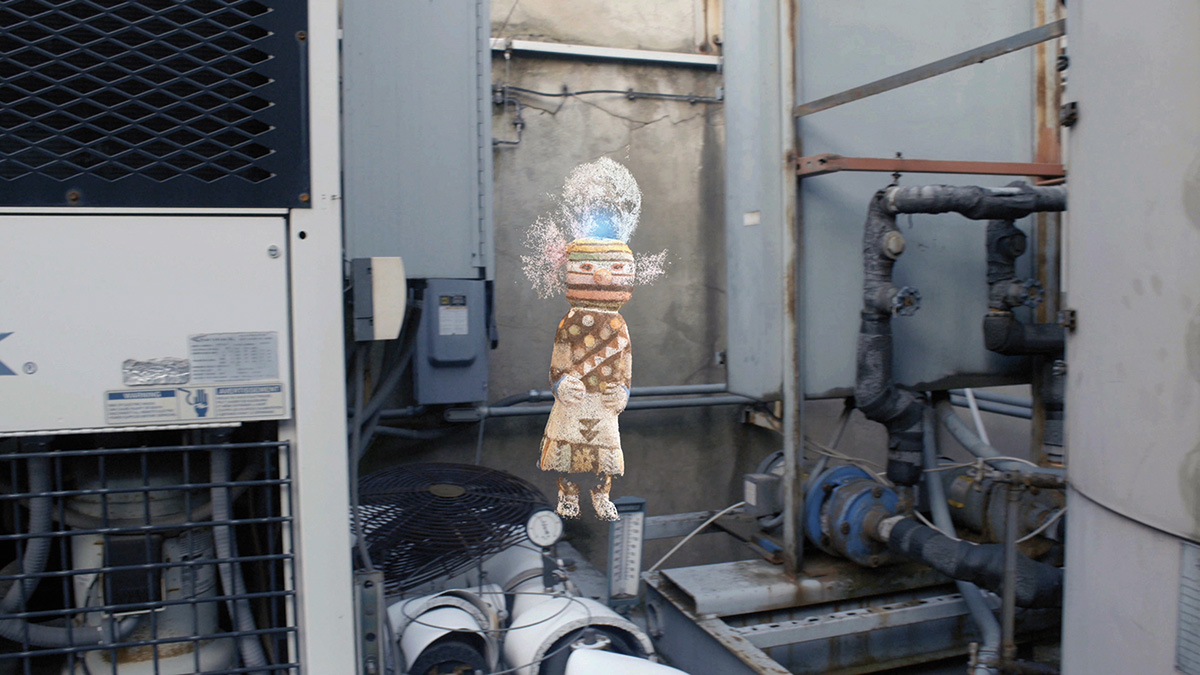
"Appropriation takes you on a weird ride" étudie l'étrange enthousiasme des Allemands pour les Autochtones d’Amérique, en relation avec le racisme contemporain et ses profondes racines coloniales. Cette fascination, surtout en ce qui a trait à la construction d'une identité allemande, a une chronologie plus effrayante qu'impressionnante. Elle commence avec Arminius, chef de la tribu germanique des Chérusques au premier siècle, et d’étend aux romans d'aventure de Karl May et aux spectacles du Far West de Buffalo Bill au XIXe siècle, en passant par les expositions ethnographiques (Völkerschauen) dans les zoos et les cirques, et la fondation de "clubs indiens" au début du XXe siècle, jusqu’à l'appropriation des identités autochtones par les idéologues nazis, et jusqu’à notre époque, où de nouveaux groupes de droite ont commencé à s’identifier de manière troublante avec les peuples autochtones des Amériques.
Nina Fischer et Maroan el Sani sont artistes visuels et réalisateurs. Ils vivent à Berlin (Allemagne). Ils travaillent ensemble depuis 1995. De 2007 à 2010, ils ont été Maîtres de conférence en cinéma et art médiatique, à l'Université de Sapporo (Japon). Depuis 2015, Nina Fischer est professeure de cinéma expérimental et d'art médiatique à la Universität der Künste Berlin (Allemagne). Ensemble, ils ont participé à des expositions d'art et à des festivals de cinéma à l’international, notamment à la Berlinale – International Filmfestival Berlin (Allemagne); au Festival international du film de Rotterdam (Pays-Bas); au Istanbul Film Festival (Turquie); à la Biennale de Sydney (Australie); à la Biennale de Gwangju (Corée du Sud); à la Liverpool Biennial of Contemporary Art (Royaume-Uni); à Manifesta 4, Francfort-sur-le-Main (Allemagne); à la Media City Seoul Biennale, Séoul (Corée du Sud); et à la Triennale d'Aichi (Japon). Ils ont également participé à des expositions individuelles, notamment au Tokyo Photographic Art Museum (Japon); au Stedelijk Museum Bureau Amsterdam (Pays-Bas); au Museum of Contemporary Art Hiroshima (Japon); à la K21 - Kunstsammlung Nordrhein Westfalen, Düsseldorf (Allemagne); et au MAXXI Museum, Rome (Italie).

Judy Fiskin, Peter Kirby
So Long For Awhile
Doc. expérimental | mov | couleur | 43:44 | USA | 2020
"So Long For Awhile" documente deux ans du processus de désinstallation de la collection permanente du Los Angeles County Museum of Art, en préparation de la démolition de certains des bâtiments existants et de la construction d'un nouveau bâtiment. Cette réalisation célèbre les compétences et l’attention des préparateurs et des archivistes, qui doivent relever des défis uniques à chaque œuvre d'art. Il n'y a ni musique, ni narration. En ces temps difficiles pour les institutions culturelles, nous saluons le personnel de ce musée, ainsi que celui de toutes les institutions culturelles qui se consacrent à la préservation de la culture sous toutes ses formes.
Judy Fiskin est née à Chicago (USA). Elle vit et travaille à Los Angeles (USA). Elle a obtenu un Licence en arts du Pomona College, Claremont (USA), en 1966, a fait des études de deuxième cycle en histoire de l'art à la University of California, Berkeley (USA), de 1966 à 1967, et a obtenu une Master de la University of California, Los Angeles (USA), en 1969. Elle a débuté dans les années 70, avec des photographies singulières de petit format de l'architecture californienne. Ces dernières années, elle a acquis une renommée internationale pour ses œuvres vidéo ludiques et incisives. Peter Kirby est né à Ottuma (USA). Il vit et travaille à Los Angeles (USA). Il produit des œuvres vidéo depuis 1970. Il a étudié à la Film and Video School at Cal Arts, Los Angeles (USA). Ses premiers travaux vont du lancement des vidéoclips, avec Toni Basil et David Byrne, aux vidéos produites pour Allan Kaprow et Allen Ruppersburg, en passant par des documentaires sur le programme des Case Study Houses, Chris Burden, John Baldessari et Louis Isadore Kahn. Au cours des 35 dernières années, il a surtout travaillé avec des artistes, des galeries et des musées, à la création de travaux documentaires, de médias pour des installations muséales, et à la production et l’édition pour des artistes.

Anna Fo
Sealed Faithful Halls
Vidéo expérimentale | hdcam | couleur | 3:0 | Chypre | 2020
"Sealed Faithful Halls" - un poème transformé en film expérimental - fait référence à une série de vidéos tournées dans différents endroits, sur une période de plusieurs années, soit dans le cadre de projets artistiques (mais n’ayant jamais été utilisées), soit comme un enregistrement de situations, de sentiments et de moments dans le temps, en vue d’être utilisées pour de futurs projets artistiques. Ce matériel d'archive est devenu le moteur d'une œuvre d'art vidéo, réalisée pendant la pandémie de 2020, alors que les déplacements étaient limités et que l'enfermement était imposé: aucune nouvelle vidéo de pouvait être tournée. En s'inspirant des formes rectangulaires du peintre expressionniste Mark Rothko, une juxtaposition d'images en mouvement et de sons a été créée, une illusion de situations, où des espaces réels sont transformés en espaces imaginaires. "Sealed Faithful Halls" devient un enregistrement des pensées, des sentiments et de la manière dont l’artiste "voit" tout ce qui se passe devant elle, et devient la cause de la relation allégorique entre forme et espace, réalité et illusion, langage et texte.
Anna Fo (Fotiadou) est d’origine chypriote. Elle est artiste multidisciplinaire et éducatrice, spécialisée en l'art vidéo et en réalisation. Elle est titulaire d'une Licence en design graphique et d’un Master en conception et pratique de la performance. Anna est graphiste indépendante et a remporté des prix pour son travail d’illustratrice. Elle a travaillé en tant que vidéaste, directrice artistique et metteuse en scène pour plusieurs pièces de théâtre, performances et spectacles de danse, à Chypre et en Europe. Elle est la co-scénariste du film primé "Pause" (Chypre, Grèce, 2017). Anna Fo a réalisé son premier film court, "Drained" (Chypre, États-Unis, 2020), qui sortira en 2021 et explore les questions de féminité, d'abandon et de vengeance, à travers une relecture contemporaine du mythe de Clytemnestre. Elle a présenté ses réalisations - tant dans des expositions individuelles que collectives - dans des galeries, des salles d’exposition, des festivals et des biennales à Chypre, en Grèce, en Italie, en Espagne, en Allemagne, en France, au Royaume-Uni, aux Pays-Bas, en Autriche et au Mexique. Elle travaille sur des projets artistiques collectifs, et collabore avec des artistes issus de différentes pratiques et disciplines. Sa recherche artistique se concentre sur le thème de la réalité et de l'illusion, en explorant les concepts de juxtaposition de la dualité entre le texte et l'image, dans le cadre d'un examen de la performance, des médias numériques et du placement de l'art dans l'espace.

Sarah Francis
Kama fissamaa', Kathalika alal ard
Film expérimental | mov | couleur et n&b | 70:0 | Liban | 2020
Un groupe de personnes erre dans un paysage désertique, autour de balançoires comme unique point de repère. À mesure qu'elles avancent, leurs mouvements cartographient, explorent, réorganisent le territoire. À mesure qu'elles se déplacent, les changements dans les paysages sonores leur font traverser virtuellement différents espaces géographiques. Dans le ciel, un point lumineux les suit comme un présage: la lune, autrefois symbole du temps cyclique et d'éternels recommencements, est désormais un territoire à conquérir et à coloniser. Imaginaire et réalité s'entremêlent dans une recherche existentielle. Peut-on imaginer un nouveau départ? En bas, comme en haut.
Sarah a grandi et étudié à Beyrouth (Liban). En 2005, son court-métrage de fin d'études, "Interférences", a remporté la compétition des films étudiants au Festival du Cinéma européen, Beyrouth (Liban). Le thème de la ville de Beyrouth était déjà présent dans ce tout premier projet. Elle a participé à plusieurs workshops internationaux. Depuis 2006, elle travaille en tant que réalisatrice indépendante pour plusieurs sociétés de production. Son premier long métrage et documentaire, "Birds of September" (2013), qu'elle a réalisé et produit, a été présenté en avant-première dans la compétition officielle du CPH:DOX, Copenhague (Danemark), puis projeté dans plus de 30 festivals et musées internationaux, notamment à Art of the real au Lincoln Center, New York (USA); au Stedelijk Museum, Amsterdam (Pays-Bas) et à DOXA, Vancouver (Canada). Il a également remporté plusieurs prix. "As Above so below" est son deuxième long métrage, et a été présenté en première dans la section Forum de la Berlinale, Berlin (Allemagne) [2020]. Elle développe actuellement son premier projet narratif.

Mauricio Freyre
Interspecies Architecture
Fiction expérimentale | mov | | 11:0 | Pérou, Espagne | 2020
Comment rétablir l’avenir de nos relations avec les autres espèces? Un voyage dans la forêt près de Taipei, une destination incertaine. Une spéculation nomade sur les relations et les processus qui se produisent entre les espèces, et sur des dimensions qui dépassent l'être humain.
Mauricio Freyre est né à Lima (Pérou) en 1976. Chercheur, artiste audiovisuel et réalisateur, il a une formation en architecture. Ses projets tournent autour des structures et des systèmes de pensée en marge du construit et du projeté, concentrant l'attention sur les angles morts, les zones d'ombre, les accidents, les distorsions et les formes de conscience exclues. Il travaille actuellement sur le projet audiovisuel "Estados Generales", axé sur le rôle de la botanique et de son pouvoir au sein des sciences coloniales, explorant la dimension politique et subversive du monde végétal par rapport à une épistémologie occidentale. Il a obtenu le prix national du film expérimental, décerné par le ministère de la culture du Pérou, ainsi que la Matadero Production Grant, Madrid (Espagne). Ses films et installations ont été présentés dans divers programmes et expositions, notamment au Festival Internacional de Cine Valdivia (Chili); au Strangloscope, Florianópolis (Brésil); aux Rencontres Internationales Paris/Berlin (France/Allemagne); à L’Alternativa, Barcelone (Espagne); à la Haus der Kulturen der Welt, Berlin (Allemagne); au TENT, Rotterdam (Pays-Bas); au Nederlands Film Festival, Utrecht (Pays-Bas); et à la Fundación Telefonica Lima (Argentine).

Sarah Friedland
Drills
Vidéo expérimentale | mov | couleur | 16:45 | USA | 2020
"Drills" est un film sur la chorégraphie de la préparation pour l'avenir. Hybride entre documentaire et film de danse expérimentale, réimaginant la forme des films d’éducation sociale produits par le gouvernement américain à l'époque de la guerre froide, "Drills" interroge les avenirs auxquels nous nous préparons par le biais d'exercices incarnant les anxiétés actuelles. Entrelaçant de multiples formes de chorégraphie et de documents, "Drills" remet en scène des exercices de confinement et de tireur actif, présente la méditation dans les bureaux de grandes entreprises et de start-up technologiques, et réinterprète des exercices scouts tirés du manuel 1917 des Boy Scout.
Sarah Friedland est cinéaste et chorégraphe. Elle travaille à l'intersection des images et des corps en mouvement. Son travail a été projeté et présenté dans de nombreux festivals et lieux de cinéma, notamment le New York Film Festival (USA); le festival New Directors/New Films, New York (USA); le Ann Arbor Film Festival (USA); le New Orleans Film Festival, La Nouvelle-Orléans (USA); la BAMcinématek, New York (USA) et les Anthology Film Archives, New York (USA); dans des lieux d’expositions telles que la biennale Performa19, New York (USA); La MaMa Galleria, New York (USA); le MoMA – Museum of Modern Art, New York (USA); la Sharjah Art Foundation, Sharjah (Émirats arabes unis); le MAM Rio – Museu de Arte Moderna do Rio de Janeiro (Brésil); Nasher Museum of Art, Durham (USA); le Wassaic Project, Wassaic (USA) et la Manifattura delle Arti, Bologne (Italie); ainsi que dans des lieux de danse, tels que le American Dance Festival, Durham (USA) et la Dixon Place, New York (USA). Son travail a été soutenu par la Foundation for Contemporary Arts, New York (USA); la Film Society of Lincoln Center, New York (USA); la Dance Films Association, New York (USA); la Art Factory International, Bologne (Italie); le New York State Council of the Arts/Wave Farm (USA); le Rhode Island State Council of the Arts/National Endowment for the Arts (USA); Berlinale Talents, Berlin (Allemagne), où elle a été l'une des 10 scénaristes et réalisateurs sélectionnés pour le Script Station/Project Lab de 2017; et, plus récemment, par le Bronx Museum, New-York (USA), où elle a été AIM Emerging Artist Fellow en 2020. Elle est diplômée du département de la culture moderne et des médias de l'université Brown, Providence (USA), et a commencé sa carrière en assistant des cinéastes, notamment Steve McQueen, Mike S. Ryan et Kelly Reichardt. Elle a travaillé sur des projets de recherche et d'écriture en collaboration avec les théoriciens des médias Wendy Chun (sur le slut-shaming et les fuites dans les nouveaux médias) et Erin Brannigan (sur le corps dansant au cinéma), et collabore actuellement avec l'écrivaine, chercheuse et programmatrice Tess Takahashi sur les masses et l'incarnation. Elle a donné des workshops sur le film de danse et a été artiste invitée, notamment aux universités Brown, Providence (USA); Yale, New Haven (USA); Skidmore College, Saratoga Springs (USA); NYU Florence, Florence (Italie); Reed, Portland (USA); University of Utah, Salt Lake City (USA) et au centre UnionDocs, New York (USA).

Albert García-alzórriz
EYES / EYES / EYES / EYES
Doc. expérimental | 4k | couleur et n&b | 37:7 | Espagne | 2020
Des archives conservent les fragments de statues renversées. Dans un coin, un ventilateur berce l’atmosphère. L’air caresse les gestes mesurés des archivistes. Le vrombissement du moteur et l’interminable attente induisent le sommeil: Dans un rêve, militaires et civils sourient, inertes. (Tirs lointains, sifflement des balles et explosions). Dans un autre rêve, il n’y a que pierres, indifférence et oubli. (Rien de ce qui précède n’est réel, ni vrai)
Albert García-Alzórriz est né à Barcelone (Espagne) en 1992. Titulaire d'une Licence et d'un Master en architecture à la Universitat Politècnica de Catalunya, Barcelone (Espagne), et d'une Licence en beaux-arts de l'Université de Barcelone (Espagne), il suit actuellement un Master en cinéma contemporain et études audiovisuelles à la UPF - Université Pompeu Fabra, Barcelone (Espagne). Son travail d'artiste et de réalisateur a récemment été exposé dans divers événements et festivals internationaux, notamment à la 58e Biennale d’Art de Venise (Italie); à la 7e Taiwan International Video Art Exhibition, Taipei (Taïwan); au 31e FIDMarseille (France); au 8e Buenos Aires International Documentary Film Festival (Argentine); et à la 17e Documenta de Madrid (Espagne); ainsi que dans des institutions publiques telles que le IVAM – Insitut Valencià d’Art Modern, Valence (Espagne), et le ECCO – Espacio de Cultura Contemporánea de Cadiz, Cadix (Espagne).

Jakob Gautel
Souffle
Vidéo expérimentale | mp4 | couleur | 28:34 | Allemagne, France | 2020
Livestream performance, Paris, le 22 mars 2020, pendant le 1er confinement du coronavirus. Assis à une table, à très grande proximité d’une bougie, à quelques centimètres. Rester immobile et respirer. À chaque respiration la flamme vacille.
Jakob Gautel Né en 1965 à Karlsruhe, en Allemagne, vit et travaille à Paris et ailleurs. Etudes à l’Ecole nationale supérieure des Beaux-Arts de Paris. Dans son travail protéiforme (photo, video, installation, performance, dessin, livre...), il questionne l'image, et explore la limite entre être et paraître, réalité et fiction. Production de sens plutôt que production d’objets ...

Riccardo Giacconi
Ekphrasis
Doc. expérimental | mov | noir et blanc | 19:0 | Italie, Autriche | 2019
Le film s'inspire des événements survenus entre 1939 et 1943, lorsque les populations germanophones du Tyrol du Sud se sont vu donner le choix entre émigrer vers le pays voisin, l'Autriche nazie (et d'autres territoires du Troisième Reich), et rester dans l'Italie fasciste pour être intégrées de force dans la culture italienne dominante, perdant ainsi leur langue et leur patrimoine culturel. Ce système, appliqué à la suite d'un accord entre Mussolini et Hitler, a été appelé "Accord d'option". Le film évoque également les conséquences de l'accord d'option, notamment les épisodes de tension, de conflit, et de terrorisme entre les communautés ethniques. Comme dans une séance d'hypnose, une voix décrit une série de situations à la deuxième personne. Sans aucune référence à des dates, noms ou lieux, la voix décrit un ensemble d'images liées à des moments charnières de l’histoire conflictuelle du territoire du Tyrol du Sud. Exploration d'une série de photographies provenant de différentes archives, le film compose une étude visuelle de l'histoire et du paysage d'un territoire entre-deux.
Riccardo Giacconi a étudié les beaux-arts à l'Université IUAV de Venise (Italie). Son travail a été exposé dans diverses institutions, notamment au Grazer Kunstverein, Graz (Autriche); à la ar/ge kunst Gallery, Bolzano (Italie); au MAC – Metropolitan Art Center, Belfast (Royaume-Uni); à la WUK Kunsthalle Exnergasse, Vienne (Autriche); au FRAC – Fonds régional d’art contemporain Champagne-Ardenne, Reims (France); à tranzitdisplay, Prague (République tchèque); à la Fondazione Sandretto Re Rebaudengo, Turin (Italie); et la 6e Moscow International Biennale for Young Art, Moscou (Russie). Il a été artiste en résidence au Centre international d'art et du paysage, Vassivière (France); à lugar a dudas, Cali (Colombie); au MACRO – Museo d’Arte Contemporanea Roma, Rome (Italie); à La Box, Bourges (France); et au Künstlerhaus Büchsenhausen, Innsbruck (Autriche). Il a présenté ses films dans plusieurs festivals, notamment au New York Film Festival (USA); à la Mostra de Venise (Italie); au Festival international du film de Rotterdam (Pays-Bas); à Visions du Réel, Nyon (Suisse); et au FID Marseille (France), où il a remporté le Grand Prix de la compétition internationale en 2015. Il a co-fondé le festival d'écoute collective Helicotrema, ainsi que le studio de narration audio Botafuego.

Giovanni Giaretta, Giovanni GIARETTA
Words Words Words Are Decorative Sounds
Vidéo expérimentale | hdv | couleur | 7:0 | Italie, Pays-Bas | 2020
Cette vidéo étudie la relation complexe entre la langue et l'identité culturelle à l’époque contemporaine. Au lieu d’être considérées comme de simples outils de communication, les langues deviennent ici des virus capables de se contaminer mutuellement, façonnant de nouvelles identités et géographies. Le point de départ de la vidéo est la narration fragmentée d'une anecdote: un souvenir intime d'adolescent ayant appris l'anglais. Ce souvenir est filtré de manière ludique par des références à la culture visuelle dominante de la fin des années 80 et des années 90. Cette œuvre vidéo décrit le processus de formation de nouvelles formes de soi par l'utilisation du langage. Les mots, les souvenirs et les images fusionnent avec des paysages artificiels, créés et filmés dans un studio d'ingénierie marine, et s'enchaînent en séquences vagues mais cohérentes, qui semblent aussi naturelles et troublantes qu'un rêve.
Giovanni Giaretta (né en 1983 à Padoue, Italie) vit et travaille à Amsterdam (Pays-Bas). Après avoir obtenu un diplôme en design et production d'art visuel à l'université IUAV de Venise (Italie), il a participé à des programmes de résidence, notamment: Dena Foundation for Contemporary Art, Paris (France); De Ateliers, Amsterdam (Pays-Bas) et Deltaworkers, La Nouvelle-Orléans (USA). Son travail a fait l'objet d'expositions dans diverses institutions et galeries en Italie comme à l'étranger notamment: Palazzo Fortuny, Venise (Italie); MAMbo – Museo d’Arte Contemporanea, Bologne (Italie); Galleria Tiziana Di Caro, Naples (Italie); La Criée, Rennes (France); Foundation Botin, Santander (Espagne); De Appel, Amsterdam (Pays-Bas); MACRO – Museo d’Arte Contemporeana Roma, Rome (Italie); Musée Départemental d'Art Contemporain de Rochechouart (France); Fondazione Sandretto Re Rebaudengo, Turin (Italie). Ses films ont été présentés au Festival international du film de Rotterdam (Pays-Bas); au IDFA - International Documentary Filmfestival Amsterdam (Pays-Bas) et au New Horizons International Film Festival, Wroclaw (Pologne); entre autres festivals et projections. Entre 2016 et 2017, ses recherches se sont concentrées sur la relation entre la perception et l'altération pendant la nuit. Pour les mener à bien, Giaretta a travaillé comme portier de nuit dans un hôtel d’Amsterdam (Pays-Bas). Il est Maître de conférences à la AKI – Academy of Arts and Design à Enschede (Pays-Bas). Il est représenté par la Galleria Tiziana Di Caro, Naples (Italie).

Gabriela Golder
Instancias de lucha
Installation vidéo | mov | couleur | 18:0 | Argentine | 2019
Répétitions pour le poing levé. La création d'un geste, sa naissance et sa mémoire. "Instancias de Lucha" a été réalisé avec des ouvriers d'usines récupérées par les travailleurs de Buenos Aires et des acteurs de groupes de théâtre communautaire. Je les ai invités à répéter un geste de lutte. Le choix du plan séquence, du cadre fixe et du ralenti permet d'observer la déconstruction de chaque mouvement, sa gestation, son développement et sa fin. Cette œuvre appartient à la série "Scenes of work". Elle prend comme point de départ les thèmes, les préoccupations et les représentations visuelles du groupe "Les artistes du peuple" (Los Artistas del Pueblo, actif entre 1915 et 1930 en Argentine) et en propose une relecture contemporaine en format vidéo.
Gabriela Golder est née en 1971 à Buenos Aires (Argentine), où elle vit et travaille. Artiste visuelle, commissaire d'exposition et professeure, elle est directrice de la BIM - Bienal de la Imagen en Movimiento, Buenos Aires (Argentine), et commissaire de El Cine es otra cosa, le programme de vidéo et de film expérimentaux du Buenos Aires Museum of Modern Art (Argentine). Elle travaille essentiellement les "images en mouvement", et sa pratique artistique soulève principalement les questions de la mémoire, de l'identité et du monde du travail. Ses vidéos, films et installations, pour lesquels elle a remporté plusieurs prix et bourses, ont été présentés dans de nombreux lieux d'exposition et festivals dans le monde entier. Elle a notamment reçu les prix suivants: le Estado da Arte, de la 21a Bienal de Arte Contemporánea Sesc_Videobrasil, São Paulo (Brasil); le "Sigwart Blum Award" de la Asociación Argentina de Críticos de Arte (Argentine); le Media Art Award du ZKM – Zentrum für Kunst und Medien, Karlsruhe (Allemagne); le premier prix du Festival Videoformes, Clermont-Ferrand (France) et le Tokyo Video Award (Japon).

Tamar Guimaraes, in collaboration with Luisa Cavanagh and Rusi Milán Pastori
Soap
Fiction | 4k | couleur | 53:50 | Brésil, Allemagne | 2020
"Soap" est un film en quatre épisodes, dans lequel un groupe de citadins de gauche isolés imagine comment créer une telenovela, un soap, pour infiltrer l'extrême droite conspiratrice, dans le Brésil de Bolsonaro. Une coalition de militants, d'artistes et d'écrivains peut-elle éviter de se prendre les pieds dans ses propres préjugés et privilèges, pour créer quelque chose de convaincant? Peuvent-ils unir leurs forces pour battre un système populiste à son propre jeu? "Soap" est une collaboration entre Tamar Guimarães, Luisa Cavanagh et Rusi Millán Pastori. Il a été filmé à Berlin et São Paulo pendant le premier confinement du Covid19, en 2020.
Tamar Guimarães est née à Belo Horizonte (Brésil) en 1967. Elle vit et travaille à Berlin (Allemagne). Elle est artiste visuelle, travaillant le film et d'autres formes de médias basés sur le temps. Elle collabore souvent avec des acteurs et des non-acteurs dans des films semi-fictionnels qui explorent les dynamiques sociopolitiques résiduelles ou contemporaines, ainsi que des problématiques dans l'art, l'architecture et les institutions qui les présentent. Son travail a été présenté aux 29e, 31e et 33e Biennales de São Paulo (Brésil); à la 56e Biennale de Venise (Italie) [Pavillon belge]; à la 55e Biennale de Venise (Italie); au LACMA – Los Angeles County Museum of Art (USA); au Guggenheim Museum, New York (USA); au SculptureCenter, New York (USA); à la Renaissance Society, Chicago (USA); à la 7e Biennale de Gwangju (Corée du Sud); au Frac - Le Plateau, Paris (France); et au Centre d’art contemporain - Synagogue de Delme (France). Parmi ses expositions individuelles, citons le Museo Nacional Centro de Arte Reina Sofia, Madrid (Espagne), et le Jeu de Paume - Satellite, Paris (France). Luisa Cavanagh est née en 1979 à Buenos Aires (Argentine). Elle est artiste visuelle, coloriste et directrice de la photographie. Elle a étudié la cinématographie à la Escuela Nacional de Realización y Experimentacioón Cinematográfica, Buenos Aires (Argentine). Intéressée par le travail collaboratif, elle a rejoint le "Grupo Mexa", afin de développer le film/performance "Cancionero Terminal 10Mg". Elle est co-fondatrice de Eterno work in progress, un ciné-club géré par des artistes qui explore les possibilités de l’exposition de cinéma, de la musique en direct et des images en mouvement. Rusi Millán Pastori est né en 1976 en Argentine. Il est écrivain, réalisateur et directeur de la photographie. Des scénarios politiques réels constituent le dénominateur commun de son travail, sous la forme de chroniques combinant différents personnages et situations. Il a étudié la réalisation à la Escuela Nacional de Realización y Experimentación Cinematográfica, Buenos Aires (Argentine). Il a réalisé des courts et moyens métrages qui ont été présentés dans divers festivals, notamment au BAFICI – Festival international du cinéma indépendant de Buenos Aires (Argentine) et à la 41e Mostra de São Paulo (Brésil).

Michelle Handelman
These Unruly and Ungovernable Selves
Vidéo expérimentale | 4k | couleur | 6:0 | USA | 2020
La nouvelle œuvre vidéo de Michelle Handelman, "These Unruly and Ungovernable Selves (The Lockdown)", recontextualise des personnages de ses œuvres précédentes dans un essai visuel hypnotique à propos de la transfiguration de l'intériorité pendant les périodes d'isolement et de peur. La vidéo prend la pandémie de Covid comme point de départ, et la filtre à travers les écrits de la théoricienne Jill Casid sur le nécrocène, et les écrits de Walter Benjamin, extraits du "Livre des passages", se glissant entre seuils et limites, considérant que le bioterrorisme n'est peut-être pas seulement la propagation intentionnelle d’un virus, mais peut-être aussi ce qui vit à l'intérieur de nous, notre propre peur, que le capitalisme tardif utilise pour nous détruire. Les personnages de Michelle Handelmann, qui ont tous déjà été confrontés aux questions existentielles de l’appartenance et de la peur dans ses projets "Dorian, a Cinematic Perfume" (2009-2011), "Irma Vep, The Last Breath" (2013-2015), et "Hustlers & Empires" (2018), sont juxtaposés à des images et des textes trouvés pendant la pandémie, pour prendre une nouvelle forme qui nie et lutte contre l’enfermement. Casid écrit: "Qu'aucun d'entre nous ne se repose pendant que nous vivons notre mort. Que nous n'oubliions pas, mais que nous fassions l’effort de tenir compte de ceux qui ne sont pas encore comptés, des crimes de la guerre sans fin dans laquelle nous sommes toujours."
Michelle Handelman est artiste visuelle, réalisatrice et écrivaine. Son travail repousse les limites du genre, de la race et de la sexualité. Ayant traversé les années de la crise du sida et des luttes culturelles, elle a construit un ensemble d'œuvres qui explorent les zones sombres et inconfortables de l'identité queer. Elle a reçu le prix de Creative Capital en (2019); la bourse Guggenheim Fellow (2011); le Art Matters Award (2011); et la bouse NYFA – New York Foundation for the Arts Fellow (2011). Elle a exposé son travail à de nombreuses reprises, notamment au San Francisco Museum of Modern Art, San Francisco (USA); au Eli & Edythe Broad Art Museum, East Lansing (USA); à la PERFORMA Biennial, New York (USA); au MIT List Visual Arts Center, Cambridge (USA); à Participant, Inc, New York (USA); à la Henry Art Gallery, Seattle (USA); au Museum of Contemporary Art Chicago (USA); au Contemporary Arts Museum Houston (USA); au Guangzhou 53 Art Museum (Chine); au Film at Lincoln Center, New York (USA); au British Film Institute, Londres (Royaume-Uni); et au Centre Georges Pompidou, Paris (France). Dans les années 90, Michelle Handelman habitait à San Francisco, où elle a collaboré avec Monte Cazazza, pionnier de la scène de la musique industrielle, a réalisé le long métrage "BloodSisters : Leather, Dykes and Sadomasochism" (1995), et a joué dans plusieurs films de Lynn Hershman-Leeson. Son travail a fait l'objet d'articles dans Bomb Magazine, Artforum, Art in America, Filmmaker Magazine et le New York Times. Son travail fait partie de nombreuses collections privées, notamment celle du Eli & Edythe Broad Art Museum, East Lansing (USA); celle de la Kadist Art Foundation, Paris (France); celle de la di Rosa Foundation and Preserve, Napa (USA); et celle du Zabludowicz Art Trust. Elle vit à Brooklyn, New York (USA), et est professeure au département de cinéma, médias et arts du spectacle du Fashion Institute of Technology, New York (USA).