Catalogue > Search
Results for : Tout le catalogue
Jasmina Cibic
NADA: Act III - The Exhibition
Video | 4k | color | 16:20 | Slovenia, Germany | 2017
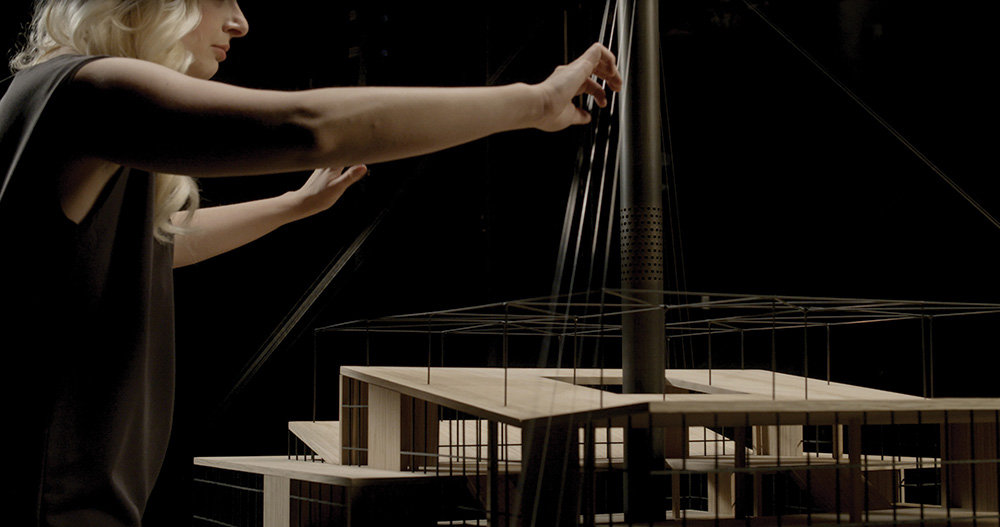
Composed of quotes drawn from political discussions on German national representation at 20th Century’s World Expositions, The Exhibition creates an original conversation between three allegorical positions. The Curator, the Artist and Germania become a reflection of ideological deliberation facing a practical scruple: how to create an exhibition of the nation’s best artworks in order to affect society. Including words drawn from the opening address at the German Pavilion at Barcelona EXPO 1929, Goebbels’ ideas on casting out women from politics and post 2WW soft power deliberations, The Exhibition merges political rhetoric to arrive at what seems to be the only solution that guarantees the success of capital: banning the audience. Filmed within the villas Haus Esters and Lange, that Ludwig Mies van der Rohe built for the Krefeld silk barons in 1920s, The Exhibition uses the architecture which itself served as soft power realised: a theatrical frame and pedestal that went on to establish Mies as the architect that paved way for the theatricality of the concept of nation state and its visual branding.
Jasmina Cibic (b. Ljubljana 1979) is a London based artist who works in performance, installation and film, employing a range of activity, media and theatrical tactics to redefine or reconsider a specific ideological formation and its framing devices such as art and architecture. Jasmina represented Slovenia at the 55th Venice Biennial with her project “For Our Economy and Culture”. Her recent exhibitions include solo shows at: DHC/Art Montreal, BALTIC Centre for Contemporary Art Gateshead, Museum Haus Esters Krefeld, Aarhus 2017, Esker Foundation Calgary, Museum of Contemporary Art Zagreb, Museum of Contemporary Art Belgrade, Museum of Contemporary Art Vojvodina, MGLC Ljubljana and Ludwig Museum Budapest along with group exhibitions at MOMA NY, MUMA Monash Museum, CCS BARD, Guangdong Museum of Art China, Pera Museum Istanbul, La Panacee Montpellier, City Gallery Wellington, MSUM Ljubljana, MNHA Luxembourg, Joanneum Museum Graz and California College of the Arts. Cibic’s films have been screened at FIAC Paris, Pula Film Festival, HKW Berlin, CCA Laznia, Les Rencontres Internationales Paris, Dokfest Kassel and Copenhagen International Documentary Festival. Jasmina Cibic has been shortlisted for the Jarman Award (2018) and was the winner of the MAC International Ulster Bank and Charlottenborg Fonden awards (2016).
Jasmina Cibic
Nada: Act I
Video | hdv | color | 10:9 | Slovenia, United Kingdom | 2016
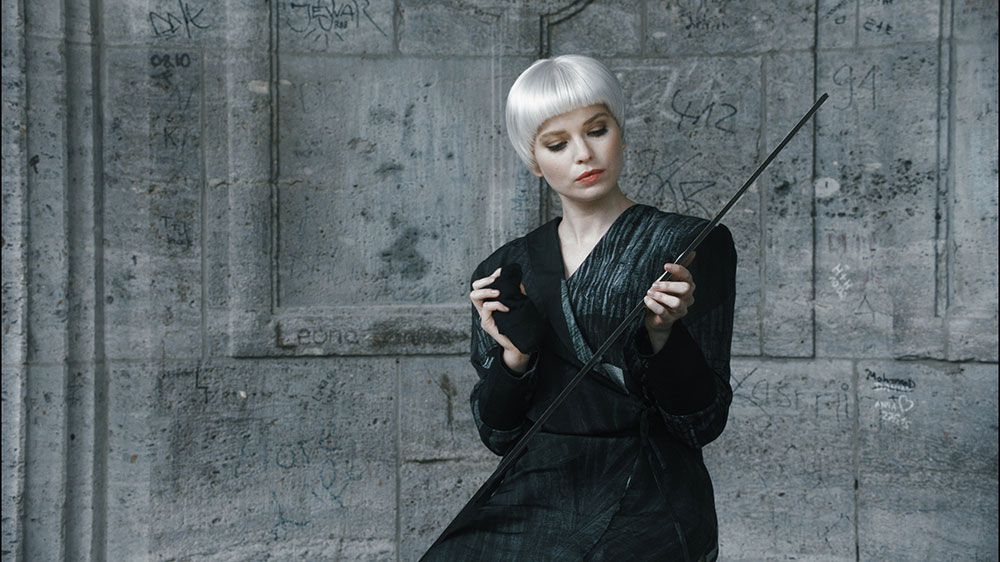
Jasmina Cibic’s film trilogy NADA draws parallels between the construction of national culture and its use-value for political aims. The first chapter Nada: Act I fans out from a biographical thread of architect and artist Vjenceslav Richter, one of the key figures in charge of the visual representation of the Yugoslav state and his first and unrealized design for the Yugoslav Pavilion at the 1958 EXPO in Brussels. Cibic traced this architecture through archives and recreated the pavilion’s initial design as a musical instrument. In the film, a violinist constructs and continually tunes the instrument according to the Miraculous Mandarin, a musical composition for ballet written by Béla Bartók. This artwork was the one chosen to represent Yugoslavia at the most important dates of the pavilion itself “its National Days” whose role was to maximise the attention and the number of visitors. Paradoxically, this work was since its conception in 1917 marred by state censorship due to its explicit subject matter: a plot of a prostitute, her pimps and the client’s roles which Cibic recasts in the following chapters of Nada into characters of Mother Nation, politicians and the artist in charge of national presentation.
Jasmina Cibic works in performance, instalation and film, employing a range of activity, media and theatrical tactics to redefine or reconsider a specific ideological formation and its framing devices such as art and architecture. She represented Slovenia at the 55th Venice Biennial with the project “For Our Economy and Culture”. Her recent solo exhibitions include Esker Foundation Calgary, Museum of Contemporary Art Zagreb, Museum of Contemporary Art Belgrade, Museum of Contemporary Art Vojvodina, MGLC Ljubljana and Ludwig Museum Budapest along with group exhibitions at Hessel Museum, Pera Museum Istanbul, Museum of Modern Art Ljubljana, La Panacee Montpellier, City Gallery Wellington, MSUM+ Ljubljana, MNHA Luxembourg. Her films have recently been screened at Biennial of Moving Image Buenos Aires, Pula Film Festival, HKW Berlin, CCA Laznia, Les Rencontres Internationales Paris, Dokfest Kassel and Copenhagen International Documentary Festival. Cibic has been nominated for the Jarman Award (2016), Golden Cube Award (Dokfest 2016) and won the MAC International Ulster Bank Award (2016) and best International Artist at the Kunsthalle Charlottenburg(2016). Cibic’s upcoming solo exhibitions include NN Contemporary, Crawford Art Gallery Cork, Aarhus 2017, BALTIC Gateshead, Krefeld Museum and DHC Art Montreal.
Jasmina Cibic
The Gift
Experimental fiction | 4k | color | 27:56 | Slovenia, France | 2021
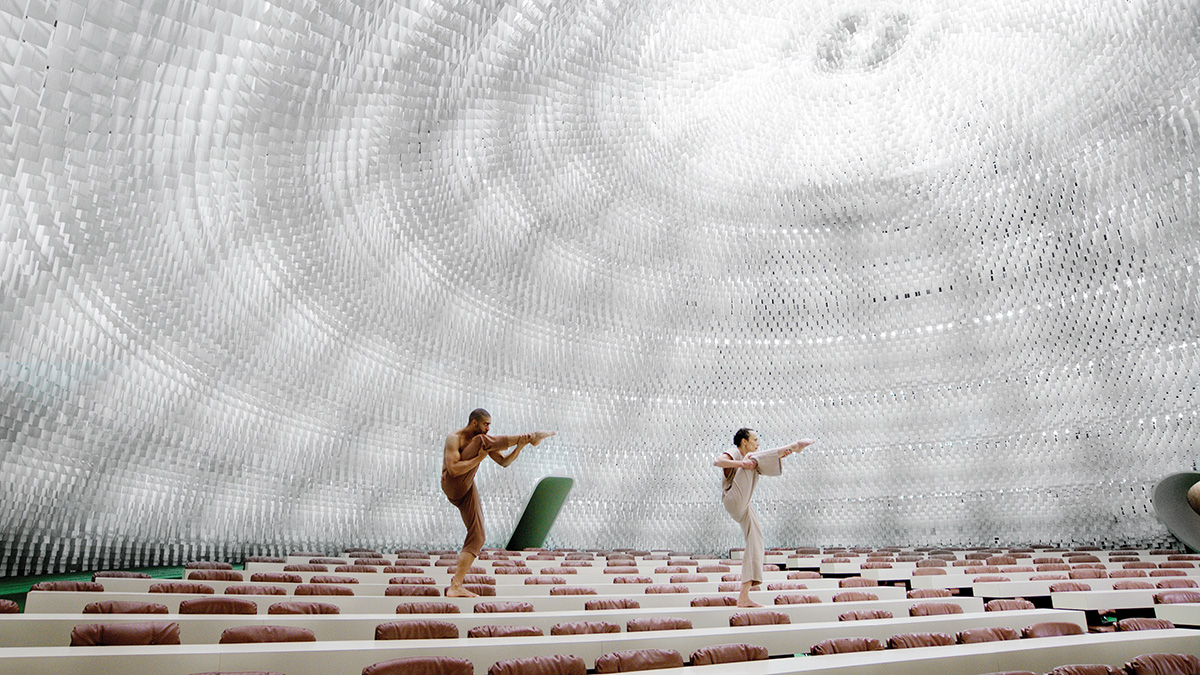
The Gift is a film about the use and abuse of culture in times of political and ideological crisis. It tells the story of a competition for a perfect gift that could heal a broken nation. The Gift is composed entirely of historical ready-mades that include some of the most perturbing examples of art, music and architecture deployed as trojan horses of political powers. The film’s locations include iconic buildings which were all political gifts themselves - including Oscar Niemeyer’s French Communist Party HQ in Paris, the Palace of Nations in Geneva, Mount Buzludzha in Bolgaria and the Palace of Culture and Science in Warsaw.
Jasmina Cibic is a Slovenian artist currently based in London, who works in film, performance and installation. She represented Slovenia at the 55th Venice Biennial with her project “For Our Economy and Culture”. Her recent exhibitions include solo shows at: Museum der Moderne Salzburg, The Highline New York, macLyon, Museum Sztuki ?ód?, Museum of Contemporary Art Ljubljana, CCA Glasgow, Phi Foundation Montreal, BALTIC Centre for Contemporary Art Gateshead, Ludwig Museum Budapest, Kunstmuseen Krefeld along with group exhibitions at MAXXI Rome, Steirischer Herbst ‘19, MOMA NY, Marta Herford and Guangdong Museum of Art China. Cibic’s films have been screened at the Barbican London, Whitechapel Gallery, CCA Montreal, Pula Film Festival, HKW Berlin, Louvre, Les Rencontres Internationales Paris, Aesthetica, Berwick Film and Media Arts Festival, BFI London Film Festival, Dokfest Kassel and Copenhagen International Documentary Festival. Cibic was the winner of the MAC International Ulster Bank and Charlottenborg Fonden awards (2016), the B3 Biennial of the Moving Image Award (2020) and the Film London Jarman Award (2021).

Jasmina Cibic
Beacons
Experimental doc. | 4k | color | 23:0 | Slovenia, United Kingdom | 2023
Beacons is a cinematographic journey portraying eight women who distil the archive of cultural workers from countries of the Non-Aligned Movement into a musical score. They translate and decipher words into sounds and choreography and meet within a proposition for an address recasting the unrealised promises of the past into a sonic address a rehearsal for our present. Filmed on isolated architectures steeped in nature that once served the awakening of transnational solidarity, the project aims to re-inscribe the missing female voice into the history of world-building.
Cibic represented Slovenia at the 55th Venice Biennial with her project “For Our Economy and Culture”. She was the winner of the Film London Jarman Award (2021), the B3 Biennial of the Moving Image Award (2020) and has screened her films at the Whitechapel Gallery, London Film Festival, HKW Berlin, the Louvre, Dokfest Kassel and the Copenhagen International Documentary Festival among others. Cibic’s recent exhibitions include solo shows at the Museum of Contemporary Art Zagreb, The High Line New York, Museum der Moderne Salzburg, macLyon, Museum Sztuki Lódz, CCA Glasgow, Phi Foundation Montreal and BALTIC Centre for Contemporary Art Gateshead. Cibic’s work recently been presented at group exhibitions including IMMA Dublin, Biennale Jogja, Innsbruck Biennial, MAXXI Rome, Mac Belfast, MOMA New York, the Chicago Architectural Biennial and the Museum of Contemporary Art Belgrade.
Jasmina Cibic
Tear Down and Rebuild
Experimental fiction | 4k | color | 15:28 | Slovenia, United Kingdom | 2015
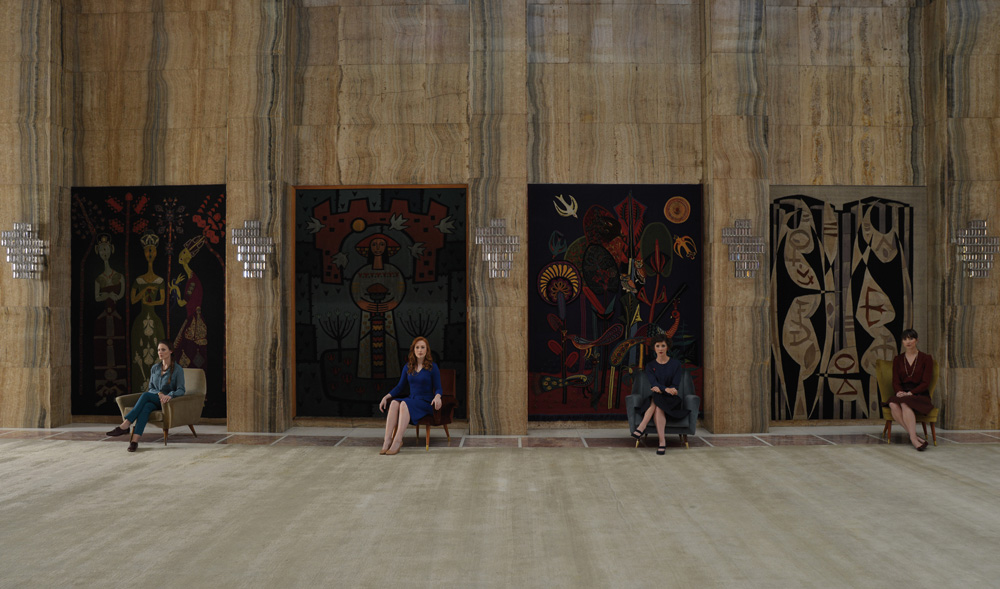
Composed of various quotes - belonging to political speeches, debates and proclamations that extract and emphasize the iconoclasm of architecture, art and monuments – the film creates an original conversation between four characters. A Nation Builder, a Pragmatist, a Conservationist and an Artist/Architect become a reflection of ideological deliberation facing a practical scruple. Including words drawn from Regan’s speech on the Berlin Wall, Prince Charles’s 1984 address at RIBA and Isis bloggers’ proclamation on the demolishment of temples, the film’s storyline uses language that endorses demolition and redesign, which were to aid the creation of new displays for ensuing nation-states or ideological positions throughout the 20th and 21st centuries. As the film’s narrative unfolds, the viewer is a witness to the final decision to demolish the fictitious building, the image of which is constructed in the spectator’s imagination through a collage of quotations on diverse, ideologically contrived and historically charged buildings, monuments, walls etc. that were to be or were knocked down - pointing to the universality and timelessness of the paradox of national and ideological representation and its icons.
1979, Ljubljana A London based artist working in installation, performance and photography. Cibic has begun making films in 2012 for her solo presentation of the Slovenian Pavilion at the 55th Venice Biennial. Cibic`s work is site and context specific, performative in nature and employs a range of activity, media and theatrical tactics to redefine or reconsider an existent environment and its politics. The basic gesture in Cibic’s artistic explorations is the dismantlement and careful analysis of the work of art, its representation, and its relationship to the viewer as she tries to operate inside the system she is investigating. The mechanisms and structures of the system thus often become integral parts of the practice, allowing the work to transcend the plane of art and the language of form. Her film works have been shown at Ludwig Museum Budapest, MSUB Belgrade, MGLC Ljubljana, Dokfest Kulturbahfhof – Kassel, Haus der Kulturen der Welt Berlin, Les Rencontres Internationales - Gaîté Lyrique Paris, Copenhagen International Documentary Festival, Art Brussels Cinema Program and Nassauischer Kunstverein Wiesbaden. Her upcoming solo screenings include MSUM Ljubljana, Crawford Art Gallery Cork, the Artist Cinema at the Museum of Contemporary Art Zagreb.
Mariangela Ciccarello, Philip Cartelli
Lampedusa
Experimental fiction | hdv | color and b&w | 13:44 | Italy, USA | 2015
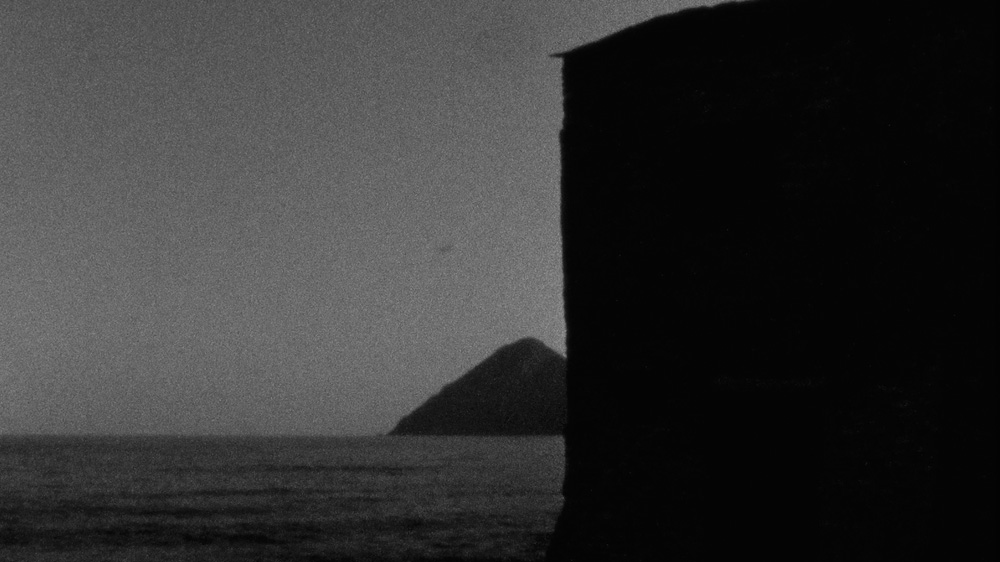
Combining high definition and Super 8 footage, Lampedusa is composed of interwoven narratives based on a series of real events. In late 1831, a volcanic island suddenly erupted from the sea a few kilometers off the southern coast of Sicily. An international dispute ensued, during which a number of European powers laid claim to this newfound “land.” The island receded below sea level six months later, leaving only a rocky ledge under the sea...
Philip Cartelli Philip Cartelli is a filmmaker, critic, researcher, and doctoral candidate in Harvard University’s Sensory Ethnography Lab. His film and video works have been shown in international festivals, conferences, and installation settings. Mariangela Ciccarello After studies in philosophy and visual art, Mariangela Ciccarello pursued a career as a curator in galleries and museums between Europe and South Africa. She has made a series of films over the past few years, most recently during a fellowship at the UnionDocs Center for Documentary Art in Brooklyn.

Linda Ciharova
Jízda Emokrajem
Video | dv | color | 8:15 | Czech Republic | 2010
The whole project is interested in the border of an urbanistic landscape, where the city meets the nature. It is using an artficial light (hand torch, car lights or a helicopter´s search light ) to enlight and discover a landscape. An artificial light paraphrases here not only quite invasive human activity, but also a searching human mind. Through giving an focused attention revaluates an relationship to this "normal" suburbian landscape and lifts up the landscape and its part into unique objects. The fundamental element here is a feeling - an emotion, which we get from some places minded to communicate with us.
Linda Čihařová has born on 2.7.1982 in Prague, where she is also living and working. She graduated at the University of Art, Archuitecture and design in Prague and also experienced studies on FAMU in Prague, University of New Mexico in Albuquerque and Academy Beeldene Kunste in Maastrichtu, Netherlands. Although Linda Čihařová is using different new media, her projects have base in land art and concept art. She is in a way an muliinstrumentalist of new media techniques, because she is formally not limited in means of expression. While working on her ideas, she is mostly using video, photography, drawing, painting, instalations, an interactivity with a viewer and their combinations. Unifying element and main inspiration source she almost always finds in landscape, nature and a point of reflection of a human energy on it. Recently she is focused on communication of humans and their surrounding. She is also inspired by scientifical methods, micro worlds and landscape deatils. By making the photography an abstract one, she gets into a inner world of landscape and creating a psychological portrait of the place. she finds creatures, stories and situations, which want to be made visible. The drawing is here an expression of a personal reading in particular place and the landscape an interactive personality.
Claudia Claremi
El Tiempo
Experimental doc. | mov | color and b&w | 18:36 | Cuba, Spain | 2020
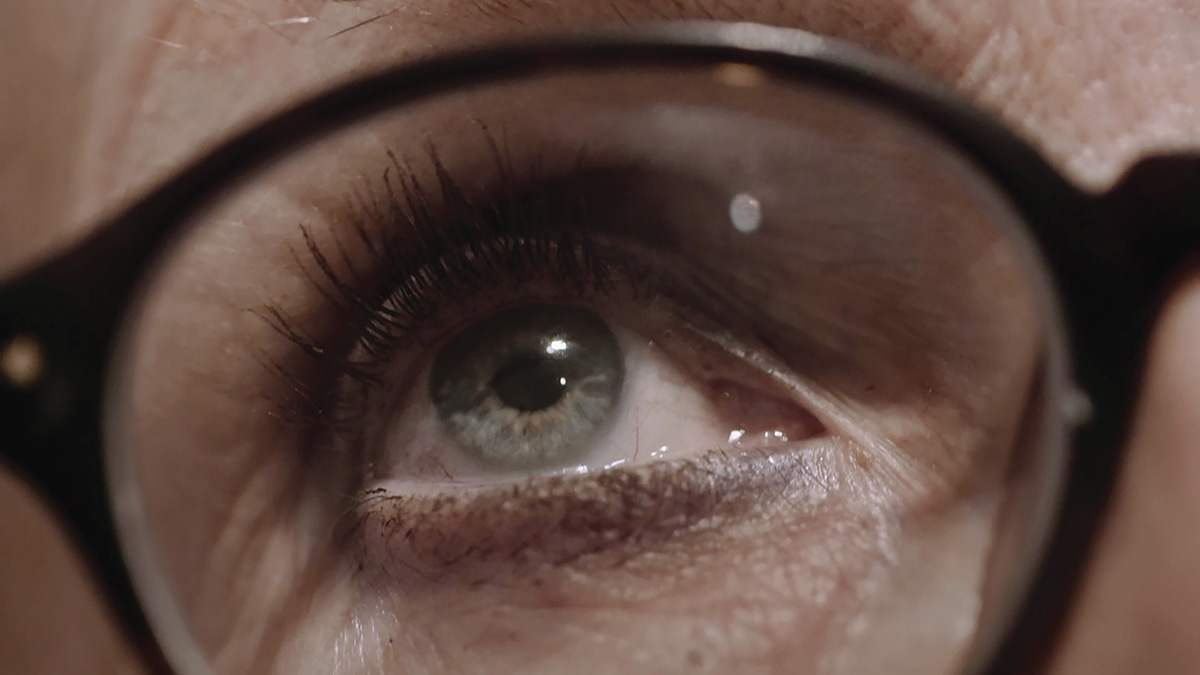
El Tiempo is a collaboration with the volunteers of the Reina Sofía Museum, a group of pensioners that play an active role in the museum’s educational programmes. Through the creation of a collaborative experimental film, El Tiempo examines the intangible, explores personal and collective memories, and delves into the relationship between this group and the Museum, representing a symbiosis of bodies and artworks. The project started in 2019, with the idea of making a film set in a dystopian present, where the Museum is closed to the public as a result of the collapse of modern society. Western culture has therefore lost its hegemonic role, causing the abandonment of the institutions that sustained it. In this context, the volunteers appear to be the only people who inhabit the Museum. The framework of this fictional thread, facilitated the development of group and individual performative actions, and allowed a series of encounters of bodies, space and artworks. This work was shot just before the pandemic and the editing and post-production process took place during the confinement. This experience deeply redefined the project and those images that were created as a vision of an imagined present, began to represent a plausible reality.
Claudia Claremi (Madrid, 1986). Visual artist and filmmaker. Graduated in Documentary Film from the Escuela Internacional de Cine y Televisión de San Antonio de los Baños (Cuba) and in Fine Arts from University of the Arts London (UK) and the Instituto Superior de Arte de La Habana (Cuba), and she has participated in alternative programmes of study and critical practice such as VISIO (Lo Schermo dell’Arte, Florence), P.O.P.S. (Colectivo Ayllu, Matadero, Madrid), Campus (Latitudes, Barcelona) and La Práctica (Beta Local, Puerto Rico). Her films Firefly, Bat and The woodland, among others, have been shown and awarded at international film festivals such as Raindance, Ann Arbor, Ji.hlava, FIC Guadalajara, Documentamadrid or Márgenes. Her work has been part of many exhibitions and she has also obtained the XXI Generación 2021 award, XXXI Circuitos award, the Matadero CREA grant. In 2020-21 she has completed El Tiempo, a film in collaboration with the Reina Sofía Museum in Madrid.

Louis Braddock Clarke
Under Boom
Video installation | 4k | color | 18:0 | United Kingdom, Netherlands | 2024
UNDER BOOM (2024) is a hallucinatory cinematic experience shaped through a combination of human-shaped sonic ecologies and deep time. Framed as a listening station and a geological hotspot to imagine society’s shifting sonic world, the work takes the audience through an anthropogenic cinema experience with infrasound, an inaudible bandwidth of 0–20 Hz filled with shockwaves caused by human activities. These include mining blasts, burning space debris, air strikes, atomic bangs, sonic booms, seismic guns, and the calving of ice sheets. The work stems from the discovery of a listening island in the mid-Atlantic, which due to its geo-positioning and low noise ratio is hyper-sensitive to long-wave sounds. From this island, the sonic ruptures of the Earth’s ever-changing global acoustics can be heard. UNDER BOOM is captured using stroboscopic techniques, where anthropogenic beats orchestrate the presence of visuals. Infrasonic events become markers of visibility, entangling frequency with video frame-rates in an act to dissolve ocularcentrism. The frictions of vibrating matter, shaking sonics, and flickering images highlight the physical renderings of human sounds on the Earth. Linking the intimacy and intensity of flicker cinema with an embodiment of climate allows for alternative modes of listening and climatic imaginary experiences. What if the Earth was dancing faster and faster every year?
Louis Braddock Clarke is an artist and researcher interpreting notions from domains of art, geography, physics, and esoteric philosophy. Listening and amplification as creative methods have become key approaches to their work relating to disrupted ecologies. Through fieldwork, filmmaking, sonic tuning, and amateur geology their projects seek to speculate on the future surfaces of the Earth. Braddock Clarke’s relationship with the geographical arts is embedded in their formative years in Cornwall, surrounded by radon moorlands, granite quoits, shifting isolines, pixies, tin mines, and trans-Atlantic cable systems. These entangled Earth energies have become paramount to their ongoing research methods relating to technologies and terrains.
Dana Claxton
Anwolek - Regatta city
Experimental video | dv | color | 4:22 | Canada | 2005
Originally commissioned by the City of Kelowna and the Alternator Gallery, this work addresses memory, loss, identity, nostalgia, and how the landscapes gets de-territorialized through pageantry. Rich with subtext and metaphor, this work engages 9/11, the shooting of JFK, and Olympia by Leni Riefenstahl.
Lenka Clayton
Zweifel (doubt)
Documentary | betaSP | color | 32:0 | United Kingdom | 2006
A surreal look at the remnants of Socialist East Germany. Told by a double of ex-president Erich Honecker, two ex-border guards (one from the east, one from the west) who photographed each other over the fence for 18 years, and a man with a dream to rebuild his own version of the GDR in a bleak East German town with a 70% unemployment rate. This film offers a complex insight into the confused aftermath of a vanished country.
Lenka trained as an artist at Central St. Martins. Upon graduating she left England for Berlin where she worked as a projectionist and ran a gallery of contemporary art. Her first film; "Qaeda, quality, question, quickly, quickly, quiet", an alphabetical re-arrangement of President Bush`s "Axis of Evil" speech, has been shown internationally and the soundtrack has been released as a limited edition 12" by Accidental Records. She has exhibited in and been curator of exhibitions around the world, and has recently collaborated with musician Matthew Herbert and choreographer Rafael Bonachela on two video performances. Her graduation film "Zweifel" (doubt), a surreal look at the remnants of East Germany, has been shown in the Czech Republic, Germany, the Ukraine, and Lebanon. She is currently working on a photo document of North Korea and teaching Moving Image at St. Martins School of Art in London.
Charlotte Clermont
Gephyrophobia
Documentary | 16mm | black and white | 2:21 | Canada | 2012
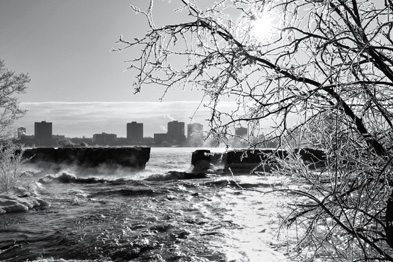
Gephyrophobia ? latin word for ?the fear of crossing bridges? - was shot in Ottawa/Gatineau, Canada. Inspired by pet architecture, a term coined by Japan?s Atelier Bow-Wow, and seeking to integrate the experience of the cinema into that of the city, the Situated Cinema references small buildings that have been squeezed into leftover urban spaces. The small cinema space, which can be demounted and which will travel to unorthodox locations across Canada, is intended to provide an alternative cinema-going experience: rather than constructing an immovable structure situated more or less permanently in the city, the Situated Cinema Project will construct a mobile micro-cinema that can be situated into various spaces, tapping into the flow and energies of the city. The cinema will screen a loop of five specially commissioned silent 16mm films from artists across the country.
Caroline Monnet is an award winning filmmaker and visual artist working in film/video, installation and printmaking. Her work has been exhibited extensively in film festivals and galleries, including the Toronto International Film Festival, Clermont-Ferrand vidéoformes (France), Urban Shaman Contemporary Aboriginal Art Gallery (Winnipeg), Künstlerhaus Bethanien (Berlin), Plug In Institute of Contemporary Art (Winnipeg) and the Manguere Arts Centre (Auckland, NZ). Monnet is also part of ITWÉ, a trans-disciplinary art collective dedicated to the creation of Aboriginal digital culture. She works and lives in Montréal, Canada.
Charlotte Clermont
Semi-auto Colours
Experimental fiction | 16mm | color | 6:10 | Canada | 2011
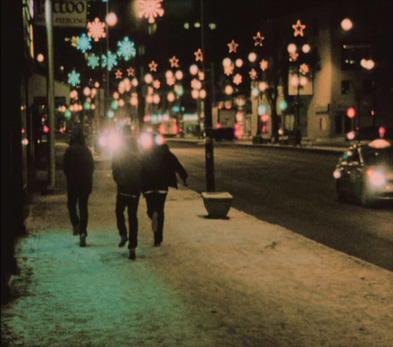
Kids in the West End of Winnipeg learn to count to One.
Isiah Medina was born in 1991, and grew up in the West End of Winnipeg. Main influences include Badiou, Godard, and Jay-Z. Semi-auto Colours is his first film.
Claude Closky
Flux
Video installation | 0 | color | 20:0 | France | 2004
?The recent work by Claude Closky is interested in hyper consumption of signs and particularly in advertising signs maong which we shall include easily the graphic vocabulary of economy, as much as we accept its signification, tis ability of representation of an efficient reality, erasing behind a entertaining abstraction, which produces a tapestry effect. Closky values those signs caring only about enunciation of significants, and their functions spilling acroos to reality, making disappear every message for a decorative pattern, which infinity of variations produce nothing but a unwary reproduction of the same.Flux uses in a simple way, reduced to water down logotype of herniated form an modernist geometric abstraction (circle and lines), one of these characteristic patterns of the contemporary economy, consisting to represent their shifting, materials and non material, between masses. Extracting this flood of all intentions and all contexts, CLosky make their movements intransitives until the absurd, but also as they rise in value, without it to be questioned, neither suspected, the notions of mobility, adaptability, flexibility? Over the plain surface of spheres and vectors, the fluidity of their quiet animation, violence shows through a reality wisely erased of these representations invariably positive: violence of fading of causes and possible consequences of these exchanges.? François Piron, March 2004 Courtesy www.art-netart.com
Claude CLosky lives in Paris. He works with different media such as video, photography, internet or drawings? He exhibited at the Arnolfini Gallery, Bristol (2002), to the Bass Museum, Miami 2005, at the Bunkamura Gallery of Tokyo, Japan (1999), at the Busan MoMA, Busan (2005), at the Castello di Rivoli (1996), at the CCA, Glasgow (1996), at CCAC, San Francisco (2001), at the CGC, Genève (1994), at the Centre Pompidou, Paris (1993, 2000, 2001, 2002), at the fondations Cartier, Paris (2001), la Caixa, Lleida (2004), Tarragona, Girona (2005), Mirò, Barcelone (2004), Olivetti, Rome (2002), at the Fotomuseum, Winterthur (2001), at the GEM, La Haye, at the Location One, New York (2003), at the Ludwig Museum, Cologne (2002, 2005), at the Migros Museum, Zürich (2002), at the Moderna Galerija, Ljubljana (2000), at the Musée d`art moderne de la Ville de Paris (ARC) (1992, 2000), at the Musée d`art moderne Grand-Duc Jean, Luxembourg (2002), at the Museum of Contemporary Art, Herzliya (1997), à l`Oca, Sao Paulo (2001), à la Schirn Kunsthalle, Francfort (2002), à la Tate Liverpool (2001, 2003), etc. He took part in the Biennales of Lyon (1995), Rotterdam (photo, 2003), Sharjah (2005), Sydney (1996), Taïwan (2000), Valence (2001),Venise (2001), etc? He?s presented by the galleries Mehdi Chouakri, Berlin - Laurent Godin, Paris - Edward Mitterrand, Genève - Nicola-Fornello, Prato, Turin.
Claude Closky
+1
Video installation | 0 | color | 99:99 | France | 2000
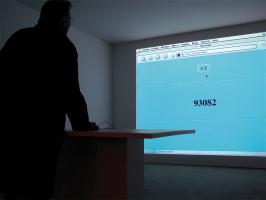
Closky does not decode just for fun. He doesn?t reformulate the signs of consumption because he enjoys criticizing. In his nihilist and desperate way, he puts in doubt the very possibility of communicating anything to anyone. In his works, the relationships that characterize the elements used count more than the content. He therefore does not take an interest in introspection, nor in singular stories, but rather in the often poor, stereotypical, and repetitive relationships with our mental and physical environment that we create. Far from expressing something personal, the function + 1 is one of the commonplaces of arithmetical thought. We learn to add once we know by heart the sequence of numbers. The addition of one unit constitutes an elementary operation whose result is known in advance. No intervention of chance or emotion could shake the rules of this quite ancient game. To make this point and expose the automatism of thought and behavior, Claude Closky turns to familiar technological tools: a computer, a screen, a mouse. In a rather elementary way, the screen gives a uniformly light blue background. In the center, + 1 is inscribed in a rectangle. The disjunction between the sophisticated mechanisms that are set in motion and the effect, which is both simple and tautological, that the user attains by clicking + 1, sends the user into a state of unease. Why, and for what desired effect, did (s)he just click once, or several times in a row? Entirely in line with the inscribed formula, the result holds no surprise. The number goes up by one unit with each new click. It all began with the number one, one day in January 2000. Since then, the multi-digit number that appears on the screen is nothing more than the sum of all the previous clicks. In a seemingly naive way, Claude Closky takes over the commonplaces of artistic thought. The dream of interactivity, which publicists and cultural mediators hold so dear, is put to the test in a singular way. With + 1, Closky brings about a conceptual, minimalist work, accessible to anyone who chooses to engage with it, from any computer that is connected to the internet.
Pierre Yves Clouin
I'm a New York Based Artidt
Art vidéo | dv | color | 2:12 | France | 2007
what will be will be
Pierre Yves Clouin
Waiting
Experimental video | dv | color | 1:8 | France | 2006
On that day in Paris the artist was cold, following a passer-by. The mailbox is visible from the street: it belongs to a very discreet and resilient Irish author who has been dead for a long time, but the mailbox is still there as if waiting for more mail, that's what it looks like. It is said that he gave out his sweaters when one was cold.
Pierre Yves Clouin's video works have been broadcast on: Arte, VPRO Amsterdam, ADD-TV Manhattan and Canal+. They have been shown at: the Bauhaus Dessau Foundation, Oxford Museum of Modern Art, BFI London, San Francisco Cinematheque, Philadelphia Museum of Art, Dublin Art House, Paula Cooper, Mexico City's Museo Tamayo Arte Contemporáneo, Sao Paulo Museum of Image and Sound, Anthology Film Archives, Chicago Filmmakers, Pleasure Dome Toronto, Forum des Image Paris, Smart Project Space Amsterdam, Podewill Berlin, Hong Kong Space Museum, Guggenheim Bilbao, Art Basel, Museum of Africa Johannesburg, Buenos Aires University, Laval Québec, Concordia Montréal, Cornell, Harward, Yale, San Francisco Art Institute, Museum of Contemporary Art of Rosario Argentina, Museum of Modern Art Lille-Metropole, Pro Arte Institute in St. Petersburg, and the Museum van Hedendaagse Kunst in Antwerp. Selected festivals around the globe include: Videonale, Videoformes, Videobrasil, Hamburg Kurzfilmtage, MIX NYC, Nashville, Kassel, Cork Film Festival, Cinematexas, the International Film Festivals of San Francisco, Chicago, Thessaloniki, Moscow and Los Angeles, the Biennial of Moving Images Geneva, Ars Electronica and Sundance.
Daniel Cockburn, Emily Vey DUKE
Figure vs. Ground
Experimental video | dv | color | 7:0 | Canada | 2004
A roving search across endless colour-fields gradually reveals a solitary singer, struggling to be heard over distortion and doppelgangers. A journey from cacophony to harmony.
Daniel Cockburn is a Toronto-based moviemaker and writer. He is an independent curator, a member of the Pleasure Dome programming collective, and has written on media arts for a number of publications. His work has been exhibited internationally. Emily Vey Duke received her BFA from the Nova Scotia College of Art and Design, her Masters at the University of Illinois at Chicago, and is best known for her collaborations with Cooper Battersby including the award winning "Being Fucked Up".

Daniel Cockburn
God's Nightmares
Video | hdv | color and b&w | 5:20 | Canada | 2019
Even the all-powerful creator of the universe has bad dreams from time to time. In God's Nightmares, A panoply of film clips illustrate God's interior monologue, in which he muses about his recurring nightmare of being an everyman.
Daniel Cockburn is a Canadian filmmaker based in the UK. His shorts have been the subject of an internationally touring retrospective, his feature film script The Engineers received the TIFF Telefilm Canada Pitch This! prize, and his feature You Are Here (2010) played Locarno, Toronto, and Rotterdam, and 40+ other festivals. Called "a major discovery" by the director of the Locarno Film Festival, You Are Here won the Jay Scott Award from the Toronto Film Critics Association and the top prize at the European Media Art Festival, for "trend-setting media art". It has been compared to the work of Charlie Kaufman, Jorge Luis Borges, and Philip K. Dick. He is currently adapting Mark Vonnegut’s memoir The Eden Express into a feature screenplay, and creating a new one-man multi-screen live show which will premiere at the Flatpack Festival in Birmingham in 2020.
Clément Cogitore
Bielutine - Dans le jardin du temps
Documentary | hdcam | color | 36:0 | France | 2011
Ely and Nina Bielutin are the owners of one of the biggest private collections of Renaissance Art (Caravaggio, Titian, Van Eyck, Leonardo da Vinci, ...) in the world. Under the eyes of the masterpieces of this mysterious collection, jealously kept in their Moscow apartment, these artist and art historian try to write their own legend...
- VISITÉS / 2006 / 20` (Locarno, Montreal, Novigrad?) - CHRONIQUES / 2006 / 30` (great Prize Belfort, fondation beaumarchais, ecrans documentaries, premiers plans Angers, Paris tout court, Wroclaw?) - PASSAGES / 2005 / 4` - TRAVELL(ING) / 2004 / 3` ? Several awards for video art installations Clément Cogitore, who was born in Colmar in 1983, has developed an artistic approach half way between contemporary cinema and art. Through films, videos, photographs and set pieces his work questions the collective memory, representations of the past and, more generally, the ways in which people cohabit with their images. His films have been selected for numerous national and international festivals (Locarno, Vendôme, Belgrade?) and won several awards (European Grand Prize for first films, the Beaumarchais Foundation?s SACD Prize, Special Prize awarded by the jury of the Festival Entrevues?). His work has also been presented at biennial and international exhibitions (Geneva, Shanghai, Wroclaw?) and in various art centres and museums (Galeries nationales du Grand Palais-Paris, Centre d?art le Casino-Luxembourg, Kunsthalle-Basel). Clément Cogitore, who also works as director and editor for Arte G.E.I.E and RTL, spends his private and working life between Strasbourg, Paris and Luxembourg.
Clément Cogitore
Passages
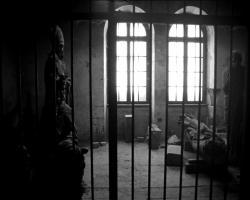
Experimental video | 16mm | color | 8:0 | France | 2005
A slow tracking among pieces of religious figures stored in cages as if they were sacred monsters.
After studying at the School of Decorative Arts of Strasbourg, Clément developped an artistic work halfway between film-making and contemporary art. Mixing films, pictures, videos and installations, his work puts into question the notions of image and territories/screen. Using the traditional screening device in a different way and exploring experimental narrative forms, his work suggests a few reflexions about history, collective memory and about the representation of what is sacred. Prize-winner of the Beaumarchais Foundation and currently resident at the National Fresnoy-Studio for Contemporary Arts, Clément Cogitore lives and works between Lille, Paris and Strasbourg.