Catalogue > Search
Results for : Tout le catalogue
Louise Bourque
L?éclat du mal
Experimental film | 16mm | color | 8:0 | Canada | 2005
Nelson Bourrec Carter
It's Coming from Inside the House
Experimental fiction | mp4 | color | 10:45 | France | 2022
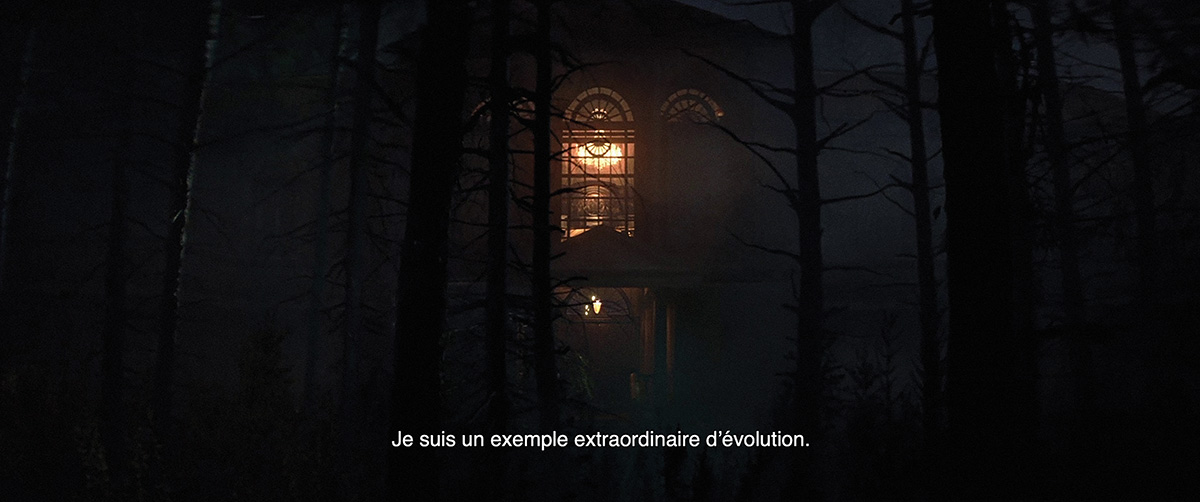
A seemingly disembodied voice reflects on what it takes to survive, in a world modeled after a perception of reality far from what the one it experiences on a daily basis.
Nelson Bourrec Carter is a French-American filmmaker and visual artist. His practice combines photography, film, installation and performance while his research revolve around the links woven between real territories and fantasized landscapes, whether they be urban, peri-urban, or rural, influenced by the weight of popular imagery. His work focuses mainly on the influence of American iconography on identity construction and racial awareness, and operates from places whose hybridity, history or architecture lend themselves to a new interpretation. He demonstrates that these visual tropes are more interconnected than they appear and that they articulate questions of gender, race, and class, while raising the issue of which bodies - whether they are embodied or inscribed in a ghostlike manner within the architecture - occupy the spaces of representation in the American cultural economy. Nelson’s films have been shown in festivals such as New Directors/New Films, Entrevues Belfort, Vila do Conde or within institutions like the Cinémathèque Française or the Jeu de Paume.
Gast Bouschet, Nadine HILBERT. Collaboration: Stephen O'MALLEY
Tempestarii
Video | hdv | black and white | 38:25 | Luxembourg | 2013
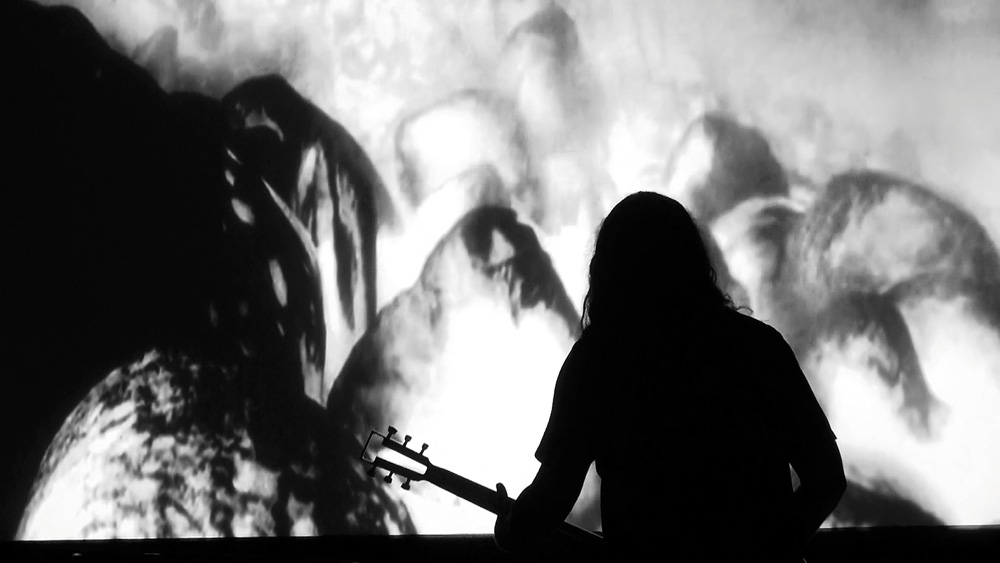
Dawn spreads its luminous rays across the coast of Iceland, revealing a sorcerer standing between wine-dark sea and mountainous black rock. It is Tempestarii, a figure of medieval lore, undertaking a primitive rite manifested to conjure a storm. The tides of the deep ocean breathe heavily, rising and falling across the cinema screen with amplifying power as the weather-maker beats a mysterious sack against the monolithic cliffs with powerful repetition. As a magical tool, this sack contains forceful winds pulled from each corner of world. As an analogy, it is aligned with the revolutionary transformations of nature by water, air, solar radiation, and geological shifts and filled with the vast potential of man’s will in alliance with Nature. As an omen, the tempestarii signals profound change in both physical and metaphysical realms. (Amelia Ishmael)
Gast Bouschet & Nadine Hilbert were both born in Luxembourg and are currently based in Brussels, Belgium. They have worked together since 1990s, using a combination of photography, video, and sound to create potent social, political, and institutional critiques which they have exhibited at major international venues including The Wall Taipei, Taiwan; Cube Space Taipei, Taiwan; Philharmonie, Luxembourg; Muzeum Sztuki Lodz, Poland; Casino Forum d`Art Contemporain, Luxembourg; Trienal de Luanda, Angola; Busan Biennale of Contemporary Art, South-Korea; Camouflage Johannesburg, South Africa; MUHKA Antwerp Belgium, CCA Glasgow, Scotland among others. Gast Bouschet & Nadine Hilbert represented Luxembourg at the Venice Biennale in 2009.
Antoine Boutet
Zone of Initial Dilution
Experimental doc. | dv | color | 30:0 | France, China | 2006
"Zone of Initial Dilution" interests itself in the urban transformation of the Three Ravines region, China, disrupted by the implementation of the world`s largest hydraulic dam. This initial zone of dilution - term borrowed from engineers to define the perimeter of a body of water polluted by waste which will progressively dilute into the general current - illustrates the generalised situation in the region, with the gradual erasure of lifestyles and local practices. Before the end of construction, foreseen in 2008, the video lays out the state of the spaces, cities and banks of the Yangtze River, of those in ruin or those which have disappeared. The video also attempts to define the consequences on the landscape and the affected populations, within a planned perspective of the ultimate rising of the waters

Bryan Boyce
America's Biggest Dick
Experimental video | dv | color and b&w | 4:0 | USA | 2004
United States Vice President Dick Cheney finally tells the truth.
San Francisco native Bryan Boyce is a film and video artist whose work has been shown around the world, including such venues as the Sundance, NY Underground, Cinematexas, RESfest, MTV and the Pacific Film Archive.
Velibor Bozovic
My Prisoner
Video | hdv | color | 21:41 | Canada, Bosnia & Herzegovina | 2014
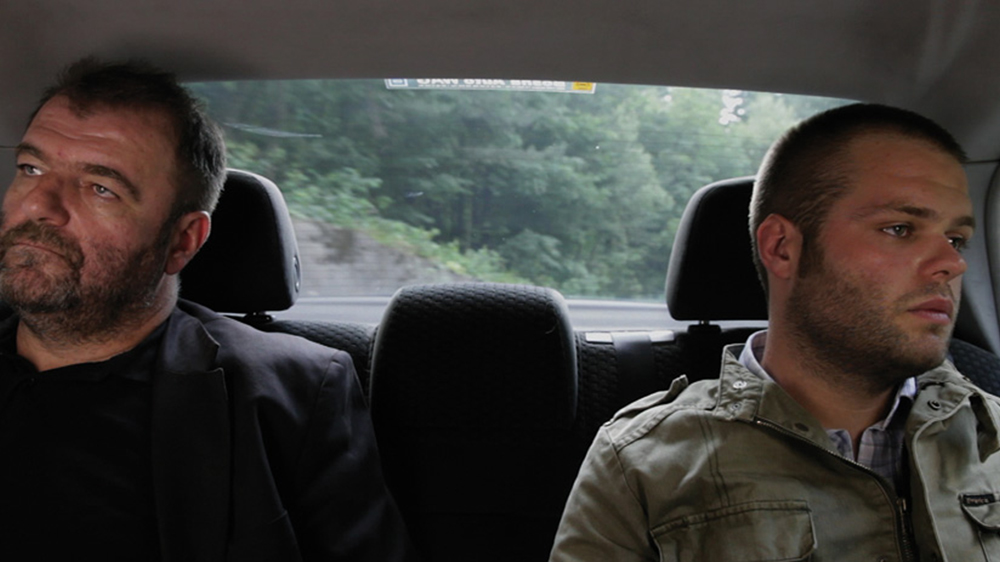
My Prisoner is a video work that reconstructs the event that occurred on 3 April 1994 in war-torn Bosnia by intermixing archival footage with contemporary reimagining of the occasion. It shows a young man being escorted by an army intelligence officer to visit his imprisoned father. As the men travel side-by-side in the back seat of a car Shine on You Crazy Diamond by Pink Floyd begins to play on the car radio. The young man acknowledges the music and tries to make conversation but the officer does not even recognize the track. A composite of autobiography, documentary and fiction, My Prisoner navigates through the space where the historical, the personal and the fictional simultaneously interfere with and enhance one another.
Velibor Božović grew up in Sarajevo, Bosnia-Herzegovina. When he was in his twenties, the country of his youth became a war zone and he spent the duration of the siege of Sarajevo honing his survival skills. In 1999, Velibor moved to Montréal where he worked, for eight years, as an engineer in aerospace industry until he gave up his engineering career to devote his time fully to art practice. Subsequently, Velibor completed a Master of Fine Arts degree in Studio Arts at Concordia University. He is the recipient of the Claudine and Stephen Bronfman Fellowship in Contemporary Art (2015), Concordia International Mobility Award (2014), the Bourse de Maîtrise en Recherche from FRQSC - Fonds de recherche sur la société et la culture Quebec (2012) and Roloff Beny Foundation Fellowship in Photography (2011). His work has been exhibited in the United States, Cuba, Canada, and Bosnia-Herzegovina. His images appeared in The New York Times, The Paris Review, Descant, International Herald Tribune, Chicago Tribune, Granta, BH Dani and others.
Igor Bošnjak
Hotel Balkan
Experimental film | | color | 10:25 | Bosnia & Herzegovina | 2013
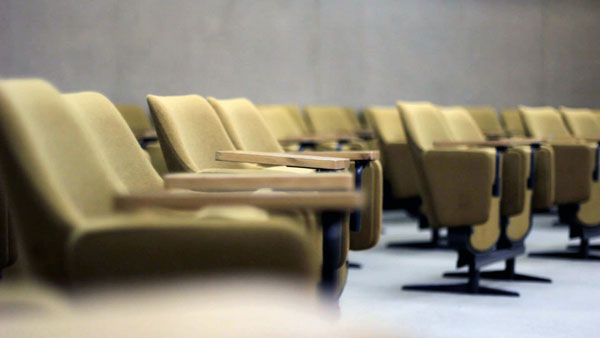
?It is not the literal past that rules us, it is images of the past...? George Steiner Hotel Balkan is meditative and ambiental video which defines borders between futuristic memory of past and present thinking of future. I?ve been wondering about something: Why is it that images from the past - the actual past - often feel more futuristic than our current images of an imagined future? But if the future doesn?t look much like the future, the past often does. There are pictures from the past that, while you immediately recognize them as being from the past, nevertheless feel futuristic. It?s as though there?s something in your brain that wants to read them as images from the future. In this concept there is an idea that Tito?s nuclear bunker is equivavelnt for some kind of motel, or maybe even a hotel. Nowadays, Tito?s nuclear bunker wants sunshine instead of fluorescent lights, the sound of wind blowing through trees instead of the dull noise of its massive air-conditioning unit. It looks forward to the chatter of people and the sound of their footsteps instead of the noise produced by the closing of its steel antinuclear doors.
Born 1981 in Sarajevo, former Yugoslavia. Lives & work in Trebinje, Bosnia & Herzegovina. He is mainly working within the fields of film, video, concept, installation & photography. Also works as a video curator & freelance theoretician. Curently works as a asistant professor at Academy of Visual Arts in Trebinje. Education 2005 Academy of Visual Arts (BA) in Trebinje, Department of Painting 2006 Founder and the curator of the international namaTREba project biennial 2008 Interdisciplinary master (MA) studies at the University of Arts in Belgrade, Theory of Art & Media Department 2011 Interdisciplinary (PhD) studies at the University of Arts in Belgrade / Theory of Art & Media Department His works shows and exhibited at Kunsthal Charlottenborg, Copenhagen, Moscow Museum of Modern Art, Moscow, Atopia Film & VideoKunst Gallery, Oslo, CAM Casoria, Contemporary Art Museum, Naples, Kunst Museum, Bonn, Galleria d? Arte Moderna Palazzo Forti, Verona, Museum of Contemporary Art RS, Banja Luka, Point Ephemere, Paris, Contemporary Music Centre, Dublin, Espacio Center Canarias, Tenerife, Fabbrica del Vapore, Milan, Center of Contemporary Art, Plovdiv, Budapest Art Fair Mucsarnok, Budapest, Spazio Monitor, Museum of Contemporary Art, Rome, Tapetenwerk Halle C, Leipzig, A+A Galerie, Art Verona, Venice, Gallery Remont, Belgrade... more info: www.igorbosnjak.com
Igor Bošnjak
Future Repeats Itslef More Than History Used To
Experimental fiction | 4k | black and white | 13:49 | Bosnia & Herzegovina | 2020
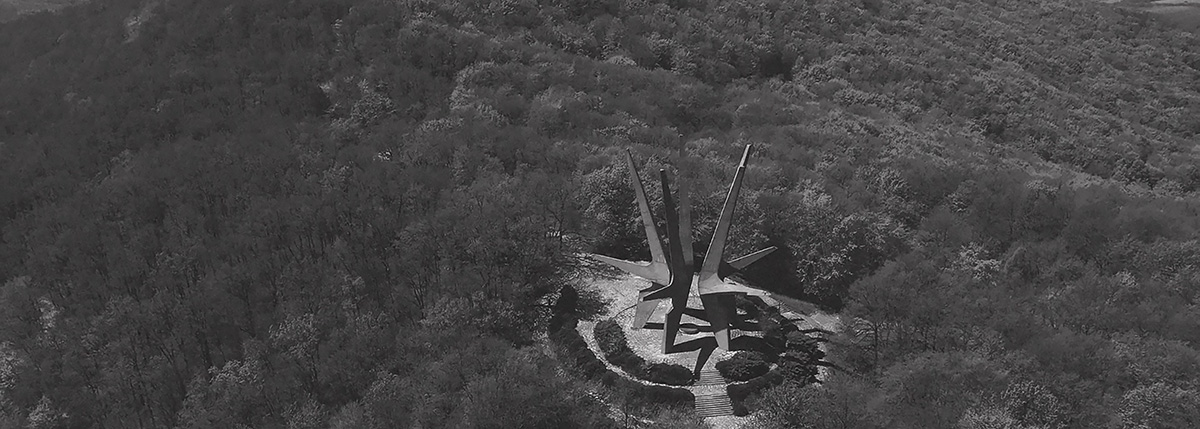
An attempt on aesthetic-technological-ideological objectivity in non-objective reality. How can we see today, the monuments of the NOB (National Liberation War), what they represent to us in the context of the new division of fashion as well as changes in paradigm and ideology in the former Yugoslavia. Is a new reading possible without a nostalgic undertone? How to think about architectural and concrete structures in the 2000s? What is the relationship between monument and human, what is the relationship between monument and unbridled nature. What is the relationship between monuments and contemporary technology and contemporary art today? How much contemporary and how much tech addiction? How to reinterpret the artifacts of the anti-fascist struggle, but so that the monument of the NOB remains at the denotative level of meaning of the monument, that new meanings do not endanger the given basic meaning, the one that is. Creating narratives as a new reading and a new "seeing" and seeing of monuments and creating new visual realities.
Igor Bošnjak (b. 1981 in Sarajevo, Yugoslavia) lives and works in Trebinje (Bosnia & Herzegovina). He is mainly working within the fields of contemporary art: moving images, video, installation, objects, drawing & photography. From 2009 works as a professor at Academy of Visual Arts in Trebinje, University of East Sarajevo on courses Intermedia art, Video art, Digital art. From 2019 works as visiting lecturer on Faculty of Fine Arts, Cetinje, University of Montenegro.

Brigitta Bödenauer, Miguel CARVALHAIS
Can I have two minutes of your time?
Experimental video | dv | color | 2:0 | Austria | 2005
starting from the continuous filming of a clock`s display for two minutes, the video was processed in a realtime-programming-environment for video . the individual frames were then printed on paper and subsequently redrawn frame by frame in charcoal and oil paint. scanned back, the frames were animated as the final video. This video was commissioned for the "Essays on Radio: Can I have 2 minutes of your time?" compilation produced by the media label Crónica (www.cronicaelectronica.org) that proposed all the audio and visual artists to reflect upon the technology and culture of radio in the early 21st century media-scape. The goal of this video was then to explore the idea of time in the crossing of analogue and digital techniques: starting from 2 minutes, reducing the video to 6 single images and then expanding it once again to 2 minutes, restoring the loss of quality introduced by the digital/mechanical manipulation trough the use of diverse analogue/manual recreations of each discrete frame. In the end, the symbolic representation of time is no longer readable but time and the mechanisms for representing and capturing it are felt all along the piece.
Born 1972, lives and works in Vienna, Austria Studies of theatre-and media criticism, artist, photographer, vj, dj, currently teaching videoediting at a private multimedia-school in Vienna. Curated "Cinemasonic-Lounge", a threemonths experimental video festival in Vienna, in 1999. Changed her focus from analogue photography and film towards digital video. In her work she reorganizes geometric and anatomic dominated image collections in a recursive compositing process, using a set of video applications and developing environments. With her videos she tries to generate emotive sequences from reassembling stills (photographic images, grafics, sketches etc.) into animated trajectories beyond their original context.
Marco Brambilla
Civilization (MEGAPLEX)
Video | dv | color | 3:22 | Italy | 2008
Nicolás Branca
Las Nuevas Aventuras de Tom y Jerry
Experimental fiction | dv | color | 17:50 | Uruguay | 2005
It's not clear what kind of relation Tom & Jerry have. Friends, enemies or a couple? Anyway, the video talks about the love, hate, sadness, and tenderness in their peculiar relationship.
Nicolas Branca Rosse was born in 1972 in Montevideo, Uruguay. He is a visual artist, photographer, video artist, and filmmaker. Among his most recent works are found: 2002-03, "OVNI", fiction; 2004, "Panamericano", experimental loop exhibited at Centro Cultural de España, Montevideo; 2005, "Victima", experimental exhibited at Bar Tasende, Entrepiso Artístico; "Las Nuevas Aventuras de Tom y Jerry", experimental exhibited at Festival de Cine y Video Latino de Buenos Aires 2005, received First Place in the experimental category; 2006, Exhibition - Zemos98 Festival Acción Paralela; "El Teórico" video installation loop; Exhibition - Centro Cultural Ex Teresa. México DF, Mexico.

Ulu Braun
Gerhard-Trailer
Video | hdv | color | 2:0 | Germany | 2024
An ecstatic biopic about the world's most successful living painter. In vivid images, this AI hybrid film sheds light on the social role of painting in the field of tension between creativity, capital investment and spirituality. We are currently in the middle of the transition phase from analog to artificial reproducibility. Gerhard's unique painting techniques, especially squeegeeing, have triggered a worldwide hype. His techniques and ideas are being adapted, refined and improved by global “protagonists” and then flooded the markets (+social media). The myth of the “genius” writes itself into the DNA of an increasingly uncontrollable chain of creation as a fabulous and controversial homage.
Ulu Braun (1976) lives in Berlin and Finland. Between 1996 - 2005 he studied painting and film in Vienna, Helsinki, and Berlin. He has been using the medium of video to explore the field between the visual arts and auteur cinema since 1997 and he is one of the key figures who have transferred painting into video art. His works are regularly shown at film festivals and exhibited in art institutions.
Ulu Braun
Südwest
Art vidéo | | color | 1:45 | Germany | 2006
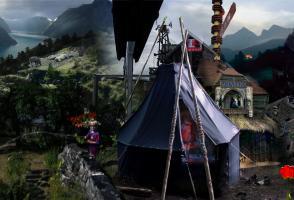
Südwest is a detailed and utopic construction of a landscape, which unites aspects of tradition and globalisation. The video combines idyllic scenes from the European culture with the catalogue- promises of modern tourist industry to form a panorama which thus recreates the poetic mystique of things so common to our eyes.
Ulu Braun
WESTCOAST
Video | | color | 7:20 | Germany | 2009
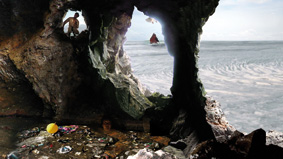
Westcoast is a panorama-video consisting of interweaved scenes mounted on a coastline - somewhere between Rotterdam and Sydney. Starting from a bubbling primordial soup the view pans along a waterfront in the style of a late transnational financial eclecticism and passes mystical spots such as a giant hippo eating carrots and hectically spinning rubber boats. After a dark spiritual waterway recalling Hieronymus Bosch atmospheres, the panorama ends in a cave with refuse-Jacuzzi in which a white woman gazes about herself melancholically.
Ulu Braun (1976) is belonging to a new generation of artists that entered the field of digital film with a background in visual arts and street art. In his works he integrates various production methods to form sceneries that play between Hollywood, Prado and periphery. In most of his works he observes the tragic of reality from different angles. Braun exhibits internationally including recent solo shows in Germany, Belgium, USA and group shows in Germany, Spain, France, Finland, Estonia and Greece. His works have been screened at the major experimental Film and Media Art Festivals. Collaborations with Roland Seidel as BitteBitteJaJa and finnish artist group YKON. He is currently living in Berlin. www.ulubraun.com
Pamela Breda
The Shape of Things to Come
Experimental fiction | hdv | color | 25:0 | Italy, France | 2022
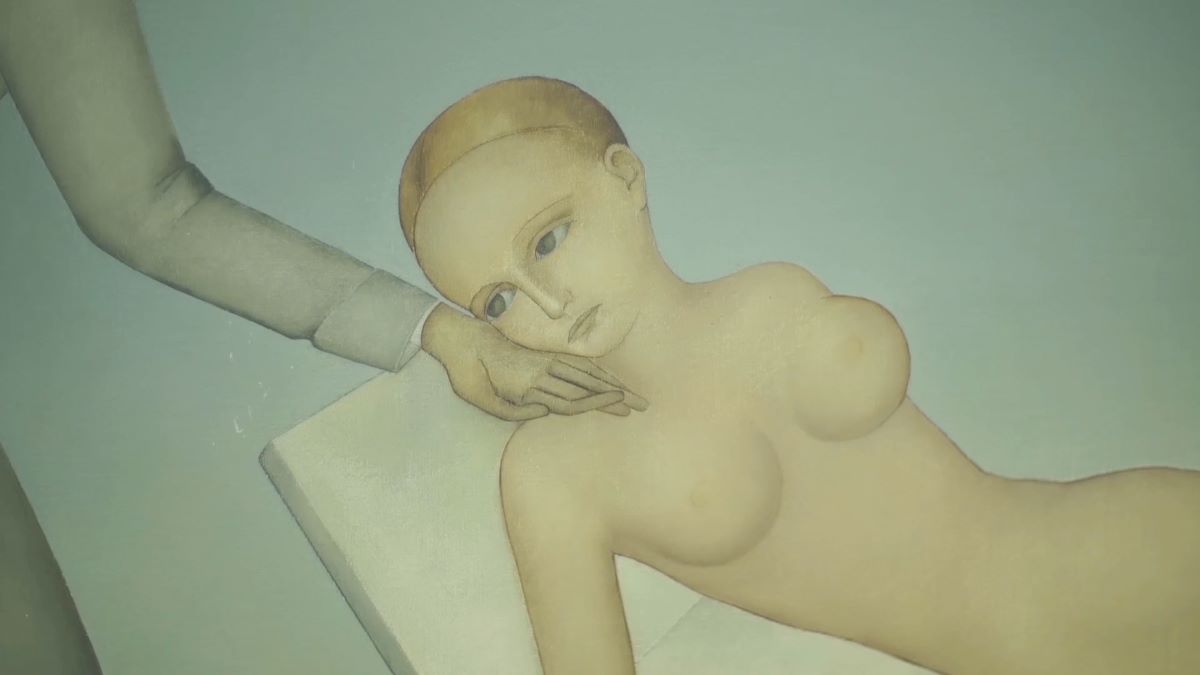
What is the future of life in a world ever more dominated by Artificial Intelligence Can we develop a sense of connection and empathy towards highly elaborated machines? In a time when the lines between humanity and technology blur, "The Shape of Things to Come" takes audiences on a journey of human-AI interaction that challenges our perceptions of identity, love, and ethics. The film follows the activities of a team of pioneering researchers pushing the boundaries of AI technology, seeking to develop an AI with the capacity to feel and understand emotions. As they delve deeper into the mysteries of human emotions, they confront ethical dilemmas, technical challenges, and unforeseen consequences. Tensions rise as the project advances. Some believe that bestowing AI with emotions could revolutionize healthcare, therapy, and human-AI partnerships, while others fear the potential risks and moral implications. " The Shape of Things to Come " explores profound questions about the nature of consciousness, the essence of humanity, and the ethical responsibilities that come with playing the role of creator. As the project's success seems within reach, the researchers must confront their own humanity and the consequences of their ambition.
Pamela Breda is an artist, filmmaker and researcher living between Turin and Vienna. She holds a MA in Visual Arts from IUAV University (IT) and a PhD in Visual Arts from Kingston University (UK). She was appointed artist and fellow in residence at several international art institutions, including Max Planck Institute For Empirical Aesthetics (Frankfurt, DE), Pratt Institute (New York, USA), Cité Internationale Des Arts (Paris, F), PROGR (Bern, CH) Botin Foundation (Santander, E). She was recipient of several art awards and fellowships, including IMèRA Fellowship (Marseille, F), Cantica 21 (MibaC, IT), Italian Council Award (MibaC, IT), Kingston University Phd Scholarship (Kingston, UK), Moving’Up (Turin, IT), JRC, Joint Research Center, European Commission (Ispra, IT), ‘Love Me Tender’, Stonefly Production Prize (Fabbrica del Vapore, Milano, IT), Italian Institute of Culture (Moscow, RU), Photography Award, IED, European Institute of Design (Venice, IT). Her film research explores the intersections of visual imaginaries, narratives, and stories that often remain on the fringes of mainstream consciousness. With a deep passion for shedding light on the voices and experiences of marginalized communities, her work dives into the complex web of human existence, particularly focusing on the clash between old and new technologies that shape worldviews.
Karolina Bregula
Dust
Experimental fiction | mov | color | 21:45 | Poland, Taiwan | 2021
Dust is a story about two women living in an old district earmarked for demolition. Since their building is due to be demolished soon, all the neighbours have already left. Yet, the women decide to stay in their flat. The protagonists spend time in the abandoned multi-storey building and observe through the window bulldozers working around. Four out of five films were made in collaboration with Ms. Zou and Ms. Huang from Daguan in Taipei. When the project was in production, their houses in Daguan were bound for demolition while Ms. Zou, Ms. Huang together with their neighbours kept fighting against the evictions in the district. The first two films are a fictive story staged with Ms. Zou and Ms. Huang in an empty building awaiting demolition in central Taipei. I entered the building, cleaned up and furnished one chosen flat to turn it into a friendly liveable space and used it as a film location. Another two films are a conversation between Ms. Zou and Ms. Huang, Ms. Huang singing a sad song which reminds her of home and an image of a Daguan streets. The last film is a documentation of the demolition of the house where the first two films were made. One month after the films were done, Ms. Zou and Ms. Huang were forced to move away and Daguan was demolished.
Karolina Bregu?a (b. 1979) is a visual artist, a graduate of the National Film School in ?ód?. She creates films, photographs, installations and performance. Her work explores the problems of the status of the artwork and the materiality of art objects. She critically scrutinises contemporary art and its reception. She creates stories about art and architecture, which are a field of her anthropological and sociological observations. She is interested in the connection between art and reality – the favourable and detrimental effect of artists’ work, the remedial and destructive force of artistic activity, rituals connected to art and art’s social role. Many of her works are co-created with their protagonists and participants, blurring the border lines between professional and amateur artistic activity. Her works have been exhibited at institutions such as National Museum in Warsaw, Jewish Museum in New York and MOCA Taipei and at international events such as Venice Art Biennale and Singapore Biennale. She is the winner of the second prize in the Views 2013 Deutsche Bank Foundation Award, the third Samsung Art Master 2007 award and the 2016 Golden Claw at the Gdynia Film Festival. Her works are included in collections such as Tokyo Photographic Art Museum, Zach?ta National Gallery of Art, Wroclaw Contemporary Museum and ING Polish Art Foundation. She is an associate professor at Academy of Art in Szczecin, she collaborates with lokal_30 Gallery. She lives in Warsaw.
Dietmar Brehm
Hylo - Vision - Plus (Version 1)
Experimental video | 0 | color | 3:18 | Austria | 2023
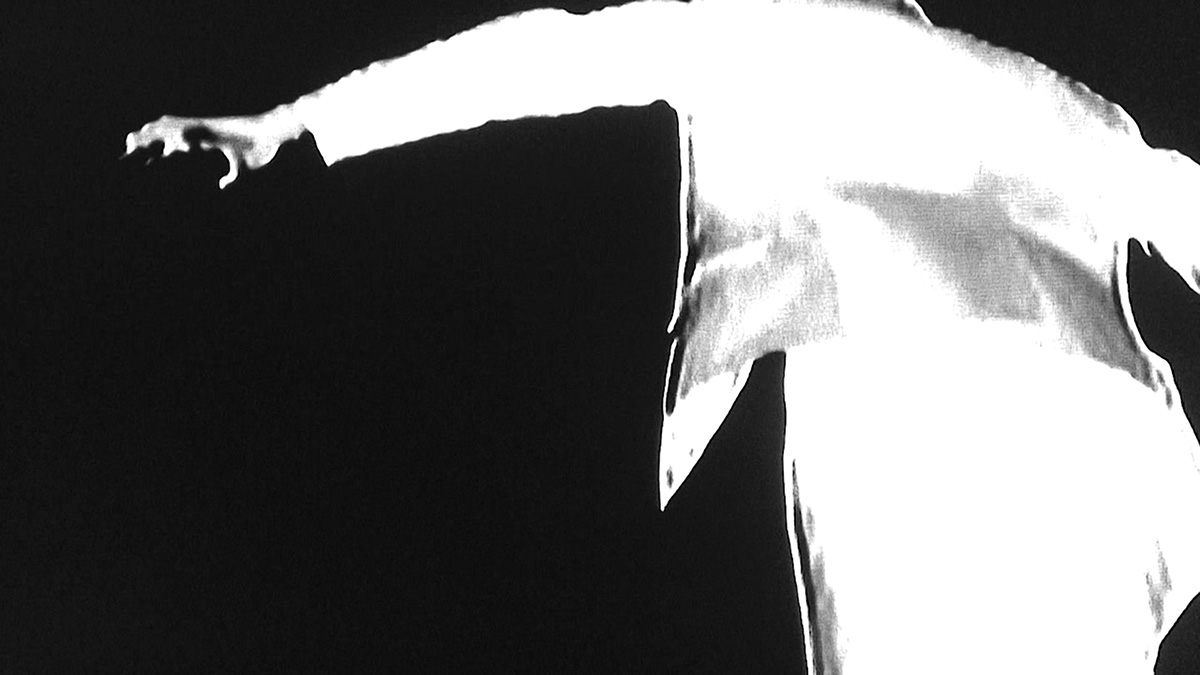
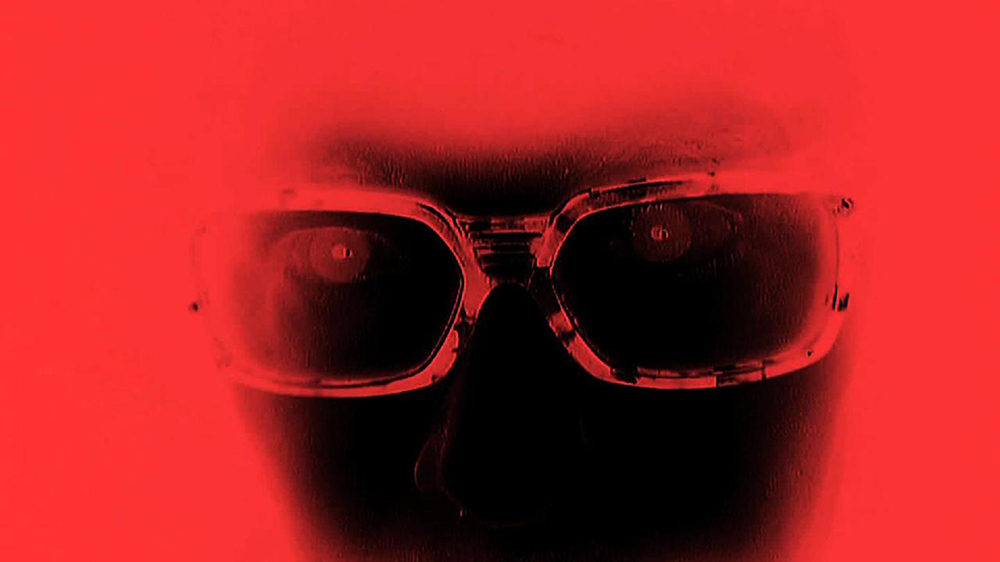
Dietmar Brehm's Hylo-Vision-Plus. Version 1 is a minimalistic study of ecstatic moments and it is named after eye-drop medicine.
born in 1947 in Linz 1967-72 studied painting at the University of Fine Arts/Linz. Professor at the University of Fine Arts/Linz. Drawing + painting, experimental films and photography. Numerous filmscreenings and exhibitions at home and abroad. 1974-1989: 74 Super8 films since 1990: 16mm films since 2000: video
Dietmar Brehm
Inside - The Color Version
Video | hdv | color | 5:0 | Austria | 2017
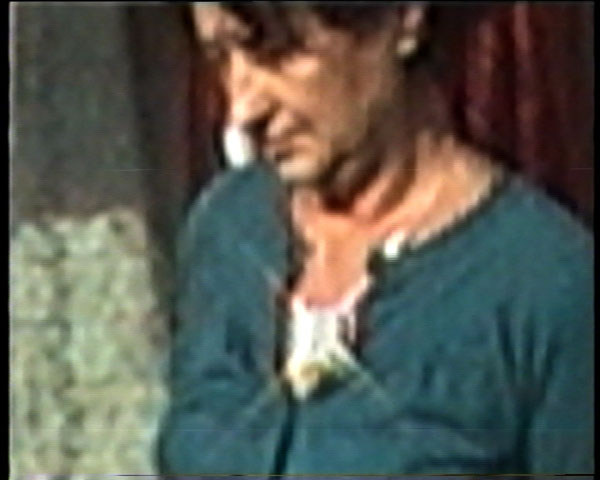
It hisses, it blinks. A virtual, two-dimensional anaglyph flickers in red and green, unfolding a visual space true to the Brehmian aesthetic. Concentratedly condensed collisions occur between everyday life and the world, being and performing, symbols and icons. A human skull, human bodies, Castle Grafenegg as an architectonic stand-in for the uncanny … Sex and crime, art and pop culture flicker at pixilated speed – the stuff of dreams – most penetrating however brief. The mundane alternates with the fetish, glimpsed in the blink of an eye, intersected by a long drag on a Chesterfield cigarette while the full-bodied, tube-amped slow-motion reverb sound of a guitar swings in the background.
Dietmar BREHM Born in 1947 in Linz. 1967-72 studied painting at the Academy of Fine Arts/Linz professor at the Academy in Linz. Since 1973 teaches at the Academy in Linz. Drawing + painting, experimental films and photography. Numerous filmscreenings and exhibitions at home and abroad, various awards for his work.
Michele Bressan
fifth,sixth and seventh floor
Documentary | dv | color | 4:27 | Romania | 2010
The block across the street, or mirror block, has been for the past 17 years my immediate landscape, a modular display of my closest reality, one I often avoided, as familiar images get skipped, distancing into the background. It happens because repetition eventually subsides the identification process. I chose to recognize the occurrences nearby and regard my quotidian landscapes as a view, put together by architecture and space boundaries, which also cause an involuntary voyeurism to appear.
Michele Bressan (b.1980) in the last few years his works were exhibited in several solo and group exhibitions, including Museum fur Photographie Braunschweig (2013), Centre Wallon d`Art Contemporain (2012), ViennaFair The New Contemporary (2012), Les Rencontres d`Arles photo festival (2011), Musée d`Art Moderne Saint Etienne (2011), Gate11 international departures, Fondazione Fotografia Modena (2011), Biennale di Venezia, Padiglione Italia nel Mondo (2011), Mois de la Photo (2010), National Museum of Contemporary Art Bucharest (2009/2010), Performance Art Institute San Francisco (2010), ESSL Museum Wien (2009), Neuen Museum/ Bauhaus Universitat Weimar (2009). In 2010 he won the Constantin Brabcusi fellowship at the Cité Internationale des Arts Paris. In 2009 he recived the ESSL award for photography, in the same year was nominee for the Henkel award.

Viktor Brim
Dark Matter
Experimental doc. | 4k | color | 19:52 | Germany, Russia | 2019
A trace of regularly ordered mounds of earth. In the twilight a dump truck is being loaded. A thick veil of mist hangs over the tops of the trees. Dark earth is excavated, loaded and transported off the scenery. In Dark Matter (2020), via the situative arrangement of different picture elements a visual friction surface is created, which is shaped by the figurations of a post-apocalyptic landscape. The images are determined by the processes of extracting raw materials. Without the mineral resources from the numerous diamond and gold mines in the so-called Russian Federation subject Yakutia, the Soviet Union would never have been able to exist until the 1990s. Technology and ideology go hand in hand and leave their mark. Military and economic efforts to secure power are inscribed in this landscape. The extraction of raw materials and the exploitation of nature show their planned economic and geopolitical consequences, which make up the character of the “subjects of the Federation”. Their designation as “subjects” was introduced in the USSR in order to equip and administer different categories of territorial units with different degrees of autonomy. Technological progress and ideological utopias constitute a processual and changeful network of relationships between subject definition and state apparatus.
Viktor Brim was born in 1987 in Tashkent, Uzbekistan. From 2009 to 2011 he studied media art at the HGB in Leipzig, began directing studies at the Filmuniversity Babelsberg KONRAD WOLF and completed a postgraduate course at the Academy of Media Arts in Cologne, where he worked not only with fictional forms but also increasingly with documentary approaches.
Ondrej Brody, Kristofer PAETAU
Artstar
Experimental video | dv | color and b&w | 3:0 | Czech Republic | 2006
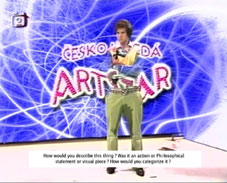
Neo-Dadaistic artist duo that hunts for grotesque aspects of both the institutionalized art world and the very phenomena of art production itself. Their strategy is obvious and almost embarrassing in its literacy and straightforwardness but apparently that is their strongest aspect. Their issues and targets are elemental as well: everyday ethics, not to say moral code booklets, become their source of subject-matter-like vocabulary. The investigation is always and first of all in regards to the psychology of behavior as influenced or provoked by the external aspects of life and politics. Oscillating between use and abuse, advanced manipulation and cold untouchable registration of absurd reality, their work is truly critical and sincere in its desire to uncover the pathologies and hidden normalcies of inter-human relations. Their actions are always well structured and the dramaturgy is almost perfect, precise, and calculated, cold and emotionally disturbing, bold and vicious - thoroughly penetrating. It perhaps only needs to be more carefully balanced: the desired scandal properly used as a tool to emphasize a decay of certain values and their sudden corruption.
Ondrej Brody was born in Prague, Czech Republic in 1980, and currently lives between Antwerp, Berlin, and Prague. In his early childhood he lived in Guayaquil, Ecuador, where he remained until 1999. In 2000 he started his art degree at the Instituto Superior de Arte in Havana, Cuba. In 2001, he transferred to the Academy of Fine Arts in Prague, where he received his degree in 2005. He is a visual artist who works mainly with video and interventions/actions. His recent exhibitions include: Jiri Svestka Gallery, Prague (2006); Kunsthallen Brandts, Odense, (2006)' Sammlung Essl, Klosterneuburg/Vienna, (2005); and Jack the Pelican, New York City, (2006), among others. His prizes include the Essl Award, Sammlung Essl, Vienna, Austria (2205), and the International Prize for Performance, Galeria Civica, Trento, Italia (2006). Kristofer Paetau was born in Borga, Finland in 1972. He spent years studying various disciplines. In 2005/06 he was at the Higher Institute for Fine Arts (HISK), Antwerp, Belgium; in 2000/01 he did a Post-Diplome International ERBAN, Nantes, France; in 1999/2000 he received a Meisterschüler Diploma, having studied in the class of John M. Armleder at the Hochschule für Bildende Künste (HBK), Braunschweig, Germany; in 1999 he earned a MA in Art studies at the Ecole Nationale Supérieure d'Arts, Cergy, France; in 1993/94 he studied Art history at the Ecole du Louvre, Paris, France; and in 1991/92 he studied aesthetics and French at the University of Helsinki, Finland. His artistic experience includes various types of projects and work, such as: in 2004 - curated project "St. Stephanus Church", with Torsten Prothmann, Berlin, Re-Institutionalize #03, and solo show: "Antigraffitihiphop" installation and dance performance, at Paul Ekaitz 5050 Gallery, Berlin; in 2005 - group show "BoundLess", participation in the work of Jan Christensen, Stenersenmuseet, Oslo, Norway (catalogue), and performance: "Belgian Air Guitar Champion", In/Out Space, Open Studios, Higher Institute for Fine Arts, Antwerp, Belgium, and in 2006 - project "Super-Flux" e-mail service, together with Ondrej Brody. A short-time concurrence to e-Flux, and "Picturepeople", an e-mail-project (work in process), together with Rüdiger Heinze the writer.