Catalogue > Search
Results for : Tout le catalogue
Marianne Flotron
Fired
Video | dv | color | 7:51 | Switzerland, Netherlands | 2007
Das Video Fired besteht aus einer Trainingssituation in der Manager lernen wie Angestellte zu entlassen. Der erste Teil des Videos zeigt ein Rollenspiel eines auszubildenen Managers und einer Schauspielerin. Im zweiten Teil des Videos erklaert eine Psychologin was sich bei Angestellten in dieser Situation abspielen kann. In der Rollenspiel Situation verwendet der Manager den Begriff ?Bewegen- -Mobility- anstelle ?Entlassen-. Die Angestellte konfrontiert den Manager im Laufe des Gespraechs mit diesem Ausdruck und verlangt von ihm die Sache beim Namen zu nennen. Waehrend des Rollenspiels besteht der Eindruck, dass es sich um eine inszenierte Situation handelt. Erst gegen das Ende des Videos wird klar, dass es sich um eine reale Situation handelt, oder genauer um eine ?reelle gestellte Situation? im Rahmen eines ?Verhaltenstrainings? was die Absurditaet der Situation weitertreibt.
Née en Suisse en 1970, Marianna Flotron vit et travaille actuellement à Amsterdam (Pays-Bas). Après deux années d'études d'histoire à Zurich, elle a suivi les cours de l?Ecole des Beaux-Arts de Genève (Suisse) où elle a obtenu son diplôme en 2001. Actuellement, Marianna Flotron est en résidence artistique à la Rijksacademie voor Beeldende Kunsten d?Amsterdam. Elle a remporté le Swiss Art Awards en 2003 et en 2007. En 2008, elle a reçu la bourse Aeschlimann Corti du canton de Berne. Son ?uvre est actuellement modelée plutôt par la déconstruction d?un objet ou d?une situation donnée que par l?adition de couches successives. De par son intérêt pour l?interrelation entre les systèmes (politiques ou économiques) et le comportement humain, elle essaie de retrouver la trace des manipulations qui peuvent potentiellement influencer le comportement humain (et vice-versa). Son point de départ est souvent une forme de comportement qui, hors contexte, a tendance à devenir abstrait ou absurde.
Adrian Flury
A place I`ve never been
Experimental film | 4k | color | 4:40 | Switzerland | 2014
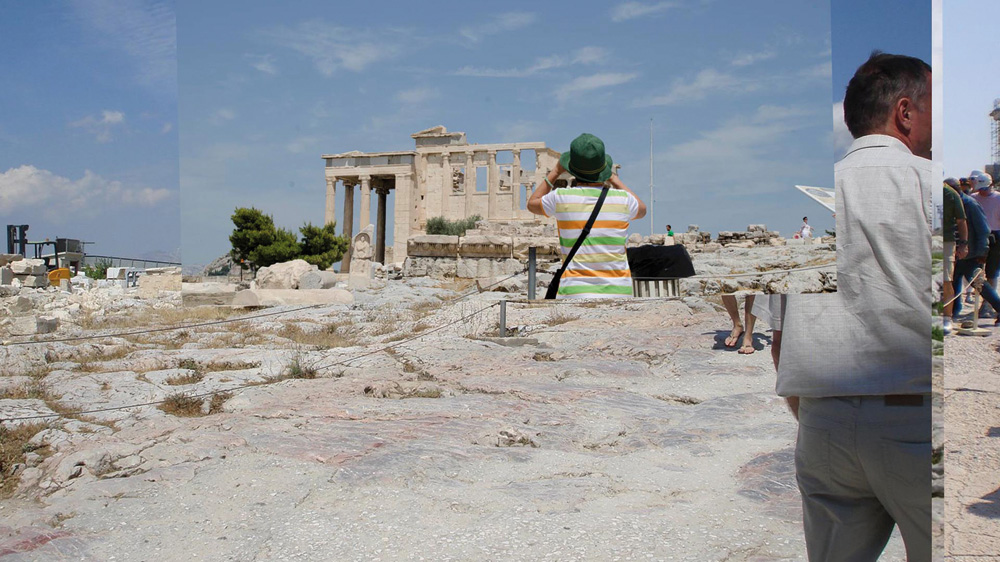
By sourcing multiple digital images of the same place from different archives this experiment in film makes use of frame by frame montage to discover hidden forms, patterns and references thereby giving new meaning to the prevailing redundancy of these pictures.
Adrian Flury was born in 1978 in Zug, Switzerland. He started out in an apprenticeship as an electrician, after which he studied animation at the Lucerne University of Arts. He has been working in the field of moving images since 2005.

Anna Fo
Sealed Faithful Halls
Experimental video | hdcam | color | 3:0 | Cyprus | 2020
“Sealed Faithful Halls” —a poem turned to an experimental film— refers to a series of videos that have been recorded in different locations, through a period of years, either as part of art projects (but were never used) or as a record of situations, feelings and moments in time, in order to be used for future art projects. This archival material, became the motivation of a video art piece, made during the pandemic of 2020, when movement was restricted and confinement was imposed; therefore no video was able to be recorded. Drawing inspiration from the rectangular forms of expressionist painter Mark Rothko, a juxtaposition of moving images and sounds was created, an illusion of situations, where real spaces are transformed into imaginary ones. Sealed Faithful Halls becomes a record of thoughts, feelings and ways in which an artist 'sees' everything that passes in front of her and the cause for the allegorical relationship of form-space, reality-illusion, language-text.
Anna Fo (Fotiadou) is a Cypriot multidisciplinary artist and educator with specialisation in video art and direction. She holds a Bachelor degree in Graphic Design and Fine Arts and a Master degree in Performance Design and Practice. Anna is a freelance graphic designer and awarded illustrator and has been working as a video artist, art director and director for various theatre plays, performances and dance shows, in Cyprus and in Europe. She is the co-writer of the awarded film “Pause” (Cyprus, Greece, 2017). Anna directed her first short film entitled “Drained” (Cyprus, USA, 2020) which will be released in 2021 and explores issues of femininity, abandonment and revenge through a contemporary re-tell of the myth of Clytemnestra. Anna has presented her artwork —both in solo and group exhibitions— in galleries, venues, festivals and biennials in Cyprus, Greece, Italy, Spain, Germany, France, UK, Netherlands, Austria and Mexico. She works in collective art projects and collaborates with artists of different practices and disciplines. Her artistic research focuses on the subject matter of reality and illusion by exploring conceptual frameworks of the duality juxtaposition between text and image, within an examination of performance, digital media and art placement in space.
Sirah Foighel Brutmann, Eitan Efrat
Nude Descending a Staircase
Video | hdv | color | 18:30 | Denmark, Belgium | 2015
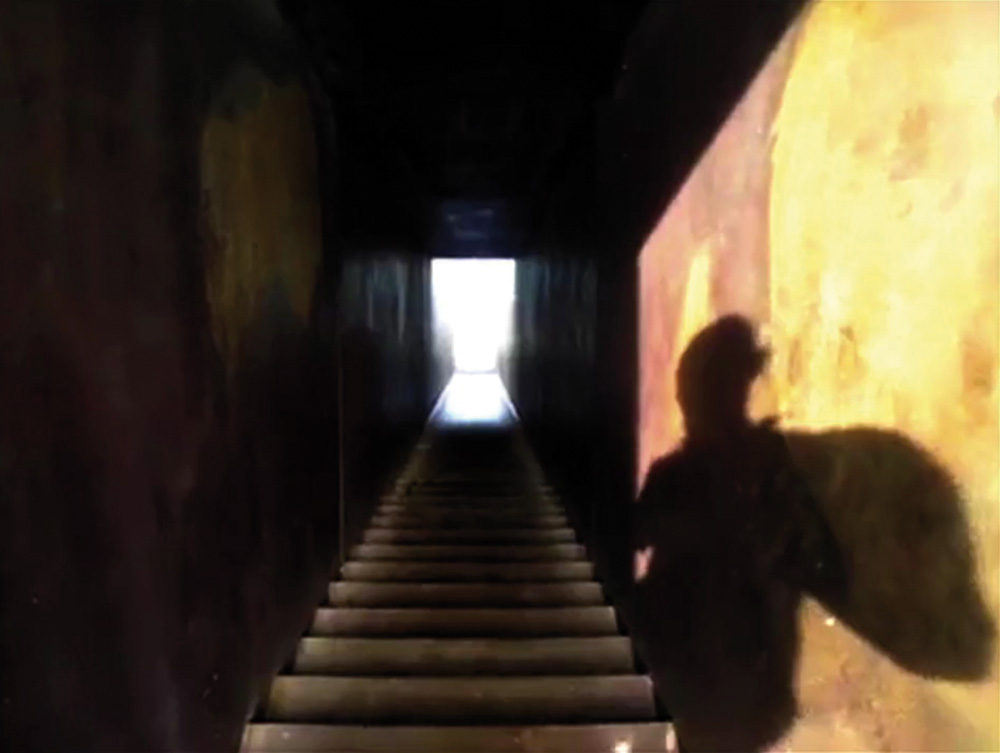
The first part of Nude Descending a Staircase is a composition of clips found online that were made by visitors—pilgrims—to the remote memorial site of Walter Benjamin in Portbou, Spain. Each of these individual registrations is anchored in the specificity of the location. They start with the arrival to Portbou, go through the small town up to the cemetery, and end in a dramatic descent down Dani Karavan’s iconic staircase, which was created as an homage to Walter Benjamin. The assembly this audiovisual material transforms the autonomous experiences into one collective trajectory, and entangles collective memory, experience and the production of images. The second part reveals another staircase, abandoned and barricaded, on a small stage-like platform, outside the former Espai Memorial Walter Benjamin. The second staircase modestly suggests an alternative mode of framing memory. The title, borrowed from Marcel Duchamp’s 1912 painting, proposes to dialogue Walter Benjamin’s writing on history and reproduction with Duchamp’s attempt—in relation to the developments in photography—to capture movement autonomous from a body. Nude Descending a Staircase is the first chapter in a series of works titled Gathering Series.
Sirah Foighel Brutmann and Eitan Efrat (both °1983 in Tel Aviv) have been working in collaboration for several years and are creating works in the Audiovisual field. Living and working in Brussels. Their works have been shown in film festivals as IDFA and Rotterdam Film Festival (NL); Courtisane (BE); New Horizons (PL); on ARTE/WDR; exhibited in solo exhibitions at Kunsthalle Basel (CH) and Argos (BE), and group exhibitions in STUK (BE); EMAF (DE) and The Petah-Tikva Museum for Contemporary Arts (IL). Their works have been produced by Auguste Orts and Argos (BE) and distributed by EYE institute (NL), they have won prizes in IMAGES (CA) and Oberhausen Film Festival (DE). Sirah and Eitan have presented their work as featured artists at the 59th Flaherty Film Seminar (US), and have participated in artists talks and presentations in institutions such as FLACC, Genk, LUCA BFA class, Brussels, L`erg BFA class, Brussels, DocNomads 2014, and Bezalel MFA class, Tel Aviv. Sirah and Eitan`s practice focuses on the performative aspects of the moving image. In their work they aim to mark the spatial and durational potentialities of reading of images – moving or still; the relations between spectatorship and history; and the temporality of narratives and memory. Sirah and Eitan are members of the artists-run collective Messidor
Sirah Foighel Brutmann, Eitan Efrat
Orientation
Experimental doc. | hdv | color | 12:40 | Denmark, Belgium | 2015
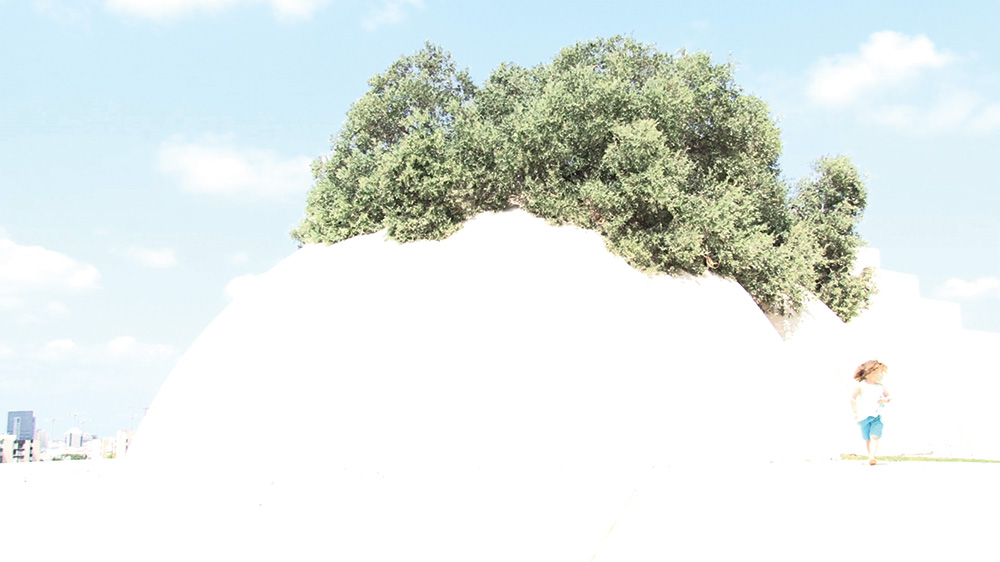
Looking at two locations— the public sculpture White Square commemorating the founders of Tel Aviv, and the shrine of Palestinian village Salame in today’s Israeli Kafar Shalem—Orientation focuses on the ability of architectural material, and of sound and image, to register collective experience of forgetfulness. In 1989, the Israeli sculptor Dani Karavan, completed his sculpture White Square. The work was commissioned by the Municipality of Tel Aviv, and by the end of the building process Karavan decided to dedicate the sculpture to the founders of Tel Aviv—among whom his father Abraham Karavan, who was the city’s landscape architect for four decades from 1930’s onwards. The sculpture is composed of simple geometrical shapes and is made of white concrete, influenced by the International Style of early architecture in Tel Aviv. White Square—situated on the highest point in the area located in the eastern outskirts of Tel Aviv—overlooks through the skyscrapers all the way to the Mediterranean Sea in the west. The commonly used name of the hill on which White Square is exalted is pronounced in Arabic: “Giv’at Batih” (Watermelon Hill). The remains of the shrine of Salame, in today’s Tel Avivian neighbourhood Kfar Shalem is located a few hundred meters south of this hill. The abandoned dome-structure was once at the centre of the ancient Palestinian village Salame. The village, dating back to the 16th century up until 1948, was located on the highway from Jaffa Port to the mainland. During the ‘Nakba’ of 1948 it was occupied and depopulated by the Israeli Army and the new Zionist state. Weeks after expelling the Palestinian villagers from their land, the Israeli authorities—managing waves of Jewish immigration—re-inhabited the village with Yemenite Jews. Those, were settled in the original Palestinian stone houses. Today, decades later, the ownership of the land is still in dispute, and the Jewish-Israeli residents of Kfar Shalem are threatened with evacuation due to a construction-corporations’ plan to destroy the stone houses and to build a new profitable neighbourhood. Orientation is the second chapter in a series of works titled Gathering Series.
Sirah Foighel Brutmann and Eitan Efrat (both b.1983 in Tel Aviv) have been working in collaboration for several years and are creating works in the Audiovisual field. Living and working in Brussels. Their works have been shown in filmfestivals as IDFA and Rotterdam Film Festival (NL); Courtisane (BE); New Horizons (PL); on ARTE/WDR; exhibited in solo exhibitions at Kunsthalle Basel (CH) and Argos (BE), and group exhibitions in STUK (BE); EMAF (DE) and The Petah-Tikva Museum for Contemporary Arts (IL). Their works have been produced by Auguste Orts and Argos (BE) and distributed by EYE institute (NL), they have won prizes in IMAGES (CA) and Oberhausen Film Festival (DE). Sirah and Eitan have presented their work as featured artists at the 59th Flaherty Film Seminar (US), and have participated in artists talks and presentations in institutions such as FLACC, Genk, LUCA BFA class, Brussels, L’erg BFA class, Brussels, DocNomads 2014, and Bezalel MFA class, Tel Aviv. Sirah and Eitan’s practice focuses on the performative aspects of the moving image. In their work they aim to mark the spatial and durational potentialities of reading of images ? moving or still; the relations between spectatorship and history; and the temporality of narratives and memory. Sirah and Eitan are members of the artists-run collective Messidor

Mauro Folci
noia
Art vidéo | dv | color | 3:33 | Italy | 2009
A man is sitting at a desk opposite a lion, whose paws rest on the desk, an implicit, strictly formal cross-reference to a painting by Antonio Colantonio, Saint Hyeronimus in his study (1455) in which the saint extracts a thorn from a lion`s paw. The imagine focuses on the two figures and on the strange interaction between the animal`s paw and the man`s hands. As a result of the bare surroundings, both the interplay between the hands and the paws and the man`s closeness to the enormous beast sitting solemnly opposite his minute body stand out. The hands and the paws rest on the table at a proximity emphasized by the black background.
Mauro Folci Lives beetween Rome and Milan. Visual artist and Performative Art professor at Brera Art Accademy Milan.
Miguel Fonseca
ALPHA
Fiction | 35mm | color | 27:0 | Portugal | 2008
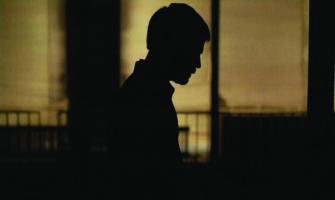
What starts as an animal lab experiment leads, in the future, to the development of artificial beings capable of carrying out the most varied and complex of tasks. These totally human-looking beings are intelligent and versatile ? they?re capable of doing simple things like watering plants, laying the table, doing the laundry or feeding a pet. But that?s not all. These beings are almost autonomous and can even talk or interact with us. They have been designed to be more than a perfect appliance; they can cater to what the customer wants them to be ? they can be mere home helpers or a children?s toy but they can also be sophisticated lovers or the perfect companion for lonesome people. Before being delivered to their customers, the manufacturer develops a kind of final quality control test, supervised by a technician, where certain skills (like learning the customer?s language) are improved. This part of the process invariably occurs in a closed environment, usually a house with key characteristics of the customers home. Alpha is one of such artificial beings. He and Beta are a couple only a few weeks away from being shipped to their future owners in Japan.
Miguel Fonseca was born in Lisbon in 1973. He studied at the Universidade Clássica de Lisboa where he got his degree in Philosophy. Since 2001 he works at the production company O Som e a Fúria. ALPHA is his first film.
Miguel Fonseca
I KNOW YOU CAN YOU HEAR ME
Experimental fiction | | color | 4:8 | Portugal | 2010
A film about love inside a film about war. Every shot of the work belongs to the film ?First Blood?, directed by Ted Kotcheff in 1982. (The first Rambo film). I use only those shots without anyone, only empty shots. And I use every one of them.
Miguel Fonseca was born in Lisbon in 1973. He studied philosophy and in 2008 he directed ALPHA, his first film. He?s currently preparing his next short film ?The Waves?. He works as a director, as a writer and as a continuity supervisor.
Marco Fontichiari
Primal
Experimental video | hdv | color | 7:50 | Italy | 2017
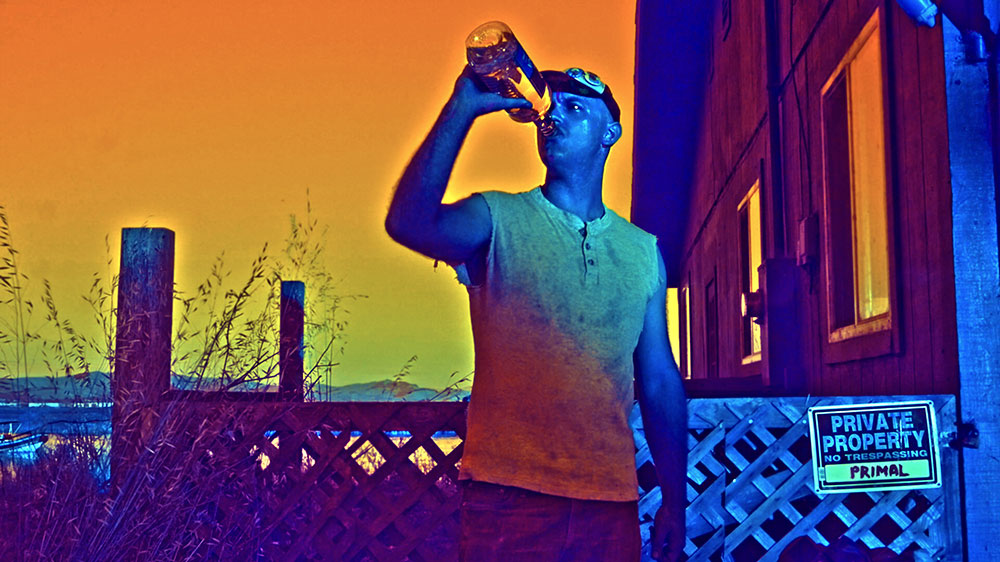
“Primal” is a video that documents the layers of individual memories and how events take place from a subjective point of view. The stories originate from encounters that the videomaker had during his 4293 KM walk across the USA.
Marco B. Fontichiari was born in 1992, he is currently working and living in Bologna, Italy. In 2018 he graduated in Film Studies from the Academy of Fine Arts of Bologna. His works are mainly video and performance pieces that question the relationship between human limits and absolute concepts. Marco has presented his work in several galleries and festivals among which, P420, 2016, Ibrida Festival, 2017, METACINEMA, 2017-2018, FILE Festival 2018.
André Fortino, Thomas Jeames
866 FEROCE
Video | hdv | color | 9:6 | France | 2011
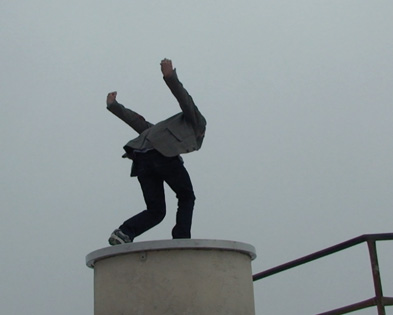
A traffic circle, some tap dancing, the Calanques, a refrigerator, a scooter, the matador of cock...
André Fortino
Hôtel Dieu
Art vidéo | dv | color | 45:0 | France | 2009
Vidéo réalisée à l?Hôtel-Dieu de Marseille. Un individu masqué déambule dans un hôpital désaffecté et interagit avec l?espace et les objets qu?il rencontre.
Né le 30 Avril 1977 à Marseille
Pietro Fortuna
Studio Visit
Video | hdcam | color | 5:2 | Italy | 2013
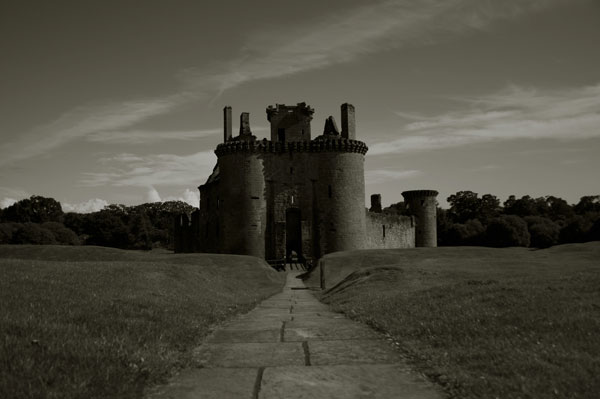
Studio Visit (2013) is a nocturnal incursion in Pietro Fortuna`s atelier, where a feeble light discovers in the darkness artworks, materials, everyday objects and still figures.
Pietro Fortuna was born in Padua, and moved to Rome to study Architecture and Philosophy. He made a very early debut as assistant stage designer in prestigious theatre?s productions (La Fenice in Venice, S. Carlo in Naples, La Scala in Milan,). In the eighties he exhibited at the São Paulo Biennial; the Paris Biennial, at the Künstlerhaus in Graz and the Hildenin Taidemuseo in Tampere, at the Centre National d?Art Contemporain Villa Arson in Niece, and the Frankfurter Kunstverein. In that same period in Italy at the Galleria Comunale d?Arte Moderna in Bologna, the Eleventh Quadrennal in Rome, and at several other public institutions. He divided his life between Rome and New York, with a debut at the Pack Bulding. Over the first half of the nineties, his work was exhibited at a range of institutions, among which the PMMK Museum in Ostenda, the Museum of Contemporary Art in Caracas, the Museum of Modern Art in Bogotà, the Galleria d?Arte Moderna in San Marino, and the Sierkunst in Gand. His interest in theoretical foundations was manifested at the outset, leading to the production of a considerable body of writings. Between the years 1996-2004 he instituted Opera Paese as a continuing project over; a locus/work of meditation around the idea of community in which art events, music and theoretical speculation combined. The place saw artist like Philip Glass a Jan Fabre, Pistoletto a Kounellis, Kankeli and many others. From 2000 to 2004 he helds solo shows in public institutions such as the Kaohsiung Museum of Fine Arts in Taiwan, the Galleria Comunale d?Arte Moderna e Contemporanea in Rome, the Museo Pecci in Prato, and the Watertoren in Vlissingen. Between 2004 and 2011, both solo and group exhibitions, including ones at the Certosa di Padula, The Museo de Arte Contemporáneo Florencio De Lafuente in Requena, the Fondazione Morra in Naples, and the Twelfth Biennial of Sculpture in Carrara. 2010 saw the beginning of the cycle of works named Glory. At the Tramway in Glasgow he inaugurated Glory I - The Raft,. In 2011 his second cycle, Glory II - The Tears of the Angel at the Macro Museum of Rome and a third appointment in May 2012 at the Marca Museum of Catanzaro. In 2013 has a solo shows at La Quadriennale di Roma. Along his career he has numerous collaboration with private galleries like Luciano Inga-Pin in Milan, Massimo Minini in Brescia, Studio Guenzani in Milano, Nosei Gallery in New York, Eva Menzio a Torino, Montenay ? Delsol in Paris, Otmar Triebold in Basel, Giuliana de Crescenzo, La Nova Pesa and Giacomo Guidi Gallery in Rome.
Maider Fortune
Curtain!
Experimental video | | black and white | 18:45 | France | 2008
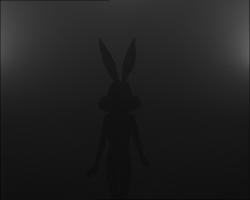
In a dark space with undefined surroundings, the heroes? silhouettes animated drawings of childhood appear. Their acidulous colors have disappeared, only the outline of the characters remains, the essence from the original drawings. Such are the empty envelopes, delivered to cheer our goodwill; they advance slowly towards the bottom of time, where they are swallowed up by a diaphanous light of which they will no more return.
Maïder Fortuné was born in 1973. She lives and works in Paris. After schooling at the International School of Theatre Jacques Lecoq in Paris, she creates her own company of physical theatre then joined the post-diploma of Fresnoy, National Studio of the Contemporary Arts in Tourcoing. Her works (videos, photographs, films, installations) are staged through dramatic settings strangely embodied in corporal figures. Each image proposes a situation where the body seems to take part in a narrative which oscillates between fable and mystery. She has had her work shown in Europe, in Canada, in Asia and in the United States since 2001.
Maider Fortune
i wasn't crying but the ground wasn't still
Video installation | betaSP | color | 11:0 | France | 2006
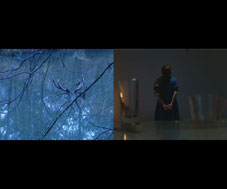
Inside a stripped contemporary home, two little girls play a strange game: one of them is standing up in the middle of the room, and blows in the direction of her mate (her sister?) who she then keeps floating in the air above her. Between them lies the extreme tension of subjection hanging on her lips. Desire becomes a counterpart of belief which makes impossible come true. Fully wrapped up in their act, in this hallucinated concentration inherent in the ritual, the two little girls set magical forces free and bring the strange into the contemporary space. The inside of the house, with its precise contours, is transfigured, and everyday life objects (from technological tools, these "new messenger angels" to kitchen tools, including a play carpet) gain a new function of disquieting vitality. The video camera, equipped with a steadycam device which rids movements of all organic materiality, slides around the scene like a floating spirit (the spirit of the breath?). For the time of one passage through, the camera acts as a bodiless and voiceless look on this enigmatic action. A forest at dawn. Thick branches, steady waters spreading on the ground, mossy ground, unearthed roots ... it is an infinite game of matters and shapes, echoes and medleys between different categories of species streaming before the attentive look and slow motion of the video camera´s vertical tracking shots. Between two tree trunks, at the heart of the pond surrounded by the forest, a shape appears: a stag, the antlers of which are the only visible element, and which haunts the pool. The double projection, which juxtaposes the two movies almost on the same ground, confronts both spaces. On one side, the cold modern apartment, an enclosed and protected area, with its cleanness evoking rationality, present days, and on the other side there is the forest, an exhibited outdoors place, but above all, the fantastic space where the first children´s fears are gathered (as forest is omnipresent in fairy tales), and which perpetuates its symbolic game far ahead in adults´ unconscious.From one to the other a game of combinations starts, brought by similar movements of the video camera. The breath of the kid echoes that of the wind, the shapes of the forest echoes these of the objects in the apartment, the soundtrack switches from one movie to the other, and vice versa, and the spaces become permeable and weave the web of the magical thought.
Fed with a deep practice of movement, my images question the moments of apparition of motions. The principle of motions lying in each body reveals instability, the hold slipping and the dissolution of grasp. Through staged scenes purified only to leave the very present artistic dimension (resulting from important digital manipulations of the images) and very careful about matters of filming devices, fictions about corporal presence are drawn, virtual presences, strangely incarnated in the exhibition area. Each image, be it photographic or video, isolated or plural, with or without sound, suggests a situation in which the body seems to take place in a story which wavers between fable and mystery. "Maïder Fortuné uses video with an intuition linked with her experience of the body and performance. An open body, available, floating, which captivates and transmits the world going through it, while evacuating all psychology and affectation. A body both captivating and sending, her own body that she often displayed in her videos and public actions. Her videographic gesture, like her body gesture, is precise and uses every possibility the medium offers. Pauses, poses, movements, duration and the circuit are no accident; in each case they correspond to a wish to catch a certain state of the human being in his relation to space, itself multiplied. The body, transparent and divided in two of the series I´Games, the motionless bodies in "Playing Dead" game of death, the animal and magnetized body of "Everything is going to be alright"´s trampolining man, the floating body of "I wasn´t crying but the ground wasn´t still", etc., are as many figures and possibilities for a body indeed, with common technologies going through it, but still attentive about its origins and therefore its originality contemporary creation explores (dance in particular). Maïder Fortuné belongs to this quest of an extraordinary body, unique, which continues to hopelessly reinvent itself, against all the models exposed on the shelves of globalized cosmetics." Françoise Parfait.

Maïder Fortuné
Boomerang
Video | 4k | color | 13:0 | France | 2024
The inner courtyard of the Canebière building, built by Fernand Pouillon in 1952 as a vision of quality housing for the people. The camera slowly follows the vertical and horizontal lines of the windows. Traces of human presence punctuate the uniformity of the façade (laundry, plants in pots). The rythm suddenly syncopates, accelerates : pendulum movements replace pans, the sounds of steps and voices echoing in the hall reaches a crescendo. The screen turns black, and James Baldwin’s voice, talks in french about the position french society allows algerians in its midst. Between the wordless images and the imageless words, a common thread : the legacy of people’s struggles in french society, of their claims for dignity and equality.
Maïder Fortuné, studied literature and theatre (École Jacques Lecoq in Paris) before entering Le Fresnoy National Studio for Contemporary Arts, where she developed a performance-related practice of the technological image. With its great formal rigor, Fortuné’s work commands all the viewer’s attention for a genuine experience of the image and its processes. Recently, her practice turned to more narratives preoccupations. Lecture performances and films deeply rooted in writing, are the mediums she process to open up new narrative strategies. Her work has been exhibited internationaly (Europe, Brazil, Canada, China, Japan). In 2010 she won the Villa Medicis fellowship in Roma, Italy. Recent shows and performances have been held at Gallery 44, Toronto, Centre Pompidou Paris, and the Toronto International Film Festival. In 2019, her mid-length film L’inconnu de Collegno was part of IFFR Bright Future selection. In 2020, Communicating Vessels won the Accomodo Tiger award at IFFR Rotterdam, the Main Award of Moscow International Experimental Film Festival, the Student Award of Black Canvas film festival in Mexico, and was part of Indie Lisboa film festival, FID Marseille film festival, Montreal documentary Film Festival, Bucharest Film Festival. Outhere (for Lee lozano) is her last film codirected with Annie Mac Donell.

Maïder Fortuné, Annie Mac Donell
Communicating Vessels
Experimental fiction | 4k | color | 30:48 | France, Canada | 2019
An art professor tells the peculiar story of her student E., a strange young woman whose conceptual performance pieces and singular existence leave the professor increasingly unmoored. Combining fictional narrative, personal anecdote and private conversation, Communicating Vessels explores how we influence each other in ways that are sometimes good, sometimes bad, yet always urgent and necessary. An unusual tribute to art and its creation, channelling seminal performances by Joan Jonas and Lygia Clark.
Maïder Fortuné, studied literature and theatre (École Jacques Lecoq in Paris) before entering Le Fresnoy National Studio for Contemporary Arts, where she developed a performance-related practice of the technological image. With its great formal rigor, Fortuné’s work commands all the viewer’s attention for a genuine experience of the image and its processes. Recently, her practice turned to more narratives preoccupations. Lecture performances and films deeply rooted in writing, are the mediums she process to open up new narrative strategies. Her work has been exhibited internationaly (Europe, Brazil, Canada, China, Japan). In 2010 she won the Villa Medicis fellowship in Roma, Italy. Recent shows and performances have been held at Gallery 44, Toronto, Centre Pompidou Paris, and the Toronto International Film Festival. In 2019, her mid-length film L’inconnu de Collegno was part of IFFR Bright Future selection. In 2020, Communicating Vessels runs for the Accomodo Tiger award at IFFR Rotterdam. ANNIE MACDONELL- BIO Annie MacDonell is a visual artist. Her practice begins from the photographic impulse to frame and capture, and is concerned with the production and circulation of images in the present moment. Her work includes film, installation, sculpture, performance and writing in addition to photography. She received a BFA from Ryerson University in 2000, followed by graduate studies at Le Fresnoy, Studio National des Arts Contemporains, in France. Recent solo shows have been held at Gallery 44, Toronto, Parisian Laundry, Montreal, the Art Gallery of Ontario. Recent performances have been presented at Nuit Blanche Toronto, le Centre Pompidou and the Toronto International Film Festival. In 2019, her films have screened at TIFF and the Viennale. In 2012 she was short-listed for the AGO AMIA prize for photography, and she was long listed for the Sobey Art Award in 2012, 2015 and 2016. She is a founding member of Emilia Amalia, a feminist research and writing group. She is an assistant professor at Ryerson University and lives in Toronto with her family.
Claire Fowler
Portrait As
Experimental doc. | 16mm | color | 7:0 | United Kingdom, France | 2006
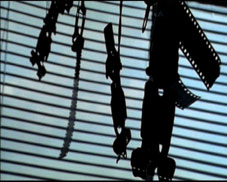
A visual portrait of the disabled avant-garde filmmaker Stephen Dwoskin, as represented by his environment. The film is a very personal movement through Steve's past and present, as seen through the house he has lived in for the last 30 years, and the objects within it that both surround and represent him - as an individual living with a disability, and as an artist-filmmaker who has enjoyed a long and successful career.
Claire Fowler is a British filmmaker who works with documentary and experimental narratives. A graduate of both the Royal College of Art and Oxford University, she divides her time between Europe, where she has recently completed a 3- month artist residency in Paris, and the States, where she is currently completing a half hour documentary exploring the difficulties the Palestinian children have in obtaining essential medical care within the occupied territories of the West Bank (In association with the Palestine Children's Relief Fund).
Nick Fox-grieg
A Good Joke
Experimental video | dv | color | 3:16 | USA | 2005
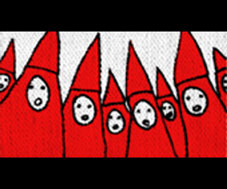
The joke is an old one, a perennial in compilations of Jewish humour. Although the details differ between versions, the scene remains the same: a priest challenges a rabbi to a debate on the spiritual condition of Jewish people.
Nick Fox-Gieg is an animator and theatrical designer. His short films have been shown at the Rotterdam and Ottawa Film Festivals, at the Centre Pompidou in Paris, and on Canada's CBC Television.
Alicia Framis
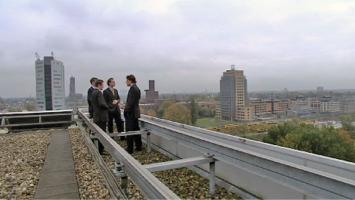
Secret Strike, Rabobank
Art vidéo | betaSP | color | 9:17 | Spain, Netherlands | 2004

Daniela Franco
Tiada Tajuk
Video | dv | color | 4:9 | Mexico, Malaysia | 2006
Tlada Tajuk (Untitled in Malay) is a video made during an artistic residency in Kuala Lumpur. The video consists of cut-out headlines from Malaysian English newspapers and a sort of mumbling karaoke. A group of artists were invited by ́École des beaux-arts in Paris and the Malaysian Ministry Of Culture to spend some weeks in Kuala Lumpur in order to create work that reflected their experience in Malaysia. In a complex country where at least three etnias with their respective languages, culture, food, religion, etc interact, English has been chosen as the language that presents Malaysia to the Western world, it serves both as a means of communication and a filter. Everyday I read and kept headlines from Kuala Lumpur`s English newspapers, the only ones I could understand, as a means to take the pulse of the city and understand it. Attempting to get a sense of Kuala Lumpur in such short time proved to be, as with most similar experiences, impossible. The result, of course, is closer to a personal diary that, through Kuala Lumpur`s headlines, says more about the artist than the city itself.
daniela franco is an artist who uses a variety of mediums to present projects that are usually collective and interdisciplinary. She archives other people`s collections, treasures notes addressed to strangers and photographs of people she has never met. She reviews concerts that she never attended and art exhibitions she has never seen. Daniela was born in Mexico and currently lives in Paris. She has been a Fulbright and Rockefeller grantee and her work has been shown in individual and collective exhibitions around the world. Currently she works on « The Sandys at Waikiki » a photography book with the collaboration of some members of the French group Oulipo and other writers, that will be published in 2009.
Michel François
Fox
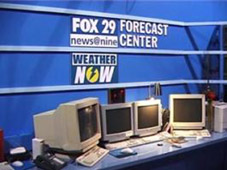
Art vidéo | dv | color | 8:0 | Belgium, USA | 2007
The video work of Michel François is often based on the isolation of interludes, tiny events and movements, and the engraving of tiny sculptures in real time. He draws up an inventory of the world around us making use of antitheses: not merely formal, but also philosophical; social or political-economical oppositions. This video was recorded during a single night in the studios of the American TV-network FOX. The camera wanders about between abandoned cameras and illuminated TV-screens. In the background the dialogues resound the soundtrack of the program that was being broadcast at the time - an episode from a lawyer series. The duration of the film corresponds with the last minutes of the program. The acoustic climax echoes through the empty, dehumanized studio.
Educated at Brussels' École de recherche graphique (ERG), Michel François doesn't want to limit himself to one discipline. He uses all sorts of materials and a range of methods, combining industrial and natural objects, and photographs and installations, into a result that appeals to all of our senses. François analyses and refers to everyday customs and habits in an associative manner without detracting from their general validity. By way of simplification we could say that Michel François is a sculptor. As a video-maker each one of his sequences form a transition to the next sequence, and his whole output is based on his skill at isolating interludes, minor occurrences, and unsuccessful revived acts from that real time which principally consists in spare time. Central in Michel François's work is his personal perception of reality although he himself remains in the background, anonymously documenting the events taking place. The objects he depicts in quick succession do not represent commentaries, reactions, or answers to political, cultural, or economic questions. Being non-autobiographical in nature, neither posed nor staged, they explore cause and effect, being experimental in nature and immediately explicable. François inventories the world around us by way of antitheses: formal opposites such as the sculptural extremes of concave-convex and empty-full; and such opposites as freedom and imprisonment, poor and rich. In his photographs and video works Michel François does not construct his work within an autonomous, digital world but he finds his subjects in the real - almost by definition anti-heroic - ordinary world. At the same time, this living context is the place where his art is displayed. François's images possess nothing of the unique, isolated object. His view is not attached to what has been canonised but to the liveliness of everyday life. What he registers is the unexpected in the familiar, the intense in the inconstant. His photographs and videos reveal themselves as paintings with restrained or openly expressed sculptural qualities. No matter how they are defined, they are qualities of his physical and emotional life that confront those of the spectator. "L'art, de toute façon, c'est la vie que l'on sculpte", thus François.