Catalogue > Faire une recherche
Résultats pour : Tout le catalogue
Nick Jordan
Havanazephyr
Art vidéo | dv | couleur | 6:10 | Royaume-Uni | 2005
Un film révolutionnaire en trois parties.
Nick Jordan est un artiste basé à Manchester. C'est un personnage à plusieurs facettes, maniant la vidéo, le dessin, l?évènementiel et la publication. Son travail comprend un panel éclectique de motifs culturels et personnels, tirés du cinéma, de l?histoire de l?art, de la littérature, des bandes dessinées, des arts graphiques, entre autres sources. Le travail vise à animer les difficultés et les procédures incluses dans la production d?images et la manière dont les éléments découverts peuvent, assemblés, faire que "quelque chose se passe ?. Ses vidéos capturent des moments bien singuliers d?observations quotidiennes. Elles sont souvent combinées, par le montage, avec d?autres références afin de former un scénario particulier ou un épisode de fiction.
Lamia Joreige
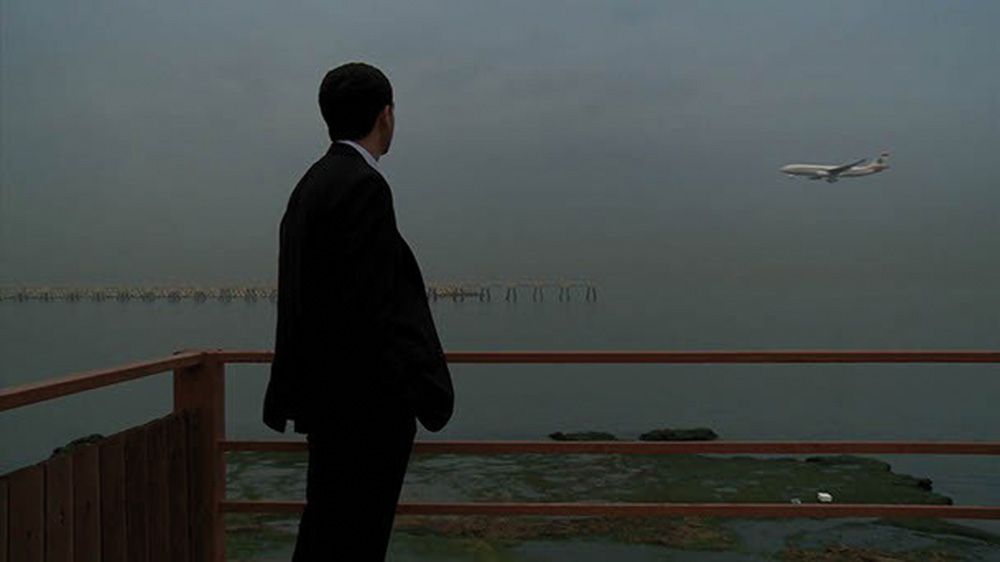
And the living is easy
Fiction | hdv | couleur | 75:0 | Liban | 2014
"Beyrouth, en 2011. La ville est plongée dans une étrange accalmie alors que la région autour s’embrase. A travers cinq personnages, principalement des acteurs non-professionnels, Lamia Joreige réalise un portrait unique de sa ville natale. Qu’il soit attaché commercial, musicien, étudiant, acteur, chacun livre son attachement profond à Beyrouth et sa difficulté ou impossibilité d’y vivre. Pendant plusieurs mois, la cinéaste leur a demandé de jouer des scènes qu’elle a imaginé en s’inspirant de leur vie amoureuse, professionnelle ou amicale. Elle a fictionnalisé leur quotidien, faisant ainsi ressortir leur malaise. Ces scènes ont été jouées dans les quartiers où ils habitent, dans les lieux qui leurs sont chers. La ville et leurs sentiments sont intimement imbriqués. Sous la beauté des images, sous l’apparente douceur de leur vie se profile l’angoisse de l’instabilité politique au Proche-Orient et la peur d’une guerre dévastatrice."
"Born in Lebanon in 1972, Lamia Joreige is a visual artist and filmmaker who lives and works in Beirut. She uses archival documents and fictitious elements to reflect on the relation between individual stories and collective history. She explores the possibilities of representation of the Lebanese wars and their aftermath, and Beirut, a city at the center of her imagery. Her work is essentially on time, the recordings of its trace and its effects on us."
Lamia Joreige
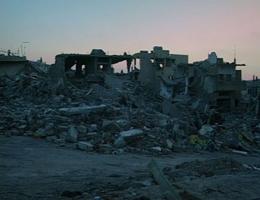
Nights and Days
Doc. expérimental | dv | | 17:0 | Liban | 2007
Nights and Days raconte l?expérience de la guerre d?un point de vue personnel, à partir de notes écrites et filmées durant l?été 2006. La première partie qui ressemble à un journal de guerre sans en être un, alterne des plans de jour avec des plans de nuit, qui sont construit avec la bande sonore, pour exprimer l?idée du passage du temps, l?attente, les peurs et les transformations vécues dans ces circonstances inhabituelles. La deuxième partie est un voyage au Sud-Liban qui a été dévasté durant cette guerre. De beaux paysages sereins s?alternent avec des ruines et des destructions, avec pour seul son, une musique. Ici aucun mot ne peut exprimer la dévastation. Nights and Days réfléchit à la relation entre image et son et aussi à « l?horreur » qui peut se trouver derrière la ?beauté?. Dans ces beaux paysages urbain et naturels, seuls quelques détails révèlent la présence et la violence de la guerre.
Née en 1972 à Beyrouth au Liban, Lamia Joreige étudie le cinéma et la peinture à Rhode Island School of Design, USA, où elle obtient un Bachelor of Fine Art en 1995. Parmi ses réalisations: Je d?histoires, installation vidéo interactive 2006 - Un voyage, documentaire vidéo 2006 - Objets de guerre 1, 2, 3, 4, installation vidéo et objets 1999-2006 - L?autre et le temps, exposition et livre 2004 - Ici et peut-être ailleurs, documentaire 2003 - Ici et peut-être ailleurs, nouvelle, fiction 2003 - Sans-titre 1997-2003, installation vidéo - Replay (bis), fiction 2002 - Replay, installation vidéo 2000 - Le déplacement, installation d?images vidéo-fixes 1998-2000. Elle présente son travail dans de nombreux festivals et lieux parmi lesquels : The Images Festival, Toronto - Les universités Harvard et Columbia, USA - Les Rencontres Internationales Paris / Berlin - La Cinémathèque de Paris - The Rotterdam International Film Festival - Le Festival de Cinéma méditerranéen, Montpellier. La fondation Caixa, Barcelone. Et diverse expositions dont les plus récentes sont: Rumor as Media, Akbank Sanat, Istanbul - Coding Decoding, Musée d?art contemporain, Roskilde, Danemark - Out of Beirut, Modern Art Oxford, Royaume Uni - INSA art space, Séoul - Present / Absence, galerie Tanit, Munich - Laughter (in LIFT), Londres - Possible Narratives (in VideoBrasil), Sao Paulo - DisOrientation, Maison des Cultures du Monde, Berlin Elle a réalisé des expositions personnelles à: ACAF & Townhouse gallery, Egypte, 2004 - Musée Nicéphore Niepce, France, 2003 - Galerie Nikki Marquardt, Paris, 2000 - Galerie Janine Rubeiz, Beyrouth, de 1999 à 2004. Son travail est présenté à la deuxième biennale de Séville, en 2006, et à la Biennale de Venise, dans le Pavillon libanais en 2007. Elle participe à plusieurs publications artistiques: Art forum, USA Octobre 2006 - Out of Beirut, M.A.O. (Royaume Uni) 2006 - Livraison n°4 (Rhinocéros, France) - Camera Austria n° 78 / 2002 - Homeworks II, 2005, Missing Links, 2001 et Hamra Street Project, 2000 (Ashkal Alwan) - Lamia Joreige (galerie Janine Rubeiz, Beyrouth),1999 - Surfaces, Lamia Joreige, Centre Culturel Français, Beyrouth, 1997)
Joreige / Hadjithomas
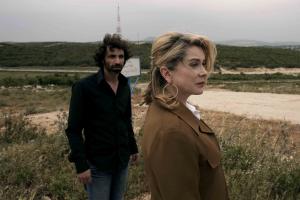
JE VEUX VOIR
Fiction | | couleur | 1:15 | Liban | 2007
Juillet 2006. Une guerre éclate au Liban. Une nouvelle guerre mais pas une de plus, une guerre qui vient briser les espoirs de paix et l?élan de notre génération de trentenaires. Nous ne savons plus quoi écrire, quelles histoires raconter, quelles images montrer. Nous nous demandons : « Que peut le cinéma ? » . Cette question, nous décidons de la poser vraiment avec l?aide d?une « icône », une comédienne qui représente pour nous le cinéma, Catherine Deneuve. Elle va rencontrer à Beyrouth notre acteur fétiche, RabihMroué. Ensemble, ils parcourent les régions touchées par le conflit. à travers leurs présences, leur rencontre, nous espérons retrouver une beauté que nos yeux ne parviennent plus à voir. Une aventure imprévisible, inattendue commence alors?
Nés à Beyrouth, ils travaillent conjointement en tant que plasticiens et cinéastes. Ils ont réalisé des courts-métrages, Ramad (Cendres) en 2003 etOpen the door, please ( du filmcollectif Enfances) en 2007 et des longs-métrages de fiction Al Bayt el zaher (Autour de lamaison rose) en 1999 et A Perfect Day en 2006. Ils ont également réalisé des documentaires tels que Khiam en 2000 ou El film el maoud (Le Film perdu) en 2003 et Khiam 2000-2007 en 2008. Leurs films ont été présentés dans un très grand nombre de festivals où ils ont reçu de nombreux prix et ont été accueillis avec enthousiasme tant par la critique que par les spectateurs. Leur travail cinématographique s?accompagne d?une recherche dans les arts plastiques. Ils ont ainsi créé plusieurs installations photo ou vidéo et exposent régulièrement dans des centres d?art, des musées ou des galeries. Leur prochaine exposition individuelle aura lieu le 11 décembre 2008 auMusée d?art moderne de la ville de Paris. Ils enseignent à l?université au Liban et participent à de nombreuses publications.
Claudia Joskowicz
Los rastreadores
Video | hdv | couleur | 23:0 | USA | 2014
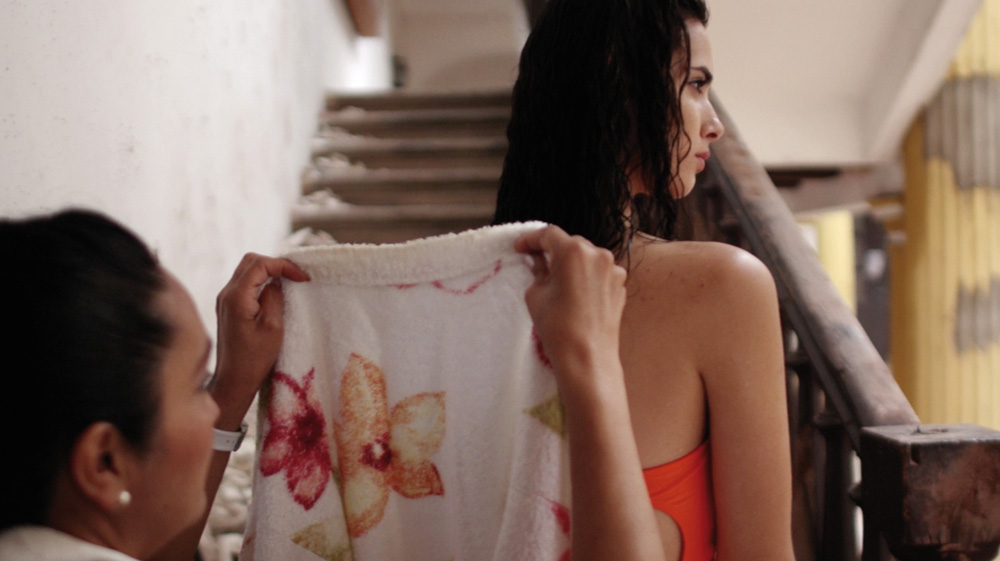
Los rastreadores is a two channel video installation set in Bolivia and very loosely inspired by John Ford's American Western classic film The Searchers. It does not attempt to recreate the film but adapts its major themes where the similarities lie in the use of landscape and depictions of themes like race and alienation. The main character in Los Rastreadores, Ernesto Suarez, is a drug lord who, recently released from a Miami prison, returns to his home in Santa Cruz only to immediately depart in a search towards the oposite side of the county for his family's only surviving members after a home invasion and massacre. Ernesto's character is modeled after Roberto Suarez Gomez, a Bolivian drug trafficker nicknamed "king of cocaine" and the most powerful drug lord in Bolivian history. Los Rastreadores merges and distills issues of race, belonging, class systems, and alienation into a minimal narrative that con - denses the massacre of Ernesto's family, the kidnapping of his daughter, and his departure to search for her. Using silences and voice-overs rather than traditional dialogue it centers on the power of myth where literal events operate as a displacement for the political discourse in the country.
Claudia Joskowicz (MFA New York University, 2000) has had solo exhibitions at LMAK Projects, Forever & Today, Inc., Thierry Goldberg Projects, and Momenta Art in New York, Dot Fiftyone in Miami, California Museum of Photography in California, Galeria ACBEU in Salvador, Espacio Simón Patiño and Museo Nacional de Arte, Centro Cultural Santa Cruz and Galería Kiosko in Bolivia, and Lawndale Art Center in Houston. Recent group exhibitions at the Guggenheim Museum, NY; Fondation Cartier pour l`art contemporain, Paris; Museum of Contemporary Art, Denmark; Tenth Sharjah Biennial; the 29th São Paulo Biennial; the Tenth Habana Biennial; Slought Foundation, Philadelphia and the 17th and 18th Videobrasil Festivals in São Paulo. She has received a Guggenheim fellowship, a mid-career artist commission from the Cisneros Fontanals Art Foundation, a Fulbright Scholar award, and a fellowship from the Vermont Studio Center. Recidencies include Sacatar Institute in Brazil, Lower Manhattan Cultural Council Workspace, and the Bronx Museum of the Arts AIM program. Joskowicz is currently the artist in residence at the LMCC’s Residency at Cité Internationale des Arts, Paris.
Claudia Joskowicz
La niña de sus ojos
Vidéo | 4k | couleur | 18:32 | Bolivie, USA | 2022
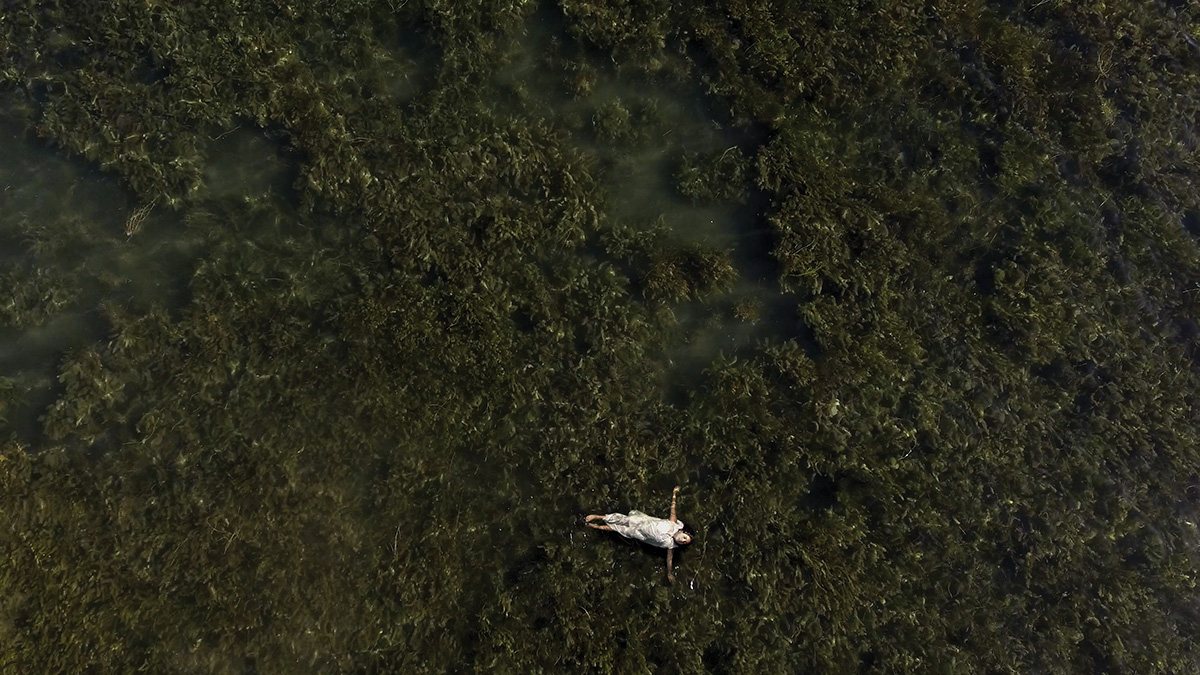
La niña de sus ojos (2022) appropriates fragments of the Bolivian folk novel of the same name (Antonio Díaz Villamil, La Paz 1948), that formed an important part of the discourse popular amongst the Bolivian intellectual elites of the period directly preceding the 1952 revolution. The novel, still in use in national pedagogy today, reflects the misogynistic and racist lens that was, and still is, used to impart seemingly democratic projects in Bolivia. Using the house - and home - as a narrative device, along with descriptions of the novel's main characters and the contemporary city of El Alto, this work seeks to locate the viewer between the unrealistic stereotypes described in the book and the true context of El Alto, highlighting the void that still exists today, over half a century later, between political discourse and enacted change.
Claudia Joskowicz is an artist who works primarily with film, video, installation and digital media. Her practice centers on history and its narrative, considering how popular media circulates and shapes collective memory, contemporary history and social realities. Using long and slow video footage and oscillating between film and photography, she reproduces moments captured from global collective memories and personal stories (her own and others’) that have a historical dimension and are anchored in her native Latin American landscape. For most of her career, she has focused on the Latin American landscape, producing work in her home country of Bolivia and South America at large. Her early video work was staged as minimalist reenactments - with attention to the figure and the landscape and focusing on gesture and subtle movement - and has moved towards re-imagined cinematic stagings of landscapes, urban and otherwise, where nuanced political drama unfolds in real time. The landscape and built environment are main characters throughout her work, as are her medium’s structural elements, drawing attention to the media’s role in constructing historical events, and our memories of them. Joskowicz has exhibited widely in the United States and internationally and her work is in the permanent collections of the Guggenheim Museum, NY; the Kadist Foundation, San Francisco, the Cisneros Fontanals Foundation, Miami, and the Banco Central de la República, Bogotá. Joskowicz has received numerous awards and grants including a NYFA Fellowship in film/video, an Anonymous Was a Woman Award, a Cisneros Fontanals Foundation Mid-Career Artist’s Commission, a Guggenheim fellowship in film/video, and a Fulbright Scholar award. She has been a fellow at Yaddo, the Latin American Roaming Art Project, Oaxaca, Mexico, the Sacatar Institute, Bahia, Brazil, the AIM program at the Bronx Museum of the Arts, NY and the LMCC’s Workspace and Paris residencies.
Jon Jost
Coming to Terms
Fiction | hdv | couleur | 89:0 | USA | 2013
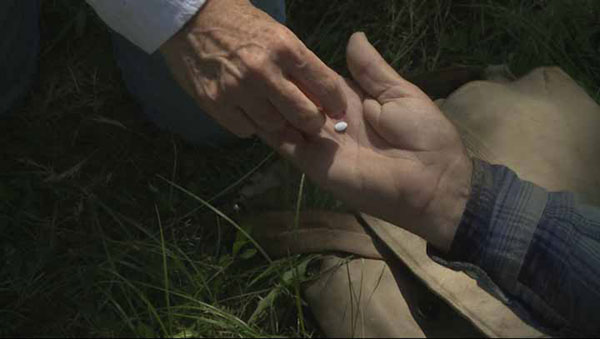
Couched as a fictional story, Coming to Terms is a meditation on a death, and its psychological impact on a fractured and divided family. Its formal structure is far from normal narrative story-telling in the cinema.
Jon Jost is a 50 year veteran of filmmaking with some 36 features to his name. He also paints, writes, does photography and writes and sings country-western music.
Jon Jost
Homecoming
Fiction | dv | couleur | 104:0 | USA | 2004
Tourné à Newport (Oregon), une petite ville côtière où la flottille de pêche a disparu qui survit désormais grâce aux résidences secondaires et au tourisme, HOMECOMING s`inscrit profondément dans la réalité actuelle de l`Amérique. Nous faisons la connaissance d`une famille ordinaire: Jeff (Keith Scales) et sa femme Mattie (Kate Sannella), ainsi que leur fils Chris (Ryan Harper Gray). Jeff dirige une petite agence immobilière avec sa femme. Chris est un chômeur fainéant de 26 ans qui vit avec sa petite amie plus jeune que lui (Kat Eastman). Petit à petit, nous apprenons l`existence d`un autre fils, engagé dans l`armée, "là-bas". Mattie boit de temps en temps en cachette, Jeff quant à lui n`est pas très honnête dans son travail. Lorsque Mattie oublie d`envoyer des papiers à la banque, l`entreprise de Jeff perd un contrat de 50 000 dollars. Chris se fait plaquer par sa copine et consulte un psychothérapeute des services sociaux (Steve Taylor). Nous découvrons que Jeff est le beau-père de Chris et que son propre fils, Steve, est en Irak. Steve retourne à la maison dans un cercueil. Après les funérailles, la famille se rassemble au bord de l`océan et les déchirures internes apparaissent. Jeff et Chris se disputent violemment et Chris se retrouve à terre, le nez en sang. Mattie boit et finit à son tour par terre alors que Jeff perd le contrôle. Chris va chez son psychothérapeute et leur rencontre s`achève par une fellation. Il passe voir son ex pour tenter de renouer; elle le rejette. Chris saute d`une falaise surnommée dans la région "Jump Off Joe`s". HOMECOMING n`est pas un film basé sur un scénario, c`est plutôt un poème symphonique; ses significations émergent de son atmosphère, de ses humeurs, de son sens du temps et de l`espace. Il est pensé comme une métaphore de l`Amérique en général, qui est actuellement très divisée et incapable de débattre de manière constructive en passant outre cette division. Ce film aborde ce sujet de manière poétique, douce, à travers des personnages incapables de confier aux autres ou à eux-mêmes l`inquiétude qui se fige en eux.
Jon Jost
La lunga ombra
Fiction | dv | couleur | 77:0 | USA | 2006
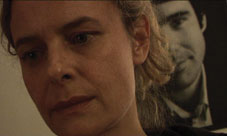
Trois femmes d'âge mûr se rendent à la mer, deux d'entre elles (Miglio et Gianfelici) réconfortent la troisième (Nano) que son mari vient de quitter. Au cours de leur tentative pour consoler Anna, les deux femmes sont entraînées dans le maelström de sa tristesse. Cette oeuvre est surtout un récit à caractère poétique, dans lequel le véritable sujet, l'impact du 11 septembre sur l'intelligentsia européenne et italienne, n'est jamais mentionné, mais demeure à l'arrière-plan agissant de manière invisible sur les personnages. La "Lunga Ombra" a été réalisée sur une durée de 5 jours, de manière improvisée, sans suivre de script, mais seulement avec la vague idée d'évoquer l'angoisse qui s'est répandue en Europe à la suite du 11 septembre, un trouble qui s'immisce insidieusement, au-delà des mots.
Jon Jost a réalisé des vidéos et des films expérimentaux, dont quelques 15 long-métrages sur film celluloid, en 16 et 35 mm, et 12 long-métrages en vidéos numériques, ainsi que de nombreux films très courts; et plus récemment, des installations avec plusieurs écrans. Il vit actuellement à Lincoln Nebraska, aux Etats-Unis, où il est en résidence d'artiste.

Joyce Joumaa
To Remain in the No Longer
Doc. expérimental | 16mm | couleur | 37:0 | Canada | 2023
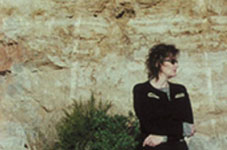
In 1962, Oscar Niemeyer was invited to conceive an international fairground in the city of Tripoli, Lebanon, which was never completed. To Remain in the No Longer looks at how architecture operates in this failed state. By examining the precarity of the project site that remains to this day, the film reflects on the country’s current socio-economic crisis. Employing archival materials, interviews, and 16mm and digital film, the experimental documentary explores the political and cultural forces that have come to bear on the site—from its halted construction to its imposed abandonment and attempted reappropriations. How has architecture been instrumentalized in the ongoing construction of a national narrative? What is the role of architects in shaping society within corrupt ecologies of power and failed financial engineering? Film becomes a plastic medium to reframe the positivism of urban masterplans and architectural monuments and formulate a social critique. Modern structures under threat of collapse stand in as protagonists to tell the story of a promised metropolis that never came to be, while the fairground acts as a lens to look at implicit collapse beyond the perimeter of the site.
Based between Beirut and Amsterdam, artist and filmmaker Joyce Joumaa earned a BFA in Film Studies from Concordia University in Canada. In 2021-2022, Joumaa had her first institutional solo show at the CCA The Canadian Centre for Architecture. Her work has shown at the Montreal Museum of Fine Arts, Fofa Gallery, the Sharjah Architecture Triennial and in the 2024 60th Venice Biennale.
Valérie Jouve
Grand Littoral
Vidéo expérimentale | 35mm | couleur | 20:0 | France | 2003
« Ce n?est pas dans l?idée de fiction ou de documentaire que je me suis posé la question du cinéma... Je pourrais parler de composition, de structure musicale des images ; c?est dans ce sens que ce film a pris, petit à petit, forme dans mon esprit. En effet, la musique permet d?aborder le réel avec des notions de pleins, de vides, de rythmes, de temporalités... J?ai toujours eu une relation à l?image qui se construit dans cette abstraction là, construisant toujours le réel. »
Valérie Jouve was born in 1964 in Saint Etienne, France, and she currently lives in Paris. She has produced documentaries that have been shown in diverse festivals, and has produced numerous individual and collective exhibitions in Europe, China, and the United States.

Maren Dagny Juell
Human Resource the Musical
Animation | hdv | couleur | 6:22 | Norvège | 2023
The scripts are based on resources like instructional videos and management training tools, sales pitches and tutorials on stress management. Collaging and adapting elements from these and other sources, the work gives birth to a ‘subject’ who speaks with a double tongue, veering between the human and the digitally generated, and delivering a message that is simultaneously authoritative and incoherent, reassuring and vacuous.
Maren Dagny Juell is an artist working with moving image, installation and VR/AR. Maren was born in Oslo, Norway where she currently has a studio. She received her MA from Chelsea College of Art (London) in 2004. The last solo shows have been at Trondheim Center for Electronic Arts (2023), Tenthaus (2021), Atelier Nord Oslo (2019), Trafo Kunsthall (2018), Podium Oslo (2017) and Trøndelag Senter for Samtidskunst (2018). Work has been included in group shows at Bergen Center for Electronic Arts (2021), Astrup Fearnley Museum of Modern Art (2008) and Stavanger Kunstmuseum (2015) amongst others. Moving image works have been screened internationally like The Australian video Biennial in Melbourne( 2017 and 2019). She has participated in and made new works for various biennials including; Riga Photography Biennial (2020), Meta.Morf Trondheim international biennale for art and Technology (2022) and Art Encounters Biennial, Timisoara Romania (2023). In 2024 she won the Nordic Award category at Lumen Prize for “Human Resource the Musical”.
Pauline Julier, Nicolas Chapoulier
Tout Ira Bien
Vidéo expérimentale | 4k | couleur | 8:55 | Suisse, Italie | 2020
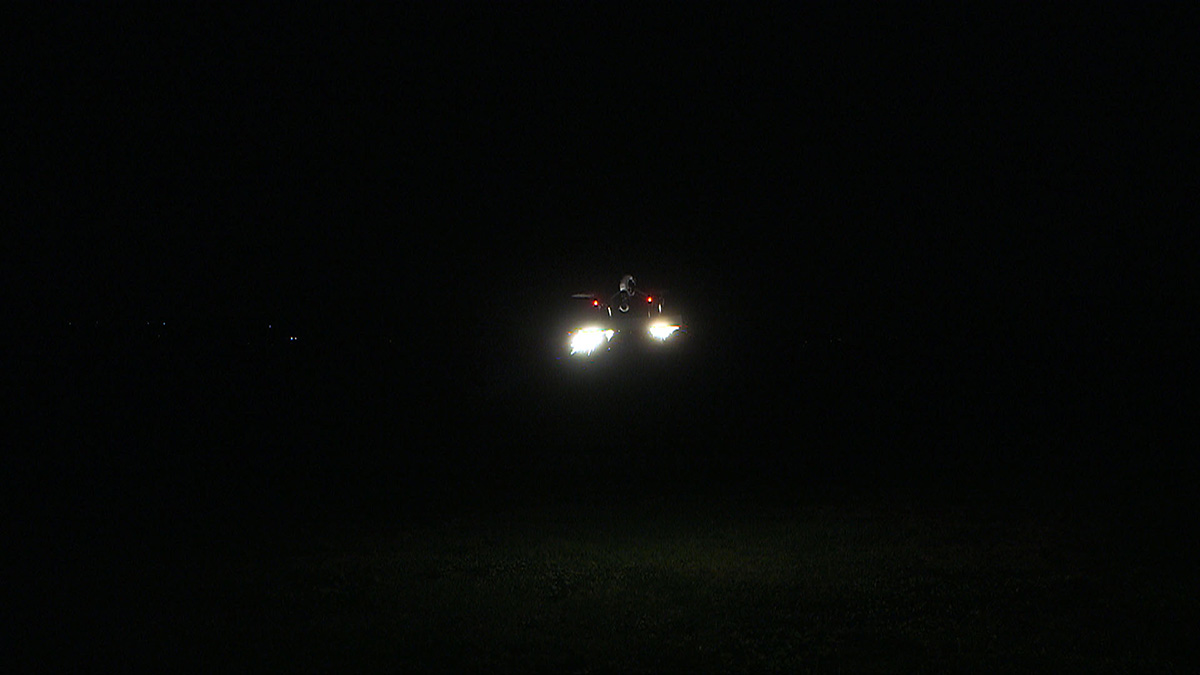
A la tombée de la nuit, un oracle volant s’avance et déroule un message.
Pauline Julier est artiste et cinéaste. Ses films ont été présentés dans des festivals, des centres d’art et des institutions du monde entier, parmi lesquels le Centre Pompidou à Paris, le Festival Loop à Barcelone, Visions du Réel à Nyon, DOCLisboa, le Tokyo Wonder Site à Tokyo, le Museum of Modern Art en Tanzanie, le Centre d’Art de Genève, à New York, Madrid, Berlin, Zagreb, Bucharest, à la Cinémathèque à Toronto ou encore au Pera Museum Musée à Istanbul. Elle a reçu le Swiss Federal Art Price à Art Basel en 2010 et elle a présenté une exposition solo au Centre Culturel Suisse de Paris en 2017. Cette année, elle participe à l’exposition de Bruno Latour, « Critical Zone » au ZKM et finit une résidence d’une année à l’Institut Suisse de Rome pour un nouveau cycle de recherches et films. Nicolas Chapoulier, co-réalisateur sur ce film, est directeur artistique de la compagnie « Les 3 points de suspension » avec laquelle il tourne mondialement. Auteur, comédien, acrobate, plasticien et metteur en scène, il assure la mise en scène et la direction artistique des spectacles Nié qui tamola, La grande Saga de la Françafrique (nominé aux Molières 2017) Looking for Paradise, et Squash . En 2011, il rédige Nié qui tamola au Editions Requins Marteaux, un roman graphique documentaire. En 2014, il est lauréat de la Fondation Beaumarchais/SACD Ministère de la Culture- Bourse à l’écriture, Ecrire pour la Rue pour le projet Looking for Paradise. En 2015, il fonde le collectif 3615 Dakota, qui réalise des performances urbaines avec lequel ils sont invités au pavillon français de la biennale de Venise d’architecture en 2019.

Pauline Julier
Noé
Doc. expérimental | betaSP | couleur | 22:0 | Suisse | 2010
Le spectateur est à la place de Noé, en plein rêve. Il se réveille dans un lieu clos, avec autour de lui une énorme quantité de graines visiblement conservées à l?abri. L?espace est trop étroit, il décide de sortir. Dehors le monde a disparu sous la glace. Il est seul. Alors qu?il est partagé entre la peur et un sentiment de plénitude face à cette nouvelle découverte, des images désordonnées lui soufflent le souvenir de son monde. Métaphore poétique d?un état de folie lucide, le film suggère la possibilité d?un monde inhabité et stérile, un cauchemar blanc...
Née en 1981 à Genève, Pauline Julier est diplômée avec mention de l?Institut d?Etudes Politiques de Grenoble en 2002 et de l?Ecole Nationale Supérieure de Photographie d?Arles en 2007. Elle présente plusieurs de films dans des expositions collectives et des festivals de cinéma, et son film Pamięć est paru en mars 2009 aux Editions Waknine. Elle a reçu cette année le Prix d`art fédéral Suisse à Art Basel pour l`installation de son dernier film Noé. Elle s?intéresse à plusieurs médiums complémentaires au cinéma et travaille notamment au sein de PHP (Henriette Desjonquères, Paul Fargues, Pauline Julier), collectif transdisciplinaire associé au 104 à Paris dès 2011. Elle filme et écrit pour créer des agencements d`éléments réels et imaginaires. Son travail interroge les rapports étroits et ambigus entre réel et fiction et propose des formes narratives singulières.
Pauline Julier
Cercate Ortensia
Doc. expérimental | hdv | couleur | 16:0 | Suisse | 2021
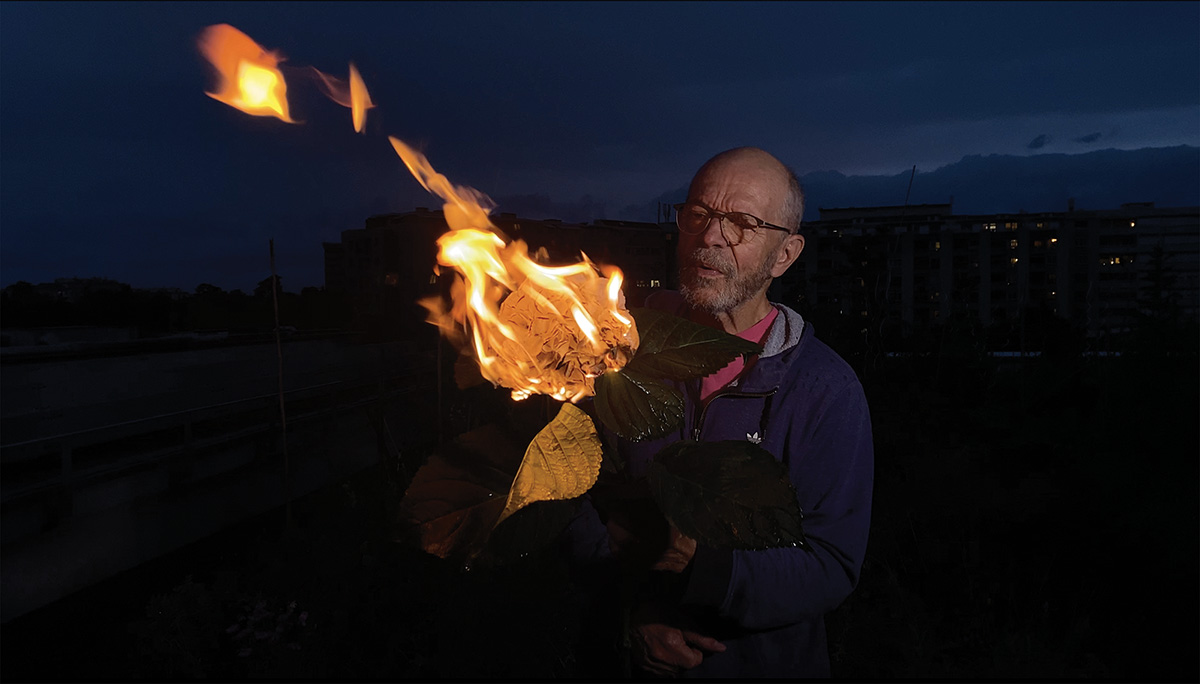
Inspirée par le poème féministe italien d’Amelia Rosselli, La Libellula (Panegirico della libertà) (1958), Cercate Ortensia est un film d’archives scientifiques, personnelles et de réseaux sociaux. Entre hommage et vengeance face à son héritage littéraire, le poème de Rosselli se nourrit de l’ambivalence de la figure d’Hortense du poème « H » d’Arthur Rimbaud, entre élan d'ouverture et retrait intime. Cercate Ortensia recrée un mouvement circulaire marquant une bouffée d’air libératrice face au passé et la vieillesse. Le film explore la chute, la disparition, l’oubli, l’évanescence, traçant un lien entre les recherches de pionniers scientifiques, la désorientation liée à la perte de mémoire d'un père vieillissant et malade, jusqu’à l’actualité brûlante de la catastrophe écologique.
Pauline Julier est artiste et réalisatrice. Elle explore les liens que l'homme crée avec son environnement à travers des histoires, des rituels, des connaissances et des images. Ses films et installations sont composés d'éléments d'origines diverses (documentaire, théorique, fictionnel) pour restituer la complexité de notre rapport au monde. Ses installations et films ont été projetés dans des centres d'art contemporain, des institutions et des festivals du monde entier, notamment au Centre Pompidou (Paris), au Loop (Barcelone), à Visions du Réel (Nyon), au Tokyo Wonder Site (Tokyo), au Musée d'art moderne de Tanzanie, au Geneva Art Center, au Palazzo Grassi (Venise), à New York, Madrid, Berlin, Zagreb, à la Cinémathèque de Toronto et au Pera Museum d'Istanbul. Julier a présenté une exposition personnelle au Centre Culturel Suisse à Paris (CCS) en 2017 et vient de recevoir le Prix fédéral d'art suisse en 2021. Son film « Naturales Historiae » vient d'être diffusé en ligne sur Vdrome.org et son prochain film, « Way Beyond », sélectionné en compétition à Visions du Réel 2021 sera dans les salles suisse à l’automne. Elle présente ce printemps une grande installation à l’institut d’Art Contemporain de Villeurbanne.
Sophie Jung
The Objective I
Vidéo | hdv | couleur | 5:13 | Luxembourg, Suisse | 2012
Form, function, awe and all.
Sophie Jung was born in 1982 in Luxemburg and grew up in Germany and Switzerland. She studied Photography and Media Arts at the Folkwang school in Essen, the Zürcher Hochschule der Künste and graduated in 2011 from the Rietveld Academy in Amsterdam and is currently doing her MA in Fine Arts at Goldsmiths, University of London. She lives and works in Basel and London.
Mathieu K. Abonnenc
Secteur IX B
Fiction | 4k | couleur | 42:35 | France | 2015
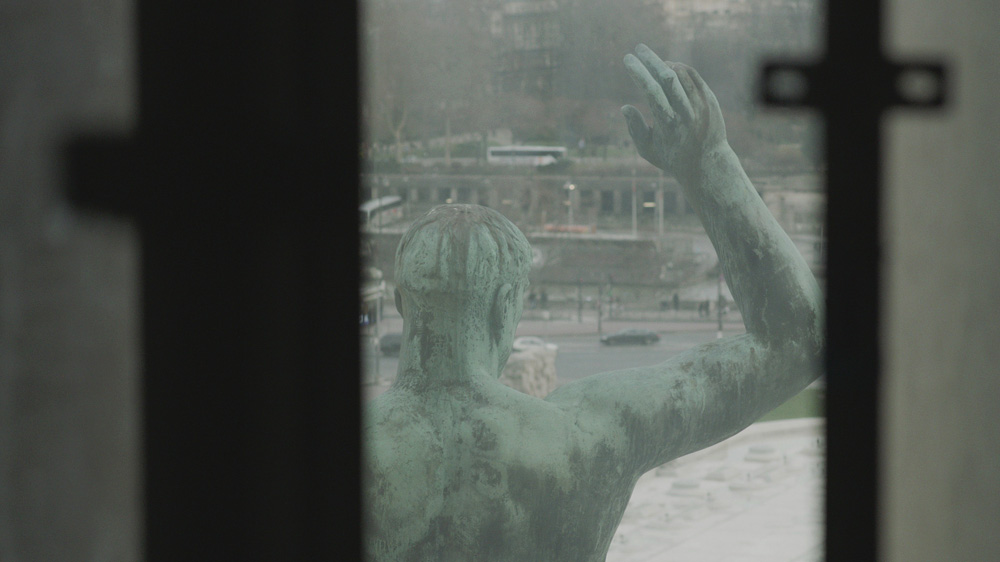
Secteur IX B met en scène la conservation d’une collection anthropologique ramenée la Mission Dakar-Djibouti, une des plus grande opération de collecte coloniale, à travers une relecture de l’ouvrage L’Afrique fantôme de Michel Leiris. Par son dispositif, tourné entre la France et le Sénégal, le film dévoile le destin et la mémoire d`archives par un récit fantasmé, qui désigne un état des relations entre les peuples.
Mathieu Kleyebe Abonnenc s’attache à interroger les formes d’hégémonie culturelle sur lesquelles s’est appuyée l’évolution de nos sociétés contemporaines. Qu’il s’agisse de vidéos, de photographies, d’installations, de dessins ou de projets d’exposition, Mathieu Kleyebe Abonnenc explore les principes de représentation dominants en s’appropriant des éléments et des événements préexistants, principalement liés aux histoires impériales et coloniales des pays dits développés. Autant d’objets appartenant à une mémoire collective dont l’universalisme de principe est mis à l’épreuve depuis plus d’un siècle. Chacun de ces éléments nécessite d’être constamment renégocié afin d’en dégager des problématiques contemporaines, en termes de construction d’une identité, d’une communauté, d’une nation, et ainsi permettre par moment de réinventer l’action artistique et politique. Mathieu Kleyebe Abonnenc est diplômé des Beaux-arts de Marseille en 2002. Il a fait parti du programme de recherche La Seine de l’Ecole Nationale supérieure des Beaux-arts de Paris de 2006 à 2008 . Son travail à fait l’objet en 2013 de deux expositions personnelles, Songs for a Mad King à la Kunsthalle de Bâle, Suisse et Kannibalen au Bielefelder-Kunstverein, Allemagne. En 2012, deux institutions, la Fondation Serralves à Porto au Portugal et Pavilion à Leeds en Angleterre, ont organisé des expositions personnelles de l’artiste. Toujours en 2012 , Mathieu Kleyebe Abonnenc a participé à la Triennale de Paris, Intense Proximité, au Palais de Tokyo, ainsi qu’à des expositions collectives à la Fondation d’entreprise Ricard à Paris et l’ICA – Institue d’Art Contemporain de Philadelphie aux États-Unis.
Yasmine Kabir
The Last Rites
Documentaire | dv | couleur | 17:0 | Bangladesh | 2008
` The Last Rites?, a silent film by Yasmine Kabir, depicts the ship breaking yards of Chittagong- a final destination for ships that are too old to ply the oceans any longer. Every year, hundreds of ships are sent to yards in Bangladesh. And every year, thousands of people come to these yards in search of jobs. Risking their lives to save themselves from hunger, they breathe in asbestos dust and toxic waste. The elemental struggle between man and metal figures throughout the film, as men carry the weight of steel ropes over their shoulders, pull huge parts of the vessels inland, and bear great metal plates. ` The Last Rites? is an allegorical portrayal of the agony of hard labor.
Yasmine Kabir is an independent filmmaker based in Bangladesh. Her filmography includes: Death Chant 1992 A day at the Embassy 1996 For Solaiman 1997 A Mother`s Lament (Duhshomoy) 1999 My Migrant Soul (Porobashi Mon Amar) 2000 Direct-Direct (Music Video) 2003 A Certain Liberation (Shadhinota) 2003 The Last Rites (Shesh Kritto) 2008
Jane Jin Kaisen
Halmang
Vidéo | 4k | couleur | 13:13 | Danemark, Coree du Sud | 2023
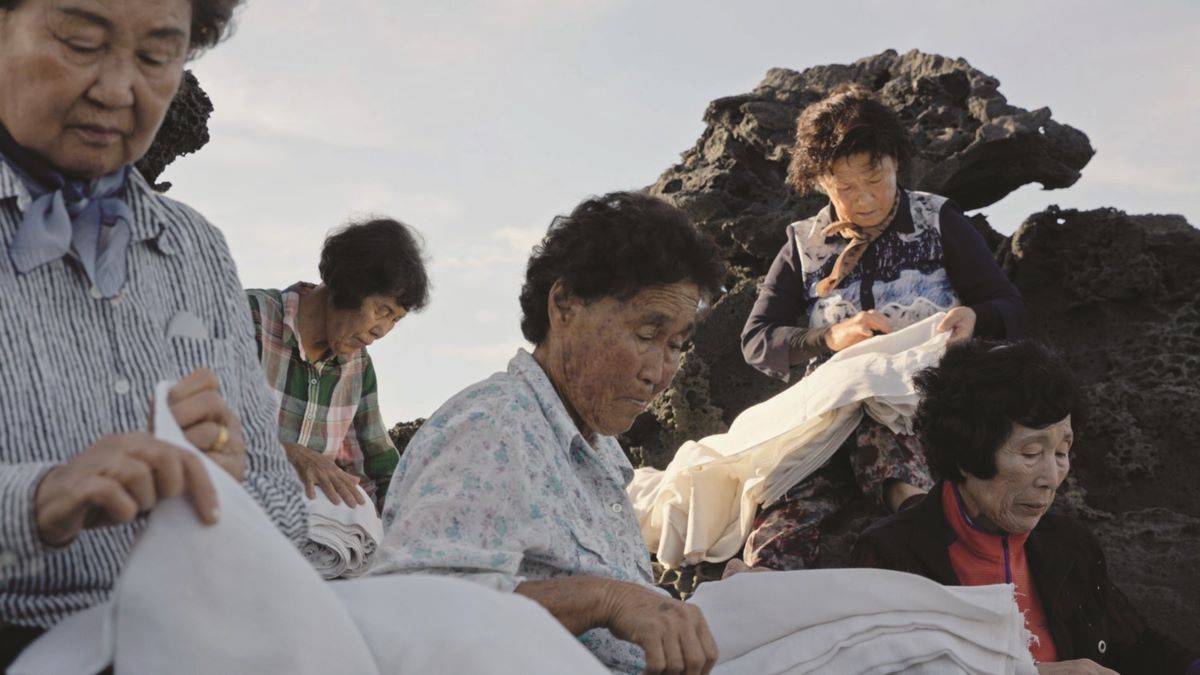
Halmang revolves around a group of eight women in their 70s and 80s. It is filmed by the coast of Jeju Island near a lava rock islet that used to serve as a shamanic shrine for the wind goddess Yongdeung Halmang. The women, who have worked and made a living together for most their lives as haenyeo sea divers, used to depart together for the sea from this very location. The title Halmang refers to this spiritual aspect as shamanic goddesses in Jeju are referred to as ‘halmang’ while also being the Jeju term for ‘grandmother’ and a respectful form of address for a woman. It was also from this area that Kaisen’s grandmother during her lifetime used to depart for the sea as a haenyeo sea diver. The film portrays the aging women’s lived experience, their community and spirituality connected to the sea, the wind and the island. Central to the work is its focus on the collective use and care for sochang; a white, long cotton cloth associated with female labor and a symbol of cycle of life and death and humans’ connection to the spirit world. The camera carefully registers their hands, gestures, and facial expressions as they meticulously tend to the fabric. As the piece unfolds, they start connecting the long rolls of sochang until it comes to form a large spiral enveloping the black lava rocks. The music is produced by Lior Suliman (also known as Dub Mentor) and is comprised of layers of on-site recordings, looped, interleaved and treated to create an immersive sound experience. It also features The Song of the Haenyeos by Gang Gyung Ja and Song of Haenyeo Preservation Association.
Jane Jin Kaisen is an artist, filmmaker, and Professor of the School of Media Arts, The Royal Danish Academy of Fine Arts. Spanning the mediums of video installation, experimental film, photography, performance, and text, her work is informed by extensive interdisciplinary research and long-term engagement with minoritarian communities. She is known for her visually striking, multilayered, performative, poetic, and multi-voiced feminist works through which past and present are brought into relation. Engaging topics such as memory, migration, borders, and translation, she activates the field where lived experience and embodied knowledge intersect with larger political histories. Kaisen is a recipient of is a recipient of the New Carlsberg Foundation Artist Grant (2023) and a 3-year work grant from the Danish Arts Foundation (2022) and awarded Exhibition of the Year 2020 by International Association of Art Critics, Denmark for the exhibition Community of Parting at Kunsthal Charlottenborg. She represented Korea at the 58th Venice Biennale and has exhibited and screened her artworks and films in a wide range of contexts internationally.
Jane Jin Kaisen
Burial of this Order
Film expérimental | 4k | couleur | 25:12 | Danemark, Coree du Sud | 2022
A procession of non-conforming people – from musicians, artists and poets to anti-miliary activists, environmentalists and diasporic, queer and trans people – carry a coffin together through the ruins of what turns out to be an abandoned resort on the South Korean island of Jeju. It soon becomes clear that this is no traditional Confucian funeral. Age and gender roles are subverted, the coffin is draped in dark camouflage colours and the traditional portrait of the deceased is replaced by a black mirror. In the field between funeral ritual, political protest and carnival performance, the people in the procession who have come together to undo a world order built upon hierarchy and division, march through the ruins of capitalist modernity. Time and place begin to lose their stability as mythical Dokkaebi deities pass through the building and heavy rain and wind blow through its cavities. As if possessed the group, in a moment of revolutionary fervour, overthrows and dismantles the scaffolding of the prevailing order and other stories begin to take form. Jane Jin Kaisen’s interdisciplinary work not only activates Jeju’s violent history as a site of oppression and rebellion, but is a work with universal power.
Jane Jin Kaisen (born 1980 in Jeju Island, lives in Copenhagen) is a visual artist, filmmaker, and Professor of the School of Media Arts, The Royal Danish Academy of Fine Arts. Spanning the mediums of video installation, narrative experimental film, photographic installation, performance, and text, Kaisen’s artistic practice is informed by extensive interdisciplinary research and engagement with diverse communities. She is known for her visually striking, multilayered, performative, poetic, and multi-voiced feminist works through which past and present are brought into relation. Engaging topics such as memory, migration, borders, and translation, she activates the field where lived experience and embodied knowledge intersect with larger political histories. Through multi-year projects and collaborations, she has engaged topics such as transnational adoption, the Korean War and division, the Jeju April Third Massacre, and Cold War legacies. Another recurring focus revolves around nature and island spaces, cosmologies, feminist re-framings of myths, and engagement with ritual and spiritual practices. Working from the thresholds of mediums and forms, disciplines and sensibilities, her works negotiate and mediate the means of representation, resistance, and recognition, thus contouring alternative genealogies and sites of collective emergence. Kaisen is a recipient of the New Carlsberg Foundation Artist Grant (2023) and a 3-year work grant from the Danish Arts Foundation (2022). She represented Korea at the 58th Venice Biennale with the film installation Community of Parting (2019) alongside artists Hwayeon Nam and siren eun young jeong in the exhibition History Has Failed Us, but No Matter curated by Hyunjin Kim. She was awarded “Exhibition of the Year 2020” by AICA - International Association of Art Critics, Denmark for the exhibition Community of Parting at Kunsthal Charlottenborg. Kaisen has participated in the biennials of Liverpool, Gwangju, Anren, Jeju, among others. Recent solo exhibitions include Jane Jin Kaisen: Braiding and Mending at The Image Centre (2023), Of Specters or Returns at Le Bicolore (2023), Currents at Fotografisk Center (2023) Parallax Conjunctures at Museum of Contemporary Art Detroit (2021), Community of Parting at Art Sonje Center (2021) and Kunsthal Charlottenborg (2020). Other recent exhibitions and screenings: Dislocation Blues: Jane Jin Kaisen, Tate Modern (2023), Ceremony (Burial of an Undead World), Haus der Kulturen der Welt (2022), Checkpoint: Border view from Korea, Kunstmuseum Wolfsburg (2022), Unmoored Adrift Ashore, Or Gallery Vancouver (2022). She holds a PhD in artistic research from the University of Copenhagen, Department of Art and Cultural Studies, an MFA in Interdisciplinary Studio Art from the University of California Los Angeles, an MA in Art Theory and Media Art from The Royal Danish Academy of Fine Arts, and she participated in the Whitney Museum of American Art Independent Study Program. Other exhibition and screening venues include: Kunsthal Aarhus, Nikolaj Contemporary Art Center, The National Museum of Photography (DK), Haus der Kulturen der Welt, Berlinale, Kunstmuseum Wolfsburg, Times Art Center, Museum Ludwig, Videonale (DE), Asian Art Museum, Museum of Contemporary Art Los Angeles, Gana Art New York, DePaul Art Museum (USA), ARKO Art Center, Seoul Museum of Art, Incheon Art Platform, Seoul New Media Art Festival, Leeum Samsung Museum of Art, Asia Culture Center, Coreana Museum of Art, DMZ International Documentary Film Festival (KR), Silencio Club, Palais de Tokyo, Foundation Fiminco (FR), Malmö Konstmuseum, Malmö Konsthall, Inter Arts Center, Kalmar Art Museum (SE), Sørlandet Art Museum and Oslo Kunstforening (NO), Finnish Museum of Photography (FN), ParaSite (HK), Kyoto Arts Center, Kyoto Museum of Art, Fukouka Museum of Art, Yamagata International Documentary Film Festival, (JP), Times Museum Guangzhou, Beijing 798 Art Zone (CN), Kaohsiung Museum of Fine Art, Taiwan International Documentary Film Festival (TW), Museum of Contemporary Art and Design (PH), The National Gallery (Indonesia), and Townhouse Gallery (EG).
Leilani Kake
Tino Rangatira Tanga
Documentaire | dv | couleur | 16:6 | Nouvelle-Zélande | 2008
Maranga mai Wake up Maranga mai e te iwi Rise up the people O nga hapu Ngapuhi of the families of Ngapuhi Ki a mau, ki a u,ki a pupuri ai be strong,be fixed,hold on ki nga akoranga nui to the larger lessons "My very first memory of my Dad actually has no visual label but is made up of Sound, the warm soundscape of him singing as he strums the guitar, his voice booms over the acoustic harmonies of the strings. His mouth smiles as he sings a verse, his hands strums with vigor. I am safe in his song. On the night of the seventeenth of April 2008 my father Richard Kake passed away in Whangarei Hospital after suffering a massive stroke, he was fifty seven years old." Tino Rangatira Tanga invites the viewer into a sacred space of Love, loss and revelation. "It is a celebration of my relationship with my Father told through deeply intimate experiences strengthened through the musical soundscape that surrounded my Father?s life and death. The process of filming,editing and viewing the footage of my father?s life and untimely death helped me to grieve and in turn heal. Being able to experience and share this work has created moments of personal growth and insight. "
Kia Ora and Warm Pacific Greetings, My name is Leilani Kake, I live in Otara, Manukau City, South Auckland,Aotearoa(New Zealand) and I am a practicing Video Installation Artist of Nga Puhi, Tainui (NZ Maori) and Manihiki (Cook Island) descent. I graduated with the University of Auckland at the Manukau School of Visual Arts with a Bachelor of Visual Arts in 2002 and a Post Graduate Diploma of Fine Arts in 2005. My work transfers documentary footage and the recording of real events into an art context. My projects tend to be highly personal stories dealing with issues of identity and culture, tradition and change. Insight: ?Raising awareness of important issues pertaining to myself, Tangata Whenua(New Zealand Maori) and Pacific people in a way that creates constructive discussion has always been the main focus of my art.?