Catalogue > Liste par artiste
Parcourez la liste complète des artistes présentés dans le cadre des Rencontres Internationales depuis 2004. Utilisez le filtre alphabétique pour affiner vos recherches.
Aisling O' Beirn
Catalogue : 2007and other storeys | Animation | 0 | couleur | 11:55 | Irlande | 2006
Aisling O' Beirn
and other storeys
Animation | 0 | couleur | 11:55 | Irlande | 2006
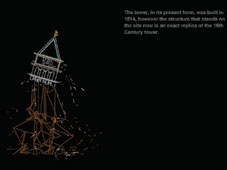
Cette oeuvre récente s'inspire d'un ensemble de recherches sur différents récits informels concernant des lieux. Pour mener cette recherche elle fait la collection de mythes urbains, d'anecdotes, de monuments, de surnoms de lieux et de plans déssinés à la main qu'elle a rassemblés dans différentes villes et cette collection est de plus en plus importante. Cet intérêt pour ces récits informels vient d'une préoccupation concernant la plotique de description de l'espace à niveau local et non officiel. Des installations récentes et des oeuvres in situ marquent une tentative de rassembler quelques unes de ces informations hétérogènes de façon non linéaire grâce à des sculptures et des moyens adaptés à des lieux précis. Cette animation, '...and other storys...' ('... et autres étages...'), raconte une série d'histoires populaires à propos de différents monuments situés dans un éventail de villes et lieux. Ces histoires, souvant amusantes, illustrent la nature contestée de chacun de ces lieux tout en signifiant à quel point des emplacements géographiques différents peuvent souvent être liés par leur caractère ordinaire. Vous pouvez trouver de la documentation sur les oeuvres précédentes à l'adresse suivante : www.aislingobeirn.com
Aisling O'Beirn travaille principalement à Belfast et réalise des oeuvres pour des galleries mais aussi des oeuvres in situ. Elle a fait des expositions nationales et internationales. Elle donne des cours sur la sculpture à l'université d'Ulster (University of Ulster). Aisling O'Beirn est représentée par la Third Space Gallery de Belfast. Parmi les expositions récentes on trouve la Biennale de Venise, 'The Nature of Things: A Long Weekend' ('La Nature des choses : un long weekend'). Les artistes venant d'Irlande du Nord lors de la 51ème Biennale de Venise, responsable H. Mulholland Oct 2005, CITY/OBSERVER, accueilli par Rhizome, dirigé par Yukie Kamiya, 'RISK' exposition collective et atelier/Residency CCA Glasgow, dirigé par Ele Carpenter 'THE BELFAST WAY' Herzeliya Museum of Contemporary Art, Tel Aviv, Israël mars 2005 organisé par S. Edelsztein. Exposition à deux avec R. Buchannen, Ards Arts Centre, organisé par Fully Formed Projects, 2006, SPACE SHUTTLE 2006, Lr Garfield Street and PS2, Belfast organisé par P. Muschler OBSCURED BY ARCHITECTURE, South Dublin Co. Council organisé par M. Dewmpsey DOGS HAVE NO RELIGION, le musée tchèque des beaux arts, Prague, organisé par R. Drury, 2006. Parmi les expositions personelles on trouve '...AND OTHER STOREYS' Void, Derry, organisé par C. Darke et M. O'Boyle, 2006 ainsi que A SMALL URBAN INVENTORY, Golden Thread Gallery April 2005
Mark O'connell
Catalogue : 2006All Broke Up | Art vidéo | dv | couleur | 3:58 | USA | 2004
Mark O'connell
All Broke Up
Art vidéo | dv | couleur | 3:58 | USA | 2004
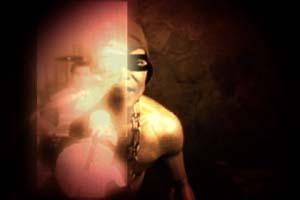
"What? Torture!?! I didn`t see any torture. Did you see some torture? Nobody saw any torture....."
Mark O`Connell probes and pushes the emerging representational, juxtapositional possibilities afforded by today`s expanding range of digital media. After a score of years in music--as a performer, composer, and producer--he now works with a variety of media: still images, video, film, music and text; all manipulated as digital information. The finished pieces are generally delivered via videotape or Quick Time computer files. His work has been exhibited in a wide range of venues.
Alison O'daniel
Catalogue : 2007Deep Woods | Vidéo expérimentale | dv | couleur | 5:30 | Royaume-Uni | 2005
Alison O'daniel
Deep Woods
Vidéo expérimentale | dv | couleur | 5:30 | Royaume-Uni | 2005
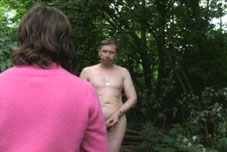
Le dos d'une femme quelque peu à gauche du centre, remplit l'image. Elle se tient juste devant la caméra, qui de temps en temps enregistre un aperçu de l'homme qui se tient face à elle à quelques mètres de distance, quelque part dans une forêt. La caméra, l'homme et la femme bougent à peine tandis u'un voix off éclaire le contexte de ce qui est en train de se passer. La voix appartient probablement à l'homme duquel nous avons vu juste assez pour être capable d'estimer qu'il doit être un vieux gentleman. Il explique qu'il est sans cesse à l'affût de nouveaux défis, expériences et limites. Il se demande comment cela va l'affecter, quelque soit ce qu'il fera plus tard, ce dont le spectateur ne peut qu'avoir une idée. La voix off semble être basée sur une conversation ou correspondance qui se joue entre lui et la femme avant l'enregistrement. Il admet qu'il se sent embarrassé, gêné par cette situation et dans l'idée qu'il va faire une telle chose en sa présence, en la présence de l'équipe caméra et éventuellement d'un public. Puis, alors que la caméra se déplace un peu, nous pouvons voir qu'il commence à se dévêtir calmement. Il remet ses vêtements à la femme. Comment son corps va-t-il réagir en ces circonstances, va-t-il coopérer élégamment ou cela va-t-il l'embarrasser ? Il n'est pas un modèle ou un acteur, dit-il. Il regarde alternativement vers la femme ou la caméra, comme si il ne voyait pas la femme, ou sur les côtés ou vers le haut. Très calmement il exécute les actions acceptées et ce sur quoi elle lui remet un morceau de tissu et ses vêtements. "Deep Woods" pourrait être interprété comme une performance qu'effectue O'Daniel à travers quelqu'un d'autre. C'est une action pour laquelle elle a besoin de l'autre et s'implique en entier dans ce dont elle est en premier lieu témoin : elle se tient clairement entre l'homme et la caméra, et le spectateur. Derrière son dos on peut voir ce qu'elle voit mais seul celui qui est face à elle peut voir son visage. Et ce n'est pas elle mais vous qui êtes le voyeur, sûrement pour le moins gêné par ce que vous êtes en train de voir.
Nick O'dwyer, Rachel BLISS
Catalogue : 2006Village Life | Documentaire | dv | couleur | 60:45 | Royaume-Uni | 2005
Nick O'dwyer, Rachel BLISS
Village Life
Documentaire | dv | couleur | 60:45 | Royaume-Uni | 2005
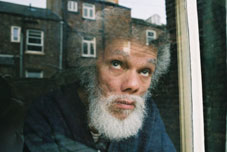
Le village de Botton - replié dans les hautes contrées du Nord du Yorkshire Anglais ? est un épisode d?une série télévisée ; l?épisode du Village des Dammnés. C'est une expérience sociale audacieuse dans laquelle 136 villageois handicapés, ayant des difficultés pour apprendre, vivent en communauté avec 100 co travailleurs. A cause de sa situation géographique isolée entre autres, Botton est un lieu chargé d?émotion où d' étranges sauts d?humeurs sont routiniers et tolérés. Landmark film a bénéficié d'un accès au village de Botton remarquablement libre et VILLAGE LIFE ? filmé lors d?un froid hiver?est un mélange extraordinaire d?émotions et de bizarrerie. Le film suit à la trace un groupe de villageois au travers d?évènements de leur vie émotionnellement difficiles. C?est un documentaire inhabituellement "pur" qui déroule une série de scènes observées, permettant à ces gens dans le besoin de parler par eux-mêmes, sans la médiation d?experts ou de thérapeutes. Le résultat du film est très cru, direct, honnête et provocant.
Nick O?Dwyer a principalement, tourné pour la BBC depuis 1994 où il a réalisé la série Modern Time. Il a, à partir de 1998, commencé à travailler alternativement sur des séries de documentaires touchants pour ITV et Channel 4. Depuis, Nick est retourné une seule fois travailler avec la BBC à l?occasion d?un documentaire en 2002.
Doireann O'malley
Catalogue : 2023New Maps of Hyperspace | VR vidéo 360 | 4k | couleur | 6:44 | Irlande | 2020

Doireann O'malley
New Maps of Hyperspace
VR vidéo 360 | 4k | couleur | 6:44 | Irlande | 2020
The work is a parable on Alan Turing’s technological disembodiment, drawing on concepts from Terrence McKenna’s Hyperspace, an undoing of the matter of consciousness and technologies empty promises of liberation and progress. Imagining a future self calls for a dreaming of the kind Terence McKenna evokes in his essay New Maps of Hyperspace (1989) and from which this work formed the research. For McKenna the dream is “zero time” and “outside of history.” It is analogous to the speculative experience of hyperspace, a scifi term given to the space-time continuum in which it is possible to travel faster than light. In both states, time appears to stand still (Einstein’s theory of relativity tells us that the closer an object travels to the speed of light the slower time becomes). Dreaming can quickly turn to nightmare however, and the episodic repetition of history-as-nightmare can, at times, feel like farcical simulation. Finally this work touches on the yawning gaps between our wish for escape, human connection and approval — and our seemingly Sisyphean task of achieving any of it. Hyperspace is a notion from science fiction of a superluminal method of travel. It is typically described as an alternative “sub-region” of space co-existing with our own universe which may be entered using an energy field or otherdevice. In most fiction, hyperspace is described as a physical place that can be entered and exited. Whereas in the VR work the viewer is essentially trapped in blue screen of death, unable to escape. (Text by Thomas Butler)
Doireann O’Malley (born 1981 in Limerick, IE) is a multidisciplinary artist based in Berlin. Their research-led practice unites collaborative methodologies, healing and reparative movement, writing, and theory, with a strong technological emphasis on new media, virtual Reality, 3Dand film installation. O’Malley holds an MFA from University of Ulster in Belfast, UK. From 2021- 2022 held the position of Professor of Gender & Space at Akademie der bildenden Künste Wien. They were a research fellow at the Berliner Förderprogramm Künstlerische Forschung (2020-2021) and a participant of the BPA// Berlin programme for artists (2019-2020). They acted as a guest mentor on the The Live Arts MA / AdBK Nuremberg (2001) Their exhibitions, talks and screenings have been presented at IMMA, Dublin, IE; Art Institute, Basel, CH; Biennale Zielona Góra, PL; Goethe-Institut Montreal, CA; Goethe-Institut, NY, USA; Neuer Berliner Kunstverein (n.b.k.), Berlin, DE; National Sculpture Factory/Cork Film Festival, Cork, IE; GöteborgInternational Biennial for Contemporary Art, SE; Rencontres Internationales, Forum des Archives, Paris, FR & HKW, Berlin, DE; Mumok Kino, Vienna, AT; Dublin City Gallery, Dublin, IE; KW Institute for Contemporary Art, Berlin, DE; Berlin Art Prize, 2018, Berlin, DE; Edith-Russ-Haus für Medienkunst, Oldenburg, DE.
Doireann O'malley
Catalogue : 2019Prototype I: Quantum Leaps in Trans* Semiotics through Psycho-Analytical Snail Serum | Vidéo | 4k | couleur | 36:35 | Irlande, Allemagne | 2018
Doireann O'malley
Prototype I: Quantum Leaps in Trans* Semiotics through Psycho-Analytical Snail Serum
Vidéo | 4k | couleur | 36:35 | Irlande, Allemagne | 2018
In Prototypes the viewer is guided sonically and visually through various dream- and land-scapes, observing psychoanalytic references to both shamanistic pasts and speculative futures that evoke alternate modes of existence. We meet the protagonists who interact with undefined technologies and it appears ambiguous as to whether they are rendering themselves in a virtual world, a potential future, or creating their present. In fact, throughout Prototypes there is little to distinguish between “the symbolic, the imaginary, and the real”. Psychoanalytic sessions emphasise a transgression of boundaries. The viewer becomes increasingly disoriented between the physical and dream worlds, where the psyche presents symbols as metaphors for psychological obstacles to overcome. Working with a cast of almost entirely non-professional actors in a collaborative process was integral to the work. Several of whom attended a dream workshop and shared their own dreams, which were then, too, woven into the script. In an exquisite corpse of unconscious connection, one protagonist’s dream depicts a tongue, abstracted and contrasted against the director’s own dream of tentacles growing from a stomach. One of the protagonists, Pol, professes that the experience of taking testosterone feels like being in a science fiction movie. Through an experiential understanding of the pliant body made available through bio-hacking, the protagonists begin to sense a form of liberation, a way to indirectly denounce systems of control. They experience an expanded potentiality to create for themselves new meanings and languages, new architectures. Pol’s analogy concretes what is alluded to throughout the film, that this depicted version of reality is one formerly unimaginable, consequently allowing us to further speculate on an abundance of potential futurities. A gay cruising scene suggests that the result of Pol’s bio-hacking allows him access into this formerly unimaginable reality.
Doireann O’Malley, born Limerick, Ireland 1981. Lives and works in Berlin, Germany. Prototypes was the winner of The Berlin Art Prize 2018 and has been exhibited in The Hugh Lane Gallery, Dublin, Edith Russ Haus für Medienkunst, Oldenburg and has been screened in Bobs Pogo Bar, KW, Berlin. Doireann is currently participating on The Berlin Program for Artists and has upcoming shows in Mexico City and the Göteborg Biennial.
Chris Oakley
Catalogue : 2010Half-Life | Vidéo | dv | couleur | 14:42 | Royaume-Uni | 2009
Chris Oakley
Half-Life
Vidéo | dv | couleur | 14:42 | Royaume-Uni | 2009
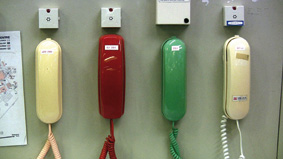
Half-life? looks at the histories of Harwell, birthplace of the UK nuclear industry, and the development of fusion energy technology at the Culham facility in Oxfordshire. Produced with the cooperation of both these organisations, the film examines nuclear science research through a historical and cultural filter. Drawing on archive footage of the sites, alongside contemporary materials, the work takes structural clues from nuclear physics, exploring the heritage of nuclear energy from the roots of the technology that drove the industrial revolution. The relationship between nature, and our reliance on mineral energy resources, and the portrayal of the often-mundane realities of nuclear research seek to ?normalise? the subject. With the recent widespread acceptance of the reality of climate change driven by carbon dioxide emissions, the work explores the realities and myths surrounding the nuclear sciences.
An artist working with video and digital imaging, Chris Oakley?s concerns are focused on mediated experience, including mainstream media, amateur photography, and mass communications. In a critical analogy to the methods employed by the mass media, he utilises processes of fictionalising material captured from life, which explore the increasingly uniform treatment of the fictional and the factual in the mass media. Current works explore the fluid nature of history and ?media memory? and the re-authoring of narratives of the past.
Chris Oakley
Catalogue : 2007Sight/Seeing | Vidéo expérimentale | dv | couleur | 6:0 | Royaume-Uni, Allemagne | 2005
Chris Oakley
Sight/Seeing
Vidéo expérimentale | dv | couleur | 6:0 | Royaume-Uni, Allemagne | 2005
SIGHT/SEEING explore notre relation avec les notions d?étendue sauvage dans une ère mondialisée. A mi-chemin ente le court-métrage touristique et le documentaire sur la vie sauvage, ce travail étudie la relation que nous avons avec notre environnement naturel fondé sur des idées reçues véhiculées par les media. Le tourisme a déclanché un processus qui fait du monde naturel un simple produit, l?exemple typique étant le safari qui permet de vivre quelque chose de spectaculaire, immortalisé par l?objectif d?un caméscope. La vidéo étudie un phénomène dans lequel le spectacle nous fait passer à côté de la véritable expérience et où voir devient moins important qu?enregistrer. Des défauts photographiques de plus en plus absurde et la présence du touriste, caché derrière son objectif, nous conduisent vers un monde où le regard romantique du touriste devient concret grâce à l?image enregistrée ; un monde vu à travers un filtre qui ne peut être enlevé.
Chris Oakley est un artiste qui travaille avec l?imagerie vidéo et numérique, ses préoccupations se concentrent sur l?expérience biaisée par les media, que ce soit les principaux media, la photographie amateur, les communications de masse et la réalité accrue. A travers une analogie critique des méthodes employées par les principaux media, il utilise des processus de fictionalisation des matériaux qu?il a récolté au quotidien afin d?essayer de définir un espace entre la réalité et la représentation ; essayer de définir à quel moment l?expérience vécue si intensément doit se conformer à un récit purement linéaire. Durant ces trois dernières années, le travail d?Oakley a suscité l?intérêt des media européens mais pas seulement. Ces ?uvres ont été exposées aux côtés de celles de Tony Oursler, Jozef Robakowski, et Pipilotti Rist. Parmi ses récentes réussites, on peut compter des sélections pour de nombreux festivals d?arts médiatiques majeurs et des expositions. On peut citer entre autres la Transmediale 05 de Berlin, une exposition au musée d?art contemporain de Los Angeles et des panneaux publicitaires via video sur Sunset Strip. Il a également remporté un prix au Media Forum du Festival International du Film de Moscou en 2005. Il est le premier artiste vidéo à vendre ses ?uvres sur internet grâce au téléchargement. http://www.chrisoakley.com
Catalogue : 2006The Catalogue | Art vidéo | dv | couleur | 5:42 | Royaume-Uni | 2004
Chris Oakley
The Catalogue
Art vidéo | dv | couleur | 5:42 | Royaume-Uni | 2004
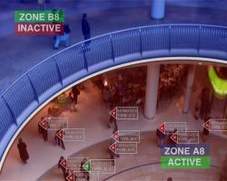
Le Catalogue explore les nomenclatures de l'humanité élaborées par les sociétés commerciales dans l'environnement de la consommation. En tant que consommateurs, nos modes de vie sont minutieusement analysés par les grands groupes. La carte de fidélité, la puce RFID (Identification par Fréquence Radio) et les logiciels de reconnaissance faciale sont autant de moyens de collecte de données qui leur permettent de réaliser le traçage des individus en temps réel. Les sociétés spécialisées dans le négoce de bases de données peuvent montrer où nous nous trouvons, ce que nous achetons, ce que seront nos volontés futures. Techniquement, elles pourraient déjà élargir ces données au delà de la sphère des habitudes de consommation et de nos modes de vie pour atteindre celles concernant notre intégrité physique, en prédisant notre santé future par le croisement de statistiques et ce grâce à l'analyse des données tirées de nos courses hebdomadaires. Le Catalogue propose une analogie à ce processus, contraignant le spectateur à prendre la position d'une agence, froide et distante, et en considérant l'humanité comme une série d'entités dont la valeur de chacune est définie par sa capacité à dépenser et par ses besoins futurs.
Les centres d'intérêt de Chris Oakley concernent aussi bien les média de masse que la photographie amateur, les moyens de communication de masse, le recueil de données, et l'influence de ces phénomènes hétérogènes sur nos comportements, les interactions, et les relations qui en découlent sur notre corps. Pour Oakley, la caméra amateur, la caméra de surveillance, et le reportage télévisé sont regardés comme procédant d'un même phénomène ; chacun fournit un point de vue représentant un univers médiatisé, une réalité limitée, coupée de toute véracité. Dans une comparaison critique des procédés employés par les mass-média, il est fasciné par les processus de fictionnalisation, essayant de définir l'espace entre réalité et représentation, le point à partir duquel le caractère aléatoire de l'expérience humaine est standardisé pour se conformer à un cliché narratif. Influencé à ses tout débuts par le Process Art, et par les cinéastes matérialistes et structuralistes, il a développé un vocabulaire combinant une approche orientée "processus" avec des références culturelles plus larges. S'appropriant des techniques de plateau de télévision et de production de film et les combinant avec le point de vue du cinéma Vérité, le processus s'intéresse autant à observer le spectateur que le sujet. Depuis deux ans, le travail de Oakley recoit une attention de plus en plus importante de la part des media en Europe, voire au delà. Ses créations ont été exposées au côté de celle de Tony Oursler, Jozef Robakowski, Kutlug Ataman et de Pipilotti Rist. De ses récentes réalisations, on mentionnera la circulation d'une exposition dans un grand nombre de festival internationaux d'arts multimedia notamment au festival Exit à Paris, au Transmediale .05 à Berlin, l'exposition de ses travaux au Musée d'Art comtemporain de Los Angeles, des projections video au Sunset Strip, ainsi qu'un prix au Festival international du Film de Moscou en 2005. Biographie sommaire : 1971 Naissance à Chester 1988 - 1990 North East Wales Institute 1990-93 School of Art & Design, University of Wolverhampton 1993-95 Kent Institute of Art & Design
Damir Ocko
Catalogue : 2025The Dawn Chorus | Vidéo | 4k | couleur | 17:43 | Croatie | 2023
Damir Ocko
The Dawn Chorus
Vidéo | 4k | couleur | 17:43 | Croatie | 2023
"The Dawn Chorus" is an outbreak of birdsong at the start of a new day, depicted in the film as the inspiration for a dream-like gathering of the artists local queer community in Zagreb. This joyous celebration of queer bodies pays homage to the kingdom of birds through voguing, dancing, drag and costumes. It is a transposition that imagines the potential in the intersection between our own identities and the inclusive spaces that are open for other species. Filmed without the predictable popular electronic beats typically associated with ballroom, the film solely features the sounds of bodies in motion, the rhythmic impact of dancing, resounding percussive noises created by bodies, and chanting. These elements are accompanied by polyphonic sounds of birdsong onomatopoeias, sourced from ornithological manuals and sung by ”Le Zbor” a lesbian-antifascist choir from Zagreb accompanied by subtle gravity-like pedal tones played on Organ.
Damir Ocko (b. 1977, Zagreb) Graduate from the Academy of Fine Arts in Zagreb, O?ko has exhibited on solo exhibitions at Kunsthalle Krems, Museum of Contemporary Art Zagreb, Jeu de Paume, Paris, National Gallery in Prague, Museum of contemporary Art Bordeaux, Museo Amparo, Mexico, DAZIBAO, Montreal, Palais de Tokyo in Paris, Yvon Lambert Gallery in Paris, Künstlerhaus Halle für Kunst und Medien in Graz, Kunsthalle Dusseldorf, Temple Bar Gallery and Studios in Dublin, Kunstverein Leipzig among other places. He participated in numerous group exhibitions internationally with institutions such as, OFF Biennale Budapest, MUDAM in Luxembourg, FRAC le Plateau, Württembergischer Kunstverein Stuttgart, Kunsthalle Vienna, Louis Vuitton foundation among others. Damir O?ko represented Croatia in the 56th Venice Biennale with a solo exhibition "Studies on Shivering / The Third Degree. His works are included in many public and private collections such as FRAC le Plateau, Foundation Louis Vuitton, CNAP – Centre national des arts plastiques in Paris, MUDAM in Luxembourg and Museum of contemporary Art in Zagreb, among others.
Damir Ocko
Catalogue : 2016TK | Film expérimental | 4k | couleur | 19:46 | Croatie | 2015
Damir Ocko
TK
Film expérimental | 4k | couleur | 19:46 | Croatie | 2015
Departing form an eight part poem the artist constructs a complex polyphonic work in which poetry meets movements, sounds, silences, bodies, and ¬endurability in order to project the ideas behind the work. Several topics constantly reoccurring through out the work are brought forward by a meticulously scored narration, in which pause and silence are equally important as the spoken or written word. Poem itself depicts on various images, starting as a morning song in which a question of a routine and a rotation turns the engine on for work to move towards more difficult imagery. People gather in dangerous constellations to act in violence, to observe silently, or to setup the false feeling of tranquillity which is constantly turned upside down by the various mechanisms of the film itself. Heavy things get stuck in the throat, stones used as tools and voices come to unrest.
Damir Očko (b. 1977, lives and works in Zagreb) is one of the most prominent Croatian artist of his generation. His videos, films, poetry and works on paper have been exhibited recently in Temple Bar Gallery in Dublin (2014), KM - Künstlerhaus Halle für Kunst & Medien in Graz (2014), Yvon Lambert gallery in Paris (2013), Palais de Tokyo in Paris (2012), Galleria Tiziana Di Caro in Salerno (2012), and Kunsthalle Dusseldorf (2011). He participated in numerous collective exhibitions with institutions such as MUDAM, Luxembourg, FRAC Le Plateau in Paris, Kunsthalle Wien, and Museum of Contemporary Art in Zagreb among others. His works are part of many public and private collections around the world.
Damir Ocko
Catalogue : 2008The Boy with a magic Horn | Art vidéo | dv | couleur | 16:0 | Croatie | 2007
Damir Ocko
The Boy with a magic Horn
Art vidéo | dv | couleur | 16:0 | Croatie | 2007
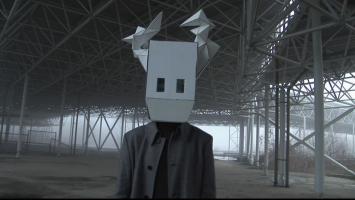
"Un grand rêve allait être réalisé mais quelque chose se passa pendant le réveil." Pendant la période de transition, la Croatie abandonna un des plus gros projets qui allai être construit sur cet hémisphère, un hôpital universitaire qui allait occuper 250000m2. L'hôpital a été planifié dans la fin des années 70 et était en construction dans les années 80 mais jamais fini. De nos jours, ce hall vide, ces murs de béton, ce labyrinthe de pièces sans noms et la nature envahissant tout l'environnement peut lui donner l'allure d'une quelconque construction mais, le fait de savoir ce que cet endroit devrait être, transforme cette réalité en une expérience presque mélodramatique; être bloqué dans un lieu et à une époque, quelque part entre ce que c'était, ce que ça devrait être et ce que c'est. Une vision romantique de la transition nous amène à l'intérieur de l'architecture fantôme et nous participons au voyage a travers une intrigue Wagnérienne, où la fiction rentre dans la réalité, transformé et perdue dans un lieu où le héros arrive trop tard. Extrait des synopsis de Wagner, l'intrigue devient un jeu rêveur et hallucinogène auquel les personnages jouent pour décrire leur nouveau déplacement social et émotionnel vers un lieu qui existe quelque part entre l'espoir et l'oubli. Mais pourtant, il se dit que la corne magique a un tel effet que celui qui l'entend va croire presque tout.
Damir Očko was born in 1977 in Zagreb, Croatia and studied at the Academy of Fine Arts, Zagreb. He was a resident artist at Tirana Institute of contemporary art, Tirana, Albania and Kulturkontakt Vienna, Austria. He also received a Academie schloss solitude fellowship. He is working in diverse medias, like video, installation, site specific projects and music. His recent solo exhibitions include: Why does Gravity make things fall?, Tirana Institute of Contemporary Art, Tirana, Albania, The Missing Mountain, Barutana, Osijek, Croatia, Compositions, Museum of Contemporary Art, Zagreb, Croatia. Recent group exhibitions include: The post Cinema experience, Australian centre for photography, Sydney, Australia, New revelations, Spectrum project space, Perth, Australia, Heroes in Transition, Angel Row Gallery, Nottingham, UK, and 2WP at Art Point Gallery Vienna, among others. His films where recently screened at Chavoul cinema, Sydney, Australia, 52nd Venice Biennale as part of a video program selected by Edi Muka on the PS1&PAN boat and International center for culture Arbnori, Tirana, Albania among others. Currently he is living and working in Zagreb.
Damir Ocko
Catalogue : 2017The Third Degree | Vidéo | hdv | couleur | 10:30 | Croatie | 2015
Damir Ocko
The Third Degree
Vidéo | hdv | couleur | 10:30 | Croatie | 2015
The Third Degree is a single scene film exploring a close-ups of skin scars resulting from third degree burns filmed through an installation of broken mirrors reflecting the crew and the whole background process while filming the scars, thus integrating the subject of the camera with the process of filming itself. The Third Degree was made as a response to questions that emerged due the particularly violent way the previous film TK was filmed. The term "Third Degree" has an ambiguous meaning in the English language: it is a way to classify a burn of a very strong degree, but it can also signify a process of extorting a confession under violence. Set in motion by such violent interpretations and perspectives, film tries to critically, yet poetically, cut through the collective haze that blurs relations between means of production, control and the subject itself, giving rise to alternative methods of understanding as a reflection determined at the same time by social, political and aesthetic parameters.
Damir Očko was born in 1977 in Zagreb, where he lives and works. A graduate from the Academy of Fine Arts in Zagreb. Očko has exhibited on solo exhibitions at DAZIBAO, Montreal, Palais de Tokyo in Paris, Künstlerhaus Halle für Kunst und Medien in Graz and Kunsthalle Dusseldorf, Temple Bar Gallery and Studios in Dublin among other places. He participated in numerous group exhibitions internationally with institutions such as, MUDAM in Luxembourg, FRAC le Plateau, Württembergischer Kunstverein Stuttgart, Germany, Kunsthalle Vienna, among others. His works can be found in the collections of Louis Vuitton Foundation for Creation and CNAP – Centre national des arts plastiques in Paris or at the MUDAM in Luxembourg. Damir Očko was representing Croatia in the 56th Venice Biennale with a solo exhibition "Studies on Shivering / The Third Degree.
Christoph Oertli, Ahmad El-Sawy
Catalogue : 2020Sensing Bodies | Doc. expérimental | 4k | couleur | 48:0 | Suisse | 2019
Christoph Oertli
Sensing Bodies
Doc. expérimental | 4k | couleur | 48:0 | Suisse | 2019
Le film traite de l‘utilisation de nos corps dans un environnement parfaitement structuré et construit. Le film se penche sur une société hautement organisée et explore les questions de l'expérience corporelle active par rapport à l'état statique de l‘expérience virtuelle. A quelle distance de la nature l‘homme peut-il vivre?
1962* Winterthur/Switzerland, lives and works in Basel/Switzerland. education ZHdK Zürich, Graphic design; Swiss Television Zürich, stage design; FHNW Basel, audiovisual design. from 1995: videotapes, video installations, documentary videos, video for dance and theater. Works 1995-97 on cruise-ships around the world, lives 1998-2000 in Montréal/Canada and 2002-07 in Paris, 2008-16 in Brussels. 2000-02 lecturer for video Fachhochschule Vorarlberg/Austria. from 2004 guest lecturer HSLU Lucerne/Switzerland.
Catalogue : 2015Tension Box | Doc. expérimental | hdv | couleur | 16:22 | Suisse | 2014
Christoph Oertli
Tension Box
Doc. expérimental | hdv | couleur | 16:22 | Suisse | 2014
Two young Ethiopians tell about their lifes as students of Addis Ababa University; they focus on the sharing of a small room in the dormitory and the reality of a multi-ethnic country like Ethiopia. The observing camera shows the dormitory, as it were a stage, consisting of bunk beds, built-in cupboards and a corridor. Eight young men share this narrow space, where they sleep, eat, study or pray. They are Christians or Muslims, communicate in one of the many local languages or help themselves with English in order to understand each other. What may look like a refugee camp allows us actually to gain an insight into a community of young people, who prepare their future in a promising African country.
* Winterthur/Switzerland, lives and works in Basel/Switzerland and Brussels/Belgium education ZHdK Zürich, Graphic design; Swiss Television Zürich, stage design; FHNW Basel, audiovisual design. from 1995: videotapes, video installations, documentary videos, video for dance and theater. Works 1995-97 on cruise-ships around the world, lives 1998-2000 in Montréal/Canada and 2002-07 in Paris, then moves to Brussels. 2000-02 lecturer for video Fachhochschule Vorarlberg/Austria. 2004-14 guest lecturer HSLU Lucerne/Switzerland.
Catalogue : 2013Monsieur René | Vidéo | hdv | couleur | 11:11 | Suisse, Belgique | 2012
Christoph Oertli
Monsieur René
Vidéo | hdv | couleur | 11:11 | Suisse, Belgique | 2012
The camera is invading an over-stuffed apartment, floating through an almost surreal material world. There is a presence of the real tenant, supposedly an old man, who we don?t get to see. Instead, a younger man in search of a place to rest is wandering about. The rooms reveal the standstill of a lonley person, who has separated himself from life and the outside world by pileing up consumer objects. A glance out of the window shows a formerly fancy boulevard in Brussels, ruled today by Moroccan traders and African immigrants.
1962* Winterthur/Switzerland, lives and works in Basel/Switzerland and Brussels/Belgium HGK Zürich, Graphic design; Swiss Television Zürich, stage design; HGK Basel, audiovisual design. videotapes, video installations, documentary videos. Works 1995-97 on cruise-ships around the world, lives 1998-2000 in Montréal/Canada and 2002-07 in Paris, then moves to Brussels. 2000-02 lecturer for video Fachhochschule Vorarlberg/Austria. From 2004 guest lecturer HGK Lucerne/CH.
Catalogue : 2012The ground is moving | Vidéo | hdv | couleur | 10:30 | Suisse, Belgique | 2010
Christoph Oertli
The ground is moving
Vidéo | hdv | couleur | 10:30 | Suisse, Belgique | 2010
1962* Winterthur/Switzerland, lives and works in Basel/Switzerland and Brussels/Belgium. HGK Zürich, Graphic design; Swiss Television Zürich, stage design; HGK Basel, audiovisual design. videotapes, video installations, documentary videos. Works 1995-97 on cruise-ships around the world, lives 1998-2000 in Montréal/Canada and 2002-07 in Paris, then moves to Brussels. 2000-02 lecturer for video Fachhochschule Vorarlberg/Austria. 2004/06/11 guest lecturer HGK Lucerne/CH.
Catalogue : 2011Come on into the continents | Vidéo | dv | couleur | 5:50 | Suisse | 2009
Christoph Oertli
Come on into the continents
Vidéo | dv | couleur | 5:50 | Suisse | 2009
Outside of Luxor the eye moves in a slow circle. People are standing in the desert, alone or in groups. Tourists descend from the sky in a large red balloon. The camera?s perspective corresponds to the gaze of a foreigner having a look around. A couple of details sail past, without for all that rendering the situation as a whole perceptible. The eye wanders on across the surface of the desert. Urban settlements come into view. An arrival is summed up in one long, slow pan, a touchdown on a strange planet, recounted from a horizontal perspective only gradually closing the gap between itself and its object.
* Winterthur/Switzerland, lives and works in Basel/Switzerland and Brussels/Belgium education: HGK Zürich, Graphic design; Swiss Television Zürich, stage design; HGK Basel, audiovisual design. Author of videos, video installations, documentary videos.
Catalogue : 2010Sinbad - new voyages | Vidéo | dv | couleur | 43:0 | Suisse | 2009
Christoph Oertli, Ahmad El-Sawy
Sinbad - new voyages
Vidéo | dv | couleur | 43:0 | Suisse | 2009
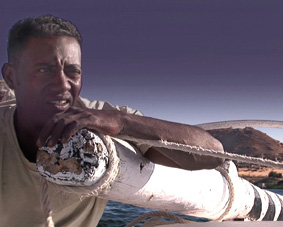
This project consists of a musical live-performance by Ahmad El-Sawy (oud/voice/electronics) with a video-projection by Christoph Oertli. Starting point is the legend of Sinbad and his journeys on the sea. What would Sinbad get to see if he?d be travelling nowadays? This interrogation should produce images and music, which juxtapose past realities and myths with the actual situation of the Arab World. The cooperation of the Egyptian musician and the Swiss video artist combines different medias and view points: Ahmad El-Sawy has transferred Arabic poems into music. Some of those texts can be read as comment about our times dispite the fact that they originate from past centuries. The writers talk about the loss of values and most importantly about the loss of the own culture. Christoph Oertli has shot video images during two longer stays in Egypt and compressed these images into a visual strand, which resembles a journey through different centuries: landscapes, urban scenes and ultramodern building complexes slowly drift past the camera. A young man embodies todays? Sinbad; occasionally he?s travelling within his own country, but he undertakes as well virtual journeys at his computer, since means and possibilities are missing for travelling abroad.
1962* Winterthur/Switzerland, lives and works in Basel/Switzerland and Brussels/Belgium education: HGK Zürich, Graphic design; Swiss Television Zürich, stage design; HGK Basel, audiovisual design. Works as video artist, produces videotapes, video installations, documentary videos.
Catalogue : 2007Cairo | Vidéo expérimentale | dv | couleur | 11:0 | Suisse | 2006
Christoph Oertli
Cairo
Vidéo expérimentale | dv | couleur | 11:0 | Suisse | 2006
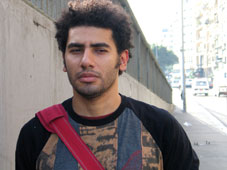
La vidéo se concentre sur les chemins parcourus dans la ville. Les chemins que chaque habitant doit effectuer, pour lui-même et seul parmi les autres. Dans la réalité quotidienne, cela constitue un "déplacement de masse" dense et permanent, pour que chacun puisse s'assurer un logement et un travail. On peut voir un jeune homme qui marche très lentement. Il prend neuf visages différents, et son cheminement s'étend sur toute une enfilade de rues et de quartiers du Caire. Tout autour de lui, du bruit et beaucoup d'autres gens. Puis il se retrouve soudain seul, mais continue, sans y prêter attention, à marcher lentement. Quelques personnages isolés qui croisent son chemin.
Né en 1962, vit à Bâle et à Paris. Etudes: HGK (Ecole supérieure d'art et création) de Zurich, design graphique télévision suisse, design scénique HGK Bâle, design audiovisuel.
Catalogue : 2006Come, heavy sleep | Vidéo expérimentale | dv | couleur | 8:0 | Suisse, France | 2004
Christoph Oertli
Come, heavy sleep
Vidéo expérimentale | dv | couleur | 8:0 | Suisse, France | 2004
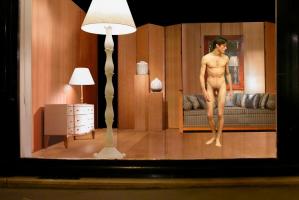
De nuit, un salon à l?ameublement précisément choisi. Aucune trace des habitants. Un jeune homme nu traverse l'espace. Il se couche sur un sofa, dépose un plat sur la table. Il agit comme un étranger qui se serait introduit dans la maison. Les meubles tremblent, apparaissent, disparaissent comme déplacés par une main invisible. Le rapport à l'intimité et à la proximité du corps de l'homme changent brusquement lorsque l'extérieur devient visible. Nous sommes face à une vitrine de magasin.
*Winterthur/Suisse, vit et travaille à Bâle et à Paris. Formation: HGK Zurich, Arts graphiques, Télévision Suisse, Scénographe, HGK Bâle, Arts audiovisuels
Christoph Oertli
Catalogue : 2020Sensing Bodies | Doc. expérimental | 4k | couleur | 48:0 | Suisse | 2019
Christoph Oertli
Sensing Bodies
Doc. expérimental | 4k | couleur | 48:0 | Suisse | 2019
Le film traite de l‘utilisation de nos corps dans un environnement parfaitement structuré et construit. Le film se penche sur une société hautement organisée et explore les questions de l'expérience corporelle active par rapport à l'état statique de l‘expérience virtuelle. A quelle distance de la nature l‘homme peut-il vivre?
1962* Winterthur/Switzerland, lives and works in Basel/Switzerland. education ZHdK Zürich, Graphic design; Swiss Television Zürich, stage design; FHNW Basel, audiovisual design. from 1995: videotapes, video installations, documentary videos, video for dance and theater. Works 1995-97 on cruise-ships around the world, lives 1998-2000 in Montréal/Canada and 2002-07 in Paris, 2008-16 in Brussels. 2000-02 lecturer for video Fachhochschule Vorarlberg/Austria. from 2004 guest lecturer HSLU Lucerne/Switzerland.
Catalogue : 2015Tension Box | Doc. expérimental | hdv | couleur | 16:22 | Suisse | 2014
Christoph Oertli
Tension Box
Doc. expérimental | hdv | couleur | 16:22 | Suisse | 2014
Two young Ethiopians tell about their lifes as students of Addis Ababa University; they focus on the sharing of a small room in the dormitory and the reality of a multi-ethnic country like Ethiopia. The observing camera shows the dormitory, as it were a stage, consisting of bunk beds, built-in cupboards and a corridor. Eight young men share this narrow space, where they sleep, eat, study or pray. They are Christians or Muslims, communicate in one of the many local languages or help themselves with English in order to understand each other. What may look like a refugee camp allows us actually to gain an insight into a community of young people, who prepare their future in a promising African country.
* Winterthur/Switzerland, lives and works in Basel/Switzerland and Brussels/Belgium education ZHdK Zürich, Graphic design; Swiss Television Zürich, stage design; FHNW Basel, audiovisual design. from 1995: videotapes, video installations, documentary videos, video for dance and theater. Works 1995-97 on cruise-ships around the world, lives 1998-2000 in Montréal/Canada and 2002-07 in Paris, then moves to Brussels. 2000-02 lecturer for video Fachhochschule Vorarlberg/Austria. 2004-14 guest lecturer HSLU Lucerne/Switzerland.
Catalogue : 2013Monsieur René | Vidéo | hdv | couleur | 11:11 | Suisse, Belgique | 2012
Christoph Oertli
Monsieur René
Vidéo | hdv | couleur | 11:11 | Suisse, Belgique | 2012
The camera is invading an over-stuffed apartment, floating through an almost surreal material world. There is a presence of the real tenant, supposedly an old man, who we don?t get to see. Instead, a younger man in search of a place to rest is wandering about. The rooms reveal the standstill of a lonley person, who has separated himself from life and the outside world by pileing up consumer objects. A glance out of the window shows a formerly fancy boulevard in Brussels, ruled today by Moroccan traders and African immigrants.
1962* Winterthur/Switzerland, lives and works in Basel/Switzerland and Brussels/Belgium HGK Zürich, Graphic design; Swiss Television Zürich, stage design; HGK Basel, audiovisual design. videotapes, video installations, documentary videos. Works 1995-97 on cruise-ships around the world, lives 1998-2000 in Montréal/Canada and 2002-07 in Paris, then moves to Brussels. 2000-02 lecturer for video Fachhochschule Vorarlberg/Austria. From 2004 guest lecturer HGK Lucerne/CH.
Catalogue : 2012The ground is moving | Vidéo | hdv | couleur | 10:30 | Suisse, Belgique | 2010
Christoph Oertli
The ground is moving
Vidéo | hdv | couleur | 10:30 | Suisse, Belgique | 2010
1962* Winterthur/Switzerland, lives and works in Basel/Switzerland and Brussels/Belgium. HGK Zürich, Graphic design; Swiss Television Zürich, stage design; HGK Basel, audiovisual design. videotapes, video installations, documentary videos. Works 1995-97 on cruise-ships around the world, lives 1998-2000 in Montréal/Canada and 2002-07 in Paris, then moves to Brussels. 2000-02 lecturer for video Fachhochschule Vorarlberg/Austria. 2004/06/11 guest lecturer HGK Lucerne/CH.
Catalogue : 2011Come on into the continents | Vidéo | dv | couleur | 5:50 | Suisse | 2009
Christoph Oertli
Come on into the continents
Vidéo | dv | couleur | 5:50 | Suisse | 2009
Outside of Luxor the eye moves in a slow circle. People are standing in the desert, alone or in groups. Tourists descend from the sky in a large red balloon. The camera?s perspective corresponds to the gaze of a foreigner having a look around. A couple of details sail past, without for all that rendering the situation as a whole perceptible. The eye wanders on across the surface of the desert. Urban settlements come into view. An arrival is summed up in one long, slow pan, a touchdown on a strange planet, recounted from a horizontal perspective only gradually closing the gap between itself and its object.
* Winterthur/Switzerland, lives and works in Basel/Switzerland and Brussels/Belgium education: HGK Zürich, Graphic design; Swiss Television Zürich, stage design; HGK Basel, audiovisual design. Author of videos, video installations, documentary videos.
Catalogue : 2010Sinbad - new voyages | Vidéo | dv | couleur | 43:0 | Suisse | 2009
Christoph Oertli, Ahmad El-Sawy
Sinbad - new voyages
Vidéo | dv | couleur | 43:0 | Suisse | 2009
This project consists of a musical live-performance by Ahmad El-Sawy (oud/voice/electronics) with a video-projection by Christoph Oertli. Starting point is the legend of Sinbad and his journeys on the sea. What would Sinbad get to see if he?d be travelling nowadays? This interrogation should produce images and music, which juxtapose past realities and myths with the actual situation of the Arab World. The cooperation of the Egyptian musician and the Swiss video artist combines different medias and view points: Ahmad El-Sawy has transferred Arabic poems into music. Some of those texts can be read as comment about our times dispite the fact that they originate from past centuries. The writers talk about the loss of values and most importantly about the loss of the own culture. Christoph Oertli has shot video images during two longer stays in Egypt and compressed these images into a visual strand, which resembles a journey through different centuries: landscapes, urban scenes and ultramodern building complexes slowly drift past the camera. A young man embodies todays? Sinbad; occasionally he?s travelling within his own country, but he undertakes as well virtual journeys at his computer, since means and possibilities are missing for travelling abroad.
1962* Winterthur/Switzerland, lives and works in Basel/Switzerland and Brussels/Belgium education: HGK Zürich, Graphic design; Swiss Television Zürich, stage design; HGK Basel, audiovisual design. Works as video artist, produces videotapes, video installations, documentary videos.
Catalogue : 2007Cairo | Vidéo expérimentale | dv | couleur | 11:0 | Suisse | 2006
Christoph Oertli
Cairo
Vidéo expérimentale | dv | couleur | 11:0 | Suisse | 2006
La vidéo se concentre sur les chemins parcourus dans la ville. Les chemins que chaque habitant doit effectuer, pour lui-même et seul parmi les autres. Dans la réalité quotidienne, cela constitue un "déplacement de masse" dense et permanent, pour que chacun puisse s'assurer un logement et un travail. On peut voir un jeune homme qui marche très lentement. Il prend neuf visages différents, et son cheminement s'étend sur toute une enfilade de rues et de quartiers du Caire. Tout autour de lui, du bruit et beaucoup d'autres gens. Puis il se retrouve soudain seul, mais continue, sans y prêter attention, à marcher lentement. Quelques personnages isolés qui croisent son chemin.
Né en 1962, vit à Bâle et à Paris. Etudes: HGK (Ecole supérieure d'art et création) de Zurich, design graphique télévision suisse, design scénique HGK Bâle, design audiovisuel.
Catalogue : 2006Come, heavy sleep | Vidéo expérimentale | dv | couleur | 8:0 | Suisse, France | 2004
Christoph Oertli
Come, heavy sleep
Vidéo expérimentale | dv | couleur | 8:0 | Suisse, France | 2004
De nuit, un salon à l?ameublement précisément choisi. Aucune trace des habitants. Un jeune homme nu traverse l'espace. Il se couche sur un sofa, dépose un plat sur la table. Il agit comme un étranger qui se serait introduit dans la maison. Les meubles tremblent, apparaissent, disparaissent comme déplacés par une main invisible. Le rapport à l'intimité et à la proximité du corps de l'homme changent brusquement lorsque l'extérieur devient visible. Nous sommes face à une vitrine de magasin.
*Winterthur/Suisse, vit et travaille à Bâle et à Paris. Formation: HGK Zurich, Arts graphiques, Télévision Suisse, Scénographe, HGK Bâle, Arts audiovisuels
Christoph Oeschger, Waltenspül/Schulze
Catalogue : 2021Unlearning Flow | Documentaire | hdv | noir et blanc | 11:9 | Suisse | 2019
Christoph Oeschger, Waltenspül/Schulze
Unlearning Flow
Documentaire | hdv | noir et blanc | 11:9 | Suisse | 2019
“Machining of Steel”, “Mating of Two Males”, “Dumdum Bullet Effect” and “String Figures” played by the Inuit, the Krahô or the Taulipang in Guyana exemplify that the Institute for Scientific Film (IWF) in Göttingen aimed at capturing all the movement processes of the world on celluloid. The scientific films that the IWF produced, archived and distributed were supposed to be “documents of reality”. Without using commentary, they should make movements visible, storable and re-analyzable at any time. Can there be pictures that are more real than others? The essay film “unlearning flow” examines both National Socialist prehistory and the legacy of the IWF. It reveals the ideology of the distant, objectifying camera view and also the active white washing of the Institute’s history after World War II. With their film, filmmaker Christoph Oeschger and the historians of media and knowledge, Sarine Waltenspül and Mario Schulze, touch only the tip of the iceberg: (war) research with film, the (re-)production of colonial power relations and the creation of (a lack of) knowledge through film.
Christoph Oeschger (1984*) lives in Zurich as an artist, photographer and publisher. In 2014 he founded the book publisher cpress an in 2020 cpressfilms an agency for artist films together with Christof Nüssli. He works with various forms of the documental. His work has been shown in various museums including Fotomuseum Winterthur (CH), Zentrum für Kunst und Medientechnologie , Karlsruhe (DE), Centre de la Photographie Geneve (CH). Mario Schulze (*1986, Halle/Saale) is a cultural scientist and scientific researcher who works on the history of exhibitions, object theories and scientific films. His doctoral thesis is due in 2017 under the title "How things learned to speak. A History of the Museum Object 1968-2000". He has taught at the universities of Leipzig, Berlin, Zurich and Frankfurt as well as at the Zurich Art Academy. Sarine Waltenspül (*1986, Basel) works as a media historian on scientific films. In 2018, she received her doctorate on cinematographic models in films. She co-directs the SNSF research project Aerial Photographs/Light Images and the DFG network Lens On! Furthermore, she has been involved in various functions in the conception and production of music videos, theatre documentaries and feature films and was head of the "Hungerkünstler Verlag".
Martin M. Oesterheld
Catalogue : 2014LA MULTITUD | Documentaire | hdcam | couleur | 60:0 | Argentine | 2012
Martin M. Oesterheld
LA MULTITUD
Documentaire | hdcam | couleur | 60:0 | Argentine | 2012
In the margins of the city, two lots sharing coincidences are placed in a dialogue. They were both locations for entertainment built by different dictatorships: The Sport City of La Boca, and the Interama amusement park. Today both places are in ruins and their surroundings harbor settlements and shanty towns where thousands of families live, many of them migrants and in extreme poverty. Through a thorough investigation, the documental shows the transit of those characters as they frequently pass though these places, and it depicts the present day over the tracks history left on the urban landscape. The result is a Buenos Aires City seen from its ends with perplexity, beauty, emotion and a neutral eye. The film combines densities with an analytical storytelling that is yet deeply atmospheric and transforming through the reality it manages to capture.
Born in 1974, Martín M. Oesterheld is a visual artist with a scholarship from the UBA / CC Rojas Research Lab for Arts Parctices. His most recent work includes the documentary "La Multitud" (Crowd), the video shorts ?Tránsito? (Transit), and ?Para la Defensa? (To the defense) made together with Julián D?Angiolillo and premiered in the Tecnopolis Exhibition.
Barbara Oettinger, Sabatini Pedro
Catalogue : 2021Sombra | Animation | mp4 | couleur | 8:12 | Chili | 2020
Barbara Oettinger, Sabatini Pedro
Sombra
Animation | mp4 | couleur | 8:12 | Chili | 2020
L'une de nos grandes préoccupations pendant la pandémie a sans doute été de savoir à quel point nous serions affectés physiquement, et mentalement, par le confinement et l’impossibilité de voir nos proches. Pour répondre à cette question, et en lisant certains articles trouvés sur Internet, nous avons trouvé une expérience menée par Donald Hebb dans les années 50, au cours de laquelle il a isolé (séparément) un certain nombre de volontaires dans un espace totalement dépourvu de stimuli. Dans ces conditions extrêmes, ils ont développé au fil du temps de multiples hallucinations auditives et visuelles. "Sombra" est une vidéo qui a été réalisée dans des conditions de confinement dues à la pandémie, pendant laquelle nous avons aussi été privés de tout contact humain significatif. Ainsi, "Sombra" explore, métaphoriquement, les effets de l'isolement en relation avec notre perception du corps, du temps et de l'espace. Comme mentionné plus haut, notre perception sensorielle peut être affectée par l'isolement, ce qui amène notre esprit à créer un monde de science-fiction, à remettre en question l'idée d'authenticité, ou à se demander si ce que nous voyons et entendons est bien réel. Pour réaliser "Sombra", nous avons utilisé une plateforme de jeu vidéo, dans laquelle nous réutilisons des scénarios et des personnages déjà créés / simulés, en modifiant certaines fonctionnalités et certains éléments esthétiques typiques de ces jeux, et en les réorganisant au sein du scénario virtuel, dans le but de produire un film court de machinima. Les personnages et les mondes fictifs sont clonés numériquement, versions multiples d'un personnage piégé et dupliqué un nombre infini de fois, qui parvient parfois à "s'échapper" de son esprit en projetant son corps sur d’autres informations simulées, générant diverses couches de représentations. *Projet en collaboration avec Pedro Sabatini.
Bárbara Oettinger est née à Santiago (Chili) en 1981. Elle a obtenu une Licence en beaux-arts à l'Université du Chili, Santiago (Chili), et un Master à la Pontificia Universidad Católica de Chile, Santiago (Chili). Elle a participé à diverses expositions et projections dans des centres culturels, des galeries et des musées au Chili, au Pérou, en Bolivie, en Argentine, en Uruguay, au Brésil, aux États-Unis, en Inde, en Indonésie, en Ukraine, en Slovénie, en Espagne, en France, au Portugal, en Corée, et à Taïwan. Elle suit actuellement des études de Master of Fine Arts en pratiques intégrées au Pratt Institute, New York (USA), financé par le gouvernement chilien et la CONICYT – Comisión Nacional de Investigación Científica y Technológica. Ses projets actuels sont des rencontres avec des dialogues, qui mettent l’accent sur des témoignages conservant un sens historique, tout en racontant l'expérience psychologique. Des témoignages basés non seulement sur l'immédiateté et l'exactitude supposées de la source historique, mais aussi sur la construction subjective de récits différents. Pedro Sabatini est né à Santiago (Chili) en 1979. Il est titulaire d'une Licence en cinéma. Ces trois dernières années, il a travaillé à la production de films publicitaires. Il sait d’expérience s'adapter à toutes sortes de budgets, tout en restant compétitif. Ses contributions sont liées à sa fascination pour le cinéma indépendant et à sa recherche de nouveaux langages. Son travail a été reconnu comme meilleur film court de fiction à la UNIACC – Universidad de las Artes, Ciencias y Communicaciones, Santiago, Chili; a reçu le prix Best international documentary ARCOS, Santiago (Chili); et a fait partie de la sélection officielle au Festival Biarritz Amérique Latine (France).
Dietmar Offenhuber, Sam AUINGER
Catalogue : 2006Heinz weiss (naredmanet) | Vidéo expérimentale | dv | couleur | 4:0 | Autriche | 2005
Dietmar Offenhuber, Sam AUINGER
Heinz weiss (naredmanet)
Vidéo expérimentale | dv | couleur | 4:0 | Autriche | 2005
fghrt
Dietmar Offenhuber, born 1973, graduated in Architecture and has been working since 1994 in animation, interactive environments and digital architecture. Between 2002 and 2004 Dietmar worked as key researcher in the Interactive Space departement at the Ars Electronica Futurelab. Since Fall 2004 he is Professor for animation and interactive media at the University of Applied Sciences in Hagenberg / Austria.
Anna Ogden Smith
Catalogue : 2012The Lie | Vidéo | | couleur | 2:40 | Liban | 2008
Anna Ogden Smith
The Lie
Vidéo | | couleur | 2:40 | Liban | 2008
Catalogue : 2012The Dream | Vidéo | | couleur | 2:10 | Liban | 2008
Anna Ogden Smith
The Dream
Vidéo | | couleur | 2:10 | Liban | 2008
Anna Ogden-smith
Catalogue : 2009The Dream (VHS: 1989-1994) | 0 | dv | couleur | 4:20 | Liban | 2008
Anna Ogden-smith
The Dream (VHS: 1989-1994)
0 | dv | couleur | 4:20 | Liban | 2008
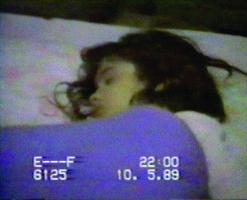
En tombant par hasard sur une collection de vidéos maison réalisées par sa mère, datant de 1989 à 1994, Anna Ogden-Smith s?est tout à coup intéressée à la manière dont les archives VHS sont actifs dans processus de filtration de notre mémoire.
Née à Beyrouth (Liban) en 1984, Anna Ogden-Smith a obtenu une licence en design graphique à l'Université américaine de Beyrouth en 2006. Depuis, elle a principalement travaillé en free-lance dans le design imprimé et a poursuivi sa vocation de danseuse contemporaine à Londres (Royaume-Uni) et à Beyrouth. Récemment, elle a commencé à explorer différents médiums, en réalisant deux autofictions, « Le mensonge » et « Le Rêve ».
Senem Gökce Ogultekin, Levent Duran
Catalogue : 2025Void | Film expérimental | digital | couleur | 16:57 | Turquie, Allemagne | 2024
Senem Gökce Ogultekin, Levent Duran
Void
Film expérimental | digital | couleur | 16:57 | Turquie, Allemagne | 2024
While the shade of a tree is being stolen away, bodiless organs sit in the enormous gaps of the drained earth. Under the constant noise of unseen machines, disjointed body parts touch the drying soil and breaths are only audible to insects. In this quiet, distorted world, old songs of goodwill are sung: “Future times of vain sorrow do not disturb our gentle sleep...” While we are waiting for the miracle to come the sand continues to fly.
SENEM GÖKCE OGULTEKIN work spans the disciplines of choreography, performance, vocal work and film. In 2019, "Dun/Home" was chosen for Artist´s Film International, an international event initiated by Whitechapel Gallery in London and was shown at various museums and galleries of the world. In 2020, Senem Gökce Ogultekin was awarded the Allbau Foundation Culture Prize and was appointed to the Young College by the North Rhine-Westphalian Academy of Sciences and Arts in 2021. LEVENT DURAN is a multidisciplinary artist and writer. They studied sociology at Istanbul University and film at the Fine Arts University of Hamburg, where they obtained their master's degree. Their writings have been published in major magazines and newspapers in Turkey, and their visual creations (video, painting, sculpture, installation) have been exhibited internationally. Their film project "Murmuring Draft Dodgers" received the Courageous Citizen Award from the European Cultural Foundation.