Catalogue > Search
Results for : Tout le catalogue
Dorothée Smith
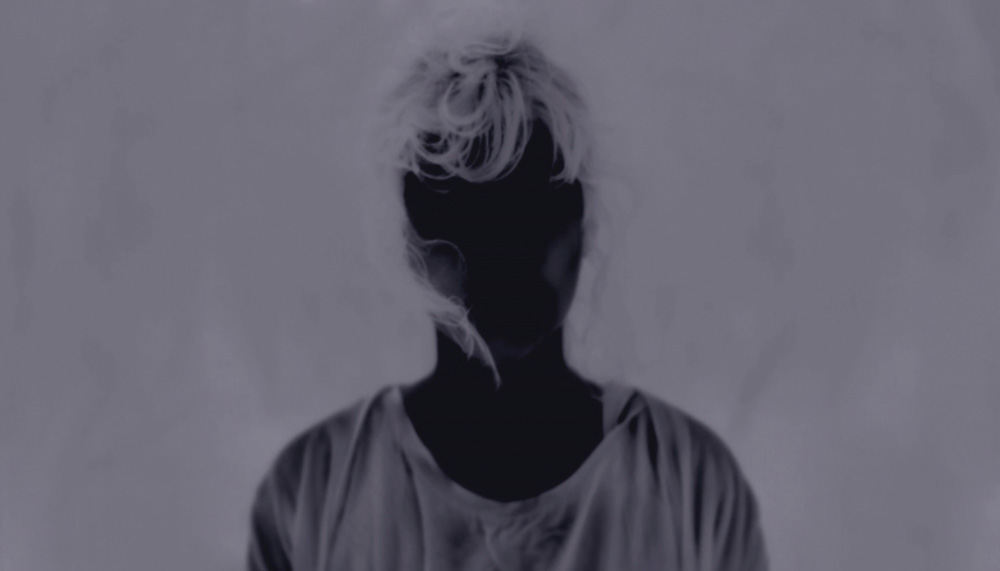
Spectrographies
Experimental fiction | 4k | color | 59:0 | France | 2015
Au fil d’une nuit fantastique, un personnage arpente sans fin des avenues froides et nues, des institutions désertes, des non-lieux inhabités, en marche, en quête, solitaire - guettant les apparitions de fantômes venant se glisser dans son sillage. Suspendu aux télé-technologies (téléphone, puce électronique) de l’intime, il semble se nourrir de l’absence d’un être aimé, ailleurs, loin, intouchable, dont l’absence hante sa déambulation.
Dorothee Smith est une photographe née au milieu des années 80, c’est une enfant de la chute du mur de Berlin, cet évènement qui marque la fin d’une ère, celui de la guerre froide du capitalisme républicain contre le communisme soviétique, et le début d’une autre, celui de la guerre informelle entre l’occident judéo-chrétien et les extrémistes islamiques (Palestine, Irak, Iran, Afghanistan). C’est aussi l’enfant du mouvement queer, avec ses identités fleurissantes et sa nouvelle philosophie du corps. C’est encore et enfin l’enfant de la catastrophe de Tchernobyl, d’une planète maltraitée car trop polluée, d’une terre nucléaire menacée de destruction. C’est un peu ce court morceau d’histoire, qui a un peu plus de vingt ans maintenant, que l’on retrouve dans le sampling visuel de la photographe plasticienne.

Gregg Smith
Should we never meet again
Experimental fiction | betaSP | color | 25:0 | South Africa, France | 2005
A young man is traversing Paris, using his mobile, and talking to himself. He has problems and is looking for shelter for the night. In his mind, he runs through his whole circle of friends, but in reality he does not dare approach any of them. He would like to blame everyone and everything for this uncomfortable and narrow life where all good opportunities seem to have been squandered. From time to time, he stops and is then pulled into another dimension - a dimension where no boundaries and formalities exist and where, very briefly, he makes contact with total strangers. The very simple and functional design of this 'fourth dimension' makes its existence plausible. Everyone could flee to it from time to time. The film is shot in the busy neighbourhoods of Barbès, Château Rouge, and Gouttes d`Or, in Paris, and against a blue screen in Le Fresnoy. With Mireille Abadi, Manon Querelle, Feyçal Bagriche, Gérard Abela, and Gregg Smith.
Gregg Smith is an artist from Cape Town, South Africa. He completed his studies at the Michaelis School of Fine Art, University of Cape Town, in 1991 and since then has been active in a range of contemporary art and theatre projects in South Africa and abroad. With origins in painting, performance, and art in public space, his present work incorporates aspects of all these practices in the development of video and film projects. In 2001-02, Gregg was a participant at the 'Rijksakademie van Beeldende Kunsten' in Amsterdam, and following this moved to France where he studied film-making at Le Fresnoy studio national des arts contemporains (2002-04). His work has recently been exhibited at the Dakar Biennial (Senegal, 2004); Le Musée de Jeu de Paume (Paris); the Rotterdam Film Festival (Holland); Hidden Rhythms (Nijmegen, NL); Hilchot Schschenim C at the Digital Art Lab (Tel Aviv, Israel); Model Missed Opportunities, Brandenburger Kunstverein, Berlin; Videobrazil, Sao Paulo; the Rotterdam International Film Festival (2004, 2005); and Le Plateau, Espace Experimantal, Paris, France, 2006. Other notable projects in the field of art in public space include The Lovephones (Cape Town, 2000); The Lovephones in London (Gasworks Gallery, London, 2001); The Long Street Baths Mural Project (Cape Town, 1994-98); and his ongoing Cape Town based project and discussion series, "Very Real Time".

John Smith
Throwing Stones
Experimental doc. | dv | color | 10:55 | United Kingdom | 2004
As the camera looks out through a barred window and the clock strikes four in a Swiss city, the death of Yasser Arafat provides the starting point for a journey back in time. "Throwing Stones" is the third video in the "Hotel Diaries" series, a collection of late night recordings made in foreign hotel rooms which relate personal experiences to contemporary world events.
John Smith was born in London in 1952 and studied film at the Royal College of Art. His film, video and installation works have been shown in cinemas, art galleries and on television throughout the world and have been awarded major prizes at film festivals in Leipzig, Oberhausen, Hamburg, Cork, Palermo, Graz, Uppsala, Bangkok, Ann Arbor and Chicago. Recent exhibitions include one-person shows at Pearl Gallery (London), Open Eye Gallery (Liverpool), Kunstmuseum Magdeburg and retrospectives at Oberhausen, Cork, Tampere, Uppsala and Winterthur international film festivals. John Smith is Professor of Fine Art at the University of East London.
Bogdan Smith
Traum
Fiction | hdv | color | 24:0 | France | 2016
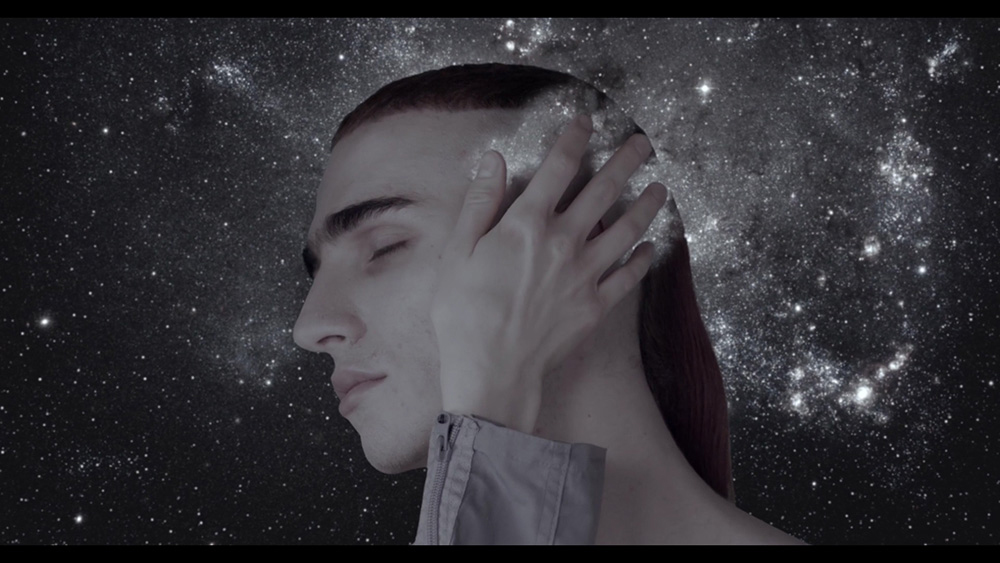
Indeterminate epoch and country. At 21, Yevgueni is a young astronaut-technician. If he dreams of traveling in space, his employment consists of working at the heart of a launching base for space travel, as a spacecraft launching operator. At the particularly critical launch of an inhabited Soyouz shuttle, Yevgueni abruptly loses consciousness, which causes loss of contact with the team in orbit and the explosion of the spacecraft. Haunted by this catastrophe, Yevgueni progressively loses grip with reality and becomes contaminated by the trauma.

Gregg Smith
The End
Art vidéo | | color | 13:45 | South Africa, Belgium | 2006
The End (duration: 14 minutes, DVD from HDV) video installation with digital prints and other elements. Two men circulate around an office space, they are engaged in a common project, the purpose of which is unclear. Their work drives them at a constant rate of activity to which they seem to have become so accustomed, that they barely seem conscious of their actions; sorting through papers, filing documents, making small notes, passing documents to one another. To occupy their thoughts they talk of other things, they have clearly known each other for a long time. Operating in such close proximity to each other over an extended period, they have developed a kind of intimacy. They know each others strengths and weaknesses, perhaps as a way to break the monotony they explore this terrain, moving into the vulnerable territories, in a way which is at once tender and manipulative, revealing a personal power struggle which preoccupies their existence. The film is shot on a constructed set and in an abandoned coal mine in Genk, Belgium.
Gregg Smith: biography www.greggsmith.co.za Gregg Smith is an artist from Cape Town, South Africa. He completed his studies at the Michaelis School of Fine Art, University of Cape Town, in 1991 and since then has been active in a range of contemporary art and theatre projects in South Africa and abroad. With origins in painting, performance, and art in public space, his present work incorporates aspects of all these practices in the development of video and film projects. In 2001-02, Gregg was a participant at the Rijksakademie van beeldende kunsten in Amsterdam, and following this moved to France where he studied film-making at Le Fresnoy studio national des arts contemporains (2002-04). His work has recently been exhibited at the Dakar Biennale (Senegal, 2004), Le Musé de Jeu de Paume (Paris), and the Rotterdam Film Festival (Holland), Hidden Rhythms (Nijmegen, NL), Hilchot Schschenim C at the Digital Art Lab (Tel Aviv, Israel), Model Missed Opportunities, Brandenburger Kunstverein, Berlin, Videobrazil, Sao Paulo and the Rotterdam International Film Festival (2004, 2005), Le Plateau, Espace Experimantal, Paris, France, 2006, and Architecture au corps, Galerie Anton Weller, une proposition d?Alexandra Fau, Paris, France. Other notable projects in the field of art in public space include The Lovephones (Cape Town, 2000) and The Lovephones in London (Gasworks Gallery, London, 2001), The Long Street Baths Mural Project (Cape Town, 1994-98), and his ongoing Cape Town based project and discussion series, Very Real Time (www.veryrealtime.co.za). Present projects include the comission of a new work by Espai d`Art Contemporani de Castellon in Castellon, Spain as part of the exhibition, Our Hospitality, curated by Rodrigo Alonso.
Gregg Smith
UNDEREXPOSED
Experimental fiction | | color | 23:0 | South Africa | 2009
A young man (Hubert Brown) arrives in a quiet rural location in order to present his candidature for job there. As the interview procedures are to take place over several days, he has traveled together with his wife (Christine), so that they might both benefit from a few days in the countryside. Though he has little working experience as yet, he has been recommended for the post by the wife of an acquaintance, who seems to have some influence. The project involves the redevelopment of a piece of land previously used as a nature reserve. As the day unfolds a precarious web of power relations becomes evident as various individuals struggle to find a firm footing in a scheme which at this stage remains highly speculative. It becomes evident that there are several forces already at play in this seemingly empty landscape. For one thing, it is inhabited by residents who have a strong bond with the land, and are resistant to the development plans. The area seems also to physically affect all those who move through it, animating their gestures with sporadic dancelike movements. These movements are never noticed or remarked upon. The film takes the dance-musical form as a point of departure, but eliminates the element of music. The issue of land is remains a charged and unresolved issue in South Africa. In the video project Underexposed, notions of ownership and empowerment are taken a level further. The film questions the dynamics at play in daily exchanges which determine who has the means to exploit their own resources : their body, their ideas and beliefs. The loose fiction follows the redevelopment of a large piece of seemingly vacant land. A precarious web of power relations becomes evident as various individuals struggle to find a firm footing in a scheme which at this stage remains highly speculative. It becomes evident that there are several forces already at play. For one thing, it is inhabited by residents who have a strong bond with the land, and are resistant to the development plans. The area seems also to physically affect all those who move through it, animating their gestures with sporadic dancelike movements. These movements are never noticed or remarked upon.
Gregg Smith is an artist of South African origin, born in Cape Town and currently living and working in Paris, France. with origins in the traditions of painting and performance his video works experiment with the narrative form as means to question the relation between personal perceptions and social interactions. His work is equally traverses the realms of cinema of contemporary art traditions Recent exhibitions and screenings include : Fondation Espace Ecureuil (Toulouse), Rotterdam International Film Festival, FIDMarseille International Documentary Film Festival, Galeria dels Angels - Carmelitas Gallery, LOOP `07 (Barcelona), Fundació Joan Miró, (Barcelona), Le Plateau, Espace Experimantal (Paris) et Musé du Jeu de Paume (Paris).

Ula Sniegowska
Centre for Contemporary Art in Varsaw
0 | 0 | | 0:0 | Poland | 2007
The Centre for Contemporary Art is a place for the creation and documentation of art in all its forms. The Centre achieves its goals through exhibitions, performances, presentations of visual theatre, concerts of contemporary music, the showing of experimental films, video art, shows and creative workshops, as well as various interdisciplinary events. Twelve years have passed since the Centre for Contemporary Art began its systematic and comprehensive activity in the public domain. A unique feature of this process is the way the developing art program is correlated with the reconstruction and organisation of the architectural spaces of the Castle in which the Centre is housed.
Michael Snow
Reverberlin
Experimental video | 0 | color | 55:0 | Canada | 2006
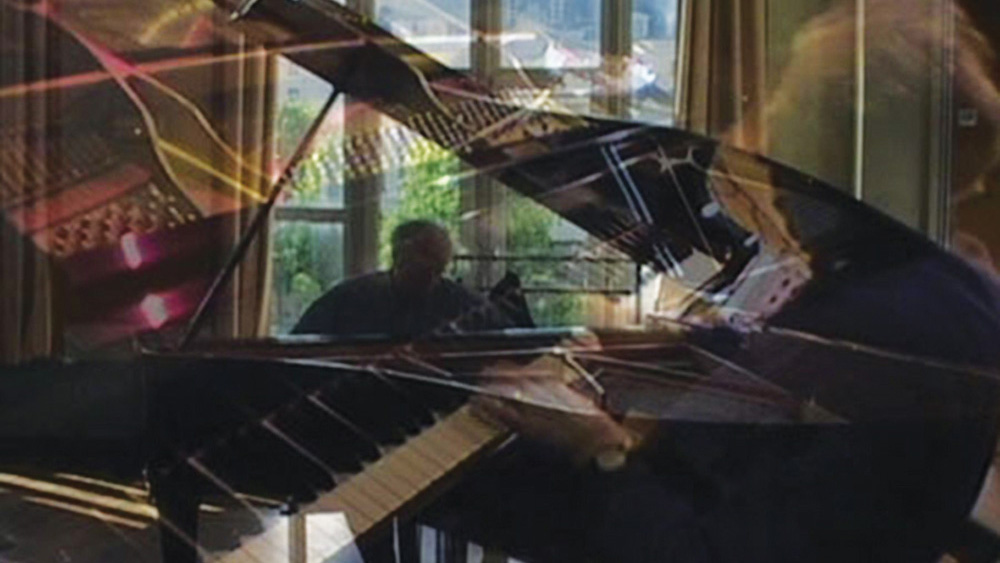
Based on a concert Michael Snow performed with his improvisatory ensemble CCMC at Kunst-Werke in 2002, Reverberlin is the first work for which Snow, both an esteemed filmmaker and musician, co-composed both sound and image. Using digital video images of CCMC playing all over the world, Snow creates counterpoints and juxtapositions to the unedited live recording (only sound) of 2002.
Michael Snow
Sheeploop
Art vidéo | dv | color | 17:0 | Canada | 2000
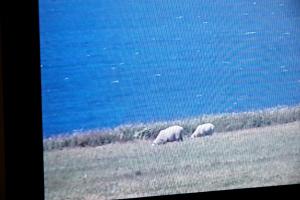
Sheeploop est un plan fixe, un paysage qui évolue lentement. Sheeploop offre un drôle d`instantané bucolique. Regarder des moutons mastiquer graduellement leur passage dans un pâturage, encore et encore, force le spectateur à reconsidérer la beauté de décors aussi idylliques. Typique des stratégies cinématographiques de Snow, cette oeuvre nous sensibilise au regard que nous portons sur un paysage, et sur la nature même de notre perception.
Michael Snow (né en 1929 à Toronto) est considéré comme l`un des plus importants artistes canadiens. En mars 2000, il recevait pour l`ensemble de son oeuvre cinématographique l`une des plus hautes distinctions au Canada, le Prix du Gouverneur général en arts visuels et arts médiatiques. Artiste multidisciplinaire, il est peintre, photographe, cinéaste et musicien. En 1956, il réalisait son premier film. Son film Wavelength (1967) le consacre comme l`un des cinéastes importants de « l`avant-garde américaine » (sic). À la fin des années 1960, pour la réalisation de son film La Région Centrale (1971), il collabore avec un ingénieur canadien à la conception et à la réalisation d`un bras mécanique qui permet à la caméra de tourner dans tous les sens et à des vitesses de rotation contrôlées par l`artiste. Au cours des dix dernières années, Snow a participé à toutes les expositions importantes ayant trait aux images dans le monde contemporain : Passages de l`image, réalisée par le Centre Pompidou; Projections, les transports de l`image, d`abord présenté au studio national des arts contemporains, Le Fresnoy; La Biennale d`art contemporain de Lyon, qui célébrait en 1995 les cent ans du cinéma, intégrait Snow à l`exposition. Enfin, le Musée des beaux-arts de l`Ontario et le Power Plant lui consacraient conjointement une grande rétrospective, Michael Snow Project. Encore récemment, on présentait en Europe une grande rétrospective de ses travaux filmiques et photographiques intitulée Panoramique : oeuvres photographiques et films=Photographic Works and Films : 1962-1999 et la Arnolfini Gallery de Bristol en Angleterre présentait en 2001 une exposition intitulée Michael Snow: almost Cover to Cover. Il est membre de l`Ordre du Canada et Chevalier de l`Ordre des arts et des lettres (France).
Michael Snow
Wavelength For Those Who Don't Have the Time
Experimental video | dv | color | 15:0 | Canada | 2003
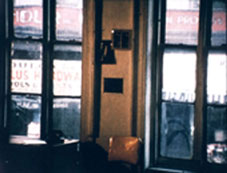
WVLNT ("Wavelength For Those Who Don't Have the Time") is a reworking of Michael Snow's ground-breaking 45 minute experimental film Wavelength (1967). One of the most influential works of structuralist film, the original has been literally cut in three, with each section's visual and sound superimposed upon the others, resulting in a shortened yet intense video version.
Michael Snow is considered one of Canada's most important living artists, and one of the world's leading experimental filmmakers. His wide-ranging and multidisciplinary work explores the possibilities inherent in different media and genres, and encompasses film and video, painting, sculpture, photography, writing, and music. Snow's practice comprises a thorough investigation into the nature of perception. While Snow early established himself as a successful painter and musician in his native Toronto, it was his 1962 move to New York City that marked the beginning of his rise to international prominence. He entered into a long-lasting and fruitful dialogue with downtown Manhattan's artistic avant-garde, exchanging ideas with figures such as Yvonne Rainer, Philip Glass, Sol LeWitt, and Richard Foreman, and developing some of his most ambitious and influential works to date. Snow would continue to pursue improvised music, both on his own and in ensembles such as Toronto's CCMC. The generation and reception of sound in the broader sense emerged as one of his main concerns, reflected in performance and tape works that share qualities with contemporaneous experiments by composers like Steve Reich. At the same time, Snow made alliances within the underground film scene centered around Jonas Mekas 'Filmmakers' Cinematheque. He created his most famous experimental film "Wavelength" in 1967, which notoriously includes a 45-minute camera zoom within a fixed frame. Snow's other films of this period, including "Back and Forth" (1969), and "La Région Centrale" (1971), similarly explored the mechanics of filmmaking to simultaneously investigate the functional processes of cinema and of thinking itself. In the 1970s and 1980s Snow, responding to a growing institutional commitment to his work, experimented more with large-scale installations, including public sculptures such as "Flightstop" (1979) and "The Audience" (1988-89). In recent years he has focused on the specific nature and potential of digital media, yielding works like the video-film "Corpus Callosum" (2002). Regardless of artistic genre, Snow consistently engages in an analytical discourse on the nature of consciousness and experience, and language and temporality.

Freja Sofie Kirk
B Plots
Video | hdv | color | 6:30 | Denmark | 2020
Joanna is a singer who performs in a bar six nights a week, inside a hotel where she lives a few floors below. Her voice guides us through her work routine and the circular route between her room and the stage, all while the video continuously interrupts itself, disrupting the linearity of her story. 'B Plots' looks into the connection between images and physical spaces and how they mirror and affect each other. The mechanic movements of the camera are not hidden, but amplified, directing ones attention towards the camera as a medium and the materiality of the video.
Freja Sofie Kirk works within video, photography and installation, often in connection with one another. Through her ongoing work with two-dimensional representations, Kirk’s practice investigates how images generate meaning in contemporary society. Her work takes the form of a continuous study of spatial and medial constructions, the violence they perform and the architecture they manifest. By utilizing the camera, Kirk attempts to renegotiate the power relations inherent in both architecture and image production.

Haim Sokol
Before the Storm
Video | hdv | color | 3:46 | Israel, Russia | 2012
The film is based on Lenin?s article ?Before the Storm? which tells about the First Russian Revolution of 1905. So it is a very short reenactment of the previous revolution. On the other hand it is taking place in today?s Moscow and labour migrants feature in the film, so it can be also a rehearsal of the future rebellion.
Haim Sokol b. 1973, Archangelsk, Russia Lives and works in Moscow Winner in 2009 for Special Stella Art Foundation prize Haim Sokol is an installation, sculpture, and video-based artist whose practice addresses the dramatic social histories of Russia and Eastern Europe. Though many of his works teeter on the edge of fiction and fantasy, Sokol roots his use of literary allusion in historical reality and the legacy of major 20th century uprisings, revolutions, massacres and genocides. By compounding the grim realities of urban life with the complexity of exile and socio-political diaspora, Sokol?s works effectively capture experiences of alienation, isolation and disrupted communication. Sokol is a graduate of the Hebrew University in Jerusalem (1996) and the Moscow Institute of Contemporary Art (2007). Sokol has exhibited in solo exhibitions at the M&J Guelman Gallery, Triumph Gallery, Anna Nova Gallery and other galleries in Moscow and St Petersburg. He has participated in the First Indian Biennale (Kochi-Muziris, 2012), Mediation Biennale (Poznan, Poland, 2010), the Third Moscow Biennale of Contemporary Art (2009), the Second Biennale of Contemporary Art in Thessaloniki (Greece, 2009), the First Moscow Biennial for Young Artists (2008) and other exhibitions in Russia and internationally.
Teresa Solar Abboud
Los Embajadores
Video | dv | color | 6:45 | Spain | 2010
Teresa Solar Abboud
You have been tracking us
Video | dv | color | 2:26 | Spain | 2009
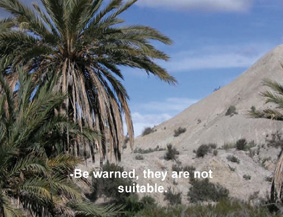
You have been tracking us, is a video work that reconstructs one of the scenes of the movie Lawrence of Arabia (directed by David Lean in 1962), the scene is the one that has an oasis as background, where the little army of Lawrence has stopped to rest. The video has been shot at the same spots of Tabernas? Desert (Almería, Spain) where the scene was orginally shot, copying the movements of the camera, in order to analyze the landscape that the cinematographic industry produced and, afterwards, left behind. The production team of the movie created the oasis for the shooting and did not remove the palm trees afterwards, so the trees have managed to survive and they still remain alive, 40 years after; this particular condition creates an interesting situation, where fictional elements have produced a?real? landscape. The video works with images aesthetically close from documentaries, but follows the shots ant the movements of the original scene, creating a contradictory and strange landscape.
Teresa Solar has studied Fine Arts at the Universidad Complutense, in Madrid and has obtained an MA in Contemporary Art at the European University of Madrid. She has been selected in different national contests such as ?Momentos de paisaje 09? (CDAN) and has participated in various exhibitions like ?Yo no tengo razón? (Off Limits, Madrid, 2009) and LOOP Festival (Barcelona, 2009). Since 2008 she has been investigating the relationships between touristic and cinematographic industry and landscape. Nowadays she is producing a new project in Cairo, Egypt.
Isabelle Solas
EN UN TEMPS SUSPENDU
Documentary | hdcam | color | 14:27 | France | 2012
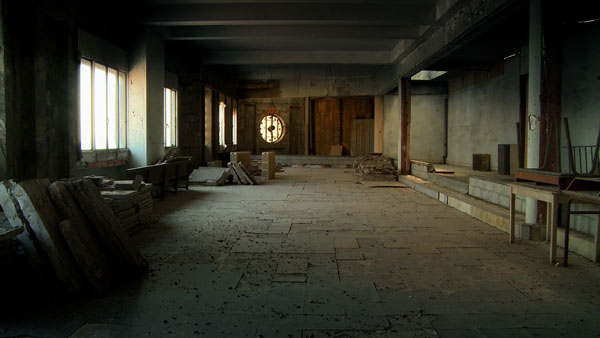
Au c?ur de Bordeaux demeure l?imposante Bourse du travail, lieu témoin d?une époque où la valeur travail et la lutte des classes étaient moteurs de la construction de la société. Sa façade égratignée, ses étages désertés sont autant de signes que le temps est passé, emportant avec lui la vivacité de l`idéal du Front Populaire. Un groupe visite le bâtiment, le patrimoine semble pousser l`action syndicale aux oubliettes, pourtant le lieu dévoile peu à peu ses habitants, bien vivants et animés par des problématiques sociales on ne peut plus actuelles.
Isabelle Solas est réalisatrice et cadreuse. Suite à des études en anthropologie et en langues orientales, elle intègre la prestigieuse Ecole du Doc de Lussas, en 2005, où elle réalise Dorsale sur le proche Atlantique, et rencontre les différents acteurs issus de ce "village documentaire". Depuis, elle travaille comme cadreuse pour d`autres réalisateurs (Gilles Kerpen, Galés Moncomble, Anna Feillou). Elle réalise son premier long métrage Inventaire en 2009, diffusé à l`Utopia à Bordeaux, et au festival Traces De Vies 2009. Elle se consacre ensuite à la réalisation de films engagés, Anastasie, portrait d?une sans-papier, La Presqu?Île, portrait d?un SDF (Programmation au Festival Traces de Vie 2011), et Voisins, Rencontres et jardins cachés, documentaire sur la question du logement social à Begles, programmé en 2010 au Festival Traces de Vie. Elle travaille également comme vidéaste avec le collectif "Monts et Merveilles", autour d`expériences artistiques et participatives, dans Soupe 3, et Cocktail Manoir, en collaboration avec Florent Ghys, contrebassiste et compositeur, elle réalise des vidéos musicales, 4, et Déviation. Elle travaille actuellement sur un nouveau projet de moyen métrage documentaire en coproduction avec France 3, intitulé PAS DE NOSTALGIE, CAMARADES avec la société Sister productions.
Federico Solmi
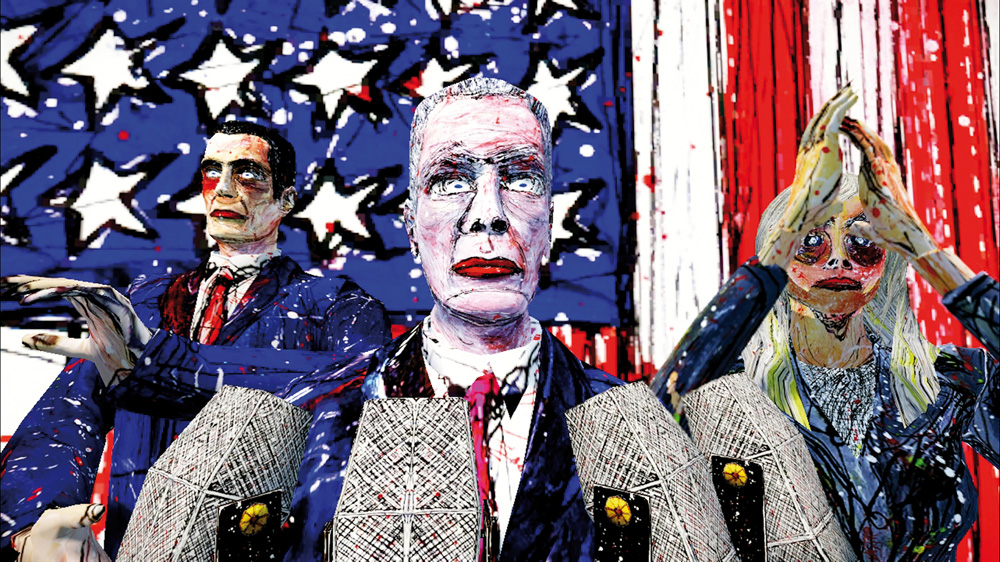
Chinese Democracy and the last day on earth
Video | hdv | color | 10:22 | Italy | 2012
In Chinese Democracy and the Last Day on Earth Federico Solmi aims to lampoon the contemporary society and the self–destructive nature of mankind. In contrast with their playful faux-naïve aesthetics, the videos indict a male dominated, hierarchal world controlled by corrupt, arrogant dictators, politicians, businessmen as forces behind the disintegration of ethical and moral values.
BIOGRAPHY Federico Solmi (Italy, 1973) currently lives and works in New York. His exhibitions, which often combine articulate installations composed of different media such as video, drawings, mechanical sculptures and paintings, use bright colors and a satirical aesthetic to portray a dystopian vision of our present day society. Irreverent, surrealistic, the videos and the works by Federico Solmi are as he is: extravagant, rowdy and ironic. They are satires about the evilness and the vices that affect contemporary society and mankind. The artist uses images culled from the video game industry, pop culture, and the Internet and collages them with a historical influence to produce original artworks about the seemingly disparate subject at hand. The universe that Solmi likes to represent is the exaltation of a present that is crumbling apart. His work is a criticism of a system that approves and trusts without questioning the fragile foundation on which our culture and post-modernist society is based. In the year 2009, Federico Solmi was awarded by the Guggenheim Foundation of New York with the John Simon Guggenheim Memorial Fellowship in the category Video & Audio. Solmi`s works has been exhibited in several international Biennials, such as First Shenzhen Animation Biennial in China (2013), the 54th Venice Biennial (2011), and Site Santa Fe Biennial in New Mexico (2010). His works have been exhibited and screened in the following museums and institutions for contemporary art: Centre De Pompidou, Palais De Tokyo, Paris; Drawing Center, New York; Reina Sofia National Museum, CA2M Centro De Arte Dos De Mayo (upcoming), Italian Cultural Institute, Madrid; Haus der Kulturen der Welt, Berlin; Herzliya Museum of Contemporary Arts, Israel; OCT Contemporary Art Terminal, Shanghai; Australian Center of Moving Images, Melbourne; Victoria Memorial Museum, Calcutta, India; Palazzo Delle Esposizioni, Rome, Palazzo Delle Belle Arti, Naples, Italy Solmi`s video have been screened in several film and video festivals around the world including the Kassel Documentary film and video festival; Tina B, Prague; Les Rencontres Internationales, Paris, Madrid, Berlin; The London International animation festival; Loop Barcelona and others. Federico Solmi has given lectures on his work in several universities and art schools in the United States and Europe, including Yale University in New Haven, School Of Visual Arts in New York, and Accademia di Belle Arti Brera and Universita` Cattolica in Milan.
Federico Solmi
Douche Bag City
Animation | dv | color | 8:0 | Italy, USA | 2009
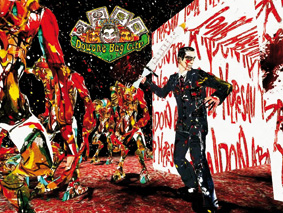
Douche Bag City is a video installation of 24 drawing animated film. It was conceived by the artist to be a satire about the current world economic crisis. The main character ?Dick Richman? is a greedy, dishonest, and selfish Wall Street employee who has been banished to live in Douche Bag City. Douche Bag City is a hopeless place, where the greedy villains of society are imprisoned for their atrocities committed against the community. The video is made of several chapters. In the final version of the installation, 24 videos/episodes will be playing simultaneously; each episode represents a mission for the main character. The ultimate goal of the protagonist ? Dick Richman? is to survive different challenges, but the drawing animated /video games are set by the artist in a way that the main character ?Dick Richman? cannot win. For each video I used a combination hand-made drawings, video game technologies, 3D and 2D animation. The installation was made in collaboration with Russell Lowe, an Australia-based 3D artist and professor at the New South Wales University in Sidney.
Federico Solmi was born in Bologna, Italy in April 1973 and currently lives and works in New York. His exhibitions, which often combine articulate installations composed of different media such as video, drawings, mechanical sculptures and paintings, use bright colors and a satirical aesthetic to portray a dystopian vision of our present day society. Irreverent, surrealistic, and sexually explicit, the videos and the works by Federico Solmi are as he is: extravagant, rowdy and ironic. They are satires about the evilness and the vices that affect contemporary society and mankind. In the year 2009, Federico Solmi was awarded by the Guggenheim Foundation of New York with the John Simon Guggenheim Memorial Fellowship in the category Video & Audio. Federico?s work has been featured in the following museums and Institutions for Contemporary art; Santa Fe Biennal (upcoming June 2010), Centre Pompidou, Paris, Drawing Center, New York; Haus der Kulturen der Welt, Berlin, National Center for Contemporary Art, Moscow, CA2M Centro de Arte Dos de Mayo, Madrid, Australian Center of Moving Images, Melbourne, Victoria Memorial Museum, Calcutta, India, Contemporary Art Center of Rouboix, Palazzo Delle Arti, Naples, Palazzo Delle Esposizioni, Rome, Italy.
Federico Solmi
King Kong and the End of the World
0 | dv | color | 4:27 | Italy, USA | 2006
KING KONG AND THE END OF THE WORLD - 2005 - 2006 King Kong and the End of the World is a sensational and sarcastic drawing animated film, based on the original 1933 King Kong movie. In this version, King Kong (played by the alter ego of the artist) destroys New York City, using the Guggenheim Museum as a weapon, then he climbs to the top of the Empire State Building where he pees, eats wall street brokers for lunch, and fights the Statue of Liberty in the arena of Time Square. The artist uses King Kong as an allegory of the art world and the money-frenzy culture of the city. In this world, art is struggling against its role as a commodity. Ideas around the nature of money, technology, the natural and ?man-made? come together in the painstaking hand drawing of every frame. When he is finally killed, King Kong triggers a cataclysmic earthquake that destroys the earth or as it?s called by the artist ?the world of assholes?. All that is left is for Federico and his wife Jennifer to repopulate a better mankind using a baby making machine.
Federico Solmi was born in Bologna, Italy in April 1973 and currently lives and works in New York. His exhibitions, which often combine articulate installations composed of different media such as video, drawings, mechanical sculptures and paintings, uses bright colors and a satirical aesthetic to portray a dystopian vision of our present day society. Power is often the nemesis in his worlds, manifesting itself in the elliptical layers of the Guggenheim Museum (King Kong and the End of the World, video 2006), the shiny Prada shoes of the Pope (The Evil Empire, video 2007), and the personal obsession to be as famous as the giant letters that spell out ?Hollywood?. The artist uses images culled from the video game industry, pop culture, and the Internet and collages them with a historical influence to produce original artworks about the seemingly disparate subject at hand. What results from the combination of all these elements is art that is humorous, absurd, and scathingly critical of our contemporary society. .

Federico Solmi
American Fables
Video | mp4 | | 7:40 | Italy, USA | 2020
Inspired by the legacies of real historical events and manufactured myths, American Fables, re-imagines through video vignettes some of the most celebrated moments in American History. I have long been influenced by the comically one-dimensional and inaccurate accounts of history common to most US textbooks, where ethnocentric perspectives create propagandistic narratives of American exceptionalism. Continuously, I find myself fascinated by the subjectivity of history, its vulnerability to partisan ideals and nationalism, rendering historical accounts more akin to folktales than facts. This inspired me to create my own library of counterfeit and re-imagined American History in an effort to submit my own voice into the ever expanding campaign of misinformation entrenched in Western rhetoric.
Federico Solmi (Italy, 1973) currently lives and works in New York. Solmi’s work utilizes bright colors and a satirical aesthetic to portray a dystopian vision of our present-day society. His exhibitions often feature articulate installations composed of a variety of media including video, painting, drawing, and sculpture. Solmi uses his art as a vehicle to stimulate a visceral conversation with his audience, highlighting the contradictions and fallibility that characterize our time. Through his work, Solmi examines unconscious human impulses and desires in order to critique Western society's obsession with individual success and display contemporary relationships between nationalism, colonialism, religion, consumerism. By re-configuring historical narratives across eras, he creates social and political commentary works which disrupt the mythologies that define American society. Scanning his paintings into a game engine, Solmi’s videos confront the audience with his own absurd rewriting of past and present, merging dark humor and sense of the grotesque with new technologies. He creates a carnivalesque virtual reality where our leaders become puppets, animated by computer script and motion capture performance rather than string.
Federico Solmi
The Bacchanalian Ones
Experimental VR | 0 | color | 0:0 | USA | 2021
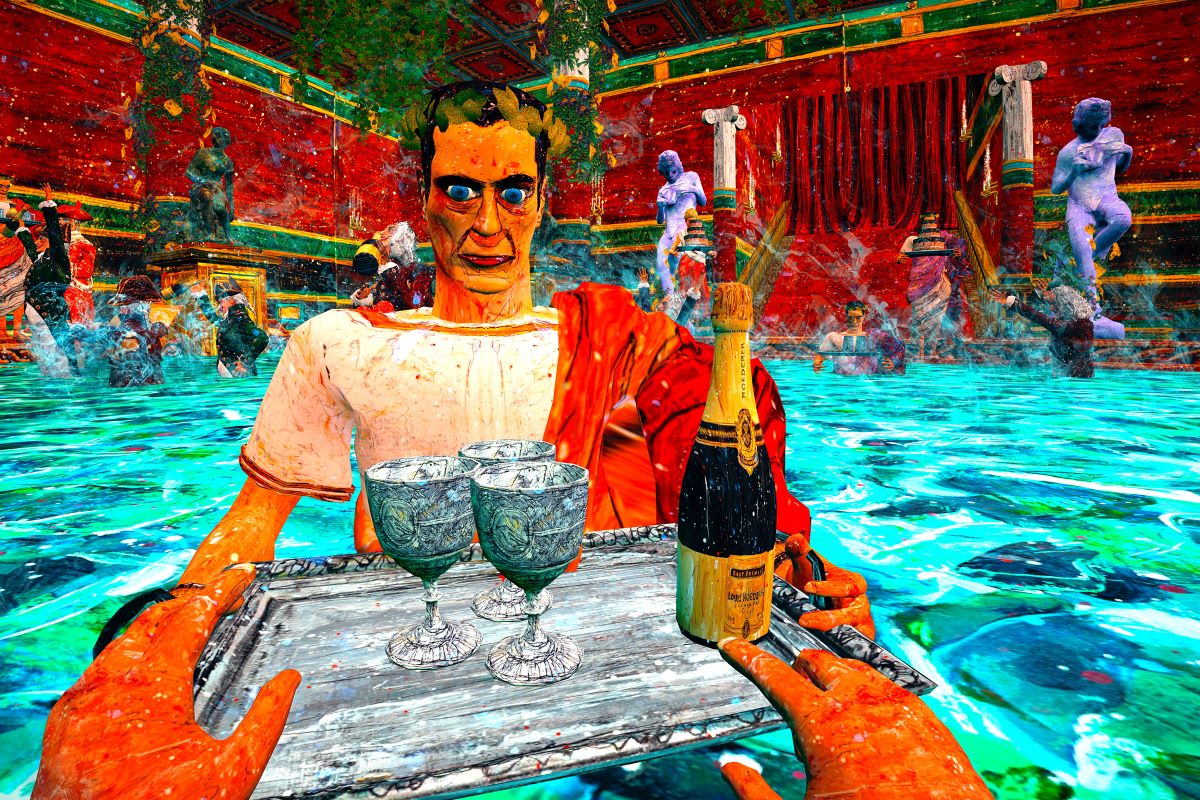
The Bacchanalian Ones, VR Experience for Oculus Quest 2 Inspired by ancient mythology, modern myth, and contemporary celebrity culture, The Bacchanalian Ones compares the historical myth with a satirical mash-up of the powerful self-absorbed who preen and wallow in a banal spectacle of their own creation. In a fantastically opulent setting of unrestrained hedonism, political, religious, and military leaders with ghoulish, bouffonesque appearances are surrounded by social elite sycophants like the devotees of the cults of Bacchus and Dionysus. Solmi’s phantasmagoric world of whirling space, jerking movement, and oscillating facades that strive to overwhelm the viewer’s visual field is pushed to extremes in a new interactive Virtual Reality installation. This work invites the visitor to enter the Bacchanal by donning a VR mask and manipulating two hand-held controllers in order to pick the perspective of one of his historical avatars. Newly empowered, and emboldened, the visitor is able to control the narrative, allowing them to experience the debauchery up close and personal through their embodiment of the avatar.
Federico Solmi was born in Bologna, Italy in 1973. Since 1999 he has lived and worked in New York. Solmi’s work utilizes bright colors and a satirical aesthetic to portray a dystopian vision of our present-day society. His exhibitions often feature articulate installations composed of a variety of media including virtual reality experiences, video installation, painting, drawing, and sculpture. Solmi uses his art as a vehicle to stimulate a robust conversation with his audience, highlighting the contradictions and fallibilities that characterize our time. In 2009, Solmi was awarded by the Guggenheim Foundation of New York with the John Simon Guggenheim Memorial Fellowship in the category of Video & Audio. Solmi’s work was included in the 100-year anniversary exhibition of The Phillips Collection, Seeing Differently, and in the Smithsonian National Portrait Gallery’s traveling exhibition, Outwin 2019: ‘American Portraiture Today,’ as well as the inaugural exhibition of the Ocean Flower Museum Island in Hainan Province, Danzhou, China. From 2016 to 2019 Federico Solmi was visiting Professor at Yale University School of Art, and Yale School of Drama, New Haven CT. Solmi was appointed guest critic at the Yale University School of Art for 2022.
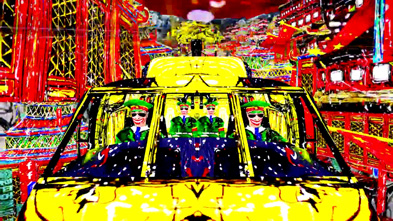
Federico Solmi
Song of Tyranny
Animation | hdv | color | 6:0 | Italy, USA | 2012
"A Song of Tyranny", is the first video episode of the Trilogy entitled Chinese Democracy and The Last Day On Earth, a project by Federico Solmi, which was commissioned by the Guggenheim Foundation of New York after the artist was awarded the John Simon Guggenheim Fellowship for video. In this swarming animation, the artist investigates the self destructive nature of mankind through the examples of political dictatorship and authoritarian behaviors. Beyond the apparent Manichean character of such a vision, the video is articulated as a fictitious portrayal or the hagiography of an imaginary leader of the mid-21st century, idolized by his crowd of subjects. Solmi`s playful aesthetics integrate a series of visual metaphors to present viewers with a comedic-grotesque parabola on power and its excess. This sarcastic and irreverent tone allows Solmi to target the epitome of human folly, greed, and thirst for power, preventing a simple reproduction of the dichotomic good versus evil. A Song of Tyranny, centers on the protagonist in the phase of becoming a dictator while he is permeated with values and models that will influence his successive actions and decisions in the process of rising to power. Solmi?s complex technique combines traditional hand drawn animation with digital models, utilizing computer gaming engines. The result is an absolutely unique hand-made texture within a real-time 3D framework, created in collaboration with Australian based 3D artist, Russell Lowe.
Federico Solmi (Italy in 1973), currently lives and works in New York. His exhibitions, which often combine articulate installations composed of different media such as video, drawings, mechanical sculptures and paintings, use bright colors and a satirical aesthetic to portray a dystopian vision of our present day society. Irreverent, surrealistic, and sexually explicit, the videos and the works by Federico Solmi are as he is: extravagant, rowdy and ironic. They are satires about the evilness and the vices that affect contemporary society and mankind. The artist uses images culled from the video game industry, pop culture, and the Internet and collages them with a historical influence to produce original artworks about the seemingly disparate subject at hand. The universe that Solmi likes to represent is the exaltation of a present that is crumbling apart. His work is a criticism of a system that approves and trusts without questioning the fragile foundation on which our culture and post-modernist society is based. In the year 2009, Federico Solmi was awarded by the Guggenheim Foundation of New York with the John Simon Guggenheim Memorial Fellowship in the category Video & Audio. Solmi?s videos were featured in the 54th Venice Biennial, in the exhibition entitled ?Italians do it better?. His work was included in the year 2010 at the Site Santa Fe Biennial, an exhibition curated by Sarah Lewis and Daniel Belasco. His work has been exhibited in the following museums and Institutions for Contemporary art; Centre Pompidou, Paris, Reina Sofia National Museum, Madrid, Drawing Center, New York; Haus der Kulturen der Welt, Berlin, CA2M Centro de Arte Dos de Mayo, Madrid, National Center for Contemporary Art, Moscow, Australian Center of Moving Images, Melbourne, Victoria Memorial Museum, Calcutta, India, Contemporary Art Center of Rouboix, Palazzo Delle Arti, Naples, Palazzo Delle Esposizioni, Rome, Italy. In addition, his video animations have been screened in several film and video festivals, such the Kassel Documentary film and video festival, Tina B, Prague, The London International animation festival, Loop Barcelona, IndieLisboa, Lisbon, Impakt Film and Video festival, Utrecht.