Catalogue > Search
Results for : Tout le catalogue
Mohammad Shawky Hassan
Wa 'ala Sa'eeden Akhar
Experimental video | mov | color | 24:0 | Egypt | 2015
And on a Different Note is a navigation of an attempt to carve out a personal space amid an inescapable sonic shield created primarily by prime time political talk shows with their indistinguishable, absurd and at times undecipherable rhetoric/ noises. Equally repulsive and addictive, these noises travel across geographies gradually constituting an integral part of a self-created map of exile.
Mohammad Shawky Hassan studied philosophy, film directing and cinema studies at The American University in Cairo, The Academy of Cinematic Arts & Sciences and Columbia University. His films include balaghany ayyoha al malek al sa’eed/ it was related to me (2011), On a Day like Today (2012) and Wa Ala Sa’eeden Akhar/ And on a Different Note (2015). He presented film programs at the Oberhausen Short Film Festival, Anthology Film Archives, The New York Public Library and UnionDocs, and was running the Network of Arab Arthouse Screens (NAAS)till 2016.

Rachel Shearer
Hold Still
Experimental video | dv | | 6:36 | New Zealand | 2009
Ethel Garden, Lucy Mills and Violet Winstone, women of means in 1930?s New Zealand use 16mm film cameras to document their lives and surroundings. Incidental to this act, a psychic tracery is drawn of simultaneous moments. The intimacy of their home movie making has been edited and re- assembled into a study of a landscape - internal, physical, cultural - and these women`s place within it. The addition of sound looks to support a cinematic treatment of the images by drawing on traditional aspects of film sound design but reducing the usual combination of elements (ambience, music, Foley, sound effects, dialogue) to selected singular layers - the musical sequences drawing on silent movie?s tradition of theatre cinema organ music, the emotive devices of gothic film noir, progressively reduced to sound effect gestures, coloured ambience and back to silence, implying a selective listening/remembering of history.
Rachel Shearer is a sound artist based in Auckland, New Zealand. A history in a range of sound practices and their relationship with moving image informs her work. Active as a performing and recording musician since the late 1980?s, Rachel has released material internationally with well-known music labels, (Xpressway (NZ), Flying Nun (NZ), Ecstatic Peace (US), Corpus Hermeticum (NZ), Family Vineyard (US) among them. Rachel trained in Cologne, Germany in live sound engineering, subsequently working freelance in both live sound and in post-production audio for film and television. She has sound designed and composed for a number of NZ award winning features and short films. Her most recent sound art commissions include permanent site-specific sound installations in New Zealand.
Rina Sherman
Ovaryange tji veya
Documentary | dv | color | 30:0 | South Africa, Namibia | 2006
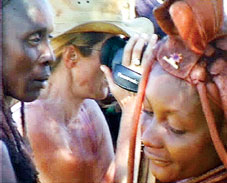
"Ovaryange tji veya / Quand les invités arrivent" is about the relationship between Rina Sherman, filmmaker and ethnographer, and an Omuhimba family with whom she lived for seven years, filming and photographing aspects of their everyday and ritual lives. Halfway through her tenure in the field, Rina Sherman presented a multimedia exhibition, entitled "The Ovahimba Years: Work in Progress" in Windhoek, Namibia. A group of young people from the community of Etanga participated in the exhibition. The film explores the evolution of this relationship that lead to the exhibition; shows the group of young people discovering the presentation of their cultural heritage at the exhibition, with performances as part of the programme presented; and shows the resulting discussions and consequences of the exhibition once everyone is back in Ovahimba country. "Ovaryange Tji Veya" is a film about an anthropologist in situ, and evokes several notions central to fieldwork, such as the nature of the bond between the observer and the observed, the observed observer, participant-anthropology, and emotion as a possible vector or hindrance in fieldwork.
Rina Sherman was born in South-Africa. Exiled from her birth country, she settled in France in 1984 where she has been living and working ever since. She became a French citizen in 1988. A musician by training, she worked as a theatre actress and as a vision mixer in television before turning to filmmaking. In 1990 she successfully completed a doctorate at the Sorbonne supervised by Jean Rouch. Her first novel, "Uitreis", (Leaving) was published in South Africa in 1997 to critical acclaim. Writer, filmmaker and anthropologist, Rina Sherman has initiated several cultural projects. She was the audiovisual director for the manifestation, "South Africa: Music of Freedom", La Villette, 1995. She was awarded the prestigious French prize, Villa Médicis Hors les Murs, which allowed her to undertake research in the film archives of the Southern African region. In 1996, she organised Jean Rouch?s tour of South African universities in collaboration with the French Institute in South Africa and the French Embassy in Namibia. In 1997 Rina Sherman was awarded a Lavoisier Research Bursary by the French Ministry of Foreign Affairs for the project "The Ovahimba Years", a multi disciplinary long-term research programme (drawings, oral tradition, video, film, photography) aimed at creating a living trace of Ovahimba cultural heritage. For a period of seven years, Rina Sherman filmed and photographed aspects of the daily and ritual lives of the Ovahimba. In 2002, she presented a multimedia exhibition, "Work in Progress", at the Franco-Namibian Cultural Centre in Windhoek. In 2003, she extended her research into the south west of Angola, and has hence covered the entire Otjiherero socio-linguistic cultural heritage landscape. She is currently writing and editing films about her seven years spent with the Ovahimba. The project received support from the French Ministry of Foreign Affairs, various EU Embassies, The Ford Foundation, and numerous private sponsors.
Wenhua Shi
Endless
Experimental film | 16mm | color | 10:0 | USA, China | 2005
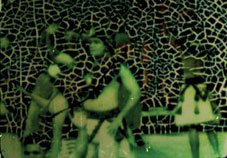
"Endless" is a meditation on the inevitable deterioration of certain traditional values that have been established (or destroyed) throughout civilization. This elegiac account uses symbolic representation from natural elements in order to convey the inevitability of remembering the social and cultural erosion, and places a layer of texture in front of the elliptical glimpses of imagery, separating the viewer from the past. The re-occurring image of flames remains untouched by the erosion aspects of reticulation, ultimately alluding to nature's powerful quality.
Wenhua Shi, originally trained as a doctor in China, departed from the medical field and began working in radio and TV in his hometown of Wuhan. At the end of 2000, he came to Colorado, studying with the experimental Film giant Stan Brakhage and Phil Solomon. He started making and exploring film as a medium at the University of Colorado at Boulder (BA & BFA) and the University of California, at Berkeley. His films have been screened at Pacific Film Archive, Smithsonian Freer Gallery of Art and Arthur M. Sackler Gallery, the National Museum of Film, Photography and Television (UK) , Denver Contemporary Museum of Art, Beijing Film Academy, The Jack Kerouac School of Naropa University, and dozens of international film festivals, including Rotterdam, Hamburg, Bradford, and Mexico City, where his works have been recognized with top honours. He works on the poetic approach to filmmaking and crossing the boundary of narrative and experimental style. He is very engaged with sound projects (Chinese New Ear/ director: Dajuin Yao) and is also the curator of Flickercafe, a monthly experimental film screening in Boulder, CO, in the post-Stan Brakhage age.
Lo Shih-tung
Ghosts next to the city
Video installation | 0 | color | 14:3 | Taiwan | 2011
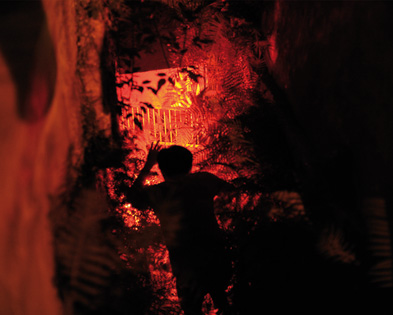
The script is written according to a conflagration which happened years ago in Treasure Hill. Through photo documents and interviews with residents, one can relate various images of fire to the past lifestyles of residents, whether it be fire accidents, bonfires, or fires for the purpose of producing light and warmth. These flickers of light can be seen as historical signifiers, linking together all the different people and memories belonging to this land. At present, Treasure Hill has been transformed and regenerated as an Artist Village. How to recollect the historic local memories and let them permeate into the present or even the future through the practice of contemporary art is a major issue that challenges us today. To this date, the flames of Treasure Hill have not yet ceased and are continuing to spread. Through various forms of fire (light) and images, it allows us to "see / illuminate" the different textures of Treasure Hill.
I regard the special textures present in our daily life, seeing them as in Walter Benjamin?s discourse, fragments and reflection of a complete structure, a whole world. My works are organic documents attempting to inquire and contemplate ever-changing warped messages. They do not only focus on one direction. Painting, photography, performance, audio/ video, installation, happenings can all be part of a creation thrown to public arenas awakening its refraction and feedback. Through the process of creating and interacting with spectators and communities, the fragmented, fissured, and forgotten history can be restored or even fictionalized. It is about seeking one?s identity, residence, hometown, and city; those long forgotten, unseen ghosts.
Yoshida Shingo
journal intime
Art vidéo | | color | 5:45 | Japan, Swaziland | 2010
journal intime «Mon travail se base sur des interventions parasitaires dans l`espace public, à travers l?observation, l?expérience et le souvenir des comportements humains. Les actions que je realise en transforment le sens, interrogeant l?usage et les relations des gens à leur environnement. Ce que je réalise est un constat teinté d?humour. Je travaille comme un voyageur, sans atelier fixe. Mon activité artistique dépend de l?endroit où je me trouve et permet d?identifier cet endroit. Je suis autonome, mon atelier est mobile. Il est primordial pour moi d?envisager les villes du monde entier, comme des lieux de création, de jeu et de me confronter aux différents modes de vie et différents codes sociaux.»
Shingo Yoshida est né le 18 avril 1974 à Tokyo. Il entre en 1999 à la Villa Arson à nice où il se consacre au son ainsi qu`a la vidéo.Il en sort en 2004 avec les félicitations du jury. Puis il emménage à lyon où il fait un post-diplome en Art , suite à quoi il intègre le programme La Seine des beaux arts de Paris (2005). Depuis Shingo Yoshida voyage à travers le monde dont il a fait son atelier, adaptant sa pratique à l endroit où il se trouve, il est pour lui primordial d` envisager les villes du monde entier comme des lieux de création, de jeux et de se confronter à différents modes de vie et différents code sociaux ce dont son travail se nourrit
Takeshi Shiomitsu
One lone hand clenched in a fist in the air (Real natural)
Video | hdv | color | 2:29 | United Kingdom | 2012
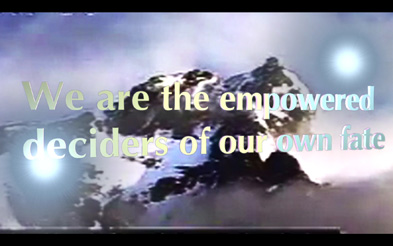
One lone hand clenched in a fist in the air (Real natural) is part of a series of video and sculptural work exploring how human relationships to nature are actualised through cultural means, in an age of digital, ecology and networks. It is an exploration of the discourse involved in questioning the distinctions between a symbolic relationship and a ?traditionally? meaningful (often read as ?material?) one, or what engagements are truly possible. Simultaneously, it is in dialogue with taste, and the distinctions between ?valid? and poor tastes. It consists of shards of information, processed and reprocessed, hashed and spun together; some heightened, some pushed towards abstraction. Intentionally amateurish, it is part karaoke atmosphere video, part QVC sales pitch, part manifesto, part pop-philosophy.
Takeshi Shiomitsu is an artist living in London, working in video and sculpture.
Ding Shiwei
GOODBYE UTOPIA
Animation | hdv | black and white | 7:31 | China | 2014
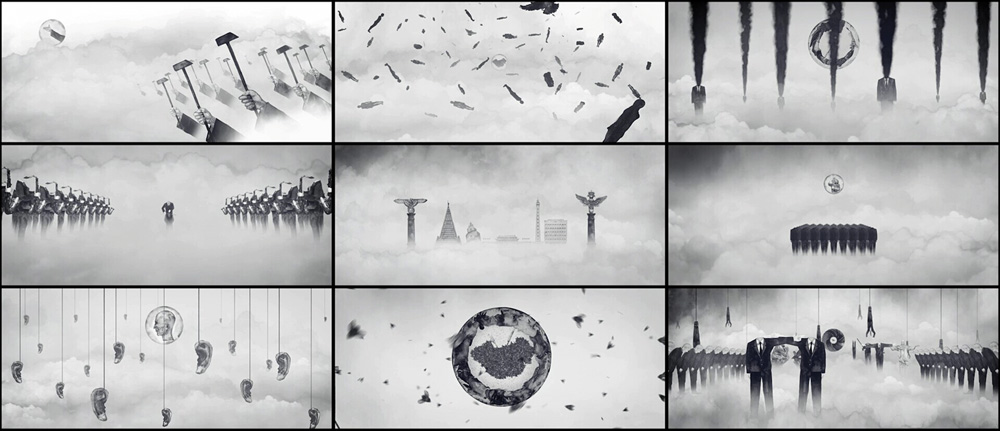
In memory of ancient humans, God issued commandments to Moses on Mount Sinai and said, "can not kill." However Nietzsche tells us that God has been dead already. Human beings created God, but also exterminated God. We childbirth themselves, but also slay ourselves.
Ding Shiwei was born in Heilongjiang Province and graduated from China Academy Of Art with BFA in 2012. He currently lives and works in Hangzhou, China. Main in Experimental Animation, Experimental Video. His works were presented in Montreal Museum of Fine Arts, Quebec, Canada; Li Xianting Film Fund, Beijing, China; OCAT Contemporary Art Center, Shenzhen, China; A4 Contemporary Art Center, Chengdu, China. His works had been selected out in the international competition section and media art section of Tampere Film Festival; Up and coming Int. Montreal International Film Festival of Films on Art; Image Forum Film Festival in Japan. His works were collected by Li Xianting Film Fund, Beijing, China.
Tim Shore
Cabinet
Experimental film | dv | color | 18:20 | United Kingdom | 2006
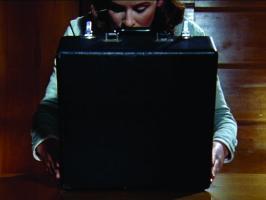
?In Cabinet, Tim Shore pursues a disturbing message through the spaces of the American landscape. An associative framework of found footage, digital reconstruction and text form a meditation on identity, technology and the land. Shore?s fragments of found imagery and sound evoke America?s myths of itself, from its war record to its prairies and birdsong. Yet, this is shadowed by the dark spaces of the Unabomber in his forest cabin, and the repetitive sound of the typewriter, a reference not only to the latter?s destructive manifesto but also to the fragmenting advance of technology.? Lucy Reynolds
Tim Shore graduated in animation from the Royal College of Art in 2002. His graduation film, Rosabelle Believe was screened at festivals around the world, including Rotterdam, European Media Art Festival Osnabruck, and Los Angeles. Keepsake (2004), about the drowning of the Elan Valley, was commissioned by Channel 4 Wales. His most recent film, Cabinet (2006), continues an interest in, and exploration, of the history of technological progress and its often ambivalent impact on society and the individual. It was awarded Second Prize Prize at transmediale.07, Berlin, and other screenings include Rotterdam, Impakt Festival, Centraal Museum, Utrecht; New York Video Festival, Lincoln Center; Courtisane, Ghent; Media City, Windsor, Ontario; Alternative Festival, Belgrade. Tim Shore?s films are developed from a period of careful research often of social/historical themes and subjects. Through this extended process Shore aims to extract subtle, detailed and engaging ?narratives? from historical record. He often uses archive material, including photographs, film and sound, in his work. Tim is Head of Animation at the London College of Communication, University of Arts, London.
Rafiqul Shuvo
Artifacts, relating to upcoming events
Video | hdv | black and white | 13:1 | Bangladesh | 2014
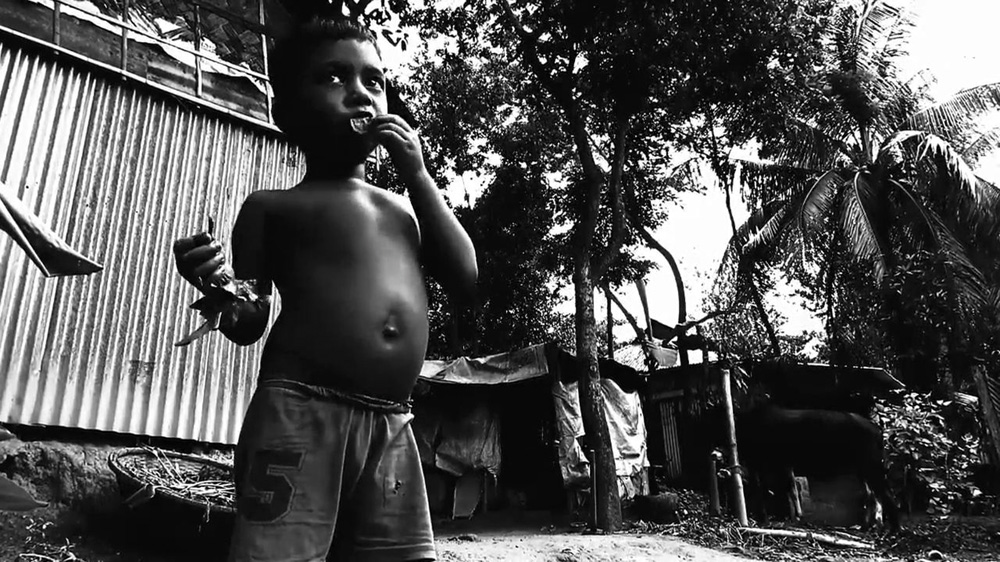
‘Timelessness’ is the key of this video. The quality is not referring to ignore time rather; it’s capacity to ignore the influence of Time-a vital ruler of our life. Every era carries thousands of master pieces. With the passage of time, number of pieces of a particular era reduces for less occupancy to the people of the following era. It’s because the time changes reality. What can travel more must less influenced by time. From the first human to now, what is still constant? –Human body and Nature. The video is about relationship of body with nature. Figure used in the video represents only body; actions are natural. The actions of figures are in playing mode, the purpose is absent but the pleasure is inevitable. The purposeless is meaningless- The truth that we are here and will not be. The audio exactly carries the screaming of the truth of that we are passing. The video with creates insecurity as it demolishes meaning of security. A very melancholic feeling of death but hints how to face? And finally how it brings color to life? The ending commentary- ‘Body is for usage…..’-depicts how the video is “Optimistic about nothing”.
Rafiqul Shuvo was born in 1982 in Dhaka, Bangladesh. He was from a national cricket academy and initially started his career as a cricketer but later on he moved in the field of visual arts and studied sculpture (B.F.A and M.F.A) in Dhaka University Faculty of Fine Arts. Back in 2012 he curated a major show named “Only God Can Judge Me” an art event in a abandoned factory which ran parallel to the Dhaka Art Summit. In the following year 2013 he curated another collective multimedia and avant-garde show called Mourn. He is the founder of ‘OGCJMart’ a non-organizational collective along with his 12 artist friends. He works with his OGCJMart friends and he helps to develop and promote their works. He has, over the last ten years, participated in numerous exhibitions at home and abroad. He is a conceptual artist works in various media his practice mainly focusing on paintings, sculptures, videos and photography. Recently he is making several videos and finished working on his first film.
Rafiqul Shuvo
Faster satiation, but only for Nevertheless behavior
Experimental film | hdv | black and white | 6:38 | Bangladesh | 2014
A land of disaster and death, a land of Mourn, the political domination, social, cultural confliction are extreme , when the tragic events happen one after another and sufferings of people knows no bound , all these issues are never questioned. What are the connection do the people hold with nation?
Rafiqul Shuvo was born in 1982 in Dhaka, Bangladesh. He was from a national cricket academy and initially started his career as a cricketer but later on he moved in the field of visual arts and studied sculpture (B.F.A and M.F.A) in Dhaka University Faculty of Fine Arts .Back in 2012 he curated a major show named “Only God Can Judge Me” an art event in a abandoned factory which ran parallel to the Dhaka Art Summit. In the following year 2013 he curated another collective multimedia and avant-garde show called Mourn. He is the founder of ‘OGCJMart’ a non-organizational collective. He has, over the last ten years, participated in numerous exhibitions at home and abroad. He is a conceptual artist works in various media his practice mainly focusing on paintings, sculptures, videos and photography. Recently he is making several videos and finished working on of his first film.
Ludivine Sibelle
Le sacrifice des géants
Experimental doc. | 16mm | color | 11:0 | France | 2013
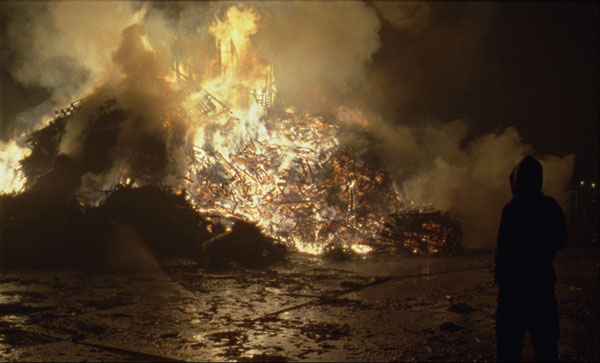
A slight crackling accompanied by a silent voice, take us through a series of cold and desolate landscapes, in which gather silhouettes carrying torches. They perform rituals that we fail to understand. When daylight comes, it only remains fragments. Until the sacrifice of giants is a documentary fable about the disappearance of myths in contemporary society, through the observation of popular rites.
After three years of study at the Ecole Nationale Supérieure des Arts Appliqués Duperré in Paris, Ludivine Sibelle studied photography and video at the National School of Visual Arts of La Cambre in Brussels from 2004 through 2009. Her artistic work ranges from drawing to video, through photography, and more recently installation. In 2012, she joined the Fresnoy where she made her first film, a short film between documentary and fiction entitled Until the sacrifice of giants.
Raphael Siboni
La forme M
Experimental video | dv | color | 8:30 | France | 2005
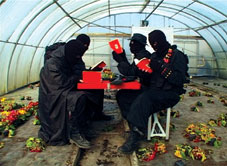
There is a red folding table with soldiers dressed in black all around. The red table is the main character of the movie, and soldiers are the accessories. There is no guns but black tubes. No corpses but black-zipped bags. The movie spreads out all around the table, and the m., somewhere, must be something.
Raphaël Siboni was born in 1981 and graduated from the Fine Arts School of Paris. He lives and works somewhere between Paris and Roubaix, entered residency at the Fresnoy, National Studio of Contempory Arts, and currently works on several projects, such as the Kant Tuning Club.

Berta Sichel
Reina Sophia Museum
0 | 0 | | 0:0 | Spain | 2007
On September 10th, 1992, their Majesties King Juan Carlos and Queen Sofía opened the Permanent Collection of the Museo Nacional Centro de Arte Reina Sofía. What had before only been host to temporary exhibitions was now a true museum, with the task of looking after, increasing, and exhibiting its artistic collections. The building that is the home of the MNCARS, however, dates back many years. In 1566, during the reign of Felipe II, the idea arose of bringing all the many different centres and hospices scattered around the city of Madrid together under one roof and thirty years later, during the reign of Felipe III, the first shelter was opened on Calle Santa Isabel. Other installations were then added to this shelter, including Hospital de Santa Catalina and Hospital de la Pasión, and the complex formed as a result was named Hospital General. From that time, the Hospital has undergone various modifications and additions, managing to survive demands for its demolition by way of a Royal Decree in 1977 that declared it a national historical and artistic monument. In 1980, Antonio Fernández Alba began work to restore the building and at the end of 1988, José Luis Iñíguez de Onzoño and Antonio Vázquez de Castro put the final touches to the modifications, among which the three glass and steel lift towers, designed in collaboration with British architect Ian Ritchie, are of particular interest. Soon after, in 1988, a Royal Decree turned the Centre into a National Museum to replace the former Museo Español de Arte Contemporáneo (MEAC). The institution's first director, who held the position from June 1988 to December 1990, was Tomás Llorens. In late December 1990, María del Corral took over as director. In September 1994, a new director was appointed, José Guirao Cabrera, who directed the centre until May 2000 when he was replaced, until June 2004, by Juan Manuel Bonet. Since June 7th, 2004, Ana Martínez de Aguilar has held the position as director of the museum.
Luke Sieczek
Phantom
Experimental video | dv | color | 6:20 | Poland, USA | 2007
PHANTOM (Luke Sieczek, 6:20 min., Digital Video, Color/Sound, 2007) PHANTOM recomposes two scenes from Jacques Tourneur`s film Cat People, reanimating the words and images of its heroine, played by the actress Simone Simon. Her voice reverberates a feeling of intense restlessness, while luminous specters emanate from all sides, surrounding her in a pulsing, phosphorescent glow. PHANTOM re-imagines a half-remembered midnight movie: the dying rays of a television screen are re-absorbed into a spectral, volatile afterimage.
Originally from Poland, Luke Sieczek is an independent film and video artist, whose films have been exhibited at numerous international film festivals and venues. His films and videos have shown at Museum of Modern Art, the New York Film Festival`s "Views from the Avant-Garde," the European Media Art Festival, and the Rotterdam International Film Festival, among others. While varying in genre and technique, his films and videos continue to explore concerns that include the investigation of place, memory, the status of the - immigrant - outsider, and the shifting and unstable relations of audio-visual time and space. Luke Sieczek studied at Bard College and received an MFA from the University of Wisconsin. He currently lives in Seattle, WA.
Amie Siegel
Berlin Remake
Video installation | dv | color and b&w | 14:0 | USA | 2005
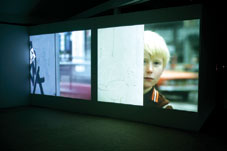
"Berlin Remake" is a video installation comprised of shot-for-shot remakes of scenes from the East German state film studio (DEFA). The movie scenes are re-created and framed exactly as in their original set-ups, only populated now by contemporary architecture and historical absence ? evocative cinematic gestures re-staged throughout East Berlin. The "remade" scenes are projected alongside the "original" film scenes, a synchronous, looped double projection in a darkened space. The video installation is an uncanny juxtaposition of past and present, making history (like the GDR) simultaneously present and absent, dramatic and banal, ruptured and reconnected, and explores how within cinema's fictionalization of history, documentation and archiving occurs.
Born in Chicago in 1974, Amie Siegel works with film, video, sound, and writing. A graduate of Bard College and The School of the Art Institute of Chicago, Siegel's work has exhibited at the Whitney Museum of American Art, Kino Arsenal Berlin, Toronto Cinematheque, Museum of Fine Arts Boston, Facets Cinematheque, and Austrian Film Museum. She is the author of The Waking Life (North Atlantic Books, 1999). "Empathy", her first feature film, premiered at the 2003 Berlin International Film Festival. Siegel has received fellowships from the MacDowell Colony, DAAD Berliner-Künstlerprogramm and the Edith Ruß Haus für Medienkunst. She lives in New York and Berlin.
Liina Siib
Nii tuli lõpp
Experimental doc. | 4k | color | 17:31 | Estonia | 2025
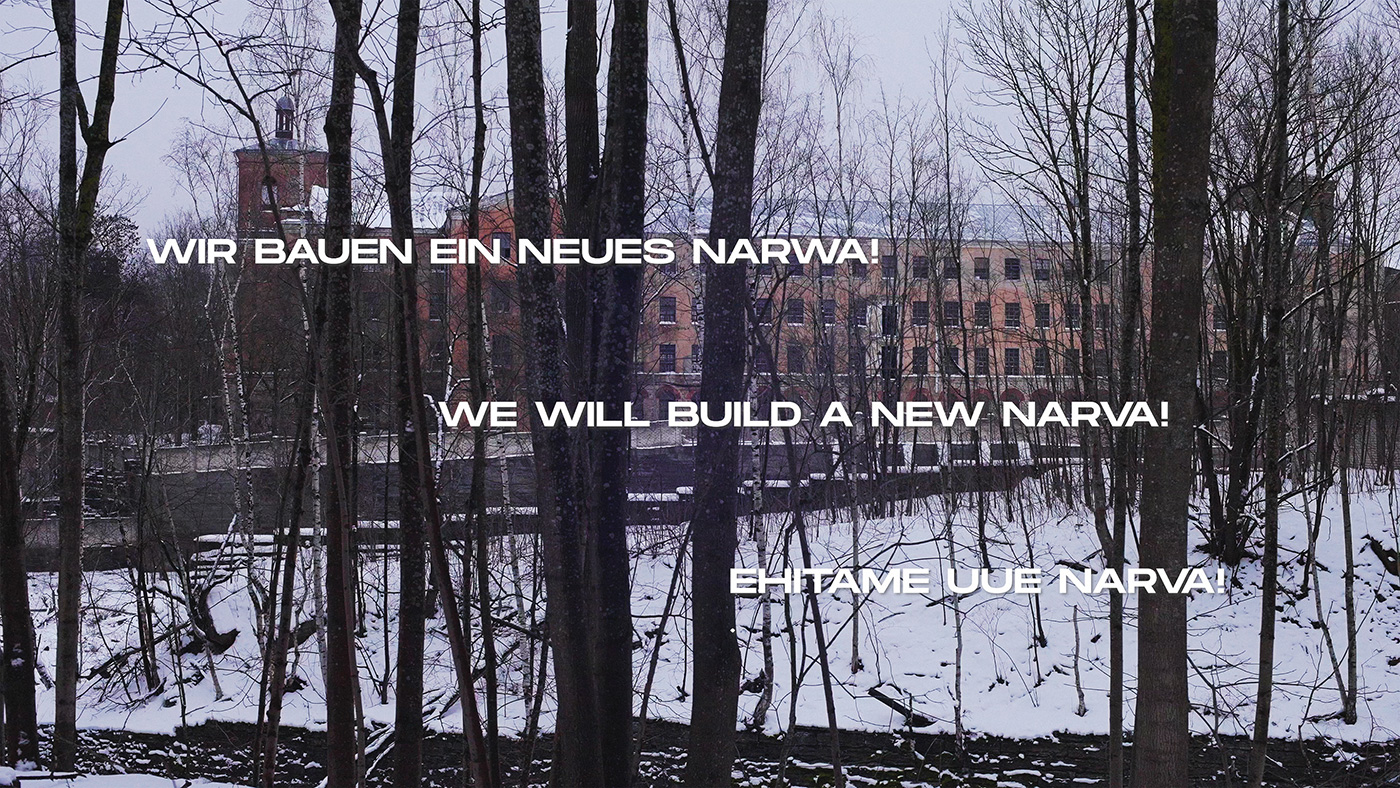
"Nii tuli lõpp / And Then Came The End" is based on the experiences of a German Catholic priest, Magnus Frey, in prisoner of war camps in Narva, Estonia from 1945 to 1946. In this film, Siib depicts the locations of the story in Narva in their current state and without people, i.e. dilapidated buildings and winter landscapes. The soundtrack includes everyday life snippets from Frey’s memoirs, such as how prisoners of war were not paid the few rubles they had been promised and had their warm blankets taken away before winter came. And how religious prisoners managed to make communion bread despite the difficult conditions. And how hungry prisoners entertained themselves and each other by remembering their favourite dishes and writing down their favourite recipes. The excerpts of Frey’s diary are arranged on screen with a picture and on a soundtrack with music to create a prose poem of documentary material. The value of such micro-history, both as text and film, is not in revealing major developments or in interpreting historical turning points. Instead, the value is that individual anecdotes and fragments can be evidence that bring history to life and help us to take seriously the suffering and existence of others — past and present. By Teemu Mäki
Liina Siib is a visual artist, filmmaker and educator who lives and works in Tallinn, Estonia. The topic of her works ranges from femininity and social space to different manifestations of people’s everyday practices. She combines field observations with archival sources, historical accounts and various narratives circulating in the society as well as with psychoanalytic approaches and contemporary art and film theories. The characters, spaces and situations in her works tend to go unnoticed due to their ordinariness or are silenced or ignored. In her multidisciplinary approach she uses the means of film, video, photography, installation, performance, ready-mades, print media and artist’s books. Her experimental documentary videos and staged short films have been shown both at festivals of artists' films and at art exhibitions in the galleries, often using the format of expanded cinema. In 2011, the project A Woman Takes Little Space by Liina Siib represented Estonia at the 54th Venice Art Biennale. Her work has been included in several public and private collections (e.g., the Art Museum of Estonia in Tallinn, Neues Museum in Nürnberg and Moderna Museet in Stockholm).

Liina Siib
House of Sleep
Fiction | dv | color | 12:23 | Estonia | 2004
The video moves around the rooms of a century-old house in North London. Improvisation based on Muriel Spark's novel Memento Mori (1959) helps to tame it. The wealthy elderly of London are getting phone calls from a mysterious caller who tirelessly repeats the same message: "Remember you must die!" The police are unable to track the person but the elderly die sooner or later, of various causes, including robbery and murder. The events following between the marks of control, observation, and tea ceremony culminate with the milkman who faces the uncollected milk bottles on the doorstep. Fear of the intruder, a possible encounter with death against the background of old age, and solitude and property are conditions that could be experienced by anyone, regardless of their financial status or nationality.
Liina Siib was born in Tallinn, Estonia where she is currently a freelance artist. She has a MFA in Photographic Studies from the Estonian Academy of Arts in Tallinn, and did photographic studies at the University of Westminster in London (as an exchange program). She has had 25 solo exhibitions in Estonia, Latvia, Belgium, France, Germany, and Finland. She has participated in group shows in Estonia and abroad, such as Villa Manin in Codroipo, Italy; Finnish Photography Museum in Helsinki; Moderna Museet in Stockholm; Hamburger Bahnhof in Berlin; and Corcoran Gallery of Art in Washington DC among others. She has works in collections at the Neues Museum für Kunst und Design, Nürnberg and in the Moderna Museet, Stockholm. She has been making videos since 2002.

Liina Siib
Kiosk
Experimental doc. | dv | color | 2:56 | Estonia | 2005
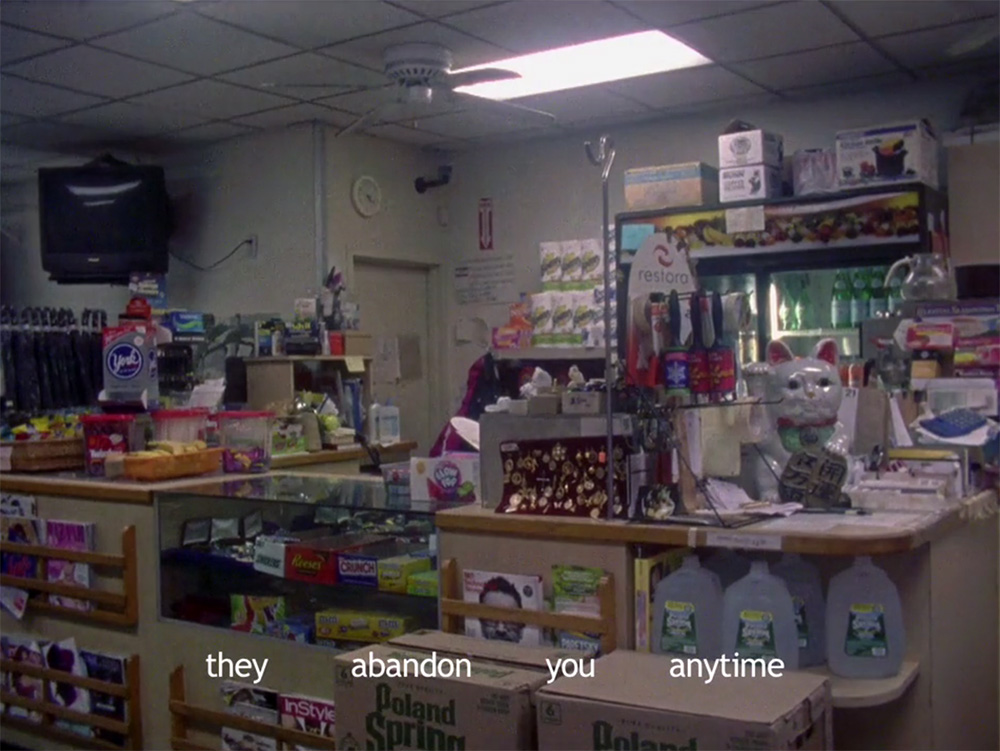
'Kiosk' in Turkish and 'periptero' in Greek. In Turkish the word also refers to an object that acts as a shadow or shade-maker. Peripteros in Athens. Periptero in Syntagma Square. Democracy. Water bottles. Cigarettes. Bus tickets. Snacks. Leather belts. Millions of other accumulated things, such as magazines, sweets, sunglasses, newspapers, etc. Rhetoric of the accumulation of goods. All in one kiosk. Everything one has to consume in the heat of Mediterranean culture. Anything a contemporary human being, even a flâneur could immediately need on the streets of Athens. Kiosk is open on some or on all sides. Highly absorbent. Compulsory anchors of noisy trajectories. A focal point in the dense street razzmatazz. Today, there are many kiosks in Greece. Kiosk Anastassopoulos, Kolonaki Square, Athens. Kiosk Porfiri, Kolonaki Square, Athens. Kiosk Tassias, Apergi Square, Athens. Kiosk is probably the most common and uncommon thing in Athens. Kiosk in Omonia Square. Chance encounters. Rapid house-machine for satisfying most urgent desires on the street. Modern condensed equivalent for an ancient forum?
Liina Siib was born in Tallinn, Estonia where she is currently a freelance artist. She has a MFA in Photographic Studies from the Estonian Academy of Arts in Tallinn, and did photographic studies at the University of Westminster in London (as an exchange program). She has had 25 solo exhibitions in Estonia, Latvia, Belgium, France, Germany, and Finland. She has participated in group shows in Estonia and abroad, such as Villa Manin in Codroipo, Italy; Finnish Photography Museum in Helsinki; Moderna Museet in Stockholm; Hamburger Bahnhof in Berlin; and Corcoran Gallery of Art in Washington DC among others. She has works in collections at the Neues Museum für Kunst und Design, Nürnberg and in the Moderna Museet, Stockholm. She has been making videos since 2002.
Liina Siib
Mass Line: Office 1
Experimental video | hdv | color and b&w | 12:41 | Estonia, Sweden | 2013
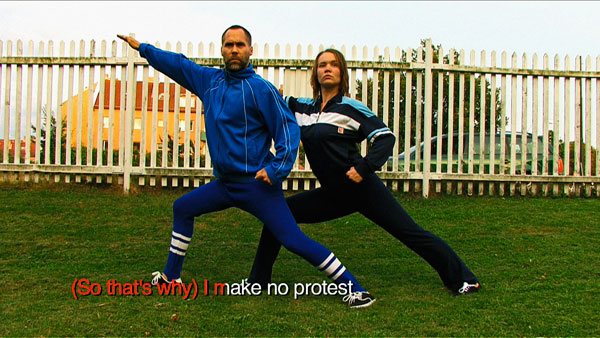
Mass Line: Office 1 is a karaoke video produced for the large scale performance Mass Line at the Lilith Performance Studio in Malmö. Mass Line merges China and the western world?s political ideologies to a peculia, thorough analysis and practice-oriented observation of systems, prohibitions and orders, both big as well as small ones. Mass Line is distinctly political but yet at the same time a highly poetic performance, where most of the part is based upon the artist?s own observations and life experience from living in a closed country. In Mass Line Liina Siib plays with big political and social systems we all have to follow in order to be part of the group. Systems whose intensions are to keep us occupied, to act correct and keep us in line. In countries with strict leadership and control system people use to perform, to be someone else in public than at home. Everyone becomes an actor ready to stage what the system expects from them, performing ideologies as one?s second nature as a wise survival tactics of everyday life. At the end it is impossible to decide what is a performance and what is not.
Liina Siib is a video and photography artist born and based in Tallinn, Estonia. She studied graphic art and photography at the Estonian Academy of Arts, where she also earned an MA in photography. In 2002 she was in exchange at the Westminster University in London at the Photographic Studies MA course. Several of Liina Siib`s art works have a starting point in the experience of living in a both socialistic and capitalistic system, and in the antagonism that appears in shifting between two systems. In her photo, video and room installations, the artist explores various topics, ranging from femininity and social space to different representations of people?s everyday practices and daily routines. In 2011 Liina Siib represented Estonia with her project A Woman Takes Little Space at the 54th Venice Art Biennale. She has had over thirty solo exhibitions in Estonia, Germany, Belgium, France, Finland and Latvia. Her works have been presented at a number of international group shows and festivals in Estonia, Europe, Asia and the USA. In October 2013 her large-scale performance Mass Line in a close collaboration with the Lilith Performance Studio was presented at the Lilith Performance Studio in Malmö, Sweden.
Liina Siib
Orbs
Video | hdv | color | 3:15 | Estonia | 2016
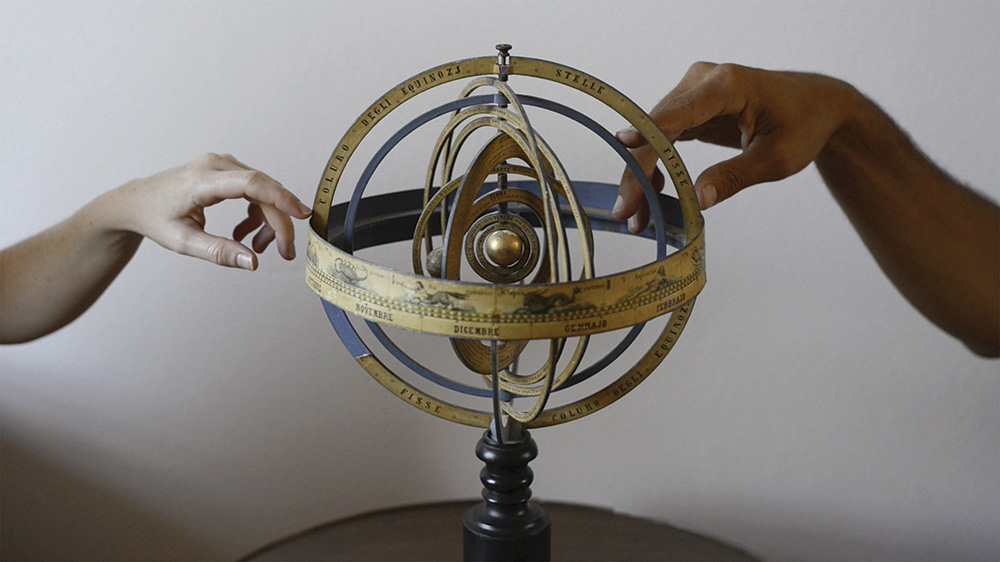
In the video “Orbs” we see two persons playing with an old armillary sphere. This old tool is a model of objects in the sky, one of the oldest astronomical instruments in the world, one of the first models ever made. Representing the heavens with the sun as center, it is known as Copernican armillary. By a simple gesture of moving the armillary rings as heavens, one can demonstrate how the stars move. We see the two people moving the stars and by that they are moved by the stars.
Liina Siib is a visual artist who lives in Tallinn, Estonia. She holds an MA in photography from the Estonian Academy of Arts. The themes of her works range from femininity and social space to different manifestations of people’s everyday practices, to work and leisure time routines. She works with video, installation, photography and performance. Liina Siib has had solo exhibitions in Estonia, Germany, Belgium, France, Sweden, Finland and Latvia. Her works have been presented at a number of exhibitions and festivals in Europe, Asia and the USA. In 2011, Liina Siib represented Estonia at the 54th Venice Art Biennale with her project ‘A Woman Takes Little Space’. She has also curated art and culture projects in Estonia, the UK and Belgium. Since 2015, she works as the Professor of Graphic Art at the Estonian Academy of Arts.