Catalogue > Liste par artiste
Parcourez la liste complète des artistes présentés dans le cadre des Rencontres Internationales depuis 2004. Utilisez le filtre alphabétique pour affiner vos recherches.
Lev Aleshkin, Kalashnikova, homoabsurdus, Gorshunova,
Catalogue : 2026«Das Unaussprechliche» | Performance | mp4 | couleur | 47:31 | Russie | 2024

Lev Aleshkin, Kalashnikova, homoabsurdus, Gorshunova,
«Das Unaussprechliche»
Performance | mp4 | couleur | 47:31 | Russie | 2024
«Whereof one cannot speak, thereof one must be silent» Ludwig Wittgenstein, Tractatus Logico-Philosophicus Nowadays we are witnesses to the world in the state of unceasing and disgusting war. As Russian citizens, we empathize with everybody who has suffered or whose family has suffered from this conflict. In our country, we can’t speak about that openly. We have to stop any attempts to talk about it. And every day we see the consolidation of political power, the tightening of laws and measures in relation to people who are against the war. When facts of the world become unspeakable, language loses its logical completeness and perfection, which are brought forth by Ludwig Wittgenstein in the «Tractatus Logico-Philosophicus». We're only left with the things outside of language - the unspeakable, the senseless. Things you can only show, not tell. From this point of view, «Das Unaussprechliche» is a reflection of the world, rather than broken up language. At the start, we're still bound by systems of symbols. Over the course of the performance we get to observe the participants gain new ways of communication, while the experience is recorded using photographs and graphs.
«Not quite open meetings» is an art collective, created by 2024` alumni of Institute of Contemporary Art Moscow. It emerged early in 2024 due to our reading-group where we can meet regularly and discuss philosophy and art. While all members of «Not quite open meetings» are also individual artists, we’re united by our shared object of interest and exploration - the Unspeakable. The term was coiled by Ludwig Wittgenstein and in our performance «Das Unaussprechliche» we gave it a somewhat unexpected spin. The problems that we address in our art and discussions are speechlessness, community, pressure, body. As a collective we hope to share our emotional experience, that is nowadays probably familiar to many, and weave our low-voice narrative together with you.
Lee Alex
Catalogue : 2022the Fold | VR expérimental | mp4 | couleur | 0:0 | USA | 2019
Lee Alex
the Fold
VR expérimental | mp4 | couleur | 0:0 | USA | 2019
"The Fold" is a non-linear film and virtual reality-based art game involving rooms with doors containing a concept folding into other rooms with doors. Inspired by Jorge Luis Borges' short story The Garden of Forking Paths, each room consists of an idea inspired by structuralist & surrealist literature, mathematics, the readymade virtual object, and more. This project is a virtual 'escape the room' concept where some rooms are puzzle experiences and others are more experiential. All rooms follow a similar visual monochromatic motif. To date, the project involves five rooms: the Doors, the Fold, the Grid, the Meridies, and the Cave. Subsequent rooms will be released as this project is a long-term episodic series. Chapter one is debuted at Berlin Recontres International.
Alex M. Lee is an artist who utilizes 3D animation, video game engines, virtual/augmented/immersive reality platforms, and the potential of simulation technologies in order to visualize and complicate our perception of time, space, image and light - culling from concepts within science, science fiction, physics, philosophy, and modernity. He received his BFA (2005) and MFA (2009) from the School of the Art Institute of Chicago. Born in Seoul, South Korea, Lee was raised in the USA and is associate professor in the Digital Arts & Sciences Program at Clarkson University located in Potsdam, NY - a private science and engineering university located north of the Adirondack Mountains where he divides his time between Potsdam and New York City. Lee has exhibited internationally in North America and Asia. Selected exhibitions include: Mio Photo, Osaka, Japan; Daegu Art Factory, Daegu, Korea; The Gene Siskel Film Center, Chicago, Illinois; Eyebeam: Center for Art & Technology, New York, NY; Gallery DOS, Seoul, Korea; Museum of Contemporary Art, Montreal, QC. His work has been published in articles covering art, science, and culture including: Metaverse Creativity, Canadian Art, and Routledge Press.
Amy Alexander
Catalogue : 2022What the Robot Saw | Installation multimédia | 0 | couleur | 0:0 | USA | 2020
Amy Alexander
What the Robot Saw
Installation multimédia | 0 | couleur | 0:0 | USA | 2020
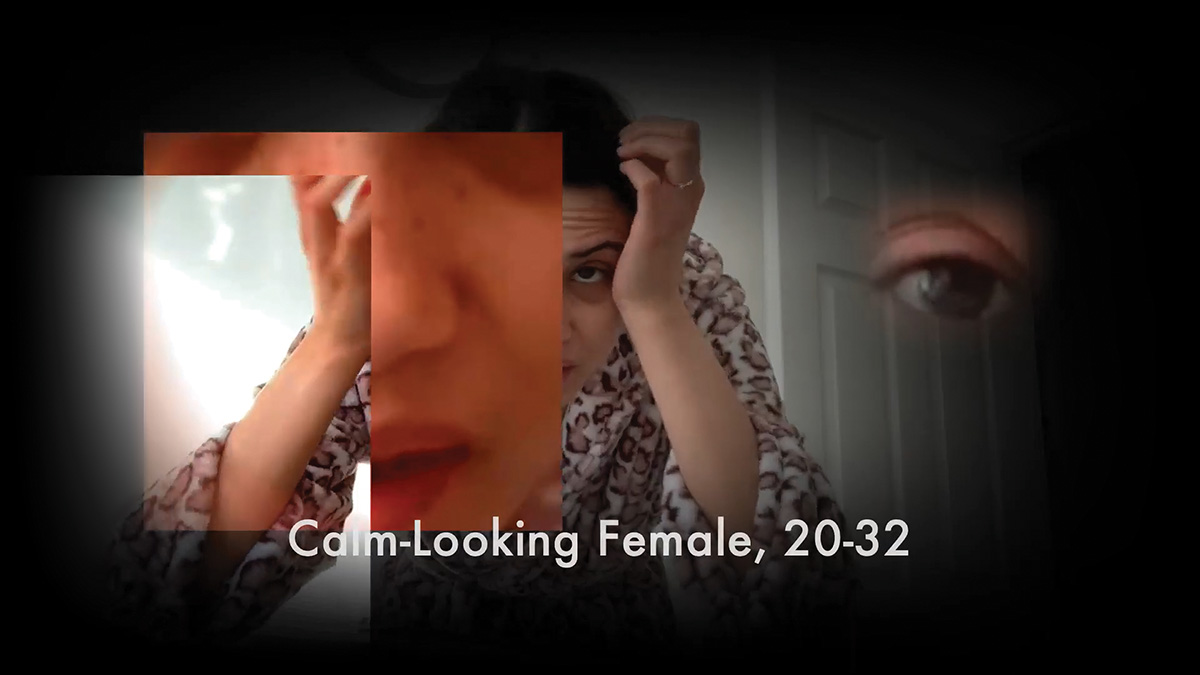
An invisible audience of software robots continually analyze content on the Internet. Political trolls and YouTube celebrities gain visibility because social media ranking algorithms promote addictive videos to the top of search and recommendation rankings. What the Robot Saw is a continuously-generated livestream film that uses contrarian algorithms to constantly curate some of the least attention-grabbing videos recently uploaded to YouTube. These videos, and their creators, are rendered largely invisible by social media algorithms. Their primary audience may be the robots that rank them. What the Robot Saw uses computer vision algorithms to curate videos and study their subjects. It focuses on first-person, camera facing narrators. The robot continually assembles its film and labels its “talking head” performers in a robo-fantastical cinematic style. The Robot titles its human subjects according to the demographically-focused feature set of Amazon Rekognition, a popular facial analysis system. In a robot-centric world, attributes like presumed age, gender, and emotion might better identify us than our names. The title is a reference to early 1900s What the Butler Saw “peep show” films. Both the butlers and the Robot got a superficial glimpse of a seductive “show;” they could not really understand the objects of their obsession.
Amy Alexander is a professor and hackernaut who has been making computationally-based art projects since the 1990s. Amy is a Professor of Computing in the Arts in the Visual Arts Department at UC San Diego. She is an algorithmic filmmaker and performer who has focused throughout her career on the fuzzy borders between media and the world. Amy’s work has frequently addressed algorithmic subjectivity in digital culture by creating transparently biased, sometimes funny alternatives. Her latest project returns to this theme — this time taking on the attention economy and social influence of algorithms used for social media rankings and facial classification. Using computer vision and machine learning-based methods of curation and production, What the Robot Saw, is a perpetual live stream that depicts the cinematic fantasy of the surveillant AI robots who “see” the social media content few humans get to experience. Amy’s art practice has spanned net art, software art, computationally-based installation, audiovisual performance, and film. Her research and practice over the years has focused on how contemporary media – from performative cinema to social media – changes along with cultural and technological shifts. Amy’s projects have been presented on the Internet, in clubs and on the street as well as in festivals and museums. She has written and lectured on software art, software as culture, and historical and contemporary audiovisual performance. She has served as a reviewer for festivals and commissions for new media art and computer music.Her recent lectures span topics including algorithmic bias and subjectivity, cultural anthropologies of gender roles in 20th and 21st century computing, and systems and disruption in 20th and 21st century media.
Amy Alexander
Catalogue : 2026Deep World | Installation multimédia | 0 | couleur | 0:0 | USA, 0 | 2025
Amy Alexander
Deep World
Installation multimédia | 0 | couleur | 0:0 | USA, 0 | 2025
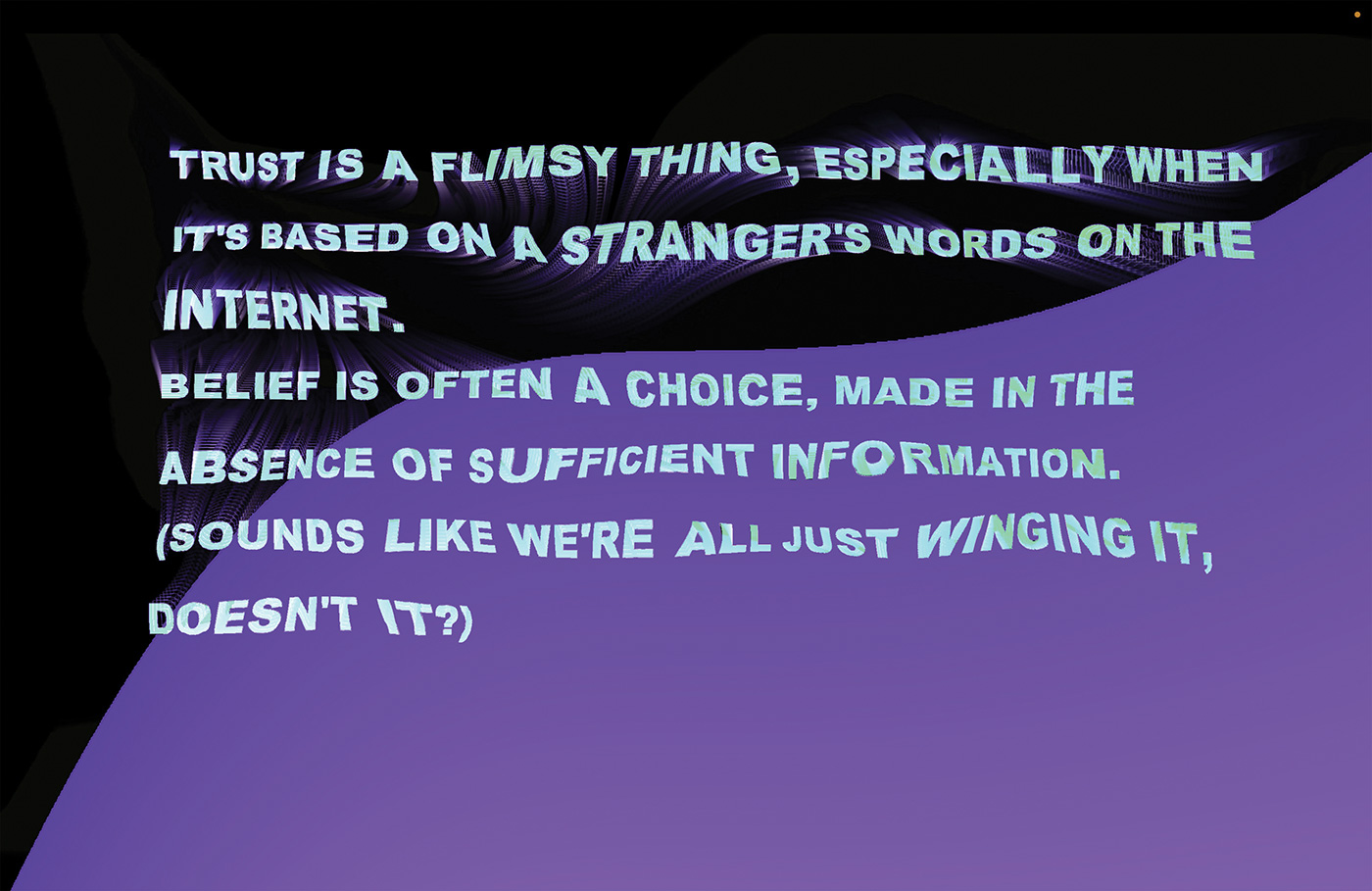
Deep World is a performance and installation project examining the evolving relationship between humans and chatbots — from their early role as informal therapists to their current position as omnipresent advisers in unsettled times. At Deep World’s center is a chatbot intentionally re-authored with ideas drawn from writers and theorists who confronted difficult eras, combined with contemporary material reflecting concerns of today. Visitors bring real worries and complicated questions; the chatbot’s output veers between philosophical and poetic, revealing both insight and self-doubt. The gap between what people need and what the machine can offer becomes part of the work’s texture — by turns earnest, wry, and unsettling. Performance version: Performed by VJ Übergeek (Amy Alexander), the piece blends live text improvisation, VJ practice, and game-controller interaction. The dialogue becomes a semi-theatrical search for clarity, humor, and company in difficult times. Installation version: The current installation iteration focuses on borders — political and social, physical and metaphorical — as a lens for contemplating contemporary dilemmas. The installation invites visitors to speak directly with Deep World, generating evolving text and psychedelic visuals in a secular-sanctuary setting. Additional installation iterations are under development.
Amy Alexander is an artist and professor whose work spans computational installation, performance, net art, and film. She has been making software-based art since the 1990s and writing about the cultural roles of algorithms since the early 2000s. With a background in film, music, programming, and IT, she focuses on the porous borders between media and the world, and on how technologies shape – and are shaped by – cultural conditions. Much of her work examines algorithmic subjectivity in digital culture. Recent projects extend this focus to AI and machine learning systems, including custom large language models used as collaborators in live performance and as tools for examining generative AI–based cinema. Her projects have explored themes ranging from surveillance and social media to public-space performance and the mechanics of computational authorship. Alexander’s work has been exhibited or performed at venues including the Whitney Museum, Prix Ars Electronica, Transmediale, SIGGRAPH, NIME, the New Museum, CURRENTS, and ICLC, as well as clubs such as Sonar and First Avenue, and in street performances in Los Angeles, San Diego, San Jose, Zürich, and Aberdeen. She has also written and lectured widely on software art, audiovisual performance, and media preservation. Alexander is a Professor of Computing in the Arts at UC San Diego.
Vito Alfarano, Francesco Biasi
Catalogue : 2023THE PASSENGERS | Vidéo | hdv | couleur | 14:50 | Italie | 2023
Vito Alfarano, Francesco Biasi
THE PASSENGERS
Vidéo | hdv | couleur | 14:50 | Italie | 2023
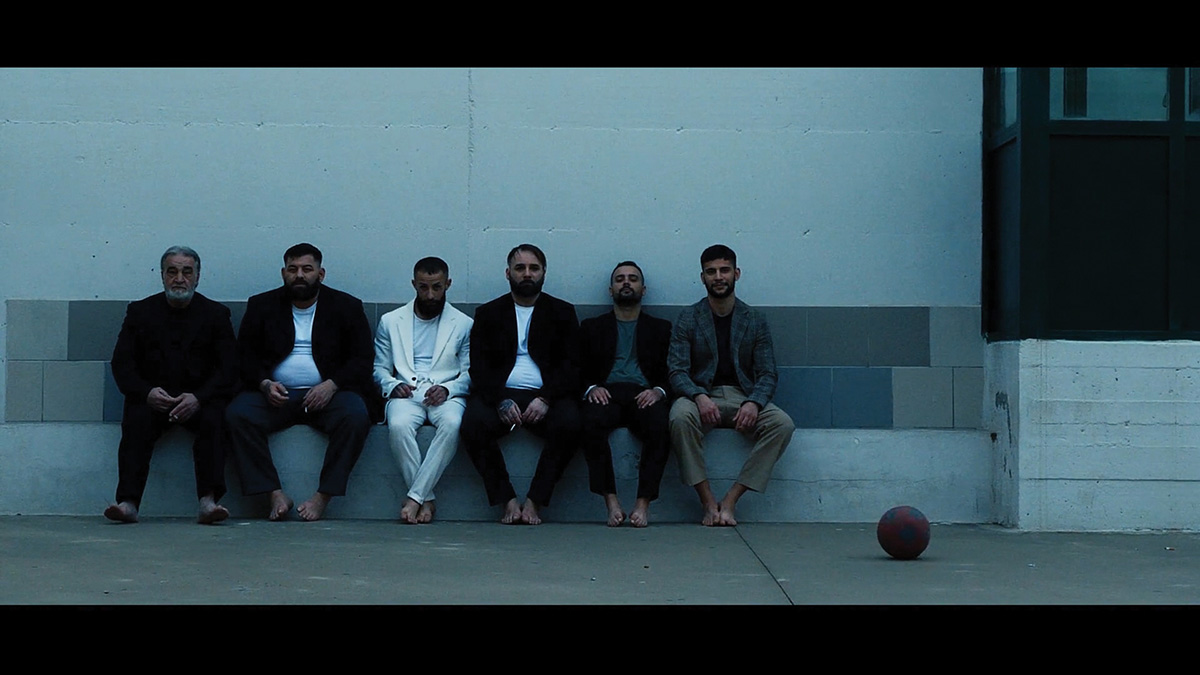
Avec les détenus de la prison de Brindisi comme protagonistes, THE PASSENGERS parle de l'attente, ce moment où tout s'arrête, où l'on a le temps de réfléchir et de repartir en pleine conscience. Les passagers accueillent tout le monde dans leur wagon, l'important étant de se laisser porter par la puissance évocatrice de leurs récits. Ils racontent leur attente, leur rapport au temps, ils manifestent leur fragilité et en dansant ils s'amusent, ils jouent avec eux-mêmes. Entre lectures de passages écrits dans la cellule, musique entraînante et chorégraphie de groupe, les protagonistes libèrent tout le monde : parce que tout le monde est prisonnier de quelque chose qu'il porte en lui. Et le partage est l'outil qui permet de s'en libérer. La mise en scène est signée Vito Alfarano, tandis que la chorégraphie est un travail à quatre mains entre Alfarano lui-même et Francesco Biasi, le jeune chorégraphe de la compagnie. Les textes sont de Michele Caiulo, qui a écrit ses pensées et ses réflexions dans son journal pendant sa détention. Choisis par Vito Alfarano et réadaptés par Marcello Biscosi, ils sont devenus le guide du spectacle. Le projet bénéficie du soutien de la Garant des personnes soumises à des mesures de restriction de la liberté personnelle du Conseil régional de la Région des Pouilles et est réalisé en coopération avec la Direction de la Prison de Brindisi, Ministère de la Justice.
VITO ALFARANO _ Directeur artistique et chorégraphe Il a commencé sa carrière comme danseur indépendant en travaillant avec différents chorégraphes. Avec ses chorégraphies et ses scénographies, il a remporté les premiers prix lors de concours internationaux et de festivals de scénographie. Il est le directeur artistique d'AlphaZTL Company of Dynamic Art basée à Brindisi (Italie), qui s'occupe d'ART & SOCIAL avec de la danse contemporaine et de la screendance, et de BRINDISI PERFORMING ARTS, un festival d'inclusion sociale par le biais des arts du spectacle. ____________________________ FRANCESCO BIASI _ Vidéaste et chorégraphe Danseur, vidéaste et chorégraphe. Sa contamination entre la danse, la vidéo et la réalité caractérise sa recherche artistique. Il tente de transmettre à ses danseurs le pouvoir de l'interprétation personnelle afin que chacun puisse exprimer au mieux son âme.
Greta Alfaro
Catalogue : 2020He Had Got Certain Vibes | Vidéo | hdv | couleur | 2:31 | Espagne, Royaume-Uni | 2019
Greta Alfaro
He Had Got Certain Vibes
Vidéo | hdv | couleur | 2:31 | Espagne, Royaume-Uni | 2019
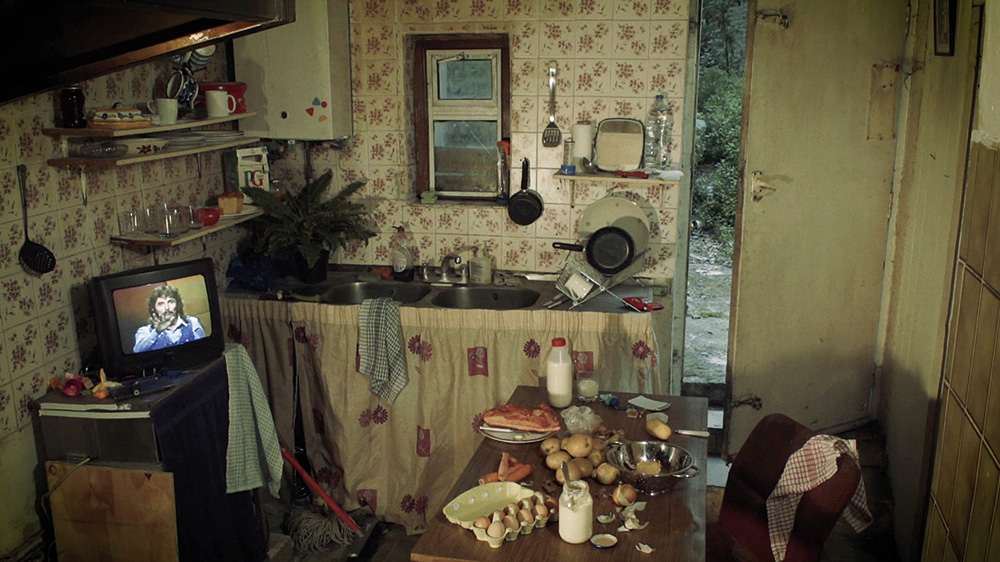
One still life of the 20th Century. Poverty, mental health, media and magic. The fragility and drama of the everyday and domesticity.
Greta Alfaro (Spain, 1977) is a visual artist. Her solo exhibitions include Decimocuarta estación (2019) at the Fundación BBVA, Madrid; In Ictu Oculi (2019) at the Flint Institute of Arts, Michigan; El cataclismo nos alcanzará impávidos (2015) and European DarkRoom (2014) at Galería Rosa Santos, Valencia; Still Life with Books (2014) at Artium, Vitoria; In Praise of the Beast (2013) at Hiroshima City Museum of Contemporary Art, Japan; and Invención (2012) at Ex Teresa, Mexico City. Among her other solo site-specific projects are I Will Not Hesitate to React Spiritually (2019), with Roaming Room, and A Very Crafty and Tricky Contrivance (2012), with Genesis Foundation, both in London, and Comedias a honor y gloria (2016) in La Gallera, Valencia. She has taken part in numerous group shows and festivals in venues like the Whitechapel Gallery, Institute of Contemporary Arts and Saatchi Gallery in London; Centro Cultural Banco do Brasil in Brasilia; The Bass Museum of Art in Miami; the Conciergerie in Paris; Künstlerhaus Bethanien in Berlin; La Casa Encendida in Madrid or the International Film Festival Rotterdam.
Catalogue : 2011In Ictu Oculi | Art vidéo | dv | couleur | 10:35 | Espagne | 2009
Greta Alfaro
In Ictu Oculi
Art vidéo | dv | couleur | 10:35 | Espagne | 2009
There is a table in the middle of the countryside, but the guests are absent. There is a feast of food and wine waiting in the cold weather and the dry landscape. The vultures are to come and eat our food and destroy our setting: the still life, the banquet, the space of enjoyment and civilization. The vultures, the beasts linked to death and dirt, to violence and fear, arrive by surprise, and like in a fable, represent for us some of our own qualities.
Greta Alfaro (Spain, 1977) is currently studying an MA in Photography at the Royal College of Art, London. In recent years she has been the recipient of several grants and scholarships among which are Matadero-City Council of Madrid, Casa de Velázquez, Fundación BilbaoArte, the Government of Mexico or the Genesis Foundation. She is taking part in the exhibition Bloomberg New Contemporaries 2010 at the ICA, London, and her recent solo shows include In Ictu Oculi, in Galería Marta Cervera, Madrid and Carpe Diem, Lisbon, and Elogio de la Bestia, in Centro de Arte Contemporáneo Huarte, Spain.
Pierre Alferi
Catalogue : 2007Mots croisés | Vidéo expérimentale | dv | couleur | 2:45 | France | 2006

Pierre Alferi, Jacques JULIEN
Mots croisés
Vidéo expérimentale | dv | couleur | 2:45 | France | 2006
Pierre Alféri est né à Paris en 1963. Il a fondé la revue `Détail` avec Suzanne Doppelt et est également co-fondateur de `La revue littéraire générale` avec Olivier Cadiot. Il est pensionnaire de l`Académie de France à Rome entre 1987 et 1988 et `écrivain résident` de la Fondation Royaumont entre 1991 et 1992. Pierre Alféri possède de nombreuses casquettes : il est à la fois romancier, traducteur d`ouvrages américains et russes, essayiste et poète.
Catalogue : 2006In time | Vidéo expérimentale | dv | couleur | 16:30 | France | 2005
Pierre Alferi
In time
Vidéo expérimentale | dv | couleur | 16:30 | France | 2005
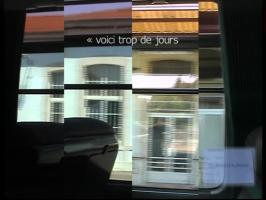
Intime, de Pierre Alféri est un travail à la fois littéraire et vidéopoétique, où l`espace du voyage est celui de la langue. C`est une traversée en images, traversée de lieux et de paysages, et en mots, lettres adrésées à des anonymes, qui dépouillés de leur "moi" sont dépeints comme des caractères. L`intime n`est donc pas celui du "moi" de l`être mais naît du déséquilibre crée par les mots, qui tissent alors des liens rendus nécessaires entre les personnages.
Pierre Alféri est né à Paris en 1963. Il a fondé la revue `Détail` avec Suzanne Doppelt et est également co-fondateur de `La revue littéraire générale` avec Olivier Cadiot. Il est pensionnaire de l`Académie de France à Rome entre 1987 et 1988 et `écrivain résident` de la Fondation Royaumont entre 1991 et 1992. Pierre Alféri possède de nombreuses casquettes : il est à la fois romancier, traducteur d`ouvrages américains et russes, essayiste et poète.
Pierre Alferi, Jacques JULIEN
Catalogue : 2007Mots croisés | Vidéo expérimentale | dv | couleur | 2:45 | France | 2006
Pierre Alferi, Jacques JULIEN
Mots croisés
Vidéo expérimentale | dv | couleur | 2:45 | France | 2006
Pierre Alféri est né à Paris en 1963. Il a fondé la revue `Détail` avec Suzanne Doppelt et est également co-fondateur de `La revue littéraire générale` avec Olivier Cadiot. Il est pensionnaire de l`Académie de France à Rome entre 1987 et 1988 et `écrivain résident` de la Fondation Royaumont entre 1991 et 1992. Pierre Alféri possède de nombreuses casquettes : il est à la fois romancier, traducteur d`ouvrages américains et russes, essayiste et poète.
Catalogue : 2006In time | Vidéo expérimentale | dv | couleur | 16:30 | France | 2005
Pierre Alferi
In time
Vidéo expérimentale | dv | couleur | 16:30 | France | 2005
Intime, de Pierre Alféri est un travail à la fois littéraire et vidéopoétique, où l`espace du voyage est celui de la langue. C`est une traversée en images, traversée de lieux et de paysages, et en mots, lettres adrésées à des anonymes, qui dépouillés de leur "moi" sont dépeints comme des caractères. L`intime n`est donc pas celui du "moi" de l`être mais naît du déséquilibre crée par les mots, qui tissent alors des liens rendus nécessaires entre les personnages.
Pierre Alféri est né à Paris en 1963. Il a fondé la revue `Détail` avec Suzanne Doppelt et est également co-fondateur de `La revue littéraire générale` avec Olivier Cadiot. Il est pensionnaire de l`Académie de France à Rome entre 1987 et 1988 et `écrivain résident` de la Fondation Royaumont entre 1991 et 1992. Pierre Alféri possède de nombreuses casquettes : il est à la fois romancier, traducteur d`ouvrages américains et russes, essayiste et poète.
Selene Alge
Catalogue : 2021Coming soon | Vidéo expérimentale | mp4 | couleur | 10:43 | Brésil | 2019
Selene Alge
Coming soon
Vidéo expérimentale | mp4 | couleur | 10:43 | Brésil | 2019
"Coming Soon" reprend 218 intertitres tirés bandes-annonces, des années 30 à 2019. Ces intertitres sont juxtaposés et montés chronologiquement, afin de ne conserver que le texte "coming soon". En 10 minutes environ, une attente est créée par la répétition de cette expression cinématographique, dans laquelle on ne sait pas exactement ce qu’on attend - s'agit-il de quelque chose d'extérieur à la vidéo ou d'un événement en soi? Quelque chose est toujours en train d'arriver; cela n'arrive jamais et/ou c’est déjà arrivé.
Selene Alge (née en 1986, à São Paulo, Brésil) est artiste visuelle. Elle est diplômée de la FAAP - Fundação Armando Alvares Penteado, São Paulo (Brésil). De 2016 à 2017, elle a été artiste en résidence à la Cité Internationale des Arts, Paris (France), où elle est retournée en 2019 pour poursuivre ses recherches sur les souvenirs liés aux salles de cinéma. Ces dernières années, elle a participé à des expositions et des festivals de cinéma, notamment à la Mostra do Filme Livre, qui s’est tenue au CCBB - Centro Cultural Banco do Brasil, à São Paulo, à Rio de Janeiro et dans le District Fédéral (Brésil); ainsi qu’à la Mostra Strangloscope, à Florianópolis (Brésil).
Abu Ali
Catalogue : 2011al barzaj | Vidéo | dv | couleur | 14:0 | Espagne, Maroc | 2010
Abu Ali
al barzaj
Vidéo | dv | couleur | 14:0 | Espagne, Maroc | 2010
1960 born in Barcelona (Spain) 1981 graduates in History of Art and Philosophy at the University of Barcelona since 1982 freelance writer studies photography, video and film at the School of Visual Arts, New York since 1990 works with video, foto and other media founding member of ?La 12 Visual?, an independent videoartist group created several compilations of video (Wahab, Istishara and others) develops the Babylon Archives lives in Barcelona and Marocco
Catalogue : 2008Los Sures | Doc. expérimental | dv | couleur | 12:0 | Espagne, USA | 2007
Abu Ali
Los Sures
Doc. expérimental | dv | couleur | 12:0 | Espagne, USA | 2007
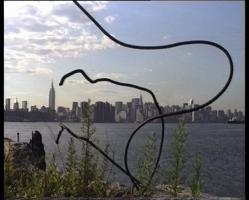
Los Sures, au premier niveau, est un detournement autour de South Street, Brooklyn New York, avec son front de mer, ses terrains vagues, ses gens; un quartier dur et pauvre d'une megalopole. Mais au final, ce film est un voyage interieur dans un paysage de symboles et de metaphores sortis de la vie de tous les jours, un voyage à travers
Toni Serra * Abu Ali Barcelona 1960. Lives in between Duar Msuar (Morocco) and Barcelona (Spain). videos, mass-media archaeology, video-installation, interactives,.. Most of my works are positioned on a tense line between the inner experience...and the social field dominated by a growing dispositives of control, manipulation of identities and communities. This exploration meets issues as: erasing and constructing identities through the media (The TV Code Series), constructing realities through video games and ?expanded reality? (Babylon Archives ? The War Room),...the ?ritual climax? and the interzone space of the dreams as a doors to ?other realities? as well as realities of the ?other?. I am also a founder member of OVNI Archives - Observatorio de Video No Identificado (www.desorg.org), where I am doing research and programming: - Exodus, The Margins of the Empire - Colonial Dream and Autononous Zones, - Resistances, - Post Sept 11th, - Communities, - Media vs Identity, Other programms curated: - TransArab - City Unrest - (...)
Kamal Aljafari
Catalogue : 2023Paradiso, XXXI, 108 | Film expérimental | mov | couleur | 18:40 | Allemagne | 2022
Kamal Aljafari
Paradiso, XXXI, 108
Film expérimental | mov | couleur | 18:40 | Allemagne | 2022
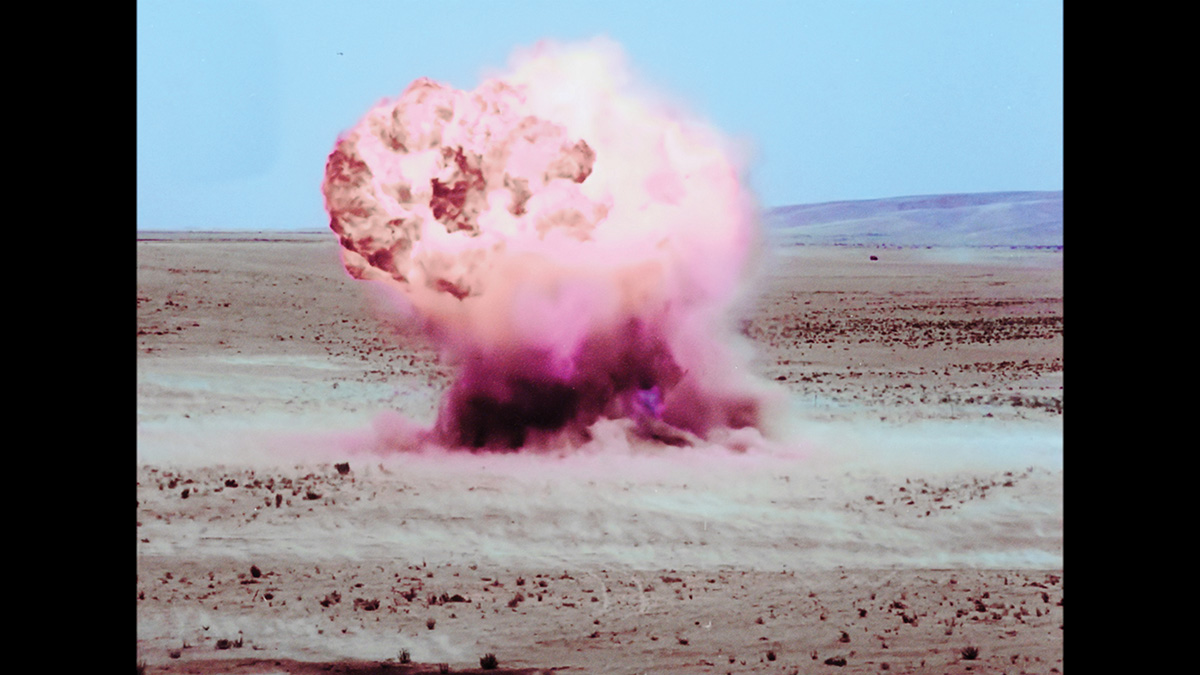
«It’s going to be quite soundless, the roar of our aircraft is drowning everything else. We are running straight into the most gigantic display of soundless fireworks in the world, and here we go to drop our bombs»
Kamal Aljafari is a Palestinian filmmaker. He attended the Academy of Media Arts in Cologne and now lives in Berlin, Germany. He has taught filmmaking at The New School in New York and the Deutsche Film- und Fernsehakademie, Berlin. He was also a Film Study Center Radcliffe Fellow at Harvard University. In 2021 Olhar de Cinema – Curitiba International Film Festival in Brazil devoted its Focus Section to his work. Most recent work, Paradiso, XXXI, 108, premiered at Corti d'Autore, in Locarno Film Festival 2022. He is currently completing “A Fidai Film”, and preparing a fiction film to be shot in Jaffa.
Kamal Aljafari
Catalogue : 2025UNDR | Film expérimental | hdv | couleur et n&b | 15:0 | Allemagne | 2024
Kamal Aljafari
UNDR
Film expérimental | hdv | couleur et n&b | 15:0 | Allemagne | 2024
The camera's eye returns obsessively to the same places, a vertical perspective that imposes control, the possession of archaeological sites, stones lying for thousands years in the desert. The places it observes, however, are not deserted: we see, as if glimpsed from afar, the peasants working the land, themselves transformed into landscape. Something disturbs the stillness of the place: explosions on land and in the sea prepare the ground for new cities with new names, new forests. This landscape is transformed into a scenography of appropriation.
Palestinian filmmaker Kamal Aljafari studied at the Kunsthochschule für Medien Köln and currently lives in Berlin. He has taught filmmaking at The New School (New York) and the DFFB (Berlin). He is a fellow at the Institute for Ideas and Imagination of Columbia University. In May 2024, IndieLisboa dedicated a retrospective to his work. In 2024 his film UNDR was selected at IFFR and A Fidai Film at Visions du Réel, where it won the Grand Jury Prize Burning Lights Competition. Aljafari is currently working on a fiction film to be shot in Jaffa.
Dana Aljouder
Catalogue : 2014Tiles | Performance | hdcam | couleur | 1:0 | Koweït, Royaume-Uni | 2013
Dana Aljouder
Tiles
Performance | hdcam | couleur | 1:0 | Koweït, Royaume-Uni | 2013
Filmed in a neglected expat housing complex in Hawalli, this out of context mirage disorients the familiarity or nostalgia of the space. The multicultural neighborhood vibrates with a multicultural working force who have consciously migrated from their diverse backgrounds to participate in the daily routine designated by a profiting developer. The tiling of the colonnade, as is the tiling of the dress, is reflective of the blurring of these expat cultures to camouflage within the existing- the existing which is not only foreign to them but foreign to the space - creating the out of context "Where am I?" phenomenon. These diverse cultures try to adapt to a "?" culture imposed by another country whilst struggling to identify between pre-imposed ethnic stereotypes and their traditional heritage. The freedom of the body is limited to the disproportion of the imposed cage, irritated within the larger cage of the structure.
Dana Aljouder is a designer, writer, and performance artist who graduated with a Bachelors Architecture from Pratt Institute in 2009. She received the Twinings Scholarship to research allegories of the Medici in Renaissance Art in Florence, and is currently an academic researcher for the Kuwait Pavilion at the Venice Biennale 2014. She has also presented her furniture "The Chair" at Higgins Hall Gallery in Brooklyn in 2009 and "Kursi" at the Design Terminal in Budapest in 2013. She has worked with OOS on the winebox installations of the Albert Reichmuth showroom in Zurich. Aljouder has also collaborated with sound artist Bassem Mansour at the Beirut Art Center show "Exposures" and Altofest Performance Festival in Naples in 2012 and 2013.
Bassam Alkhouri
Catalogue : 2007Untitled | Vidéo expérimentale | dv | couleur | 2:35 | Syrie | 2005
Bassam Alkhouri
Untitled
Vidéo expérimentale | dv | couleur | 2:35 | Syrie | 2005
Nous communiquons de plus en plus à travers notre propre façon de penser, sans essayer de comprendre la mentalité, le passé, les opinions politiques de 'l'autre'. "Untitled" : il est debout derrière la fenêtre, mettant en oeuvre tous ses sens. Le dialogue entre en scène.
Bassam Alkhouria a éudié à l'académie des beaux-arts de Damas en Syrie, où il a obtenu une licence de commnunication visuelle en 1993. Il a ensuite participé au programme de recherche et de pratique artistique au Dutch Art Institute à Enschede, Pays-Bas, de 2003 à 2005. Ses oeuvres ont été présentées aux occasions suivantes : mai 200- - "Here as the center of the world", Dutch Art Institute, NIASD, Damas, Syrie; mai/juin 2006 - 6ème édition des Journées de la photographie de Damas, Centre culturel français de Damas, Syrie; mars 2006 - Festival International d'Art Vidéo de Casablanca, Maroc; mai 2005 - Open Daizzz, Dutch Art Institute, Enschede, Pays-Bas; A Consumption of Justice, Centre d'art de la galerie d'art de la ville Diyarbakir, Turquie; avril 2005 - Centre d'art de Dyarbakir, Turquie; novembre 2004 - Crossing The Border Opstandingskerk, Enschede, Pays-Bas; avril 2004 - The Big Communication, Nanjing Art Academy, Chine; mars 2003 - Howden Festival, East Yorkshire, Angleterre; avril 2003 - Assyrian New Year Convention City Hall, Hengelo, Pays-Bas; mars 2002 - AL-Tajalliat ('Les visions'), Holy cross halls, Damas, Syrie; sept. 2000 - Darat Al Funun, la Maison der arts, Amman, Jordanie; mai 2000 - Semaine de la passion, Eglise arménienne, Damas, Syrie; mai 1997 - Semaine de la passion, The Round Theatre, Damas, Syrie; janvier 1994 - Many and Almanawia, Goethe-Institut, Damas, Syrie. Depuis son arrivée aux Pays-Bas en 2004, il s'intéresse au travail de la vidéo, dérivé de ses expériences quotidiennes.
Almare
Catalogue : 2025Cronache di vita di Dorothea Ïesj S.P.U. | Fiction expérimentale | digital | couleur | 83:26 | Italie | 2024

Almare
Cronache di vita di Dorothea Ïesj S.P.U.
Fiction expérimentale | digital | couleur | 83:26 | Italie | 2024
“Life Chronicles of Dorothea Ïesj S.P.U.” is a film written and directed by Italian collective ALMARE. The film is set in a future society, in which an imaginary technology called ECHO detects on any surface sound waves imprinted over centuries, making them readable as an archaeological sound-find. “Life Chronicles” follows the voice diary entries of researcher Dorothea Ïesj. Her precarious financial situation drove her into sound-finds trafficking, especially in ancient erotic sounds. Thus began a smuggling network run with her friends and colleagues Juliette, Tancred and Miss Lowenhaupt. Thanks to them, Dorothea receives a scholarship funded by the military industry and the powerful fraternity S.P.U., to study antique warfare sounds. During her research, Dorothea extracts a sequence of cannon shots and Soviet naval sirens. This discovery arouses the interest of a range of misfit buyers who will stop at nothing to get hold of those «talking relics». Entirely filmed from movable type prints "Life Chronicles of Dorothea Ïesj S.P.U." is an imageless film which straddles the borders between radio drama, cinema and literature. The screenplay is written in a dystopian language that mixes ancient and contemporary Italian and openly alters excerpts from essays and novels.
Founded in Turin in 2017 by Amos Cappuccio, Giulia Mengozzi, Luca Morino and Gabriele Rendina Cattani, ALMARE is an artistic-curatorial collective dedicated to contemporary practices that use sound as an expressive medium. ALMARE works between artistic and curatorial practices, through writing, collective research, sound and music production, concert organisation, performance lectures, talks and exhibitions. In 2020, ALMARE inaugurated the production of its first feature film and audio-drama “Life Chronicles of Dorothea Ïesj S.P.U.”
Emanuel Almborg
Catalogue : 2016The Majority Never Has Right On Its Side | Doc. expérimental | hdv | couleur | 40:0 | Suède, Royaume-Uni | 2013
Emanuel Almborg
The Majority Never Has Right On Its Side
Doc. expérimental | hdv | couleur | 40:0 | Suède, Royaume-Uni | 2013
The Majority Never Has Right on its Side is a film project about the Summerhill School in England, established in 1921 and still open. The school is known for its anti-authoritarian pedagogy built on the egalitarian principles of A.S. Neill, a socialist schoolmaster from Scotland often described as a “cynical utopian”. The film looks at the school today in relation to its “image” by using the school’s own film and video archive.
Emanuel Almborg’s work is often research-based and includes film, photography, installation and lectures and deals with themes around community and communication, utopian imagination, history and education. His work has recently been shown at Moderna Museet, Malmö and Elizabeth Foundation, New York. He finished the Whitney Independent Study program in New York, 2015 and is currently a PhD candidate at The Royal Institute of Art, Stockholm, Sweden.
Catalogue : 2009Newsreel | Art vidéo | dv | couleur | 8:50 | Suède | 2008
Emanuel Almborg
Newsreel
Art vidéo | dv | couleur | 8:50 | Suède | 2008
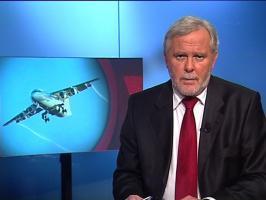
« Newsreel » peut être considéré comme une tentative de décrire et déconstruire l'esthétique des journaux télévisés en prenant comme point de départ un journal du Channel 4 suédois. Les informations quotidiennes jouent un grand rôle dans notre vie de tous les jours. Nous devenons de plus en plus dépendants et habitués à la qualité informative des nouveaux médias. Ils nous font prendre conscience du monde qui nous entoure et du débat mondial. En même temps, on pourrait soutenir que le journal télévisé repose souvent sur une structure narrative que l?on retrouve dans l'histoire du cinéma. « Newsreel » tente d?examiner si, et comment, le présentateur, le décor du studio, et la structure des informations se réfèrent à des règles narratologiques, et ce qui se passe si on les enfreint. S?il est vrai que l'objectif du journal est de nous informer de manière intelligible sur des questions et des événements importants et urgents, l?auteur voudrait repartir de ce qui rend les choses compréhensibles ainsi que poser la question plus large : qu?est-ce que l'intelligibilité ? En séparant les informations des procédés qui en communiquent le contenu, l?auteur veut créer la possibilité de prendre de la distance et de regarder le journal télévisé d?un ?il différent.
Emanuel almborg www.sakerna.se/emanuel Born in Stockholm, Sweden 1981, lives and works in London and Stockholm. Education: 2005 ? 2007 MFA, Fine art Goldsmiths College, London 2001 - 2004 BA, Fine art Konstfack, Stockholm Selected Group Exhibitions and Solo Shows: 2008 MI2 B.I.G ProjectSpace, K44, Athens 2008 Loop international festival and fair for video art, Barcelona 2008 Videotheque Sala Rekalde, Bilbao 2008 Auction in a suitcase, 1:1 projects, Rome 2007 One must be so careful these days. Alma Enterprises, London 2007 MFA Degree show, Goldsmiths College, London 2007 Michael Poppyfield projects, Cal Arts, Los Angeles 2006 Goldsmiths MFA survey, Gallery white Box, New York 2006 Rag and Bone, Three Colts Gallery, London 2006 The Union, Collaborative project at Gallery Meals & SUVs, London 2005 Sakerna, magazine/installation, Stockholm ArtFair, Stockholm 2004 Been Here Too Long, Video, Gallery SAK, Stockholm 2004 The Second City, Video, Group show at Kulturhuset (Culture House) Stockholm 2003 Första Saken, Collaborative project at Gallery Konstfack, Stockholm 2002 Hyères Festival des arts de la Mode, France Other Projects: 2007 Artist Clothing at Tensta konsthall, photographer for project. Catalogue and poster. 2005 Beckmans Initiator/Tutor for workshop at Beckmans college Stockholm. 2004 Andra Saken Magazine (Distributed around the world) 2003 Första Saken Magazine (Distributed around the world) 2004 www.sakerna.se Website 2003-2006 Founder, Editor, Photographer, filmmaker, Sakerna Magazine and Project (www.sakerna.se) Selected Bibliography: 2006 Sede, (Magazine) 2006 Influences, Die Gestalten Verlag (collection of art/desig book) 2005 Übersee, Die Gestalten Verlag (collection of art/design Book) 2002 Super, Die Gestalten Verlag (collection of art/design Book) 2001 Desire, Steidl (collection of photography Book)
Bon Alog
Catalogue : 2020I will not | Installation vidéo | mp4 | couleur | 2:29 | Lituanie | 2019
Bon Alog
I will not
Installation vidéo | mp4 | couleur | 2:29 | Lituanie | 2019
The Hippocratic oath is known as a golden ideal standard of ethics for professionals working in the field of medical science. The Hippocratic oath and its modern version is relevant as a division between the power of killing and medical treatment. An extract of oath is chosen emphasize a moral pledge, which starts with negative form promise – I will not. Repetitive militaristic movements and hunting simulation is used as an imperative of security forces, defense, discipline and power relations in biotechnology context.
Bon Alog (LT) is a media artist. She graduated BA in Photography and Media arts at the Vilnius Academy of Arts and BA in creative industries at Vilnius Gediminas technical university. Bon works with video, film, installations and photography.
Catalogue : 2018Summa summarum | Film expérimental | hdv | couleur | 5:46 | Lituanie | 2017
Bon Alog
Summa summarum
Film expérimental | hdv | couleur | 5:46 | Lituanie | 2017
The characteristics of our subconsciousness has its own model of reality. Human-being is trying to distinguish where simulation starts and ends. But the self-reflection of consciousness is full of absurdity itself... What is REAL? And what is REALLY happening?
2015 - present BA in Photography and Media art, Vilnius Academy of Arts (Lithuania) 2017.10 - 2018.02 Photography and Time-based arts, Bucharest national university of Arts (Romania) 2009 - 2013 BA in Creative industries, Vilnius Gediminas technical university (Lithuania) 2012 Spring semester - Multimedia, Tomas Bata university (Czech Republic)
Alejandro Alonso, Alejandro Pérez
Catalogue : 2023Terranova | Doc. expérimental | digital | couleur et n&b | 50:0 | Cuba | 2021
Alejandro Alonso, Alejandro Pérez
Terranova
Doc. expérimental | digital | couleur et n&b | 50:0 | Cuba | 2021
Cities do not repeat themselves; they transmute. The city of Havana is portrayed in Terranova as a phantasmagorical, magical, and sensory space. An urban landscape created through reflections, glimpses of other cities, and visions of the future.
Director and photographer. Graduated in the Documentary Filmmaking at the lnternational School of Cinema and TV (ElCTV) in San Antonio de los Baños, Cuba. His documentary "The Farewell" (2015) had its international premiere at lDFA; it was awarded for Best Film in the Aciertos category of FlCUNAM and obtained the Full Frame President Award. "Duel" (2016) premiered at Cinema du Réel; it won the award for Best Short Film at the 32nd Mar del Plata Film Festival and Best Short Film at the 58th Popoli Festival. His feature film "The Project" (2017) had its world premiere at Visions du Réel, it won the FlPRESCl Award at the 60 Dok Leipzig. "Terranova" (2020), a medium-length film co-directed with Alejandro Pérez, won the Ammodo Tiger for Best Short Film at the Rotterdam Festival. His latest film, "Abissal" (2021), had its premiere at Visions du Réel, won the Audience Award at Documenta Madrid, 2021 and won the Golden Dove Dok Leipzig, 2021. Between 2017 and 2019, coordinated the Alternative Film Master's program organized by the EICTV. His feature-length documentary project "The Star" was selected for the Residency at the Academy of Cinema in Madrid during 2021.
Alejandro Alonso
Catalogue : 2020Metatron | Documentaire | hdv | noir et blanc | 13:0 | Cuba | 2018
Alejandro Alonso
Metatron
Documentaire | hdv | noir et blanc | 13:0 | Cuba | 2018
.
.
Saif Alsaegh
Catalogue : 2025The Motherfucker's Birthday | Film expérimental | mp4 | couleur | 6:20 | Iraq, USA | 2024
Saif Alsaegh
The Motherfucker's Birthday
Film expérimental | mp4 | couleur | 6:20 | Iraq, USA | 2024
Through dancing, the film shows the evil of the dictator and the horror people endure under powerful political leaders. Saddam dances, Bush dances, so what's left for the Iraqi people except to join in.
Saif Alsaegh is a United States-based filmmaker from Baghdad. Much of Saif’s work deals with the contrast between the landscape of his youth in Baghdad growing up as part of the indigenous Chaldean minority in the nineties and early 2000s, and the U.S. landscape where he currently lives. His films have screened in festivals and venues including Cinéma du Réel, Kurzfilm Hamburg, Kassel Dokfest, Aesthetica Short Film Festival, Madison Museum of Contemporary Art and The Gene Siskel Film Center. Alsaegh’s films are distributed by Video Data Bank.
Catalogue : 2020Bitter with a Shy Taste of Sweetness | Film expérimental | hdv | couleur et n&b | 8:47 | Iraq, USA | 2019
Saif Alsaegh
Bitter with a Shy Taste of Sweetness
Film expérimental | hdv | couleur et n&b | 8:47 | Iraq, USA | 2019
Bitter with a Shy Taste of Sweetness contrasts the fragmented past of the filmmaker growing up in Baghdad with his surreal California present. Through poetic writing and jarring visuals, the film creates a calm and cruel sense of memory and landscape.
Saif Alsaegh is a United States-based filmmaker from Baghdad. Much of Saif’s work deals with the contrast between the landscape of his youth in Baghdad growing up as part of the Chaldean minority in the nineties and early 2000s, and the U.S. landscape where he currently lives. His films have screened in many festivals including Cinema du Reel, Kruzfilm Festival Hamburg, Kasseler Dokfest, Onion City Film Festival and in galleries and museums including the Wisconsin Triennial at MMoCA. He received his MFA in filmmaking from the University of Wisconsin-Milwaukee.
Basma Alsharif
Catalogue : 2010we began by measuring distance | Vidéo expérimentale | dv | couleur | 19:0 | Palestine, Egypte | 2009
Basma Alsharif
we began by measuring distance
Vidéo expérimentale | dv | couleur | 19:0 | Palestine, Egypte | 2009
Long still frames, text, language, and sound are weaved together to unfold the narrative of an anonymous group who fill their time by measuring distance. Innocent measurements transition into political ones, drawing to an examination of how image and sound communicate history, tragedy, and the complication of Palestinian nationalism. The work explores an ultimate disenchantment with facts when the visual fails to communicate the tragic.
Born 27 august 1983 in Kuwait. Spent early childhood in Brittany France. Educated in the US, earning BFA & MFA from the University of Illinois at Chicago School of Art & Design and was a guest student at the Malmö Art Academy, Lund University Sweden in 2004. Taught as an adjunct instructor at The University of Illinois at Chicago, The School of the Art Institute of Chicago, and the American University in Cairo. Currently based in Beirut Lebanon as a recipient of the Fundación Marcelino Botín Visual Arts Grant 2009-2010 developing a series of new projects in photography, film, and text.