Catalogue > Liste par artiste
Parcourez la liste complète des artistes présentés dans le cadre des Rencontres Internationales depuis 2004. Utilisez le filtre alphabétique pour affiner vos recherches.
Vaikla Ingel
Catalogue : 2025Moi aussi, je regarde | Doc. expérimental | 16mm | couleur et n&b | 22:16 | Estonie, Belgique | 2024
Vaikla Ingel
Moi aussi, je regarde
Doc. expérimental | 16mm | couleur et n&b | 22:16 | Estonie, Belgique | 2024
The unité d’habitation is a modernist residential housing typology developed by Atelier Le Corbusier. The first unité d’habitation building in Marseille, France was built between 1947 and 1952. The building houses 337 apartments with 1200 inhabitants. The apartments were originally equipped with built-in furniture designed by Charlotte Perriand. The flat roof is designed in collaboration with an architect Blanche Lemco van Ginkel as a communal terrace with sculptural ventilation stacks, a running track, and a shallow paddling pool for children. The building is the first and finest example of vertical urbanism. Moi aussi, je regarde is an experimental documentary film which portrays widely reproduced building the unité d’habitation through the stories of its female inhabitants in an attempt to give the building its own agency to not only be looked at but to be empowered to look back in the masculine world of modernity.
Ingel Vaikla (1992, Tallinn) is a visual artist and a filmmaker based in Brussels working primarily with video, 16 mm analogue film and found footage. Vaikla’s artistic practice focuses on representation of architecture and on the relationship between spaces and their communities. She is on a constant search for visual language that would not simply observe architecture as a sculptural form but would translate the existential, conceptual and ideological qualities spaces manifest. Her works The House Guard, Roosenberg, Double Exposure, Papagalo, What's the Time?, EUR42 have been screened internationally at film festivals and art institutions such as IDFA in Amsterdam, Kunsthalle Wien, EKKM in Tallinn, Beursschouwburg and Bozar in Brussels, Manifesta 13 in Marseille, Videonale in Bonn, Tramway in Glasgow, EMAF in Osnabrück, Busan International Video Art Festival etc.
Catalogue : 2023Papagalo, What's the Time? | Doc. expérimental | 16mm | couleur et n&b | 7:0 | Estonie, Belgique | 2022
Vaikla Ingel
Papagalo, What's the Time?
Doc. expérimental | 16mm | couleur et n&b | 7:0 | Estonie, Belgique | 2022
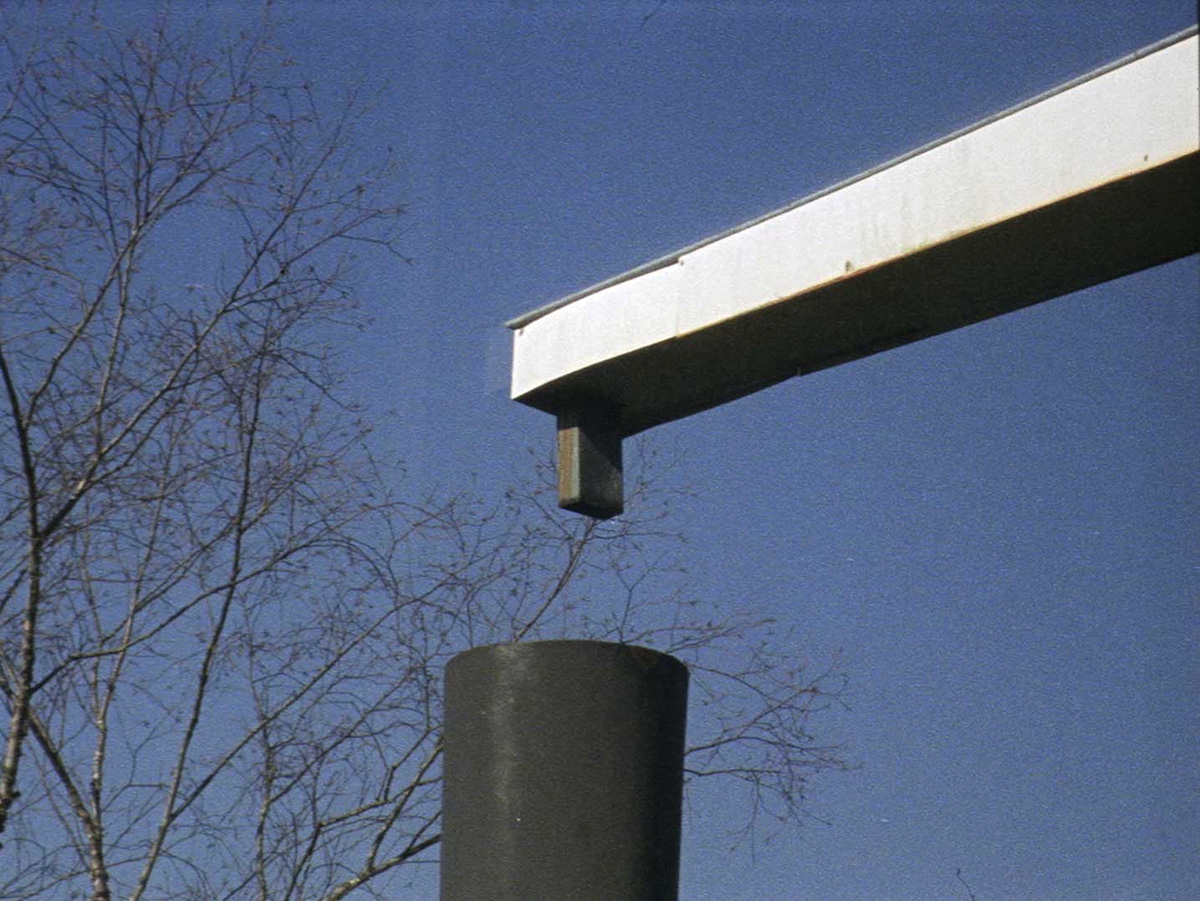
Papagalo, what’s the Time? explores the architecture of the former Yugoslavian pavilion from the Brussels World Expo (1958) in its current function as Sint-Pauluscollege. The film follows a group of kids playing old Yugoslavian children’s games at the building. The camera moves from outdoors to the interior spaces, along the hallways from floor to floor exploring the building together with the group of children. The work creates a poetic exchange between the modernist architecture and the contemporary function of the building, between the moving bodies and solid walls.
Ingel Vaikla (1992, Tallinn) is a visual artist and a filmmaker based in Brussels. Vaikla’s practice focuses on the relationship between place, identity and its users, and the representation of space in photography, video and film. She is in constant search for visual language that would not simply observe architecture as aesthetic sculptural form but would explore the existential, conceptual and ideological qualities it can convey. She believes that buildings do not only provide shelter, they are also a mental mediation between the world and us. Her films ‘The House Guard’, ‘Roosenberg’, ‘Double Exposure’, ‘Papagalo, What’s the Time?’ and ‘EUR42’ have been screened at film festivals and art institutions such as IDFA in Amsterdam, Kunsthalle Wien in Vienna, Contemporary Art Museum of Estonia (EKKM) in Tallinn, Tramway in Glasgow, Beursschouwburg in Brussels, Manifesta 13 in Marseille, EMAF in Osnabrück, Videonale in Bonn etc.
Catalogue : 2016Majavalvur | Documentaire | hdv | couleur | 25:55 | Estonie | 2015
Vaikla Ingel
Majavalvur
Documentaire | hdv | couleur | 25:55 | Estonie | 2015
The House Guard is a double portrait – of the Tallinn Linnahall concert and sports venue and its caretaker Peter, who are both bound by seclusion. It tells the story of the decline of a legendary building through one man`s eyes, and the personal story of a man against the backdrop of a vanishing building. It is a dialogue between the two.
Ingel Vaikla (1992) is a photographer and filmmaker. In her work she mostly questions the relation between architecture and its users, and the representation of architecture in camera based mediums. Ingel was part of the team representing Estonia at the 2012 Venice Architecture Biennale with a contribution titled `How Long is the Life of a Building?`. Her film “The House Guard” (2015) has been screened on Estonian national television and on several international film festivals in Europe. Right now she is studying in film Masters in Royal Academy of Fine Arts in Gent. She writes for design and architecture magazine Idee and organises film screenings for the International Interior Architecture Symposium SISU.
Marion Inglessi
Catalogue : 2017Catastrophe | Vidéo | hdv | couleur | 5:0 | Grèce | 2015
Marion Inglessi
Catastrophe
Vidéo | hdv | couleur | 5:0 | Grèce | 2015
Catastrophe is the fatal turning point or resolution in Ancient Greek drama. The word catastrophe in Greek and Arabic bears the same weight: the catastrophe of Asia Minor, the Exodus from Palestine. When catastrophe strikes, the visual equivalent of extreme shock is to drop whatever one holds in one’s hands. The “unbreakable” Duralex glasses were created in France in the late 50’s and have today become a classic. A symbol of strength and durability, they have spread around the whole world and have been photographed in the hands of Afghan tribesmen, James Bond, and even Osama bin Laden. The “Western” glasses are shot in slow motion as they fall to the ground, bounce, alternate and merge with the more fragile Arabic tea-glasses in a silent and ultimately shared - dance of death. Letters hit the falling glassware with the rhythmic intensity of gunshots, spelling the word catastrophe in Greek, English, and Arabic (nakba). Catastrophe is a reflection on the current events in the world and the increasing loss of value of human life.
Marion Inglessi is a visual artist, scene designer, curator. Born in Athens, she lived in Ghana, Nigeria, Lebanon, Italy, France and USA. After a BA in English Literature, she received an MFA in Theatre Design from Brandeis University, Boston, U.S.A. (1986-89). She attended Istanbul Bilgi University, Turkey on an Erasmus scholarship (2010-11). In 2014 she received an MFA from the School of Fine Arts, Aristotle University, Thessaloniki. She has worked as a designer for theatre, opera, film and advertising, in New York, Paris, Athens (1989-2003). She was Head of exhibitions & curator at the Thessaloniki International Film Festival (2005-2009), for film directors Nico Papatakis, William Klein, Werner Herzog, Wim & Donata Wenders, Eve Sussman, Nuri Bilge Ceylan, Guillermo del Toro, Cao Fei, and others. In 2015 she co-created a video animation project for refugee children & adolescents in Athens shelters. She has had two solo painting and sculpture exhibitions while participating and curating a number of group shows. Her work is in private collections in Greece, France, Switzerland and Turkey and the Macedonian Museum of Modern Art. Her video Catastrophe participated in the video survey Fireflies in the Night Take Wing, at the SNFCC, Athens, 2016.
Lilja Ingolfsdottir, Sara ELIASSEN
Catalogue : 2006Not Worth It - Shine and Glow | Fiction | 35mm | couleur | 3:30 | Norvège, Royaume-Uni | 2005

Lilja Ingolfsdottir, Sara ELIASSEN
Not Worth It - Shine and Glow
Fiction | 35mm | couleur | 3:30 | Norvège, Royaume-Uni | 2005
Lilja Ingolfsdottir nait en Norvège en 1976. Elle étudie à la International Film School de Londres entre 1997 et 2002 et à la FAMU (Czech National Film School, Prague) entre de 2000 à 2001.
Institute For New Feeling
Catalogue : 2018Avalanche | Vidéo expérimentale | hdv | couleur | 16:40 | USA | 2017
Institute For New Feeling
Avalanche
Vidéo expérimentale | hdv | couleur | 16:40 | USA | 2017
Avalanche is an enhanced water beverage filtered through a human pipeline that traces the flow of water through a city and through the body. A live performance presents municipal water usage as a literal concert of bodies, a system that is improbable, arduous, and flawed. The Avalanche bottling process begins with an ice cap harvested from the Never Summer Mountain Range. The ice melts and travels through a series of human filters, eventually collecting in crystal singing bowls. The sound of this filtration is performed as a concert for a live audience, while at the same time being live broadcast back to the mountain range, causing an avalanche from the vibration of sound waves. The avalanche is bottled for consumption, while also providing new ice to begin the process again. The project consists of a one night live performance, multi-channel video and vending machine stocked with Avalanche water, all of which work together to create a mythology of the product’s source. Passing water between the city and the mountain in an endless feedback loop, IfNf`s filtration process equates the mountain spring with the trickle of water across a dirty windshield, the tears of two middle-aged men, the gargle and spit from a teenager’s mouth, juxtaposing trivial everyday gestures with the looming, dark future of a changing climate.
The Institute for New Feeling is a collective founded by Scott Andrew, Agnes Bolt, and Nina Sarnelle, committed to the development of new ways of feeling, and ways of feeling new. As a group, our identity is always shifting. Borrowing aesthetics and language from wellness and tech industries, market research, speculative design, political propaganda, we assume a familiar yet fragile voice of authority. IfNf has recently shown work at The Getty Center, LA, Ballroom Marfa, TX, MoMA, NY, Istanbul Modern, Turkey, MAAT, Lisbon, Whitechapel Gallery, London, Hammer Museum LA, Fundacion PROA, Buenos Aires, Akademie Schloss Solitude, Stuttgart, Jardin Essential, Bruxelles, Recess, NY, and Mwoods, Beijing. IfNf has been featured in Frieze, Art in America, Vogue Italy, Huffington Post, SFMoMA, Creators Project, FlashArt, and Hyperallergic.
Catalogue : 2017This is Presence | Vidéo | hdv | couleur | 17:19 | USA | 2016
Institute For New Feeling
This is Presence
Vidéo | hdv | couleur | 17:19 | USA | 2016
A 17-min video commissioned by Ballroom Marfa for the Artist Film International program led by Whitechapel in London. This video depicts a journey through the Institute for New Feeling’s fabricated SEO Marketing campaign, a web of interconnected sites populated with training modules, news articles, facility tours, click bait and social networking sites all linking back to the Institute for New Feeling.
The Institute for New Feeling 3 person collective committed to the development of new ways of feeling, and ways of feeling new. As a group we assume the authoritative voice of the Institution, borrowing from the language of corporate branding as well as that of mainstream medicine, therapy, health and beauty. Our work takes the form of treatments, therapies, retreats and wellness products. We are interested in the wellness industry as a shifting, slippery intersection of capitalism, technological innovation, and the body. IfNf has recently shown work at Ballroom Marfa, TX, Istanbul Modern, Turkey,Museum of Modern Art, NY, MAAT, Lisbon, Whitechapel Gallery, London, Hammer Museum, Los Angeles, Fundacion PROA, Buenos Aires, Akademie Schloss Solitude, Stuttgart, Kevin Space, Vienna, Jardin Essential, Bruxelles, Recess, NY, and Akademie Schloss Solitude, Stuttgart.
Arne Intveen
Catalogue : 2013etwas. | Vidéo | | couleur | 5:54 | Suisse, Allemagne | 2011
Arne Intveen
etwas.
Vidéo | | couleur | 5:54 | Suisse, Allemagne | 2011
Born 1986 in Geneva, Switzerland. Has studied fine arts at the FHF Freiburg from 2006 to 2010. Has been studying Kunst & Medien at the UDK Berlin since 2010.
Yuk Yiu Ip
Catalogue : 2019HBG: HUMANS, BEASTS & GHOSTS | Création numérique | mov | couleur et n&b | 0:0 | Hong Kong | 2018
Yuk Yiu Ip
HBG: HUMANS, BEASTS & GHOSTS
Création numérique | mov | couleur et n&b | 0:0 | Hong Kong | 2018
Inspired by the works of the Chinese literary master Qian Zhongshu, HBG: Humans, Beasts and Ghosts is an experimental video game, a playable life simulator in which the audience, assuming the role of God, facilitates the everyday being of the different worlds inhabited by humans, beasts and ghosts. The player can choose to act as an interventionist God, creating and destroying whimsically, or simply watching the worlds unfold with minimal or no interference. A literary adaptation in a digital and playable form, HBG is an allegorical play about human existence, its dilemma and other catastrophes.
IP Yuk-Yiu is an experimental filmmaker, media artist, art educator and independent curator. His works, ranging from experimental films, live performances, media installations to video games, have been showcased extensively at international venues and festivals, including European Media Art Festival, New York Film Festival (views from the avant-garde), the Image Festival, FILE Festival, VideoBrasil, Transmediale, NTT InterCommunication Center [ICC] and WRO media art Bienniale. He is the founder of the art.ware project, an independent curatorial initiative focusing on the promotion of new media art in Hong Kong. IP has over fifteen years of curatorial experience in film, video and media art. Currently he is Associate Professor at the School of Creative Media, City University of Hong Kong. His recent works explore hybrid creative forms that are informed by cinema, video games and media art practices.
Carlos Irijalba
Catalogue : 2026Wanderers | Doc. expérimental | 4k | couleur | 3:38 | Espagne, Pays-Bas | 2025
Carlos Irijalba
Wanderers
Doc. expérimental | 4k | couleur | 3:38 | Espagne, Pays-Bas | 2025
Wanderers est un film centré sur la manière dont la matière — et, par ricochet, nos corps — est mue par le magnétisme, l’impulsion ou le rythme porté par l’inertie terrestre. Un mouvement primordial, d’origine minérale, antérieur à la vie et à l’humain. Pour en rendre compte, le film adopte une perspective universelle sur la dynamique des oiseaux, la migration des corps, et la fascination humaine pour le vol, perçue comme une tentative de défier ces lois. Cette notion abstraite se déploie à travers deux phénomènes contemporains : la fauconnerie moderne pratiquée à bord d’avions commerciaux, et la passion des pilotes de répliques d’avions de ligne en radiocommandé. Ces deux pratiques dessinent la dichotomie entre l’évolution naturelle, notre matérialité physique et le désir de s’extraire de la réalité terrestre — des forces générales, de la gravité, de ce qui nous retient au sol.
Carlos Irijalba (né à Pampelune, Espagne, en 1979) Résident à la Rijksakademie van Beeldende Kunsten (Amsterdam) en 2013–2014 et diplômé de l’UDK Berlin auprès du professeur Lothar Baumgarten, Irijalba a reçu de nombreux prix artistiques, parmi lesquels le NYC Culture Pair Program avec le Department of Design and Construction (DDC) en 2023, le Mondriaan Fonds (Amsterdam, 2022), le Sifting Foundation Art Grant (San Francisco, 2015) ou encore la bourse Marcelino Botín (2007–2008), entre autres. Il a exposé à l’international, notamment à la Biennale de Shanghai 2021, au CAB Art Center (Bruxelles), à la Triennale de Guangzhou 2017, ainsi qu’au MUMA (Melbourne, Australie). À la question : « Le monde a-t-il besoin de cet objet nouveau ? », la réponse est la plupart du temps « non ». C’est pourquoi le travail d’Irijalba se déploie selon un principe de pertinence, cherchant à rester en résonance avec les contextes. Dans des projets tels que Skins (2013), Hiatus (2022) et Pannotia (2016–en cours), il travaille avec la géologie et des matériaux industriels sensibles au temps, offrant de nouvelles perspectives sur les récits dominants de l’histoire occidentale. Ses œuvres figurent dans des collections publiques telles que le Museo Nacional Reina Sofía, la Netherlands National Collection, la Sammlung Wemhöner (Allemagne), la Taviloglu Art Collection (Istanbul) ou encore la Fondation Acciona (Espagne). Elles sont également largement représentées dans des collections privées en Amérique du Nord et du Sud, en Europe et en Asie, notamment les collections Pilar Citoler, Kells Collection, David Breskin Collection, entre beaucoup d’autres.
Catalogue : 2022HALF WET | Fiction expérimentale | mp4 | couleur | 17:49 | Espagne, Pays-Bas | 2021
Carlos Irijalba
HALF WET
Fiction expérimentale | mp4 | couleur | 17:49 | Espagne, Pays-Bas | 2021
At a dystopian future moment in the coast of Oaxaca, due to global warming the oceans PH levels have acidified making them unsuitable for humans, therefor sea tourism has been gone for generations and only indigenous language is spoken. Wuicho repeats his father’s and grandfather’s ritual of keeping swimming pools pristine while he questions his actions and his predecessors. Written a dn filmed on his own, with a reflex camera and a smart phone in 10 days. His work tries to generate no residue in a ready made mode.
Carlos Irijalba born 1979 in Pamplona (Spain) currently lives in Amsterdam where he was a Rijksakademie resident 2013/14. His practice involves environmentally sensitive installations including sculture, video and photography. He has been awarded Mondriaan Fonds Bewezen Talent 2017-2020 and exhibited in itnernational venues loke the Shanghai Biennale, CAB Art Center Brussels, or MUMA en Melbourne in Australia. His work is present in international collections as Sammlung Wemhoener Foundation in Germany, MNCARS Reina Sofia Museum (Madrid) or the Taviloglu Art Collection in Istambul.
Catalogue : 2013Inertia | Vidéo | hdv | couleur | 4:20 | Espagne | 2012
Carlos Irijalba
Inertia
Vidéo | hdv | couleur | 4:20 | Espagne | 2012
INERTIA. Device and residue. Just as an eye blink denies the presence of a specific space or time within a continuum, so a frame freezes a particular place and moment. It is the indivisible unit of the audiovisual mechanism, and its basic inductor is light. Thereby begins a journey that takes us from the real to the represented, finally leading us to that ultimate reality, the document. Inertia deals with the construction of reality. The route is a place and the vector imposes itself on the object. The present then tends to disappear in a continuous movement and what happens is indeed its non-presence. Over its four-minutes length, Inertia responds to the conventions of rhythm, visual axes, and other narrative norms with the rules that we use to assimilate the entire audiovisual spectrum. There occurs a specific accident between the fragile rules of narration and the sophistication of what is staged, confronted with the inescapable physical connotations of gravity, weight, or the volume of the elements in its service.
Carlos Irijalba (Pamplona, 1979) graduated in 2002 at the Fine Arts Basque Country University and studied at UDK Berlin is actually resident at Rijksakademie Amsterdad. Awarded Purificacion Garcia photography first Prize and the Revelation PhotoEspaña Prize among others, he also received the Guggenheim Bilbao Photography grant in 2003 or the Marcelino Botín Foundation in 2007/08. Irijalba has exhibited at international Art Museums, including the CCCB Barcelona or Herzliya Museum Israel. In projects as Unwilling Spectator (2010) or Inertia (2012) works between relative experience of time and space and the collective construction of the real.
Carlos Irijalba
Catalogue : 2011Unwilling Spectator | Art vidéo | 0 | couleur | 5:21 | Espagne, Chine | 2010
Carlos Irijalba
Unwilling Spectator
Art vidéo | 0 | couleur | 5:21 | Espagne, Chine | 2010
La tendance à négocier l?espace en faveur d?une certaine hégémonie du temporaire s?est développée au point de devenir une réalité stratégique à caractère global, avec des vues économiques et politiques. Actuellement, le gain de temps est une question qui vise exclusivement les trajectoires, les vecteurs, et le territoire abandonne sa signification au profit de ce qui est en mouvement. Les approches développées dans les projets récents de l?artiste, comme "Switch off all Devices" en 2006, ou "Twilight", en 2008, font état d?une capitalisation patente de l?espace et du mouvement. L?espace est assimilé et devient même quelque chose dont on peut se dispenser, alors que le geste ou l?orientation prennent l?avantage et acquièrent une nature visuelle. Le chemin est un endroit et la trajectoire est imposée à l?objet. Le présent tend donc à disparaître dans un mouvement incessant. Le présent tend donc à disparaître dans un mouvement incessant, entraînant sa non présence. Ce projet propose une intervention réelle sur le lieu même du conflit. Les voies rapides de circulation, les autoroutes, matérialisent le lieu du désengagement topographique, de la mise en ?uvre de la coercition, de l?engagement dans le mouvement, ici dans le mouvement incessant sur une bretelle très fréquentée. Cette contradiction peut prendre la forme de déserts isolés au sein de la circulation, et prend ici la forme d?une forêt miniature, réduite à sa fonction symbolique, et dont l?expérience que l?on peut en faire en tant que lieu est impossible, car ce lieu est inaccessible. Les problématiques comme celle de l?échelle ou de la tangibilité sont ici défaites. Une trouée s?ouvre, des temporalités radicalement différentes se succèdent.
Carlos Irijalba est un artiste espagnol né à Pampelune en 1979. Il est diplômé de l?université du Pays basque et de l?UDK, Université des arts de Berlin. Dans son travail, il analyse la manière dont la culture occidentale recrée un medium abstrait qui perd toute relation, hormis à lui-même. Le spectacle a délimité le visible de manière à ce qu?il puisse être rapidement digéré, en transférant l?attention vers une série de pseudo événements. Le travail de Carlos Irijalba tend à faire éprouver l?expérience relative du temps et de l?espace, et de la construction collective du réel.
Catalogue : 2010Twilight | Vidéo | | couleur | 13:0 | Espagne | 2008
Carlos Irijalba
Twilight
Vidéo | | couleur | 13:0 | Espagne | 2008
TWILIGHT. Twilight consists of the displacing of a floodlighting tower for a football pitch, a space that is hyperdefined by and for spectacle, whose descriptive lighting presents the subject of its attention as the only one that exists. This tower has been transferred to one of Europe?s last forests, Irati, in the north of Navarre, creating as a replica a redefinition of the real as visible employing the language proper to spectacle. The project is about the way in which the West constructs a circuit of the real through light. Natural lighting provides a consistent space-time dimension, while the West?s approach to light, in contrast, goes beyond the manufacture of an eternal day to rupture structures and cycles towards the construction of an abstract medium that loses all relations except in relation to itself. Fire as the first artifice and, later, artificial light have symbolised the place of transformation. Spectacle has inherited the place and hypnotic qualities of fire and has marked out the plane of the visible so that it can be digested, transferring attention towards a series of pseudo-events. Representation of place is now insufficient. The project poses this installation as the need for the real beyond its image. The last place is the place itself.
Carlos Irijalba. Biography Carlos Irijalba (Pamplona, 1979) graduated in 1998 from the Pamplona School of Art and went on to continue his training at the University of the Basque Country where he obtained his Fine Arts degree. He also studied in Berlin at the Universität der Kunst with artist and professor Lothar Baumgarten and actually has a studio residence at ISCP New York. In 2004 he received the First Award for Young Artists, as well as a photography grant from the Guggenheim, to which must be added a Plastic Arts Grant from the Fundacion Marcelino Botín in 2007 and the Purificacion Garcia Photography Award. Carlos has exhibited at national and international Centres, including the CCCB in Barcelona, Miami, New York,Tokyo and Beijing. In previous projects, such as ?Outside comes first? or ?Devices? (both in 2007) he had already worked on the distortion of the construction of reality in the West. So, with Twilight he continues to delve into our understanding of and approach to reality, and spectacle. He is currently developing a photograph and video project in Beijing entitled Dromocracia.
Adla IsanoviĆ
Catalogue : 2015Images Within Us | video | hdv | couleur | 4:19 | Bosnie-Herzégovine | 2012
Adla IsanoviĆ
Images Within Us
video | hdv | couleur | 4:19 | Bosnie-Herzégovine | 2012
There is a huge amount of well-known media reports recorded in Sarajevo during the Siege (1992-1996). Media framed those events, streets, places and people into well-known images, common representations of war. Audience around the world was/is able to watch such imagery, over and over again. Adla Isanović erased the whole urban scene and context out of it, leaving only images of people. In that way, she explores how does the audience`s relationship to such imagery of people, whose context is erased-change. After pictures, what remains? What is our relationship with such images, representations, subjectivity, knowledge, with facts, feelings, emotions and experiences?
Adla Isanović Born 1977 in Sarajevo (Bosnia and Herzegovina). Lives and works in Sarajevo. She holds a MA in “New Media”, as well as a MA in “Critical, Curatorial, Cybermedia Studies” (Geneva, Switzerland). She works at the Academy of Fine Arts Sarajevo as Assistant professor on the courses on Multimedia. Furthermore, she was a visiting lecturer at the International University Sarajevo, as well as at the Academy of Performing Arts Sarajevo. Her previous engagements include a work as a researcher/analyst at the Mediacentar Sarajevo. She has been engaged on numerous local and international projects in the fields of culture and art. Her artworks were presented in Bosnia and Herzegovina, Austria, Switzerland, Slovakia, Montenegro, Ireland, Netherlands, Great Britain, Latvia, Italy, Germany, Greece, France, Canada, Japan, Columbia, etc.
Takashi Ishida
Catalogue : 2008Ema/Emaki 2 | Animation | 16mm | couleur | 6:30 | Japon | 2006
Takashi Ishida
Ema/Emaki 2
Animation | 16mm | couleur | 6:30 | Japon | 2006
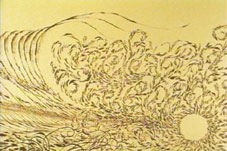
"Ema/Emaki 2"de Takashi Ishida est composé d'une série de séquences longues d'une minute. Dans son film, Ishida anime des formes linéaires et organiques qui ne cessent de pousser vers le haut. Chacune des formes animées est ensuite recombinée avec les autres pour donner naissance à une série de variation créées par de multiples expositions. -Andréa Picard et Chris Gehman (Festival international du Film de Toronto)
Né en 1972 à Tokyo, Takashi Ishida commence à réaliser des films dès 1995. Il travaille aussi bien sur ses films que sur des travaux collectifs dans bien d'autres domaines: par exemple, il a contribué au design scénique pour les représentations du danseur Nohmi Kenshi, et a travaillé avec le poète Gozo Yoshimasu.
Dana Iskakova
Catalogue : 2026Whose Voice Is This? | Film expérimental | 35mm | couleur et n&b | 13:52 | Kazakhstan, Allemagne | 2024

Dana Iskakova
Whose Voice Is This?
Film expérimental | 35mm | couleur et n&b | 13:52 | Kazakhstan, Allemagne | 2024
Shifting perspectives from the visual to the aural, this film is a result of research into the Central Asian holdings of Arsenal’s archive. It explores the evolution of sound, speech, and music in local cinema from the 1960s to the 1990s. By listening to characters’ concerns through dubbed voices in addition to soundscapes and soundtracks, we can trace the impact of Soviet ideology, its gradual weakening, and the rise of Perestroika’s freedom. Although the archive, with 45 films from Central Asia, cannot represent all of the region’s political and social shifts, it does offer a valuable basis for analyzing how evolving sound reflects broader transformations over three decades. “Whose Voice Is This?” was commissioned by Arsenal – Institute for Film and Video Art in the framework of a Living Archive Residency supported by the Goethe-Institute Uzbekistan. Central Asian Research Collective DAVRA Germany, Uzbekistan, Kazakhstan 2024
Dana Iskakova is an artist and cultural practitioner from Almaty, Kazakhstan, currently pursuing an MA in Fine Arts at the Basel Academy of Art and Design. She previously studied finance at the International IT University and liberal arts at Smolny College. As a member of the DAVRA research group, she participated in documenta 15 (2022) and Archival Assembly #3 (2024). In 2023, Iskakova presented the printed magazine on fictional contemporary art called “If” and its first issue, created in collaboration with the MATA collective. Her practice explores the intersection of truth and fiction, perception, and collective imagination.
Bobur Ismailov
Catalogue : 2010yuz | Vidéo | dv | couleur | 6:0 | Ouzbékistan | 2008
Bobur Ismailov
yuz
Vidéo | dv | couleur | 6:0 | Ouzbékistan | 2008
A woman takes off a veil in a hope to open her face and discover the world surrounding her. The layers of veils don`t let her to break the limits of darkness. Each time she takes of the veil we hope to see her unveiled but this freedom doesn`t arrive.
Babur Ismailov is born in Uzbekistan, where he graduated from State Art Institute. He is a member of the Academy of Fine Arts of Uzbekistan and Russia. Babur Ismailov expresses himself in painting, graphics, video installations. He worked in cinema, animation, illustration, theater proving himself as truly multidimensional artist. He took part in over thirty international exhibitions in France, Italy, Germany, USA, Russia and other countries. And presented several personal exhibitions in Tashkent, Uzbekistan and Paris, France.
Tatiana Istomina
Catalogue : 2014Yalta: A story of disappearance | Fiction expérimentale | 16mm | couleur | 10:36 | USA | 2012
Tatiana Istomina
Yalta: A story of disappearance
Fiction expérimentale | 16mm | couleur | 10:36 | USA | 2012
This short film is made of archival footage shot at the Yalta conference (1945) - a historic meeting between Roosevelt, Churchill and Stalin shortly before the end of the WWII. The film mimics the style of a TV documentary and shows behind-the-scenes of the conference through the eyes of a fictitious character, whose possible involvement in espionage and unexplained disappearance comprise the mystery, which the film attempts to resolve, - albeit unsuccessfully. The fictional narrative provides possible reasons and motivations behind the random collection of recordings in the original footage, weaving together several important historical themes associated with the Yalta conference: the deep cultural divide between the Soviets and the Western Allies; the eavesdropping and espionage attempts made by the negotiators, and the premonitions of the upcoming Cold War.
Tatiana Istomina is a Russian-born US artist working in video, painting and drawing. She holds a PhD in geophysics from Yale University (2010) and MFA from Parsons New School (2011). Her works have been shown in the US, Russia and Canada; she had solo shows in New York and Houston. Istomina has completed several artist residencies, including the Core Program (Museum of Fine Arts of Houston) and the AIM residency (The Bronx Museum of Arts, New York). She was nominated for Kandinsky prize and Dedlaus foundation fellowship and received awards such as the Joan Mitchell Foundation Award and the American Austrian Foundation Prize for Fine Arts.
André Iten
Catalogue : 2007Centre de l'Image Saint-Gervais | 0 | 0 | | 0:0 | Suisse | 2007

André Iten
Centre de l'Image Saint-Gervais
0 | 0 | | 0:0 | Suisse | 2007
Créée en 1985, la Biennale de l?Image en Mouvement (BIM) est une des manifestations pionnières dans la programmation de films d?artistes. Comprenant un festival et une exposition, la Biennale a pour mission de présenter des films tissant des liens entre les arts plastiques, le cinéma et le monde des médias. Cette année, le festival consacrera certaines de ses rétrospectives à Stavros Tornès (GR), Robert Morin (CAN) et Clemens Klopfenstein (CH). Des programmes seront dédiés à Hannes Schüpbach (CH), Shelly Silver (USA), Corinna Schnitt (DE) ou Martha Rosler (USA), et de jeunes artistes seront à découvrir dans les sections compétition internationale et programmes d?écoles d?art. Des conférences seront également organisées autour du travail de plusieurs artistes. Conçue en parallèle au festival, l?exposition permet de présenter des installations vidéos. Sous le titre de « Culture hors-sol », cette édition présentera notamment des ?uvres de Thierry Kuntzel (F), Pierre Huyghe (F), Beat Streuli (CH), David Claerbout (B), Hubbard & Birchler (CH/USA), Stan Douglas (CAN) et Samuel Beckett (GB). Informations: www.12bim.ch
André Iten est Directeur du Centre Saint-Gervais Genève pour l`Image Contemporaine. Soucieux de préserver le patrimoine artistique que constituaient les bandes réalisées par des artistes dans le courant des années 60 et 70, il fut à l`origine d`un plan de restauration, catalogage et archivage des bandes, plan initié en 1990 qui permit de révéler la richesse de cette collection de travaux vidéos à travers un programme historique intitulé "Les pionniers de la vidéo en Suisse", face visible de ce vaste plan de restauration financé par le Fonds municipal d`art contemporain de la ville de Genève. En 1998 il donnait naissance au Centre pour l`image contemporaine, lieu consacré aux activités liées à l`image, dans le souci de donner corps à plusieurs années de réflexion sur les évolutions de l`image et d`activités portées par son engagement artistique.
Artem Iurchenko
Catalogue : 2015Atelier #5 | Documentaire | hdv | couleur | 28:0 | Ukraine | 2014
Artem Iurchenko
Atelier #5
Documentaire | hdv | couleur | 28:0 | Ukraine | 2014
L`atelier de Vladimir, artiste-graveur, à Kiev, Ukraine, semble une boule hermétique. Pourtant le monde extérieur se fait entendre jusqu`ici. Qu` attend Vladimir de la révolution?
né le 31/12/1987 Kiev, Ukraine Formations : 2013-14 Master 2, documentaire de création, parcours réalisation (Ecole documentaire de Lussas, Université Stendhal 3 Grenoble), mention très bien. 2010-12 École Supérieure des Beaux-Arts Tours Angers Le Mans, cite d`Angers M2, Bac+5, option Art Média 2004-2008 Diplôme de Maîtrise (Bac +4) de l`Institut d`Édition Polygraphique de l`Université Technique Nationale de l`Ukraine "Institut Polytechnique de Kiev"
Stefan Ivancic
Catalogue : 20151973 | Doc. expérimental | hdv | couleur | 33:29 | Serbia | 2014
Stefan Ivancic
1973
Doc. expérimental | hdv | couleur | 33:29 | Serbia | 2014
Scènes de vie quotidienne au bord du Danube, en Serbie ; il ne se passe rien ou presque pour ces hommes échoués au port en même temps que les bateaux. Guidé par un protagoniste aussi attachant qu’un peu naïf et décalé, on parle économie, papillons de nuit, on parle des vieilles chansons de jeunesse, à la mode dans les années 1970. Un film sensible d’observation, d’une société en suspens.
Stefan IVANČIĆ was born in Belgrade, SFR Yugoslavia, in 1985. From 1991 to 2009 he lived in Barcelona, Spain, where he got his Bachelor’s degree in Mechanical Engineering. After living for 18 years far away from his birthplace, he went back to what was left of Yugoslavia in 2009, and graduated in film directing at the Faculty of Dramatic Arts in Belgrade, Serbia, in 2013. He has written film criticism for a number of Spanish and Serbian publications, he is a member of FIPRESCI and he was a founding member and editor-in-chief of the Spanish web-magazines Lumière (www.elumiere.net) and Contrapicado. He has collaborated in several collective books on cinema and has worked as a programmer and publications editor at Cinema City International Film Festival Novi Sad, Pančevo Film Festival and Las Palmas de Gran Canaria International Film Festival. His short films Soles de primavera (2013), 1973 (2014) and Moonless Summer (2014) have been selected at a great number of international film festivals, including Cannes, Rotterdam, FID Marseille, Torino, San Sebastian, Visions du Réel, IndieLisboa, Seville, Thessaloniki, L’Alternativa Barcelona and Premiers Plans Angers. Stefan is currently producing the feature film The Load by Ognjen Glavonić, a Hubert Bals Fund, CineMart and Connecting Cottbus-supported project.
Daria Ivans, Orlikova Polina
Catalogue : 2023(anti)Mobilization | Vidéo expérimentale | mp4 | couleur | 6:21 | Russie | 2022
Daria Ivans, Orlikova Polina
(anti)Mobilization
Vidéo expérimentale | mp4 | couleur | 6:21 | Russie | 2022
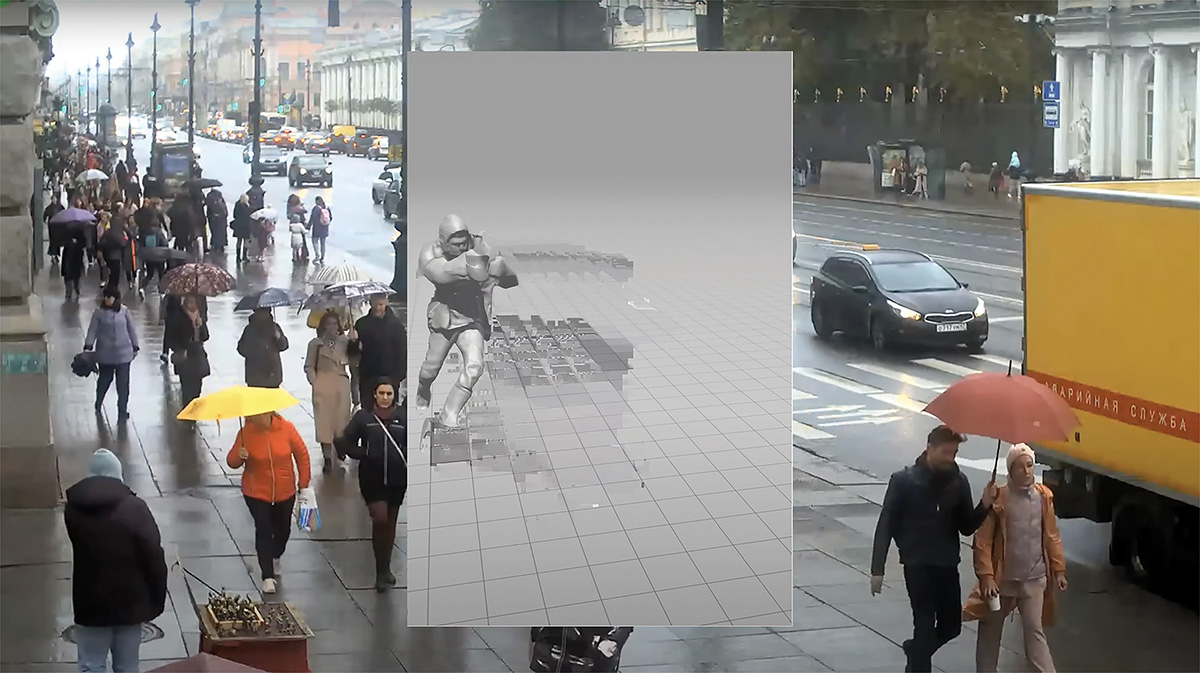
The video project is dedicated to the current political reality of the war between Russia and Ukraine, in which a lot of people are involved. On September 21, 2022, Vladimir Putin announced a "partial" mobilization. Many of our relatives and friends who did not want to participate in the war found themselves under the threat of being forcibly drawn into the military action. Many managed to escape and avoid this fate, many had to abandon their families to do so, leaving them in uncertainty about the future. Daria and Polina, observing these events both from the inside and from the outside (Polina emigrated to Thailand at the beginning of the war), brought another perspective to their observation - that of surveillance cameras, indifferent and accurate witnesses and instruments of human manipulation, depending on who uses them. Almost a year has passed since the mobilization. We fear the second wave of mobilization and say goodbye in advance to those of our friends who still remain in Russia. We are talking about things that are forbidden to talk about in “our” country, because it's our way of resistance.
Daria Ivans is a xenomedia artist from Saint Petersburg specializing in the magical analysis of digital algorithms, beloved daughter of dispersed Y2K melancholy, interface therapist-researcher of molten Web 1.0, gif-jockey of dig-artifacts and amulets for forging extensions of connections between worlds and points of contemporaneity, cyber-switcher/-scanner of sticky image mutations. She is a bachelor of philosophy, master of "Art & Science." Polina Orlikova (aka Popo) is a young musician currently living and creating in Bangkok. Her interests and productions are laid around discovering and exploring young genres. In her latest path she is looking for the intersections between club and experimental sounds.
Hanne Ivars