Catalogue > Liste par artiste
Parcourez la liste complète des artistes présentés dans le cadre des Rencontres Internationales depuis 2004. Utilisez le filtre alphabétique pour affiner vos recherches.
Fisnik Maxhuni
Catalogue : 2019La Vallée Heureuse | Fiction expérimentale | mp4 | couleur | 17:0 | Kosovo, Iran | 2017
Fisnik Maxhuni
La Vallée Heureuse
Fiction expérimentale | mp4 | couleur | 17:0 | Kosovo, Iran | 2017
Nord de l`Iran, 2017: un jeune homme entreprend une recherche fantastique d'une pierre mythique, réputée pour apporter le bonheur. Au travers de sa recherche pour l'atteindre, il croisera le chemin de tout ceux qui ont eu, comme lui, à traverser les épreuves pour espérer trouver cette fameuse pierre. En dressant un portrait intergénérationnel de l'Iran moderne, La Vallée Heureuse met en scène la quête mythique et universelle du bonheur.
Né en 1989 au Kosovo, ex-Yougoslavie. émigre en Suisse, à Neuchâtel en 1993. Réfugié politique et apatride jusqu'à l'obtention des nationalités suisse et kosovare en 2005. Durant ses études de Bachelor en Relations Internationales à l'Université de Genève, il commence à réaliser ses premiers essais filmiques. En 2012, il diplôme du Master en Géopolitique à King's College London. Il est membre de la "London Film Society". Durant ses séjours au Japon (2012, en qualité d'assistant en diplomatie à l'ambassade suisse à Tokyo), en Indonésie (2013) et Bolivie (2014), il expérimente davantage le processus du film. Depuis 2014, études Master en Cinéma, option réalisation, entre l'ECAL et la HEAD. Il réalise "Ministarstvo Sjecanja" en 2015, sous l'égide de Béla Tarr à Sarajevo. En 2015, il participe à la Baushtellë Artists Residence à Zürich, Belgrade et Prishtina au cours de laquelle il publie un court roman anthropologique sur la perception des racines et des origines à l`époque moderne. Diplôme en 2016 avec son film "Lost Exile", tourné au Kosovo et présenté en première mondiale au Festival du Film de Locarno où il remporte un prix du jury. Il est invité à plus de 30 festivals dont Clermont-Ferrand, Soleure, Tirana, Lisbon, Prizren, New Delhi, Villeurbanne, Montréal, Den Haag, Montevideo, Los Angeles. Il remporte une dizaine de prix avec son film. En 2016, il est invité à participer aux Masterclasses pour jeunes talents organisés dans le cadre du Zürich Film Festival. En 2017, il fonde Visceral Films et produit deux films qu'il réalise lui-même : "La Vallée Heureuse", court-métrage de fiction, co-produit et tourné en Iran. Le film sera présenté à Winterthur, Solothurn et en première internationale au Festival International du Film de Sao Paolo. Puis "Zvicra", long-métrage documentaire co-produit par la RTS (Radio Télévision Suisse) sur la question de la "double identité" albano-suisse. Actuellement, il écrit depuis début 2018, "La Terre de mes Entrailles", son premier long-métrage de fiction. Au même moment, il travaille comme réalisateur 2nd unit sur la nouvelle série télévisée de la RTS, "Helvetica". Avec "La Terre de mes Entrailles", il a été sélectionné dans le cadre des Talents Sarajevo en 2018, où il aura l'occasion de pitcher le projet, après avoir déjà fait l'exercice dans le cadre du Festival de Cannes 2018. On Culture and Tropics (2014) 12` Ministarstvo Sjecanja (2015) 15` Lost Exile (2016) 29` La Vallée Heureuse (2017) 18` Zvicra (2017) 70" La Terre de mes Entrailles (2019) 110"
Moe Myat May Zarchi
Catalogue : 2023The Altar | Film expérimental | digital | couleur et n&b | 10:10 | Myanmar | 2023
Moe Myat May Zarchi
The Altar
Film expérimental | digital | couleur et n&b | 10:10 | Myanmar | 2023
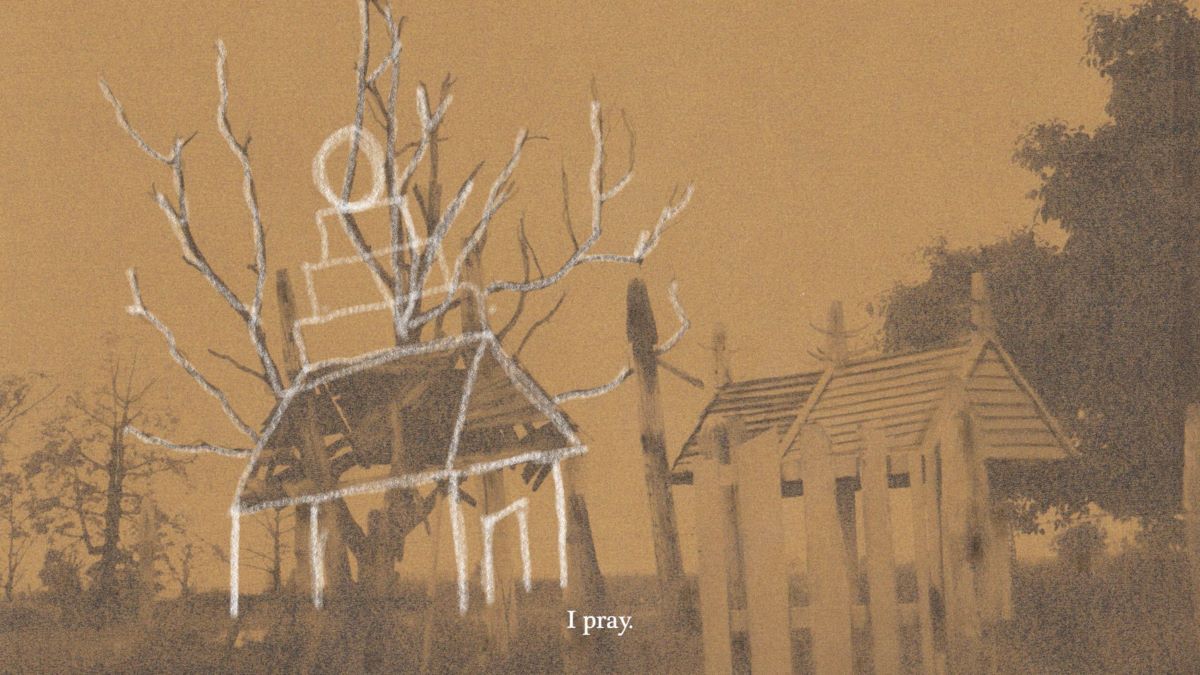
Séquences photographiques peintes d'or et de gris qui mettent en image la culpabilité d'une enfant lorsqu'elle se lave les mains dans l'évier et tue une fourmis. Monologues chuchotements et bruits parasites qui reflètent un royaume de cosmos, de pouvoir, de culpabilité, de prières et de l'existence.
Moe Myat May Zarchi (born in 1994, Myanmar) is a filmmaker, musician and a lens-based media artist. Her short films have been screened at International Short Film Festival Oberhausen, Vienna Shorts, Women Make Waves Int’l Film Festival and so on. Her films have won awards at Singapore International Short Film Festival (SGIFF), Bangkok Asean Film Festival (BAFF), UK Asian Film Festival and Vesoul International Film Festival of Asian Cinema (FICA). Her recent short film “The Altar” just won the Arte Award at Kurzfilm Hamburg in 2023. She was also nominated as a finalist in Julius Baer Next Generation Art Prize in the category Moving Image and was awarded Prince Clause seed awards for emerging artist. In most of her works, Moe loves to explore the metaphysical, identity, femininity and personal aspects in storytelling through innovative use of visuals and sound. She is also the founder of '3-ACT', a cinema magazine and a film education initiative, to support narrative storytelling in the film community in Myanmar. She also co-founded an interdisciplinary arts initiative called ‘MATTER audiovisual lab’ to interconnect innovative different forms of art and other disciplines.
Peter Maybury
Catalogue : 2026L’esprit de l’escalier | Film expérimental | 4k | couleur | 5:50 | Irlande | 2025
Peter Maybury
L’esprit de l’escalier
Film expérimental | 4k | couleur | 5:50 | Irlande | 2025
L’esprit de l’escalier est le troisième film d’une trilogie consacrée au Pálás, un cinéma de Galway, en Irlande, conçu par Tom dePaor. Ouvert en 2018, le cinéma a fermé au public en février 2025, et j’ai assisté à l’une des dernières projections au Pálás : Goodbye Dragon Inn de Tsai Ming-Liang, lui-même un film sur la fermeture d’une salle de cinéma. Je suis revenu le lendemain matin, ces pensées encore en tête, pour filmer les escaliers qui parcourent le bâtiment. Ces espaces ne sont pas tempérés, à moitié intérieurs, à moitié extérieurs, tandis que les salles de projection, avec leurs intérieurs rouges et feutrés, sont optimisées pour le son, la température et la lumière. Le titre de mon film renvoie à l’expression “avoir l’esprit de l’escalier” (penser à la réplique parfaite trop tard), mais surtout à l’esprit même de l’escalier. Comme dans Goodbye Dragon Inn, tant de vie circule dans ces lieux où les personnes, la météo, la lumière et le son s’entrecroisent, influencent — voire habitent — le mouvement ou l’immobilité de la caméra, jusqu’à ce que l’endroit lui-même devienne un film.
Peter Maybury est un artiste pluridisciplinaire irlandais. Ses recherches fondées sur la pratique couvrent des travaux en tant qu’artiste, graphiste, cinéaste, éditeur, écrivain, rédacteur, commissaire, musicien et enseignant. Il est diplômé de Central Saint Martins, à Londres, et doctorant au Centre for Socially Engaged Practice-Based Research de la TU Dublin. Il a collaboré de manière extensive avec des artistes et des institutions, des éditeurs et des commissaires, sur plus de 200 publications d’art et d’architecture. Peter est un collaborateur de longue date de Tom dePaor, avec qui il réalise des livres, des films et des œuvres pour des expositions. Parmi ses travaux filmiques figurent On being there (2022/23, projeté aux Rencontres Internationales Paris/Berlin 2023/24), Landfall (2020), une installation filmique d’une heure sur double écran, ainsi que, avec dePaor, les films de Gall Drape (2018) et A Study (2015), réalisé pour une exposition à l’ETH Zurich. Peter est l’auteur de Make Ready (2015), et co-auteur avec dePaor de Reservoir (2010) et Of (2012).
Catalogue : 2023On Being There | Film expérimental | 4k | couleur et n&b | 60:0 | Irlande | 2022
Peter Maybury
On Being There
Film expérimental | 4k | couleur et n&b | 60:0 | Irlande | 2022
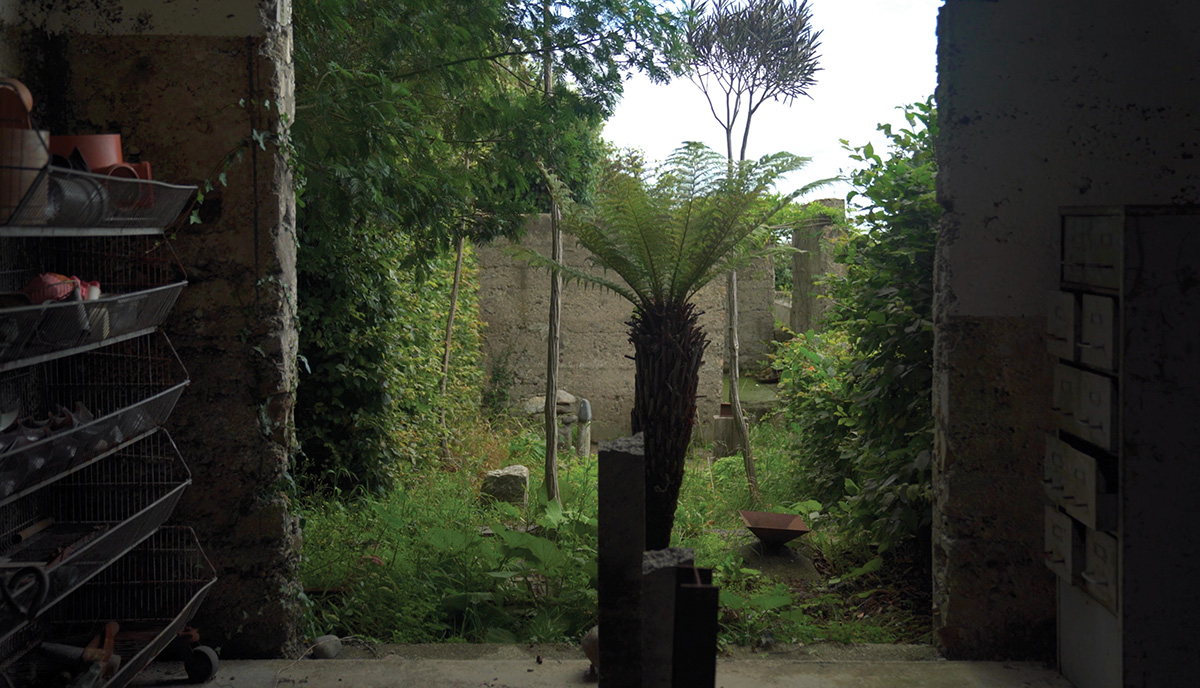
On being there is a filmic encounter with the material and outputs of the office of Tom dePaor, drawing on 30 years of practice. There is the place itself. There are notebooks, drawings, prints, scale models, 35mm slides, photographs, films, files, books, writing. A diversity of materials and media, evidencing significant technological changes in production and reproduction. This is the raw material. The film is a rerecording, or sampling of this material, where scale, media, and modes of presentation and realisation merge. The linear transition from drawing to model to built landscape and documentation is disrupted. The film explores the permeability of the image. Animated or activated through movement and operation, everything can be superimposed, overlaid, or cut into. An audio-visual encounter with place, within the space of the screen and the loudspeaker.
Peter Maybury is an Irish multidisciplinary artist. His practice-based research encompasses works as an artist, graphic designer, filmmaker, publisher, writer, editor, curator, musician, and educator. He is a graduate of Central Saint Martins, London, and is a Doctoral Candidate at the Centre for Socially Engaged Practice-Based Research, TU Dublin. He has collaborated extensively with artists and institutions, editors and curators, on more than 200 art and architecture publications. Peter is a longstanding collaborator with Tom dePaor, making books, films, and works for exhibition. His film work includes Landfall (2020), an hour-long dual-screen film installation, and with dePaor the Gall films Drape (2018), and A Study (2015) made for exhibition at ETH Zurich. Peter is author of Make Ready (2015), and co-author with dePaor of Reservoir (2010) and Of (2012).
Marian Mayland
Catalogue : 2025Outside | Doc. expérimental | mov | couleur | 29:52 | Allemagne | 2023
Marian Mayland
Outside
Doc. expérimental | mov | couleur | 29:52 | Allemagne | 2023
A curator, an archivist, an art dealer, a relative: in staged situations, four people discuss their relationship to an artist who, by means of a fictionalised biography, has pretended to be a Holocaust victim.
Maria Mayland (*1988) is a visual artist and filmmaker. She obtained her MFA from Basel’s Art Institute, taught by Chus Martínez, and took part in KKH Stockholm's postgraduate program Philosophy in the Context of Art, taught by Peter Osborne. Her short film works have been shown in various contexts across Europe. Screenings include International Short Film Festival Oberhausen, European Media Art Festival Osnabrück, IDFA Amsterdam, Hamburg International Short Film Festival, transmediale, Edinburgh Film Festival and Sharjah Film Platform. She won the German Short Film Award in 2022, the EMAF-Media Art Award of the German film critics association (VdFK) in 2021, and the award for the best entry in the NRW competition of the International Short Film Festival Oberhausen in 2018, as well as in 2022.
Catalogue : 2021Dunkelfeld | Doc. expérimental | mp4 | couleur et n&b | 16:12 | Allemagne | 2020
Marian Mayland, LOHSE Patrick, HEYER Ole-Kristian
Dunkelfeld
Doc. expérimental | mp4 | couleur et n&b | 16:12 | Allemagne | 2020
En août 1984, une maison habitée par des travailleurs immigrés a été incendiée à Duisburg. Sept personnes ont perdu la vie. La police a immédiatement exclu le motif raciste, mais les survivants se demandent encore aujourd'hui si l’incendie de leur maison était vraiment dû au hasard.
Ole-Kristian Heyer, né en 1981, a étudié la photographie à la FADBK – Freie Akademie der bildenden Künste, Essen (Allemagne), et la géographie à la Ruhr-Universität Bochum (Allemagne). Dans ses œuvres, les principes de la perception humaine fusionnent avec les fonctionnalités des médias visuels. Patrick Lohse, né en 1983, a étudié à la Folkwang Universität der Künste, Essen (Allemagne). À partir de stratégies documentaires, ses œuvres interrogent les récits habituels et renvoient ainsi à des perspectives sous-représentées. Marian Mayland, né(e) en 1988, a étudié aux académies d’art de Essen (Allemagne), Bâle (Suisse), Vienne (Autriche) et Stockholm (Suède). Marian Mayland travaille depuis 2015 avec diverses formes de documentaires narratifs.
Catalogue : 2020Untitled (A Refusal of Leave to Land) | Doc. expérimental | hdv | couleur | 28:20 | Allemagne | 2019
Marian Mayland
Untitled (A Refusal of Leave to Land)
Doc. expérimental | hdv | couleur | 28:20 | Allemagne | 2019
untitled (a refusal of leave to land) is an essayistic short film on a prisoner of war camp from the second world war, the arms industry in the Ruhr area and the relation between individual and collective memory. Starting out with a childhood memory of finding a fossil in a bed of rocks of a former railroad track, the narration follows the connections between the former POW camp Stalag VI F in Bocholt and the Krupp company in Essen.
Marian Mayland was born in Bocholt, Germany, in 1988. Since 2013, after completing his studies in painting, Mayland has been working postconceptually with various media. He holds an MFA from Basel?s Art Institute and took part in KKH Stockholm?s postgraduate program Philosophy in the Context of Art, taught by Peter Osborne. His short film works have been shown in various contexts across Europe. Recent screenings include IDFA Amsterdam, Kasseler Dokfest, and Internationale Kurzfilmtage Oberhausen.
Marian Mayland, LOHSE Patrick, HEYER Ole-Kristian
Catalogue : 2025Outside | Doc. expérimental | mov | couleur | 29:52 | Allemagne | 2023
Marian Mayland
Outside
Doc. expérimental | mov | couleur | 29:52 | Allemagne | 2023
A curator, an archivist, an art dealer, a relative: in staged situations, four people discuss their relationship to an artist who, by means of a fictionalised biography, has pretended to be a Holocaust victim.
Maria Mayland (*1988) is a visual artist and filmmaker. She obtained her MFA from Basel’s Art Institute, taught by Chus Martínez, and took part in KKH Stockholm's postgraduate program Philosophy in the Context of Art, taught by Peter Osborne. Her short film works have been shown in various contexts across Europe. Screenings include International Short Film Festival Oberhausen, European Media Art Festival Osnabrück, IDFA Amsterdam, Hamburg International Short Film Festival, transmediale, Edinburgh Film Festival and Sharjah Film Platform. She won the German Short Film Award in 2022, the EMAF-Media Art Award of the German film critics association (VdFK) in 2021, and the award for the best entry in the NRW competition of the International Short Film Festival Oberhausen in 2018, as well as in 2022.
Catalogue : 2021Dunkelfeld | Doc. expérimental | mp4 | couleur et n&b | 16:12 | Allemagne | 2020
Marian Mayland, LOHSE Patrick, HEYER Ole-Kristian
Dunkelfeld
Doc. expérimental | mp4 | couleur et n&b | 16:12 | Allemagne | 2020
En août 1984, une maison habitée par des travailleurs immigrés a été incendiée à Duisburg. Sept personnes ont perdu la vie. La police a immédiatement exclu le motif raciste, mais les survivants se demandent encore aujourd'hui si l’incendie de leur maison était vraiment dû au hasard.
Ole-Kristian Heyer, né en 1981, a étudié la photographie à la FADBK – Freie Akademie der bildenden Künste, Essen (Allemagne), et la géographie à la Ruhr-Universität Bochum (Allemagne). Dans ses œuvres, les principes de la perception humaine fusionnent avec les fonctionnalités des médias visuels. Patrick Lohse, né en 1983, a étudié à la Folkwang Universität der Künste, Essen (Allemagne). À partir de stratégies documentaires, ses œuvres interrogent les récits habituels et renvoient ainsi à des perspectives sous-représentées. Marian Mayland, né(e) en 1988, a étudié aux académies d’art de Essen (Allemagne), Bâle (Suisse), Vienne (Autriche) et Stockholm (Suède). Marian Mayland travaille depuis 2015 avec diverses formes de documentaires narratifs.
Catalogue : 2020Untitled (A Refusal of Leave to Land) | Doc. expérimental | hdv | couleur | 28:20 | Allemagne | 2019
Marian Mayland
Untitled (A Refusal of Leave to Land)
Doc. expérimental | hdv | couleur | 28:20 | Allemagne | 2019
untitled (a refusal of leave to land) is an essayistic short film on a prisoner of war camp from the second world war, the arms industry in the Ruhr area and the relation between individual and collective memory. Starting out with a childhood memory of finding a fossil in a bed of rocks of a former railroad track, the narration follows the connections between the former POW camp Stalag VI F in Bocholt and the Krupp company in Essen.
Marian Mayland was born in Bocholt, Germany, in 1988. Since 2013, after completing his studies in painting, Mayland has been working postconceptually with various media. He holds an MFA from Basel?s Art Institute and took part in KKH Stockholm?s postgraduate program Philosophy in the Context of Art, taught by Peter Osborne. His short film works have been shown in various contexts across Europe. Recent screenings include IDFA Amsterdam, Kasseler Dokfest, and Internationale Kurzfilmtage Oberhausen.
Iris Mayr
Catalogue : 2007Ars Electronica | 0 | 0 | | 0:0 | Autriche | 2007

Iris Mayr
Ars Electronica
0 | 0 | | 0:0 | Autriche | 2007
Avec les orientations spécifiques et la continuité qu'il a déployée depuis 1979, Ars Electronica est une plate-forme unique pour les arts digitaux et la culture média organisée en quatre divisions : Ars Electronica ? Festival d'Art, de Technologie et de Société. Le Prix Ars Electronica, Compétition Internationale pour les Arts cybernétiques. Ars Electronica Center- Musée du futur. Ars Electronica Futurelab ? Laboratoire pour les Innovations du futur. Le Festival Ars Electronica. Le Festival Ars Electronica, reconnu au niveau international, est une rencontre interdisciplinaire et ouverte entre experts internationaux en arts et en sciences avec un public large, d'horizons divers, et aux intérêts très différents. Chaque année depuis 1979, le festival se compose de conférences, d'expositions et de performances et d'événements conçus pour approfondir la confrontation scientifique et artistique avec les phénomènes sociaux et culturels qui sont les conséquences du changement technique. http://www.aec.at/en/festival2007/. Le Prix Ars Electronica En tant que compétition d'arts cybernétiques, le Prix Ars Electronica est un forum pour la créativité artistique et l'innovation depuis 1987. C'est le baromètre des tendances dans un monde du média art en constante évolution et de plus en plus diversifié. Du fait de sa fréquence annuelle, de sa visée internationale et de la variété incroyable des ?uvres sélectionnées pour le Prix, les Archives du Prix Ars Electronica permettent un regard précis sur le développement de l'art média et donnent une idée de son ouverture et de sa diversité. http://www.aec.at/en/prix/index.asp?nocache=165093 Le centre Ars Electronica : Le centre Ars Electronica a ouvert en 1996 en tant que prototype du "Musée du Futur". Sa mission est d'utiliser des formes interactives de médiation pour faciliter la rencontre du public avec la réalité virtuelle, les réseaux digitaux et le mlédia moderne. Une attention portée sur les sujets à l'interface du média art, nouvelles technologies et développements sociaux, caractérise les expositions innovantes du Centre. Le Centre Ars Electronica est la base permanente et aussi la structure organisationnelle des activités régionales et internationales d'Ars Electronica. http://www.aec.at/en/center/ Ars Electronica Futurelab: Le Futurelab est un modèle de laboratoire d'un type nouveau pour le média art dans lequel les innovations technologiques et artistiques génèrent une inspiration réciproque. L'équipe du laboratoire rassemble une grande variété d'aptitudes spécialisées, leur approche est caractérisée par l'interdisciplinarité et un travail en réseau international. Les activités multiples du Futurelab vont de l'organisation d'expositions et la création d'installations, à la poursuite d'une recherche en collaboration avec les universités et s'engage dans des partenariats avec des associés des secteurs privés.
Iris Mayr est née en 1971 en Autriche. Elle étudie la science de la communication et l'administration des affaires à Linz, Salzburg et Seville. En 2003 et 2004, elle est assistante de recherche et tutrice à l'Université de Salzburg (Departement de l'Audiovision et de la Communication digitale et le Centre ICT&S). Depuis 1996 elle est membre du Centre Ars Electronica de Linz (Festival Ars Electronica, Production and Curatorial Team). En 2006 elle est conservatrice auprès de Lev Manovich, Yuko Hasegawa et Pili à la Media City_Séoul à Séoul. De 2004 à 2007, elle est l'instigatrice du Prix Ars Electronica ? International Competition for CyberArts et conservatrice culturelle indépendante.
Tatiana Mazú, Tatiana Mazú
Elena Mazzi, Daniele Alef Grillo
Catalogue : 2018Pirolisi solare (Solar Pirolysi) | Installation vidéo | hdv | noir et blanc | 4:0 | Italie | 2017
Elena Mazzi, Daniele Alef Grillo
Pirolisi solare (Solar Pirolysi)
Installation vidéo | hdv | noir et blanc | 4:0 | Italie | 2017
The material grain of the film fixes the light that, by installing mirrors that have been protagonist of my previous work (Reflecting Venice, 2012-2014), strikes a cumulation of straw, transforming it into biomass, the energy resource of the future. A step forward in scientific research that quotes Archimedes` experiments in order to work with energy sources at the reach of everyone.
Elena Mazzi was born in 1984 in Reggio Emilia (Italy). She received her BFA in 2007 in History of Art from Siena University, and her MFA in 2011 in Visual Art from IUAV, Venice University. She was selected for an exchange program at Royal Academy of Art (Konsthogskolan) of Stockholm. Her works have been displayed in many solo and collective exhibitions, among others: Palazzo Fortuny in Venice, 16° Rome Quadriennal, GAM Turin, 14° Istanbul Biennale, 17° BJCEM Mediterranean Biennale, EGE-European Glass Experience, Fittja Pavilion at the 14° Architecture Venice Biennale, COP17 in Durban, Festival of Contemporary Art in Slovenia, Botkyrka Konsthall, Italian Institute of Culture in Brussels and Stockholm, XIV BBCC Expo in Venice, Bevilacqua La Masa Foundation. She attended different residency programs and workshops such as HIAP (FI), GuilmiArtProject (IT), Via Farini (IT), Foundation Botin (SP), Bevilacqua La Masa (IT), Future Farmers A.I.R. (USA), Fondazione Spinola Banna in Turin (IT), Dolomiti contemporanee (IT), Botkyrka Konsthall Air (SE). She is one of the finalists at Celeste Prize, Fabbri prize, Meru prize and Termoli prize and the winner of Thalie Art Foundation grant 2017, VISIO Young Talent Acquisition prize, Eneganart prize, Illy grant for Unidee, Pistoletto Foundation 2016, ntcm e l’arte 2016, m-cult media and technology program 2016, Special mention for Arte Patrimonio e diritti umani, Antworks award 2015, Sandretto Re Rebaudengo prize 2015, Lerici Foundation grant in 2012 and Movin’up Italian prize for young Italian artists abroad in 2011. In 2016-2017 she is tutor artist for Spinola Banna Fondation program in collaboration with GAM, Turin.
Corinne Mazzoli
Pablo Mazzolo
Pablo Mazzolo
Catalogue : 2020Ceniza Verde | Doc. expérimental | 16mm | couleur | 10:26 | Argentine | 2019
Pablo Mazzolo
Ceniza Verde
Doc. expérimental | 16mm | couleur | 10:26 | Argentine | 2019
The Henia/Kamiare aboriginals inhabited the current territory of the Sierras de Córdoba (Argentina) for at least 1600 years. In 1575, the resistance led by cacique Onga was cornered and defeated by the spanish conquering troops. After resisting the spanish in the Charalqueta mountain (named after the God of Joy), hundreds of Hênia-Kâmîare women, children and elders jumped off the top of the Colchoquí mountain in order to avoid being enslaved. The Charalqueta mountain was renamed as Colchiqui, (after the God of Fate and Sadness). This was the biggest collective suicide in the territory currently known as Argentina.
Pablo Mazzolo was born in Buenos Aires in 1976. He graduated in Image and Sound Design at University of Buenos Aires. His films have participated in festivals like Rotterdam film festival, New York Film Festival: Views from the Avant Garde, Ann Arbor film Festival, Edinburgh Film Festival, Videoex, Chicago Underground, among others. He was also invited to attend in various film performances and solo presentations in museums like Rufino Tamayo (Mexico), MALBA (BsAs, Arg), MassArt (Boston,USA), FAMU (Ptague, Cz Rep.), San Francisco cinematheque, Excentric (Barcelona), La Mostra (S8) a Coruña. His work has been prized in Ann Arbor, Media City, National Fund of Ars, The Bienal of Moving Image, BAFICI, among others.
Marko Mäetamm
Catalogue : 2011MUSE | Documentaire | dv | couleur | 3:5 | Estonie | 2009
Marko MÄetamm
MUSE
Documentaire | dv | couleur | 3:5 | Estonie | 2009
She is a sourse of my inspiration. She gives my life a meaning. I am part of her and she is part of me. We can`t live without each other because she gives ideas for my artistic creation.. She is my muse.
Born in 1965 in Viljandi, Estonia. Studied in Estonian Academy of Arts, MA 1995 Lives and works in Tallinn, Estonia. Works with a wide range of media including photography, sculpture, animations, painting and text. Mäetamm tells us the stories which happen behind the closed doors and pulled curtains of the intimate territory we called home. Mäetamm portrays the family as a little society -relaying through a dark humor the petty moments of daily life - and exploring the way our society manipulates the family dynamics through the macrocosms of economy, consumerism, and ?quality-of-life? standards. Inspired by his own private life and the recurrent feeling he could fail to preserve the balance in his existence, Mäetamm?s work explores the grey area where ambiguous feelings of being in control and being controlled merge. Marko Mäetamm has exhibited internationally and represented Estonia at the 52nd Venice Biennial in 2007. Contact: maetamm@yahoo.com HOMEPAGE: www.maetamm.net
Catalogue : 2009CAR RIDE | Animation | dv | couleur | 3:16 | Estonie | 2008
Marko MÄetamm
CAR RIDE
Animation | dv | couleur | 3:16 | Estonie | 2008
Cette ?uvre parle de la façon dont les choses peuvent très souvent sembler différentes de ce qu?elles sont en réalité, et de la façon sont les choses sont absolument différentes de ce qu?elles semblent. Un beau vendredi soir, au début du mois de mars, l?auteur a emmené sa jolie femme et ses deux merveilleux enfants dans leur petite Honda Civic afin d?aller rendre visite à ses parents dans le Sud de l?Estonie...
Marko Mäetamm est né dans la petite ville de Nuia, au sud de l?Estonie. L'idée de devenir artiste lui est subitement venue, comme tombée du ciel, à l?âge de 18 ans. Il a étudié la gravure à l?Académie Estonienne des Arts, où il a obtenu sa licence en 1993 et son master en 1995. Marko Mäetamm a commencé à exposer alors qu?il était encore étudiant. Ses premiers travaux se sont basés essentiellement sur les techniques de gravure après quoi il est passé à la peinture, qu?il trouvait plus directe. À un certain moment, le texte est devenu essentiel dans ses projets. Puis, suivant ses idées, il a commencé à travailler avec les images en mouvement. À l?heure actuelle, Marko Mäetamm travaille en mélangeant différents types de médias. Il fait des photos, des objets, et des animations, il peint et produit des textes et mélange le tout dans ses installations. En 2007, Marko Mäetamm a eu la chance de représenter l?Estonie à la Biennale de Venise (Italie), avec le projet « Loser's Paradise », ce qui a fortement influé sur sa carrière artistique.
Catalogue : 2008FAMILY | Animation | dv | couleur | 4:9 | Estonie | 2007
Marko MÄetamm
FAMILY
Animation | dv | couleur | 4:9 | Estonie | 2007
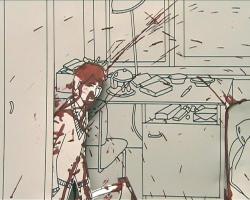
Un homme muni d?une hache court dans son appartement. Il semble être à la poursuite de sa femme et de ses deux enfants. Ces derniers essaient de se cacher derrière le canapé, le lit, le placard ou encore sous la couverture, mais l?homme à la hache parvient toujours à les trouver, et quelque chose se passe. Chaque fois l?homme se voit encore davantage couvert de sang, tandis que la femme et les enfants semblent se porter de mieux en mieux. Et c?est sans fin.
Son travail a été exposé au Pavillon estonien aux 50ème et 52ème Biennale de Venise, au Musée d?art contemporain deTallinn, à la kArton Gallery à Budapest, au centre d?art contemporain Rekalde, à Bilbao, au Musée d?art de Dubrovnik, Croatie, à la Nettie Horn Gallery, Londres, à la KunstRaum de Linz, Autriche, au centre d?art contemporain de Vilnius, Lituanie, à la Pinakothek der Moderne de Munich, au KUMU Art Museum, Tallinn, à la biennale Balticum 2006 au Rauma art museum, au Kunstraum Düsseldorf, Allemagne, au Art Hall et au KUMU art center de Tallinn, à Kiasma, au Musée d?art contemporain d?Helsinki, Finlande, au centre d?art contemporain de Vilnius, Lituanie.
Brigid Mccaffrey
Catalogue : 2025Sanctuary Station | Doc. expérimental | 16mm | noir et blanc | 69:0 | USA | 2024

Brigid Mccaffrey
Sanctuary Station
Doc. expérimental | 16mm | noir et blanc | 69:0 | USA | 2024
Sanctuary Station traces a series of encounters with women and youth who have cultivated intrinsic attachments to the various life forms that inhabit the redwood forests and remote terrains of northwestern California. Oscillations between the desire for solitude and the need for collaboration recur through an album-like progression of personal stories and actions. These encounters are framed through the poems of Mary Norbert Körte (1934-2022), an ex-nun who built her own cabin deep in the forest, adjacent to a former logging railroad. Körte’s life and work bear witness to the daily phenomena of internal and external experience. Depictions of ongoing forest defense movements, collective and personal rites of mourning, and intimate everyday routines evoke cycles of life unfolding within this intricately interwoven environment.
Brigid McCaffrey is a Los Angeles-based artist and filmmaker whose work documents environments and people in states of flux. Her films explore extremes of autonomy and coexistence experienced by individuals who have distinct relationships with the land. Often taking shape as nuanced portraits, the films respond to the physical and emotional changes of their subjects while fusing representations of self and place. She has exhibited at venues such as the Hammer Museum, the Museum of Contemporary Art in Los Angeles, the Harvard Film Archive, the New York Film Festival - Projections, the Rotterdam International Film Festival, and the Whitechapel Gallery in London, among others. Her work was presented by Ballroom Marfa for the 2015 edition of Artists’ Film International and she was a featured artist at the 2016 Flaherty Seminar. McCaffrey was named a Guggenheim fellow in Film & Video in 2019.
Anthony Mccall
Catalogue : 2010You and I | 0 | 0 | | 0:0 | USA | 2010
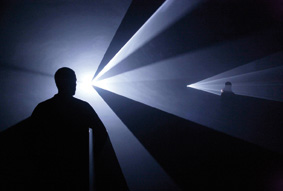
Anthony Mccall
You and I
0 | 0 | | 0:0 | USA | 2010
Anthony Mccall
Catalogue : 2007Line Describing a Cone | Film expérimental | 16mm | noir et blanc | 30:0 | France, USA | 1973
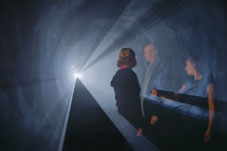
Anthony Mccall
Line Describing a Cone
Film expérimental | 16mm | noir et blanc | 30:0 | France, USA | 1973
A l?espace perspectif et illusionniste conventionnel qui rabat le cinéma sur la peinture, les films de McCall substituent un espace projectif qui le ramène à la sculpture. Désormais le film n?est plus cette image projetée qui creuse dans la surface du mur une profondeur fictive mais un champ réellement constitué qui se confond avec l?événement de la projection même. C?est ainsi que les faisceaux lumineux découpés dans la fumée d?Anthony McCall, développant les propriétés proprement plastiques du film, passent les frontières de l?histoire du cinéma pour rejoindre les propositions minimalistes de la sculpture des années 70 et s?inscrire à côté des structures géométriques de Robert Morris, Saul Le Witt, ou Carl Andre, des champs colorés de Dan Flavin ou des fils de coton coloré tendus dans l?espace de Fred Sandback. Au commencement des années 2000, après un silence de 20 années et alors que les présentations des Solid Light Films se multipliaient aux Etats-Unis comme en Europe, Anthony McCall inaugurait une nouvelle série d??uvres réalisée non plus sur support argentique, mais en numérique, l?ordinateur lui permettant de concevoir des tracés complexes, et d?explorer les propriétés plastiques des lignes ondulantes : alors que les pièces géométriques des années 70 se fondaient sur un principe d?équivalence entre la ligne et le plan, les pièces néo-géométriques des années 2000 jouent de la réversibilité des formes, des échanges entre intérieur et extérieur ou encore de l?équivalence des vecteurs horizontaux et verticaux. Simultanément, la substitution aux machines à fumées traditionnelles de brumisateurs diffusant de la vapeur d?eau produisant une texture plus uniforme à plus grand échelle permettait à McCall de démultiplier la taille de ses pièces désormais conçues A l?espace perspectif et illusionniste conventionnel qui rabat le cinéma sur la peinture, les films de McCall substituent un espace projectif qui le ramène à la sculpture. Désormais le film n?est plus cette image projetée qui creuse dans la surface du mur une profondeur fictive mais un champ réellement constitué qui se confond avec l?événement de la projection même. C?est ainsi que les faisceaux lumineux découpés dans la fumée d?Anthony McCall, développant les propriétés proprement plastiques du film, passent les frontières de l?histoire du cinéma pour rejoindre les propositions minimalistes de la sculpture des années 70 et s?inscrire à côté des structures géométriques de Robert Morris, Saul Le Witt, ou Carl Andre, des champs colorés de Dan Flavin ou des fils de coton coloré tendus dans l?espace de Fred Sandback.
Steven Mccarthy
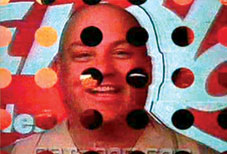
Catalogue : 2007Commercial rhetoric art project | Vidéo expérimentale | dv | couleur | 7:30 | USA | 2005
Steven Mccarthy
Commercial rhetoric art project
Vidéo expérimentale | dv | couleur | 7:30 | USA | 2005
"Commercial Rhetoric Art Project" utilise la matière visuelle destinée aux marchés domestiques afin de créer une oeuvre recontextualisée en un énoncé social, politique et économique. En démantelant et réorganisant les messages commerciaux censés nous séduire, nous clients potentiels, le projet amène les spectateurs à questionner la rhétorique qui tente de coloniser nos foyers. Stratégie de collage, de juxtaposition, de satire et de parodie servent à inverser le mouvement dominant de la propagande publicitaire qui s'invite dans nos espaces privés. Une série de collages créés à partir de prospectus, des assemblages d'emballages de produits et de nourriture, reconfigurés dans des habillements marqués, des publicités digitalement remixées, des sites de web et des "spams" (des courriers indésirables) - "Commercial Rhetoric Art Project" utilise toute publicité indésirable dans son fourrage. Certains de ces objets fabriqués sont purement esthétiques, des critiques, consommateurs de culture et autres esquissent une fonctionnalité alternative. Plus de 100 publicités destinées à la télévision ont été enregistrées, éditées et remixées en 7 vidéos digitales courtes. Cette gamme de compilations dont la longueur varie de 30 à 90 secondes emploie différents montages visuels et structures narratives. Avec des thèmes récurrents tels que le désir sexuel, le drame familial, fétichisation du produit, nourriture, luxure et figure d'autorité de persuasion qui sont extraites pour en dénoncer le ridicule.
Steven McCarthy a obtenu une Maitrise de Graphisme (Design) à l' Université de Stanford, un programme hybride entre le "Département d' Art et d' Ingénierie" et une "Licence des Beaux-Arts" specialisé dans la sculpture et dessin à l'Université de Bradley. Il est actuellement professeur-associé de studio-graphique à l'Université du Minnesota, Twins City Campus. Ses actuelles recherches créatives se soucient de raconter des histoires et de fournir des expériences intéractives dans l'environnement digital de nos jours. Toutefois, son souci premier concerne la condition humaine- la technologie et les moyens lui importent peu. Le graphisme autodidacte de Steven a été publié dans "Graphis Poster", le "American Institute of Graphic Arts annual" et dans "Provocative Graphics: The Power of the Unexpected in Graphic Design". Ses registres sont dans de nombreux collections dont: le "Museum of Modern Art", le "Banff Centre" au Canada, le "Sackner Archive of Visual and Concrete Poetry", et la "Houghton Library" à l' Université de Harvard. Ses oeuvres intéractives ont été performées /exposées internationalement, avec des représentations récentes au "VideoFormes", France, FILE 2003, 2004 & 2006 (le Festival International du Langage Electronique), São Paulo, et le Festival d'Images 2005,de Toronto. Présentations récentes et conférences de Design dont "Declarations", Montréal (2001), "Mind the Map", Istanbul (2002), "Hidden Typography", Londres (2003), "Politics of Design", Belfast (2004), New Views, Londres(2005) et "Wonderground", Lisbonne (2006). Steven a aussi publié des articles en tant qu'examinateur-expert dans des journaux académiques. Pour en savoir plus sur Steven et son oeuvre, visitez son site personnel: http://www.episodic-design.com.
Tiona Nekkia Mcclodden
Catalogue : 2021I prayed to the wrong god for you | Installation multimédia | mp4 | couleur | 0:0 | USA | 2019
Tiona Nekkia Mcclodden
I prayed to the wrong god for you
Installation multimédia | mp4 | couleur | 0:0 | USA | 2019
"I prayed to the wrong god for you", de Tiona Nekkia McClodden, combine des éléments vidéo et sculpturaux dans un rituel très personnel, dédié à Shango, une divinité (ou Orisha) de la religion afro-cubaine Santería/Lucumí, dont les origines remontent au peuple Yoruba du Nigeria. Dans ce projet, Tiona Nekkia McClodden fait converger ses exigences spirituelles en tant que prêtresse d'Ogun et son travail artistique, pour se remettre d’une période d'épuisement personnel, et pour interroger la relation entre christianisme et colonialisme qui a été imposée à ses ancêtres: des Africains réduits en esclavage, les Noirs du Sud. Pour commencer ce projet, elle a coupé un cèdre (un bois hybride, différent du cèdre pur traditionnellement associé à Shango), et a sculpté six outils dans ce bois. En voyageant avec ces objets à travers les États-Unis, Cuba et le Nigeria, l'artiste s'est engagée dans un rituel avec Shango, utilisant le casque exposé ici comme témoin de cérémonie. Les vidéos, qui retracent le travail et le temps consacrés à ce projet, offrent un compte rendu de la dévotion diasporique, et de la signification des objets en tant que conteurs d'histoires.
Tiona Nekkia McClodden [elle/la] est artiste visuelle, réalisatrice et curatrice. Son travail s'appuie souvent sur une pratique de la citation, qui explore et critique des questions au croisement des notions de race, de genre, de sexualité et du commentaire social. Son approche interdisciplinaire traverse ses films documentaires, ses vidéos expérimentales, sa sculpture et ses installations sonores. Elle a exposé et présenté ses œuvres, notamment au Institute of Contemporary Art, Philadelphie (USA); au MoMA - Museum of Modern Art, New York (USA); au Whitney Museum, New York (USA); au MOCA – Museum of Contemporary Art, Los Angeles (USA); au MCA – Museum of Contemporary Art Chicago (USA); et au MoMA PS1, New York (USA). Elle a récemment reçu le Bucksbaum Award - elle a été choisie parmi soixante-quinze artistes, dont les œuvres ont été présentées dans le cadre de la 2019 Whitney Biennial, New York (USA). Entre autres prix et bourses, elle a reçu la 2019 Guggenheim Fellowship in Fine Arts; la bourse Keith Haring Fellowship in Art and Activism 2018-2019; le Louis Comfort Tiffany Foundation Award 2017, Cold Spring Harbor (USA); et la Pew Fellowship in the Arts in Philadelphia, Philadelphie (USA). Tiona Nekkia McClodden a été curatrice des expositions itinérantes "A Recollection. + Predicated.", présentée dans le cadre de "Julius Eastman: That Which is Fundamental", et, plus récemment, "There Are No Shadows Here: The Perfect Moment at 30". Elle vit et travaille à Philadelphie (USA).
Cal Mccormack
Catalogue : 2022Agony to Ecstasy | Doc. expérimental | mp4 | couleur et n&b | 12:50 | Royaume-Uni | 2020
Cal Mccormack
Agony to Ecstasy
Doc. expérimental | mp4 | couleur et n&b | 12:50 | Royaume-Uni | 2020
‘Agony to Ecstasy’ looks at the scope of the socio-addictive condition within Scottish people. It focuses on the relationship between pain and pleasure, between stress and relief and between entrapment and escape. The film in many ways, is a dissection of two spaces – euphoric clubbing and silent Scottish nature, offering a perspective on our need for salvation within both. Neurologically, there is very little difference between the brain addicted to something, as to when falling in love. As a result, the film fluctuates between these neurological and personal perspectives on addiction and connection – where their conflating and often paradoxical relationship are juxtaposed. The film is made with reflection as its key focus. Made during the middle of the first lockdown, it uses the collective state of withdrawal and loneliness to observe realities within clubs. A slow-motion strobe follows the film throughout, as a visual deconstruction of the joy, yet ghostly inhibition of the people in the shots. Vulnerability was key in Dej’s recollections – his words occupy the emotional worlds of mental health, stigma and the ecstasy of clubbing, without having a particular stance or opinion. Ultimately 'Agony to Ecstasy' looks beyond fixed stereotypes of addicts, and into the dependencies, shame and love between Scottish people.
Cal Mac is a visual artist working and living in Glasgow. Working between sculpture print and video, he explores themes of belonging and addiction through sociological, scientific and visual dialogues. His work often looks at clubbing and natural environments, to unravel truths about our current condition and need for connection. His work has been screened at Atlas Arts (skye), The Royal Scottish Academy (Edinburgh), Limerick Institute of Technology, and online for Lift off Festival, and Film and Video Umbrella. Following his first commission from Film and Video Umbrella in 2020, Mac has done residencies at Cove Park and Edinburgh Sculpture Workshop. In 2021 Mac was shortlisted for the Royal Scottish Academy Morton Award.
Olivia Mcgilchrist
Catalogue : 2014Ernestine and me | Installation multimédia | dv | couleur | 10:0 | Jamaïque | 2012
Olivia Mcgilchrist
Ernestine and me
Installation multimédia | dv | couleur | 10:0 | Jamaïque | 2012
In Ernestine and me (2012) my alter-ego ?Whitey? presents herself as a cultural object to a range of contemporary Jamaicans, exposing their varied reactions to this forced encounter. This experimental video offers a double take on contemporary Jamaican life for a returning white female of part- Jamaican origin; with no living Jamaican relatives remaining, and very little information about my Jamaican heritage. Ernestine was my black great-grandmother, which I only discovered two years ago in a family photograph found at my late grandfather?s house upon my return to the island.
100 word bioraphy Born in Kingston (Jamaica) in 1981 to a French mother and a Jamaican father and educated in France and the U.K., I moved back to Jamaica in 2011 after completing a Photography M.A. at the London College of Communication in 2010. Since this sudden return, I have indulged my alter-ego Whitey in her appropriation of this space of utter difference; Jamaica; by exploring trans-location and physical expressions of emotional states in the search for my cultural identity. My practice has incorporated my body, remapping it within the tropical picturesque through photographic tableaux, performances and multi-layered videos.
Dayna Mcleod
Catalogue : 2025FoUBARthes: Death of the Author | Vidéo expérimentale | hdv | couleur | 3:4 | Canada | 2024
Dayna Mcleod
FoUBARthes: Death of the Author
Vidéo expérimentale | hdv | couleur | 3:4 | Canada | 2024
Media performance artist Dayna McLeod asked ChatGPT to write an increasingly snarky and heated dialogue between Roland Barthes and Michel Foucault about The Death of the Author, inspired by Barthes' famous essay. This script is performed by AI actors of the theorists, with Dayna’s AI doppelgänger, DaynAI, acting as host to their debate.
Dayna McLeod is a queer performance-based media artist. Her work often uses humour and capitalizes on exploiting the body’s social and material conditions. Her video and performance work have been presented at the Impakt Festival in Utrecht Netherlands, the Mardi Gras Festival in Darlinghurst Australia, MIX Brasil Festival Of Sexual Diversity in São Paulo Brazil, the Modern Art Museum in Warsaw Poland, Le Centre d’art contemporain in Paris, the PHI Centre, OFFTA, and Rendez-vous du cinéma québécois in Montreal, the Summerworks Theatre Festival in Toronto, Sporobole in Sherbrooke, and Performatorium, Queer City Cinema’s performance festival in Regina. www.daynarama.com
Ross Meckfessel
Catalogue : 2025Spark From a Falling Star | Film expérimental | 16mm | couleur | 21:0 | USA | 2023
Ross Meckfessel
Spark From a Falling Star
Film expérimental | 16mm | couleur | 21:0 | USA | 2023
In Spark From a Falling Star, an odd, unseen alien presence arrives, one that, beyond the usual fondness for abduction, transforms people into objects, public spaces to private real estate. At home in a world of windows and reflections, it floats unmoored through the real and virtual alike. While the world is devoured in its never-ending thirst for conquest, every zone becomes imprinted by the arrival. Where, finally, are you going to run?
Ross Meckfessel is an artist and filmmaker who works primarily in Super 8 and 16mm film. His films often emphasize materiality and poetic structures while depicting the condition of modern life through an exploration of apocalyptic obsession, contemporary ennui, and the technological landscape. His work has screened internationally and throughout the United States including in Toronto International Film Festival, New York Film Festival, Open City Documentary Festival, San Francisco Cinematheque’s CROSSROADS Film Festival, Hong Kong International Film Festival, Media City Film Festival, and Curtas Vila Do Conde among others.
Catalogue : 2022Estuary | Film expérimental | 16mm | couleur | 11:30 | USA | 2021
Ross Meckfessel
Estuary
Film expérimental | 16mm | couleur | 11:30 | USA | 2021
When you question the very nature of your physical reality it becomes much easier to see the cracks in the system. Estuary charts the emotional landscape of a time in flux. Inspired by the proliferation of computer generated social media influencers and the growing desire to document and manipulate every square inch of our external and internal landscapes, the film considers the ramifications of a world where all aspects of life are curated and malleable. As time goes on all lines blur into vector dots.
Ross Meckfessel is an artist and filmmaker who works primarily in Super 8 and 16mm film. His films often emphasize materiality and poetic structures while depicting the condition of modern life through an exploration of apocalyptic obsession, contemporary ennui, and the technological landscape. His work has screened internationally and throughout the United States including in Toronto International Film Festival, New York Film Festival, San Francisco Cinematheque’s CROSSROADS Film Festival, Internationales Kurzfilm Festival Hamburg, Sheffield Doc/Fest, and Curtas Vila Do Conde among others.
Catalogue : 2019The Air of the Earth in Your Lungs | Film expérimental | 16mm | couleur | 11:0 | USA | 2018
Ross Meckfessel
The Air of the Earth in Your Lungs
Film expérimental | 16mm | couleur | 11:0 | USA | 2018
Drones and GoPros survey the land while users roam digital forests, oceans, and lakes. Those clouds look compressed. That tree looks pixelated. A landscape film for the 21st century.
Ross Meckfessel is an artist and filmmaker who works primarily in Super 8 and 16mm film. His films often emphasize materiality and poetic structures while depicting the condition of modern life through apocalyptic obsession, contemporary ennui, and the technological landscape. His work has screened internationally and throughout the United States including Projections at the New York Film Festival, Wavelengths at Toronto International Film Festival, San Francisco Cinematheque's CROSSROADS Film Festival, Internationales Kurzfilm Festival Hamburg, Antimatter [Media Art], Iowa City International Documentary Film Festival, and The Artifact Small Format Film Festival where he was awarded best 16mm film.