Catalogue > Search
Results for : Tout le catalogue
Erwin Olaf
Grief
Experimental video | dv | color | 3:59 | Netherlands | 2007
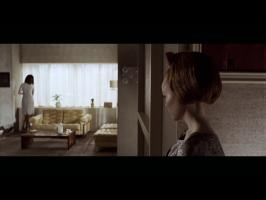
Grief NL, 2007, 3`59? Thunder-like sounds accompany the image of a woman who, withdrawn into herself, is staring out of the window. A radio voice, only partly intelligible, reports on certain events, and a second woman hesitantly enters the room. Neither woman says anything; silence persists between them. The rain, the radio, the back of the woman at the window and the tenseness of the visitor keep one another in a grip. Interacting with the radio report the claps of thunder suddenly sound threatening, and the viewer begins to suspect that there is a connection between the thunderstorm, the vague messages seeping through into the room and the state of mind of the waiting woman who remains physically unapproachable to the other. She keeps on turning her back on her; she is hiding her silent tears. In one single scene and with minimal means, Grief conjures up a whole story of unfolding misery.
Erwin Olaf was born in 1959 in Hilversum, The Netherlands. Olaf has a passionate love affair with life, and enjoys to the full everything it has to offer. His oeuvre is a manifestation of his passion and of his genuine engagement with his subjects. Olaf has been professionally active for twenty-five years and in this period he has succeeded in evolving from a participating photographer to a director who creates his own reality. Olaf's pictures are filled with humor, imagination and exuberance, but they go much further than simple visual intrigue. His works deal with freedom, beauty, loneliness, and being different. He convinces his public in a shameless and versatile manner, questioning established norms. Olaf consistently expresses his own standpoints, fulminating against narrow-mindedness, smugness, and rigid norms, but not without humor, bravura and bite. An authentic Olaf is a blow to the head, ruthlessly direct, but simultaneously wrong footing the viewer and poking fun. One reviewer remarked that in Erwin Olaf's photographs everyone stares unwaveringly into the lens--thus looking straight into the photographer's big blue eyes, as it were. Olaf approaches the world openly and enthusiastically and this is also the way in which, in his work, he dares to enter the public debate. Olaf is a master in generating his own world, whether this be in autonomous photographic series or film projects. He is also hypercritical, nothing escapes him, so that pictures are created with a placement composed so meticulously that it is almost painful to examine. With these, Olaf manages to produce fictitious yet convincing images of bygone days, fairytales and dreams, populated by historical figures, elves, dwarves, lunatics, and god knows who.

Erwin Olaf
La tristesse riche
Experimental fiction | hdcam | color | 10:30 | Netherlands | 2010
Jaamil Olawale Kosoko, Ima Iduozee
Chameleon (A Visual Album)
Video | hdv | color | 21:16 | USA, Germany | 2020
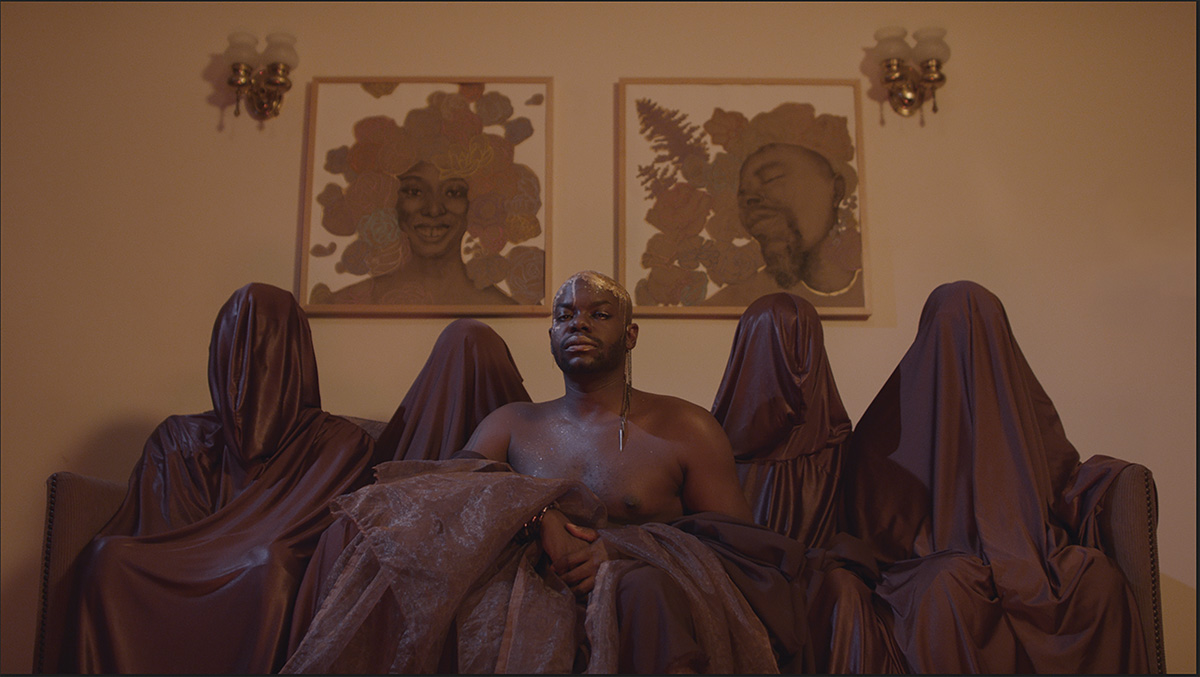
Chameleon is an experimental visual album inspired by the radical queer feminist genre of the “Biomythography” which refers to Audre Lorde’s foundational work entitled Zami: A New Spelling of My Name published in 1982. It combines history, biography, and myth, and holds a literary perspective that serves as a guiding light for complex narrative storytelling rooted in a queer, Black self-defined, feminist imagination.
jaamil olawale kosoko, (they/them) of Yoruba and Natchez descent is an award winning filmmaker, movement artist, poet, and facilitator whose work in embodied poetics and performance has been presented internationally and is rooted in the intergenerational passage of Black feminist knowledge, queer theories of the body, and sacred rituals of intimacy & wellness as a means to craft perpetual modes of freedom, healing, and care where/when/however possible. Their new book, Black Body Amnesia: Poems & Other Speech Acts was released in Feb. 2022. jaamil is the recipient of a MacDowell Fellowship, PEW Fellowship in the Arts, Princeton Arts Fellowship, 2019 Red Bull Writing Fellowship, and a 2017 Cave Canem Poetry Fellowship. Their works in poetry, curation, performance and education have taken them all around the world having performed and taught in over 21 countries on 5 continents including Morocco, South Africa, Germany, Finland, Sweden, UK, Norway, Switzerland, Canada, Mexico, Japan, and throughout the Americas. Of Nigerian and Finnish descent, Ima Iduozee is a choreographer, director, dancer and filmmaker based in Helsinki, Finland. His debut solo work, This is the Title, premiered in 2012 and went on to garner international acclaim, touring in 15 countries across Europe, North America and Asia. In 2015 the annual honorary prize of the Finnish Critics Association, Critics Spurs´, was given to Iduozee, as an acknowledgement for the best artistic breakthrough of the year. Earlier commissions include works for The Finnish National Theatre, Aalto International, Stockholm City Theatre, Helsinki City Theatre, Finnish National Opera and Helsinki International Film Festival. In 2016 Iduozee graduated from the Arts University of Helsinki (Theatre Academy).
Joachim Olender
Tarnac. Le chaos et la grâce
Animation | hdv | color | 23:0 | France | 2012
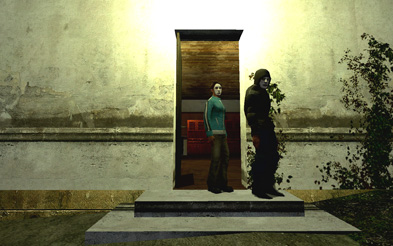
Le 11 novembre 2008, cent cinquante policiers envahissent le petit village de Tarnac en Corrèze. Neuf personnes sont soupçonnées d?avoir posé des crochets métalliques sur des caténaires pour désorganiser les lignes SNCF. A l?issue de leur garde à vue, cinq d?entre elles sont placées en détention provisoire pour terrorisme. Le principal suspect restera incarcéré durant six mois sans preuve à l?appui. Voici l?affaire de Tarnac. Ce film en retrace la fiction.
Joachim Olender est scénariste, réalisateur et vidéaste. Sa démarche découle d?un va-et-vient entre l?écriture et l?image, le cinéma et la vidéo. Il a étudié le droit et le cinéma à Bruxelles. En 2006, il débute une thèse à l?EHESS sur la faille dans le cinéma US des années 2000. Accompagné par le cinéaste Luc Dardenne, il écrit un scénario de long métrage, adapté du roman Les Choses de Georges Perec, dont une première apparition se déroule à la BNF dans l?exposition « Choses lues choses vues » conçue par Alain Fleischer (fin 2009). Il est publié dans Pylône Magazine. En 2010, il intègre Le Fresnoy studio national des arts contemporains et réalise Bloody eyes (fiction 22 min, prod. Le Fresnoy, 2011), tiré d?une nouvelle de Luc Dardenne. En 2012, il réalise Tarnac. Le chaos et la grâce, documentaire d?animation entièrement tourné dans un jeu vidéo, qui explore les méandres de cette fiction d?Etat. En 2012, il entame le développement d?un documentaire sur Herman Daled et sa collection d?art conceptuel rachetée par le MOMA et s?associe à Camille de Toledo et Grégoire Hetzel dans l?opéra vidéo « La chute de Fukuyama ». Il poursuit actuellement sa recherche avec Le Fresnoy. Joachim Olender est né en Belgique en 1980. Il vit et travaille entre Paris et Bruxelles.

Mike Olenick
The Cure
Experimental fiction | hdv | color | 19:35 | USA | 2017
A mom cries, photos fly, cats spy, and bodies collide in this sci-fi soap opera about people who are desperately searching for ways to cure their fears of loneliness. Dad is dying, mom can’t sleep, and Nancy is determined to find a photograph so she can forget something that she saw. Linda relives a past trauma and fears what might happen while she is away from home. Meanwhile, her boyfriend Mark entertains a mysterious stranger, who is secretly conducting a deadly experiment.
Mike Olenick’s perverse films focus on memories, reproduction, appropriation, transformation, and forbidden desire. His films have screened at Slamdance, Fantasia International Film Festival, Fantastic Fest, Palm Springs ShortFest, Hamburg International Short Film Festival, and the World Wide Video Festival; streamed on MUBI; and won awards at the Slamdance, Ann Arbor, Big Muddy, and Chicago Underground film festivals. For nearly fifteen years Mike was a video editor in the Film/Video Studio residency program at the Wexner Center for the Arts. He’s worked as an editor on projects for Guy Maddin (including “Keyhole” and “The Forbidden Room”), the Quay Brothers, Sadie Benning, and Lucy Raven, among others. Since 2003 he has edited numerous films for Jennifer Reeder including “A Million Miles Away,” which screened at Sundance. He also edited her feature “Knives and Skin,” which premiered at the Berlin Film Festival and is distributed by IFC Midnight. Projects he has worked on as an editor are in the collections of MoMA, the Guggenheim, the Whitney, and the Tate. Mike has an MFA in Photography from the Cranbrook Academy of Art. In 2016 he was awarded a fellowship at the inaugural Shudder Labs.
Mike Olenick
For a Blonde...
Experimental video | dv | color | 5:57 | USA | 2005
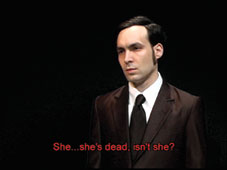
"For a Blonde... For a Brunette... For Someone... For Her... For You..." is a karaoke style video that re-enacts a key scene from Alfred Hitchcock's film "Vertigo". The artist plays the role of John Ferguson at the moment when he re-discovers his Madeleine. 'Karaoke' subtitles allow the viewer to perform Kim Novak's part and complete the scene with the artist.
Mike Olenick (b. 1978) is a video artist, photographer, and editor. His work often fuses fake moments from his own life with real ones from cinema and pop culture. The resulting videos and photographs are a mangled collection of fact and fiction, comedy and tragedy, love and death. His work has been shown in the Ann Arbor Film Festival, The Oberhausen Film Festival, VIPER Basel, Cinematexas, The Brooklyn Underground Film Festival, and the World Wide Video Festival. Currently, Mike is a video editor in the Art & Technology Studio at the Wexner Center for the Arts, where he has worked on projects with Jennifer Reeder, Sadie Benning, Deborah Stratman, Andrea Fraser, Joe Sola, and Josiah McElheny, among others. He also teaches video production at the Columbus College of Art and Design. He received his MFA (with an emphasis in Photography) from the Cranbrook Academy of Art and his BFA in Media Studies from the Columbus College of Art and Design.
Jacco Olivier
Calling
Animation | dv | color | 1:9 | Netherlands | 2005
This animation is a succession of typical thriller and horror scenes: a black crow, an endlessly ringing telephone, creaking stairs, a shadow gliding past, a curtain flapping in the wind, and people walking the streets like zombies. All these elements seem to come together in a surrealistic ending. A shadow moves behind the window of a floating house. Was what we saw earlier perhaps the visualization of his thoughts? This is probably just one of the possible plots. Each viewer can construct a different story out of the available building blocks.
Jacco Olivier
Comfort
Experimental video | dv | color | 1:13 | Netherlands | 2005
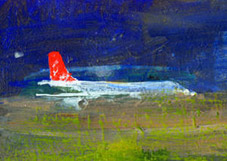
The animation Comfort sheds light on the way Jacco Olivier works. The story that he originally has in mind is open to ideas that emerge during the creation process. In this way, an animation can eventually be built up out of various story lines. The various lines are woven together by rhyming imagery: from the red tail of a stationary Boeing, to the red Vodafone logo, and from there to a ringing red telephone. The animation also appears to be examining itself, when the camera suddenly dives into the deep and peels away the layers of a painting one by one, only to remerge at the top layer. Effortlessly the thread of the story is picked up again. In contrast to what the title suggests, an atmosphere of fear and oppression predominates in this work.
Erik Olofsen
Public Figures
Experimental film | 0 | color | 10:22 | Netherlands, Belgium | 2007
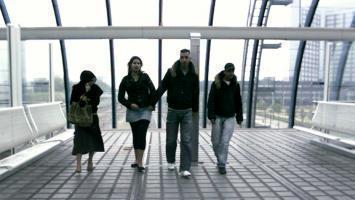
The film was shot using a digital high-speed camera from a moving metro car while entering a busy station. The result is an endless shot of people on a subway platform passing by in slow motion. The tranquil movement of the camera and stillness of the people portrayed, give room for a hypnotic chain of thoughts and associations. The platform seems to have transformed into a stage where everyday people`s small gestures and simple routines turn into a performance.
Born in The Netherlands, in 1970. His installation works have been shown in numerous countries, and usually involve different medias such as sculpture, architectural elements, video, photographs and sound. He also introduced new technology to his artistic work, including industrial robots and high-speed digital cameras. Was a resident at the Rijks Academy in Amsterdam, the Chinese European Art Centre in Xiamen, and Bilbao Arte. Prizes include winning the prestigious Dutch Prix de Rome with the installation ?Remotely Here?, the Spanish international prize Vidalife with the work ?Divine methods / Hidden motives? and the Media Forum prize at the Moscow International Film Festival with the video ?In Places?.
Arianne Olthaar
Gesamtschule
Experimental film | 16mm | color | 5:23 | Netherlands | 2016
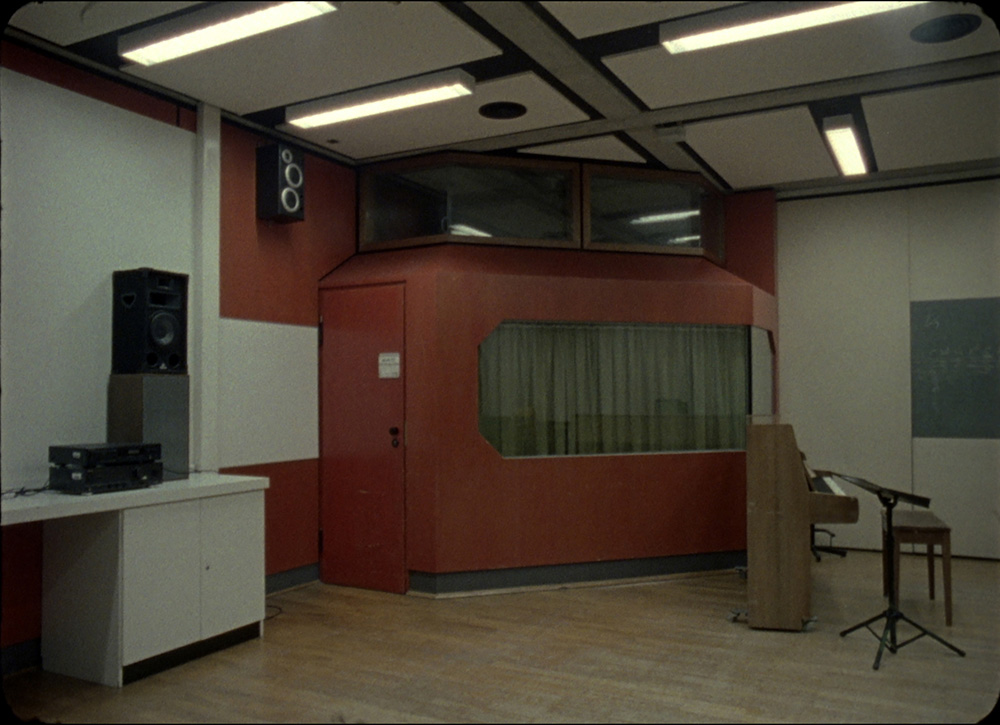
Images of a comprehensive school in West Germany that was built between 1972 and 1978. At the time it was very modern and progressive, both in the way of its education as well in its interior design. An example is the integrated disco in the cellar where up untill today schoolchildren can dance during their lunch break.
Arianne Olthaar (1970, Netherlands) is making experimental films, photographs and miniature models. Her work has a strong focus on the once-luxurious interiors of public spaces that were built in the 1970s and 80s, such as primate enclosures, dining cars, hotel nightclubs, discotheques, a school interior. Interiors that once represented an explicit modern luxury but nowadays have an aura of faded glory and are increasingly disappearing by renovation or demolishment. Her work has been presented in a variety of exhibitions as well as numerous international film festivals, including Cinematexas; Media City Film and Video Festival, Windsor; International Short Film Festival Oberhausen; EMAF Osnabrück; New York Film Festival; Onion City Experimental Film and Video Festival, Chicago; VIDEOEX; Zürich, International Film Festival Rotterdam; Rencontres Internationales, Paris/Berlin.
Arianne Olthaar
Hotel Forum
Video | hdv | color | 9:30 | Netherlands | 2016
The film is inspired by the once huge and luxurious hotels in the former Eastern Bloc designed in the 1970s and 80s. In the meantime their glamour is considered out of date and most of the hotels have been shut down, renovated or demolished.
Arianne Olthaar (1970, Netherlands) graduated as a painter from the Hagues? Royal Academy of Art in 1992. She is making experimental films, photographs and miniature models. Her work has a strong focus on the once-luxurious interiors of public spaces, built in the 1970s and 80s (primate enclosures, dining cars, hotel nightclubs, discotheques, a school interior). Interiors that once represented an explicit modern luxury but nowadays have an aura of faded glory and are increasingly disappearing by renovation or demolishment. Her work has been presented in a variety of exhibitions as well as numerous international film festivals, including Cinematexas; Media City Film and Video Festival, Windsor; International Short Film Festival Oberhausen; European Media Art Festival, Osnabrück; New York Film Festival; Onion City Experimental Film and Video Festival, Chicago and International Film Festival Rotterdam.
I Oñederra
HEZURBELTZAK, una fosa común
Animation | 35mm | black and white | 4:30 | Spain | 2007
The Basque word hezurbeltzak does not appear in dictionaries. It is a non-existing word used to describe socially invisible groups. Its literal translation would be ?black bones?.
Azkoitia, 1979. She got a degree in Fine Arts at the University of the Basque Country and she specialized in painting and in animation cinema. She wrote a thesis on the figure of the antihero and how it has been represented in contemporary art. She exhibits her work regularly with the Epelde-Mardaras gallery from Bilbao. She has organised animation workshops for children and nowadays, she took part in the Berbaoc animation project, which is coordinated by Isabel Herguera in the Arteleku centre in San Sebastian.
Hans Op De Beeck
All together now...
Experimental video | betaSP | color | 6:20 | Belgium | 2005
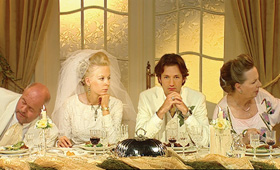
"All together now..." is a lively, tragicomic portrait of three groups of table-companions, portrayed on three different occasions: a group of people in their late seventies at a table, set rather soberly with coffee and cake after a funeral; a wistful bride and her bridegroom with their families in an over-decorated party center, and a birthday dinner for a well-to-do pater familias in an under-cooled design interior. These moments around a table may be some of clearest situations in which people gather together in a more or less artificial manner. Mutual grudges, unspoken feelings, and tensions between family members are hidden between the lines of the ritual. The camera slowly pans once along the people around the table. This six-minute choreography of actions in miniature, conversations, and knowing glances, clarifies the relationships around the table. Some of the characters are comic, others rather tragic or touching. Due to the slow-motion technique, every detail becomes outspokenly visible. "All together now..." is a contemporary portrait of human beings around the table, in which the sobering, post-party emptiness, can be sensed while the feast is still in progress.
The Belgian visual artist Hans Op de Beeck (Turnhout, 1969) creates huge, life-sized installations, imaginary urban sites on scale, video installations, sculptures, photos, drawings and animated films. He has for several years been involved in many individual projects and group shows in quick succession. His work has been shown throughout Europe and the United States. In 2002-2003 he was artist-in-residence at MoMA-PS. in New York. At Art Unlimited (Art Basel 2004) he showed a life-sized motorway restaurant, overlooking a nightly motorway. Recently he showed work at MARTa Herford, Kunstverein Hannover, MuHKA Antwerp, Casino Luxemburg, Shanghai Art Museum, PSK Brussels, GEM-Museum of Contemporary Art (The Hague), and The Drawing Center (New York).
Hans Op De Beeck
Before the rain(a village)
Experimental doc. | hdv | color | 12:0 | Belgium, India | 2013
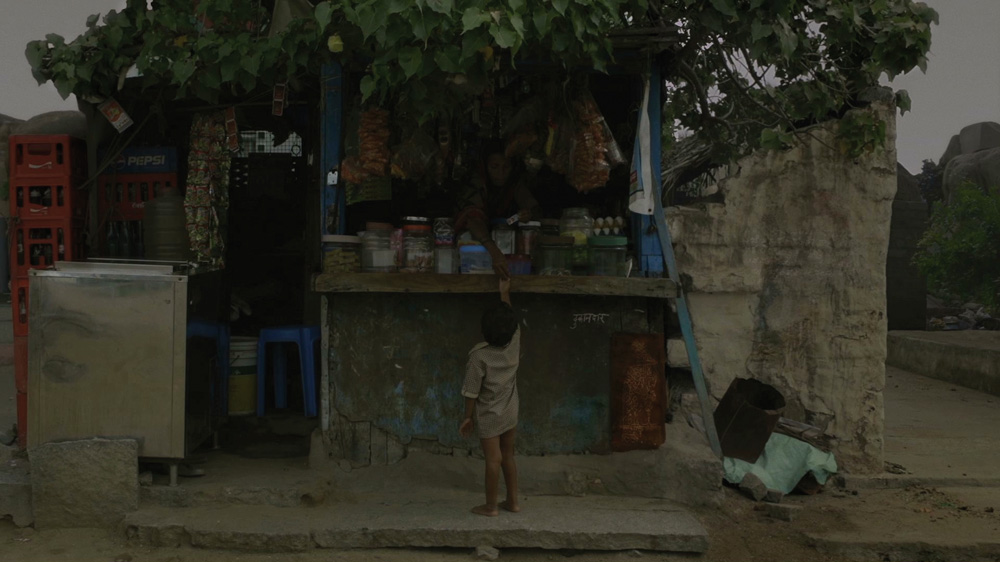
Before the Rain (A Village) shows us the daily events in this South Indian region, which combines a mineral, eroded landscape with rice fields, sheep herds and the impressive ruins of the Vijayanagara dynasty (1336-1565). During the rain season the artist stayed in the remote South Indian village, where humans and animals live together in small huts and sheds. He filmed only just before the onset of a new shower of rain—a time when the light becomes very diffuse and the sky becomes strangely, vaguely white. Oddly enough, as a result the Indian village bathes in a typically subdued, Western European light that is very unusual in the south of India. The film is constructed as a series of silent tableaux vivants that are filmed with a static, frontal camera on a tripod. Op de Beeck quite deliberately sought the small, everyday things we share beyond cultural borders, and consciously stayed away from the spectacular and that which is explicitly related to religion, mysticism or “being different”. Thus with this film he tried to create a sort of imaginary, universal village that speaks about how time silently passes in a small community, while avoiding the “exoticizing” glance of the idealizing idyll. The work invites a silent, sensory perception and reflection.
Hans Op de Beeck (° 1969 - Turnhout, Belgium) Lives and works in Brussels, Belgium Education/ Programs/ Awards 2009: Catholic University of Leuven Culture Prize 2009-2010 2006: Winner of the Prize Eugène Baie 2003-2005, Antwerp 2002-2003: Artist at the MoMA-P.S.1 Studio Program, New York 2001: Winner of the `Prix Jeune Peinture Belge 2001`, Palais des Beaux Arts, Brussels 1998-1999: Participant at the Rijksakademie, Amsterdam (post-MA) 1996-1997: Participant at The Higher Institute for Fine Arts-Flanders, Antwerp (post-MA) 1992-1996: Masters Degree in Visual Arts, Higher Institute Sint-Lukas, Brussels Situating the artist and his oeuvre Visual artist Hans Op de Beeck lives and works in Brussels, where he has developed his career through international exhibitions over the past ten years. His work consists of sculptures, installations, video work, photography, animated films, drawings, paintings and writing (short stories). It is his quest for the most effective way of presenting the concrete contents of each work that determines the medium that the artist ultimately selects. The scale can vary from the size of a small watercolour to a large, three-dimensional installation of 300m2. The artist not only uses a very wide variety of media, but also deliberately employs a diversity of aesthetic forms, ranging from an economical, minimalist visual language to overloaded, exaggerated designs, always with the aim of articulating the content of the work as precisely as possible. Thematically, the work concentrates on our laborious and problematic relationship with time, space and each other. Op de Beeck shows the viewer non-existent, but identifiable places, moments and characters that appear to have been taken from contemporary everyday life, aiming thereby to capture in his images the tragicomic absurdity of our postmodern existence. Key themes are the disappearance of distances, the disembodiment of the individual and the abstraction of time that have resulted from globalisation and the changes to our living environment that developments in media, automation and technology have brought about. Hans Op de Beeck sometimes calls his works "proposals"; they are irrefutably fictional, constructed and staged, leaving it up to the viewer whether to take the work seriously, as a sort of parallel reality, or immediately to put it into perspective, as no more than a visual construct. His work is nourished by a keen interest in social and cultural reflection. The artist also questions the difficult relationship between reality and representation, between what we see and what we want to believe, between what is and what we create for ourselves in order to make it easier to deal with our own insignificance and lack of identity. The visual output of that investigation often produces slumbering, insidious, melancholy and astonishing images.
Hans Op De Beeck
Night Time (extended)
Animation | hdv | black and white | 19:18 | Belgium | 2015
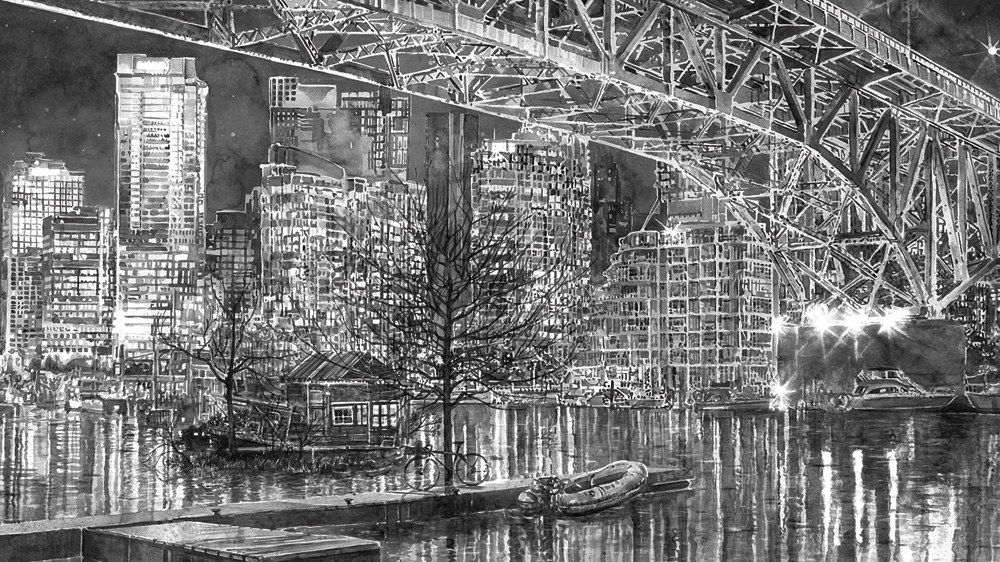
"Night Time (extended)" - Hans Op de Beeck 2015 Full HD video, black and white, sound, 2015 (19 minutes 20 seconds) ‘Night time (extended)’ is a dark, enigmatic animation without text based on a large series of monumental monochrome watercolours which Op de Beeck steadily realised over the past five years, in between all his other multidisciplinary projects. All the watercolours were painted by the artist at night in complete solitude and concentration.This nightly atmosphere is a tangible presence in the metropolitan landscapes, the images of nature, the buildings, interiors and characters which the artist brings to life in the film. "Night time (extended)" is conceived as a mysterious dream in which all proportions, perspectives and environments are fictitious. In this way, intimate close-ups are made to alternate with sweeping images; every image clearly and visibly the product of deliberate construction. The film is comforting and soothing, yet also exudes a sense of dormant danger and derailment, just as in the film noir tradition. Here, Op de Beeck brings together an anachronistic whole of both classical and distinctly contemporary themes into an effortless blend of both highly cultivated and more visceral subcultural elements.
Hans Op de Beeck produces large installations, sculptures, films, drawings, paintings, photographs and texts. His work is a reflection on our complex society and the universal questions of meaning and mortality that resonate within it. He regards man as a being who stages the world around him in a tragi-comic way. Above all, Op de Beeck is keen to stimulate the viewers’ senses, and invite them to really experience the image. He seeks to create a form of visual fiction that delivers a moment of wonder and silence. Over the past fifteen years Op de Beeck realized numerous monumental ‘sensorial’ installations, in which he evoked what he describes as ‘visual fictions’: tactile deserted spaces as an empty set for the viewer to walk through or sit down in, sculpted havens for introspection. In many of his films though, in contrast with those depopulated spaces, he prominently depicts anonymous characters. Hans Op de Beeck was born in Turnhout in 1969. He lives and works in Brussels and Gooik, Belgium. Op de Beeck has shown his work extensively in solo and group exhibitions around the world. He had substantial institutional solo shows at the GEM Museum of Contemporary Art of The Hague, The Hague, NL (2004); MUHKA Museum of Contemporary Art, Antwerp, B (2006); Centraal Museum, Utrecht, NL (2007); the Smithsonian’s Hirshhorn Museum and Sculpture Garden, Washington DC, US (2010); KunstmuseumThun, CH (2010); Centro de Arte Caja de Burgos, Burgos, ES (2010); Butler Gallery, Kilkenny, IRL (2012); Kunstverein Hannover, D (2012); Tampa Museum of Art, Tampa, USA (2013); the Harn Museum of Art, Gainesville, FL, USA (2013); FRAC Paca, Marseille, F (2013); MIT List Visual Arts Center, Cambridge, Boston MA, US (2014); MOCA Cleveland, OH, US (2014); Sammlung Goetz, Munich, D (2014), … Op de Beeck participated in numerous group shows at institutions such as The Reina Sofia, Madrid, ES; the Scottsdale Museum of Contemporary Art, AZ, US; the Towada Art Center, Towada, JP; ZKM, Karlsruhe, DE; MACRO, Rome, IT; the Whitechapel Art Gallery, London, GB; PS1, New York, NY, US; Musée National d’ArtModerne, Centre Pompidou, Paris, FR; Wallraf-Richartz Museum, Köln, DE; Hangar Bicocca, Milano, IT; the Hara Museum of Contemporary Art, Tokyo, JP; 21C Museum, Louisville, Kentucky, US; The Drawing Center, New York, NY, US; Kunsthalle Wien, Vienna, AT; Shanghai Art Museum, Shanghai, CN; MAMBA, Buenos Aires, AR; Haus der Kunst, Munich, DE; Museod’ArteModerna di Bologna, Bologna, IT; Kunstmuseum Bonn, Bonn DE, … His work was invited for the Venice Biennale, Venice, IT; the Shanghai Biennale, Shanghai, CN; the Aichi Triennale, Aichi, JP; the Singapore Biennale, Singapore, SG; Art Summer University, Tate Modern, London, GB; the Kochi-Muziris Biennale, IN, and many other art events.
Hans Op De Beeck
The Girl
Experimental film | hdv | color | 16:0 | Belgium | 2017
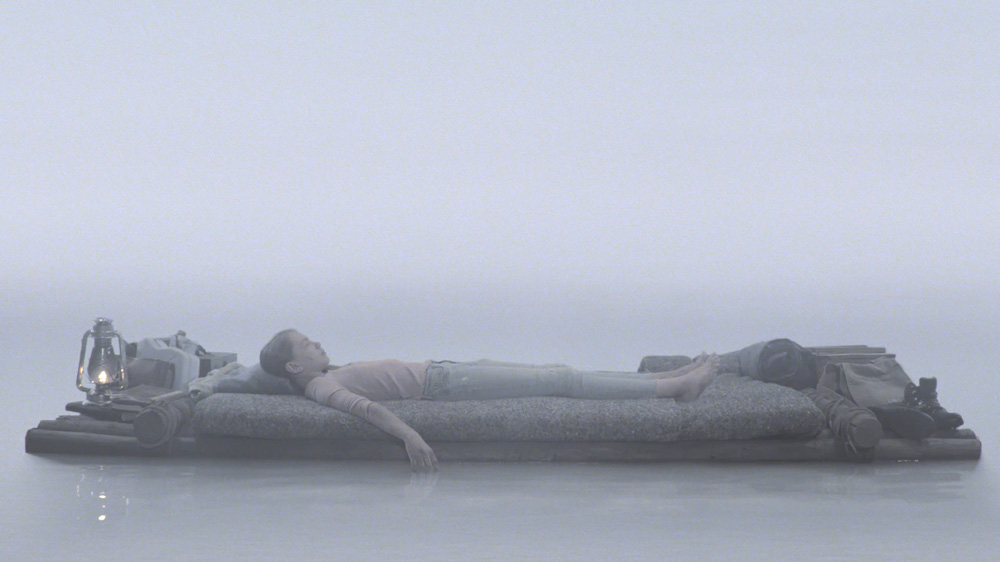
"The Girl" is a slow, suggestive, perception-oriented animated film in which the viewer is transported to the strange world of a silent, 14-year-old girl. The dreamy landscape images show a dark forest, a vast landfill, a gas station, a highway landscape, a meadow, a factory site and a mysterious lake. Amidst all this stands an old caravan. The scene seems to suggest that the protagonist leads a lonely life on these premises. For a further unspecified reason, she must at one time have left her parental home, which is presented to us at the beginning of the film, both in perfect condition, and later in a neglected, abandoned state. In a variety of different landscapes, we see the girl perform small acts such as gather usable waste or pick herbs. We often get to see her cargo bike; the vehicle she uses to gather the bear necessities in order to survive. Nighttime, breaking dawn, wind, rain, fog, cold and warming fire are present throughout the film. Occasionally, we get to see the girl “resting serenely” from up close, as if we were right beside her, and could feel her breath. At the end of the film we understand that she is resting on a raft in the lake, floating, passive, as a metaphor for surrender. An original soundtrack for the film was composed by Tom Pintens, on a text by the artist.
Hans Op de Beeck produces large installations, sculptures, films, drawings, paintings, photographs and texts. His work is a reflection on our complex society and the universal questions of meaning and mortality that resonate within it. He regards man as a being who stages the world around him in a tragi-comic way. Above all, Op de Beeck is keen to stimulate the viewer’s senses, and invite them to really experience the image. He seeks to create a form of visual fiction that delivers a moment of wonder and silence. Over the past twenty years Op de Beeck realized numerous monumental “ sensorial ” installations, in which he evoked what he describes as “ visual fictions ”: tactile deserted spaces as an empty set for the viewer to walk through or sit down in, sculpted havens for introspection. In many of his films though, in contrast with those depopulated spaces, he prominently depicts anonymous characters. Hans Op de Beeck was born in Turnhout in 1969. He lives and works in Brussels and Gooik, Belgium. Op de Beeck has shown his work extensively in solo and group exhibitions around the world.
Hans Op De Beeck
Staging Silence (2)
Experimental video | | black and white | 20:48 | Belgium | 2013
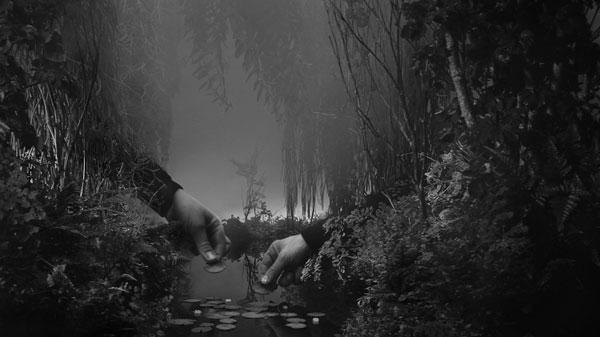
Hans Op de Beeck`s film `Staging Silence (2)` is based around abstract, archetypal settings that lingered in the memory of the artist as the common denominator of the many similar public places he has experienced. The video images themselves are both ridiculous and serious, just like the eclectic mix of pictures in our minds. The decision to film in black and white heightens this ambiguity: the theatre like approach of the video invokes the legacy of slapstick, as well as the insidious suspense and latent derailment of film noir. The title refers to the staging of such dormant decors where, in the absence of people, the spectator can project himself as the lone protagonist. Memory images are disproportionate mixtures of concrete information and fantasies, and in this film they materialise before the spectator`s eyes through anonymous tinkering and improvising hands. Arms and hands appear and disappear at random, manipulating banal objects, scale representations and artificial lighting into alienating yet recognisable locations. These places are no more or less than animated decors for possible stories, evocative visual propositions to the spectator. Op de Beeck`s film is accompanied by a score which, inspired by the images themselves, has been composed by composer-musician Scanner (UK).
Hans Op de Beeck Situating the artist and his oeuvre Visual artist Hans Op de Beeck lives and works in Brussels, where he has developed his career through international exhibitions over the past ten years. His work consists of sculptures, installations, video work, photography, animated films, drawings, paintings and writing (short stories). It is his quest for the most effective way of presenting the concrete contents of each work that determines the medium that the artist ultimately selects. The scale can vary from the size of a small watercolour to a large, three-dimensional installation of 300m2. The artist not only uses a very wide variety of media, but also deliberately employs a diversity of aesthetic forms, ranging from an economical, minimalist visual language to overloaded, exaggerated designs, always with the aim of articulating the content of the work as precisely as possible. Thematically, the work concentrates on our laborious and problematic relationship with time, space and each other. Op de Beeck shows the viewer non-existent, but identifiable places, moments and characters that appear to have been taken from contemporary everyday life, aiming thereby to capture in his images the tragicomic absurdity of our postmodern existence. Key themes are the disappearance of distances, the disembodiment of the individual and the abstraction of time that have resulted from globalisation and the changes to our living environment that developments in media, automation and technology have brought about. Hans Op de Beeck sometimes calls his works ?proposals?; they are irrefutably fictional, constructed and staged, leaving it up to the viewer whether to take the work seriously, as a sort of parallel reality, or immediately to put it into perspective, as no more than a visual construct. His work is nourished by a keen interest in social and cultural reflection. The artist also questions the difficult relationship between reality and representation, between what we see and what we want to believe, between what is and what we create for ourselves in order to make it easier to deal with our own insignificance and lack of identity. The visual output of that investigation often produces slumbering, insidious, melancholy and astonishing images.
Hans Op De Beeck
Sea of Tranquillity
Video | | color | 29:50 | Belgium | 2010
The medium-length film `Sea of Tranquillity` is a combination of live video recordings of actors and digitally-generated 3D environments in which the viewer makes a night-time visit to a mysterious, mythical cruise liner, the `Sea of Tranquillity`. This fictitious cruise liner has been designed by Hans Op de Beeck, following a short residence at Saint-Nazaire in France in 2008, during which the artist became intrigued by the remarkable Second World War story and postwar reconstruction of this harbour town, whose shipyards produce the worlds largest cruise liners. It seemed to the artist that the Queen Mary 2, then just completed, was, like the Burj Khalifa in Dubai (the highest building in the world), a suitable metaphor for our belief in spurious values and in such concepts as work, leisure time and luxury consumerism. We nowadays use such categories as the highest, the first and the biggest, but what do these terms say about the actual quality of things?
Visual artist Hans Op de Beeck lives and works in Brussels, where he has developed his career through international exhibitions over the past ten years. His work consists of sculptures, installations, video work, photography, animated films, drawings, paintings and writing (short stories). It is his quest for the most effective way of presenting the concrete contents of each work that determines the medium that the artist ultimately selects. The scale can vary from the size of a small watercolour to a large, three-dimensional installation of 300m2. The artist not only uses a very wide variety of media, but also deliberately employs a diversity of aesthetic forms, ranging from an economical, minimalist visual language to overloaded, exaggerated designs, always with the aim of articulating the content of the work as precisely as possible. Thematically, the work concentrates on our laborious and problematic relationship with time, space and each other. Op de Beeck shows the viewer non-existent, but identifiable places, moments and characters that appear to have been taken from contemporary everyday life, aiming thereby to capture in his images the tragicomic absurdity of our postmodern existence. Key themes are the disappearance of distances, the disembodiment of the individual and the abstraction of time that have resulted from globalisation and the changes to our living environment that developments in media, automation and technology have brought about. Hans Op de Beeck sometimes calls his works "proposals"; they are irrefutably fictional, constructed and staged, leaving it up to the viewer whether to take the work seriously, as a sort of parallel reality, or immediately to put it into perspective, as no more than a visual construct. His work is nourished by a keen interest in social and cultural reflection. The artist also questions the difficult relationship between reality and representation, between what we see and what we want to believe, between what is and what we create for ourselves in order to make it easier to deal with our own insignificance and lack of identity. The visual output of that investigation often produces slumbering, insidious, melancholy and astonishing images.
Hans Op De Beeck
Staging Silence
Video | dv | black and white | 22:0 | Belgium | 2009
?Staging Silence? is based around remembered spaces; not any specific sites, but the abstract, archetypal settings that lingered in my memory as the common denominator of the many similar public places I have visited and experienced. The video images themselves are both ridiculous and serious, just like the eclectic mix of pictures in our minds. The decision to film in black-and-white heightens this ambiguity: the amateurish quality of the video invokes the legacy of slapstick, as well as the insidious suspense and latent derailment of film noir. But perhaps gravity and menace ultimately prevail. The title, ?staging silence?, refers to the staging of such dormant decors where, in the absence of people, the spectator can project himself as the lone protagonist, unhindered by others. Memory images are disproportionate mixtures of concrete information and fantasies, and in this film they materialize before the spectator?s eyes through anonymous tinkering and improvising hands. Arms, like those of faceless puppeteers, appear and disappear at random, manipulating banal objects, scale representations and artificial lighting into alienating yet recognizable locations. These places are no more or less than animated decors for possible stories, evocative visual propositions to the spectator. The film is accompanied by a score which, inspired by the images themselves, has been composed and performed by composer-musician Serge Lacroix.
Visual artist Hans Op de Beeck lives and works in Brussels, where he has developed his career through international exhibitions over the past ten years. His work consists of sculptures, installations, video work, photography, animated films, drawings, paintings and writing (short stories). It is his quest for the most effective way of presenting the concrete contents of each work that determines the medium that the artist ultimately selects. The scale can vary from the size of a small watercolour to a large, three-dimensional installation of 300m2. The artist not only uses a very wide variety of media, but also deliberately employs a diversity of aesthetic forms, ranging from an economical, minimalist visual language to overloaded, exaggerated designs, always with the aim of articulating the content of the work as precisely as possible. Thematically, the work concentrates on our laborious and problematic relationship with time, space and each other. Op de Beeck shows the viewer non-existent, but identifiable places, moments and characters that appear to have been taken from contemporary everyday life, aiming thereby to capture in his images the tragicomic absurdity of our postmodern existence. Key themes are the disappearance of distances, the disembodiment of the individual and the abstraction of time that have resulted from globalisation and the changes to our living environment that developments in media, automation and technology have brought about. Hans Op de Beeck sometimes calls his works "proposals"; they are irrefutably fictional, constructed and staged, leaving it up to the viewer whether to take the work seriously, as a sort of parallel reality, or immediately to put it into perspective, as no more than a visual construct. His work is nourished by a keen interest in social and cultural reflection. The artist also questions the difficult relationship between reality and representation, between what we see and what we want to believe, between what is and what we create for ourselves in order to make it easier to deal with our own insignificance and lack of identity. The visual output of that investigation often produces slumbering, insidious, melancholy and astonishing images.
Hans Op De Beeck
The stewarts have a party
Experimental video | dv | color | 4:19 | Belgium | 2007
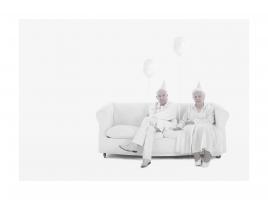
?The Stewarts? are a fictitious and carefully cast family. The various family members appear and disappear in an empty white room, like life-sized marionettes dressed in white. As is customary in this subgenre of marionette theatre, they are manipulated by puppeteers dressed in black; consisting in this case of the set entourage: production assistants, a makeup girl and a hair stylist. The family members are moved to spots in the space and tidied up for their performance. Finally the puppeteers/assistants strap balloons to ?The Stewarts? and place cardboard party hats on their heads. All of this takes place calmly and in complete silence, none of the Stewarts shows a sign of emotion.
Hans Op de Beeck (BE, 1969) studied at the Hogeschool Sint-Lukas, Brussels and the Rijksacademie, Amsterdam. As a multi-disciplinary artist he makes use of various media, like video, installations, sculptural work, photography, text, animation and sketches. He adapts his medium to the chosen thematic, always searching for some kind of parallel world, an ageless nowhere. The world as it is presented here is an uncanny no man?s land, in which there is hardly room for human beings. Op de Beeck is looking for a ?being in transit?, an in-between, seemingly reason-less entity: the unrestrained, the chaos of the undefi ned. Op de Beeck has exhibited at the Fondazione Bevilacqua La Masa (Venice), GEM (The Hague) and Xavier Hufkens (Brussels). In 2001 he won the Young Belgian Painting Award, in 2006 the Prize Eugène Baie.
Hans Op De Beeck
The Building
Art vidéo | dv | color | 4:19 | Belgium | 2007
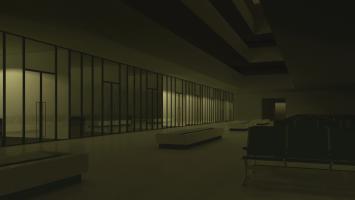
"The Building" is a digitally generated animation movie in which the artist sends the viewer on a virtual, nocturnal walking tour of a fictitious, megalomaniacal hospital complex. This hospital has the same mediocre, half-hearted, over-the-top architectural features as the hospitals, shopping malls, health clubs, and airports that have shot up like mushrooms all over the Western world. These buildings are designed to accommodate thousands of visitors. They radiate a mood of alienation and interchangeability. Strikingly enough, these impersonal hospital complexes usually form the backdrop to the most personal and essential moments in life: in a hospital one is born, suffers, comforts, heals, and dies. "The Building" does not follow a strict narrative line, rather it submerses the viewer in the slumbering, nocturnal machine, with the camera switching back and forth between a neutral, observational point of view and the subjective position of the patient.
Hans Op de Beeck (°1969, Turnhout, Belgium) Lives and works in Brussels (Belgium) www.hansopdebeeck.com SELECTION OF SOLO-EXHIBITIONS AND PROJECTS 2007 Hans Op de Beeck: Extensions M, Louvain Hans Op de Beeck: Extensions Centraal Museum, Utrecht Hans Op de Beeck: Merry-go-round (2) Art Unlimited, Basel Hans Op de Beeck: Extensions Galleria Continua, San Gimignano Hans Op de Beeck: All together now... Galerie Ron Mandos, Amsterdam 2006 Hans Op de Beeck: Family (scenes and scenery) Xavier Hufkens Gallery, Brussels Hans Op de Beeck: Tables... Galerie Krinzinger, Vienna Hans Op de Beeck: My Brother?s Gardens Fondazione Bevilacqua La Masa, Venice Hans Op de Beeck: Loss Viafarini, Milan 2005 Hans Op de Beeck: In their minds? Nicole Klagsbrun Gallery, New York Hans Op de Beeck: T-Mart MuHKA, Museum of Contemporary Art, Antwerp 2004 Hans Op de Beeck: Loss Galerie Les Filles du Calvaire, Paris Hans Op de Beeck: Location (5) Art Unlimited, Basel Hans Op de Beeck Galerie Ron Mandos, Rotterdam Hans Op de Beeck: Meanwhile? Museum of Contemporary Art, The Hague 2003 Hans Op de Beeck: My brother?s gardens Xavier Hufkens, Brussels 2001 Hans Op de Beeck Hales Gallery, London SELECTION OF GROUP-EXHIBITIONS 2008 Car Culture Scottsdale Museum of Contemporary Art, Arizona Discovering Slowness M?Ars - Centre of Contemporary Art, Moscow Variable Capital Bluecoat Arts Centre, Liverpool Towada Art Project (permanent installation of ?Location (5)?) Towada Art Center, Towada (JP) 2007 A Story of the Image: Visual Art as Visual Culture ICA, Singapore Dealing with Reality Museum of Modern Art, Arnhem (NL) La città che sale - We try to build the future ARCOS, Benevento (IT) - MACRO, Rome Imagination Becomes Reality (# 6) (Goetz Collection) ZKM, Karlsruhe (DE) Our Magic Hour ARARIO Gallery, Seoul The Leading Thread Centro de Arte Caja de Burgos (CAB), Burgos (ES) 2006 Rencontres Internationales Cinéma de l?Entrepôt, Paris - Cinema Babylon, Berlin - Circulo de Bellas Artes, Madrid Version Animée - Biennale des nouveaux médias Centre pour l?image contemporaine, Genève 6th Shanghai Biennale Shanghai Art Museum, Shanghai Fresh! Museum of Glass, Tacoma, Washington Animated Stories CaixaForum, Barcelona - Sala Rekalde, Bilbao - Le Fresnoy, Tourcoing (FR) Analog Animation 2006 The Drawing Center, New York 2005 NIGHT SITES Kunstverein Hannover, Hanover The MARTa Herford Collection MARTa, Herford En Attente Casino Luxembourg - forum d?art contemporain, Luxembourg Visionary Belgium (Harald Szeemann) Palais des Beaux-Arts, Brussels 2004 100 % Acid Free White Columns, New York All that useless beauty Whitechapel, Project Space, London 2003 Silent Wandering... Postbahnhof Am Ostbahnhof, Berlin Breaking Away P.S.1-MoMA, New York 2002 Printemps de Septembre (festival) Toulouse BIG Torino 2002, International Biennial of Young Art (Big Social Game) Torino