Catalogue > Search
Results for : Tout le catalogue
Shirin Mozaffari
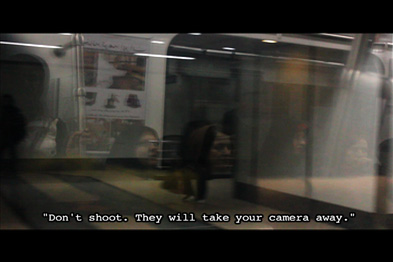
Someone Else's Project
Documentary | hdv | color | 4:7 | Iran, USA | 2012
Someone Else?s Project gives an unmediated insider look to the everyday lives of residents of Tehran, focusing on a correspondence between a U.S. based artist, and a Tehran based videographer, who takes on the risk of shooting illegally on the streets. The videographer recounts her interactions with civilians and guards, where strangers offer her voluntary and enthusiastic support to accomplish an illegal task. While reflecting on the unexpectedly familiar nature of everyday life in Tehran, Someone Else?s Project sheds light on Tehrani civilian?s resistant attitude towards civil obedience and the isolation of a society that is desperate to participate.
Shirin Mozaffari is a media artist, born and raised in Tehran, Iran. She holds a Master of Fine Arts from The School of The Art Institute of Chicago. Mozaffari has screened her short films and exhibited her video installations widely in the United States and abroad including the Asian American Film Festival at The Gene Siskel Film Center in Chicago, and the Queelnsland Gallery of Modern Art in Queensland Australia. Mozaffari was awarded for best Art Direction at Chicago Short Film Festival for her film Namesake. Mozaffari currently lives and works in Boston, MA.

Pavel Mozhar
Ungewollte Verwandtschaft
Documentary | 4k | color | 30:0 | Germany | 2024
The reports by civilian victims of the Russian and Belarusian occupation in Ukraine contain descriptions of torture and repression that appear to be systematic in nature. Taking those reports as a basis, a filmmaker born in Belarus investigates that systematic procedure on the streets of his Berlin neighbourhood. He also confronts the question of what this war of annihilation has to do with him and what responsibility he himself bears.
Born in Minsk, Belarus in 1987, he grew up in and around Berlin from the age of ten. From 2009 to 2012, he studied philosophy and economics at the University of Bayreuth. In 2015, he took up a film directing degree with a focus on documentary at the Film University Babelsberg Konrad Wolf. His short documentary Handbook, about the protests in Belarus in August 2020, won numerous awards, including Best Short Film at the IDFA in 2021. Mozhar’s most recent work is a short documentary Unwanted Kinship about the Russian war of extermination in Ukraine.
David Mozny
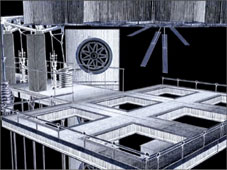
Pomalu
Animation | dv | color | 4:20 | Czech Republic | 2005
This is an animated movie based on the illustrations in "Duden", a German-Russian vocabulary book. This 1953 version depicts the world in numerous illustrated tabs starting from political life to sports and housing to nature and the human body. The movie is independent from the text of the song; it loosely reflects its psychedelic and surreal mood /"the city is the fishhook, the prey on its thin rope... i'm smoking now, after the work, the door slams...slowly through the day, nothing to do, slowly along the window shops and pubs..."/
David Mozny is a visual artist who has been working with digital images since 2000. He exhibits his works in galleries as well as in media, theatre, clubs, and as a VJ. He is a part-time teacher at the faculty of social studies, 'new media section' in Masaryk University Brno. He works from home.
Marianna / Rannvá Mørkøre / Káradóttir, Káradóttir, Rannvá
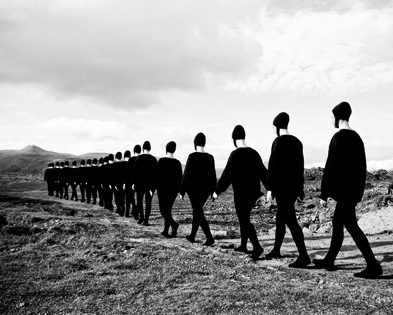
Magma
Experimental film | super8 | black and white | 5:19 | Faeroe islands | 2010
Magma is the first film in a greater series of experimental short films called The Cycle - 8 experimental short films that embrace and discover movement through camera. The films are shot in the extreme and wild landscapes of a remote group of islands far up in the North Atlantic Ocean, the Faroe Islands. Fragmented stories are unraveled in these open and empty spaces, enhanced by the uncontrollable and extreme weather conditions that have an important character in all the films. Deprived from dialogues and narratives, the repetitive patterns of movements, costumes, music, landscapes and other components create an intriguing atmosphere that takes the viewer to a surrealistic yet hauntingly beautiful universe.
Rannvá Káradóttir is a London-based artist and filmmaker. Since graduating from London Contemporary Dance School she has emerged as one of the most prominent performance directors on screen. Rannvá started to use the film media for her practice early on and has developed a distinctive movement vocabulary on screen, exploring dance in various contexts and cross disciplinary works. Marianna Mørkøre, filmmaker and illustrator, began her career during fashion studies in London, especially interested in editing. Her constant curiosity in challenging the traditional perception of moving image has generated unique visual narratives that are marked by an experimental approach and a personal voice - a methodology of intriguing imagery determined to linger in your mind.
Lubanzadyo Mpemba
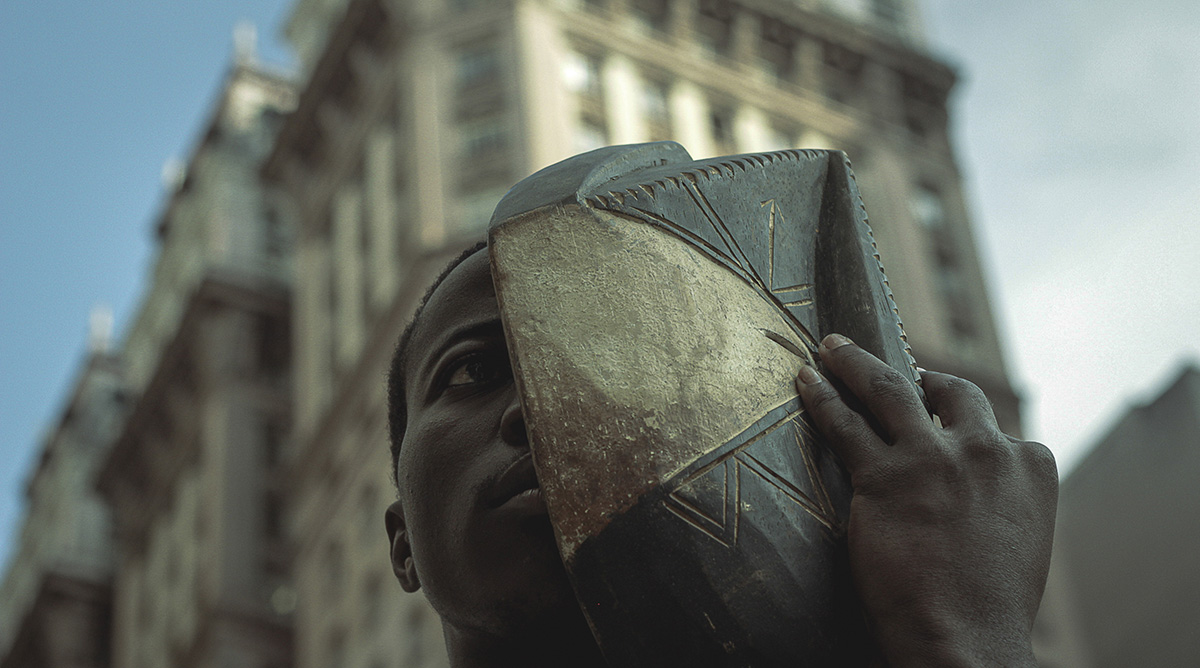
Sirenes Opacas de São Paulo
Experimental video | mov | color | 5:42 | Angola, Brazil | 2019
In Opaque Sirens of São Paulo wells the tension between the city as anonymous concrete that occupies the space, and the world as experience accumulated in the body. But the city is also the world and the space is also the body, and each one carries the anatomy of opaque memories. The magnitude of the buildings vis-à-vis the passing human scale is opaque to the search for safe places before the imposing verticality. The gesture as a detail of the body that speaks is opaque to the noise of the urban abyss. The inert suspense that scratches the skies is opaque to the experiences that transfigure themselves in self-search. And this tension neither increases nor decreases, it is constant and what sustains the daily movement, and the absence of it, in the streets of São Paulo.
Born in Angola in 1989. A transdisciplinary artist, Lubanzadyo Mpemba expresses himself in video art, photo performance, performance, and documentary. His work includes visual stagings that address migration, urban gentrification, institutional violence, and collective memory. He has a law degree, and studied Urban Sociology, Curatorial Studies, Film, and Painting in Motion.

Marcel Mrejen
Memories of an Unborn Sun
Experimental doc. | 4k | color | 22:0 | Algeria | 2024
Written upon testimonies, rumors and fake news, this film questions the architectures of energy shaping the Algerian territory from its colonial history to the rise of Chinese extractivism, underlining the multiplicity of reality in a post-truth era. Since 2006, thousands of Chinese workers have been arriving daily in Algeria to build new cities across the country. Refusal of taking care of the dead by construction companies led to rumors about the disappearance of worker’s bodies, therefore questioning the collective memory of these workers expunged from history. Memories of an Unborn Sun aims to articulate a metaphysical query around light as a form of memory, blending archives from French nuclear tests in the Sahara, viral footage of an artificial sun rising in the sky and verses from Tuareg poet Hawad. As this nightless world embodies the capitalist utopia of infinite growth, how to remember those made invisible? Exiled workers and ghosts of an energetical quest.
Marcel Mrejen (FR/DZ) born in 1994 (Paris, FR) is a visual artist and filmmaker exploring the articulation of technology within living and economic metabolisms. The form of his work spans various time-based media — installations, filmmaking, sound, and machine-learning. He graduated from the Gerrit Rietveld Academie in 2018, before being a resident of Le Fresnoy - Studio national des arts contemporains. His work has been exhibited in various cultural institutions, including the Stedelijk Museum, Laurel Project Space, De Brakke Grond, or the Institute of Contemporary Arts in London. Parallel to his artistic practice, he co-curated the first edition of REFRESH: Future-Proof. In collaboration with Eliott Déchamboux, his book: L’Europe c’est Deutshland quand tu rate laba tu est foutue mon frère, le reste c’est du fouma-fouma, was published by Jungle Books in 2019. His debut film Memories of an Unborn Sun was awarded the Jury Prize at Visions du Réel in 2024.
Marcel Mrejen
Larry
Video | 4k | color | 10:0 | Algeria | 2024
Set against silent 16mm footage filmed by a French soldier in occupied Algeria, the film stages an encounter between colonial memory and the soundscape of contemporary warfare. As present-day militarism infiltrates the archive, time fractures and the images begin to echo with conflicts past and future. What emerges is a haunting meditation on the ways colonial violence continues to reverberate through today’s military imaginaries.
Marcel Mrejen (FR/DZ) born in 1994 (Paris, FR) is a visual artist and filmmaker exploring the articulation of technology within living and economic metabolisms. The form of his work spans various time-based media — installations, filmmaking, sound, and machine-learning. He graduated from the Gerrit Rietveld Academie in 2018, before being a resident of Le Fresnoy - Studio national des arts contemporains from 2021 to 2023. His work has been exhibited/screened in various cultural institutions, including the Stedelijk Museum (Amsterdam), the Institute of Contemporary Arts (London), or the Eye Filmmuseum (Amsterdam). Parallel to his artistic practice, he co-curated the first edition of REFRESH: Future-Proof in 2021. His debut film Memories of an Unborn Sun was awarded Best Short Film at Visions du Réel in 2024 and was screened and won awards in numerous festivals around the world. In 2025, it was awarded the Scam Prize for Best Experimental Film. In collaboration with Eliott Déchamboux, his book: L’Europe c’est Deutshland quand tu rate laba tu est foutue mon frère, le reste c’est du fouma-fouma, was published by Jungle Books in 2019.

Rabih Mroue
Face A/Face B
Video | | color | 10:0 | Lebanon | 2002
Petra Mrzyk, Jean-François MORICEAU
Looping
Art vidéo | 0 | color and b&w | 14:0 | France | 2004
"Looping", l?une des ?uvres majeures de JEAN-FRANÇOIS MORICEAU ET PETRA MRZYK caricature avec une précision chirurgicale un monde dont les personnages et les objets animés, à la fois grotesques et improbables, semblent en parfait décalage avec le réel: des animaux fantasques, une danseuse hermaphrodite, deux squelettes figés à jamais dans un coït, deux maisons jumelées en twin towers, l?écran d?un téléphone portable se dématérialisant." Extrait du texte de présentation de Fri-Art, au Centre d`art contemporain Kunsthalle, du 17 septembre 2005 au 6 novembre 2005.
Paula Muhr
Test-imony
Experimental video | hdv | color | 5:5 | Serbia, Germany | 2018
The starting point of the work is a sound recording of an interview with a woman suffering from recurring spells of dissociative memory loss that arose in response to a repressed trauma. It appears that her body developed a coping strategy in response to the trauma that consisted of blocking her short-term memory of events that reminded her of the initial event. In the video, the fragments from the original soundtrack are juxtaposed with aural noise and with visual material that references current psychological research into post-traumatic stress disorder as well as theories of defense mechanisms related to basic emotions. The monochromatic colours that shift throughout the video are punctuated by short-duration images of slightly blurred and apparently mutually unrelated objects and gestures. These images symbolically reinterpret the visual material used in current research to uncover the nature of intrusive memories and the various objects that can trigger them. It appears that the potential threat lurks in anything that perceptually resembles an object unconsciously associated with the initial trauma. In a highly intuitive way, the video charts how the interviewee gradually comes to term with her trauma-induced memory loss.
Paula Muhr (1977, Serbia) is a visual artist and researcher based in Berlin, Germany. She studied photography and comparative literature in Belgrade (Serbia) and received her master’s degree from the Academy of Visual Arts in Leipzig. She is currently a Ph.D. Candidate at the Institute of Art History and Visual Studies of the Humboldt University in Berlin. Through her research-based artistic practice, Muhr examines socio-cultural strategies of constructing sexuality, gender, desire, and normality. Her work has been shown internationally in numerous solo and group exhibitions, including the Museum of Modern and Contemporary Art in Rijeka (Croatia), Fotogalerie Wien (Vienna, Austria), Kunsthalle der Sparkasse Leipzig (Germany), Fotogalleriet Format (Malmö, Sweden), Museo Municipal de Bellas Artes (Tenerife, Spain), Centre national de l’audiovisuel (Luxembourg), MAMAC (Liege, Belgium), Einstein Forum (Potsdam, Germany) and the Shenzhen Fine Art Institute (China). She received the Sittcomm Award for Central European Photography (Slovakia), the FEX Award for Experimental Photography (Dortmund, Germany) and was shortlisted for the Haus am Kleistpark Art Award (Berlin, Germany). She received grants by Pro Helvetia, ifa (Institute for Foreign Relations, Germany), as well as residencies at the Centre national de l’audiovisuel (Luxembourg), Shenzhen Fine Art Institute (China) and the City of Salzburg (Austria).
Simon Mullan
Future Cinema
Video | dv | color | 0:53 | Sweden | 2009
Future Cinema 00:00:53:09 min Mini DV / Colour Vienna / Austria 2007 Future Cinema Das Video behandelt das Thema : was ist eine Projektion ? Licht wird in einen Dunklen raum geschossen . Die einfache Metapher des schießen ( to shoot ) gab Anlass eine Rakete in einen Dunklen Raum zu schießen . Slogans wie, ?Rockets for the Crowd? lehnen sich an die Performances des Expanded Cinema der sechziger Jahre in Wien. Das aufleuchten der Rakete , zeigt uns für einen Moment ein Bild, eine Projektion . Mit Humor wird dargestellt, das Licht dass Kino erst möglich macht.
Simon Mullan Lebt und Arbeitet in Stockholm ( Sw), sowie Wien (A) Geboren am 28.04.1981 in Kiel, Deutschland. Aufgewachsen , gemeinsam mit vier Geschwistern in Österreich , Wien . 1999 Abschluss mit Abitur am Wirtschaftsgymnasium,Anton Kriegergasse in Wien . Künstlerische Ausbildung an der Universität fuer angewandte Kunst Wien ,in der Klasse von Professor Brigitte Kowanz / Transmediale Kunst . Seit 2008 in Stockholm Schweden . Einjähriges Studium an der Königlichen Universität für Bildende Kunst Stockholm , im Bereich Video . Während des Künstlerischen Studiums entwickelte sich ein besonderes Interesse am Medium Video. Hier ,in besonderen immer in der Mitte zwischen bewegtem Bild und dem festgehaltenem Moment in der Fotografie. So liegt es nahe , dass nun viele Video arbeiten in Zeitlupe zu sehen sind. Die Bewegung oft kaum merkbar ,der Rahmen gewählt als wäre es ein Foto. Während der Ausbildung, wurde bei Harun Faroki, sowie Ruth Noak, Film und Video erforscht und eine eigene Ästhetik geformt. Über die Jahre entstanden so viele Video arbeiten, oft werden soziale Themen behandelt, seien es Behinderte Menschen , oder Immigranten und ihr Dasein in einer Stadt wie Wien . Die arbeiten sind meist einfach gehalten. Kurze Statements oft mit Ironie und Humor.
Simon Mullan
Intermorior
Video installation | hdv | black and white | 2:0 | Sweden | 2011
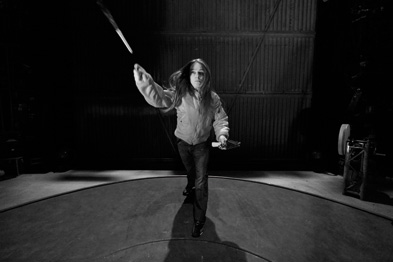
The latest video piece by Simon Mullan was shot and produced in Stockholm in May this year with one of the last remaining knife throwers worldwide. The artist becomes the focus and he is also the target. Here a confrontational encounter is witnessed between the performance artist and the knife throwers. Mullan choses to be subjected to an old ritualistic fairground act. Central to the piece is the two man facing each other in their roles and respective professions. The performance is punctuated by the rhythm of the knives piercing into the turn table also known as the ?wheel of death?. The artist is deliberately encountering a feeling of mortality, total helplessness and compliance while there is an anticipation felt from him as well as the viewer. Curiosity and arousal of the ten knives being thrown ceremoniously and intermittently at the artist transport the viewer into the artists place. With the fortuitous outcome a sense of relief is felt at the end of the performance. Simon Mullan is searching in all his work for the point of no return. He is also addressing the questions of masculinity, machoism, innate fear and pathos. The notion of drama is elementary.
Personal Information: Date of Birth: 28.04.1981 Place of Birth: Kiel , Germany Citizenship: German Based in Stockholm and Berlin. Education : University of applied arts Vienna / Transmedial Art. 2001-2007 Royal University College of fine art Stockholm / Video Department 2008-2009.
Simon Mullan
Teaser02#
Video | dv | color | 2:52 | Sweden | 2009
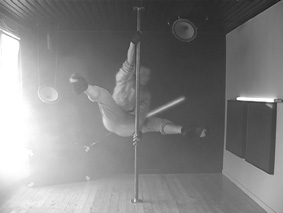
Teaser02# 00:01:10:07 min Mini Dv / B+W Schweden 2009 Teaser02# Zu sehen ist ein Junger Tänzer der Uebungen an einer Pole Stange betreibt. Die Zeitlupe unterstützt hierbei die Ästhetik des Tanzes. Der Ton besteht aus der Original Ton Aufnahme. Das Video behandelt die Thematik Tanz. Tanz als Kampf gegen die Langeweile, das ausleben von Bewegung, Energie als Form von Kunst . Der Junge Tänzer ist teil einer Generation die hier wieder gegeben wird. Eine Generation die sich mit Thematik des Überkonsum und dessen Stagnation befasst. Eine : alles ist möglich Stimmung, die oft zum Verdruss führen kann. Der Tänzer und seine uebungen, die er alleine, und nur für sich macht , zeigen eine Möglichkeit des ausleben, des kämpfen für werte abseits von Alkohol und Drogen. Der Titel Teaser , legt sich an das wort ? Teasing ? und lässt auch erahnen das dieses kurze Video erst der Anfang ist ,von einer weiteren Auseinandersetzung mit der Thematik.
Simon Mullan Lebt und Arbeitet in Stockholm ( Sw), sowie Wien (A) Geboren am 28.04.1981 in Kiel, Deutschland. Aufgewachsen , gemeinsam mit vier Geschwistern in Österreich , Wien . 1999 Abschluss mit Abitur am Wirtschaftsgymnasium,Anton Kriegergasse in Wien . Künstlerische Ausbildung an der Universität fuer angewandte Kunst Wien ,in der Klasse von Professor Brigitte Kowanz / Transmediale Kunst . Seit 2008 in Stockholm Schweden. Einjähriges Studium an der Königlichen Universität für Bildende Kunst Stockholm , im Bereich Video . (2008-2009) Während des Künstlerischen Studiums entwickelte sich ein besonderes Interesse am Medium Video. Hier ,in besonderen immer in der Mitte zwischen bewegtem Bild und dem festgehaltenem Moment in der Fotografie. So liegt es nahe , dass nun viele Video arbeiten in Zeitlupe zu sehen sind. Die Bewegung oft kaum merkbar ,der Rahmen gewählt als wäre es ein Foto. Während der Ausbildung, wurde bei Harun Faroki, sowie Ruth Noak Film und Video analysiert und eine eigene Ästhetik geformt. Über die Jahre entstanden so viele Video arbeiten , oft werden soziale Themen anhand von interesanten charaktären gezeigt, seien es Behinderte Menschen , oder Immigranten und ihr Dasein in einer Stadt wie Wien . Die arbeiten sind meist einfach gehalten . Kurze Statements oft mit Ironie und Humor.

Antoni Muntadas
In Girum Revisited
Video | hdv | color | 30:0 | Spain | 2018
Barcelona-born, but a longtime New Yorker, Antoni Muntadas figures among a first generation of artists investigating the social and political significance of information and broadcast media. This thirty-year retrospective, first seen at the Pinacoteca do Estado de Sao Paulo, includes several videos from the pre’fiber optic era, such as Video Is Television’, 1989, which magnifies and distorts images from a host of appropriated sources, including several Hollywood films (Poltergeist, Network). Backed by a plunking score, the nearly indecipherable TV images are overlaid with captions such as CONTEXT and FRAGMENT: blunt reminders of mass media’s partiality and its constitutive power. An even earlier interactive installation, On Subjectivity, 1978, invites visitors to comment on media images divorced from their original context and therefore’a critical ‘therefore’ for the artist’shorn of their original meaning.
Antoni Muntadas
In Girum Revisited
Video | hdv | color | 14:26 | Spain, Italy | 2016
Antonio Muntadas
On Translation: Fear/Miedo
Experimental doc. | dv | color | 30:0 | Spain, USA | 2005
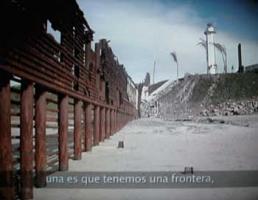
On Translation: Fear/Miedo is a televised intervention aimed at the border between the U.S. and Mexico. Combining interviews, documentary footage, and journalistic material, Muntadas seeks to reveal the fear that the border inspires on both sides of the divide, and how this fear is constructed. The interviews feature those who have experienced first-hand the tensions generated by the border. The work was made for broadcast in Tijuana, San Diego, Mexico City, and Washington D.C. in 2005.
Antoni Muntadas
On Translation: Açik Radyo
Experimental doc. | dv | color | 31:41 | Spain, Turkey | 2010
Antonio Muntadas est un artiste majeur de ces 50 dernières années. Il est né en Espagne en 1942, vit à New-York depuis 1971. En considérant les médias comme un instrument de socialisation et de normalisation, les vidéo et installations de Antonio Muntadas, qui sont reconnues à l`échelle internationale, explorent les messages contradictoires diffusés au travers des médias écrits et télévisés, leur organisation et leur langage. A travers son ?uvre, Muntadas re-conceptualise l`imagerie disponible en vue de susciter chez le spectateur une réflexion quant à la signification des messages, créant ainsi une brèche dans la construction uniforme du "flot médiatique", ce flux d`informations managé par les publicitaires dans le but de leur totale consommation, brute de toute analyse par le public. Dans son film Political Advertisements (présenté en coopération avec Marshall Reese), Muntadas nous présente un pays de la manipulation, le pays des politiques télévisées. Son film Between The Frames était axé sur l`univers de l`art et présentait des interviews révélant les entrelacs structurels venant établir le mode de communication de l`art, sa construction et son commerce. Son travail fait partie des collections permanentes du MuHKA, Musée d?art contemporain d?Anvers, Belgique, du Musée d?art contemporain de Valladolid, Espagne, du Musée national d?art contemporain d?Athènes. En dehors des nombreuses projections de son travail vidéo, le travail de Muntadas a été présenté au musée d?art contemporain de Barcelone, à la Kunsthalle de Vienne, au centre Witte de With à Rotterdam, au SMAK à Gand, Belgique, au Ludwig Museum Budapest. Il a été professeur invité au Fresnoy. Il est présenté cette année à la Biennale de Venise. Dans ses installations, projet en espace public, et ses vidéos, Muntadas déconstruit le système de représentations et d`information qui prévaut dans le paysage médiatique contemporain. Il étudie les mécanismes invisibles qui régissent les informations dans la production et la réception du contenu des médias de masse. Il analyse la consommation de l`information et le processus par lequel elle est manipulée par le pouvoir, la propagande et le profit.
Antoni Muntadas, Marshall REESE
Political Advertisement VII, 1952 - 2008
Experimental doc. | dv | color and b&w | 75:0 | Spain, USA | 2008
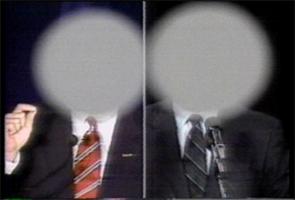
Antonio Muntadas and Marshall Reese have been documenting the selling of the American presidency since 1984, and have expanded and updated the series with every election. Political Advertisement 2000 features ads from the 1950s to the present, including the 2008 campaign. As Muntadas and Reese trace the development of the TV spot, what emerges is the political strategy and manipulative marketing techniques of the American televisual campaign process. "Political Advertisement 2008" includes many rare spots, some never before seen. Edited without commentary, there`s an endless stream of candidates, from Eisenhower to Obama and McCain, who are sold like commercial products.
Examining the media as an instrument of socialization and normalization, Antonio Muntadas¹s internationally recognized videotapes and media installations investigate the contradictory messages projected by print and broadcast media, architecture, and language. Throughout his work, Muntadas re-contextualizes available imagery in order to provoke the viewer into rethinking the meaning of the messages, creating a breach in the uniformly constructed "media flow," a stream of information engineered by advertisers to be consumed whole, unanalyzed by the home audience. In Political Advertisements, (edited with Marshall Reese), Muntadas shows us a land of manipulation?the land of television politics. His Between The Frames focuses on the art world and presents interviews that reveal the interwoven structures delimiting how art communicates, how it is made, bought, and sold.

Antonio Muntadas, Marshall REESE
Political advertisement 2004
Experimental doc. | dv | color | 60:0 | Spain, USA | 2004
Antonio Muntadas and Marshall Reese have been documenting the selling of the American presidency since 1984, and have expanded and updated the series with every election. Political Advertisement 2000 features ads from the 1950s to the present, including the 2004 campaign. As Muntadas and Reese trace the development of the TV spot, what emerges is the political strategy and manipulative marketing techniques of the American televisual campaign process. Political Advertisement 2004 includes many rare spots, some never before seen. Edited without commentary, there`s an endless stream of candidates, from Eisenhower to Al Gore, who are sold like commercial products.
Examining the media as an instrument of socialization and normalization, Antonio Muntadas¹s internationally recognized videotapes and media installations investigate the contradictory messages projected by print and broadcast media, architecture, and language. Throughout his work, Muntadas re-contextualizes available imagery in order to provoke the viewer into rethinking the meaning of the messages, creating a breach in the uniformly constructed "media flow," a stream of information engineered by advertisers to be consumed whole, unanalyzed by the home audience. In Political Advertisements, (edited with Marshall Reese), Muntadas shows us a land of manipulation?the land of television politics. His Between The Frames focuses on the art world and presents interviews that reveal the interwoven structures delimiting how art communicates, how it is made, bought, and sold.
Oscar Muñoz
Linea del destino
Video installation | dv | black and white | 1:55 | Colombia | 2006
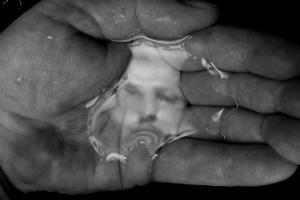
Line of destiny (2006) is Óscar Muñoz?s latest video, where he synthesizes in a very simple action, elements and preoccupations which he has worked for the past years on the relation between fixation and memory. Based on the original idea of the Narcissus myth, a man who stares at himself in the reflection of the water that he holds in his hand ?during the development of this action, the reflection/portrait is as well in a constant making and unmaking of itself? even the theme of photography and its fixation: the video seems to be an intention to reveal and at the same time a liquid and fluid portrait, which at the end detaches itself because of its impossibility to hold the water in his hand.
Was born in Popayán, Colombia, in 1951. He lives and works in Cali. He participated in several group exhibitions since 1980, and in international events such as the XIX Sao Paulo Biennial in 1987; the first Kwangju Biennial, in South Korea 1994; the FotoFest, Houston, in 1996; the VI Havana Biennial in 1997 and the VIII Bogotá Art Biennial in 2002. From the beginning of his career as a photo-realist drawing artist, he has developed his work based on photography. Since the Narcisos series, first shown in 1995 at the La Tertulia Museum of Modern Art (Cali, Colombia) , Muñoz has explored portrait and its relationship with the passing of time. This ork has made him come to inquire, through diverse media and supports, the fundamental elements of image from antagonist opposites like literal/metaphoric, reality/fiction
Ambre Murard
A perte de vue
Video | dv | color | 7:36 | France, Tibet | 2012
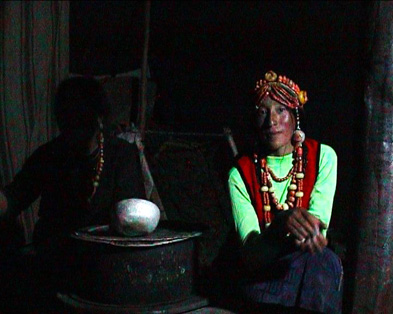
Un lent travelling révèle des visages et silhouettes colorées dans le noir : fragment de la vie d`une famille nomade sous la tente. Le chant suraigu d`une femme dit l`immensité du grasseland au dehors.