Catalogue > Search
Results for : Tout le catalogue
Jorunn Myklebust Syversen
Cyrk
Experimental doc. | hdv | color | 20:19 | Norway | 2014
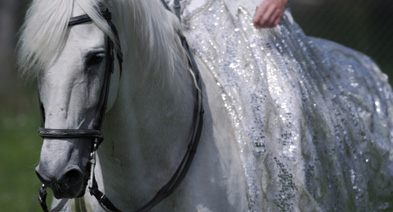
In Cyrk we meet the Circus Arnardo and the people who work there. The film stylises the life of the circus and its main character. Through the interplay of fact and fiction, the film investigates the tricks and devices used in our various forms of media and our different ways of perceiving the world. Cyrk wishes to challenge our need to understand and find meaning in the things we are asked to take on trust. Exploring the relationship between subjectivity and objectivity, between body and mind, the film conveys both the physical and the emotive aspects of the main character’s story of grief and loss. Thematically, it revolves around the fear of meaninglessness as a human disposition, which we confront by seeking structure in the ideas of religion, ideology and culture. It also raises questions about the way this search for meaning, order and system – on both the private and the social level – can lead to the categorisation and stigmatisation of certain groups and individuals.
Jorunn Myklebust Syversen (b. 1978) graduated from Bergen National Academy of Art and Design in 2005. She lives in Oslo and is working in the field of film and videoart. She has participated in numerous international festivals, screenings and exhibitions and has received several national grants.
Jorunn Myklebust Syversen
Violent Sorrow Seems a Modern Ecstasy
Experimental video | dv | color | 9:0 | Norway | 2006
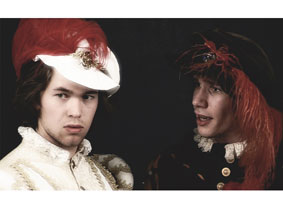
The video ? Violent Sorrow Seems a Modern Ecstasy? is sampled by different Shakespeare plays into a new manuscript. Syversen used sentences from Macbeth, Othello, Romeo and Juliet and Hamlet, cross clipped them and put them together to a new drama. Every reference of names and time is removed. No words are changed or added to the script except grammar in order to obtain a logical structure and coherency. The new story is a dialog between two unnamed young men. X is suicidal Y tries to pursue X that life is worth living. X cannot overcome and he decides to salve his friend from life and he therefore kills him. He thereafter stabs a knife into his own heart and dies. The composer Jan Erik Mikalsen wrote the music to the video.
Jorunn Myklebust Syversen was born in Gol, Norway 1978. She graduated from Bergen National Academy of the Arts in 2005. She lives in Oslo and is working in the field of experimental video, photography, and installations. She has participated in numerous international festivals, screenings and group exhibitions and has received several national grants. Last year her work was shown in Paris Photo, Caroussel du Louvre, Paris. Together with artists like Eija-Liisa Ahtila, Johanna Billing, and Miriam Bäckström she has been shown in Malmø, Berlin, and New York in the screening project UNCLASSIFIABLE. She participated in, produced, and curated the video screening ?Behind the Scene? at Frogner Kino in Oslo showing other artists like Miriam Bäckström, Per Teljer, Tova Mozard and Ane Lan.
Galina Myznikova, Sergey Provorov
Otchajanie
Video | dv | black and white | 29:50 | Russia | 2008
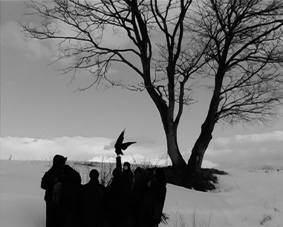
Insignificant within the immensity of a snowy landscape, a handful of men oppose their physical resistance to the force of nature. United, close together, they tackle the hostility surrounding them by way of a strangely choreographed, hesitant ballet. A visual poem of furious beauty, Despair depicts the mechanisms of a world governed by crows.
Since 1993 Galina Myznikova and Sergey Provorov have created a large number of projects, which demonstrate a wide range of the artists` interests and their inclination to creative experiments in sphere cinema and of contemporary art. Among them there are experimental films which took part in numerous international festivals around the world (such as Rotterdam, Oberhausen, Clermont-Ferrand, Milan, Hamburg, Montreal, Moscow, Pesaro. Sao Paulo and others). Many of films have won several awards (including Tiger Award for Short Film of 38th International Film Festival Rotterdam and Gran Premio of Asolo International Art Film Festival ); and belong to the museum collections; a number of installations created as joint international projects and presented at some Biennale (such as Moscow Biennale of Contemporary Art /Moscow/, The young artist`s Biennial/Bucharest/, KunstFilmBiennale/Cologne/, Biennial of Moving Images/Geneva/. In 2005, Myznikova and Provorov /PROVMYZA/ represented Russia with innovative project ?Idiot Wind? at 51st Venice Biennial. In 2007 they became nominees of Main National Premiums of Contemporary Art ?Innovation? and ?Kandinsky Award?.

Hira Nabi
All That Perishes at the Edge of Land
Documentary | hdv | color | 29:48 | Pakistan | 2019
In this docu-fictional work, ‘Ocean Master’ a container vessel is anthropomorphized, and enters into a dialogue with several workers at the Gadani yards. The conversation moves between dreams and desire, places that can be called home, and the structural violence embedded in the act of dismembering a ship at Gadani. As the workers recall the homes and families they left behind, the long work days mesh indistinguishably into one another, the desperation that they carry with them like shackles rises to the forefront, and they are forced to confront the realities of their work in which they are faced with death every day. How may they survive and look towards the future?
Hira Nabi is a filmmaker and visual artist, based in Pakistan. Her work thinks through the value associated with labor, networked industrial practices, botanical migrations and their impact upon cultural identities, and notions of homemaking. She lives and works in Pakistan.

Tomomichi Nakamura
Ari
Animation | dv | color | 11:0 | Japan | 2008
Ants and a crow in this work symbolize intermediaries between a big man, a small man, and a pregnant girl. It projects complexities of life and death in this living world. Through phantasmagoria, it reverses an ordinary image of life and death, and questions its human-centric view.
Nakamura Tomomichi (Male) Nationality: Japanese Birth: Jan. 10 1972
Mayumi Nakazaki
hunt hunter hunted
| dv | color | 13:0 | Japan | 2009
It consists of a video footage of a socializing event for people and their dogs in the central park in New York City and the voice over. The event includes activities such as the Best in Park dog show, games, contests, and agility tests, etc. The voice over is not directly related to the event itself, but written based on a conversation between two artists dealing with photography. The artists have photographed hunting scene, and they are looking at their pictures of dead animals. This work investigates how we relate to animal, and questions our industrialized world surrounded by animal imagery.
Born in Japan and based in the Netherlands since 1994, Mayumi graduated from Gerrit Rietveld Acadmy in 1999. She is an alumna of residency programs such as Rijksakademie van Beeldende Kunsten in Amsterdam (2000-2001), Location One in New York (2005-2006). Exhibitions/presentations include: Jamaica Center for Arts and learning in NY, Macy Art Gallery Colombia University New York/Art Basel Miami Verge Fair, Kunstpavilion Zagreb Croatia, Stedelijk Modern Art Museum Amsterdam, The Netherlands Institute for Media Art, and Viper International Film Video and New Media Festival, Basel. She has received awards and grants including the Japanese government overseas study program, Fonds bkvb NL, Rene Coelho Prize from Netherlands Institute for Media Art Amsterdam, among others.
Rebekka Nanna, Pernille Lystlund Matzen
Hestebetvinger
Video | 4k | color | 15:0 | Denmark | 2015
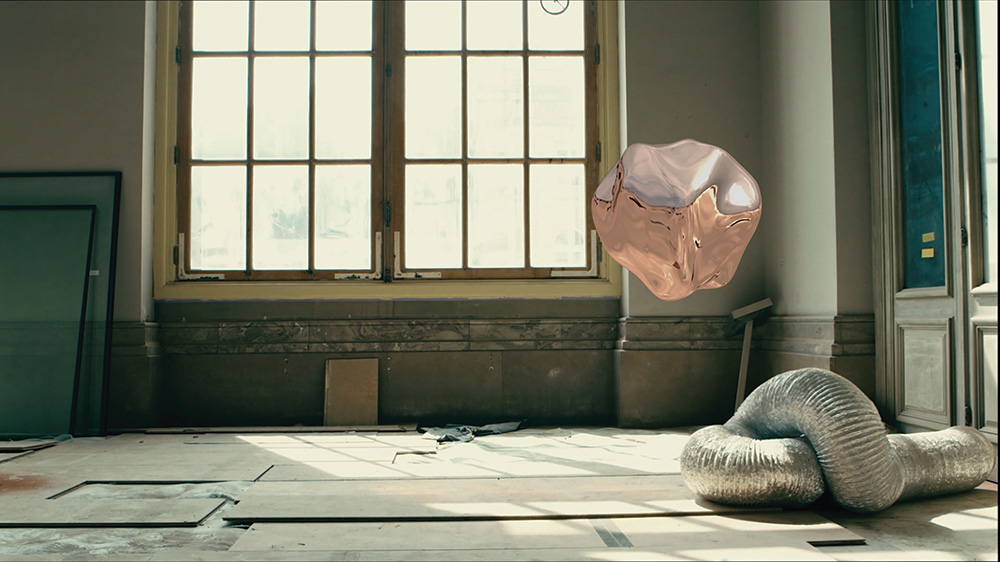
An easily overlooked T-junction in Copenhagen`s Sydhavn district is the location of a dramatic statue. In the midst of everyday urban space rises a bronze sculpture of a young man who is about to tame two unruly horses. The essay film ?Breaker of Horses? delves into the bronze sculpture and follows the hidden stories that are contained in the cast. This leads us back to the genesis of the sculpture in an antique Greek myth, to a Belgian Africa museum and deep into Europe`s colonial past. With formal nods to contemporary video artists such as Camille Henrot and Hito Steyerl, ?Breaker of Horses? is an overheated information flow of images, digital productions and archive material. The visual abundance is coloured by a soundtrack that alternately seethes with synthetic sound effects and detached bits of songs about the statue and its history. The film traces the copper material in the bronze sculpture back to the Congo, where extraction of copper through forced labour and slavelike conditions for the Congolese comprised one of the economical foundations for the Belgian King Leopold?s empire. Solidly placed in the era of today, ?Breaker of Horses? is a video work that turns to the past.
Nanna Rebekka is an independent filmmaker based in Copenhagen. Her work lies within the realm of hybrid fiction, documentary and video art. She has studied filmmaking at Center for Digital Arts and Experimental Media, University of Washington and at School of the Arts, Media, Performance & Design, York University. She is currently pursuing a masters degree in Visual Culture at University of Copenhagen. She is a former member of Copenhagen LGBTQ Film Festival. Pernille Lystlund Matzen (b. 1986) is an independent writer and filmmaker currently living in Copenhagen. Her work concentrates on new documentary forms, video art and essayistic modes of filmmaking. She holds a masters degree in Art History and Modern Culture from Columbia University, Universitat der Kunste, Berlin, and Copenhagen University. She currently works as an art critic at the Danish newspaper Information. Together, Nanna and Pernille have directed the short film `Breaker of Horses`.
Mai Yamashita Naoto Kobayashi
Miracle
Experimental video | dv | color | 3:10 | Japan | 2004
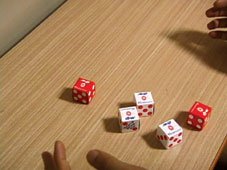
In this piece, five dice are thrown. No matter when they are thrown, they show the same spots. It hints that hundreds, thousands even, of failed miracles definitely exist, that is to say in "daily-life". (Actually, dice were thrown every day for two months.)
The Japanese artist duo Mai Yamashita (born 1976) and Naoto Kobayashi (born 1974) work in the field of multi-media. Both of them studied at MFA Tokyo National University of Fine Arts and Music. Since their arrival in Europe in 2004, they have been living and working in Europe. They have participated in major international exhibitions and festivals: Philip Morris K.K. Art Award 2002 "The First Move", Tokyo International Forum, Japan; transmediale.06, Akademie der Künste, Berlin, Germany; ARS 06, The Museum of Contemporary Art KIASMA, Helsinki; LichtRouten Lüdenscheid, Lüdenscheid, Germany; etc.
Mai Yamashita Naoto Kobayashi
Release of mineral water
Experimental doc. | dv | color | 5:33 | Japan, Germany | 2003
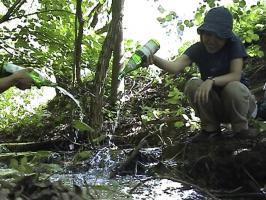
Bottles of German mineral water, "Tonissteiner", were bought from a package store in Japan and taken to their source, the Eifel region in Germany, where they were released.
The Japanese artist duo Mai Yamashita (born 1976) and Naoto Kobayashi (born 1974) work in the field of multi-media. Both of them studied at MFA Tokyo National University of Fine Arts and Music. Since they came to Europe in 2004, they have been living and working in Germany. They have participated in major international exhibitions and festivals: Philip Morris K.K. Art Award 2002 "The First Move", Tokyo International Forum, Japan; transmediale.06, Akademie der Künste, Berlin, Germany; ARS 06, The Museum of Contemporary Art KIASMA, Helsinki; LichtRouten Lüdenscheid, Lüdenscheid, Germany. etc.
Francis Naranjo
...agosto 2007...
Experimental video | 0 | color | 18:0 | Spain | 2008
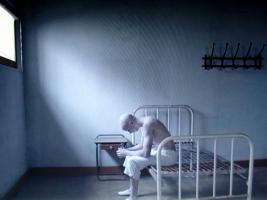
?August 2007? (Francis Naranjo, video made in 2008, Spain, in Spanish with English subtitles, based on a poetic text; duration 18 minutes, PAL) This video is the result of the collaboration between three creative disciplines: image, Francis Naranjo; music, Jose Manuel López López; poetry, Dionisio Cañas. The video ?August 2007? is a beam of light, an encounter, of visual, acoustic and poetic information. Three elements, image, music and word, are combined in the virgin screen. Risky and a looked for encounter of three nomadic planets that floated in the uncertain space of pre-creation, of a future event: a video (Francis N), a musical composition (Jose Manuel L L), a poem (Dionisio C). The narrative resources of image, music and poetry are synchronized by the aesthetic and existential emotion. The three spaces, image, music and poetry, are interlaced creating a spider web in which the glance, the ear and the subconscious mind, that ?is waked up? by the poetic word, catch the spectator in a mortal trap: the one to see himself reflected in the video. The three different concepts of time, image, music and poetry, are a unique labyrinth which only the spectator who does not have a heart leaves undamaged, but the sensible spectator slides tenderly to the exit of the video-labyrinth, a flowery precipice, a creative emptiness, the overwhelming end of a white screen that is not a end but a beginning.
FRANCIS NARANJO 1961, Santa María de Guía. Gran Canaria, España EXPOSICIONES INDIVIDUALES 2008 Re:move. Final Release. Intervenciones en la fachada del Recinto Ferial de A Coruña, EXPOCoruña. España. Mente de adentro. La Nave Espacial. Sevilla. España. 2007 La condición humana / La condition humaine. Instituto Cervantes. París. Francia. Tell me more. Galería AFA. Santiago de Chile. 2006 La línea. (Trama/La línea, junto a Juan Castillo). Galería Gabriela Mistral. Santiago de Chile. Trazo continuo visible o imaginario. Espai d?Art ?La Llotgeta? (CAM). Valencia. España. 2005 illuminazioni urbane. Ecoteca. Pescara. Italia. Red home. Intervención permanente en el edificio de Canarias Cultura en Red (Gobierno de Canarias). Las Palmas de Gran Canaria. España. 2004 IN/OUT. Centro de Arte Juan Ismael. Cabildo de Fuerteventura. España. Iluminaciones. Inauguración de la Casa de la Cultura de Santa María de Guía. Gran Canaria. España. Red time. Kulturprojekt Röda Sten. Göteborg. Suecia. Terapia entrópica. Biblioteca del Gabinete Literario. Las Palmas de Gran Canaria. España. 2003 Terapia entrópica. 108 Contemporary Art. Miami. USA. Tráfico (TRÁFICO). Museo de Arte Contemporáneo (MAC), Santiago de Chile. 2002 White time. Centro de Arte La Regenta. Las Palmas de Gran Canaria. España. White time. Centro de Arte La Granja. Santa Cruz de Tenerife. España. Bakom Ansiktet (Detrás del Rostro). Ekeby Qvarn Art Space. Uppsala. Suecia. 2001 Orden cuántico. Foto-Ars. Lanzarote. España. 2000 The new world border. Galería Por Amor A Arte. Oporto. Portugal 1999 Toponimias. Horno de La Ciudadela. Pamplona. España. 1998 In a Faraway Country, u-topos. (EVENTA 4). Ekeby Qvarn Art Space. Uppsala. Suecia. EXPOSICIONES COLECTIVAS 2008 Ideas y propuestas para el arte en España. Arco?08. Stand del Ministerio de Cultura español. Recinto Ferial Juan Carlos I. Madrid. España. A ras de suelo. Galería Rosa Santos. Valencia. España. Hyper Cinema. (Rencontres Internationales Paris/Berlin/Madrid). Complejo El Aguila. Comunidad de Madrid. Opening. (Rencontres Internationales Paris/Berlin/Madrid). Museo Nacional Centro de Arte Reina Sofía. Madrid. ArteBA? 08. 17 Feria de Arte Contemporáneo. Galería AFA (Santiago de Chile) Buenos Aires. Argentina. Prohiviciones y Normatibas. Off Limits. Madrid. Eröffnungsveranstaltung. (Rencontres Internationales Paris/Berlin/Madrid). Haus der Kulturen der Welt. Berlin. Alemania. Colección de invierno. Galería AFA. Santiago de Chile. Parejas. Colección Antonio P. Martín. Centro de Iniciativas de La Caja de Canarias. CICCA. Las Palmas de Gran Canaria. España. Rastros. Casa de Los Coroneles. La Oliva. Fuerteventura. España. ArtBo?08. Galería AFA (Santiago de Chile). Feria Internacional de Arte de Bogotá. Colombia. Buenos Aires Photo 2008. Galería AFA (Santiago de Chile). Palais de Glace. Buenos Aires. Argentina. 2007 7.1 Distorciones. Documentos. Naderías y Relatos. Centro Atlántico de Arte Moderno (CAAM). Las Palmas de Gran Canaria. España. Arco?07. Galería Pack (Milán). Recinto Ferial Juan Carlos I. Madrid. España. Deambulatorios de una jornada, en el principio y el proyecto Tindaya. Intervención en el Malpaís de la Oliva. Cabildo de Fuerteventura. España. I Encuentro entre dos Mares.Bienal São Paulo ? Valencia. La Nave, Puerto de Sagunto. Valencia. España. From the Vault. Galleria Pack. Milano. Italia. Signos de la Ciudad. Centro Andaluz de Arte Contemporáneo (CAAC), Sevilla. España. Iberoamérica Glocal: Entre la Globalización y el Localismo. Casa de América. Madrid. 8ª Bienal de Vídeo y Nuevos Medios de Santiago de Chile. Chile. Rescate. Centro Cultural Matucana 100. Santiago de Chile. Signos de la Ciudad. Centro de Cultura Antiguo Instituto. Ayuntamiento de Gijón. Rencontres Internationales Paris/Berlin/Madrid. Centre Georges Pompidou. Cinema L? Entrepot. Instituto Cervantes. París. 2006 Arco?06. Galería Pack (Milán) y Galería Punto (Valencia). Recinto Ferial Juan Carlos I. Madrid. España En español - spanish as a global language - an arts festival. Instituto Cervantes. Nueva York. USA. Sin miramiento alguno [arte iberoamericano actual], 9ª bienal de la Habana, La Habana, Cuba. Las ciudades invisibles. V Festival Internacional de Cortometrajes-Almería en corto. Patio de Luces de la Diputación Provincial de Almería. España. Pabellón dd, versión final. Centro de Arte Juan Ismael, Cabildo de Fuerteventura. España. En el país de los ciegos. [video art screening]. Instituto de América / Centro Damián Bayón, Santa Fe, Granada, España. New Mystics. Sala de Exposiciones Cabrera Pinto, La Laguna, Tenerife. España. Vigilancia. AYN Centro de Arte. Madrid. España. CITÉINVISIBLE/INVISIBLE CITY. Bienal MIVEAM. New National Library of the Quebec. Montreal. Canadá. PULSAR. International event. The Caracas Contemporary Art Museum. Venezuela. XIX BIENNAL IBIZAGRAFIC?06. Museu d?Art Contemporani d?Eivissa. Islas Baleares. España.
Francis Naranjo
acto frívolo
Art vidéo | 0 | color | 8:46 | Spain | 2007
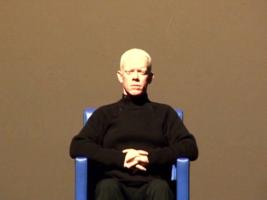
Behind always remind this part of everything, this part that everyone knows, this part that none see and that is so because a prohibition, it is because we can?t remember the way to look at things lacking by force of such a habit in force the principle the rule for hiding origins and roots keeping ourselves thinking that we come from nowhere, from nothing and more if we talk of art; for too many people a subject that only depends on creativity or equally depending on alien forces, like the smile of the trapeze artist that hides his effort to keep in balance, or like the cry of the clown that hides the origins of his laugh. It is always that way and we are used to accept that things happen without a reason, that when things show you the inner part, what is behind, to refuse to any kind of understanding and this is your aim toward what is moving in front of you and them you look for a judgement that you will never get because your luck of habit, as I have said before. And moreover in the slippery slope this Christmas present that we use to call art. Although there are a few artists, and I will not give now that uncertain list, that keep on trying to show the hidden efforts that is behind the trapeze artist?s smile or the clown´s sorrow; Like Francis Naranjo, and I can hardly remember the first time he fixed the cables over one of his characteristic environments, that in the beginning were mere installations and today have become really heteroclite worlds. Those cables where there in order to aloud you in seeing things in the family tree, moreover in such extreme cases like Francis Naranjo´s first works always in the border of the unbelievable. Judge it by yourself and say that if this little environment of absolute reality could not seem a fake without the inclusion of the inner part of the scene, if it would not be consider in a different and colder way without the drama you have seen disentangled on stage, as you can see in the length of the curtains and number of the stalls. In front of such evidences, you just can think the main actor is no so important because in the middle of the inner part he becomes our equal, like the drag queen who undresses herself showing the set of fake attributes that conform her appearance. It is like our own life that runs in front of us without a certain reason. A reason that you ignore just because never have been aloud for looking behind and therefore you luck of such a habit. Nilo Casares. 2007
FRANCIS NARANJO 1961, Santa María de Guía. Gran Canaria, España individual exhibitions (selection) 2007 La condición humana / La condition humaine. Instituto Cervantes. París. Francia. Tell me more. Galería AFA. Santiago de Chile. 2006 La línea. (Trama/La línea, junto a Juan Castillo). Galería Gabriela Mistral. Santiago de Chile. Trazo continuo visible o imaginario. Espai d?Art ?La Llotgeta? (CAM). Valencia. España. 2005 illuminazioni urbane. Ecoteca. Pescara. Italia. 2004 IN/OUT. Centro de Arte Juan Ismael. Cabildo de Fuerteventura. España. Red time. Kulturprojekt Röda Sten. Göteborg. Suecia. 2003 Terapia entrópica. 108 Contemporary Art. Miami. USA. Tráfico (TRÁFICO). Museo de Arte Contemporáneo (MAC), Santiago de Chile. collective exhibitions (selection) 2007 Arco?07. Galería Pack (Milán). Recinto Ferial Juan Carlos I. Madrid. España. Deambulatorios de una jornada, en el principio y el proyecto Tindaya. Intervención en el Malpaís de la Oliva. Cabildo de Fuerteventura. España. I Encuentro entre dos Mares.Bienal São Paulo ? Valencia. La Nave, Puerto de Sagunto. Valencia. España. From the Vault. Galleria Pack. Milano. Italia. Signos de la Ciudad. Centro Andaluz de Arte Contemporáneo (CAAC), Sevilla. España. Iberoamérica Glocal: Entre la Globalización y el Localismo. Casa de América. Madrid. 8ª Bienal de Vídeo y Nuevos Medios de Santiago de Chile. Chile. Rescate. Centro Cultural Matucana 100. Santiago de Chile. 2006 Arco?06. Galería Pack (Milán) y Galería Punto (Valencia). Recinto Ferial Juan Carlos I. Madrid. España En español - spanish as a global language - an arts festival. Instituto Cervantes. Nueva York. USA. Sin miramiento alguno [arte iberoamericano actual], 9ª bienal de la Habana, La Habana, Cuba. New Mystics. Sala de Exposiciones Cabrera Pinto, La Laguna, Tenerife. España. Vigilancia. AYN Centro de Arte. Madrid. España. CITÉINVISIBLE/INVISIBLE CITY. Bienal MIVEAM. New National Library of the Quebec. Montreal. Canadá. PULSAR. International event. The Caracas Contemporary Art Museum. Venezuela. XIX BIENNAL IBIZAGRAFIC?06. Museu d?Art Contemporani d?Eivissa. Islas Baleares. España. 2005 Art Miami. Galería 108 Contemporary Art. Miami. USA. Arco?05. Galería Pack (Milán). Recinto Ferial Juan Carlos I. Madrid. España. Art Cologne. Galería Punto (Valencia). Köln. Alemania. Rencontres Internationales Paris/Berlin. Cinema L? Entrepot. París. 2004 Art Philadelphia 04. Gallery 108 Contemporary Art. Pennsylvania Convention Center. USA. Unidad mínima de habitación. Espai D`art La Llotgeta. CAM. Valencia. España. Seducciones y Pasiones. Espacio C. Camargo. España. _to the other side_ in the context of _unzipping codes_ at Nabi Center in Seoul. South Korea. 2003 Paralelo [3] Meridiano [3]. (Terry Berkowitz, Juan Castillo, Francis Naranjo). El Almacén, Cabildo de Lanzarote, Arrecife. España. Las tentaciones de San Antonio. Centro Atlántico de Arte Moderno (CAAM), Las Palmas de Gran Canaria. España. Pieles. Centro de Arte La Regenta. Las Palmas de Gran Canaria y Colegio de Arquitectos, Santa Cruz de Tenerife. España. Konstens Axel. Konceptkonstmuseum, Rydboholm, Suecia. Observatori?03. Laboratorio internacional de investigación artística. Museo de las Ciencias Príncipe Felipe. Valencia. España. Fotonoviembre. La Recova. Santa Cruz de Tenerife. España.
Francis Naranjo
DISTOPIA EN EL SISTEMA BINARIO
Experimental video | dv | black and white | 7:21 | Spain | 2011
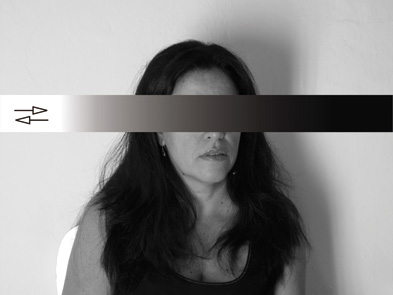
The protagonist of the video is located on a white, sterilized stage without any possibility for us to be distracted from the speech: a person defined as transgender tells us, opened heart, but concealing his/her identity, his/her experience for defending being himself/herself, far from the placements of gender and sex. After all sex is biological, but gender is a social construct and as such is built and is changed. The content of his speech, also by the concealment of his/her identity, can be extrapolated to other areas of a binary and Manichean society that feels more secure to pigeonholing people. Therefore, Dystopia in the binary system is presented more as a space of visibility of diversity.
Francis Naranjo is a Spanish artist born in Santa María de Guia, in the Canary Islands, in 1961. He has produced videos and installation pieces. His work develops problem areas pertaining to the society of information, highly technological, in which we are being controlled or in which we control, as well as globalization and the general use of new technologies and the human condition. Among other places, his work has been exhibited in the in different cities of the world like Santiago de Chile, Berlín, Nueva York, Göteborg, Miami, Uppsala, Madrid, París, Sevilla, Valencia, Casablanca, Tel Aviv, Montreal, South Korea, etc.
Francis Naranjo
EN UN PAIS LEJANO: UTOPOS
Video | | color | 4:50 | Spain | 2013
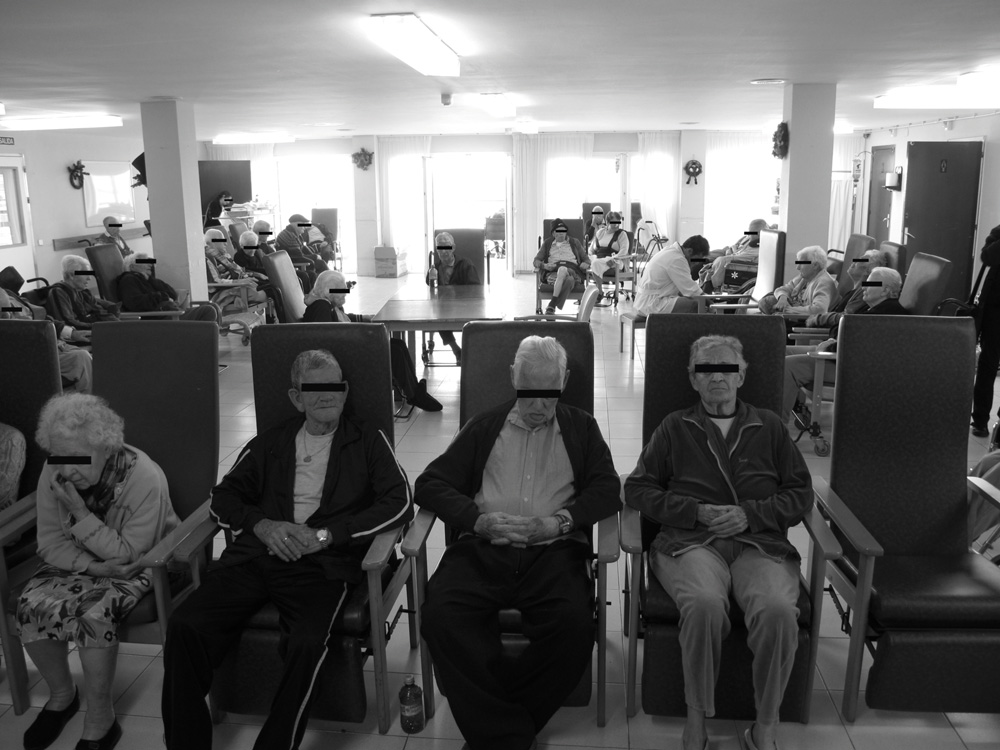
This is an experimental video work based on the premise of the introductory text: In a very far land, there exist some mythological creatures called SHICHAS. They combine the different gender alternatives and have the quality to absorb all negative energies keeping them inside. The whole piece has been built using a technique that links photograms together. It starts with a white screen where a set of black rectangles progressively spread on the surface of the image. Then, this image merges with another where some characters appear, who have their eyes covered with rectangles which hide their identities. This image represents the main hall of a geriatric, where we can see many residents whose memories are now defeated by their absence of identity. The work ends with a review of moments represented by souvenirs and the twist of those creatures that absorb the negative energy and stand for the globality, now sick and amnesic. The soundtrack is made with the sounds of corporal fluids.
FRANCIS NARANJO 1961, Santa María de Guía. Gran Canaria. España http://www.francisnaranjo.blogspot.com/ INDIVIDUAL PRESENTATIOS (SELECTION) 2014. Discordancias. Parque Cultural de Valparaíso. Chile. En un país lejano: utopos. Club Kitel Atacama. Bahía Inglesa. Copiapó. Chile. 2013. La paz armada. Centro de Arte Contemporáneo Wilfredo Lam. La Habana. Cuba. SAKER i LIVET . Galleri Lokomotiv. ÖKKV Kulturfabriken. Ömsköldsviks. Suecia. EUROPA (El continente triste). Centro Cultural de España. La Paz. Bolivia. 2012. La coleccionista de luces. Museo de Arte Contemporáneo. MAC. Santiago de Chile. Chile. White. Librería Fayad Jamís. XI Bienal de La Habana. Cuba. 2011. Personne n’est plus. Galería del Institut Français de Madrid. España. None is more. Instituto Cervantes de Rabat. Marruecos. ….agosto 2007…. Inauguración de Centro de Cultura Contemporánea San Martín. Cabildo de Gran Canaria. Las Palmas de Gran Canaria. España. Smile. Fundación Municipal de Cultura, Educación y Universidad Popular. Centro de Cultura Antiguo Instituto. Sala 1. Ayuntamiento de Gijón. España. GROUP PRESENTATIONS (SELECT) 2014. Cruces. Museo Nacional de Arte. La Paz. Bolivia. Festival de cine EL LUGAR SIN LÍMITES. Quito, Guayaquil, Manta, Cuenca. Ecuador. Cruce de colecciones (25 años del Centro Atlántico de Arte Moderno-CAAM).Centro Atlántico de Arte Moderno (CAAM). Las Palmas de Gran Canaria. España. Prohiviciones y Normatibas. Gabinete de Hygiene. Mercado de Tapineria. Valencia. España. 2013. SIART. Bienal de Arte Internacional de Bolivia. 8ª Versión. La Paz. Bolivia. V Semana de Vídeo Iberoamericano. Centro Cultural de España. La Paz. Bolivia. Cartografías de lo (im)posible. Centro de Arte Contemporáneo Wilfredo Lam. La Habana. Cuba. 12 fotos para 2013. S/t Espacio Cultural. Las Palmas de Gran Canaria. España. V Semana de Vídeo Iberoamericano. Filmoteca de Andalucía. Córdoba. España. 2012. Topographies virtuelles. Rencontres Internationales Paris/Berlin/Madrid. Palais de Tokyo. París. Francia. Reinventar la Isla 2. San Martín Centro de Cultura Contemporánea. Las Palmas de Gran Canaria. España. ALZHEIMER. Parque Cultural Ex Cárcel. Valparaíso. Chile. Identités. Recontres Internationales Paris/Berlin/Madrid. Haus der Kulturen der Welt. Berlín. Alemania. Olympic Fine Arts “OFA 2012”. Barbican Arts Centre. Londres. Reino Unido. Artistas de la Galería. Galería AFA. Santiago de Chile. Mulier-Mulieris. Museo de la Universidad de Alicante. Alicante. España. 11ª Bienal de la Habana. Prácticas artísticas e imaginarios sociales. La Habana. Cuba. A través del cristal. (Visiones fotográficas en la Colección del CAAM). Museo de Esculturas "Abraham Cárdenes". Tejeda. Gran Canaria. España. ArtBooks. Centro de Arte La Regenta. Las Palmas de Gran Canaria. España. 25 años de La Regenta. Centro de Arte La Regenta. Las Palmas de Gran Canaria. España. 2011. III Semana de vídeo Iberoamericano. Filmoteca de Andalucía. Córdoba. España. Revelaciones.Objetos, metáforas y ficciones en la colección del CAAM. CAAM - Sala San Antonio Abad. Centro Atlántico de Arte Moderno. Las Palmas de Gran Canaria. España. Identités. Recontres Internationales Paris/Berlin/Madrid. Centre Pompidou. París. Francia. Tesoros de los Museos del Cabildo de Gran Canaria. Colección del CAAM. Salón Noble del Edifici del Rellotge. Barcelona. España. Metamorphose. Recontres Internationales Paris/Berlin/Madrid. Auditórium del Ministerio de Cultura. Madrid. España. Creative Insomnia – Red night. Atelier Meta-morphic. Madrid. España. Longitudes de onda. Espacio de arte OTR. Madrid. España. Metamorphose. Recontres Internationales Paris/Berlin/Madrid. Haus der Kulturen der Welt. Berlín. Alemania.
Francis Naranjo
Iluminaciones urbanas 1
Art vidéo | dv | color | 4:28 | Spain | 2004
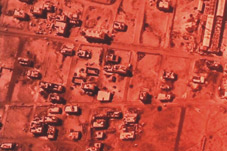
When Bird Songs are all that Abide Everything flows (?panta rehi?), as Heraclitus of Ephesus said some 2500 years ago. And Francis Naranjo, in his new video series, Iluminaciones urbanas (Urban illuminations), seems to be saying that we can?t see the same street twice, even when, as here, its his own street, because everything changes and nothing abides. The cars that animate the urban landscape aren?t the same cars; the sunlight which illuminates our everyday world varies in brightness and shines through distinct clouds; the neighbors we meet in the street look like mutants, they change clothes and moods, sometimes they greet us, at others they?re in a hurry?And us? How many ?I?s are there in ourselves? Moving images, like he world in Heraclitus? philosophy, seem to endlessly reprise themselves?being always different, the sound of bodily fluids accompany them, reinforcing the notion of bathing in a different river, though the river is always the same. Francis speaks of the continual internal and external flow, as though honing to the belief that there are some things which abide. But our biological fluids seem to always find a different path in the vascular labyrinth of our bodies, just as our human and automotive neighbors seem to create a city distinct from our own city with every passing day; just as we do from our own windows, and just as our neighbors do from theirs, always the same, always inert, always looking out on distinct scenes. In the past, it was thought that poor health came from the corruption or putrefaction of our bodily fluids. And bloody concoctions were created to eliminate them, to expel them from our body to flow toward the gutter. Through his videos Francis seems to puncture our idle everyday memory, drawing blood from our routine. But neither the blood flowing from our consciousness, nor we ourselves, would be the same?And maybe we have to repeat this conceptual bleeding forever in an eternal becoming, because everything flows? The Final Journey, by the Spanish poet Juan Ramón Jiménez (Nobel Prize, 1956) is one of the poems which best reflects this struggle/indecision/dichotomy between our ephemeral condition, our human desire for renewal, and our at times unavowed anxiety for permanence and transcendence: ?And I?ll depart. And the singing birds will abide; and my garden, with its green tree and white well, will abide. Every afternoon the sky will be calm and blue; And the church bells will ring in the belfry, Just like they?re ringing now. Those that loved me will pass away; and the village will renew itself each year; and in that whitewashed and florid corner of my garden my spirit will wander, nostalgic? And I?ll depart, and I?ll be alone, without a home, without my green tree, without the white well, without the calm, blue sky? But the singing birds will abide. And the videos of Francis Naranjo will remain to speak about becoming, about the guise of the false changes until the Final Change arrives.
1961, Santa María de Guía. Gran Canaria, España
Francis Naranjo
Los colores de la libertad: Blanco
Video | dv | color | 10:26 | Spain | 2010
Francis Naranjo
Return
Video | hdv | color | 8:12 | Spain | 2012
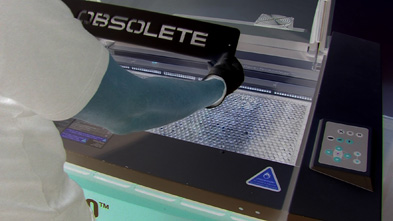
Return is the way back. The journey in the reverse direction. An alternative approach to the beginning. Then, from there, to recover the choice of starting " the new" trip. To get back lucidity from obsolescence.
Francis Naranjo is a Spanish artist born in Santa María de Guia, in the Canary Islands, in 1961. He has produced videos and installation pieces. His work develops problem areas pertaining to the society of information, highly technological, in which we are being controlled or in which we control, as well as globalization and the general use of new technologies. Among other places, his work has been exhibited in the in different cities of the world like Santiago de Chile, Berlín, New York, Göteborg, Miami, Uppsala, Madrid, París, Sevilla, Valencia, Casablanca, Tel Aviv, Montreal, South Korea, La Habana, etc.
Francis Naranjo
Smile
0 | dv | color | 1:10 | Spain | 2009
A voice in of us warns before the slogan that is repeated constantly: HELP, in which a character with their backs to appears right next to a loudspeaker, from where presumably comes the slogan; the character tour in a fused one giving the round and running against the camera, here a smile is generated that it closes the work.
Francis Naranjo is a Spanish artist born in Santa María de Guia, in the Canary Islands, in 1961. He has produced videos and installation pieces. His work develops problem areas pertaining to the society of information, highly technological, in which we are being controlled or in which we control, as well as globalization and the general use of new technologies. Among other places, his work has been exhibited in the in different cities of the world like Santiago de Chile, Berlín, Nueva York, Göteborg, Miami, Uppsala, Madrid, París, Sevilla, Valencia, Casablanca, Tel Aviv, Montreal, South Korea, etc.
Arash Nassiri
Tehran-Geles
| | color | 18:10 | Iran | 2014
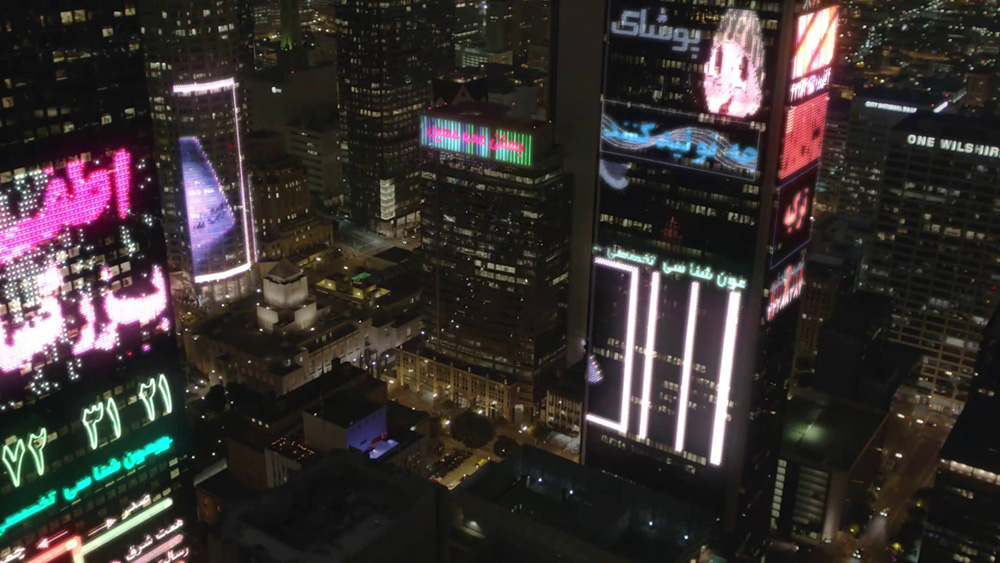
Tehran-Geles is a fictional vision of Tehran, set within the urban landscape of Los Angeles. Through an aerial journey, we discover an architectural transposition of the two cities. While flying over the LA boulevards, personal migrant testimonies echo the collective story of the Iranian capital. Downtown, the buildings are saturated with neon signs pulsating with voices that take us on a hallucinatory trip. Parallel to the science fictional genre – where the present is projected into the future – this short film projects the past of Tehran into the Western present. The production of this short film generated an audio-visual `migration`, where aerial shots of Los-Angeles merge with videos filmed in Tehran and later transported by plane, as well as interviews recorded via Skype in different cities around the world.
Born in 1986 in Tehran, Iran, Arash Nassiri works and lives in Paris, France. Arash graduated from the Ecole Nationale Supérieure des Arts-Décoratifs in 2012. He is also a 2014 graduate of Le Fresnoy, National Studio of Contemporary Arts . Arash’s academic achievements include courses at the Paris National School of Fine Arts (Ecole Nationale Supérieure des Beaux-Arts de Paris) in 2007, and at the University of the Arts in Berlin, where he lived in 2010. Arash has showcased his work in exhibitions, both in France and abroad, including the 2011 Galerie du Crous, the 2013 and 2014 Panorama exhibitions, the Venice Biennale of Architecture, and the "From the object to the city" exhibition organized by the National School of Arts in 2010. In July 2014, his work was featured in cultural magazine, Les Inrockuptibles. Arash has also been awarded the 2014 Cote Court Pantin Grand Prize for Video Art and the Les Amis du Fresnoy Prize. His video Tehran-Geles will be featured in the international film festival of Bucharest in Romania next Decembre.
Frederic Nauczyciel
Red Shoes
Video installation | hdv | color | 4:17 | France | 2015
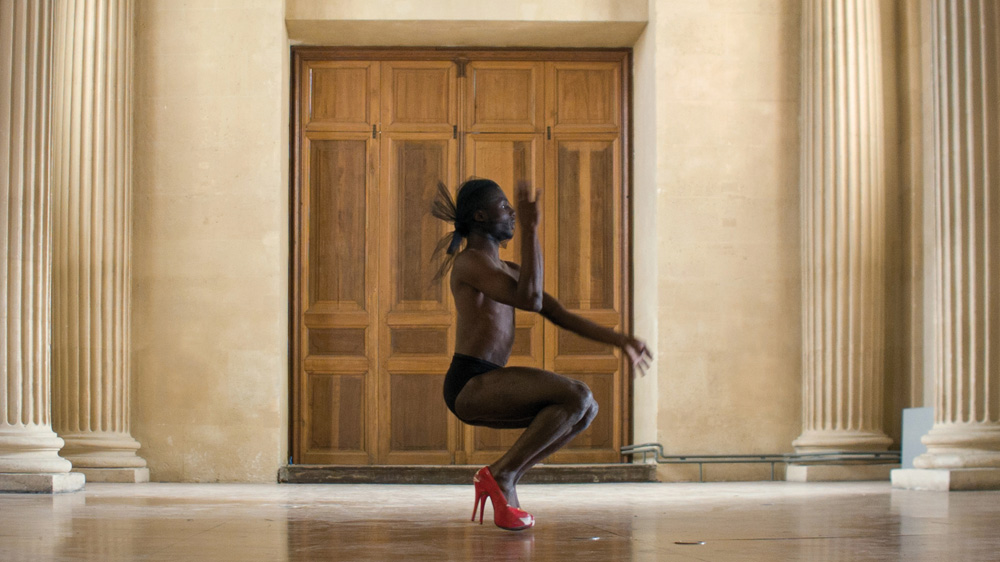
Red Shoes est un rituel. Le vogueur Kendall Mugler (Paris) mets ses talons aiguille rouges, et remplit l’espace d’une énergie dite « dramatique » - c’est à dire : théâtrale, sauvage, hautement technique, audacieuse.
Frédéric Nauczyciel est un artiste visuel français. Il travaille entre la France et les Etats-Unis. Nourri par la danse et le cinéma, il réalise des photographies, des films et des performances. Il construit avec ses sujets des images collaboratives qui tendent vers une hybridation des formes. Il fait appel à l’expérience de la performance pour produire des « images vivantes » qui convient la présence. Depuis 2011, il déploie son travail entre les ghettos noirs de Baltimore et la périphérie parisienne, puisant dans la force des langages performatifs tel que le voguing. Il expose en France (Musée de la Chasse à Paris, Mac/Val, Eté Photographique de Lectoure, Rencontres Internationales de Photographie d’Arles, Festival d’Avignon, Centre Pompidou Paris), à Barcelone (Palau de la Virreina), ou aux Etats-Unis (Washington, Houston, Baltimore et New York). Il est lauréat en 2011 de la Villa Médicis Programme Hors les Murs pour les Etats-Unis (Institut Français), reçoit en 2013 l’Allocation de recherche du Centre National des Arts Plastiques et figure dans la collection du Fonds national d’Art Contemporain (Public # Ceux qui nous regardent, Le temps devant et The Fire Flies, Baltimore). Il est en résidence en Seine-Saint-Denis pour deux années, de 2014 à 2016.

Frederic Nauczyciel
La Peau Vive [Skin Live]
Video installation | hdv | color | 38:0 | France | 2017
J’ai invité dans le studio des complices de plusieurs années, issus de la communauté noire transgenre des deux territoires, et d’autres artistes connus ou inconnus, engagés dans des pratiques performatives, masculines et féminines, urbaines et savantes, waaking, krump, art performance, slam... Tous sont reliés par un désir puissant d’inventer leur identité et par une appartenance revendiquée aux marges, réelles et symboliques. Je leur ai proposé de filmer eux-mêmes leurs tatouages, leurs scarifications, leur peau, face à la caméra ; et ce faisant, à échantillonner, une partie de leur histoire.
Frédéric Nauczyciel est artiste visuel. Il vit à Paris et travaille entre Paris et Baltimore. Depuis 2011, il déploie des installations vidéos, des photographies et des performances qui relient les ghettos noirs de Baltimore et la périphérie parisienne, puisant dans la force de langages performatifs tel que le Voguing, les fanfares déambulatoires ou la langue des signes. Ses projets en cours sont des récits mettant en jeu la langue, la trans-communauté, la traversée des lignes de partage. Il développe l’idée d’un “ endroit de confiance “, un espace libre d’assignation où la singularité de chacun existe sans labellisation. Il a exposé au Musée de la Chasse à Paris (2012), au Mac/Val (2012), au Festival d’Avignon (2013), au Palau de la Virreina, Barcelone (2010), au FotoFest International, Houston (2015) entre autres. Ses films ont été montrés aux Rencontres Internationales Paris / Berlin, au Festival Distrital à Mexico City, au Palace Festival à Chicago, etc.
Mario Navarro
The Dreams of Sttaford Beer
Art vidéo | dv | color | 7:48 | Chile | 2007
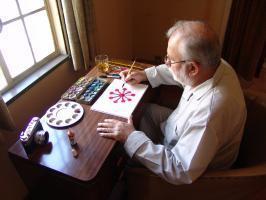
In 1971, an innovative system of information management and transfer began developing in Chile during the government of President Salvador Allende; the CYBERSYN project, cybernetic synergy or SYNCO, information and control system. In Chilean State owned companies a system for capturing, processing and presenting economic information to be managed in ?quasi? real time, becoming an absolute pioneer in the application of a cybernetic model in mass socio-economic contexts, and based on a convergence of science, technology, politics and cybernetics. In 1972 was constructed a ?futuristic? CONTROL ROOM for to manage information an data. The scientific director of the project was the Britain?s Stafford Beer, father of global cybernetics, In this fictional mise en scène, Stafford Beer imagines in dreams -in a hotel room- how to construct and to implement its project in Chile, but all the time blurredly and apparently drunk, Beer very insistently tries to show a coherent structure of interaction, that nevertheless is not perfect nor correct for anybody more than he.
Mario Navarro (1970), Live and work in Santiago, Chile. He studied visual arts in the Universidad Católica de Chile. Has been invited, as an artist in residence, to Couvent des Récollets, Paris (2003) and recently has been invited to IASPIS, Stockholm. Mario Navarro has participated in numerous international exhibitions, such as Santiago Manifest?, Centro Cultural Matucana100, Santiago (2007), ?Sur Scene?, Chateau de Tours, France (2007), ?XXVII Bienal de São Paulo?, (2006), ?IV Liverpool Biennial ?(2006), ?Busan Biennial?,Korea (2006), ?Efecto Downey?, Espacio Telefónica, Buenos Aires, Argentina (2006). As solo shows it is important to mention: ?Red Diamond?, Salvador Allende Museum, Santiago, (2007), ?Not Like this, like this?, Lakeside Kunstraum, Klagenfurt, Austria (2006), ?Dignidad?, Die Ecke Gallery, Santiago, (2005), ?30 days with nothing?, Public intervention Canal Saint Martin, Paris (2003) As a curator has created the projects ?Daniel Lopez Show?, Withe Box and Roebling Hall, New York (2007), ?Transformer?, Centro Cultural Matucana 100, Santiago (2005) and ?Doméstico?, MAC, Valdivia, Chile (1999)