Catalogue > Search
Results for : Tout le catalogue

Natacha Nisic
e
Experimental doc. | 0 | color | 20:0 | France | 2010
− e est le récit d`un voyage dans le nord du Japon à la recherche d`un territoire inaccessible : un territoire transformé, meurtri par un tremblement de terre d`intensité 6,7 sur l`échelle de Richter en juin 2008. La montagne déplacée, ouverte en quelques minutes par le choc violent des éléments, est une cicatrice ouverte d`une étrange beauté dont le sort reste indéterminé Cette cicatrice qui ne peut se refermer, reste un paysage d`une grande beauté, un grand canyon qui pourrait devenir un parc d`attraction, un « ecopark » qui attirerait les touristes, faisant de la catastrophe un argument de vente, .. − Nous survolons ce territoire, tentons d`y accéder malgré les barrages qui le clôturent. Ne peuvent y accéder que les camions des travailleurs à la reconstructions et les résidents reclus. Ceux qui ont vécu le tremblement de terre racontent et rejouent ces instants violents. Apprivoiser la catastrophe est une attitude culturelle japonaise. Si on ne peut apprivoiser le futur, on peut le prévenir.
Née en 1967 à Grenoble, Natacha Nisic poursuit des études d`art à l`ENSAD de Paris, et de cinéma à DFFB de Berlin et à la Femis. Son travail se situe à la frontière des différents supports de l`image en mouvement, Super 8, film et vidéo, mais aussi par la photographie et l`installation. Elle réalise de nombreuses expositions en France, Printemps de Cahors, Centre National de la Photographie, Le plateau-Frac Ile-de-France. Ses films ont été récemment présentés au Centre Georges Pompidou à Paris, K21, Düsseldorf, Metropolitan Museum of Photography, Tokyo, British Film Institute, Londres.
Natacha Nisic, en collaboration avec Ken Daimaru
Osoresan
Video | hdv | color | 17:15 | France, Japan | 2018
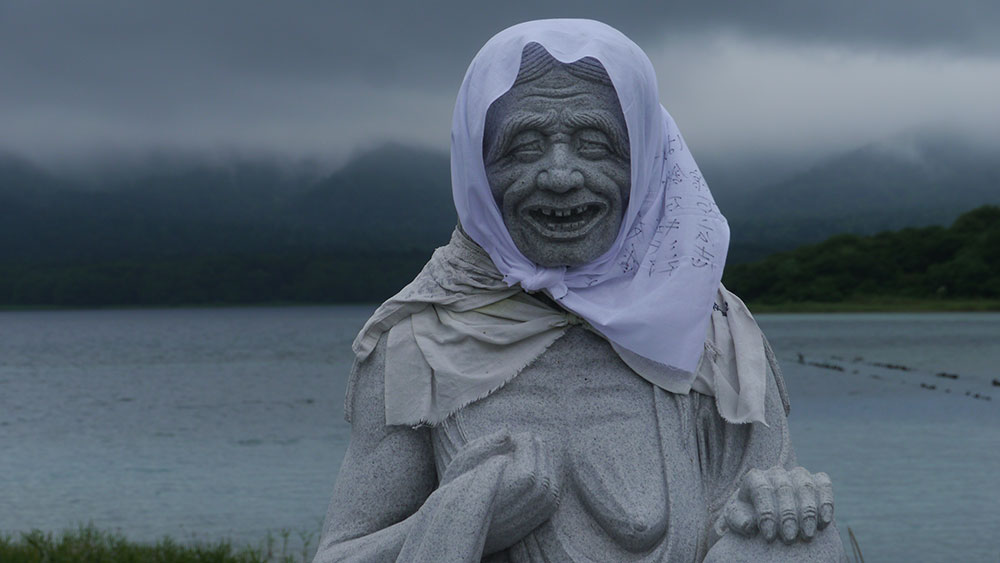
OSORESAN Natacha Nisic & Daimaru Ken 3 channels installation, stereo sound, 17’, 2018 The Itako are women who train to become spiritual mediums in Northeast region of Japan and to evoke departed spirits for the living seeking to communicate with the dead. Most of them have visual disabilities and learn language and rites to describe a rich spiritual world entirely through oral communication. Our first meeting wit Nakamura Take took place in Hachinohe city in Jully 2015. Fiming a blind person is a challenge, in one hand, we would see what she would never share with us, and on the other hand, it seems that she « sees » things that we aslo don’t see. We met her two times in 2015 and in 2017. Each sequence was very short between clients who were regularely knocking at her door. Those fragments of her life, moments of remembering songs, rites and legends were too short to build up a large portrait. They became elements of a constellation we wanted to draw : balancing her humility and modesty versus the huge scale of the desaster which happened not so far fom a living region. Her way to travel in unknown countries of dead and spirits, using a treasure of words, notes, incantation, has been guiding own journey into the landscapes revealing the traces of the post catastrophy. (imprégnant par ses paroles chacune de nos visions des paysages que nous traversions). She told us the legend of «Oshirasama», the founding tail for Itakos, a cruel story of a father, a beloved daughter and a horse. As we crossed the city of Soma, we remembered the Horse Festival organized by the city just one year after the disaster. The horses are still there, waiting. The desire to make peace with the dead motivates each one visiting an Itako. What could help us to make our own peace with the heritage of the post catastrophy ? What kind of political individual gestures could face the large scale of political environmental decisons ? We still have to deal wih nuclear threat. As a symbol of fear, the mount Osoresan, a lansdcape of ashes, smoke and dark water, responds to the hyptnotic beauty of the fragmentation of alpha an beta rays displayed at the Rokkasho PR Center. Fear, to be acclimated must show a fascinating face, as Itakos used to be represented ; stranges, unreachable and dangerous figures of women. Witches. We discovered a touching, smily, opened woman. We realized that Take Nakamura is a monument of Japan history. Very precious, rare and fragile. With participation of Take Nakamura and Itakos of Osorezan Cast: Satoko Abe, Fumie Kubota, Yohei Kobayashi, Kyoko Takenaka, Mika Shigemori
Bio Natacha: The work of Natacha Nisic explores the invisible, even magical relationship between images, words, ritual and memory. She interweaves links between stories, past and the present, to reveal the complexities of the relationship of what is shown and what is hidden, the spoken and the unspoken. Her work questions the nature of the image through various media: Super 8, 16MM, video, photography and drawing. In 2014, her highly acclaimed solo exhibition, Echo at the Jeu de Paume in Paris presented several installations created since 1995 and new works produced specifically for this show. She exhibits extensively around the world : recent shows include the Media City Biennale in Seoul (2016), Bienal de la Imagen en movement in Buenos Aires, Munfret in Buenos Aires (2016), Hermès Foundation in Seoul (2012), K21 in Düsseldorf (2011), Metropolitan Museum of Photography in Tokyo (2010), British Film Institute, London (2010), and the Centre Georges Pompidou, Paris (2009). Nisic has been awarded numerous grants and residencies including the Villa Kujoyama, Tokyo in 2001 and 2016 Gyeonngi Creation Center, South Korea (2010) and the Villa Medici, Rome in 2007. Education: Ecole Nationale Supérieure des Arts Décoratifs, Paris; Deutsche Film und Fernseh Akademie, Berlin; La Femis, Paris. Born Grenoble, France, 1967. Bio Ken: Ken Daimaru is a history researcher at the Ecole des hautes études en sciences sociales (Paris, France), and is the author of Between War Wounds and a War of Wounds (Mouvement social). Over the years, his researches have ranged from the social and cultural history of Japan in the late nineteenth and early twentieth centuries, to medical histories of military conflict between the Russo-Japanese war and the Second World war, focusing on the understanding of subjects “violence, the body, the suffering, the emotions” central to human experience. During 2011-2012, he wrote prolifically on question of health, emotional responses in the aftermath of 2011 Tohoku earthquake and tsunami. Daimaru was born in the city of Fukuoka. As a young child, he lived in Hiroshima, before moving to Brussels for high school. Since 2003, he lives in Paris.

Natacha Nisic
Le textile est mort mais les gens vivent encore
Experimental doc. | 16mm | color | 11:6 | France | 2008
Natacha Nisic
Saint-Désir l'Exil
Video | mov | color | 9:15 | France | 2020
Au coeur de Saint-Désir l'Exil se trouve une piscine. Au coeur de la piscine se trouvent les corps nocifs. A côté de la piscine, ma maman vit ses derniers instants sous le soleil.
Natacha Nisic
Le textile est mort mais les gens vivent encore 1
Experimental doc. | super16 | color | 5:47 | France | 2009
L`usine Desurmond à Tourcoing a fermé en 2004. C`était la dernière usine de filature de cette région. Les ouvriers se sont regroupés en association afin de faire valoir leurs droits et créer une communauté, au delà de la perte du travail. Les hommes puis les femmes ont reproduits la chaine et les gestes du travail à la chaine dans cette filature. Certains y ont travaillés en équipe de nuit pendant 35 ans.
Née en 1967. Ecole Nationale Supérieure des Arts Décoratifs de Paris, poursuit des études à la Deutsche Film und Fernseh Akademie de Berlin et à la Femis à Paris pour l`écriture de scénario. Elle réalise de nombreuses expositions et films où la question de l`image est mise en jeu. Elle utilise pour cela différents médiums : super 8, 16 mm, vidéo, photographie. Images fixes ou en mouvement fonctionnent comme substrat de la mémoire, mémoire tendue entre sa valeur de preuve et sa perte. Les différentes expositions personnelles comme au Plateau, Frac île de France, puis au musée Zadkine à Paris, sont des autant de prises de positions sur le statut des images et les possibles de la représentation.Ces oeuvres ont été montrées dans de nombreux pays, Allemagne, Espagne, Japon, Corée, canada, Argentine... Ses films sont diffusés sur Arte et au Centre Georges Pompidou à Paris. Pensionnaire de la Villa Kujoyama (2001) et Villa médicis (2007).
Natacha Nisic
Le textile est mort mais les gens vivent encore 2
Experimental doc. | super16 | color | 5:20 | France | 2009
voir ouvrier 1
Voir ouvrier 1
Natacha Nisic
Et n'être que brume
Experimental film | 0 | color | 15:0 | France | 2023
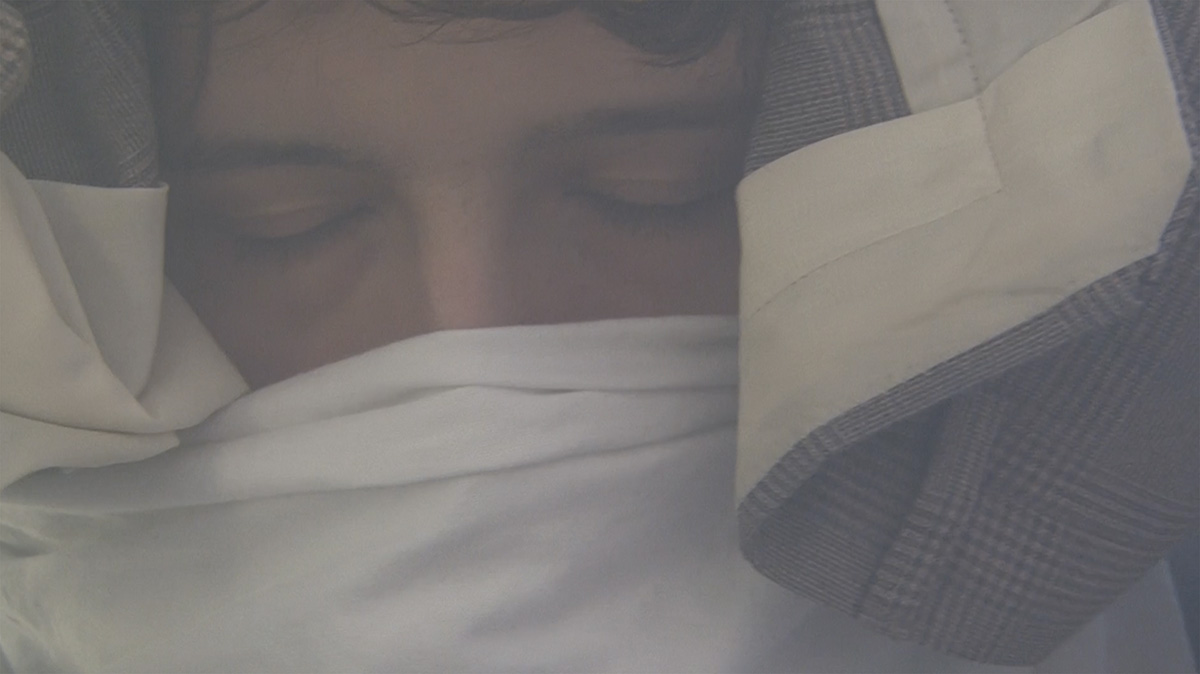
Dans la tour de la ville de Malakoff "Et n’être que brume » met en place le cadre expérimental d’une improvisation.Plongés dans les brumes, les êtres se révèlent. L’écran de la fumée permet une libération des affects car au sein du brouillard se logent les souvenirs, les torpeurs et les désirs. Le film est en hommage à la Crimée annexée depuis 2014 par la Russie.

Rossella Nisio
The Silent Ray
Video | hdv | color | 18:1 | Italy, Netherlands | 2019
The man’s presence lingers in the room that for years served as his study. Present and past intertwine as he follows threads of his memory and recalls events from the time of his participation in the colonial war against Ethiopia in 1935-36.
Rossella Nisio [IT] is a visual artist based in Rotterdam whose work has a strong focus on notions of memory, imagination and space. She has a background in the theory of cinema and performing arts; she pursued her practical training first within the field of documentary photography, eventually moving towards a more autonomous approach to still and moving image-making. She completed the advanced photography studies in Ar.Co in Lisbon in 2017 and earned an MA in Fine Art and Design at the Piet Zwart Institute in Rotterdam in 2019.
Barbara Noiret
C'est-à-dire
Art vidéo | dv | color | 4:30 | France | 2005
?Time of each session, something happens to the almost still things that are represented by these images. Someone comes, moves, upsets, or modifies a very precise point of the frame in order to do a precise use of the place ? fastidious exploration or just by standing. In that precise point of these minimalist narrations, the video is a photography that last long.? Eléonore Espargillière
I?m born in 1976 and I live and work in Paris. The Gallery Frédéric Giroux exhibits my work since the group exhibition ?Le Corps en Perspective? where I was invited in 2004. The gallery permitted me to do a solo exhibition in May and June 2005 and made take part in many contemporary art venues: Artissma, Turin, Italia, FIAC 2004 and 2005, Paris. I realized exhibitions and residence projects in two contemporary art centre: the Domaine Kerguéhennec, Bigan, France, where I presented at the end of the 3 month residence a personal project, the space of the image in he disused places of the caste (2000). The Domaine Départemental de Chamarande invited me this year to realize and photographic and video work around the memory of the castle in the estate. Some works, especially videos, where shown in the framework of the ?Journées du Patrimoine? in September 2005. The Fond National d?Art Contemporain just bought two pictures done in the Domaine de Chamarande. I exposed in Germany, in Bremen, at the Music School, Hochschule für Künste Bremen. The school invited me to take part in the presentation of students? works. I realized there a video in situ especially for the occasion. Regarding other venues, the Institut Marcel Rivière, a psychiatric hospital located in the Verrière, France, let for my use currently a disused pavilion for two years. My project is to work in the different spaces of the hospital in relation with patients and doctors. In this project framework I just received the individual creation scholarship form the DRAC Ile-de-France. I did a short residence in La Casa de Velasquez, Madrid, Spain, in the framework of a project of in Escenario staging ?Identité et Image de David Ferré?. I tool part as photographer director of the project in 2001. I obtained my Diplôme National Supérieur d?Expression Plastique with jury honours at the Beaux-Art of Anger in 2000 and my Diplôme National d?Art Plastique with honours at the Ecole Superieure des Beaux-Arts of Le Man in 1998.
Barbara Noiret
Verrière
Experimental video | dv | color | 2:32 | France | 2006
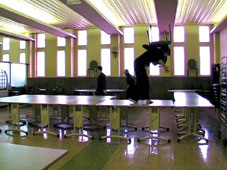
This video is the result of a performance carried out by patients and caregivers during lunch at the restaurant of the Institut Marcel Rivière in Verrière psychiatric hospital. It was made in collaboration with Régis Bouchet-Merelli and Dominique Larcher from the contemporary dance company K-Denza. The performance lasted 25 minutes but only 2'32'' have been kept to create this video, based on the body movements in connection with the architecture. The rhythm in this video is created by the surrounding noise of the meal (plates, cutlery, discussions...). This performance was conceived in relation with the restaurant's historical and architectural context: the hall in which the performance is set was reserved to the caregivers in the 1960's. This room is separated by large bay windows from another larger room where the patients have dinner. At the time, these bay windows allowed for the observation and diagnosis of the patients during lunch. This practice is no longer in use today, but the caregivers continue to dine in one room while the patients dine in the other. The aim of the performance was for everyone to dine together in the same space, and for the space, both open and closed because of the windows, to become a performance space, where objects lose their functionality: The tables are assembled and disassambled to form a dance stage, and the chairs no longer serve as seats. An attempt to disrupt the meal space and everyone's habits by creating a mental architecture.
Barbara Noiret was born in 1976. She currently lives and works in Paris. The Frédéric Giroux Gallery, where in 2005 she produced a personal exhibition, has been promoting her work since 2004. Thanks to the gallery, she took part in several collective exhibitions and contemporary art fairs - Artissima, Turin, and FIAC 2004, 2005 and 2006, in Paris. She has carried out exhibition and residency projects in two contemporary art centres, and the departmental estate of Chamarande invited her to produce a work of photography and video based on her final project on the domain's castle. Le Fonds National d?art contemporain acquired two photographic works produced on this estate in 2006. Some of her work was shown during the days of patrimony in September 2005, and was further displayed in the exhibition "L'esprit des lieux" from November 2006 to February 2007. At the end of her three month residence in 2000, the estate of Kerguéhennec, Bignan allowed her to present a personal project, "l'espace de l'image", on the abandonned floors of the castle. Barbara has exhibited her work at the Music and Art School in Brême, Germany. The school invited her to participate in the presentation of the student's works. She produced an installation video especially for the occasion. As for other projects, the Marcel Rivière Institute, a psychiatric hospital in Verrière, put a disused pavilion at her disposal two years ago and she continues to make use of it. She works in different spaces of the hospital in relation to the patients and the caregivers. In 2005, in the framework of this project, Barbara received individual creation aid and an installation allowance (material aid) from DRAC Ile-de-France. In 2001 she completed a short residency at La Casa de Vélasquez in Madrid, working on the directorial project "Sin Escenario1 Identité et Image" by David Ferré as a photographer screenwriter.
Simon Norfolk, Tate Films
Burke + Norfolk: Photographs From The War In Afghanistan
Documentary | hdv | color | 17:12 | United Kingdom | 2011
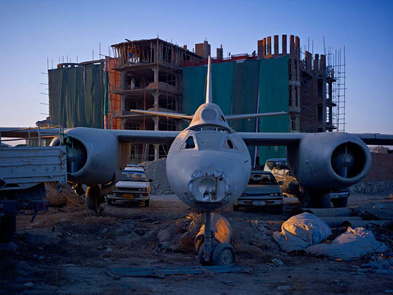
In October 2010, Simon Norfolk began a series of new photographs in Afghanistan, which takes its cue from the work of nineteenth-century British photographer John Burke. Norfolk?s photographs reimagine or respond to Burke?s Afghan war scenes in the context of the contemporary conflict. Conceived as a collaborative project with Burke across time, this new body of work is presented alongside Burke?s original portfolios. The exhibition takes place in conjunction with an earlier complementary exhibition in March 2011 at the Queen?s Palace in the Baghe Babur garden in Kabul, supported by The World Collections Programme and the Aga Khan Trust for Culture, which resulted from a series of workshops with Afghan photographers, featuring work by Fardin Waezi and Burke alongside Norfolk?s own work.
Simon Norfolk was born in Lagos, Nigeria, in 1963 and educated in England, finishing at Oxford and Bristol Universities with a degree in philosophy and sociology. After leaving a documentary photography course in Newport, South Wales, Norfolk worked for far-left publications specializing in work on anti-racist activities and fascist groups, in particular the British National Party. In 1994 he gave up photojournalism in favor of landscape photography. His book For Most of It I Have No Words: Genocide, Landscape, Memory, about the places that have witnessed genocide, was published in 1998. The work was exhibited at many venues, including the Imperial War Museum in London, the Nederlands Foto Instituut, and the Holocaust Museum in Houston, Texas. Photographs of the war in Afghanistan in 2001, published as Afghanistan: Chronotopia, won the European Publishers` Award for Photography and an award from the Foreign Press Club of America and was nominated for the Citibank Prize. In 2004, Norfolk won the Infinity Award from the International Center of Photography in New York and in 2005 Le Prix Dialogue in Arles. His most recent book, Bleed, about the aftermath of war in Bosnia, was published in 2005. His work appears regularly in the New York Times Magazine and the Guardian Weekend.
Kristina Norman
THIRST
Experimental fiction | 4k | color | 16:7 | Estonia | 2022
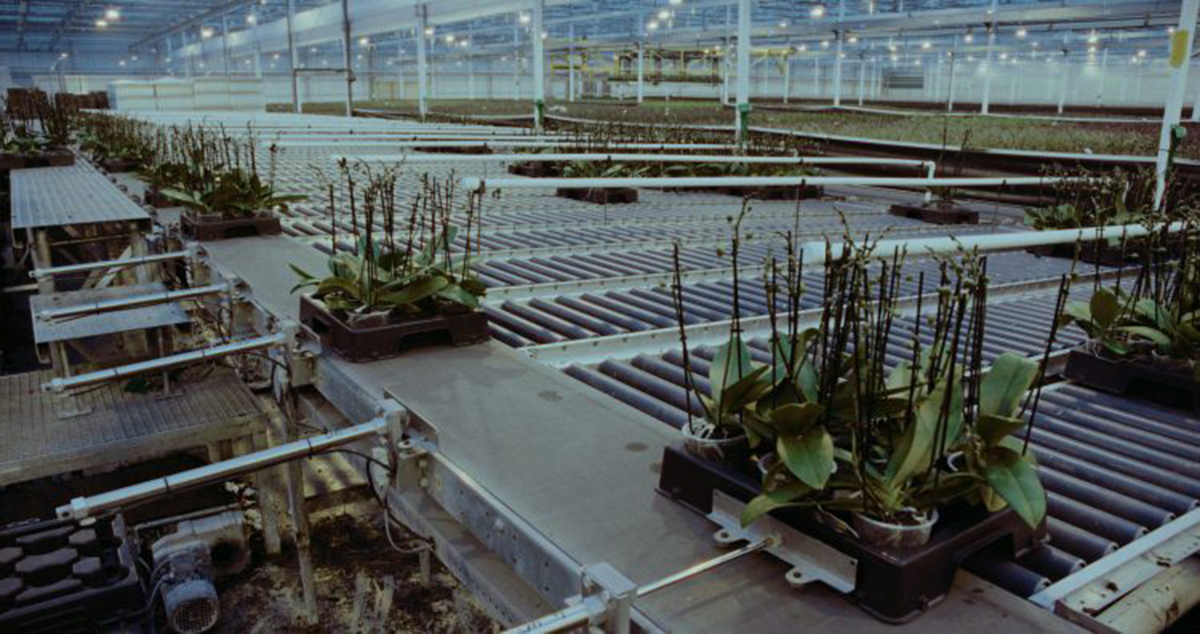
The film Thirst is a post-human choreography of machines and displaced plants. Millions of tons of Estonian peat end up in greenhouses in the Netherlands, where it is used as a soil substrate for tropical Phalaenopsis orchids. Meanwhile, local communities in Estonia are left with dry wells and a lack of drinking water as their fragile wetlands are drained for peat extraction. The orchids from the Netherlands then find their way back to supermarkets and homes in Estonia. It is a thirst for luxury and abundance that keeps the capitalist machinery running. Thirst is one episode from Kristina Norman’s Orchidelirium film trilogy. Commissioned for the Estonian Pavilion at the 59th International Art Exhibition – La Biennale di Venezia. Author and director: Kristina Norman Cinematographer: Erik Norkroos Composer: Märt-Matis Lill Choreographer and cast: Mari Mägi Produced by Rühm Pluss Null in collaboration with CCA Estonia
Kristina Norman (b.1979, lives and works in Tallinn) is an artist whose interdisciplinary work includes video installations, sculpture, and projects in the city space, as well as documentaries and performance. She is interested in the issues of collective memory, the memorial uses of the public space, but also the subtle sphere of the body politic that transgresses the boundaries between the public and the private. In 2009 she represented Estonia at the 53rd International Art Exhibition – La Biennale di Venezia, with a solo project; a multilayered mixed media installation entitled After-War. The project was a study of a conflict around the relocation of a Soviet monument in Tallinn. In 2022 at the 59th edition, the artist again represented Estonia with an ecocritical exhibition “Orchidelirium. An Appetite For Abundance”, a duo show with Bita Razavi, curated by Corina Apostol. Norman’s experimental film trilogy commissioned for the Estonian Pavilion, offers multiple ways to reflect on the legacies of colonialism from a specifically Eastern European perspective.
Jussie Nsana Banimba
Bimbambukila
Video | hdv | color | 6:1 | Congo (Brazzaville) | 2012
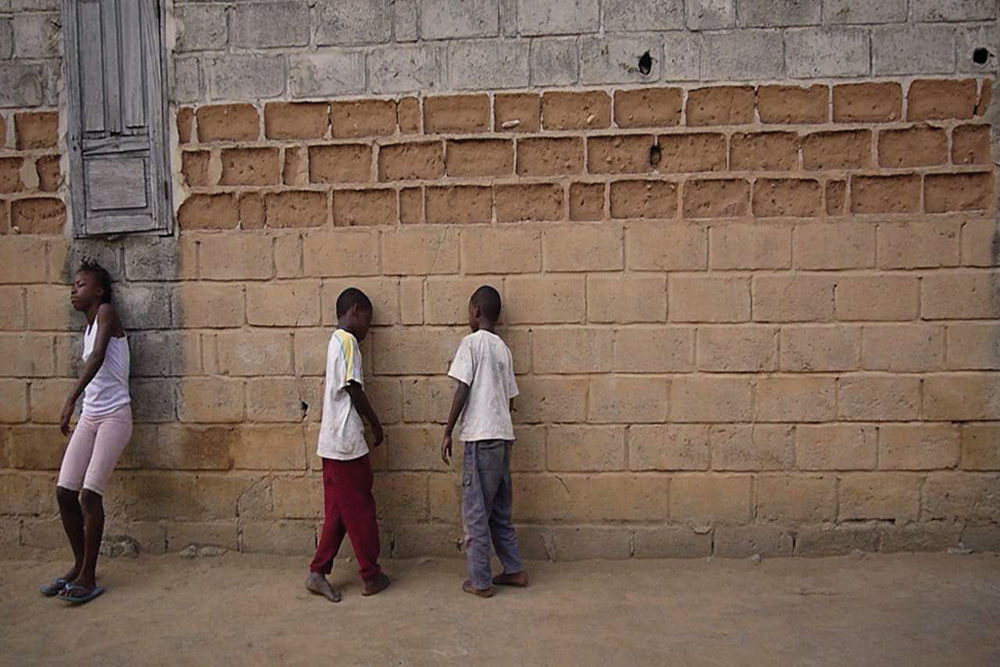
Réalisée lors des Ateliers Sahm (Rencontre Internationale d’Art Contemporain, qui se sont tenus du 15 novembre au 15 octobre 2012 à Brazzaville, « Bimbanbukila », première vidéo de Jussie Nsana pose le problème de mémoire. Cette première réalisation de l’artiste nous emmène au cœur de Brazzaville où l’artiste magnifie le mur sous toutes ses coutures. Des murs qui deviennent des espaces témoins, de ponts entre le passé et le présent.
Jussie Nsana Banimba est née à Brazzaville en 1984 et elle vit et travaille actuellement à Pointe-Noire. Elle est diplômée de l`École Nationale des Beaux Arts de Brazzaville, en arts plastiques. Elle se considère comme une artiste à part entière et crée des peintures, des bandes dessinées, et des vidéos. Jussie à participé octobre 2015 au Festival International de la Bande Dessiné d’Alger en Algérie. Elle a exposée ses œuvres en novembre 2015 à l`exposition «Soul Power» au Musée-Galerie du Bassin du Congo à Brazzaville, en 2014 à l`exposition "Butselé" au Centre Culturel Basango à Pointe-Noire; en 2013 à l`Institut Français du Congo (IFC) à Pointe-Noire; en 2012 et 2013et 2015 elle a participé à la 1ère, 2e et 4e édition de la "Rencontre d`Art contemporain de Brazzaville" aux Ateliers SAHM. Comme elle-même le dit, Jussie transporte dans son « sac à arts », ses passions les plus artistiques, la BD, la peinture et la vidéo. Engagée avec la jeunesse, Jussie, avec une générosité hors du commun, transmet son savoir-faire et son amour pour l’art aux enfants et aux jeunes dans son espace Nsana – Arts’ Butsilé.
Monika Nuber
Duette Chöre Formationen
Animation | 0 | color | 11:20 | Germany | 2005
Masked forms sing a hymn, Quivering figures celebrate friendship, Young girls sing about love and sex, A three-headed dog and its master make rhymes, A group of kids in the forest sing a mysterious melody and two hanged people mutually help each other to present a song.
Monika Nuber is a Stuttgart based plastic artist and musician. She studied at Stuttgart's Arts Academy with Joseph Kosuth and Joan Jonas, and at the Academy of Fine Arts in Prague with Milan Knizak. Successive scholarships led her to Mongolia, China, and Pakistan.

Christof Nuessli
Under The Skin
Video | hdv | color | 16:40 | Switzerland, United Kingdom | 2019
Zooming into two books containing mug shots from around 1880–1935, Under the Skin, draws lines from historical events to contemporary developments of control and surveillance. While describing what she sees in the books, the narrator intertwines subject areas like; how time changes perspectives on historical events, the role of archives as foundations for power and control, the possible brutality of bureaucracy, the current state of facial recognition and personal experience with the law enforcement. Under the Skin questions given structures of power and asks how we can take back the sovereignty of information.
Christof Nüssli (*1986, Zurich) is a visual artist, whose interdisciplinary approach involves moving images, photography, sculpture, installation, text and artist books. His work has been exhibited in various institutions and off-spaces. In 2019 his work was shown at Photoforum Pasquart (CH), Swiss Institute New York (US), Glue Factory (UK) and VideoEx (CH). Nüssli authored three artist books (Miklos Klaus Rozsa, Withheld due to:, googly eyes) which won international prizes. Since 2014 Christoph Oeschger and Christof Nüssli run the publishing project cpress, focusing on artist books. In 2018, Nüssli was an artist in residence at the Swiss Institute New York, the Andreas Zuest Library and in 2016 at the Istituto Svizzero di Roma. In 2013, Nüssli received a Master of Design from Werkplaats Typografie. Since 2018 he attends the Master of Fine Arts program at the Glasgow School of Arts.
Eko Nugroho
Ma Ling
Experimental video | dv | color | 4:0 | Indonesia | 2006
"Ma Ling" (in Bahasa Indonesian can be mean: Thief) is an instant canned food from China. This work talks about stealing back terrors that have already been produced by television. Inspired by what happened in China for a pirated business product; taking something from a thing that already exists and reproducing it as something "new".
Eko Nugrono
Bercerobong
Animation | dv | black and white | 4:0 | Indonesia | 2006
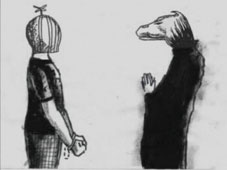
As a great and productive comic maker, Eko Nugroho smartly uses simple drawing and animation for his video "Bercerobong" (Smoke-piping). He attempts to portray a condition happening in a community, in particular when a change of political agenda takes place in Indonesia after the downfall of the Soeharto regime. Everyone seems to be in turn: politicians, armies, governmental officers, religious teachers, and others. Like chameleons they have quickly changed their life's attitude, way of speaking, and action, adjusting to the environment and chatting partners. Sometimes in a tricky way, they use the situation for the sake of their own interest.
Bettina Nürnberg, Dirk Peuker
Franzosensand
Documentary | hdv | color | 8:30 | Austria, Germany | 2016
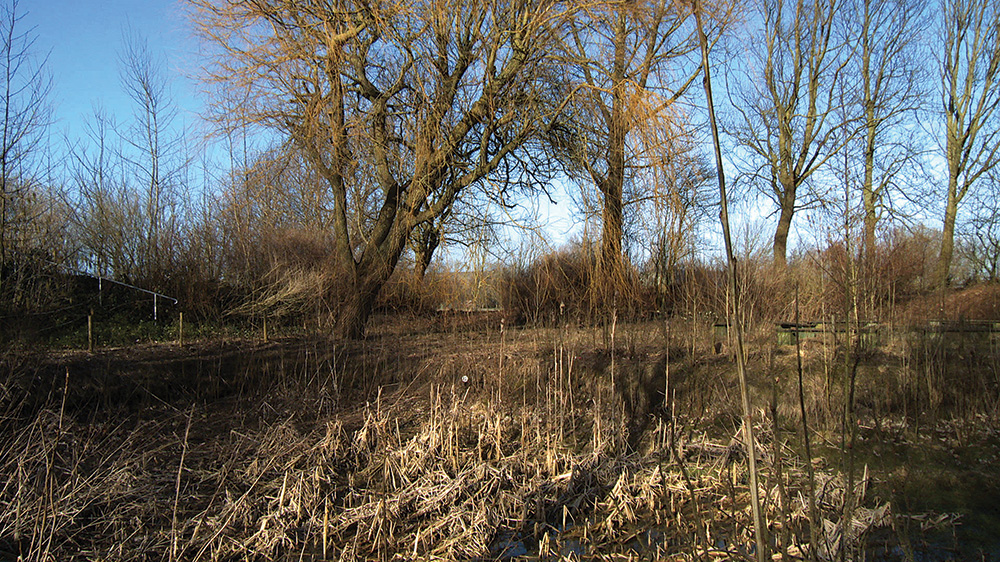
The film “Franzosensand” centers on agricultural settlements founded by theGerman National Socialitst on newly built dikes on the mudflat of the Wadden Sea (North Sea). Of the settlements, the so-called “Adolf-Hitler-Koog”, was meant to be a prototype for a national socialist community.Today, the bleak and tidy landscape does not offer much testimony to its history. Excerpts of archived materials that are interwoven with present-day images make the present appear as a surface built on complex, deeper layers of the past.
Bettina NUERNBERG (1976, Germany) was educated in art and film in Hamburg, Berlin and Toulouse. The work of the Berlin-based artist has been screened and exhibited worldwide. She founded the internet platform vestibuel-film. Dirk PEUKER (1970, Germany) studied film and art in Berlin and Vienna. The work of the experimental filmmaker and artist has been screened and exhibited worldwide.
Bettina Nürnberg, Dirk PEUKER
Zement
Documentary | hdv | color | 12:38 | Germany, Austria | 2014
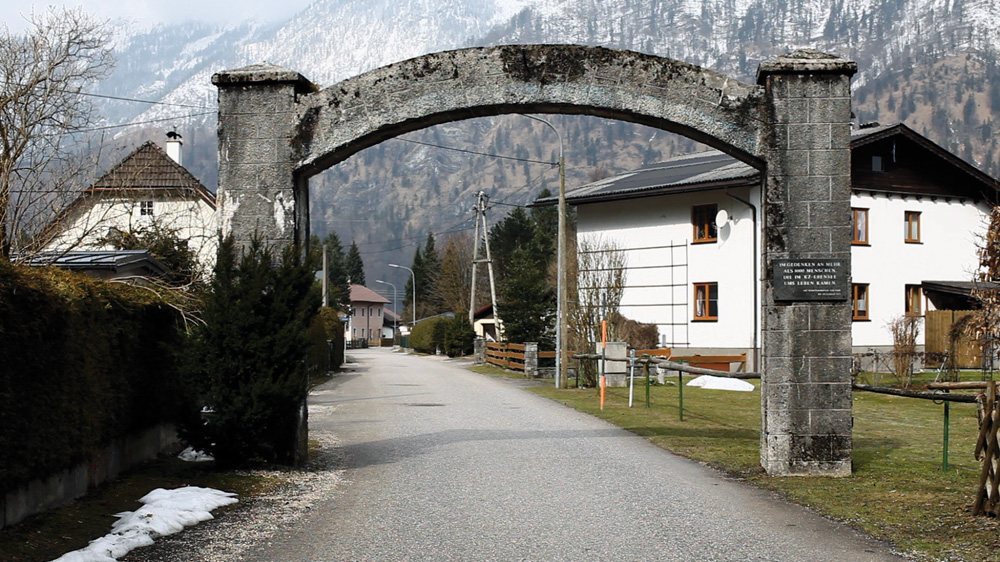
The Nazis set up a concentration camp in Ebensee. Nürnberg and Peuker wonder what conclusions they can draw from the topography about dealing with the past. The takes remain static; a woman’s voice dryly contributing information from off screen is all that clarifies the context within contemporary history. A site that looks like a dirt road turns out to be the “Löwengang (Lion’s Walk),” which the camp’s prisoners were driven down like animals to reach a tunnel that had to be dug. As soon as the film moves to the residential area that was founded on the site of the concentration camp shortly after the end of the war, surprise at the lack of sensitivity in dealing with the past mixes into the off-screen commentary. What Zement aims to get at is the ambiguity of this proximity of commemorative site and settlement.
Dirk Peuker * 1970 in Friedrichroda 1998 – 2005 Studium experimentelle Filmgestaltung an der Universität der Künste Berlin und bildende Kunst an der Akademie der bildenden Künste Wien. 2006 Stipendium der Stiftung Kulturregion Hannover und der Nordmedia Filmförderung, Villa Minimo. 2007 DAAD Jahresstipendium 2008 Postgraduiertenstipendium des Freistaates Thüringen 2008 Meisterschüler der Universität der Künste Berlin 2009 NaFÖG Stipendium des Berliner Senats seit 2009 künstlerischer Mitarbeiter an der Kunsthochschule Berlin Weißensee
Mark O'connell
All Broke Up
Art vidéo | dv | color | 3:58 | USA | 2004
"What? Torture!?! I didn`t see any torture. Did you see some torture? Nobody saw any torture....."
Mark O`Connell probes and pushes the emerging representational, juxtapositional possibilities afforded by today`s expanding range of digital media. After a score of years in music--as a performer, composer, and producer--he now works with a variety of media: still images, video, film, music and text; all manipulated as digital information. The finished pieces are generally delivered via videotape or Quick Time computer files. His work has been exhibited in a wide range of venues.
Alison O'daniel
Deep Woods
Experimental video | dv | color | 5:30 | United Kingdom | 2005
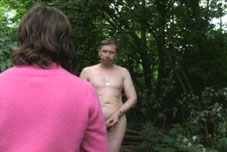
A woman's back, somewhat to the left of centre, fills the image. She is standing straight in front of the camera, which now and then registers a glimpse of the man who is standing face to face with her at a few metres' distance, somewhere in a forest. Camera, man, and woman are barely moving, while the voice-over clarifies the context of what is happening. The voice probably belongs to the man, of whom we have just seen enough to be able to decide that he must be an elderly gentleman. He explains that he is always looking for new challenges, experiences and boundaries. He is wondering how it will affect him, whatever it is he is going to do later, and about which the viewer can still only take a guess. The voice-over appears to be based on a conversation or correspondence that took place between him and the woman before the recording. He admits that he feels embarrassed and uncomfortable with the situation and with the idea that he is going to do something like that in her presence, and in that of the camera crew and eventually, of an audience. Then, as the camera moves along, we see how he calmly starts to undress. He hands his clothes to the woman. How will his body respond in these circumstances, will it cooperate gracefully, or will it embarrass him? He is not a model or an actor, he says. He looks alternately at the woman or just past her into the camera, or sideways and upwards. Very calmly he carries out the agreed action, and within a few moments it is done, upon which she hands him a cloth and his clothes.