Catalogue > Search
Results for : Tout le catalogue

Vasco Braga Santos
Bars & Tone
Art vidéo | dv | color | 1:10 | Portugal | 2004
Time, color, and volume marks, from a television emission are the initial point. This concepts manipulationis used too create visual reading, sound and time errors. Target marks loose their sense, the loop development sugests an action ending that never hapens, proposing suspense.
Vasco Braga Santos Born in Lisbon 08-January 1980 2005- Begans Master in Artistic Education at Faculdade de Belas Artes da Universidade de Lisboa (Fbaul) 2004 - Finishes College in Fine Arts at Escola Superior de Arte e Design (ESAD) Classified with 16 (0-20) 2005 Vídeo Galeria Cubic- Lisboa Exibithion ?Near Step? Video Centro Cultural de Paredes de Coura XVII Bienal de Cerveira Vídeo Lisboa Vídeo Show 2005, ETICVídeo Sevilha Festival Zemos 98 Participation in Zemos 98 Fest, Informative Selection 2004 Group Exibithion Caldas da Rainha ESAD04 Exposição Colectiva Porto Labor.04 Colectiv Exibithion in Fernando Santos Galeria, Oficina e Padaria Independente

Davor Sanvincenti
The River
Experimental video | betaSP | black and white | 7:30 | Croatia | 2009
Through multiple crackling structures The River spreads audiovisual resources to create atmospheres that combine narrative and aesthetic concepts beyond one photography, Versus, captured with 82 years old camera-box which portrays the social landscape that is devoid of any romanticism. The work investigates and examines the human like the unforeseeable active presence between the nature and technology, analogue and digital, static and dynamic. It explores and reveals a research for the essence of seeing and hearing, for ontology of the audiovisual landscape.
Davor Sanvincenti a.k.a. Messmatik (b.1979) is a Croatian multimedia artist. Over the last years he has been specifically interested in a field of audiovisual research and anthropology of visual culture, particularly oriented on the conditions and forms of human senses and perceptions, developing experimental videos and immersive installations which are at the intersection of video and performing arts. He explores aesthetical and qualitative capabilities of different media as direct communication with the spectator which becomes an inevitable part of the work, a reflecting contemplative-physical structure. He is recipient of several art awards, including the Radoslav Putar Award 2010 for the best Croatian artist under 35. His physical video installation "1001" is part of the AV collection of the Museum of Contemporary Art in Zagreb.
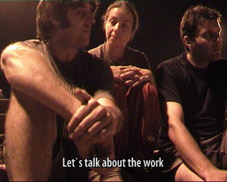
Denis Saraginovski, Stevceska SLOBODANKA, Talevski SASHO
Let's talk about?
Experimental video | dv | color | 7:0 | Macedonia | 2003
OPA&HA are faced with the difficult task of being on camera while saying something important concerning contemporary arts, particularly regarding their role in the Macedonian contemporary art scene. The video shows their struggle.
OPA&HA is a collaborative team made up of three authors: Denis Saraginovski, (born 1971 in Macedonia; studied at The Faculty of Fine Arts, Skopje; visual artist and freelance videographer), Slobodanka Stevceska (born in 1971 in Macedonia; studied at The Faculty of Fine Arts, Skopje; visual artist and art instructor) and Sasho Talevski (born in 1967 in Macedonia; studied at The Faculty of Philosophy, Skopje; conceptual artist, writer, and journalist). The OPA&HA (Obsessive Possessive Aggression and Chronically Arrogance) collaboration started working in 2002 on projects that involve action, performance, video, mockumentaries, site specific works, etc. Some examples of their projects are: Professional Site Specific Installers, Don?t miss the MISS, Reality Macedonia, etc. Their work is focused on the position/relation of the artist in/with different social or cultural systems. They treat political, social and cultural issues with humor and an approach that criticizes local concerns and situations. In 2004, they received the annual award for Best Young Macedonian Artist, DENES. They have exhibited in several countries in Europe, as well as in the USA.

Martin Sastre
Bolivia 3: Confederation Next
Experimental fiction | dv | color | 15:0 | Uruguay, Spain | 2007
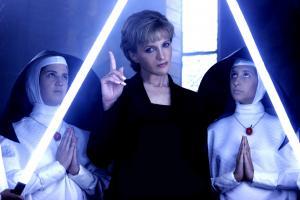
"Bolivia 3: Confederation Next", takes us to the future,more precisely to the year 2876, to a time were the American Continent presents an inverse political map from the one we know today. South America has became a huge confederation named Bolivia, while North America is divided in small countries emancipated from the former United States of America and Canada. In this future Tom Cruise is an immortal vampire that lives in a dark swamp where at some time was Hollywood and tell us the story of how the other Americans won the "War for Fiction Control" with a sward fight between Martin Sastre and Matthew Barney.
Born in 1976 in Montevideo, Uruguay, Martin Sastre was formed by 80`s VCR culture, experimenting on video and cinematic images since childhood. Now he`s considered one of the most representative Latin-American artists of his generation and has participate in International Biennials like the 1st. Prague Biennial, 8ª La Havana Biennial, 28ª Sao Paulo Biennial, 51ª Venice Biennial and the 11ª Biennial for Moving Images of Geneva. Nowadays his working on his first feature film and developing The Martin Sastre Foundation for the Super Poor Art to sponsor Latin -American artists who normally can`t access the international circuits with the aim of changing the historic definition of center and periphery
Martin Sastre
Diana, The Rose Conspiracy
Experimental fiction | dv | color | 20:0 | Uruguay | 2005
Princess Diana didn?t die in a car accident in Paris; she?s now living a happy and new undercover life in a poor neighborhood of Montevideo, Uruguay.
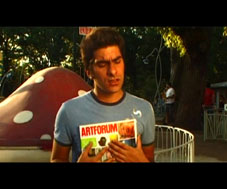
(Montevideo,1976). Has been showing solo internationally since 2002 and has participated in Biennials such as the Busan Bienal, Korea (2008), Usuahia, Argentina and Bienal de Pontevedra, Spain (2007), Bienal de l?Image in Geneva (2006), Venice (2005), Sao Paulo Bienal as the National Representation (2004), La Habana (2003), Praga (2002) y Mercosur (2001), Awards include 2004 ARCO Prize at the Madrid International Art Fair and 2008 Faena Prize given by a jury formed by Jessica Morgan (Tate Modern), Okwui Enwezor ( San Francisco Institute of Art) and Carlos Basualdo (Philadelphia Museum of Art) for a urban intervention in Buenos Aires, Argentina.
Martín Sastre
Montevideo : the dark side of the pop
Experimental fiction | dv | color and b&w | 15:0 | Uruguay, Spain | 2006
Ari Satria Dharma
Igra
Experimental video | dv | color | 2:15 | Indonesia | 2005
About how if letters, which form words and then sentences ? part of our daily life as a medium for communication and promotion ? would suddenly go away slowly, or become "erased", leaving the platform space empty. Is it because we are a consumptive society that we really see it as a empty space? Or do the letters just want to convey their own messages? What if this really happened?
Reetu Sattar
Shabnam
Experimental film | 4k | color and b&w | 22:32 | Bangladesh | 2022
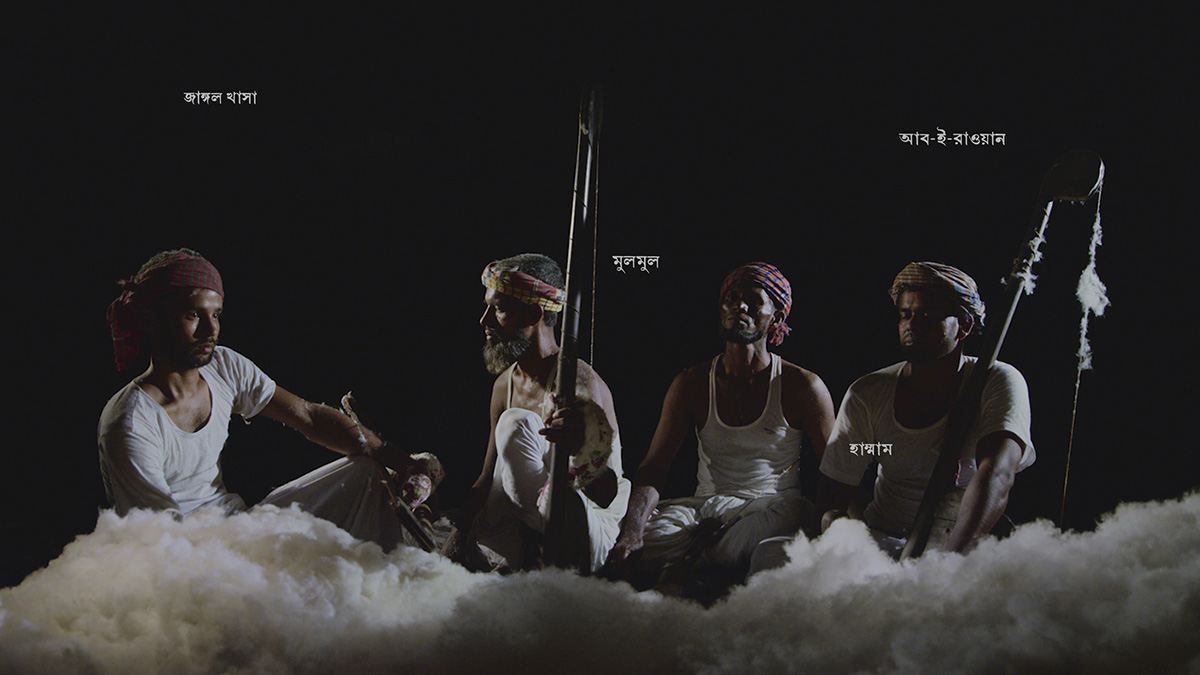
Shabnam unfolded a research on my colonial history in relation to Muslin where I tried to visualize a certain nerve-racking situation when people from a certain part of the world reflect an accumulation of knowledge and wealth. Sometimes the monumental museum display gives a strange complexity. The difference between the one who needs to rumble around archives all around the world to connect the threads between past and present and one who gets everything compiled and labelled is an important one. By process, Shabnam is like a patchwork. The idea was cautiously extended over found images and sounds. Here, the Bangla language is a part of the sonic experience; that is why the subtitle is always coming later as part of an image. I think the sonic experience of the film is something to bear the uneasiness about unequal relationships and exchanges that we have in this world. The drawing of the Bangla letters or the sound of the language played a pivotal role in telling disturbed cartography. What was a work about cotton and lost heritage, has reached me to few questions. How do you visualize the feeling of ‘other’? How do you visualize the churn in your stomach when you find yourself in front of unresolved loss?
Reetu Sattar is an artist and film-maker, based in Dhaka, Bangladesh. Her practice, both performative and experimental in nature, questions human perception and imperceptible nature by re-examining history and the creation of knowledge. In a constant dialogue with immediate surroundings, her work engages with the poetics of environments and explores inner urges for change, perception, (re)relation to body and matter. Born in Dhaka Reetu works and lives in Dhaka. Her recent exhibitions include Istanbul Biennial, British Textile Biennial, International Film Festival Rotterdam, Liverpool Biennial, and Dhaka Art Summit as well as venues including the British Film Institute, London; Alserkal Avenue, Ishara Art Foundation, Dubai; Artspace, Sydney; Palais de Tokyo, Paris and NTU CCA Singapore. Her performances have been staged internationally at venues in London, Birmingham, Bangkok and Goa. Reetu’s first film premiered at International Film Festival Rotterdam, in 2019 and the second film Shabnam premiered at the latest IFFR. Reetu’s performance installation programmed in Spring 2020 will be presented at The Museum of Modern Art, New York on a date forthcoming. Reetu Sattar is a member of Britto Arts Trust, an artist collective based in Dhaka. She also works with Dhaka-based theatre group Prachyanat. Reetu is currently in an 11-month residency at Jan Van Eyck, Netherlands.
Volker Sattel
Unternehmen Paradies
Experimental doc. | 16mm | color | 60:0 | Germany | 2003
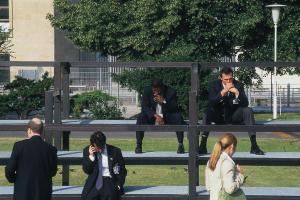
In this unusual city portrait, Berlin is not presented as a buzzing new metropolis, but as a city that goes about its business quite unexcitedly. Choosing a slow pace, this documentary grants us the privilege of observing from afar the gestures and movements of people pursuing their different activities in Berlin`s often vast and surprisingly empty urban spaces. A seemingly indifferent camera takes us to international summits, demonstrations, parades, housing estates and shopping centres. As we begin to discern the patterns of life in the city, it is as if we are witnesses to life on another planet, an impression enhanced by the film`s intricate score which provides the film`s only, yet subtle commentary.
Denis Savary
Pégase
Video | dv | color | 1:51 | Switzerland | 2009
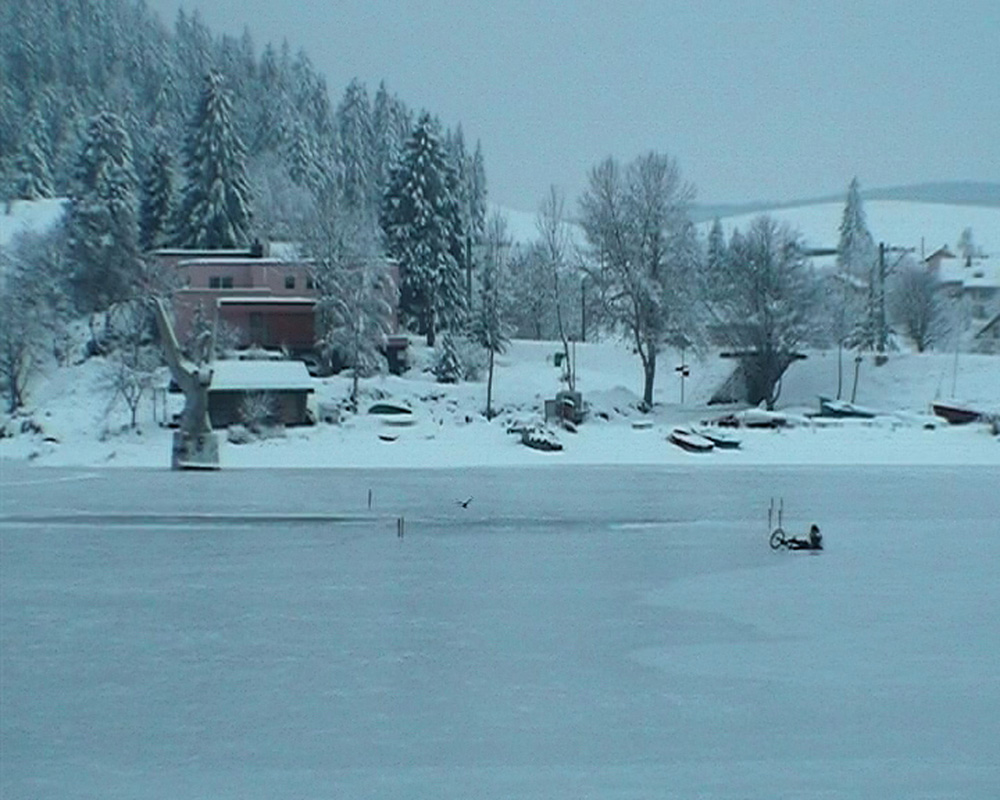
A la vallée de Joux, en Suisse, un vélo cycliste tente la traversée d`un lac gelé. Le titre de la vidéo, Pégase, provient de la sculpture que l’on voit en arrière plan. Ce petit film s’inscrit dans une série d’une trentaine de films autonomes réalisés entre 2003 et aujourd’hui.
Denis Savary est né en 1981 à Granges-Marnand en Suisse. Il vit et travaille à Genève. Diplômé de l’Ecole Cantonale d’Arts de Lausanne, il est en résidence à l’atelier des Arques, puis au Pavillon du Palais de Tokyo en 2006/2007. Il a participé à de nombreuses expositions de groupe : Enchanté château, organisée par Christian Bernard à la Fondation pour l’art contemporain Claudine et Jean-Marc Salomon en 2005, au MAMCO de Genève en 2006, Voici un dessin suisse (1990-2010), au Musée Rath (Genève), Wind, me souffle entre les images au Quartier à Quimper, au Printemps de Septembre à Toulouse en 2009 et 2008... Son travail a également été montré en 2008 au Jeu de Paume (Paris) dans le cadre de la programmation Satellite et au Musée Jénisch à Vevey (Suisse). Lors de l’exposition Le Narrenschiff au Centre Pasquart en 2010, on a pu découvrir un vaste ensemble de films de l’artiste. En 2012, la Kunsthalle de Berne lui consacre une exposition intitulée Balthiques. Plus récemment, une sélection de ses films a été projetée au Centre Georges Pompidou (Paris) lors du festival Hors Pistes. En 2015, une exposition monographique lui sera consacrée au MAMCO de Genève.
Kirill Savchenkov
The Past Ripens in the Future
Video | hdv | color | 5:1 | Russia, Italy | 2022
Alli Savolainen
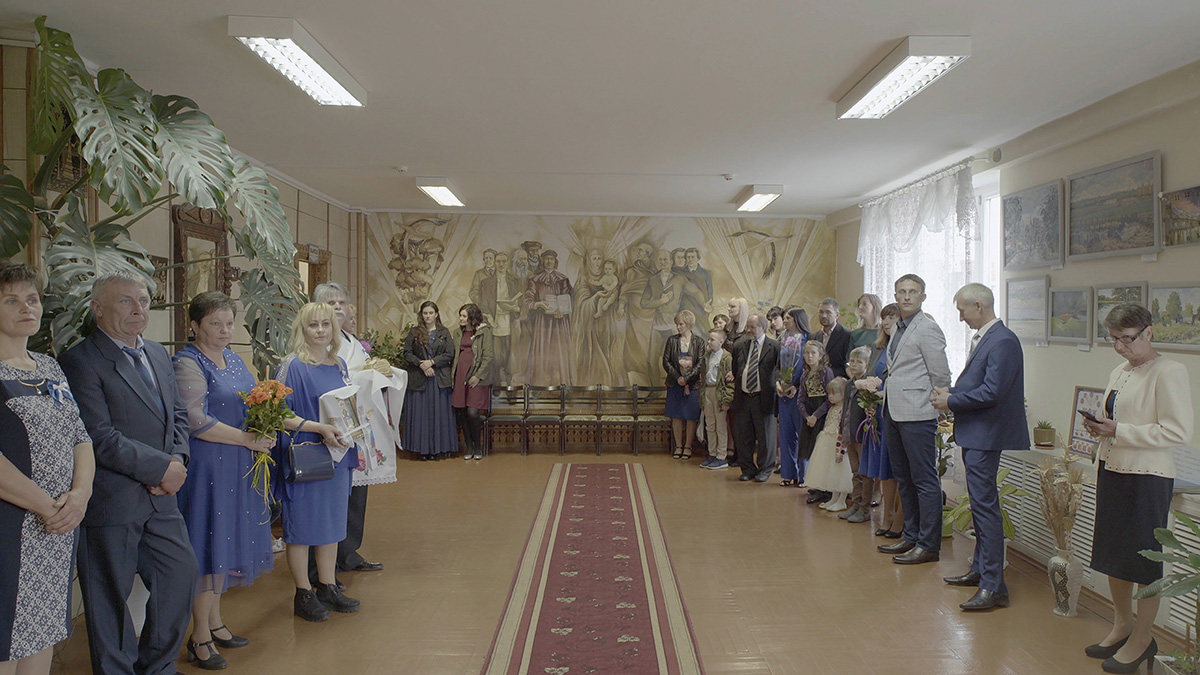
Excuse Me Could You Make Me Photo
Video | dv | color | 3:0 | Finland | 2007
Kristina Savutsina, Georg Kussmann
Khan’s Flesh (Telo Khana)
Documentary | mp4 | color | 57:30 | Germany, Belarus | 2021
Choreographies of everyday life in a small town in Belarus. Through static images and associative montage, Telo Khana (Khan’s Flesh) conveys a perspective on society and the intangible power relations it is permeated by. The priest's ear recognizes the sins of the parishioners. The heartbeat of the fetus is monitored. Workers leaving factory. Telo Khana (Khan’s Flesh) shows the everyday life of a small town in Belarus as choreographies within stage-like images. The inhabitants move and position their bodies depending on the situation and according to their social and professional status. A skeleton of norms, rules and role models, completed with the bodies of active citizens, becomes a vital structure whose components alternatingly discipline themselves through mutual control, praise and punishment. These interwoven social structures are getting traced, broken up and recontextualized by a dance-like montage. The images strict tableau-style reveals a surreal theatricality of the institutionally shaped everyday life. At the same time Telo Khana (Khan’s Flesh) is a contemporary document of life in the Belarusian province, barely a year before the beginning of the nationwide protests against the state apparatus.
Kristina Savutsina was born in 1989 in Riga, into a Belarusian family. From 1993 to 2014 she lived in Belarus. She graduated with diploma in cultural studies in Minsk. In 2014 Kristina moved to Germany, where she has been studying film and fine arts at the University of Fine Arts Hamburg (HFBK). In her work Kristina deals with regulatory politics and its concrete manifestations in Belarus. Besides artistic practice she works as curator and translator. She lives and works in Hamburg. Georg Kussmann was born in Halle/Saale, East Germany in 1989 and grew up there. He studied photography and film at the University of Fine Arts in Hamburg. Currently he lives in Berlin and works as an artist, filmmaker and cinematographer.
Jacky Sawatzky
Social metronome
Création numérique | 0 | color | 0:0 | Canada | 2006
A few years ago, artist Jacky Sawartzky was living in the West End, a neighbourhood in Vancouver (Canada). Her apartment looked out on a back alley and four garbage bins. At dawn her wake-up call was the sound of the homeless pushing their shopping carts through the back alley intersected by car doors slamming and motors starting. The back alley was a lively place. In that same period she was doing research around surveillance methods that use a computer application other then vision to discriminate. "Social Metronome" is seven videos in which the image as well as the editing structure is determined by movement in the back alley. A camera controlled by a computer program uses the syntactical structure of a computer programming language - the logical proposition of 'if followed by then', to create a portrait of this back alley. The program selects according to the intensity of movement and not the content of movement. For seven days of a week, this system was set up from dawn to dusk, resulting in an average of 500 clips a day. These clips were then assembled into seven videos that portray a back alley based on movement.
Jacky Sawatzky is a performance and media artist. Originally from Winnipeg (Canada), she spent most of her life in the Netherlands, where she completed the majority of her formal training, and later moved to Vancouver to complete a MFA degree at Simon Fraser University. Her recent projects are intended to create an awareness of the concepts behind digital technology and explore the influence this technology has on our perception and consumption of such. She taught at Ryerson University, School for Image Arts, in Toronto, and is currently spending time on her own art-practice.
Susannah Sayler, Edward Morris
The Amazon is Elsewhere
Experimental film | 4k | color and b&w | 12:0 | USA | 2025
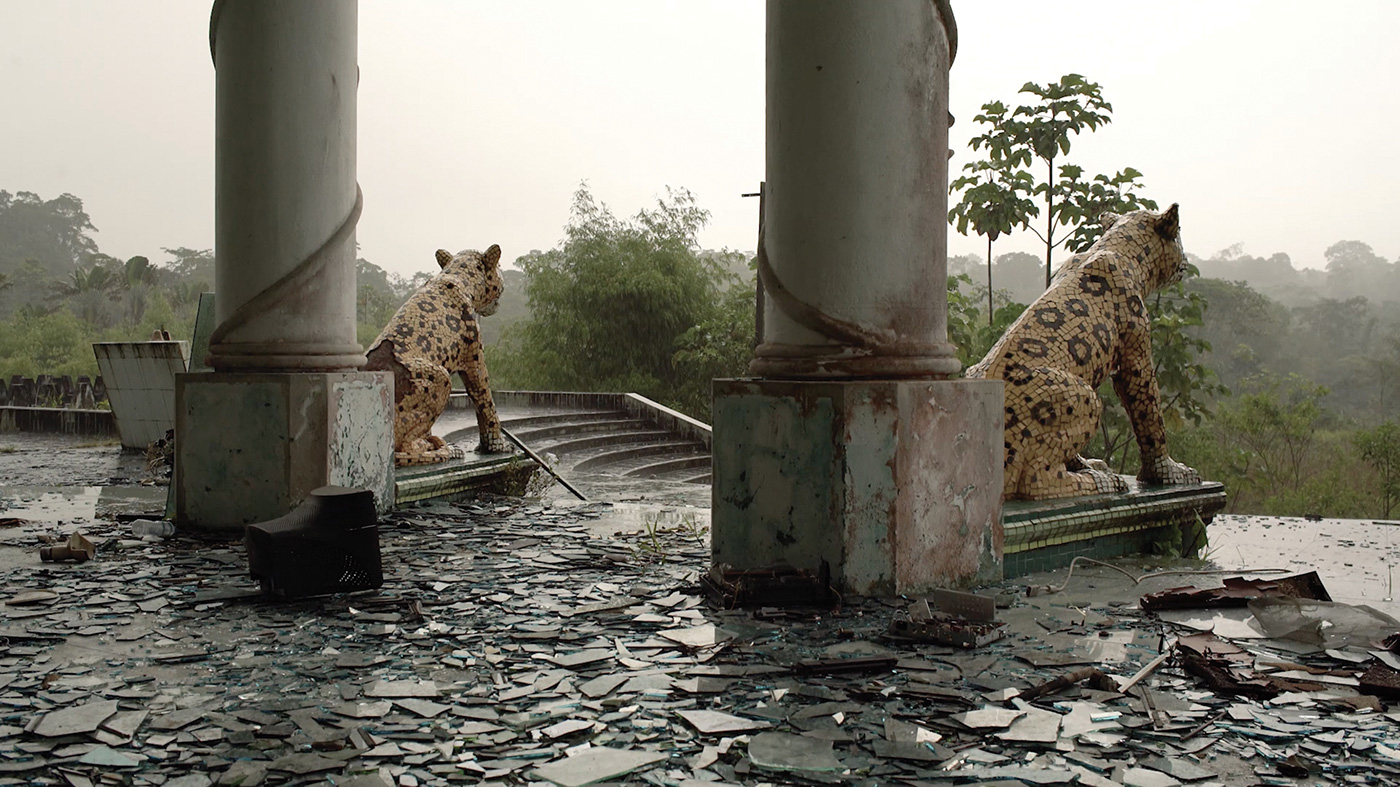
Amazon is Elsewhere is a short film that mediates on the unknowability and power of the Amazon for those who do not live within it. For many, the Amazon symbolizes “the lungs of the earth” or “nature” itself. For the indigenous people of the region, many of whom have no separate word for jungle or forest, it is simply home. The film centers around a building on the edge of the jungle: a mélange of architectural styles where trees break through the concrete floors; plants grow in the faux Corinthian columns; and jaguars made from ceramic tiles guard the entrance. AI-generated images express forces at play in both the building and the jungle that are difficult to parse as being malevolent or redemptive. The film is part of a body of work that considers how to represent the Amazon in light of its multiplicity of refracted meanings.
Susannah Sayler and Edward Morris (Sayler/Morris) work with video, photography and installation to examine our changing notions of nature, culture, and ecology. Their work is often place-based and focused on historical research. They have been awarded numerous fellowships including the Guggenheim Fellowship (2023) New York Artist Fellowship (2016), the Smithsonian Artist Research Fellowship (2014), the Center for Art and Environment Research Fellowship (2013), and the Loeb Fellowship at Harvard Graduate School of Design (2008). Their work has been exhibited broadly in the U.S. and internationally, including at the Massachusetts Museum of Contemporary Art, the Kunsthal in Rotterdam, the North Carolina Museum of Art, the Belvedere Museum, and the Southeast Center for Contemporary Art. Sayler currently teaches in the Film and Media Arts Department at Syracuse University, while Morris is Executive Director of Marble House Project. Their archives are collected by the Nevada Museum of Art / Reno, Center for Art and Environment. In 2006, Sayler/Morris co-founded The Canary Project, a studio that produces visual media and artworks that deepen public understanding of climate change. In 2021, they founded Toolshed, a platform for connecting ecological thought and action.

Gerald Schauder
Skulptur21
Multimedia installation | hdv | color | 3:30 | Germany | 2015
Skulptur21 is an 8 meter long sculpture made of wood, wire, carbon fiber and acrylic paint. It consists of individual hollow elements that are loosely assembled together, partly elevated on wires, on a specially constructed table. The different elements are painted white, light and dark grey, and black. The sculpture is a structural visualisation of Hans Richter‘s experimental film Rhythmus 21. The film, created around 1921, is considered a milestone in film history and is one of the first abstract films ever made. It consists of varying geometric elements that move within the pictorial frame of the screen and change in shape. The elements also change in size, giving the impression of movement towards and away from the viewer, thereby creating a feeling of depth. Skulptur21 shows this movement in space. In the sculpture, every element of the film is shown as a three- dimensional object. Size, position and colour of the elements correspond to those shown in the film. The viewer can physically retrace the elements of the lm by walking along the sculpture. One second of the 3-minute lm corresponds to about 5 cm of the 8 meter long sculpture. The lm can be seen in its entirety at one glance. The sculpture reveals relationships between the elements over the entire duration of the film. However, the translation of the film Rhythmus 21 into sculpture goes beyond a mere reinterpretation of the lm. Skulptur21 creates a connection between the time present in film and the space of architecture. In his paintings, Hans Richter was concerned with studying movement and rhythm. Taking as a basis musical theories, he started developing horizontal rolls depicting geometric elements that gradually change in shape and thus suggest movement. Skulptur21 can likewise be read as a musical score, a linear experimental notation that visualises dynamic proportions and progressions. In addition to o ering a new way of looking at the film Rhythmus 21, the aim of Skulptur21 is to enable the viewer to make their own personal discoveries and experiences, no matter what background or field they come from.
Gerald Schauder a.k.a. KABELTON, born and raised in Munich, socialized in Graz, now living in Cologne, produces media art, electronic music and electroacoustic compositions. He is working as a sound engineer for film and music

Sandra Schäfer
Into the Magnetic Fields
Experimental doc. | 4K | color | 14:10 | Germany | 2024
What waves and signals run through the hybrid landscapes between agricultural use and fallow land? Who passes through them? Working, traversing, and intervening in the landscape and space meet the atmosphere, the wind, the earth. Posthuman modes of production encounter magnetism and visions of Afrofuturism. The settings of the film include a field in the Lower Rhine region, outer space, a forest in Bad Marienberg, and a research site for migratory birds. Generated voices quoting texts by feminist science fiction author Ursula K. Le Guin, theorist Mark Fisher, artist Lygia Clark, and interviews with foresters and bird researchers form the soundtrack together with music by Dominik Eulberg, Manuela Schininà, Maya Shenfeld, and Tim Tetzner.
Sandra Schäfer’s artistic practice deals with the production of urban, rural and geopolitical space, history, and visual politics. Often her works are based on researches, in which she is concerned with the margins, gaps and discontinuities of our perception of history, political struggles, urban, rural and geopolitical spaces. Her works were exhibited at 66th and 67th Berlinale (Forum Expanded), Berlin; at Camera Austria, Graz; Museum für Gegenwartskunst, Siegen; Schirn Kunsthalle Frankfurt; mumok, Vienna; Museum Ludwig, Cologne; Depo, Istanbul; La Virreina, Barcelona; Zentrum für Kunst und Medien, Karlsruhe. In 2018, she completed her doctorate focusing on militant visual and spatial politics at HFBK University of Fine Arts Hamburg. Schäfer also is professor at the Academy of Fine Arts Munich and an associated member of the feminist film distributor Cinenova in London. Schäfer’s practice involves curating film and lecture programmes. In 2003, for example, she curated the film festival Kabul/ Tehran 1979ff: Film Landscapes, Cities under Stress and Migration at the Volksbühne Berlin and the Filmkunsthaus Babylon together with Jochen Becker and Madeleine Bernstorff.
Sandra Schäfer
Westerwald: Eine Heimsuchung
Experimental doc. | 4k | color | 43:40 | Germany | 2021
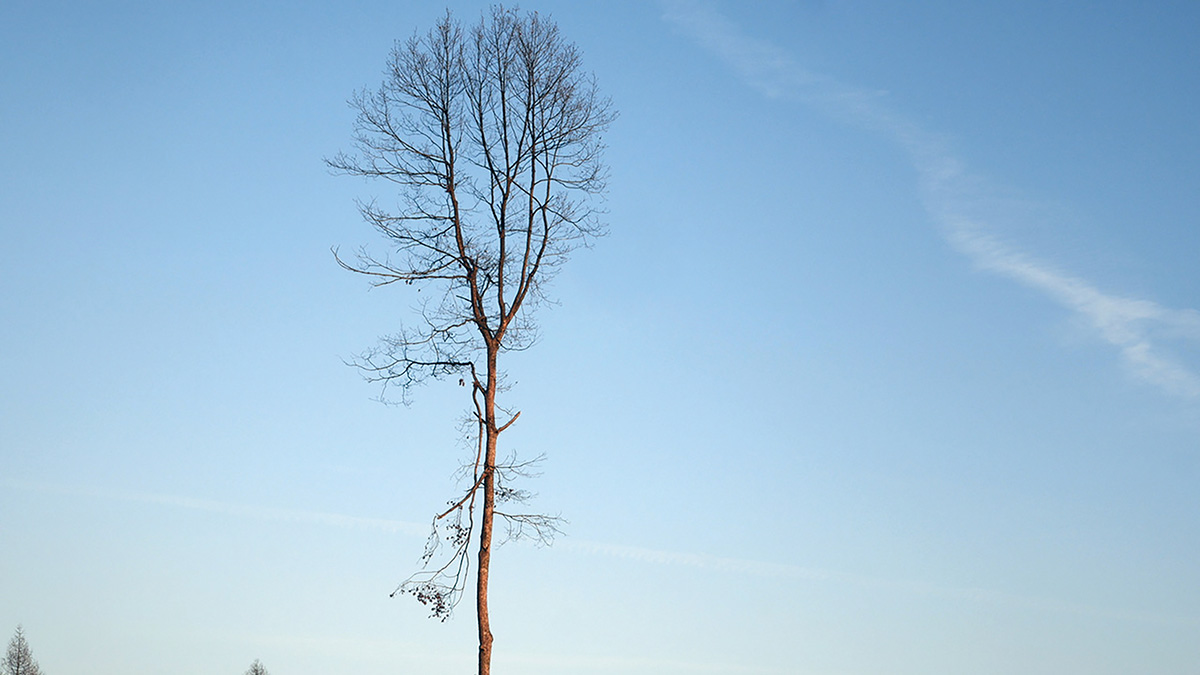
In her video installation “Westerwald: A Visitation”, the Berlin artist Sandra Schäfer - based on August Sander's series of Westerwald farmers - deals with the transformation of the rural region in which the artist herself grew up. Sandra Schäfer juxtaposes August Sander's perspective with her own and contemporary view. For it is also about how a region, its landscape and agricultural use have changed over the course of time. In her artistic work, Schäfer is interested in the various contemporary witnesses and their entanglements: How do the relatives/portrait subjects speak about the (artistic/documentary) pictures by August Sander? What does it mean to hear the dialect that always also marks a class difference? What knowledge is there about the photographer and his approach? How does this differ from that of photo curators in the museum context? And what does it mean for the artist, who was born and raised there, to return to create this artistic work?
The artist Sandra Schäfer works with film and video installations. Therein she deals with processes of unfolding and rereading of documents, images, spatial narratives and performative gestures. Often her works are based on longer researches, in which she is concerned with the margins, gaps and discontinuities of our perception of history, political struggles, urban and geopolitical spaces. Her works were exhibited at 66th and 67th Berlinale (Forum Expanded), Berlin; Camera Austria, Graz; Museum für Gegenwartskunst, Siegen; Schirn Kunsthalle Frankfurt; mumok, Vienna; Museum Ludwig, Cologne; Depo, Istanbul; La Virreina, Barcelona. Schäfer also is professor at the Academy of Fine Arts Munich and an associated member of the feminist film distributor Cinenova in London. She edited the books: Moments of Rupture: Space, Militancy & Film, Spector Books, Leipzig (2020), stagings. Kabul, Film & Production of Representation, b_books, Berlin (2009) and Kabul/ Teheran 1979ff. Filmlandschaften, Städte unter Stress und Migration, b_books, Berlin (2006, together with Jochen Becker and Madeleine Bernstorff).
Sandra Schäfer
The making of a demonstration
Documentary | dv | color | 10:0 | Germany, Afghanistan | 2004
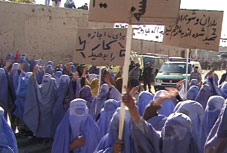
At the heart of this movie is the reconstitution of a women's demonstration after the Taliban bans them from working. These sequences were born during the shooting of the movie "Osama", in November 2002, in the streets of Kabul. One thousand women came to act out the scene. Most of them did so in order to earn money. By asking for work they hoped to improve their situation in life.
Sandra Schäfer studied arts, politics and sociology in Kessel, London, and Karlsruhe. She is a Berlin based director and movie curator. In November 2002 she visited Kabul and Tehran to perform research for her documentary film, "Passing the Rainbow", and the Film Festival "Kabul/Tehran: 1979ff". She curated a series of movies for Afghanistan and Tehran in Belfast, Lüneburg, Karlsruhe, and Berlin. She is currently working in collaboration with Elfe Brandenburger on the documentary movie "Passing the Rainbow". Schäfer is the co-editor of the book "Kabul/Tehran 1979ff: Filmlandschaften, Städte unter Stress und Migration", published and released in 2006 in Berlin by b_books-Verlag. Films/videos/video installations: "Traversée de la Mangroves" (2006), "The Making of a Demonstration" (2004), "A country?s new dawn" (2001), "Die unsichtbare Dienstleistung" (2000), "Kontaktfreudig, offen und gewandt im Umgang" (1999), "England-Deutschland" (1997), "Shift" (1996).
Cyril Schäublin, Valentin Merz
MODERN TIMES
Experimental doc. | hdv | color | 7:22 | Switzerland, Germany | 2013
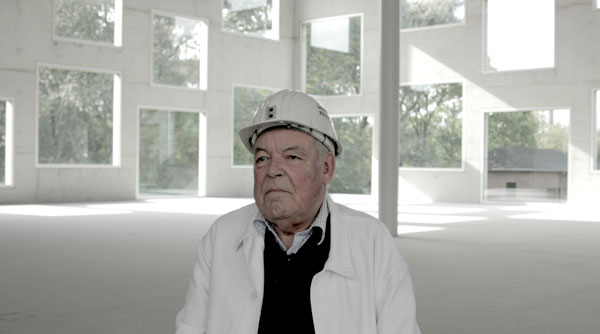
In the city of Essen, the Zollverein coal mine, once the dynamic center of the region, has been closed for many years. Adjacent to the empty factory, most of the residential buildings and shops are now abandoned. People have moved away from here. However, in 2001, the deserted coal mine received the UNESCO World Heritage status. A museum and the new `Zollverein Cube`, designed in 2006 by the Japanese architects Kazuyo Sejima and Ryue Nishizawa (SANAA), could be seen as an attempt to bring back life to the area. Yet the site appears only as a shadow of its former self; a vast, grey void is pervading the air. On a search to find some traces of life here, the film comes across an old veteran worker and meets visiting tourists from China, both with conflicting opinions on the old mine.
Cyril Schäublin was born in 1984 in Zurich, Switzerland. In 2005 he left to study filmmaking in Beijing, Berlin and Paris. In 2012 he graduated (M.F.A.) in film directing at the German Film and Television Academy Berlin (dffb). Cyril Schäublin lives and works in Zurich and Berlin. Valentin Merz was born in 1985 in Zurich. Trained as a graphic designer, he moved to Mexico City in 2007 to study Art History and Spanish Literature at the Universidad Nacional Autónoma de México. That aside, he worked as an actor, directing assistant and director on films in the US, Mexico and in Berlin. Valentin Merz lives and works in Zurich and Berlin.
Alexander Schellow
fragment/ Vienna
Animation | dv | black and white | 10:10 | Germany | 2009
fragment / Vienna 2009 DVD, S/W, Ton mono, 10:10 fragment ist die Rekonstruktion einer visuellen Situation im U-Bahnhof Karlsplatz in Wien anhand von drei Fragmenten dort (strikt in Mono) aufgenommenen Audio-Materiales. Dieses wurde in der Folge als eine Art Score genutzt, um die visuelle Situation in einer scheinbar lineraren timeline zu verorten und dabei das Erinnerte frame für frame zu rekontruieren. fragment kopiert dabei in einer Art künstlich erzeugter Kamerabewegung den Duktus der Objektivität einer ?echten? visuellen Aufnahme. Sichtbar ist einer jener Überwachungsräume in Wiener U-Bahnhöfen, in denen eine Reihe von CCTV-Monitoren dem Fahrgast in einer Art öffentlicher Installation präsentiert wird. Oft sieht der Betrachter von hinten wiederum einen Angestellten der Verkehrbetriebe, der seinerseits die Monitore beobachtet. Der Film gräbt in der gefundenen Oberfläche, legt in einer Art prospektiver Archäologie die zeitweise beinahe surreal anmutenden Schichtungen der Überwachungssituation frei. Jeder der drei Teile tut dies mit einem etwas anderen Fokus der Analyse, so dass sich in der Relation der Teile ein komplexes Gefüge zu bilden und dieses in der Wahrnehmung des Betrachters zu oszillieren beginnt. Jeweils nach die visuell rekonstruierten Sequenzen ist das zugrunde liegende auditive Material hart geschnitten. Es ist zu hören, während das Bild Schwarz bleibt. Die betrachtende Arbeit der Überlagerung und Verknüpfung des gehörten und (erinnert) gesehenen spiegelt sich an den Konstruktionsachsen zwischen Bild und Ton.