Catalogue > Search
Results for : Tout le catalogue
Alexander Schellow
Marseille #01 - #30
Animation | dv | black and white | 6:3 | Germany, France | 2011
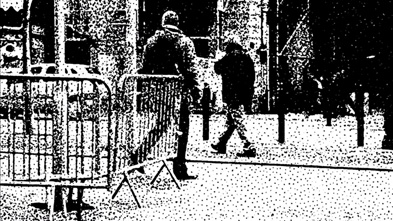
Marseille #01-#30 s?inscrit dans une série de films de 3 secondes intitulés spots, série débutée en 2006. Les spots consistent en la reconstruction de mémoire de fragments de scènes du quotidien, à partir de dessins qui deviennent ensuite de brèves animations. Cet ensemble de 30 spots se concentre sur des moments spécifiques observés dans l?espace urbain marseillais. Une animation de trois secondes est constituée d?environ 36 dessins. Chacun est reconstruit indépendamment des autres et de mémoire. Montées en boucle et en alternance avec des écrans noirs d?une durée identique, les images apparaissent et disparaissent avant que l?on puisse vraiment les saisir, comme des souvenirs qui infiltrent inconsciemment la perception. Les spots Marseille #01-#30 ont été réalisés en 2011 dans le cadre d?une carte blanche proposée par les Rencontres Parallèles, à Marseille. À cette occasion les spots furent dispersés dans divers lieux de la ville, privés comme publics, sur des supports de tous types mais déjà existants : télévision d?un bar, magasin d?audiovisuel, librairie, cinéma, restaurant, etc. Les films agissent alors de manière diffuse sur la perception des spectateurs inconscients de leur statut. Ils ont ensuite fait l?objet d?un montage expérimental et d?une édition DVD offrant plusieurs approches de la matière.
Basé à Berlin, Alexander Schellow est né en 1974. Depuis 1999, il développe une pratique continue de reconstruction de la mémoire par le dessin et l?animation. Récemment, on a pu voir son travail au FIDMarseille 2012, à la Biennale de Lyon 2011, au Fresnoy, au Festival d?Upssala (Suède), à la Biennale de Tirana (Albanie), à la Biennale de Thessalonique (Grèce), au Museion de Bolzano (Italie), au Kunstmuseum de Stuttgart (Allemagne), ou encore au DeApple Artcenter (Amsterdam). En 2012, le Musée d?Art Contemporain de Lyon a fait l?acquisition de son installation Ohne Titel (Fragment). Il a créé en 2011 la société index.film, basé à Berlin. Il collabore régulièrement avec la plateforme internationale de production MELD (New York/Paris/Athènes), le label d`avant-garde Lowave (Paris), la société de production Films de Force Majeure (Marseille), et l?association Catalogue du Sensible. Depuis 2007, Alexander Schellow intervient comme enseignant dans diverses universités (Paris, Londres, Anvers, Constance). Il a obtenu plusieurs bourses et résidences - dernièrement à l`Akademie Schloss Solitude dirigée par Jean-Baptiste Joly ou au Zukunftskolleg de l`Université de Constance. Il termine actuellement le documentaire d?animation Tirana et prépare la création de la performance Ohne Titel (Live).
Alexander Schellow
still lives
Animation | dv | black and white | 3:36 | Germany, United Kingdom | 2007
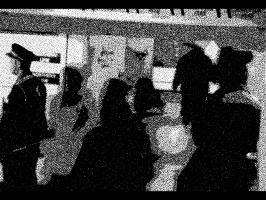
»still lives« is an attempt to rework and reuse memory. By that the practice particulary doesn`t focus on those daily experiences, that attract our strongest attention but in opposite to that. It focuses on the unfocussed perception ? what one hasn`t noticed clearly, but what still somehow is archived in one`s minds: a group of people in a train, a person behind a window, an empty staircase. Alexander Schellow deconstructs a series of thirty three-second long still images of London Underground-journeys from memory each into 36 individual images (drawn on paper) and reassembles them into a film. The sequence of three seconds corresponds with the perception of the present state in the human brain. It is, what we call a moment in the sense of a smallest possible memory-unit, out of which past and future are located. The filmic animated (re-)production becomes the reconstruction of this present moment condensed to a maximum. Based on the perception of ?still lives?, the film shows one possible realm of possibilities to reconstruct the scenario. With its slow and repeating scenic description, Alexander Schellow manages to constitute reality in a comprehensive sense.
Alexander Schellow Born 1974 in Germany Hannover, Alexander Schellow studied ?visual arts? at the Universität der Künste Berlin and the Glasgow School of Art. Since 1999 several solo- and groupshows in Europe, works for performance-theatre and lectures ? recently Steirischer Herbst, Graz (film-installation) / Kunstmuseum Stuttgart (solo-show) / Centre Pompidou, Paris (lecture with live-mapping) / 1. Biennale Thessaloniki / Galerie Ute Parduhn, Düsseldorf (solo-show) / Kunstsammlungen Zwickau (show of nominated artists) / Storefront for Art and Architecture, New York (screening of ?spots?). Publications 2007 beside catalogues of the Kunstmuseum Stuttgart and the Kunstsammlungen Zwickau include his book-project ?STORYBOARD? (published by Merz/Solitude, Stuttgart) and the DVD ?still lives? by Filmarmalade (London) such as contributions to magazines as DOMUS or LICHTUNGEN. Recent performancetheater-work 2007/2008 with David Weber-Krebs, Amsterdam, and Philipp Gehmacher, Vienna. 2006/07 Alexander Schellow was resident fellow of the Akademie Schloss Solitude (Stuttgart) and is Pechstein-fellow 2007. He lives in Berlin and teaches at the Metropolitan University in London.
Hester Scheurwater
Glamour Girls
Experimental video | dv | color | 6:30 | Netherlands | 2004
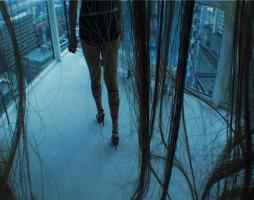
In Glamour Girls, as in many of her short films, Hester Scheurwater?s camera explores the relationship between human beings and space, and between humans themselves. That relationship does not flourish. The modern individual - in this case three women imprisoned by the glass and concrete of sleek high-rise structures - appears isolated from reality, unable to connect with itself or its surroundings. The women are modern geisha`s, with excessive, smudged make-up, and limbs covered in blood. After trying to fill the void with glamour, they lie down in silence, realizing that innocence has been lost. And brushing your teeth afterwards doesn`t scrub away the taste of sin. `As I lick your lips, they turn to stone,` sing Chicks on Speed. `Your hands are cold, I can see right through them, left with nothing but the aftertaste.? In Scheurwater?s universe there is hardly any room left for human warmth. The only living being that evokes a sense of pity is a dog. And the only hope that remains is the camera itself, feverishly searching for compassion in the remnants of decay.
Hester Scheurwater (born 1971, H.I. Ambacht, The Netherlands) studied monumental art at the Royal Academy of Fine Arts in The Hague, where she participated in workshops with Frans Zwartjes and Nan Hoover. She now teaches video art at the Academy. Since 1996, Scheurwater has made video installations and experimental films that have been shown all over the world at festivals, museums, galleries and art spaces. In many of her short films and videos, Hester Scheurwater`s camera explores the relationships between human beings, and between humans and space, relationships that rarely flourish. The modern individual appears isolated from reality, unable to connect with self or surroundings. In Scheurwater`s universe there is very little room for human warmth; the only hope that remains is the camera itself, feverishly searching for compassion in the remnants of decay.
Hester Scheurwater
Mama
Art vidéo | dv | color | 2:30 | Netherlands | 2005
In Glamour Girls, as in many of her short films, Hester Scheurwater?s camera explores the relationship between human beings and space, and between humans themselves. That relationship does not flourish. The modern individual - in this case three women imprisoned by the glass and concrete of sleek high-rise structures - appears isolated from reality, unable to connect with itself or its surroundings. The women are modern geisha`s, with excessive, smudged make-up, and limbs covered in blood. After trying to fill the void with glamour, they lie down in silence, realizing that innocence has been lost. And brushing your teeth afterwards doesn`t scrub away the taste of sin. `As I lick your lips, they turn to stone,` sing Chicks on Speed. `Your hands are cold, I can see right through them, left with nothing but the aftertaste.? In Scheurwater?s universe there is hardly any room left for human warmth. The only living being that evokes a sense of pity is a dog. And the only hope that remains is the camera itself, feverishly searching for compassion in the remnants of decay.
Hester Scheurwater (born 1971, H.I. Ambacht, The Netherlands) studied monumental art at the Royal Academy of Fine Arts in The Hague, where she participated in workshops with Frans Zwartjes and Nan Hoover. She now teaches video art at the Academy. Since 1996, Scheurwater has made video installations and experimental films that have been shown all over the world at festivals, museums, galleries and art spaces. In many of her short films and videos, Hester Scheurwater`s camera explores the relationships between human beings, and between humans and space, relationships that rarely flourish. The modern individual appears isolated from reality, unable to connect with self or surroundings. In Scheurwater`s universe there is very little room for human warmth; the only hope that remains is the camera itself, feverishly searching for compassion in the remnants of decay.
Schiefelbein
I can. You can.
Video | hdv | color | 7:22 | Germany | 2012
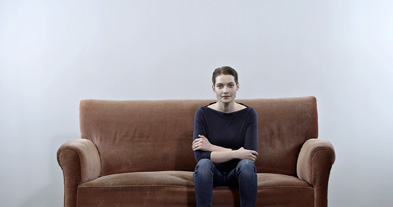
A women is sitting on a couch while focussing her iron view into the camera and suddenly starts to talk. Out of her grows a canny and calm monologue which manifests her world of thoughts and ideas. The at first independently created monologue starts to get tangled up into contradictions, torn between different views and ideologies. It is a result of phrases taken out from different commercials which were combined into a continuously ongoing monologue. The women monologue turns out to be commanded and alienated by advertisement.
Marko Schiefelbein (*1984 in Stralsund, Germany) is a German artist living and working in Berlin. He studied Art History and graduated in Fine Arts in 2011 from University of Fine Arts Braunschweig (Germany). He is a master student of Prof. Candice Breitz. His works deals with the human estrangement in the century of modern life in a consumer society. His work was shown in
Jérôme Schlomoff
Amsterdam Reconstruction
Experimental film | 35mm | black and white | 20:0 | France, Netherlands | 2007
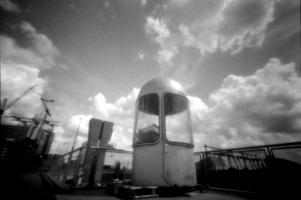
Ce film sténopé propose une visite de la ville d?Amsterdam à travers les chantiers de reconstruction de quatre institutions culturelles qui sont : la salle de cinéma de la Maison Descartes ; le Rijksmuseum ; le Stedelijk Museum Amsterdam ; le centre d?art W139. Ces lieu sont actuellement en travaux. Ce film est construit comme une mystérieuse balade du regard à travers ces 4 chantiers chargés d?histoire, où la magie de l?architecture mise à nu nous plonge dans un univers étrange et dont la caméra sténopé nous révéler la force poétique. Tout au long de cette balade, les éléments poétiques successivement rencontrés sont confrontés à la vision d?un monde industriel, en analogie ou en opposition, avec celle de la nature intacte. Cette vision d?Amsterdam permet de créer lien dynamique entre les quatre chantiers. Il s?agit d?une histoire de reconstruction, reconstruction de la ville à travers notre propre reconstruction du regard.
Jérôme Schlomoff. je suis né en 1961. J`habite & travaille à Amsterdam. Je suis photographe. Depuis 1984, je travaille sur le thème du portrait ; mon terrain de prédilection est le monde de l?art contemporain et je photographie sans cesse de nombreux créateurs. A partir de 1996, mon intérêt pour l?architecture s?affirme et je développe la série des « Sténopés d?Architecture », projet qui montre les liens étroits qui existent entre la photographie et l?architecture, en transformant l?architecture en appareil photo. Enfin, en l`an deux mille je construis ma caméra sténopé 35mm en carton et j?entreprends, image après image, la réalisation de films cinématographiques 35mm, où je prends le temps de poser un regard sur la ville, avec en tête toujours cette même question : « Comment habiter la ville aujourd?hui » ?. Portrait, architecture, cinéma sont ainsi les territoires essentiels à partir desquels s?organisent et se structurent mes recherches sur l?acte de photographier et sa signification actuelle. C?est au croisement de ces trois disciplines, dans leur dialogue permanent et leur enrichissement respectif que prend place mon attitude de photographe, de réalisateur & d?artiste. La littérature, le théâtre, toutes les formes de création, qui nourrissent mon imaginaire en poésie, attirent mon attention. Elles deviennent les territoires d?une expérimentation partagée autour d?un même langage.
Jérôme Schlomoff
Blonde Redhead Meets Gainsbourg
Experimental film | dv | color | 5:5 | France, Netherlands | 2009
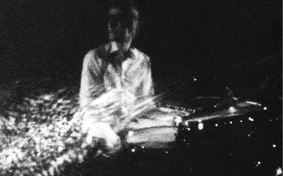
Live concert filmed in the "Cité de la Musique" in Paris on October 25th, 2008, at the request of the Blonde redhead group. For the American rock trio Blonde Redhead, filmmaker and photographer Jérôme Schlomoff used a pinhole camera to make a music video of their song "Spring & by Summer Fall." The video combines outdoor shots with concert footage recorded during the "Blond Redhead meets Gainsbourg" tour in Paris in October 2008. The song appears to be about someone searching for his own life who only manages to see fragments of it in the expressions of passersby. The feelings of desolation and longing are clearly visible in the images. Unrecognizable and at a distance, the musicians play in an enormous emptiness that is only occupied by the music. Outside, the camera travels over a railroad track, looking for someone or something. The effect of the pinhole camera is that all images from the past appear to be snatched away, and as a result are endowed with something tragic. Jérôme Schlomoff started using a pinhole camera he built himself as the medium for his 35mm films back in 2000. This camera with no lens works by allowing light into an otherwise lightproof box through a miniscule hole, which records the images on film. Schlomoff's film Amsterdam Reconstruction was selected for Paradocs in 2007.
My name is Jérôme Schlomoff. I?m born in Vincennes (France) in 1961. I live and work in Amsterdam since 2005. I am a photographer & filmmaker. Since 1984, shooting portraits has been my main occupation. My favorite field is the World of Contemporary Art, and I have been taking pictures of new creators continuously. My interest in architecture was confirmed in 1996 as I developed the « Sténopés d?Architecture » (Architectural Pinhole) series. This project shows the tight link between photography and architecture, as I turn architecture into a camera. Finally, in the year 2000, I built, by necessity, my first 35mm cardboard pinhole camera. Image after image, I gave life to a 35mm motion picture, taking my time, and wondering, with the city as my model, and with only one question in mind:? How can you live in a city today??. Portrait, Architecture, cinema are the essential fields from which I organize and build my research on the action of taking a picture and it?s actual meaning. It is at the crossroad of these three techniques, in their permanent dialogue, and respective enrichment that I set my attitude as a photographer, as a filmmaker and as an artist.
Jérôme Schlomoff
la villa k
Experimental film | 35mm | black and white | 2:20 | France, Netherlands | 2008
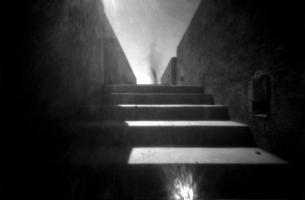
This film proposes a visit to the building site ?the villa K?, built on the outskirts of a small village 20 km from Marrakech by the architects Karl Fournier & Olivier Marty, founders of the agency Studio KB. The dialogue that the architects have between traditional and modernity created through their work, joined with his cinematographic approach, the artist also endeavors to capture the magic and the poetry which results from this dialogue.
Jerome Schlomoff was born in 1961. He lives and works in Amsterdam. Since 1984, he works as a portrait photographer; his predilection is the world of contemporary art and photography. From 1996, his interest in architecture continues and he develops the series of the ?Pinholes of Architecture?, project which shows the close links which exist between photography and architecture. Lastly, in 2000 the artist built his a pinhole 35mm camera out of paperboard and made 35mm films with it image of the city with the ever present question ?How to live in a city today??.Portraits, architecture, cinema are the essential territories from which the artist organizes and structures his research on photography and its significance today. It is at the intersection of these three disciplines in their dialogue and their respective enrichment takes place that shows his position as a photographer, director and artist.

Jérôme Schlomoff
Marbre
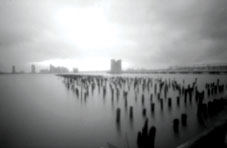
Experimental film | 35mm | black and white | 8:13 | France, Netherlands | 2010
« Marbre » est une ?uvre de l?artiste français Marc Couturier, de 1999, faisant partie de la série : « Redressement ». Elle se présente sous la forme de deux blocs de marbres de Carrare juxtaposés au sol (chacun au format 30X42 sur 12 cm de haut). Sur celui de gauche sont empilés 375 lavis à l?encre de chine sur papier bouffant (au même format 30X42). Accéder à l?appréhension intégrale de l??uvre consiste à feuilleter ce « livre » de dessins représentant 375 bouquets de fleur dans leur vase. On comprend la difficulté de faire vivre au public cette expérience dans un musée. Ce film met scène, en un plan fixe, l?artiste entrain de nous offrir cette expérience. Son accomplissement filmé devient une performance éphémère de l?artiste ayant valeur de portrait de l??uvre et de l?artiste. Le film crée la performance. Le film témoigne de la performance. Le film est performance.
Jérôme Schlomoff. Je suis né en 1961. Je suis photographe. Depuis 1984, je travaille sur le thème du portrait ; mon terrain de prédilection est le monde de l?art contemporain et je photographie sans cesse de nombreux créateurs. A partir de 1996, mon intérêt pour l?architecture s?affirme et je développe la série des « Sténopés d?Architecture », projet qui montre les liens étroits qui existent entre la photographie et l?architecture, en transformant l?architecture en appareil photo. Enfin, en l`an deux mille je construis ma caméra sténopé 35mm en carton et j?entreprends, image après image, la réalisation de films cinématographiques 35mm, où je prends le temps de poser un regard sur la ville, avec en tête toujours cette même question : « Comment habiter la ville aujourd?hui » ?. Portrait, architecture, cinéma sont ainsi les territoires essentiels à partir desquels s?organisent et se structurent mes recherches sur l?acte de photographier et sa signification actuelle. C?est au croisement de ces trois disciplines, dans leur dialogue permanent et leur enrichissement respectif que prend place mon attitude de photographe, de réalisateur & d?artiste.
Jérôme Schlomoff
New York zéro zéro
Experimental film | 35mm | black and white | 20:50 | France, USA | 2006
March 19, 2003, New York, 8.00pm. End of the ultimatum set by George W. Bush to Saddam Hussein. All the televisions broadcast live the president's short speech: America just entered war against Iraq. To these images of American television respond those of New York as a devastated world, plunged in an urban chaos that threatens a great cataclysm. Man deserts the city under a snowstorm. From strolling to strolling, from district to district, the city is broken up, abandoned. Then comes the meeting with Jerzy W.Sulek. An architect originally from Poland, he lives in the street and sleeps in his pick-up parked in front of undeveloped land. He collects furniture and objects which he sells for survival while waiting for some hypothetical building permit deposited years earlier at city hall. He talks about his dream of architecture and his outlook on the question "how to inhabit the city nowadays?"
Jérôme Schlomoff is forty year old photographer who lives and works in Paris. Since 1984, he has been working on the theme of the portrait; his field of predilection is the contemporary art world where he is constantly taking photographs of numerous creatives. In 1996 his interest for architecture asserted itself and he developed the series "Sténopés d?Architecture", a project that shows the close link that exists between photography and architecture while transforming architecture into a camera. In the year 2000 he I built a 35mm pinhole camera made out of cardboard and started, image after image, on the production of 35 mm cine films, where he allowed himself to stare at the city with the same question in mind: "How to inhabit the city nowadays?"
Eske Schlüters
Title (Life goes on)
Video | hdv | color | 12:0 | Germany | 2015
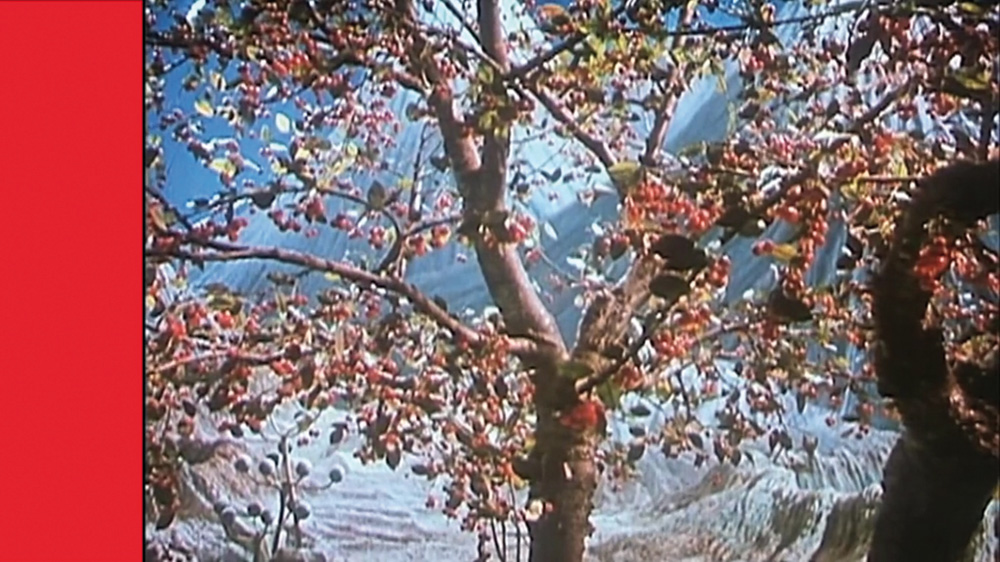
This is a film about the making of a film about a film that was never made. The film described here, as it is being made, is a true film, which however operates with film illusions to the extent that the film that treats this film is a film that was never made because it would have served to maintain illusions. This is a fictional documentary or a documenting fiction about a film that was planned and partly realized by the Ufa in the 1940s.
Romana Schmalisch
Decision of the party
Experimental film | super8 | color | 5:33 | Germany | 2008
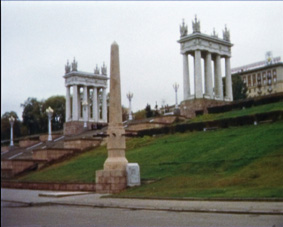
Decision of the Party (2008) is a film, which combines Super8 material from today?s Volgograd with parts of the sound track from the Soviet propaganda film The Promise (Kliatva, 1946). In this movie, Joseph Stalin plans and realises ?his? city, Stalingrad (now Volgograd). Thus, the real city of today is juxtaposed with its past medial vision, in turn becoming a projection of its own history within the film.
Romana Schmalisch 1974 born in Berlin, Germany lives and works in Berlin, Germany Education 1995 Universität der Künste, Berlin 2000 Hunter College, New York, USA 2001 Surikov-Institut, Moscow 2002 MFA, Universität der Künste, Berlin 2006/2007 Researcher Fine Art, Jan van Eyck Akademie, Maastricht Grants 2009 International Residency, Berlin Senate`s Department of Science, Research and Culture in collaboration with the Whitechapel Gallery and Studio Voltaire, London | 2007 Karl-Hofer-Gesellschaft Art Award, Berlin | Provinzial Förderprojekt 2005 Goldrausch Künstlerinnenprojekt art IT | film grant from the Berlin Senate for Cultural Affairs, Berlin 2004 DAAD stipend, Paris 2003 project grant from the Berlin Senate for Cultural Affairs, Berlin for ?Dom Sovietov? 2002/2003 Kyoung-an Artist-in-Residency, Seoul
Romana Schmalisch, Robert Schlicht
Recitando
Experimental fiction | hdv | color | 35:1 | Germany | 2010
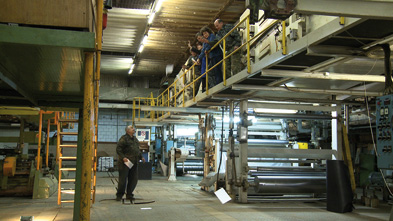
The film ?Recitando? is the documentation of an encounter between workers from the Moscow paper factory ?October? and two filmmakers from abroad. The film experiments with and combines modes of documentary and fiction, and strategies of theatre and film, in order to investigate into and construct models of cinematography. The paper production process which seems to be captured in documentary shots is in fact staged for the camera by the workers, since the factory does not pro¬duce anything at the moment ? and this nonproduction is the condition for their appearance as actors in the film. For at the same time, the workers recount and reflect upon their current situation ? being filmed instead of producing paper ? in choric recitations and two songs, delivered in a manner reminiscent of Brechtian ?Lehrstücke?. The customary contrast of documentary and fictional modes, of reality ?caught unawares? and scripted enactment is thus being twisted and deconstructed. Additionally, the film is continually interrupted by intertitles citing discussions from late 1920s? Soviet cinema ? e. g., about documentarism à la Dziga Vertov and Esfir Shub, about Sergei Eisenstein?s reenactment of the October revolution ten years after the event and the film?s mixed reception, and of the relation between images and text ? thus evoking a friction between early avant-garde cinematography and today?s filmic modes, as well as rendering the question as to who speaks even more uncertain. The two filmmakers may not only come from a different country but even from a different era. The film thus experiments with different cinematographic models. Instead of pur¬porting to present something which could be considered as a finished film, it at¬tempts to create fissures in the cinematographic texture as spaces for the reflection on different filmic modes, on the interrelations of history of film, and on representa¬tion and reality. ?Recitando? was shot in the Moscow paper factory ?October? (formerly ?Red October?), which was founded in 1924. During Soviet times one of Moscow?s largest paper mills, the residual staff only rarely produces paper today. Parts of the com¬plex have been transformed into the art space PROEKT_FABRIKA, where the film premiered in January 2010.
Romana Schmalisch (1974) born and based in Berlin Romana Schmalisch graduated with an MFA from the Universität der Künste, Berlin, in 2002. She focuses on the architectonic urban space, its changes and the accompanying social changes. In her film works, she combines sequences shot by herself with image and film quotations and with text fragments in the form of a collage, juxtaposing different layers of times and imagery. Romana Schmalisch collaborated on various film projects with Robert Schlicht. Robert Schlicht (1975) born and based in Berlin Robert Schlicht has studied philosophy and literature and graduated from the Humboldt University Berlin. His thesis with the title ?Passage au Cinéma? examined the relation of Walter Benjamin?s film theory and his theory of history and historiography. Subsequently, Robert Schlicht was concerned with the interface of theory and film, and collaborated on various film projects with Romana Schmalisch. Recent exhibitions/screenings (selection): National Centre for Contemporary Arts, NCCA, Moscow (2011), centre d?art passerelle, Brest (2010), Proekt_Fabrika, Moscow (2010), Utopiana, Yerevan, Armenia (2009), National Centre for Contemporary Arts, NCCA, Moscow (2009), Centre for Contemporary Art at Ujazdowski Castle, Warsaw (2009), Wilhelm Lehmbruck Museum, Duisburg (2007), STUK Theater, Leuven (2007), Arsenal/Freunde der deutschen Kinemathek, Berlin (2007), Arsenal/Freunde der deutschen Kinemathek, Berlin (2005)
Romana Schmalisch
Real Estate Avantgarde
Experimental video | dv | color and b&w | 5:20 | Germany | 2010
Real Estate Avantgarde »Real Estate Avantgarde«, HD, 5:20 min., 2010 ?Real Estate Avantgarde? is a fictitious promotion trailer for a real estate investment project in St Petersburg. The investor Igor Burdinsky has purchased the former textile factory ?Red Banner?, a masterpiece of avantgarde architecture, and is now seeking partners to realise a cultural and/or business centre. While the investor draws on the symbolic power of avantgarde architecture, the film in turn appropriates this business strategy.
Romana Schmalisch is based in Berlin. Recent exhibitions/screenings include: centre d?art passerelle, Brest (2010) Transmission Gallery, Glasgow (2010), Proekt_Fabrika, Moscow (2010) FormContent, London (2009), National Centre for Contemporary Arts, NCCA, Moscow (2009), Contemporary Art Centre, CAC, Vilnius (2009), Centre for Contemporary Art at Ujazdowski Castle, Warsaw (2009), Museum Folkwang, Essen (2008), MuseumKunstPalast, Düsseldorf (2008), Wilhelm Lehmbruck Museum, Duisburg (2007), STUK, Leuven (2007)
Romana Schmalisch
Weg zum Klub. Erholung durch Kultur
Experimental video | 16mm | color | 11:0 | Germany | 2007
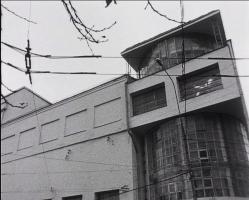
Romana Schmalisch (English Version) ?Walking to the Club. Recreation through Culture?, mixed media/DV, 11 min., 2007 The film combines in the form of a collage Soviet avant-garde buildings from the 1920s, which I have recorded in b/w 16mm shots, with film and audio recordings from the late 1930s, in which the subject of changes in the city of Moscow plays a central role. While the protagonists in the films from the 1920s had still been able to actually see the real city of Moscow with their own eyes, the perspective in the films from the 1930s is directed by ideological texts ? the protagonists get to see no more than an ideal mock-up of the city. The films show a fictitious cityscape, whose centre is often taken by the ?Palace of Soviets?, a building that, like many others, was never realised. These changes in the political as well as the architectural landscape within a period of no more than a couple of years become the central subject of the film ?Weg zum Klub. Erholung durch Kultur?. The visions of the early avant-garde are confronted with Stalinist mega plannings that also used the medium film in order to determine the image of the city even before its realisation. The film ?Weg zum Klub. Erholung durch Kultur? examines the media image of the city of Moscow in a time of radical political and social changes. Among the films I cite, it is in particular Alexander Medvedkin?s ?The New Moscow? (1938) that visualises the rapid changes in this period, and uses the architectonic model as an indispensable part of the properties. The attempt of a painter to capture Moscow in his pictures fails since the cityscape changes at a tremendous pace: the old buildings vanish overnight, are being replaced by others. The film shows an engineer travelling from Siberia to Moscow, where he presents his plans for the new city, the city he had never seen but always dreamt of. Film documents from the Sukharevskaya tower, the Cathedral of Christ the Saviour and the Strastnoy cloister being blown up are integrated in his model ? instead of these buildings drawings and models of the new city appear on the screen. Thus, the real space is replaced by a city comprising of paper models and houses which are supposed to symbolise a new reality in the film. ?Weg zum Klub. Erholung durch Kultur? works with quotations from the dialogues of this film.
Romana Schmalisch 1974 born in Berlin, Germany lives and works in Berlin, Germany Education 1995 Universität der Künste, Berlin 2000 Hunter College, New York, USA 2001 Surikov-Institut, Moscow 2002 MFA, Universität der Künste, Berlin, Prof. K. Sieverding 2006/2007 Researcher Fine Art, Jan van Eyck Akademie, Maastricht Grants 2007 Karl-Hofer-Gesellschaft Art Award, Berlin | Provinzial Förderprojekt 2005 Goldrausch Künstlerinnenprojekt art IT | film grant from the Berlin Senate for Cultural Affairs, Berlin 2004 DAAD stipend, Paris 2003 project grant from the Berlin Senate for Cultural Affairs, Berlin for ?Dom Sovietov? 2002/2003 Kyoung-an Artist-in-Residency, Seoul Solo exhibitions 2008 ?Il braccio di Lucifero si pone 645 1/3 braccia?, Galerie Karin Günther, Hamburg | ?Drehort Zukunft?, Uqbar Berlin 2007 ?Future Cities?, Wilhelm Lehmbruck Museum, Duisburg * ?Radiation. An Alien Revue? (with Robert Schlicht), Performance, STUK Theater, Leuven 2006 ?Two Steps Back Till Unrise?, Casco Projects, Utrecht (with Nina Könnemann) 2005 ?reading in absence?, dreizehnzwei, Vienna (with Tatiana Lecomte) * 2003 ?A Journey to the Space?, Young Eun Museum Contemporary Art, Seoul * Group exhibitions/screenings (selection) 2008 ?Digging Deeper II?, Museum Folkwang, Essen | ?Zerbrechliche Schönheit?, Museum Kunst Palast, Düsseldorf * | ?Cinema?, Galerija Meno Parkas, Kaunas 2007 ?Changing Spaces?, Städtische Galerie Waldkraiburg * ?Radiation?, Arsenal/Freunde der deutschen Kinemathek, Berlin | ?Videonale 11?, Kunstmuseum Bonn, Bonn * 2006 ?Resonances?, Artis, Den Bosch * | ?Tales from a Travel Journal?, Contemporary Art Center (CAC), Vilnius * | ?La Boum II?, Galerie Sies+Höke, Düsseldorf * | ?La Boum I?, Galerie Ben Kaufmann, Munich 2005 ?Differences ? Art as a Film Form?, Migros Museum für Gegenwartskunst, Zürich | ?Fiav.05?, Centre d?Art Santa Monica, Barcelona | ?Polished?, Goldrausch, Kunstraum Kreuzberg/Bethanien, Berlin * | ?Jump Cut-Nights?, SK Stiftung Kultur, Cologne 2004 ?Representing History?, Austria Filmmakers Cooperative, Filmcasino, Vienna 2003 ?Museale 03?, Museumsfilmfestival, Kulturforum, Berlin ( * with catalogue) Bibliography 2008 Barbara Buchmaier, ?Was gestern Welt von morgen war?, in: Texte zur Kunst, nr. 71, pp. 224?226 | ?Zerbrechliche Schönheit?, Hatje Cantz Verlag 2007 ?Reconstructing Futures?, German/English catalogue, Stiftung Wilhelm Lehmbruck Museum, texts by Robert Schlicht and Sabine Maria Schmidt | ?Karl-Hofer-Preis 2007?, text: Esther Buss | ?Changing Spaces?, German/English catalogue, Modo Verlag, pp. 28?31, text: Elke Keiper and Axel Wieder | ?Radiation?, brochure, Kino Arsenal/Freunde der deutschen Kinemathek 2006 ?Tales From the Travel Journal Vol.1?, English catalogue, CAC, pp. 30?31/72?73, with a text by Catherine Hemelryk | ?Videonale 11?, German/English catalogue, Walther König Verlag, pp. 86-87, with a text by Thomas Jantschik | ?Resonances?, poster, with a text by Astrid Wege 2005 ?reading in absence?, catalogue, with texts by Melanie Ohnemus and Marc Riess | ?Der Berg?, catalogue, Goldrausch, with a text by Tabea Metzel Collections Sammlung Provinzial Sammlung Stiftung Wilhelm Lehmbruck Museum, Duisburg
Max Philipp Schmid
DAS GESPENST DES GLÜCKS
Experimental video | | color | 10:20 | Switzerland | 2011
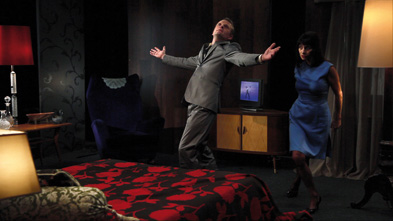
A man and a woman practise the great embrace. Ardently they try to simulate the vibrant style of a Hollywood musical ?.
Stephana Schmidt
Handy moovie
Experimental video | | color | 3:15 | Germany | 2006
Arrival, finally again! But where is that? What sort of thing is a piano becoming when being transformed into distorted electronic streams by a mini-microphone? Elevated randomly from the archive, data have been put together into a memory package. This feeling between the places is, whose notion the entire metropolitan community can share. All takes have been shot with "handy devices". Time window: 5 years.
Stephana Schmidt was born 1976 in Halle/S., ex-GDR. After various daydreams, music experiments plus an education on classical piano he studied Philosophy and doing Photographs. He graduated in Visual Arts at Bauhaus Weimar and Fine Arts at Beaux Arts Toulouse. Ever since he lives and works as a "Multipurpose Artist" in Berlin running the "Gedankenschmied-Project".
Nicolaas Schmidt
First Time [The Time for All but Sunset - Violet]
Experimental fiction | 0 | color | 49:0 | Germany | 2021
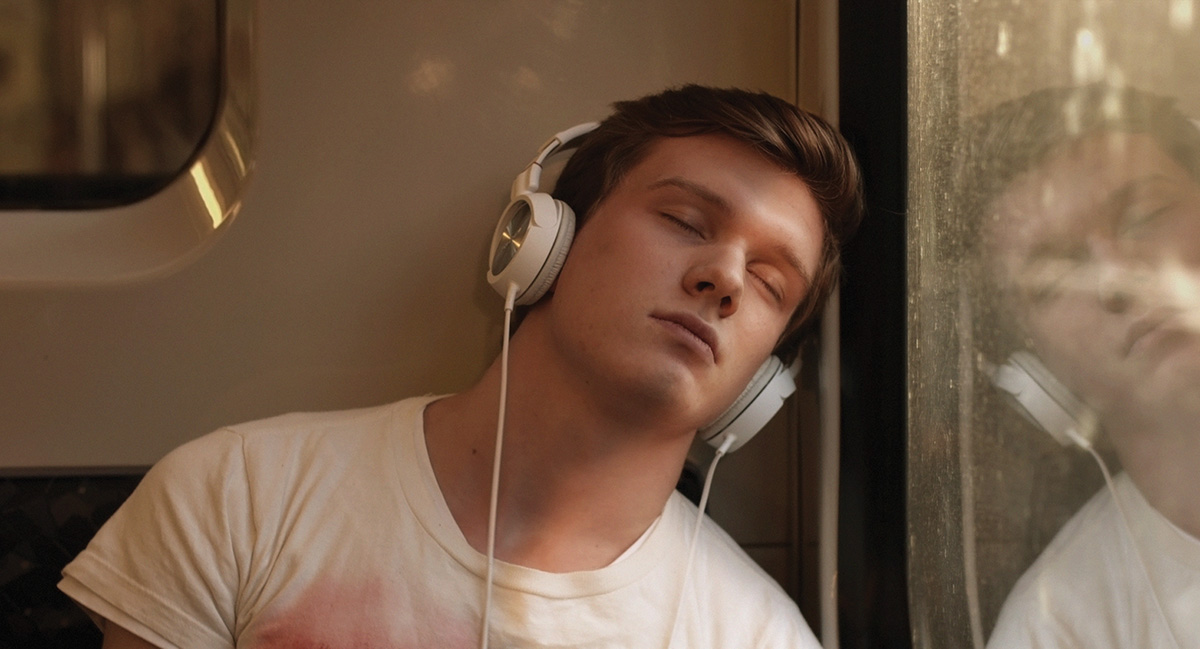
We listen to music and are on the way. In doing so, we see things and the world differently than before. So that things don't always go on like this, but may become better: Two boys meet on a train ride. Something is born – not much and yet everything. Enjoy a Golden Hour Carousel Ride. A Common Sensations Music Movie.
Nicolaas Schmidt lives and works as Filmmaker, Video- and Concept Artist in Hamburg, Europe. He studied Fine Arts, Time Based Media and Visual Communication (Film) at Hamburg Academy of Fine Arts. His works are shown at international film festivals, exhibitions and other contingencies.
Antoine Schmitt
Facade Life
Multimedia installation | | | 0:0 | France | 2010
Antoine Schmitt
Systemic
Multimedia installation | | | 0:0 | France | 2010
Systemic est une installation monumentale interactive in situ qui consiste en la relecture d`un lieu public existant par la vidéoprojection sur ses espaces architecturaux d`une population de vecteurs-flèches blancs extrêmement dynamiques qu`ils habitent ainsi, et qui incarnent les forces invisibles à l`oeuvre au sein des structures du bâtiment. Sensibles aux humains qui y passent, ils réinterprètent aussi les forces de mouvement et d`intention autour et entre des visiteurs, et entre les visiteurs et le bâtiment. Très fluides, dynamiques, autonomes, dotés de comportement individuels et de groupe, ces vecteurs-forces procèdent par attraction, répulsion, curiosité, ennui, désir, volonté propre et psychologie de foule. Grouillants, ils habitent le sol, les mur, le plafond du lieu, qu`ils considèrent comme leur territoire et dont ils connaissent les moindres recoins sur lesquels ils glissent et se frottent de manière physique. Systemic s`inscrit dans une approche artistique personnelle commencée il y a 15 ans et focalisée sur la plastique des forces à l`oeuvre, et dans un processus général de confrontation de cette approche avec des champs de création traditionnels tels la musique, la danse ou l`architecture.
Artiste plasticien, Antoine Schmitt crée des oeuvres sous forme d?objets, d?installations ou de situations à l?esthétique minimale et radicale, pour traiter de la notion de mouvement propre, en tant que forme et en tant que point de vue. Héritier de l?art cinétique et de l?art cybernétique, nourri de science-fiction dans sa dimension philosophique, il révèle et manipule littéralement les forces à l?oeuvre, pour questionner les modalités de l`être libre au sein de systèmes de réalité complexes. Son travail a reçu plusieurs prix dans des festivals internationaux, parmi lesquels transmediale.07 (deuxième prix 2007) et Ars Electronica (deuxième prix 2009). Il a été exposé entre autres au Centre Georges Pompidou (Paris), à Sonar (Barcelone), au CIAC de Sienne (Italie) et dans plusieurs Nuits Blanches (Paris, Bruxelles, Madrid, Metz, Amiens). Il fait partie des collections de l?Espace Gantner (Bourogne, FR) et du fond Digitalarti (Paris, FR).

Kirstin Schmitt
Quítame la sal de encima
Video | hdv | | 3:15 | Germany, Cuba | 2019
QUÍTAME LA SAL DE ENCIMA (original Spanish title) The video installation QUÍTAME LA SAL DE ENCIMA (englisch TAKE THE SALT OFF ME) takes a part in a group of works with called „MUNDO POR DELANTE - EL FUTURO NO ES NUESTRO“ which contains photographs, objects and video: THE WORLD AHEAD - The future is not ours; tales of anguish and perhaps some hopes... "And the day arrived that Ikú, the Death, after throwing down so many heads, got tired and did not want to knock down one more. So he went to see Olofi, the Creator, at his foam palace, giving him back his scepter of bone and dried flowers, he said: - „Agé Babá Olofi, since you invented the world and things, I am the one who keeps the last rest of your creatures. Even so, nobody thanks me, and to be honest, I?m tired of everyone running away from me, so I entrust that job to someone else.“ And without letting Olofi reply, he climbed to the top of a mountain and there ecstatic by the contemplation of nature, Ikú forgot the world. At first the Creator did not worry too much about the decision of the Death: „It will not be difficult for someone else to take his place," he told himself. But later he understood that he was wrong ... (Patakí - mythical Afrocuban parables of Yoruba origin) ___________SYNOPSIS - QUÍTAME LA SAL DE ENCIMA Blackout in Havana - Life in the eye of the cyclone ... At the first level, the video deals inductively with the effects of global climate change in the microcosm of everyday life. But basically it's a metaphor that seems to be exposed to circumstances that seem to be beyond our control. ___________KEYFACTS about CITA ME LA SAL DE ENCIMA Installation / video / documentary / dystopia / La Habana, Cuba / Spanish with english subtitles / Cuba 2020 / part of the ongoing exhibition project „MUNDO POR DELANTE“ / 2K / color / unpublished / Video is presented in the exhibition as a loop director & camera: Kirstin Schmitt producer: SAILOR´S YARN collective, Maren Schmitt & Kirstin Schmitt
German documentary filmmaker and photographer lives since 2006 in Berlin and Havana. After studying Visual Anthropology, Mesoamerican Studies and filmmaking in Germany and Cuba, she worked 2010-2014 as filmmaking professor in Luanda, Angola. Schmitt's long-term-projects focusing the impact of transition on individuals. Recurrent topics are premonitions and liminal stages. She captures everyday life miniatures, which she understands as confession of how we are dealing with meaning and meaninglessness of life. Characteristics of her work are the use of the environment as manifestations of inner landscapes and intimate encounters with the strength and vulnerability of her protagonists who often seem to have a presentiment of something, yet it still isn't tangible. Her award-winning photographs (1 place Sony Award, 1place IPA Awards, USA, Px3 etc.) and moving-images have been exhibited internationally at art fairs and festivals (Art Basel Miami-Scop art show, Somerset house London, Shanghai International Film Festival, Dok-Leipzig, SIPF-Singapore international photography festival etc.). She had solo- and collective exhibitions in both Americas, Africa Asia and Europa. Her work got published in a variety of international press like TimeLightbox, the guardian, Spiegel, Zeit online, Huffington Post etc.