Catalogue > Search
Results for : Tout le catalogue
Christian Bagnat, Elvira Sánchez Poxon
Tembiapo Pyharegua
Experimental doc. | hdv | color and b&w | 120:0 | Argentina, Spain | 2022
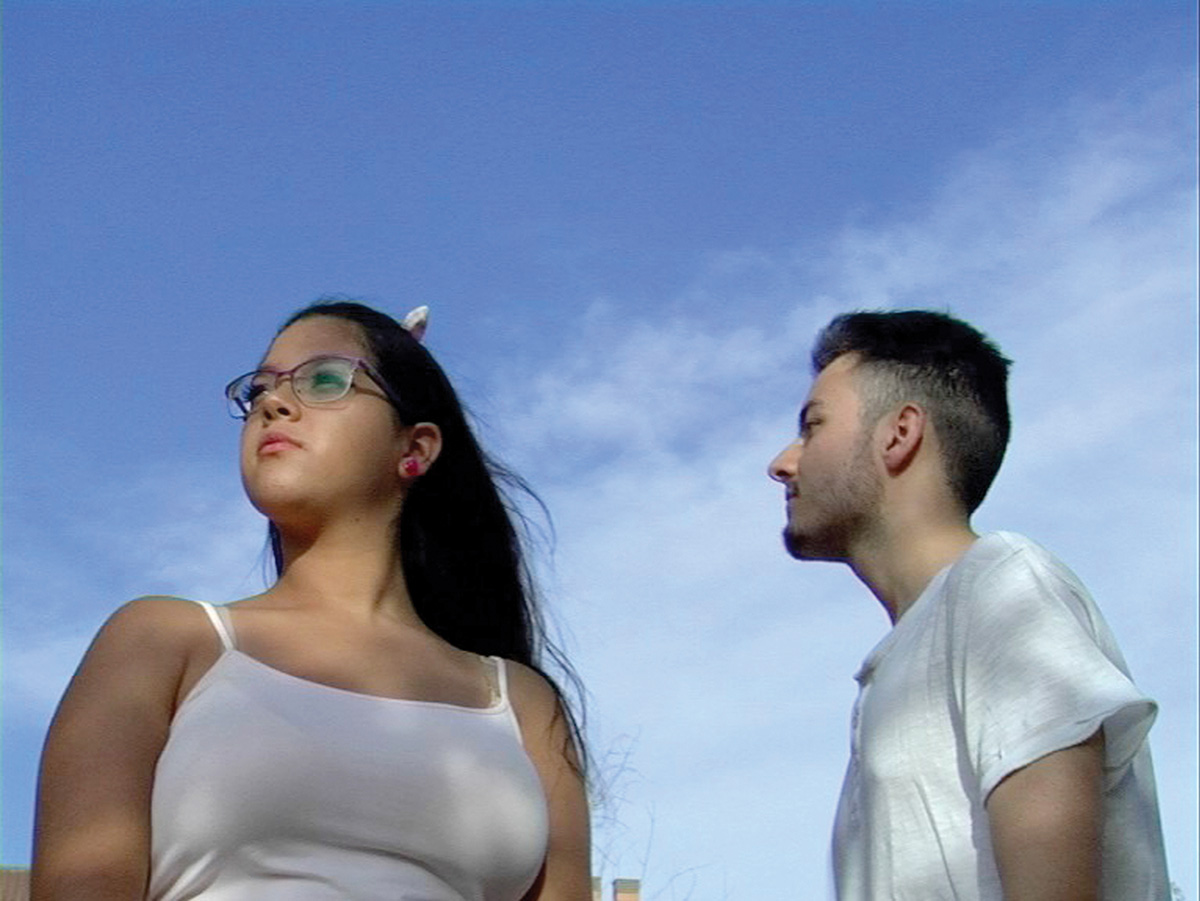
Tembiapo Pyharegua (Night Work) is a cinematographic chronicle that follows the life of a Paraguayan Guarani-speaking community that settled in Cuenca, Spain. The title refers to those nights where the impossible is dreamed and lived, that time of life between working hours. That is where we stop and observe how they recover their time. And how they spend their leisure hours. During those nights they name the things they are willing to do when they return to their country. Desires, dreams, future projects: every day they say them out loud, as if it were a spell. A record of this future is slowly being made, night by night.
Christian Bagnat. Argentina 1971. Studied Art and later Film. Night Work, first feature film co-directed with Elvira Sánchez Poxon. It’s filmed in Cuenca over seven years, using a particular method of work that reflects on the changes and events that occur in a small town. He works creating a film archive about the Latin diaspora in Spain. Elvira Sánchez Poxon Madrid 1977. She studied Fine Arts at the UCM and developed works in the field of painting and experimental sound stories. In the meantime, she studied film, collaborating regularly with Christian Bagnat. They co-directed the short film Pablo and Night Work is their first feature film.
Jeremy Bailey
Full Effect
Experimental video | dv | color | 2:0 | USA, Canada | 2005
Cheap effects cannot make a melodramatic performer feel any better.
Jeremy Bailey is currently pursuing his MFA in Video Art at Syracuse University in Syracuse NY. His work is often technologically grounded and fundamentally concerned with authorship and authenticity. He is also video programmer for SPARKVIDEO, a successful video series at Spark Contemporary Art Space in Syracuse.

Nicolas Bailleul
Boolean Vivarium
Experimental doc. | hdv | color | 0:0 | France | 2023
In a house isolated from the rest of the world, Léo and Nicolas are busy creating Vivarium, a video game in which we witness the rotting of an uninhabited house. A game that strangely echoes the place where the protagonists struggle to cohabit.
Born in Paris in 1991, Nicolas Bailleul is a plastic artist and researcher, with a diploma from the Haute École des Arts du Rhin (Strasbourg) and a master's degree in anthropological and documentary cinema (Université Paris-Nanterre). Through his films and other narrative devices, Nicolas Bailleul explores the terrain of the interior in the age of connected networks. In particular, he is interested in new amateur practices (designated or claimed as such), using and diverting their captat ion tools and invest iting/infiltering their spaces of dissemination and encounter. Nicolas documents, fict ionnalizes and narrates his explorat ions. Since October 2020, he has been a doctoral student in research-creation at Université Paris 8 under the direction of Patrick Nardin and the co-direction of Gwenola Wagon.

Daria Baiocchi
Plasma
Création sonore | hdv | color | 7:0 | Italy | 2016
The creative idea for this piece comes from the word “ Plasma ” that is often called the "Fourth State of Matter". Plasma is a distinct state of matter containing a significant number of electrically charged particles, a number sufficient to affect its electrical properties and behavior. Plasma also refers to the liquid component of blood that holds the blood cells in suspension. Energy, thunder and blood inspired my composition process. I started by recording some sounds with a new percussion instrument, called “ Sinori ”, a thunder-sheet, that have been processed with these images in my mind.
DARIA studied piano, classical composition and electronic music. Her compositions have been played in theaters and concert halls throughout the World and broadcast by several Radio stations (Holland National radio, France,Portugal, UK, USA etc). She also owns a degree in “Classical Literature” from the University of Bologna (Italy).

Bridget Ann Baker
Jetty SCOUR
Video | hdv | color | 20:53 | South Africa | 2014
Jetty SCOUR, suggests the physical markings left behind from a ships arrival and departure. Here is the present day ‘arrival’ of the “human-transporter”, a replicated 19th century cane-woven basket or ‘lift’ to a harbour in South Africa. The original would have been used off the coast of Algoa Bay in South Africa from 1890-1920 to lift colonial settlers to and from ships at sea before the development of harbours. Here the artist works with the object as historical witness, to engage with contested sites and legacies linked to the arrival of her own ancestors, a British settler family, to that same bay in 1820. The film, whilst documenting a contemporary working harbour within the economy of international trade, marks this space and place with historical encryptions, the smallest tensions, that refuse a “blanking out” of history.
Bridget Baker lives and works in London and Cape Town (b.1971, East London, South Africa). Her work is situated at the intersection of documentary and myth creation, forming a series of complex visual fragments realised through filmmaking, installation and performed re-stagings. Baker’s practise and visual language, whilst based on in-depth research into personal and public modes of representation within colonial and postcolonial narratives remains characteristically speculative, nomadic and estranging. Occupying the realm of the imaginary, the characters in her films, installations and photographs are spliced into roles as presences / witnesses / mirrors that enact lost memory within those peripheral places blind spotted by “official” history making.

Bridget Ann Baker
The Remains of the Father
Experimental video | hdv | color | 24:0 | South Africa, Italy | 2012
The Remains of the Father: Fragments of a Trilogy (Transhumance) is an experimental film and installation. It considers marginally remembered Italian colonial history in Eritrea and Ethiopia between 1930 and 1941. An Eritrean researcher Lula Teclehaimanot discovers an archive of non-official ethnographic literature collected by a Bolognese couple Giovanni Ellero and Maria Pia Pezzoli who had worked for the ?Ministry of Italian Africa? in Eritrea and Ethiopia during that period. Lula has been tasked by the municipality of Asmara to translate from Amharic into Tigryna: A contribution to the birth of the colonial style, an unpublished manuscript written by Ellero promoting the rationale of a modernist Ethiopian architectural vernacular. While she works Lula listens to a radio interview conducted in Italian, Tigryna and Amharic about the contemporary relevance of proverbs in Eritrean and Ethiopian societies. Set within a single room of a derelict house in Bologna which had been built for retired fascist army officials, is also the imagined office of Ellero. Many of the documents laying about the office; Eritrean and Ethiopian proverbs, hand drawn maps, and family emblems and curiously amongst these are the traces of her own family history, collated by Ellero before she was born.
Bridget Baker is an artist from South Africa. She is based in London and Cape Town. Baker?s work is situated at the intersection of documentary and myth creation, forming a series of complex visual fragments realized through film making, installation and documented re-stagings. Baker`s practice and visual language, while based on in-depth research, is often speculative and nomadic, seldom offering a finite position on events or histories. Her work has been exhibited extensively but also at The Museum of African Art (NYC), MAMbo (Bologna, Italy) Centro des Artes Contemporanea (Burgos, Spain), Palazzo delle Papesse (Siena, Italy), Neue Berliner Kunstverein (Berlin), the 2nd Johannesburg Biennale (Cape Town), Bow Arts Centre (London), Glasgow Film Festival (Scotland), Dak?art 2012 (Senegal), Wapping Project (London), South African National Gallery (Cape Town), the South Africa National Arts Festival (Grahamstown, South Africa), and the Oberhausen Short Film Festival (Germany).

Pariya Bakhshi, Blanca Barbat
Velodrome
Experimental film | 16mm | color | 6:0 | Iran, Germany | 2023
A surreal take on two people longing to bond through movement. The setting is a bygone velodrome, the Albert Richter track in Cologne. Without words, VELODROME evokes a poetic and eerie liminal space. It portrays a pursuit of communication, a permanent interruption. A moment of encounter without meeting.
Pariya Bakhshi, (they/she) born 1997 in Hiroshima, is an Iranian filmmaker and artist. Pariya lives in Germany and has been studying film at the 2019 studying film at the Academy of Media Arts Cologne. She grew up in Iran, Tehran and studied design at the Tehran University of Fine Arts. One of her main themes is freedom and exile, which she explores in her autobiographical essay film Displaced in Time. For her, the act of making art and film becomes political, among other things by breaking conventions and media boundaries. In her feature films, she translates the unspoken from our reality into a surreal film world, through the expression of the body, beyond language. Pariya therefore works mainly with dancers, as in Katzenbellen, L , VELODROME and ANAMORPHOSIS. Blanca Barbat : I am a multidisciplinary artist. My creative praxis can take the form of films, installations, drawings, performances, and more. I'm particularly intrigued by the concept of 'bodies,' often exploring their boundaries, especially their thresholds, and their role in the ever-evolving narrative of our transforming reality. I perceive myself as both an expression of the world and a spectator within it. I connect with concepts like the rhizome and the collective unconscious.
Mieke Bal
Nothing is Missing
Experimental doc. | dv | color | 35:0 | Netherlands, Turkey | 2006
Visitors are invited to sit in armchairs or on sofas while around them women speak to someone else. The interlocutors are people close to them, intimates, but the relationships with them have been interrupted due to the migration of the women's children: a grand-child one didn't see grow up; a child-in-law one chose not to approve of; an emigrated child; in one case, three generations. The intimacy, but sometimes a slight uneasiness, is characteristic of the situation. Sometimes you hear the other voice, sometimes not. Intimacy in the film is enhanced not only by the subject discussed ? the departure of the child who left for Western Europe ? but also because the mothers talk to someone close to them. Moreover, the filmmaker sets the shot, switches the camera on, and leaves the room, only to return after the allotted time. This abandoning of authority and leaving what happens to chance, and the interaction between the two people, makes the filming highly performative. Things happen between the speaking parties, due to the filming but not due to directions from the filmmaker. This performative aspect enhances the value of the process, some of which is also at issue during viewing.
Mieke Bal, cultural critic and theorist, holds the position of Royal Dutch Academy of Sciences Professor (KNAW). She is also Professor of Theory of Literature and a founding director of the Amsterdam School for Cultural Analysis, Theory and Interpretation (ASCA) at the University of Amsterdam. Her areas of interest include literary theory, semiotics, visual art, cultural studies, postcolonial theory, feminist theory, French, the Hebrew Bible, the seventeenth century, and contemporary culture. She is also a video-artist. Her many books include A Mieke Bal Reader, Chicago: University of Chicago Press, 2006; Travelling Concepts in the Humanities: A Rough Guide, Toronto: University of Toronto Press 2002; Louise Bourgeois? Spider: The Architecture of Art-writing. Chicago: University of Chicago Press 2001; Quoting Caravaggio: Contemporary Art, Preposterous History, Chicago: University of Chicago Press 1999; and Reading Rembrandt: Beyond the Word-Image Opposition, New York and Cambridge: Cambridge University Press 1991. A Mieke Bal Reader just appeared with Chicago University Press. Her video installation "Nothing is Missing" is currently touring internationally.
Mieke Bal
Access Denied
Experimental doc. | betaSP | color | 30:0 | Netherlands | 2004
Ihab (31), a Palestinian academic living in Amsterdam, is preparing to travel to visit his family in Gaza for the first time in four years, and do some fieldwork. Gary (28), an Irish artist also living in Amsterdam, intends to accompany Ihab and film the reunion with his family, the interviews with informants, and the progress of Ihab?s project: to study the cultural memory in Palestine of al nakba, the catastrophe of 1948. While they prepare for the trip, Ihab and Gary become closer. But, once they arrive in Cairo airport, Ihab?s arrest and deportation separates the two. From here on, the film alternates vistas of the two men?s trip. While Ihab conducts his research with determination and commitment, Gary is flooded by his first encounter with Arabic culture. He turns around in circles, having nothing to do but wait until he can fly back to Amsterdam. Ihab, in contrast, works frantically, but cannot leave on the planned date, since Israel has closed the borders. This film uses the metaphors of travel and failed encounters for a meditative reflection on the intercultural encounter between Arabic and Western individuals eager, but not always able, to understand each other.
Mieke Bal, cultural critic and theorist, holds the position of Royal Dutch Academy of Sciences Professor (KNAW). She is also Professor of Theory of Literature and a founding director of the Amsterdam School for Cultural Analysis, Theory and Interpretation (ASCA) at the University of Amsterdam. Her areas of interest include literary theory, semiotics, visual art, cultural studies, postcolonial theory, feminist theory, French, the Hebrew Bible, the seventeenth century and contemporary culture. She is also a video-artist. Her many books include Travelling Concepts in the Humanities: A Rough Guide, Toronto: University of Toronto Press 2002; Louise Bourgeois? Spider: The Architecture of Art-writing. Chicago: University of Chicago Press 2001; Quoting Caravaggio: Contemporary Art, Preposterous History, Chicago: University of Chicago Press 1999; Reading "Rembrandt": Beyond the Word-Image Opposition, New York and Cambridge: Cambridge University Press 1991. A Mieke Bal Reader is forthcoming with Chicago University Press.
Ruxandra Balaci
National Contemporary Art Museum
0 | 0 | | 0:0 | Romania | 2007
Inaugurated at the end of 2004 in Bucharest, Romania, the MNAC (National Museum of Contemporary Art) occupies 16000 square metres of the E4 wing in the Parliamentary Palace, the second biggest building in the world after the Pentagon. Also known under the nicknames "palace of the people" and "Ceausescu's palace", the Parliamentary Palace is a genuine pornographic projection of power, a megalomaniac erection. A place marked by a totalitarian history, the Palace, after having welcomed the Romanian Parliament and an international conference centre, it now welcomes a space dedicated to the dynamic of ideas and artistic dialogue. The MNAC is an ambitious project, a project trapped by the Romanian situation, unstable and always close to regression. It is a gigantic contemporary art museum, the biggest of Eastern Europe; innovating and avant-garde, it has to succeed in making a link between a "provincial" population, who remains to be educated, and its ambitious programming. The MNAC is the fruit of the obstinacy of the scope of two Romanian personalities: Mihai Oroveanu, the museum's Chief Executive who carried the project for more than ten years, and Ruxandra Balaci, his Scientific and Artistic Director. Today the museum's board of directors is made up of a genuine international dream team where reside Ami Barak, Curator and President of the International Association of Curators of Contemporary Art; Rene Block, Director of the Kassel Kunsthalle Fridericianum; Nicolas Bourriaud, Co-Director of Palais de Tokyo, Paris; Heiner Holtappels, Director of the Netherlands Media Art Institute ? Montevideo/TBA in Amsterdam; Anders Kreuger, Independent Curator and former Director of the Nordic Institute for Contemporary Art in Stockholm; Enrico Lunghi, Director of Casino Luxembourg, Forum d'Art Contemporain in Luxembourg; and Catherine Millet, Director of Artpress. The MNAC is a living, pliable, polemic space, animated by a web of intellectuals in which the East and the West are partners, a lab open to research in the visual field.
Critic and commissioner of the exhibition, Ruxandra Balaci directed the Gallery Gad in Bucharest, Rumania. Today she is co-editor of the review Artelier, and the deputy manager as well as the Artistic and Scientific Director of the Bucharest National Museum of Contemporary Art (MNAC).
Laurence Balan
Le Plein Pays
Documentary | | color | 58:0 | France | 2009
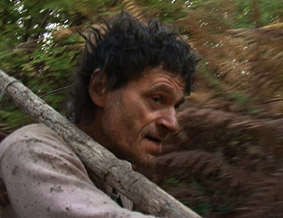
A man has been living for thirty years as a recluse in a forest in France. Alone, he hews out deep underground tunnels and galleries, which he decorates with old-fashioned engravings. They must withstand the planetary disaster that has been announced, and they must explain things, through their perceptive messages, to future inhabitants. The film recounts this experience as lived on the sidelines of modern society, affected as it is by human wretchedness and the loss, once and for all, of a perfect world.
Antoine Boutet works in Montreuil, France. Artist and filmmaker, his recent films include documentary "ZONE OF INITIAL DILUTION (2006) and CONSERVATION_CONVERSATION (2005), experimental films UTOPIA (2005) and PLUS OU MOINS (2004). In 2010, a documentary film project untitled TAMING THE WATERS will be realized in China. Selected video-installations and site-specific art projects have been recently exhibited in Pratt Manhattan Gallery/ New York, Biennale de Selest`Art/ France, Galerie des Filles-du-Calvaire/ Paris, Kunstraum Walcheturm/ Zürich, Lianzhou International Photo Festival/ Chine, Ateliers des Arques, Musée d`Art Contemporain les Abattoirs/ Toulouse, Festival Estudio Abierto/ Buenos Aires. He will participate in Printemps de Septembre at Toulouse, 2009, with LE PLEIN PAYS.
Raphaël Balboni, Daniel Van De Velde
Continuum
Art vidéo | dv | color | 10:0 | France | 2005
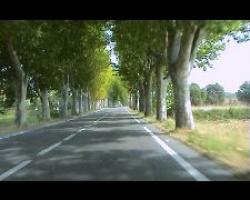
A travers la vidéo « Continuum », Raphaël BALBONI cherche a déceler la réalité. Son intention est de ne pas réduire celle-ci à une valeur d?usage, en créant des décalages par des séparations des éléments, des scissions, dans un espace dit naturel. Une route traversant une forêt implique une vide central entre les deux parties de la forêt que cette route traverse. Un vide qui se divise en quatre pour rejoindre l?intérieur de quatre troncs évidés ; eux-même en mouvement. En partant du mouvement des quatre troncs évidés, repartir sur quatre arbres dans quatre forêts où l?on accède par quatre routes différentes. La vidéo ici travaille le regard dans le mouvement continuel, des trajectoires sans commencement ni fin. Ce pour rendre le regard actif. Filmer en prenant comme point d?appui quatre troncs, quatre lunes, quatre routes différentes, pour délocaliser le regard. Un exotisme en mouvement qui ne ramène pas à une unité de lieu, donc de regard mais pousse celui-ci en continuum à l?intérieur de l?univers dont il est parti. L?auteur travaille ici sur la segmentation : les troncs segmentés en bûches évidées, - pour inclure le regard immédiatement dans le monde par des séquences, des interstices et ainsi petit à petit le regard s?éprouve comme immergé, intégré dans un univers dans lequel il circule tout comme le fait la caméra tout au long de la vidéo. Un regard, une ?uvre qui ne se constituent plus à partir du paysage, un regard, une ?uvre où l?horizon est mis a distance. Une regard, une ?uvre où les vitesses de rotation d?une voiture (par les tournants), de rotation du monde (gravitation, cycle lunaires et végétaux), de rotation d?un tronc segmentés en bûches évidées (cycle de croissance propre à l?arbre qui se dessine en spirale, par la double action de la gravitation et de la photosynthèse) sont captées par des images en mouvement. Quelque chose qui opère de façon juste et nécessaire parce que seule à ce jour, la vidéo permet une telle saisie de la réalité en mouvement. En devenir consistant?
Raphaël Balboni est né à Troyes (France) en 1978 et réside actuellement à Bruxelles (Belgique). Il est actuellement étudiant. Il obtient en 1998 une licence en Arts du spectacle et cinéma à Paris. De 2001-2005 il étudie à l?IDA (Institut des Arts et de la Diffusion). En 2002-2003 il suit également des cours à l?Académie Royale des Beaux-arts de Bruxelles. Depuis 2000 il a réalisé et monté nombreuses ?uvres et documentaires, présentés en Europe, par exemple le Centre d?Art Contemporain Passage, le Centre Culturel Canadien à Paris, la galerie Cour Caché à Paris ou encore à l?Institut Supérieur de l?Etude du Langage Plastique à Bruxelles. En 2004 il réalise avec Cécile Masart une vidéo, "Le site de Soulaines-Dhuys", sur le site de traitements de déchets nucléaires de l?ANDRA. En 2004 Raphaël Balboni réalise avec Anne Herbaut un film d?animation en 16mm, "Et Jean s?est perdu dans ses pensées".
Benjamin Balcom
The Phalanx
Experimental doc. | 16mm | color | 13:30 | USA | 2025
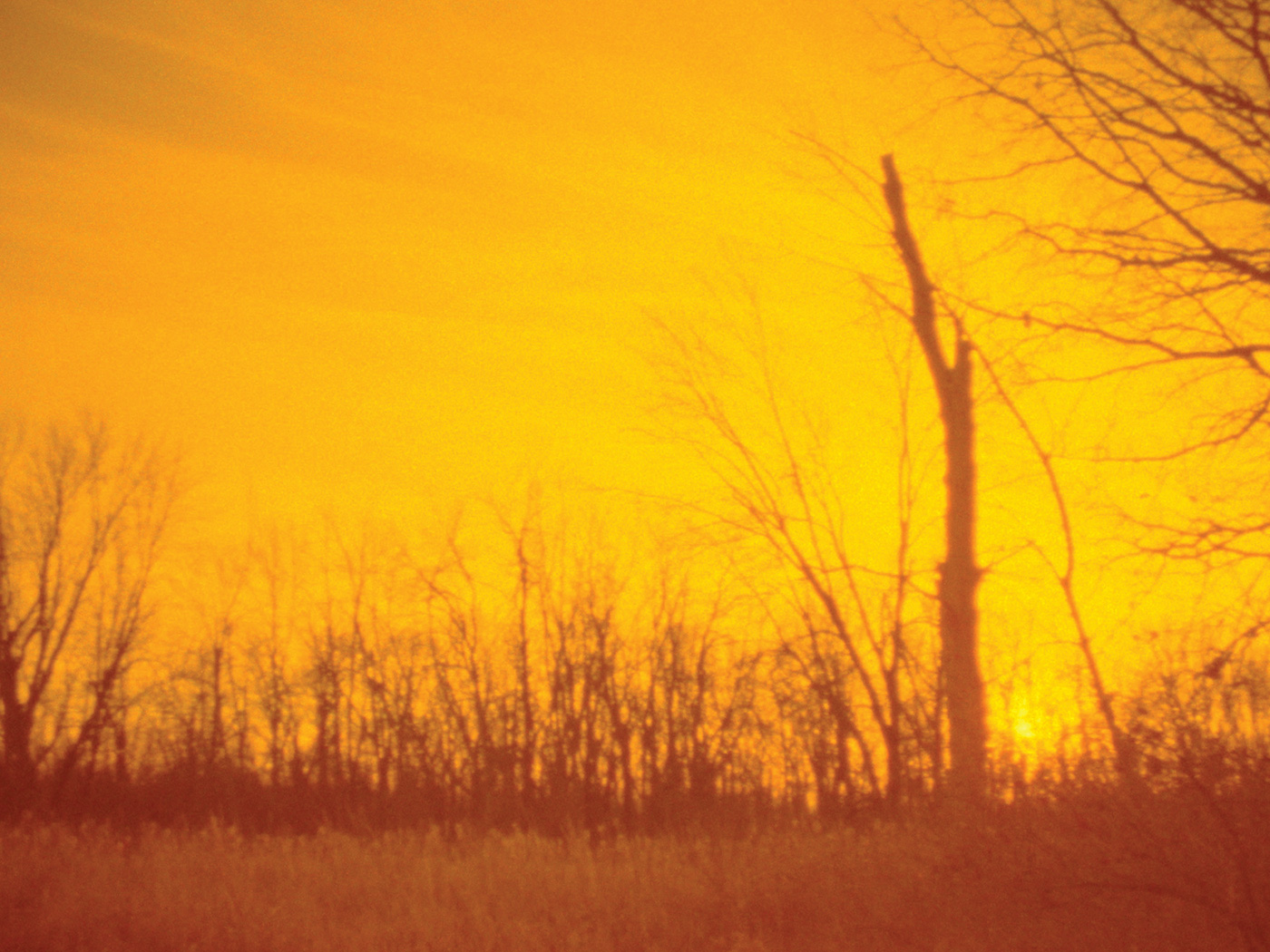
Letters from the Ceresco community trace the fragility of harmony, the dream of life in association, the frictions that give way to fracture. Members of the phalanx drift apart, lingering in private corners, suspended in speculative time.
Ben is a filmmaker and educator based in Milwaukee, Wisconsin, where he is a professor of Film, Video, Animation, and New Genres at the University of Wisconsin–Milwaukee. His most recent films explore the histories and afterlives of radical social ideals and communal living. These projects combine archival research and various modes of filmmaking to reflect on alternative ways of living. Drawing from speculative fiction, critical theory, and utopian poetics, his work often revisits the sites of now-defunct experimental schools and intentional communities, using cinema as a space for both research and imagination. Featuring landscapes both real and imagined, these films engage collective memory while speculating on futures beyond the limits of capitalism. Earlier in his practice, Balcom worked with abstraction, introspection, and formal experimentation, exploring the tensions between perception and communication, and probing the materiality of film itself. These threads continue to inform his evolving approach to nonfiction and poetic cinema. Balcom’s films have screened internationally at venues and festivals including the Museum of the Moving Image, International Film Festival Rotterdam, European Media Arts Festival, IndieLisboa, Media City Film Festival, and Ann Arbor Film Festival. He has received awards from Onion City, Athens International Film + Video Festival, and Ann Arbor. In 2023, he was a research fellow at the Center for 21st Century Studies. He also co-founded Microlights Cinema, a microcinema that ran from 2013 to 2023, dedicated to bringing experimental film and video art to audiences in Milwaukee.
Ben Balcom
Looking Backward
Experimental doc. | 16mm | color and b&w | 10:0 | USA | 2022
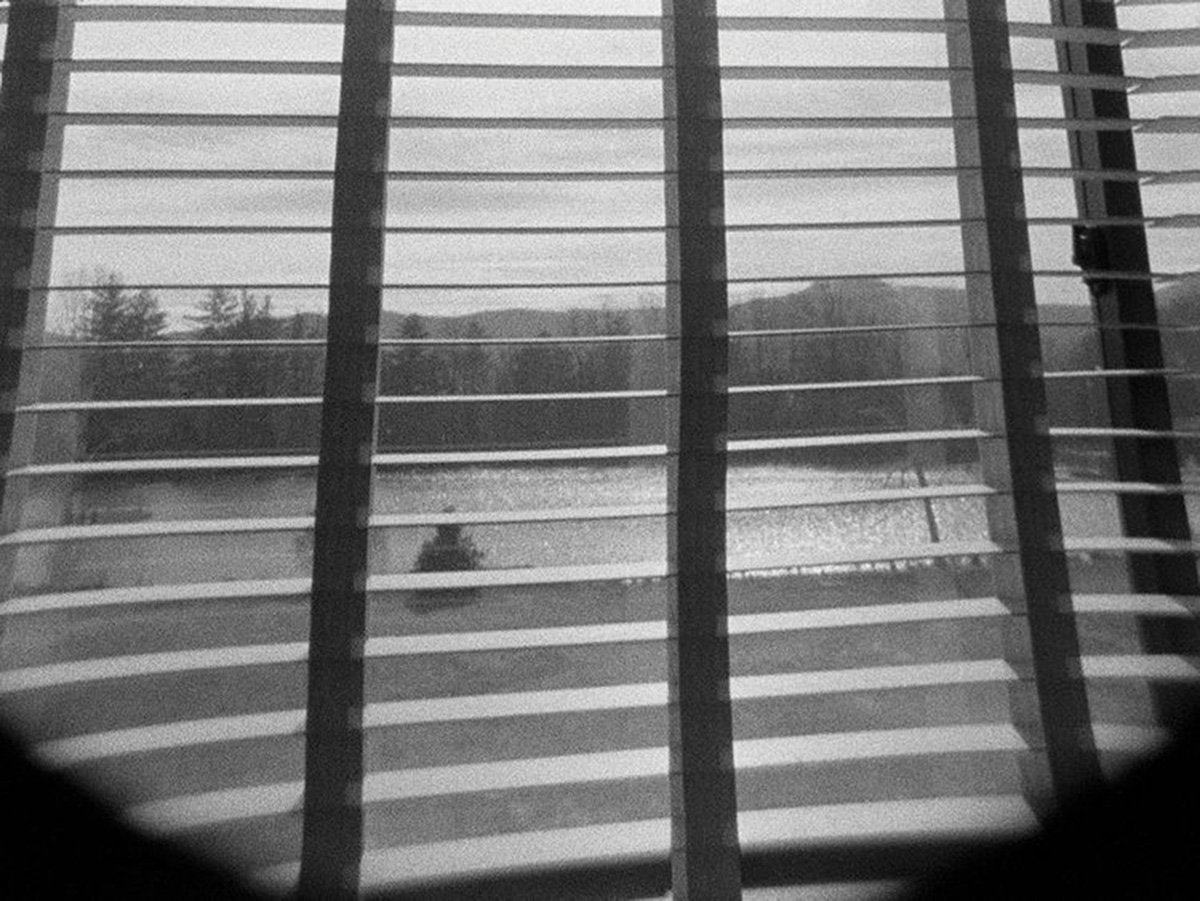
Filmed on the former grounds of Black Mountain College, Looking Backward is a brief elegy to the legacy of a utopian college and other impossible projects.
Ben Balcom is a filmmaker and educator currently living and working in Milwaukee, Wisconsin. He is an assistant professor at the University of Wisconsin-Milwaukee and is the co-founder and programmer of Microlights Cinema, an artist-run microcinema which has been operating since 2013 and has hosted artists from around the world. Recently, his films have taken a lyrical approach to documenting the spaces and legacies of now-defunct experimental schools. Prior to that he made a series of introspective landscape films that engaged with Milwaukee’s progressive political past and contemporary anxieties about the future. Earlier films used abstraction to explore the tensions between perception and communication, with a reflexive attention on the medium itself. These films have been exhibited around the world at venues and festivals such as The Museum of Moving Image, European Media Arts Festival, International Film Festival Rotterdam, IndieLisboa, Media City Film Festival, Alchemy Film, and Slamdance. The films have received awards at Onion City Film Festival, Athens International Film & Video Festival, and Ann Arbor Film Festival. Recently, Balcom was a fellow at the Center for 21st Century Studies at UW-Milwaukee.

Nicholas Baldas
Loverboy
XR expérimental | | color | 12:5 | Greece, Australia | 2022
Inspired by the story of British serial killer Dennis Nilsen, Loverboy operates as a meditation on the dark side of human intimacy. The project’s approach rejects moral simplifications, offering a narrative that is less a linear story than an immersive dissection of isolation and obsession. Recurring dialogues, eerie distortions, and environmental shifts that envelope the viewer in a claustrophobic cycle of increasingly fractured reality. Designed to linger like an emotional imprint, Loverboy challenges viewers to exit the refuge of orderly modern life and confront the fragility of human empathy and connection.
Nicholas Baldas is a writer, director, and producer whose creative work utilises cutting-edge technology to explore the prohibited boundaries of human experience through psychological immersion. The Heraclitian principle "life is flux" is the only constant in his creative pursuits, his collaborator Michael Plumb is a writer, filmmaker and performer. He has a Phd in Econometrics from University of Oxford. His creative focus is on the art of storytelling, drawing on his background in academia and public policy to explore questions about society and humankind. Michael is fascinated by exploring different media - old and new - to bring stories to life and reach new audiences.
Steven Ball, Novaković, Rastko
Concrete Heart Land
Experimental doc. | hdv | color and b&w | 25:0 | United Kingdom | 2014
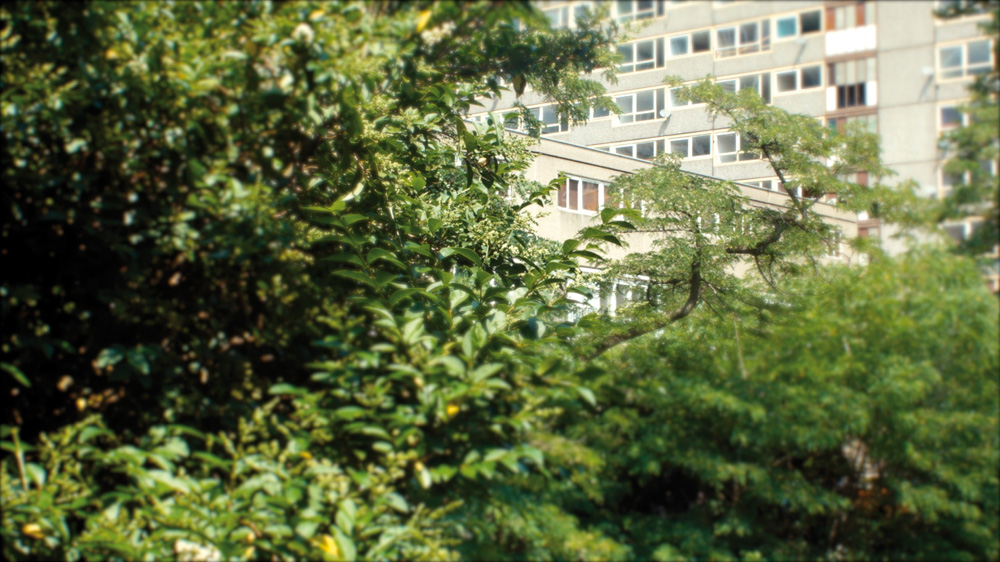
Concrete Heart Land exposes the social cleansing of the Heygate Estate in Elephant and Castle, South London. It marks the moment that the estate was finally lost as social housing to make way for an unjust `regeneration` scheme. Assembled from 12 years of archive materials the film charts the struggles of the local community to keep their homes, stay living in the area, and maintain communal benefits in the face of the advance of this now notorious `urban redevelopment programme`. Throughout the film we hear the community engaging in some of the crucial battles with elected officials, planners, and barristers in municipal planning meetings, public enquiries, and interviews. Weaving through these recordings is a performance staged in 2012 on the then still inhabited estate. An assembled group of past and present residents, community activists, and critics of the Heygate plans chant texts composed from phrases used in the Regeneration Masterplan. The performances parody the technical language of regeneration and the aspirational language of gentrification. Over the course of 2012 and 2013 we filmed panoramic video images of the estate and interiors of some of the Heygate flats, all of which feature in the film.
Steven Ball`s current practice engages with landscape and spatial representation, in local and global, social, political and post-colonial spheres. He also writes about contemporary and historical moving-image related practice, and curates screenings and exhibitions. Since 2003 he has been Research Fellow at Central Saint Martins College of Art and Design where he was instrumental in developing the British Artists’ Film and Video Study Collection. He is also a member of the legendary post-punk DIY group Storm Bugs. www.steven-ball.net Rastko Novaković used to be a filmmaker. He has made over 30 moving image works, from one minute to feature-length videos, panoramas, open-air cinemas, documentaries, lyrical films, campaigning videos, documented performances, interventions in histories and spaces. His works include April Showers (2011) a docu-fiction about a student terrorist group at University College London and lebensraum | living space (2009) which stages a Yugoslav war diary on the streets of London. He now spends most of his time organising at his workplace and with different communities. www.rastko.co.uk
Steven Ball
The War on Television
Experimental video | dv | color | 5:37 | United Kingdom | 2004
The War on Television is made almost entirely from images derived from interference fractured digital television broadcasts. These are randomly processed and manipulated through layers of scratch techniques exaggerating the stuttering fragmentation. The pristine digital veneer, the authority and reliability of the always-on 24 hour news channel becomes abstracted, fucked over in the flow of jarring noise and stammering incoherence. A celebration of digital anti-aesthetics, excess and entropic fallibility.
Steven Ball has worked in film, video, sound and installation since the early 1980s. In the late 1980s he accidently migrated to Melbourne Australia. There he continued his practice making a number of film, video and sound and installation works, as well as being engaged in various arts activist, curatorial, administrative, teaching and writing activities. Since returning to the UK in 2000 he has worked predominantly with digital video, producing a series of works which, among other things, are particularly concerned with digital material processes and spatial representation. He is currently Research Fellow at the AHRB British Artists` Film and Video Study Collection, Central Saint Martins College of Art and Design in London.

Delphine Balley
Charivari
Experimental fiction | hdv | color | 19:54 | France | 2016
Charivari, l’intrusion des sons discordants dans un village, annonce la chasse de la boite noire, l’inversion des codes, la menace funeste qui contrarie l’ordre établi, une rumeur lointaine qui s’approche... Une cavalière venue d’un autre temps gît sur le sol, blessée. Le visage d’un homme apparait battu par le vent, souillé par la terre. La forêt derrière lui est à peine visible. Concentré, il écoute: les bruits d’une chasse ancestrale céleste, des aboiements de chiens, puis soudain... un charivari primitif naît d’une rumeur transportée par le vent. Les chasseurs en poste, guettent cette chasse lointaine, par-delàles forêt qui se déroule au son du cors. Blessée au visage, la cavalière se redresse. Le regard fixe, elle traverse en boitant la forêt plongée dans un désordre de sons. Elle est attendue... L’homme au visage souillé halète, la boîte noire est à terre. Le sang coule de sa plaie. La lame du couteau brille dans la nuit. Du sacrifice naît le rituel, la cavalière porte le masque d’or sur le visage. Dans une maison bourgeoise, Le Charivari atteint son apogée, les murs résonnent d’un rythme funeste et hors d’âge. Des convives vétus de fourrures déambulent dans les couloirs, les visages défilent telle une galerie de portraits. C’est le rendez-vous secret d’un rite ancestrale. Le vent s’est introduit dans la maison. Au loin, des coups de feu résonnent, des chiens aboient, le gibier est de retour, la chasse peut commencer.
Née en 1974 à Romans en France, Delphine Balley vit et travaille à Saint-Jean-en-Royan Delphine Balley est diplômée de l’école Nationale Supèrieure de la Photographie d’Arles en 1999. Ses séries photographiques, faites à la chambre, reconstituent et théatralisent faits divers, scènes familiales, scènes d’avant ou d’après crime, histoires vraies, avec une extrème minutie, un goût prononcé pour le motif et le détail. Ces sayntes, métaphores du quotidien, sont autant de huis clos hors du temps qui mélent savamment réalité et fantastique. La singularité créatrice de l’artiste transporte le spectateur dans un univers insolite, étrange, inquiétant, parfois dérangeant. Delphine Balley entremèle la chronique, le journalisme, le fantastique, la narration, le conte, la sorcellerie, ou encore le cinéma.
Ieva Balode
Commission
Experimental fiction | 16mm | color | 6:0 | Latvia | 2019
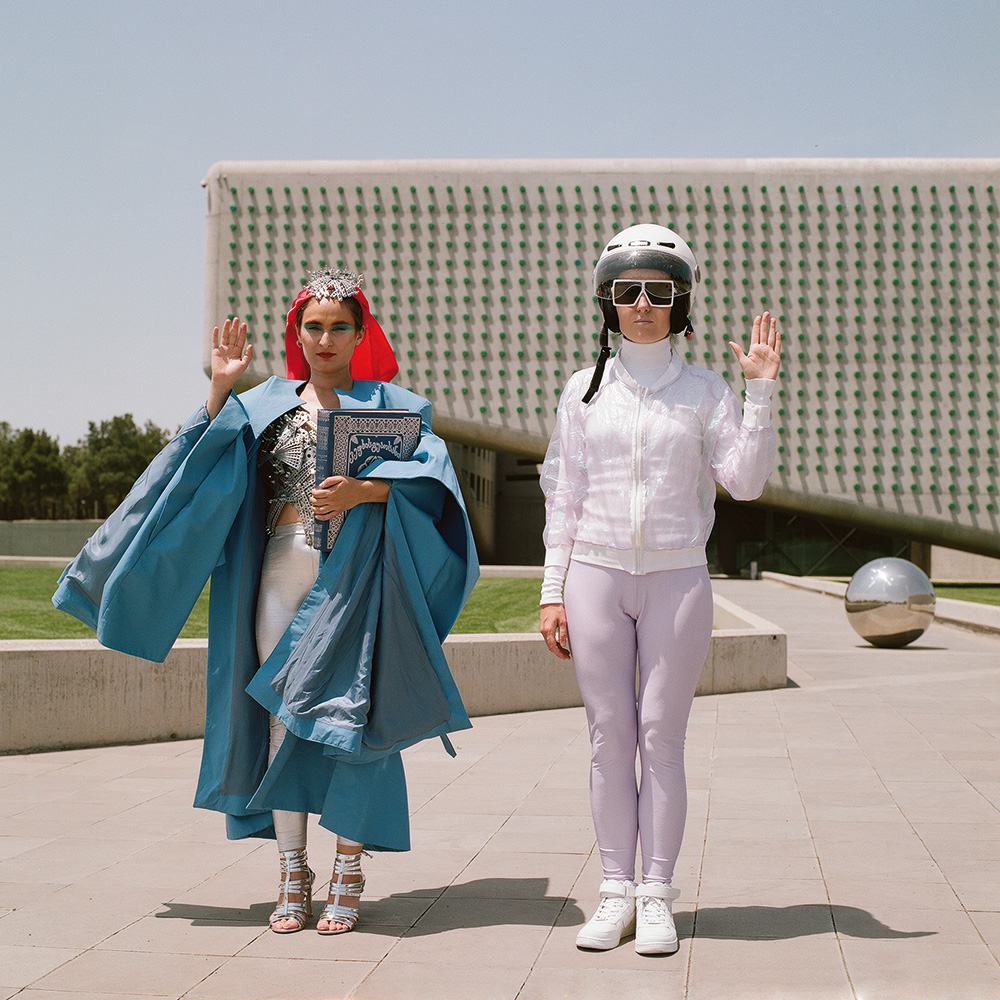
The story of a film “Commission” starts in Georgia at some unknown point of time where a heroic, mythical female character has written a book which is being delivered by a courier (the artist herself) to three powerful women. The content of a book is hidden within an existing book – “The Knight in the Panther’s Skin” written by Medieval Georgian poet Shota Rustaveli who dedicated the book to 12th century Queen Tamar who at the time brought prosperity and many social changes in the country. Being used as a secret shell or a reference to female power from the past, the freshly embedded content of a book serves as manifesto to the women who haven’t been equally appreciated due to history books still being written from male perspective. The book offers alternative gaze to a world history which can exist only in utopian science-fiction film commissioned and executed by females only. Shot in significant Soviet era architecture monuments (by that referring to Soviet time failed gender equality propaganda), using exaggerated costumes and scenes once associated with B class sci-fi movies, the film serves as humorous, yet rebellious propaganda material of female role and emerging power.
Ieva Balode born in 1987, Riga, Latvia is an artist and film curator working with analog image. She has graduated Latvian Academy of Art and studied film and photography in Yrkeshögskolan Novia, Finland. In her artistic practice she is interested in human identity matters, which she explores through the language and philosophy of an image – both still and moving. Drawing inspiration from texts, archival materials and nature, the artist seeks to find the border between human consciousness and transcendence within it. Her interest in analog medium lies within the medium’s relation to nature and human perception. With her works she takes part in international exhibitions and film festivals presenting her work both in installation, as well as cinema and performance situation. As a curator she is a founding member of Baltic Analog Lab - artists collective providing a space and platform for analog film production, research and education. She is also a director of experimental film festival "Process" happening in Riga from year 2017.
Sammy Baloji
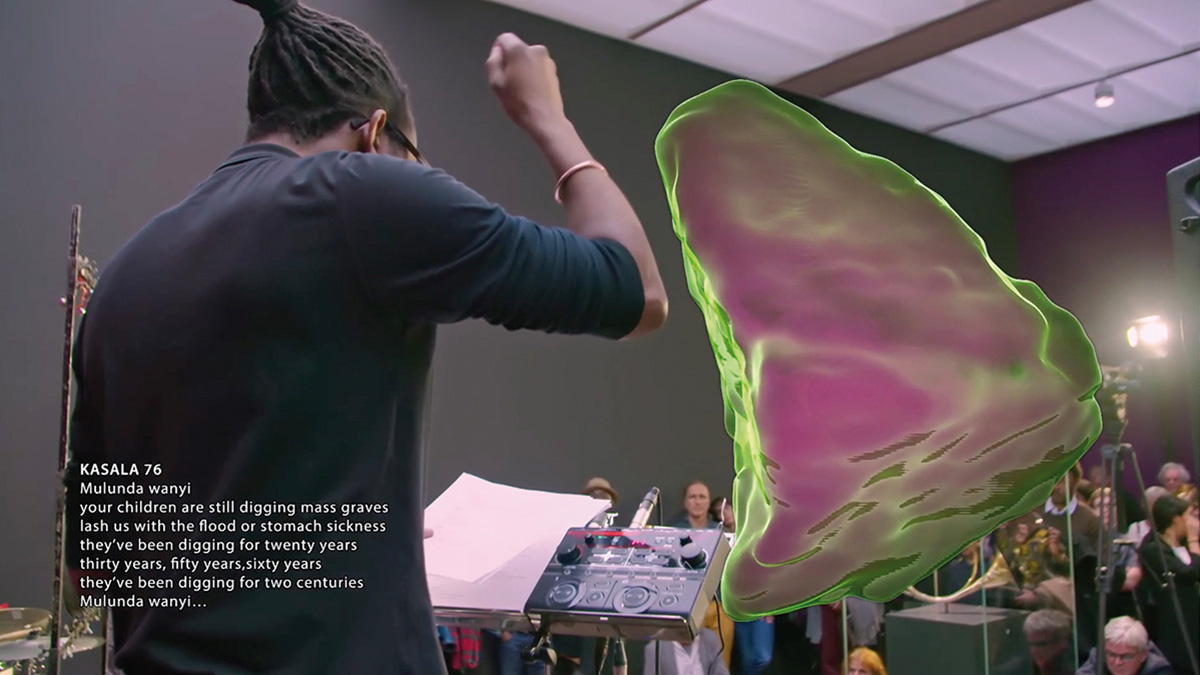
Kasala: The Slaughterhouse of Dreams or the First Human, Bende's Error
Experimental video | mp4 | color | 31:40 | Congo (RDC), Belgium | 2019
The Slaughterhouse of Dreams is a performance and interactive video installation on the subject of the transmission of Luba specific history through mnemonic objets and orality. The Kasala is a ceremonial poem, a laudatory, public and solemn way of naming the person. In the Baluba tradition, the“Kasala” is a well-defined form of slogans or pœtry in free verse. It is sung or recited, sometimes with instrumental accompaniment, by men and women who are professional specialists. It dramatizes public events that require strong emotions, such as courage in battle, collective joy at official functions, and mourning at funerals. In style and content, kasala is an entirely different genre with proverbs, myths, fables, riddles, tales and historical narratives. A contemporary Kasala written by Fiston Mwanza Mujila - a Congolese author based in Graz, Austria - on expropriations of diamond diggers is recited by the author him- self accompanied by Patrick Dunst on saxophone and Grilli Pollheimer on the drums. On stage copper musical instruments (a drum and a trumpet) whose surface has been marked by traditional scarification are presented. In the meanwhile, the performance is recorded and transposed into an interactive installation where images of Con- golese television reports are mixed with images of X Ray scanned sculptures and images of Mbudye dancers.
Sammy Baloji (b. 1978 in Lubumbashi, DR Congo) lives and works between Lubumbashi and Brussels. Sammy Baloji received a degree in Information and Communication Sciences from the University of Lubumbashi and a degree from the Haute Ecole des Arts du Rhin. He started in September 2019 his PhD artistic research project “Contemporary Kasala and Lukasa: towards a Reconfiguration of Identity and Geopolitics” at Sint Lucas Antwerpen. A Chevalier des Arts et des Lettres, he has received numerous awards and distinctions, including the Prince Claus Prize, the Spiegel Prize of the African Photography Encounters of Bamako and the Dakar Biennale, and the Rolex Mentor and Protégé Arts Initiative. For the year 2019-2020, he is a resident of the Académie de France à Rome – Villa Médicis. Since 2018, he teaches each summer at the Sommerakademie in Salzburg. Sammy Baloji co-founded in 2008 the Rencontres Picha/Biennale de Lubumbashi. His recent personal exhibitions include Sammy Baloji, Other Tales, Lund Konsthall and Aarhus Kunsthal (2020); Congo, Fragments d’une histoire, Le Point du Jour, Cherbourg (2019); A Blueprint for Toads and Snakes, Framer Framed, Amsterdam (2018); Sven Augustijnen & Sammy Baloji Museumcultuur Strombeek (2018); Urban Now: City Life in Congo, Sammy Baloji and Filip de Boeck, The Power Plant, Toronto and WIELS, Brussels (2016-2017), and Hunting and Collecting, Mu. ZEE Kunstmuseum aan zee, Ostend (2014). He has recently participated in the Sydney Biennial (2020), documenta 14 (Kassel/Athens, 2017), the Lyon Biennial (2015), the Venice Biennial (2015), the Photoquai Festival at the Musée du Quai Branly (Paris, 2015).

Sammy Baloji
Aequare. The Future that Never Was
Experimental doc. | 4k | color | 21:0 | Congo (RDC), Belgium | 2024
Aequare. The future that never was by Sammy Baloji, 2023, 21’04 The film swings between archival film clips dating from 1943 and 1957, sourced from INEAC’s colonial propaganda, and 21st century captures of the same Yangambi premises, like a pendulum that never moves time forwards. An acronym for the former National Institute for the Agronomic Study of the Belgian Congo, its post-colonial successor, the Institut national pour l’Etude et la Recherche Agronomique (INERA), is on film so suffused with past, colonial “coordinate systems” that the present looks inert and at a standstill, as if held hostage by frames of knowledge that refuse to abdicate. Decades after decolonization, that persistent hold is made explicit by an imposing and intact map of the Belgian Congo hung high on the wall, and by all the remaining rusty machines, labelled test tubes and rotting reports and specimens, dusty instruments of measure, and laboratories. Against the crumbling of these infrastructures, a devoted population of Congolese clerks seem to assist the preservation of the collected data and methods, in a choreography of gestures that the montage reveals to be inherited from the colonial decades. Amidst images of farmers burning trees to make the charcoal sold at surrounding markets, or those of clerks’ motivational posts proudly professing the exactitude of their pursuit, the atavism of colonial ecology seems apparent. Excerpt from: Sandrine Colard, FROM THE EQUATOR, I HAVE SEEN THE FUTURE
Since 2005, Sammy Baloji has been exploring the memory and history of the Democratic Republic of Congo. His work is an ongoing research on the cultural, architectural and industrial heritage of the Katanga region, as well as questioning the impact of the Belgian colonization. He touches upon a variety of media to translate his research into artefacts. His use of photographic archives allows him to manipulate time and space, comparing ancient colonial narratives with contemporary economic imperialism. His video works, installations, sculptures, andphotographic series highlight how identities are shaped, transformed, perverted and reinvented. His critical view of contemporary societies is a warning about how cultural cliches continue to shape collective memories and thus allow social and political power games to continue to dictate human behavior. His recent personal exhibitions include: Sammy Baloji, Goldsmiths CCA, London (2024), Unextractable: Sammy Baloji invites, Kunsthalle Mainz, Mainz (2024), Style Congo: Heritage & Heresy, CIVA, Brussels (2023), K(C)ongo, Fragments of Interlaced Dialogues. Subversive Classifications, Palazzo Pitti, Florence (2022) He has recently participated in the 35th Bienal de Sao Paulo (2023), the Architecture Biennale of Venice (2023), the 15th Sharjah Biennial (2023), the Sydney Biennial (2020), documenta 14 (Kassel/Athens, 2017) Sammy Baloji co-founded in 2008 the Rencontres Picha/Biennale de Lubumbashi. In September 2019 Sammy Baloji started a PhD in Artistic Research titled “Contemporary Kasala and Lukasa: towards a Reconfiguration of Identity and Geopolitics” at Sint Lucas Antwerpen.