Catalogue > Search
Results for : Tout le catalogue

Adrian Balseca
El Condor Pasa
Video | 4k | color | 8:29 | Ecuador | 2015
For “The Condor passes by” - in Spanish “El Condor Pasa”- the artist purchased a car: the mythical Condor GT (1981). This emblematic model fabricated in fiberglass during the transition from a military dictatorship to the restoration of democracy in Ecuador, is also part of the last days of the so-called “oil boom” in the country and the main focus of the proposal. Balseca recalls the nostalgic story of one of the last “national” cars and pays a posthumous tribute to that period of the local industry. The video shows us the last moments of the car before taking his “last flight”,when it is dropped from the top of a hill in the surroundings of the Mount Catequilla.
Adrián Balseca (Quito, Ecuador, 1989) lives and works in Quito. Balseca’s work aims to activate strategies of representation, narration, and/or interaction in order to highlight cultural specificities of a particular place. It explores the relationship and tensions between industrial and craft practices, revealing a fascination with the historic processes, and the configuration of materials involved in the production of manufactured goods. His work often involves transforming the composition of daily objects or certain civil laws into other material forms, or legal experiences. These projects —from small interventions to large-scale ‘site specific’ actions or video documentations— elaborate on ideas of emerging economies, nature, power, and social memory.

Ingo Baltes
CONVERSATIONS IN MILTON KEYNES
Documentary | dv | color | 72:12 | Germany, Belgium | 2011
One evening, by chance, the filmmaker arrives at Milton Keynes, an English ?New Town? the existence of which he had never suspected. A city in no way responsive to his orientation reflexes, at odds with his intuition, scornful of his judgment, which becomes his subject and muse. On his route, alone with his camera, from the outskirts to the town center, he strikes up the odd acquaintanceship. A beer drinker, a family inspecting a model home, a ?shepherd? of shopping caddies, various and sundry officials and ?users?: each contributes, from a unique perspective, to the image of this ?town for the 21st century?. Amongst those met is Derek Walker, the city?s first chief architect and planner - only 32 years old at the time of its conception in 1967 - who guides us through its workings even while taking issue with today`s reality. Filmed over several years as a complete autoproduction, ?Conversations in Milton Keynes? is Ingo Baltes? first film.
Ingo Baltes was born in Singen (Germany) in 1972. After his Master in philological studies (French, Spanish, Swedish & Icelandic), he came to Brussels to graduate in film direction at INSAS (2002). Today, he works as an independant filmmaker as well as director for children and magazine programmes at Belgian TV RTBF. His documentary films, always linked to one definite place in Europe, analyse phenomena and changes in society in the long term. He is a member of Polymorfilms since 2007.

Boris Baltschun, Serge BAGHDASSARIANS
Brownout
Création sonore | 0 | | 15:0 | Germany | 2005
Cette installation sonore se base sur deux observations: La première est la production de sons provoqués par des récipients fermés qui laissent échapper lentement et de manière discontinue leur contenu (air, eau) par une valve, et qui génèrent un déroulement chaotique, bien que plus ou moins prévisible dans son ensemble. La deuxième ? qui a donné le titre au film ? concerne le phénomène du « brownout » auquel nous avons été confronté lors d?un voyage à travers la Californie. Il s?agit là, en quelques sortes des prémices du black-out. Une baisse de tension dans un système interdépendant entraîne une comportement chaotique de ce dernier et a souvent pour conséquence une réaction en chaîne qui provoque la défaillance de ce système (pour la Californie ce système est le réseau électrique). Afin de rendre hommage à nos pauvres amis américains qui subissent de temps à autres de telles coupures d?électricité, nous nous passons - dans la mesure du possible - de l?électricité dans cette installation. Il fera donc nuit. Pour le reste, il se laisse entendre, en guise de solidarité avec les pays à travers le monde qui n?ont pas d?électricité.
Serge Baghdassarians & Boris Baltschun travaillent ensemble depuis 1997 et vivent à Berlin. En plus de leur travail en duo et des concerts/installations dans des lieux comme Amsterdam (Sonic Acts), Berlin (Total Music Meeting, Ultraschall, Uchiage), Los Angeles (Beyond Baroque), New York (Tonic), Paris (Les Instants chavires) et Stockholm (Moderna Museet, Fylkingen), ils travaillent régulièrement avec Burkhard Beins (B-Musik), Günther Christmann (Mal d`Archive), Dror Feiler (Kombinat), Alessandro Bosetti/Michel Doneda (Strom) et Annette Krebs/Andrea Neumann (Helix). Ils ont également collaborés avec de nombreux autres musiciens, danseurs et poètes tels que Conny Bauer, Paul Dutton, Richard Barrett, Tony Buck, Berlinfactory (Wolfgang Fuchs), Mark Trayle, Jim Denley, Axel Dörner, Chris Brown, Mats Gustafsson, Fine Kwiatkowski, Bernhard Lang, Michael Moser, John Oswald, Natalia Pschenitschnikowa, Elliott Sharp, Stevie Wishart, John Butcher et Paul Lovens. Un nouveau CD sort en 2005 chez Charhizma.
Spencer Bambrough
Parade de Somnambules
Experimental film | 0 | | 0:0 | France | 2025
While their bodies sleep, their shadows quicken, merging with the source that lights them. Sleepwalk Ruminations is an experimental short stemming from an ongoing feature-film project entitled Parade Somnambule. Figures such as the passenger, the sleepwalker, the hysteric and the vigil interfere with the pace of the machine, overflowing the time they’re given in a naïve embodied rhythm.
Spencer Bambrough's experimental film practice first emerged after his social anthropology studies (SOAS - University of London). From a fascination of the embodied presence of the subject in urban space, he sought to blur the boundaries of the self in its relationship to the collective. Today, his films, performances and installations in collaboration with Luis Carricaburu stage upswells in the flow of everyday life, exposing the forces underlying the grid in a sensory documentary approach. A resident at Mains d'Œuvres since 2024, he has been involved in numerous collaborations resulting in hybrid forms, namely Le Cabinet des États Intermédiaires in December 2024, and Le Sucré de l'Univers, a visual and sound installation in collaboration with Vincent Chéry for Nuit Blanche 2025. He is a regular contributor and writer for Parad Publishing, the Parisian publishing house specialising in documentary photography monographs. He is currently writing his first feature film, Parade Somnambule, in collaboration with Luis Carricaburu.
Tanatchai Bandasak
Air Cowboy
Experimental video | dv | color | 2:55 | Thailand | 2010
Along the highway, herds of cows are often seen in a rice field. Some standing still and some grazing. At times we see them through the windshield, loaded onto the back of a running truck. This work is a collective of those reduced images and sounds looking as if they are in a controlled atmosphere.
Tanatchai Bandasak, Born in 1984, in Bangkok; lives and works in Paris and UdonThani. BA Film and Photography; Thammasat University Bangkok Thailand, currently in the final year at École Nationale Supérieure D`ARTS Paris-Cergy, France.
Suhel Banerjee
CycleMahesh
Experimental doc. | mov | color | 60:35 | India | 2024
Four years ago, young construction worker Mahesh had cycled two thousand kilometres alone, to return home during the first Covid lockdown. Now he finds himself the subject of a film being made about his epic journey. But what is he getting out of the film shoot? Blending fact and fiction, this film-within-a-film retells migrant workers’ tales while examining its own gaze. As the shoot comes to a close and Mahesh returns to the maze-like site of his construction job, the portrait of an endearing young man trapped in his condition emerges. How will Mahesh escape this vicious cycle of disappointments?
Suhel Banerjee is an Indian writer-director, known for blending fiction and nonfiction, myth and reality in his storytelling. His films have been shown in film festivals around the world. He lives in Goa and is currently working on his debut novel.
Kostana Banovic
PLOHA
Experimental doc. | betaSP | color | 48:0 | Netherlands | 2007
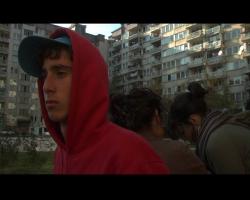
PLOHA, SYNOPSIS A mother takes her children to her city of birth, Sarajevo. The children however have no relations with the city. She experiences a distance between her and her place of birth, the distance in time and therefore, between herself and her children. For generations we feel the absence of the fathers. Taking part in and researching ritual as a means of getting in touch with oneself and others is a recurring element in the work of Kostana Banovic. Her latest film, Ploha (Hop) documents a journey that she undertakes with her teenage daughter and son to Sarajevo, her city of birth ? which she left years ago as result of her family?s incapacity to deal with the unexpected death of her father. Showing Sarajevo as a place of multiple identities itself, Ploha actually started with the need to explore identity issues of (her) children being part of a family in the diaspora. As a result Ploha deals with the notion of distance: the emotional and geographical distance between a mother and her city of birth, and between the children and their parent?s country of origin, as well as the distance between the mother and her children. In an attempt to bridge the gap between expectations and reality and between past and present, Banovic brings her children to various places that are of importance to her. She tells her as it seems not always overly interested children fragmented, sometimes half-remembered personal stories and folk-tales about the city and its origin, and points at the changes the city underwent over the years ? still bearing the visible an invisible marks of the last war. Most of the scenes are shot by a cameraman, but some also by the children ? as to give them authorship too, to enable them to find their own way to relate to a place that is so unfamiliar to them. The scenes are intermingled, sometimes actually coincide, with episodes in which the three of them (emotionally) discuss the falling apart of their family through divorce. The absence of the children?s father is being interwoven with the loss of Banovic? own father and the loss of Tito as the father of the former Yugoslavian nation. Each sequence in the film is concluded with archive material of an annual event dating from the Tito era, consisting of an estafette during which numerous people ran across the country, passing on a baton containing a message for their president. In another attempt to make the children familiar with their parents? past and background they undergo certain rituals that have been of importance to their mother. On one of these occasions an imam tries to cure the son from stuttering ? a condition that started when he was required at an early age to learn a fourth language due to his parents move to yet another country. It is an important given in the family?s history, as it was at that moment, that Banovic decided to only speak Dutch with her children. Parallel to her previous film Sey ? the economy of love (2005) Ploha shows highly private moments of the artist?s life, and simultaneously raises questions of the complex morality of dealing with others in a layered, even ambiguous way. Transcending questions of the politically correct though, the work seems to reflect and negotiate the reality of everyday life.
I am visual artist educated in painting and drawing. From 2000 on I have been involved in video. I made several short films and few experimental documentaries. Taking part in and researching `ritual` as a mean of getting in touch with oneself and others is a recurring element in my work. I seek this purity in daily life. The emphasis is not the images itself but the action, its repetition and the state of mind it evokes.
Kostana Banovic
Sey, the economy of love
Experimental doc. | dv | color | 42:43 | Netherlands | 2005
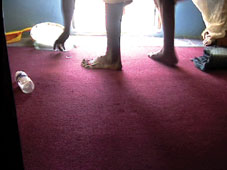
This is, like Banovic's previous films, a personal documentary essay. This film consists of her daily and religious rituals, and her personal search for identity. A man and a women are very far from each other, as far as can be: historically, geographically, philosophically, economically, culturally, and through race - the ritual is the only place where they meet, where they try to communicate. It is also the place where the love, of which they are not yet conscious, in all its impossibility, seems to arise. There are conversations about being a women in Islam, polygamy, politics, the Sjaria law, etc... This film discusses different expectations of a man and a woman who meet by accident, go travelling together, and get trapped in the net of cultural discrepancies.
Myrthe Baptist
Caresse
Video | hdv | color | 6:40 | Belgium | 2019
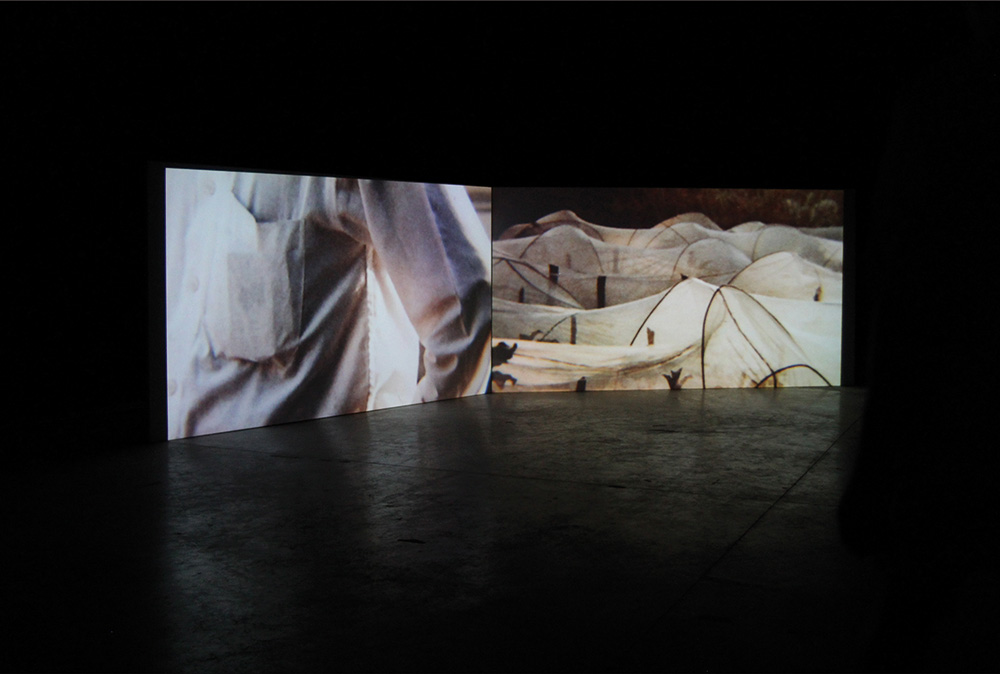
The camera leads our gaze closely across the surface of photographs. Small details of different moments become part of a movement: the searching, caressing gesture of filming. Projected on two adjoined screens, the images move together, towards each other and away again. The gaze becomes tactile, connecting what is seemingly separated by time, by distance and by the borders of the photographic image.
Myrthe Baptist (BE, 1994) is an artist and filmmaker based in Brussels. She works mainly with moving image, often starting from photographs, notes, letters and archival material. She has obtained a Master of Fine Arts at KASK School of Arts in Ghent.
Francisco Baquerizo Racines
La Quema (del Planeta “B”)
Video | 4k | color | 20:50 | Ecuador | 2025
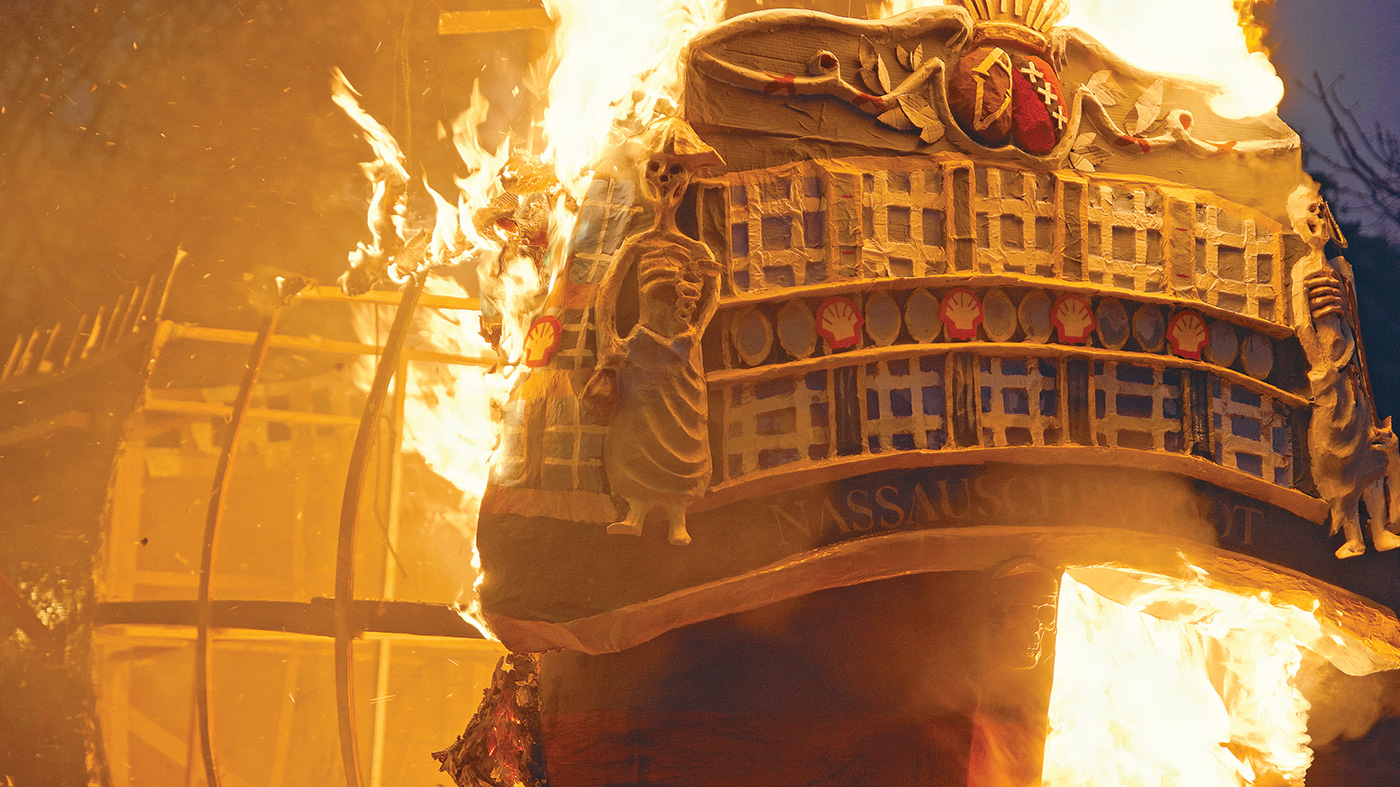
La Quema (del Planeta “B”) is a video installation that reflects on the 1624 burning and sacking of Guayaquil by the Nassau Fleet through the lens of Ecuador’s current vernacular practices—most notably año viejo, a popular custom in which effigies are collectively burned during New Year’s celebrations. This mestizo ritual resists linear narratives, offering instead an Andean zig-zag perspective on renewal through repetition. The crafting of these effigies embodies Guayaquil’s vibrant popular culture and capitalist-driven desires, while paradoxically creating space for (political) protest. In a context where sustaining artistic practices remains precarious, this tradition has also given rise to informal economies. Artists Joshua Jurado and Diego Cuesta—both based in southern Guayaquil—were invited to construct a año viejo in the shape of a galleon, inspired by the Dutch East India Company (VOC) vessel Amsterdam. Paraded through the city before being set alight, the sculpture marked 400 years since the original event, confronting historical cycles through collective action and vernacular symbolism. Filmed during one of Guayaquil’s recent peaks in violence—tied to extractivist legacies—the project brings together two temporal perspectives shaped by the same hegemonic system. La Quema (del Planeta “B”) stands as a pointed question to that very system—one that has shaped our bodies, ethics, and desires in service of capital.
Francisco Baquerizo-Racines (b. 1993, Quito, Ecuador) Currently living and working in the Netherlands. Baquerizo-Racines holds an MA in Fine Arts from HKU University of the Arts Utrecht (2022) and a BA in Visual Arts from PUCE (2017). His work has been shown across Ecuador, South America, and the Netherlands, with projects held in the MACBA archive and supported by the Mondriaan Fonds. In 2025, his film installation La Quema (del Planeta “B”) premiered at the 54th International Film Festival Rotterdam (IFFR).
Adina Bar-on
Sacrifice
Création sonore | 0 | | 16:30 | Israel, Poland | 2005
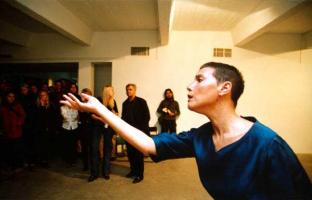
In Sacrifice, emotions form in vocal enunciations and melodic structures reminiscent of marches, lullabies, women`s chatter, a baby crying, screams and anguish. Victor Petrov, curator of Navinki Festival of International Performance Art `02(Minsk,Belarus) has written in its catalogue: "Concentrated emotions, plaintive singing and scream, gesture, extreme emotionality.This is the inner dialogue of a screaming soul, a tale of time, reflections of one`s place in the world. The powerful vocal sounds accompanying it are like associations with femininity, love and the origins of life." *Sacrifice - the Voice Performance has evolved since 1991 and is about 20 minutes when presented live. Requires no amplification and if for a large audience than ordinary voice amplification.(has not been performed, ever, in Paris or Berlin) *Sacrifice - The CD is an honest recording of the performance. It is 16:30 minutes long. It will be released in December 2005 by Totamto Art & Media in Warsaw in 500 signed copies only as a collectore item.
Adina`s work holds a discourse about conflicts of identity and conflicting identifications. Adina has been an active performer since 1973, when she was a 3rd year student at the Bezalel Academy of Fine Arts and Design in Jerusalem. Over the years she has presented her work in Israel`s major Art Museums and galleries. Making it her business to emphasize her political and social stand she has insistently performed in social and political events. In recent years she has been traveling abroad, 5 months of the year, to present her Performances. Among the countries are: Canada,USA,Hong Kong,Japan,Thailand,Germany,France,Poland,Lithuania, Serbia,N.Ireland,Russia. In 2001 Adina was awarded a major prize for her contribution to Israeli Art by the American Israel Cultural Foundation, and a biographical book "Adina Bar-On , Performance Artist", had been published.
Saulius Baradinskas
Golden Minutes
Fiction | 16mm | color | 10:0 | Lithuania | 2019
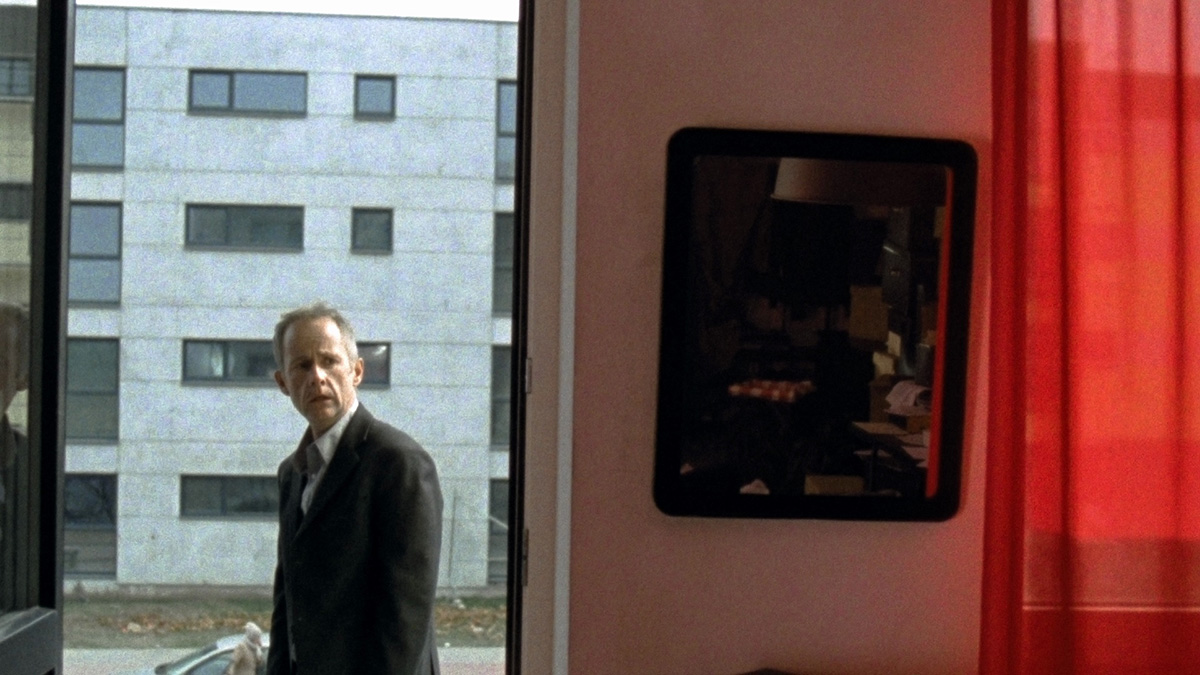
Driven to the edge by a huge debt and his impending divorce, a poetic accountant decides to kill himself but is rescued by a heart attack.
Saulius Baradinskas (born on September 19, 1990) is a film, commercial & music video director from Vilnius, Lithuania. ?Saulius is noticed for directing music videos that already got recognition in the Baltic states. In 2018 annual music video awards Saulius was selected as a best director of the year and won best music video award for directing.
Christian Barani
Entre-temps
Experimental doc. | dv | color | 31:30 | France, Nepal | 2006
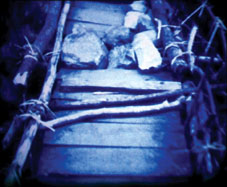
A march in the valley that bypasses the Manaslau. The ghostly but genuine presence of the Maoists prevents the artist from filming during the first few days. Then the militaries disappear and the image can exist. A super8 camera captures the time of the march during which the mind slides, is fragmented, loops, is moved, and the video camera records the unfolding of time.
Christian Barani's conception of his artistic carreer is that of a go-between, crossing the realms of direction, diffusion, and transmission. As a video artist, he decided in 1997 to enter the documentary sphere for ethic and political stakes, and for other stakes linked to the representation of the human being in his daily actions. This research is based on a filming apparatus that transforms the shot into a performative act. The narration develops in fragments. Christian Barani's videos are presented in Europe and abroad. He regularly collaborates for the Arte research workshop. As a teacher, from 1990 to 2006, he directed the video studio at the Ecole Nationale Supérieure de Création Industrielle of Paris, as well as workshops, conferences, and did research in experimental forms of educating. In the area of diffusion, he co-founded an association for the diffusion of artists' videos, 'Est-ce une bonne nouvelle'. These programs/diffusions are presented in France and throughout the world.

Christian Barani
Dans la fumée d'une peau
Experimental doc. | hdv | color | 12:30 | France, South Africa | 2018
Christian Barani
My Dubaï Life
Experimental doc. | 0 | color | 60:0 | France | 2011
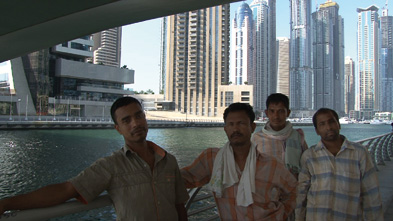
In his work, Christian Barani questions and deconstructs the documentary's codes. It is not question of representation of the reality nor fiction but the experience. By summoning the walking and the drift, he involves another process of creation which generates a representation without a priori. He plays with fate and improvisation. No sequence is recorded twice. On the occasion of an exhibition entitled "Manifesto about the invisible cities", Olivier Marboeuf suggests to Christian Barani to direct a "drift" in Dubaï. This approach, appropriate for the artist, consists in walking in landscapes and cities. In this case, Dubaï is a town where nothing is thought for the moving body, a town built for and by the influx. It's a question of walking to get lost in these fiction spaces, and to build from the fate.
Christian Barani, born 1959, works and lives in Paris. He starts working with video in 1990, and founds the Moving Image department at the Nationale Supérieure school of Industrial Creation where he's been teaching for 17 years. In 2000, he co-founded a structure of artists' videos broadcasting, "estceunebonnenouvelle" bringing together a hundred of international artists and a collection made up of 500 movies. Inlaying, link to painting and poetry make up the axis of research of his first videos. Since 1997, his work questions and deconstructs the codes of documentary, through an experience engaging a body/camera in space, not a documentary nor a fiction. He directs linear movies, art installations, performances... His work has been shown in numerous festivals, museums and art centers in Europe, notably at the Centre Pompidou, at the Jeu de Paume, at the Lieu Unique in Nantes, at the MUSAC Museo de Arte Contemporaneo de Castilla y Leon, at the National Museum Reina Sofia.
Christian Barani, reynard guillaume
kazakhstan, naissance d'une nation
Experimental doc. | dv | color | 64:0 | France, Kazakhstan | 2008
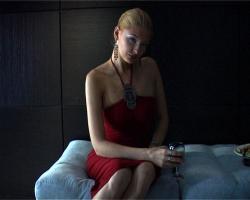
In 1998, seven years after the independence of the country, autocratic president Kazakh Noursoultan Nazarbaiev decides to move the capital of Almaty to Astana, the barren plains of the north. Vertiginous towers of glass rise above ground, financed by oil exports. A presidential speech in 1997 on the future of Kazakhstan opens the film, praising the ?three social levels, the rich, the middle class and the poor?, and the infinite promises of the market. Christian Barani and Guillaume Reynard see the birth of a new social level, in the standardized tinsel and foil of richness. Attempting to represent ?the fiction which in each scene seems to have preceded reality?, until a change of scene by writer Darejan Omirbaev, they also venture backstage, a hut on a site of a recently expropriated maisonnette. A portrait of a melancholic person and poetic globalization through the ex-Soviet oligarchy, in full expansion.
Christian Barani, on his artistic path, researches into the fields of realization, diffusion and transmission. As a video maker, he decided as from 1997 to participate in the area of documentaries with ethical and political stakes. This research is based on a film which offers a plan turning a performance into a fragmented narration. Guillaume Reynard is an illustrator in Paris. He collaborates with several publishers and publishes in various newspapers (Le Monde, Libération?). Without falling under a strict or anecdotic image, his work, fact of figurative drawings, explore the bond which links human beings with places, beings with objects.
Christian Barani
des êtres de poussière
Experimental doc. | hdv | color | 18:0 | France, Nepal | 2018
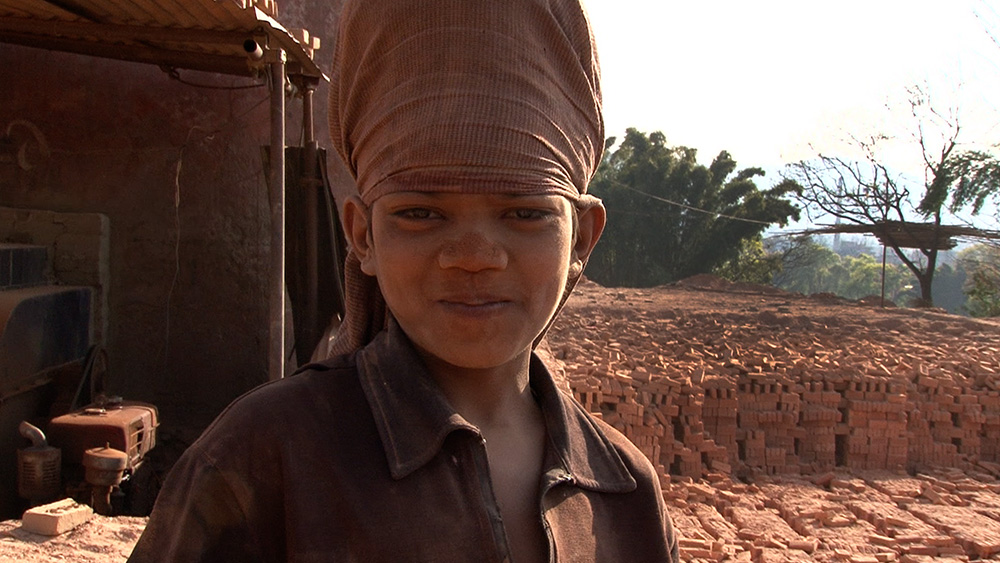
A starting point : In Upper Mustang, a very old story is told in the village of Ghemi. Despite the courage and the fighting of the villagers, every night, the demon Balmo and her spirits destroy the houses of the village. Exhausted, they decide to ask the help of a monk, the guru Rimpoche who meditated in the valley. Rimpoche then leaves his meditation and agrees to fight the demon. For seven nights the fight was monstrous. But Rimpoche won the battle. Today in the Nepalese country, the fight against the spirits that are constantly destroying the country continues. Despite a Maoist revolution that resulted in democracy, the abolition of the monarchy, the writing of a new constitution, the equality of man and woman ... the country is still a victim of destructive spirits and the Nepali people continue without stop the fight
Christian Barani is born in 1959 and lives in Paris. He ends his studies with a master?s degree in science economic in the Faculty of Nice. In the 90s, the arrival of the format DV pushes aside its relation in the images and allows him to acquire a freedom of creation and production. He builds a practice which associates the field of the documentary with the Visual Arts. Over a period of 10 years, he films in Kazakhstan with G. Reynard the social transformations of this country of Ex Union Soviétique, he films in Nepal during the Maoist revolution, in Namibia, in Ethiopia, in Cyprus, in Dubai, in the Lebanon ... His process of realization sets up a performative device which is going to generate images without in priori. It is about experience committing a body / camera walking in the space. He defines a rules of the game which composes with the coincidence and the improvisation. No preliminary scenario. Everything takes place in an instant. Never a sequence is twice shot. What is void and void. In the term of the experience, a material of images and sounds is collected. He will take various forms according to the project to come and from places of exhibition : movie in room, movie deployed in the space of exhibition, installation, performance ? He realize in parallel numerous commissioned works for museums as the House Arthur Rimbaud in Charleville-Mézières, the Royal Institute of the Natural sciences of Brussels, the Center of Culture of Rennes, Agora : biennial event of Architecture of Bordeaux, Mons Mémorial Museum in Belgium, The Museum of Confluences in Lyon, The City of the architecture and the heritage of Paris ? From 1990 till 2006, he creates to the National School of Industrial Design, the department Images in Movement, the unit of Experiment Images and Sound (Xis- with Jeff Guess, Extensions - dynamics of writings with Frédéric dumond. In 2000, he cofounds, with Véronique Barani and Sabine Massenet, a structure of distribution of videos artists " estceunebonnenouvelle " which is going to include more than hundred international artists and a collection understanding more than 500 movies
Christian Barani
Prolégomène à la lumière
Experimental doc. | dv | color | 7:0 | France, Kazakhstan | 2013
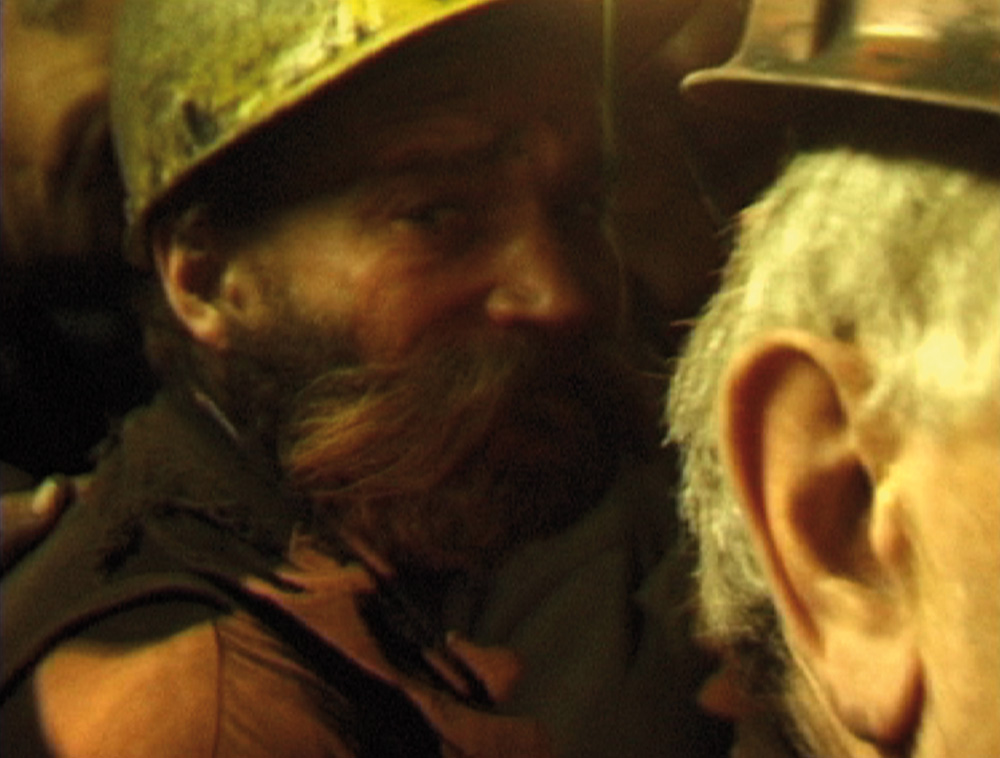
KAZAKHSTAN. Mine de Kouzembaïev dans les steppes de Karaganda. Durant l'époque soviétique, les mineurs bénéficiaient d’un très grand respect de la part du régime et de la population. Ce statut était dû aux nombreux sacrifices subis pour la construction du pays. Depuis la chute du mur, une société libérale est apparue. Avec lui, l’individualisme, le chômage et la crise. Les mines ferment les unes après les autres. Sur 28 mines présentent dans la région, seules 8 sont encore en service. Dans la mine du héros Kouzembaëv, dans cet instant qui précède la descente dans le noir, seule la lumière persiste pour honorer ces corps.
Christian Barani est né en 1959. Il construit une pratique qui associe le champ du documentaire à celui des Arts Visuels. Dans le processus de réalisation, il est question d’expérience engageant un corps/caméra marchant dans l’espace. Pour filmer, il se définit une règle du jeu qui compose avec le hasard et l’improvisation. Pas de scénario préalable. La marche est utilisée comme un vecteur de rencontres. Tout se joue dans l’instant. Au terme de l’expérience, un matériau est récolté. Il prendra différentes formes en fonction du projet à venir, des lieux d’exposition : film, installation, performance…
Christian Barani
Windhoek
Documentary | dv | color | 32:0 | France | 2005
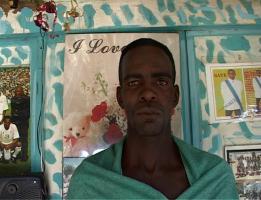
The wandering produces an attitude, a form and makes an other city appear. The crossing of the city becomes an art performance which result is the plastic form, documentary form. The territory is represented as an experience. Each frame is shot only once. The improvisation structure and the shooting desire. The intuition makes the recording trigger pulled but with no idea of the result. Shooting becomes a performative act where the meeting with the other becomes a representation stalk. To represent this suspended moment where the instinctive relation is created, is accepted, or even refused. In this wandering, I invent a journey; I discover secret territories and adapt myself to the context. The journey includes both physical geography and my psychic relation to space and people. This drift form appears during the editing of singular ambiances linked to the urban landscapes crossed and people met. It creates an urban collage.
Christian Barani is positioning in his artistic career, as a bystander investing directing, diffusion and transmission domains. As a videaste, he decides from 1997 to intervene in the documentary sphere for ethic and politic stakes linked to the human being representation in its daily behaviour. This research is based on a shooting procedure that gives to the frame a performative act status and to narration to develop under fragment form. These videos are presented in Europe and abroad. He often collaborate with the Arte research workshop. As a teacher, he manages since 1990 the video studio at the Ecole Nationale Supérieure de Creation Industrielle of Paris, realizes workshops, conferences and research for experimental educational forms. In the diffusion domain, he cofounded an ssociation of artist?s videos ?est-ce une bonne nouvelle?. These programmations/diffusions are presented in France and abroad.
Christian Barani
je me suis enfui
Experimental doc. | mov | color | 83:0 | France, Ethiopia | 2021
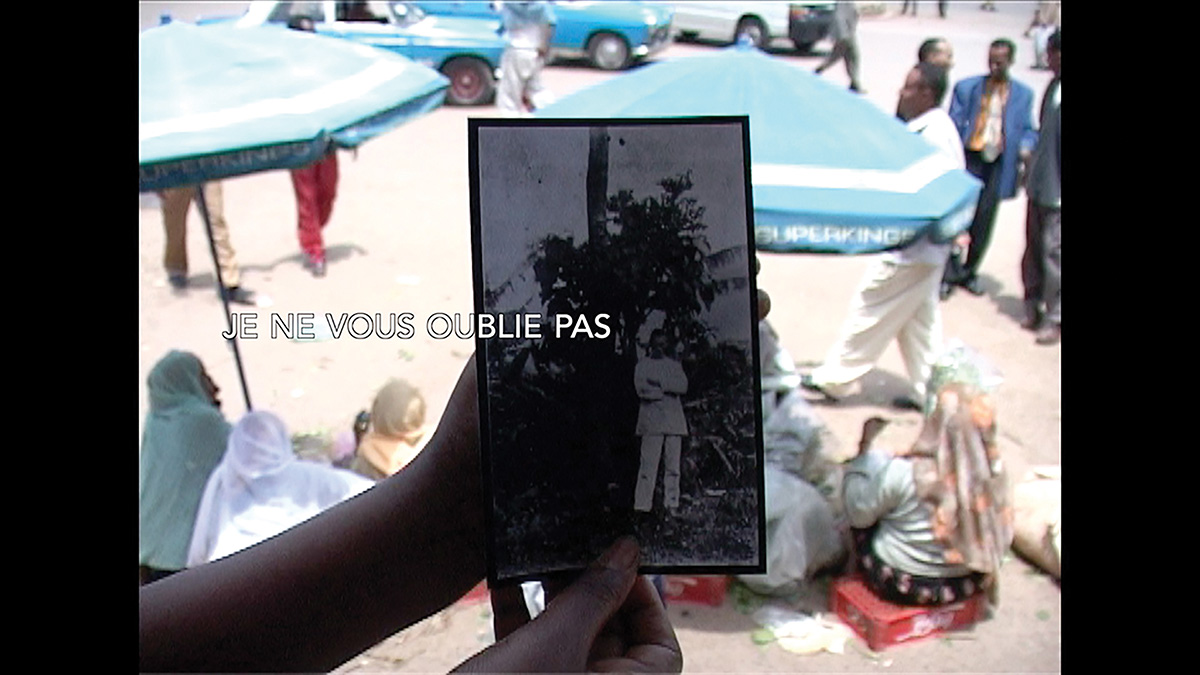
One day Arthur Rimbaud left the world of culture, tired, disappointed and angry. He does not understand, he does not admit the conventions, the lack of courage, the lack of investment of the art world. "Real life is absent," said Arthur Rimbaud. So he leaves, he leaves for an elsewhere that is less a place than an anarchic tension. He looks for chance, the unknown, the encounter, the unexpected. He now wants to practice poetry since nobody can understand his poetry. Arthur Rimbaud lived the last ten years of his life in Harar, a holy city in Ethiopia (1880-1891). In 2005, I left for Harar. Every day I walk, I get lost. I don't look for anything because there is nothing to look for. I film a contemporary Harar. In 2020, I decided to make a film out of these sequences.
Christian Barani's work takes the form of a committed realist poetry. Engaged in an improvised otherness, never sought after. His body, often lost in space, allows him to show a certain state of the world. He walks, crosses, observes, feels, analyses, meets, films. He loses himself, he drifts to find, to provoke and to create a necessary and essential link to the production of an image. He walks for long hours until he is exhausted, until he reaches the end of himself. Drifting puts him in danger. A physical and mental danger that allows, that authorises the filming of the other in his difficulty of life, in his quest for survival, in his struggle. Only at this price is it possible to welcome them. The image comes as a consequence. The forms that emerge from these experiences have no a priori. They are often diverse and take the form of film, film installation, reading projection, photographic notes and texts. They are created from the material captured and are often conceived according to the spaces in which they are exhibited.
Christian Barani
Lac Assal
Experimental doc. | hdv | color | 15:12 | France, Djibouti | 2019
In the rift valley of Djibouti, in the black of volcanic rocks, men are waiting. In this desert, a few years before, the production of salt organized life. Since the competition has won. On the shores of Lake Assal, resistance fighters go in search of salt concretions hoping to sell them to the few tourists who would come to contemplate the blue of the lake.
Christian Barani was born in 1959, lives in Paris. He builds a practice that combines the field of documentary with that of Visual Arts. His research is based on a performative device that engages a body/camera walking in space. It defines a rule of the game that composes with chance and improvisation and generates images without a priori. He filmed where political and social violence oppressed, drawing a portrait of the defeated over time.