Catalogue > Search
Results for : Tout le catalogue
Nina Lassila
Piiskaa!
Experimental video | dv | color | 1:13 | Finland, Sweden | 2005
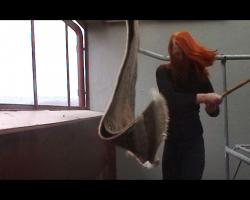
In Piiskaa! / Beat it! we see a woman cleaning a carpet. Though clearly she is beating the carpet up...is she angry and why? There is something provocative about a physical woman; even a loud laughter can provoke some people. There is a prevailing notion that a loud physical woman is somehow deranged, out of control. ? Gender is a lived ideology ? a system of ideas about men and women with which we live our lives. As lived ideology those ideas get transformed into specific bodily practices. Socially produced sex differences are embodied and lived out as real. They are materialized as habit and taken for granted as second nature.? (Bordieu)
Nina Lassila is a visual artist working mainly with video, performance and photography. She was born 1974 in Helsinki Finland but lives and works in Göteborg, Sweden since 2003. In many of her works she deals with questions of identity ? specifically identity affected by social barriers, conventions based on gender and upbringing and cultural differencies. The field of her interest spans from cultural & political issues to mumbojumbo sciene. She has taken part in several group shows and video festivals mainly in the Nordic and the Baltic countries, but also Germany and Canada. In 2004 she was awarded a Nordic Air residency in Tallinn Estonia by Nifca. In October 2008 she is attending the CAMAC residency in Marnay-sur-Seine in France. She is currently working on soloshows for gallery Formverk in Nyköping (SE) and Gallery SINNE in Helsinki (FIN) and she will participate in the Reykjavik Festival of Culture. www.ninalassila.com
Lasse Lau
Stem - Sound from the Tropical
Experimental video | hdv | color | 33:25 | Denmark | 2017
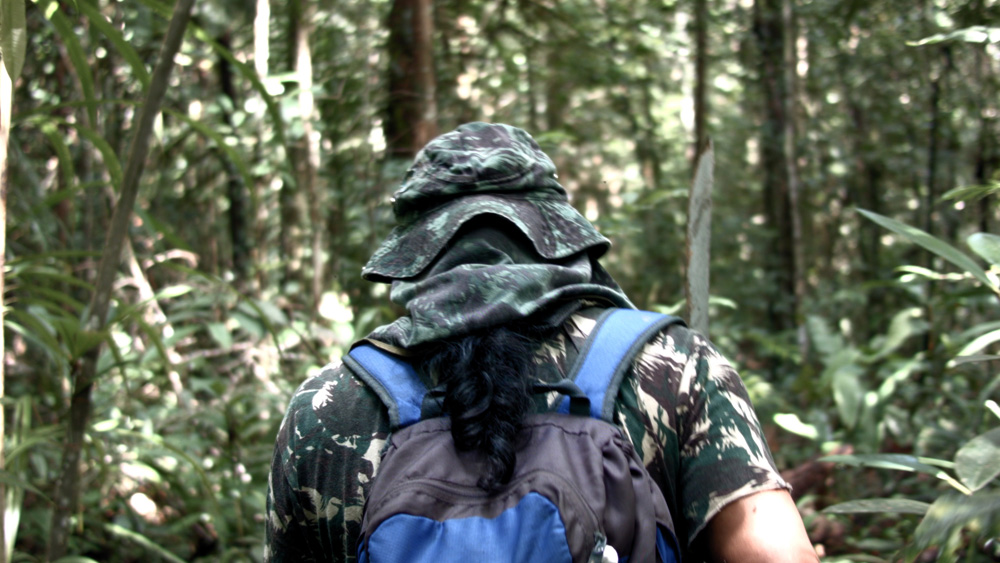
In the middle of Lisbon between Avenue Liberdade and the Natural History Museum lays a little gem of a garden, The Jardim Botânico da Universidade de Lisboa. It was inaugurated in 1873. The garden’s crown jewel is its subtropical collections which has a unique microclimate that enables unique tropical plants to survive. STEM is a film about the migration of plants and the beginning of botanical gardens decay. Years of neglects of the Lisbon University Garden have created a romantic environment where the garden is growing wild. The film investigates the displacement in migration and morphology of plants. And investigates some of the post-colonial environmental ramifications of transfer into new subjectivities of the"other." The film came together as is a collaboration between the filmmaker and the German sound artist Max Schneider. Together they traveled Brazil to sound record 17 unique plants. The film features an interview with professor James Clifford, author of "The Predicament of Culture: Twentieth-Century Ethnography, Literature, and Art" (1988), "Routes: Travel and Translation in the Late 20th Century" (1997), and Returns: Becoming Indigenous in the Twenty First Century" (2013).
Lasse Lau, born in Denmark in 1974, is a filmmaker, a video artist, and the winner of the Nordic:Dox Award 2018 for his film Lykkelænder. He studied at the Media Art Department at Funen Art Academy in Denmark, at the Hochschule der Künste in Berlin, and at the Whitney Museum of American Art Independent Study Program in New York. His films deal with socio-economic issues, the negotiation of conflicts and the notion of space through the language of film. Lau seeks to utilize aesthetics as a framework that can open dialogical paths. The artist’s work was completed by Max Schneider, sound art teacher at the Hochschule für Grafik und Buchkunst Leipzig, and founding member of the sound design agency Aconica. As a freelance sound designer, Schneider works for contemporary artists and experimental filmmakers, festival producer and curator. His work today focuses on sound design methodology at the heart of applied functional sound design production. Lasse Lau has exhibited in a wide range of museums and galleries including Westfälischer Kunstverein (Münster, Germany), Hamburger Bahnhof (Berlin, Germany), Aarhus Art Museum (Aarhus, Denmark), Brandts Klædefabrik (Odense, Denmark), Museum of Contemporary Art (Zagreb, Croatia), the Turin Biennial of Contemporary Art (Turin, Italy), Contemporary Museum (Baltimore, USA) and MoMA PS1 (New York, USA). Co-founder of Kran Film Collective and member of the Editorial Selection Board at the Danish Film Institute Video Workshop 2001-02, he also works with New York based artist group Camel Collective.
Daniel Laufer
Colour Memory
Experimental video | hdv | color and b&w | 13:13 | Germany | 2016
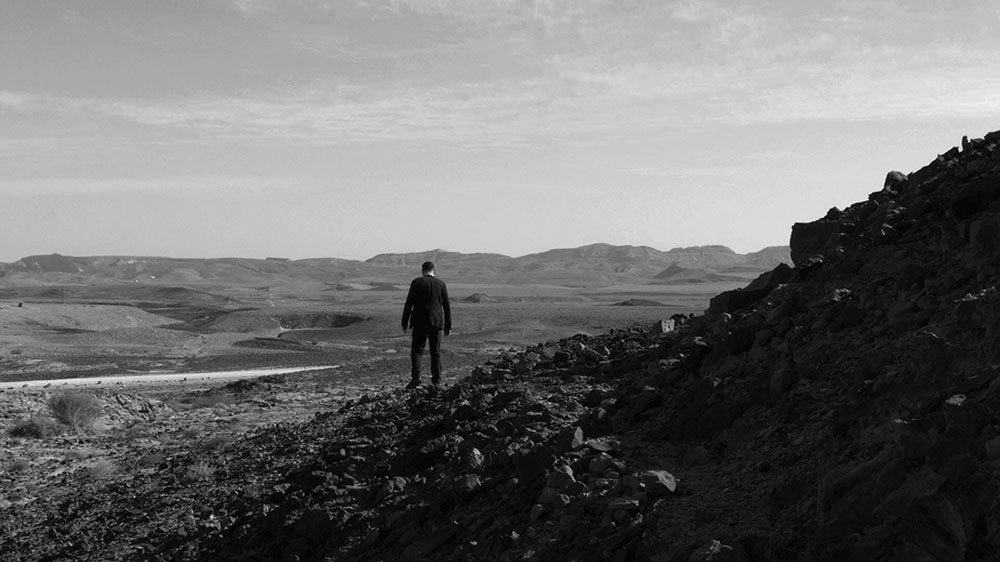
The protagonists in the film move through spaces like the desert, the city and the gallery space. All are production spaces of the film and combining different layers of time and contexts with each other. The Film follows the history of the gaze. The focus is on the phenomenon of the afterimage. This so-called phi-effect makes film sequences following a strong color stimulus appear in a complementary color. The effect is based on the fact that the retina continues to briefly perceive an image after the light stimulus and merges it with the following image. The sound sometimes refers to the previously perceived film still in some instances, letting the words speak at a different position. The brain requires a moment to connect what is heard with what is seen. Furthermore, the afterimage links different levels of time, the past with the present moment, which in the next instant is already the past again.
Daniel Laufer is an artist, filmmaker and curator, lives and works in Berlin. He has studied at the HBK-Braunschweig. Laufer is a recipient of the grant of the Arthur Boskamp Foundation for Space concepts, Stiftung Kunstfonds and the Berlin Senat among other awards.His exhibitions include: Artists Space, NYC; KM Gallery, Berlin; Galerie Kamm, Berlin, Kunstverein Harburger Bahnhof, Hamburg; Schaufenster, Kunstverein f. d. Rheinlande und Westfalen, Düsseldorf; Fridericianum, Kasseler Kunstverein, Kassel; KW Institute for Contemporary Art, Berlin; Jewish Museum Berlin, Kunstmuseum, Bonn; Van Gogh Museum, Amsterdam; Irish Museum of Modern Art, Dublin.
Matthew Lax
A Tired Dog Is a Good Dog, Part One
Experimental doc. | 4k | color | 20:0 | USA | 2022
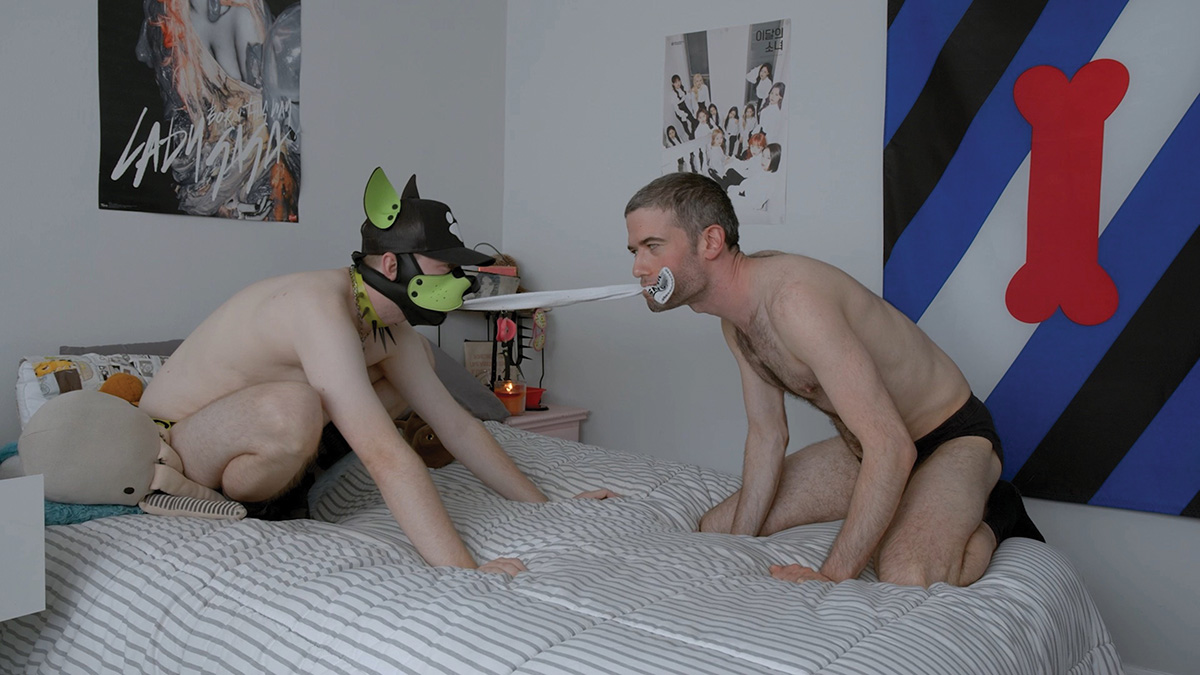
A quadruplet raised on a collie farm explores human-dog behaviors through queer “puppy play,” leading to nuanced discoveries of how people treat people “like animals.”
Lax’s films and video installations have screened and been exhibited at venues including Viennale (Austria), IHME Contemporary (Helsinki), MIX New York and MIX Brasil (São Paulo), table (Chicago), Los Angeles Municipal Art Gallery (LAMAG), Los Angeles Contemporary Archive (LACA), Everson Museum of Art (Syracuse, NY), REDCAT, Film Forum, Winnipeg Underground Film Festival, The Drawing Center (New York), and CROSSROADS (San Francisco), among others. Lax’s organizational projects include those held at Anthology Film Archives (NY), Fellows of Contemporary Art (LA), and Human Resources LA. Lax’s writing has appeared in print and online publications including MARCH Journal, Los Angeles Review of Books (LARB), ArtPractical, and Texte Zur Kunst), as well a catalogue contribution with the Lawndale Art Center (Houston, TX) and a limited edition zine with Inga Books (Chicago).
Oliver Laxe
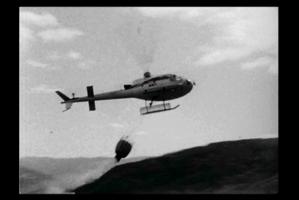
Suena la trompeta, ahora veo otra cara
| 16mm | color | 8:30 | Spain, Morocco | 2007
THE TRUMPET SOUNDS, NOW I SEE ANOTHER FACE In this piece, a combination of melancholy and dense sorrow, like a cloudy day, Oliver Laxe once again confronts the ?Other? and demonstrates that, deep down, we can be foreign in Galicia, as well as in Morocco or Paris. Without any predetermined scripted aims, Laxe films with the simplicity of looking. Narrative is unnecessary as any form of structure would vanish the subtlety of the everyday. With a certain degree of lyrical quietude, of exotic nostalgia, Laxe portrays along ephemeral sequences a group of construction workers at the site of one of the stadiums, planned for what was supposed to be Morocco?s 2010 Football World Cup. In the background we get to see a green landscape, under gray clouds and littered with the stadium?s cement structures. Some men are in groups, and others walk on their own. Yet they all seem to want to isolate themselves from their circumstances. The cuts in the film, quiet, brute and crude, barely edited, provide the noise, the ambiguity, the tension. They inspire contemplation. A car escape, the bare skeletons of buildings on both sides of the road, the Rif mountains... A market falls victim to the Sharki, the much dreaded northeast wind; an exceptional phenomenon of nature that makes everything disappear. The apparent estrangement between the author and his blurry characters is formally resolved into a gentle dissolution of the individuals into their environment. Laxe?s handcrafted and straightforward gaze does not just portray and observe everyday aspects of life, it also dares to capture the passing of time itself. How? By providing his images with a personal and intimate affect that makes us transcend that which is being shown to us, a myriad nuances impossible to capture in an objective documentary or conventional audiovisual product.
Oliver Laxe was born in Paris in 1982. He lived in La Corogne until the age of 18 and studied audio-visual communications at the Pompeu Fabra University in Barcelona. He is a member of the platform for experimental cinema "No.w.here" of London, where he has resided for a year. His final thesis "Chimneys have decided to Escape," directed with Enrique Aguilar, was selected for exhibition at the Gijon Film Festival, won a prize at the Grenade Film Festival, and was selected for Injuvre's Visual Arts Sampling. The Bureau of Culture of Galicia has financed his film "Paris #1." He participates in a film workshop along a group of socially excluded children, in collaboration with the Cinémathèque de Tanger. In Tanger he also filmed "The Trumpet Plays," included in the film "A Day in the Life of Andrei Arsenevitch" in honor of Tarkovsky.

Duy Le Ngoc
Cuôi giuong dây lên môt tiêng goi
Experimental doc. | hdv | color | 14:56 | Vietnam | 2023
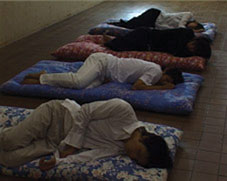
Echoed in a memory-laden house are daily conversations between a mother and her two sons, all seemingly asleep. This autobiographical short, in a hybrid form, chronicles a personal memory from director Le Ngoc Duy's adolescence, using set design and reenactment to reconstruct his childhood home and featuring his mother’s voice as part of the cast.
LE Ngoc Duy (b. 2000) is a Vietnamese filmmaker and a member of A Sông Collective from Danang City. He was trained in filmmaking workshops by doc cicada and New Asian Filmmakers Collective in Cambodia. His works explore the subjects of family and homeland memories, queerness, and young adulthood, often set against historical backdrops and blending nonfictional and poetic elements within fictional narratives. "The House That Stays", Duy’s debut short film, was an official selection at Kaohsiung Film Festival, ZINEBI International Festival of Documentary and Short Film of Bilbao, Uppsala Short Film Festival, and Jogja-NETPAC Asian Film Festival. Currently, he is organizing and co-programming the Cinema Con Nha Ngheo project in Danang.
Le Pavillon
Yumeji
Experimental video | dv | color | 48:0 | France | 2004
The film Yumeji (Pathway to dreams) has been shot during a workshop of the resident artists of the Pavillon, a creation lab for the Tokyo Palace in Japan in May 2004. This is a collective movie which summarizes both the experience of the exhibition in Hiroshima and of the trip. It is an interactive film. Its tree view allows the passage from the collective film to individual dreams imagined by each artist.
Le Pavillon is the laboratory of creation for Tokyo´s Palace in Paris. Students for the year 2003-2004 were Ziad Antar, Louidgi Beltrame, Davide Bertocchi, Sophie Dubosc, Johannes Fricke Waldthausen, Shiho Fukuhara, Agnieszka Kurant, Gerald Petit. During the whole year, headmaster Ange Leccia, Christian Merlhiot (in charge with pedagogy), Jean-Luc Vilmouth (invited artist) and Pascal Beausse (invited art critic) followed them in their reflection.
Joan Leandre
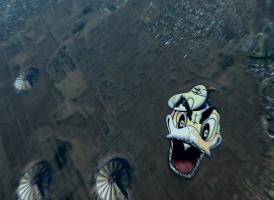
In the Name of Kernel! Song of the Iron Bird
Experimental video | 0 | color | 0:0 | Spain | 2007
"The Dr Strangelove of computing, Leandre loves the bomb and knows its mechanisms well enough to transform them instantly into the workings of a multi-layered ambiguous narrative, esoteric and seductive at the same time. This is what we can see in his latest project, In the Name of Kernel (2006 - ongoing). The kernel, the heart of every operating system, becomes the myth around which coagulates a symbolic event combining travel literature, the alchemy tradition and science fiction, terrorism and conspiracy theories, programming and mountaineering, 3D modelling and satellite mapping, hallucinations and revelations. A high definition metaphor for those who love the clear air of the high peaks." - Domenico Quaranta
Joan Leandre (b. 1968, lives and works in Barcelona, Spain) Media interpreter, member of the OVNI Archives since 1994. From 1994-1996 I worked on the series of media interruptions MAP (Mega Assemble Project), Fundación Zero and Serial Monuments, in 1995-1997 the Oigo Rom project, later in 1998 in Brooklyn I was involved with the President Archives. In 1999 I worked again with mass entertainment software and started the projects retroyou (RC) and retroyou (nostalG) and the long series still in process, retroyou nostalg2 and the Black Boot Project. Other colective projects I`ve been involved with these years are Velvet Strike (http://www.opensorcery.net/velvet-strike/) and the Archivos Babilonia (http://desorg.org/babylon_25-01-2005.php). I`m currently in that floating point of several considerations which bring the name of the iron bird scream in its flight through the automatic dusk, ...In the Name of Kernel!.

Joan Leandre
OVNI
0 | 0 | | 0:0 | Spain | 2007
The OVNI (Observatoire de la vidéo non identifiée) was founded in 1993 by the artists Joan Leandre, Toni Serra and Rosa Llop in Barcelona. OVNI's archives have an international and thematic character, facilitating a criticism of the contemporary culture using various strategies such as video art, independent documentary, and the archaeology of mass media. The archives gather a constellation of disparate works of which the common denominator is self-expression and thought about fears and the place of individual in collectives, building, and conjugating a multiple view. A thousand little works go into detail and explore our world or announce other possibilities. A discourse of which major values are heterogeneity, plurality, and contradiction, and in which subjectivity accomplishes itself. In this discourse, subjectivity is the only tool of repulsion against cloning and corporate mass media's repetition. During the various editions, the thematic character of this convocation changes through selections of works into a reading, a particular register of our time's dreams and nightmares. Thus, one could verify how the concerns' spectre has been gradually concentrated, taking part in a very developed range at the beginning of OVNI in 1993-1999 (to develop and explore video language's boundaries, recovering its first formal freedom and theme), until that it concentrates itself more and more on specific themes : Identity against Media (1997-98), Community (2000), Globalization (2002), September 11th's Consequences (2003), Resistances (2005), and the Colonial Dream Independent Zones (2006).
The Catalan artist Joan Leandre has been a member of OVNI (Observatoire de la vidéo non identifiée) since 1993. From 1994 to 1996, he worked on the series MAP (Mega Assemble Project), Foundation Zero and Serial Monuments. In 1996 he instigated the project Oigo Romo, financially supported by the Audiovisual University Institute (Instituto Universitario del Audiovisual) which provided a place for the Mega Assembly Project MSN ? Adult Playground 1.0. In 1998, he participated in President Archives in New York. In 1999, he began the project retroyou.org made for the break series of software retroyou RC, retroyou nostal(G), retroyou nostalg2, and the mailing list autoreplicant http://ddtpv-txmx7-bbgj9-wgy8k-b9ghm.org. During the last few years, he has made projects in collaboration with Archivos Babilonia and Velvet Strike.
Joan Leandre
In the Name of the Kernel Series - Magic Line
Animation | hdv | color | 22:25 | Spain | 2010
An exhibition of HD video, digital print and text by Barcelona based artist Joan Leandre. As the second Gallery exhibition in the artist?s extensive history, In the Name of Kernel ! The Magic Line is the third installment of the In the Name of Kernel series, introducing Leandre?s critical practice of media interpretation and reverse engineering to a new audience. The first two films of the series toured internationally to venues such as Sonar Festival, Barcelona 2008, 3rd Moscow Biennial, Moscow, 2009, and Centre George Pompidou, Paris 2009.
"Media interpreter and member of the OVNI Archives since 1994. From 1994 to 1996 I worked on a series of media interruptions called MAP (Mega Assemble Project), Fundación Zero and Serial Monuments. From 1995-1997 I was involved in the Oigo Rom project, and later in 1998 in Brooklyn I was involved with the President Archives. In 1999, I began working again with mass entertainment software and started the projects retroyou (RC) and retroyou (nostalG), and continue to work on the series retroyou nostalg2 and the Black Boot Project. Other collective projects include Velvet Strike and the Archivos Babilonia.? J.Leandre

Joan Leandre
In the Name of Kernel Series - Lonely Record Sessi
Video | dv | color | 20:0 | Spain | 2009
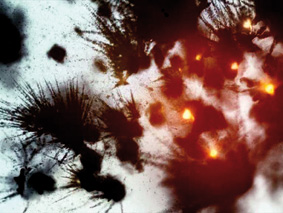
?In the Name of Kernel ! The Magic Line? is the third installation of the ?In the Name of Kernel series?, introducing Leandre?s critical practice of media interpretation and reversing engineering to a new audience. ?In the Name of Kernel ! ? gathers his last videos in an open cycle. They offer to the viewer a complex narration in which he can decode the mechanisms of the fascination for technology to which we are usually subjected, such mechanisms, that will then condition our perception of the world. In that sense, the work of Joan Leandre is quite subversive. In this installation, the kernel, which is at the heart of most computer systems, becomes the myth around which a symbolic event coagulates. It combines travel literature, the alchemy tradition, science fiction, terrorism and conspiracy theories, computer programming, mountain climbing, 3-D modeling, satellite mapping, hallucinations and revelations. Joan Leandre explores the troubled imagination of a fundamental principle of computer science, without regard for its potential uses, be they military or dreamlike. The image itself, which is created by manipulating computers, changes its status. Along with the images, the blind power of the Kernel appears, the kernel in whose name all technological usages become possible.
Joan Leandre lives and works in Barcelona. He is media interpreter and member of the OVNI Archives (Observatoire de Vidéos Non Identifiées). since 1994. From 1994 to 1996 he worked on a series of media interruptions called ?MAP? (Mega Assemble Project), ?Fundación Zero? and ?Serial Monuments?. From 1995-1997 he was involved in the Oigo Rom project, and later in 1998 in Brooklyn he was involved with the President Archives. In 1999, he began working again with mass entertainment software and started the projects ?Retroyou (RC) and retroyou (nostalG)?, and continues to work on the series ?Retroyou nostalg2? and the ?Black Boot Project?. Other collective projects include Velvet Strike and the Archivos Babilonia. Since the begining of the 90ies, Joan Leandre is a media interpreter, an Internet archeologist. He make permanent excavations and collects data. He archives numerous datas that have been ?forgotten?, on a corporate site for example, or, contrariwise, data that have very short apparition before becoming confidential or outdated in terms of technologies. Going further than the apparent usability of such or such interface, he tries to create a state of consciousness concerning what the machines are able to make us do because of our ignorance and the power of the ideological conditioning on our understanding of the real today due to the new images. Since 2006, the work of Joan Leandre lies essentially on the analysis and the deconstruction of games, simulation or military training softwares. His work has been shown at the Sonar festival, Barcelona, at Transmediale, Berlin ; at the Whitney Biennial in the Whitney Museum of American Art, New York, at the Laboral Centro de Arte Contemporaneo, Gijon, at the Moscow Biennale, at the ZKM, Karlsruhe.
Joan Leandre
Magic Line
Video | dv | color | 20:0 | Spain | 2010
Joan Leandre
Retroyou_nostal(g)
Multimedia installation | 0 | | 0:0 | Spain | 2007
?Retroyou_nostal(g)? is a software research project whose aim is to transform the original programs into self-running simulation environments. The conditions in four flight simulator programs are modulated in such a way that they can hardly be operated by human pilots any more. Prix Ars Electronica 2006, Honorary Mention Interactive Art
The Catalan artist Joan Leandre has been a member of OVNI (Observatoire de la vidéo non identifiée) since 1993. From 1994 to 1996, he worked on the series MAP (Mega Assemble Project), Foundation Zero and Serial Monuments. In 1996 he instigated the project Oigo Romo, financially supported by the Audiovisual University Institute (Instituto Universitario del Audiovisual) which provided a place for the Mega Assembly Project MSN ? Adult Playground 1.0. In 1998, he participated in President Archives in New York. In 1999, he began the project retroyou.org made for the break series of software retroyou RC, retroyou nostal(G), retroyou nostalg2, and the mailing list autoreplicant http://ddtpv-txmx7-bbgj9-wgy8k-b9ghm.org. During the last few years, he has made projects in collaboration with Archivos Babilonia and Velvet Strike.
Sonia Leber, David Chesworth
Earthwork
Video | hdv | color | 5:0 | Australia | 2016
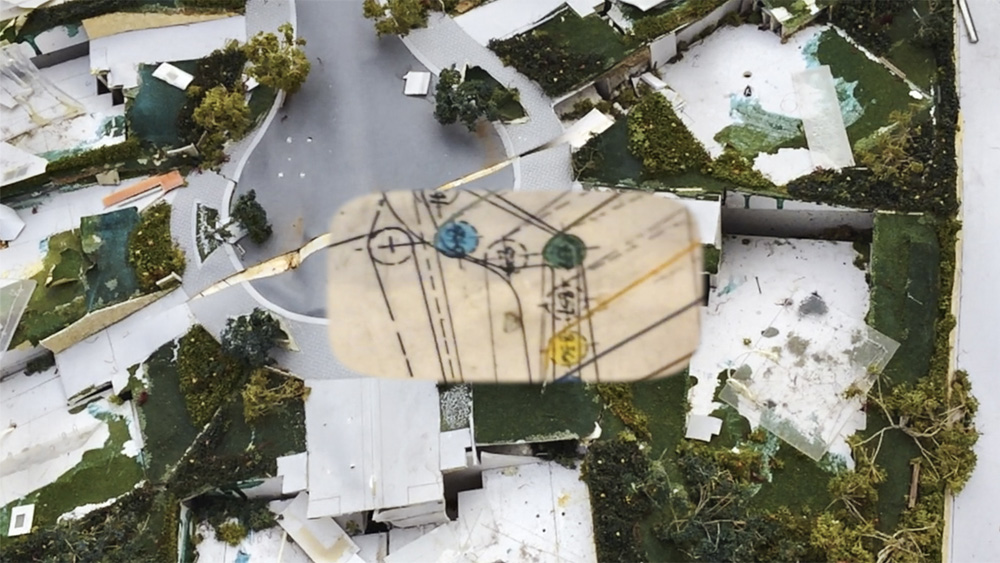
Earthwork’s screen is positioned flat on the floor, facing upwards. The visitor, looking down, gets a bird’s-eye view of a suburban landscape in which there are destroyed buildings, damaged roads, fences, and gardens. The image suggests a world that has undergone massive disruption. It is unclear whether accident, entropic forces, or warfare has caused this result. Superimposed upon Earthwork’s devastated landscape is another smaller image that presents the viewer with an alternative framing the site. We see diagrams: symbols of what might be location coordinates, suggesting an ongoing search for boundaries, and an intention. The two images appear to be attempting to “ line-up ”, but this is never achieved. The title, Earthwork, references the American Land Art movement of the 1960s; Leber and Chesworth’s videowork further explores Robert Smithson’s concept of the “ non-site ”. A non-site is an artwork situated in a gallery that metaphorically represents a remote actual site. As Smithson suggests “ the site is evading you all the while its directing you to it ”.
Sonia Leber and David Chesworth are known for their distinctive installation artworks, using video, sound, architecture, and public participation. Developed through expansive research in places undergoing social change, Leber and Chesworth’s works are speculative and archaeological, responding to architectural, social, and technological settings.
Sonia Leber, David Chesworth
Where Lakes Once Had Water
Video | 4k | color | 28:14 | Australia | 2020
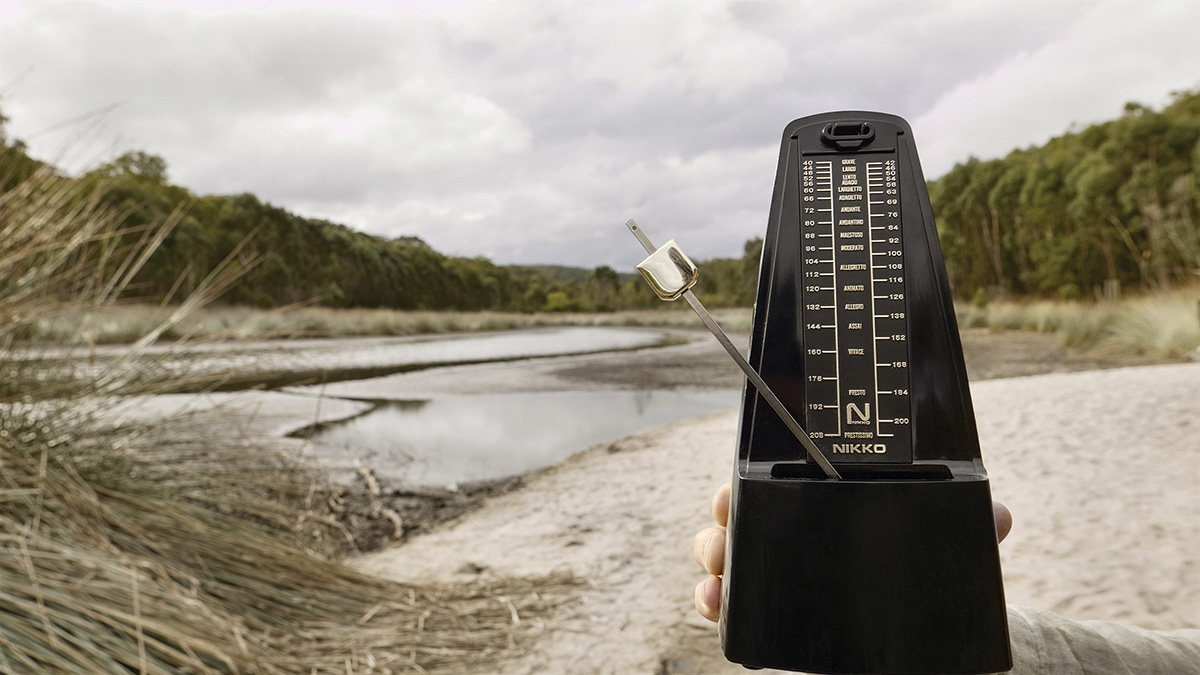
‘Where Lakes Once Had Water contemplates how the Earth is experienced and understood through different ontologies – ways of being, seeing, sensing, listening and thinking – that reverberate across art, Indigenous thought, science, ancient and modern cultures, and the non-human.’ Sonia Leber and David Chesworth travelled with a team of Earth and environmental scientists who are investigating changes in the climate, landscape and ecology over 130,000 years. Their journey took them to Australia’s Northern Territory, to spectacular yet challenging environments, from locations of long-term aridity to lush, green waterways. Where Lakes Once Had Water channels the experience, where Indigenous rangers, Elders and community members collaborate with scientists. Working across the ancient shorelines, everyone is receptive to the signs, signals and rhythms of the land. Meanwhile, non-human cohabitants continue their struggles for survival. Leber and Chesworth deploy video as a tool, scanning tree lines, erosions, termite mounds, and the effects of water, sun and fire. Their disquieting sound design encompasses natural and human-made sounds, and the hidden signals and energies that exist beyond human hearing. The project is a journey across audio-visual realms, scientific endeavour and Indigenous knowledge – a coalescence of efforts to understand the ancient land. "Where Lakes Once Had Water" was commissioned by the Australian Research Council Centre of Excellence for Australian Biodiversity and Heritage (CABAH) in association with Bundanon. It was filmed on the lands and waters of the Mudburra, Marlinja, Jingili, Elliot, Jawoyn and Larrakia communities in Northern Territory, with additional filming and editing on Barkandji, Dharawal, Djabugay, Yidinji and Wurundjeri Country. University of Wollongong Art Collection, Australia.
Australian artists Sonia Leber and David Chesworth are known for their distinctive video, sound and architecture-based installations that are audible as much as visible. Leber and Chesworth’s works are speculative and archaeological, often involving communities and elaborated from research in places undergoing social, technological or local geological transformation. Their works emerge from the real but exist significantly in the realm of the imaginary, hinting at unseen forces and non-human perspectives. Leber and Chesworth’s artworks have been shown in the central exhibitions of the 56th Venice Biennale: All The World’s Futures (2015) and the 19th Biennale of Sydney: You Imagine What You Desire (2014). Solo exhibitions include What Listening Knows, Messums Wiltshire, UK (2021) and the survey exhibition Architecture Makes Us: Cinematic Visions of Sonia Leber & David Chesworth, Centre for Contemporary Photography, Melbourne, Australia (2018) touring to Griffith University Art Museum, Brisbane (2019) and UNSW Galleries, Sydney (2019).
Ange Leccia
Nuit bleue
Experimental fiction | | color | 86:0 | France | 2010
"Celui qui n`accepte pas de se laisser égarer n`empruntera jamais que des chemins déjà tracés: il risquera de manquer celui qui le concernerait en propre. A moins qu`il ne sabote tous les chemins, les coupe et les embrouille." L?égarement de mes personnages dans « Nuit Bleue » s?imprègne de la pensée du philosophe Jean Toussaint Desanti ; mes émotions visuelles tentent de l?illustrer. A. LECCIA
Ange Leccia est né le 19 avril 1952 à Minerviù en Corse. Artiste plasticien, il a été pensionnaire de la villa Médicis à Rome en 1981-1983, puis résident à la villa Kujoyama à Kyoto en 1992-1993. Professeur à l?École Régionale des Beaux-Arts de Grenoble de 1985 à 1997, puis à l`l?École nationale supérieure des Beaux-Arts de Cergy de 1997 à 2000, il est actuellement directeur du Pavillon, le laboratoire de création du Palais de Tokyo. Ses oeuvres ont été exposés dans de nombreux musées (Guggenheim, Centre Georges Pompidou) et manifestations (Kassel, Sydney) en France et à l`étranger et il a réalisé de nombreux films dont Ile de Beauté (1996) et Gold (2000) avec Dominique Gonzales-Foerster, ainsi que Azé (2004) ou encore La déraison du Louvre (2005).
Johanna Lecklin
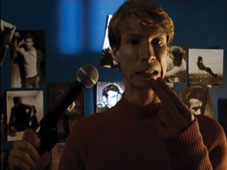
Paljon on iloakin
Experimental video | dv | color | 10:0 | Finland | 2005
The script in "There is a Lot of Joy, too" is based on discussions with a young boy who has Asperger's syndrome. The script became a fictive dialogue between a boy and his mother. They never meet on the screen, but are shown in their own rooms next to each other. The boy talks about his dreams and the mother recounts how it is to live with a child who is different.
Johanna Lecklin is currently completing a PhD at the Academy of Fine Arts in Helsinki, Finland. Her subject is Narrativity, Documentary, and Performativity in Video Art; it is closely related to her own artistic practices. Her background includes an Erasmus exchange at Slade School of Fine Art, UCL in London 1998-99 and a MA degree from the Academy of Fine Arts in Helsinki in 2003. She has taken part in film and video festivals such as Raindance Film Festival in London, UK in 2006; "bzzz" - Pépinières européennes pour jeunes artistes - 18th Festival International des Programmes Audiovisuels Biarritz in France 2005; and in Kasseler Dokumentarfilm - & Videofest Festival, in Kassel, Germany, 2004. She has had several solo shows in Finland and taken part in group shows in many Finnish museums and abroad. In 2001 she won First Prize of the Artists' Association of Finland.
Jean François Lecourt, Thomas Auriol
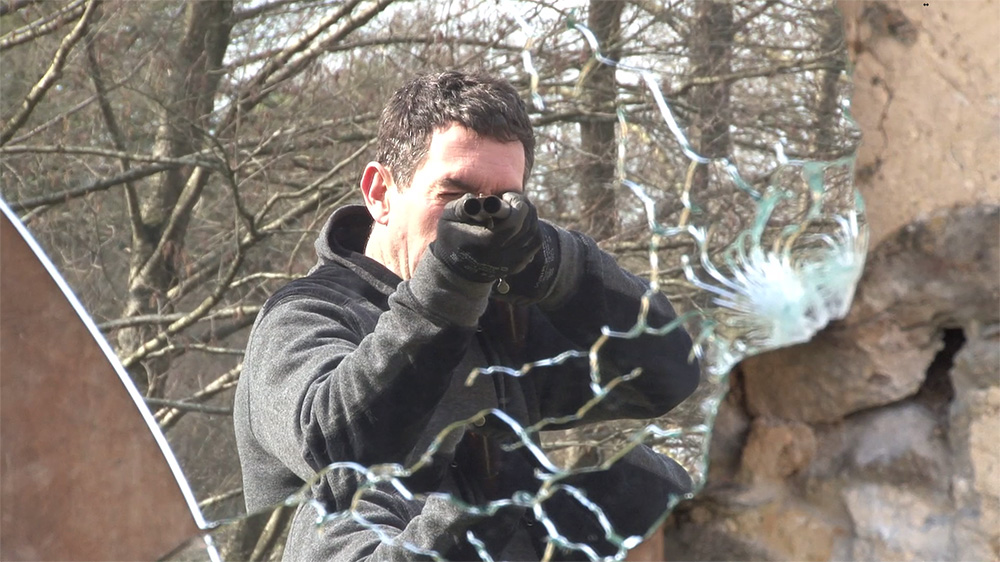
Tir dans le miroir
Performance | hdv | color | 0:0 | France | 2010
Jean-François Lecourt est né dans le Perche le 3 Novembre 1958, au sein d’une famille d’agriculteurs. Il entre à 17 ans à l’école des Beaux-Arts du Mans où enseigne Gina Pane, une des artistes fondatrices du mouvement de l’art corporel. Parallèlement, il suit l’éducation d’un Maître d’Arts Martiaux en Karaté Do (la voie des mains nues) de l’école Shotokan, et s’adonne assidûment aux pratiques du Tir à l’arme à feu et du Tir à l’arc. Sa démarche est basée sur l’analogie et l’identification. Une méthode qui le conduit à la découverte de l’aspect cyclique et symétrique des processus de tir et de photographie ; d’où le concept majeur de son œuvre : Le Tir dans l’appareil photographique.Cet acte artistique est un cérémonial immuable qu’il pratique depuis 1977. Il ne s’agit pas pour lui d’illustrer une névrose autodestructrice mais de tenter, en un retour immédiat, d’abolir l’arrêt fatal du cliché. La photographie est donc ici un Art martial. Comme dans le Kuy-Do, la cible à atteindre est soi-même, le but étant la réalisation au présent de celui qui pratique. Une nouvelle création vidéo de 2010 implique une série de films qui mettent en jeu l’autoportrait, la détonation, effondrement et la renaissance du paysage, ce travail s’intitule « Les tirs dans le miroir ».
Alejandro Lecuna
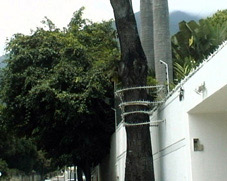
718 Nebel und Rauch
Art vidéo | dv | | 7:18 | Venezuela, Germany | 2005
The polarized political situation of Venezuela is presented as an asymmetric documentary that shows the private and the public space in the capital Caracas. The constant fear induced by political in-stability and the incapability of the government in public safety has given raise in the last few years to a prosperous industry of home-security that has re-shaped the public and private space. Bob-wire and electric fences are the new decoration fashion that every house must have in order to be saved from the ?other?. Caracas is a place where nature, humans and panic seem to be able to co-exist in a tense harmony.
Alejandro Lecuna started his career in the arts has aprenticeship of the Venezuelan Op artist Carlos Cruz-Diez. Studied Graphic Design in the Instituto de Diseño de Caracas and in the School of Visual arts of New York with Prof. Milton Glazer, Prof. Tony Palladino and Prof. Ed Benguiat. Recently finished his studies in Visuelle Kommunikation and Video art- at the University of the Arts of Berlin with the German video-artis Prof. Maria Vedder and Prof. Holger Matthies (UdK). Currently studies his Maisterschüler (member of a master class) also with Prof. Vedder. In the commercial world his experience lies in the area of corporate design for print & digital. He has worked for various firms including SME branding and FDTdesign in NY and frogdesign in Germany. Among his clients and projects are Coca-Cola, DaimlerChrysler, Smart, Consors, NHL, NFL, NBA and David Byrne`s music label Luaka Bop. In the art world his video works has found space in the Berlin night scene. His most recent shows include the "Dis-appearances" show in 2004 in the Opel Haus in Berlin Friedrichstrasse (catalog) and the 48 Stünden Neu-Koln Kunst un Kultur Festival. He has concentrated his art in using the public space as the object and objective of his work. He is a regular lecturer in the design and art schools in Venezuela.
Samuel Kiehoon Lee
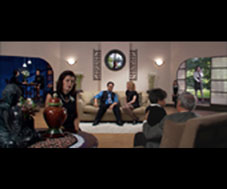
5 x 90: the wake
Experimental video | dv | color | 10:45 | Canada | 2005
Five different stories comprise a single ninety second vignette; each tale illuminating an element of the deceased's life during his wake. A meditation on the Buddhist notion of reincarnation, "5x90: the wake" is a sly and clever look at an interracial family coping with a death in the family.
Samuel Kiehoon Lee's award-winning pieces include the short documentary "How to make Kimchi according to my Kun-Umma"; the experimental narrative "5 x 90: the wake"; and "Hannah".
Eelyn Lee
An Ealing Trilogy
Video installation | hdv | color | 7:46 | United Kingdom | 2014
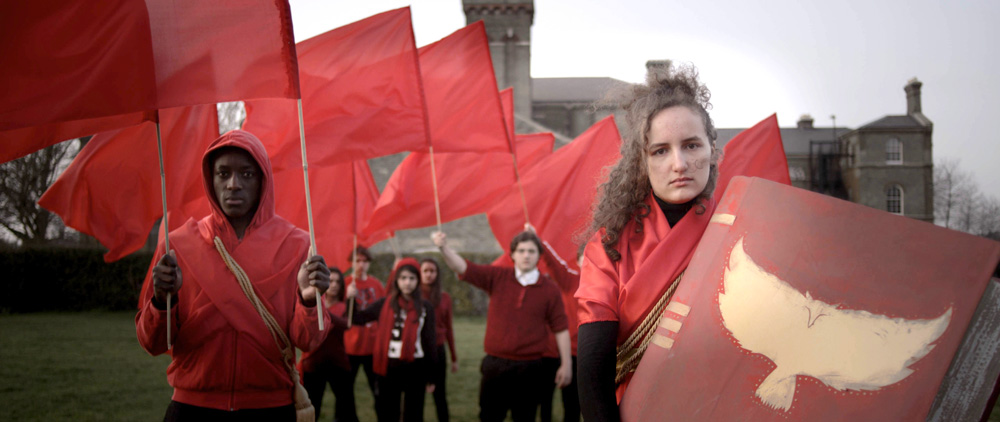
An Ealing Trilogy is a response to selected portraits from the collection of the National Portrait Gallery, London. Commissioned by the gallery, the film re-invents the lives of inspirational people who have links to Ealing, West London including Dusty Springfield, Charlie Chaplin and Freddie Mercury. Tableaux imagery is combined with an abstract soundscape to create a captivating slow motion film portrait of people and places from a west London borough.
Eelyn Lee is an award-winning artist-filmmaker who had works screened across London including Tate Modern and Whitechapel Gallery as well as internationally in Paris, Berlin and Toronto. Using processes of devising and collaboration her films use rich imagery and soundscapes to tell multi-layered stories about people and place. She is interested in groups of people, both in the making of the work and the subject of the work itself. The vision, energy and experience she brings to the creative process builds an environment conducive to making bold and original work. www.eelynlee.com