Catalogue > Search
Results for : Tout le catalogue
Jacques Lennep
Délirium vidéo sélection
Experimental video | dv | color | 30:18 | Belgium | 2005
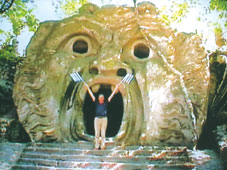
Five of these sketches are inspired by modern art: "Le calvaire de R.Mutt" ("R.Mutt´s calvary", a reference to M.Duchamp). The artist follows an abrupt Way of the Cross. He is carrying Duchamp´s "Fountain" (a reference to Warhol). In a landscape, the artist paints the word "brillo" in white on a white board. "Tombeau pour M.B" ("A tomb for M.B", a reference to Broodthaers). The artist finds the "Belgian man´s thighbone", painted in the Belgian colors. He discolors it and buries it in the ground of the Battle of Waterloo. "Le semeur de pensées" ("the pansies sower", a reference to Monet). The artist sows pansies in Monet´s garden in Giverny. "Parcours d´artiste" ("an artist´s route", a reference to Ensor). The artist, wearing a 3-piece-suit and carrying a suitcase, walks up a brook. He ends up finding a smoked herring (pun with the name of the fish in French, "hareng-saur", and "Ensor"). Three sketches give to the television another role than that of a screen : "La tour penchée" (The leaning tower). Toutists try to push Pisa´Tower. The tower is set upright again by inclining the television. "Repasser l´image" ("ironing/replaying the movie"). One scene displaying a woman ironer is being replayed on the TV screen. "Chaussettes-show" ("the socks´ show). The ballet of a pair of socks for a pair of shoes. A sketch where a message is transmitted by the viewer: "Le message de l´ogre"("the message of the ogre", Bomarzo´s enigma). In the park of Bomarzo´s monsters, the artist transmits an enigmatic word in semaphore language.
Jacques Lennep was born in Uccle, Belgium, on the 11th of July 1941. He is a multidisciplinary artist. In 1972 he created the CAP group within which he formulated the principles of a relational art. He developed one sociological trend of this art by creating his Man´s museum in 1974. From then, he dedicated himself to video, and was a video pioneer in Belgium. He taught in the Academy of Fine arts in Brussels. He belongs to the Royal Academy of Belgium. His most recent videos are gathered under the titles "Delirium-vidéo" and "Musée de l´homme Postproduction". He wrote 2 books about his approach : Alchimie du sens (La part de l´oeil Editions, Bruxelles, 1999) and Conversation avec P.-Y Desaive (Tandem Editions, Gerpinnes 2003). The Museum of Modern and Contemporary Art (MAMAC) of Liège will devote a retrospective to him in 2007.

Thomas Leon
Escape from abstraction island
Art vidéo | | color and b&w | 11:30 | France | 2009
The installation directly refers to spectacular films, in its organization and dramaturgy (the scenes? succession, the function of music) as well as in the implemented technical means (HD projection, 5.1 surround sound). Designed as an adventure movie in which the main character would be hold by the camera, the video makes its way through an island that happens to be a shapes directory. It is a long tracking out : inside a crystal structure, through different desert and deserted places, flying over the sea off a prismatic object. The nature of the depicted objects and places, as well as their relations, is never obvious, as the camera changes directions to get closer of surfaces, and plays with scales? effects, sometimes even getting lost in details. Co-production Ville de Beauvais, Le LABO, DRAC Picardie.
Thomas Leon
High Latency
Installation vid�o | | black and white | 12:0 | France | 2008
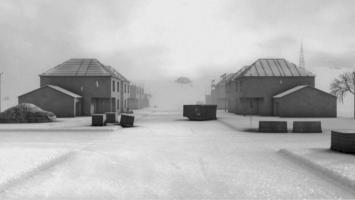
This is a film about time and experiencing a work of art. The form and structure of video and the use of digital media and sound instill emotional tension in an environment that otherwise lacks it. The camera tracks forward and progresses into a snowy landscape. The video is divided into two equal parts which are linked together when the camera?s angle moves towards the floor. From this moment forward, the image slides from the representation of a physical space to a rhythmic abstraction. When the camera lifts up again, we are back at the beginning. Two successive soundtracks accompany each part of this video.
Born in 1981 in Dijon (France), Thomas Leon currently lives and works in Paris. His work is articulated mainly around the video medium, in the form of complex and condensed installations, on the border of narration. His achievements were especially chosen for the following exhibitions: ?The children of Sabbath 07? with the Hollow of the hell, Centers Contemporary art of Thiers (France) in 2006, ?Multipolar? with the Market 14 of Leipzig (Germany) in 2006, ?Filterbox? with Glassbox (Paris) in 2006, ?the syndrome of Broadway? in the Center of Art of the Saint-Leger Park to Pougues-the-Water (France) in 2007, ?Science and fiction? with General in Manufacture in 2008.
Thomas Leon
To Ashes
Video | 0 | color | 5:6 | France | 2025
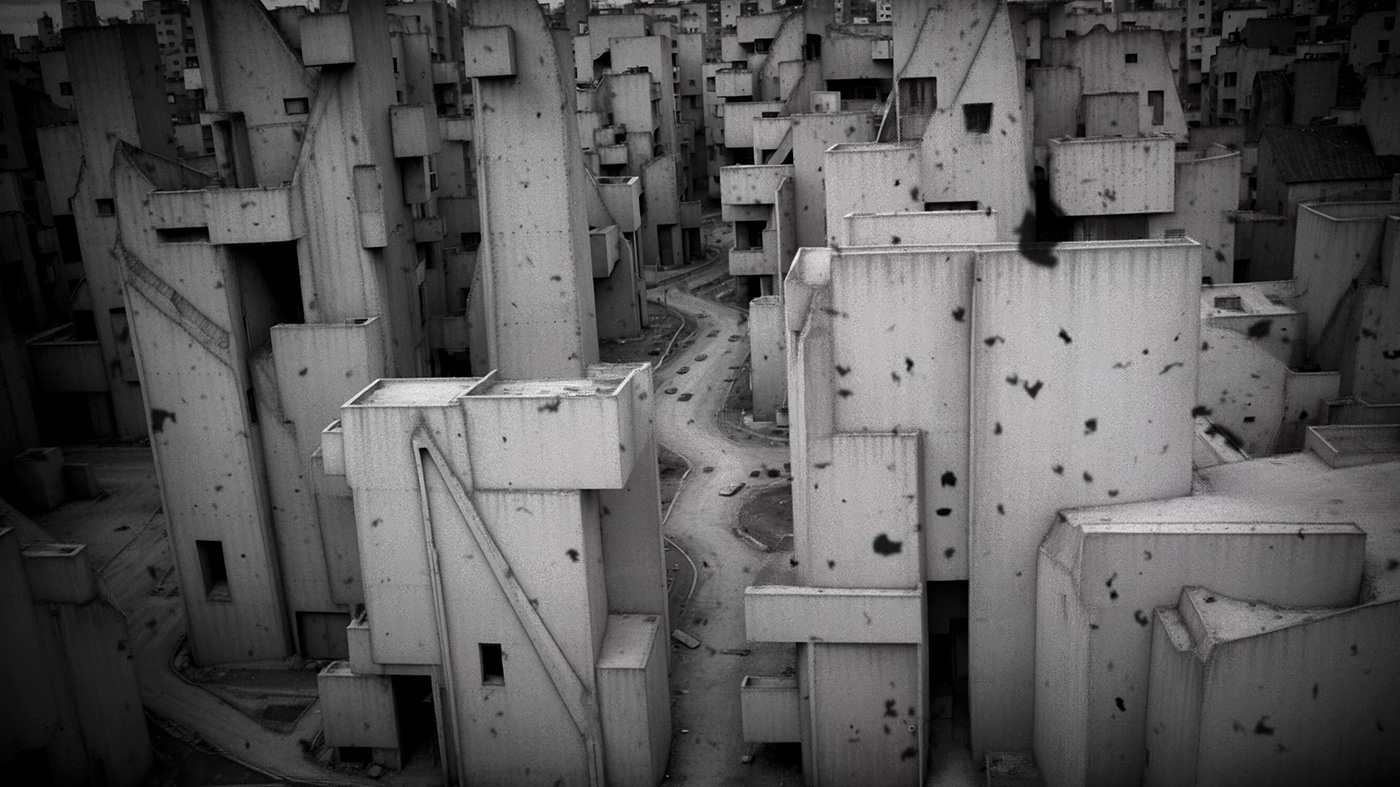
To Ashes explores the thresholds between reality and machinic hallucination, questioning contemporary image-generation technologies — particularly artificial intelligence — and their influence on our perception of the real. Created through a hybrid process combining 3D modeling and AI-based generation tools, the video unfolds as a continuous tracking shot through a brutalist megastructure in constant transformation. Architectural forms disintegrate and transform, while ash-like particles rise into the air. This disintegration is accompanied by an experimental soundscape, where analog synthesizers and transformed voices evoke a latent collapse. Gradually, the architecture gives way to unstable crystalline structures. Reality wavers. In the end, something gives way, shifts, disappears. Everything must burn.
Thomas Léon develops his practice by merging cinema, graphic arts and images from new technologies. He creates films, immersive video and sound installations, as well as large-format drawings. His work explores the interconnections between memory, sensuality, intimate experiences, and the imaginary, drawing on fictions, whether they be social, urban, climatic, etc. He is notably influenced by science fiction and utopian literature and frequently develops his projects using contemporary image creation tools (3D modeling, AI, etc.). He regularly participates in screenings or exhibitions in France and abroad: 'Listening to Transparency' at the Minsheng Art Museum in Shanghai (China, 2017), 'Cruces Sonoros: Mundos Posibles' at the MAC in Santiago de Chile (Chile, 2016), 'Rendez-vous 11' at the Institute of Contemporary Art in Villeurbanne (France, 2011), and at the South African National Gallery in Cape Town (South Africa, 2012). He notably took part in residencies : Drawing Factory organized by CNAP (National Center for Visual Arts) and the Drawing Lab (Paris) in 2021 ; a residency in Taiwan, organized by Grame, the National Center for Musical Creation (Lyon), and the Digital Art Center (Taipei) in 2011. His works can be found in the collections of CNAP (National Center for Visual Arts) and the Louis Vuitton Foundation. Thomas Léon lives and works in Montreuil.
Slava Leontjev
1:1
Experimental film | 16mm | black and white | 5:30 | Lithuania | 2007
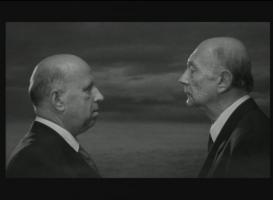
maybe dramatic frame change is unnesessarry...
Born in Vilnius in 1967. Graduated from the Art School of Justinas Vieno?inskis in Vilnius. In the 1983?1995 period, he worked as an art director at a Vilnius restoration studio, as a costume designer, art director and director at the Lithuanian national television, was a lecturer at the Vilnius Conservatoire and worked as art director assistant in the film Corridor (Koridorius) by ?arūnas Bartas. In 1996? 2000, Leontjev worked as art director and creative director at the advertising agency Brand Sellers DDB Vilnius. From 2000 until present, he has been the director of film production company Vilks Studija. Leontjev has directed a number of commercials and music videos that have won various awards including the MTV Russia prize for the music video of the year in 2004. He has authored scores of film scripts that are yet to be fulfilled. He is currently preparing for the shooting of a new 20 minute short film. Absence (Nebuvimas) is the first film from the cycle You Are Not Alone.
Leopold Emmen
Another Woman - film adaptation (work in progress)
Video installation | mp4 | | 13:6 | Netherlands | 2025
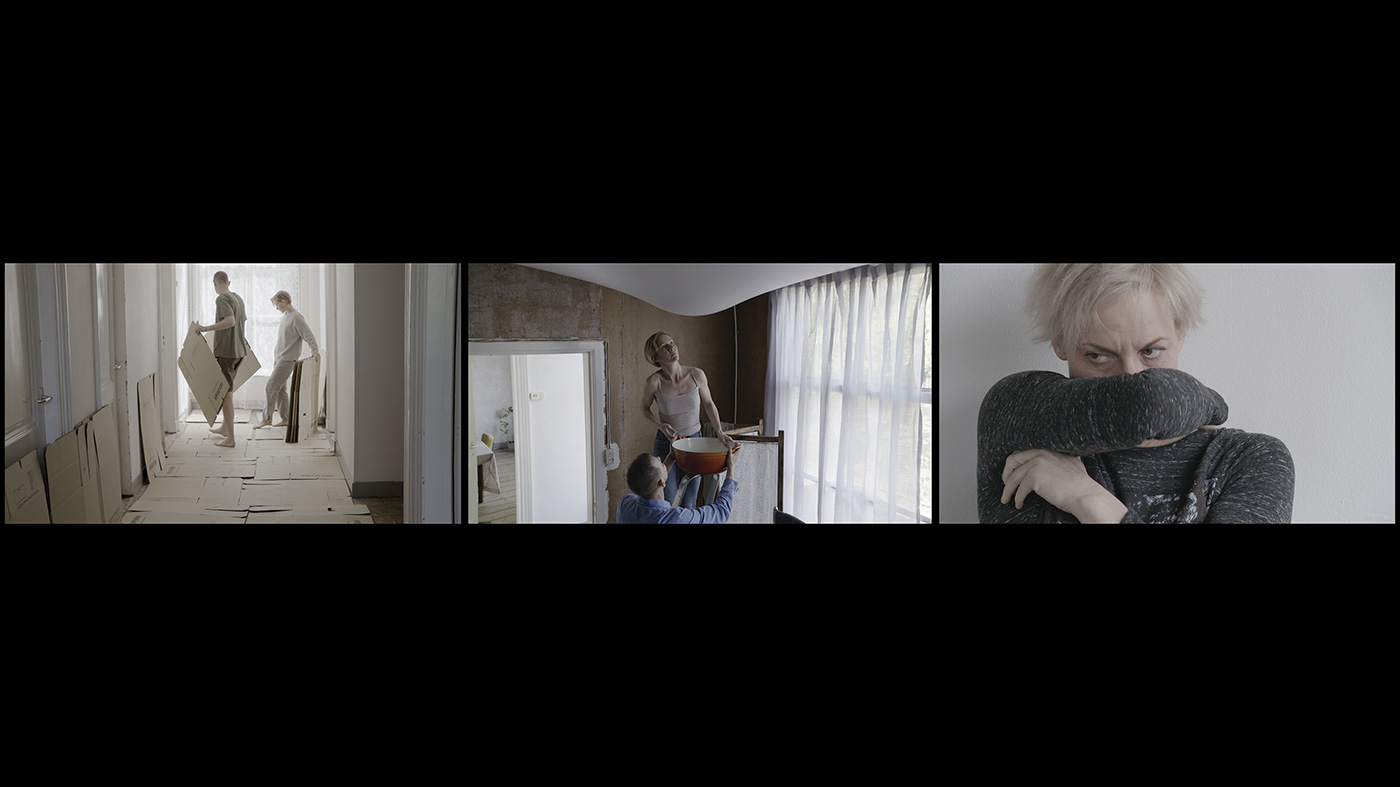
'Another Woman - film adaptation' is a three channel film presenting intimate scenes of three characters, two women and a man, in the course of a breakup. The film explores a world of fiction and performance in a cinematographic and spatially designed narrative where three images are presented simultaneously. The visual style focusses both on the performing bodies and their surroundings. Subcutaneous emotions surface through tactile interaction, as the characters touch and feel their place amidst the physical properties of the space. Walls, ceiling, floor, curtains and furniture form obstacles, boundaries and voids that confront the protagonists with the situation and state of mind in which they find themselves. The interiors become mirrors for their inner worlds, surreal and intuitively recognisable at the same time. 'Another Woman - film adaptation', 2025, is a re-staging of the spatial installation 'Another Woman', 2022. We show an exerpt of 13 min 6 sec. of the final film that will have an estimated duration of 70 minutes.
Leopold Emmen is a collaboration between filmmaker Nanouk Leopold and visual artist Daan Emmen. In our work, we experiment with film as a spatial, cinematographic experience in which the visitor plays an active role. Through the characteristics of a place and the behaviour of our protagonists, we want to make tangible how a presence influences life and relationships with the other. An open invitation to explore the physical and mental world of the characters themselves. Creating awareness of the way in which space, sound and moving image can come together in a deepening, embodied experience, we want to stir up our conditioned gaze. Reflecting on how we see the world, how we see ourselves in that world and how we see each other.
Edgar León
Contrapeso / Rojo / Verde
Experimental doc. | dv | color | 3:12 | Costa Rica, Mexico | 2005
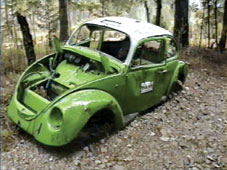
"Contrapeso/verde/rojo" is a video-documentary presenting two distinct glances. The first scene happens in the park of Chapultepec (Mexico city), where we observe a snack-stand whose tarpaulin is supported by a rope at the end of which is a bottle of Coca-Cola. It plays the role of a counter-weight, like a scale or an anchor (hence the name of the play). The second scene presents a zoom into another Coca-Cola bottle which, thanks to the opening shot, finds itself inside a demolished cab in the woods of Ajusco. The two glances start with and confine themselves to the tension generated by these bottles between the natural and the cultural, which allows us to associate the objects when they activate or deactivate something concrete. The structural logic of León's work in these two videos resides in the presentation of a narrative that leads to the reading of an idea of production after the one of consumption.
Edgar León finished his Master in Visual Arts at the Academy of San Carlos, Independent National University of Mexico (UNAM), in 2005. He produced a dozen of solo exhibitions between Mexico and Costa Rica, and has participated in more than forty group shows world-wide. As an independent commissioner, his latest work "La reconstrucción del lugar común. Imàgenes de autor" was inaugurated in 2005 at the Museum of Art and Drawing in San José, Costa Rica. He organised "Residuos y Particulas" Privado Público" in Mexico in 2004. León lives and works in the Paris area.
Xenia Lesniewski
Egodyston
Animation | dv | color | 3:27 | Germany | 2009
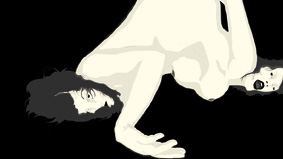
Egodystonic - My fear of death will blow my head away. I think I need other eyes for my brain.
Born in 1985 / Frankfurt am Main, has been studying Fine Arts with focus on Painting and New Media at the Offenbach Academy of Art and Design since 2005.
Xenia Lesniewski
GERADE AUS
Experimental video | dv | color | 2:0 | Germany | 2007
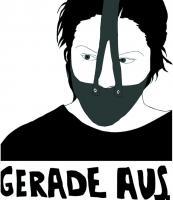
xenia yvon lesniewski GERADE AUS Die künstlerin stellt eine schwarzweiss animation mit dem titel ?gerade aus? vor. zeichnungen sind der ausgangspunkt von xenia yvon lesniewskis arbeit, welche sie dann in stilistische animationen überträgt. kurze szenen werden durch ein flimmern ineinander übergeleitet. szenen, in denen zum beispiel eine mit einem maulkorb versehene, der künstlerin stark ähnelnde person, nach luft schnappt oder in einer unterwürfigen pose auf dem boden liegt. fetisch und sadomasochismus werden in ihrer arbeit thematisiert, gefühle plakativ und direkt wiedergegeben. ?der betrachter ist ein teil meiner arbeit.? dem zuschauer werden innere verlassene landschaften vor augen geführt. man erhält unweigerlich einen offenen blick in eine innere folterkammer. für die künstlerin handelt es sich hierbei um eine sehr intime arbeit ?die grenzen zwischen realität und fiktion verschmelzen. ein zwischenraum entsteht und zwar ? GERADE AUS.? der eingeschobene text gibt hinweise und lenkt den betrachter. der abstrakte sound der arbeit nimmt unmittelbar einfluss auf seine befindlichkeit. aus dieser fragmentierung von bild, text und ton resultiert eine provokative und kompromisslose aussage über die erfahrung von kunst und wirklichkeit. text anna kalinski
biografie xenia yvon lesniewski xenia yvon lesniewski geboren 1985 in frankfurt, deutschland: bildende künstlerin; studiert seit 2005 an der hochschule für gestaltung offenbach freie kunst mit dem schwerpunkt malerei und neue medien. malerei prof. adam jankowski freies zeichnen/film prof. mariola brillowska experimentelle raumgestaltung prof. heiner blum warum sie etwas tut? alles immer nur mittel zum zweck. aber sie hätte sich auch auf die zunge beissen können, sie hat eine schöne, gesunde zunge - rot von blut.
Xenia Lesniewski
Remisequenz
Animation | dv | color | 2:23 | Germany | 2010
Das Fehlen eines konkreten Bildes. Autobiografische Bruchstücke zwischen Fiktion und Realität vereint zu konstruierten Erinnerungssequenzen und endlosen Variationen davon. Das Gegenteil des Vergessens. Aber was ist wirklich passiert? Es gibt nur die eine Wahrheit. Die eigene. Entscheidungen trifft man, weil man sie treffen muss.
1985 in Frankfurt am Main geboren, seit 2005 Studium der freien Kunst an der Hochschule für Gestaltung Offenbach mit dem Schwerpunkt Malerei und neue Medien und seit 2010 Studium der Malerei, Animation und Tapisserie in der Klasse von Judith Eisler an der Universität für Angewandte Kunst Wien. Ihre Videoarbeiten wurden bereits bei vielen nationalen und internationalen Filmfestivals wie z.B. den Kurzfilmtagen Oberhausen, der Kunstfilmbiennale Köln/Bonn oder den Rencontre Internationales Paris/Berlin/Madrid gezeigt.2008 erhielt Xenia Lesniewski den ?3 Sat Förderpreis? bei den Internationalen Kurzfilmtagen Oberhausen sowie das Stipendium der Deutschen Studienstiftung. 2009 gewann ihre Arbeit EGODYSTON den "Movies and Stills" Award der Videor Art Foundation sowie den zweiten Muvi-Preis bei den Internationalen Kurzfilmtagen Oberhausen. 2010 erhielt sie beim Internationalen Filmfest Dresden den Drematrix Förderpreis. Ebenso nahm Lesniewski an zahlreichen Ausstellungsprojekten sowie weiteren internationalen Film- und Medienkunstfestivals teil.
Xenia Lesniewski
SUPERSENSIBEL
Art vidéo | dv | color | 2:30 | Germany | 2008
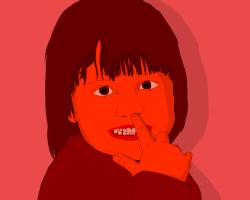
Children´s excrement anal-yzed between sodomy and fear of death. The video ?Supersensibel? of Xenia Yvon Lesniewski is a provocative animation which deals with sex, eroticism, obscenity and individual fear. A daring representation of the polymorphic sexuality accompanied by phrases and noises in the form of riddles which give the film an infectious energy.
Xenia Yvon Lesniewski was born in 1985 in Frankfurt; she has been studying since 2005 at the School of Realization of Offenbach specializing in Painting and New Media (communications).
Isabelle Levenez
animaux domestiques
Art vidéo | dv | color | 4:0 | France | 2006
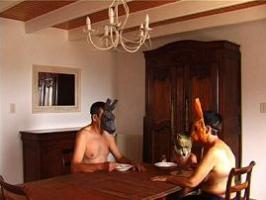
Depuis 1991 et à travers ses vidéos, dessins ou photographies, Isabelle Lévénez révèle le mal être de l`individu ou son inquiétude identitaire dans sa dimension cachée sans que le dysfonctionnement mental ne soit jamais mis en avant.Les vidéos de la serie animaux domestiques forment pour elle, une seule et même ?uvre considérée à des stades différents de sa conscience du monde. Elle s`interroge ici sur la dualité humaine, déchirée entre pulsion animale et respect de la loi. Ces vidéo montrent le corps de personnages dénudés portant un masque (lapin, loup, âne, mouton?) Les protagonistes sont souvent silencieux, par exemple en partageant un repas qui se termine par un cri proche de celui d?un animal. La caméra abandonnée à elle-même en plan fixe construit une image anonyme et saisit sans émotion le cours indistinct du temps qui s?écoule. Dans le fragment de ce cadre, un univers hybride, humain/animal, semble évoluer, monologuer et construire de toutes pièces une mise en scène imaginaire. Les visages recouverts d?un masque d?animaux nous renvoient à la construction d?un système où désir, violence et pulsions rencontrent la morale d?un monde codifié. Cette violence ne fait jamais l`objet d`une quelconque fascination, elle n`est pour l`artiste que le reflet du monde dans lequel elle vit.
Isabelle Levenez est née à Nantes en 1970. Artiste enseignante à l`école des Beaux arts d`Angers, elle se considère comme une artiste multimédia, c`est à dire qu`elle passe d`une production de dessin à une réalisation d`installation vidéo ou de photographie numérique. Entre réalité et fiction son travail ne cesse d`interroger l`individu. Son travail a été montré dans de nombreuses expositions individuelles et collectives, notamment à la galerie Anton Weller, à LOOP Barcelone , au CCC de Tours, à l?Abbaye du Ronceray, Angers, au Musée de Grenoble, à l?ARCO, au Musée National des Beaux Arts de Lettonie à Riga, à la National Art Gallery à Sofia, dans plusieurs Instituts Français à l?étranger : à Barcelone, Budapest, Cologne, Berlin. Elle a également exposé au Palais de Tokyo, Paris, au Musée Péra d?Istambul, au Musée Benaki, Athènes, au Musée Zadkine à Paris, à l?Orangerie du Sénat et Jardin du Luxembourg, Paris, au Musée des Beaux arts de Tourcoing, au Lieu unique à Nantes, au Musée d`art contemporain de Milan. Son travail fait partie des collections du FNAC et de plusieurs FRAC. Elle a obtenu la bourse de la villa Médicis hors les murs à Los Angeles.
Isabelle Levenez
A mort la mer
Art vidéo | dv | black and white | 5:0 | France | 2008
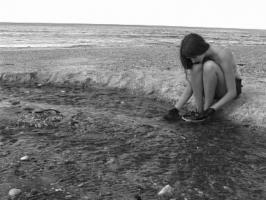
Je m`interroge ici sur la dualité humaine, déchirée entre pulsion de mort et respect de l'environnement. Ainsi la vidéo, qui a pour titre " à mort la mer" montre des images en Noir et Blanc d`un paysage marin. La jeune fille filmée au bord de la mer, la présence du vent,un bateau échoué au milieu d`un champ créent une atmosphère étrange, ou temps, espace et mouvement sont modifiés. La caméra abandonnée à elle-même en plan fixe construit une image anonyme et saisit sans émotion le cours indistinct du temps qui s?écoule. Dans le fragment de ce cadre, un univers suréaliste semble évoluer, monologuer et construire de toutes pièces une mise en scène imaginaire. La jeune fille les mains tachées de goudron manipule un poisson dans l`eau, joue t `elle ? , est ce qu`elle le lave de son jus noir ? avant de finir triomphante sur son bateau échoué brandissant son trophée à la main: un poisson vierge de toute pollution!
Isabelle Lévénez (1970) vit et travaille entre Trélazé (49) et Paris. Elle est représentée par la Galerie Aeroplastic à Bruxelles. Depuis 1995 Isabelle Lévénez a effectué plusieurs séjours à l`étranger au cours desquels son travail a été exposé: New York, Milan,Barcelone, Madrid, Berlin, Moscou, Tokyo, Budapest, Prague, Amsterdam, Rotterdam, Ottawa, Reykjavik.... En 2001, elle a obtenu la bourse de la Villa Médicis hors les murs (Los Angeles). Différents lieux en France (musées, centres d`art, Fracs...) lui ont consacré des expositions personnelles et collectives notamment: Le centre d`art de Meymac (2007),Musée de Grenoble (2007), Le Palais de Tokyo (2006),Le lieu Unique, Nantes (2004),Le Centre d`art de St Fons (2002), Le Frac Haute Normandie ( 2002), Le rac Alsace (2000), La Fondation Guerlain, Paris (1999), La Box, Bourges (1997)...
Isabelle Levenez
Animaux domestiques, le pain
Art vidéo | dv | color | 3:0 | France | 2006
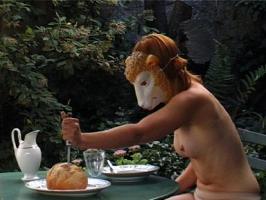
Depuis 1991 et à travers ses vidéos, dessins ou photographies, Isabelle Lévénez révèle le mal être de l`individu ou son inquiétude identitaire dans sa dimension cachée sans que le dysfonctionnement mental ne soit jamais mis en avant.Les vidéos de la serie animaux domestiques forment pour elle, une seule et même ?uvre considérée à des stades différents de sa conscience du monde. Elle s`interroge ici sur la dualité humaine, déchirée entre pulsion animale et respect de la loi. Ainsi les vidéos ayant pour titre de série "Animaux domestiques", montrent le corps de personnages dénudés portant un masque (lapin, loup, âne, mouton?) Les protagonistes sont souvent silencieux, par exemple en partageant un repas qui se termine par un cri proche de celui d?un animal. La caméra abandonnée à elle-même en plan fixe construit une image anonyme et saisit sans émotion le cours indistinct du temps qui s?écoule. Dans le fragment de ce cadre, un univers hybride, humain/animal, semble évoluer, monologuer et construire de toutes pièces une mise en scène imaginaire. Les visages recouverts d?un masque d?animaux nous renvoient à la construction d?un système où désir, violence et pulsions rencontrent la morale d?un monde codifié. Cette violence ne fait jamais l`objet d`une quelconque fascination, elle n`est pour l`artiste que le reflet du monde dans lequel elle vit.
Isabelle Levenez est née à Nantes en 1970. Artiste enseignante à l`école des Beaux arts d`Angers, elle se considère comme une artiste multimédia, c`est à dire qu`elle passe d`une production de dessin à une réalisation d`installation vidéo ou de photographie numérique. Entre réalité et fiction son travail ne cesse d`interroger l`individu. Son travail a été montré dans de nombreuses expositions individuelles et collectives, notamment à la galerie Anton Weller, à LOOP Barcelone , au CCC de Tours, à l?Abbaye du Ronceray, Angers, au Musée de Grenoble, à l?ARCO, au Musée National des Beaux Arts de Lettonie à Riga, à la National Art Gallery à Sofia, dans plusieurs Instituts Français à l?étranger : à Barcelone, Budapest, Cologne, Berlin. Elle a également exposé au Palais de Tokyo, Paris, au Musée Péra d?Istambul, au Musée Benaki, Athènes, au Musée Zadkine à Paris, à l?Orangerie du Sénat et Jardin du Luxembourg, Paris, au Musée des Beaux arts de Tourcoing, au Lieu unique à Nantes, au Musée d`art contemporain de Milan. Son travail fait partie des collections du FNAC et de plusieurs FRAC. Elle a obtenu la bourse de la villa Médicis hors les murs à Los Angeles.
Isabelle Levenez
Espace de confidentialité
Video | dv | color | 2:47 | France, Morocco | 2010
La vidéo met en scène le corps de personnages dénudés filmé en caméra infra rouge semblant errer dans un espace vert, enveloppés de silence. Les corps se heurtent, se touchent, se bousculent. La caméra abandonnée à elle-même en plan fixe construit une image anonyme et saisit sans émotion le cours indistinct du temps qui s?écoule. Dans le fragment de ce cadre, entre violence et douceur les hommes semblent monologuer et construire de toutes pièces une mise en scène imaginaire.
Isabelle Lévénez aime à manier les contraires et l?ambiguïté. Les images, les titres de ses ?uvres, les phrases qu?elle écrit sont autant de jeux d?ombres et de lumières qui définissent la posture générale de l?artiste, développé par les multiples pièces de son travail tournant autour du thème du secret », nous proposant une réalité fragmentée, un jeu entre innocence rêves et fantasmes, entre douceur et violence. Biographie : Isabelle Lévénez Après des Etudes à l?école des Beaux Arts de Nantes elle décide de s?installer à Paris ou elle obtient en 1997 un DU en psychopédagodie à l?université paris V. En 1994 elle est sélectionnée pour le master de l?institut des Hautes études en arts plastiques crée par Pontus Hulten. En 1995 elle effectue un master multi média aux Arts et métiers à Paris. Depuis 1995 Isabelle Lévénez a effectué plusieurs séjours à l?étranger au cours desquels son travail a été exposé : New York, Milan, Madrid, Berlin, Moscou, Bratislava, Budapest, Prague, Amsterdam, Rotterdam, Ottawa, Nagoya, Reykjavik, Athènes, Riga, Barcelone, Istambul, Sofia. En 2001, elle a obtenu la bourse de la Villa Médicis hors les murs à Los Angeles. Différents lieux en France et à l?étranger (Musées, Centres d?art, Fracs, Galeries?) lui ont consacré des expositions personnelles et collectives , notamment
Les Leveque
Communists Like Us
Experimental video | dv | black and white | 3:28 | USA | 2010
Communists Like Us is an ambient music video made from a few seconds of archival footage of Mao Zedong applauding and members of the Red Guard chanting. The title Communists Like Us was taken from the 1985 text of the same name written by Felix Guattari and Toni Negri.
Les LeVeque received an MFA in Video Research from the Department of Art Media Studies at Syracuse University. He is a Visiting Associate Professor in Film and Electronic Media at Bard College and co-Chair of the Film/Video program in the Milton Avery Graduate School of the Arts. His work has been exhibited internationally including 2000 Whitney Biennial, Georges Pompidou Center, Museum fur Neue Kunst ZKM, Australian Centre for the Moving Image, Museo de Arte Moderno Buenos Aires, Laboratorio Arte Alameda, Centre Culturel et de Cooperation Linguistique Bilbao, Pacific Film Archive, Palm Beach Institute of Contemporary Art, The Hammer Museum and The New Museum of Contemporary Art. Festival screenings of his work include Transmediale Berlin, San Francisco International Film Festival, and Sundance Film Festival. The Video Data Bank distributes his single channel video work. He is represented by KS Art in New York City.
Les Leveque
Dramatically Repeating Lawrence of Arabia
Experimental video | dv | color | 14:43 | USA | 2004
Dramatically Repeating Lawrence of Arabia is a re-edit of David Lean?s orientalist ?classic? Lawrence of Arabia into a dissonant hallucination of repeating masculinized poses, costumes and dramatic gestures.
Over the last decade Les LeVeque has produced works in video where algorithmic editing structures are applied to a variety of mass cultural media forms, from Hollywood films, advertising, presidential broadcasts and publicly televised hearings. These works employ a misuse of persistence of vision and the phi phenomenon to generate sensuous hallucinations, which activate an aleatory space between images.
Les Leveque
Nine Hamlet RGB
Video | hdv | color | 5:55 | USA | 2015
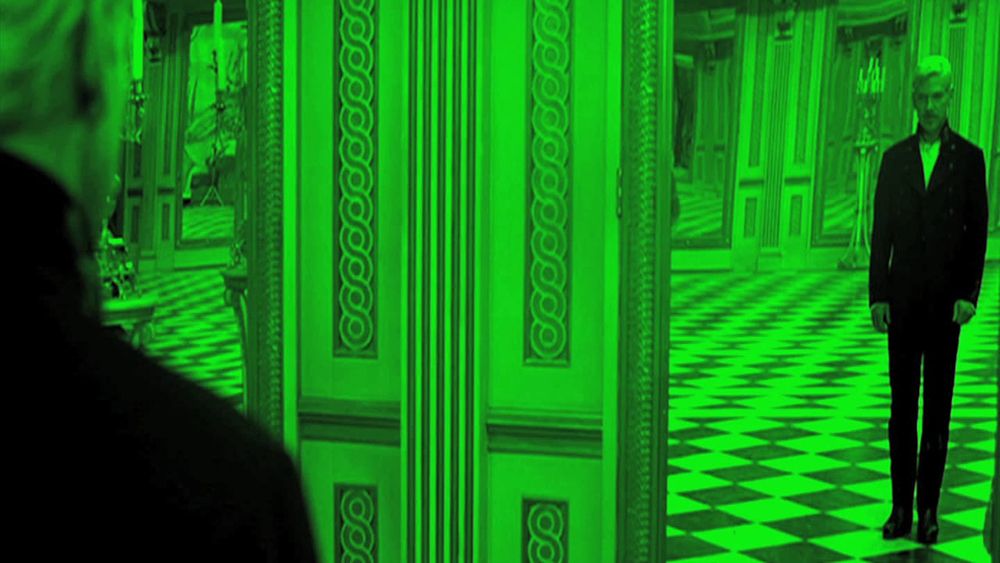
Nine Hamlet RGB engages a simple algorithm to destabilize the timing of the red, green and blue frame sequential display system while incorporating fragmented, appropriated “to be or not to be” excerpts from nine Hamlet films. The audio is the synced sound from the appropriated excerpts laced with low frequency binaural tonal pulsations. The physicality of the constructed optical and aural experience is seeking a mechanism of unconscious disarticulation. The ghosting of colors, evanesent Hamlets, and somatic tones are looking for a “dream-work” that can be ciphered, displaced, or not.
Les LeVeque works with digital and analog electronic technology. His projects include single and multi-channel videos and video/computer based installations. His projects have been exhibited and screened internationally. Video Data Bank distributes his single-channel video work. He is represented by Kerry Schuss Gallery in New York City.
Les Leveque
stammering forward backward GIANT
Experimental video | dv | color | 17:0 | USA | 2008
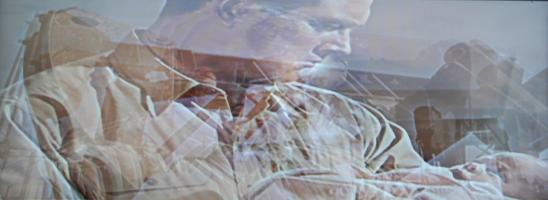
stammering forward backward GIANT is a re-edit of George Stevens? 1956 film Giant - an epic story of Texas, oil and racism. Condensed to 17 minutes and beginning in the middle stammering forward backward GIANT implements improvisational percussive frame by frame editing structures to simultaneously unwind the film to the conclusion of beginning and end.
Les LeVeque is an electronic media artist who lives in New York City. His work has been exhibited in internationally including 2000 Whitney Biennial, Georges Pompidou Center, Museum fur Neue Kunst ZKM, Australian Centre for the Moving Image, Museo de Arte Moderno Buenos Aires, Laboratorio Arte Alameda, Centre Culturel et de Cooperation Linguistique Bilbao, Pacific Film Archive, Palm Beach Institute of Contemporary Art, The Hammer Museum and The New Museum of Contemporary Art. Festival screenings of his work include Transmediale Berlin, San Francisco International Film Festival, and Sundance Film Festival. The Video Data Bank distributes his single channel video work. He is also represented by KS Art in New York City.
Boaz Levin, Adam Kaplan
Last Person Shooter
Video | hdv | color | 11:42 | France | 2014
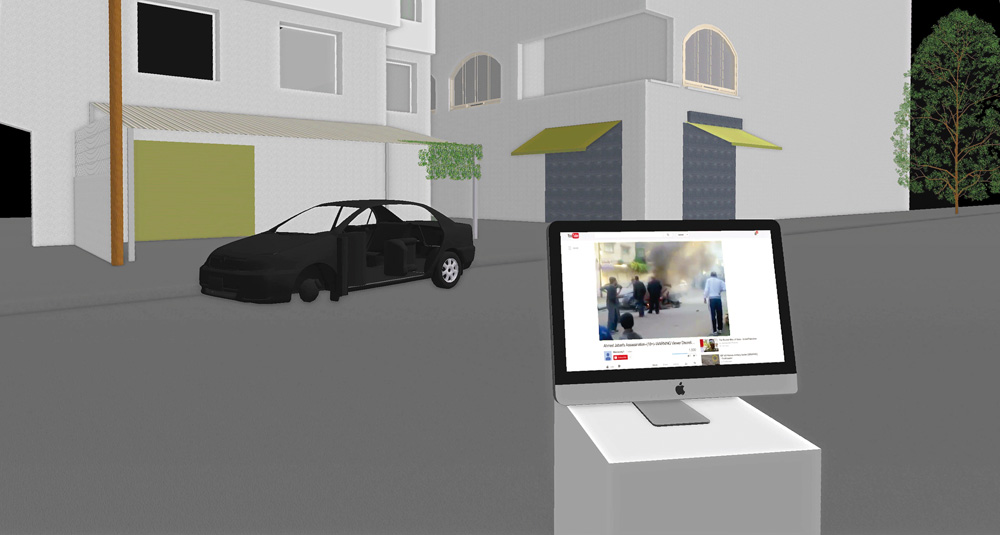
Last Person Shooter examine a range of both human and mechanical modes of vision. By way of a series of historical scenes reconstructed as 3D architectural models, the historical context of machine vision and its underlying concepts are conjured. These models are explored by an invisible protagonist, embodying the familiar, yet antiquated aesthetic of a first-person shooter. The work opens with a reconstruction of the assassination of Ahmed Jabri, a Palestinian militant who was targeted by an Israeli drone in November 2012. The assassination was documented simultaneously both by Palestinian passersby and by the IDF’s drone, creating two parallel, conflicting narratives: these were then uploaded to Youtube and tweeted, in what was in effect a war of images. The video leads into a dreamlike digital desert, evoking the Cuban Missile Crisis and its significance for the development of satellite reconnaissance during the 1960s. The protagonist embodies a birds-eye view, exploring the blind spots and prejudices of such varying perspectives. Finally, the film concludes with a reenactment of a video shot by an American soldier in Afghanistan in a first-person perspective. The footage offers an immersive, bleak representation of 21st century warfare and its mediation.
Adam Kaplan is an artist, a graduate of the Fine Arts department in Bezalel Academy in Jerusalem and the Academy of Fine Arts Vienna. Born in Jerusalem, he currently lives between Montreal and Berlin where he is studied under Hito Steyerl as a guest student in the Universität der Künste. Boaz Levin is an artist and writer based in Berlin. He studied at the Bezalel Academy of Arts and Design in Jerusalem and under Hito Steyerl at the Universität der Künste in Berlin.
Erik Levine
The Guilty Sleep
Experimental video | 4k | color | 24:31 | USA | 2022
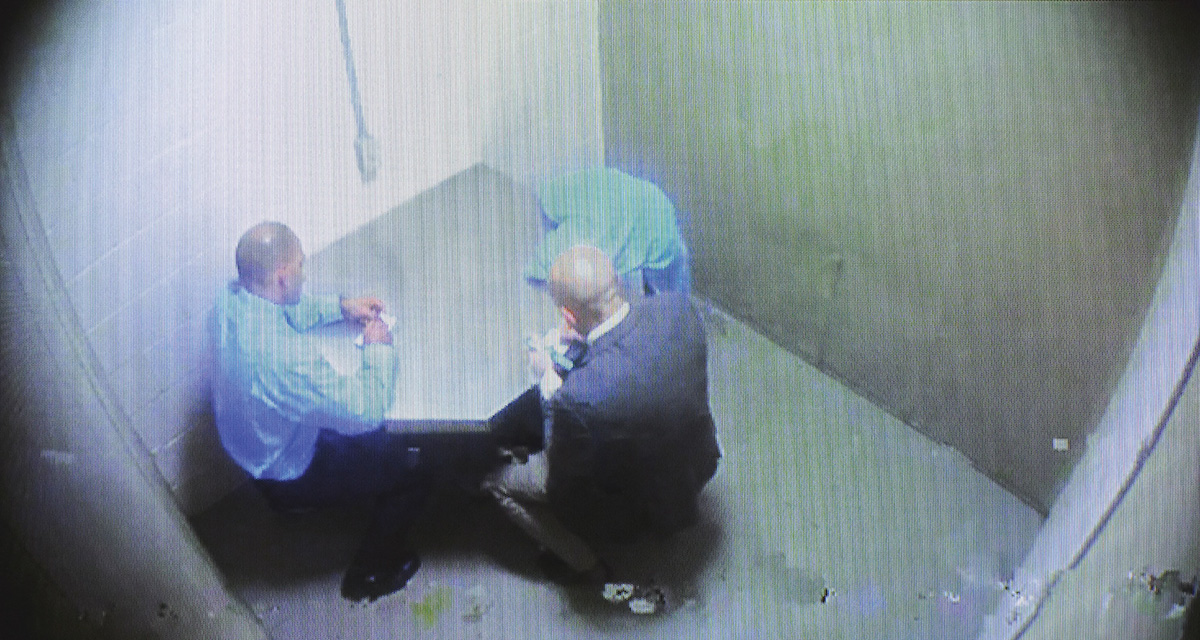
The Guilty Sleep, filmed during more than 75 overnight ride-along shifts with the police, illuminates urgent issues related to the current state of policing. It's a composed collage of raw, slow paced, and evocative imagery and sounds that frame polarities such as justice/injustice, observer/observed, confined/free, power/disempowered, and innocence/guilt. The video highlights the landscape behind these dualities and focuses on their complex relationship to one another.
Erik Levine was born in Los Angeles, California in 1960. He has exhibited widely in the United States and Europe, most recently at Ludwig Forum Aachen with a solo survey exhibition of his videos from the past 15 years. His work includes video, sculpture, and drawings, and is in the public collections of the Whitney Museum of American Art, Museum of Contemporary Art, Los Angeles, Walker Art Center, Hirshhorn Museum and Sculpture Garden, and Des Moines Art Center, among several others. He has received numerous awards including a Guggenheim Fellowship and three Pollock–Krasner Foundation awards. In addition, he’s received two grants each from the National Endowment for the Arts, the New York Foundation for the Arts, the New York State Council on the Arts, and the Massachusetts Cultural Council, as well as grants from Awards in the Visual Arts, Nancy Graves Foundation, and the Jerome Foundation.