Catalogue > Search
Results for : Tout le catalogue

Dan Mihaltianu
Divided Cities
Experimental film | super8 | black and white | 3:44 | Romania, Germany | 2013
Divided Cities, 2013, 03:44 min, 8mm film transfer on Full HDV, camera / editing: Dan Mihaltianu A film based on fragmented views of Berlin and Bucharest, divided between east and west, past and present, left and right, centre and periphery, rich and poor, hip and precarious, in and off. The footage is covering the laps-time between 1992-2013 in the attempt to catch the rapid transformations of the two metropoles.
Dan Mihaltianu (born 1954 in Bucharest, Romania, based in Bucharest, Berlin and Bergen) has studied at the Institute of Fine Arts Bucharest (1975-1983). He was cofounder of subREAL, Bucharest (1990); Professor at Bergen Academy of Art and Design (2001-2007), Guest Professor at Université du Québec á Montréal (2008-2009); Editor / Associate Editor of Arta Magazine, Bucharest (1990-1993 / 2011- to present). Since the 1980s his work has been exhibited in major international art events, museums, art centres and galleries in Europe, Asia, North and South America.
Dan Mihaltianu
In the Skin of a Srtay Dog
Experimental film | super8 | color | 5:19 | Romania | 2014
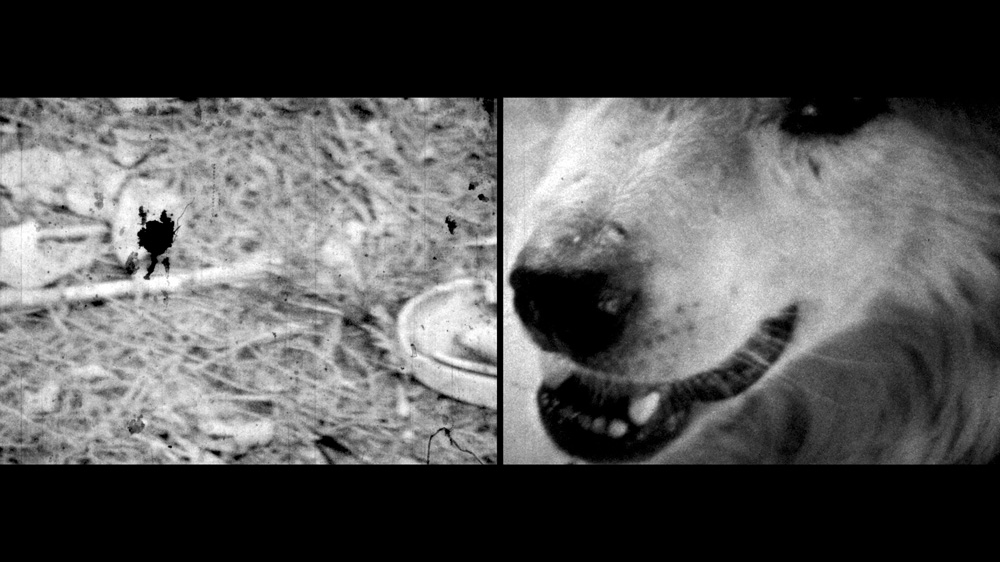
In the Skin of a Stray Dog Of dogs and men, black and white film material shot between 1992-1994 and edited twenty years later, depicting the decay of the urban environment after the collapse of Communism in Bucharest and the alternative living in Berlin after the fall of the Wall.
Dan Mihaltianu is a cross-media artist, born 1954 in Bucharest, Romania, based in Bucharest, Berlin and Bergen. His artistic approach is concern with social, political and trans cultural aspects related to the permanent changes occuring in our society, by developing long term process-oriented-projects, among others: Field Archive (1979-1989), Nature of Light (1980-1989), Official History / Personal History (1984-1994), Liquid Matter (1993-2014), Divided Files (2001-2014), Plaques tournantes (2004-20014), Celluloids (1992-2014). Since the 1980s his work has been exhibited internationally in various art events, biennials,, museums, art centres and galleries from Europe, Asia, North and South America.

Mikomikona
Mikomikona Live
Performance | 0 | | 30:0 | Germany | 2007
Mikomikona experimentally investigates the dynamic transformability of sound into image, image into sound, and the effects of cross media interface. Devices that enable the connection and transformation of visual signals into acoustic signals and vice versa are developed and explored in different audio-visual set-ups creating a synaesthetical environment. The resulting performance modules all share the idea of new symbolic coding of media information and are also used for live VJ-ing. For the performances the artists work with analogue media like overhead projectors, super-8 film projectors, video projectors, and visual devices and sound. Mikomikona uses the simultaneity and speed of analogue electronic circuits. Their interest is more within the field of synthesizers (modulated), rather than the paradigm of sequencers (serial, clocked, and triggered, as used in digital environments). Theoretical approach: transformation noise. By transforming information into different media formats, snippets of transformation noise - bruit parasitaire - are received that reflect there shifted use of media technology. The transformation noise is media specific by revealing the media structure itself. In terms of acoustic-visual performances Mikomikona explores the dynamical transformability of technical image into sound and vice versa. By these means synaesthetic bypasses are compressed and media content is newly coded. Computer experience makes transparent the exchangeability of code: the use of binary coding to represent image, text, and sound. The binary code seems to be the omnipotent currency in which nearly all content may be saved and reproduced.

Tihomir Milovac
Zagreb Contemporary Art Museum
0 | 0 | | 0:0 | Croatia | 2007
The Museum of Contemporary Art in Zagreb was established in December 1954 as the City Gallery of Contemporary Art , with the purpose of following, documenting, and promoting contemporary art events, styles, and phenomena. Throughout almost half a century of its existence, the Museum ? as it is now known ? has undergone a number of changes, from its name, the space available, the number of collections and their contents. Its fundamental commitments have remained constant however ? presentation of contemporary art and the creation of conditions favourable both to the understanding and enjoyment of Croatian and international art alike, as well as ensuring that the exchange between creative and interpretative experience be as dynamic as possible. The Museum's collections include holdings which show the beginnings and logical development of individual artistic tendencies, as well as their direct and indirect impacts on the production that followed chronologically. The collections simultaneously embody the reality of Croatian artistic production within a specific period in relation to the synchronous points of development of European or global art. The largest part of the Museum's contemporary art collection consists of works by both Croatian and foreign authors created after 1950, while a smaller part is comprised of pieces dating back to the first half of the 20th century and whose presence is essential for grasping the concept of both modern and contemporary art. The collections currently include some 9000 works of both modern and contemporary art, which shall finally become available to the general public in the new Museum building. Following long-standing attempts to situate the Museum in a suitable space, it was decided to build a brand new museum in the new part of Zagreb, and has been under construction since 2003. The building takes up a total surface area of some 14,500 square meters, of which 4,800 are foreseen for the exhibition spaces. This geometrically divided volume, with its five floors, is expected to become a recognizable emblem of the city in the near future.
Tihomir Milovac is a senior curator at the Museum of Contemporary Art in Zagreb, and is the head of the Experimental-Research Department at the Museum. As a curator and art critic he has curated many exhibitions and other visual arts projects in Croatia and abroad, most often engaged in new, contemporary phenomena in visual arts, especially new media, but also the phenomena of historical avant-garde. He had edited numerous publications and catalogues, and curated exhibitions like Kasimir Malevich, Retrospective, 1990; Ukrainian Avant-garde 1910?1930, 1990/91; Andres Serrano: Buapest/Morgue, 1996; Jan Fabre: Passage, 1997/98; The Future is Now ? Ukrainian Art in the Nineties, 1999?2000; The Baltic Times ? Contemporary Art from Latvia, Lithuania and Estonia, 2002; Misfits: Conceptual Strategies in Croatian Contemporary Art, 2002; Sanja Iveković: Women's House 1998-2002, 2002; System of Coordinate ? Russian Art Today, 2004; Zlatko Kopljar: Compassion +, 2005; Insert ? Retrospective of Croatian Video Art, 2005.
Dina Mimi
The Melancholy of this useless afternoon II
Experimental film | mov | black and white | 13:0 | Palestine | 2022
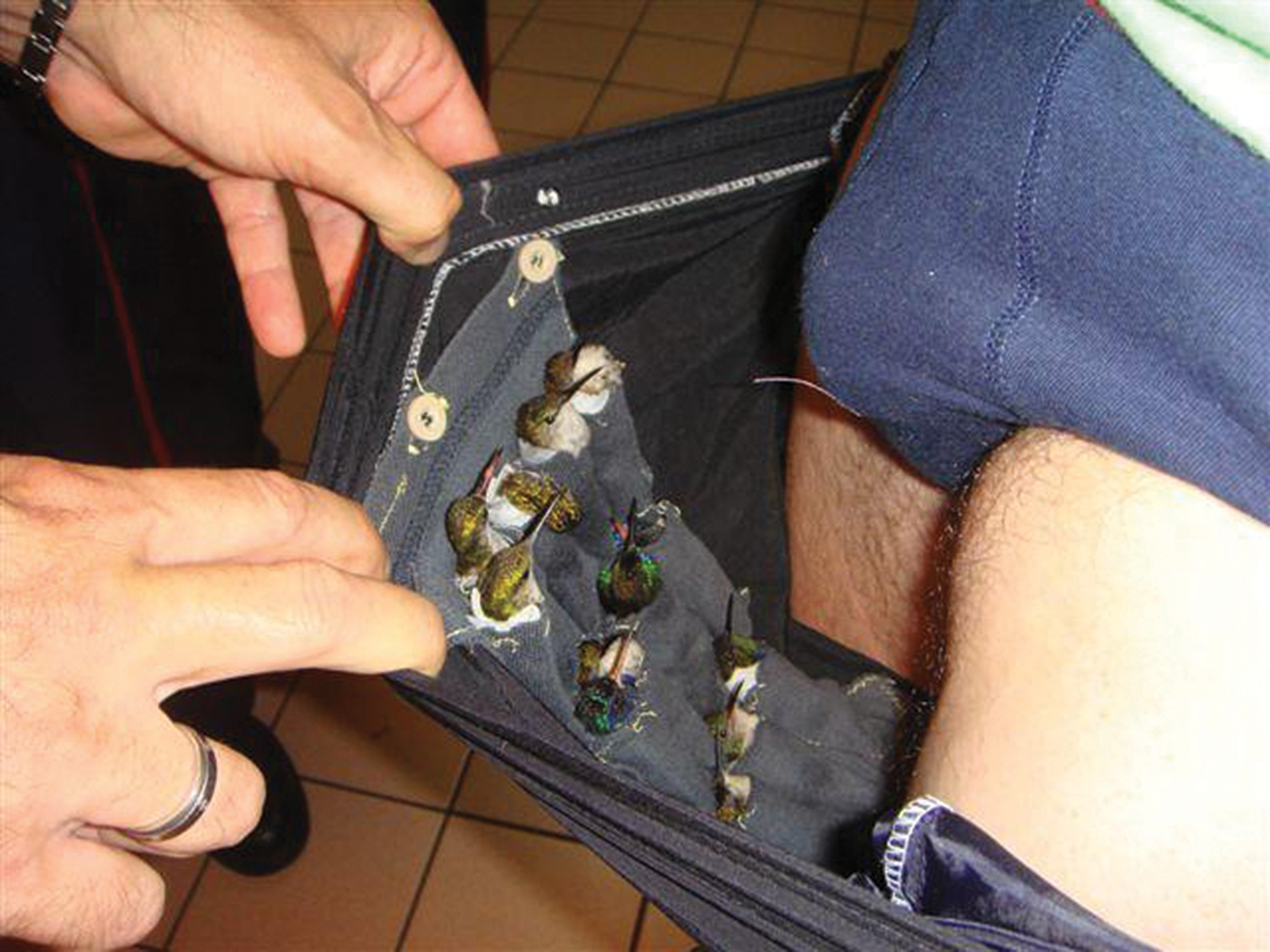
The Melancholy of this Useless Afternoon, chapter 2 (2023, 11:25) explores the shared gestures between the fugitive and the smuggler, and their relationship to being seen. The melancholy of this useless afternoon researches the links between the fugitive and the smuggler, their shared gestures and relationships to being seen. By escape and flight, risking capture or death, the fugitive works to keep themself hidden. The smuggler, however, moves with stealth, using gestures to hide things, often close to their body.
Dina Mimi is a Palestinian visual artist and filmmaker who is based between Palestine and the Netherlands. Mimi works with experimental filmmaking and lecture performances that research the question of how and when bodies become sites of resistance. This question finds its material interest in moving images, especially found footage, that is discarded and therefore deemed invaluable. Understanding editing as a playground, Mimi plays with opacity in moving images by seeking to brush up against footage which desires to be ungraspable or is in the act of vanishing. This is a continuous attempt at non-linear narration as a way of disfiguring one’s.

Jaro Minne
Da-Dzma
Experimental fiction | hdv | color | 17:25 | Belgium | 2019
Winter. A fifteen-year-old girl in a remote Georgian village tries to get closer to her older brother, just as he decides to leave home in search for work abroad.
Jaro Minne (b. 1992) is a Belgian writer/director who frequently works on the East-West crossover. He studied at KASK Ghent, Helsinki Film School before completing a master degree at LUCA School of Arts in Brussels in 2015. His work combines intimacy with distance, often exploring rootlessness and family dynamics.
Ariel Mioduser
Reality TV
Animation | dv | black and white | 2:6 | Israel | 2006
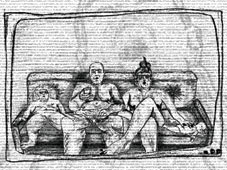
"Reality TV", as its name suggests, confronts the spectator with the false reality concepts represented by the media which itself defines false reality concepts and behaviours as what is usually called 'real life'. This supposed reality is represented by small fragments of typical TV commercials and shows, each of them displaying just the moments of false ecstasy, out of their original context. For example, the sequence in which the model describes emphatically how a certain shampoo completely changed her life, or one in which the model holds a cardboard box (of cereal? washing machine soap? You may choose) in a quasi orgasmic posture. As opposed to these, we start to conceive the dimmed image of a typical bourgeois family sitting in front (or inside?) the TV set, an image which shows the only "real reality" present. But, what can we say; this reality of captive zombies sitting in front of the commercials doesn't look as glamorous... We still have the baby, who ? for the moment ? is the only one to demonstrate some kind of reaction. The structure of the movie supports the message both in the visual and musical way: each commercial fragment represents a module which can be displayed before or after any other module in a random way. Each of these modules contains its own specific music. A random sequence of these modules results in a monotonous white noise stream made of ecstatic fragments.
Ariel Mioduser was born in Buenos Aires, Argentina, and now lives in Jaffa, Israel. He earned a diploma at the Bezalel Academy of Art and Design, Jerusalem, and a M.A. at Alcala University, Spain. He teaches in the Digital Art Department and Visual Communication Department at the Technology Education College, Tel Aviv, Israel. After nearly two decades of commercial work, Ariel Mioduser started working on personal animation shorts - work that resides on the border between animation and art. Mioduser's work has focused on social subjects such as poverty and the culture of poverty, oppression of ethnic or gender groups, globalization, and environmentalism. In a world in which visual images serve manipulative goals, he creates from within this world and at the same time observes it with a critical eye.
Victor Missud
La forêt de l'espace
Experimental doc. | hdv | color | 30:0 | France | 2019
Des hommes, envoyés sur la Lune pour la végétaliser, attendent l’arrivée des terriens. Au milieu de la forêt qu’ils ont fait grandir, ils racontent leurs souvenirs de leurs vies sur Terre et le monde dans lequel ils aimeraient pouvoir vivre. Mais qui sont ces hommes ? Sont-ils réels ? Ont-ils été oubliés ?
Originaire de Toulouse, Victor Missud se forme au cinéma à l’université Sorbonne Nouvelle de Paris et à la Escola Superior de Teatro e Cinema de Lisbonne, où il réalise des courts-métrages documentaires expérimentaux autoproduits. Son dernier film, À qui le monde (en production, coréalisé avec Marina Russo Villani), est lauréat de la bourse Brouillon d’un rêve documentaire de la SCAM, de la Résidence d?écriture de Saint-Quirin et du nouvel Accompagnement aux VFX du CNC.

Victor Missud, Marina Russo Villani
A qui le monde
Experimental doc. | 4k | color | 45:0 | France | 2024
In Benin, the water people, who once fought against colonisation, are now facing water hyacinth, a colonising plant that reproduces at breakneck speed, suffocating the lake. Realism and imagination intertwine, as if one were only understandable or tolerable because of the other.
Italian and a graduate in Art Economics from Bocconi University, Marina Russo Villani trained in cinema and screenwriting in France, at the Sorbonne Nouvelle and Paris Nanterre. A screenwriter and director of fiction and documentaries, she co-wrote ‘À qui le monde’ (To Whom Does the World Belong), a fantastical political fable that paints a fantastical and ironic portrait of how the world works. In parallel with her work as an author, she founded her production company, Filibusta, in 2023. Victor Missud's work takes a poetic interest in people marginalised from a territory and society, who become non-professional actors and actresses in his works. Blending documentary, fiction and genre cinema, his works have been presented and awarded prizes in France and abroad - Visions du Réel, IFF Rotterdam, Hors Pistes - Centre Pompidou, Rencontres Internationales Paris/Berlin, Etats Généraux du Documentaire de Lussas. In 2024, he joined Le Fresnoy - National Studio of Contemporary Arts.

Magdalena Mitterhofer
Corte
Experimental fiction | 4k | color | 24:3 | Italy | 2024
Six millennials meet renowned writer Noel Riccardi at a former workers' holiday settlement in the Italian Alps. Intrigued by the younger generation, Noel invites them for an evening of food, drinks, and debate. But as political disagreements arise, a generational clash ensues, leading Noel to respond with a cowardly act of violence. The following morning, another friend of the group arrives and joins Maria, who has developed an affinity for the aging intellectual. Together, they pay him a visit.
Magdalena Mitterhofer (1994, Italy) is a director and artist living in Berlin. In her site-specific, narrative works, she explores the relationships between surrounding architectural, socio-political structures and their inhabitants. Magdalena received a Master's degree in Fine Arts from the class of Hito Steyerl at the University of the Arts Berlin and studied New Media at Tama University in Tokyo. 2021 she co-founded the nomadic performance project "lament.tv". Her work was shown, amongst others, at Volksbühne Berlin, Julia Stoschek Foundation, KW Institute for contemporary art Berlin, Tanzquartier Vienna.

Mochu
Groteskkbasiliskk! Mineral Mixtape
Experimental video | mov | color | 26:0 | India, Germany | 2022
GROTESKKBASILISKK! MINERAL MIXTAPE looks at online subcultures premised on rapid technological acceleration and imperialist nostalgia, and their weird affinities with anti-rationalist ideas in the public sphere.
Mochu (b. India, 1983) works with video and text arranged as installations, lectures and publications. Techno-scientific fictions feature prominently in his practice, often overlapping with instances or figures drawn from art history and philosophy. Recent projects have explored cyberpunk nostalgia, corporate horror, mad geologies, psychedelic subcultures and Indian modernist painting. He is the author of the books Bezoar Delinqxenz (Edith-Russ-Haus / Sternberg Press, 2023), and Nervous Fossils: Syndromes of the Synthetic Nether (Reliable Copy / KNMA, 2022). His works have been exhibited at Edith-Russ-Haus für Medienkunst, Home Works Forum, 9th Asia Pacific Triennial, Sharjah Biennial 13, 4th Kochi-Muziris Biennale and transmediale:BWPWAP.
Matej Modrinjak
Upwards
Art vidéo | dv | color | 6:48 | Slovenia | 2005
Always upwards. Sometimes it goes slow, sometimes it stops. But it goes never down.
I was born in 1980 in Maribor, Slovenija. In 1999 i finished the school for Design and Photography in Ljubljana as Professional Photographer. Between the years 1999 and 2002 i worked for the SNG Maribor (Slovene National Theater) as a theater-photographer. In summer 2002 I attended at the artist in residence program Unidee, Cittadellarte-Fondazione Pistoletto in Italian city Biella. In June 2005 i finished my education in the Art and Digital Media Institute at the Academy of Fine Arts Vienna, with the Academic degree Magister Artium. In November 2005 i started the artist in residence program at AIRantwerp Antwerpen, Belgium.
Lauren Moffatt
Image Technology Echoes
Experimental VR | 0 | color and b&w | 5:30 | Australia, Ireland | 2021
In the immersive experimental fiction Image Technology Echoes by Lauren Moffatt, we enter a quiet gallery inside a cavernous museum space. The gallery is empty, except for an older man and a younger woman. The pair are having a stilted conversation about the painting they are looking at: a large expressionist canvas depicting a stormy ocean. This odd exchange seems to circulate indefinitely… unless we step inside the body of one of the two figures and are transported to their mental space. Each interior is a messy room with its own life. In this place, the person’s doppelgänger homunculus is reciting their stream of consciousness that the artist generated with a neural network, and the painting appears very different from what we just saw in the gallery.
Lauren Moffatt is an Australian artist working between video, performance and immersive technologies. Her works, often presented in multiple forms, explore the paradoxical subjectivity of connected bodies and the friction at the frontiers between digital and organic life. Lauren's works usually take the form of speculative fictions and environments, which are conceived using a mixture of obsolete and pioneering technologies and often occupy both physical and virtual space. Lauren completed her studies at the College of Fine Arts (AU), Université Paris VIII (FR), and at Le Fresnoy Studio National des Arts Contemporains. Lauren's works have been screened and exhibited most recently at Le Centre Pompidou (FR), Le Grand Palais Éphémère (FR) Hartware MedienkunstVerein (DE) Palais de Tokyo (FR), Villa Medici (IT), UNSW Galleries (AU), Daegu Art Museum (KOR), Museum Dr. Guislain (BE), SAVVY Contemporary (DE), FACT Liverpool (UK) The Sundance Film Festival (US) ZKM (DE), Q21 Freiraum (AT) and at La Gaïté Lyrique (FR). She lives and works between Berlin (DE) and Valencia (ES).
Frédéric Moffet
Goddess of Speed
Experimental video | 16mm | color and b&w | 8:0 | Canada, USA | 2023
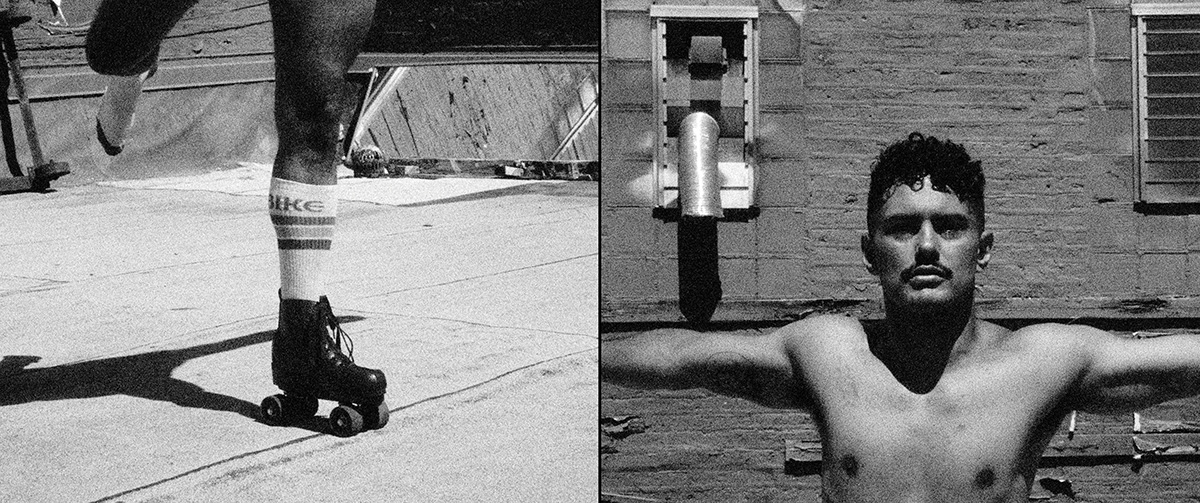
A film titled Dance Movie (aka Rollerskate) appears in many Warhol filmographies, but no work with this title can be found in the Collection. The lost film, starring dancer Fred Herko gliding on a single roller skate, was shot in 1963. Herko was a talented dancer and choreographer who cofounded and performed with the Judson Dance Theater. Herko was also associated with the Mole People, a group of queer men and women who came together to get high on speed and listen to opera. In October 1964, unhoused and strung out on drugs, Herko leapt out of an open window while dancing naked to Mozart’s Coronation Mass in C Major. Although the current location of Dance Movie is unknown, accounts of it do exist, including Warhol’s evocative description in POPism of Herko “gliding in dance attitudes and looking as perfect as the ornament on the hood of a car.” Goddess of Speed poetically reimagines the missing film.
Frédéric Moffet is a media artist, educator, video editor, and cultural worker. He lives in Montreal and Chicago. His work explores the slippery territory between history, lived experience and fantasy. His projects include: Horsey, Fever Freaks, The Magic Hedge, Adresse Permanente, The Faithful, POSTFACE, Jean Genet in Chicago and Hard Fat.
Avi Mograbi
Details 11, 12, 13
Video | dv | color | 12:0 | Israel | 2009
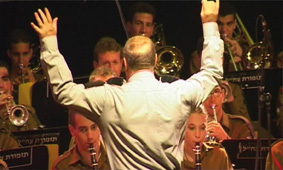
2 scenes shot in a car driving in the occupied territories. Israeli Human Rights journalists on their way to a story. In one scene they ask themselves if they should continue driving down the road because the locals say there is an Israeli tank shooting at whoever comes near it. In the second scene they detect the Istraeli military post where they were shot at from a few months earlier. In the third scene the IDF orchestra plays a happy march.
Avi Mograbi, filmmaker and video artist. He is the director of: Details 11-13 (2009), Z32 (2008), Mrs. Goldstein (2006), Avenge but one of my two eyes (2005), Detail (2004), August (2002), Wait, it?s the soldiers, I`ll hang up now (2002), At the back (2000), Will you please stop bothering me and my family (2000) Relief, (1999), Happy Birthday Mr. Mograbi (1999), How I learned to overcome my fear and love Arik Sharon (1997), The reconstruction (1994), Deportation (1989).
Naeem Mohaiemen
Abu Ammar is Coming
Video | hdv | color and b&w | 6:0 | Bangladesh, United Kingdom | 2016
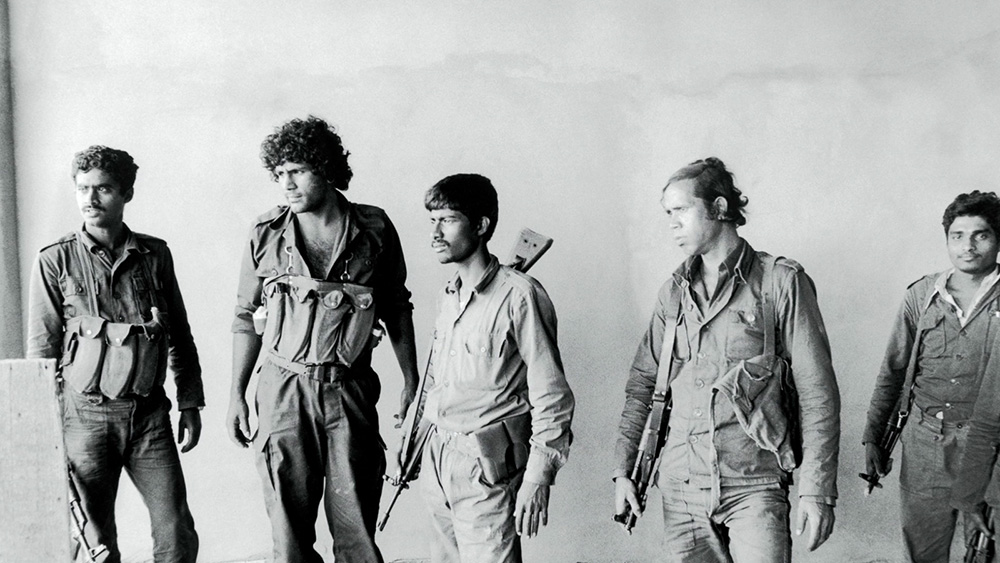
A photograph circulates, showing five men staring out of a window. Actually, only four look out; the last man breaks protocol and looks at the camera. The light has a soft glow. The stage is a bombed building. All five men wear military fatigues; the color must have been olive green.Snapped by a Magnum photographer in 1982, the image is a teasing enigma. Arabic newspapers claim it as evidence of Bangladeshi fighters in the PLO (Fatah faction). Go a little deeper into the memory hole and sediments will darken the third world international. Still, the light was beautiful. Abu Ammar is Coming continues The Young Man Was project’s exploration of the 1970s revolutionary left as a form of tragic utopia. Previous chapters have shown at the 2015 Venice Biennale, the Museum of Modern Art (New York), and the 2011 Sharjah Biennial.[Abu Ammar was the nom de guerre of Yasser Arafat. His Fatah faction of PLO fascinated Bangladesh JSD (National Socialist Party) leader Major Jalil, despite the sharper Marxist tendencies of the George Habash faction.] Picture credit: Volunteers from Bangladesh fighting with Palestinians, 1982 © Chris Steele-Perkins / Magnum Photos The Young Man Was project examines the failures of radical, armed leftist movements of the 1970s. The protagonists often display misrecognition, ending up as an “accidental trojan horse” carrying tragic results to the countries in question (from Japanese hijackers commandeering Dhaka airport for “solidarity,” to migrant labor pipelines transformed into PLO “volunteers”). In spite of its failures, Mohaiemen’s reading of the potential of international left solidarity is still, always, one of hope. The first part (United Red Army, 2011) reconstructs the 1977 hijacking of Japan Airlines Flight 472 through a series of crisply polite negotiation tapes. The second film (Afsan’s Long Day, 2014) addresses the misrecognition of Marxist ideologies from the perspective of a young historian (Afsan Chowdhury, whose diary entry gives the series its name), slaloming between Bangladesh’s summer of tigers, and the German Autumn associated with the Rote Armee Fraktion. The third film (Last Man in Dhaka Central, 2015) traces, in reverse, the journey of Peter Custers, a Dutch journalist jailed in Bangladesh in 1975, accused of belonging to an underground armed Maoist group. A more recent short film, Abu Ammar is Coming (2016), digs into the illusions of a press photograph of “PLO fighters” taken by Chris Steele-Perkins for Magnum. In the form of Peter Custers, who unfortunately passed away in 2015, many of the questions of The Young Man Was project take a personal form. What lies behind utopian hope, especially within the idea of socialism, against the weight of history and experience? What also of the men who survived those terrible times, unlike so many of their comrades, and now spend their waning days in solitary apartments, writing down memories? What was such a man then, and how does he remember himself today? Was he John Reed, recording the Russian Revolution, in the last free moment before the Thermidor? What does it mean to be a survivor and witness—the last man standing on the eve of another collapse, surveying the wreckage of the socialist dream in the middle of a horrific present that teeters on the cusp of the Anthropocene?
Naeem Mohaiemen is a writer and visual artist. Since 2006, he has worked on "The Young Man Was," a series of projects on the 1970s radical left. The first two films in this sequence are "United Red Army" (2012), which premiered at Sharjah Biennial, IDFA, and Hot Docs, and "Afsan`s Long Day" (2014), which premiered at MoMA, New York, and Oberhausen. He is researching the third installment, "Last Man In Dhaka Central" (2015). The project has been supported by grants from Creative Capital, Creative Time, Franklin Furnace, Rhizome, Puffin Foundation, and Arts Network Asia. He is a 2014 Guggenheim Fellow. The works are also in private collections, as well as the permanent collection of the Tate Modern and the British Museum.
Maria Mohr
Cousin cousine
Experimental doc. | super8 | color and b&w | 19:32 | Germany | 2005
Cousins. Space without words. Voice at the piano. Fingertips feeling for meaning. A bridge, too high. "Cousin, Cousine" is a personal film between documents and poetry. About a love that cannot be.
Maria Mohr was born in 1974 in Mainz, Germany. She studied French and architecture in Darmstadt and Paris. Since 1998 Maria Mohr has been living in Berlin, where she has been involved in several independent theatre and dance pieces while also working on film, video and photography. From 2002 to 2005 she studied experimental film at the University of Arts in Berlin. "Cousin, Cousine" ("Cousins"), finished in 2005, is her graduation work. It has been shown at various festivals and is the winner of important national and international prizes. Maria Mohr is now working on her first feature length documentary.
Thomas Mohr
Impact-9.2
Video | hdv | color and b&w | 10:44 | Netherlands | 2016
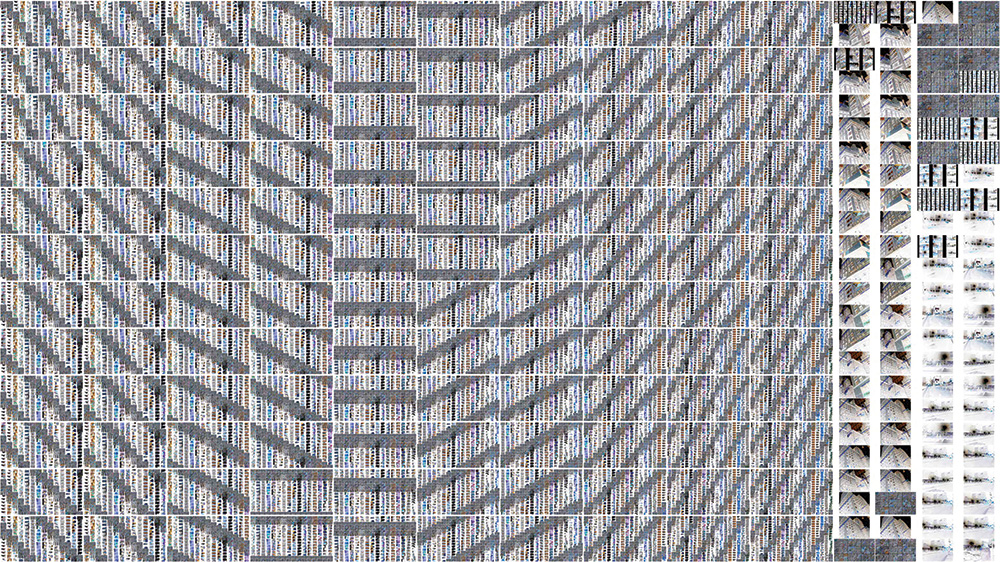
After a moment of brightness, a memory unit containing 59.049 images is explored from the totality to its individual images, creating connections on various levels in various directions in a shifting dynamic system. Beginning with a sudden and rough recall of memories the information merges with increasing compression in several cycles and repetitive feedback to transform in an almost ad infinitum expanding time space topology of intense subtlety. The visual composition is inverted and disrupted several times by visual blanks of bright white. The original images were taken handheld in 2002/3 when the experience of 9/11 still was present. The composition is made frame by frame using “contact sheets” (6, 5 fps). The integration of the outdated format SD in the more contemporary HD leaves empty space in the memory levels and in the processing levels. The memory unit used in this video is the second out of nine units, which will become one total memory at a later stage covering 30 years from 1985 to 2015. The music composed by Michael Bonaventure (organ sounds) and René Baptist Huysmans (electronic sounds) is inspired by the poem “The Comet at Yalbury” by Thomas Hardy ?
Born in Mainz, Living and working in Amsterdam. Since the late 1980ties systematically exploring processes of perception and experience in installations and "films" referring inter alia to conceptual and minimal art, to the history of early cinematography , the transformation of information, the evolution of (new) media. Working with computer-generated processes combined with manual execution based on a growing photo archive containing at this moment more then 500000 pictures taken from 1985 regarding important moments of modern history as to major and minor personal events.
Thomas Mohr
St. Marien
Experimental video | mov | color | 10:58 | Netherlands, Germany | 2023
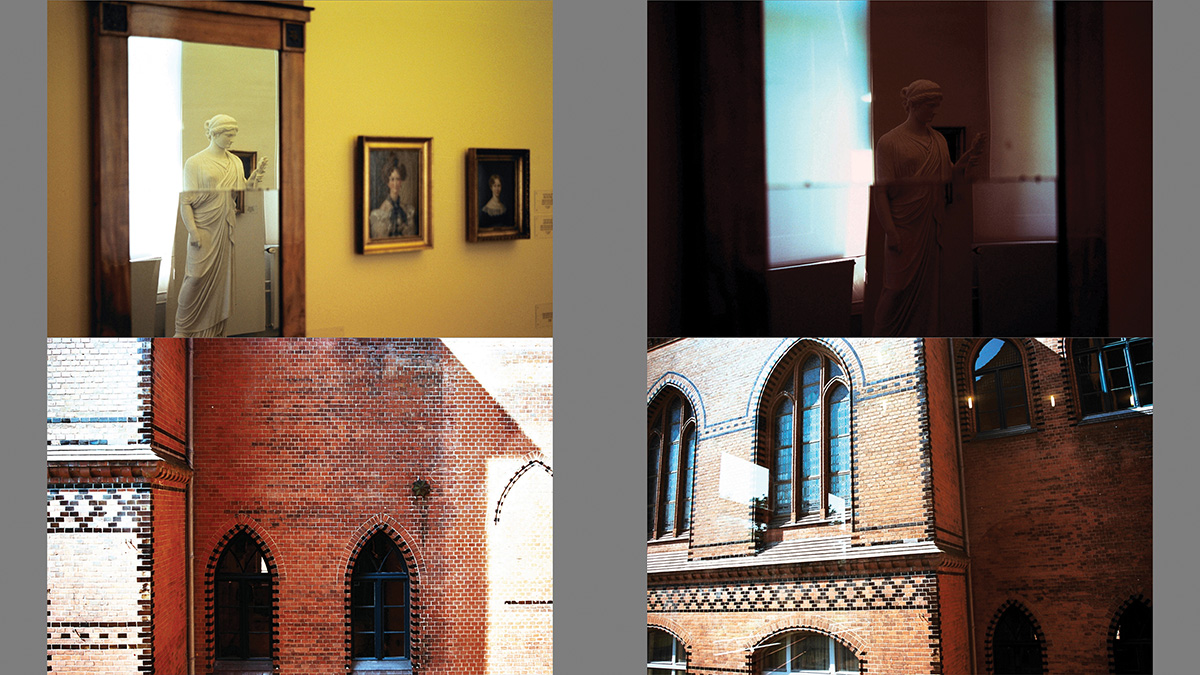
What role does childhood play in developing experience? How are personal present and past connected in the process of aging? The longing for the places of the personal past was the reason for a trip to Flensburg in 2001 a few weeks before 9/11. More than 2000 photos were taken in just a few days. It was only many years later that the negatives were digitized and it was only more than 20 years later that the need to process these recordings into a composition arose. The turbulent German-Danish history on both sides of today's border and the places of childhood come together in a whole where the past merges into one experience in the now. 3636 images are processed frame by frame in the first 3 movements. Each movement is containing 24 sequences of stills. The amount of images in the stills increases from 4 to 625 images simultaneously. After the first 3 movements the process is repeated towards the infinite to end in structures similar to the layers one would find in rock formations.
Thomas Mohr is exploring processes of perception and memory systematically in performance, painting, video, installations. From 1985 onwards a growing archive containing more then 600000 pictures regarding a wide range of events of transition from a collective meaning to very personal moments. Distributed by LIMA. Sreenings at various festivals since 2009: IFFR/Rotterdam, JMAF/Tokio, Ars Electronica, Transmediale Berlin, IFF Japan, NeMaf/Seoul, IKFF/Hamburg, Jihlava IDFF, HAFF/Utrecht, Media Art Biennale Wro, Rencontres Paris/Berlin, EMAF, Atonal Berlin, Projects with music at Stedelijk Museum, Orgelpark Amsterdam, Edith Russ Haus Oldenburg, CCAM / Scène Nationale de Vandœuvre. Michael Bonaventure , based in Edinburgh & Amsterdam, is composer, organist and collaborator in new and experimental music projects; Extended cyclic works predominate in his output including huge body of electronic and electro-acoustic pieces as well as instrumental and organ music. From a sonic universe deriving its inspiration from mysticism and ritual, natural and imaginary worlds, astronomical and supernatural phenomena.

Thomas Mohr
Matters of Time
Video | hdv | color | 12:35 | Netherlands | 2019
From Berlin to Hiroshima, from Hiroshima to Berlin. From Past to Now, from Now to Past. Connecting events, remembering the suffering of war and new beginnings. Observations. 7 identical defined time units each containing a series of 24 progressing intervals of shifting box systems descending from 25x25=625 to 2x2=4 images. The construction of each unit is exactly the same, the content of each unit is entirely individual. Walking through a winter night in Berlin, going from Miyajima island to Hiroshima, the experience of My Facebook Timeline Having devastating destruction in mind and reconstruction. Straight forward, up side down, rotating. Positive, negative. Complex layers, more complex layers. Text, subtext.
Biografy: Moving, changing, transformation, experience. Exploring processes of perception and memory systematically since the late 1980ties. From 1985 onwards a growing archive containing more then 500000 pictures and thousands screenshots regarding a wide range of events of transition from a collective meaning to very personal moments. Living and working in Amsterdam. Distributed by LIMA. Sreenings at various festivals since 2009: IFFR/Rotterdam, JMAF/Tokio, Ars Electronica/LInz, Transmediale Berlin, IFF Japan, NeMaf/Seoul, IKFF/Hamburg, Jihlava IDFF, HAFF/Utrecht, Media Art Biennale Wro, Rencontres Paris/Berlin, EMAF, Atonal Berlin

Thomas Mohr
Zu Hanne Darboven
Video | hdv | color | 8:27 | Netherlands | 2014
Is it possible to understand the work of the artist and composer Hanne Darboven (1941 - 2009) famous for her large scale installation containing thousands of drawings and notes? The project Zu / On Hanne Darboven is an exploration of herless known music in relation to her visual oeuvre. Abschliessend (In conclusion) is based on 1853 pictures handheld taken- as meticolous as possible - very close to the details of the works in the last space of the exhibition “The order of time and things. The home studio of Hanne Darboven” organised by the Museo Nacional Centro de Arte Reina Sofía and the Deichtorhallen Hamburg - Sammlung Falckenberg in collaboration with the Hanne Darboven. The music is the last part of Hanne Darbovens Requiem recorded in eleven volumes. The pictures are processed in still compositions frame by frame in a series of cycles increasingly compressing the original information.
Living and working in Amsterdam. Since the late 1980ties systematically exploring processes of perception and experience in installations and "films" referring inter alia to conceptual and minimal art, to the history of early cinematography , the transformation of information, the evolution of (new) media. Working with computer-generated processes combined with manual execution based on a growing photo archive containing at this moment more then 500000 pictures regarding major and minor personal and historic events. Main themes recently the reverberation of historic incidents and and the intertwined relations of culture. Thomas Mohr’s particular way of composing films since 2008 begins with smallest elements - taking single images. This material is processed in repetitive steps to higly compressed structures where the visual properties are almost dissolved. Since 2010 works specifically related to the body of work of Hanne Darboven. Now working on constructing an episodic memory covering the information of 30 years (1985-2015).