Catalogue > Search
Results for : Tout le catalogue

Masbedo
Condivisione di un ricordo
Video | mp4 | color | 13:13 | Italy | 2020
The major video screening set up echoes the documentary Condivisione di un ricordo: this work presents the operation which concerned Bergamo and the municipalities of the Val Seriana over the summer, in which numerous posters portraying Pellizza’s painting were displayed, thanks to the involvement of people encountered by the artists.
The two artists have worked together since 1999, focusing on video art and installations. They express themselves through the language of video, and in different forms such as performance, theater, installation, photography and recently cinema. In Italy they are recognized among the most important video artists and innovators in the field of contemporary art. Their artistic research has focused on the theme of incommunicability, highlighting the paradox of our communication society. This has led them to produce very intimate pieces alongside work with a greater anthropological, social, and political feel. They strive to engage their audience by using the moving image as an immersive installation. MASBEDO have also worked with video-performances to engage their audience within the creative space and gestures created by the video itself
Monika Maslon
Control Negative
Experimental VR | 0 | color | 40:0 | Poland | 2022
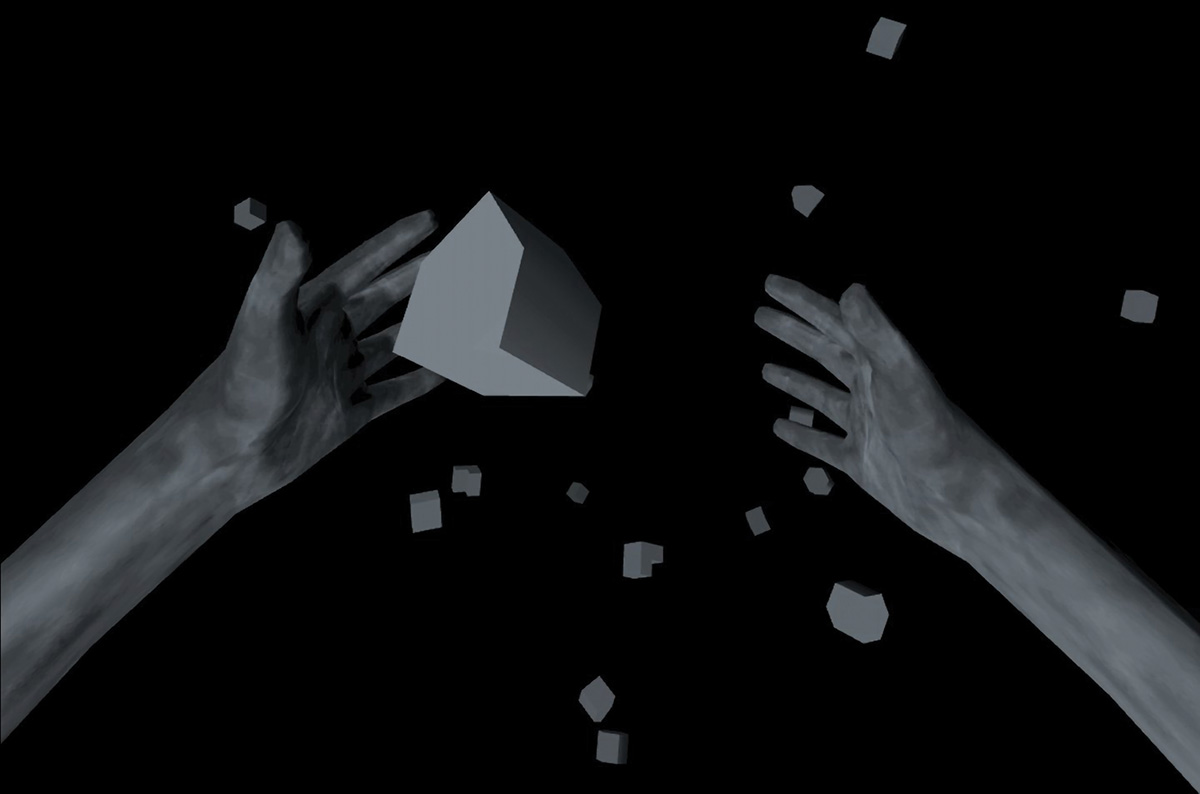
The CONTROL NEGATIVE experience is an exercise in a loss. Using VR technology, author Monika Mas?o? situates the viewer in an emotional state where frustration, helplessness, anger, and sadness are used to reveal basic human assumptions, including the illusory conviction of being fully in control of one's own life. The unreal world of the experience — a negative version of the real world — is a training space where you can better understand yourself and your emotions. The user is guided through seven chapters, which gradually move from physical activity to contemplation.
Dr. Monika Maslon (born 1982) - visual artist and art educator. She graduated from the Academy of Fine Arts in ?ód? and Ph.D. studies at the Film School in ?ód?, where she completed her Ph.D. thesis entitled “Do zobaczenia” (See you), under the supervision of Prof. Józef Robakowski. She is a lecturer at the University of Leipzig and the Maria Grzegorzewska University in Warsaw where she conducts classes with the students of the department of Arts education in fine arts. In 2014 she stayed at an artistic residence in Singapore, where she made an artistic project called “Comfort of Long-Distance Perceiving”. In 2016 she implemented the project “Template - a tool to learn how to use an image”, as a part of a scholarship awarded by the Ministry of Culture and National Heritage. The scope of her art activities is manifested mainly through realizations based on audiovisual material. She participated in numerous exhibitions and shows. She is the author of the VR experience - CONTROL NEGATIVE.
Valérie Massadian
America
| | | 6:57 | France | 0
One Place One Boy One Day One Shot One Wheel of Film

Valérie Massadian
Nana
Experimental fiction | hdv | color | 68:0 | France | 2011
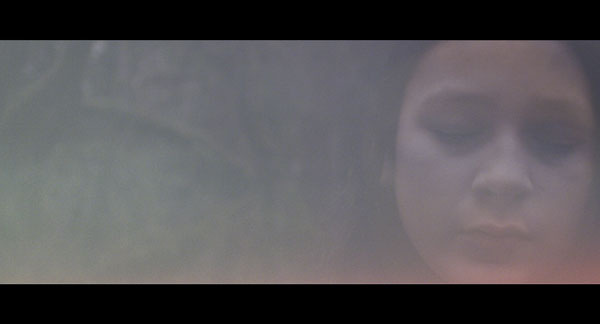
Nana is 4 years old and lives in a stone house beyond the forest. Back from school, a late afternoon, all she finds is silence in the house. A journey into the night of her childhood.
It's through photography, and notably her collaboration with Nan Goldin, that Valerie Massadian came to image-making,Creating slide- show screenings (The Link, Mary Go Round, Journal de Bord), exhibited in Tokyo, London and Porto. What she has retained from photography is its freedom and the rigor of frontal contact. She has taken this same approach, committing to a project from concept to completion, in her collaborations with several film directors. From there came the need of her own film, NANA, which won the Price for Best First Feature Film at the Locarno Film Festival 2011, as well as the Price for Best International Feature Film at the Festival Internacional de Ciné de Valdivia.

Guy Massaux
La selva oscura
Experimental fiction | 4k | color | 19:0 | Belgium, Italy | 2018
La Selva oscura (La forêt obscure) film/vidéo, texte de Dante Alighieri, La Comédie, L’Enfer, Chant treizième (XIII) Préambule: Dans la forêt des suicidés, Dante et Virgile croisent deux formes humaines qui fuient devant eux, arrachant tout sur leur passage et brutalisant ainsi elles-mêmes leur chair jusqu’à ce que des chiennes faméliques (Harpyes) les rejoignent et les dépècent. Tel est le châtiment de ceux qui ont péché contre eux-mêmes par dissipation. Synopsis: Par une nuit obscure, A. et D. progressent, séparément, dans une forêt où nul sentier n’indique le chemin à suivre, où aucune issue ne se présente à eux. Ils se sont égarés, la forêt les retient. Ils surgissent de l’obscurité, débusqués par les éclairages qui les aveuglent. Un face-à-face s’installe entre eux et la forêt, à la présence des arbres répondent leurs propres regards et voix. A. s’est levé, D. de même, résonnent en eux les aboiements d’une meute de chiens qui progressivement se rapproche. Une course-poursuite est engagée où toute issue leur sera fatale.
Guy Massaux est artiste visuel, curateur d’exposition, professeur d’art à l’Académie des beaux-arts de Bruxelles. Après avoir consacré son travail d’artiste principalement à la peinture, il oriente, depuis plusieurs années, ses préoccupations de création autour de l’image en mouvement par l’écriture cinématographique, notamment à travers des dispositifs de vidéo-installations. Il a réalisé plusieurs courts métrages en langue italienne, La Selva Oscura (2018), Il Rifugio (2014) et "B.", film en cours de post-production (2020). Il partage ses principales activités et son emploi du temps entre l’Italie et la Belgique. Il collabore régulièrement avec Mirco Mencacci ingénieur du son. Créateur des univers sonores de films italiens tels que « Le Regard de Michel Ange (Lo Sguardo di Michelangelo) » de Michelangelo Antonioni, « Nos meilleures années (La Meglio gioventu)» de Marco Tullio Giordana ou encore «La Fenêtre d’en face» (Facing Windows) de Ferzan Ozpetec. Pour ses créations, il travaille sur une nouvelle manière de diffuser le son et développe le système du « son sphérique », utilisé pour la première fois dans le film « Le Regard de Michel Ange ».

Agnieszka Mastalerz
Nodes
Video | digital | black and white | 3:16 | Poland | 2023
Nodes is a project analyzing spells as an example of control over another being. I focused on the violence of persuading somebody to fall in love. I have been considering casting a spell as an influential but not direct act for which specific tools or gestures might be needed. I chose orchids whose roots were used to influence another person, both when it comes to feelings and sexual activity. In the areas of today’s Poland and Italy, dried wild orchid roots were hidden under somebody’s clothes, or an orchid-based powder was added to goat milk which was supposed to help sexual arousal. On the contrary, nowadays, in a huge industrial space, hundreds of almost identical orchids run through a commercial line. Although the production is highly mechanized and managed by technology, the final sculptural touch on every flower goes through the working hands of females — they manually shape this organic material by adding artificial backbones and cutting off the rotten parts. The women use this intimate act to fit the normalized aesthetics. With Nodes, I am bringing attention to the powerful operations both in private and industrial environments by looking at the human element in them.
Female visual artist based in Warsaw. Graduate of the Studio of Spatial Activities by Miroslaw Balka at the Academy of Fine Arts in Warsaw (BA, MA, 2018), former student of Candice Breitz and Eli Cortiñas at the HBK in Braunschweig (Deutscher Akademischer Austauschdienst (DAAD) Scholarship for 2019/2020), and a guest by Adam Broomberg and Oliver Chanarin at the HFBK in Hamburg (2017/2018). She also obtained her BA in Cultural Studies at the University of Warsaw (2013). Currently participant of the Autumn Intensive at the Malmö Art Academy. She exhibited with Catinca Tabacaru Gallery at the Goethe Institut in Bucharest (2024), NS-Dokumentazionszentrum in Munich (2023), MOCAK – Museum of Contemporary Art in Krakow, Manifesta 14 Prishtina, eastcontemporary gallery in Milan (2022), Fabbri Schenker Projects in London, MAXXI – National Museum of 21st Century Art in Rome, Center for Contemporary Art Luigi Pecci in Prato (2021), Wschód gallery in Warsaw (2020), Palazzo Strozzi in Florence, Starak Family Foundation in Warsaw (2019), Deichtorhallen in Hamburg, Fondation Hippocrène in Paris (2018), Museum of Modern Art in Warsaw (2017 – laureate of the Hestia Artistic Journey Competition), and TRAFO Center for Contemporary Art in Szczecin (2016). Art fairs include NADA Villa Warsaw (2024), Artissima, and Arco Madrid (2021). Agnieszka Mastalerz was a resident of Hospitalfield in Scotland (2022), Muzeum Susch in Switzerland, the Artist Development Program at the EIB Institute in Luxembourg (2021), and Futura gallery in Prague (2020, Visegrad Fund). She participated in the Lucy Art Residency public program in Kavala (2022) and in the School of Expressions in PLATO Ostrava (2019). She is a laureate of M?oda Polska scholarship for 2024. Works of her are in Fondazione in Between Art Film by Beatrice Bulgari, Ergo Hestia Group, European Investment Bank, and Warsaw Ghetto Museum collections, as well as in private ones. Since 2021, Mastalerz is represented by eastcontemporary gallery in Milan.

Jonas Matauschek, Culurgioni, Emerson
Leuna
Experimental doc. | hdv | color | 13:0 | Germany | 2013
In the course of one day, the flm follows various characters in their local environment, which is infuenced by the presence of an industrial plant. Their individual sights tell about the relation between human being and industry.
Jonas Matauschek 1987 born in Dresden, Germany 2007 – 2014 studies of photography at the Academy of Visual Arts, Leipzig since 2015 Meisterschüler in the class of Prof.Peter Piller, Academy of Visual Arts, Leipzig Emerson Culurgioni 1986 born in Munich, Germany 2007-2009 studies of visual communication at the Free University of Bolzano 2010 - 2014 studies of media art at the Academy of Visual Arts, Leipzig currently Meisterschüler in the class of Prof. Clemens von Wedemeyer, Academy of Visual Arts, Leipzig
Ramon Mateos
HERRAMIENTAS DE CONSTRUCCION NACIONAL I
Video | | color | 1:59 | Spain | 2009
We live in a globalized world where national and supranational identity has been subsumed by the value and brand image; A world in which politics is written in capital letters on the desks of major companies and ends endorsed in the areas of representation of popular will: the parliaments, with the essential and necessary support of the media, which, in turn, are part of the fabric of these same corporations. However, it is a historical reality, the search for differentiation with respect to the other, from a political and socio-cultural. Today we can hardly distinguish the discourse of national identity distinct of riots, revolts and terrorism, for the sake of a flawed and corrupt information that is confusing the part with the whole in a universal metonymy, and that is where this project address. NATIONAL BUILDING TOOLS is formalized in video format that work as a manual that relates ideological instruments and tools, used to reaffirm a hypothetical national identity, using the techniques and applications specific to the media.
Ramón Mateos. (Madrid1968) Works and lives in Madrid. Graduated from the Faculty of Fine Arts ofthe Complutense University, Madrid. He has participated in numerous solo and group, nationals and internationals exhibitions, and his work is in major public and private collections. Founder and component, until its dissolution in 2006, of the ?EL PERRO? art collective. He has participated in: PROYECTO JUAREZ. Ciudad Juarez, Mexico (2007-2009); INTERFERENCIAS, PhotoEspaña 2008, Casa de America, Madrid, 10 th Istanbul Biennial, Istanbul (2007); FRECUENCIAS in 2008 and 2009 for the Cervantes Institute in Morocco
Mateo Maté
Thanksgiving turkey
Experimental film | dv | color | 5:30 | Spain | 2006
The concept of camouflage has seeped into virtually all the human social activities. Over the past century, the companies have developed acquiring a power that is even greater than that of the countries and they have invented the science of marketing that camouflages objects in dreams. All humans use the different brands, like a second skin to integrate ourselves into the social group of the sheet to which we want to belong; the products that we use do not project what we are; they project what we want to be or just want to appear. The economic power has kidnapped the sense of sight that was until recently a ?notarial act of the truth?. Polyespan, Photoshop and plastic surgery have turned our surroundings into a theme park in which the objects, messages and bodies are false. The eternal sentence ?if I hadn?t seen it with my own two eyes, I would not believe it? no longer has any meaning. However we continue believing it because we are all actors on the same stage; with leading or supporting roles, but accomplices in different degrees. Currently, the military look has spread throughout the social strata. The large clothing chains offer us every day garments for going to school or work that are camouflaged; the houses on the new estates acquire the presence of unassailable bunkers in the same style as the kibbutz?s in the ?occupied territories?; even the vehicles have been contaminated by the armour plating appearance of the Empire?s war ships. With the total militarization of all our borders, implanted with the excuse of security, we are all ready for a general mobilisation. We do not know when or where the conflict will arise, but we must be ready for it. In "Thanksgiving Turkey" a general harangues to his troops. Following his precise instructions, the soldiers will conquer his guests, during a memorable dinner, with a delicious and magisterial recipe of the "Thanksgiving Turkey". Mateo Maté, 2007
MATEO MATÉ Born in Madrid (Spain), 1964. Lives and works in Madrid (Spain) www.mateomate.com m.mate@mateo mate.com SOLO EXHIBITIONS 2007-?Paisajes uniformados?. Centro de Arte de Burgos, CAB. Spain. -?Nacionalismo Doméstico?. Galería Llucià Homs. Barcelona. Spain. -"Thanksgiving Turkey". Galería Trinta, Santiago de Compostela. España. 2006-?Cartografías personales?. Sala CAI Luzán. Zaragoza. Spain. -?Nacionalismo Ibérico?. Fundación Encosta, Lisboa. Portugal. -?Fronteras interiores?. Casa de España, Lima. Perú. 2005 -?Delirios de Grandeza?. Galería Grita Insam. Viena. -?Nacionalismo Doméstico?. Galería Oliva Arauna, Madrid. Spain. 2003 -?Desubicado?. Galería Oliva Arauna. Madrid, Spain. -?Desubicado?. Galerie Six Friedrich & Lisa Ungar, Munich. Germany.
Stephan Mathieu, Mathieu STEPHAN
Radiance
Experimental video | dv | color | 2:0 | Germany | 2005
A fast and dirty analogue movie to accompany my audio piece "Radiance"
I was born october 1967 in Saarbrücken, Germany and spent a good part of the 90s as a professional drummer in Berlin. In 1998 I moved back to Saarbrücken where I?m working today in the field of digital arts. Since 1999 sixteen albums of my music have been released on labels worldwide. In 2002 british magazine The Wire voted ²frequencyLib³ among the 10 best electronic music releases of the year . I am creating sound installations, graphic design and have worked as a lecturer on digital arts and conception at the Royal Academy of Arts, Göteborg, the Bauhaus University, Weimar, the University of Arts and Design HBKSaar, Saarbrücken and the Merz-Akademie in Stuttgart among others.
Yuiko Matsuyama
Hana
Experimental film | 16mm | color | 5:30 | Japan | 2004
In this film, Yuiko Matsuyama concentrates on light and microscopic movements, attempting to metaphorically create a flower. Using the same film several times, Matsuyama produced this film with a double exposure technique, as well as with Indian ink. This work is the fourth in a series begun with Field in 2000. In this film Yuiko Matsuyama is interested in the light and movements that exist on a microscopic level. She tries in particular to evoke metaphorically a flower. To produce this film, she carried out a double exposure technique while using the same reel several times. This work realised with Indian ink is the foruth of a serie begun with Field in 2000.
Yuiko Matsuyama was born in Ehime Japan in 1972. She studied at Tsuda College, where her major was social psychology. She began making films in 1997. Yuiko is now living in Tokyo. She belongs to the ISLANDS collective.
Gordon Matta-clark
Conical intersect
Experimental doc. | 16mm | black and white | 19:0 | USA, France | 1975
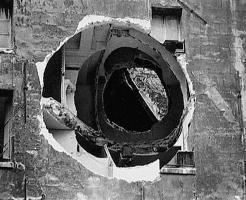
"Conical Intersect", Matta-Clark's contribution to the Paris Biennial of 1975, manifested his critique of urban gentrification in the form of a radical incision through two adjacent 17th-century buildings designated for demolition near the much-contested Centre Georges Pompidou, which was then under construction. For this anti-monument, or "nonument", which contemplated the poetics of the civic ruin, Matta-Clark bore a tornado-shaped hole that spiralled back at a 45-degree angle to exit through the roof. Periscope like, the void offered passers-by a view of the buildings' internal skeletons.
Gordon Matta-Clark studied architecture at Cornell University, but never practiced as a conventional architect. He also spent a year studying French literature at the Sorbonne in Paris where he also was during the student strikes of May 1968. It was in Paris that he became aware of the French deconstructionist philosophers and Guy Debord and the Situationists. These cultural and political radicals developed the concept of détournement, or "the reuse of pre-existing artistic elements in a new ensemble". Such concepts would later inspire his work. He is most famous for works that radically altered existing structures. His "building cuts" (in which, for example, a house is cut vertically in half) alter the perception of the building and its surrounding environment. Matta-Clark used a number of media to document his work, including film, video, and photography. His work includes performance and recycled pieces, space and texture works, and his "building cuts". Matta-Clark also used puns and other wordplays as a way to re-conceptualize preconditioned roles and relationships (of everything from people to architecture). He demonstrated that the theory of entropy applies to language as well as to the physical world, and that language is not a neutral tool but a carrier for society's values and a vehicle for ideology. Matta-Clark died from pancreatic cancer on August 27, 1978.
Gordon Matta-clark
The Wall (1976-2007)
Art vidéo | 35mm | color | 15:4 | USA | 1976
This newly assembled work is a rare document of a 1976 Matta-Clark performance in Berlin. The piece begins with the following statement: "In 1976, as part of the Akademie der Kunst and Berliner Festwochen exhibition `Soho in Berlin,` Gordon Matta-Clark went to Germany with the intention of blowing up a section of the Berlin Wall. Dissuaded by friends from such a suicidal action, the result was the following performance." The film records Matta-Clark as he stencils `Made in America` on the Wall, affixes commercial advertisements over graffiti, and has a run-in with the police. A remarkable record of a little-known Matta-Clark performance, this work is also a historical time capsule of a political and physical landscape that no longer exists.
Gordon Matta-Clark was born in New York in 1943 and died in 1978. He studied French literature at the Sorbonne and Architecture at Cornell University. From the early 1970s, as a founding member of the artist-run Food Restaurant in New York`s Soho neighborhood, Matta-Clark participated in numerous group exhibitions and projects. His work was presented in Documenta V, Kassel, Germany; and at exhibitions in Sao Paolo, Berlin, Zurich, and in the 9th Biennale de Paris. Major projects by Matta-Clark were staged in Aachen, Paris and Antwerp. Following his death, retrospective exhibitions have been organized by the Museum of Contemporary Art, Chicago; Badischer Kunstverein, Karlsruhe, Germany; and IVAM Centro Julio Gonzalez, Valencia, Spain.
Mara Mattuschka
In Transit
Experimental film | 35mm | color | 4:55 | Austria, Germany | 2008
A moving image. And a story about portrait-paintings being tired of exhausted museum visitors. (production note) Over the entrance of the Uffizi Gallery in Florence hangs a digital display indicating the amount of time visitors still have to wait in line. In the high season this can be up to four hours. Still, the majority, after entering the museum, immediately begin to hurry, checking off the highlights as fast as they can. The average museum visitor, according to the hypothesis Reinhold Bidner proceeds from, spends all of six seconds looking at individual paintings. In his video In Transit Bidner takes up this phenomenon. At first, there?s a painting on the wall and a man sitting in front of it, apparently resting his legs. The camera slowly zooms into the painting until the surrounding space disappears?and it begins to move: The image of a girl by French Classicist William-Adolphe Bouguereau transforms into Rubens? portrait of his daughter, Caravaggio?s sickly Bacchus, the latter?s head of Medusa, and numerous other works from the history of art. Finally, Bouguereau?s girl reappears, smiling as she peers from the painting, the camera moves away and films the?now different?surroundings. The final shot is of a yawning woman. During this virtual museum tour the painting is covered by a veil of drops that reflect the movements of Louvre visitors, who are both tired and hectic. Through this formal choice Bidner keeps the viewer at a distance, while at the same time adding a second level: that of the museum visitors who, due to their exhaustion, see nothing. Together with Richard Eigner, who made the swelling and diminishing soundtrack, Reinhold Bidner successfully created a sensitive study on human behavior in the museum of the 21st century. The audience is invited to take a more intensive and concentrated look at art. (Nina Schedlmayer)
Born in Kabul, Afghanistan in 1973, Lida Abdul resides there now. She lived in Germany and India as a refugee when she was forced to leave Afghanistan after the former-Soviet invasion. Her work fuses the tropes of Western formalism with the numerous aesthetic traditions ?Islamic, Buddhist, Hindu, pagan and nomadic? that collectively influenced Afghan art and culture. She has produced work in many media including video, film, photography, installation and live performance. Her most recent work has been featured at the Venice Biennale 2005, São Paulo Biennial 2006, Gwanju Biennial 2006, Moscow Biennial 2007, Sharjah Biennial 2007, Istanbul Modern, Kunsthalle Vienna, Ok Centrum, Museum of Modern Art Arnhem, Tate Modern, Moma NY, National Museum of Kabul, Netherlands and Miami Central, ICA London, ZKM, Capc Bordeaux, CAC Centre d?Art Contemporain de Bretigny, and Frac Lorraine Metz, France. This coming year she has solo exhibition at Indianapolis Museum (IMA) and Smithsonian at Sackler galleries.
Peter Maybury
L’esprit de l’escalier
Experimental film | 4k | color | 5:50 | Ireland | 2025
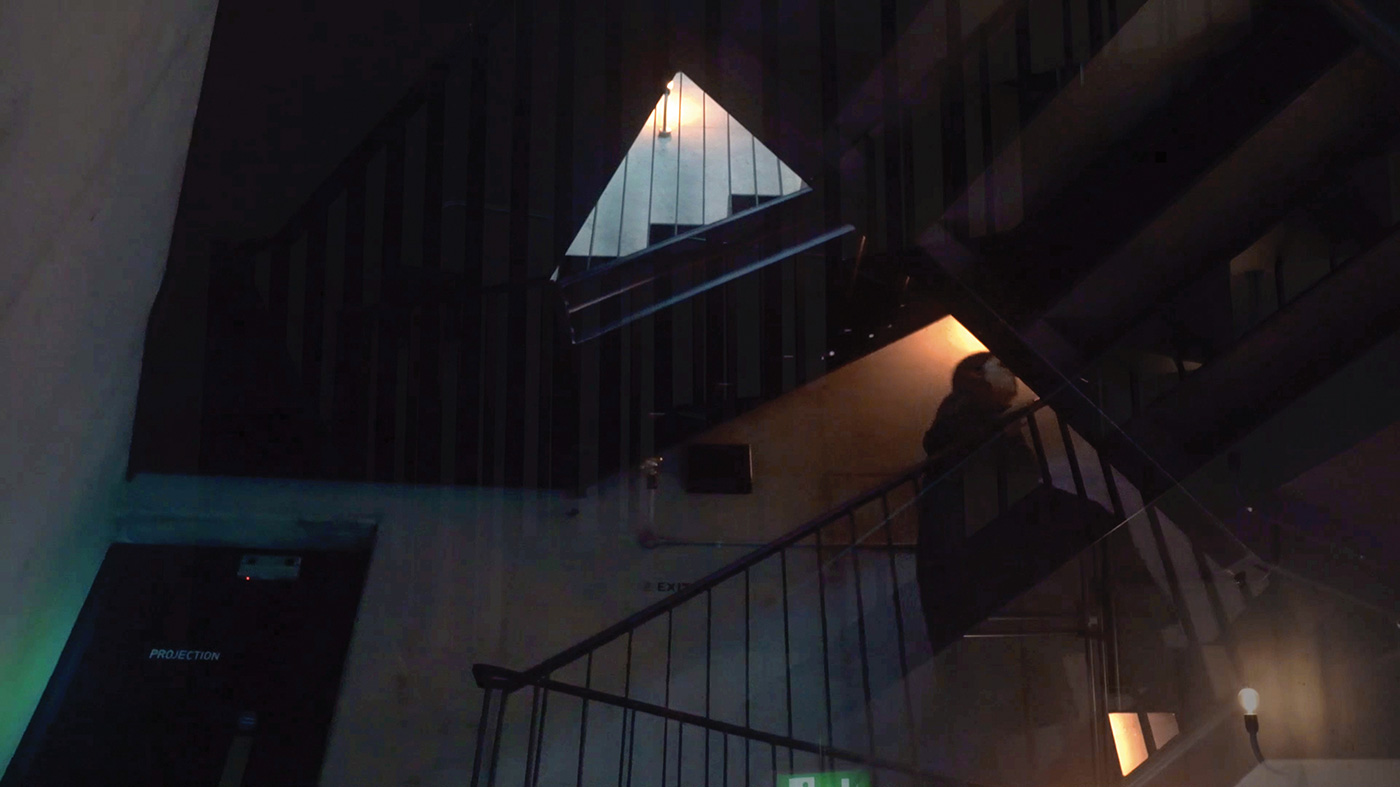
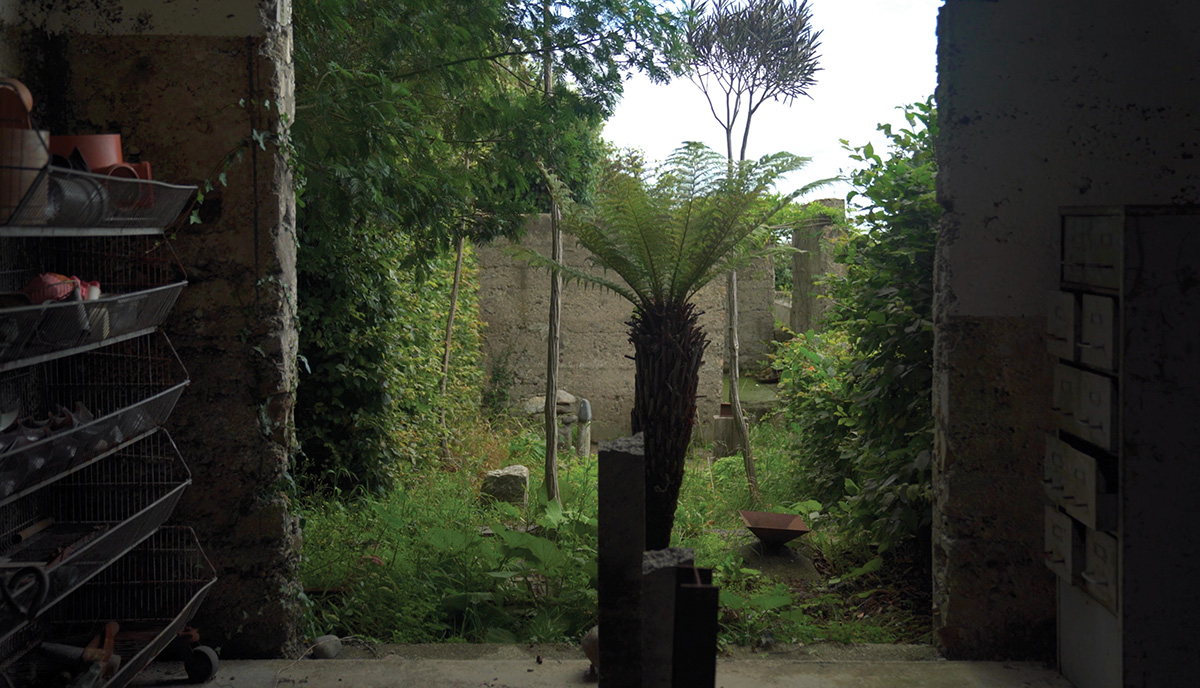
L’esprit de l’escalier, is the third in a trilogy of films surrounding Pálás, a cinema in Galway, Ireland, designed by Tom dePaor. Opening in 2018, the cinema closed to the public in February 2025, and I attended one of the last screenings at Pálás – Tsai Ming-Liang’s Goodbye Dragon Inn, itself a film about the closing of a cinema. I returned the following morning with thoughts of this in my head as I filmed the staircases throughout the building. These spaces are untempered, part indoor, part outdoor, while the cinemas with their plush red interiors are optimised for sound, temperature, and light. The title of my film refers to the expression (to think of the perfect reply too late) but moreover to the spirit of the staircase. Just like Goodbye Dragon Inn, so much life goes on in these spaces, where people, weather, light, and sound, intersect with, and even possess the movement or the stillness of the camera, the place itself becoming a film.
Peter Maybury is an Irish multidisciplinary artist. His practice-based research encompasses works as an artist, graphic designer, filmmaker, publisher, writer, editor, curator, musician, and educator. He is a graduate of Central Saint Martins, London, and a Doctoral Candidate at the Centre for Socially Engaged Practice-Based Research, TU Dublin. He has collaborated extensively with artists and institutions, editors and curators, on more than 200 art and architecture publications. Peter is a longstanding collaborator with Tom dePaor, making books, films, and works for exhibition. His film work includes On being there (2022/23, screened at Rencontre Internationale Paris/Berlin 2023/24), Landfall (2020), an hour-long dual-screen film installation, and with dePaor the Gall films Drape (2018), and A Study (2015) which was made for exhibition at ETH Zurich. Peter is author of Make Ready (2015), and co-author with dePaor of Reservoir (2010) and Of (2012).
Peter Maybury
On Being There
Experimental film | 4k | color and b&w | 60:0 | Ireland | 2022
On being there is a filmic encounter with the material and outputs of the office of Tom dePaor, drawing on 30 years of practice. There is the place itself. There are notebooks, drawings, prints, scale models, 35mm slides, photographs, films, files, books, writing. A diversity of materials and media, evidencing significant technological changes in production and reproduction. This is the raw material. The film is a rerecording, or sampling of this material, where scale, media, and modes of presentation and realisation merge. The linear transition from drawing to model to built landscape and documentation is disrupted. The film explores the permeability of the image. Animated or activated through movement and operation, everything can be superimposed, overlaid, or cut into. An audio-visual encounter with place, within the space of the screen and the loudspeaker.
Peter Maybury is an Irish multidisciplinary artist. His practice-based research encompasses works as an artist, graphic designer, filmmaker, publisher, writer, editor, curator, musician, and educator. He is a graduate of Central Saint Martins, London, and is a Doctoral Candidate at the Centre for Socially Engaged Practice-Based Research, TU Dublin. He has collaborated extensively with artists and institutions, editors and curators, on more than 200 art and architecture publications. Peter is a longstanding collaborator with Tom dePaor, making books, films, and works for exhibition. His film work includes Landfall (2020), an hour-long dual-screen film installation, and with dePaor the Gall films Drape (2018), and A Study (2015) made for exhibition at ETH Zurich. Peter is author of Make Ready (2015), and co-author with dePaor of Reservoir (2010) and Of (2012).

Iris Mayr
Ars Electronica
0 | 0 | | 0:0 | Austria | 2007
With its specific orientation and long-standing continuity it has displayed since 1979, Ars Electronica is an internationally unique platform for digital art and media culture consisting of the following four divisions: Ars Electronica ? Festival for Art, Technology and Society; Prix Ars Electronica ? International Competition for CyberArts; Ars Electronica Center ? Museum of the Future; and Ars Electronica Futurelab ? Laboratory for Future Innovations. The essence of the internationally renowned Ars Electronica Festival is interdisciplinarity and an open encounter of international experts from the arts and sciences with a broad audience of highly diverse backgrounds and interests. Annually since 1979, the Festival has featured a line-up of symposia, exhibitions, performances, and events designed to further an artistic and scientific confrontation with the social and cultural phenomena that are the consequences of technological change. As the world's premier cyberarts competition, the Prix Ars Electronica has been a forum for artistic creativity and innovation since 1987. It is the trend barometer in an ever-expanding and increasingly diversified world of media art. Thanks to its annually recurring nature, its international scope and the incredible variety of the works submitted for prize consideration, the enormous Prix Ars Electronica Archive provides a detailed look at the development of media art and a feel for its openness and diversity. The Ars Electronica Center opened in 1996 as a prototype of a "Museum of the Future". Its mission is to utilize interactive forms of mediation to facilitate the general public's encounter with virtual reality, digital networks, and modern media. A focus on issues at the interface of media art, new technologies and social developments characterize the Center's innovative exhibitions. The Futurelab is a model of a new kind of media art laboratory in which artistic and technological innovations engender reciprocal inspiration. The lab's teams bring together a wide variety of specialized skills; their approach is characterized by interdisciplinarity and international networking. The Futurelab's wide-ranging activities include designing and engineering exhibitions, creating artistic installations, as well as pursuing collaborative research with universities and joint ventures with private sector associates.
Iris Mayr was born in 1971 in Austria. She studied communication science and business administration in Linz, Salzburg, and Sevilla. In 2003/04 she was a research assistant and conducted tutorials at the University of Salzburg in the department of Audiovision/Digital Communication and the ICT&S Center. Since 1996 she has been a member of the Ars Electronica Center Linz (Festival Ars Electronica, Production and Curatorial Team). In 2006 she was co-curator with Lev Manovich, Yuko Hasegawa and Pili at the Media City_Seoul 2006 in Seoul, Korea. From 2004-2007 she was the producer of the Prix Ars Electronica ? International Competition for CyberArts, and a freelance cultural curator.
Marko Mäetamm
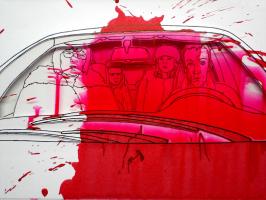
CAR RIDE
Animation | dv | color | 3:16 | Estonia | 2008
This work is about how something looks very often different from how it actually is and how something is so absolutely different from the way it looks. One beautiful Friday evening in early March I put my lovely wife and two wonderful kids in our little Honda Civic and we took a trip to visit my parents in South-Estonia...
I was born in a small town Nuia in South-Estonia. The idea to become an artist hit me suddenly and absolutely out of the blue when I was 18. I studied printmaking in Estonian Academy of Arts, graduated my BA in 1993 and MA in1995. I started exhibit when I was still a student. My first works were very printmaking-based. Then I moved to painting because I found it more direct. Then at one point text became very essential in my projects. And then following my ideas I took up moving image. At the moment I work very mixed-media-wise. I do photos and objects and animations, I paint and I produce texts and I mix it all together in my installations. In 2007 I had a great opportunity to represent Estonia in Venice Biennale with the project ?Loser?s Paradise? and it had a strong influence to my artistic career.
Marko Mäetamm
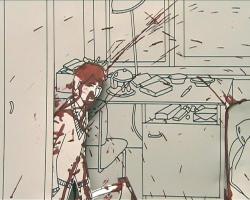
FAMILY
Animation | dv | color | 4:9 | Estonia | 2007
About FAMILY There is an axe-man, running around the flat after quite presumably his wife and two children. The wife and children are trying to hide behind the sofa or a bed or a cupboard, or under the blanket, but the axe-man always finds them and then something happens. And every time after that the axe-man is more and more covered with blood. And the wife and two children are more and more well. And it never ends.
Marko Mäetamm
MUSE
Documentary | dv | color | 3:5 | Estonia | 2009
She is a sourse of my inspiration. She gives my life a meaning. I am part of her and she is part of me. We can`t live without each other because she gives ideas for my artistic creation.. She is my muse.
Born in 1965 in Viljandi, Estonia. Studied in Estonian Academy of Arts, MA 1995 Lives and works in Tallinn, Estonia. Works with a wide range of media including photography, sculpture, animations, painting and text. Mäetamm tells us the stories which happen behind the closed doors and pulled curtains of the intimate territory we called home. Mäetamm portrays the family as a little society -relaying through a dark humor the petty moments of daily life - and exploring the way our society manipulates the family dynamics through the macrocosms of economy, consumerism, and ?quality-of-life? standards. Inspired by his own private life and the recurrent feeling he could fail to preserve the balance in his existence, Mäetamm?s work explores the grey area where ambiguous feelings of being in control and being controlled merge. Marko Mäetamm has exhibited internationally and represented Estonia at the 52nd Venice Biennial in 2007. Contact: maetamm@yahoo.com HOMEPAGE: www.maetamm.net
Anthony Mccall
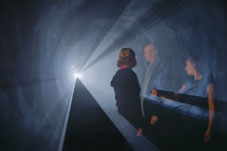
Line Describing a Cone
Experimental film | 16mm | black and white | 30:0 | France, USA | 1973
To the conventional perspective and illusionist space that cinema brings down on painting, McCall's films substitute a projective space that brings it back to sculpture. From then on the film is no longer this projected image that digs a fictitious depth in the wall's surface but a field actually constituted that blends with the event itself. It is in this way that the cut up luminous beams in Anthony McCall's smoke, developing the plastic properties of the film, pass the frontiers of the history of cinema to meet up the minimalist propositions of sculpture of the 70's and inscribes itself beside the geometric structures of Robert Morris, Saul Le Witt, and Carl Andre, the coloured fields of Dan Flavin, or the coloured tight cotton threads in Fred Sandback spaces. At the beginning of this century, after a silence of twenty years and as the presentations of Solid Light Films multiplied in the USA as in Europe, Anthony McCall inaugurated a new series of works no longer developed with traditional support, but rather numeric support, the computer allowing him to conceive complex traces and to explore plastic properties of undulating lines. Simultaneously the substitution of traditional smoke machines by sprays producing a water vapour with a more uniform texture at the largest scale allowed McCall to demultiply the size of his pieces from then on.