Catalogue > Search
Results for : Tout le catalogue
Christian Merlhiot
rice bowl hill incident
Fiction | dv | color | 40:0 | France | 2008
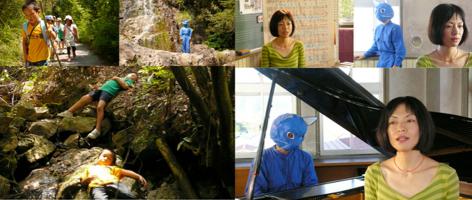
This film takes root in an extract from a report issued by the Military Intelligence Service and borrowed from Haruki Murakami?s Kafka on the shore. In this report called Rice Bowl Hill Incident a Japanese school teacher relates an unexplainable and nearly supernatural event that happened to her pupils as they were on a field trip in the mountains. The first sequence of the film shows a natural-setting reconstitution of the event elaborated according to the details given in the report. The second sequence of the film is none but the young woman?s narration of the facts. Filmed indoors, facing the camera, she relates the incident in front of a very unexpected Military Intelligence Service inspector.
Christian Merlhiot is a film maker. He has made ?mischief including fever? (1995), ?Voyage to the country of the vampires? (2001), ?Silenzio? (2005) and ?Indians to planet Mars? (2007). He is founder of a group which has set its stakes on mixing visual arts and cinema. Since 2002, He is responsible for the creative department of pavilion and laboratory of the Palais de Tokyo.
Christian Merlhiot
Slow life
Fiction | hdv | color | 74:0 | France | 2012
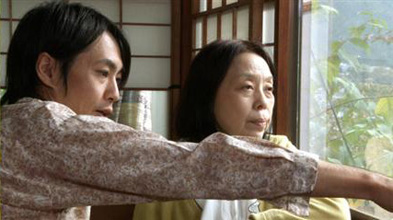
Kentaro has recently left his hometown. He lives in a village near Kyoto and works in a dyeing workshop. He also does occasional jobs for the villagers and looks after Yukiko, and old mischievious lady who says very little. The more people he meets the more he discovers new modes of living in which time flows differently. He starts to question his future and his role in this new community. On a sunny autumn day, he goes with Yukiko for a excursion to the forest?

Angelica Mesiti
Rapture (silent anthem)
Art vidéo | | color | 10:10 | Australia | 2009
Rapture (silent anthem) captures a teenage crowd caught in a slow-motion expression of quasi-religious fervour at a rock concert. Both a celebration of life and a look at the darker aspects of this zeal, the video takes a contemporary look at the human need for transcendence and communal ritual in unlikely places.
Angelica Mesiti was born in Sydney and studied at the College of Fine Arts, University of NSW. She works within the traditions of video, performance and installation and generates material through a range of approaches including staged situations, site specific performative acts, re-enactment and documentation. Her videos operate within a cinematic framework to offer fractured narratives that negotiate between primary experience and historical retelling. She uses performance as a way to embrace the present moment and several of her works focus on the dynamics of group activity as a form of social exchange.
Angelica Mesiti
The Line of Lode and Death of Charlie Day
Experimental fiction | | color | 15:45 | Australia | 2008
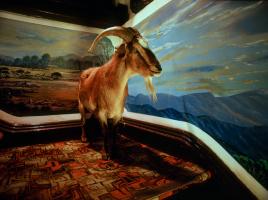
"There`s an old man He tells a story In the best way That he knows Of a hill In the desert Where he can No longer go" Set in the Australian outback town of Broken Hill, The Line of Lode and Death of Charlie Day is a story about stories. Reflecting on how different knowledges of one place intersect and overlap, the artist uses video to play with the conventions of cinematic and folkloric storytelling. Three intersecting histories of the region form the backbone of the work: Indigenous understanding of the land, the development of mining in the area including its link to the foundation of Broken Hill, and the story of a local attraction, Mario`s Palace Hotel. These images note how stories are carried by people through generations, and that they are not so much histories set in the past, as an enduring set of relationships between land and people.
Angelica Mesiti 1976, Sydney Australia. Lives and works in Paris and Sydney. Angelica Mesiti is a video, performance and installation artist based in Sydney. Her works often explore the notions of alternative histories sought through layered and less voiced stories embedded within landscapes and urban environments. Her works attempts to discover the unseen possibilities of sites through displaced activities like performance, costume and music. Exhibiting regularly since 2000, Mesiti has had solo and group shows across Australia and overseas including; LOOP Video festival Barcelona 2008, O.K Video Festival (2005), National Gallery of Indonesia, Jakarta, Game On (2006) for the Next Wave festival, Gertrude St Contemporary Art Space Melbourne and the touring show PLAY: Portraiture and Performance in Recent Video Art from Australia and New Zealand, (2006) shown at The Performance Space Sydney, Adam Art Gallery New Zealand and Perth Institute of Contemporary Art. She was a founding member of the Sydney artists run Gallery Imperial Slacks during which time she curated the video publication Serial 7?s. She has been employed by the College of Fine Arts as a casual lecturer in the Time Based Art department since 2001. Since 2000 Mesiti has been a member of the collaborative group The Kingpins, who have exhibited and performed in museums nationally and overseas including the Kunstmuseum Zurich 2008, Musée d?Art Modern Paris 2007, The Palaise de Tokyo and Nuit Blanch-Paris 2006, Liverpool Biennial 2006-UK, Contemporary Art Centre- Vilnius, Lithuania and Zacheta National Gallery of Art- Warsaw 2006, Transmodern Age Festival, Maryland, Baltimore USA 2006, South Korea, 2004 Taipei Biennale,Taipei Fine Arts Museum, Super Delux Tokyo 2004.
Angelica Mesiti
Future Perfect Continuous
Video | hdv | black and white | 8:30 | Australia, France | 2022
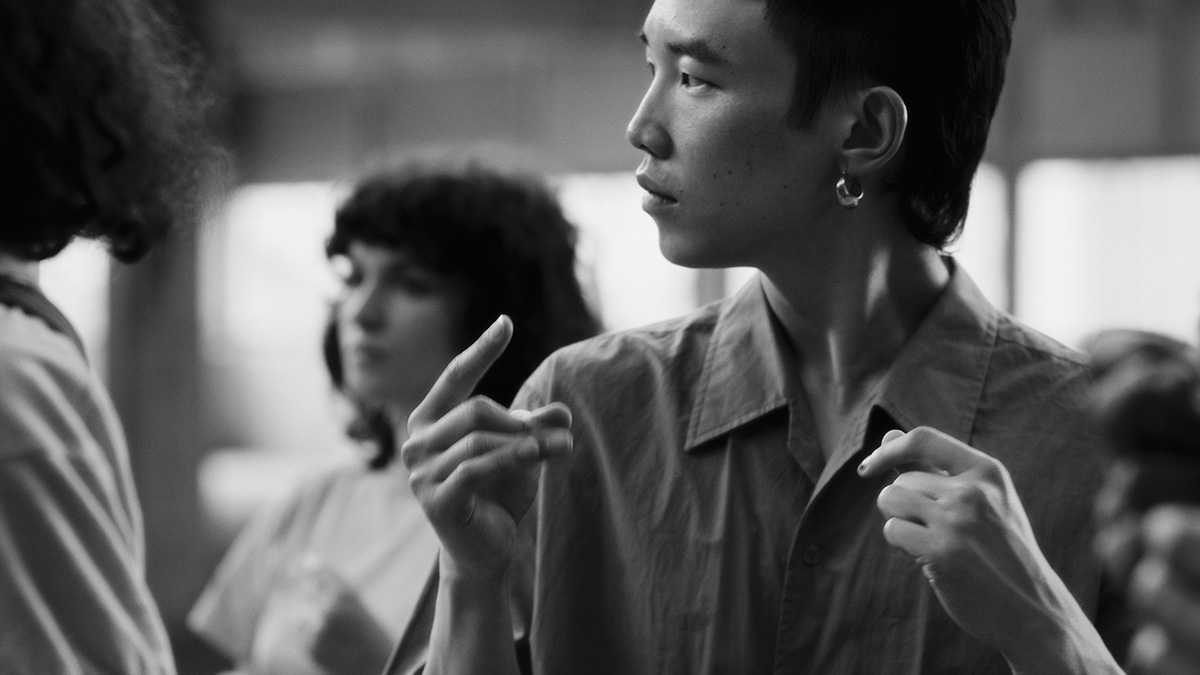
Future Perfect Continuous is an invitation to meditate, to listen closely, and to consider the greater meaning of small gestures. In this work, Angelica Mesiti creates a crease in time and in memory, while offering an anchor to a transcendent idea of community. Future Perfect Continuous is based on a game usually taught to children in a classroom setting as a community building or drama-warm-up exercise. It involves a simple series hands gesture like rubbing, snapping, clapping, slapping that when repeated by the group generate a sound performance that convincingly mimics the sound of a rainstorm. For this video the ‘rain-storm’ activity is performed by a diverse group of young adults in their 20s, at the start of their adult life. 'We can imagine them leaving home and entering society, forming new communities'(1). ‘In my work I often explore the idea of the individual and the collective and how gesture and sound can be used to express a cultural experience or moment. I am interested in how this innocent game of imitating nature could also represent a turbulence that is part of the present. The performers become the weather’(2). 1 Kathleen Ritter 2 Angelica Mesiti
Angelica Mesiti is a multi-disciplinary artist based between Paris & Sydney. Her practice combines performance with video, sound and spatial installation to create immersive environments of absorption and contemplation. Mesiti has long been fascinated by performance: as a mode of storytelling and a means to express social ideas in physical form. In recent years she has been making videos that reveal how culture is manifested through non-linguistic forms of communication, and especially through vocabularies of sound and gesture.There is a focus in her work on the unquantifiable social role played by music — and, by extension, sound in general — in our relationship with the world. Mesiti’s work is regularly shown in museums and biennales internationally. Her work ASSEMBLY was the official Australian presentation at the 58th Venice Biennale (2019).
Messieurs Delmotte
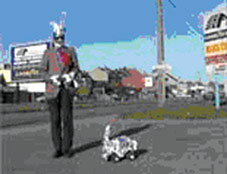
Breakdown dream - Melt Umbrella - Extinguishers
Experimental video | dv | color | 7:8 | Belgium | 2006
The work of Messieurs Delmotte is situated somewhere between reality and imagination, somewhere between genius and dilettantism. Delmotte is distinguished by his dress code and facial appearance. He always presents himself in a two- or three-piece suit. His semi-long hair is another distinctive trait, overabundantly daubed with gel, combed flat against his head, and cut straight across at the bottom. The finishing touch, an exceedingly precise stripe down the middle, completes the geometric coiffure. Delmotte puts forth a character who dashingly barrages his audience with gestural discoveries that are as unpredictable as they are absurd. In all this merriment and nonsense lies the existential and poetic revolt of the work. It is always about interfering in a situation, about engaging an hilarious and heroic battle with the trivial object, a character of a given circumstance. In Delmotte's opinion, society is irrational and possesses an insufficient sense of fairness and common sense to dismantle the mechanisms of social conditioning that determine our existence. This explains his escape into the ridiculous, the absurd, and the moments of abandoning good taste as an outlet for that which refuses to do battle with society. The physical commitment of his own body as an instrument of unruliness plays a cardinal role.
Messieurs Delmotte was born in 1967. He studied at the Liège Saint-Luc Institute and he mainly focuses on photography, video, and 'performance'. His work sides with the best Belgian surrealist tradition, somewhere between reality and imagination, between genius and dilettantism. His videos have been shown at such places as the Museum of Modern Art Philadelphia, New York Underground Festival, and MUHKA, Antwerp.
Messieurs Delmotte
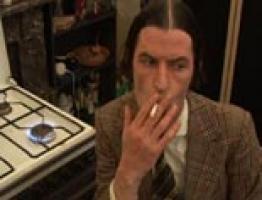
Fränz ünd Kofön
Experimental video | dv | color | 12:33 | Belgium | 0
My work is not a performance ? and actually even less of a good idea.? The videos by Messieurs ? or Monsieur- Delmotte spare nothing or no one and they trivialise anything that comes within his reach, including himself. His works are not self-portraits nor transpositions of the author in one or more imaginary characters. Maybe they can only be described as playful abdications of the subject, absurd and almost surreal one-acters. Dangling somewhere between reality and fiction ? or maybe these are even one and the same, exploding in a multitude of disengaged fragments. Delmotte, a self-declared poser, sneers at the institutionalised art world with his mischievous and surprising actions, trivial in content and simple in form. The results are uncomplicated and unvarnished, but also pure and most of all irresistibly charming. Or, as Delmotte puts it himself: "Je le fais, je ne sais pas pourquoi, mais je le fais!
Messieurs Delmotte (°1967) studied at the Liège Saint-Luc institute and he focuses mainly on photography, video and ?performance?. His work fits in with the best Belgian surrealist tradition, somewhere between reality and imagination, between brilliance and dilettantism. In his videos he translates his unbridled boyish pranks, his sneers at the institutionalized art world in one-man actions, as simple as they are absurd, as reflections of the schizophrenic identity of the artist. His video work was presented, among others at the Museum of Modern Art Philadelphia, the New York Underground Festival and the museum for contemporary art MUHKA (Antwerp).
Messieurs Delmotte
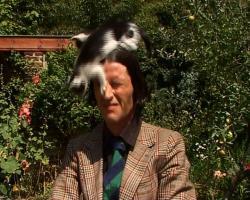
Head with the cats
Experimental video | dv | color | 1:27 | Belgium | 2006
The work of Messieurs Delmotte is situated somewhere between reality and imagination, somewhere between genius and dilettantism. Delmotte is distinguished by his dress code and facial appearance. He always presents himself in a two- or three-piece suit. His semi-long hair is another distinctive trait, overabundantly daubed with gel, combed flat against his head and cut straight across at the bottom. The finishing touch, an exceedingly precise stripe down the middle, completes the geometric coiffure. Delmotte puts forth a character who dashingly barrages his audience with gestural discoveries that are as unpredictable as they are absurd. In all this merriment and nonsense lies the existential and poetic revolt of the work. It is always about interfering in a situation, about engaging an hilarious and heroic battle with the trivial object, a character of a given circumstance. In Delmotte`s opinion, society is irrational and possesses insufficient sense of fairness and common sense to dismantle the mechanisms of social conditioning that determine our existence. This explains his escape into the ridiculous, the absurd, the moments of abandoning good taste as an outlet for that which refuses to do battle with society. The physical commitment of his own body as an instrument of unruliness plays a cardinal role.
In the eye of the spectator the work of Messieurs Delmotte (BE 1967, formerly Monsieur Delmotte) often seems bizarre, absurd or trivial, but to Delmotte his surrealist videos and installations of and with trivial actions are an absolute necessity. His shorts, focussing on obsessive behaviour and compulsive initiatives, make out a long series of attempts to pass beyond the limitations of reality, often with a cartoonlike outcome. Delmotte?s work has been shown, among others, at the Museum of Modern Art in Philadelphia, the New York Underground Festival, MUHKA (Antwerp) and Museo Reina Sofía (Madrid). He lives and works in Liège.
Christopher Messina
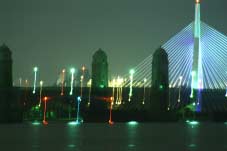
Nightlight
Experimental video | dv | color | 9:30 | USA | 2005
An experiment using digital photography, Nightlight is a study of the nights and lights along the Charles River in Boston, Massachusetts. This piece is made up entirely of still photographs, sequenced together to appear in motion. By making subtle adjustments between each photograph taken, the lights of the city seem to come to life.
Born in New York State, Chris is currently living and making films in Boston, Massachusetts.
Mathilde Mestrallet
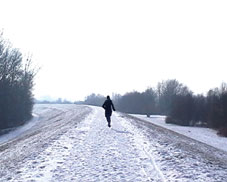
La règle du jeu
Experimental video | dv | color | 3:50 | France | 2006
"La règle du jeu" is part of a series of 8 videos called "Errances". These videos examine the relationship between man and landscape. Each project takes as a starting point a physical displacement, the discovery of a place previously unknown. The artist uses his body as a subject, a silhouette evolving in space, deciding on precise centring, fixed shots, and landscapes to be crossed. We could say that these videos revolve around nothing, a void, and that each video is the result or the narration of the encounter, the experience of these foreign spaces. A young woman is running along some bushes, then hides, as if being pursued. She is attempting to escape, a shot rings out and makes her stop. Playful slaughter, child's game, the camera shoots its victim.
Mathilde Mestrallet, studied Decorative Arts in Strasbourg, France. Her video projects examines man's place in landscape and his relationship to it. She is interested in the different routes that a given site proposes. The videos develop around simple scenarios and productions: a repetition of an action in a place; steps; strolls; and games. The lived experience, the real encounter with the landscape, the relationship to the space as an unknown piece of land, as a foreign place, and territories of possibility are the starting points of each video project. Between 'no man's land' and labyrinthine architecture, the various actors evolve in these oversized spaces.
Barbara Meter
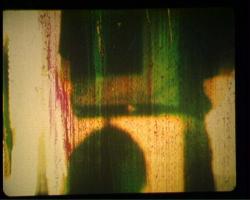
A Touch
Experimental film | 16mm | color | 13:30 | Netherlands | 2008
,,,So it all passes, like wind, like shadows and smoke.
Barbara Meter started filmmaking in the late seventies. She has made mainly experimental films but also documentaries and narratives. She has taught film in Groningen, Holland, and at the San Francisco Art Institute. She has curated many screenings of experimental films which were unique for Holland, where she lives and works up till now.
Barbara Meter
Ariadne
Experimental film | 35mm | color | 12:0 | Netherlands | 2004
Constant moving of wheels, threads and sprockets in a homage to the medium of film.
Barbara Meter (1939) attended the Dutch Film Academy in 1963. She makes films since the 70s: documentaries, feature films - mainly experimental. Meter was co-founder of Electric Cinema, in the early 70s a bastion of Dutch experimental cinema; and Stichting Lighthouse in the 80s. At present she also works as a curator of film programs, teacher and free-lance lecturer on film.
Henrike Meyer, Thérèse Nylén
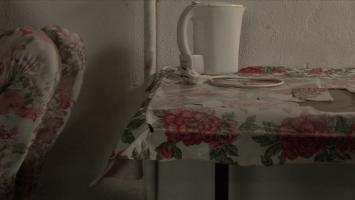
Still Leben
Video installation | | color | 4:56 | Germany | 2008
?Still Leben? is the fruit of a coproduction between the video artist Henrike Meyer and the choreographer Therese Nylén. The two artists are leaning on the cellar of an asparagus restaurant in Brandenburg. During the three months of the season, the restaurant offers lodging to 150 Polish workmen. The remainder of the year, the 30 rooms remains empty and abandoned. They produce the effect of a time capsule. Plastic flowers in large boxes, scribbled pages from the calendar, graffiti on the wall, cloths on the tables leaving many traces of the passing through of the workmen. Arrangements full of memories. The vision of these arrangements and the dancer is face to face in a 2-Channel-Projection, and are mutually motivated in their movements in a mimetic exchange.
Henrike Meyer was born in 1984 in Hoya in Weser. From 2003 to 2006, he studied theatre, the history of art and literature in Freie University of Berlin, followed on by visual communication at the University of Arts of Berlin up to 2008 and is currently working on experimental creation and media at the same university. He lives and works in Berlin. Therese Nylén was born in 1976 in Malmö, in Sweden. She obtained a degree in modern theatrical dance at the Higher School of Arts of Amsterdam in 2001. In 2005, she was chosen to reside in Scuol, in Switzerland, with the NAIRS Kuturzentrum, and again in 2007, this time with Werkbeitrag Tanz of the canton of Luzerne. From 2001 to 2007, she collaborated in projects with, Martin Butler (Netherlands), Suzanne Marx (Netherlands), Kyle Bukhari (Swiss), and Nina F.Schneider (Swiss) among others. She lives and works in Berlin.

Philippe-alain Michaud
Anthony Mccall
0 | 0 | | 60:0 | France | 2007
Movies are not this projected image that dig fictitious depth into the wall's surface anymore, but truly a constituted surface that blends with the very event of the projection. That is how the beams of light cut out in Anthony McCall's smoke, developing the specifically plastic proprieties of the movie, cross the borders of the history of cinema to join the minimalist propositions of the sculptors of the 70's.
Born in 1961, art historian and critic Philippe-Alain Michaud has been curator and head of the cinema department at the National Museum of Modern Art (MNAM), where he has been supervising the exhibition "Le mouvement des images - Art et Cinéma", since 2003. The exhibition was an original presentation of the permanent exhibition at the MNAM, in which he proposed a rereading of the history of the twentieth century based on the history of cinema. His attention is aimed at the territories situated between plastic arts and the cinema, and he questions himself about the contemporary artistic forms and their history. In 2004 he was the instigator of "Hollywood Déconstruit : remontages, remises en scène, resucées", a cycle that witnesses the manner in which experimental filmmakers and artists have revisited the universe of Hollywood Cinema, at the MNAM cinema. As an author he has written numerous articles and books, including "Le peuple des images", and "Sketches. Histoire de l?art, cinéma". He is a member of the editing board of MNAM's books and is in charge of the "La littérature artistique" collection from Macula editions.
Ariane Michel
Le dernier voyage
| | | 14:58 | France | 0
Ariane Michel
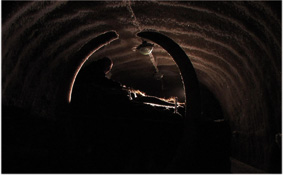
LA CAVE
Video | | color | 13:0 | France | 2009
Dans une cave gelée, un homme travaille à la lueur d`une lampe. Il dégèle patiemment un grand bloc de terre qui renferme le corps intact d`un Mammouth.
Ariane Michel vit et travaille à Paris, ou elle est née en 1973. Depuis ses études à L`ENSAD, un passage au Fresnoy et une résidence au Pavillon - cellule de recherche au Palais de Tokyo, Ariane Michel réalise des travaux en vidéo qui s`inscrivent le plus souvent dans des dispositifs d`installation ou de performance. On a pu les voir à l`Atelier du Jeu de Paume à Paris, à la foire de Bâle, en centres d`art ou dans des festivals de cinéma (FRAC de Reims, CRAC de Sète, MoMA NY, Festival de Rotterdam). Si son long-métrage Les Hommes, (Grand Prix de la Compétition Française, FID Marseille 06), est sorti en salles de cinéma en France en 2008, il s`inscrit dans une même recherche : offrir au visiteur-spectateur une expérience perceptive. En 2010, on pourra voir le travail d`Ariane Michel dans des expositions personnelles à la Fondation d`Entreprise Ricard (Paris) et à l`Espace Croisé de Roubaix. Ariane Michel est représentée par la galerie Jousse Entreprise à Paris. Plus d`infos sur: www.ariane-michel.com
Audrius Mickevicius
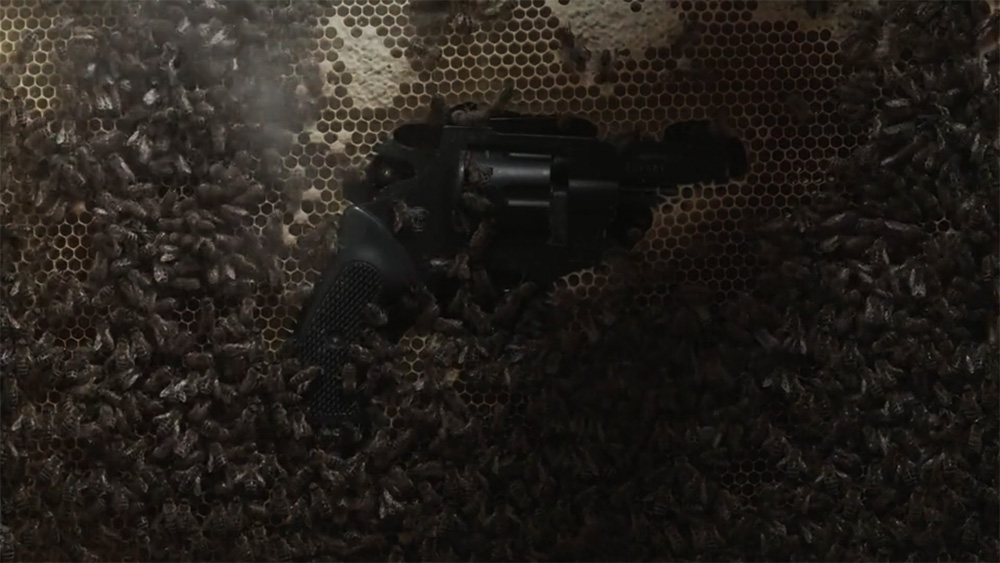
Pavyzdingas elgesys_2 (Exemplary Behaviour_2)
Video installation | 4k | color | 10:0 | Lithuania | 2017
A few years ago my elder brother was killed by two men. One of the murderers escaped punishment while the second, who alone took the blame for the crime, was later released from prison for an exemplary behaviour. This made me decide to start a socio-artistic research regarding what “exemplary behaviour” means in the case of a murderer, when and how killers behave exemplarily. In summer 2014 I started to develop feature-length creative documentary “Exemplary Behaviuor”. Logline of the documentary says: The documentary explores the paradox of exemplary behaviour in murderers currently serving life sentences in Vilnius’ Lukišk?s prison and hoping to return to society. “Exemplary Behaviour” is a journey of transformation for the author, the murderers, and society who are searching for tolerance among humans. Now the documentary developed into a big scale socio-artistic transmedia project. “Exemplary Behaviour” is a project that seeks to create an emotionally and visually strong, thoughts provoking spaces that are meant to encourage tolerance to murderers. Tolerantia in Latin means ability to bear hardship, to be patient. Today many Europeans still tend to lack tolerance towards other ethnicities, immigrants, prisoners, unorthodox thinking, etc. In this project, the prisoner becomes a metaphor for “the other”. The main goal is to encourage tolerance of “others”. Video installation “Exemplary Behaviour” is an extended format of the documentary of the same title. It concentrates on a film element called healing sequence. Film’s healing sequences are hypnotic episodes, that are meant to awaken viewers’ imagination and are related to scientific phenomenon called “Prisoner’s Cinema”. Prisoner’s cinema is mainly reported by prisoners kept in dark cells for long periods of time. It’s an experience of seeing light without light actually entering the eye. It is a visual hallucination of light created by human brain that tries to compensate for lack of stimuli and the resulting monotony
Audrius Mickevi?ius is a Lithuanian film director, interdisciplinary artist (video art, photography, architecture, installations, graphics, sound, writing), and a professor in the Department of Media Art at the Vilnius Academy of Fine Arts, a guest lecturer in European universities. He completed his architectural sudies in Vilnius (1988) and visual communication studies in Copenhagen (1996). Audrius became obsessed with cinema at a young age. In 1983 he made his first 8 mm film “Requiem for Quartet”. Since then Audrius has made 17 more films. In recent years he created several experimental, documentary, and fiction films, which were screened in various international film festivals and MoMA, New York. Since 2010 the film director has been a member of the Lithuanian Filmmakers Union. He works and lives in Vilnius, Lithuania.
Ildefonso Miguel
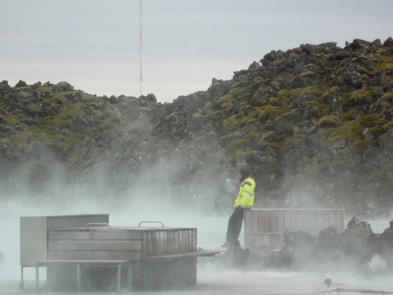
Engine
Experimental video | dv | color | 5:54 | Portugal | 2010
Man and Nature. Man and Machine. When we cross realities, something new emerges. A voice from the future is announcing a new world.
Born in 1985. He studied scriptwritting and editing. Engine is his first film.
Aurelia Mihai
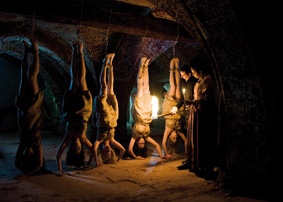
CINEMATOGRAFUL ROSU / Rotes Kino
Video | | color | 6:52 | Romania, Germany | 2009
Rotes Kino ein Projekt von Aurelia Mihai Die Arbeit ist als filmische Episode in zwei Szenen angelegt, sie baut auf einem Zeitsprung auf von 1610 zum 1969 und zurück. Konzipiert ist sie als filmische Schleife - (ein Loop in der Narration), je nachdem wo man in die Geschichte einsteigt, bekommt man sie chronologisch oder als Rückblende erzählt. In diesem Projekt benutze ich die Figur der Gräfin Elisabeth Báthory als bekannte Serienmörderin der Geschichte, und weibliches Pendant des transsilvanischen Mythos Dracula. Der Legende nach hat Elisabeth Báthory in Jungfrauenblut gebadet, in dem Glauben dadurch jung und schön zu bleiben. Da es sich um eine Hybridfigur handelt (zwischen Mythologie und Historie) bleibt sie auch in meiner Arbeit eine rätselhafte Gestalt, was durch die Verschiebung in ein andere Zeit in der zweiten Szene verstärkt wird. Hier sehen wir sie als Patientin in einer Psychiatrischen Anstalt 1969, in der Sozialistischen Republik Rumänien. Das Verhältnis von Täter und Opfer wird in Frage gestellt. Thematisiert wird hier die Problematik, die die Frauen unter dem Ceausescu Regime erlebt haben. Im Gegensatz zur sexuellen Befreiung im Westen, wurde 1966 in Rumänien per Gesetz die Einfuhr von Verhütungsmitteln verboten, um die Geburtenrate zu steigern, sowie die Abtreibung unter Strafe gestellt.
Aurelia Mihai Geboren 1968 in Bukarest, Rumänien, lebt und arbeitet in Hamburg. Studium an der Kunstakademie Bukarest, Kunstakademie Düsseldorf (DAAD Stipendium `94-`96), und an der Kunsthochschule für Medien Köln . Auszeichnungen, u.a. Villa Aurora Stipendium, Los Angeles (2001), E STAR Stipendium IEA, Alfred, N. Y. (2001), Spiridon-Never-DuMont Preis (2002), Euregio Kunstpreis / Germany / NL (2005), Hamburger Arbeitsstipendium für Bildende Kunst (2005), Deutsche Akadremie Rom - Villa Massimo (2007), Projektstipendium - Schloss Balmoral (2009). Einzelausstellungen u.a. im National Museum of Contemporary Art - MNAC, Bukarest, Rumänien (2009) Museum Goch (2007), Kunstverein Hildesheim, Marburger Kunstverein (2004), im Kunstraum Düsseldorf (2001) und in der Bremer Kunsthalle (1998). Gruppenausstellungen und Screening u.a. im Museo Nacional Centro de Arte Reina Sofia, Madrid (2005), PAN-Screening bei der 52. Biennale Venedig, Tryingtoland 2 im MACRO, Rom (beide 2007), Martin-Gropius-Bau, Berlin, Chelsea Art Museum, N. Y. und Wallraf-Richartz-Museum, Köln (alle 2006), Museum voor Moderne Kunst Arnhem, Niederlande (2005), Kunsthalle Hamburg (2004) Periferic 8 - Biennial for Contemporary Art, Iaşi, Rumänien/ RO, Robert Else Gallery, Sacramento, Californien/ USA , CIAC - Centre International d`Art Contemporain de Pont Aven/ FR (2008), K21 Düsseldorf, Kunsthalle Hamburg, Centre of Contemporary Art and the Nature World, Plymouth/ UK , Neue Gesellschaft für Bildende Kunst (NGBK), Berlin, Galerie Commune, Tourcoing, Frankreich und Städtische Galerie Ravensburg. (2009).
Aurelia Mihai
CENTO PIEDI
Experimental fiction | hdv | color and b&w | 11:7 | Romania, Germany | 2012
CENTO PIEDI (A Hundred Steps) deals with recent themes of the Romanian society: identity, image and immigration for work purposes. Immigration has become a widespread phenomenon in the last couple of years. The location of the movie centers around one of the kernels of the Romanian exodus ?Rome, the capital of Italy. The Eternal City, has played a crucial role in the history of the formation and establishment of the Romanian tongue and nation (through the conquest of Dacia in 105-106 the emperor Trajan has Latinized the Dacian people around the Danube river leading to the formation of the Romanian language). In Rome, on the site of Trajan?s Forum, we can nowadays find ?Trajan?s Column? who described through exceptional relieves the two Dacian wars. This monument is not only a masterpiece of ancient Rome but also the symbol of the birth of the Romanian people. The structure of the narrative in this movie unfolds on two parallel grounds of action through which two spaces will be defined: the Internal one (inside the column of Trajan) and the Exterior one (outside the column and on the forum).
Aurelia Mihai is an artist and filmmaker born in Bucharest, Romania who lives and works in Bucharest and in Hamburg, Germany. She is professor at the Braunschweig University of Art, Germany since 2009. Aurelia Mihai?s video work has been the recipient of numerous prizes and scholarships that include the E STAR Scholarship from the Institut for Electronic Arts, Alfred, New York and the Villa Aurora Scholarship, Los Angeles, USA (2001), the EMARE Scholarship Hull Time Based Arts, UK (2004), Prize for young artists of Düsseldor (2001), Prix Spiridon-Never-DuMont (2002), Euregio Kunstpreis / Germany / NL (2005), Hamburger Arbeitsstipendium für Bildende Kunst, Scholarship Schloss Ringenberg (2005), Project scholarship for short films, BBRKM, Künstlerhaus Schloß Balmoral, Germany (2009) , German Academy in Rome, - Villa Massimo (2007), Italy, and IASPIS, International Artist Studio Programme Stockholm, Sweden (2010). Her works have been exhibited internationally at the Städtische Galerie Wolfsburg, K21 Düsseldorf, Kunsthalle Mainz, Martin Gropius Bau, Berlin, Hamburger Kunsthalle, Germany, at the Chelsea Art Museum, New York, The Cheekwood Art Museum, Nashville Tennessee, USA , Centre Pompidou, Paris, Centre International d`Art Contemporain de Pont Aven/ FR, Cobra Museum in Amstelveen, NL.
Aurelia Mihai
City of Bucur
Experimental doc. | 0 | color | 21:42 | Romania, Germany | 2010
City of Bucur is a film about the foundation myth of Bucharest set in the present. Next to the hill which the legendary Bucur the Shepherd chose to settle down on, the People?s Palace now stands, the architectural embodiment of Ceausescu?s megalomaniac dictatorship and today the seat of the Romanian Parliament. In the ?making-of? format, the film tells the story of ?? a short movie production about the foundation myth in this historic location. The shepherd, the film director, and the flock of sheep all begin their parallel journeys towards the location, the place where the legend originated. The movie, which has not yet been shot, has actually been recounted indirectly before the film crew has even reached the set. We know about this projected film which will tell the tale of the city?s development in a single shot ? from its foundation myth to the present. One shot that transports a ?fiction? into contemporary reality.
Aurelia Mihai?s video work has been the recipient of numerous prizes and scholarships that include the Video Art Awards Bremen (1997), the E STAR Scholarship from the Institut for Electronic Arts, Alfred, New York and the Villa Aurora Scholarship, Los Angeles (2001) the EMARE Scholarship Hull Time Based Arts UK (2004) the Villa Massimo Rome Scholarship (2007) the Schloss Balmoral Scholarship (2009) and IASPIS, Stockholm, Sweden (2010). Her works have been exhibited internationally at the K21 Düsseldorf, Gropius Bau, Berlin, Hamburger Kunsthalle, Germany, at the Chelsea Art Museum, New York, USA , Centre International d`Art Contemporain de Pont Aven/ France, Museo Nacional Centro de Arte Reina Sofia, Madrid, Spanien, Periferic 8 - Biennial for Contemporary Art, Iaºi, Romania and at the Centre of Contemporary Art and the Nature World, in Plymouth, UK