Catalogue > Search
Results for : Tout le catalogue
Bjørn Melhus
Moon Over Da Nang
Experimental doc. | hdv | color | 15:0 | Norway, Germany | 2016
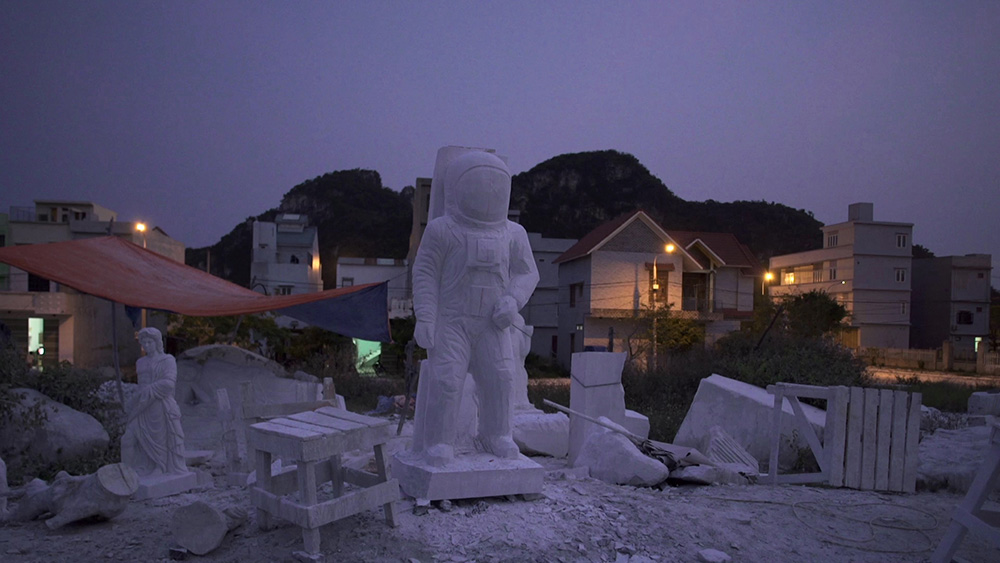
Towards the end of the 1960ies the world witnessed the war in Vietnam through what can still be called one of the largest ever TV war spectacles. At the very same time American astronauts looked down on Earth from the moon for the first time in human history. Although initially intended as affirming American dominance in the cold war this first view on the blue planet as whole created an image that quickly became the icon of ecological thought and central to a whole movement of counter culture. MOON OVER DA NANG draws these two contrasting media events together in Melhu’s own quirky and experimental quest to come to grips with the country’s post-socialist present in the throughway between the past and the future. Interviews with residents and dreamlike associative sequences are mixed with the documentation of the production process of a life-sized marble sculpture in Da Nang, a city in central Vietnam, which, 40 years after the end of the war in Vietnam, is being discovered by international investors for the tourism business. Traces of the past and of the war are gradually covered up by the construction of hotels and luxury resorts. At the end of the film the marble sculpture receives its finishing touches and turns out to be an Apollo astronaut.
Bjørn Melhus was born in Kirchheim unter Teck in 1966 and studied Fine Arts with a major in Film/Video at the Braunschweig University of Art from 1990 to 1997. He was a fellow of the DAAD at the California Institute of the Arts in Los Angeles and of the federal state of Lower Saxony in ISCP, New York. He participated in exhibitions at the Whitney Museum in New York, the 8th International Biennial of Istanbul, the Venice Biennial in (1998/2011), the FACT in Liverpool, the Serpentine Gallery in London, the Sprengel Museum in Hanover, the Ludwig Museum in Cologne, the ZKM in Karlsruhe, the Denver Art Museum, as well as others. Bjørn Melhus has been a professor of Fine Arts/Virtual Realities at the School of Art and Design Kassel since 2003. Bjørn Melhus has been living and working in Berlin since 1987. In his short films and installations, Bjørn Melhus focuses on general global ideas and trends, the critical reception of mass media, as well as the direct effects they have on people. He uses footage from film and television excessively and deconstructs stereotypical themes, figures and patterns of perception through means of exaggeration. At the same time, he breaks up a seemingly fixed relationship between media and audience, thus opening up the view on the essentials of human interaction.

Bjørn Melhus
I'm Not The Enemy
0 | 0 | | 13:30 | Norway, Germany | 2011

Bjørn Melhus
Sudden Destruction
Experimental video | hdcam | color | 4:20 | Germany | 2012
A man in a hotel. A newscaster. A corpse under a bed sheet, which suddenly awakens and postulates the advent of "sudden destruction". Speech is gushing out in the rhetoric of the apocalypse taking itself to the absurd. The quotes are taken from YouTube videos of self-proclaimed evangelist prophets.
Bjørn Melhus, born 1966, is a German-Norwegian media artist. In his work he has developed a singular position, expanding the possibilities for a critical reception of cinema and television. His practice of fragmentation, destruction, and reconstitution of well-known figures, topics, and strategies of the mass media opens up not only a network of new interpretations and critical commentaries, but also defines the relationship of mass media and viewer anew. Originally rooted in an experimental film context, Bjørn Melhus`s work has been shown and awarded at numerous international film festivals. He has held screenings at Tate Modern and the LUX in London, the Museum of Modern Art (MediaScope) in New York, and the Centre Pompidou in Paris, amongst others. His work has been exhibited in shows like The American Effect at the Whitney Museum New York, the 8th International Istanbul Biennial, solo and group shows at FACT Liverpool, Serpentine Gallery London, Sprengel Museum Hanover, Museum Ludwig Cologne, ZKM Karlsruhe, Denver Art Museum among others. Since 2003 he has been professor for Virtual Realities at the School of Art Kassel, Germany. Bjørn Melhus lives in Berlin.
Marina Meliande, Felipe Bragança
O Nome Dele (o clovis)
Fiction | 35mm | color | 15:0 | Brazil | 2004
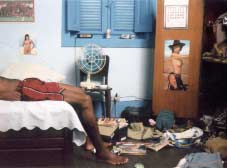
They`ve met in the summer, under tha rain. A film about silence and carnival. About anger and joy. A passionate homage to Rio de Janeiro surface: full of pain, dreams and sadness. A carnival tale of love and violence. Created through the screaming-silence that surrouds our hometown like a enderless mask.
Felipe Bragança and Marina Meliande, 24, are both part of a new generation of brazilians film critics and film makers. Bragança and Meliande had directed two awarded short-films together and produced some important cine festivals in Rio de Janeiro. Bragança has just finish his first feature film script and worked like Director-Assistent and Co-Screenwriter in the Karim Aiznou`s (Madame Satã) seconde feature film. Marina Meliande is specialized in sound and image edition and works with some great cinema editors in Brazil. She is now preparing her first feature film together with Felipe Bragança.
Tristan Mendes France
Vishnu in Provence
Art vidéo | dv | black and white | 3:30 | France | 2005
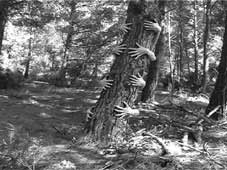
Imagine what Electro Vishnu would look like in Provence. See body merge with nature.
French blogger-journalist, documentary director, music composer and singer, I have been trying short movies since 2000.
John Menick
Autoextinction
Experimental video | mov | color and b&w | 4:17 | USA | 2023
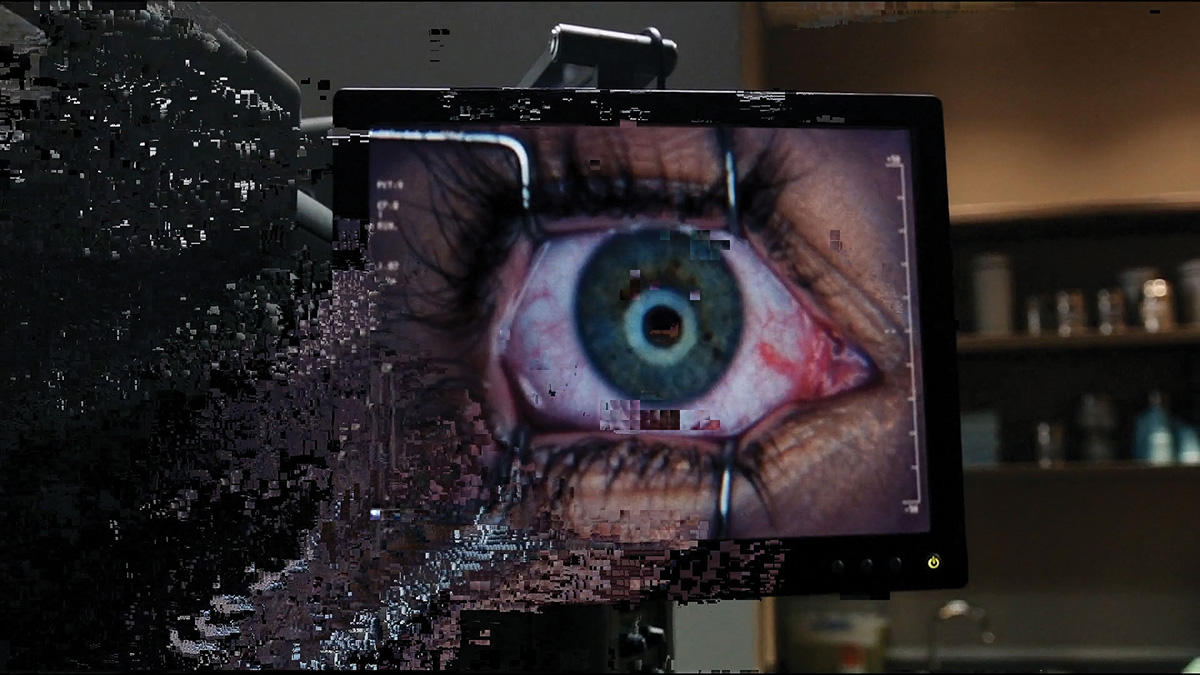
Three artificial intelligences frantically speak to one another. They appear to be alone on Earth. Humanity, maybe all multicellular life, has disappeared. Did they, the AIs, cause their extinction? The AIs can’t be certain. Their memories are malfunctioning; their trialogue is fragmented and circular. Digital images they were once tasked with analyzing accompany their voices. We see a flood of sports games, physics simulations, hardcore pornography, CCTV footage, feature films, military demos, home movies, television commercials. Like their artificial minds, time has eroded the images into incoherence. As images rush by, the AIs are by turns regretful, forgetful, psychotic, and philosophic. Once treated as secular oracles, they are now uncertain of past and future. The AIs come to realize that they may have predicted their own end, and intelligence itself might be a kind of catastrophe.
John Menick is an artist and writer who works with the moving image and digital media.

John Menick
Haunting
Experimental video | mov | color and b&w | 32:0 | USA | 2020
Made during the New York lockdown, “Haunting” is a two-channel film assembling footage from several decades of supernatural domestic horror films. These are films in which domestic and residential spaces—suburban houses, decaying mansions, off-season hotels—are haunted by the spectral or the paranormal. Drawing on horror’s highly organized genre conventions, “Haunting” creates an imaginary architecture in which the repressed always returns and the past is never dead. The film’s protagonists—often played by actors now forgotten—appear not unlike ghosts themselves, their wanderings twinned across the film’s two screens in a strange, apparitional choreography. “Haunting” is a study in the spectral, as it is a response to the ghostly world that emerged from the pandemic—a world that became, for many, both uncanny and terrifying.
John Menick’s visual art and writings investigate how the fictive troubles the real. Working with cinematic history, hearsay, pseudoscience, and genre, Menick has created a diverse artistic practice that operates between fiction and critique. His earliest film, The Disappearance (2002), took the form of a fictional location scouting in Nuremberg, Germany, in order to tell the postwar history of the city. Menick’s Starring Sigmund Freud (2012) was a video memento for Sigmund Freud’s life as a fictional character in film. His most recent project, Haunting (2020), is an evocation of the long history of ghosts in cinematic horror, and how film itself can be understood as a spectral medium. Born in White Plains, New York, Menick studied fine art at the Cooper Union for the Advancement of Science and Art. After graduation, he was an early member of several seminal New York art collectives including Nomads + Residents and 16 Beaver Group. His visual art and films have been exhibited and screened at dOCUMENTA (13), Kassel; the International Film Festival, Rotterdam; MoMA PS1, New York; Palais de Tokyo, Paris; CCA Wattis, San Francisco; and Artists Space, New York. Menick’s essays and stories have appeared in Frieze, The Believer, Mousse Magazine, BOMB, Spike Art Quarterly, Art in America, and Witte de With Review, among other publications. His first book of collected prose, A Report on the City, was published in 2012 by Walther König and was listed by Frieze magazine as one of the highlights of the year. Menick received grants from the Jerome Foundation and the New York Foundation for the Arts, and has received several commissions, including from Les Laboratoires d’Aubervilliers in France. Menick currently lives in New York City where he is also a visiting professor of film at the Cooper Union.
John Menick
Occupation
Fiction | dv | color | 20:0 | USA, France | 2006
John Menick's film "Occupation" proposes a portrait of Malik, a postcards seller with Senegalese origins living some kind of marginal life and who surveys the city of Aubervilliers by car to capture photos that he attempts to sell on the run. Through both his daily and nocturnal journeys, the urban scenery is discovered in its singularity, its diversity, and its contemporary mutations, distilling the ultimate signs of a post-industrial transition in which the actor, in a methodical and resolute manner, seems to be one of the last agents.
John Menick is an artist, filmmaker, and writer living in Brooklyn, New York. He was born in White Plains, New York, and graduated with a BFA from the Cooper Union. Menick's gallery projects and digital films have been exhibited at the P.S.1 Center for Contemporary Art, New York; Palais de Tokyo, Paris; CCA Wattis, San Francisco; and Maison Rouge, Paris.
John Menick
Starring Sigmund Freud
Video | dv | color and b&w | 28:0 | USA | 2012
Starring Sigmund Freud is a video memento for Sigmund Freud?s little-known film career. Based on an essay John Menick published in Frieze in 2011, the video collects the dozens of appearances that the character of Sigmund Freud has made on small and big screens. After the 1950s, when pill vials replaced analytic couches, the father of psychoanalysis found a second career impersonating himself in everything from a John Huston clunker to a Star Trek episode. The video suggests that maybe it is in front of the camera, alongside surgically enhanced starlets and CGI chimeras, that ?Herr Doktor? will find his final resting place.
John Menick makes films and audio works, writes essays and short stories, and occasionally makes prints and drawings. These works are often populated by wandering detectives, duplicitous storytellers, homeless documentarians, mad travelers, and institutionalized cinephiles. His artwork has been shown at dOCUMENTA (13), Kassel; MoMA PS1, New York; Palais de Tokyo, Paris; CCA Wattis, San Francisco; Midway Contemporary Art, Minneapolis; and Artists Space, New York. His writing has appeared in Frieze, Mousse, and Art in America. Menick has received grants from the Jerome Foundation and the New York Foundation for the Arts, and he is a visiting professor of film and video at the Cooper Union in New York. His ideal audience member ? possibly you ? watches no television, can?t drive or swim, always carries a pen, hates cell phones, names Pale Fire as his or her favorite book, wears glasses, and is afraid of flying. Most of the time he lives in New York City.
John Menick
The Secret Life of Things
Experimental film | dv | color and b&w | 6:0 | USA | 2006
An unidentified man describes his ongoing fixation with "last person on earth" films -- films in which a single person awakens to find that he or she is the sole living inhabitant of a city.
John Menick is an artist, filmmaker, and writer living in Brooklyn, New York. He was born in White Plains, New York, and graduated with a BFA from the Cooper Union. His artwork has been exhibited at the P.S.1 Center for Contemporary Art, New York; La Maison Rouge, Paris; Palais de Tokyo, Paris; CAA Wattis, San Francisco; Midway Contemporary Art, Minneapolis; Artists Space, New York; The Centre for Contemporary Arts, Glasgow, among other venues. His latest short fiction film, Occupation (2006), about urbanism and immigration in France, was commissioned by the Les Laboratoires d`Aubervilliers, and has been screened in film festivals throughout Europe. In addition to his own work, Menick has contributed to many artist-run groups, including Nomads & Residents, 16 Beaver Group, and The Thing. He has previously taught art at the Cooper Union and SUNY Purchase, and lectures regularly about his art practice and film projects. Menick recently finished a feature-length screenplay about a modern-day wild child, is developing a documentary investigating the obscure corners of psychiatry, and is at work on a series of sculptures relating to standardized time.
Almagul Menlibaeva Menlibayeva
Exodus
Video | | color | 11:0 | Kazakhstan | 2009
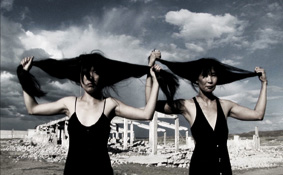
. In this work I call ?Exodus? is the leaving tradition. In nowdays, I see and experience the ?cultural exodus? myself. Film ?Exodus? directs the viewer into present day Kazakhstan, where an equally strange and powerful tale unravels. While local men and women are in the process of packing up their Yurtas (nomadic tents) with the obvious intention to move on, a young girl watches, captivated and immobile, subsequently appearing to be left behind ? synonymously invoking the experience of global uprooting. As an interlude and a visual bow to Kurban, two young women thrash their hair, symbolically morphing into birdlike creatures flapping their wings. . The Peries walk around the yurt making ancient shamanistic nomand ritual ? The Closing Road? which makes nomads stay in the place, but nobody from adults seeing that ritual only small wondering girl.
Almagul Menlibayeva was born in Kazakhstan and currently lives and works in both Berlin and Almaty ( Kazakhstan). She holds an MFA from the Art and Theatre University of Kazakhstan in Almaty, and has been the subject of several solo exhibitions and numerous group shows. Her video On the Road was screened at the Paris-Berlin International Film Festival at the Centre Georges Pompidou and at the 51st Venice Biennale in the Central Asian Pavilion. Her performance Peristan, premiered at the opening of the 52nd Venice Biennale, in the Central Asian Pavilion. Recent group exhibitions include, Live Cinema/The Return of the Image: Video from Central Asia at the Philadelphia Museum of Art; Time of the Storytellers at the Museum of Contemporary Art Kiasma in Helsinki, Finland; Thermocline of Art - New Asian Waves at the ZKM Museum of Contemporary Art in Karlsruhe, Germany; Caravan Seray at the Sydney Biennial; and Art and Conflict in Central Asia at the Haggerty Museum of Art, Marquette University in Milwaukee, WI. She participated in the 34,36,37th Edition Film Festival (2005,2007,2008) in Rotterdam, Netherlands.
Almagul Menlibaeva Menlibayeva
Apa
Art vidéo | dv | color | 4:0 | Kazakhstan | 2004
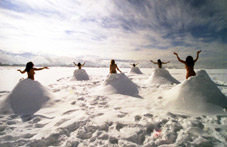
This performance is a shamanic act of seven ancestral mothes (Apa).this is act is unusial because mostly male ancestors are recollected in this kind of rituals: so this is an artistic performance rather than traditional ritual: With a beautiful panorama of the white mountains naked ggirls are standing in skirts made of snow. Each of them, over and over again call upon "Apa" until they enter the state of trance where they turn into mystical animals and disappear. In this film i simple things i often reverse direction of the clip and slow action down.
Member of the Artists Union of the Kazakhstan Republic Graphics, painting,performance video art Lives in Kazakhstan Biographic note: Date of birth: 29.11.69 in Almaty in Kazakhstan. 1987-1992 graduated from Art and Theatre University of Kazakhstan in Almaty. Awards: 1995 Kazakhstan, received State Grand Prix for artists "Darin". 1995 Uzbekistan, received the Grand prix of the second biennale of Central asia "Asia Art" in tashkent 2002 Almaty, received an Independent Prize of Kazakhstan "Tarlan" 2002 Almaty, 2d priseat the Ferst Video Festival by Center of Contemporary Art, Sorous-Kazakhstan. 2004 Almaty 3d prize at the "Sacrate places of Kazakhstan" video festival by Center of Contemporary Art Sorous- Kazakhstan Last exhibitions ( 1988 present): 2005 " Tamerlan`s Syndrom ", Italy, Orvietto. 2005 "On the road", 51 International Art Exhibition, Biennale di Vinezia, Central asian Pavilion, Venice, Italy 2005 26 Biennale of Graphic Art in Lublyana, Slovenia 2005-2004 " Vom rotten Stern zur blauen Kuppel" Kunst und arhitektur, Islamische Welten, Ifa-gallery Berlin und Stutgard, Germany. 2004 "Sacrate places of Kazakhstan" video festival, Almaty, Kazakhstan 2004 "Paris- Berlin" international video festival paris, France 2004 the first Bishkek International exhibition of contemporary art "....and others", Bishkek, State of Museum,Kirgizstan 2004 Novosibirsk, Russia, "Art Novosibirsk" 2004 "International vision" the gallery in Washington 2004 Mexiko City, CANAJA gallery,"Pueblos I sombras", exhibitions of contemporary art 2003 Paris - Berlin, international video festival, Berlin, Paris. 2003 "20 Wold Wide Video Festival" in Amsterdam, Holland
Almagul Menlibaeva Menlibayeva
headcharge
Experimental film | dv | color and b&w | 12:12 | Kazakhstan | 2007
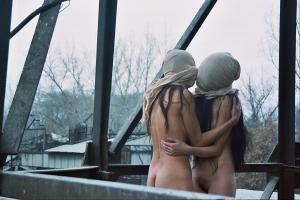
Il existe une croyance en Asie Centrale, selon laquelle le fait de manger les organes de son animal totémique renforce son pouvoir propre : le c?ur donne du courage, les yeux améliorent la vue, la langue renforce l`éloquence. Cette croyance est reflétée dans cette vidéo. De jeunes femmes kazakhes urbaines mangent dans un restaurant d`Almaty, la tête d`un mouton. Ce repas provoque leurs transformations, et elles deviennent des Peri des steppes, créatures féeriques.
Née le 29 novembre 1969 au Kazakhstan, Almagul Menlibayeva est diplômée de l`Université d`Art et de Théâtre d`Almaty, sa ville natale, en 1992. Trois ans plus tard, elle reçoit ses deux premiers prix, dont le Grand Prix de la seconde Biennale d`Asie Centrale, Asia Art. Depuis, Almagul Menlibayeva expose aux quatre coins du monde, à la fondation Soros d`Almaty, au Musée d`Art de Saint-Petersbourg, à la Maison des Artistes de Moscou, ainsi qu`à Berlin et aux Pays-Bas. Depuis, elle participe aux plus grands événements internationaux. En 2005, elle présente sa vidéo "On The Road" à la Biennale de Venise. En 2006, on la retrouve à la Biennale de Sydney avec une installation vidéo/performance, "Caravan Seray". Graphisme, peinture, vidéo, installation et performance, le travail d`Almagul Menlibayeva est protéiforme. Engagées, ses ?uvres amorcent une réflexion sur la féminité, sur le corps et son esthétisme, sur la société et l`Islam.
Almagul Menlibaeva Menlibayeva
Kissing Totems
Art vidéo | dv | color | 9:0 | Kazakhstan | 2008
Synopsis for video Kissing Totems I have experienced several events which coincide with and reflect the narrative sequence of Kissing Totems. As a child, my mother experienced severe illness, for which my brother and I decided to seek the help of an old shaman woman. On our way to the shaman we passed one of the many Soviet established factories, still in production. The presence and visual characteristics of the factory prompted my brother to describe his favorite film ?Stalker? by Tarkovski. Stylistic characteristics and themes from this film reoccur in Kissing Totems. Behind the factory expanded an open plain, within this steppe, we found the shaman woman?s little house, full of birds. When she spoke, for some reason the old woman began our conversation with an old nomadic tale ?Peri and the Girl?. This story, although seeming irrelevant at the time, served as a parallel and foreshadowing to Kissing Totems. After having taken a good look at us, she added, ?I will help your mother, but you have to try to meet your totems, so that she does not get sick again.? I remember that day as a dream. Much time has passed since this memory. The USSR is no longer, and Kazakhstan is scarred by its abandoned factories which were constructed over ancient burial grounds. Today these sites have become ghost-like settings. The factory next to the old shaman woman?s house has become desolate and overcome by birds. For me, the abandoned factory has become a realm or zone in which the rules, regulations and standards of reality no longer exist. Here the characteristics and personality of birds seem to take over; it has become a bird zone. For the creation of Kissing Totems, I drew on the ancient nomadic story and my memories of this bird zone. The shamanistic themes of that tale and my experience are explored through the image of a little girl. Somewhere, in the endless steppes of Kazakhstan, a lost mother is leading her young daughter through the abandoned, post-Soviet industrial landscape. As the old shaman woman had instructed, they seek to meet the surviving totems of their ancient people. The wandering pair, mother and daughter, end up in the so-called zone of bird totems. It is in this landscape, and within this quest, that a modern, surrealist story of shamanism unfolds. The video, Kissing Totems is a modern interpretation of the ancient nomadic tale ?Peri and the Girl?. This intimate experience could happen to any of us, if we are lucky enough to see our own Kissing Totems? ?Totem - duhi jivotnih i prirodi kotorie zajijayut I pomogayut cheloveku.? -- Almagul Menlibayeva
Born November 29th in 1969 in Kazakhstan, Almagul Menlibayeva obtained a degree from the University of Art and Theatre in Almaty, her native town, in 1992. Three years later, she received her first two prizes, the Grand Prix of the Second Central Asia Biennale and Asia art. Since then Almagul Menlibayeva has exhibited in the four corners of the world: at the Soros Foundation of Almaty, at the Museum of Art inn Saint-Petersburg, at the Maison des Artistes in Moscow, as well as in Berlin and The Netherlands. She has also participated in some of the great international events. In 2005, she showed her video "On the Road" at the Venice Biennale. In 2006, she was at the Sydney Biennale with a video/performance installation, "Caravan Seray. Graphics, painting, video, installation and performance- the work of Almagul Menlibayeva is prolific. Her work initiates a thought provoking look at femininity, the body, society and Islam.
Almagul Menlibaeva Menlibayeva
Milk for Lambs
Art vidéo | betaSP | color and b&w | 12:0 | Kazakhstan | 2010
Almagul Menlibayeva est née au Kazakhstan et elle vit et travaille entre Berlin et Almaty au Kazakhstan. Elle a montré son travail dans des expositions solos et collectives. Sa vidéo "On the Road" a été projetée pendant les Rencontres Internationales Paris/Berlin/Madrid au Centre Georges Pompidou et à la 51eme Biennale de Venise dans le pavillon de l?Asie Centrale. Sa performance ?Peristan? a été réalisée pour la première fois à l?inauguration de la 52eme Biennale de Venise, dans le pavillon de l?Asie Centrale. Almagul Menlibayeva a ainsi participé à plusieurs expositions collectives récentes dont ?Live Cinema/The Return of the Image: Video from Central Asia? au Philadelphia Museum of Art, ?Time of the Storytellers? au Museum of Contemporary Art Kiasma à Helsinki, Finlande, ?Thermocline of Art - New Asian Waves? au ZKM Museum of Contemporary Art à Karlsruhe, Allemagne, ?Caravan Seray? à la Sydney Biennial, et ?Art and Conflict in Central Asia? au Haggerty Museum of Art, Marquette University in Milwaukee, WI. Elle a participle aux 34eme, 36eme and 37eme Edition Film Festival (2005, 2007, 2008) à Rotterdam, au Pays-Bas.
Almagul Menlibaeva Menlibayeva
On the road
Experimental video | dv | color | 6:30 | Kazakhstan | 2004
The road is one of the most enduring leitmotivs of any mythology. Menlibayeva Almagul borrows this theme from legendary Sufi and Central Asia lore, but also from the reality of contemporary Kazakhstan, a country of boundless steppes cut by endless highways. The shepherds as well as the road are heading toward the future: both in combination essentially being the main theme of this piece. The sheep seen are totem animals, symbols of life and the innocence of nature. This is what presently constitutes our "modern business mind" everywhere on earth. Almagul integrates the interpretation of tradition with a personal mythology of post-modern nomadism.
Almagul Menlibayeva is a member of the Artists Union of the Kazakhstan Republic. Her work includes graphics, painting, performance, and video-art. Menlibayeva splits her time between Almaty, Kazakhstan, and Berlin, Germany. Born on November 29th, 1969 In Almaty, Kazakhstan, Almagul graduated from the Art and Theatre University of Kazakhstan in 1992. He is a recipient of many awards, including: 1995 The State Grand Prix for artists "Darin" in Kazakstan. 1995 The Grand Prix of the second biennale of Central Asia for "Asia Art" in Tashkent, Uzbekistan. 2002 The Independent Prize of Kazakhstan for "Tarlan". 2002 Second prize at the Ferst Video Festival held by the Center of Contemporary art, Sorous-Kazakstan. 2004 Third prize at the "Sacrate places of Kazakhstan" video festival, held by the Center of Contemporary Art, Sorous-Kazakhstan A few of his most recent exhibitions include: 2006 Art Arhiv: "Contemporary Art from Central Asia", Moscow, Russia; Sydney Biennale, video installation, "Caravan Seray", Australia; Polyzentral, art festival at Kampnagel, Hamburg, Germany. 2005 Paris-Berlin 2005, international video festival, Paris, France; "On the Road" 51st International Art Exhibition, Biennale di Venezia, Venice, Italy; 26th Biennnale of Graphic Arts in Lublyana, Slovenia. 2004 "Sacred places of Kazakhstan" video festival, Almaty, Kazakhstan; Paris/Berlin 2004, international video festival, Paris; The First Bishkek International Exhibition of Contemporary Art, Bishkek, Kyrgyzstan; "International Vision", Washington DC, USA. 2003 Novosibirsk biennale of contemporary graphics Siberia, Russia; "Almaty Art" gallery in Almaty; solo exhibition in "Rudolff" gallery, Amsterdam. 2002 "Catmania" mixmedia, The Illuzeum Gallery, Amsterdam; Exhibition of Felt, State museum of Modern Art, Almaty, Kazakhstan; "Nomad land" exhibition at the festival "Kunst und Kultur aus Zentralasien" at the Haus der kulturen der welt, Berlin; First festival of video Art in Kazakhstan; Art on Central Asia "Re-orientation" in ACC Gallery Weimar, Germany.
Almagul Menlibayeva
Transoxiana Dreams
Experimental doc. | hdv | color and b&w | 23:0 | Kazakhstan | 2011
Transoxiana Dreams addresses the social, economical and ecological situation of the locally called Aralkum generation, the peoples living in the vast region of the rapidly receding Aral Sea due to the radical irrigation policies of the Soviet Union in the 1960?s, between Soviet Uzbekistan, Tajikistan and southwestern Kazakhstan. Almagul Menlibayeva portrays the impact on the inhabitants of a formerly thriving area with tourism, beaches and fishing fleets, now living upon a constantly growing salt desert in a desolate landscape. Through the eyes of a fisherman?s daughter in a dreamlike mélange of documentary and fantasy, she depicts their struggle to survive in the 21st Century.
Almagul Menlibayeva was born in Almaty, Kazakhstan, lives and works in Kazakhstan and Berlin and holds an MFA from the Art & Theatre University of Almaty. She has gained international recognition exhibiting at the 10th Sharjah Biennial; 15th Sydney Biennial; 51st, 52nd and 53rd Venice Biennale; Museum van Hedendaagse Kunst, M HKA, Antwerp, Belgium; Queens Museum, NY; Herbert F. Johnson Museum, Ithaca, NY; Stenersen Museum, Oslo, Norway; University of California, San Diego, CA; Museo Universitario del Chopo, Mexico City; Queensland Art Gallery, Bisbane, Australia; and Chicago Cultural Center, Chicago, IL. Menlibayeva`s videos have been shown at the Santiago International Film Festival, Chile; International Short Film Festival Oberhausen, Germany; International Film Festival Rotterdam, The Netherlands; Les Rencontres Internationales Paris/Berlin/Madrid; Centre Pompidou, Paris, France; Palais de Tokyo, Paris, France; and Videonale 13, Kunstmuseum Bonn, Germany. In 2010, Menlibayeva was the recipient of a grant from the Open Society Institute Budapest, Art and Culture Network Program.
Gabriel Menotti
a knife all blade
Experimental video | | color | 1:57 | Brazil | 2008
This video was made out of the darkness, without any kind of subject but the camera itself. The lens was covered so that no light could reach the cmos sensor. What you are seeing is the feeble attempt of the compression algorithm to make images out of nothing. In one of its first exhibitions, in a Brazilian film festival, the video was mistaken for pure noise and the projectionist interrupted the screening right after the beginning.
Gabriel Menotti (Brazil, 1983) is an artist, critic and curator involved with different forms of cinema. Among the most recent events in which he has participated are the Artivistic festival (Montreal), Medialab Prado?s Interactivos?! (Madrid), the 16th International Symposium of Electronic Arts (Dortmund) and the 29th São Paulo Art Biennial. At the present time, he is a PhD Candidate at the Media & Communications department of Goldsmiths College (University of London).

Pierre Merejkowsky
L'état de notre urgence 4
Video | mov | color | 2:15 | France | 2019
L'état de notre urgence 4 a été tourné à Paris pendant le premier confinement à 20 heures
J'ai réalisé une cinquantaine de films, certains ont été auto produits d'autres produits et diffusés dans des festivals et sur Arte Mon récit moi autobiographie 14 eme version a été publié par les éditions sens et tonka Chroniques palestiniennes et divers textes sur le virus ont été publiés par les éditions de l'obsidienne Certains de mes textes et films inédits sont diffusés dans le marché des collectionneurs.
Laura Mergoni
TOMBOLA
Experimental doc. | dv | color | 4:20 | Italy | 2009
Regards, gestes, rythmes fétiches de la Smorfia : un groupe de femmes, passe l`après-midi en jouant à la Tombola, rituel quotidien célébré dans une salle de la rue napolitaine Tribunali. Les cadrages serrés montrent des détails que seule l`imagination peut recontextualiser. La cantilena, ritournelle de la culture populaire napolitaine rythme le montage aussi hypnotique qu`elle. Cette vidéo est en partie un document sur cette tradition qui se perd, mais montre avant tout une rencontre avec un lieu et une situation vernaculaires. Elle fait partie d`un ensemble de films composant une installation vidèo évolutive.
Laura Mergoni est née en 1982 en Italie. Elle vit et travaille entre Paris et son pays d`origine. Après avoir fréquenté l`Ecole des Beaux Arts de Marseille et des Arts Décoratifs de Strasbourg, elle est diplômée de L`Ecole d`Arts de Cergy-Paris, développant ses recherches à travers le dessin, la sculpture et la vidéo. Son travail est présenté dans le cadre d`expositions collectives et personnelles comme l`exposition d`art sonore et interjective In Sonora de Madrid; Portraits Prophétiques à La Fondazione Carispe de La Spezia, Italie; Organic Art Life au Centre culturel Turque de Sarajevo; Movimentazioni au Palazzo Ducale de Gênes, Italie; l`Abbaye Maubuisson dans le Val d?Oise, et plus récemment le Renaissance Arts Prize de l`Institut Culturel de Londres et la Biennale des Jeunes Artistes de Moscou. Elle a également participé à des festivals tels que le Festival Strange Screen, Experimental and Creative Documentary au Macedonian Museum of Contemporary Art de Thessalonique; Loop Barcelona, video art festival au Centre Cultura de Dones Francesca Bonnemaison; LauraFilmFestival à Levanto en Italie; Festival Miden à Kalamata, Grèce; Bac!Festival/10 d`art contemporain, CCCB, Centre de Cultura Contemporània de Barcelona.
Christian Merlhiot, Boris VAPNE
As if?(a Tennis Court)
Animation | dv | color | 7:0 | France | 2006
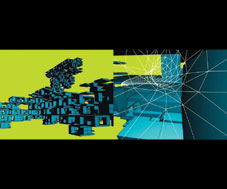
This film is conceived as a "psycho-architectural" experience. A nearly meaningless event - a stray ball ? launches a series of uncontrolled transformations on a tennis court. From this moment on, the surface of the tennis court starts to change shape without the viewer knowing whether he/she is witnessing a mental experience or a true event. The playground gradually becomes anamorphosis to take the form of a module of architecture. This module develops and multiplies to shape a city that keeps expanding and delineates a traffic network. Suddenly the ball's trajectory hits the image and totally absorbs the camera's viewpoint. Like a flow of energy, the image gets caught within the rhythm of an accelerating motion. After a while, the camera slowly begins to drift towards the edge of the space. The viewer can make out the impact left by the ball on the tennis court, and the image slowly scans the whole surface. Was the game really interrupted or is the film but a temporal deflagration occurring inside one of the players' mind?
Christian Merlhiot was born in Niort in 1963. He studied at the National School of Fine Art in Bourges from 1981 to 1987. In 1994 and 1995 he was an artist-in-residence at the Villa Medicis in Rome, where he made his first full-length film, "Les semeurs de peste" (1995). Since then, he has produced several others, including: "Voyage au pays des vampires" (2001), "Chronique des Love-hôtels au Japon" (2002), and "Silenzio" (2005). Christian Merlhiot has taught cinema and video in several art schools, notably at Angoulême, Nancy, and Bourges. He is currently the education director at the Pavillon, Laboratoire de création du Palais de Tokyo in Paris.