Catalogue > Liste par artiste
Parcourez la liste complète des artistes présentés dans le cadre des Rencontres Internationales depuis 2004. Utilisez le filtre alphabétique pour affiner vos recherches.
Gavin Hipkins
Catalogue : 2026The Deep II | Vidéo | 0 | couleur et n&b | 9:36 | Nouvelle-Zélande, 0 | 2025

Gavin Hipkins
The Deep II
Vidéo | 0 | couleur et n&b | 9:36 | Nouvelle-Zélande, 0 | 2025
Between sleeping and waking, a dreamscape charts fragile ecologies through the destructive forces of late capitalism. Found footage and wilderness travels overlap to evoke a hybrid condition of collective paralysis. This trance-like state navigates paradoxes of therapy and disturbances, isolation and connectivity.
Gavin Hipkins (b. 1968) is a New Zealand-based artist. He holds a Bachelor of Fine Arts from the University of Auckland and a Master of Fine Arts from the University of British Columbia. He is currently an Associate Professor at Elam School of Fine Arts at the University of Auckland. His photographs and moving images interrogate how images create meaning through fragmentation and circulation. His work explores the nation-state, particularly in colonised countries in an era of re-imagined communities and ideas of social and political utopia. His recent moving image works engage film as a cinematic art that blurs conventional genres of essay film, documentary and experimental narrative structures. His work has been exhibited widely over the last two decades including: Baltic Centre for Contemporary Arts, Newcastle, UK (2024); Recontres Internationales Paris/Berlin (2023, 2020); CROSSROADS 2022, San Francisco Cinematheque (2022); Internationale Kurzfilmtage Winterthur (2021); 25FPS Festival, Zagreb (2020); Stuttgarter Filmwinter (2020); Videoex, Switzerland (2019); 9th Asia Pacific Triennial of Contemporary Art, Gallery of Modern Art, Brisbane (2018); International Film Festival Rotterdam (2018, 2015); International Short Film Festival Oberhausen (2017, 2016); The Jewish Museum, New York (2015); Museum of Arts and Design, New York (2014); Edinburgh Art Festival (2014); Armory Film, New York (2012); Centre Pompidou, Paris (2011); Austrian Museum of Applied Art and Contemporary Art (MAK), Vienna, (2011); Gallery of Modern Art, Brisbane (2010); San Diego Museum of Photographic Arts, San Diego (2007); International Museum of Photography and Film at George Eastman House, Rochester, New York (2006); Australian Centre for Contemporary Art, Melbourne (2004); CCA Watts Institute for Contemporary Arts, California (2002); Museum of Contemporary Art, Los Angeles (2000).
Gavin Hipkins
Catalogue : 2023Nature Writing | Vidéo expérimentale | mov | couleur et n&b | 9:48 | Nouvelle-Zélande | 2022
Gavin Hipkins
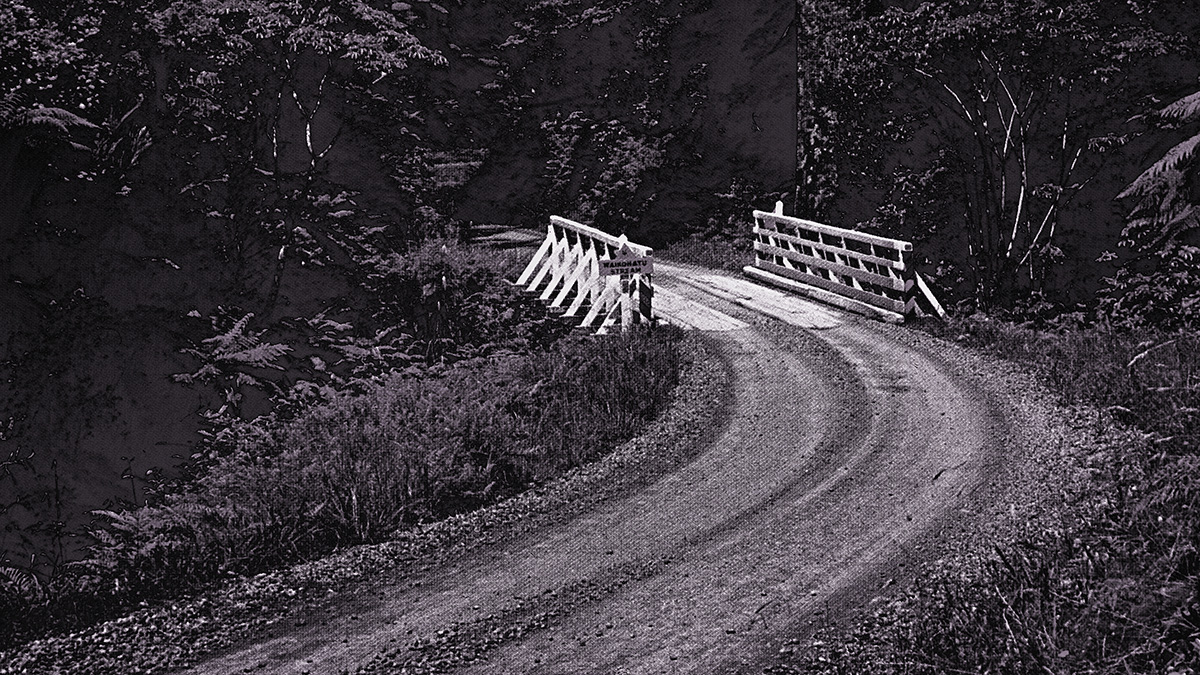
Nature Writing
Vidéo expérimentale | mov | couleur et n&b | 9:48 | Nouvelle-Zélande | 2022
Recorded at night with a humble camcorder over multiple excursions through indigenous and exotic flora, rhythmic observational studies chart real and imaginary wildernesses. Revisiting Thoreau’s Walden ideal, the sentimental appeal of taking an axe to the woods in white-settler colonies encounters postcolonial unease.
Gavin Hipkins (born 1968, Auckland, Aotearoa New Zealand) holds a Bachelor of Fine Arts from the University of Auckland and a Master of Fine Arts from the University of British Columbia, Vancouver. He is an Associate Professor of Fine Arts at Elam School of Fine Arts, the University of Auckland. His photography and moving image works interrogate how images create meaning through fragmentation and circulation. His work explores the nation state, particularly in colonised countries in an era of re-imagined communities and ideas of social and political utopia. His practice engages film as a cinematic art that blurs conventional genres of essay film, documentary and experimental narrative structures. Hipkins has exhibited widely in international exhibitions and film festivals including: CROSSROADS 2022, San Francisco Cinematheque (2022); Internationale Kurzfilmtage Winterthur, Switzerland (2021); 25FPS Festival, Zagreb (2020); Rencontres Internationales Paris/Berlin (2020); Videoex, Zurich (2019); The 9th Asia Pacific Triennial of Contemporary Art, Gallery of Modern Art, Brisbane (2018); International Film Festival Rotterdam (2018, 2015); International Short Film Festival Oberhausen (2017, 2016); The Jewish Museum, New York (2015); Edinburgh Art Festival (2014); Armory Film, New York (2012); Centre Pompidou, Paris (2011); Austrian Museum of Applied Art and Contemporary Art (MAK), Vienna, (2011).
Catalogue : 2021Album | Film expérimental | 4k | couleur et n&b | 14:45 | Nouvelle-Zélande | 2020
Gavin Hipkins
Album
Film expérimental | 4k | couleur et n&b | 14:45 | Nouvelle-Zélande | 2020
La lettre d'un jeune homme à sa mère, envoyée en Nouvelle-Zélande depuis l’Angleterre pendant la première guerre mondiale. Les parcs royaux de Londres forment un cadre pittoresque pour repenser l'empire, le tourisme et la nostalgie, dans ce film hybride qui présente les photographies et les écrits du grand-père de l'artiste sur ses voyages dans l’armée.
Gavin Hipkins est artiste et est installé à Auckland, en Nouvelle-Zélande. Il est titulaire d'un Master en Arts Visuels de l'Université de la Colombie-Britannique, à Vancouver (Canada). Il est actuellement professeur d’arts visuels à la Elam School of Fine Arts de l'université d'Auckland. Son travail interroge l'État, en particulier dans les pays colonisés, à une époque de communautés réimaginées et d’idées d'utopie sociale et politique. Ses récents travaux sur l'image en mouvement abordent le film comme un art qui brouille les genres conventionnels de l'essai, du documentaire et des structures narratives expérimentales. Il a participé à de nombreuses reprises à des expositions et festivals de cinéma d’envergure internationale, notamment: 16e 25FPS International Experimental Film and Video Festival, Compétition internationale, Zagreb (Croatie) [2020]; Rencontres Internationales Paris/Berlin [2020] ; 33e Stuttgarter Filmwinter: Festival for Expanded Media, Stuttgart (Allemagne) [2020]; Festival international du film de Nouvelle-Zélande [2020]; Videoex, Zurich (Suisse) [2019]; The 9th Asia Pacific Triennial of Contemporary Art, Gallery of Modern Art, Brisbane (Australie) [2018]; Festival international du film de Rotterdam (Pays-Bas) [2018, 2015]; Festival international du court métrage d’Oberhausen, Compétition internationale (Allemagne) [2017, 2016]; Jewish Museum New York (USA) [2015]; MAD - Museum of Arts and Design , New York (USA) [2014]; Edinburgh Art Festival (Royaume-Uni) [2014].
Catalogue : 2020The Valley | Vidéo | hdv | couleur et n&b | 14:18 | Nouvelle-Zélande, Royaume-Uni | 2019
Gavin Hipkins
The Valley
Vidéo | hdv | couleur et n&b | 14:18 | Nouvelle-Zélande, Royaume-Uni | 2019
Devon’s moors are the backdrop for this hybrid film that constructs an imaginary community and frames sentiments of belonging at a time when parochialism and nationalism are globally prevailing. Inspired by Arthur Conan Doyle’s The Hound of the Baskervilles, Hipkins grafts portraits of his forebears across Devon?s uncanny landscapes. A subtext of Doyle’s classic novel negotiates yearnings for a homecoming and a mythical ancestral land.
Gavin Hipkins (b. 1968) is a New Zealand-based artist. He holds a Master of Fine Arts from the University of British Columbia. He is currently Associate Professor at Elam School of Fine Arts at the University of Auckland. His work explores the nation state, particularly in colonised countries in an era of re-imagined communities and ideas of social and political utopia. His recent moving image works engage film as a cinematic art that blurs conventional genres of essay film, documentary and experimental narrative structures. His work has been exhibited widely over the last two decades. His solo exhibition The Homely will open at the Museum of Contemporary Art Australia, Sydney in July 2020. Recent exhibitions and screenings include: Videoex, Switzerland (2019); 9th Asia Pacific Triennial of Contemporary Art, Gallery of Modern Art, Brisbane, Australia (2018); International Film Festival Rotterdam (2018, 2015); International Short Film Festival Oberhausen (2017, 2016); The Jewish Museum, New York (2015); Museum of Arts and Design (MAD), New York (2014); City Art Centre, Edinburgh Art Festival (2014); Armory Film, New York (2012); Centre Pompidou, Paris (2011); Austrian Museum of Applied Art and Contemporary Art (MAK), Vienna, (2011).
Nadia Hironaka, Matthew Suib
Catalogue : 2009The Soft Epic, or: Savages of the Pacific West | Art vidéo | dv | couleur | 3:6 | USA | 2008
Nadia Hironaka, Matthew Suib
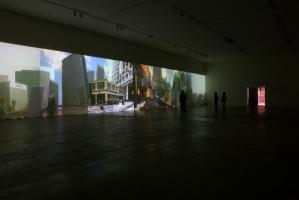
The Soft Epic, or: Savages of the Pacific West
Art vidéo | dv | couleur | 3:6 | USA | 2008
« The Soft Epic, or: Savages of the Pacific West » est une vidéo monumentale et une installation audio qui examine les représentations historiques et contemporaines de l'anxiété culturelle, et la relation fluide entre l'Histoire et le Cinéma, où réalité et fiction s?écroule l?une sur l'autre comme les plis d'un rideau de théâtre tiré. Composée de multiples projections et d?une bande son en surround ? nouvellement commandée à Bird Show (Ben Vida) ? l??uvre synthétise des images et des effets à partir de fresques historiques, d?épopées de science-fiction, de films de catastrophe et de peintures de Jérôme Bosch, en un paysage urbain fracturé et dystrophique, parsemé de flammes éternelles et de chimères. À travers la projection vidéo longue de cent pieds, la splendeur d?Hollywood usurpe le récit mythologique et historique au service de l'autorité politique et l'ordre social.
Nadia Hironaka réside actuellement à Philadelphie (USA) et est professeur au Maryland Institute College of Art. Elle a obtenu son MFA (Master of Fine Art) à l'Art Institute de Chicago (USA) et son BFA (Bachelor of Fine Art) à l'Université des Arts. En 2008, elle était membre du Pennsylvania Council on the Arts. Ses films et installations vidéo ont été montrés internationalement. Matthew Suib, artiste basé à Philadelphie, a exposé ses installations, vidéos, ?uvres audio, et photographies internationalement. En 2007, il a co-fondé Screening, avec Nadia Hironaka. Il est également membre du Pennsylvania Council on the Arts, et ancien membre de Vox Populi, un collectif d?artistes de Philadelphie.
Sin Tung Ho
Catalogue : 2013Folie à deux | Doc. expérimental | dv | couleur | 73:0 | Hong Kong | 2011
Sin Tung Ho
Folie à deux
Doc. expérimental | dv | couleur | 73:0 | Hong Kong | 2011
Ho Sin Tung?s Folie à deux, shows a sequence of 17 people reading a passage with their back to the camera - from a book they have chosen themselves, at different indoor and outdoor locations in Hong Kong, the mainland China and Macau. This deceptively simple video, however, has a psychological tension reflected in its title, folie à deux, a term describing ?a condition in which symptoms of a mental disorder, such as the same delusional beliefs or ideas, occur simultaneously in two individuals who share a close relationship or association.? In the video, the intimate relationship is between the reader and the on-looking viewer of her video, the audience. Each reading situation becomes an almost confessional as the read passage reflects an intimate and potentially embarrassing part of the personality or ?soul? of the reader. The viewer is drawn into the readers? spoken passage, its significance, its meanings, and each reader?s viewpoint appreciated, possibly even absorbed by the viewer.
Ho Sin Tung was born in Hong Kong in 1986, and graduated from the Fine Arts Department of Chinese University in Hong Kong in 2008. Ho`s recent work predominantly uses pencil, graphite and watercolour in combination with found and ready-made images - such as stickers, maps, charts, rubber-stamps and timelines. These are reinterpreted to narrate stories of places, relationships and periods of time often within a considered, objective historical setting. Apart from painting, ho also do writing, installation and video work. Her work uses a lot of literature and cinema references. "Folie à deux" is an obvious combination of both themes.
Wei-ming Ho
Catalogue : 2015Over my dead country | Vidéo | hdv | couleur et n&b | 11:11 | Taiwan | 2013
Wei-ming Ho
Over my dead country
Vidéo | hdv | couleur et n&b | 11:11 | Taiwan | 2013
Is this the 100th anniversary celebration of a country or a prediction of doom, the last rays of a sun that is setting beneath the shadow of threats? Mixing the firework display and the self-immolation of freedom fighters, this work not only presents visual paradoxes but also re-visits the ghosts of history. Fusing tragedy and celebration, it reflects concerns about media monopolies and the current situation of the country. A historical process, repetition or an ending – what will be revealed through the flames?
Wei-Ming Ho was born in Taipei, Taiwan as a visual artist and filmmaker. He works across the fields of experimental film, video installation and media art. His works have been presented in cinemas and also in artistic contexts such as Museo Nacional Centro de Arte Reina Sofia, Egyptian Theater in Hollywood, National Taiwan Museum of Fine Arts and numerous art & film festivals in 40 countries.
Tzu Nyen Ho
Catalogue : 2008The Bohemian Rhapsody Project | Film expérimental | dv | couleur | 6:52 | Singapour | 2006
Tzu Nyen Ho
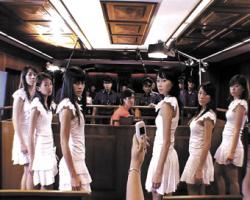
The Bohemian Rhapsody Project
Film expérimental | dv | couleur | 6:52 | Singapour | 2006
Le "Bohemian Rhapsody Project" est entièrement basé sur les paroles de la chanson de Queen, "Bohemian Rhapsody", et tourné à la cour suprême de Singapour. Un garçon est accusé, et son coeur est brisé à la vue de sa "mama" en larmes. Au cours des mois de juin et juillet 2006, il a fallu quatre tours d'auditions pour le rôle du personnage principal. La chanson de Queen, écrite en 1975, remplace la structure de la chanson pop de base (couplet-refrain-couplet), par un jeu de rôle multiple et un mélange quasi schizophrénique de styles musicaux différents. Sur les nombreux professionnels et non professionnels auditionnés, 22 ont été invités à un dernier tour d'audition qui s'est tenu dans une ancienne salle d'audience de l'hôtel de ville. Etaient présents des spectateurs spécialement invités, 18 autres membres du casting, ainsi qu'une équipe de film. Sur ces 22 auditionnés, 21 ont été sélectionnés pour le film final, composé uniquement de ces images d'audition. Le film qui en résulte, découpé sur la durée exacte de la chanson (5mn 52), fonctionne en même temps comme enregistrement de cette audition. De plus, le film, qui oscille entre texte parlé et texte chanté, est un moyen de solliciter la mémoire musicale des spectateurs et d'encourager leur participation à un exercice de karaoké mental.
Born in Singapore, Ho Tzu Nyen is a visual artist and filmmaker. His first project was Utama - Every Name in History is I (2003), a film and installation that has been shown in art exhibitions and film festivals such as the 26th Sao Paulo Biennale (2004); the 3rd Fukuoka Asian Art Triennale (2005), before being presented as a performance lecture at KunstenFESTIVALdesArts (2006). In 2005, he scripted and directed 4 x 4 ? Episodes of Singapore Art, a unique hybrid of the art documentary, video essay and drama that was broadcasted over 4 weeks on a public television channel in Singapore. It was last shown at ZKM, Germany (2007). In 2006, he was commissioned by the inaugural Singapore Biennale to produce The Bohemian Rhapsody Project, a film that has since been shown in film festivals such as the 53rd International Short Film Festival Oberhausen, and the 30th Clermont-Ferrand Film Festival. In 2007, he completed a short film called Reflections, based on a 19th Century parable by Lafcadio Hearn, which was exhibited in Zendai Shanghai Museum of Modern Art and the National Gallery of Poznan. Reflections will be shown in 2008 at the 54th International Short Film Festival Oberhausen and the 8th Jeonju International Short Film Festival. He is now making his first feature film, Here. In 2006/2007, he conceptualized and wrote the first and second parts of King Lear ? The Avoidance of Love, a live audition / film shoot / lecture / theatre performance, which he co-directed with Fran Borgia.
Do Hoang
Catalogue : 2015Tôi muốn rao lên | Fiction expérimentale | hdv | noir et blanc | 20:0 | Viet nam | 2014
Do Hoang
Tôi muốn rao lên
Fiction expérimentale | hdv | noir et blanc | 20:0 | Viet nam | 2014
The movie is about traces, disintegration, and the feeling of being adrift. Two people are in love with each other through the tangible objects. The film opens with a break-in and several stolen objects. A sense of losing traces, filled with shadows of violence and unexpectedness is provoked, foreseeing a disintegrated future. In theanxious space remained an old cloth - a hidden, humble and sensitive trace. The story tells the journey of the old cloth with the Man – the Woman and the Anonym, challenging their sensitive and hard-to-identify existences.
DO VAN HOANG 26/6/1987 Director, Screenplay, Actor Mobile: + 84(0)1668606403 Email: dovanhoang266@gmail.com EDUCATION Documentary and Experimental Film-making Course, Hanoi DOCLAB, Goethe Institute, 2010-2011 Faculty Cinema, The HaNoi Academy of Theatre & Cinema, 2007-2011
Jan Hoeft
Catalogue : 2015Exit Strategies | Vidéo | hdv | couleur | 18:0 | Allemagne | 2014
Jan Hoeft
Exit Strategies
Vidéo | hdv | couleur | 18:0 | Allemagne | 2014
In Exit Strategies an endless sequence of industrial fire escapes is shown. While somebody tells us how his life would change in case of a disaster, we see more and more examples of architecture that prepares us for the worst.
Jan Hoeft (b. 1981) is a visual artist based in Cologne. He was a researcher at the Jan Van Eyck Academy Maastricht in 2013/14. He is a graduate of the Academy of Media Arts Cologne and the Karlsruhe Institute of Technology.
Philippine Hoegen
Catalogue : 2019Crossed Wires | Doc. expérimental | hdv | couleur | 23:44 | Pays-Bas, Belgique | 2018
Philippine Hoegen
Crossed Wires
Doc. expérimental | hdv | couleur | 23:44 | Pays-Bas, Belgique | 2018
This document is an exploration of the Belgian art scene. It shows a series of conversations, with an informal, subjective mapping of the scene as a backdrop. In the conversations, questions are approached through the specificity of peoples' own trajectories: their practical, artistic or social paths, how such trajectories shaped certain practices and how these practices connect to the biotope of the art scene within its contemporary societal and political context. In preparation of the film numerous people were asked the question which persons, places or practices are important for them. We asked every interlocutor to suggest new interlocutors, so that every conversation generated new conversations. We let ourselves be guided by the suggestions we received, resulting finally in a varied assortment of interviewees. The notes for the informal preparatory conversations became the set for the film: they were drawn up on the walls, creating a haphazard, subjective mapping. The set functions as a performative space, as the interviewees are immersed in this unruly apparatus which they begin to correct, add on to, disagree with and debate
Philippine Hoegen is an artist living in Brussels. Her multi-stranded practice engages with issues of objectness and personhood, through the notion of versioning: How we create different versions of ourselves, the processes and technologies we use for that and what the existence of those multiple versions means for our understanding of self. Her work consists primarily of performance and performative interventions or events. She is researcher at CARADT, Avans University, NL; teacher at AKV St Joost, Breda and on an irregular basis mentor at apass, Brussels. Recent activities include: "Being as Becoming", a residency / exhibition and collaborative research project at Onomatopee, Eindhoven (2018); "Ventriloquists III", solo performance, at Plymouth University in the SAR conference Artistic Research Will Eat Itself and at the University of Twente in the conference Narrative Matters (2018); "Crossed Wires", a film commissioned by and launched at Art Brussels (2018); "The Many Machine", a performative collaborative event at AKV St Joost, Breda (2018). Recent publications include: "Ventriloquists III", a contribution to Proceedings 9th SAR Conference: Artistic Research Will Eat Itself (2018); "Body of Books: The BAS Collection", essay on the artists' run space BAS in Istanbul, published by Collectorspace, Inc, New York/Istanbul (2017).
Catalogue : 2015Arena | Vidéo | dv | couleur | 65:0 | Pays-Bas | 2014
Philippine Hoegen
Arena
Vidéo | dv | couleur | 65:0 | Pays-Bas | 2014
Arena is part of an on-going examination into the nature of display, and the ways in which objects and bodies are made to perform, through their display. The material for this work was shot at the Mission Museum of Steyl near Venlo in The Netherlands. The museum holds a collection of animals and artifacts that were collected by missionaries from the Steyl Monastery during their travels all over the world in the 19th and early 20th centuries. The museum was built specially to house the collection and its display has never been changed since it was first installed in the 1930’s and it uniquely reveals and exemplifies the perceptions and views of its time, many of which persist in the present. The animals’ bodies, stuffed and stiffly set in eternal grimaces, growls and howls, are made to perform these perceptions, ideas and ideologies that are projected upon them. The film is made of slow vertical pans that map the entire collection. The camera’s position is close up; skin fur and feathers take equal attention, as do painted backdrops, stones and attributes. As we stand before the projection, larger than life, of these animals, what becomes unclear and what is questioned is: Who is displaying what and for whom? Who is looking at whom?
Philippine Hoegen lives and works in Brussels and Amsterdam. Her work consists of installations and performance. She is currently a participant of apass artistic research program in Brussels and tutor of visual art at AKV St Joost Academy for Visual Art, Breda/Den Bosch, NL. With Carolien Stikker she runs BREW, a space in Brussels, which organises and hosts events in the field of contemporary art. She is founder and board member of Calcite Revolt, a transnational platform of exchange for artists, curators, critics and theoreticians, and with Banu Cennetoglu she conceived, produced and edited Bent, a series of artists’ books from Turkey. Recent projects, presentations and performances include: 2014 Kunstallmend (Transnational Art Commons: collective on-going project), Bern Biennial, Bern CH; Masist Gül by Banu Cennetoglu and Philippine Hoegen, KunstraumLakeside, Klagenfurt AT; 2013 Performative lecture Exterior Monologue followed by a workshop, University of Art and Design, Cluj-Napoca, RO; Exhibition; Exhibition and public discussions Adaptations, with Banu Cennetloglu, The Collective Gallery, Edinburgh SCO. Recent publications include: 2013 ‘Going Underground”, review by P. Hoegen and S. van Stein on the Sarajevo Biennale, Metropolis M online, April 2013, Kunstwordtterugkunst, Cahier for Contemporary Art, (artist’s contribution). 2012 Mutualisms Proximity Edition, magazine for contemporary art and culture, Public Media Institute, Chicago, artist’s contribution P. Hoegen and C. Stikker.
Peter Hoffmann
Catalogue : 2012La dernière année | Doc. expérimental | 16mm | noir et blanc | 78:0 | Allemagne, France | 2010
Peter Hoffmann
La dernière année
Doc. expérimental | 16mm | noir et blanc | 78:0 | Allemagne, France | 2010
Lisa Hoffmann
Catalogue : 2026all through a life | Installation vidéo | 4k | couleur | 10:45 | Allemagne | 2025
Lisa Hoffmann
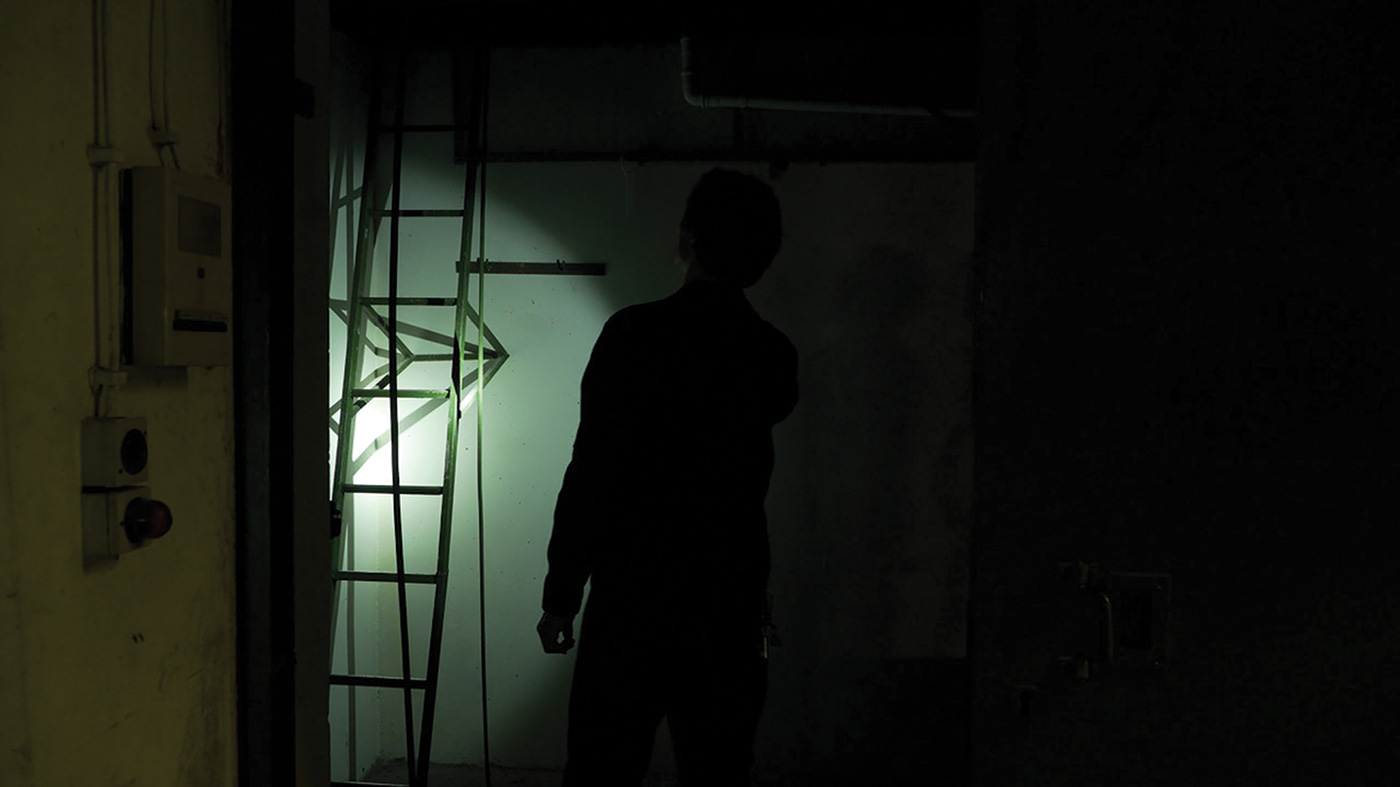
all through a life
Installation vidéo | 4k | couleur | 10:45 | Allemagne | 2025
all through a life is a video installation that examines routines of care and control, and questions the possibility of imitating, demarcating, and regulating natural systems. The work invites viewers into an ambiguous environment. the space is filled with reverberating industrial sounds and two monitors arranged like surveillance or control-room screens. A slowly transforming colour field unfolds across one of these displays, alongside a looped film. Within this film a figure moves methodically through a space whose function remains undefined. This caretaker or scientist-like presence performs gestures of monitoring and documentation, enacting a rhythm of daily labour. A shell-based bioplastic receiver, reminiscent of a telephone, softly transmits a voice. If picked up and held to the ear, the voice gently informs the listener about tasks, routines, and the contours of their working environment. The film both documents a real location and opens up a fictional dimension within it. It references architectural spaces designed for containment or control, such as Biosphere 2 or the sarcophagus over the Chernobyl reactor—sites where the boundary between care and crisis, science and survival, is constantly negotiated. These are infrastructures that demand continuous regulation, where control is never absolute and systems must be maintained despite their inherent instability. The title all through a life refers to a song by the band Rites of Spring and also gestures toward the often-invisible material and political forces that permeate our lives and bodies. What seeps into our existence—wage labour, radiation, ambient toxins? What do we manage to control, and what always escapes us? The voice over was composed from an interview with the actual care-taker of the depicted space as well as from theory and fiction. The looped video itself depicts a loop of work: an everyday routine organized around maintaining a status quo. And yet, change creeps in—subtly, continuously. This is made tangible in the gradual de-synchronization of the colour field, which alter the ambient light and begin to “contaminate” the film from which they were originally extracted. Control proves to be porous; feedback and bleed-through occur despite all efforts to contain. There are no truly closed systems. In an era of Mars colonization fantasies, luxury survival bunkers, and geoengineering dreams rooted in mechanistic thinking, the line between science fiction and nfrastructural reality grows thinner. all through a life asks not only what we are trying to hold together, but at what cost—and with what illusions of stability.
Lisa Hoffmann works in-between art, research, film, and performance. Her installations, moving images, and collective actions are equally material- and concept-driven, engaging critically with the complex currents of ongoing ecological and economic crises and the decomposition of dominant cultural narratives. Often departing from a clichéd phenomenon—such as shells, palm trees, or fire—Hoffmann approaches these motifs with rigor and obsession, unpacking their layered cultural, ecological, and political meanings through experimentation and context-specific techniques. Her practice draws on Situationist tactics and more-than-human thinking, attending to absent presences and present absences. The result is a body of work that is referential, layered, and at times darkly humorous. Hoffmann studied Sustainable Product Design (MFA, Bauhaus University Weimar) and Art and Media (MFA, Berlin University of the Arts), where she was appointed Meisterschülerin. She is an active member of the climate-education collective Klasse Klima and a co-initiator of Studium Planetare, a pilot project for applied climate education at art and design academies. Her work has been presented internationally, including at Kunsthaus Dresden (2025, DE), Kommunale Gallerie (DE, 2024), BAK – basis voor actuele kunst (NL, 2023), KOMMET Art Space (FR, 2023), Hamburger Bahnhof (DE, 2022), Tampere Film Festival (FI, 2022), Roman Susan Art Foundation (US, 2020), Biennial of Photography Porto (PT, 2019), DL gallery (GR, 2019), Closer Art Space (UA, 2019), Triennial of Photography Hamburg (DE, 2018) and Kunstfest Weimar (DE, 2016), among others. She is the recipient of the UdK Art Award and Rundgang 50Hertz, and has held residencies at l’escaut (BE, 2025), an• other here and the Cité Internationale des Arts, Paris. Hoffmann lives and works in Berlin.
Rhys Hollis
Noah Holtegaard
Catalogue : 2023Glimmerstøv | Vidéo expérimentale | mp4 | couleur | 1:37 | Danemark, Suède | 2022
Noah Holtegaard
Glimmerstøv
Vidéo expérimentale | mp4 | couleur | 1:37 | Danemark, Suède | 2022
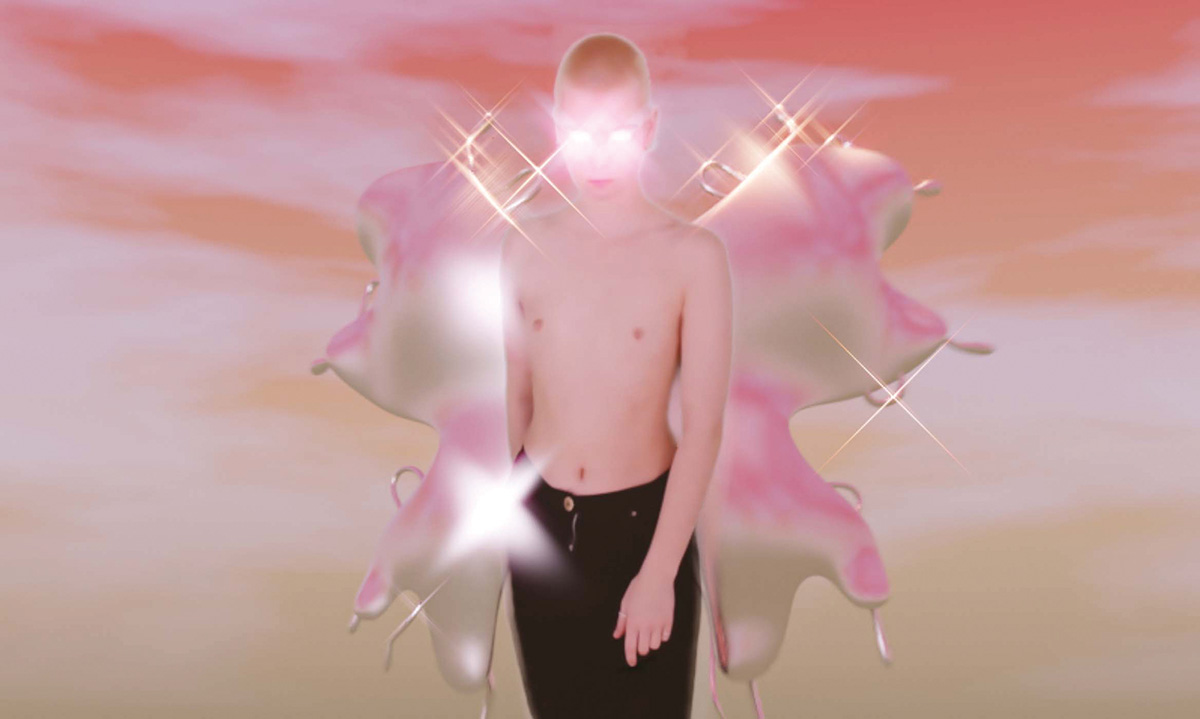
“Glimmerstørv” is a video work about transness, inspired by cartoons like Winx, Ben10 and Dragon Ball, which are cartoons about people transforming themselves in fantastic, luminous sequences and becoming a more magical version of themselves. I work with creating digital realities that can act as a virtual utopia for queer people, free from the constraints of our physical reality.
Bio Noah Holtegaard (b. 1999) is a transmasculine nonbinary artist and uses the pronouns they/them. Holtegaard completed their BFA in fine arts from HDK-Valand in Gothenburg in 2022 and began their MFA in media arts at the Royal Danish Academy of Fine Arts in Copenhagen the same year. In their artistic practice, Holtegaard primarily works digitally, which includes image manipulation, 3D modelling, animation, AR (Augmented Reality) and video. Holtegaard's work often revolve around queerness and transness. They describe how they want to give a voice to those who have never had a voice before, tell stories about transgender people that have never been told before, and show bodies that have never been shown before. In their art, Holtegaard dreams of creating a queer utopia in a digital space without the limitations of the physical world.
Gerard Holthuis
Catalogue : 2006Careless Reef: 1. preface | Film expérimental | 16mm | noir et blanc | 3:50 | Pays-bas | 2004
Gerard Holthuis
Careless Reef: 1. preface
Film expérimental | 16mm | noir et blanc | 3:50 | Pays-bas | 2004
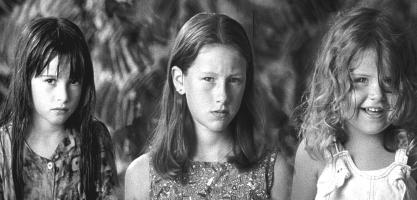
"Preface" est un film sur notre vision des choses. Que voit-on dans un visage, et comment nous décodons ce que nous voyons. En introduction à "Careless reef", 6 films sur le monde sous la surface.
Gerard Holthuis est un cinéaste indépendant.
Barbara Holub
Catalogue : 2009Make News Instead of | 0 | dv | couleur | 22:0 | Allemagne, Autriche | 2008
Barbara Holub
Make News Instead of
0 | dv | couleur | 22:0 | Allemagne, Autriche | 2008
La double projection vidéo « Make news instead of » est basée sur la double projection diapositive d?une exposition de l?artiste, « More Opportunities », à l?Arts Center de Plymouth (Royaume-Uni) en 2007- 2008. Cette ?uvre traite de la question de la transformation de la ville de Plymouth, comme un exemple de changement d?une ville industrielle mise au service de l'économie, dans le contexte de la mondialisation. Il traite du changement d?identité rapide et radical d'une ville et ses habitants, dans un docu-fiction réalisé à partir du collage de matériaux divers, notamment « A Voyage to the Bottom of the Sea », film de Science-fiction de Irwin Allend (1961), un film-documentaire en 16 millimètres sur la grève du chantier naval de Plymouth du Southwest Filmarchive Plymouth (1969), « The Way We Live », documentaire de Jill Craigie sur l?architecte Abercrombie (1946), ou « More Opportunities », une manifestation mise en scène de Barbara Holub (2007).
Parallèlement à son travail d'artiste, la carrière de Barbara Holub comprend notamment la Présidence de la Sécession de Vienne depuis 2006-2007. De 2004-2007, elle a été membre du Comité d'Art Public de Basse-Autriche. En 1999, elle a créé la compagnie d'architecture et d'urbanisme Transparadiso, avec son associé Paul Rajakovics. Leur travail expérimental reflète l'architecture et le développement urbain dans le contexte des questions posées par la mondialisation, en même temps qu?il développe de nouveaux outils pour ce que Transparadiso appelle l?« urbanisme direct ». Parmi les récentes expositions de Barbara Holub, signalons notamment « This is a Gallery and a Gallery is Many Things » à l?Eastside Projects de Birmingham (Royaume-Uni), « Orientierungen » au Regionale 08 de Styria, « Periscope Elevator » à Amsterdam/Ijburg (Pays-Bas), « Ganz nah so fern » à Vienne (en collaboration avec Grita Insam Gallery), ou « More Opportunities » à l?Austrian Cultural Forum du London Festival of Architecture.
Heidrun Holzfeind
Catalogue : 2026EIN OKTOPUS HAT DEN MOND ZERSTÖRT | Documentaire | mov | couleur | 90:0 | Autriche, Allemagne | 2024

Heidrun Holzfeind
EIN OKTOPUS HAT DEN MOND ZERSTÖRT
Documentaire | mov | couleur | 90:0 | Autriche, Allemagne | 2024
Horticulture, agriculture and animal care are taught in the agricultural department of the integrative August-Sander-School in Berlin Friedrichshain. Over the course of a school year, the film accompanies students with different learning capacities, behavioral issues and impairments in their everyday school life. A portray of adolescents at the crossroads between school and work, childhood and adulthood, struggling to find their place in the school system and society.
Heidrun Holzfeind is an artist and filmmaker based in Berlin. She studied at the Academy of Fine Arts in Vienna and at Cooper Union in New York. She is interested in how architecture interacts with people’s everyday life. Her works question immanent architectural and social utopias and explore the relationships between history and identity, individual histories and political narratives of the present.
Catalogue : 2010Friday Market | Installation vidéo | betaSP | couleur | 8:0 | Autriche, Egypte | 2008
Heidrun Holzfeind
Friday Market
Installation vidéo | betaSP | couleur | 8:0 | Autriche, Egypte | 2008
LONG SHOT: In one long shot the camera travels along the section of Cairo?s Friday market that is set up on railroad tracks. Here, framed by the highway and the Al-Imam As Safi?i cemetery, every Friday locals and vendors from all over the city offer their products for sale, set up on tables or spread on the ground. The camera moves at a steady, slow paste along the tracks, like a train passing a closed down station. The people inhabiting the market ? the sellers and buyers, and the people living at its edge become the protagonist of the film, collapsing the borders between performance, documentary and fiction film. The slow paste of the shot allows the viewer?s attention to oscillate between the market in the foreground ? the goods for sale, the dynamics between sellers and buyers, and the many (informal) architectural layers of the housing area and cemetery directly behind. I am equally interested in the complex and multilayered architectural constructions as in the informal economy of the market. The range of products for sale questions our western concepts of what holds value, and the very notion and definition of a ?product? in itself: What we easily label as trash - useless or broken parts - are being recycled and offered for sale, a sign not only of desperation and economic need, but also of faith in the creativity of the buyer to find a possible new use for these items. MAKING-OF: The making-of documents the film shoot during the course of the day (from 6 am to the early afternoon when rain and a sandstorm hit the market) and offers glimpses into the socioeconomic context of the market, the location and its inhabitants through close ups of sellers, buyers and products, and short interviews with locals.
Heidrun Holzfeind studied at the Academy of Fine Arts in Vienna and at Cooper Union in New York. She lives and works in New York. solo exhibitions include CCA, Ujazdowski Castle, Warsaw (2010); De Vleeshal, Middelburg, The Netherlands (2009); Sala de Arte Público Siqueiros in Mexico City (2008), Galerie im Taxispalais, Innsbruck (2007); Lado b, MUCA Museum Mexico City (2005), Artists Space (project room), New York (2005), W139 in Amsterdam (2004) Recent group shows and screenings include CASM, Barcelona; Manifesta7, Trentino; Photocairo4, Cairo; MOMA, New York; Zendai Art Museum, Shanghai; Goethe Institute Dublin; OK Centrum Linz, Austria; Grazer Kunstverein; Festival der Regionen 2007; Exit Art, New York; Architecture Museum Basel; Salzburger Kunstverein, Austria; Bronx Museum of the Arts, New York; Swiss Institute New York; BAK Utrecht, and others. Festivals include European Media Arts Festival, Osnabruck; Assim Vivemos Festival Brazil, Rio de Janero & Brasília; Duisburger Filmwoche, Germany; Diagonale, Graz, Austria; Impakt Festival, Utrecht; Transmediale Festival Berlin; Videoart Center Tokyo; SKIF Festival, St. Petersburg; SNIFF Int. Short Filmfestival, Novo Mesto, Slovenia, and others.
Juul Hondius
Catalogue : 2022To Unveil a Star | Doc. expérimental | 4k | couleur | 54:0 | Pays-Bas | 2021
Juul Hondius
To Unveil a Star
Doc. expérimental | 4k | couleur | 54:0 | Pays-Bas | 2021
An essay-film by artist Juul Hondius about the remarkable relationship between himself and the exceptional sculpture that stands in front of the NATO headquarters in Brussels. Since its inception, the sculpture has been shown countless times on worldwide media broadcasts. Hondius enters into a direct dialog with the sculpture against the backdrop of the chronology of the relocation of this sculpture. Do we want to keep you as a symbol? Can we still identify with the concepts you represent? In the film, the elderly architect Raymond Huyberechts is revealed as the author of this iconic symbol. How does Huyberechts feel about his creation from 1970? To Unveil a Star (2021) is a kaleidoscopic portrait of a sculpture in which the filmmaker transforms a solid, steel sculpture into an anthropomorphic character. Playing with the formalities of genres, to create a stream of consciousness about the context of this sculpture that moves from one character's mind to another, through objects and experiences that seem to repeat themselves throughout history. The narrative intends to make the audience question their own position towards a sculpture that represents a system we are all somehow connected with. To Unveil a Star shines a critical light on the alliance between a military-political ideology, a piece of modernist design, and the shifting geopolitical landscapes it has witnessed.
Juul Hondius (1970, Ens, The Netherlands) studied at the FAMU Photography, Film & Television School in Prague and the Royal Academy of Fine Art in Rotterdam, The Netherlands. His work can be found in the collections of the Fonds National d’Art Contemporain in Paris, Stedelijk Museum Amsterdam and Museum Boijmans Van Beuningen. Amongst other venues his work was exhibited in Maison Européenne de la Photographie, Paris (2006); Centraal Museum Utrecht (2021/2007); Stedelijk Museum Amsterdam (2002); Platform Garanti (Salt), Istanbul (2007); Stedelijk Museum Schiedam (2014); Museum Boijmans van Beuningen (2013/2004); The Chicago Art Institute (2006); Musée des Beaux-Arts, Nantes (2002); Kunsthalle Düsseldorf (2011); Juan Miro Foundation, Barcelona (2011); Kunsthalle Mannheim (2010); Museum de Fundatie, Heino (2010); Fotomuseum, The Hague (2010);; De Appel Arts Centre, Amsterdam (2004), Huis Marseille, Amsterdam (2003); and numerous festivals and biennials, including LOOP Barcelona (2015), Beijing Photo Biennial (2014), Lagos Photo International (2010), IDFA (2005), and Busan Biennale (2004). Recent screenings of ‘To Unveil A Star’ where held in the Eye Filmmuseum in Amsterdam (2021) and in cooperation with Centraal Museum in Utrecht during the NFF, the National Dutch Film Festival (2021).
Kerstin Honeit
Catalogue : 2021[zi:lo]5 | Vidéo expérimentale | 4k | couleur | 17:17 | Allemagne, Canada | 2019
Kerstin Honeit
[zi:lo]5
Vidéo expérimentale | 4k | couleur | 17:17 | Allemagne, Canada | 2019
Le Silo 5, autrefois le plus grand grenier au monde, a été célébré par l'architecte Le Corbusier en 1927 en tant qu’aperçu d'une modernité utopique et d'un avenir esthétique de l'architecture. Depuis les années 90, le gigantesque complexe de silos de Montréal est une ruine industrielle, bien trop grande pour être démolie. Le grenier abandonné, devenu par la force des choses un monument à l'extractionnisme colonial global, marque, en tant que lieu de stockage, le point de départ de la pièce vidéo [zi:lo]5. L'œuvre aborde différents gestes et technologies de conservation et de collecte et, par conséquent - simultanément et indissociablement - des questions relatives aux notions d'écrasement, de suppression ou de réécriture. Sous l'angle d'un futur proche (et queer), les collections s'exposent comme des accumulations de lacunes et d'omissions. Ces vides deviennent des corps résonnants ayant le potentiel d'ouvrir des espaces à d'autres pratiques de stockage intermédiaire.
Kerstin Honeit a étudié les beaux-arts et la scénographie à la Kunsthochschule Berlin Weissensee (Allemagne). Elle vit à Berlin (Allemagne) et enseigne l'art médiatique à la Hochschule für Grafik und Buchkunst Leipzig (Allemagne). Dans sa pratique en tant qu'artiste et réalisatrice, elle travaille à l’intersection de différentes formes de mise en scène. Sa recherche artistique se concentre sur l'étude des mécanismes de représentation dans la production de mondes d'images hégémoniques, notamment en relation avec les modes de traduction culturels et linguistiques dans le contexte des images en mouvement. Depuis 2006, elle a présenté son travail dans plusieurs expositions et festivals, notamment: La Centrale galerie Powerhouse, Montréal (Canada); HMKV – Hartware MedienKunstVerein, Dortmund (Allemagne); São Paulo International Short Film Festival, São Paulo (Brésil); Ruhrtriennale, Bochum (Allemagne); Kunsthalle Rostock, Rostock (Allemagne); Neuer Berliner Kunstverein, Berlin (Allemagne); OFF Biennale Cairo, Le Caire (Égypte); Videoart at Midnight, Berlin (Allemagne); MMOMA - Moscow Museum of Modern Art, Moscou (Russie); Schwules Museum, Berlin (Allemagne); Fajr International Film Festival, Téhéran (Iran); HKW – Haus der Kulturent der Welt, Berlin (Allemagne); Internationale Kurzfilmtage, Oberhausen (Allemagne); SixtyEight Art Institute, Copenhague (Danemark); Berlinische Galerie, Berlin (Allemagne); Les Complices*, Zurich (Suisse); Videonale, Bonn (Allemagne); Gallery 400, Chicago (USA); CCNY – Camera Club of New York (USA); Arsenal - Institut für Film und Videokunst, Berlin (Allemagne).
Catalogue : 2019PANDA MOONWALK or WHY MENG MENG WALKS BACKWARDS | Doc. expérimental | 4k | | 8:0 | Allemagne | 2018
Kerstin Honeit
PANDA MOONWALK or WHY MENG MENG WALKS BACKWARDS
Doc. expérimental | 4k | | 8:0 | Allemagne | 2018
Since 2017 the Giant Panda Bears Meng Meng and Jiao Qing have been hired out to the Berlin Zoo from China to attract more visitors and to therefore increase profit. Unfortunately for the Berlin Zoo this advertising campaign did not work out as planned - in fact it worked backwards. Meng Meng, the female Panda will only walk backwards - probably protesting the fact that she is kept in captivity and in a totally different continent from her origins. But instead of rethinking the problematic concepts of zoos in general, international media is taking on a different debate: blaming Meng Meng’s behavior on the fact that she has not bred yet and is just looking for attention. Kerstin Honeit’s video aligns Meng Meng’s protest with other performances of protesting bodies using movement in public space to address grievances.
Kerstin Honeit studied fine arts and stage design at the Berlin Weissensee School of Art. She has been teaching at Kunsthochschule Kassel since 2014. Using video works, performance an d installations in her artistic research, Honeit examines worlds of hegemonic image production in the media of information technology and pop culture. Intervening at the boundaries of representation and reception, she questions the construction of social norms. Most recently, her works were shown at Off Biennale Cairo (2018); Videoart at Midnight, Berlin (2018); Moscow Museum of Modern Art (2018); La Centrale, Montreal (2018); Bärenzwinger, Berlin (2018); Schwules Museum, Berlin (2018); Rencontres Internationales Paris / Berlin (2018); International Short Film Festival Oberhausen (2017); Berlinische Galerie (2017); SixtyEight Art Institute, Copenhagen (2017).
Catalogue : 2018My Castle Your Castle | Doc. expérimental | hdv | couleur | 14:47 | Allemagne | 2017
Kerstin Honeit
My Castle Your Castle
Doc. expérimental | hdv | couleur | 14:47 | Allemagne | 2017
my castle your castle Set up as a somewhat retro TV talk show my castle your castle operates from within the skeleton of the Prussian castle that is currently being re-built in the center of Berlin. Erected on the foundations of the dismantled GDR parliament building called Palace of the Republic, the castle is not only an imperialist architectural remake, in its future function as exhibition space for the “ Ethnographic Collections ” of Berlins National Museums it literally embodies Germany’s legacies of colonial violence. The video engages with the building site as a stage for the material and social construction “ as well as the queer contestation ” of “ nation ” and (white) “ masculinity”: Interviewed by a talk show host over a piece of cake from porcelain dishes with reproductions of the castle and its disappeared counterpart, two construction workers evoke an opaque third in a language of structural matter. Peter Friedrich had supervised the construction (1973-76) of the Palast der Republik, and Gunter Teichert worked as the head of its deconstruction (2006-08). In the matter of fact conversation between the “ makers of the palace ”, their body of work “ in other words architecture, political representation, memory ” disintegrates in the builder’s jargon. However, the material and machinic vocabulary of construction site itself resonates the massive urban reconstructions, redistributions of properties and redefinitions of political meaning through architecture that have followed the disappearance of state socialisms in Europe. This vocabulary is emphasized and queered in short interludes to the talk show in which the talk show host, who is performed by the artist Kerstin Honeit herself incorporating elements of drag, appears sitting on a huge excavating machine or between metal poles that stabilize casts for concrete. (Text by Suza Husse)
Kerstin Honeit was born in Berlin, where she still lives and works. She studied Fine Art and Theatre Design at the Kunsthochschule Weissensee in Berlin. Since 2014 Honeit has been teaching at the Kunsthochschule Kassel (künstlerische Mitarbeiterin, class of Bjørn Melhus). Using video works, performance and installations in her artistic research, Honeit examines worlds of hegemonic image production in the media of information technology and pop culture. Intervening at the boundaries of representation and reception, she questions the construction of social norms. Her recent work has been shown at Berlinische Galerie - Museum of Modern Art, Haohaus Taipei, Stuttgarter Filmwinter - Festival for Expanded Media, Bärenzwinger Berlin, SixtyEight Art Institute Copenhagen, Kunstverein Leipzig, International Short Film Festival Oberhausen, Arsenal - Institut für Film u. Videokunst Berlin, Monitoring Dokumentarfilm- u. Videofest Kassel, Neuer Berliner Kunstverein, Videonale.15 Kunstmuseum Bonn, Les Complices* Zurich, Gallery 400 Chicago, CCNY New York, Site Gallery Sheffield.
Jun-yuan Hong
Catalogue : 2020Where do you come from-1981 | Vidéo | 4k | couleur | 16:44 | Taiwan | 2019
Jun-yuan Hong
Where do you come from-1981
Vidéo | 4k | couleur | 16:44 | Taiwan | 2019
The film consists of the photographic narratives of individuals’ polaroid pictures taken at the time of their birth, which is used as the intertwining signifiers. A few of the selected actors came from broken families and had similar life experiences as the concept expressed in this work. In other words, the subjects in the images are not only a semiotic interpretation of role-playing? but also a reiteration of life experiences that overlap with these actors. That is, the creative approach adopted constantly seeks subjects close to its own life trajectory as a way to realize internal, psychological imageries and spiritual restoration.
Jun-Yuan Hong was born in 1981 in Taiwan and is currently a candidate in the Doctoral Program in Art Creation and Theory of Tainan University of the Arts. Video has strong inner emotional problems. The main reason comes from his incomplete original family. Therefore, in the video, he likes to construct these tangled feelings through close-up, and look for people with similar family situations, let them be his elements of the image that respond to and express their emotional state of facing family problems through the encounters of these different living individuals.
Zhou Hong Bo, Wang Zhi Jian
Catalogue : 2025Bamboo horse,Paper house | Doc. expérimental | digital | couleur | 84:48 | Chine | 2024

Zhou Hong Bo, Wang Zhi Jian
Bamboo horse,Paper house
Doc. expérimental | digital | couleur | 84:48 | Chine | 2024
Wang, an unemployed and destitute artist, received an invitation from a producer to leave the city and film the lives of mountain people. During a period in the mountains, he returned to a beautiful world. However, this is not everything, he is trying to return to the city?his hometown, and win back his life. He is like an aimless old Jeep, running around with the aim of not becoming scrap metal.
Hongbo Zhou graduated from Beijing Film Academy, with a master’s degree in 1999. His graduation film, A Fish Who Wants to Fly, was selected for Cannes Film Festival 2000, Cinéfondation. Since then, Zhou has made several features and documentaries which were screened at various international film festival.
Krzysztof Honowski
Catalogue : 2021Beasts Of No Nation | Film expérimental | mov | couleur | 9:28 | Allemagne | 2019
Krzysztof Honowski
Beasts Of No Nation
Film expérimental | mov | couleur | 9:28 | Allemagne | 2019
Un film-essai sur les foules, le nationalisme et la solitude des montagnes russes. Né à Londres d'une famille d'immigrants polonais et vivant aujourd'hui en Allemagne, Krzysztof Honowski est très déconcerté par ce qui se passe actuellement dans ses deux pays d’origine. En examinant les sources de sa propre déception politique, Krzysztof Honowski, avec l'actrice allemande Laura Sundermann, tente de créer un récit qui "parle pour une génération". Cela s’avère bien sûr impossible, et cette parodie de grand récit déraille rapidement à cause de petits détails du quotidien. Le narrateur de Krzysztof Honowski et Laura Sundermann doit plutôt faire face à leur propre lâcheté, leur épuisement et leur désaveu.
Krzysztof Honowski est né à Londres (Royaume-Uni) en 1986 et a étudié la littérature anglaise à l'université de Cambridge (Royaume-Uni) avant de suivre des études supérieures en art à la Slade School of Fine Art de Londres (Royaume-Uni) et à la KHM - Kunsthochsschule für Medien de Cologne (Allemagne). Il est doctorant en théorie de l'art à la Akademie der Bildenden Künste Wien, Vienne (Autriche). Il a présenté des performances et des expositions dans toute l'Europe. Parmi celles-ci, citons "Kustom Kar Kommandos Karaoke" (2015-16) au Barbican de Londres (Royaume-Uni), au Sound Acts Festival d'Athènes (Grèce) et au a.m. de Londres (Royaume-Uni), ainsi que "And Now The Screen Is Struck By Lightning" au Tropez de Berlin (Allemagne) en 2019. Parmi les présentations de groupe citons la Kunsthalle de Düsseldorf (Allemagne), Art Cologne (Allemagne) et le Musée juif de Berlin (Allemagne). En 2019, son film court "Beasts Of No Nation" a été présenté en première mondiale à la Ruhrtriennale, Bochum (Allemagne), et a été sélectionné pour la compétition officielle allemande au International Short Film Festival Oberhausen (Allemagne) en 2020. En 2021, le film a été choisi par AG Kurzfilm, l'Association allemande du film court, pour son programme "Emerging Artists". Une nouvelle installation sera présentée en 2021 au Kunstverein Leverkusen, Leverkusen (Allemagne).