Catalogue > Faire une recherche
Résultats pour : Tout le catalogue

Christoph Oertli
Come on into the continents
Vidéo | dv | couleur | 5:50 | Suisse | 2009
Outside of Luxor the eye moves in a slow circle. People are standing in the desert, alone or in groups. Tourists descend from the sky in a large red balloon. The camera?s perspective corresponds to the gaze of a foreigner having a look around. A couple of details sail past, without for all that rendering the situation as a whole perceptible. The eye wanders on across the surface of the desert. Urban settlements come into view. An arrival is summed up in one long, slow pan, a touchdown on a strange planet, recounted from a horizontal perspective only gradually closing the gap between itself and its object.
* Winterthur/Switzerland, lives and works in Basel/Switzerland and Brussels/Belgium education: HGK Zürich, Graphic design; Swiss Television Zürich, stage design; HGK Basel, audiovisual design. Author of videos, video installations, documentary videos.
Christoph Oertli
Come, heavy sleep
Vidéo expérimentale | dv | couleur | 8:0 | Suisse, France | 2004
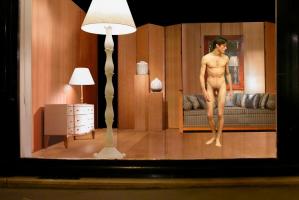
De nuit, un salon à l?ameublement précisément choisi. Aucune trace des habitants. Un jeune homme nu traverse l'espace. Il se couche sur un sofa, dépose un plat sur la table. Il agit comme un étranger qui se serait introduit dans la maison. Les meubles tremblent, apparaissent, disparaissent comme déplacés par une main invisible. Le rapport à l'intimité et à la proximité du corps de l'homme changent brusquement lorsque l'extérieur devient visible. Nous sommes face à une vitrine de magasin.
*Winterthur/Suisse, vit et travaille à Bâle et à Paris. Formation: HGK Zurich, Arts graphiques, Télévision Suisse, Scénographe, HGK Bâle, Arts audiovisuels
Christoph Oertli
Monsieur René
Vidéo | hdv | couleur | 11:11 | Suisse, Belgique | 2012
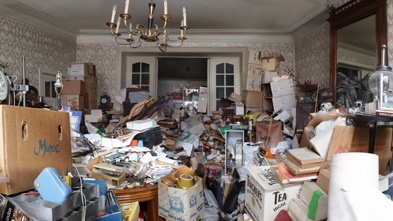
The camera is invading an over-stuffed apartment, floating through an almost surreal material world. There is a presence of the real tenant, supposedly an old man, who we don?t get to see. Instead, a younger man in search of a place to rest is wandering about. The rooms reveal the standstill of a lonley person, who has separated himself from life and the outside world by pileing up consumer objects. A glance out of the window shows a formerly fancy boulevard in Brussels, ruled today by Moroccan traders and African immigrants.
1962* Winterthur/Switzerland, lives and works in Basel/Switzerland and Brussels/Belgium HGK Zürich, Graphic design; Swiss Television Zürich, stage design; HGK Basel, audiovisual design. videotapes, video installations, documentary videos. Works 1995-97 on cruise-ships around the world, lives 1998-2000 in Montréal/Canada and 2002-07 in Paris, then moves to Brussels. 2000-02 lecturer for video Fachhochschule Vorarlberg/Austria. From 2004 guest lecturer HGK Lucerne/CH.
Christoph Oertli
The ground is moving
Vidéo | hdv | couleur | 10:30 | Suisse, Belgique | 2010
1962* Winterthur/Switzerland, lives and works in Basel/Switzerland and Brussels/Belgium. HGK Zürich, Graphic design; Swiss Television Zürich, stage design; HGK Basel, audiovisual design. videotapes, video installations, documentary videos. Works 1995-97 on cruise-ships around the world, lives 1998-2000 in Montréal/Canada and 2002-07 in Paris, then moves to Brussels. 2000-02 lecturer for video Fachhochschule Vorarlberg/Austria. 2004/06/11 guest lecturer HGK Lucerne/CH.

Christoph Oertli
Sensing Bodies
Doc. expérimental | 4k | couleur | 48:0 | Suisse | 2019
Le film traite de l‘utilisation de nos corps dans un environnement parfaitement structuré et construit. Le film se penche sur une société hautement organisée et explore les questions de l'expérience corporelle active par rapport à l'état statique de l‘expérience virtuelle. A quelle distance de la nature l‘homme peut-il vivre?
1962* Winterthur/Switzerland, lives and works in Basel/Switzerland. education ZHdK Zürich, Graphic design; Swiss Television Zürich, stage design; FHNW Basel, audiovisual design. from 1995: videotapes, video installations, documentary videos, video for dance and theater. Works 1995-97 on cruise-ships around the world, lives 1998-2000 in Montréal/Canada and 2002-07 in Paris, 2008-16 in Brussels. 2000-02 lecturer for video Fachhochschule Vorarlberg/Austria. from 2004 guest lecturer HSLU Lucerne/Switzerland.
Dietmar Offenhuber, Sam AUINGER
Heinz weiss (naredmanet)
Vidéo expérimentale | dv | couleur | 4:0 | Autriche | 2005
fghrt
Dietmar Offenhuber, born 1973, graduated in Architecture and has been working since 1994 in animation, interactive environments and digital architecture. Between 2002 and 2004 Dietmar worked as key researcher in the Interactive Space departement at the Ars Electronica Futurelab. Since Fall 2004 he is Professor for animation and interactive media at the University of Applied Sciences in Hagenberg / Austria.
Anna Ogden Smith
The Lie
Vidéo | | couleur | 2:40 | Liban | 2008
Anna Ogden Smith
The Dream
Vidéo | | couleur | 2:10 | Liban | 2008
Anna Ogden-smith
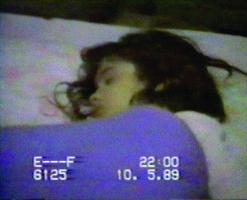
The Dream (VHS: 1989-1994)
0 | dv | couleur | 4:20 | Liban | 2008
En tombant par hasard sur une collection de vidéos maison réalisées par sa mère, datant de 1989 à 1994, Anna Ogden-Smith s?est tout à coup intéressée à la manière dont les archives VHS sont actifs dans processus de filtration de notre mémoire.
Née à Beyrouth (Liban) en 1984, Anna Ogden-Smith a obtenu une licence en design graphique à l'Université américaine de Beyrouth en 2006. Depuis, elle a principalement travaillé en free-lance dans le design imprimé et a poursuivi sa vocation de danseuse contemporaine à Londres (Royaume-Uni) et à Beyrouth. Récemment, elle a commencé à explorer différents médiums, en réalisant deux autofictions, « Le mensonge » et « Le Rêve ».

Senem Gökce Ogultekin, Levent Duran
Void
Film expérimental | digital | couleur | 16:57 | Turquie, Allemagne | 2024
While the shade of a tree is being stolen away, bodiless organs sit in the enormous gaps of the drained earth. Under the constant noise of unseen machines, disjointed body parts touch the drying soil and breaths are only audible to insects. In this quiet, distorted world, old songs of goodwill are sung: “Future times of vain sorrow do not disturb our gentle sleep...” While we are waiting for the miracle to come the sand continues to fly.
SENEM GÖKCE OGULTEKIN work spans the disciplines of choreography, performance, vocal work and film. In 2019, "Dun/Home" was chosen for Artist´s Film International, an international event initiated by Whitechapel Gallery in London and was shown at various museums and galleries of the world. In 2020, Senem Gökce Ogultekin was awarded the Allbau Foundation Culture Prize and was appointed to the Young College by the North Rhine-Westphalian Academy of Sciences and Arts in 2021. LEVENT DURAN is a multidisciplinary artist and writer. They studied sociology at Istanbul University and film at the Fine Arts University of Hamburg, where they obtained their master's degree. Their writings have been published in major magazines and newspapers in Turkey, and their visual creations (video, painting, sculpture, installation) have been exhibited internationally. Their film project "Murmuring Draft Dodgers" received the Courageous Citizen Award from the European Cultural Foundation.
Yuki Okumura
Countdown in NYC
Art vidéo | dv | couleur | 1:43 | Japon | 2006
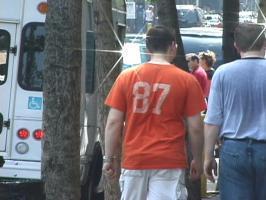
L'artiste a filmé des gens sur la route à New York portant des t-shirts avec des nombres, et les a rassemblés de façon à créer un décompte de 99 à 0. Il s'agit de révéler ou de reconstruire un ordre caché derrière le chaos de la ville.
Yuki Okumura est né à Aomori, au Japon, en 1978. Il vit à Tokyo et crée des installations vidéo. Son oeuvre à été montrée dans son pays et sur le plan international. Il a reçu le grand prix du Philip Morris Art Award en 2000. En 2006, il a obtenu de l'Asian Cultural Council Fellowship la possibilité d'être artiste en résidence à Location One, à New York. Il a participé à d'autres programmes de résidence comme le Taipei Artist Village, à Taipei et l'Irish Museum of Modern Art, à Dublin, en 2007.
Erwin Olaf
dusk & dawn
Vidéo | 35mm | couleur et n&b | 5:12 | Pays-Bas | 2009
Dusk: A mother mourns the death of her husband while her son questions his existence. Dawn: A mother mourns the death of het child, while her husband tries to deal with the death and the misshapen newborn.
Erwin Olaf Born in Hilversum in the Netherlands in 1959, Erwin Olaf lives and works in Amsterdam since the early 80`s. His current studio is situated in a former church hall. Mixing photojournalism with studio photography, Olaf emerged in the international art scene in 1988 when his series `Chessmen` was awarded the first prize in the Young European Photographer competition. This award was followed by an exhibition at the Ludwig Museum in Cologne, Germany. Since then Olaf has continued to explore issues of gender, sensuality, humor, despair and grace in each successive series. Printing his early work in documentary style black-and-white, he first gradually introduced color and then digital manipulation. There is great contrast between each series. Mature (1999): golden-hued portraits of elderly women in the poses of kittenish supermodels; Fashion Victims (2000): a lewd commentary on the consumerism of sex and designer labels; Royal Blood (2000): minimalist white-on-white portraits, depicting the vengeful nature of members of the aristocracy who have suffered unsavory deaths; Paradise (2001): picturing a dark and baroque underworld of gleeful clowning and lunacy; Separation (2003) portraying an ice cold and introverted family in a sterile living room. In his four most recent series Rain, Hope, Grief and Fall, Erwin Olaf returns to classic imagery with minimal computer retouching. Video and film offer new possibilities to explore. His first film Tadzio (1991, co-directed with painter F. Franciscus) was soon followed by comic videos for children`s television, short documentaries, music clips and commissions by the Dutch National Ballet. Recently Olaf has created autonomous video works like Separation, Rain and Grief, starring models who also appear in the accompanying photo series. In the films they play a different character, as though his moving images provide a parallel history to his color photographs. These short films have been selected for film festivals all over the world. Over the years many of Olaf`s works - from his unabashed nude portraiture and intense symbolism to the unflinching gaze in his blood-drenched images of staged violence - have provoked controversy. Not surprisingly, this ability to attract attention has seen his work embraced by the advertising world, resulting in commercials for Lavazza, BMW, Microsoft and Nintendo among many others. Lately Erwin is frequently shooting in commission for magazines such as The New York Times Magazine, The Sunday Times Magazine, Elle and Citizen K. In 1999 his worldwide campaign for Diesel Jeans won him the coveted Silver Lion at the Festival for Advertising in Cannes. He was awarded the same prize two years later for his imagery produced for Heineken. Among numerous other international art and media prizes, in 2006 he was awarded Photographer of the Year in the International Color Awards. In 2007 Kunstbeeld magazine chose him Artist of the Year of the Netherlands. Recently he received a Lucie Award for his entire oeuvre
Erwin Olaf
Grief
Vidéo expérimentale | dv | couleur | 3:59 | Pays-Bas | 2007
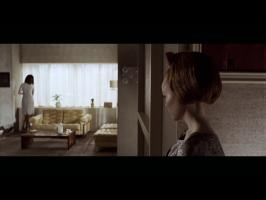
Grief NL, 2007, 3`59? Semblables à du tonnerre, des bruits accompagne l'image d'une femme qui, renfermée sur elle-même, fixe par la fenêtre. Une voix radiophonique, partiellement intelligible, fait un rapport sur certain évènements, et une autre femme entre dans la pièce en hésitant. Aucune des deux femmes ne dit un mot; le silence persiste entre les deux. La pluie, la radio, la tension du visiteur, se maintiennent en haleine. Les coups de tonnerre interagissant avec la radio prennent tout à coup une sonorité menaçante et le public commence à suspecter une connection entre l'orage, les vagues messages se glissant dans la pièce et l'état de santé mentale de la femme qui attend qui reste physiquement inapprochable pour l'autre. Elle continue de tourner son dos à l'autre; elle cache ses larmes silencieuses. En une seule scène et avec des moyens minimes, "Grief" conjures une histoire entière de développement miséreux.
Erwin Olaf was born in 1959 in Hilversum, The Netherlands. Olaf has a passionate love affair with life, and enjoys to the full everything it has to offer. His oeuvre is a manifestation of his passion and of his genuine engagement with his subjects. Olaf has been professionally active for twenty-five years and in this period he has succeeded in evolving from a participating photographer to a director who creates his own reality. Olaf's pictures are filled with humor, imagination and exuberance, but they go much further than simple visual intrigue. His works deal with freedom, beauty, loneliness, and being different. He convinces his public in a shameless and versatile manner, questioning established norms. Olaf consistently expresses his own standpoints, fulminating against narrow-mindedness, smugness, and rigid norms, but not without humor, bravura and bite. An authentic Olaf is a blow to the head, ruthlessly direct, but simultaneously wrong footing the viewer and poking fun. One reviewer remarked that in Erwin Olaf's photographs everyone stares unwaveringly into the lens--thus looking straight into the photographer's big blue eyes, as it were. Olaf approaches the world openly and enthusiastically and this is also the way in which, in his work, he dares to enter the public debate. Olaf is a master in generating his own world, whether this be in autonomous photographic series or film projects. He is also hypercritical, nothing escapes him, so that pictures are created with a placement composed so meticulously that it is almost painful to examine. With these, Olaf manages to produce fictitious yet convincing images of bygone days, fairytales and dreams, populated by historical figures, elves, dwarves, lunatics, and god knows who.
Erwin Olaf
La tristesse riche
Fiction expérimentale | hdcam | couleur | 10:30 | Pays-Bas | 2010
Erwin Olaf was born in 1959 in Hilversum, The Netherlands. Olaf has a passionate love affair with life, and enjoys to the full everything it has to offer. His oeuvre is a manifestation of his passion and of his genuine engagement with his subjects. Olaf has been professionally active for twenty-five years and in this period he has succeeded in evolving from a participating photographer to a director who creates his own reality. Olaf's pictures are filled with humor, imagination and exuberance, but they go much further than simple visual intrigue. His works deal with freedom, beauty, loneliness, and being different. He convinces his public in a shameless and versatile manner, questioning established norms. Olaf consistently expresses his own standpoints, fulminating against narrow-mindedness, smugness, and rigid norms, but not without humor, bravura and bite. An authentic Olaf is a blow to the head, ruthlessly direct, but simultaneously wrong footing the viewer and poking fun. One reviewer remarked that in Erwin Olaf's photographs everyone stares unwaveringly into the lens--thus looking straight into the photographer's big blue eyes, as it were. Olaf approaches the world openly and enthusiastically and this is also the way in which, in his work, he dares to enter the public debate. Olaf is a master in generating his own world, whether this be in autonomous photographic series or film projects. He is also hypercritical, nothing escapes him, so that pictures are created with a placement composed so meticulously that it is almost painful to examine. With these, Olaf manages to produce fictitious yet convincing images of bygone days, fairytales and dreams, populated by historical figures, elves, dwarves, lunatics, and god knows who.
Jaamil Olawale Kosoko, Ima Iduozee
Chameleon (A Visual Album)
Vidéo | hdv | couleur | 21:16 | USA, Allemagne | 2020
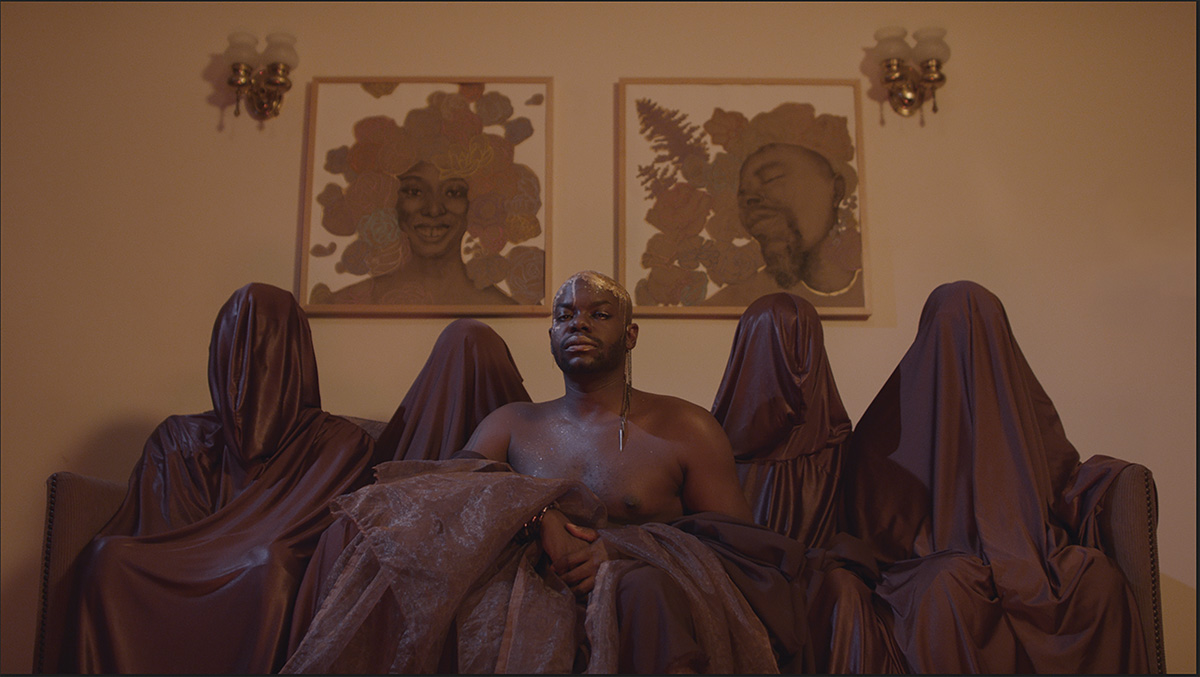
Chameleon is an experimental visual album inspired by the radical queer feminist genre of the “Biomythography” which refers to Audre Lorde’s foundational work entitled Zami: A New Spelling of My Name published in 1982. It combines history, biography, and myth, and holds a literary perspective that serves as a guiding light for complex narrative storytelling rooted in a queer, Black self-defined, feminist imagination.
jaamil olawale kosoko, (they/them) of Yoruba and Natchez descent is an award winning filmmaker, movement artist, poet, and facilitator whose work in embodied poetics and performance has been presented internationally and is rooted in the intergenerational passage of Black feminist knowledge, queer theories of the body, and sacred rituals of intimacy & wellness as a means to craft perpetual modes of freedom, healing, and care where/when/however possible. Their new book, Black Body Amnesia: Poems & Other Speech Acts was released in Feb. 2022. jaamil is the recipient of a MacDowell Fellowship, PEW Fellowship in the Arts, Princeton Arts Fellowship, 2019 Red Bull Writing Fellowship, and a 2017 Cave Canem Poetry Fellowship. Their works in poetry, curation, performance and education have taken them all around the world having performed and taught in over 21 countries on 5 continents including Morocco, South Africa, Germany, Finland, Sweden, UK, Norway, Switzerland, Canada, Mexico, Japan, and throughout the Americas. Of Nigerian and Finnish descent, Ima Iduozee is a choreographer, director, dancer and filmmaker based in Helsinki, Finland. His debut solo work, This is the Title, premiered in 2012 and went on to garner international acclaim, touring in 15 countries across Europe, North America and Asia. In 2015 the annual honorary prize of the Finnish Critics Association, Critics Spurs´, was given to Iduozee, as an acknowledgement for the best artistic breakthrough of the year. Earlier commissions include works for The Finnish National Theatre, Aalto International, Stockholm City Theatre, Helsinki City Theatre, Finnish National Opera and Helsinki International Film Festival. In 2016 Iduozee graduated from the Arts University of Helsinki (Theatre Academy).
Joachim Olender
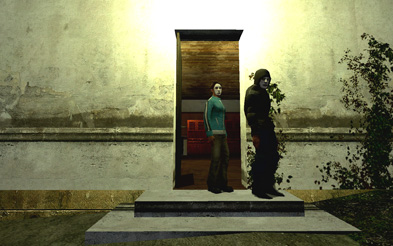
Tarnac. Le chaos et la grâce
Animation | hdv | couleur | 23:0 | France | 2012
Le 11 novembre 2008, cent cinquante policiers envahissent le petit village de Tarnac en Corrèze. Neuf personnes sont soupçonnées d?avoir posé des crochets métalliques sur des caténaires pour désorganiser les lignes SNCF. A l?issue de leur garde à vue, cinq d?entre elles sont placées en détention provisoire pour terrorisme. Le principal suspect restera incarcéré durant six mois sans preuve à l?appui. Voici l?affaire de Tarnac. Ce film en retrace la fiction.
Joachim Olender est scénariste, réalisateur et vidéaste. Sa démarche découle d?un va-et-vient entre l?écriture et l?image, le cinéma et la vidéo. Il a étudié le droit et le cinéma à Bruxelles. En 2006, il débute une thèse à l?EHESS sur la faille dans le cinéma US des années 2000. Accompagné par le cinéaste Luc Dardenne, il écrit un scénario de long métrage, adapté du roman Les Choses de Georges Perec, dont une première apparition se déroule à la BNF dans l?exposition « Choses lues choses vues » conçue par Alain Fleischer (fin 2009). Il est publié dans Pylône Magazine. En 2010, il intègre Le Fresnoy studio national des arts contemporains et réalise Bloody eyes (fiction 22 min, prod. Le Fresnoy, 2011), tiré d?une nouvelle de Luc Dardenne. En 2012, il réalise Tarnac. Le chaos et la grâce, documentaire d?animation entièrement tourné dans un jeu vidéo, qui explore les méandres de cette fiction d?Etat. En 2012, il entame le développement d?un documentaire sur Herman Daled et sa collection d?art conceptuel rachetée par le MOMA et s?associe à Camille de Toledo et Grégoire Hetzel dans l?opéra vidéo « La chute de Fukuyama ». Il poursuit actuellement sa recherche avec Le Fresnoy. Joachim Olender est né en Belgique en 1980. Il vit et travaille entre Paris et Bruxelles.

Mike Olenick
The Cure
Fiction expérimentale | hdv | couleur | 19:35 | USA | 2017
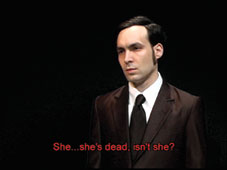
A mom cries, photos fly, cats spy, and bodies collide in this sci-fi soap opera about people who are desperately searching for ways to cure their fears of loneliness. Dad is dying, mom can’t sleep, and Nancy is determined to find a photograph so she can forget something that she saw. Linda relives a past trauma and fears what might happen while she is away from home. Meanwhile, her boyfriend Mark entertains a mysterious stranger, who is secretly conducting a deadly experiment.
Mike Olenick’s perverse films focus on memories, reproduction, appropriation, transformation, and forbidden desire. His films have screened at Slamdance, Fantasia International Film Festival, Fantastic Fest, Palm Springs ShortFest, Hamburg International Short Film Festival, and the World Wide Video Festival; streamed on MUBI; and won awards at the Slamdance, Ann Arbor, Big Muddy, and Chicago Underground film festivals. For nearly fifteen years Mike was a video editor in the Film/Video Studio residency program at the Wexner Center for the Arts. He’s worked as an editor on projects for Guy Maddin (including “Keyhole” and “The Forbidden Room”), the Quay Brothers, Sadie Benning, and Lucy Raven, among others. Since 2003 he has edited numerous films for Jennifer Reeder including “A Million Miles Away,” which screened at Sundance. He also edited her feature “Knives and Skin,” which premiered at the Berlin Film Festival and is distributed by IFC Midnight. Projects he has worked on as an editor are in the collections of MoMA, the Guggenheim, the Whitney, and the Tate. Mike has an MFA in Photography from the Cranbrook Academy of Art. In 2016 he was awarded a fellowship at the inaugural Shudder Labs.
Mike Olenick
For a Blonde...
Vidéo expérimentale | dv | couleur | 5:57 | USA | 2005
"For a Blonde... For a Brunette... For Someone... For Her... For You..." est une vidéo réalisée dans le style d'un karaoke qui reprend une scène culte du film d'Alfred Hitchcock "Vertigo" ("Sueurs Froides"). L'artiste joue le rôle de John Ferguson au moment où il redécouvre sa Madeleine. Les sous-titres "Karaoke" permettent au spectateur d'interpréter le rôle de Kim Novak et ainsi jouer la scène avec l'artiste.
Mike Olenick (né en 1978) est réalisateur de vidéos, photographe et monteur. Ses créations réunissent souvent des situations fictives de sa propre vie à des séquences réelles empruntées au cinéma et à la culture pop. Les vidéos et photographies qui résultent de ce travail mélangent faits et fiction; comédie et tragédie; amour et mort. Ses oeuvres ont été présentées au Ann Arbor Film Festival, The Oberhausen Film Festival, VIPER Basel, Cinematexas, The Brooklyn Underground Film Festival et au World Wide Video Festival. Actuellement, Mike travaille comme monteur au Art & Technology Studio au Wexner Center for the Arts, où il a travaillé sur des projets en collaboration avec, notamment, Jennifer Reeder, Sadie Benning, Deborah Stratman, Andrea Fraser, Joe Sola and Josiah McElheny. Il enseigne également la production vidéo au Columbus College of Art and Design. Il a obtenu son MFA (avec une spécialisation en Photographie) à la Cranbrook Academy of Art et son BFA d'études média au Columbus College of Art and Design.
Jacco Olivier
Calling
Animation | dv | couleur | 1:9 | Pays-Bas | 2005
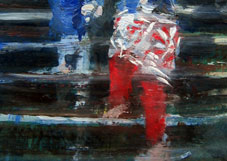
Dans cette animation des scènes d?horreur et des scènes de thriller typiques se succèdent : un corbeau, un téléphone qui sonne sans cesse, des escaliers qui craquent, une ombre passe en glissant, un rideau qui flotte dans le vent et des gens qui marchent dans la rue tels des zombies. Tous ces éléments semblent se retrouver dans une fin surréaliste. Une ombre bouge derrière la fenêtre d?une maison qui flotte. Est-ce que ce que nous avons vu plus tôt pouvait être la visualisation de ses pensées ? Ceci n?est probablement qu?une des diverses histoires possibles. Chaque spectateur peut construire une histoire différente grâce aux éléments disponibles.
Jacco Olivier
Comfort
Vidéo expérimentale | dv | couleur | 1:13 | Pays-Bas | 2005
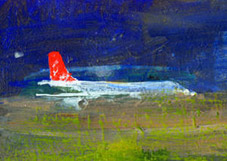
L'animation 'Comfort' nous éclaire sur la manière de travailler de Jacco Olivier. L'histoire qu'il a en tête au départ, peut évoluer en fonction des idées qui peuvent se dégager pendant le processus de création. De cette façon, une animation peut éventuellement se construire à partir de diférentes histoires. Les différentes intrigues sont reliées grâce à des images qui se font écho : de la queue rouge d'un Boeing à l'arrêt, au logo rouge de Vodafone, et de là à un téléphone qui sonne. l'animation semble également s'auto-examiner lorsque la caméra plonge en profondeur et retires les couches successive d'un tableau une par une, pour ensuite ressortir par la couche supérieure. On reprend le fil de l'histoire sans effort. Contrairement à ce que le titre suggère, ce qui prédomine dans ce travail est une atmosphère de peur et d'oppression.
Erik Olofsen
Public Figures
Film expérimental | 0 | couleur | 10:22 | Pays-Bas, Belgique | 2007
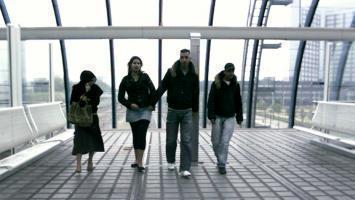
Le film fut filmé en utilisant une camera digitale a haute vitesse depuis un métro arrivant dans une gare très fréquentée. Le résultat est un plan sans fin des personnes sur un quai passant au ralenti. Le mouvement tranquille de la caméra et le calme des gens dépeints donne de la place pour une chaîne de pensées et d'associations hypnotiques. Le quai semble avoir été transformé en scène sur laquelle les gestes quotidiens et simples des gens se changent en performance.
Erik Olofsen est né aux Pays-Bas en 1970. Ses installations ont été exhibé dans plusieurs pays et mêlent différents supports tels que la sculpture, des éléments architecturaux, de la vidéo, des photos et du son. Il a aussi introduit de nouvelles technologies dans son travail d'artiste, entre autres, des robots industriels et cameras digitales à haute vitesse. Il a été résident à la Rijks Académie à Amsterdam, au Centre Chinois d'art Européen a Xiamen et au Bilbao Arte. Ses prix comprennent le prestigieux grand prix hollandais Prix de Rome pour l'installation "Remotly Here", le prix international espagnole Vidalife pour son oeuvre "Divine methods/ Hidden motives" et le prix Media Forum au Festival International du Film de Moscou pour sa vidéo "In Places".