Catalogue > Faire une recherche
Résultats pour : Tout le catalogue
Elena Näsänen
Night
Installation vidéo | 16mm | couleur | 6:40 | Finlande | 2007
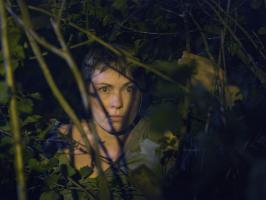
Une femme sort d'une maison solitaire dans la nuit. Elle suit un chemin étroit, marche dans les bois. L'obscurité l?entoure. Elle s?enfonce à travers les branches, de plus en plus profondément dans la forêt. « Night » ressemble à un extrait de film de suspense, dans lequel le rêve et la réalité s?entremêlent.
Née en 1968 à Helsinki (Finlande), Elena Näsänen est une artiste visuelle qui travaille avec le son, le film et les installations vidéo. Elle a étudié à l'Académie des Beaux-arts d'Helsinki et à la Slade School of Fine Art de Londres (Royaume-Uni). L?art de Näsänen se situe quelque part entre le cinéma expérimental et l?art vidéo. Ses ?uvres sont basées à la fois sur une narration cinématographique conventionnelle et sur le dérèglement de cette dernière. Une caractéristique de son ?uvre est sa puissance dramatique sonore. Les ?uvres d?Elena Näsänen ont été montrées dans nombres d?expositions, projections, festivals de film et de vidéo, notamment au Musée d?Art Contemporain Kiasma d?Helsinki, au Musée Marco de Vigo (Espagne), au Musée Anna Akhmatova de Saint-Pétersbourg (Russie), au Centre d?Art de Kyoto (Japon), au FACT de Liverpool (Royaume-Uni), à l?Anthology Film Archives de New York (USA), à La Casa Encendida de Madrid (Espagne), au Tate Modern de Londres (Royaume-Uni), au ZKM de Karlsruhe (Allemagne), et au Festival de Film de Rotterdam (Pays-Bas).

Kavich Neang
Dey thmey phlauv kouch
Fiction | 4k | couleur | 15:21 | Cambodge | 2018
Phnom Penh at night. Three young hip-hop dancers drive a single motorbike and stop on a muddy deserted road. Nick leaves the others to look for an iPhone he heard was lost in the area. Piseth and Thy discuss their hopes and doubts, and Piseth shows his best dance moves. They meet Leakhena, a young female street vendor whose cart is full of colors.
Kavich NEANG (b. 1987, Phnom Penh, Cambodia) studied music and dance at a young age before graduating in professional design in 2013. In 2010, he directed his first short film, A Scale Boy, as part of a documentary film workshop led by Khmer-French filmmaker Rithy PANH, who also produced his 2013 mid-length documentary film Where I Go. In 2014, he co-founded the independent production company Anti-Archive along with Davy CHOU, Steve CHEN, and PARK Sungho. In 2015, he directed his first two short fictions, Three Wheels, which premiered at Busan, and Goodbye Phnom Penh. A third short fiction, New Land Broken Road, premiered at the 2018 Singapore International Film Festival and won prizes in Kyiv, Tacoma, and Kaohsiung. Kavich NEANG has also joined Busan’s Asian Film Academy, Locarno’s Summer Academy, Talents Tokyo, Docs by the Sea, Luang Prabang Talent Lab, and Cannes Cinéfondation’s Résidence. His 2019 documentary, Last Night I Saw You Smiling, won the NETPAC Award at IFF-Rotterdam, the Special Jury Prize at Jeonju, Best Image at Janela do Recife and two awards at Tokyo FilmEx. His impending first narrative feature, White Building, is now in post-production.

Jürgen Nefzger
The Cloud Machine
Vidéo expérimentale | hdv | couleur | 12:35 | Allemagne, France | 2017
Jürgen Nefzger associe des projets filmiques à son oeuvre photographique centrée sur les rapports entre l’homme et son environnement dominés par les logiques économiques. Avec The Cloud Machine, il présente un film réalisé au sein d’une grande usine d’incinération. Celle-ci vient éclairer son propos, avec cette notion de recyclage, de cycle dans lequel s’inscrivent les sociétés contemporaines. Avec des pointes d’humour, il nous fait partager le quotidien de ces hommes alimentant cette machine à nuages. En dehors des fumées que rejette l’usine, il y a cette idée de boucle immuable induite par une logique consumériste portant les individus vers les centres commerciaux, achetant des produits qui nécessairement seront voués à la destruction. En découle ce constat: finalement, rien ne change malgré les aléas. La crise, mais quelle crise?
Né en 1968 à Fürth en Allemagne, Jürgen Nefzger vit et travaille en France depuis 1991, aujourd’hui entre Paris et Nice. Diplômé de l’école Nationale Supérieure de la Photographie à Arles, il est depuis 2008 artiste enseignant, à l’Ecole Supérieure d’Art de Clermont Métropole puis à l’Ecole Supérieure d’Art de Aix-en-Provence. Il est représenté par la galerie Françoise Paviot, Paris, depuis 2001. Jürgen Nefzger a obtenu le Prix Niépce pour l’ensemble de son travail en 2008. Il est également lauréat de la Villa Médicis Hors les Murs et du Prix Photo du Jeu de Paume. La publication “ Fluffy Clouds ” a reçu le prix du livre photographique en Allemagne. Dans une veine documentaire, Jürgen Nefzger aborde des sujets relevant d’une interrogation sur le paysage contemporain. Observateur critique d’une société consommatrice, il porte son regard sur des paysages marqués par les activités économiques, industrielles et de loisir. Son travail photographique se construit par série, à la chambre photographique, et associe des projets filmés en numérique présentés au sein de ses expositions ou indépendamment. Il édite aussi ses travaux sous formes de livres, en portant une grande attention aux question de narration et de positionnement.
Irit Neidhardt
NATION ESTATE
Vidéo expérimentale | hdcam | couleur | 9:0 | 0, Danemark | 2012
Short Content Nation Estate is a 9-minute sci-fi short offering a clinically dystopian, yet humorous approach to the deadlock in the Middle East. The film explores a vertical solution to Palestinian statehood: One colossal skyscraper housing the entire Palestinian population ? now finally living the high life. Long Content In Sansour`s film, Palestinians have their state in the form of a single skyscraper: the Nation Estate. One colossal high-rise houses the entire Palestinian population ? now finally living the high life. With a glossy mixture of computer generated imagery, live actors and an arabesque electronica soundtrack, Nation Estate explores a vertical solution to Palestinian statehood. Each city has its own floor: Jerusalem on the third floor, Ramallah on the fourth floor, Sansour?s native Bethlehem on the fifth and so on. Intercity trips previously marred by checkpoints are now made by elevator. Aiming for a sense of belonging, the lobby of each floor reenacts iconic squares and landmarks. The story follows the female lead in a futuristic folklore suit returning home from a trip abroad and making her way through the lobby of the monstrous building ? sponsored and sanctioned by the international community. Having passed the security checks, she takes the elevator to the Bethlehem floor and crosses Manger Square and Church of the Nativity on her way to her apartment where she prepares a plate of sci-fi tabouleh.
Born in Jerusalem, Sansour studied Fine Art in Copenhagen, London and New York. Her work is interdisciplinary, immersed in the current political dialogue and utilises video art, photography, experimental documentary, the book form and the internet. Despite its stylised imagery, sterile futurism and high production value, sci-fi tends to allow for a specific kind of almost nostalgia framing of the topic at hand, even the situation in the Middle East. Sci-fi almost invariably carries within it a sense of retro, ideas of the future tend to appear standard and cliché at the same time as they come across as visionary. Sansour borrows heavily from the language of film and pop culture. By approximating the nature, reality and complexity of life in Palestine and the Middle East to visual forms normally associated with entertainment and televised pastime, her grandiose and often humorous schemes clash with the gravity expected from works commenting on the region. References and details ranging from sci-fi and spaghetti westerns to horror films converge with Middle East politics and social issues to create intricate parallel universes in which a new value system can be decoded. Sansour`s work features in galleries, museums, film festivals and art publications worldwide. Recent solo shows include exhibitions at Kulturhuset in Stockholm, Galerie La B.A.N.K in Paris, DEPO in Istanbul and Jack the Pelican in New York. She has participated in the biennials in Istanbul, Busan and Liverpool. Her work has appeared at the Third Guangzhou Triennial in China, LOOP in Seoul, South Korea, Institut du Monde Arabe in Paris and PhotoCairo4 in Egypt. Sansour`s graphic novel The Novel of Nonel and Vovel - a collaboration with Oreet Ashery - first appeared in Venice Biennale bookshops and was since launched at the Tate Modern, UK, the Brooklyn Museum, USA, and Nikolaj Copenhagen Contemporary Art Centre, Denmark. Her short film A Space Exodus was nominated in the Best Short category at the Dubai International Film Festival. Exhibitions in 2012 include the Centre for Photography in Copenhagen, Galerie Anne de Villepoix in Paris and Australian Centre for Photography in Sydney. She lives and works in London and Copenhagen.

Warren Neidich, Assistant Director Ashiq Khondker
Pizzagate - From Rumor To Delusion
Vidéo | hdv | couleur | 20:20 | USA, Allemagne | 2017
We have now entered into a new era some have called the post-truth society characterized by a deluge of fictive mediated stories dubbed Fake News. One of these stories, Pizzagate concerns the conspiracy theory, circulated at the end of the Trump-Clinton presidential election, that accused Hillary Clinton and other members of her Democratic election committee of running a childhood sex ring in the basement of Comet Ping Pong pizza restaurant. As preposterous as this is, many people believed it and the story went viral. My PIZZAGATE: FROM RUMOR TO DELUSION as an experimental documentary which uses non-linear video editing techniques to collage extracted You Tube clips with real video taped footage collected on site at the Comet Ping Pong pizzeria investigates the conditions of our now planetary network existence to understand this event and its implications. I utilize the story of the delusional behavior of James Welch who drove up from North Carolina, shotgun in hand, to free the girls as an example of a generalized societal condition addicted to social media. I speculate that we have transitioned from Guy Debord’s Society of the Spectacle to what I am calling The Society of the Neuron in the Attention Economy.
- Theorist, film maker, composer and installation artist, Warren Neidich, who works between Los Angeles and Berlin, brings to any discussion platform a unique interdisciplinary position that he calls “trans-thinking”. The model explores the way cognition is mediated and acted upon by co-extensive cultural inputs consisting of an evolving socio-cultural-political milieu wherein various unequally distributed and contested discursive fields gather and entangle themselves with the plastic brain. The result being what Gilles Deleuze referred to as the image of thought. His works of art have been exhibited internationally including the Ludwig Museum, Cologne, The Whitney Museum, New York City, PS1 MOMA, Long Island City, The ICA London, LACMA, Los Angeles and many others. His one-person exhibition, Rumor to Delusion, premiered at the Zuecca Project Space, during the Venice Biennale, 2019. He is founder and director of the Saas-Fee Summer Institute of Art and is a recipient of the Vilem Flusser Theory Award, Transmediale, AHRB/ACE Arts and Science Research Fellowship, Bristol and The Fulbright Scholarship. Additionally he was former tutor in the departments of visual art, computer science and cultural studies at Goldsmith College London as well as recently serving at Professor of Art at the Weissensee Kunsthochschule, Berlin.
Art Collective Neozoon
MY BBY 8L3W
Vidéo | hdv | couleur | 3:3 | Allemagne | 2014
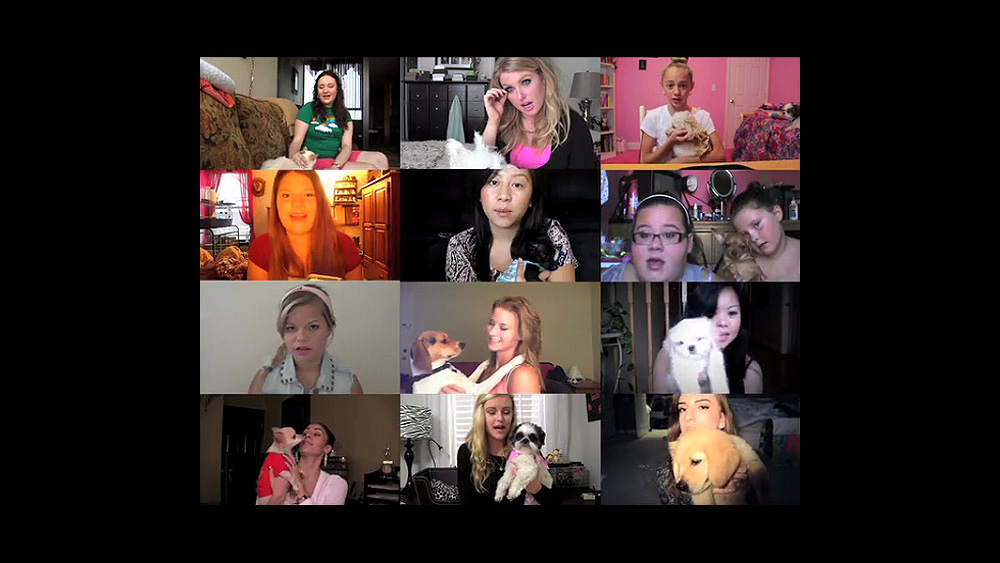
MY BBY 8L3W Synopsis The thirty track installation MY BBY 8L3W is a video collage about women who present their pets on the internet. The women simultaneously speak the same lines about their love for the animals.
NEOZOON Biography NEOZOON, founded 2009 is a female art collective based in Germany and France. Among others the work and films of the group has been shown at the Centre Pompidou in Paris, at the Transmediale in Berlin, at the Internationale Kurzfilmtage in Oberhausen, at the IFFR in Rotterdam, at the Videonale in Bonn and at the ZKM in Karlsruhe.
Art Collective Neozoon
Lake on Fire
Doc. expérimental | mov | couleur | 11:0 | Allemagne | 2022
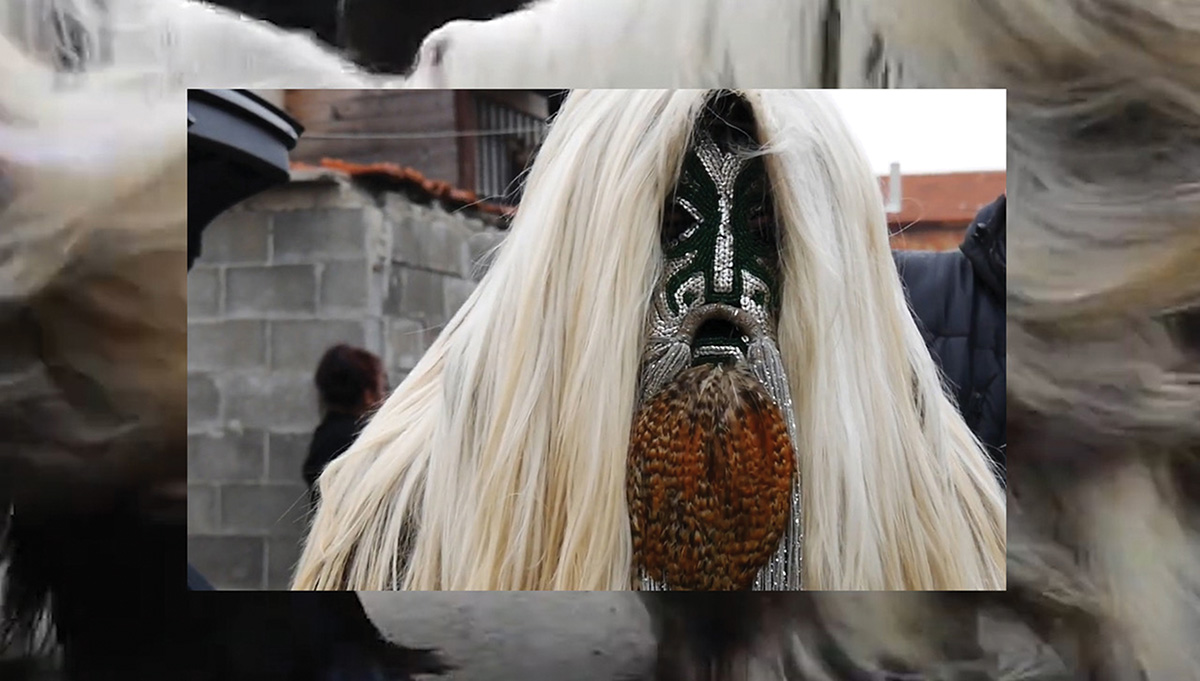
LAKE OF FIRE deals with religious filter bubbles in the social network Youtube and thematizes the fear of death and hell as a place of eternal damnation. Old and new iconographies of religious presenters are interwoven with pagan customs and the consequences of dualistic religions and anthropocentrism become visible.
NEOZOON is a female art collective founded 2009 in Berlin and Paris. Their work is based on the principle of collage and investigate sociological questions that deal with speciesism in the Anthropocene. In their video films, the de-and recontextualization of Found Footage / Youtube material is a recurring element. Amongst others NEOZOON´s work was exhibited at Centre Pompidou in Paris, at ZKM in Karlsruhe, at Kunstwerke Berlin and has been shown at national and international film festivals in Oberhausen, Rotterdam, Locarno and New York.

Jean Francois Neplaz
ALPINI
Documentaire | 16mm | couleur et n&b | 60:0 | France | 2010
L?histoire tourmentée du XXe siècle dans le nord de l?Italie est un « point de voir » qui nourrit l?oeuvre, majeure, de l?écrivain Mario Rigoni Stern. Dans cet ultime témoignage (il est décédé en juin 2008), il accompagne notre cheminement dans l?imaginaire des montagnards d?Asiago. La place de l?homme au coeur de la nature autant qu?au coeur de la guerre se mêle à la voix de l?écrivain. Ici le territoire est une frontière, le fascisme est un passé présent, la guerre est inscrite sous une paix de neige? Et l?homme est là.
Diplômé de l?IDHEC (Institut des Hautes études Cinématographiques en 1979) en prise de vue et réalisation. En 1994, il s?installe à Marseille, lance le collectif Film flamme et crée le Polygone étoilé, salle de cinéma alternative et outil de création cinématographique (salles de montage, mixage, etc?). Depuis 2003, Film flamme développe le Studio Autonome du Cinéma de RecherchE (SACRE) pour soutenir les auteurs indépendants. Ce collectif a pour originalité de vouloir travailler prioritairement pour les salles de cinéma. Si tous les films sont achevés en 35 mm, ils sont aussi tournés et travaillés sur tous les supports existant à ce jour, vidéo (analogique ou numérique) ou film. Est également producteur, notamment : Ho, de Gaëlle Vu Binh Giang, de France 2007 de Jun Gee Jung et de Lettre à la prison de Marc Scialom.
Jean-françois Neplaz, Elisa ZURLO
L'autre matin... En attendant Mario Rigoni Stern
Doc. expérimental | 16mm | couleur | 11:30 | France, Italie | 2006
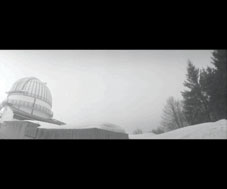
Un marcheur parcourt en une promenade âpre, les paysages hivernaux des environs d?Asiago dont tout évoque les expériences, les paysages et les hommes racontés par l?écrivain Mario Rigoni Stern. Là, le monologue contre la guerre de celui qui commença d?écrire sur le front russe « Le sergent dans la neige », donne à la déambulation son caractère métaphorique.
Elisa Zurlo studied theatre, cinema, and semiology of the language of visual art in the faculty of arts and philosophy at the University of Bologne under the direction of Umberto Eco. At the Ipotesi Cinema Institute of Padoue, under the tutelage of director Ermanno Olmi, she herself specialized as a director in audiovisual communication in the area of cinema and television. At the same time in Bologne she founded the cooperative 'Les Machines Célibataires' with a group of researchers, for the experimentation and diffusion of new technologies in contemporary art. She has created an impressive amount of work and participated in several exhibitions. A select few include: 1993 - Realization, Giannina Censi, Aérodanseuse Futuriste; 1996 - Realization, Chant végétal à Pachamama coca; 1997-2002 - Assistant to trilogy filmmaker Gianni Toti; 2000 - Installation, "Salitudine", a pyramid of salt and projection of images, for the city of Bologne, European Cultural Capital 2000; 2002-2003 - Multimdeia Installation "Flying Cities", European project with the CICV Montbéliard-Belfort. Elisa Zurlo currently lives in Italy, between the cities of Bologne and Padoue. Jean-François Neplaz holds a degree from IDHEC. His works and exhibitions include: "La Blanche", 1986; International Film Festival of Autrans, "Guide et sa voie", 1987, was awarded; Festival of Epinay 88, "Ante Inferno"; Semaine vidéo des "cahiers du Cinéma", Rue de Montreuil, 1990; Etats généraux du documentaire français Lussas... "Tu", a Polish film, 1990; 6th M. I. V. TV. Montbéliard competition; Forum des images de Valence, 1992, awarded, "Cancer"; Etats généraux du documentaire de Lussas, 1993... "Vivants et nus", 1994, "Signe ascendant", Poème documentaire, 1996, "Besoin de rien", 2000, musical film; and Festival Paris-Berlin 2003. Collaborations: "Abondance", feature length fiction film, 2005, and "Terre d?un homme", feature length documentary project devoted to Mario Rigoni Stern, 2006.
Jean François Neplaz
Si elle Tomber
Doc. expérimental | 16mm | couleur | 32:54 | France | 2013
Diane Nerwen
FUH2
Vidéo expérimentale | dv | noir et blanc | 0:40 | USA | 2006
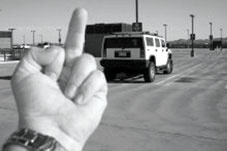
FUH2 rend hommage au site citoyen www.fuh2.com hébergeant le Hummer Salute officiel. Richement documenté le site présente la sous culture de resistance à la "Hummerisation". Intercalant images du site et pubicités pour Hummer, cette vidéo catharcique de 30 secondes charge contre le véhicule d'assault (sub)urbain.
Diane nerwen est une artsite vidéo et enseigne l'art multi-média. Son travail a été présenté à travers le monde (festival du film de berlin, festival vidéo de New York, musée Guggenheim, NY and Viper International Festival of Film Video and New Media, Bâle, Suisse). Elle a été plusieurs fois récompensée notament par la DAAD Artist in Residence Fellowship de Berlin en 2001. Nerwen est née a Montréal et vit a Brooklyn, NY. son travail est distribué par Video Data Bank, Chicago, Women Make Movies, NY, et Vtape, Toronto.
Diane Nerwen
The sexorcist:revirginize
Vidéo expérimentale | dv | noir et blanc | 13:0 | USA | 2005
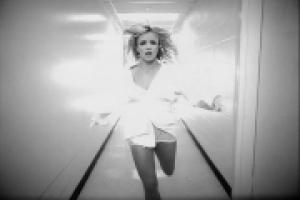
The Sexorcist : Revirginize est un thriller psycho-sexuel avec Britney Spears dans le rôle d´une adolescente que sa nervosité sexuelle tourmente, et Ellen Burstyn dans le rôle de la mère terrorisée et déséspérée. Cet amusant mais glaçant récit sur la possession, les angoisses d´adolescence et de panique morale entremêle images et sons de films tels que l´Exorciste, Crossroads et Buffy la chasseuse de Vampires, exposant de manière satirique le programme idéologique derrière une éducation sexuelle basée sur l´abstinence.
Diane Nerwen est née à Montréal et vit à Brooklyn, NY. C'est une artiste qui enseigne et fait de la vidéo. Ses vidéos ont été internationalement projeté, notemment au Festival du Film de Berlin, au Festival du film de New-York et au Musée Guggenheim, NY. Elle a reçu de nombreux prix et récompenses, dont un DAAD Artist in Residence Fellowship à Berlin en 2001. Son oeuvre explore les corrélations entre média, politique et vie de tous les jours. Parmis ses récentes cassettes on trouve Under the Skin Game, un documentaire experimental sur l´utilisation et l´abus des moyens de contraception, et leur relation avec les politiques de races, genre (masc/fém) et classe. Spank est la manipulation numérique d´un très court clip Hollywoodien. Ses cassettes ont été projeté internationalement et sont distribuées par Women Make Movie et Video Data Bank.
Gerald Nestler
COUNTERING CAPITULATION
Vidéo | hdv | couleur | 11:25 | Autriche | 2013
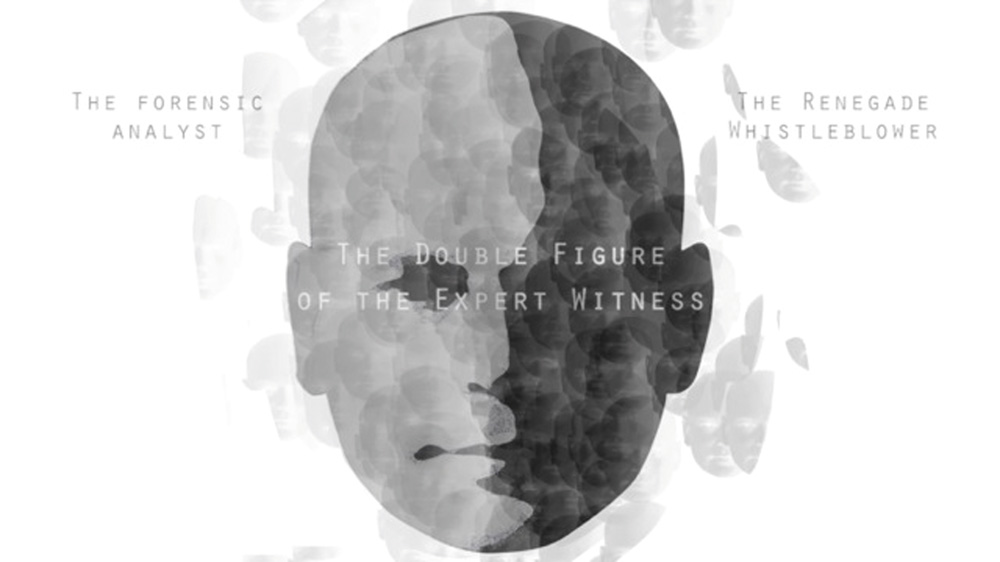
COUNTERING CAPITULATION engages with the inquiries following the Flash Crash of May 6, 2010, an event that went down as the biggest one-day market decline in financial history. Focusing on a remarkable forensic analysis that not only contradicted the official findings of the regulatory authorities and shed light on the impact of algorithmic trading but also developed tools to visualize material processes that operate beyond human perception, Nestler argues that in the current legal framework evidence of market events can only be produced by a double figure of the expert witness: when the (forensic) analyst is joined by a whistleblower or informant. With this ambivalent, contingent and marginal figure at its heart—a renegade, a traitor—COUNTERING CAPITULATION proposes a multilayered, transdisciplinary artistic practice: creating narrative instabilities that coagulate dissent into insurrection by enhancing resolution in the technological, social as well as legal meanings of the term. The video concludes with a call for renegade solidarity between the general public and whistleblowers as the contemporary figures of insurrection to counter the excesses of (automated) evaluation and decision-making, not only as regards financial markets but black box regimes in general.
Gerald Nestler combines theory with video, installation, performance, speech and text to interrogate the ideological, methodological and fictive narratives of finance and their role in current biopolitics as well as contemporary art in particular. After graduating from the Academy of fine arts Vienna (1992) he conducted artistic fieldwork as broker and trader (1994-97). He lectures at Webster University Vienna and is completing a PhD at the Centre for Research Architecture, Goldsmiths, University of London. Selected recent exhibitions: The New Derivative Order (kunstraum Bernsteiner, Vienna, 2012), Cargo Carry Cult (Kunsthalle Wien, 2013), Forensis (curated by Anselm Franke and Eyal Weizman, HKW, Berlin, 2014), Social Glitch (kunstraum NOE and other venues in Vienna, in prep., 2015). Recent publications: editor of Kunstforum International 200/201 on art and economy (with D. Buchhart, 2010), Paratactic Commons (amber Art+Technology Festival Istanbul), What’s next. Art after the crisis (eds. Johannes M. Hedinger & Tobias Meyer, Kadmos, 2013), Forensis. The Architecture of Public Truth (ed. Forensic Architecture, Sternberg, 2014).
Peter Nestler
Die Nordkalotte
Documentaire | 16mm | couleur | 90:0 | Allemagne | 1990
Peter Nestler, geboren 1937 in Freiburg im Schwarzwald. Über Lahr/Baden nach Berlin. Anfang des Krieges nach Bayern, wail meine Eltern zu Recht befürchtet haben, dab da bald Bomben fallen. In Grainau an der österreichischen Grenze Volksschule. Nach dem Krieg die Scheidung meiner Eltern. Aufteilung der Geschwister, zwei bei meiner Mutter, ich und die älteste Schwester bei meinem Vater. Internat. Weil es nicht so einfach war, die Kinder grobzuziehen zu Hause. Ab fünfzehn per Autostop durch Frankreich, Italien. Nach der Handelsschule endgültig von zu Hause weg. Fabrikarbeit. Zur See gefahren. Dann wieder zurück in den Familienbetrieb des Grobvaters und und der Restfamilie in Lahr. Abgebrochen, weil es aussichtslos war, nur für den Erwerb tätig zu sein. Malereistudium in München. Siedbruck in Stuttgart in der Werkstatt von Willi Baumeister, die industriell weitergearbeitet hat. Nicht mehr zu Lebzeiten von Baumeister. Wieder zurück nach München. Kleine Statistenrollen als Nebenerwerb. Ersten Rollen mit der Absicht, aus dem Geld Filme zu machen. Dann in den frühensechziger Jahren Film - und Fernsehrollen, die immer wieder zu eigener Filmarbeit geführt haben, kurzen Dokumentarfilmen. Das ging bis 1965. Dann war es schwer, weiter Geld auzutreiben. Emigration nach Sweden, das Land meiner Mutter. Heirat 1966 in Hungarn. Dann kam die Familie in Scheden. Da auch noch Waldarbeit und Fabrikarbeit, bis ich endgültig Fub gefabt hatte mit Film beim schwedischen Fernsehen. Arbeit mit Kinderprogrammen. Teils eigene Filme, teils Filme für die Dokumentarfilmabteilung. Dann in der Hauptsache eingestellt, um Filme aus Ausland eizukaufen. In den letzten Jahren keine Dokumentarfilme mehr für das schwedischen Fernsehen, sondern auf Free lance-Basis in dienstfreier Zeit. Filme, die oft in Deutscland finanziert wurden. Vier Kinder sind grob geworden in Schweden.
Peter Nestler
Verteidigung der Zeit
Documentaire | dv | couleur | 27:0 | Allemagne | 2007
Peter Nestler, geboren 1937 in Freiburg im Schwarzwald. Über Lahr/Baden nach Berlin. Anfang des Krieges nach Bayern, wail meine Eltern zu Recht befürchtet haben, dab da bald Bomben fallen. In Grainau an der österreichischen Grenze Volksschule. Nach dem Krieg die Scheidung meiner Eltern. Aufteilung der Geschwister, zwei bei meiner Mutter, ich und die älteste Schwester bei meinem Vater. Internat. Weil es nicht so einfach war, die Kinder grobzuziehen zu Hause. Ab fünfzehn per Autostop durch Frankreich, Italien. Nach der Handelsschule endgültig von zu Hause weg. Fabrikarbeit. Zur See gefahren. Dann wieder zurück in den Familienbetrieb des Grobvaters und und der Restfamilie in Lahr. Abgebrochen, weil es aussichtslos war, nur für den Erwerb tätig zu sein. Malereistudium in München. Siedbruck in Stuttgart in der Werkstatt von Willi Baumeister, die industriell weitergearbeitet hat. Nicht mehr zu Lebzeiten von Baumeister. Wieder zurück nach München. Kleine Statistenrollen als Nebenerwerb. Ersten Rollen mit der Absicht, aus dem Geld Filme zu machen. Dann in den frühensechziger Jahren Film - und Fernsehrollen, die immer wieder zu eigener Filmarbeit geführt haben, kurzen Dokumentarfilmen. Das ging bis 1965. Dann war es schwer, weiter Geld auzutreiben. Emigration nach Sweden, das Land meiner Mutter. Heirat 1966 in Hungarn. Dann kam die Familie in Scheden. Da auch noch Waldarbeit und Fabrikarbeit, bis ich endgültig Fub gefabt hatte mit Film beim schwedischen Fernsehen. Arbeit mit Kinderprogrammen. Teils eigene Filme, teils Filme für die Dokumentarfilmabteilung. Dann in der Hauptsache eingestellt, um Filme aus Ausland eizukaufen. In den letzten Jahren keine Dokumentarfilme mehr für das schwedischen Fernsehen, sondern auf Free lance-Basis in dienstfreier Zeit. Filme, die oft in Deutscland finanziert wurden. Vier Kinder sind grob geworden in Schweden.
Peter Nestler
Wie macht man Glass? Partie 1 / Handwerklich
Documentaire | 16mm | noir et blanc | 24:0 | Allemagne | 1970
Wie macht man Glas? (handwerklich) Im Frühjahr 1970 in Schweden gefilmt von Peter und Zsoka Nestler. Antike Glasgefässe und dann die Herstellung von Glas und Gläsern der waldreichen Landschaft Smaland. Mit der Kamera wird beobachtet und entdeckt, gleichzeitig ein chronologisches Beschreiben der Arbeitsgänge. Das Zusehen ist Bewunderung und Staunen über die Bewegung, das Material, das Licht und die Kunstfertigkeit der Glasmacher.
Peter Nestler, geboren 1937 in Freiburg im Schwarzwald. Über Lahr/Baden nach Berlin. Anfang des Krieges nach Bayern, wail meine Eltern zu Recht befürchtet haben, dab da bald Bomben fallen. In Grainau an der österreichischen Grenze Volksschule. Nach dem Krieg die Scheidung meiner Eltern. Aufteilung der Geschwister, zwei bei meiner Mutter, ich und die älteste Schwester bei meinem Vater. Internat. Weil es nicht so einfach war, die Kinder grobzuziehen zu Hause. Ab fünfzehn per Autostop durch Frankreich, Italien. Nach der Handelsschule endgültig von zu Hause weg. Fabrikarbeit. Zur See gefahren. Dann wieder zurück in den Familienbetrieb des Grobvaters und und der Restfamilie in Lahr. Abgebrochen, weil es aussichtslos war, nur für den Erwerb tätig zu sein. Malereistudium in München. Siedbruck in Stuttgart in der Werkstatt von Willi Baumeister, die industriell weitergearbeitet hat. Nicht mehr zu Lebzeiten von Baumeister. Wieder zurück nach München. Kleine Statistenrollen als Nebenerwerb. Ersten Rollen mit der Absicht, aus dem Geld Filme zu machen. Dann in den frühensechziger Jahren Film - und Fernsehrollen, die immer wieder zu eigener Filmarbeit geführt haben, kurzen Dokumentarfilmen. Das ging bis 1965. Dann war es schwer, weiter Geld auzutreiben. Emigration nach Sweden, das Land meiner Mutter. Heirat 1966 in Hungarn. Dann kam die Familie in Scheden. Da auch noch Waldarbeit und Fabrikarbeit, bis ich endgültig Fub gefabt hatte mit Film beim schwedischen Fernsehen. Arbeit mit Kinderprogrammen. Teils eigene Filme, teils Filme für die Dokumentarfilmabteilung. Dann in der Hauptsache eingestellt, um Filme aus Ausland eizukaufen. In den letzten Jahren keine Dokumentarfilme mehr für das schwedischen Fernsehen, sondern auf Free lance-Basis in dienstfreier Zeit. Filme, die oft in Deutscland finanziert wurden. Vier Kinder sind grob geworden in Schweden.
Peter Nestler
Wie macht man Glass? Partie 2 / Maschinell
Documentaire | 16mm | noir et blanc | 24:0 | Allemagne | 1970
Wie macht man Glas? (maschinell) Im Sommer 1970 in Schweden und Westdeutschland gefilmt von Peter und Zsoka Nestler. Das Formen von Glas in Maschinen und Automaten der Industrie, die Anstrengung der Glasmacher und ihr immer noch handwerkliches Geschick an dem heissen Glas der schmelzenden Flammen, an dem kalten Glas der rotierenden Schleifscheiben.
Peter Nestler, geboren 1937 in Freiburg im Schwarzwald. Über Lahr/Baden nach Berlin. Anfang des Krieges nach Bayern, wail meine Eltern zu Recht befürchtet haben, dab da bald Bomben fallen. In Grainau an der österreichischen Grenze Volksschule. Nach dem Krieg die Scheidung meiner Eltern. Aufteilung der Geschwister, zwei bei meiner Mutter, ich und die älteste Schwester bei meinem Vater. Internat. Weil es nicht so einfach war, die Kinder grobzuziehen zu Hause. Ab fünfzehn per Autostop durch Frankreich, Italien. Nach der Handelsschule endgültig von zu Hause weg. Fabrikarbeit. Zur See gefahren. Dann wieder zurück in den Familienbetrieb des Grobvaters und und der Restfamilie in Lahr. Abgebrochen, weil es aussichtslos war, nur für den Erwerb tätig zu sein. Malereistudium in München. Siedbruck in Stuttgart in der Werkstatt von Willi Baumeister, die industriell weitergearbeitet hat. Nicht mehr zu Lebzeiten von Baumeister. Wieder zurück nach München. Kleine Statistenrollen als Nebenerwerb. Ersten Rollen mit der Absicht, aus dem Geld Filme zu machen. Dann in den frühensechziger Jahren Film - und Fernsehrollen, die immer wieder zu eigener Filmarbeit geführt haben, kurzen Dokumentarfilmen. Das ging bis 1965. Dann war es schwer, weiter Geld auzutreiben. Emigration nach Sweden, das Land meiner Mutter. Heirat 1966 in Hungarn. Dann kam die Familie in Scheden. Da auch noch Waldarbeit und Fabrikarbeit, bis ich endgültig Fub gefabt hatte mit Film beim schwedischen Fernsehen. Arbeit mit Kinderprogrammen. Teils eigene Filme, teils Filme für die Dokumentarfilmabteilung. Dann in der Hauptsache eingestellt, um Filme aus Ausland eizukaufen. In den letzten Jahren keine Dokumentarfilme mehr für das schwedischen Fernsehen, sondern auf Free lance-Basis in dienstfreier Zeit. Filme, die oft in Deutscland finanziert wurden. Vier Kinder sind gross geworden in Schweden.
Yves Netzhammer
Dialogical abrasion
Animation | 0 | couleur | 20:20 | Suisse | 2011
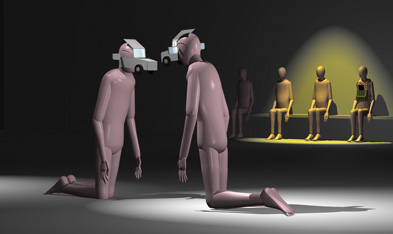
An accident setting serves as the scope for a cinematic metaphorical dialogue: two figurine subjects, that ultimately crash into each other in a slow motion car crash scene, act as the framework to the formal structure of the film. Mutual subjection and impression are allegorically exemplified - the momentum of the impact of the collision subserves as a generator to astonishing artificial bodily postures, that could be translated into something like an archive of embodiments. In transitory cut scenes between the decelerated sequence of this mishap, "biographical" flashbacks are inserted.
Yves Netzhammer, born in 1970. Since 1997, he has been working on a widely ramified, poetic imagery cosmos. His video installations, objects and drawings fascinate through their bodily charisma and their formal clarity. The playful recombination of elements which seemingly can not be combined leads to the threshold of our existence?s dark side: Dulcet aspects interlock with displeasing ones, the dead melts with the alive into creatures never seen before, and the depicted scenarios run from microscopic to giant scales. Solo exhibitions include Minsheng Art Museum Shanghai (2011), Kunstmuseum Bern (2010), Palazzo Strozzi (2009), SFMOMA, San Francisco (2008), Venice Biennale (2007), Karlskirche Kassel (supporting program documenta 12, 2007), Kunsthalle Bremen (2005). Yves Netzhammer lives and works in Zurich.
Yves Netzhammer
Die Subjektivierung der Wiederholung, Projekt A
Vidéo expérimentale | | couleur | 42:24 | Suisse | 2007
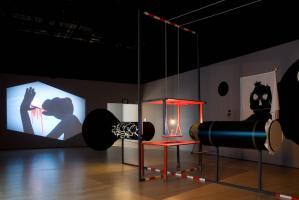
Yves Netzhammer a réalisé, pour le pavillon suisse de la Biennale de Venise, une installation dans une pièce où interagissent l'architecture, des dessins, des projections vidéos et de la musique. L'artiste a étendu la partie sud-est du pavillon, érigé en 1951 par Bruno Giacometti, avec une intervention architecturale/sculpturale qui perturbe la perception entre intérieur et extérieur. C'est une réflexion architecturale et politique. Le fait d'insérer dans le pavillon une ligne inclinée qui pénètre le pavillon en même temps qu'il l'ouvre met en perspective les frontières nationales et internationales et ce qu'elles rendent impossible. Dans son travail pictural et ses films pour Venise, Netzhammer confronte le stéréotype de l'"Autre" à sa lecture de l'histoire. L'"Autre" apparaît sous la forme d'un sujet psychologique refoulé, des corps qui ne sont que des ombres, des entrailles invisibles, des couleurs de peau différentes; autant de signes de l'altérité culturelle. Le fait d'associer ces motifs créée un rapport nouveau entre soi et autrui, entre les cas individuels et les problèmes universels, et permet une discussion sur les façons de se positionner dans l'espace et la relation aux autres. Netzhammer réfléchit aux manières de rendre le "soi" réceptif à l'"autre".
Yves Netzhammer est né en Suisse en 1970. Il vit et travaille à Zürich. Son travail a été présenté entre autres à La Neue Gesellschaft Für Bildende Kunst (NGBK) à Berlin, au Centre culturel Suisse à Paris, au ZKM de Karlsruhe, au Musée d?art du Texas à Austin, Texas, au centre international de sculpture de Duisburg, à VIPER à Bâle, à la Kunsthalle de Bâle, au Witte de With à Rotterdam, à la 11ème Biennale de l'Image en Mouvement à Genève, au Centre d'Art Contemporain de Fribourg, à la biennale d?art contemporain de Prague, à la Kunsthalle de Brême, à la Galleria d´Arte Moderna de Bologne. Son travail fait partie des collections du FRAC - Nord-Pas de Calais, Dunkerque et du FRAC - Provence-Alpes-Côte d'Azur, Marseille Il est actuellement présenté à la 52ème Biennale de Venise
Yves Netzhammer
Furniture of Proportion
Animation | betaSP | couleur | 35:42 | Suisse | 2008
« Furniture of Proportion » d?Yves Netzhammer révèle la fascination de l?artiste pour les paysages intérieurs et de l'esprit. Netzhammer présente un univers poétique de pure invention. Projeté pour la première fois au San Francisco Museum of Modern Art (USA), sa nouvelle installation vidéo à trois canaux « Furniture of Proportion » (2008) mêle des dessins de mur très stylisés, des animations et des objets sculpturaux afin de créer un espace narratif complexe. Sur invitation de Rudolf Frieling, le conservateur des arts médiatiques du San Francisco Museum of Modern Art, Netzhammer a consciemment développé une ?uvre dans laquelle l'ordinateur, en tant qu?outil artistique et moyen d'expression, a la priorité. Netzhammer combine une variété de médias traditionnels à différentes techniques informatiques afin d?exprimer son profond intérêt pour l'histoire de la philosophie et del'art. L'artiste se penche également sur les processus de la pensée humaine et sur l'interaction entre les images extérieures du monde et les images intérieures de l'esprit. Entrepris comme une enquête sans fin, son art s?intéresse à l'éphémère et aux états de changement, et traite, avec des effets surréalistes, les associations d?idées, et de la multiplicité temporelle.
Yves Netzhammer est né en Suisse en 1970. Il vit et travaille à Zürich. Son travail a été présenté entre autres à La Neue Gesellschaft Für Bildende Kunst (NGBK) de Berlin, au Centre culturel Suisse de Paris, au ZKM de Karlsruhe, au Musée d?Art du Texas d?Austin (USA), au centre international de sculpture de Duisburg, au VIPER de Bâle, à la Kunsthalle de Bâle, au Witte de With de Rotterdam (Pays-Bas), à la 11e Biennale de l'Image en Mouvement de Genève, au Centre d'Art Contemporain de Fribourg (Allemagne), à la Biennale d?Art Contemporain de Prague, à la Kunsthalle de Brême, à la Galleria d?Arte Moderna de Bologne (Italie). Son travail fait partie des collections du FRAC - Nord-Pas de Calais, Dunkerque (France) et du FRAC - Provence-Alpes-Côte d'Azur, Marseille.
Yves Netzhammer
Vororte der Körper
Fiction expérimentale | digibeta | couleur | 17:10 | Suisse | 2012
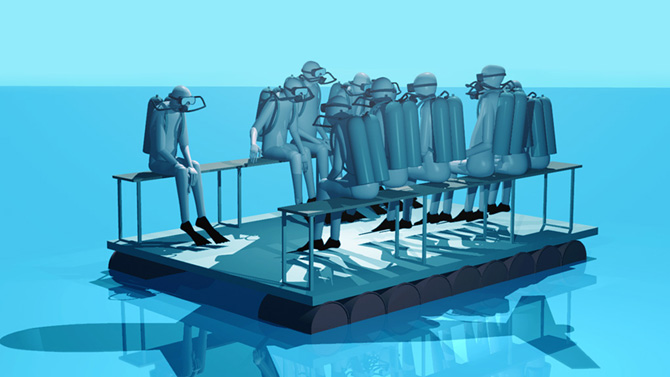
A consequential animation film which casts the medium of film back on its origin, the image. Beginning with divers on a platform in the sea, the viewer is simultaneously immersed in pictorial spaces in pictorial worlds, whose associative inner logic collides with the customs of conventional narration.
Yves Netzhammer, born in 1970, studied Visual Design at the Zurich College of Art and Design. Since 1997, he has been working on a widely ramified, poetic imagery cosmos. His video installations, objects, slide shows and drawings fascinate through their bodily charisma and their formal clarity. The playful recombination of elements which seemingly can not be combined leads to the threshold of our existence?s dark side: Dulcet aspects interlock with displeasing ones, the dead melts with the alive into creatures never seen before, and the depicted scenarios run from microscopic to giant scales. Solo exhibitions include Kunstmuseum Bern, Switzerland, (2012), Liverpool Biennial, SFMOMA (2010), San Francisco (2008), Venice Biennale (2007), Karlskirche Kassel (supporting program documenta 12, 2007), Museum Rietberg, Zürich (2006), Kunsthalle Bremen (2005) and Helmhaus Zürich (2003). Yves Netzhammer lives and works in Zurich.