Catalogue > Faire une recherche
Résultats pour : Tout le catalogue
María Molina Peiró
One Year Life Strata
Installation vidéo | hdv | couleur | 0:0 | Espagne, 0 | 2018
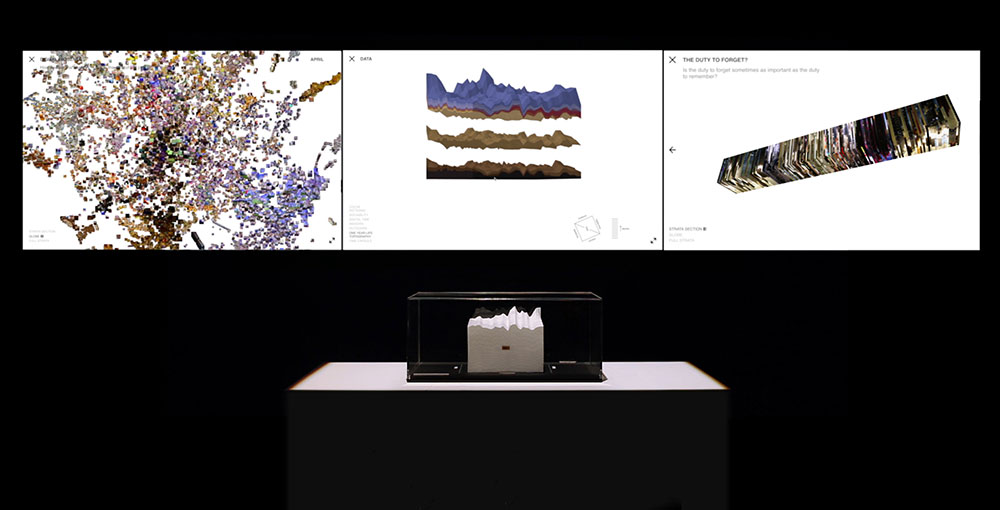
During one year María Molina Peiró carried a wearable camera taking a photo every 30 seconds. The enormous collection of photos collected by the camera are shown in an online archive that instead of "remembering" creates a creative forgetting of the vast photo archive. One Year Life Strata proposes a visual metaphor of forgetting by transforming the digital images into what is likely the ultimate memory trace that will remain from us: The geological record. The project, in a sort of digital geology, mines the data from the strata and invite viewers to investigate one year of Maria Molina's life through an AI vision system, not concerned about personal memories but the collection of patterns and numbers they contain. In a society obsessed with recollection, data and monitoring One Year Life Strata addresses the disturbing territory of forgetting. Today that we have the tools to remember and archive almost everything, forgetting has become a term very close to death raising very similar fears. One Year Life Strata wants to overcome this fear and embrace forgetting in a game of time scales, where the speed of Digital Time is buried into a time difficult for us to grasp, the slow Deep Time.
María Molina is an audio-visual artist and filmmaker with a background in fine arts. She works in an open format mixing film, digital media and experimental animation. María Molina´s films and art works have been showcased in international museums like Haus der Kulturen der Welt (Berlin), EYE Film Museum (Amsterdam), MACBA (Museum of Modern Art Barcelona), Hong-Gah Museum (Taipei), Centre de Cultura Contemporània Barcelona (CCCB), MATADERO (Madrid) or Museum of Contemporary Art of Vojvodina (Serbia) among others. Her works has been featured in festivals like Rotterdam Film Festival, Art Futura (Barcelona), Taiwan Video Art Biennial, MADATAC (Madrid), VISS (Vienna International Film Festival) or Forecast Forum (Berlin). In her work she explores the increasingly blurred boundaries between material and digital realities. She is particularly interested in the convergences between different memory systems (from Geology to Digital Memory) and how the ubiquity and pervasive nature of Digital Technology is reframing our spatial and temporal perspective. Her films and installations often use metafiction, postproduction and geo-tools to unfold layered realities that connect humans, technology and nature. Her current research focuses on humanity's constant struggle with its temporal and spatial limitations, and how this struggle has driven civilisation and technology to change our relation with nature, time and our understanding of life itself.

Mercedes Molla Marfil
Normal envy
Vidéo | dv | couleur | 1:8 | Belgique | 2009
I am in a supermarket. Instead of buying the products I need, I buy that ones that the others want. Does a product taste better when is desired by the others? A supermarket is a very common place in our daily life which represents well today`s capitalist system. Through my action I attempt to confront the idea of consumer choice and desire. Transcending the comic or quirky, the video promotes the possibility of a critical engagement with consumer values and cultural behaviour. It has without being propangandist a political agenda.
Mercedes Mollá (b. 1980, Valencia) received a Postgraduate Diploma in Fine Arts at Chelsea College of Art and Designed, University of the Arts in London. Studied her BA at Facultad de Bellas Artes de San Carlos in Valencia .With the Erasmus scholarship she studied six months at Winchester School of Art,UK. Recent solo exhibitions include Matuvu gallery, Brussels, Art Below, London; Imprevisual gallery, Valencia. Group exhibitions include Canvas Collectie , gallery on line ,Belgium; Really London?s gallery; Galeria de arte Kessler-Battaglia, Valencia. Mercedes is currently based in Brussels.
Christine Molloy, Christine MOLLOY
Moore Street
Fiction | 35mm | couleur | 5:35 | Irlande | 2004
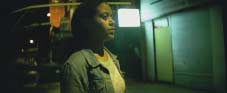
Moore Street est un unique travelling filmé à Moore Street en Ireland. Le film est en swahili et en anglais. Pendant cinq minutes, nous suivons les pensées d'une jeune africaine en Irlande, songeant à son passé, son avenir et le sentiment d'identité qui se révèle à elle tandis qu'elle longe la rue dans la nuit. D'une part, Moore Street revient sur rue emblématique de Dublin à un moment charnière de son renouveau officiel de développement, où déjà les espoirs et les rêves des nouvelles communautés refondent la ville à l'image de leur chez-eux. D'autre part, il s'agit d'une lettre d'amour chuchotée à un amant absent au c?ur de la nuit.
Christine Molloy et Joe Lawlor sont tous deux originaires de Dublin (Irlande). Ils sont actuellement basés à Londres où ils réalisent des ?uvres filmiques et vidéo pour le cinéma, Internet, sites et galeries. Moore Street est issu d'une série de sept cours métrages en 35mm tournés par Molloy et Lawlor sous le titre Civic Life qui ont contribué à l'entrée de l'Irlande dans la Biennale de Sao Paulo en 2004.
Christine Molloy, Joe LAWLOR
Civic Life: Tiong Bahru
Fiction | 35mm | couleur | 19:55 | Irlande, Singapour | 0
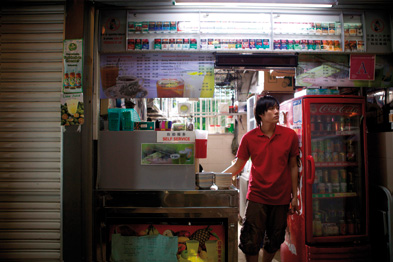
TIONG BAHRU follows the lives of three characters of very different ages over the course of a day as they reveal to their families and friends their hopes and desires. Lyrical and musical in its style, the film is a sensitive portrait of 3 people caught at a crossroads in their lives and the extraordinary place in which they live. TIONG BAHRU is the latest and most ambitious film in CIVIC LIFE, the acclaimed series of short films by Christine Molloy and Joe Lawlor, through which over the last 8 years the artists have explored the themes of belonging, place, change and relationships. The films are developed through an extensive process of dialogues with communities and are made with casts of volunteers drawn from the areas in which they are filmed. Featuring 150 volunteers, many of whom had never acted before, TIONG BAHRU was shot on 35mm in the market and hawker centre of the art deco heritage estate of Tiong Bahru in Singapore in June 2010. ?TIONG BAHRU is the touchstone of (Molloy and Lawlor?s) work?restrained and lavish, formally audacious and sentimental? (Sight & Sound)
Born in Dublin, Ireland Christine Molloy (b 1965) and Joe Lawlor (b 1963) studied theatre in the UK in the late 80s. From 1992 to 1999 they devised, directed and performed in six internationally acclaimed touring theatre shows before shifting their attention towards moving image based work. Between 2000 and 2003 they directed a number of episodic, interactive works for the internet, and large-scale community video projects for galleries. Since 2003 Molloy and Lawlor have produced, written and directed 10 acclaimed short films, under the title CIVIC LIFE. All shot on 35mm, the CIVIC LIFE films have screened extensively around the world including screenings at the Telluride Film Festival, the International Film Festival Rotterdam, the Thessaloniki International Film Festival, the Sydney Film Festival and IndieLisboa. HELEN, their acclaimed debut feature film, premiered at the Edinburgh International Film Festival in June 2008 before screening at over 50 film festivals worldwide. TIONG BAHRU is the latest film in the CIVIC LIFE series.
Jonathan Monaghan
Mothership
Animation | hdv | couleur | 14:42 | USA | 2013
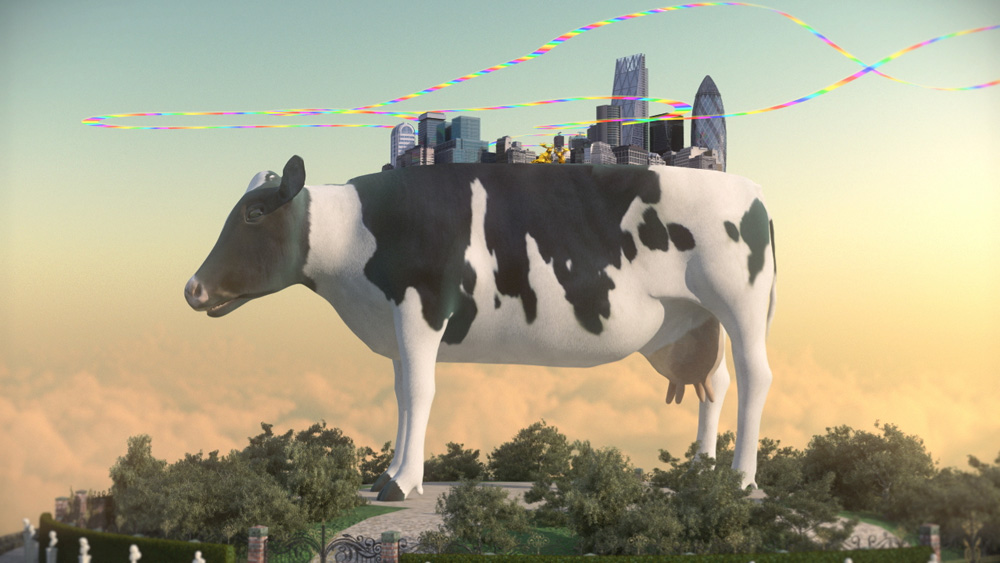
Salvador Dali meets science fiction in a fantastical vision from an alternate reality. Cows, superheros, video games, luxury hotels, and operating rooms seamlessly meld in a surreal exploration of value and power in the digital era. Trapped in an endless loop of seductive but ultimately vacuous simulation where meanings don’t quite materialize.
American artist Jonathan Monaghan (born 1986, New York) creates sculpture and animated video installations that challenge the boundaries between the real, the imagined, and virtual. Pulling from wide-ranging sources such as science fiction and baroque architecture, he creates bizarre, yet compelling, virtual environments and stories with the same high-end technology used by Hollywood and video games. His work has been exhibited worldwide in venues such as Bitforms Gallery in New York, BFI Southbank in London, Eyebeam Art & Technology Center, The Hirshhorn Museum in Washington D.C., and the Moving Image Art Fair London. His work has been featured by The Washington Post, Metropolis M, The Huffington Post, TimeOut NY, The Wall Street Journal and NYC TV.

Caroline Monnet
Gephyrophobia
Film expérimental | 16mm | | 0:0 | Canada | 2012
La peur des ponts
Caroline Monnet est une artiste multidisciplinaire d`origine Algonquine et Française qui travaille principalement en film et vidéo, photographie et sérigraphie. Ses oeuvres ont été présentées dans plusieurs galleries et festivals autour du monde, notamment au Festival International de Toronto, Urban Shaman Contemporary Aboriginal Art (Winnipeg),Plug In ICA, Cannes, Magere Arts Centre (NZ) et Künstlerhaus Bethanien (Berlin). Monnet est membre active d`ITWÉ, un collectif dédié à la recherche, à la création et à la production des arts médiatiques autochtones.
Alex Monteith
Composition with RNZAF 3 Squadron Exercise Blackbird for three-channel video installation
Vidéo | hdv | couleur | 15:16 | Nouvelle-Zélande | 2010
?onboard three grey Iroquis in military formation over Te WaiPpounamu?ridgetop alpine mists?tussock valley floors?radio communication... Award winning artist Alex Monteith collaborated with Royal New Zealand Air Force No.3 Squadron Leader Oliver Bint to compose a flight routine for three simultaneously flying RNZAF Iroquois helicopters. The action was performed during RNZAF Exercise Blackbird; a two weeklong search and rescue (SAR) training exercise based at Dip Flat at the northern section of the Southern Alps of New Zealand during the winter of 2010. Three helicopters fly maneuvers? in the line astern formation of banking turns in the Alpine areas of the isolated Leese Valley. Each helicopter was installed with identical rearward facing on-board HD cameras. The artworks key maneuver is a three helicopter simultaneous pedal-turn on a ridge-top; the only military maneuver of this kind ever developed specifically for an artwork. The video artwork contains no cuts. The audio is continuous intercom. dialogue between the radio operators at Dip Flat and the pilots in all three helicopters as they position and reposition to maintain the flight-plan.
Born Belfast, Northern Ireland (1977), Alex Monteith is an artist and academic based in Auckland New Zealand where she is a lecturer at the Elam School of Fine Arts, the University of Auckland. In 2008 she was awarded the Arts Foundation New Generation Awards, one of New Zealand?s most important bi-anneal awards for contemporary art and her video work Passing Maneuver 2008 was a finalist for the Walters Art Prize 2010. Her work is post-studio in orientation and often takes the form of performances, video art and large-scale actions with high-speed or high-risk cultures with radical sensitivities to geography.
Alex Monteith
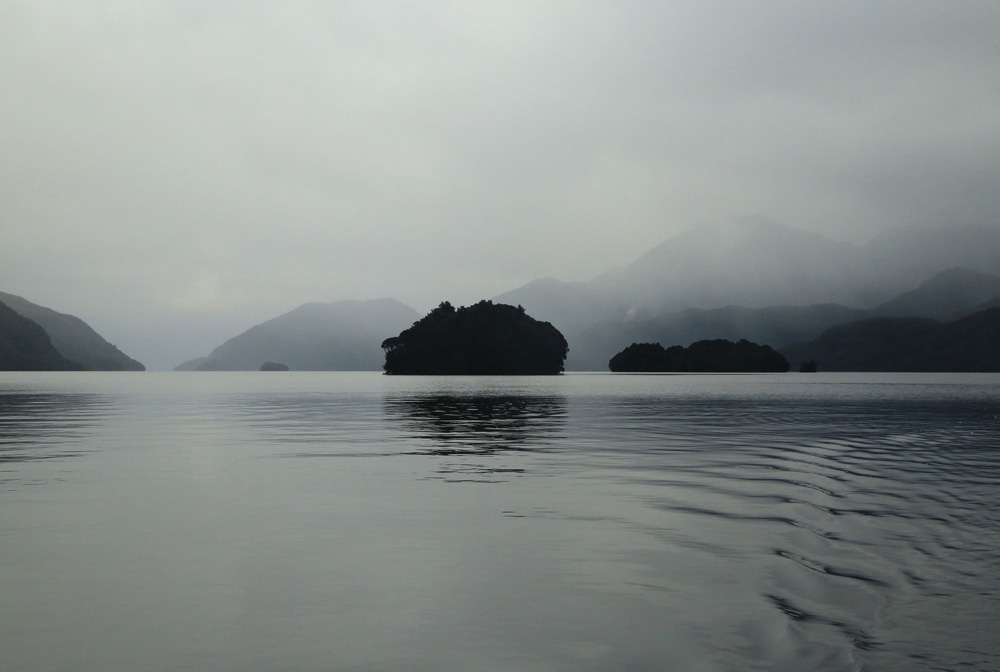
Cascade Cove in the Shadow of 150,000 Bones
Doc. expérimental | hdv | couleur et n&b | 13:0 | Nouvelle-Zélande | 2015
SYNOPSIS Film essay recorded in Aotearoa / New Zealand`s Cascade Cove, Tamatea / Dusky Sound; one of the wettest places on earth. After he had sailed there for the first time in 1770, James Cook spent more than two months in Tamatea in Aotearoa on his second journey in 1773. Cascade Cove within Tamatea is also near to the sites of the earliest archeological digs of the lower fiords of Aotearoa. The Begg Brothers, then in the modern era, Peter Coutts, each made various archeological incursions looking for and removing both settler and Maori material culture from the area. This film compiles observations of the intensity of weather atmosphere as a physical expression of tension between elemental forces, as a way of approaching a contested past in which European research methods overran already existing Maori knowledge production about the area. This film is part of an ongoing series of work about this area of Aotearoa.
Alex Monteith Biography (1977-) born Belfast, Northern Ireland, resides Tamaki Makaurau, Aotearoa resides in Piha, Aotearoa Alex Monteith’s works often explore the political dimensions of culture engaged in turmoil over land ownership, history and occupation. The works traverse political movements, contemporary sports, culture and social activities. Projects often take place in large-scale or extreme geographies. Recent surfing related actions connect the museum directly to local geography through participatory performance projects.
Marwan Montel, Sao Sopheak
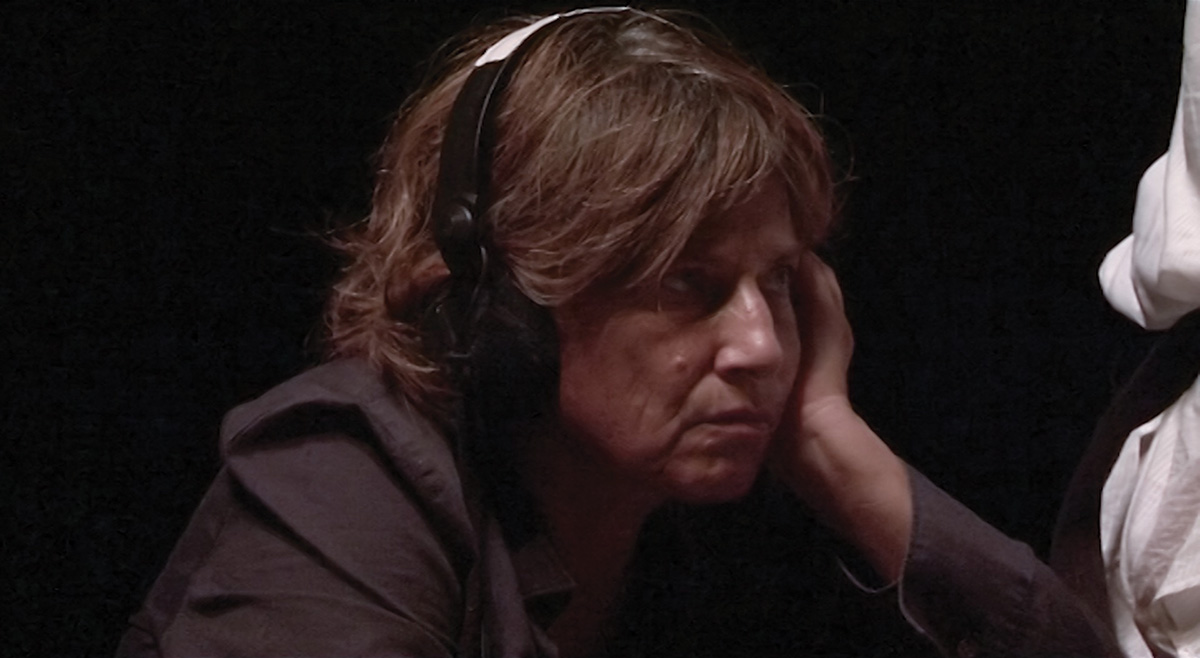
Autour de La Folie Almayer
Documentaire | mov | couleur | 49:2 | France, Belgique | 2022
La Folie Almayer est l'adaptation faite par Chantal Akerman du premier roman éponyme de Joseph Conrad ; Une histoire de passion, de perdition et de folie quelque part en Asie du Sud-Est que la cinéaste est partie tourner en 2010 au Cambodge. Présent sur le tournage, Sopheak Sao a filmé la cinéaste au cœur de son travail dans la végétation exotique et dans les eaux noires d’un fleuve qui ne semble mener nulle part. Les images qu’il a filmées ont, après un archivage de dix ans, été montées par Marwan Montel, et montrent combien le travail formel et esthétique prend le pas sur l’aspect narratif dans le travail de la réalisatrice belge. Une véritable plongée au plus près de l'artiste, et une occasion exceptionnelle de se glisser au cœur de son travail.
Marwan Montel (né à Istanbul en 2001) est un monteur et réalisateur Français. Suite à ses études à l'IAD en Belgique, d'où il sort diplômé en montage-scripte, il réalise un film documentaire d’archive sur le dernier tournage de fiction de Chantal Akerman.
Kim Mooyoung
Hwang Ryong San
Doc. expérimental | mov | couleur | 18:35 | Coree du Sud | 2021
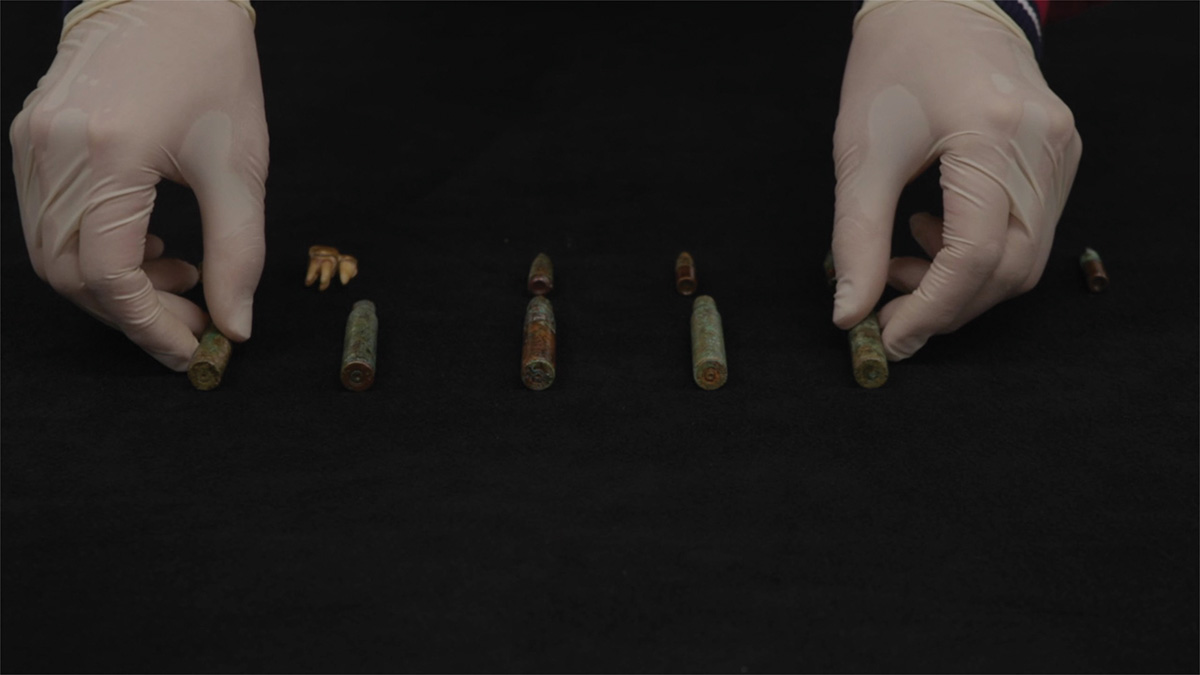
The film depicts the massacre of civilians in Geum-jeong-gul Cave in Gyeonggi-do in October 1950. This massacre, in which more than 153 people were killed in a village by South Korean military and police, was compensated by South Korean government in 1993 when it became known to the world through the efforts of the victims' bereaved families, but there is still no place for their remains in their home town.
As well as making movies, Kim Mooyoung also creates research-based media art, which is being exhibited in several countries. After four short films, SLOW DAY (2010), CONCRETE (2012), LAND WITHOUT PEOPLE (2016), and DAY AND NIGHT(2017), he directed his first feature film, NIGHT LIGHT (2018), which was invited to Busan International Film Festival 2018 and Seoul Independent Film Festival 2018.
Wagner Morales
wild life
Fiction expérimentale | dv | couleur | 9:21 | Brésil | 2006
Wild Life 9`21" 2006 Vidéo numérique ?Wild Life? est un film au sujet du sauvagerie du tourisme. Les gens voyagent dans un bateau pendant un voyage dans la Patagonie. La caméra les filment à la façon d?un documentaire à la «national géographique Channel?.
Wagner Morales est réalisateur et plasticien. Il a été résident au Fresnoy en 2004 et, en 2005/06, il a participé au Programme Pavillon du Palais de Tokyo. Il travaille en réalisant plusieurs films d?auteur, documentaires, photographie et installation. Son travail est représenté par la Galerie Virgilio, à São Paulo et ses films et vidéos, ainsi comme installations, sont exposés aux grandes institutions au Brésil, en France et un peu partout dans le monde.
Joe Moran
Materiality Will Be Rethought
Vidéo | hdv | couleur | 29:26 | Royaume-Uni | 2020
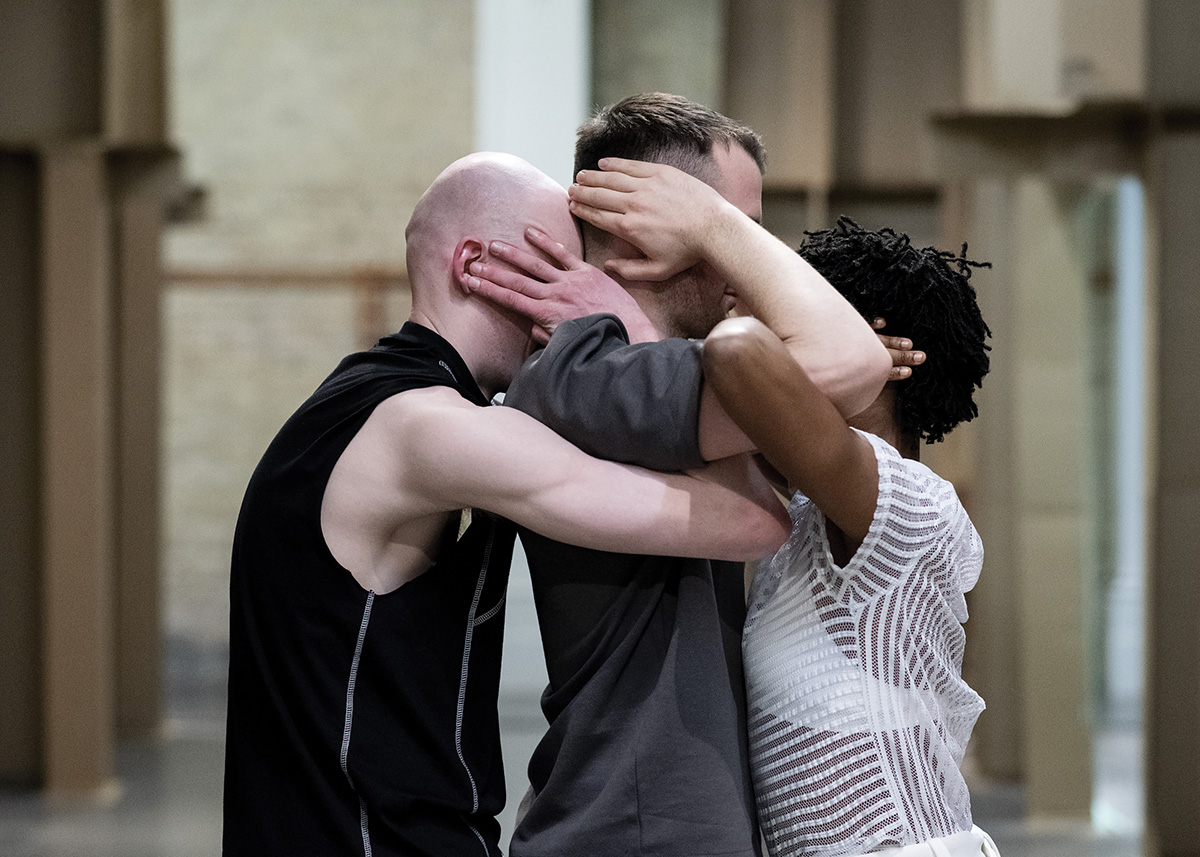
Materiality Will Be Rethought by British-Irish artist and choreographer Joe Moran was developed as a site-specific live performance before being reimagined as a film work. The work navigates dance’s potential to animate and disrupt architectural space, the physicality of the dancer’s voice and the moving body as a site of political unrest and complex subjectivities. Materiality Will Be Rethought was commissioned by Whitechapel Gallery, London, in dialogue with the exhibition Carlos Bunga: Something Necessary and Useful (on display at the gallery 21 Jan – 6 Sep 2020). It is performed by dancers Temi Ajose-Cutting, Thomas Heyes (Blackhaine), Sean Murray and Eve Stainton, and created in collaboration with editor Sue Giovanni and cinematographer Alana Mejía González.
Joe Moran is a British-Irish artist and choreographer based in London with a wide-ranging practice incorporating theatre and gallery performance works, critical writing, curatorial projects and drawing. His work centres the body and embodied presence as a site of complex subjectivities and political unrest, with queering frequently deployed as its principal critical strategy. His work is informed by a background in improvisation and experimentation, and a fascination with the problems and opportunities of formal choreographic composition and notions of expanded choreography. Joe is Artistic Director of Dance Art Foundation through which his performance and curatorial work is produced and has worked internationally as a dancer with choreographers Deborah Hay (USA), Stina Nyberg (Sweden) and Siobhan Davies (UK) amongst others. Recent commissions and performances include Whitechapel Gallery (2020), Sadler’s Wells (2019), Nottingham Contemporary (NottDance, 2019), The Lowry Galleries (2019), London Contemporary Dance School (2019), Wysing Arts Centre (2018), Bluecoat (2018) coinciding with the Liverpool Biennial, Kettle’s Yard (2018), Sadler’s Wells (2017), Delfina Foundation (2016), ICA (Block Universe/ fig-2, 2015) in collaboration with Eva Rothschild and David Roberts Art Foundation (Frieze Art Fair, 2014). Notable collaborations include with composer Kaffe Matthews, editor Sue Giovanni, visual artists Eva Rothschild, Carlos Bunga and Magali Reus, and dancers Temitope Ajose-Cutting and Andrew Hardwidge. Joe contributed a chapter to the publication?Who Cares? Dance in the Gallery & Museum, wrote Materiality Will Be Rethought, an essay on dance and the exhibition space for the Whitechapel Gallery Carlos Bunga exhibition catalogue and Nothing About Us Without Us, a commissioned article on artist advocacy published by Siobhan Davies Dance in its inaugural Material journal.

Monica Maria Moraru
I Am Also Part of the Three Turns
Film expérimental | hdv | couleur | 14:45 | Roumanie | 2024
Relying on oral and fragmentary histories, ‘I Am Also Part of the Three Turns’ traces the effects of a destructive earthquake in Bucharest and a concurrent flood it caused in a small town in Buzau, during a period of nationalistic urbanization in Communist Romania. In the capital, the destruction was seized as an opportunity by the authoritarian government to further raze large swaths of the city, invoking the earthquake as a mythological force in order to strategically replace rubble with new Soviet-bloc housing projects. Employing allegory as narrator, the film sketches a series of political congruences throughout a patchwork of intertwined landscapes, teasing out a temporally irresolute past that defies the linear cause-and-effect of both environmental disaster and authoritarian political repression.
monica maria moraru is a visual artist and filmmaker working between moving-image, sculpture, installation, and sound. Her multimedia work searches for cinematic referent across a wide range of materials. Across mediums, her work seeks to tease out entangled personal and political histories, searching for sensorial and cinematic resonances across a patchwork of temporal, relational and political histories.

Aude Moreau
Less is More or
Vidéo | 4k | couleur | 11:33 | Canada | 2018
La vidéo Less is More or documente l’intervention in situ réalisée à l’intérieur du Toronto Dominion Centre, complexe architectural conçu à l’origine par Mies van der Rohe. Revisitant l’aphorisme de l’architecte, ce projet procédait par une activation des lumières des bureaux à l’intérieur des édifices. Le tournage aérien, construit en deux plans séquences, joue sur le caractère hypnotique des images afin d’interroger les codes spectaculaires de l’industrie cinématographique. Depuis 2010, Aude Moreau développe un vaste programme de recherche qui part de l’hypothèse que si le rétrécissement de l’espace public passe par l’utilisation du vocabulaire économique pour décrire nos réalités quotidiennes, alors, la résurgence du politique passe par l’infiltration sémantique de l’architecture qui abrite cette construction du langage. Ce cycle de travail a mené à l’élaboration de quatre projets d’intervention in situ qui ont en commun d’agir à l’intérieur de l’architecture corporative du gratte-ciel, sur la lumière qu’elle émet dans la ville et d’investir la réalité géographique de l’activité économique et financière où circulent les flux déréalisés et dématérialisés de la production. Les projets d’intervention in situ Sortir, La ligne bleue, THE END in the background of Hollywood et Less is More or, sont autant de signes lumineux qui appellent à une reterritorialisation du politique dans la ville organisée comme spectacle.
Depuis les années 2000, Aude Moreau développe un corpus d’œuvres combinant sa double formation en scénographie et en arts visuels. Détentrice d’une licence en arts plastiques de l’Université Paris VIII, elle a complété une maîtrise en arts visuels et médiatiques de l’Université du Québec à Montréal en 2010. Son travail récent a été présenté à la galerie de l’UQAM, Montréal, Canada ; à la galerie The Power Plant, Toronto, Canada ; au Casino Luxembourg - Forum d’art contemporain, Luxembourg ; au Centre culturel canadien, Paris, France ; à Anthology Film Archives, New York, États-Unis ; au RISD Museum, Rhode Island International Film Festival, Providence, Etats-Unis; au Fresnoy, studio national des arts contemporains, Tourcoing, France. Ses oeuvres font notamment partie des collections du Centre canadien d’architecture, du Musée d’art contemporain de Montréal, du Musée d’art moderne du Luxembourg (MUDAM), et de la Banque d’art du Conseil des arts du Canada. Elle est récipiendaire du prix Louis Comtois de la Ville de Montréal, 2016, de la Bourse Claudine et Stephen Bronfman et du prix Powerhouse, 2011. Des comptes rendus critiques sur sa pratique ont été publiés dans les revues Esse, Espace et Art Le Sabord. Aude Moreau vit et travaille à Montréal.
Antoine Moreau
ni pirate
Vidéo | hdv | | 1:23 | France | 2011
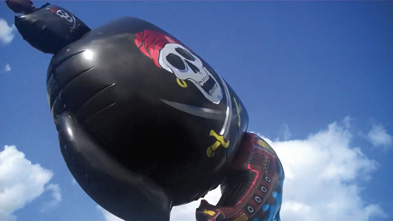
Ni pirate ni corsaire mais libre. Copyleft : cette vidéo est libre, vous pouvez la copier, la modifier, la transformer selon les termes de la Licence Art Libre. http://artlibre.org
Antoine Moreau, artiste peut-être, Docteur en Sciences de l`Information et de la Communication, initiateur de Copyleft Attitude et de la Licence Art Libre. http://artlibre.org

Delphine Moreau
Parc
Documentaire | hdv | couleur | 17:46 | France | 2023
À la suite d’un promeneur solitaire, PARC mène d'abord le spectateur dans des sensations agréables, le pousse vers ses émotions, dans une sorte d’élan romantique estival. Puis des jardiniers « en insertion » habillés en orange surgissent dans les tableaux paysagers très composés. La réalité contemporaine s’impose : violence des rapports de domination, ineptie/absurdité du travail, désespoir et mal-être social, mais aussi résistance passive. Containers et routes nationales envahissent le décor. La fin du film est marquée par une atmosphère onirique, brumeuse, avec le retour de la voix du promeneur du XVIIIème siècle qui ouvre à la possibilité d’un renouveau : le goût de la nature et la pensée rationnelle peuvent se nourrir l’une l’autre et nous aider, peut-être, à sortir des logiques marchandes.
Après des études d’histoire et de philosophie, Delphine Moreau se passionne pour le documentaire de création qu’elle explore d’abord via l’anthropologie visuelle. En 2009, elle obtient avec La Société des Arbres le Prix du Public au festival Premier Doc ainsi que le Prix du Meilleur Documentaire aux Rencontres Cinéma Nature. Elle réalise pour France Télévisions une série de courts métrages documentaires, Saisons forestières. Puis Marmites Khmères est sélectionné dans de nombreux festivals ethnographiques internationaux. Avec Les Gens du sucre, morceaux d'histoires, elle obtient la Plume d’or au festival L’ici et l’ailleurs. Le film est sélectionné dans des festivals comme le FIGRA et par Images en Bibliothèques. En 2021, elle co-réalise (avec Marie Famulicki et Corinne Sullivan) En Terrain Libre, une comédie musicale et documentaire (prix de la meilleure réalisation du festival Les sportives en lumière de Nice, sélection au festival du FFIDH de Genève, Les Écrans documentaire d’Arcueil, FIPADOC de Biarritz, Docs au féminin de Rennes, festival Résistances à Foix…) Avec PARC, elle questionne notre lien à la nature et aux utopies sociales et politiques. Parallèlement, dans une logique de créativité partagée, elle mène des ateliers d’éducation artistique qui donnent souvent la parole aux femmes.
Asa Mori
The Tea Party
Animation | dv | couleur | 1:45 | Canada | 2007
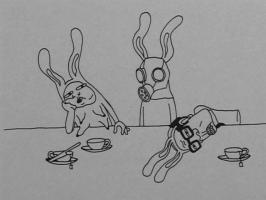
Animation Super 8 d'une partie de carte avec un petit quelque chose de spécial dans le thé.
Asa Mori est née à Nagano au Japon et vit actuellement à Vancouver. Elle a obtenu un BFA du Nova Scotia College of Art and Design, en travaillant principalement sur l'installation média et l'animation. Elle eu son premier animal de compagnie à l'age de six ans, un lapin appelé "House". House est mort tragiquement une semaine plus tard.
Armand Morin
Climatic Fictions
Doc. expérimental | dv | couleur | 5:32 | France, USA | 2009
Cette vidéo a été tournée en Arizona, dans différents parcs naturels (Painted desert, Petrified forest) ainsi qu?à Biosphere 2, centre d?étude scientifique où 4 écosystèmes et climats ont été artificiellement reconstitués sous une serre située en plein désert. Le montage et la voix du guide de Biosphère 2 construisent un documentaire de science fiction, absurde mais inquiétant. Cela laisse supposer que ces paysages immenses ont été générés par Biosphere2.
Armand Morin Né à Nevers en 1984 Vit et travaille à Lille Armand Morin a été diplômé des beaux-Arts de Nantes en 2007. Son travail s`approprie les diverses formes générées par le monde des loisirs, liées au paysage et à l`architecture. En 2008, ses vidéos et sculptures sont récompensées par le Prix des arts plastiques de la ville de Nantes. En 2009, l`école des Beaux-Arts de Nantes lui propose une bourse pour poursuivre ses recherches à Miami, dans le cadre du groupe de recherche "Pensées Archipéliques" qui s`intéresse au rapport entre l`art, la ville, le multiculturalisme et la mondialisation. Il y tourne les vidéos "Pardon our Dust" et "Le Monastère Espagnol" qui interrogent le rapport de Miami à son territoire et les emprunts culturels européens que l`on retrouve dans son architecture. Il commence à la rentrée 2010 le Cursus du Fresnoy, studio national des arts contemporains.
Didier Morin
Fontevrault 82
Doc. expérimental | super8 | noir et blanc | 14:0 | France | 2010
En 1982, j?écrivais à Jean Genet pour lui demander s?il accepterait de parler de son temps passé à Fontevrault. J?ignorais à l?époque qu?il n?y avait jamais été emprisonné. Je ne reçu aucune réponse de sa part, et l?autorisation de filmer me fut refusée. Le motif évoqué : l?abbaye était en restauration, donc dangereuse. On me demandait de refaire une demande dans quelques années. Je décidais donc de m?introduire dans l?abbaye sans autorisation. Avec une caméra super 8, un trépied et une lampe de camping, guidé par quelques-uns des derniers prisonniers qui pouvaient se déplacer librement dans l?enceinte, je filmais durant plusieurs jours les lieux, les traces, les inscriptions sur les murs de l?enceinte centrale. Au total 6 galettes de 3 minutes. (Surpris par un gardien, je dus renoncer.) En 2010, j?ordonnais cette matière brute, sans rien y soustraire, ni vraiment la monter, en laissant les reprises de plans, et les hésitations lors du tournage. (Didier Morin)
Né en 1956. Photographe et cinéaste, il enseigne le cinéma à l?école des Beaux arts de Marseille. Crée la revue Mettray en 2001. Il est l`auteur du film Le voyage d`Yves Klein (2007) et d?Un autre voyage mexicain (2010) et de Fontevrault (1979-2010). Il a publié Carnac (Monum Edt) et Les Semelles d?or (La Petite École Comp`Act). Tourne actuellement Dans l?atelier de Jean-Pierre Bertrand.
Armand Morin
keep off displays 2 (missile range
Art vidéo | dv | couleur | 6:17 | France, USA | 2007
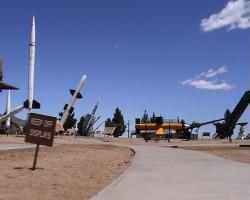
La vidéo "Keep off displays" a été tournée au Nouveau Méxique, à "Missile Range", une base militaire où ont été effectués dans les années 40 les premiers essais nucléaires. La vidéo s`attarde plus précisément sur une partie ouverte au public appelée "Missile park". Ce musée du missile propose soixante ans d`une histoire de l`armement balistique américain. Entre une réplique de la bombe H, un V2, de drônes, et le public touristique;un véhicule radiocommandé se ballade sans fin sur les allées de cette mise en scène spectaculaire. Celui-ci imite le déplacement des "Rovers",robots récemment envoyés sur mars par la NASA . Sur ce site l`histoire se déroule et se raconte avec naïveté et cynisme, dans le culte du progrès et de la performance, au mépris des implications humaines et géopolitiques les plus évidentes. Dans ce Disneyland, "Pluto" a le museau équipé d`une tête chercheuse...
Qu`il se développe sous forme de photographie de vidéos, de sculptures ou d`installations, mon travail s`interroge sur les divers moyens de représentation qui donnent naissance au paysage et dans un sens, les amorces de fictions que ces représentations matérielles ou mentales engagent. Cette pratique a pour origine diverses expériences, promenades et rencontres avec des lieux et des situations qui seront dans un premier temps documentées puis réinvesties dans des dispositifs combinant des souvenirs, des matériaux prélevés et une imagerie collective. Des séquences, du montage, de l`assemblage. Je m`intéressent particulièrement au formes produites par les lieux et les industries de consommation du temps libre, des loisirs, aux pratiques amateurs. Ces situations sont propices à la modélisation, au changement d`échelle, aux basculements sémantiques, à la naissance de récits populaires du monde. Je viens d`être diplômé (juin 2007) de l`École des beaux-arts de Nantes, ou je vis et travaille.

Maria Morina
Nizhny Tagil Youth
Documentaire | hdv | couleur | 5:5 | Russie | 2011
Nizhny Tagil Youth project explores the life of young people in one of the industrial centres, Nizhny Tagil, Russia, located on the virtual border between Europe and Asia. Their aspirations are limited by the paths already determined for them. This industrial city sits amidst the Ural mountains, the natural frontier between Europe and Asia. Of the 362,000 inhabitants, about 70,000 work for UralVagonZavod and 25,000 work for Nizhny Tagil Iron and Steel Plant, part of the Evraz Group, the two main factories located in the town. At around 16 years old, teenagers must make a choice about their employment. The majority ends up working long hours in one of the two plants, some join the small businesses that support these plants and their workers, and the rest remain unemployed. For the young people of the city, growing up within this damaged social landscape, there is a palpable sense of disillusionment. Those who work in the factories are subjected to a monotonous routine. The two hours a day commute added to eight hours on the job leaves them with little time to themselves. And lack of money often prevents them from going out, some feel that they have nothing to do.
Maria Morina is an emerging Russian documentary photographer and filmmaker based in Kiev, Ukraine. Maria Morina was born in Novosibirsk, Russia, in 1982. She graduated from St. Petersburg State University, International Relations, and attended Galperin photojournalism faculty in St. Petersburg and several workshops by Yury Kozyrev/ NOOR, and Bjarke Myrthu/ StoryPlanet organized by Objective Reality Foundation. Ms. Morina has participated in several group exhibitions and installations in Russia, UK, and US. She also worked as a field producer for documentary film Birth Of Nation by Daya Cahen, 2010. Since 2009 Ms. Morina has been working on joint project by three female photographers Grozny: Nine Cities, exploring specific aspects of the aftermath of two Chechen wars, which has been nominated for several international reward. In 2010 Ms. Morina started to work on a personal long term project on Nizhny Tagil youngsters lifestyle. The result of the project will be a series of short documentary films.