Catalogue > Faire une recherche
Résultats pour : Tout le catalogue

Francisca Somigliana
Diamante
Fiction expérimentale | 4k | couleur | 7:29 | Argentine | 2020
"Diamante" est construit comme un jeu de réflexions sur la base d'un fait divers: un vol de bijoux commis en Russie en 2018, vraisemblablement par une organisation criminelle appelée Pink Panther.
Francisca Somigliana (née à Buenos Aires en 1992) a étudié le design d’image et de son. Elle a participé au Film Program (2017) et au Artist Program(2020/21) de la Universidad Torcuato Di Tella, Buenos Aires (Argentine). Elle a été sélectionnée en 2019 pour participer à la Biennial of Young Art, Buenos Aires (Argentine). Elle a participé à plusieurs expositions et projections, notamment à "Space between", au Centro Cultural Recoleta, Buenos Aires (Argentine); à "Today I have permission to lie", à la UTDT – Universidad Torcutato Di Tella, Buenos Aires (Argentine); à Program 2016, au Dahaus Studio; à Satellite XIII (CHELA); et à "Cinematographic images and their path to freedom", à la UTDT – Universidad Torcutato Di Tella, Buenos Aires (Argentine).
Helene Sommer
Das Gelaende
Vidéo expérimentale | dv | couleur | 7:56 | Norvège, Allemagne | 2005
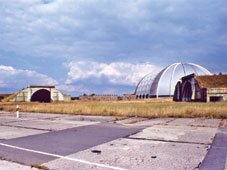
Le but initial du voyage était d?observer la construction d?un parc d?attraction tropical en intérieur mais les intentions et les intérêts ont changé à mesure que le paysage déjà existant devenait inévitable. ?Das Gelände? suit la construction d?un parc d?attraction tropical dans un ancien hangar à avion qui se trouve dans une ancienne base militaire soviétique de la RDA. Dans la vidéo, on découvre l?histoire des lieux en même temps que l?on observe la construction d?un paysage artificiel en intérieur. A mesure que les locaux changent de fonction, les différentes couches de l?histoire se révèlent au grand jour. Le recyclage visible du paysage soulève la question de savoir si le parc d?attraction banalise, camoufle ou clarifie l?histoire des lieux. La vidéo est composée d?images tournées par des Webcams téléchargées sur une période de neuf mois, ainsi que de photographies et de vidéos rassemblées pendant la construction. L?histoire est racontée grâce à des sous-titres, laissant ainsi le son des paysages comme seul fond sonore.
Helene Sommer est née en 1978 à Oslo en Norvège. Elle a obtenu son diplôme à l?Académie des beaux-arts d?Oslo en 2003 et vit et travaille actuellement à Berlin ainsi qu?à Oslo. Elle travaille sur différent media comme la vidéo, la photographie, les textes et les installations.
Helene Sommer
Persistence of vision
Art vidéo | dv | couleur | 11:0 | Norvège | 2007
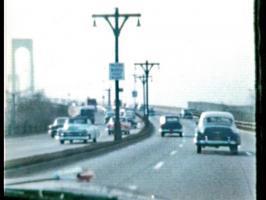
'Persistence'* of vision est basé sur les archives vidéos amateur d'un homme de 90 ans de 1950 à nos jours. Le film est centré sur ses voyages, de NYC à l'Amérique du sud dans les années 50, au japon dans les années 60, l'Egypte dans les années 70 et au villages de retraite espagnoles dans les années 90. En déconstruisant et en rassemblant les film, un nouveau "travelogue" est créer dans lequel le temps et le lieu se mélangent. ?Persistence of vision?* étudie comment la mémoire et la perception fonctionnent par rapport à l'histoire et l'acte de documenter; l'usage de la camera comme manière de voir.
Helene Sommer est né en 1978 à Oslo, Norvège. Elle a étudié les arts appliqués a Oslo. En tant qu'artiste elle travaille principalement dans la vidéo, la photo, le texte et l'installation. Elle a expose dans plusieurs endroits en Europe ces dernières années. Elle avait récemment une résidence d'artiste à la Platform Garanti à Istanbul et est maintenant enseignante à l'Akademie Schloss Solitude de Stuttgart pour les disciplines Film/Vidéo/New Media.

Wichanon Somumjarn
The Young Man Who Came From the Chee River
Fiction expérimentale | hdv | couleur | 16:38 | Thaïlande | 2015
Golf, a man who works as a debt claimer in Khonkaen. He wakes up early to work as usual. He meets many people including a desperate man in debt who falls critically ill. Golf is forced by the situation to weigh up between his professional duty and sense of moral.
Wichanon Somumjarn was born in Khon Kaen in 1982. While he was in the final year of studying engineering, he made a short film titled Phee Hong Nam (W.C.) The short won Honorable Mention at the Siam Cement Group Young Thai Artist Award 2005 in the film category. He then decided to leave his formal studies to pursue his dreams in the field of cinema. Wichanon was a participant in Asian Film Academy (AFA), Pusan International Film Festival 2009. In February 2010, Wichanon had also attended the Berlinale Talent Campus # 8 at the 60th Berlin International Film Festival, Germany. In November 2010, Wichanon had also attended the Next Master Tokyo Filmex 2010, Japan. His short film, Four Boys, White Whiskey and Grilled Mouse has been a major success on the international film festival circuit. It won Best Fiction award at the prestigious Tampere Film Festival in Finland in 2010. In April the Following Year, There was a Fire, is Wichanon’s first feature. In January 2012, it was selected for Tiger Awards Competition at International Film Festival Rotterdam 2012. Now Wichanon is developing his second feature called “Beer Girl”.
Kwang-ju Son
Amusement Epitome
Doc. expérimental | dv | couleur | 2:46 | Coree du Sud | 2006
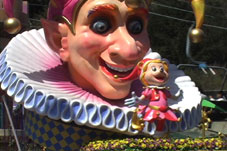
Un après-midi en semaine à Everland, l'un des plus grands parcs d'attraction de Corée.
K. Son est née en Corée en 1970 et il a remporté deux prix au Pusan International Film Festival en tant que réalisatrice. Elle a présenté ses courts-métrages lors de festivals majeurs, comme par exemple à Pusan, à Rotterdam et à Oberhausen. Elle travaille actuellement en tant qu'artiste résident à la Rijksakademie d'Amsterdam, aux Pays-Bas.
Kwang-ju Son
Characters Revisited
Doc. expérimental | 4k | couleur | 18:14 | Coree du Sud | 2016
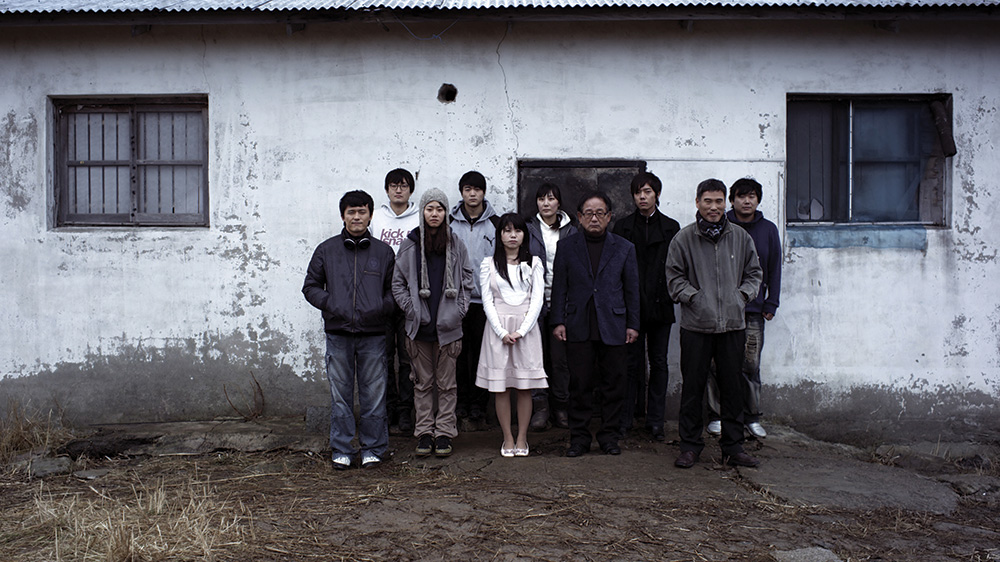
The filmmaker begins to view CHARACTERS, her first feature film made in 2011, not from the outside as a product to be consumed, but from the inside, as an engaged performance of consciousness in and through which the story is both lost and regained in the actual process of filmmaking itself. Exploring the paradoxical boundary between two worlds, she focuses on the basic conditions of existence, identity and survival of an individual in a fictional world.
Since 2003 when she received the M.F.A. in Film/Video/New Media from the School of the Art Institute of Chicago, Kwang-Ju Son(b.1970) has presented her varied short projects of both film and video, at diverse venues & international film festivals.
Guston Sondin-kung
STUXNET in Denmark
Vidéo | 4k | couleur | 4:37 | USA, Danemark | 2015
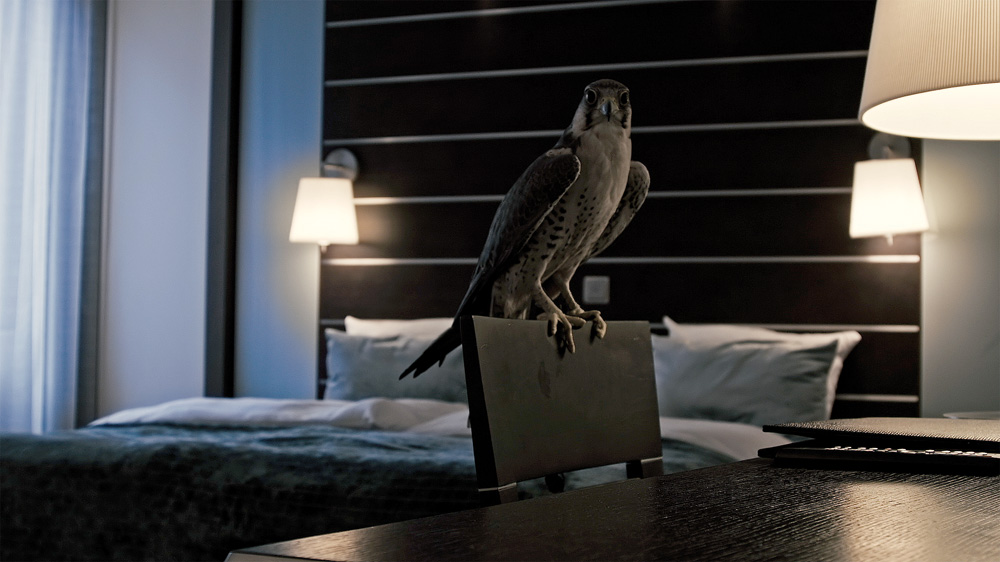
The Video work STUXNET in Denmark tells a hallucinatory realist fable about an unnamed intelligence officer who has participated in the cyber warfare attack against the Iranian Nuclear plant in Natanz from a hotel room in Copenhagen. What unfolds through the story is a dialogue about the fictive side of documents, participation and complicity in remote warfare, the trap of paranoia and the unattainable desire to be completely immune to mass surveillance. This video is based upon the real events of what has been termed the STUXNET virus, a cyber warfare weapon that was developed by a consortium of different government bodies as a way to disrupt the enrichment of uranium at the Iranian Nuclear plant in Natanz from 2010-2012. Cyber security experts have tracked the virus and discovered that one of the main control servers was located outside the city of Copenhagen, Denmark. It has been suggested by security analysts that because the control servers were located in Denmark then there would have been a forward operating command and control center set up in the country that was active during the time of the attack. An intelligence officer following standard operating procedure would have established this in a hotel and worked cloaked in what is referred to as a “security tent” that is specifically designed to create an electromagnetic shield around its exterior so as to disrupt any listening or watching devices.
Guston Sondin-Kung is a visual artist born in the USA and currently living in Copenhagen, Denmark. He works in a project-based manner primarily in the mediums of film/video, installation and writing. His artwork explores how historical narratives, memory, and ideology are constructed and influence our perception and thinking. Informed by marxist theory, psychoanalysis, postcolonial theory and feminism he is invested in deconstructing the complex intersections of race, class, and gender from a transnational perspective in order to pose alternative narratives and forms of representation. In addition to art institutions, he regularly presents his artworks and artistic research in academic, activist, educational and film festival contexts.
Ian Soroka
Nostalgia
Film expérimental | 16mm | couleur | 6:46 | USA, Tchèque (Rép.) | 2008
La nostalgie est une émotion faite d?un patchwork de souvenirs cousus ensemble, qui crée un passé idéalisé. Par le biais de réflexions sur la banalité de la vie quotidienne, « Nostalgia » s?interroge sur la création d?émotions et d?atmosphères cinématographiques. Cette ?uvre veut construire un environnement cinématographique, afin de faire allusion non seulement à quelque chose de foncièrement humain, mais aussi à une histoire émotionnelle collective.
Ian Soroka est né à New York et a grandi au Colorado (USA). Il est diplômé de la Film and TV School de l?Academy of Performing Arts de Prague (République tchèque) et étudie actuellement l?Université du Colorado, à Boulder (USA).
Gustav Sparr
Slide Projector: I.D. Roles Project
Animation | 0 | couleur | 27:46 | Suède | 2006
A cast of clones are trapped inside a seminar room and subjected to a kind of presentation or slideshow. The slideshow features over a hundred images of board games, and seems to trigger, via a small mysterious ball of light, the audience of clones to sift through their notes and act out small, possibly internal or dreamlike, dramas. As the film progresses the identies start to get tangled and conflict arises, characters want to jump out of the system or structure, while some, seemingly in power, try to control the situation and preserve the order of things. The film unfolds and is driven trough the association and manipulation of symbols: One board game leads to the next and one identity refers to another in a sequential series of mind games that eats its own tail. The sub-stories of the film deal playfully and somewhat loosely with evolution, science, existentialism, and society, as well as mysticism and hierarchies. It is part of a larger artwork and film cycle begun in 2003 and scheduled for completion in 2007.
Gustav Sparr was born in 1977, grew up in the region of Stockholm, and currently lives and works in Umeå, Sweden. After having gradually shifted from sculpture, painting, and digital illustration, his work currently focuses on animation. References from popular culture, esotericism and scientific writings have been filtered through a rather direct visual language that hides many underlying and unorthodox connections of ideas. The most obvious framework or manifestation of these thought-experiments is through the both limiting and enriching world of board games and childlike acts, which are deciphered, re-interpreted and re-coded. The animations and images are concerned with questions about identity, self-image, structures, symbols, loops, surfaces, topology, vessels of information, lifeforms, and how thoughts and ideas are born and relate and mutate. Basically it's about the brain...

Isabell Spengler, Antonia Baehr, Jule Flierl - Filmed in a visual installation by Nadia Lauro
Die Hörposaune
Fiction expérimentale | 0 | couleur | 29:38 | Allemagne | 2022
Die Hörposaune (The Hearing Trombone) film / installation by Isabell Spengler, Antonia Baehr, Jule Flierl, Germany 2022 filmed in a visual installation by Nadia Lauro short synopsis Through a floating camera motion, the film invites us to enter a world with its own logic, passing through sensitive membranes, liquefied borders and openings between inner and outer spaces. Here we attend a reading circle or vocal performance in memory of the counter tenor and queer icon Klaus Nomi, one of the first public figures to die within the AIDS pandemic. Daydream-like, as if to save them from oblivion, the film delves into the guts of fantastical, queer body imaginations - with spit, panting, oral sounds, singing, and vulva-like paper flower arrangements, whereby anatomical representations are reinterpreted.
Isabell Spengler (director) is a film/video artist from Berlin. In her films, installations and performances she analyzes and mediates diverging constructions of realities, imaginary worlds and their representation. Since 2005 she has created a series of conceptual Expanded Cinema works in dialogues with other artists. /www.isabellspengler.net Antonia Baehr (director) is a choreographer living in Berlin. Her pieces explore, among other things, the fiction of the everyday and the theater. She has worked with scores for many years - as a way to connect and collaborate. Baehr is producer of horse whisperer and dancer Werner Hirsch (performer in Die Hörposaune). /www.make-up-productions.net Jule Flierl (director) is a dance and voice artist from Berlin. She develops practices that conceive of the voice as a dancer. She revives the legacy of Valeska Gert, avant-garde dancer from 1920's Berlin, who first conceptualized the term ToneDance: to dance with one's voice. Her practice unsettles the relationship between seeing and hearing. /juleflierl.weebly.com Nadia Lauro (visual installation) is a visual artist and designer based in Paris, who works across contexts including scenic spaces, landscape architectures, museums. She conceived set designs, environments and visual installations with strong dramaturgical power, thus generating new ways of seeing and being together. /https://nadialauro.com
Isabell Spengler
Permanent Residents
Film expérimental | 16mm | couleur | 9:32 | Allemagne, USA | 2005
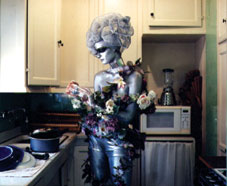
Le film "Permanent Residents" associe un design vestimentaire extrême à une mise en scène de la réalité des activités quotidiennes dans le paysage urbain de Los Angeles. Les costumes renvoient à un monde imaginaire collectif contenant les concepts flous des icônes-pop, des mythes et des fictions sociales. Les protagonistes du film communiquent dans un language non-verbal qui se joue des distances spatiales. Leurs mouvements simultanés à des endroits différents se fondent dans une chorégraphie attirant notre attention sur les aspects visuels musicaux et abstraits du design de notre environnement. Portrait de l'influence d'une ville sur ses habitants.
Isabell Spengler, est née à Berlin (Allemagne). Elle a étudié le cinéma expérimental à l'Université des Arts de Berlin(Meisterschülerin 1999) et au California Institute of the Arts Valencial (Master of Fine Arts 2001). Elle obtint une bourse du DAAD ainsi qu'une bourse Estman Kodak. Elle enseigne actuellement le cinéma à l'Université des Arts de Berlin. Appartiennent à sa filmographie : "Psychic Tequila Tarot" (1998), ?Transformation in the Land of Enchantment? (2003) et ?The Natural Life of Mermaids? (2004). Ses films ont reçu des prix, notamment au Festival NoBudget à Hambourg, au Festival international du court-métrage à Gera et au Göttingen Low Budget Film Festival. Son travail a récemment été présenté lors du Los Angeles Film Forum, Cirrus Gallery à Los Angeles, Australian Center for Photografy à Sydney, the Museum Ludwig à Cologne et au KunstWerke Institute for Contemporary Art à Berlin.
Isabell Spengler, Larry Peacock
Syncpoint
Film expérimental | 16mm | couleur et n&b | 3:54 | Allemagne | 2007
Translating a musical stage performance by the group "Larry Peacock" into the language of film, SYNCPOINT combines film images created directly on film leader with those created through normal exposure of 24 frames per second with a 16mm film camera. Central to this experimental music video is the image of the synchronization-point as a hole, derived from the film-technical synchronization method of punching a hole into the first exposed and keycode-numbered frame of a roll of film prior to its transfer to video. The image of the hole does not only mark a point in time, but is in connection with the photographically captured (percussion-) actions of the performers perceived either as a round mask of censorship or as a filled, dot-shaped image. Purposefully designed and random synchronicities between the visual and accustic events allow for a variety of interpretive connections. Larry Peacock is a feminist project with and about the performativity of electronic/pop music, reflecting gender politics and the role of the audience. The project not only destabilizes the normativity of binary gender categories, but also art categories such as ?high` and `low`, ?dance?, ?concert-performance?, and ?choreographic work?.
Isabell Spengler, born in Berlin, studied experimental film at the Universität der Künste in Berlin and at the California Institute of the Arts in Valencia. She was a recipent of a DAAD grant and a Eastman Kodak stipend. She currently teaches film at the Universität der Künste in Berlin. Her filmography includes "Psychic Tequila Tarot" (1998), ?Transformation in the Land of Enchantment? (2003), ?The Natural Life of Mermaids? (2004) and ?Permanent Residents? (2005). Her work including films, video installations and photography has recently been exhibited at Los Angeles Film Forum; Cirrus gallery, Los Angeles; Cerealart, Philadelphia; Taxter & Spengemann, New York; KunstWerke - Berlin e.V. - Institute for Comtemporary Art; Internationale Filmfestspiele Berlin (Berlinale 2007) and at the Museum Ludwig, Cologne, Germany. distribution & further information: http://www.fdk-berlin.de/en/arsenal-experimental/kuenstler/isabell-spengler.html
Gustavo Spolidoro
De Volta ao Quarto 666
Documentaire | dv | couleur | 15:10 | Brésil | 2009
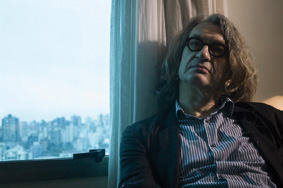
What is the future of cinema? In 1982, in Cannes, Wim Wenders invited many moviemakers to answer this question. 26 years later, the question remains, but Wenders is now on the other side of the camera.
Inspired by his father, a cinemaniac, Gustavo Spolidoro started to explore the world of film early on and inspired by filmmakers like Rogério Sganzerla and Woody Allen started his career as a director.

Alcaeus Spyrou
Anina
Vidéo | hdv | couleur | 19:51 | Grèce, Royaume-Uni | 2017
A container ship is not an inanimate object. The ship that travels thousands of miles on the high seas is full of life, stories, tragedy and hope. The harbours reached, the industrial landscape one encounters, the cargo that floats in an endless ocean. Anina is a psycho-geographic film-essay, documenting the ethnographic tendencies of the industrial landscape and its malevolent stature over the individual. The shipping industry’s ever-shifting landscape, affecting even this interaction you are having with this text, crafts its own mythology.
Alcaeus Spyrou (b.1991, Elbasan, Albania) is a visual artist working with the cinematic image. He was born on the day the fall of the Hoxha dictatorship in Albania. The conflict that ensued, forced his family to seek refuge in Athens, Greece. The frequent displacement and oscillation between the two topographies, would focus Alcaeus’s gaze towards the shifting landscape of migration. In his practice, Alcaeus utilizes a psychoanalytical scope on cinema to deconstruct the inter-dependent nature of the medium. Through this process, he searches for new dialects of the cinematic language. By combining the two antithetical genres of fiction and non-fiction he establishes connections with the alienated environment. He informs the mythologies of contemporary migration that reveal collective trauma as the substance of our intricate relations to the other.

Giulio Squillacciotti
A War Play
Fiction expérimentale | 16mm | couleur | 8:0 | Italie | 2024
Around 1920, a wealthy man from northern Italy returns from the First World War. Without having actively fought, neither having seen the blood of battle or an actual trench, he asks a group of people to stage for his camera scenes from the war as he imagined it. In 2024, four individuals are asked, in an attempt at freezing time, to didactically re-enact the scenes already staged in the 1920s photographs. In the corridors of a war museum housing a series of dioramas depicting war landscapes without figures, the endless cycle of the representation of war unfolds in an infinite suspended moment.
Giulio Squillacciotti is an artist and film-director born in Rome in 1982, living and working in Milan. After an education in Medieval Art History and Humanities in Rome and Barcelona, he studied Visual Arts at the University of Architecture in Venice. He was a fellow resident at the Jan Van Eyck Academie in Maastricht and one of the artists of the Dutch pavilion at the 2018 Architecture Biennale. His work is oriented mainly on the invention and mutation of traditions by merging together fiction and historical facts. Using film, documentary, sound and scenography, Squillacciotti produces research-based investigations that revisits history, crafting new stories from subjective perspectives, religion, language and popular culture. He is currently working on his first fiction feature film, co-produced among Italy, Ireland and Poland, project recipient, so far, of the MEDIA Creative Europe Grant and the Screen Ireland writing fund.
Giulio Squillacciotti
Casi la mitad de la historia
Fiction | | couleur | 7:46 | Italie | 2011
All the memory of the world is contained in an old Academy we don?t know the location and time. The quarrel between two men from two different generations is told through vocal notes as annotations for a possible story yet to be told. The argument stands in the chances History has to be written. How do these two persons can tell a story? How do they deal with what History already told and what is possible to add? How to tell something while is happening? A story telling method as an inheritance, to be passed on from Maestro to pupil in the aseptic spaces of an Academy. Looking for the right balance between tradition and the possible re-invention of it, as two different generations and their different approach to key words of the Historic Study. The voice leading us to these spaces has never a face, but her subjective eye has the right detach of the present on past issues. Shot for the double solo show of Antoni Muntadas and Giulio Squillacciotti in Rome (I) in 2011.
Giulio Squillacciotti (Rome, Italy 1982) studied Medieval Art History in Barcelona and Rome, where he got his BA from Sapienza University. He earned a Master?s Degree (hons) in Visual Arts from the School of Architecture in Venice in 2009, where he studied Philosophy, Semiotics and Anthropology. Once completed his studies he won, again in Venice, a one year residency at the Bevilacqua La Masa Foundation with the Ateliers Program. Never trained as an artist, neither a film maker, his work is mainly oriented on storytelling and cultural apexes and their possible reinvention in different contexts. He deals with the idea of tradition and the fictitious outlets of it, all spread through a system of layered meanings, which formally goes from film to documentary, from installation to live performing and talks. His works and talks have been shown and heard in New York and Boston (USA), Den Bosch (NL), Paris and Grenoble (FR), Istanbul (TR), Murcia (Manifesta 8, ES), Prague (CZ), Teheran (IR), Weimar (D); in Italy in Rome, Milan, Turin, Venice and Verona. He recently finished the editing of a feature documentary film (RMHC) on the punk/hardcore scene in Rome from the 80s and 90s.

Giulio Squillacciotti
What Has Left Since We Left
Fiction expérimentale | 4k | couleur | 21:15 | Italie, Pays-Bas | 2020
Le 7 février 1992, le traité sur l'Union européenne a été signé dans la ville néerlandaise de Maastricht. Des décennies plus tard, les représentants des trois derniers pays restants dans l’Europe se réunissent à nouveau dans la salle même où le traité fut signé, mais cette fois pour délibérer sur la dissolution définitive de leur Union. Dans ce qui ressemble à une séance de thérapie en boucle, les trois personnages - aidés par une interprète britannique qui s'improvise psychanalyste - tentent de gérer leur sentiment de perte. La conversation permet d’entrelacer métaphoriquement leurs liens politiques et personnels, les obligeant à faire face à leur crise d'identité et à reconnaître ce qui reste de leur Union, ce qu’elle n'est plus, et ce qu’elle pourrait encore devenir.
Giulio Squillacciotti (né à Rome, Italie, 1982) est artiste et réalisateur. Il vit et travaille entre Milan (Italie) et Maastricht (Pays-Bas). Il a étudié l'Histoire de l'art médiéval à Barcelone (Espagne) et à Rome (Italie), où il a obtenu une licence en sciences humaines à l'université Sapienza. Il a également obtenu un Master en arts visuels à l'université IUAV de Venise. Son travail s’oriente principalement sur la narration, les apogées culturelles et la façon dont les traditions se remodèlent dans de nouveaux contextes. Ses recherches mêlent fiction et faits historiques. À l’aide du film, du documentaire, du son et de la scénographie, il produit des enquêtes basées sur la recherche qui revisitent l'Histoire, créant de nouveaux récits à partir de perspectives subjectives, de la religion et de la culture populaire. Son travail a été exposé et projeté à l'international, notamment à la Biennale d'architecture de Venise – Pavillon néerlandais (Italie); aux Rencontres internationales Paris/Berlin (France/Allemagne); au Palais de Tokyo, Paris (France); à La Fémis – École nationale supérieure des métiers de l’image et du son, Paris (France); à Gaîté Lyrique, Paris (France); au Centre d'Art Contemporain de Brest (France); à la Haus der Kulturen der Welt, Berlin (Allemagne); au Neues Museum Weimar (Allemagne); au Screen Space, Melbourne (Australie); à la Manifesta 8, Murcia (Espagne); au Magasin CNAC – Centre d’Art Contemporain et de Culture, Grenoble (France); à la AKV, Den Bosch (Pays-Bas); à Istanbul 2010 European Capital of Culture (Turquie); au Beirut Art Centre (Liban), au New York Photo Festival (USA); à Video_Dumbo, New York (USA); à la Columbia University, New York (USA); au Art Institute of Boston (USA); au Now Instant Image Hall, Los Angeles (USA); au OCAT Shanghai (Chine); au PAC – Padiglione d’Arte Contemporanea, Milan (Italie); à la Triennale de Milan (Italie); au MACRO – Musée d’art contemporain de Rome (Italie); au musée MAXXI, Rome (Italie); à la 16e Quadriennale de Rome (Italie); au MAMbo – Museo d’Arte Moderna di Bologna, Bologne (Italie); à la Fondation Sandretto Re Rebaudengo, Turin (Italie) et dans la compétition officielle des 33e, 35e et 36e éditions du Torino Film Festival, Turin (Italie).
Giulio Squillacciotti
Zimmerreise
Fiction | super8 | couleur | 2:30 | Italie, Autriche | 2010
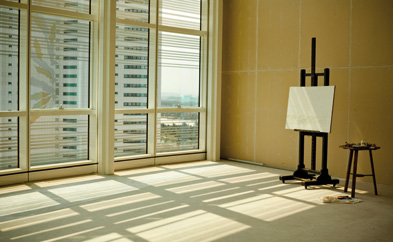
A woman wanders around the 19th floor of a building, from an anonymous industrialized city. She has been told, through a series of cryptic indications, how to paint an imaginary landscape where to meet with the author of those letters. The geographical and physical distance with the person who is writing to her, can be reduced only through a methodic work of imagination and detach from what is surrounding her. The chance of traveling from a room, by seeing with eyes closed, to a place that exists only in both their minds. The difficult task is here expressed by the contradictory indications he gives her, as an explicit giving of what is a long distance communication with its time lapses. The strength to disclose the hitch can only be found in the accurate recollection of memories she has of their real encounters, once happened, far in time, but far, from where they both came.
Giulio Squillacciotti (Rome, Italy 1982) studied Medieval Art History in Barcelona and Rome, where he got his BA from Sapienza University. He earned a Master?s Degree (hons) in Visual Arts from the School of Architecture in Venice in 2009, where he studied Philosophy, Semiotics and Anthropology. Once completed his studies he won, again in Venice, a one year residency at the Bevilacqua La Masa Foundation with the Ateliers Program. Never trained as an artist, neither a film maker, his work is mainly oriented on storytelling and cultural apexes and their possible reinvention in different contexts. He deals with the idea of tradition and the fictitious outlets of it, all spread through a system of layered meanings, which formally goes from film to documentary, from installation to live performing and talks. His works and talks have been shown and heard in New York and Boston (USA), Den Bosch (NL), Paris and Grenoble (FR), Istanbul (TR), Murcia (Manifesta 8, ES), Prague (CZ), Teheran (IR), Weimar (D); in Italy in Rome, Milan, Turin, Venice and Verona. He recently finished the editing of a feature documentary film (RMHC) on the punk/hardcore scene in Rome from the 80s and 90s.

Marina Stanimirovic
Des carcasses de tout
Doc. expérimental | mov | couleur | 4:15 | France, Allemagne | 2022
Enregistré en France et en Allemagne, "CARCASSES OF ALL KINDS" est un enregistrement sauvage d'une discussion avec ma mère avant qu'il ne soit trop tard. Ma mère, malade, me racontait notre premier retour en Bosnie-Herzégovine, l'année qui a suivi la fin de la guerre. Mais cette pièce ne traite pas tant de la guerre que de fragilité, de mémoires, cicatrices et de départs. Voix et mots utilisé comme matériel sculptural, découpés, montés et mélangés à d'autres sons enregistrés. Ceux ci proviennent d’enregistrements réalisés dans le service de cancérologie du centre hospitalier d'Argenteuil, de frottement de vêtements, de découpe de verre et de métal, de martelage, d’une imprimante industrielle et de chants. Chaque été, ma mère avait l'habitude de couper de la lavande dans son jardin et de la placer dans des bas usagés. En triant ses vêtrements après sa mort, je les ai tous rassemblé un même sac. La vidéo est une plongée dans ce sac.
Marina Stanimirovic (1988, Argenteuil) est une artiste plasticienne française basée à Berlin. Elle a étudié le bijou contemporain à l'Ecole Boulle, à Paris (2007 - 2011), à lyon, et à Londres, où elle a obtenu un Master au Royal College of Arts(2011 - 2013). De la violence contre les femmes aux disparités sociales ou aux systèmes économiques dysfonctionnels, elle observe le laid, le beau, le triste, l'absurde et le traduit à travers des sculptures et installations comprenant la photographie, vidéos et expérimentations sonores. En 2022, elle crée DERIVAT, une plateforme qui invite à réfléchir sur le marché de l'art contemporain. Depuis 2023, elle fait partie du project space Gr_und à Wedding Berlin.

Annette Stav Johanssen
HANG SAFELY DIE SLOWLY
Vidéo expérimentale | dv | couleur | 6:0 | Norvège, Suède | 2007
Un numéro d'agence de media-exorcisme dans lequel l'imprévisibilité fonctionne comme la carte de développement. Une oeuvre qui challenge le comportement post- spéculatif ou les rôles et les personnages sont prédéterminés dans un script pré-écrit. C est une recherche de risque, des chances, de grands mouvement et des situation personnifiées, les réactions directs et une action continuelle. Le choix de la dramaturgie est une extraction de la pensée d'Aristote et d?Hollywood, ou l'essence de l'action et de la composition est toujours conduit par la gène et le conflit, planté dans l'histoire pré-écrite avec les personnages impliqués. La situation est Brechtienne, ou le film illustre ses illusions et à ce moment devient un effet de narration aliéné. Il n?y a qu'une règle, contrôler le système entier, être l'image intérieure et le cadre extérieur. Il n'y a qu'une pièce, la porte est fermée, vous devriez être en sécurité. NOUS, sanglés dans le système de la totalité informative, ceci est devenu un acte de formalité.
Annette Stav Johanssen, née en 1979 à Kristiansand en Norvège, vit et travaille à Malmö en Suède. Elle produit principalement des performances, des vidéos, écrit des textes et se produit en concert. Elle se sert souvent d'elle même comme sujet challengeant l'incarnation des situations et expérimente aussi beaucoup avec la voix (Hang Safely Die Slowly est pourtant un film muet). Elle est membre de la Fine Art Union en collaboration avec Synnove G. Wetten, une autre artiste norvégienne. Fine Art Union est un collaboration interdisciplinaire qui opère dans les dynamiques d'expressions spectaculaire rebondissantes contre des comportement analytique à l'aide de cinéma neo sci-fi et d'actions ritualisées.
Christopher Steel
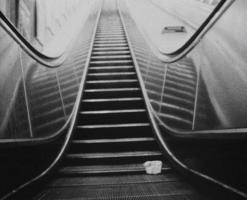
Tube
Film expérimental | 16mm | noir et blanc | 7:30 | Royaume-Uni | 2004
Le spectacle quotidien du réseau des métros à Londres est amplifié par une surimpression caméra. Le négatif est peint pour supprimer publicités et graffiti.
Christopher Stell est né à Roehampton en 1968. Il a étudié à l'Université d'Edimbourg. Il a suivi des cours de Production de Film 16mm à la Half-Way Production House, Balham, en 1993. Il a rejoint la Filmmakers? Coop de Londres en 1993.