Catalogue > Faire une recherche
Résultats pour : Tout le catalogue
Claudia Dworschak, Marion Geyer-Grois
Wilder Westen
Film expérimental | dv | couleur | 5:0 | Autriche | 2006
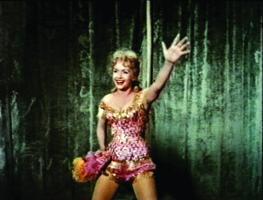
Wilder Westen Österreich gilt heute als Drehscheibe für sogenannte ?white slavery?, den Handel mit Mädchen aus Osteuropa. 2005 veröffentlichte die Wiener Stadtzeitung FALTER Auszüge aus Abhörprotokollen der Polizei, die Telefongespräche zwischen Mädchenhändlern in Wien und deren litauischen Zulieferern und österreichischen Kunden dokumentieren. Diese Polizeiprotokolle nahmen die Künstlerinnen von diekönigin, Claudia Dworschak und Marion Geyer-Grois, zum Anlass für ihre Videoarbeit Wilder Westen. Mit reduziertem Bildmaterial und eingelesenen Textfragmenten wird eine mögliche Szenerie dieses schmutzigen Geschäftes verfremdet dargestellt. Zwischen der scheinbar harmlosen, einladenden Kulisse eines möglichen Tatortes und der Ungeheuerlichkeit des Verbrechens bauen die Künstlerinnen ein Spannungsfeld auf, das mit dem Unsichtbaren, Nicht-Fassbaren operiert. (AV) eine dieköniginproduktion Katalogtext zur Ausstellung >Sexwork - Kunst Mythos Realität< der NGBK, Berlin Kehrerverlag Heidelberg, 2007
diekönigin sind... Claudia Dworschak 1963 geboren in Linz/Österreich 2000 - 2007 Studium audiovisuelle Mediengestaltung an der Kunstuniversität Linz/Österreich seit 1999 Arbeiten und Ausstellungen mit der Künstlerinnengruppe ?freundinnen der kunst? und der Radiogruppe ?spacefemfm? 2004 ?diekönigin ?wird mit Marion Geyer-Grois gegründet Marion Geyer-Grois 1976 geboren in Wien, aufgewachsen in Niederabsdorf/Niederösterreich 2000 - 2007 Studium audiovisuelle Mediengestaltung an der Kunstuniversität Linz 2004 ?diekönigin? wird mit Claudia Dworschak gegründet

Per Dybvig, Ólafur Ólafsson
Caregivers
Doc. expérimental | dv | couleur | 14:0 | Espagne, Italie | 2008
LIBIA CASTRO & ÓLAFUR ÓLAFSSON Caregivers Video, color, sound / 14 min. / English and Italian / subtitles English and local language music by Karólína Eiríksdóttir / text by Davide Berretta / music performed by: soprano; Ingibjörg Guðjónsdóttir, oboe; Matthías Nardeau, choir; Women Choir of Garðabær / camera by Libia Castro and Ólafur Ólafsson / editing by: Kristján Loðmfjörð, Libia Castro and Ólafur Ólafsson appearance by: Mihaela Tabaranu, Maria Slobodyan, Paolina Mazzucchi in Ciaghi, Diomira Raffaelli and others. 2008 Intrigued by the dense history of women-labour in the Rovereto area in the North of Italy, Libia Castro and Ólafur Ólafsson (b. 1969/1973) produced the video work Caregivers related to this macro-topic in the frame of Manifesta 7. The video portrays two migrant caregivers from Ukraine and Romania and their (elderly) clients in their relationship and daily work in the area of Rovereto. For the video´s soundtrack the artists commissioned the Icelandic composer Karólína Eiríksdóttir to write a music score to an article, written by the young journalist Davide Berretta, describing this recent and rapidly growing phenomenon. Karólína wrote the music for a soprano, women choir and an oboe. The video combines footage, edited to the soundtrack, shot in and around two homes in Northern Italy with footage documenting the singers and the musician recording the cantata in Iceland - in all juxtaposing journalism, documentary making and classical contemporary music. Supported by the Center for Icelandic Art (CIA.IS), The Netherlands Foundation for Visual Arts, Design and Architecture (BKVB), the Centre of Visual Arts Rotterdam (CBK) and Manifesta 7. Courtesy of the artists and Manifesta 7.
Libia Castro & Ólafur Ólafsson Libia Castro (b. 1969, Madrid) & Ólafur Ólafsson (b. 1973, Reykjavík) have been working together since 1997. They came to international prominence through their participation in exhibitions such as Manifesta 7 in 2008, and will be representing Iceland at the 54th Venice Biennale in 2011. Their latest video Lobbyists received The Basis Prize (third prize) in the 2009 Prix de Rome, the Dutch contemporary art award. Recent exhibitions of work by Libia Castro & Ólafur Ólafsson have included solo presentations at the Living Art Museum, Reykjavík (2010); Reykjavík Art Museum, Reykjavík (2008); Künstlerhaus Bethanien, Berlin (2008); CAC Málaga, Málaga (2007); at the Galerie Martin van Zomeren, Amsterdam (2006); and at De Appel, Contemporary Art Center, Amsterdam (2004). Their work has also been shown, amongst others, in the exhibitions Hors Pistes, Another Motion of Pictures, Centre Pompidou, Paris (2010); Favoured Nations, Momentum, 5th Nordic Biennial of Contemporary Art, Moss, Norway (2009); Biennale Cuveé, The Biennial of Biennials, OK Center, Linz, (2009); El sur de nuevo, Museo Nacional Centro de Arte Reina Sofia, Madrid (2009); Invasion of Sound, Zacheta National Gallery of Art, Warsaw, (2009); Be(com)ing Dutch, Van Abbe Museum, Eindhoven (2008); On Mobility, De Appel, Contemporary Art Center, Amsterdam and CAC, Contemporary Art Centre, Vilnius (2005-2006); Tracer, Witte de With and TENT Contemporary Art Center, Rotterdam (2004); and Art together with life, 8th Havana Biennale, Havana (2003). Libia Castro & Ólafur Ólafsson live in Rotterdam and Berlin.
Per Dybvig
Hunter Hare Dog
Animation | dv | noir et blanc | 6:51 | Espagne, Norvège | 2010
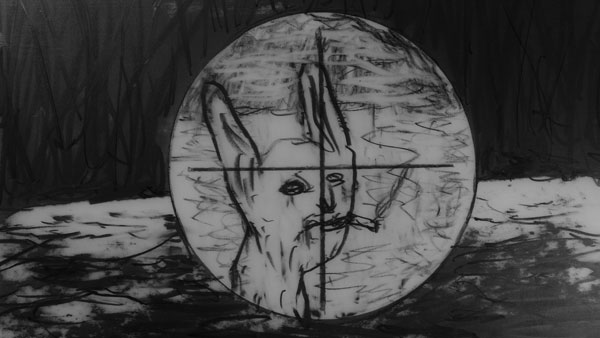
PER DYBVIG Hunter Hare Dog 2009/2010 Storyteller: Craig Whitson / Text: Per Dybvig / Technic: Andreas Joner / Duration: 6:51 min Per Dybvig`s (b. 1964) drawings are usually produced spontaneously, with a sense of urgency and almost feverishness that results in a comedic cosmos of bizarre figures and creatures. The majority of the works emerge out of specific situations and in rapid sequence. In 2009/2010, Per Dybvig transposed his drawings into his first film: Hunter Hare Dog. In this film Dybvig takes a step into a universe that revolves against a classic storytelling tradition. The title of the animation, Hunter Hare Dog, refers to Georg Pencz graphic print "The Hunter Caught by the Hares" (1534-35), but we also find clear references to the Norwegian folk tales. Folktales are free ranging and imaginative stories which have passed from storyteller to storyteller from time immemorial. They depict the relationship between people, expressed in fantastic and symbolic terms. The structure of these adventures follows a fixed pattern and the different sequences of the plot have their predetermined positions. The animation Hunter Hare Dog does however not follow the specific set of epic rules that characterize the folk tales. The story is told in fragments, new stories are emerging from the actual story, dialogue is suggested by charts and text bubbles, which we recognize from the world of comics. A narrator is reading a story that gives us clues about what is really going on, but does not necessarily always follow the course of the events. The animation is done in sequences where the drawings are made frame by frame. Dybvig does not correct or edit the frames, no «in between» drawings are added or digitally conducted. The line in movement is erased and new lines are applied to the already existent drawing.
Per Dybvig (b. 1964, Stavanger) lives and works in Stavanger, Norway. Per Dybvig is a renowned graphic artist whose publications and illustrations have won a number of awards. His work has been shown in numerous exhibitions and museums ? among them the Lillehammer Art Museum and the Stenersen Museum, both in Oslo, Norway ? and is represented in several public collections: the National Gallery in Oslo, the Rogaland Museum of Fine Arts in Stavanger and the Arts Council Norway. In 2008 Per Dybvig showed drawings at Priska Juschka Fine Art, New York. In 2010 the artist took part in the Drawing Biennale, Moss; in 2011 he will be presenting new work in a solo-show at Christine König Gallery in Vienna.
Per Dybvig
Hare! Introducing the Horse
Animation | | couleur et n&b | 7:2 | Norvège | 2013
In 2009/2010 Per Dybvig started to transfer his drawings ? non-linear narratives just like his serial works ? into film with Hunter Hare Dog and Around the House or in the Bar, at least ,2011. The animations makes reference to Georg Pencz`s print work, The Hunter Caught by the Hares (1534-35). Also introducing reference to Norwegian fairy tales, his most recent animation Hare! Introducing the Horse, 2013 - is the third animation in the series revolving around this universe. Hare! Introducing the Horse takes up the comical-abysmal story of the hunter and his dogs ? introducing the horse - , but makes it even more brutal and with an almost feverishness rhythm of events. The narrator is following the events chronologically, interrupted by sequences where the story leaps into free association. This contradictory to the earlier animations, where the story is told without apparent connection to the events .The animation is accompanied by small musical sequences and sounds. The stop-motion-animation is made without corrections and presents an admixture of free forms and finely traced contours, always permeated by the crucial element of language.
PER DYBVIG Born: 1964, Stavanger Lives and works in Stavanger, Norway SELECTED SOLO SHOWS 2014 2014 2013 Galerie Opdahl, upcoming «Zwei Männer», Stavanger Art Museum Residency/ Multimedia Art Museum, Moscow 2012 ONS, Stavanger 2012 Tou Camp, Stavanger 2011 «Hunter, Hare, Dog», Christine König Galerie, Vienna/Austria 2010 Around the House or in the Bar, at least, Galerie Opdahl, Berlin 2010 Hunter Hare Dog, Galleri Opdahl Stavanger 2009 Outside the Ale House,Tegnerforbundet, Oslo 2008 Drawings,Priska Juschka Fine Art, New York 2007 Drawings, Galerie Opdahl, Berlin 2006 One-shot Drawings,Galleri Opdahl, Stavanger 2004 When A Guest Turns Nasty, Tegnerforbundet, Oslo 2002 I`m so Happy with Monsieur Karzai, Galleri Sølvberget, Stavanger 2000 Untitled, Galleri Sølvberget, Stavanger 1999 Drawings, Galleri S.E, Bergen 1997 Untitled, Galleri Sølvberget, Stavanger 1995 Drawings, Sandnes Kunstforening, Sandnes SELECTED GROUP SHOWS 2014 2013 2013 2012 Artissima I Turin, Italy (Christine König Galerie) Vienna Art Fair (Christine König Galerie) Wien Museum: «Absolut Wien- Ankäufe und Schenkungen seit 2000», Vienna, Austria Artissima I Turin, Italy (Galerie Opdahl Berlin) 2011 Lines Fiction_Zeichnung und Animation, Fruehsorge Contemporary Drawings, Berlin Art I 42 I Basel I Animated world ARCO I Madrid, Spain Viennafair I Austria Artissima I Turin, Italy Market Art Fair I Stockholm Recontres Internationales Paris/Berlin/Madrid 2010 Rencontres Internationales Paris/Berlin/Madrid, 2010 Drawing Biennale, Lines on the Move, Moss/Norway 2009 Summer Show, Galleri Opdahl, Stavanger 2008 Nordic Drawings, Skellefteå Konsthall, Rackstadmuseet, Sweden 2008 Lines in Motion, Lillehammer Kunstmuseum 2008 Market Art Fair, Stockholm/ Galleri Opdahl 2007 Market Art Fair,Stockholm/Galleri Opdahl 2006 Tegnebiennalen, Stenersenmuseet, Oslo 2006 Art Copenhagen/Galleri Opdahl, Denmark 2005 Galleri Opdahl, Stavanger 2005 Art Forum Berlin/Galleri Opdahl 2004 Art Forum Berlin/Galleri Opdahl 2003 Class of 2003, Vestfossen Kunstlaboratorium 2002 Galleri Sølvberget, Stavanger 2001 Nasjonalgalleriet, Oslo SELECTED COLLECTIONS 2013 2012 2010 National Library, Oslo, Norway Wien Museum, Austria Statoil Collection, Norway 2009 Norwegian Council for Public Buildings 2008 Artseen Ldt/BritishVirgin Islands 2007 Stavanger County 2007 Skretting AS/Stavanger 2006 Norwegian Council for Public Buildings 2006 Rogaland Museum of Fine Arts, Stavanger, Norway 2006 StatoilHydro Collection, Norway 2003 Sic! Collection, Stavanger 2004 Norwegian Council for Cultural Affairs 2004 Stavanger Aftenblad, Norway 2002 BI, Stavanger, Norway 2002 National Library, Oslo, Norway 2001 National Library, Oslo, Norway 2000 StatoilHydro Collection, Norway 2000 National Gallery, Oslo, Norway 1999 Stavanger County, Norway 1996 Norwegian Council for Cultural Affairs GRANTS 2012/2014 2010 3 year working grant, Norwegian Council of Curtural Affairs 1 year working grant, Norwegian Artist Grant 2006/08 3 years working grant, Norwegian Artist Grant 2007 1 year Norwegian Artist Grant 2006 1 year Norwegian Artist Grant 2008 Aksel Waldemar Prize PUBLICATIONS 2013 The Moscow Drawing Book Christine Könnig Galerie / Galleri Opdahl 2011 2007 The Vienna Drawing Book Christine König Galerie/ Galleri Opdahl Per Dybvig, Artists Book / Galleri Opdahl EDUCATION 1982/83 Drawing/Bergeland, Stavanger 1983/85 Graphic Design, 2 years/Bergeland, Stavanger
Morten Dysgaard
The door of the law
Fiction expérimentale | 0 | couleur | 5:45 | Danemark | 2010
In his work ?The door of the law? (2009) we see an intense declaration of love for the American flag, The Stars and Stripes, taking place between two characters. They kiss and neatly caress the American flag in an intimate manner that tends toward the bizarre. The scene has undertones of object fetishism, thus interestingly commenting on the way we often cling to identity markers as expressed in certain cultural symbols, objects and attributes.
Since Morten Dysgaard (* 1976) graduated from The Royal Danish Academy of Fine Arts, the cinematographic narrative technique has been his preferred mode of expression, used to investigate how images and signs are instrumental in creating our cultural feelings of identity. Dysgaard has exhibited his work all over the world and is currently working on his first feature.
Eai
Digital Video Effect: New Video from the EAI Colle
0 | 0 | | 62:0 | USA | 2007
This program of videos new to the EAI collection includes work by artists with very different histories and creative strategies. Seoungho Cho's "Snap" (2006) continues his exploration of minimalist and dynamically visual video art. Michael Snow's "WVLNT" (2003) is a highly conceptual video reworking of his influential experimental film "Wavelength" (1967). Seth Price's "Digital Video Effect: "Editions" (2006) is a witty and engaging edit of excerpts from his editioned video works. Finally, Sophie Calle and Fabio Balducci's "Unfinished" (2005) is a revealing and humorous investigation of the artistic process.
Electronic Arts Intermix (EAI) est l?un des plus important centre mondiaux de ressources et de recherches sur l?art vidéo et les nouveaux médias. Fondé en 1971 par le galeriste new-yorkais Howard Wise, dont la galerie éponyme de la 57ème rue fut à une époque l?épicentre de l?art cinétique et des travaux multimédias, l?EAI avait pour objectif d?affirmer le rôle de la vidéo comme moyen de communication et d?expression artistique. En 36 ans d?existence, l?EAI a soutenu inconditionnellement les artistes et leur travaux, jouant un rôle fondamental dans le développement de l?art vidéo, disséminant dans la monde plus de 3000 ?uvres réalisées par près de 175 artistes. Aujourd?hui, l?EAI se concentre sur la distribution et la préservation de sa phénoménale collection d??uvres. Une collection qui regroupe aussi bien des travaux historiques des pionniers de la vidéo que des ?uvres contemporaines d?artistes émergeants. Une collection, véritable mémoire des arts vidéos et nouveaux, disponible, et consultable en partie, sur le catalogue en-ligne de l?EAI (http://eai.org/). Mais, si l?EAI soutient les artistes, en mettant à leur disposition des outils digitaux et analogiques de montage, si l?EAI distribue et préserve son catalogue, l?EAI est avant tout un acteur culturel engagé, dans la promotion des arts nouveaux et dans leur vulgarisation. Elle met à disposition du public une salle de visionnage, où l?intégralité du catalogue est consultable. Elle organise des expositions et des programmes publics.
Veronika Eberhart
Garten sprengen
Doc. expérimental | 16mm | couleur | 12:0 | Autriche | 2022
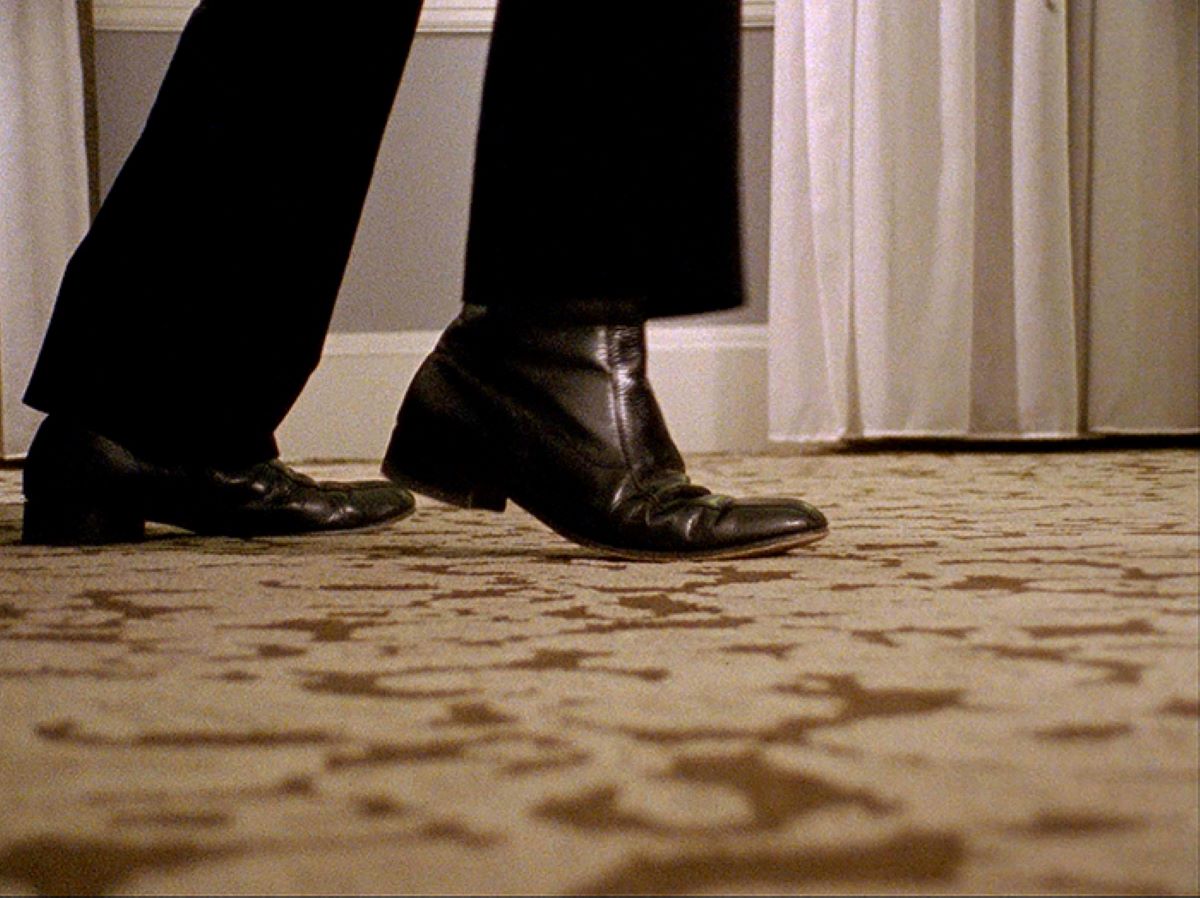
“Are you familiar with American poetry?” The question sounds like an accusation as posed by Hanns Eisler in a heavy German accent during his interrogation in 1947 by the House Committee on Un-American Activities. Simultaneously Veronika Eberhart's GARTEN SPRENGEN shows a man (performer: Ian F Svenonius) wandering down a virtually endless hotel corridor. Yet it is the elaborate blue, yellow and cream colored pattern of the hotel's carpet floor that sticks out. Its haptic quality becomes directly translated into imagery during a different montage sequence: a hand sensitively glides along a window ledge, another likewise touches the neck of a guitar, and a third caresses the armrest of a sofa. These images attempt to grasp the ghosts of an historical place, specifically the Biltmore Hotel in downtown Los Angeles. This previous site of the Academy Awards was also where Eisler's hearing at the beginning of the McCarthy era took place... more info: https://www.sixpackfilm.com/en/catalogue/2787/
Visual artist, filmmaker and musician, born 1982 in Bad Radkersburg. Studied sociology in Vienna and Copenhagen, visual arts at the Academy of Fine Arts Vienna and at the Friedl Kubelka School for independent film, Vienna. Various exhibitions and film festivals, most recently at Mackey Garage Top, MAK Center, Los Angeles (2020), Kunsthalle Vienna (2019), Kharkiv Municipal Gallery (2019), New Jörg, Vienna (2019), Kunsthalle Exnergasse, Vienna (2018), rotor Graz (2018), Bazament Art Space, Tirana (2018), A-GALLERY, Tokyo (2017)
Juan Manuel Echavarria
Bocas de Ceniza
Doc. expérimental | dv | couleur | 22:0 | Colombie | 2004
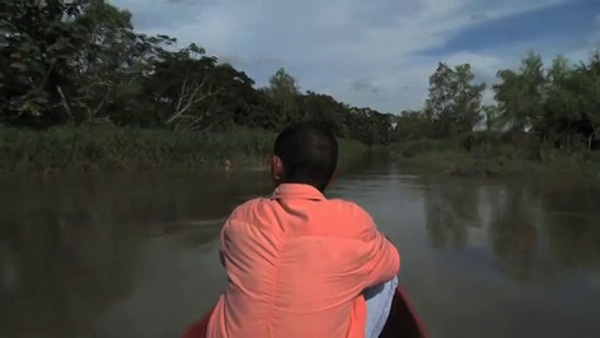
Sept colombiens, victimes de la violence de leur pays, chantent des chansons, qu'ils ont composés eux-mêmes, en réponse à leurs expériences.
Juan Manuel Echavarría est né en Colombie en 1947. Il vit et travaille entre New York et Bogota. Après la publication de ses romans et de ses nouvelles, il arrête son activité d'écriture. La société colombienne étant dominée par la violence et le pouvoir toujours grandissant des cartels de la drogue, il est frustré par la désintégration de la vie colombienne et par l'isolation sociale nécessaire pour l'écriture. Il débute son travail photographique, en allant vers l'exploitation des possibilités métaphoriques de l'image photographique. L?art d?Echavarría vise à susciter une prise de conscience, à transcender la violence généralisée de la société colombienne. La question de la représentation de cette violence est le pivot autour duquel se construit son travail. Il confère une dignité aux victimes du conflit extrêmement violent de la guerre civile. Les conflits entre l'armée, la guérilla de gauche et les paramilitaires de droite peuvent être retracés depuis les années 50, et les cartels de la drogue depuis les années 80. Chaque cycle brutal successif transmet au pays une psychose nationale de violence, un état d'esprit dans lequel le carnage et la peur omniprésente sont des états naturels d'existence. Les belles images dérangeantes de Juan Manuel Echavarria évoquent l'effroi et les pertes humaines dans cette guerre sans fin, mais sans présenter de corps ensanglantés. Ces photographies récurrentes montrent des hommes et des femmes, des villages abandonnés, leurs objets mélancoliques. Des réinterprétations grotesques mais non horribles de dessins botaniques, une théâtralisation des rituels entourant la mort, qui sont particuliers à l'héritage colombien. (Calvin Reid) Son travail a été présenté à l'Irish Museum of Modern Art, Dublin, Irlande, au Centre Regional d?art Contemporain Languedoc-Roussillon, Sète, France, au Musée d'art Moderne de New York, à la 51ème Biennale de Venise, au Musée d'art moderne de Buenos Aires, à EMAF Ossnabruck en Allemagne, au musée d'art moderne de Bogota, à la Biennale de Kwangju en Corée, au musée Reina Sofia à Madrid, au festival du film d'Oberhausen.
Juan Manuel Echavarria
Bandeja de Bolivar
Vidéo expérimentale | dv | couleur | 3:58 | Colombie | 2004
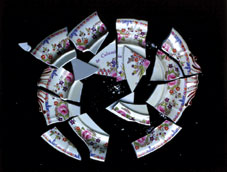
"Pour commémorer l'indépendance de la Colombie de la Couronne espagnole, Simon Bolivar commanda un service de porcelaine portant l'inscription 'Republica de Colombia para siempre' (République de Colombie pour toujours). Bandeja de Bolivar est une série de photographies, et une vidéo, qui documentent la destruction d'une réplique de ce plat qui, dans l'image finale, révèle un tas de poudre blanche, facilement identifiable comme étant de la cocaïne. Ces 30 dernières années, la Colombie a souffert de violence alimentée par le trafic de cocaïne. Cette violence, qui semble n'avoir pas de fin, ravage aussi bien les villes que les campagnes, où la guérilla surveille les trafics et la production. Les profits de ce commerce illégal sont gigantesques, la guérilla est devenue extrêmement puissante, forçant le gouvernement colombien à lui garantir une extension de territoire pour entamer des discussions pour la paix. Dans ces territoires, le gouvernement est absent. Dans cette vidéo, je cherche à montrer ce qu'il est arrivé à l'idéal de Bolivar.
Juan Manuel Echavarría est né en Colombie en 1947. Il vit et travaille entre New York et Bogota. Après la publication de ses romans et de ses nouvelles, il arrête son activité d'écriture. La société colombienne étant dominée par la violence et le pouvoir toujours grandissant des cartels de la drogue, il est frustré par la désintégration de la vie colombienne et par l'isolation sociale nécessaire pour l'écriture. Il débute son travail photographique, en allant vers l'exploitation des possibilités métaphoriques de l'image photographique. L?art d?Echavarría vise à susciter une prise de conscience, à transcender la violence généralisée de la société colombienne. La question de la représentation de cette violence est le pivot autour duquel se construit son travail. Il confère une dignité aux victimes du conflit extrêmement violent de la guerre civile. Les conflits entre l'armée, la guérilla de gauche et les paramilitaires de droite peuvent être retracés depuis les années 50, et les cartels de la drogue depuis les années 80. Chaque cycle brutal successif transmet au pays une psychose nationale de violence, un état d'esprit dans lequel le carnage et la peur omniprésente sont des états naturels d'existence. Les belles images dérangeantes de Juan Manuel Echavarria évoquent l'effroi et les pertes humaines dans cette guerre sans fin, mais sans présenter de corps ensanglantés. Ces photographies récurrentes montrent des hommes et des femmes, des villages abandonnés, leurs objets mélancoliques. Des réinterprétations grotesques mais non horribles de dessins botaniques, une théâtralisation des rituels entourant la mort, qui sont particuliers à l'héritage colombien. (Calvin Reid) Son travail a été présenté à l'Irish Museum of Modern Art, Dublin, Irlande, au Centre Regional d?art Contemporain Languedoc-Roussillon, Sète, France, au Musée d'art Moderne de New York, à la 51ème Biennale de Venise, au Musée d'art moderne de Buenos Aires, à EMAF Ossnabruck en Allemagne, au musée d'art moderne de Bogota, à la Biennale de Kwangju en Corée, au musée Reina Sofia à Madrid, au festival du film d'Oberhausen.
Juan Manuel Echavarria
Guerry y pa
Vidéo expérimentale | dv | couleur | 8:52 | Colombie | 2004
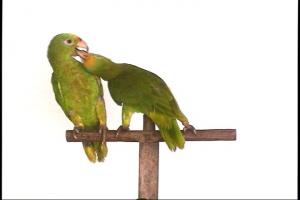
Guerra y Pa met en scène deux perroquets pendant neuf minutes. Ils ont chacun appris à répéter le mot «Guerra» pour l?un et «Pa» pour l?autre. Installés sur un perchoir, ils se battent et se disputent, dans une parodie des politiciens et des guérilleros quand ils parlent publiquement de la question de la paix et de la guerre en Colombie.
Juan Manuel Echavarría est né en Colombie en 1947. Il vit et travaille entre New York et Bogota. Après la publication de ses romans et de ses nouvelles, il arrête son activité d'écriture. La société colombienne étant dominée par la violence et le pouvoir toujours grandissant des cartels de la drogue, il est frustré par la désintégration de la vie colombienne et par l'isolation sociale nécessaire pour l'écriture. Il débute son travail photographique, en allant vers l'exploitation des possibilités métaphoriques de l'image photographique. L?art d?Echavarría vise à susciter une prise de conscience, à transcender la violence généralisée de la société colombienne. La question de la représentation de cette violence est le pivot autour duquel se construit son travail. Il confère une dignité aux victimes du conflit extrêmement violent de la guerre civile. Les conflits entre l'armée, la guérilla de gauche et les paramilitaires de droite peuvent être retracés depuis les années 50, et les cartels de la drogue depuis les années 80. Chaque cycle brutal successif transmet au pays une psychose nationale de violence, un état d'esprit dans lequel le carnage et la peur omniprésente sont des états naturels d'existence. Les belles images dérangeantes de Juan Manuel Echavarria évoquent l'effroi et les pertes humaines dans cette guerre sans fin, mais sans présenter de corps ensanglantés. Ces photographies récurrentes montrent des hommes et des femmes, des villages abandonnés, leurs objets mélancoliques. Des réinterprétations grotesques mais non horribles de dessins botaniques, une théâtralisation des rituels entourant la mort, qui sont particuliers à l'héritage colombien. (Calvin Reid) Son travail a été présenté à l'Irish Museum of Modern Art, Dublin, Irlande, au Centre Regional d?art Contemporain Languedoc-Roussillon, Sète, France, au Musée d'art Moderne de New York, à la 51ème Biennale de Venise, au Musée d'art moderne de Buenos Aires, à EMAF Ossnabruck en Allemagne, au musée d'art moderne de Bogota, à la Biennale de Kwangju en Corée, au musée Reina Sofia à Madrid, au festival du film d'Oberhausen.
Juan Manuel Echavarria Olano
Requiem NN
Documentaire | hdcam | couleur | 67:22 | Colombie | 2013
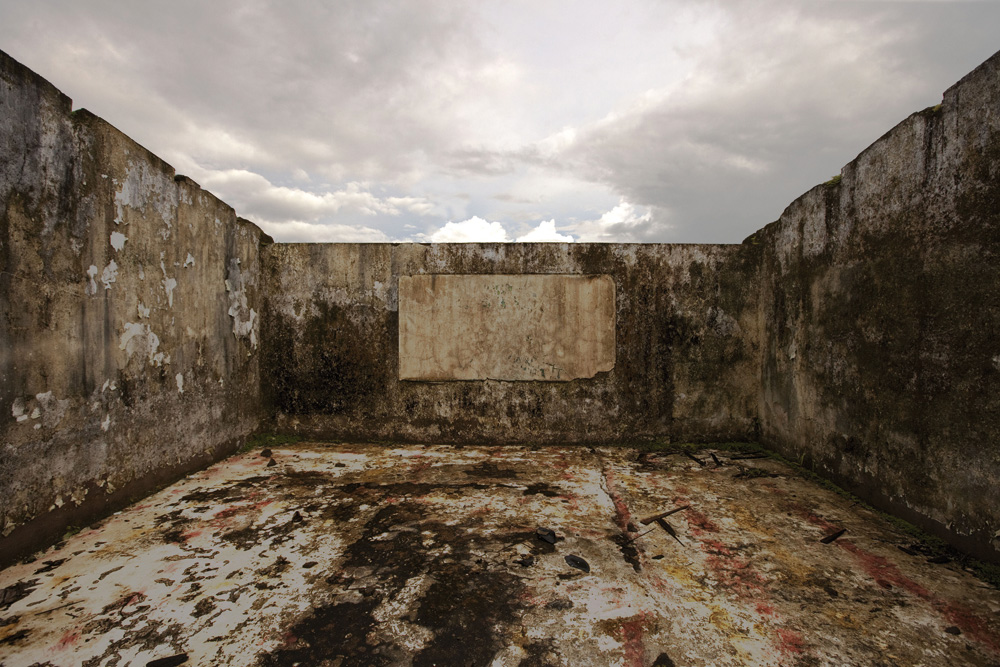
RÉQUIEM NN is a film about a ritual of resistance of the people of Puerto Berrío, Colombia ? people who have lived continuous cycles of violence for many decades. The recovery of bodies from the Magdalena River,their burial, the favors local townspeople ask of the souls of the NN (No Names), and the baptism of these unknown corpses is a collective ritual that has taken place for over 30 years.
JUAN MANUEL ECHAVARRÍA was born in Medellín in 1947. He wrote two books, "La Gran Catarata" (1981) and "Moros en la Costa" (1991), before turning to photography in 1996 when he began to investigate the violence in Colombia through art. His photographs have been exhibited in different museums in Colombia and in towns like Mampuján (Bolívar) and Puerto Berrío (Antioquia). Internationally he has shown his work in many different places such as the Biennale of Sydney, Australia (2012); the Venice Biennale, Italy (2005); the Mois de la Photo, Montreal, Canada (2011); Kumu Art Museum in Tallinn, Estonia (2011); Museum of North Dakota, Grand Forks, USA (2005); among others. "La Bandeja de Bolívar: 1999? was his first video; then "Guerra y Pa" (2001) and "Bocas de Ceniza" in 2003. His videos have been featured in the Robert Flaherty Film Seminar, USA (2009), the Musée du Jeu de Pomme, Paris (2006); MOMA, New York, USA (2005) and many more. From 2006 to 2012 he worked on "Novenarios en espera", showing the transformation through time of the NN tombs of Puerto Berrío. "Réquiem NN" (2013) is his first film.
Juan Manuel Echavarría
Silencio Invisible, Darwin and Una Lección
Vidéo | hdv | couleur | 8:0 | Colombie | 2015
Juan Manuel Echavarría parle de la guerre qui échappe au regard, dans les territoires reculés de Colombie. Les lieux, vides de toute présence humaine, évoquent l’histoire violente du pays et l’impératif de nouveaux possibles. Jussie Nsana Banimba interroge la mémoire des murs de Brazzaville, qui deviennent des espaces témoins, entre le passé et le présent. Dominik Ritszel place le son comme protagoniste principal de son film, dans une ville devenue laboratoire de perception où la civilisation est en suspens. Hans Op de Beeck crée un film d’animation à partir de ses aquarelles, introduisant un degré de fiction supplémentaire dans ce qui n’est jamais la reproduction d’une réalité. Mike Hoolboom reprend les images filmées en 1967 par Jeffrey Paull, dans un hôpital psychiatrique. Cinquante ans plus tard, il interroge Donna Washington, autiste et pensionnaire de cet hôpital à l’époque, qui raconte sa propre histoire à partir des images du film.
Juan Manuel Echavarría was born in Medellín, Colombia in 1947. He resides in Bogotá. A writer before becoming an artist, he published two novels, La gran catarata (Bogotá: Editorial Arco, 1981) and Moros en la costa (Bogotá: Ancora Editores, 1991). As of 2015 Echavarría has presented over thirty solo exhibitions and participated in well over a hundred group exhibitions, screenings and film festivals. His first solo gallery exhibition was in New York in 1998. Since then, his work has been shown at the Venice Biennale, the Korean Kwangju Biennial, Daros Latin America, Zurich, the Kiasma Museum of Contemporary Art in Helsinki, Finland at the Irish Museum of Modern Art in Dublin. As well as, El Museo del Barrio, New York, at the Musée du Quai Branly and the Cartier Foundation in Paris, France and at Sammlung Goetz at Haus der Kunst in Munich, Germany. His first solo museum exhibition in the U.S, Mouths of Ash, was organized by the North Dakota Museum of Art in 2005 and traveled to the Weatherspoon Museum of Art in 2006 and the Santa Fe Art Institute in 2007 – 2008. He’s had two very important shows in Colombia at the Ciudadela Educativa y Cultural América in Puerto Berrío as well as the Museo La Tertulia in Cali. In 2011 his works were shown in Tallinn, Stonia for the 15th Tallinn Print Triennial, in Tel Aviv, Israel at the Center for Contemporary Art, at the Museo de Antioquia in Medellín, Colombia and at the Museum of Latin American Art in Long Beach, California. In the next part of the year, his work was shown at the Bienal Do Mercosul in Porto Alegre, Brazil, Le Mois de la Photo à Montreal in Canada and at the Centre for Contemporary Culture Strozzina in Florence, Itlay. In 2012, he was invited to the Sidney Biennale All Our Relations to show Silencios and Requiem NN. In 2015 he will show his work at the Musée d’Aquitaine in Bordeaux and at the Université Catholique de Lovain in Belgium. His videos have been screened at many festivals and exhibitions throughout the world such as Colombia, the United States, Canada, Israel, England, France, Spain, Hungary, South Korea, Colombia, Argentina, Brazil, Mexico, Australia, Germany and Afghanistan. In 2013 he showed Réquiem NN, his first feature length film, a world premiere at the Festival Internacional de Cine de Cartagena followed by the North American premiere at the Museum of Modern Art (MoMA) in New York City.

Ricardo Echevarría
AVAM
0 | 0 | | 0:0 | Espagne | 2007
L'AVAM, Artistes Visuels Associés de Madrid, est une association professionnelle qui représente les artistes qui résident dans la Communauté de Madrid et qui agit comme représentant et interlocuteur des artistes visuels devant les administrations locales et autonomes. Elle s'occupe de défendre des artistes et leurs oeuvres et travaille à l'obtention d'un meilleur soutien de la création, de la formation et de la diffusion des arts visuels. L'AVAM fait partie du Conseil de la Culture de la Communauté de Madrid et est membre de l'UAAV, Union d'Associations d'Artistes Visuels, la fédération qui regroupe les associations professionnelles des diverses communautés autonomes, et qui actuellement compte environs 3.500 partenaires. L'AVAM fait également partie (à travers l'UAAV) de l'EVAN, European Visual Artists Network. Le fonctionnement de l'AVAM est démocratique et se structure autour de deux organismes, l'Assemblée Générale de partenaires et l'Assemblée Directive, constituée actuellement de 19 membres, et déléguée par l'Assemblée dans les tâches de direction, administration et représentation de l'association
Ricardo Echavarría a étudié les beaux arts, la musique et architecture à la Faculté d'Art de Cuenca, au Conservatoire Professionnel de Musique de Cuenca et à l'Université Menéndez Pelayo. Son oeuvre a été largement exposée, lors d'expositions individuelles et collectives, dans divers lieux d'Espagne et d'Europe. Parmi les expositions individuelles on peut noter : Abraham. Espace Contemporain Archives de Tolède (ECAT) (Tolède, mars 2005) ; Galerie Grand Forvm-Chantall (Tarragone, décembre 2004) ; Galerie Bs-Blanca Bosquet (Madrid, novembre 2004). Parmis les expositions collectives, on peut mentionner : Art Navas 2006 - août - Navas de le Marquez (Avila) ; Transvasements, Artistes espagnols en Vidéo, (le Pérou, l'Argentine et le Mexique août- novembre 2000) ; Germinations X - (Athènes, Grèce octobre 1998, Flandres, Belgique. Mai, 1999) ; Los Angeles Center for Photograpic Studies (Los Angeles USA, 1994). L'oeuvre d'Echevarría a été récompensée par divers prix et bourses.
Clemencia Echeverri
Supervivencias
Vidéo | hdv | couleur | 11:21 | Colombie | 2013
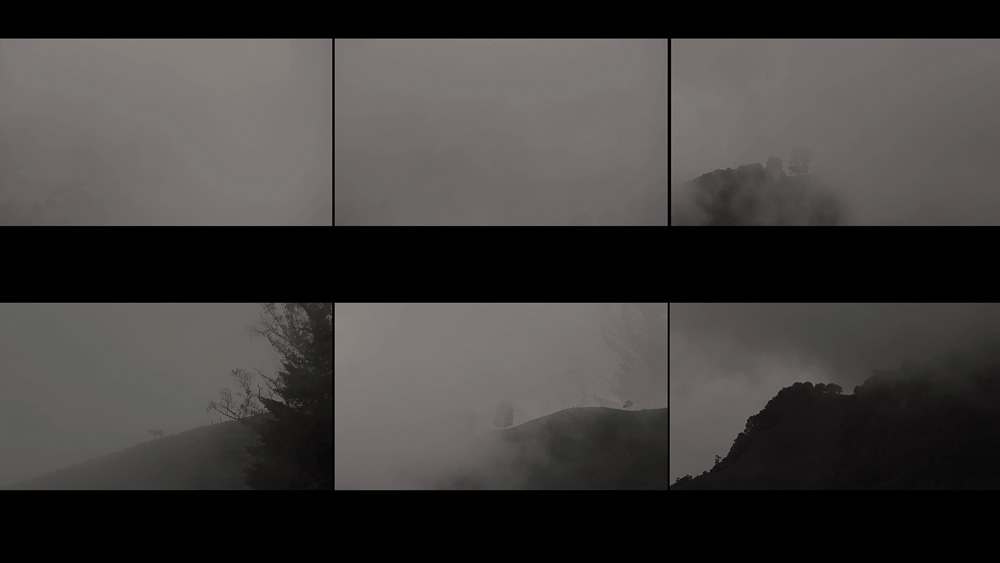
Supervivencias (Survivals) is a multichannel video installation that merges from an investigation I made of political distances in our Colombian territory. I took multiple journeys through the country, in order to hear the pulsating beats of a territory that has experienced the conflict, controversies and discords for many years; in order to sense how a land gets scorched while being traced by boundaries as well as crossroads, and how that stories, histories get calcined. This piece– executed on the basis of their own rhythm, forces and times – betoken vital ferments, trepidations and a foreboding darkness. Sol Astrid Giraldo a Colombian art critic wrote about Supervivencias " The land cannot be tranquil in the wake of sacrifices: It is a restless land, plowed by presences as much as it is by absences, limited not only by physical boundaries of blood and fire but by invisible ones as well, of added terrors and secrets. Such is the land of war, which won´t fit in with pacifier narratives. How can it be named then? How can it be made visible?".In Supervivencias a house emerges with its atavistic symbolism in full display: doors opening and closing, corridors leading who knows where inscrutable nooks and corners. Then, finally, an invasion of ghostly, overflowing presences, The ancestral house, the sheltering one, the dwelling and the refuge is now ridden with porosities that cannot curb the exterior pressure.” www.clemenciaecheverri.com
BIO Clemencia Echeverri lives and works in Bogotá. She got her BA in Fine Arts in Colombia and Masters degree in Fine Arts at Chelsea College of Arts, London. She has worked as an arts professor in Colombia. Having dedicated herself to sculpture and painting until the mid-nineties, Clemencia started to work on installation, video, sound and interactive works inspired by the political and social problems that have marked her time. At the moment she is preparing Nóctulo, for Nce–Arte in Bogotá (2015). Relevant and recent works: Treno/ Waterweavers curated by José Roca, at Bard Graduate Center New York.(2014) Sacrificio at the I International Bienal de Arte in Cartagena, and at 43 Salon (inter Nacional de Artistas)Curated by Gabriela Rangel, Medellin (2013-2014). Supervivencias at Alonso Garcés Gallery and Versión Libre (nominatedin the VI Luis Caballero award (2011) The Liverpool Biennial (2010)No longer empty sound project. CENART Mexico (2011) Cosmovideografías Latinoamericanas. A solo site specific show at Museo Nacional de Colombia. Biennal de la Habana (2000), Bienal de Bogotá 1998. Treno at Daros-Latinamerica Museum, Zurich (2009); Don’t Stare at the sun in Poland; Galeria GAK Bremen. Electronic arts festivals such as ISEA in Helsinki-Stockholm and Tallin; Artes Electrónicas Banquete in Madrid; Ars Electronica in Austria; international fellowships such as those given by Yadoo, arts residency in New York, The Arts Council, London; Canada’s Daniel Langlois Foundation; and the Bienal de las Artes award in Colombia. Collections; Daros–Latinamerica National Bank in Colombia, Los Angeles (MOLAA); the Museo MEIAC, Spain; the Essex Latin American Collection,England, as well as by a number of private collectors. www.clemenciaecheverri.com
Leon Eckard, Nathalie Brum
Toter Winkel
VR expérimental | 0 | | 0:0 | Allemagne | 2020
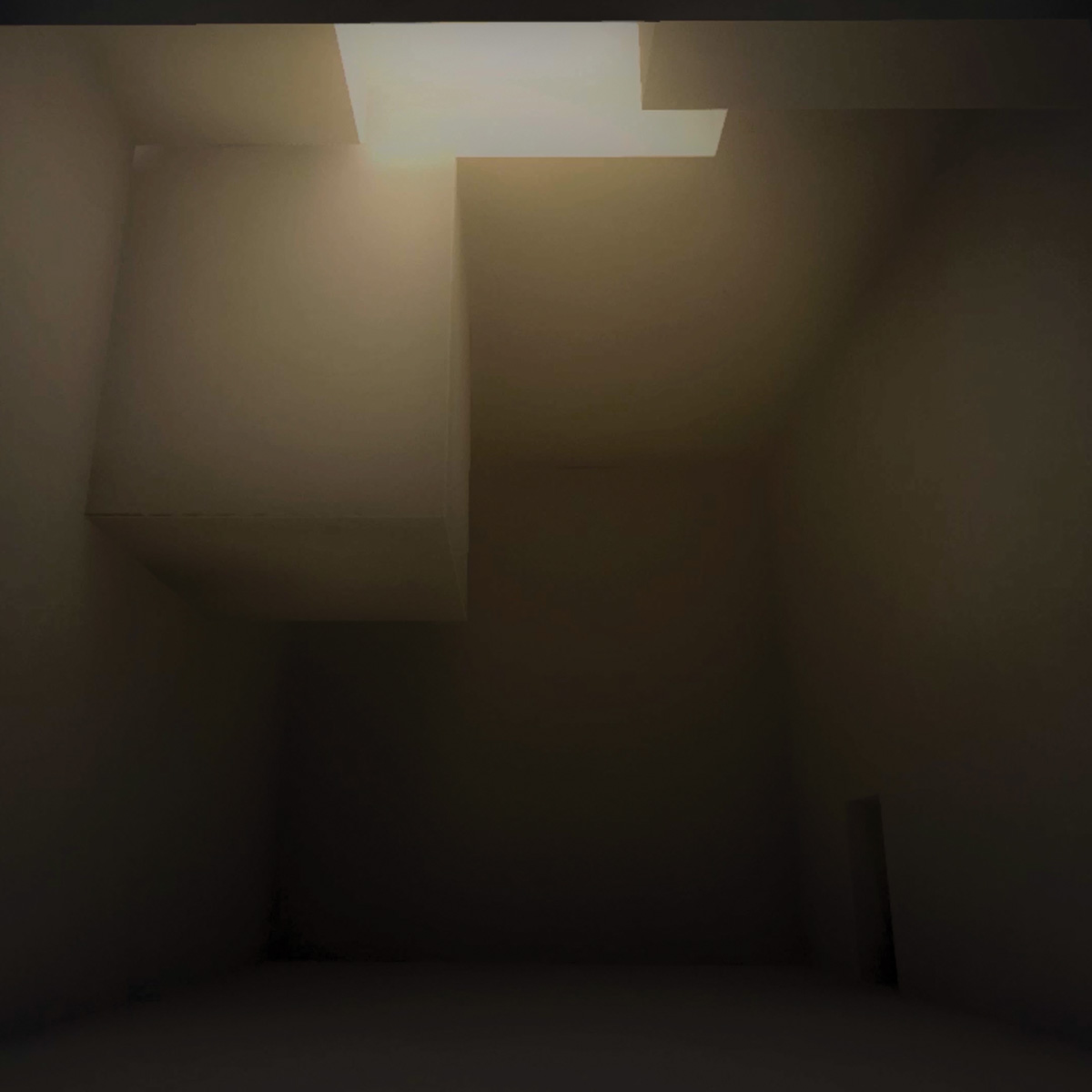
The Virtual Reality soundwalk Toter Winkel by media artist Leon Eckard (idea and implementation) and architect and sound artist Nathalie Brum (architecture) plays with spatial and acoustic paradoxes that reveal our – often deceptive – perception. The space and sound of the soundwalk are inspired by Dutch graphic artist M. C. Escher, English mathematician and theoretical physicist Roger Penrose and American cognitive scientist Roger Shepard. Its an ever ongoing cycle, which gives the illusion of a continuous tunnel, whereby the reflection about it reveals its paradox nature. The audiences for this VR work can move interactively through the virtual space and see whether they discover the blind spot. Deceptive perceptions can be found everywhere in human perception, and so Leon Eckard argues in his project that we should constantly question our own blind spot.
Leon Eckard (*1995 in Neuss) ist ein deutscher Medienkünstler, Komponist und Musiker. Bereits mit sechs Jahren fing er an Gitarre zu spielen, was er schließlich im Hauptfach Jazz-Gitarre seines Studiums „Musik und Medien“ am Institut für Musik und Medien der Robert-Schumann Hochschule Düsseldorf vertiefte. Während seines Studiums von 2015 – 2021 fokussierte er sich zunehmend auf die Bereiche Visual Music, geleitet von Prof. Dr. Heike Sperling und Musikinformatik, geleitet von Prof. Julian Rohrhuber. Von 2019 bis 2020 verbrachte er ein Auslandssemester an der „Universidad de Barcelona“, wo er in den Bereichen Design und Medienkunst studierte und unter Anderem die Arbeit „Mise En Abyme“ entwickelte, die bereits in mehreren Ausstellungen zu sehen war. So zum Beispiel im Rahmen der Ausstellung „Mind over Matter“ in „technische Sammlungen Dresden“ im Frühjahr 2021. 2019 war er außerdem Teil des Residenzprogramms “Labor der Künste” in Montepulciano, Italien, wo er die Künstler*innen Francesco Marzano und Yoana Tuzharova kennenlernte. Mit diesen entwickelte er unter anderem das Projekt „Metamorphosen – Topology of the Captial“, was im Sommer und Herbst 2021 in verschiedenen Orten zu sehen war, wie dem Kunstmuseum Temporär in Mülheim an der Ruhr. Sein künstlerisches Feld hat Leon Eckard zwischen installativer und generativer Kunst sowie Musik und Klang aufgespannt. In seinen neusten Arbeiten beschäftigt er sich mit seiner unmittelbaren Umgebung, deren Klang und ihrer Beziehung zum Menschen. Dabei spielt die Frage nach subjektiver und objektiver Realität stets eine Rolle.
Teboho Joscha Edkins
Gangster Project
Fiction expérimentale | 0 | couleur | 56:0 | Afrique du sud | 2011
In Cape Town, South Africa, one of the world`s most violent and unequal societies, a young white film student sets out with his cameraman, leaving the comfort of his protected neighbourhood. He wants to make a Gangster Film, with real gangsters. After a lengthy search for a suitably `cinematic` character, he finds the perfect gang and settles into their everyday rhythm. The reality soon catches up and the claustrophobic gangster life doesn?t exactly fit to the expectations. 20 year after the first democratic election, South Africa remains a deeply divided society, one in which dialogue and understanding seem impossible, out of reach. It is a film between fiction and reality, where real truths are revealed and fiction stops being fiction, and when it stops mattering.
Teboho Edkins was born in the USA in 1980 and grew up mainly in Lesotho, but also Germany, South Africa, France and now lives in Berlin. He studied Fine Art at the University of Cape Town, followed by a 2-year post-graduate residency at le Fresnoy, studio national des arts contemporains in France and then a post-graduate film directing programme at the dffb film academy in Berlin. His films have been screened in over 100 festivals and galleries worldwide.
Teboho Joscha Edkins
Gangster Backstage
Documentaire | hdv | couleur | 37:30 | Afrique du sud | 2013
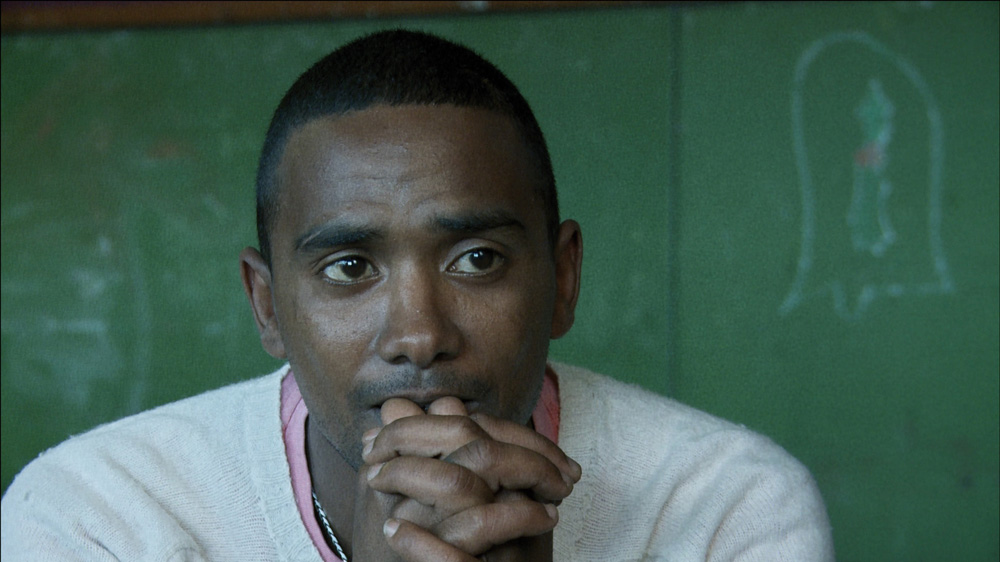
Gangster Backstage is a documentary film with gangsters in Cape Town, South Africa. As the film moves between a casting interview and scenes in an empty theatre, the sense of confinement within the space increases and becomes a feeling of being trapped, a square, boundaries, a sort of purgatory, the tempo of cigarettes, not knowing where the soul goes, fear, caught in one's thoughts, wanting to break free but can't… a cell.
Teboho Edkins was born in the USA in 1980 and grew up mainly in Lesotho, South Africa but also in Germany. He studied Fine Art at the University of Cape Town, followed by a 2-year post-graduate residency at le Fresnoy, studio national des arts contemporains in France and then a post-graduate film directing programme at the dffb film academy in Berlin.
Teboho Joscha Edkins
Initiation
Documentaire | 4k | couleur | 10:47 | Afrique du sud | 2016
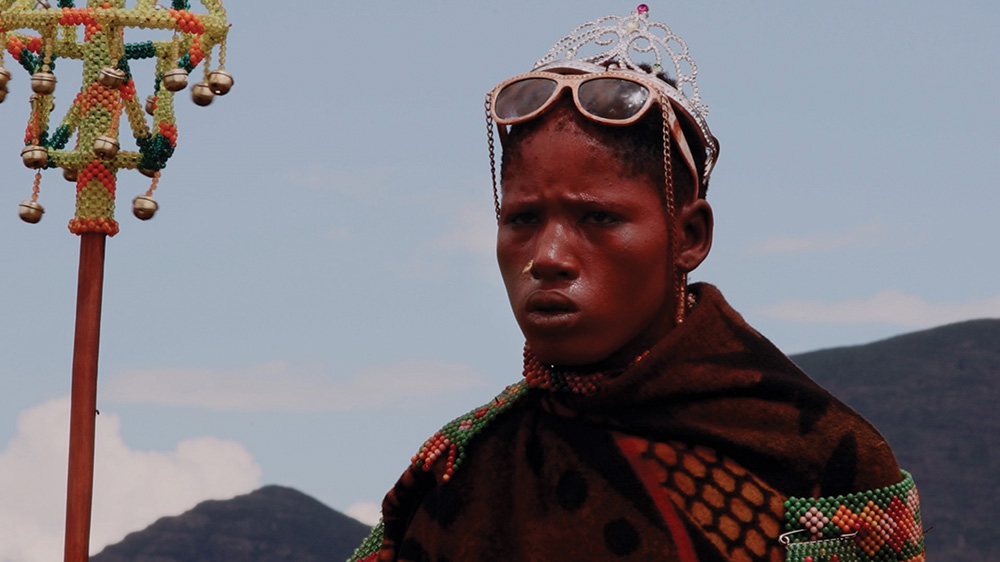
High in the mountains of Lesotho, Mosaku is anxiously awaiting the return of his older brother from an initiation ceremony. The initiates spend 5 months in a remote secrete location. When the boys return, they are grown men.
Teboho Edkins was born in the USA in 1980 and grew up in Lesotho, South Africa and also in Germany. He studied Fine Art at the University of Cape Town, followed by a 2-year post-graduate residency at le Fresnoy, studio national des arts contemporains in France and then a post-graduate film directing program at the dffb film academy in Berlin. His films show at film festivals, television, museums, win awards and have been acquired by private art collections. He currently lives between Berlin and Cape Town.
Teboho Joscha Edkins
Kinshasa 2.0
Documentaire | 16mm | couleur | 11:7 | Afrique du sud | 2008
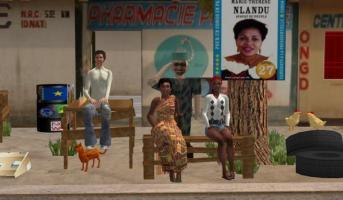
Une campagne Internet contribue à la libération d'un candidat à la présidentielle, emprisonné pour avoir parlé ouvertement de l'absence de démocratie. Oscillant entre une Kinshasa militarisée et Second Life (un chat virtuel tridimensionnel), le film examine le pouvoir subversif d'Internet pour la démocratie, tout en faisant un portrait inquiétant d'une capitale africaine.
Teboho Edkins est né aux Etats-Unis en 1980, et a grandi au Lesotho, en Allemagne et en Afrique du Sud. Il vit aujourd?hui à Berlin (Allemagne). Il a fait les Beaux-Arts de Cape Town et a été deux ans en résidence au Fresnoy, Studio National des Arts Contemporains, en France. Il suit actuellement le troisième cycle du programme de l?Académie du Film DFFB de Berlin. Il a reçu de nombreux prix et bourses.
Teboho Edkins
My Gangsta Project
Fiction expérimentale | dv | couleur | 9:0 | Afrique du sud | 2006
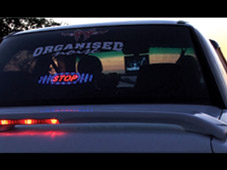
J?ai passé deux mois avec Jackals et ses amis dans un ghetto au cap, Afrique de sud. J?avais toujours eu l?envie de faire un film de gangster (comme un clip de MTV gangster rap mais réel). Plein d?attente, j'ai loué une grande bagnole, organisé un casting à Paris pour trouver une danseuse bien sexy. En effet, il me semble que ce qui fait un gangster c?est le contexte de la violence et de la pauvreté et mon film est devenu assez violent et bien que je filme une réalité ce n?est pas un documentaire.
Teboho Edkins est né aux Etats-Unis et a grandi au Lesotho, en Allemagne et en Afrique du Sud. Il est actuellement étudiant au Fresnoy, Studio National des Arts Contemporains, en France. Il a réalisé quatre films, "Ask me I am positive", "Looking Good", "True Love" et ce qu'il appelle son "First Gangster Project". Il travaille actuellement sur un autre film de gangsters au Cap et partira à Berlin en septembre.
Teboho Joscha Edkins
Ghost
Doc. expérimental | 4k | couleur | 8:41 | Afrique du sud | 2023
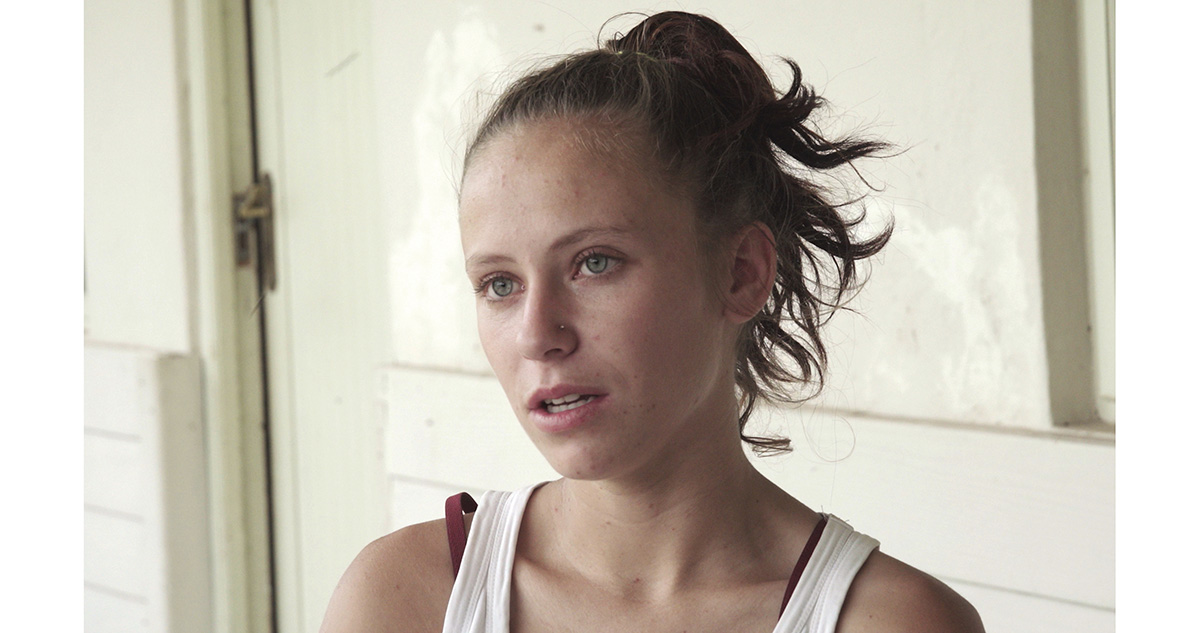
Ghosts is a short documentary film, in which ghosts, both real and imagined, haunt the lives of a rural community, in their small town in post-apartheid South Africa.
Teboho Edkins (*1980 in Tennessee, USA) grew up in Southern Africa and lives and works in Cape Town and Berlin. He studied photography and fine art at the Michaelis School of Fine Art, University of Cape Town, South Africa and film at Le Fresnoy Studio National des Arts Contemporains in Tourcoing, France. This was followed by a degree in directing at the Deutsche Film und Fernseh-akademie in Berlin (dffb). Teboho Edkins’s films have shown at many festivals, group and solo exhibitions, including at the Centre Pompidou, Paris; Tate Modern, London; South London Gallery; Haus der Kulturen der Welt, Berlin; Museum für Moderne Kunst, Frankfurt; Berlinische Galerie, Berlin; Weserburg-Museum für Moderne Kunst, Bremen; Museum of Modern Art, New York City. Some of the over 500 film festivals his films have screened at include the International Film Festival Berlin (Berlinale); International Short Film Festival, Oberhausen; and International Film Festival (IFFR), Rotterdam. His films have also been acquired by several public and private art collections including the Goetz Collection in Munich, von Kelternborn Collection in Frankfurt and the Collection KAI 10 | Arthena Foundation in Düsseldorf.